INTRO TO LARGE SCALE
SCRUM (LESS)
Srikanth Ramanujam
LeSS-TO Large Scale Scrum Toronto Meetup group
15th November 2017
WHY CHANGE?
A FUTURE IN WHICH… POSSIBLY…
• Everything is Technology centric
• AI and automation rule the world
• No need for Banks
• No need for Insurance
• What is money/wealth?
• No cars to own, self-driving cars
• What would we do with our time?
• Not enough jobs or highly skilled jobs to go around
MANIFESTO FOR AGILE SOFTWARE
DEVELOPMENT
Individuals
and
interactions
over processes
and tools
Working
software
over
comprehensive
documentation
Customer
collaboration
over contract
negotiation
Responding
to change
over following a
plan
4 Values
supported
by
12 principles
All required
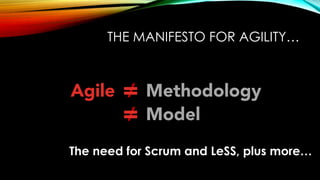
THE MANIFESTO FOR AGILITY…
Agile Methodology/=
Model/=
The need for Scrum and LeSS, plus more…
SCRUM
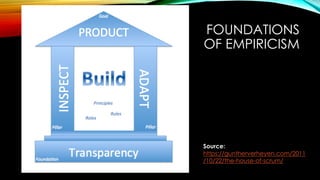
FOUNDATIONS
OF EMPIRICISM
Source:
https://guntherverheyen.com/2011
/10/22/the-house-of-scrum/
SCRUM:
5 VALUES
SCRUM:
3 ROLES
MULTI-SKILLING
SCRUM:
3 ARTIFACTS
• Product Backlog
• Sprint Backlog
• Increment (Actual releases to clients)
Supported by an:
• Continuously improving ”Definition of Done”
SCRUM:
5 CEREMONIES
And Product
Backlog refinement
Push 10-20%
and Pull 80-90%
SCRUM:
SPRINTS
SUPPORTED BY PRACTICES
Product
Management
• Client centric Products
• Product Market Fit
• Kano model
• Lean UX
• CX personas and journey's
• Lean Canvas
• Impact Mapping
• Story mapping, Release maps
• Prototyping/Design thinking
• Lean Startup
Software
Craftsmanship
• Pride of software
development
• Clean code
• Simplified architecture
• Collective code, architecture
ownership by teams
• TDD
• Continuous Integration
• Continuous Delivery
• Automation – BDD, ATDD, SBE
Release and Change
management
• Continuous Deployment
• Multiple weekly Feature
Releases
• Release on Demand
• Feature Toggles
• Build on Main Branch
• Blue-Green Releases
• Everything is version
managed
• Monitoring feedback loops
LARGE SCALE SCRUM
Culture follows structure, descaling the organization
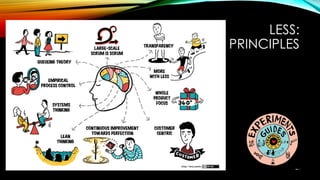
LESS:
PRINCIPLES
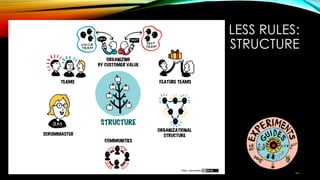
LESS RULES:
STRUCTURE
LESS RULES:
SAME 3 ROLES
• Structure the organization using real teams as the basic organizational building
block.
• Each team is (1) self-managing, (2) cross-functional, (3) co-located, and (4) long-
lived.
• The majority of the teams are customer-focused feature teams.
• Scrum Masters are responsible for a well-working LeSS adoption. Their focus is
towards the Teams, Product Owner, organization, and development practices. A
Scrum Master does not focus on just one team but on the overall organizational
system.
• A Scrum Master is a dedicated full-time role. One Scrum Master can serve 1-3 teams.
• In LeSS, managers are optional, but if managers do exist their role is likely to change.
Their focus shifts from managing the day-to-day product work to improving the
value-delivering capability of the product development system.
LESS RULES:
ROLES
LESS RULES:
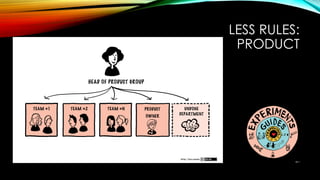
PRODUCT
• There is one Product Owner and one Product Backlog for the complete shippable
product.
• The Product Owner shouldn’t work alone on Product Backlog refinement; he is
supported by the multiple Teams working directly with customers/users and other
stakeholders.
• All prioritization goes through the Product Owner, but clarification is as much as
possible directly between the Teams and customer/users and other stakeholders.
• The definition of product should be as broad and end-user/customer centric as is
practical. Over time, the definition of product might expand. Broader definitions are
preferred.
• One Definition of Done for the whole product common for all teams.
• Each team can have their own stronger Definition of Done by expanding the
common one.
• The perfection goal is to improve the Definition of Done so that it results in a
shippable product each Sprint (or even more frequently).
LESS RULES:
PRODUCT
LESS RULES:
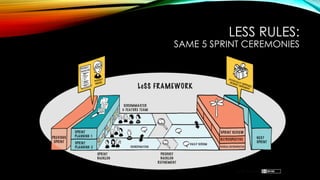
SAME 5 SPRINT CEREMONIES
LESS RULES:
SPRINTS
• There is one product-level Sprint, not a different Sprint for each Team. Each Team
starts and ends the Sprint at the same time. Each Sprint results in an integrated whole
product.
• Sprint Planning consists of two parts: Sprint Planning One is common for all teams
while Sprint Planning Two is usually done separately for each team. Do multi-team
Sprint Planning Two in a shared space for closely related items.
• Sprint Planning One is attended by the Product Owner and Teams or Team
representatives. They together tentatively select the items that each team will work
on that Sprint. The Teams identify opportunities to work together and final questions
are clarified.
• Each Team has their own Sprint Backlog.
• Sprint Planning Two is for Teams to decide how they will do the selected items. This
usually involves design and the creation of their Sprint Backlogs.
• Each Team has their own Daily Scrum.
LESS RULES:
SPRINTS
• Cross-team coordination is decided by the teams. Prefer decentralized and informal
coordination over centralized coordination. Emphasize Just Talk and informal
networks via communicate in code, cross-team meetings, component mentors,
travelers, scouts, and open spaces.
• Product Backlog Refinement (PBR) is done per team for the items they are likely
going to do in the future. Do multi-team and/or overall PBR to increase shared
understanding and exploiting coordination opportunities when having closely
related items or a need for broader input/learning.
• There is one product Sprint Review; it is common for all teams. Ensure that suitable
stakeholders join to contribute the information needed for effective inspection and
adaptation.
• Each Team has their own Sprint Retrospective.
• An Overall Retrospective is held after the Team Retrospectives to discuss cross-team
and system-wide issues, and create improvement experiments. This is attended by
Product Owner, Scrum Masters, Team representatives, and managers (if any).
SAME TECH
PRACTICES
With
integrated
Lean Product
Management,
Lean UX
practices
LESS SCRUM TEAMS:
COORDINATION & INTEGRATION
• Just Talk
• Communicate in Code
• Send Observers to the Daily
Scrum
• Component communities and
mentors
• Scrum of Scrums (maybe)
• Leading Team
• Multi-team LeSS meetings
• Multi-team Product Backlog
Refinement
• Multi-team Sprint Planning
Two
• Multi-team Design Workshops
• Exchange members in Daily
Scrum
• Travelers to exploit and break
bottlenecks and create skill
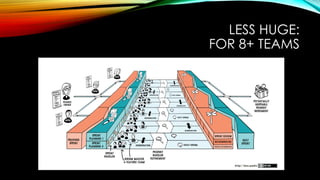
LESS HUGE:
FOR 8+ TEAMS
RESOURCES
Web sites
• www.less.works
• www.scrumguides.org
• www.scrum.org
• https://www.slideshare.net/management30/presentations
You tube videos
• https://www.youtube.com/watch?v=cvz4364pC0g
• https://www.youtube.com/watch?v=1BZf_Oa7W94
LESS
BOOKS
https://www.amazon.com/Large-Scale-Scrum-More-Addison-Wesley-
Signature/dp/0321985710
https://www.amazon.com/Practices-Scaling-Lean-Agile-
Development/dp/0321636406
https://www.amazon.com/Scaling-Lean-Agile-Development-
Organizational/dp/0321480961
THANK YOU!
Srikanth Ramanujam
LinkedIn: www.srikanth.ca

Introduction to LeSS - Large Scale Scrum

  • 1.
    INTRO TO LARGESCALE SCRUM (LESS) Srikanth Ramanujam LeSS-TO Large Scale Scrum Toronto Meetup group 15th November 2017
  • 2.
  • 5.
    A FUTURE INWHICH… POSSIBLY… • Everything is Technology centric • AI and automation rule the world • No need for Banks • No need for Insurance • What is money/wealth? • No cars to own, self-driving cars • What would we do with our time? • Not enough jobs or highly skilled jobs to go around
  • 6.
    MANIFESTO FOR AGILESOFTWARE DEVELOPMENT Individuals and interactions over processes and tools Working software over comprehensive documentation Customer collaboration over contract negotiation Responding to change over following a plan 4 Values supported by 12 principles All required
  • 7.
    THE MANIFESTO FORAGILITY… Agile Methodology/= Model/= The need for Scrum and LeSS, plus more…
  • 8.
  • 9.
  • 10.
  • 11.
  • 12.
  • 13.
    SCRUM: 3 ARTIFACTS • ProductBacklog • Sprint Backlog • Increment (Actual releases to clients) Supported by an: • Continuously improving ”Definition of Done”
  • 14.
    SCRUM: 5 CEREMONIES And Product Backlogrefinement Push 10-20% and Pull 80-90%
  • 15.
  • 16.
    SUPPORTED BY PRACTICES Product Management •Client centric Products • Product Market Fit • Kano model • Lean UX • CX personas and journey's • Lean Canvas • Impact Mapping • Story mapping, Release maps • Prototyping/Design thinking • Lean Startup Software Craftsmanship • Pride of software development • Clean code • Simplified architecture • Collective code, architecture ownership by teams • TDD • Continuous Integration • Continuous Delivery • Automation – BDD, ATDD, SBE Release and Change management • Continuous Deployment • Multiple weekly Feature Releases • Release on Demand • Feature Toggles • Build on Main Branch • Blue-Green Releases • Everything is version managed • Monitoring feedback loops
  • 17.
    LARGE SCALE SCRUM Culturefollows structure, descaling the organization
  • 18.
  • 19.
  • 20.
    LESS RULES: SAME 3ROLES • Structure the organization using real teams as the basic organizational building block. • Each team is (1) self-managing, (2) cross-functional, (3) co-located, and (4) long- lived. • The majority of the teams are customer-focused feature teams. • Scrum Masters are responsible for a well-working LeSS adoption. Their focus is towards the Teams, Product Owner, organization, and development practices. A Scrum Master does not focus on just one team but on the overall organizational system. • A Scrum Master is a dedicated full-time role. One Scrum Master can serve 1-3 teams. • In LeSS, managers are optional, but if managers do exist their role is likely to change. Their focus shifts from managing the day-to-day product work to improving the value-delivering capability of the product development system.
  • 21.
  • 22.
    LESS RULES: PRODUCT • Thereis one Product Owner and one Product Backlog for the complete shippable product. • The Product Owner shouldn’t work alone on Product Backlog refinement; he is supported by the multiple Teams working directly with customers/users and other stakeholders. • All prioritization goes through the Product Owner, but clarification is as much as possible directly between the Teams and customer/users and other stakeholders. • The definition of product should be as broad and end-user/customer centric as is practical. Over time, the definition of product might expand. Broader definitions are preferred. • One Definition of Done for the whole product common for all teams. • Each team can have their own stronger Definition of Done by expanding the common one. • The perfection goal is to improve the Definition of Done so that it results in a shippable product each Sprint (or even more frequently).
  • 23.
  • 24.
    LESS RULES: SAME 5SPRINT CEREMONIES
  • 25.
    LESS RULES: SPRINTS • Thereis one product-level Sprint, not a different Sprint for each Team. Each Team starts and ends the Sprint at the same time. Each Sprint results in an integrated whole product. • Sprint Planning consists of two parts: Sprint Planning One is common for all teams while Sprint Planning Two is usually done separately for each team. Do multi-team Sprint Planning Two in a shared space for closely related items. • Sprint Planning One is attended by the Product Owner and Teams or Team representatives. They together tentatively select the items that each team will work on that Sprint. The Teams identify opportunities to work together and final questions are clarified. • Each Team has their own Sprint Backlog. • Sprint Planning Two is for Teams to decide how they will do the selected items. This usually involves design and the creation of their Sprint Backlogs. • Each Team has their own Daily Scrum.
  • 26.
    LESS RULES: SPRINTS • Cross-teamcoordination is decided by the teams. Prefer decentralized and informal coordination over centralized coordination. Emphasize Just Talk and informal networks via communicate in code, cross-team meetings, component mentors, travelers, scouts, and open spaces. • Product Backlog Refinement (PBR) is done per team for the items they are likely going to do in the future. Do multi-team and/or overall PBR to increase shared understanding and exploiting coordination opportunities when having closely related items or a need for broader input/learning. • There is one product Sprint Review; it is common for all teams. Ensure that suitable stakeholders join to contribute the information needed for effective inspection and adaptation. • Each Team has their own Sprint Retrospective. • An Overall Retrospective is held after the Team Retrospectives to discuss cross-team and system-wide issues, and create improvement experiments. This is attended by Product Owner, Scrum Masters, Team representatives, and managers (if any).
  • 27.
  • 28.
    LESS SCRUM TEAMS: COORDINATION& INTEGRATION • Just Talk • Communicate in Code • Send Observers to the Daily Scrum • Component communities and mentors • Scrum of Scrums (maybe) • Leading Team • Multi-team LeSS meetings • Multi-team Product Backlog Refinement • Multi-team Sprint Planning Two • Multi-team Design Workshops • Exchange members in Daily Scrum • Travelers to exploit and break bottlenecks and create skill
  • 29.
  • 30.
    RESOURCES Web sites • www.less.works •www.scrumguides.org • www.scrum.org • https://www.slideshare.net/management30/presentations You tube videos • https://www.youtube.com/watch?v=cvz4364pC0g • https://www.youtube.com/watch?v=1BZf_Oa7W94
  • 31.
  • 32.