Les Invalides, Paris, was initially designed by Libéral Bruant (1635-97) as a 
hospital for disabled army veterans and completed by 1677. However, even 
before the completion, Louis XIV was planning a second chapel on a grander 
sale. In 1680 J.H. Mansart produced the final design for the Dome des Invalides 
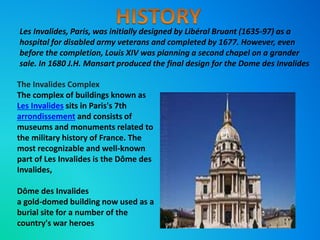
The Invalides Complex 
The complex of buildings known as 
Les Invalides sits in Paris's 7th 
arrondissement and consists of 
museums and monuments related to 
the military history of France. The 
most recognizable and well-known 
part of Les Invalides is the Dôme des 
Invalides, 
Dôme des Invalides 
a gold-domed building now used as a 
burial site for a number of the 
country's war heroes
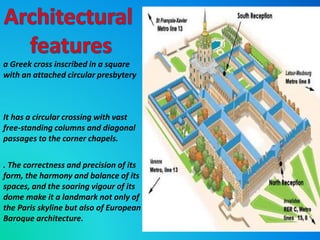
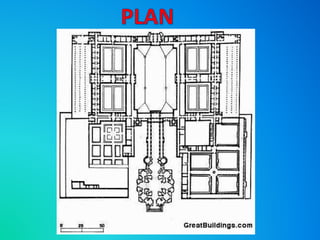
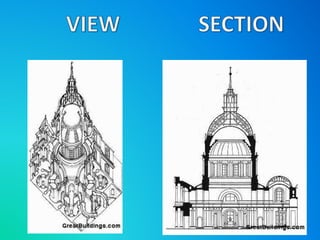
a Greek cross inscribed in a square 
with an attached circular presbytery 
It has a circular crossing with vast 
free-standing columns and diagonal 
passages to the corner chapels. 
. The correctness and precision of its 
form, the harmony and balance of its 
spaces, and the soaring vigour of its 
dome make it a landmark not only of 
the Paris skyline but also of European 
Baroque architecture.
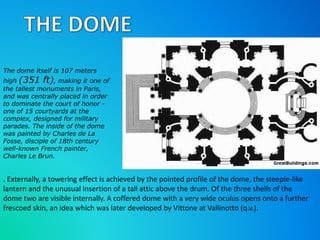
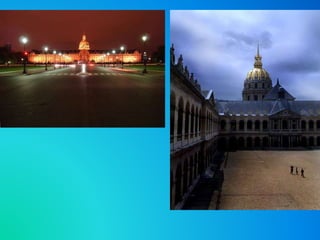
The dome itself is 107 meters 
high (351 ft), making it one of 
the tallest monuments in Paris, 
and was centrally placed in order 
to dominate the court of honor - 
one of 15 courtyards at the 
complex, designed for military 
parades. The inside of the dome 
was painted by Charles de La 
Fosse, disciple of 18th century 
well-known French painter, 
Charles Le Brun. 
. Externally, a towering effect is achieved by the pointed profile of the dome, the steeple-like 
lantern and the unusual insertion of a tall attic above the drum. Of the three shells of the 
dome two are visible internally. A coffered dome with a very wide oculus opens onto a further 
frescoed skin, an idea which was later developed by Vittone at Vallinotto (q.v.).
Napoleon's 
Napoleon 
Bonaparte, 
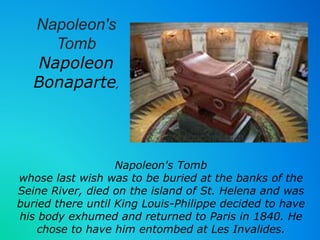
Napoleon's Tomb 
Tomb 
whose last wish was to be buried at the banks of the 
Seine River, died on the island of St. Helena and was 
buried there until King Louis-Philippe decided to have 
his body exhumed and returned to Paris in 1840. He 
chose to have him entombed at Les Invalides.
San Francisco City Hall Built in 1914-1915, 
The present dome of the United States Capitol, 
designed by Thomas U. Walter, was inspired in 
part by the dome at Les Invalides

Les Invalides

  • 1.
    Les Invalides, Paris,was initially designed by Libéral Bruant (1635-97) as a hospital for disabled army veterans and completed by 1677. However, even before the completion, Louis XIV was planning a second chapel on a grander sale. In 1680 J.H. Mansart produced the final design for the Dome des Invalides The Invalides Complex The complex of buildings known as Les Invalides sits in Paris's 7th arrondissement and consists of museums and monuments related to the military history of France. The most recognizable and well-known part of Les Invalides is the Dôme des Invalides, Dôme des Invalides a gold-domed building now used as a burial site for a number of the country's war heroes
  • 2.
    a Greek crossinscribed in a square with an attached circular presbytery It has a circular crossing with vast free-standing columns and diagonal passages to the corner chapels. . The correctness and precision of its form, the harmony and balance of its spaces, and the soaring vigour of its dome make it a landmark not only of the Paris skyline but also of European Baroque architecture.
  • 4.
    The dome itselfis 107 meters high (351 ft), making it one of the tallest monuments in Paris, and was centrally placed in order to dominate the court of honor - one of 15 courtyards at the complex, designed for military parades. The inside of the dome was painted by Charles de La Fosse, disciple of 18th century well-known French painter, Charles Le Brun. . Externally, a towering effect is achieved by the pointed profile of the dome, the steeple-like lantern and the unusual insertion of a tall attic above the drum. Of the three shells of the dome two are visible internally. A coffered dome with a very wide oculus opens onto a further frescoed skin, an idea which was later developed by Vittone at Vallinotto (q.v.).
  • 5.
    Napoleon's Napoleon Bonaparte, Napoleon's Tomb Tomb whose last wish was to be buried at the banks of the Seine River, died on the island of St. Helena and was buried there until King Louis-Philippe decided to have his body exhumed and returned to Paris in 1840. He chose to have him entombed at Les Invalides.
  • 10.
    San Francisco CityHall Built in 1914-1915, The present dome of the United States Capitol, designed by Thomas U. Walter, was inspired in part by the dome at Les Invalides