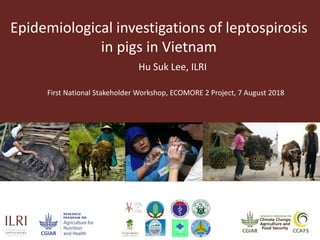
Epidemiological investigations of leptospirosis
in pigs in Vietnam
Hu Suk Lee, ILRI
First National Stakeholder Workshop, ECOMORE 2 Project, 7 August 2018
• Introduction of leptospirosis
• Research I
• Research II
• Conclusion
• Future directions
Overview
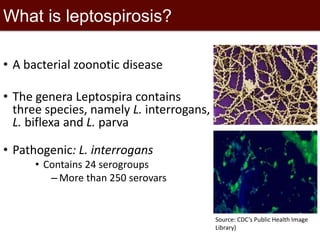
• A bacterial zoonotic disease
• The genera Leptospira contains
three species, namely L. interrogans,
L. biflexa and L. parva
• Pathogenic: L. interrogans
• Contains 24 serogroups
– More than 250 serovars
What is leptospirosis?
Source: CDC’s Public Health Image
Library)
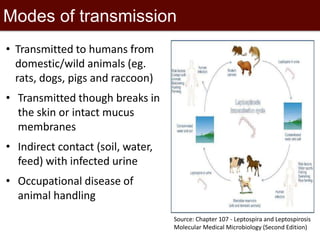
• Transmitted to humans from
domestic/wild animals (eg.
rats, dogs, pigs and raccoon)
• Transmitted though breaks in
the skin or intact mucus
membranes
• Indirect contact (soil, water,
feed) with infected urine
• Occupational disease of
animal handling
Modes of transmission
Source: Chapter 107 - Leptospira and Leptospirosis
Molecular Medical Microbiology (Second Edition)
Species Common infections Possible others
Dogs
Canicola, Icterohemorrhagiae,
Grippotyphosa, Pomona
Bratislava
Cats rarely infected
Cattle and deer
Hardjobovis, Pomona,
Grippotyphosa,
Icterohemorrhagiae
Australis, Autumnalis,
Canicola, Bataviae,
Hebdomadis, Krematosis,
Tarassovi, Sejroe, Bratislava
Pigs
Pomona, Bratislava, Canicola,
Tarassovi, Icterohemorrhagiae
Grippotyphosa, Sejroe
Sheep
Pomona, Grippotyphosa,
Bratislava, Hardjo
Horses
Pomona, Bratislava, Canicola,
Icterohemorrhagiae, Sejroe
Host animals
Reference: Bharti, A.R., Nally, J.E., Ricaldi, J.N., Matthias, M.A., Diaz, M.M., Lovett, M.A., Levett, P.N., Gilman, R.H., Willig,
M.R., Gotuzzo, E., 2003. Leptospirosis: a zoonotic disease of global importance. Lance Infect. Dis. 3, 757-771.
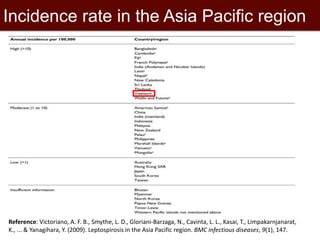
Incidence rate in the Asia Pacific region
Reference: Victoriano, A. F. B., Smythe, L. D., Gloriani-Barzaga, N., Cavinta, L. L., Kasai, T., Limpakarnjanarat,
K., ... & Yanagihara, Y. (2009). Leptospirosis in the Asia Pacific region. BMC infectious diseases, 9(1), 147.
Research I
Decision
support tools
Notification
to farmers
Climate Data
Zoonotic/livestock diseases
- Surveillance Data
- Field surveys
Responses
- Vaccination
- Movement control
- Quarantine
-…
Main objectives
• To develop early warning systems of zoonotic diseases
(prediction/disease models and risk maps)
• To conduct epidemiological investigations of diseases
• To support capacity building for public health
Early Warning and Forecasting System concept
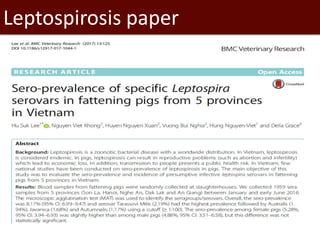
Leptospirosis paper
Introduction of study
• To evaluate the sero-prevalence
of leptospirosis in pigs in
Vietnam
• National Partner: National
Institute of Veterinary Research
(NIVR)
• Swine blood samples from 5
provinces (Jan- Jun 2016)
- 385 samples* / province
- Total sample: 1,925
- Slaughterhouses (6-9 months)
- Sampling information &
Questionnaires (252 people)
*Sample size (each province): 50% prevalence,
95% CI and precision 5%
Laboratory diagnosis
• All samples were analyzed at NIVR in Hanoi
• Microscopic Agglutination Test (MAT)
- National standard of animal leptospirosis in Vietnam
- 15 serovars of Leptospira used as antigens
- Cut-off level: ≥ 1:100 titer (~ 800)
- Positive titer is the greatest serum dilution (2-fold from
1:100) agglutinating >50% of live leptospires
No. Genomospecies Serogroup Serovar
1 L. interrogans Australis Australis
2 L. interrogans Autumnalis Autumnaliss
3 L. interrogans Bataviae Bataviae
4 L. interrogans Australis Bratislava
5 L. interrogans Canicola Canicola
6 L. kirschneri Grippotyphosa Grippotyphosa
7 L. interrogans Hebdomadis Hebdomadis
8 L. interrogans Icterohaemorrhagiae Icterohaemorrhagiae
9 L. borgpetersenii Javanica Javanica
10 L. noguchii Panama Panama
11 L. interrogans Pomona Pomona
12 L. interrogans Pyrogenes Pyrogenes
13 L. borgpetersenii Sejroe Hardjo
14 L. borgpetersenii Sejroe Saxkoebing
15 L. biflexa Semaranga Patoc
16 L. borgpetersenii Tarassovi Tarassovi
List of leptospira antigens used in the MAT
Research Team
Blood Sampling
Province
Total tested
samples
Sero-positive samples
(a titer≥1:100 for any
serovars)
Sero-positive (%) with
95% CI
Hanoi 390 37 9.49 (6.77-12.84)
Son La 384 27 7.03 (4.68-10.07)
Nghe An 380 33 8.68 (6.05-11.98)
Dak Lak 385 27 7.01 (4.67-10.04)
An Giang 420 36 8.57 (6.08-11.67)
Total 1,959 160 8.17 (6.99-9.47)
Sero-prevalence for Leptospira serovars in fattening pigs
0
5
10
15
Yên Thành TP. Vinh Đô Lương Diễn Châu Nam Đàn
Sero-positive in Nghe An
0
5
10
15
20
Thanh Trì Thanh oai Chương Mỹ Hoài Đức Đan
Phượng
Sero-positive in Hanoi
0
5
10
15
M'Đrăk TP. Buôn Mê
Thuột
Cư Mgar Buôn Đôn Krông Bông
Sero-positive in Daklak
0
5
10
15
20
25
Mộc Châu Mai Sơn Yên Châu TP. Sơn La Thuận Châu
Sero-positive in Son La
000
005
010
015
Châu Đốc Châu Thành Châu Phú TP. Long
Xuyên
Tân Châu
Sero-positive in An Giang
Sero-positive results
≥ 1:100 ≥ 1:200 ≥ 1:400 ≥ 1:800
Seorvar
n n % (95% CI) n % (95% CI) n % (95% CI) n % (95% CI)
Australis 1,959 38
1.94 (1.37-
2.65)
16
0.82 (0.42-
1.22)
7
0.36 (0.09-
0.62)
4
0.20 (0.001-
0.40)
Autumnalis 1,959 23
1.17 (0.75-
1.76)
7
0.36 (0.09-
0.62)
2 0.10 (0-0.24) 1 0.05 (0-0.15)
Canicola 1,959 2 0.10 (0-0.24) 1 0.05 (0-0.15) 0 Null 0 Null
Grippotyphosa 1,959 21
1.07 (0.62-
1.53)
9
0.46 (0.16-
0.76)
4
0.20 (0.001-
0.40)
4
0.20 (0.001-
0.40)
Hardjo 1,959 1 0.05 (0-0.15) 1 0.05 (0-0.15) 0 Null 0 Null
Hebdomadis 1,959 2 0.10 (0-0.24) 1 0.05 (0-0.15) 0 Null 0 Null
Icterohaemorrhagiae 1,959 2 0.10 (0-0.24) 2 0.10 (0-0.24) 2 0.10 (0-0.24) 1 0.05 (0-0.15)
Javanica 1,959 33
1.68 (1.11-
2.25)
8
0.41 (0.13-
0.69)
3 0.15 (0-0.33) 1 0.05 (0-0.15)
Tarassovi Mitis 1,959 43
2.20 (1.55-
2.84)
11
0.56 (0.23-
0.89)
3 0.15 (0-0.33) 1 0.05 (0-0.15)
MAT results for leptospira serovars in pigs by using 4
cutoff titers
0
5
10
15
Hanoi Son La Nghe An Dak Lak An Giang
Australis
Autumnalis
Grippotyphosa
Hardjo
Javanica
Tarassovi Mitis
Hebdomadis
Icterohaemorrhagiae
Canicola
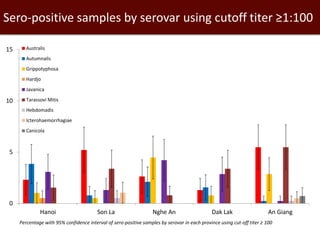
Percentage with 95% confidence interval of sero-positive samples by serovar in each province using cut-off titer ≥ 100
Sero-positive samples by serovar using cutoff titer ≥1:100
Research II
Introduction of study
• To evaluate the sero-prevalence of
leptospirosis in pigs in Vietnam
• National Partner: National Center
for Veterinary Diagnostics (NCVD)
• Swine blood samples from 10
provinces (Mar-Apr 2017)
- 200 samples / province
- Total sample: 2,000
- Small/medium size farms
• Microscopic Agglutination Test was
used for diagnosis
Sero-positive (%) for Leptospira serovars by province
Province (no.)
Sero-positive samples
(a titer≥1:100 for any
serovars)
Sero-positive (%) with 95% CI
Bac Giang (200) 61 30.5 (24.20-37.39)
Bac Ninh (200) 45 22.5 (16.91-28.92)
Binh Duong (200) 65 32.5 (26.06-39.47)
Dong Nai (200) 38 19.0 (13.81-25.13)
Dong Thap (200) 23 11.5 (7.43-16.75)
Hanoi (200) 23 11.5 (7.43-16.75)
Quang Ngai (200) 75 37.5 (30.77-44.61)
Quang Ninh (200) 43 21.5 (16.02-27.85)
Soc Trang (200) 20 10.0 (6.22-15.02)
Thai Binh (200) 28 14.0 (9.51-19.59)
Total (2,000) 421 21.05 (19.28-22.90)
MAT results by using 3 cutoff titers
Serovar Total
samples
≥ 1:100 ≥ 1:200 ≥ 400
N (%, 95% CI) N (%, 95% CI) N (%, 95% CI)
Australis 2,000 45 (2.25, 1.65-3.00) 4 (0.2, 0.005-0.05) 0
Autumnalis 2,000 1 (0.05, 0.0001-0.28) 0 0
Bataviae 2,000 10 (0.5, 0.24-0.92) 1 (0.05, 0.0001-0.28) 0
Bratislava 2,000 193 (9.65, 8.39-11.03) 39 (1.95, 1.39-2.66) 8 (0.4, 0.17-0.79)
Canicola 2,000 45 (2.25, 1.65-3.00) 2 (0.1, 0.01-0.36) 0
Grippotyphosa 2,000 18 (0.9, 0.53-1.42) 2 (0.1, 0.01-0.36) 0
Icterohaemorrhagiae 2,000 22 (1.1, 0.69-1.66) 3 (0.15, 0.03-0.44) 0
Javanica 2,000 13 (0.65, 0.35-1.11) 4 (0.2, 0.005-0.05) 0
Panama 2,000 87 (4.35, 3.50-5.34) 15 (0.75, 0.42-1.23) 2 (0.1, 0.01-0.36)
Pomona 2,000 31 (1.55, 1.06-2.19) 3 0
Pyrogenes 2,000 122 (6.1, 5.09-7.24) 8 (0.4, 0.17-0.79) 0
Hardjo 2,000 0 0 0
Sakoebing 2,000 0 0 0
Tarassovi 2,000 91 (4.55, 3.68-5.56) 8 (0.4, 0.17-0.79) 1 (0.05, 0.0001-0.28)
Patoc 2,000 5 (0.25, 0.08-0.58) 1 (0.05, 0.0001-0.28) 0
0%
10%
20%
30%
40%
50%
Bac Giang Bac Ninh Binh Dung Dong Nai Dong Thap Hanoi Quang Ngai Quang Ninh Soc Trang Thai Binh
Bratislava
Pyrogenes
Tarassovi
Panama
Australis
Canicola
Pomona
Icterohaemorrhagiae
Gryppotyphosa
Javanica
Batavie
Patoc I
Hebdomadis
Autumnalis
Sero-positive samples by serovar using cutoff titer ≥1:100
Sero-positive by age group in pigs using cut off titer ≥ 1:100
0%
25%
50%
75%
100%
5-8 weeks 9-12 weeks Sow
• Leptospirosis in pigs may be a useful indicator
of the human/animal burden in Vietnam
• Wildlife may play an important role in the
transmission of leptospirosis to domesticated
pigs in Vietnam
Conclusion
• Currently, which types of serovars are commonly
detected in humans and wildlife?
 Possible transmission of leptospirosis between wildlife
and domestic animals/humans
• To evaluate the association between leptospirosis
and potential environmental risk factors (e.g. climate
factors, rural vs urban)
• To evaluate the seasonal and temporal patterns of
leptospirosis in humans and animals
Future directions
Example: seasonality of leptospirosis
This presentation is licensed for use under the Creative Commons Attribution 4.0 International Licence.
better lives through livestock
ilri.org
ILRI thanks all donors and organizations who globally supported its work through their contributions
to the CGIAR system

Epidemiological investigations of leptospirosis in pigs in Vietnam

  • 1.
    Epidemiological investigations ofleptospirosis in pigs in Vietnam Hu Suk Lee, ILRI First National Stakeholder Workshop, ECOMORE 2 Project, 7 August 2018
  • 2.
    • Introduction ofleptospirosis • Research I • Research II • Conclusion • Future directions Overview
  • 3.
    • A bacterialzoonotic disease • The genera Leptospira contains three species, namely L. interrogans, L. biflexa and L. parva • Pathogenic: L. interrogans • Contains 24 serogroups – More than 250 serovars What is leptospirosis? Source: CDC’s Public Health Image Library)
  • 4.
    • Transmitted tohumans from domestic/wild animals (eg. rats, dogs, pigs and raccoon) • Transmitted though breaks in the skin or intact mucus membranes • Indirect contact (soil, water, feed) with infected urine • Occupational disease of animal handling Modes of transmission Source: Chapter 107 - Leptospira and Leptospirosis Molecular Medical Microbiology (Second Edition)
  • 5.
    Species Common infectionsPossible others Dogs Canicola, Icterohemorrhagiae, Grippotyphosa, Pomona Bratislava Cats rarely infected Cattle and deer Hardjobovis, Pomona, Grippotyphosa, Icterohemorrhagiae Australis, Autumnalis, Canicola, Bataviae, Hebdomadis, Krematosis, Tarassovi, Sejroe, Bratislava Pigs Pomona, Bratislava, Canicola, Tarassovi, Icterohemorrhagiae Grippotyphosa, Sejroe Sheep Pomona, Grippotyphosa, Bratislava, Hardjo Horses Pomona, Bratislava, Canicola, Icterohemorrhagiae, Sejroe Host animals Reference: Bharti, A.R., Nally, J.E., Ricaldi, J.N., Matthias, M.A., Diaz, M.M., Lovett, M.A., Levett, P.N., Gilman, R.H., Willig, M.R., Gotuzzo, E., 2003. Leptospirosis: a zoonotic disease of global importance. Lance Infect. Dis. 3, 757-771.
  • 6.
    Incidence rate inthe Asia Pacific region Reference: Victoriano, A. F. B., Smythe, L. D., Gloriani-Barzaga, N., Cavinta, L. L., Kasai, T., Limpakarnjanarat, K., ... & Yanagihara, Y. (2009). Leptospirosis in the Asia Pacific region. BMC infectious diseases, 9(1), 147.
  • 7.
  • 8.
    Decision support tools Notification to farmers ClimateData Zoonotic/livestock diseases - Surveillance Data - Field surveys Responses - Vaccination - Movement control - Quarantine -… Main objectives • To develop early warning systems of zoonotic diseases (prediction/disease models and risk maps) • To conduct epidemiological investigations of diseases • To support capacity building for public health Early Warning and Forecasting System concept
  • 9.
  • 10.
    Introduction of study •To evaluate the sero-prevalence of leptospirosis in pigs in Vietnam • National Partner: National Institute of Veterinary Research (NIVR) • Swine blood samples from 5 provinces (Jan- Jun 2016) - 385 samples* / province - Total sample: 1,925 - Slaughterhouses (6-9 months) - Sampling information & Questionnaires (252 people) *Sample size (each province): 50% prevalence, 95% CI and precision 5%
  • 11.
    Laboratory diagnosis • Allsamples were analyzed at NIVR in Hanoi • Microscopic Agglutination Test (MAT) - National standard of animal leptospirosis in Vietnam - 15 serovars of Leptospira used as antigens - Cut-off level: ≥ 1:100 titer (~ 800) - Positive titer is the greatest serum dilution (2-fold from 1:100) agglutinating >50% of live leptospires
  • 12.
    No. Genomospecies SerogroupSerovar 1 L. interrogans Australis Australis 2 L. interrogans Autumnalis Autumnaliss 3 L. interrogans Bataviae Bataviae 4 L. interrogans Australis Bratislava 5 L. interrogans Canicola Canicola 6 L. kirschneri Grippotyphosa Grippotyphosa 7 L. interrogans Hebdomadis Hebdomadis 8 L. interrogans Icterohaemorrhagiae Icterohaemorrhagiae 9 L. borgpetersenii Javanica Javanica 10 L. noguchii Panama Panama 11 L. interrogans Pomona Pomona 12 L. interrogans Pyrogenes Pyrogenes 13 L. borgpetersenii Sejroe Hardjo 14 L. borgpetersenii Sejroe Saxkoebing 15 L. biflexa Semaranga Patoc 16 L. borgpetersenii Tarassovi Tarassovi List of leptospira antigens used in the MAT
  • 13.
  • 14.
  • 15.
    Province Total tested samples Sero-positive samples (atiter≥1:100 for any serovars) Sero-positive (%) with 95% CI Hanoi 390 37 9.49 (6.77-12.84) Son La 384 27 7.03 (4.68-10.07) Nghe An 380 33 8.68 (6.05-11.98) Dak Lak 385 27 7.01 (4.67-10.04) An Giang 420 36 8.57 (6.08-11.67) Total 1,959 160 8.17 (6.99-9.47) Sero-prevalence for Leptospira serovars in fattening pigs
  • 16.
    0 5 10 15 Yên Thành TP.Vinh Đô Lương Diễn Châu Nam Đàn Sero-positive in Nghe An 0 5 10 15 20 Thanh Trì Thanh oai Chương Mỹ Hoài Đức Đan Phượng Sero-positive in Hanoi 0 5 10 15 M'Đrăk TP. Buôn Mê Thuột Cư Mgar Buôn Đôn Krông Bông Sero-positive in Daklak 0 5 10 15 20 25 Mộc Châu Mai Sơn Yên Châu TP. Sơn La Thuận Châu Sero-positive in Son La 000 005 010 015 Châu Đốc Châu Thành Châu Phú TP. Long Xuyên Tân Châu Sero-positive in An Giang
  • 17.
    Sero-positive results ≥ 1:100≥ 1:200 ≥ 1:400 ≥ 1:800 Seorvar n n % (95% CI) n % (95% CI) n % (95% CI) n % (95% CI) Australis 1,959 38 1.94 (1.37- 2.65) 16 0.82 (0.42- 1.22) 7 0.36 (0.09- 0.62) 4 0.20 (0.001- 0.40) Autumnalis 1,959 23 1.17 (0.75- 1.76) 7 0.36 (0.09- 0.62) 2 0.10 (0-0.24) 1 0.05 (0-0.15) Canicola 1,959 2 0.10 (0-0.24) 1 0.05 (0-0.15) 0 Null 0 Null Grippotyphosa 1,959 21 1.07 (0.62- 1.53) 9 0.46 (0.16- 0.76) 4 0.20 (0.001- 0.40) 4 0.20 (0.001- 0.40) Hardjo 1,959 1 0.05 (0-0.15) 1 0.05 (0-0.15) 0 Null 0 Null Hebdomadis 1,959 2 0.10 (0-0.24) 1 0.05 (0-0.15) 0 Null 0 Null Icterohaemorrhagiae 1,959 2 0.10 (0-0.24) 2 0.10 (0-0.24) 2 0.10 (0-0.24) 1 0.05 (0-0.15) Javanica 1,959 33 1.68 (1.11- 2.25) 8 0.41 (0.13- 0.69) 3 0.15 (0-0.33) 1 0.05 (0-0.15) Tarassovi Mitis 1,959 43 2.20 (1.55- 2.84) 11 0.56 (0.23- 0.89) 3 0.15 (0-0.33) 1 0.05 (0-0.15) MAT results for leptospira serovars in pigs by using 4 cutoff titers
  • 18.
    0 5 10 15 Hanoi Son LaNghe An Dak Lak An Giang Australis Autumnalis Grippotyphosa Hardjo Javanica Tarassovi Mitis Hebdomadis Icterohaemorrhagiae Canicola Percentage with 95% confidence interval of sero-positive samples by serovar in each province using cut-off titer ≥ 100 Sero-positive samples by serovar using cutoff titer ≥1:100
  • 19.
  • 20.
    Introduction of study •To evaluate the sero-prevalence of leptospirosis in pigs in Vietnam • National Partner: National Center for Veterinary Diagnostics (NCVD) • Swine blood samples from 10 provinces (Mar-Apr 2017) - 200 samples / province - Total sample: 2,000 - Small/medium size farms • Microscopic Agglutination Test was used for diagnosis
  • 21.
    Sero-positive (%) forLeptospira serovars by province Province (no.) Sero-positive samples (a titer≥1:100 for any serovars) Sero-positive (%) with 95% CI Bac Giang (200) 61 30.5 (24.20-37.39) Bac Ninh (200) 45 22.5 (16.91-28.92) Binh Duong (200) 65 32.5 (26.06-39.47) Dong Nai (200) 38 19.0 (13.81-25.13) Dong Thap (200) 23 11.5 (7.43-16.75) Hanoi (200) 23 11.5 (7.43-16.75) Quang Ngai (200) 75 37.5 (30.77-44.61) Quang Ninh (200) 43 21.5 (16.02-27.85) Soc Trang (200) 20 10.0 (6.22-15.02) Thai Binh (200) 28 14.0 (9.51-19.59) Total (2,000) 421 21.05 (19.28-22.90)
  • 22.
    MAT results byusing 3 cutoff titers Serovar Total samples ≥ 1:100 ≥ 1:200 ≥ 400 N (%, 95% CI) N (%, 95% CI) N (%, 95% CI) Australis 2,000 45 (2.25, 1.65-3.00) 4 (0.2, 0.005-0.05) 0 Autumnalis 2,000 1 (0.05, 0.0001-0.28) 0 0 Bataviae 2,000 10 (0.5, 0.24-0.92) 1 (0.05, 0.0001-0.28) 0 Bratislava 2,000 193 (9.65, 8.39-11.03) 39 (1.95, 1.39-2.66) 8 (0.4, 0.17-0.79) Canicola 2,000 45 (2.25, 1.65-3.00) 2 (0.1, 0.01-0.36) 0 Grippotyphosa 2,000 18 (0.9, 0.53-1.42) 2 (0.1, 0.01-0.36) 0 Icterohaemorrhagiae 2,000 22 (1.1, 0.69-1.66) 3 (0.15, 0.03-0.44) 0 Javanica 2,000 13 (0.65, 0.35-1.11) 4 (0.2, 0.005-0.05) 0 Panama 2,000 87 (4.35, 3.50-5.34) 15 (0.75, 0.42-1.23) 2 (0.1, 0.01-0.36) Pomona 2,000 31 (1.55, 1.06-2.19) 3 0 Pyrogenes 2,000 122 (6.1, 5.09-7.24) 8 (0.4, 0.17-0.79) 0 Hardjo 2,000 0 0 0 Sakoebing 2,000 0 0 0 Tarassovi 2,000 91 (4.55, 3.68-5.56) 8 (0.4, 0.17-0.79) 1 (0.05, 0.0001-0.28) Patoc 2,000 5 (0.25, 0.08-0.58) 1 (0.05, 0.0001-0.28) 0
  • 23.
    0% 10% 20% 30% 40% 50% Bac Giang BacNinh Binh Dung Dong Nai Dong Thap Hanoi Quang Ngai Quang Ninh Soc Trang Thai Binh Bratislava Pyrogenes Tarassovi Panama Australis Canicola Pomona Icterohaemorrhagiae Gryppotyphosa Javanica Batavie Patoc I Hebdomadis Autumnalis Sero-positive samples by serovar using cutoff titer ≥1:100
  • 24.
    Sero-positive by agegroup in pigs using cut off titer ≥ 1:100 0% 25% 50% 75% 100% 5-8 weeks 9-12 weeks Sow
  • 25.
    • Leptospirosis inpigs may be a useful indicator of the human/animal burden in Vietnam • Wildlife may play an important role in the transmission of leptospirosis to domesticated pigs in Vietnam Conclusion
  • 26.
    • Currently, whichtypes of serovars are commonly detected in humans and wildlife?  Possible transmission of leptospirosis between wildlife and domestic animals/humans • To evaluate the association between leptospirosis and potential environmental risk factors (e.g. climate factors, rural vs urban) • To evaluate the seasonal and temporal patterns of leptospirosis in humans and animals Future directions
  • 27.
  • 28.
    This presentation islicensed for use under the Creative Commons Attribution 4.0 International Licence. better lives through livestock ilri.org ILRI thanks all donors and organizations who globally supported its work through their contributions to the CGIAR system