Exam Study Guide Remember August?? September? October? November? December? Last week?
Outline Part 1 Multiple Choice, worth 75 points 25 questions Part 2 Writing Prompts worth 25 points 2 short essays, 12.5 points each
For the Writing Prompts I want you to pretend like you are really taking the exam.  This means you need to do paragraphs, complete sentences and thoroughly explain EVERYTHING you write.
This is NOT a marking period test, it is the EXAM
It is not enough to know what these terms are.  You need to understand these in order to apply them to questions.  Take your time, think each question through
Articles of Confederation Weaknesses The ARTICLES failed because they were too weak.  What were the specific weaknesses?
1)  1 Vote, Regardless of Size 2) Congress powerless to lay and collect taxes 3)  Congress powerless to regulate commerce
4)  No executive branch to enforce acts of Congress 5)  No national judicial system 6) 9/13 majority to pass laws
7)  Army was small and dependent on state militias..couldn’t control border disputes 8)  Little Money Coined by Congress 9)  Amendment only with all the States
Devolution The effort to transfer responsibility for many public programs and services from the federal government to the states.
What are some examples of devolution? Grants-in-Aide
Federalism Dual Federalism National government is supreme in its sphere, states are supreme in theirs Cooperative Federalism Growing areas of cooperation between National and State governments.  Think concurrent powers or grants
Federal Grants-in-Aide Usually there are a number of strings attached block grants mandates categorical grants project grants
4 Theories of Elitism Marxist Power Elite Bureaucratic Pluralist
Direct Democracy v. Representative Democracy What are some criticisms of a direct democracy? Are direct democracies ever successful? Views of the framers
Power ability of a person to get another person to act in accordance with the first’s intentions Authority The right to use power
Legitimacy Political authority conferred by law or by a state or a national constitution.
Can a government have power without having authority? Yes - think dictatorships
Be able to analyze the connections between power, authority, and legitimacy
Equality of Opportunity vs. Equality of Results Which do Americans favor?  Why?
Ways of political socialization family media schools civic organizations
Culture war What kind of disagreements are considered part of the culture war?
American trust in government? Increase?  Decrease? No change? Why?
Political Efficacy What is this?  Know the term. Belief that you can take part in politics or that the government will response to the citizens
Know who are likely Democratic Party voters and who are likely Republican Party voters.
What are the House committees that are important? Ways and Means House Rules Committee
Know the characteristics of different parties Democrats, Libertarian, Republicans, Populists
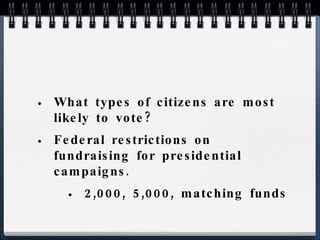
What types of citizens are most likely to vote? Federal restrictions on fundraising for presidential campaigns. 2,000, 5,000, matching funds
What is gerrymandering?  What is malapportionment? What is the biggest indicator of the likelihood of a president getting reelected? ECONOMY!!
Diversity in Congress Impact of Filibusters and Vote of Clotures -  number to control
What is the point of having congressional oversight?
WRITING PROMPTS Grants-In-Aid Categorical Grants Revenue Sharing Block Grants Mandates
What are some specific examples of these type of grants and how do they affect policy making within the states?
2.  Interest Groups and PACs How do they try to influence politics? What limits them?

AP Exam Review

  • 1.
    Exam Study GuideRemember August?? September? October? November? December? Last week?
  • 2.
    Outline Part 1Multiple Choice, worth 75 points 25 questions Part 2 Writing Prompts worth 25 points 2 short essays, 12.5 points each
  • 3.
    For the WritingPrompts I want you to pretend like you are really taking the exam. This means you need to do paragraphs, complete sentences and thoroughly explain EVERYTHING you write.
  • 4.
    This is NOTa marking period test, it is the EXAM
  • 5.
    It is notenough to know what these terms are. You need to understand these in order to apply them to questions. Take your time, think each question through
  • 6.
    Articles of ConfederationWeaknesses The ARTICLES failed because they were too weak. What were the specific weaknesses?
  • 7.
    1) 1Vote, Regardless of Size 2) Congress powerless to lay and collect taxes 3) Congress powerless to regulate commerce
  • 8.
    4) Noexecutive branch to enforce acts of Congress 5) No national judicial system 6) 9/13 majority to pass laws
  • 9.
    7) Armywas small and dependent on state militias..couldn’t control border disputes 8) Little Money Coined by Congress 9) Amendment only with all the States
  • 10.
    Devolution The effortto transfer responsibility for many public programs and services from the federal government to the states.
  • 11.
    What are someexamples of devolution? Grants-in-Aide
  • 12.
    Federalism Dual FederalismNational government is supreme in its sphere, states are supreme in theirs Cooperative Federalism Growing areas of cooperation between National and State governments. Think concurrent powers or grants
  • 13.
    Federal Grants-in-Aide Usuallythere are a number of strings attached block grants mandates categorical grants project grants
  • 14.
    4 Theories ofElitism Marxist Power Elite Bureaucratic Pluralist
  • 15.
    Direct Democracy v.Representative Democracy What are some criticisms of a direct democracy? Are direct democracies ever successful? Views of the framers
  • 16.
    Power ability ofa person to get another person to act in accordance with the first’s intentions Authority The right to use power
  • 17.
    Legitimacy Political authorityconferred by law or by a state or a national constitution.
  • 18.
    Can a governmenthave power without having authority? Yes - think dictatorships
  • 19.
    Be able toanalyze the connections between power, authority, and legitimacy
  • 20.
    Equality of Opportunityvs. Equality of Results Which do Americans favor? Why?
  • 21.
    Ways of politicalsocialization family media schools civic organizations
  • 22.
    Culture war Whatkind of disagreements are considered part of the culture war?
  • 23.
    American trust ingovernment? Increase? Decrease? No change? Why?
  • 24.
    Political Efficacy Whatis this? Know the term. Belief that you can take part in politics or that the government will response to the citizens
  • 25.
    Know who arelikely Democratic Party voters and who are likely Republican Party voters.
  • 26.
    What are theHouse committees that are important? Ways and Means House Rules Committee
  • 27.
    Know the characteristicsof different parties Democrats, Libertarian, Republicans, Populists
  • 28.
    What types ofcitizens are most likely to vote? Federal restrictions on fundraising for presidential campaigns. 2,000, 5,000, matching funds
  • 29.
    What is gerrymandering? What is malapportionment? What is the biggest indicator of the likelihood of a president getting reelected? ECONOMY!!
  • 30.
    Diversity in CongressImpact of Filibusters and Vote of Clotures - number to control
  • 31.
    What is thepoint of having congressional oversight?
  • 32.
    WRITING PROMPTS Grants-In-AidCategorical Grants Revenue Sharing Block Grants Mandates
  • 33.
    What are somespecific examples of these type of grants and how do they affect policy making within the states?
  • 34.
    2. InterestGroups and PACs How do they try to influence politics? What limits them?