History of “left handedness“..! 
Dr. Tejas
Scheme of presentation 
• Introduction & Definition 
• Assessment 
• Theories 
• Myths and Facts 
• Issues 
• References
Definition 
• Handedness: 
– Handedness is a better (faster or more precise) 
performance or individual preference for use of 
a hand.
Definition 
• Right-handedness 70–90% 
• Left-handedness 10% 
• Mixed handedness 30% 
• Ambidexterity exceptionally rare, 
– Can be learned. 
• Ambilevous or ambisinister
Testing for Handedness 
• Asking Questions or Physical Tests 
• The “Big Three” tasks are writing, eating and 
throwing. 
• Computer mouse 
• Purdue Pegboard Test
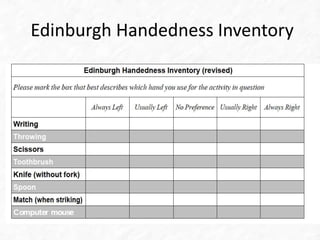
Edinburgh Handedness Inventory
Theories 
• Environmental 
• Developmental 
• Evolutionary 
• Genetic
ENVIRONMENTAL THEORIES 
• Plato was convinced that the limbs are 
naturally of equal strength and ability, and 
that any handedness is culturally imparted. 
• In fact, he went so far as to blame left-handedness 
on inept mothers and nurses who 
failed to adequately school their children in 
the correct way of doing things.
"Sword and Shield" theory 
• Thomas Carlyle claimed 
– Combatants who held their sword in the right hand 
and shield in their left (and therefore better 
protected their heart) were more likely to survive in 
battle. 
– The greater mortality of the left-handers in battle, 
then, is proposed as the mechanism driving the 
higher prevalence of right-handedness today.
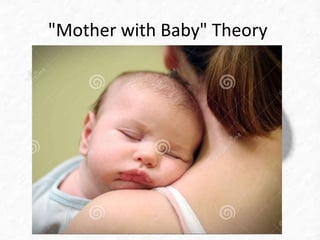
"Mother with Baby" Theory
Developmental theories
Bakan's "Birth Stress" Theory (1973) 
• That minor brain insults early in development 
caused left-handedness. 
• Only partly accepted. 
• There are just too many lefties for brain 
damage to be the major culprit.
Geschwind and Galaburda's 
"Testosterone" theory(1987) 
• Prenatal hormone exposure 
• Another study in 2003 determined that males 
with in-utero exposure 
to Diethylstibestrol were more likely to be 
left-handed over the clinical control group.
Previc's "Vestibular-Monoaminergic" 
theory. (1991; 1996) 
• The position of the foetus in the final trimester 
and a baby's subsequent birth position can 
affect handedness. 
• This partly explains why prematurity results in 
a decrease in right-handedness. 
• Previc argues that asymmetric prenatal 
positioning creates asymmetric stimulation of 
the vestibular system, which is involved in the 
development of handedness.
Evolutionary theories
MacNeilage's (1991) "Postural Origin" 
• The first evolutionary step in hemispheric 
specialization was a left-hand, right-hemispheric 
visuospatial specialization for 
unimanual predation. 
• Then it lead to a right-side, left-hemispheric 
specialization for postural support.
MacNeilage's (1991) "Postural Origin" 
• Because the respiratory and phonatory 
components of language production are 
influenced by postural factors, and facial and 
whole-body communicative gestures played a 
principal role in early communication, the left 
hemisphere may have been predisposed for 
language functions (MacNeilage, 1991).
Division of labour(Corballis ;1991) 
• Handedness and language -same hemisphere 
because they both require similar fine motor 
control.
Genetic theories 
• Charles Darwin who, although right-handed 
himself, was puzzled by his left-handed son, 
noting that his brother, mother and 
grandfather were all also left-handed.
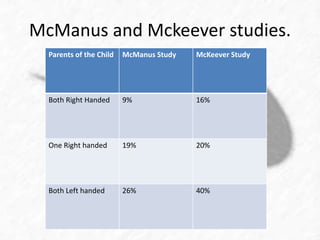
McManus and Mckeever studies. 
Parents of the Child McManus Study McKeever Study 
Both Right Handed 9% 16% 
One Right handed 19% 20% 
Both Left handed 26% 40%
Right shift Theory 
• Marian Annett back in 1972. A 
hypothetical RS+ gene (a “right shift”). 
• According to this theory, then, left-handers do 
not inherit their hand preference per se, they 
merely inherit a lack of neurological bias 
towards a dominant left hemisphere.
Dextral/Chance Theory 
• Chris McManus hypothesized a “dextral” (D) allele, 
which strongly biases handednes in favour of the 
right hand along with an alternative “chance” (C) 
allele, which is presumed directionally neutral. 
• DD genotype 
• CC genotype 
• Heterozygotic DC genotype 
• What is being inherited is not left-handedness as 
such, but rather an absence of handedness, so 
that handedness is then determined by chance.
• Annett’s RS+ and RS- genes and McManus’ D 
and C genes all remain hypothetical 
• In 2007, Oxford University researchers 
LRRTM1 (Leucine-Rich Repeat Trans-Membrane 
1), a variant of which also slightly increases the 
risk of psychotic mental illnesses. 
• In 2010 , PCSK6 and handedness in children 
with language-related disorders like dyslexia.
HANDEDNESS, THINKING AND 
HEMISPHERIC DOMINANCE
Handedness and Thinking 
• One theory divides left- and right-handed 
thinkers into two camps: Linear Sequential vs. 
Visual Simultaneous 
• Ex.Popcorn
Handedness and Thinking
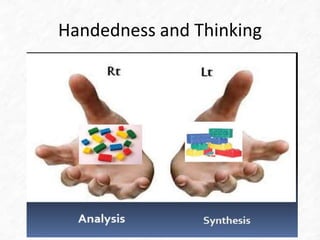
• Right-handed people process information 
using "analysis", which is the method of 
solving a problem by breaking it down to its 
pieces and analysing the pieces one at a time. 
• Left-handed people process information using 
"synthesis", which is the method of solving a 
problem by looking at the whole and trying to 
use pattern-matching to solve the problem.
• Ultimately, being left handed is not an all or 
nothing situation. The processing styles 
operate on a continuum
Intelligence 
• It’s a common belief that left-handed people 
are more intelligent or creative than right-handed 
people. 
• While there is an unresolved debate within the 
scientific community on how to operationalize 
both intelligence and creativity, some studies 
have demonstrated a small positive 
correlation
• Marian Annett indicated significantly more 
left-handers among mathematics 
students than among students of other 
subjects, arguing that this is consistent with 
her genetic right shift theory of left-handedness. 
• John Santrock's 2008 study, also suggested 
that more mathematicians, architects, 
musicians and artists - all of whom, it is 
argued, require good visual-spatial skills - are 
left-handed than the population as a whole.
FACT 
• Contrary to earlier assumptions, only about 
20% of left-handers have right-hemisphere 
language dominance. 
• Thus, while left-handers may be largely right-brain 
dominant in terms of motor control, this 
may or may not be associated with any of the 
commonly-claimed right-brain attributes (such 
as intuition, creativity, imagination, etc).
MYTH 
• Studies in the late 
1980s, showed left-handers 
tend to die 
early. In one study, 
(1991), they claimed 
that left-handers may 
die up to nine years 
earlier than right-handers. 
FACT 
• Studies were seriously 
flawed and conclusions 
erroneous. 
• The findings were 
roundly refuted by 
more than a dozen 
studies in the 1990s.
MYTHS & FACTS 
• FACT 
– Interactive sports such as table tennis, badminton, 
cricket, and tennis have an overrepresentation of 
left-handedness, while non-interactive sports such 
as swimming show no overrepresentation.
MYTHS & FACTS 
• The advantage to players in one-on-one sports, 
such as tennis, boxing, fencing or judo, is that, in 
a population containing perhaps 10% left-handers 
and 90% right-handers, the left-hander plays 90% 
of his or her games against right-handed 
opponents and is well-practiced at dealing with 
this asymmetry. Right-handers play 90% of their 
games against other right-handers. Thus, when 
confronted with left-handers, they are less 
practiced.
MYTH 
• Heterosexual 
individuals are 
somewhat more likely 
to be right-handed than 
homosexual individuals. 
FACT 
• Handedness and sexual 
orientation may be 
linked to the faternal 
birth order and there s 
no definite increased 
incidence of 
homsexuality in left 
handers..
MYTH 
• Left-handers earn lower 
wages than their right-handed 
counterparts 
FACT 
• In a study published 
in Laterality, it was 
found that lefties earn 
slightly more money 
than their right-handed 
peers who work at the 
same jobs.
FACT 
• An intresting report in Current Surgery says 
“One out of every 10 left handed surgeons is 
uncomfortable with the idea of being 
operated on by a left handed surgeon” 
• Six per cent also reported concerns by 
patients about their laterality .
FACT 
• Left-handers might have the advantage in 
careers like piloting a jet fighter or talking and 
driving at the same time. 
• A study published in the journal 
Neuropsychology in 2006 suggests that left-handed 
people are faster at processing 
multiple stimuli than righties.
MYTHS & FACTS 
• The Romans were responsible for a lot of anti-left 
customs. They were the most militantly 
right-handed people in history. Romans 
invented the right handed handshake, the 
fascist salute, and that right to left alphabet 
that still creates a lot of trouble for lefties
Myths and Facts 
• It was no coincidence that the fourth finger of 
the left-hand was chosen for the wedding 
finger in 300BC. 
• Doctors at that time believed a nerve from 
this finger ran directly to the heart
MYTHS & FACTS 
• Handshakes Whilst Julius Caesar was left-handed 
it was he who instructed all of his 
Roman subjects to adopt the right-handed 
handshake. Maybe this was because it left his 
weapon hand free whether greeting either 
friend or foe.
Left hand drive/Right hand drive 
• When passing a stranger on the road, it would be 
safer to walk on the left, so ensuring that your 
weapon was between yourself and a possible 
opponent. 
• Revolutionary France was to overturn this 
historic practice, as part of its social rethink. 
• Also Napoleon was left handed. 
• From this time any part of the world that was 
colonised by the French would travel on the 
right, the rest would remain travelling on the left.
Politics(Leftists) 
• In the French parliament before the 
revolution, the nobles sat in the right side of 
the king, while the capitalists sat on the left. 
• The right became associated with the 
prevalent social order, and the left with the 
subversive elements wanting to change it.
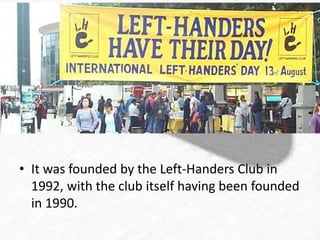
• It was founded by the Left-Handers Club in 
1992, with the club itself having been founded 
in 1990.
Handedness Issues
Handedness Issues 
• Historically, the left side, and subsequently 
left-handedness, was considered negative. 
• The word "left" itself derives from the Anglo- 
Saxon word lyft, "weak“. 
• Latin adjective sinister/sinistra/sinistrum origi 
nally meant "left“ 
• In Sanskrit, the word "वाम" (waama) stands for 
both "left" and "wicked."
Handedness Issues 
• Social stigmatization of left hand/side. 
• Cleanliness. 
• Especially in Islam and Hinduism 
• Christianity, the right hand of God is the 
favoured hand. For example, Jesus sits at 
God's right side.
Forced use of right hand 
• Can cause multiple problems - learning 
disorders, dyslexias, stuttering and 
other speech disorders 
• Shifts from left- to right-handed are more 
likely to be successful than right to left, 
though neither have a high success rate to 
begin with.
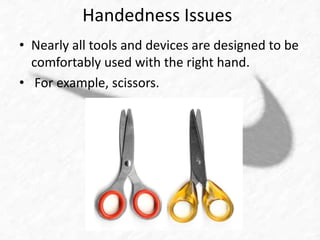
Handedness Issues 
• Nearly all tools and devices are designed to be 
comfortably used with the right hand. 
• For example, scissors.
Tools and devices 
• Opening Bottles 
• Computer input devices; QWERTY keyboards 
• Cameras 
• Musical instruments 
• Weapons 
• Machinery
WRITING PROBLEMS 
• Desks designs 
• Sitting arrangements
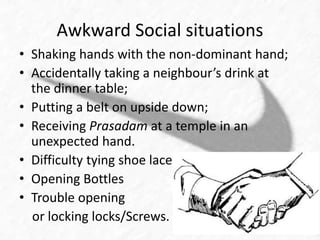
Awkward Social situations 
• Shaking hands with the non-dominant hand; 
• Accidentally taking a neighbour’s drink at 
the dinner table; 
• Putting a belt on upside down; 
• Receiving Prasadam at a temple in an 
unexpected hand. 
• Difficulty tying shoe laces 
• Opening Bottles 
• Trouble opening 
or locking locks/Screws.
FAMOUS LEFT HANDERS 
• Narendra Modi* 
• Dr. Raman Singh 
• Ratan Tata 
• Laxmi nivas Mittal 
• Sachin Tendulkar 
• Ted Williams 
• Frankie Albert 
• Pt.Hariprasad Chaurasia 
• Mahatma Gandhi 
• Amitabh Bachchan 
• Saurav Ganguly 
• Alexander The Great 
• Charlie Chaplin 
• Bill Gates 
• Bill Clinton 
• J.K. Rowling 
• James Cameron 
• Gary Kasparov 
• Marie Curie 
• Barack Obama 
• Henry Ford 
• Tom Cruise 
• Bruce Willis 
• Oprah Winfrey 
• Napoleon Bonaparte 
• Julius Caesar 
• Prince Charles 
• Leonardo Da Vinci 
• Angelina Jolie 
• Diego Maradona 
• Monica Seles 
• Martina Navratilova 
• Benjamin Franklin 
• Hellen Keller 
• John F. Kennedy 
• Rafael Nadal 
• Thomas Jefferson 
• Leo Tolstoy 
• Mark Twain
• Left Brain, Right Brain: Facts and Fantasies Michael C. Corballis mail 
Published: January 21, 2014DOI: 10.1371/journal.pbio.1001767 
• Corballis MC (2009) The evolution of language. Ann N Y Acad Sci 
1156: 19–43. doi: 10.1111/j.1749-6632.2009.04423.x 
• McManus IC, Davison A, Armour JAL (2013) Multilocus genetic 
models of handedness closely resemble single-locus models in 
explaining family data and are compatible with genome-wide 
association studies. Ann N Y Acad Sci 1288: 48–58. doi: 
10.1111/nyas.12102 
• Corballis MC, Beale IL (1993) Orton revisited: dyslexia, laterality, and 
left-right confusion. In: Willows DM, Kruk RS, Corcos E, editors. 
Visual processes in reading and reading disabilities. Hillsdale (New 
Jersey): Lawrence Erlbaum Associates. pp. 57–73. 
• McManus IC, Bryden MP (1992) The genetics of handedness, 
cerebral dominance and lateralization. In: Rapin I, Segalowitz SJ, 
editors. Handbook of neuropsychology, Vol. 6: developmental 
neuropsychology, Part 1. Amsterdam: Elsevier. pp. 115–144. 
• http://www.rightleftrightwrong.com/ 
• http://www.lefthandersday.com 
• http://en.wikipedia.org/wiki/Handedness 
• http://www.encyclopedia.com/topic/handedness.aspx
THANK YOU

Left handedness

  • 1.
    History of “lefthandedness“..! Dr. Tejas
  • 2.
    Scheme of presentation • Introduction & Definition • Assessment • Theories • Myths and Facts • Issues • References
  • 3.
    Definition • Handedness: – Handedness is a better (faster or more precise) performance or individual preference for use of a hand.
  • 4.
    Definition • Right-handedness70–90% • Left-handedness 10% • Mixed handedness 30% • Ambidexterity exceptionally rare, – Can be learned. • Ambilevous or ambisinister
  • 5.
    Testing for Handedness • Asking Questions or Physical Tests • The “Big Three” tasks are writing, eating and throwing. • Computer mouse • Purdue Pegboard Test
  • 6.
  • 7.
    Theories • Environmental • Developmental • Evolutionary • Genetic
  • 8.
    ENVIRONMENTAL THEORIES •Plato was convinced that the limbs are naturally of equal strength and ability, and that any handedness is culturally imparted. • In fact, he went so far as to blame left-handedness on inept mothers and nurses who failed to adequately school their children in the correct way of doing things.
  • 9.
    "Sword and Shield"theory • Thomas Carlyle claimed – Combatants who held their sword in the right hand and shield in their left (and therefore better protected their heart) were more likely to survive in battle. – The greater mortality of the left-handers in battle, then, is proposed as the mechanism driving the higher prevalence of right-handedness today.
  • 10.
  • 11.
  • 12.
    Bakan's "Birth Stress"Theory (1973) • That minor brain insults early in development caused left-handedness. • Only partly accepted. • There are just too many lefties for brain damage to be the major culprit.
  • 13.
    Geschwind and Galaburda's "Testosterone" theory(1987) • Prenatal hormone exposure • Another study in 2003 determined that males with in-utero exposure to Diethylstibestrol were more likely to be left-handed over the clinical control group.
  • 14.
    Previc's "Vestibular-Monoaminergic" theory.(1991; 1996) • The position of the foetus in the final trimester and a baby's subsequent birth position can affect handedness. • This partly explains why prematurity results in a decrease in right-handedness. • Previc argues that asymmetric prenatal positioning creates asymmetric stimulation of the vestibular system, which is involved in the development of handedness.
  • 15.
  • 16.
    MacNeilage's (1991) "PosturalOrigin" • The first evolutionary step in hemispheric specialization was a left-hand, right-hemispheric visuospatial specialization for unimanual predation. • Then it lead to a right-side, left-hemispheric specialization for postural support.
  • 17.
    MacNeilage's (1991) "PosturalOrigin" • Because the respiratory and phonatory components of language production are influenced by postural factors, and facial and whole-body communicative gestures played a principal role in early communication, the left hemisphere may have been predisposed for language functions (MacNeilage, 1991).
  • 18.
    Division of labour(Corballis;1991) • Handedness and language -same hemisphere because they both require similar fine motor control.
  • 19.
    Genetic theories •Charles Darwin who, although right-handed himself, was puzzled by his left-handed son, noting that his brother, mother and grandfather were all also left-handed.
  • 20.
    McManus and Mckeeverstudies. Parents of the Child McManus Study McKeever Study Both Right Handed 9% 16% One Right handed 19% 20% Both Left handed 26% 40%
  • 21.
    Right shift Theory • Marian Annett back in 1972. A hypothetical RS+ gene (a “right shift”). • According to this theory, then, left-handers do not inherit their hand preference per se, they merely inherit a lack of neurological bias towards a dominant left hemisphere.
  • 22.
    Dextral/Chance Theory •Chris McManus hypothesized a “dextral” (D) allele, which strongly biases handednes in favour of the right hand along with an alternative “chance” (C) allele, which is presumed directionally neutral. • DD genotype • CC genotype • Heterozygotic DC genotype • What is being inherited is not left-handedness as such, but rather an absence of handedness, so that handedness is then determined by chance.
  • 23.
    • Annett’s RS+and RS- genes and McManus’ D and C genes all remain hypothetical • In 2007, Oxford University researchers LRRTM1 (Leucine-Rich Repeat Trans-Membrane 1), a variant of which also slightly increases the risk of psychotic mental illnesses. • In 2010 , PCSK6 and handedness in children with language-related disorders like dyslexia.
  • 24.
    HANDEDNESS, THINKING AND HEMISPHERIC DOMINANCE
  • 25.
    Handedness and Thinking • One theory divides left- and right-handed thinkers into two camps: Linear Sequential vs. Visual Simultaneous • Ex.Popcorn
  • 26.
  • 27.
    • Right-handed peopleprocess information using "analysis", which is the method of solving a problem by breaking it down to its pieces and analysing the pieces one at a time. • Left-handed people process information using "synthesis", which is the method of solving a problem by looking at the whole and trying to use pattern-matching to solve the problem.
  • 28.
    • Ultimately, beingleft handed is not an all or nothing situation. The processing styles operate on a continuum
  • 29.
    Intelligence • It’sa common belief that left-handed people are more intelligent or creative than right-handed people. • While there is an unresolved debate within the scientific community on how to operationalize both intelligence and creativity, some studies have demonstrated a small positive correlation
  • 30.
    • Marian Annettindicated significantly more left-handers among mathematics students than among students of other subjects, arguing that this is consistent with her genetic right shift theory of left-handedness. • John Santrock's 2008 study, also suggested that more mathematicians, architects, musicians and artists - all of whom, it is argued, require good visual-spatial skills - are left-handed than the population as a whole.
  • 31.
    FACT • Contraryto earlier assumptions, only about 20% of left-handers have right-hemisphere language dominance. • Thus, while left-handers may be largely right-brain dominant in terms of motor control, this may or may not be associated with any of the commonly-claimed right-brain attributes (such as intuition, creativity, imagination, etc).
  • 32.
    MYTH • Studiesin the late 1980s, showed left-handers tend to die early. In one study, (1991), they claimed that left-handers may die up to nine years earlier than right-handers. FACT • Studies were seriously flawed and conclusions erroneous. • The findings were roundly refuted by more than a dozen studies in the 1990s.
  • 33.
    MYTHS & FACTS • FACT – Interactive sports such as table tennis, badminton, cricket, and tennis have an overrepresentation of left-handedness, while non-interactive sports such as swimming show no overrepresentation.
  • 34.
    MYTHS & FACTS • The advantage to players in one-on-one sports, such as tennis, boxing, fencing or judo, is that, in a population containing perhaps 10% left-handers and 90% right-handers, the left-hander plays 90% of his or her games against right-handed opponents and is well-practiced at dealing with this asymmetry. Right-handers play 90% of their games against other right-handers. Thus, when confronted with left-handers, they are less practiced.
  • 35.
    MYTH • Heterosexual individuals are somewhat more likely to be right-handed than homosexual individuals. FACT • Handedness and sexual orientation may be linked to the faternal birth order and there s no definite increased incidence of homsexuality in left handers..
  • 36.
    MYTH • Left-handersearn lower wages than their right-handed counterparts FACT • In a study published in Laterality, it was found that lefties earn slightly more money than their right-handed peers who work at the same jobs.
  • 37.
    FACT • Anintresting report in Current Surgery says “One out of every 10 left handed surgeons is uncomfortable with the idea of being operated on by a left handed surgeon” • Six per cent also reported concerns by patients about their laterality .
  • 38.
    FACT • Left-handersmight have the advantage in careers like piloting a jet fighter or talking and driving at the same time. • A study published in the journal Neuropsychology in 2006 suggests that left-handed people are faster at processing multiple stimuli than righties.
  • 39.
    MYTHS & FACTS • The Romans were responsible for a lot of anti-left customs. They were the most militantly right-handed people in history. Romans invented the right handed handshake, the fascist salute, and that right to left alphabet that still creates a lot of trouble for lefties
  • 40.
    Myths and Facts • It was no coincidence that the fourth finger of the left-hand was chosen for the wedding finger in 300BC. • Doctors at that time believed a nerve from this finger ran directly to the heart
  • 41.
    MYTHS & FACTS • Handshakes Whilst Julius Caesar was left-handed it was he who instructed all of his Roman subjects to adopt the right-handed handshake. Maybe this was because it left his weapon hand free whether greeting either friend or foe.
  • 42.
    Left hand drive/Righthand drive • When passing a stranger on the road, it would be safer to walk on the left, so ensuring that your weapon was between yourself and a possible opponent. • Revolutionary France was to overturn this historic practice, as part of its social rethink. • Also Napoleon was left handed. • From this time any part of the world that was colonised by the French would travel on the right, the rest would remain travelling on the left.
  • 43.
    Politics(Leftists) • Inthe French parliament before the revolution, the nobles sat in the right side of the king, while the capitalists sat on the left. • The right became associated with the prevalent social order, and the left with the subversive elements wanting to change it.
  • 44.
    • It wasfounded by the Left-Handers Club in 1992, with the club itself having been founded in 1990.
  • 45.
  • 46.
    Handedness Issues •Historically, the left side, and subsequently left-handedness, was considered negative. • The word "left" itself derives from the Anglo- Saxon word lyft, "weak“. • Latin adjective sinister/sinistra/sinistrum origi nally meant "left“ • In Sanskrit, the word "वाम" (waama) stands for both "left" and "wicked."
  • 47.
    Handedness Issues •Social stigmatization of left hand/side. • Cleanliness. • Especially in Islam and Hinduism • Christianity, the right hand of God is the favoured hand. For example, Jesus sits at God's right side.
  • 48.
    Forced use ofright hand • Can cause multiple problems - learning disorders, dyslexias, stuttering and other speech disorders • Shifts from left- to right-handed are more likely to be successful than right to left, though neither have a high success rate to begin with.
  • 49.
    Handedness Issues •Nearly all tools and devices are designed to be comfortably used with the right hand. • For example, scissors.
  • 50.
    Tools and devices • Opening Bottles • Computer input devices; QWERTY keyboards • Cameras • Musical instruments • Weapons • Machinery
  • 51.
    WRITING PROBLEMS •Desks designs • Sitting arrangements
  • 52.
    Awkward Social situations • Shaking hands with the non-dominant hand; • Accidentally taking a neighbour’s drink at the dinner table; • Putting a belt on upside down; • Receiving Prasadam at a temple in an unexpected hand. • Difficulty tying shoe laces • Opening Bottles • Trouble opening or locking locks/Screws.
  • 53.
    FAMOUS LEFT HANDERS • Narendra Modi* • Dr. Raman Singh • Ratan Tata • Laxmi nivas Mittal • Sachin Tendulkar • Ted Williams • Frankie Albert • Pt.Hariprasad Chaurasia • Mahatma Gandhi • Amitabh Bachchan • Saurav Ganguly • Alexander The Great • Charlie Chaplin • Bill Gates • Bill Clinton • J.K. Rowling • James Cameron • Gary Kasparov • Marie Curie • Barack Obama • Henry Ford • Tom Cruise • Bruce Willis • Oprah Winfrey • Napoleon Bonaparte • Julius Caesar • Prince Charles • Leonardo Da Vinci • Angelina Jolie • Diego Maradona • Monica Seles • Martina Navratilova • Benjamin Franklin • Hellen Keller • John F. Kennedy • Rafael Nadal • Thomas Jefferson • Leo Tolstoy • Mark Twain
  • 54.
    • Left Brain,Right Brain: Facts and Fantasies Michael C. Corballis mail Published: January 21, 2014DOI: 10.1371/journal.pbio.1001767 • Corballis MC (2009) The evolution of language. Ann N Y Acad Sci 1156: 19–43. doi: 10.1111/j.1749-6632.2009.04423.x • McManus IC, Davison A, Armour JAL (2013) Multilocus genetic models of handedness closely resemble single-locus models in explaining family data and are compatible with genome-wide association studies. Ann N Y Acad Sci 1288: 48–58. doi: 10.1111/nyas.12102 • Corballis MC, Beale IL (1993) Orton revisited: dyslexia, laterality, and left-right confusion. In: Willows DM, Kruk RS, Corcos E, editors. Visual processes in reading and reading disabilities. Hillsdale (New Jersey): Lawrence Erlbaum Associates. pp. 57–73. • McManus IC, Bryden MP (1992) The genetics of handedness, cerebral dominance and lateralization. In: Rapin I, Segalowitz SJ, editors. Handbook of neuropsychology, Vol. 6: developmental neuropsychology, Part 1. Amsterdam: Elsevier. pp. 115–144. • http://www.rightleftrightwrong.com/ • http://www.lefthandersday.com • http://en.wikipedia.org/wiki/Handedness • http://www.encyclopedia.com/topic/handedness.aspx
  • 55.

Editor's Notes