Drug Damage
By Jherby Kyle Teodoro
Drug Damage
• Because so little recovery occurs to brains damaged
after age 3, the effects of drugs and alcohol on the
brain might be lasting.
• Doctors know what inhalants, steroids, marijuana,
cocaine and alcohol do to the brain when people use
them. "The question scientists can't answer now is if
the damage is permanent," said Sue Rusche, co-
author of "False Messengers," a book on how
addictive drugs change the brain
Guess What
!?!
How do drugs work in the brain?
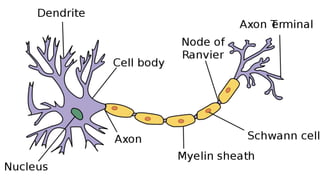
• Drugs are chemicals that affect the brain by tapping into
its communication system and interfering with the way
neurons normally send, receive, and process information.
• Some drugs, such as marijuana and heroin, can activate
neurons because their chemical structure mimics that of a
natural neurotransmitter.
• This similarity in structure “fools” receptors and allows
the drugs to attach onto and activate the neurons.
Although these drugs mimic the brain’s own chemicals,
they don’t activate neurons in the same way as a natural
neurotransmitter, and they lead to abnormal messages
being transmitted through the network.
Inhalants and Marijuana
• such as glue, paint, gasoline and aerosols, destroy
the outer lining of nerve cells and make them unable
to communicate with one another. In 1993, more
than 60 young people died from sniffing inhalants,
according to National Families in Action, a drug
education center based in Atlanta.
• Studies have found that marijuana use hinders
memory, learning, judgment and reaction times, while
steroids cause aggression and violent mood swings.
Ecstasy
•Ecstasy use is rising among young people,
Rusche said, and scientists have found
that drug destroys neurons that make
serotonin, a chemical crucial in controlling
sleep, violence, mood swings and sexual
urges.
Scientists and doctor’s opinions
about drugs
• "When people start using a drug, the scientists know nothing
about it. These people are volunteering to be guinea pigs,"
said Rusche, who is co-founder and executive director of
National Families in Action. "Once enough people take it,
scientists apply for grants and start studying it. People are
inventive. They find new drugs or new ways to take old
drugs-like crack from cocaine.
• "There's a lot we won't know about until later," she said.
"The classic example is cigarettes. We allowed people to
smoke for 100 years before we knew about all the horrible
things that nicotine will do.
The Dominant side of a Brain
• Researchers believed that brain dominance
determines a person’s preferences, problem-solving
style, personality characteristics, and even career
choices.
• For example, a right-brain individual will quickly get a
feeling for a situation, while a left-brain person will
usually ask a lot of questions first. The following
chart reflects additional difference between left
and right-brain dominance.
Personal Preferences
• Researchers believed that brain dominance determines a
person’s preferences, problem-solving style, personality
characteristics, and even career choices. For example, a
right-brain individual will quickly get a feeling for a
situation, while a left-brain person will usually ask a lot of
questions first.
• There is nothing good or bad about either preference. Both
orientations can be equally successful in accomplishing a
single task; however, one may be more appropriate over the
other depending on the situation.
Personal Preferences
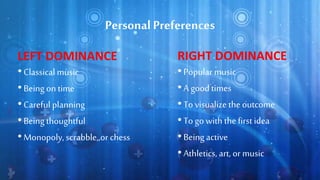
LEFT DOMINANCE
•Classicalmusic
•Being on time
•Careful planning
•Being thoughtful
•Monopoly,scrabble,,or chess
RIGHT DOMINANCE
• Popularmusic
• A good times
• To visualizethe outcome
• To gowith the first idea
• Being active
• Athletics,art, or music
RESEARCH STUDY “THE
BRAIN’S LEFT AND RIGHT
SIDES SEEM TO WORK
TOGETHER BETTER IN
MATHEMATICALLY GIFTED
MIDDLE-SCHOOL YOUTH”
LEFT
RIGHT EYE
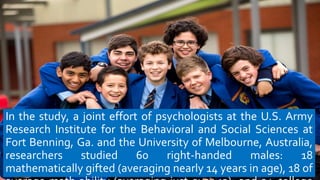
In the study, a joint effort of psychologists at the U.S. Army
Research Institute for the Behavioral and Social Sciences at
Fort Benning, Ga. and the University of Melbourne, Australia,
researchers studied 60 right-handed males: 18
mathematically gifted (averaging nearly 14 years in age), 18 of
The gifted boys were recruited from a Challenges for Youth-
Talented program at Iowa State University. Whereas the
average Scholastic Aptitude Test (SAT) math score for college-
bound high-school seniors is 500 (out of 800), the
The boys viewed letter patterns flashed on the left or right sides of a
computer screen, and had to indicate whether two patterns matched
or not - a simple way of learning how the brain responds to data put
before either the left or right visual field, corresponding to processing
in the right or left brain because the input generally crosses over to
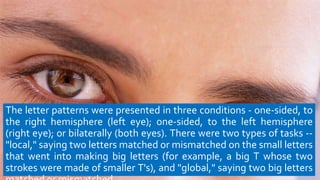
The letter patterns were presented in three conditions - one-sided, to
the right hemisphere (left eye); one-sided, to the left hemisphere
(right eye); or bilaterally (both eyes). There were two types of tasks --
"local," saying two letters matched or mismatched on the small letters
that went into making big letters (for example, a big T whose two
strokes were made of smaller T's), and "global," saying two big letters
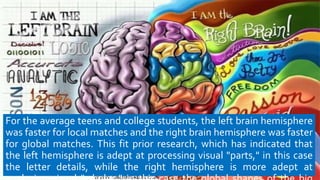
For the average teens and college students, the left brain hemisphere
was faster for local matches and the right brain hemisphere was faster
for global matches. This fit prior research, which has indicated that
the left hemisphere is adept at processing visual "parts," in this case
the letter details, while the right hemisphere is more adept at
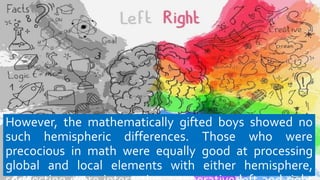
However, the mathematically gifted boys showed no
such hemispheric differences. Those who were
precocious in math were equally good at processing
global and local elements with either hemisphere,
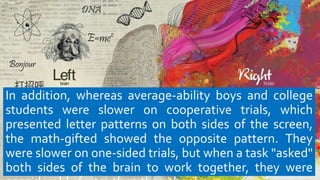
In addition, whereas average-ability boys and college
students were slower on cooperative trials, which
presented letter patterns on both sides of the screen,
the math-gifted showed the opposite pattern. They
were slower on one-sided trials, but when a task "asked"
both sides of the brain to work together, they were
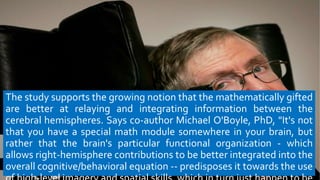
The study supports the growing notion that the mathematically gifted
are better at relaying and integrating information between the
cerebral hemispheres. Says co-author Michael O'Boyle, PhD, "It's not
that you have a special math module somewhere in your brain, but
rather that the brain's particular functional organization - which
allows right-hemisphere contributions to be better integrated into the
overall cognitive/behavioral equation -- predisposes it towards the use
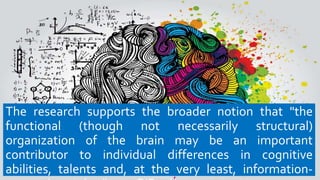
The research supports the broader notion that "the
functional (though not necessarily structural)
organization of the brain may be an important
contributor to individual differences in cognitive
abilities, talents and, at the very least, information-

Drug damage

  • 1.
  • 3.
    Drug Damage • Becauseso little recovery occurs to brains damaged after age 3, the effects of drugs and alcohol on the brain might be lasting. • Doctors know what inhalants, steroids, marijuana, cocaine and alcohol do to the brain when people use them. "The question scientists can't answer now is if the damage is permanent," said Sue Rusche, co- author of "False Messengers," a book on how addictive drugs change the brain
  • 5.
  • 9.
    How do drugswork in the brain? • Drugs are chemicals that affect the brain by tapping into its communication system and interfering with the way neurons normally send, receive, and process information. • Some drugs, such as marijuana and heroin, can activate neurons because their chemical structure mimics that of a natural neurotransmitter. • This similarity in structure “fools” receptors and allows the drugs to attach onto and activate the neurons. Although these drugs mimic the brain’s own chemicals, they don’t activate neurons in the same way as a natural neurotransmitter, and they lead to abnormal messages being transmitted through the network.
  • 10.
    Inhalants and Marijuana •such as glue, paint, gasoline and aerosols, destroy the outer lining of nerve cells and make them unable to communicate with one another. In 1993, more than 60 young people died from sniffing inhalants, according to National Families in Action, a drug education center based in Atlanta. • Studies have found that marijuana use hinders memory, learning, judgment and reaction times, while steroids cause aggression and violent mood swings.
  • 11.
    Ecstasy •Ecstasy use isrising among young people, Rusche said, and scientists have found that drug destroys neurons that make serotonin, a chemical crucial in controlling sleep, violence, mood swings and sexual urges.
  • 12.
    Scientists and doctor’sopinions about drugs • "When people start using a drug, the scientists know nothing about it. These people are volunteering to be guinea pigs," said Rusche, who is co-founder and executive director of National Families in Action. "Once enough people take it, scientists apply for grants and start studying it. People are inventive. They find new drugs or new ways to take old drugs-like crack from cocaine. • "There's a lot we won't know about until later," she said. "The classic example is cigarettes. We allowed people to smoke for 100 years before we knew about all the horrible things that nicotine will do.
  • 14.
    The Dominant sideof a Brain • Researchers believed that brain dominance determines a person’s preferences, problem-solving style, personality characteristics, and even career choices. • For example, a right-brain individual will quickly get a feeling for a situation, while a left-brain person will usually ask a lot of questions first. The following chart reflects additional difference between left and right-brain dominance.
  • 15.
    Personal Preferences • Researchersbelieved that brain dominance determines a person’s preferences, problem-solving style, personality characteristics, and even career choices. For example, a right-brain individual will quickly get a feeling for a situation, while a left-brain person will usually ask a lot of questions first. • There is nothing good or bad about either preference. Both orientations can be equally successful in accomplishing a single task; however, one may be more appropriate over the other depending on the situation.
  • 16.
    Personal Preferences LEFT DOMINANCE •Classicalmusic •Beingon time •Careful planning •Being thoughtful •Monopoly,scrabble,,or chess RIGHT DOMINANCE • Popularmusic • A good times • To visualizethe outcome • To gowith the first idea • Being active • Athletics,art, or music
  • 18.
    RESEARCH STUDY “THE BRAIN’SLEFT AND RIGHT SIDES SEEM TO WORK TOGETHER BETTER IN MATHEMATICALLY GIFTED MIDDLE-SCHOOL YOUTH”
  • 19.
  • 21.
  • 25.
    In the study,a joint effort of psychologists at the U.S. Army Research Institute for the Behavioral and Social Sciences at Fort Benning, Ga. and the University of Melbourne, Australia, researchers studied 60 right-handed males: 18 mathematically gifted (averaging nearly 14 years in age), 18 of
  • 26.
    The gifted boyswere recruited from a Challenges for Youth- Talented program at Iowa State University. Whereas the average Scholastic Aptitude Test (SAT) math score for college- bound high-school seniors is 500 (out of 800), the
  • 27.
    The boys viewedletter patterns flashed on the left or right sides of a computer screen, and had to indicate whether two patterns matched or not - a simple way of learning how the brain responds to data put before either the left or right visual field, corresponding to processing in the right or left brain because the input generally crosses over to
  • 28.
    The letter patternswere presented in three conditions - one-sided, to the right hemisphere (left eye); one-sided, to the left hemisphere (right eye); or bilaterally (both eyes). There were two types of tasks -- "local," saying two letters matched or mismatched on the small letters that went into making big letters (for example, a big T whose two strokes were made of smaller T's), and "global," saying two big letters
  • 29.
    For the averageteens and college students, the left brain hemisphere was faster for local matches and the right brain hemisphere was faster for global matches. This fit prior research, which has indicated that the left hemisphere is adept at processing visual "parts," in this case the letter details, while the right hemisphere is more adept at
  • 30.
    However, the mathematicallygifted boys showed no such hemispheric differences. Those who were precocious in math were equally good at processing global and local elements with either hemisphere,
  • 31.
    In addition, whereasaverage-ability boys and college students were slower on cooperative trials, which presented letter patterns on both sides of the screen, the math-gifted showed the opposite pattern. They were slower on one-sided trials, but when a task "asked" both sides of the brain to work together, they were
  • 32.
    The study supportsthe growing notion that the mathematically gifted are better at relaying and integrating information between the cerebral hemispheres. Says co-author Michael O'Boyle, PhD, "It's not that you have a special math module somewhere in your brain, but rather that the brain's particular functional organization - which allows right-hemisphere contributions to be better integrated into the overall cognitive/behavioral equation -- predisposes it towards the use
  • 33.
    The research supportsthe broader notion that "the functional (though not necessarily structural) organization of the brain may be an important contributor to individual differences in cognitive abilities, talents and, at the very least, information-

Editor's Notes