Exoplanet Mass and Radius and 
the Physics of Planetary Interiors 
Trent Schindler 
Trent Schindler 
Sara Seager 
Massachusetts 
Institute of 
Technology
Casey Reid 
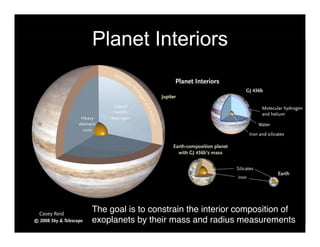
Planet Interiors 
The goal is to constrain the interior composition of 
exoplanets by their mass and radius measurements
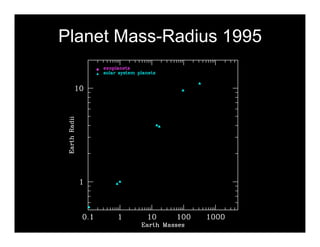
Planet Mass-Radius 1995
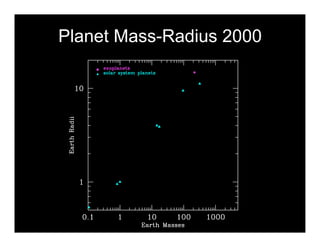
Planet Mass-Radius 2000
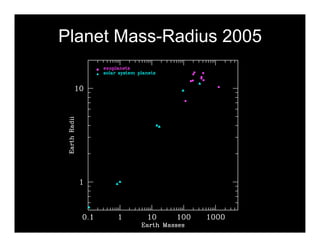
Planet Mass-Radius 2005
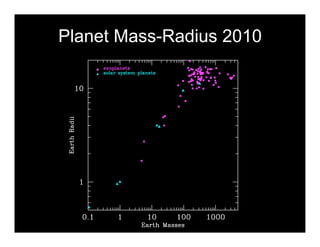
Planet Mass-Radius 2010
Exoplanet Interiors 
Introduction 
Mass-Radius Relationships 
Two Transiting Super Earths 
Kepler and Beyond
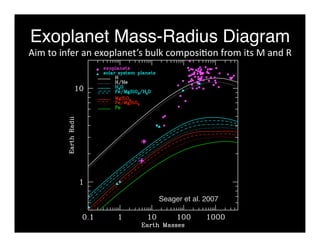
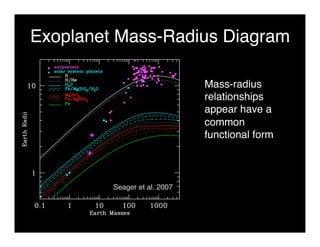
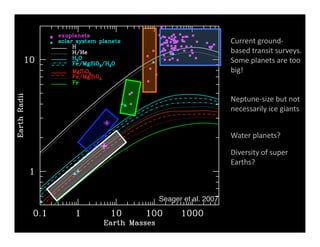
Exoplanet Mass-Radius Diagram 
Aim to infer an exoplanet’s bulk composi<on from its M and R 
Seager et al. 2007
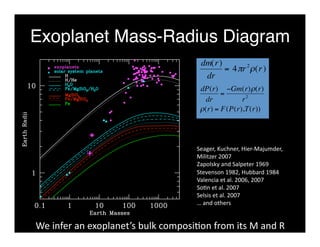
Exoplanet Mass-Radius Diagram 
dm(r ) 
dr 
dP(r) 
dr 
= 4πr 2ρ(r ) 
= 
−Gm(r)ρ(r) 
r2 
€ ρ(r) = F(P(r),T(r)) 
Seager, Kuchner, Hier‐Majumder, 
Militzer 2007 
Zapolsky and Salpeter 1969 
Stevenson 1982, Hubbard 1984 
Valencia et al. 2006, 2007 
So<n et al. 2007 
Selsis et al. 2007 
… and others 
€ 
We infer an exoplanet’s bulk composi<on from its M and R
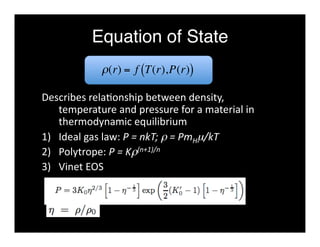
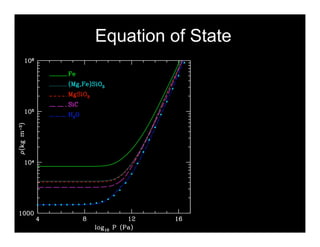
Equation of State 
ρ(r) = f (T(r),P(r)) 
Describes rela<onship between density, 
temperature and pressure for a material in 
thermodynamic equilibrium 
€ 
1) Ideal gas law: P = nkT; ρ = PmHμ/kT 
2) Polytrope: P = Kρ(n+1)/n 
3) Vinet EOS
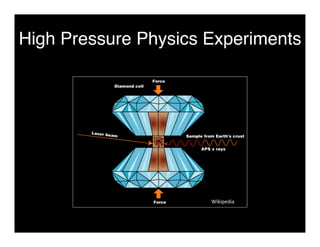
High Pressure Physics Experiments 
Wikipedia
Exoplanet Mass-Radius Diagram 
Mass-radius 
relationships 
appear have a 
common 
functional form 
Seager et al. 2007
Equation of State 
Ms << 1 
Ms <~ 4 
€ 
Seager et al. 2007 
log10 Rs = −0.209 +1/3log10 Ms − 0.0804 × Ms 
0.394
Equation of State 
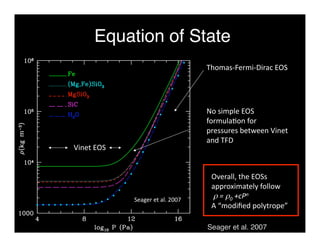
Overall, the EOSs 
Ms << 1 
approximately follow 
ρ = ρ0 +cPn 
A “modified polytrope” Ms <~ 4 
€ 
Seager et al. 2007 
log10 Rs = −0.209 +1/3log10 Ms − 0.0804 × Ms 
0.394 
Thomas‐Fermi‐Dirac EOS 
Vinet EOS 
No simple EOS 
formula<on for 
pressures between Vinet 
and TFD 
Seager et al. 2007
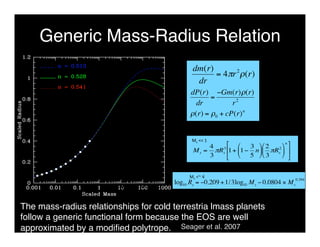
Generic Mass-Radius Relation 
€ 
Ms << 1 
Ms = 
4 
3 
 n 
 
3 1+ 1− 
πRs 
3 
5 
n 
 
 
 
 
 
2  
 
 
2 
3 
πRs 
 
 
 
 
 
 
 
 
Ms <~ 4 
€ 
log10 Rs = −0.209 +1/3log10 Ms − 0.0804 × Ms 
0.394 
€ 
Seager et al. 2007 
dm(r) 
dr 
= 4πr2ρ(r) 
€ 
dP(r) 
dr 
= 
−Gm(r)ρ(r) 
r2 
ρ(r) = ρ0 + cP(r)n 
The mass-radius relationships for cold terrestria lmass planets 
follow a generic functional form because the EOS are well 
approximated by a modified polytrope. 
Seager et al. 2007
Current ground‐based 
transit surveys. 
Some planets are too 
big! 
Neptune‐size but not 
necessarily ice giants 
Water planets? 
Diversity of super 
Earths? 
Seager et al. 2007
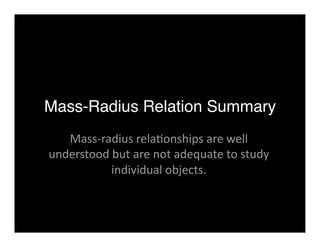
Mass-Radius Relation Summary 
Mass‐radius rela<onships are well 
understood but are not adequate to study 
individual objects.
Exoplanet Interiors 
Introduction 
Mass-Radius Relationships 
Two Transiting Super Earths 
Kepler and Beyond
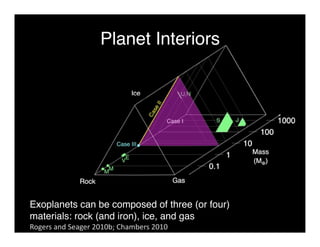
Planet Interiors 
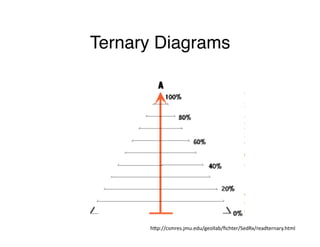
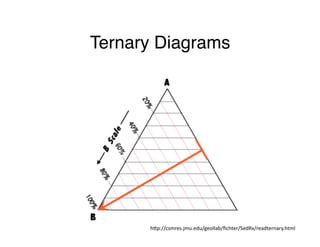
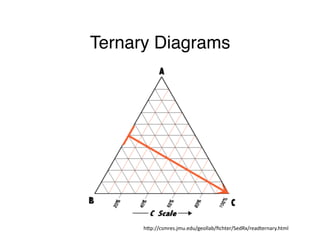
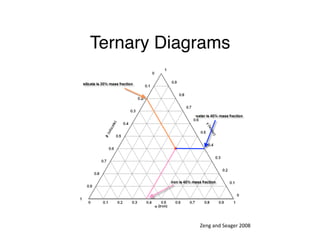
Exoplanets can be composed of three (or four) 
materials: rock (and iron), ice, and gas 
Rogers and Seager 2010b; Chambers 2010
Ternary Diagrams 
hgp://csmres.jmu.edu/geollab/fichter/SedRx/readternary.html
Ternary Diagrams 
hgp://csmres.jmu.edu/geollab/fichter/SedRx/readternary.html
Ternary Diagrams 
hgp://csmres.jmu.edu/geollab/fichter/SedRx/readternary.html
Ternary Diagrams 
Zeng and Seager 2008
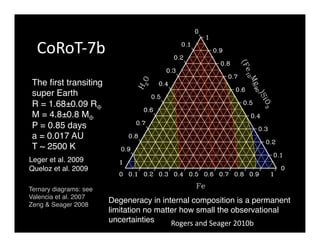
CoRoT‐7b 
The first transiting 
super Earth 
R = 1.68±0.09 R 
M = 4.8±0.8 M 
P = 0.85 days 
a = 0.017 AU 
T ~ 2500 K 
Leger et al. 2009 
Queloz et al. 2009 
Degeneracy in internal composition is a permanent 
limitation no matter how small the observational 
uncertainties 
Rogers and Seager 2010b 
Ternary diagrams: see 
Valencia et al. 2007 
Zeng & Seager 2008
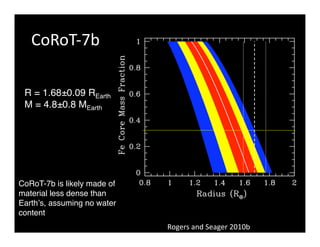
CoRoT‐7b 
Rogers and Seager 2010b 
R = 1.68±0.09 REarth 
M = 4.8±0.8 MEarth 
CoRoT-7b is likely made of 
material less dense than 
Earthʼs, assuming no water 
content
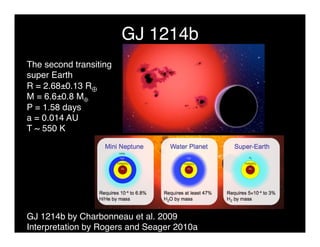
GJ 1214b 
The second transiting 
super Earth 
R = 2.68±0.13 R 
M = 6.6±0.8 M 
P = 1.58 days 
a = 0.014 AU 
T ~ 550 K 
GJ 1214b by Charbonneau et al. 2009 
Interpretation by Rogers and Seager 2010a
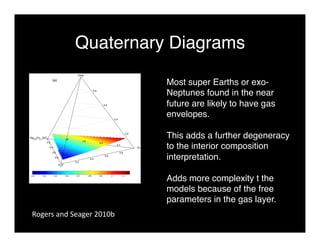
Quaternary Diagrams 
Most super Earths or exo- 
Neptunes found in the near 
future are likely to have gas 
envelopes. 
This adds a further degeneracy 
to the interior composition 
interpretation. 
Adds more complexity t the 
models because of the free 
parameters in the gas layer. 
Rogers and Seager 2010b
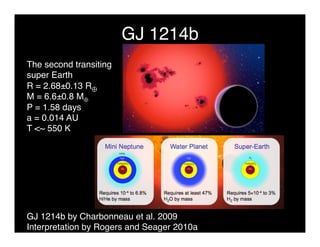
GJ 1214b 
The second transiting 
super Earth 
R = 2.68±0.13 R 
M = 6.6±0.8 M 
P = 1.58 days 
a = 0.014 AU 
T <~ 550 K 
GJ 1214b by Charbonneau et al. 2009 
Interpretation by Rogers and Seager 2010a
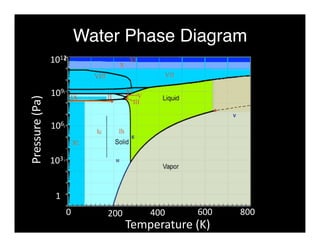
Water Phase Diagram 
1012 
109 
106 
103 
1 
Pressure (Pa) 
0 200 400 600 800 
Temperature (K)
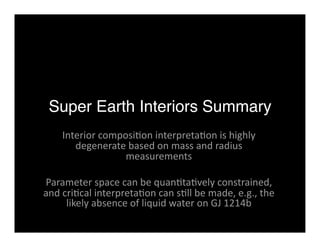
Super Earth Interiors Summary 
Interior composi<on interpreta<on is highly 
degenerate based on mass and radius 
measurements 
Parameter space can be quan<ta<vely constrained, 
and cri<cal interpreta<on can s<ll be made, e.g., the 
likely absence of liquid water on GJ 1214b
Exoplanet Interiors 
Introduction 
Mass-Radius Relationships 
Two Transiting Super Earths 
Kepler and Beyond
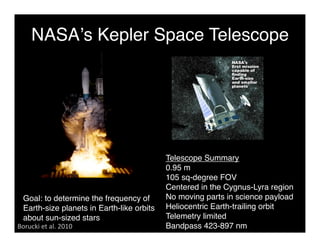
NASAʼs Kepler Space Telescope 
Telescope Summary 
0.95 m 
105 sq-degree FOV 
Centered in the Cygnus-Lyra region 
No moving parts in science payload 
Heliocentric Earth-trailing orbit 
Telemetry limited 
Bandpass 423-897 nm 
Goal: to determine the frequency of 
Earth-size planets in Earth-like orbits 
about sun-sized stars 
Borucki et al. 2010
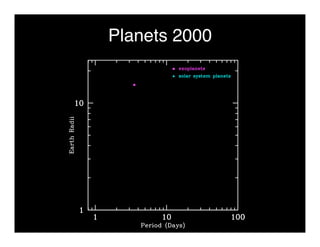
Planets 2000
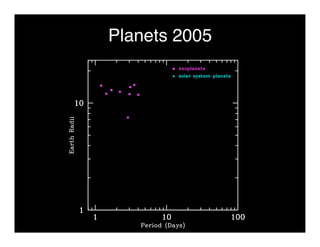
Planets 2005
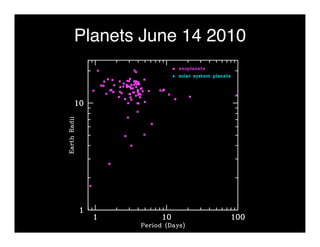
Planets June 14 2010
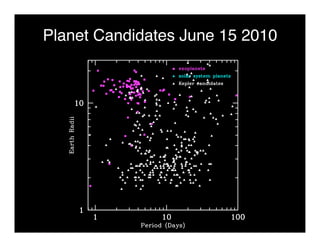
Planet Candidates June 15 2010
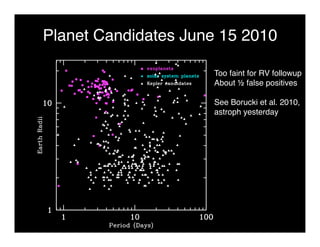
Planet Candidates June 15 2010 
Too faint for RV followup 
About ½ false positives 
See Borucki et al. 2010, 
astroph yesterday
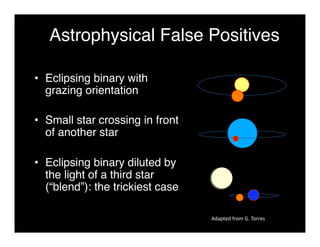
Astrophysical False Positives 
• Eclipsing binary with 
grazing orientation 
• Small star crossing in front 
of another star 
• Eclipsing binary diluted by 
the light of a third star 
(“blend”): the trickiest case 
Adapted from G. Torres
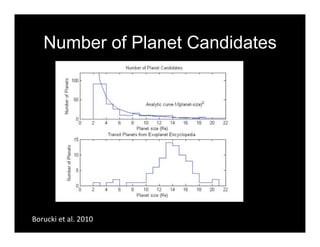
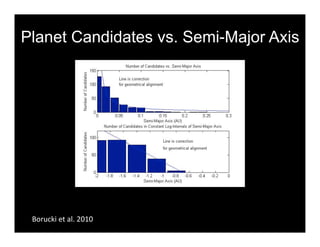
Number of Planet Candidates 
Borucki et al. 2010
Planet Candidates vs. Semi-Major Axis 
Borucki et al. 2010
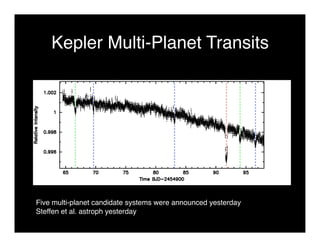
Kepler Multi-Planet Transits 
Five multi-planet candidate systems were announced yesterday 
Steffen et al. astroph yesterday
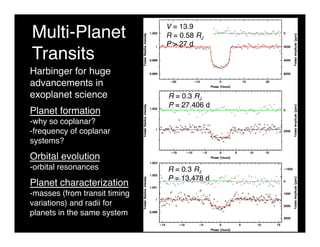
Multi-Planet 
Transits 
Harbinger for huge 
advancements in 
exoplanet science 
Planet formation 
-why so coplanar? 
-frequency of coplanar 
systems? 
Orbital evolution 
-orbital resonances 
Planet characterization 
-masses (from transit timing 
variations) and radii for 
planets in the same system 
V = 13.9 
R = 0.58 RJ 
P > 27 d 
R = 0.3 RJ 
P = 27.406 d 
R = 0.3 RJ 
P = 13.478 d
Kepler Summary 
Kepler will more than double the number of exoplanets, 
extending the orbital separa<on of transi<ng planets out 
to 1 AU. 
The data release is a game‐changer for exoplanet science 
in terms of quan<ty vs. detailed physical proper<es 
The plan is to connect radii vs. period with planet 
interiors and popula<on synthesis models to constrain 
planet forma<on models
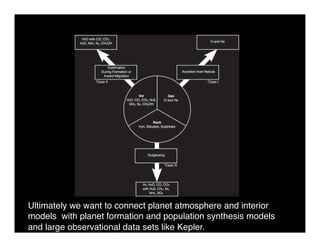
Ultimately we want to connect planet atmosphere and interior 
models with planet formation and population synthesis models 
and large observational data sets like Kepler.
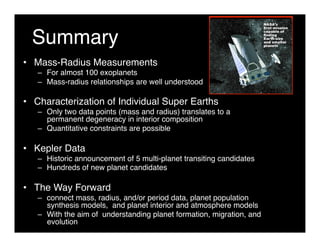
Summary 
• Mass-Radius Measurements 
– For almost 100 exoplanets 
– Mass-radius relationships are well understood 
• Characterization of Individual Super Earths 
– Only two data points (mass and radius) translates to a 
permanent degeneracy in interior composition 
– Quantitative constraints are possible 
• Kepler Data 
– Historic announcement of 5 multi-planet transiting candidates 
– Hundreds of new planet candidates 
• The Way Forward 
– connect mass, radius, and/or period data, planet population 
synthesis models, and planet interior and atmosphere models 
– With the aim of understanding planet formation, migration, and 
evolution

Sara Seager - Lecture2 - MIT

  • 1.
    Exoplanet Mass andRadius and the Physics of Planetary Interiors Trent Schindler Trent Schindler Sara Seager Massachusetts Institute of Technology
  • 2.
    Casey Reid PlanetInteriors The goal is to constrain the interior composition of exoplanets by their mass and radius measurements
  • 3.
  • 4.
  • 5.
  • 6.
  • 7.
    Exoplanet Interiors Introduction Mass-Radius Relationships Two Transiting Super Earths Kepler and Beyond
  • 8.
    Exoplanet Mass-Radius Diagram Aim to infer an exoplanet’s bulk composi<on from its M and R Seager et al. 2007
  • 9.
    Exoplanet Mass-Radius Diagram dm(r ) dr dP(r) dr = 4πr 2ρ(r ) = −Gm(r)ρ(r) r2 € ρ(r) = F(P(r),T(r)) Seager, Kuchner, Hier‐Majumder, Militzer 2007 Zapolsky and Salpeter 1969 Stevenson 1982, Hubbard 1984 Valencia et al. 2006, 2007 So<n et al. 2007 Selsis et al. 2007 … and others € We infer an exoplanet’s bulk composi<on from its M and R
  • 10.
    Equation of State ρ(r) = f (T(r),P(r)) Describes rela<onship between density, temperature and pressure for a material in thermodynamic equilibrium € 1) Ideal gas law: P = nkT; ρ = PmHμ/kT 2) Polytrope: P = Kρ(n+1)/n 3) Vinet EOS
  • 11.
    High Pressure PhysicsExperiments Wikipedia
  • 12.
    Exoplanet Mass-Radius Diagram Mass-radius relationships appear have a common functional form Seager et al. 2007
  • 13.
    Equation of State Ms << 1 Ms <~ 4 € Seager et al. 2007 log10 Rs = −0.209 +1/3log10 Ms − 0.0804 × Ms 0.394
  • 14.
    Equation of State Overall, the EOSs Ms << 1 approximately follow ρ = ρ0 +cPn A “modified polytrope” Ms <~ 4 € Seager et al. 2007 log10 Rs = −0.209 +1/3log10 Ms − 0.0804 × Ms 0.394 Thomas‐Fermi‐Dirac EOS Vinet EOS No simple EOS formula<on for pressures between Vinet and TFD Seager et al. 2007
  • 15.
    Generic Mass-Radius Relation € Ms << 1 Ms = 4 3  n  3 1+ 1− πRs 3 5 n      2    2 3 πRs         Ms <~ 4 € log10 Rs = −0.209 +1/3log10 Ms − 0.0804 × Ms 0.394 € Seager et al. 2007 dm(r) dr = 4πr2ρ(r) € dP(r) dr = −Gm(r)ρ(r) r2 ρ(r) = ρ0 + cP(r)n The mass-radius relationships for cold terrestria lmass planets follow a generic functional form because the EOS are well approximated by a modified polytrope. Seager et al. 2007
  • 16.
    Current ground‐based transitsurveys. Some planets are too big! Neptune‐size but not necessarily ice giants Water planets? Diversity of super Earths? Seager et al. 2007
  • 17.
    Mass-Radius Relation Summary Mass‐radius rela<onships are well understood but are not adequate to study individual objects.
  • 18.
    Exoplanet Interiors Introduction Mass-Radius Relationships Two Transiting Super Earths Kepler and Beyond
  • 19.
    Planet Interiors Exoplanetscan be composed of three (or four) materials: rock (and iron), ice, and gas Rogers and Seager 2010b; Chambers 2010
  • 20.
  • 21.
  • 22.
  • 23.
    Ternary Diagrams Zengand Seager 2008
  • 24.
    CoRoT‐7b The firsttransiting super Earth R = 1.68±0.09 R M = 4.8±0.8 M P = 0.85 days a = 0.017 AU T ~ 2500 K Leger et al. 2009 Queloz et al. 2009 Degeneracy in internal composition is a permanent limitation no matter how small the observational uncertainties Rogers and Seager 2010b Ternary diagrams: see Valencia et al. 2007 Zeng & Seager 2008
  • 25.
    CoRoT‐7b Rogers andSeager 2010b R = 1.68±0.09 REarth M = 4.8±0.8 MEarth CoRoT-7b is likely made of material less dense than Earthʼs, assuming no water content
  • 26.
    GJ 1214b Thesecond transiting super Earth R = 2.68±0.13 R M = 6.6±0.8 M P = 1.58 days a = 0.014 AU T ~ 550 K GJ 1214b by Charbonneau et al. 2009 Interpretation by Rogers and Seager 2010a
  • 27.
    Quaternary Diagrams Mostsuper Earths or exo- Neptunes found in the near future are likely to have gas envelopes. This adds a further degeneracy to the interior composition interpretation. Adds more complexity t the models because of the free parameters in the gas layer. Rogers and Seager 2010b
  • 28.
    GJ 1214b Thesecond transiting super Earth R = 2.68±0.13 R M = 6.6±0.8 M P = 1.58 days a = 0.014 AU T <~ 550 K GJ 1214b by Charbonneau et al. 2009 Interpretation by Rogers and Seager 2010a
  • 29.
    Water Phase Diagram 1012 109 106 103 1 Pressure (Pa) 0 200 400 600 800 Temperature (K)
  • 30.
    Super Earth InteriorsSummary Interior composi<on interpreta<on is highly degenerate based on mass and radius measurements Parameter space can be quan<ta<vely constrained, and cri<cal interpreta<on can s<ll be made, e.g., the likely absence of liquid water on GJ 1214b
  • 31.
    Exoplanet Interiors Introduction Mass-Radius Relationships Two Transiting Super Earths Kepler and Beyond
  • 32.
    NASAʼs Kepler SpaceTelescope Telescope Summary 0.95 m 105 sq-degree FOV Centered in the Cygnus-Lyra region No moving parts in science payload Heliocentric Earth-trailing orbit Telemetry limited Bandpass 423-897 nm Goal: to determine the frequency of Earth-size planets in Earth-like orbits about sun-sized stars Borucki et al. 2010
  • 33.
  • 34.
  • 35.
  • 36.
  • 37.
    Planet Candidates June15 2010 Too faint for RV followup About ½ false positives See Borucki et al. 2010, astroph yesterday
  • 38.
    Astrophysical False Positives • Eclipsing binary with grazing orientation • Small star crossing in front of another star • Eclipsing binary diluted by the light of a third star (“blend”): the trickiest case Adapted from G. Torres
  • 39.
    Number of PlanetCandidates Borucki et al. 2010
  • 40.
    Planet Candidates vs.Semi-Major Axis Borucki et al. 2010
  • 41.
    Kepler Multi-Planet Transits Five multi-planet candidate systems were announced yesterday Steffen et al. astroph yesterday
  • 42.
    Multi-Planet Transits Harbingerfor huge advancements in exoplanet science Planet formation -why so coplanar? -frequency of coplanar systems? Orbital evolution -orbital resonances Planet characterization -masses (from transit timing variations) and radii for planets in the same system V = 13.9 R = 0.58 RJ P > 27 d R = 0.3 RJ P = 27.406 d R = 0.3 RJ P = 13.478 d
  • 43.
    Kepler Summary Keplerwill more than double the number of exoplanets, extending the orbital separa<on of transi<ng planets out to 1 AU. The data release is a game‐changer for exoplanet science in terms of quan<ty vs. detailed physical proper<es The plan is to connect radii vs. period with planet interiors and popula<on synthesis models to constrain planet forma<on models
  • 44.
    Ultimately we wantto connect planet atmosphere and interior models with planet formation and population synthesis models and large observational data sets like Kepler.
  • 45.
    Summary • Mass-RadiusMeasurements – For almost 100 exoplanets – Mass-radius relationships are well understood • Characterization of Individual Super Earths – Only two data points (mass and radius) translates to a permanent degeneracy in interior composition – Quantitative constraints are possible • Kepler Data – Historic announcement of 5 multi-planet transiting candidates – Hundreds of new planet candidates • The Way Forward – connect mass, radius, and/or period data, planet population synthesis models, and planet interior and atmosphere models – With the aim of understanding planet formation, migration, and evolution