Active Appearance Models

        Edwards, Taylor, and Cootes

        Presented by Bryan Russell
Overview
 Overview of Appearance Models
 Combined Appearance Models
 Active Appearance Model Search
 Results
 Constrained Active Appearance
  Models
What are we trying to do?
 Formulate   model to “interpret” face
 images
  – Set of parameters to characterize
    identity, pose, expression, lighting, etc.
  – Want compact set of parameters
  – Want efficient and robust model
Appearance Models
 Eigenfaces   (Turk and Pentland, 1991)
  – Not robust to shape changes
  – Not robust to changes in pose and
    expression
 Ezzat   and Poggio approach (1996)
  – Synthesize new views of face from set
    of example views
  – Does not generalize to unseen faces
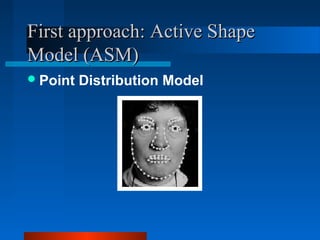
First approach: Active Shape
Model (ASM)
 Point   Distribution Model
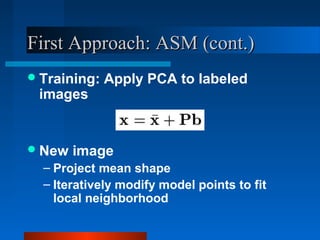
First Approach: ASM (cont.)
 Training:   Apply PCA to labeled
 images


 New   image
  – Project mean shape
  – Iteratively modify model points to fit
    local neighborhood
Lessons learned
 ASM  is relatively fast
 ASM too simplistic; not robust when
  new images are introduced
 May not converge to good solution
 Key insight: ASM does not
  incorporate all gray-level information
  in parameters
Combined Appearance Models
 Combine   shape and gray-level
  variation in single statistical
  appearance model
 Goals:
  – Model has better representational power
  – Model inherits appearance models
    benefits
  – Model has comparable performance
How to generate a CAM
 Label training set with landmark
  points representing positions of key
  features
 Represent these landmarks as a
  vector x
 Perform PCA on these landmark
  vectors
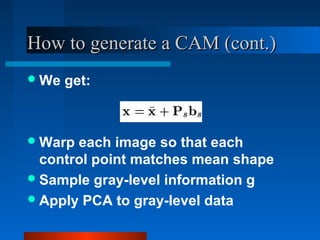
How to generate a CAM (cont.)
 We   get:


 Warp each image so that each
  control point matches mean shape
 Sample gray-level information g
 Apply PCA to gray-level data
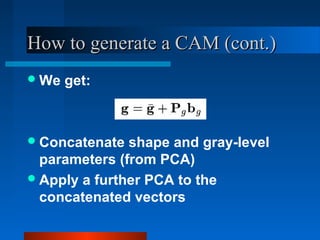
How to generate a CAM (cont.)
 We   get:


 Concatenate  shape and gray-level
  parameters (from PCA)
 Apply a further PCA to the
  concatenated vectors
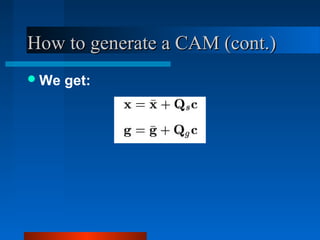
How to generate a CAM (cont.)
 We   get:
CAM Properties
 Combines  shape and gray-level
 variations in one model
  – No need for separate models
 Compared   to separate models, in
  general, needs fewer parameters
 Uses all available information
CAM Properties (cont.)
 Inherits   appearance model benefits
  – Able to represent any face within
    bounds of the training set
  – Robust interpretation
 Model parameters characterize facial
 features
CAM Properties (cont.)
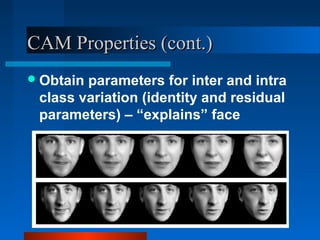
 Obtainparameters for inter and intra
 class variation (identity and residual
 parameters) – “explains” face
CAM Properties (cont.)
 Useful    for tracking and identification
  – Refer to: G.J.Edwards, C.J.Taylor, T.F.Cootes. "Learning
    to Identify and Track Faces in Image Sequences“. Int.
    Conf. on Face and Gesture Recognition, p. 260-265,
    1998.
 Note:shape and gray-level variations
 are correlated
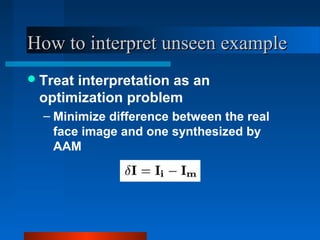
How to interpret unseen example
 Treat
      interpretation as an
 optimization problem
  – Minimize difference between the real
    face image and one synthesized by
    AAM
How to interpret unseen example
(cont.)
 Appears  to be difficult optimization
  problem (~80 parameters)
 Key insight: we solve a similar
  optimization problem for each new
  face image
 Incorporate a-priori knowledge for
  parameter adjustments into
  algorithm
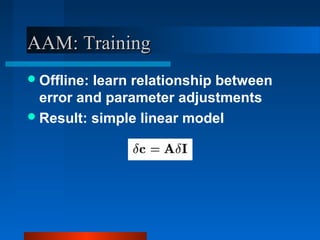
AAM: Training
 Offline:learn relationship between
  error and parameter adjustments
 Result: simple linear model
AAM: Training (cont.)
 Usemultiple multivariate linear
 regression
  – Generate training set by perturbing
    model parameters for training images
  – Include small displacements in position,
    scale, and orientation
  – Record perturbation and image
    difference
AAM: Training (cont.)
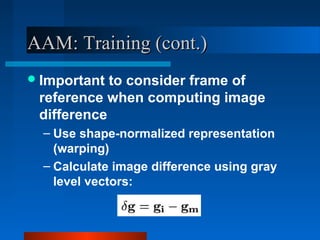
 Important to consider frame of
 reference when computing image
 difference
  – Use shape-normalized representation
    (warping)
  – Calculate image difference using gray
    level vectors:
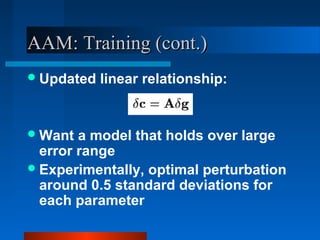
AAM: Training (cont.)
 Updated   linear relationship:


 Want  a model that holds over large
  error range
 Experimentally, optimal perturbation
  around 0.5 standard deviations for
  each parameter
AAM: Search
 Begin with reasonable starting
  approximation for face
 Want approximation to be fast and
  simple
 Perhaps Viola’s method can be
  applied here
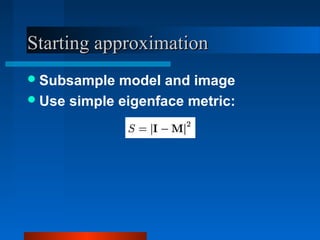
Starting approximation
 Subsample  model and image
 Use simple eigenface metric:
Starting approximation (cont.)
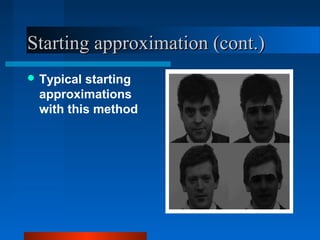
 Typicalstarting
 approximations
 with this method
AAM: Search (cont.)
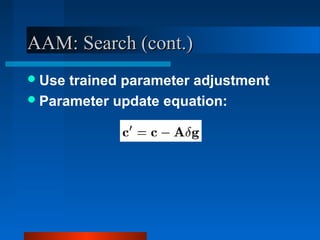
 Use trained parameter adjustment
 Parameter update equation:
Experimental results
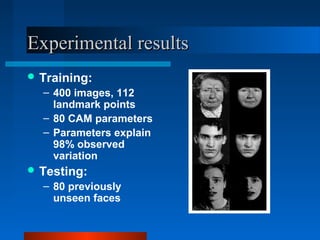
 Training:
  – 400 images, 112
    landmark points
  – 80 CAM parameters
  – Parameters explain
    98% observed
    variation
 Testing:
  – 80 previously
    unseen faces
Experimental results (cont.)
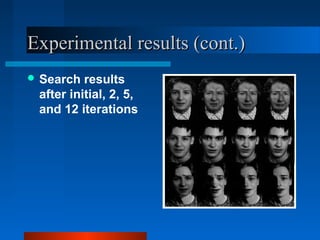
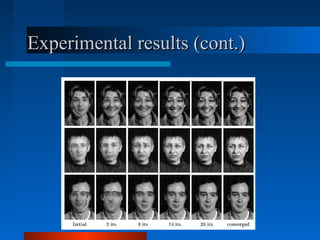
 Search  results
 after initial, 2, 5,
 and 12 iterations
Experimental results (cont.)
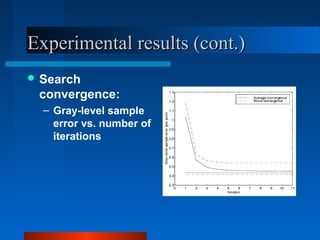
 Search
 convergence:
  – Gray-level sample
    error vs. number of
    iterations
Experimental results (cont.)
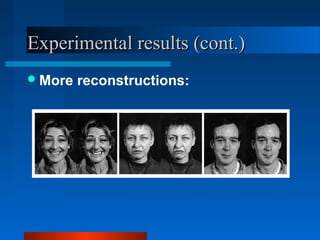
 More   reconstructions:
Experimental results (cont.)
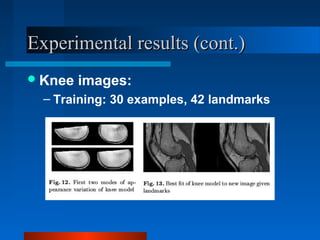
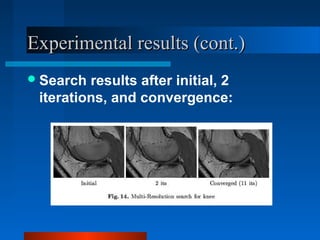
 Knee   images:
  – Training: 30 examples, 42 landmarks
Experimental results (cont.)
 Search results after initial, 2
 iterations, and convergence:
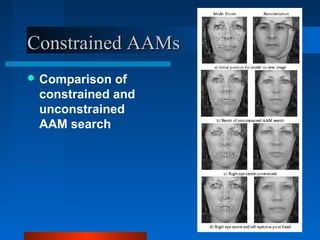
Constrained AAMs
 Model results rely on starting
  approximation
 Want a method to improve influence
  from starting approximation
 Incorporate priors/user input on
  unseen image
  – MAP formulation
Constrained AAMs
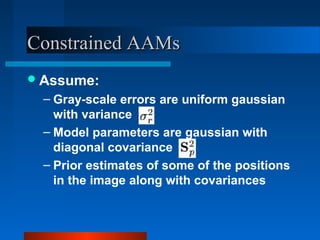
 Assume:
 – Gray-scale errors are uniform gaussian
   with variance
 – Model parameters are gaussian with
   diagonal covariance
 – Prior estimates of some of the positions
   in the image along with covariances
Constrained AAMs (cont.)
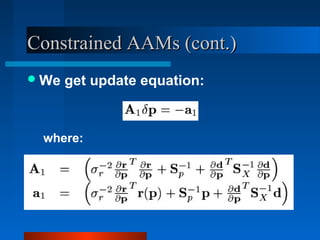
 We   get update equation:


 where:
Constrained AAMs
 Comparison of
 constrained and
 unconstrained
 AAM search
Conclusions
 Combined  Appearance Models
 provide an effective means to
 separate identity and intra-class
 variation
  – Can be used for tracking and face
    classification
 ActiveAppearance Models enables
 us to effectively and efficiently
 update the model parameters
Conclusions (cont.)
 Approach   dependent on starting
  approximation
 Cannot directly handle cases well
  outside of the training set (e.g.
  occlusions, extremely deformable
  objects)

Lecture17aam

  • 1.
    Active Appearance Models Edwards, Taylor, and Cootes Presented by Bryan Russell
  • 2.
    Overview  Overview ofAppearance Models  Combined Appearance Models  Active Appearance Model Search  Results  Constrained Active Appearance Models
  • 3.
    What are wetrying to do?  Formulate model to “interpret” face images – Set of parameters to characterize identity, pose, expression, lighting, etc. – Want compact set of parameters – Want efficient and robust model
  • 4.
    Appearance Models  Eigenfaces (Turk and Pentland, 1991) – Not robust to shape changes – Not robust to changes in pose and expression  Ezzat and Poggio approach (1996) – Synthesize new views of face from set of example views – Does not generalize to unseen faces
  • 5.
    First approach: ActiveShape Model (ASM)  Point Distribution Model
  • 6.
    First Approach: ASM(cont.)  Training: Apply PCA to labeled images  New image – Project mean shape – Iteratively modify model points to fit local neighborhood
  • 7.
    Lessons learned  ASM is relatively fast  ASM too simplistic; not robust when new images are introduced  May not converge to good solution  Key insight: ASM does not incorporate all gray-level information in parameters
  • 8.
    Combined Appearance Models Combine shape and gray-level variation in single statistical appearance model  Goals: – Model has better representational power – Model inherits appearance models benefits – Model has comparable performance
  • 9.
    How to generatea CAM  Label training set with landmark points representing positions of key features  Represent these landmarks as a vector x  Perform PCA on these landmark vectors
  • 10.
    How to generatea CAM (cont.)  We get:  Warp each image so that each control point matches mean shape  Sample gray-level information g  Apply PCA to gray-level data
  • 11.
    How to generatea CAM (cont.)  We get:  Concatenate shape and gray-level parameters (from PCA)  Apply a further PCA to the concatenated vectors
  • 12.
    How to generatea CAM (cont.)  We get:
  • 13.
    CAM Properties  Combines shape and gray-level variations in one model – No need for separate models  Compared to separate models, in general, needs fewer parameters  Uses all available information
  • 14.
    CAM Properties (cont.) Inherits appearance model benefits – Able to represent any face within bounds of the training set – Robust interpretation  Model parameters characterize facial features
  • 15.
    CAM Properties (cont.) Obtainparameters for inter and intra class variation (identity and residual parameters) – “explains” face
  • 16.
    CAM Properties (cont.) Useful for tracking and identification – Refer to: G.J.Edwards, C.J.Taylor, T.F.Cootes. "Learning to Identify and Track Faces in Image Sequences“. Int. Conf. on Face and Gesture Recognition, p. 260-265, 1998.  Note:shape and gray-level variations are correlated
  • 17.
    How to interpretunseen example  Treat interpretation as an optimization problem – Minimize difference between the real face image and one synthesized by AAM
  • 18.
    How to interpretunseen example (cont.)  Appears to be difficult optimization problem (~80 parameters)  Key insight: we solve a similar optimization problem for each new face image  Incorporate a-priori knowledge for parameter adjustments into algorithm
  • 19.
    AAM: Training  Offline:learnrelationship between error and parameter adjustments  Result: simple linear model
  • 20.
    AAM: Training (cont.) Usemultiple multivariate linear regression – Generate training set by perturbing model parameters for training images – Include small displacements in position, scale, and orientation – Record perturbation and image difference
  • 21.
    AAM: Training (cont.) Important to consider frame of reference when computing image difference – Use shape-normalized representation (warping) – Calculate image difference using gray level vectors:
  • 22.
    AAM: Training (cont.) Updated linear relationship:  Want a model that holds over large error range  Experimentally, optimal perturbation around 0.5 standard deviations for each parameter
  • 23.
    AAM: Search  Beginwith reasonable starting approximation for face  Want approximation to be fast and simple  Perhaps Viola’s method can be applied here
  • 24.
    Starting approximation  Subsample model and image  Use simple eigenface metric:
  • 25.
    Starting approximation (cont.) Typicalstarting approximations with this method
  • 26.
    AAM: Search (cont.) Use trained parameter adjustment  Parameter update equation:
  • 27.
    Experimental results  Training: – 400 images, 112 landmark points – 80 CAM parameters – Parameters explain 98% observed variation  Testing: – 80 previously unseen faces
  • 28.
    Experimental results (cont.) Search results after initial, 2, 5, and 12 iterations
  • 29.
    Experimental results (cont.) Search convergence: – Gray-level sample error vs. number of iterations
  • 30.
    Experimental results (cont.) More reconstructions:
  • 31.
  • 32.
    Experimental results (cont.) Knee images: – Training: 30 examples, 42 landmarks
  • 33.
    Experimental results (cont.) Search results after initial, 2 iterations, and convergence:
  • 34.
    Constrained AAMs  Modelresults rely on starting approximation  Want a method to improve influence from starting approximation  Incorporate priors/user input on unseen image – MAP formulation
  • 35.
    Constrained AAMs  Assume: – Gray-scale errors are uniform gaussian with variance – Model parameters are gaussian with diagonal covariance – Prior estimates of some of the positions in the image along with covariances
  • 36.
    Constrained AAMs (cont.) We get update equation: where:
  • 37.
    Constrained AAMs  Comparisonof constrained and unconstrained AAM search
  • 38.
    Conclusions  Combined Appearance Models provide an effective means to separate identity and intra-class variation – Can be used for tracking and face classification  ActiveAppearance Models enables us to effectively and efficiently update the model parameters
  • 39.
    Conclusions (cont.)  Approach dependent on starting approximation  Cannot directly handle cases well outside of the training set (e.g. occlusions, extremely deformable objects)