An Introduction toFace
Detection and Recognition
Ziyou Xiong
Dept. of Electrical and Computer
Engineering,
Univ. of Illinois at Urbana-Champaign
2.
Outline
Face Detection
Whatis face detection?
Importance of face detection
Current state of research
Different approaches
One example
Face Recognition
What is face recognition?
Its applications
Different approaches
One example
A Video Demo
3.
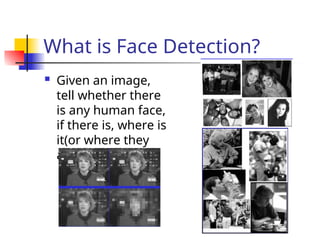
What is FaceDetection?
Given an image,
tell whether there
is any human face,
if there is, where is
it(or where they
are).
4.
Importance of Face
Detection
The first step for any automatic face recognition
system system
First step in many Human Computer Interaction
systems
Expression Recognition
Cognitive State/Emotional State Recogntion
First step in many surveillance systems
Tracking: Face is a highly non rigid object
A step towards Automatic Target Recognition(ATR)
or generic object detection/recognition
Video coding……
5.
Face Detection: currentstate
State-of-the-art:
Front-view face detection can be done at
>15 frames per second on 320x240
black-and-white images on a 700MHz PC
with ~95% accuracy.
Detection of faces is faster than
detection of edges!
Side view face detection remains to
be difficult.
6.
Face Detection: challenges
Out-of-Plane Rotation: frontal, 45 degree, profile,
upside down
Presence of beard, mustache, glasses etc
Facial Expressions
Occlusions by long hair, hand
In-Plane Rotation
Image conditions:
Size
Lighting condition
Distortion
Noise
Compression
7.
Different Approaches
Knowledge-basedmethods:
Encode what constitutes a typical face, e.g., the
relationship between facial features
Feature invariant approaches:
Aim to find structure features of a face that exist even
when pose, viewpoint or lighting conditions vary
Template matching:
Several standard patterns stored to describe the face as
a whole or the facial features separately
Appearance-based methods:
The models are learned from a set of training images
that capture the representative variability of faces.
8.
Knowledge-Based Methods
TopTop-down approach: Represent a face
using a set of human-coded rules
Example:
The center part of face has uniform intensity
values
The difference between the average intensity
values of the center part and the upper part is
significant
A face often appears with two eyes that are
symmetric to each other, a nose and a mouth
Use these rules to guide the search process
9.
Knowledge-Based Method:
[Yang andHuang 94]
Level 1 (lowest resolution):
apply the rule “the center part of the face has 4
cells with a basically uniform intensity” to
search for candidates
Level 2: local histogram equalization
followed by edge equalization followed by
edge detection
Level 3: search for eye and mouth features
for validation
10.
Knowledge-based Methods:
Summary
Pros:
Easy to come up with simple rules
Based on the coded rules, facial features in an input image
are extracted first, and face candidates are identified
Work well for face localization in uncluttered background
Cons:
Difficult to translate human knowledge into rules
precisely: detailed rules fail to detect faces and general
rules may find many false positives
Difficult to extend this approach to detect faces in
different poses: implausible to enumerate all the possible
cases
11.
Feature-Based Methods
Bottom-upapproach: Detect facial
features (eyes, nose, mouth, etc) first
Facial features: edge, intensity,
shape, texture, color, etc
Aim to detect invariant features
Group features into candidates and
verify them
12.
Feature-Based Methods:
Summary
Pros:Features are invariant to pose
and orientation change
Cons:
Difficult to locate facial features due to
several corruption (illumination, noise,
occlusion)
Difficult to detect features in complex
background
13.
Template Matching Methods
Store a template
Predefined: based on
edges or regions
Deformable: based on
facial contours (e.g.,
Snakes)
Templates are hand-
coded (not learned)
Use correlation to
locate faces
14.
Template-Based Methods:
Summary
Pros:
Simple
Cons:
Templates needs to be initialized near
the face images
Difficult to enumerate templates for
different poses (similar to knowledge-
based methods)
15.
Appearance-Based Methods:
Classifiers
Neuralnetwork
Multilayer Perceptrons
Princiapl Component Analysis (PCA), Factor Analysis
Support vector machine (SVM)
Mixture of PCA, Mixture of factor analyzers
Distribution Distribution-based method
Naïve Bayes classifier
Hidden Markov model
Sparse network of winnows (SNoW)
Kullback relative information
Inductive learning: C4.5
Adaboost
…
16.
Face and Non-Face
Exemplars
Positive examples:
Get as much variation as possible
Manually crop and normalize each face image
into a standard size(e.g., 19×19
Creating virtual examples [Poggio 94]
Negative examples: Fuzzy idea
Any images that do not contain faces
A large image subspace
Bootstraping[Sung and Poggio 94]
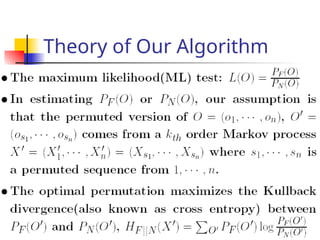
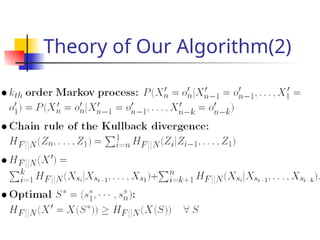
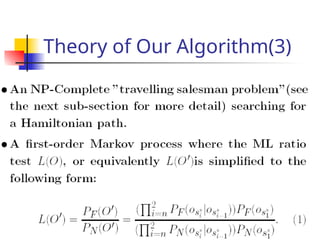
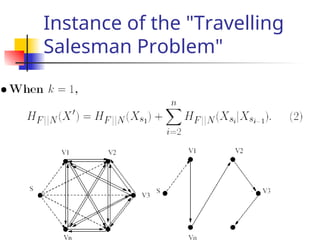
Intuition of Permutation
When modelling face images as a k-th order
Markov process, rows of the images are
concatenated into long vectors. The pixels
corresponding to the semantics(e.g, eyes, lips) will
be scatted into different parts in the vectors. The
Markovian property is not easy to be justified.
If some permutation can be found to re-group
those scattered pixels(i.e, to put all the pixels
corresponding to eyes together, those for lips
together), then the Markov assumption is more
reasonable.
Face and FacialFeature
Detection
The algorithm is also used to detect 9
facial features: 2 outer mouth
corners, 2 outer eye corners, 2 outer
eye-brow corners, 2 inner eye-brow
corners and the center of the nostrils.
Appearance-Based Methods:
Summary
Pros:
Use powerful machine learning algorithms
Has demonstrated good empirical results
Fast and fairly robust
Extended to detect faces in different pose and
orientation
Cons:
Usually needs to search over space and scale
Need lots of positive and negative examples
Limited view-based approach
34.
Color-Based Face Detector
Pros:
Easy to implement
Effective and efficient in
constrained environment
Insensitive to pose,
expression, rotation
variation
Cons:
Sensitive to environment
and lighting change
Noisy detection results
(body parts, skin-tone
line tone line regions)
35.
What is FaceRecognition?
A set of two task:
Face Identification: Given a face image
that belongs to a person in a database,
tell whose image it is.
Face Verification: Given a face image
that might not belong to the database,
verify whether it is from the person it is
claimed to be in the database.
36.
Difference between Face
Detectionand Recognition
Detection – two-class classification
Face vs. Non-face
Recognition – multi-class
classification
One person vs. all the others




![Knowledge-Based Method:
[Yang and Huang 94]
Level 1 (lowest resolution):
apply the rule “the center part of the face has 4
cells with a basically uniform intensity” to
search for candidates
Level 2: local histogram equalization
followed by edge equalization followed by
edge detection
Level 3: search for eye and mouth features
for validation](https://image.slidesharecdn.com/enggroomcodeintrofacedetectrecognition-250420101927-1abc8263/85/EnggRoom_Code_IntroFaceDetectRecognition-ppt-9-320.jpg)


![Face and Non-Face
Exemplars
Positive examples:
Get as much variation as possible
Manually crop and normalize each face image
into a standard size(e.g., 19×19
Creating virtual examples [Poggio 94]
Negative examples: Fuzzy idea
Any images that do not contain faces
A large image subspace
Bootstraping[Sung and Poggio 94]](https://image.slidesharecdn.com/enggroomcodeintrofacedetectrecognition-250420101927-1abc8263/85/EnggRoom_Code_IntroFaceDetectRecognition-ppt-16-320.jpg)