LECTURE 1: INTRODUCTION
Kamlesh T. Kahar
Faculty of Elect. & Telecommunication Engineering
SSGMCE
 Instrumentation
◦ It is the branch of engineering that deals with
measurement & control of process variables within a
production/manufacturing area.
 Measurement
◦ A method to obtain information regarding the
physical values of the variable.
2
 Physical quantity: variable such as pressure,
temperature, mass, length, etc.
 Data: Information obtained from the
instrumentation/measurement system as a result of
the measurements made of the physical quantities
 Information: Data that has a calibrated numeric
relationship to the physical quantity.
 Parameter: Physical quantity within defined
(numeric) limits.
3
4
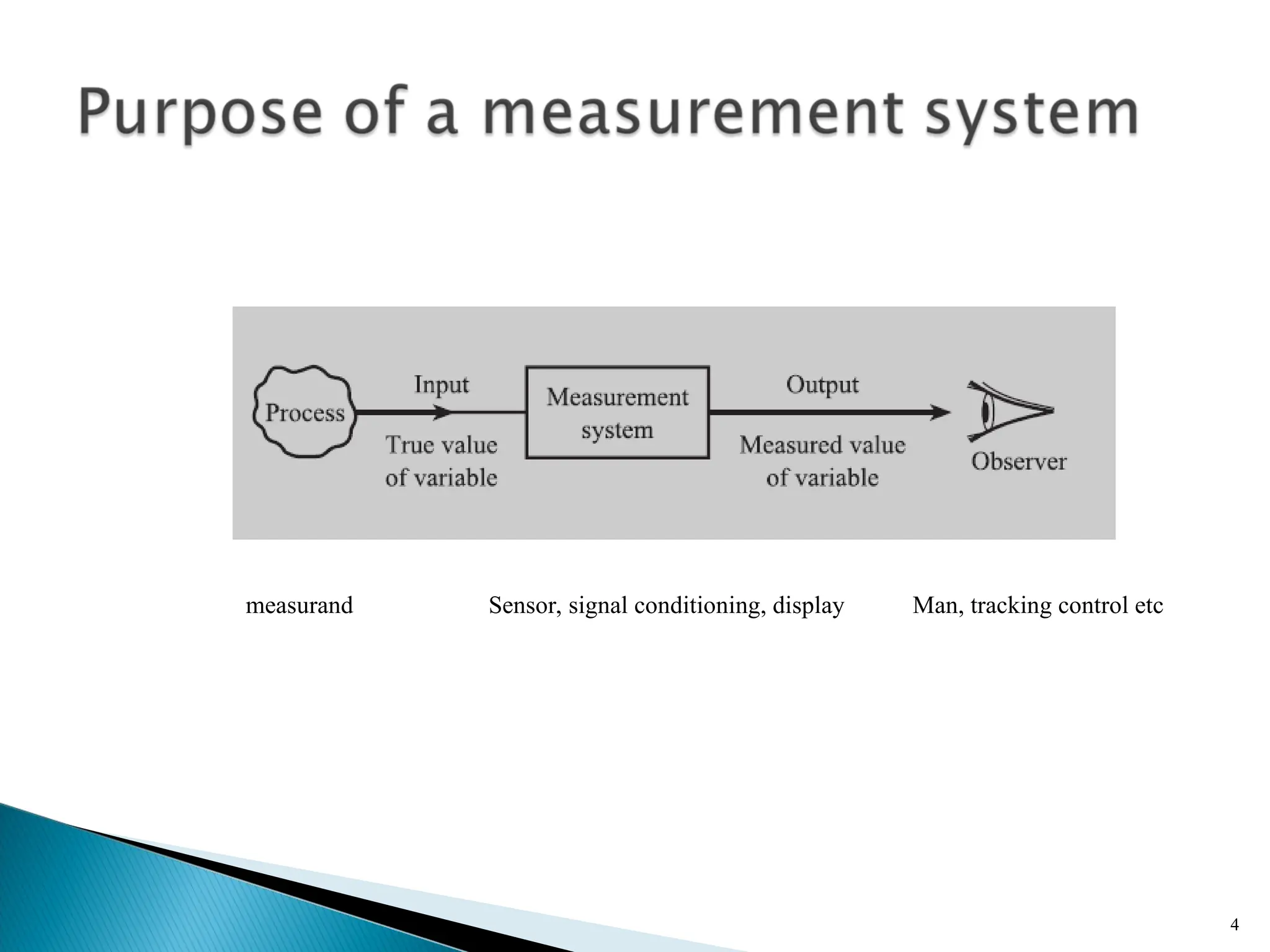
measurand Sensor, signal conditioning, display Man, tracking control etc
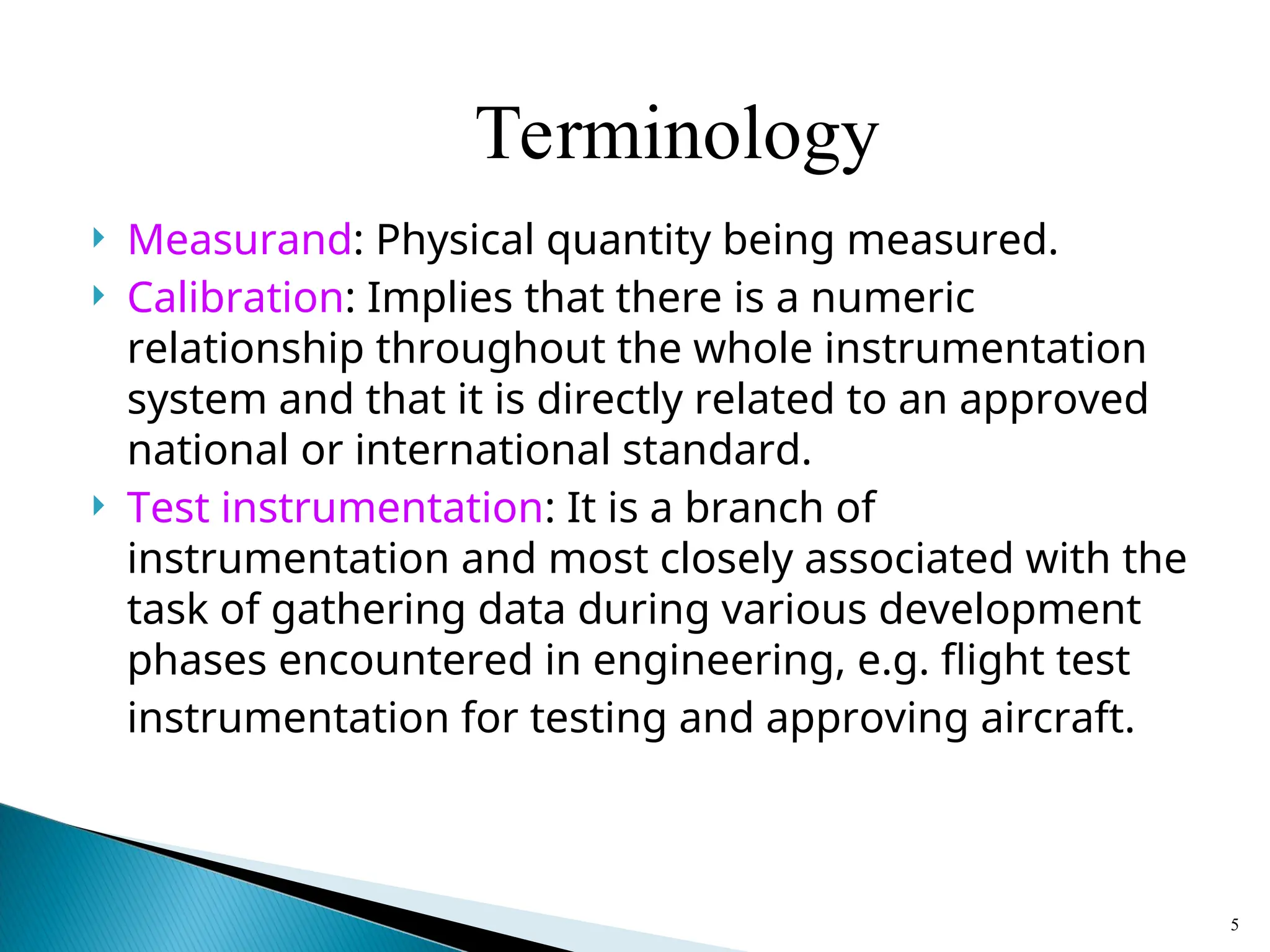
 Measurand: Physical quantity being measured.
 Calibration: Implies that there is a numeric
relationship throughout the whole instrumentation
system and that it is directly related to an approved
national or international standard.
 Test instrumentation: It is a branch of
instrumentation and most closely associated with the
task of gathering data during various development
phases encountered in engineering, e.g. flight test
instrumentation for testing and approving aircraft.
5
Terminology
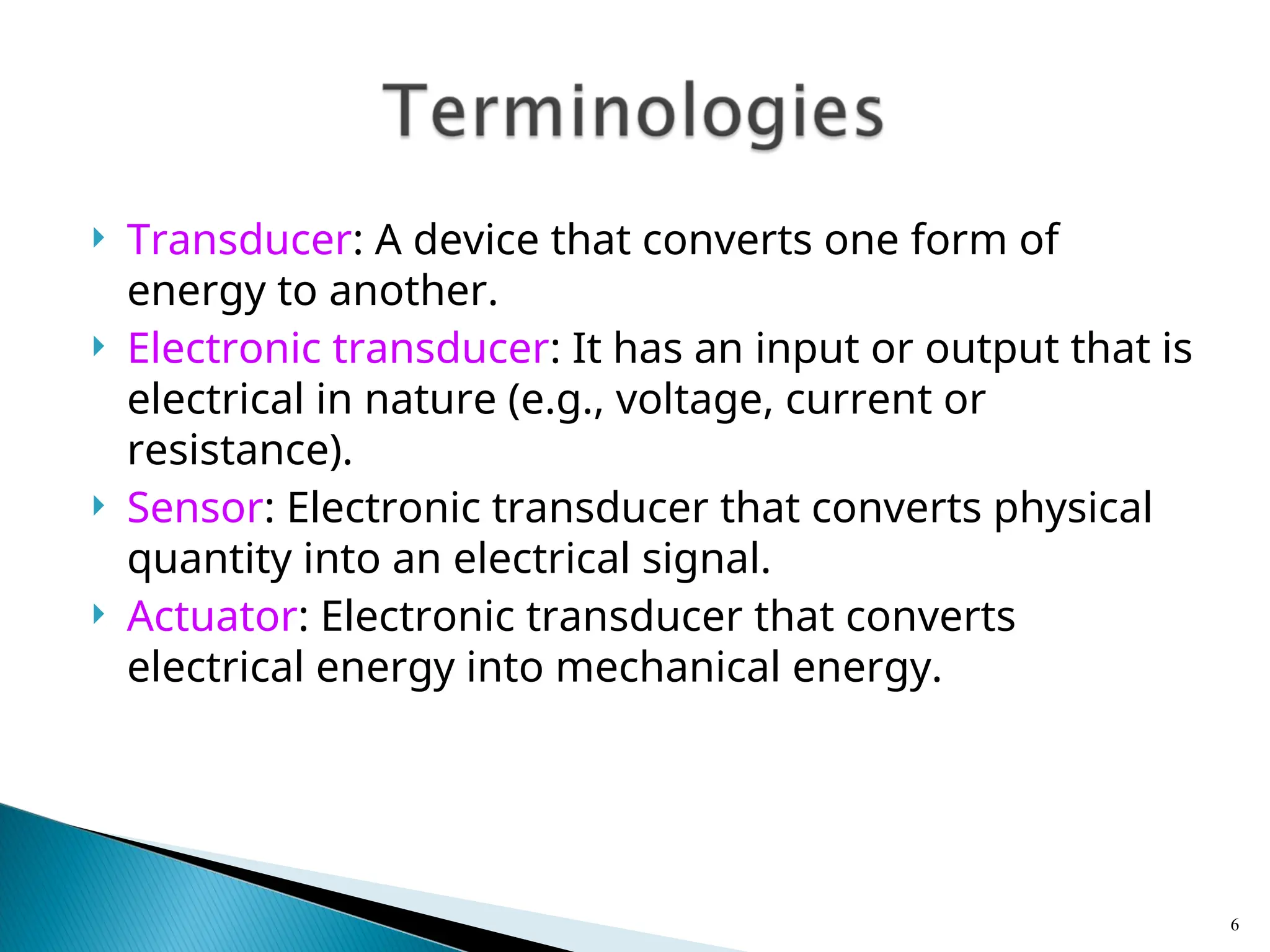
 Transducer: A device that converts one form of
energy to another.
 Electronic transducer: It has an input or output that is
electrical in nature (e.g., voltage, current or
resistance).
 Sensor: Electronic transducer that converts physical
quantity into an electrical signal.
 Actuator: Electronic transducer that converts
electrical energy into mechanical energy.
6
 In the case of process industries and
industrial manufacturing…
◦ To improve the quality of the product
◦ To improve the efficiency of production
◦ To maintain the proper operation.
7
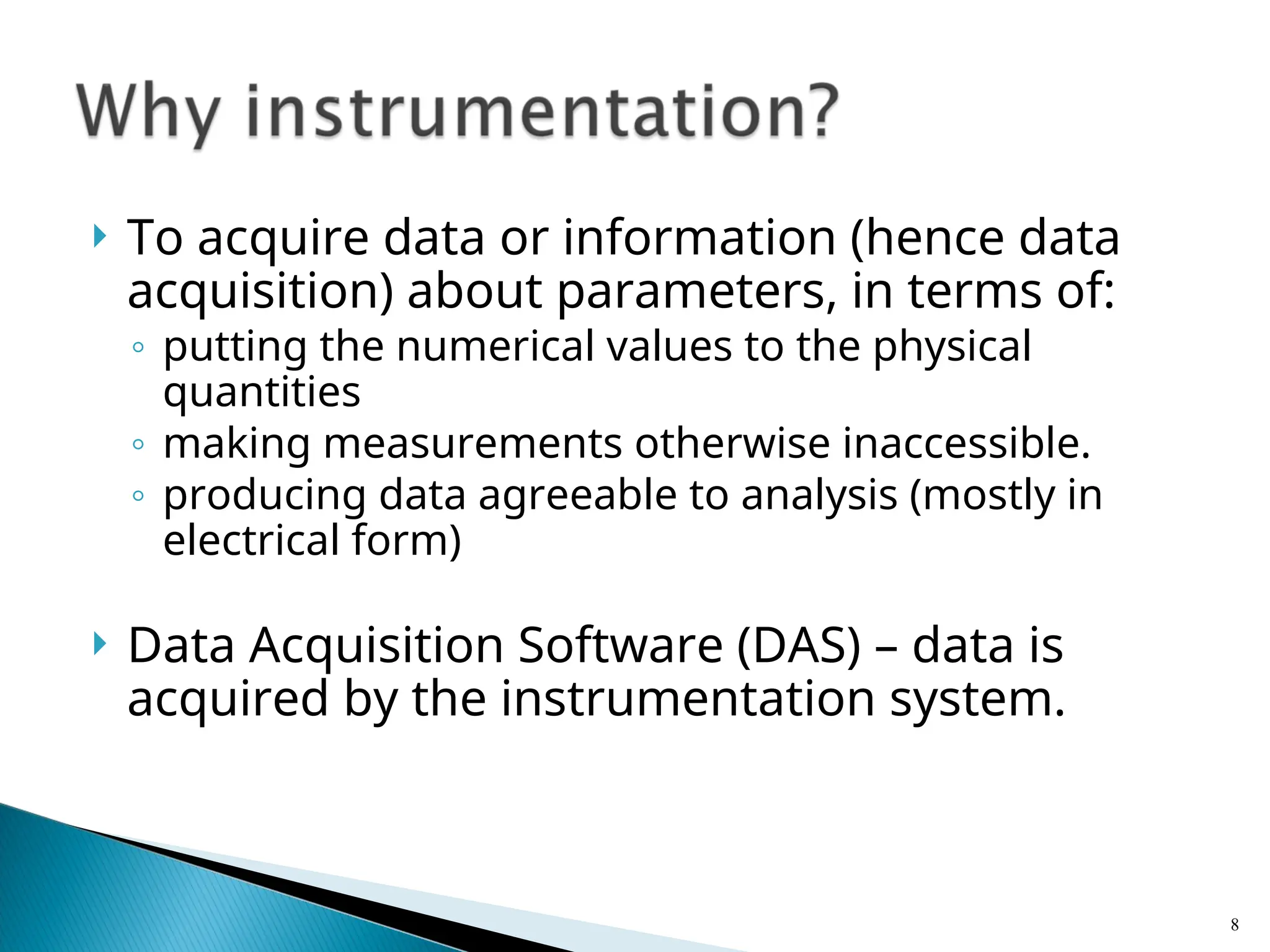
 To acquire data or information (hence data
acquisition) about parameters, in terms of:
◦ putting the numerical values to the physical
quantities
◦ making measurements otherwise inaccessible.
◦ producing data agreeable to analysis (mostly in
electrical form)
 Data Acquisition Software (DAS) – data is
acquired by the instrumentation system.
8
 Direct comparison
◦ Easy to do but… less accurate
 e.g. to measure a steel bar
 Indirect comparison
◦ Calibrated system; consists of several devices to
convert, process (amplification or filtering) and
display the output
 e.g. to measure force from strain gages located in a
structure
9
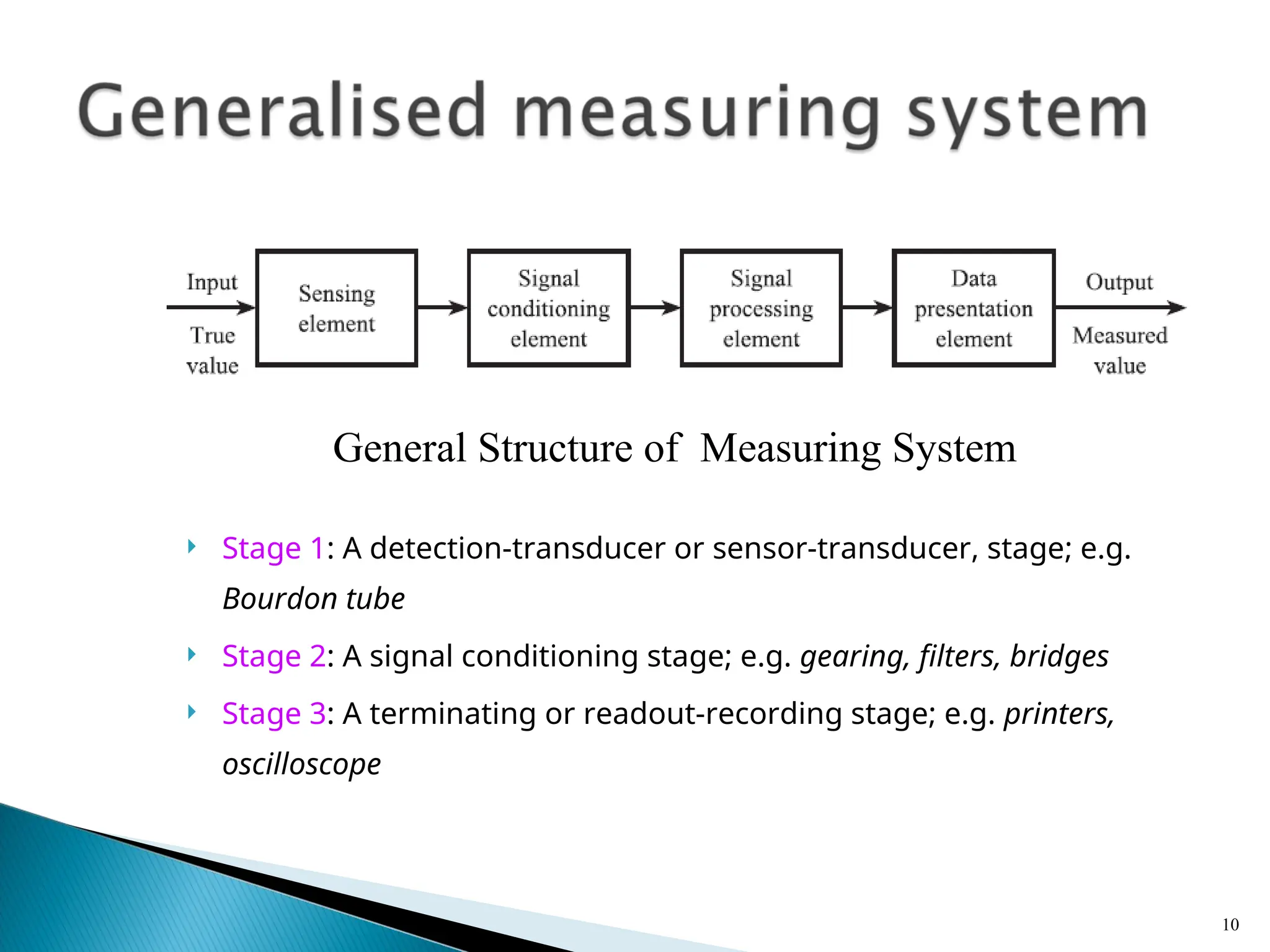
 Stage 1: A detection-transducer or sensor-transducer, stage; e.g.
Bourdon tube
 Stage 2: A signal conditioning stage; e.g. gearing, filters, bridges
 Stage 3: A terminating or readout-recording stage; e.g. printers,
oscilloscope
10
General Structure of Measuring System
 Passive Instruments
◦ the quantity being measured simply modulates (adapts to)
the magnitude of some external power source.
 Active Instruments
◦ the instrument output is entirely produced by the quantity
being measured
 Difference between active & passive instruments is the level of
measurement resolution that can be obtained.
11
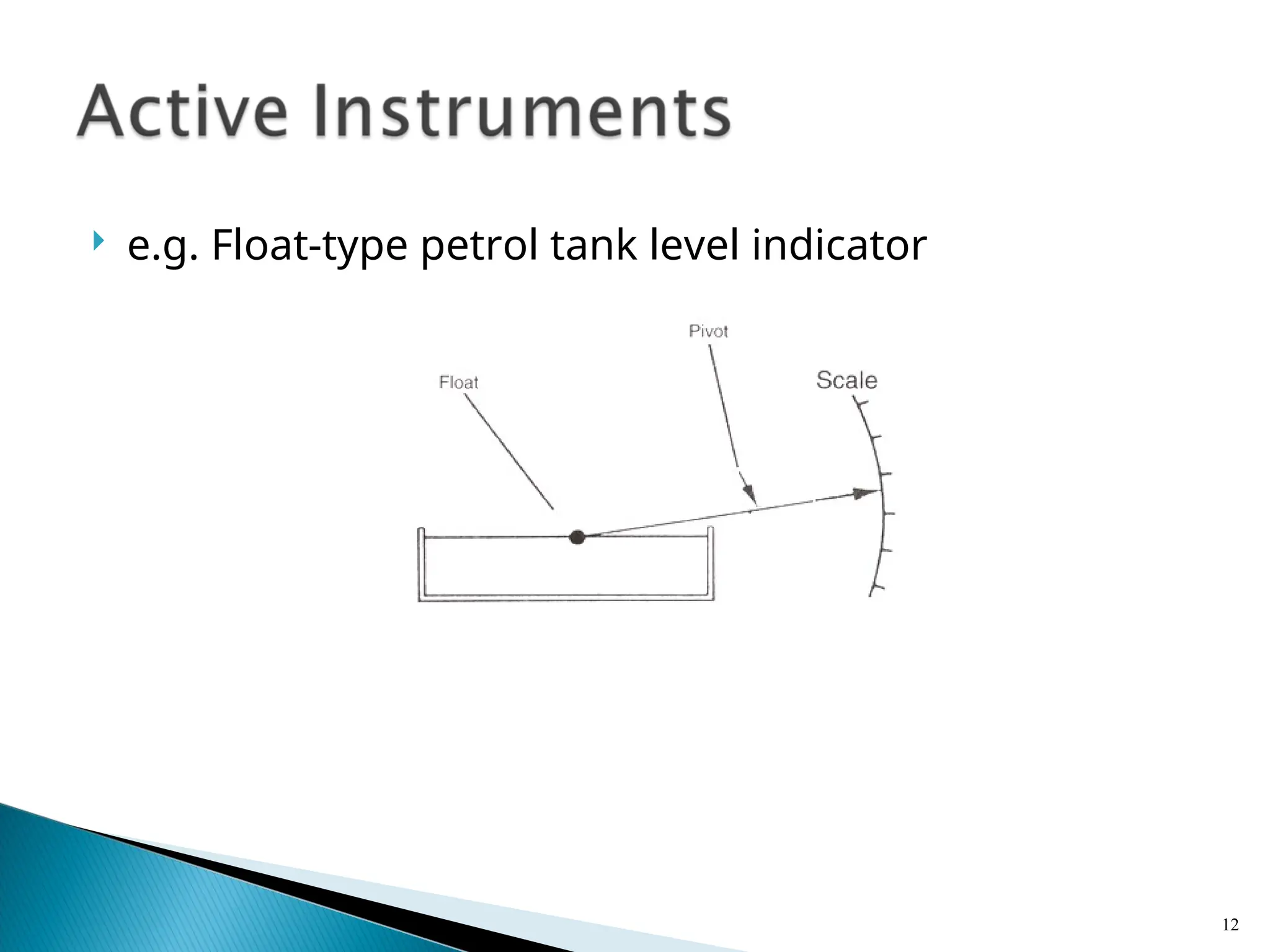
 e.g. Float-type petrol tank level indicator
12
 The change in petrol level moves a potentiometer
arm, and the output signal consists of a proportion of
the meter reading which varies according to the
position of float.
13
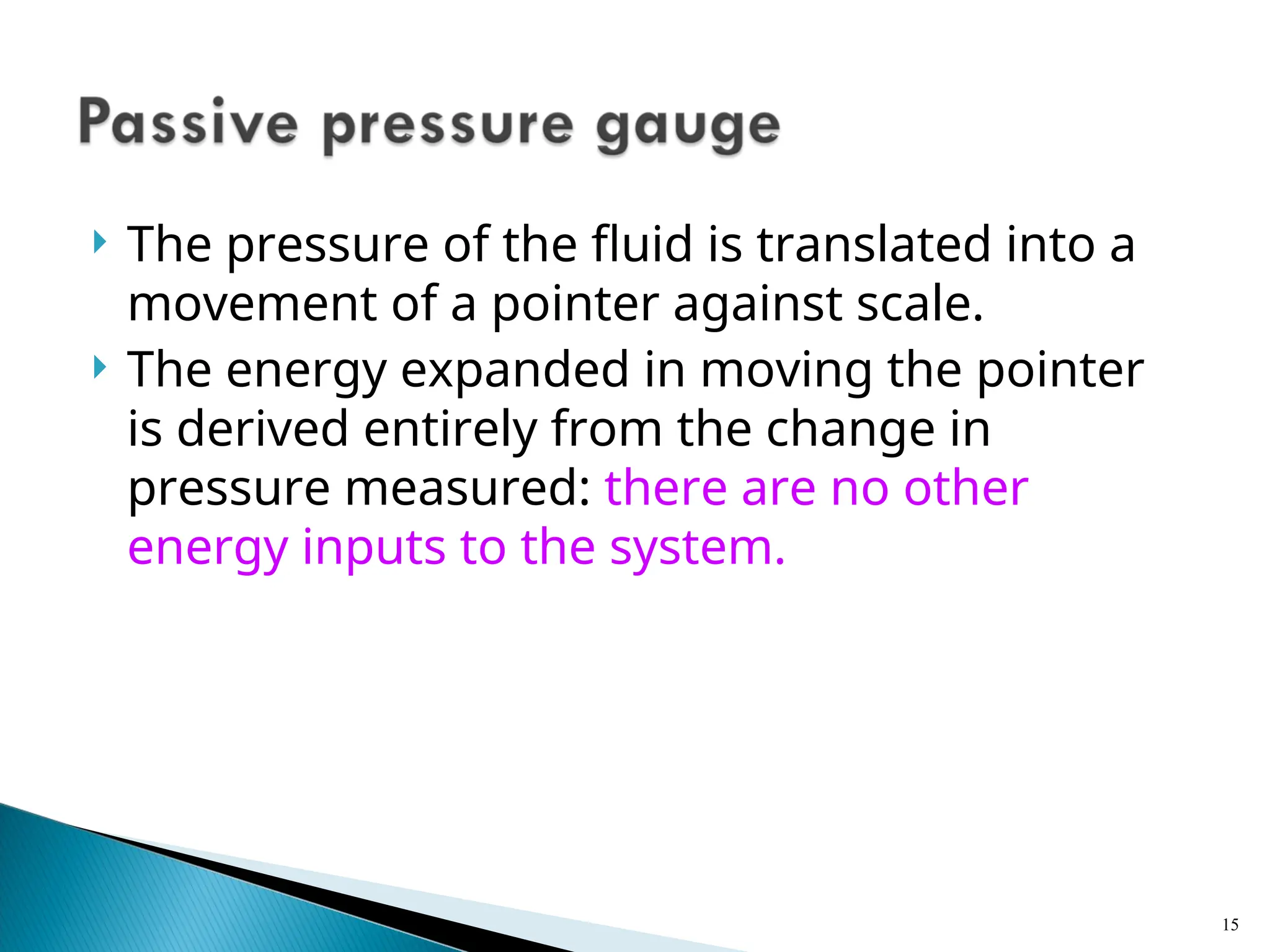
 e.g. Pressure-measuring device
14
 The pressure of the fluid is translated into a
movement of a pointer against scale.
 The energy expanded in moving the pointer
is derived entirely from the change in
pressure measured: there are no other
energy inputs to the system.
15
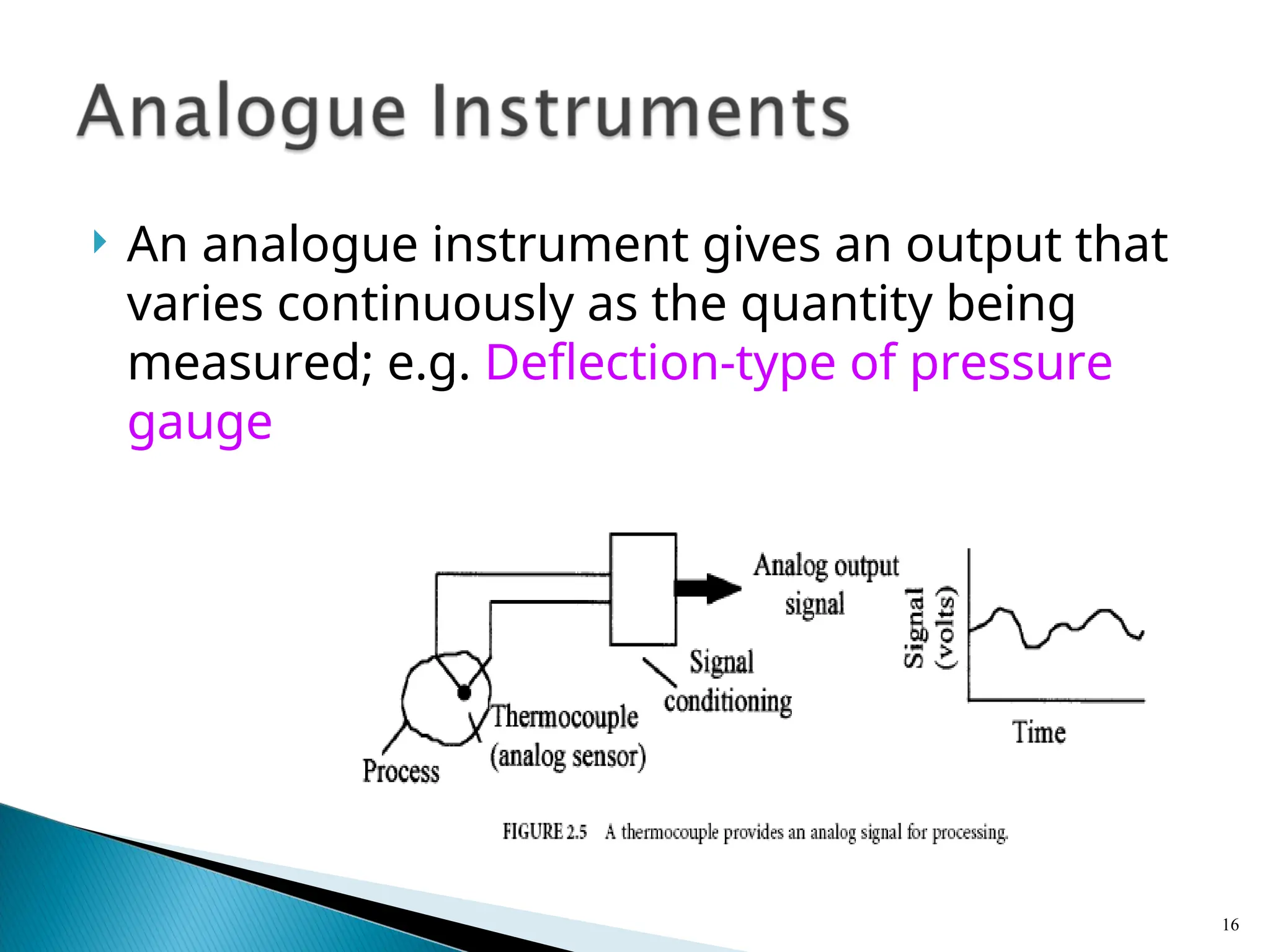
 An analogue instrument gives an output that
varies continuously as the quantity being
measured; e.g. Deflection-type of pressure
gauge
16
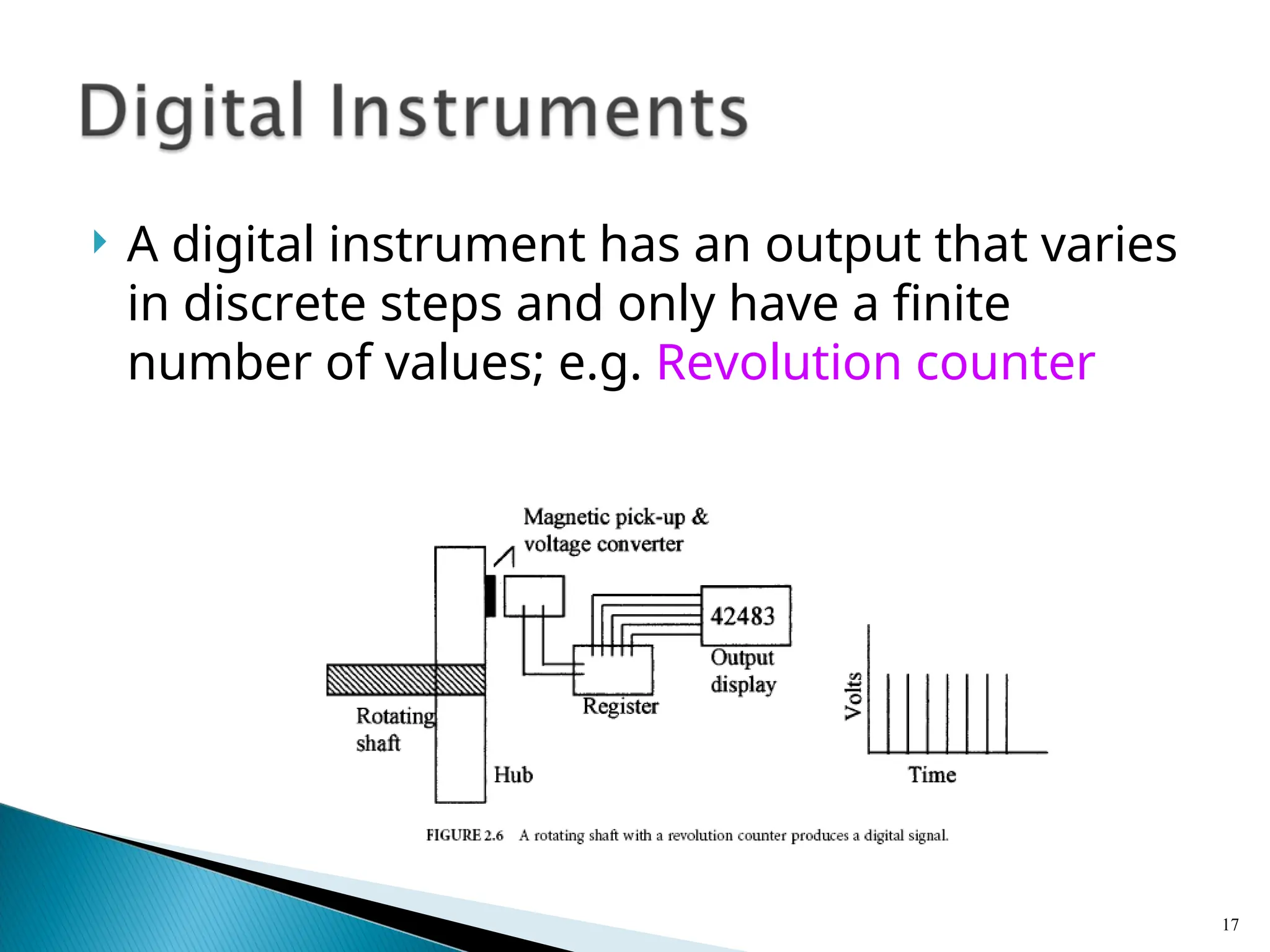
 A digital instrument has an output that varies
in discrete steps and only have a finite
number of values; e.g. Revolution counter
17
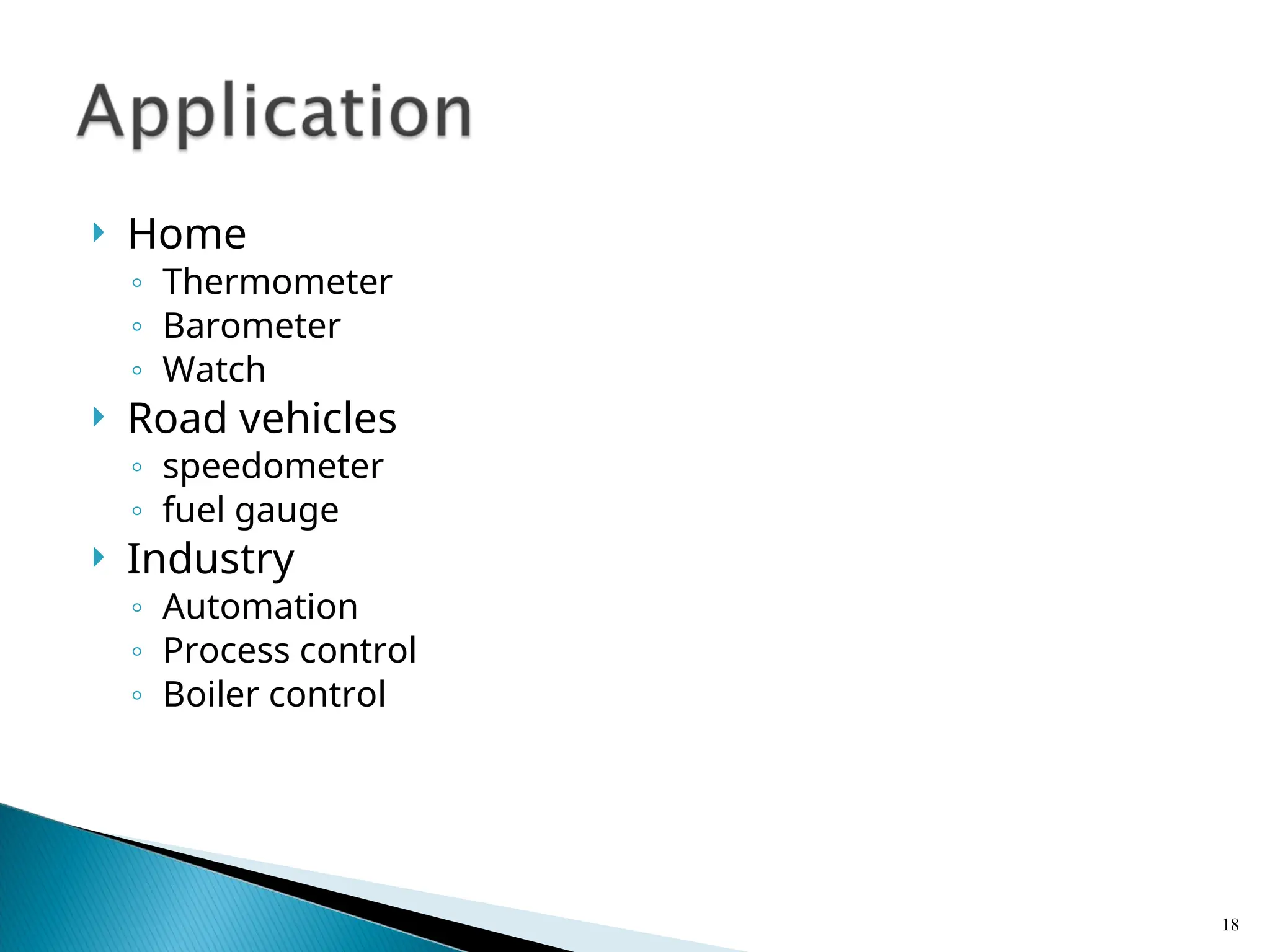
 Home
◦ Thermometer
◦ Barometer
◦ Watch
 Road vehicles
◦ speedometer
◦ fuel gauge
 Industry
◦ Automation
◦ Process control
◦ Boiler control
18
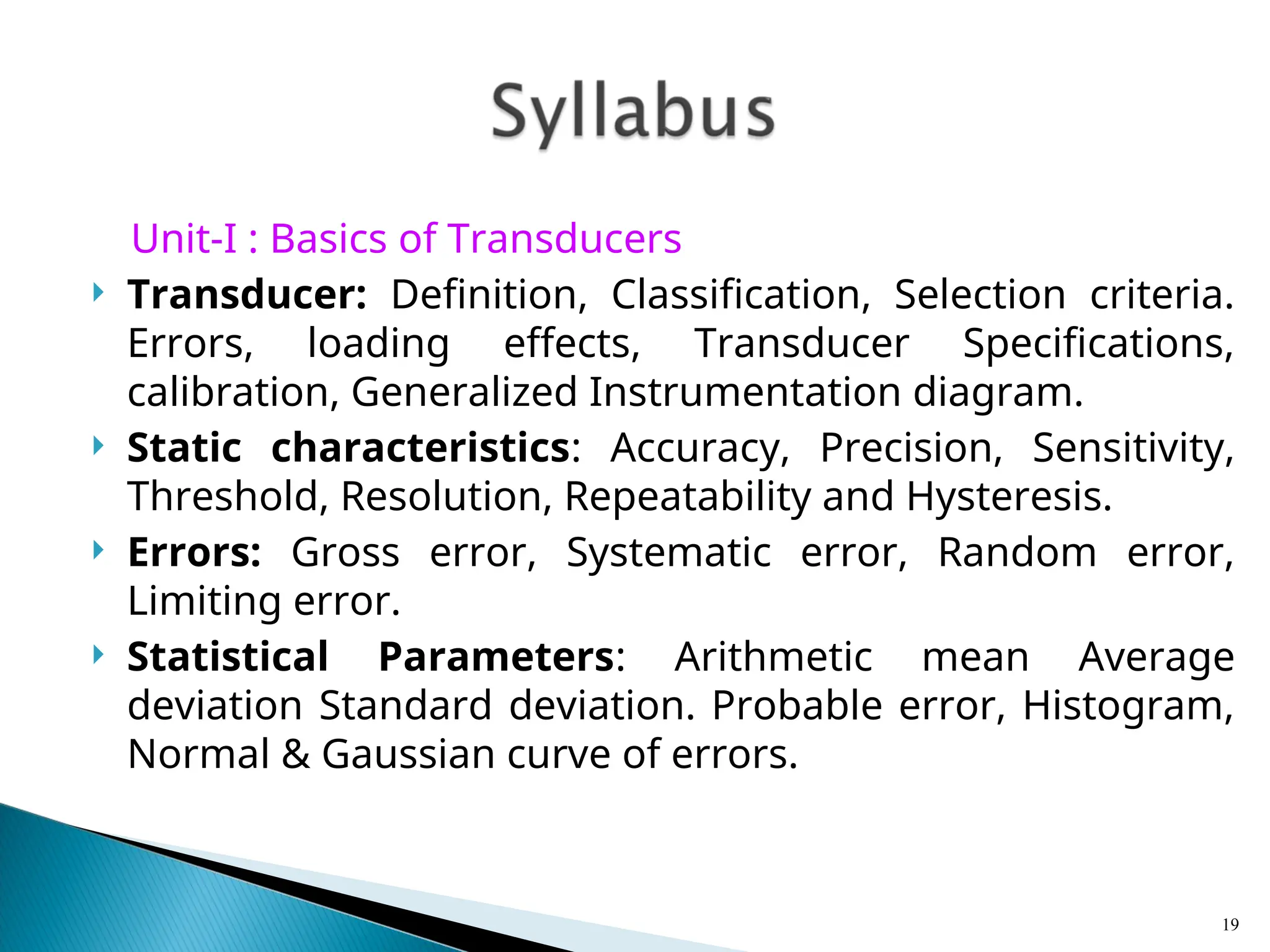
Unit-I : Basics of Transducers
 Transducer: Definition, Classification, Selection criteria.
Errors, loading effects, Transducer Specifications,
calibration, Generalized Instrumentation diagram.
 Static characteristics: Accuracy, Precision, Sensitivity,
Threshold, Resolution, Repeatability and Hysteresis.
 Errors: Gross error, Systematic error, Random error,
Limiting error.
 Statistical Parameters: Arithmetic mean Average
deviation Standard deviation. Probable error, Histogram,
Normal & Gaussian curve of errors.
19
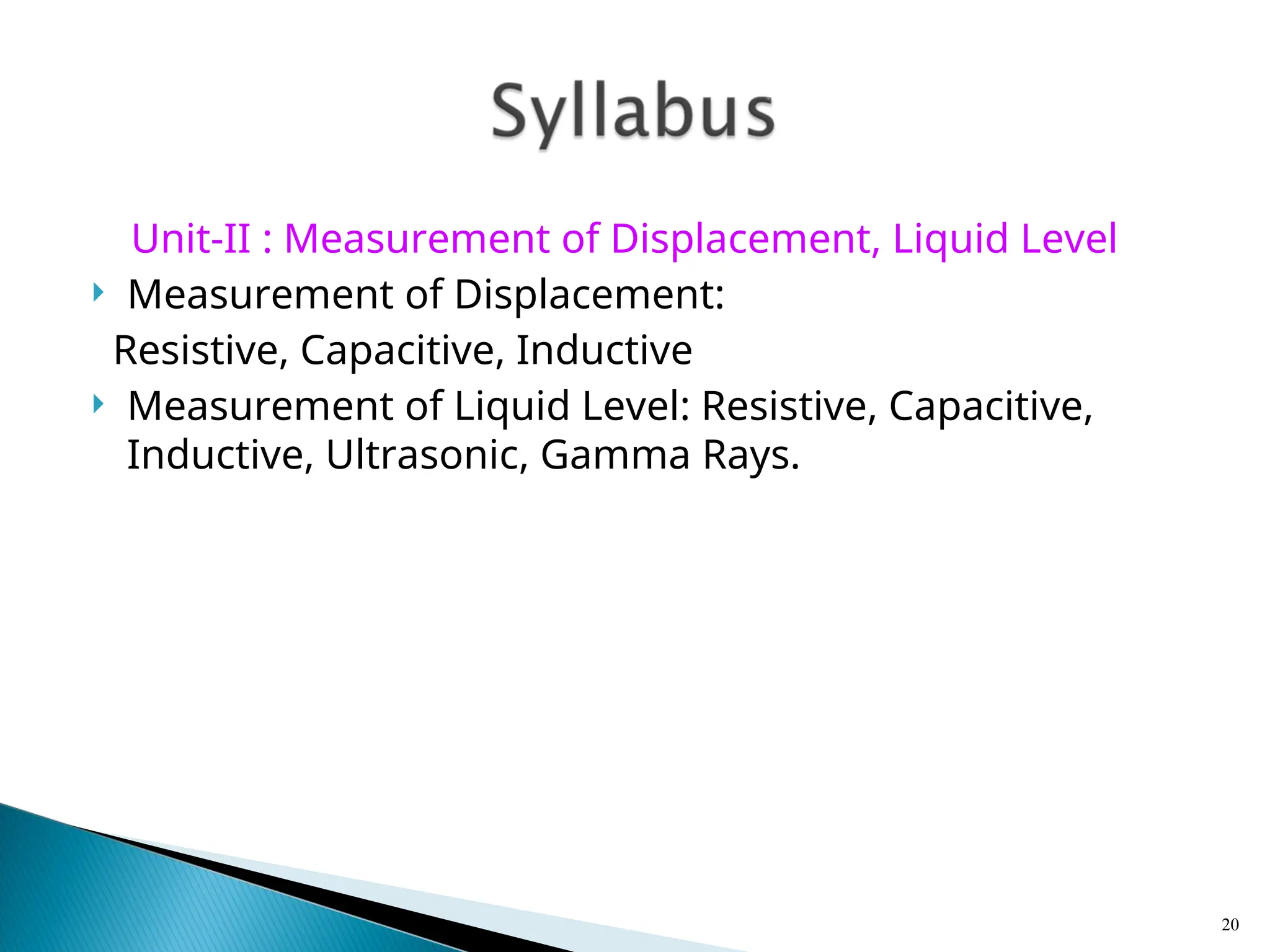
Unit-II : Measurement of Displacement, Liquid Level
 Measurement of Displacement:
Resistive, Capacitive, Inductive
 Measurement of Liquid Level: Resistive, Capacitive,
Inductive, Ultrasonic, Gamma Rays.
20
Unit-III : Measurement of Temperature
Measurement of Temperature: Resistance temperature
detector (RTD): Principle, types, Configurations,
construction and working of RTD, Material for RTD,
advantages, disadvantages and applications of RTD.
Thermistors: Principle, types (NTC and PTC), characteristics,
Construction and working of Thermistor, Materials,
specifications of Thermistor, applications.
Thermocouples: Principle, thermoelectric effect, See beck
effect, Peltier effect, laws of thermocouple, cold junction
Compensation method, thermopile, thermocouple emf
measurement method.
Pyrometers: Principle, Construction and working of Radiation and optical
pyrometers and its Applications, LM 335.
21
Unit-IV : Measurement of Pressure, Flow, Humidity.
◦ Measurement of Pressure: Primary pressure sensors - elastic
elements like bourdon tube, diaphragm, and bellows.
Electrical/Secondary Pressure
◦ Transducers: Capacitive, piezo-electric and its material,
variable reluctance, LVDT.
◦ Differential pressure measurement: Capacitive. Low Pressure
(Vacuum): Pirani gauge, thermocouple gauge, hot cathode
ionization gauge.
◦ Flow Measurement: ultrasonic, electromagnetic & hotwire
Anemometer.
◦ Flow Measurement: ultrasonic, electromagnetic & hotwire
Anemometer.
22
Unit-V : Measurement of Velocity, Strain & Miscellaneous Sensors
Velocity Measurement: Using photo detectors (both
linear & angular velocity), Stroboscope.
Strain Measurement: Introduction, types of strain gauge,
gauge factor calculation, materials for strain gauge,
resistance strain gauge bridges, temperature compensation
and applications of strain gauges.
Miscellaneous Sensors: Noise (sound) Sensors
Characteristics of sound, levels of sound pressure, sound
power and sound intensity.
Smart sensors: Objective, block diagram, advantages and
disadvantages.
23
Unit-VI : Data acquisition and applications of
Electronic Instruments
◦ Analog & Digital data acquisition system.:
Generalized block diagram of data acquisition
system(DAS), objective of DAS, signal conditioning of
inputs, single channel DAS, Multichannel DAS,
computer based DAS
◦ Digital transducer: optical encoders, shaft encoders
◦ pH and blood pressure measurement.
24
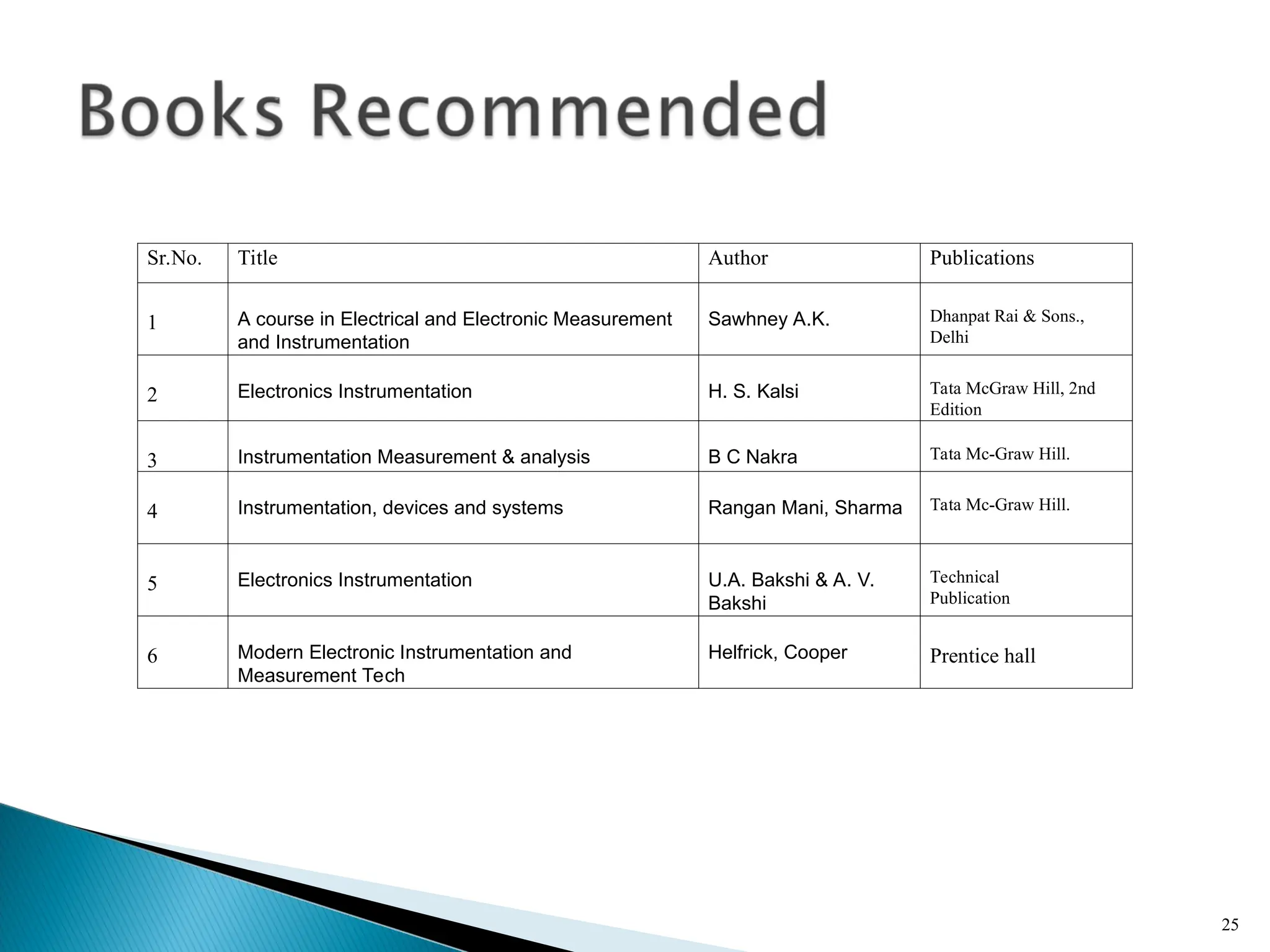
Sr.No. Title Author Publications
1 A course in Electrical and Electronic Measurement
and Instrumentation
Sawhney A.K. Dhanpat Rai & Sons.,
Delhi
2 Electronics Instrumentation H. S. Kalsi Tata McGraw Hill, 2nd
Edition
3 Instrumentation Measurement & analysis B C Nakra Tata Mc-Graw Hill.
4 Instrumentation, devices and systems Rangan Mani, Sharma Tata Mc-Graw Hill.
5 Electronics Instrumentation U.A. Bakshi & A. V.
Bakshi
Technical
Publication
6 Modern Electronic Instrumentation and
Measurement Tech
Helfrick, Cooper Prentice hall
25

lecture1.ppt instrumentation and sensors

  • 1.
    LECTURE 1: INTRODUCTION KamleshT. Kahar Faculty of Elect. & Telecommunication Engineering SSGMCE
  • 2.
     Instrumentation ◦ Itis the branch of engineering that deals with measurement & control of process variables within a production/manufacturing area.  Measurement ◦ A method to obtain information regarding the physical values of the variable. 2
  • 3.
     Physical quantity:variable such as pressure, temperature, mass, length, etc.  Data: Information obtained from the instrumentation/measurement system as a result of the measurements made of the physical quantities  Information: Data that has a calibrated numeric relationship to the physical quantity.  Parameter: Physical quantity within defined (numeric) limits. 3
  • 4.
    4 measurand Sensor, signalconditioning, display Man, tracking control etc
  • 5.
     Measurand: Physicalquantity being measured.  Calibration: Implies that there is a numeric relationship throughout the whole instrumentation system and that it is directly related to an approved national or international standard.  Test instrumentation: It is a branch of instrumentation and most closely associated with the task of gathering data during various development phases encountered in engineering, e.g. flight test instrumentation for testing and approving aircraft. 5 Terminology
  • 6.
     Transducer: Adevice that converts one form of energy to another.  Electronic transducer: It has an input or output that is electrical in nature (e.g., voltage, current or resistance).  Sensor: Electronic transducer that converts physical quantity into an electrical signal.  Actuator: Electronic transducer that converts electrical energy into mechanical energy. 6
  • 7.
     In thecase of process industries and industrial manufacturing… ◦ To improve the quality of the product ◦ To improve the efficiency of production ◦ To maintain the proper operation. 7
  • 8.
     To acquiredata or information (hence data acquisition) about parameters, in terms of: ◦ putting the numerical values to the physical quantities ◦ making measurements otherwise inaccessible. ◦ producing data agreeable to analysis (mostly in electrical form)  Data Acquisition Software (DAS) – data is acquired by the instrumentation system. 8
  • 9.
     Direct comparison ◦Easy to do but… less accurate  e.g. to measure a steel bar  Indirect comparison ◦ Calibrated system; consists of several devices to convert, process (amplification or filtering) and display the output  e.g. to measure force from strain gages located in a structure 9
  • 10.
     Stage 1:A detection-transducer or sensor-transducer, stage; e.g. Bourdon tube  Stage 2: A signal conditioning stage; e.g. gearing, filters, bridges  Stage 3: A terminating or readout-recording stage; e.g. printers, oscilloscope 10 General Structure of Measuring System
  • 11.
     Passive Instruments ◦the quantity being measured simply modulates (adapts to) the magnitude of some external power source.  Active Instruments ◦ the instrument output is entirely produced by the quantity being measured  Difference between active & passive instruments is the level of measurement resolution that can be obtained. 11
  • 12.
     e.g. Float-typepetrol tank level indicator 12
  • 13.
     The changein petrol level moves a potentiometer arm, and the output signal consists of a proportion of the meter reading which varies according to the position of float. 13
  • 14.
  • 15.
     The pressureof the fluid is translated into a movement of a pointer against scale.  The energy expanded in moving the pointer is derived entirely from the change in pressure measured: there are no other energy inputs to the system. 15
  • 16.
     An analogueinstrument gives an output that varies continuously as the quantity being measured; e.g. Deflection-type of pressure gauge 16
  • 17.
     A digitalinstrument has an output that varies in discrete steps and only have a finite number of values; e.g. Revolution counter 17
  • 18.
     Home ◦ Thermometer ◦Barometer ◦ Watch  Road vehicles ◦ speedometer ◦ fuel gauge  Industry ◦ Automation ◦ Process control ◦ Boiler control 18
  • 19.
    Unit-I : Basicsof Transducers  Transducer: Definition, Classification, Selection criteria. Errors, loading effects, Transducer Specifications, calibration, Generalized Instrumentation diagram.  Static characteristics: Accuracy, Precision, Sensitivity, Threshold, Resolution, Repeatability and Hysteresis.  Errors: Gross error, Systematic error, Random error, Limiting error.  Statistical Parameters: Arithmetic mean Average deviation Standard deviation. Probable error, Histogram, Normal & Gaussian curve of errors. 19
  • 20.
    Unit-II : Measurementof Displacement, Liquid Level  Measurement of Displacement: Resistive, Capacitive, Inductive  Measurement of Liquid Level: Resistive, Capacitive, Inductive, Ultrasonic, Gamma Rays. 20
  • 21.
    Unit-III : Measurementof Temperature Measurement of Temperature: Resistance temperature detector (RTD): Principle, types, Configurations, construction and working of RTD, Material for RTD, advantages, disadvantages and applications of RTD. Thermistors: Principle, types (NTC and PTC), characteristics, Construction and working of Thermistor, Materials, specifications of Thermistor, applications. Thermocouples: Principle, thermoelectric effect, See beck effect, Peltier effect, laws of thermocouple, cold junction Compensation method, thermopile, thermocouple emf measurement method. Pyrometers: Principle, Construction and working of Radiation and optical pyrometers and its Applications, LM 335. 21
  • 22.
    Unit-IV : Measurementof Pressure, Flow, Humidity. ◦ Measurement of Pressure: Primary pressure sensors - elastic elements like bourdon tube, diaphragm, and bellows. Electrical/Secondary Pressure ◦ Transducers: Capacitive, piezo-electric and its material, variable reluctance, LVDT. ◦ Differential pressure measurement: Capacitive. Low Pressure (Vacuum): Pirani gauge, thermocouple gauge, hot cathode ionization gauge. ◦ Flow Measurement: ultrasonic, electromagnetic & hotwire Anemometer. ◦ Flow Measurement: ultrasonic, electromagnetic & hotwire Anemometer. 22
  • 23.
    Unit-V : Measurementof Velocity, Strain & Miscellaneous Sensors Velocity Measurement: Using photo detectors (both linear & angular velocity), Stroboscope. Strain Measurement: Introduction, types of strain gauge, gauge factor calculation, materials for strain gauge, resistance strain gauge bridges, temperature compensation and applications of strain gauges. Miscellaneous Sensors: Noise (sound) Sensors Characteristics of sound, levels of sound pressure, sound power and sound intensity. Smart sensors: Objective, block diagram, advantages and disadvantages. 23
  • 24.
    Unit-VI : Dataacquisition and applications of Electronic Instruments ◦ Analog & Digital data acquisition system.: Generalized block diagram of data acquisition system(DAS), objective of DAS, signal conditioning of inputs, single channel DAS, Multichannel DAS, computer based DAS ◦ Digital transducer: optical encoders, shaft encoders ◦ pH and blood pressure measurement. 24
  • 25.
    Sr.No. Title AuthorPublications 1 A course in Electrical and Electronic Measurement and Instrumentation Sawhney A.K. Dhanpat Rai & Sons., Delhi 2 Electronics Instrumentation H. S. Kalsi Tata McGraw Hill, 2nd Edition 3 Instrumentation Measurement & analysis B C Nakra Tata Mc-Graw Hill. 4 Instrumentation, devices and systems Rangan Mani, Sharma Tata Mc-Graw Hill. 5 Electronics Instrumentation U.A. Bakshi & A. V. Bakshi Technical Publication 6 Modern Electronic Instrumentation and Measurement Tech Helfrick, Cooper Prentice hall 25