LEARNING OUTCOME 1:
INVESTIGATE ENGINEERING
MEASUREMENT SYSTEMS
CERTIFICATE IN ELECTRICAL AND ELECTRONIC ENGINEERING
INSTRUMENTATION & CONTROL
CEE 3023
Ts. PARAN JONLY
Introduction
• Instrumentation is the branch of engineering that deals with
measurement and control.
• An instrument is a device that measures or manipulates process
physical variables such as flow, temperature, level, or pressure etc.
Instruments include many varied contrivances which can be as simple
as valves and transmitters, and as complex as analyzers.
• Instruments often comprise control systems of varied processes.
• The control of processes is one of the main branches of applied
instrumentation.
• Control instrumentation includes devices such as solenoids, valves,
circuit breakers, and relays.
• These devices are able to change a field parameter, and provide
remote or automated control capabilities.
Ts. PARAN JONLY
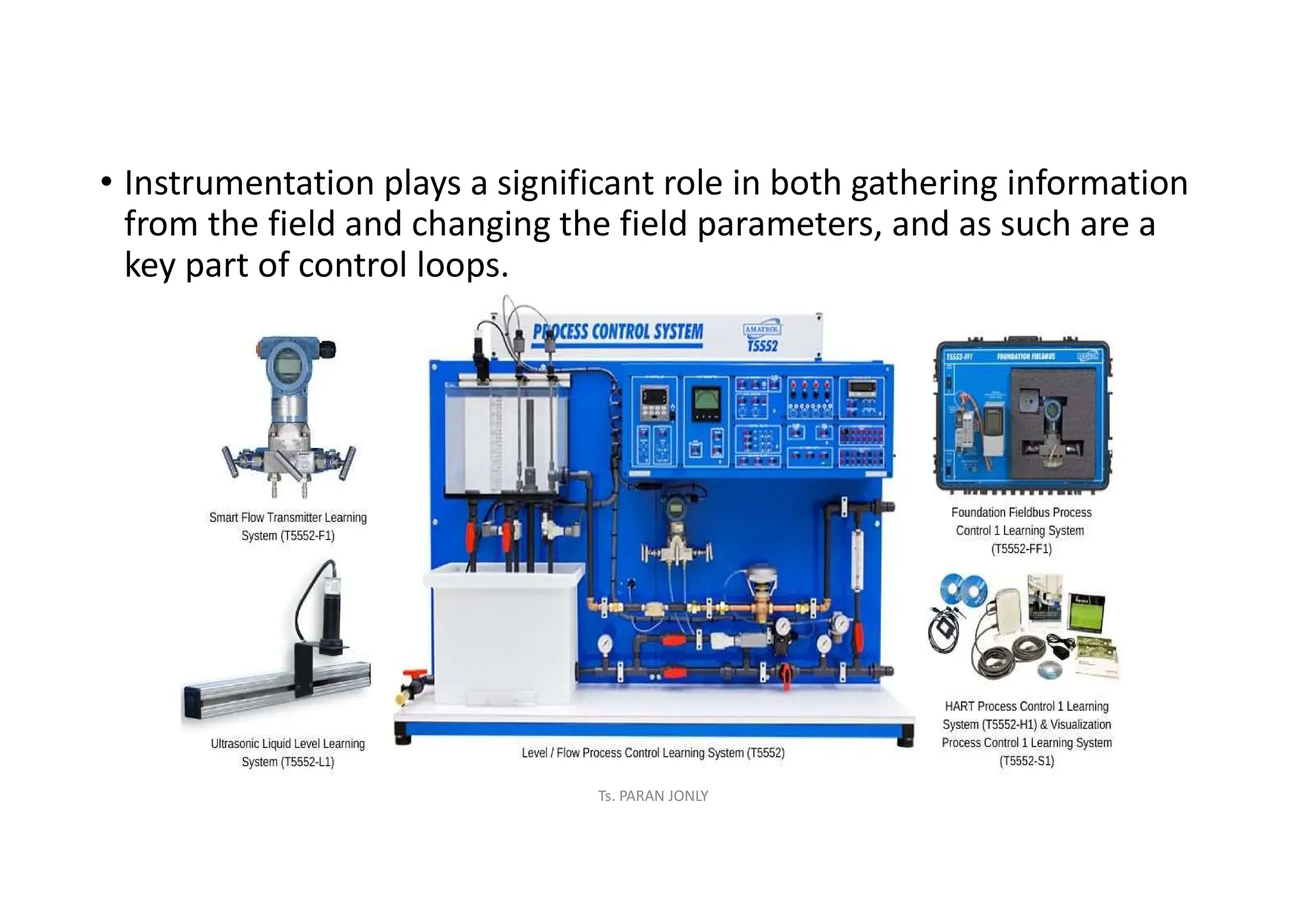
• Instrumentation plays a significant role in both gathering information
from the field and changing the field parameters, and as such are a
key part of control loops.
Ts. PARAN JONLY
In this Part 1.1, you will learn:
Basic Instrumentation System
 What are the needs of instrumentation for making
measurements?
 What are common terms used to describe the performance of
measurement systems?
 What are common sources of error that can occur with
measurement systems?
Ts. PARAN JONLY
What are the needs of instrumentation
for making measurements?
Essentially 3 different ways instrumentation is used for making measurements:
1. Obtaining data about some event or item
marking out of an item for machining and involve measurements of
lengths and angles.
Ts. PARAN JONLY
What are the needs of instrumentation
for making measurements?
Essentially 3 different ways instrumentation is used for making measurements:
2. Inspecting an item to see if it matches the specification
determine whether item being produced has the right dimensions, shape,
electrical resistance, etc. that have been specified for the item
Ts. PARAN JONLY
What are the needs of instrumentation
for making measurements?
Essentially 3 different ways instrumentation is used for making measurements:
3. Making measurements to ensure that a process is kept under control
to ensure the proper control of process.
i.e. of process measurements:
A process may involve taking a hot liquid from a tank. The level of the
liquid in the tank and the temperature have to be continually monitored.
Ts. PARAN JONLY
Basic Terminologies
Sensors
• Sensors are electronics devices that measure the physical quantity or produces a signal relating to the quantity
being measured
• Physical quantities can be temperature, pressure, light, current, weight etc.
• Process:
Series of continuous or regularly recurring steps or actions intended to achieve a predetermined result, as in
heat treating metal, or manufacturing acid.
• Transducer (sensor):
Element which converts one form of Energy to Other form.
• Primary Transducer:
Transducer which converts the Process parameter to a form readable by Secondary Transducer.
Eg: Orifice plate
• Secondary Transducer:
Transducer or transmitter which responds to a measured variable and converts it to a standardized transmission
signal which is a function only of the measurement.
Eg: DP Transmitter
Ts. PARAN JONLY
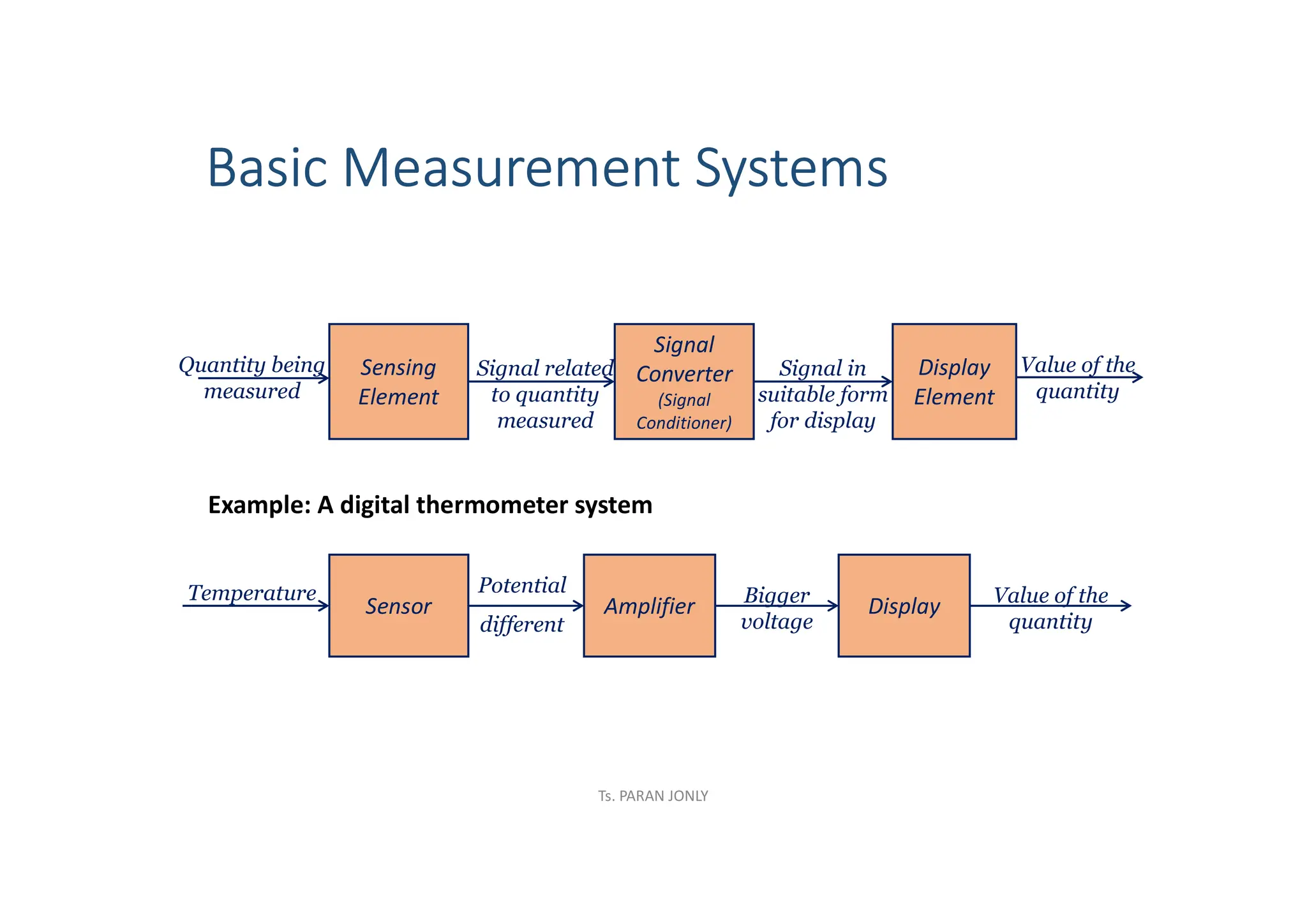
Basic Measurement Systems
Example: A digital thermometer system
Sensing
Element
Quantity being
measured
Signal related
to quantity
measured
Signal
Converter
(Signal
Conditioner)
Display
Element
Signal in
suitable form
for display
Sensor
Temperature Potential
different
Amplifier Display
Bigger
voltage
Value of the
quantity
Value of the
quantity
Ts. PARAN JONLY
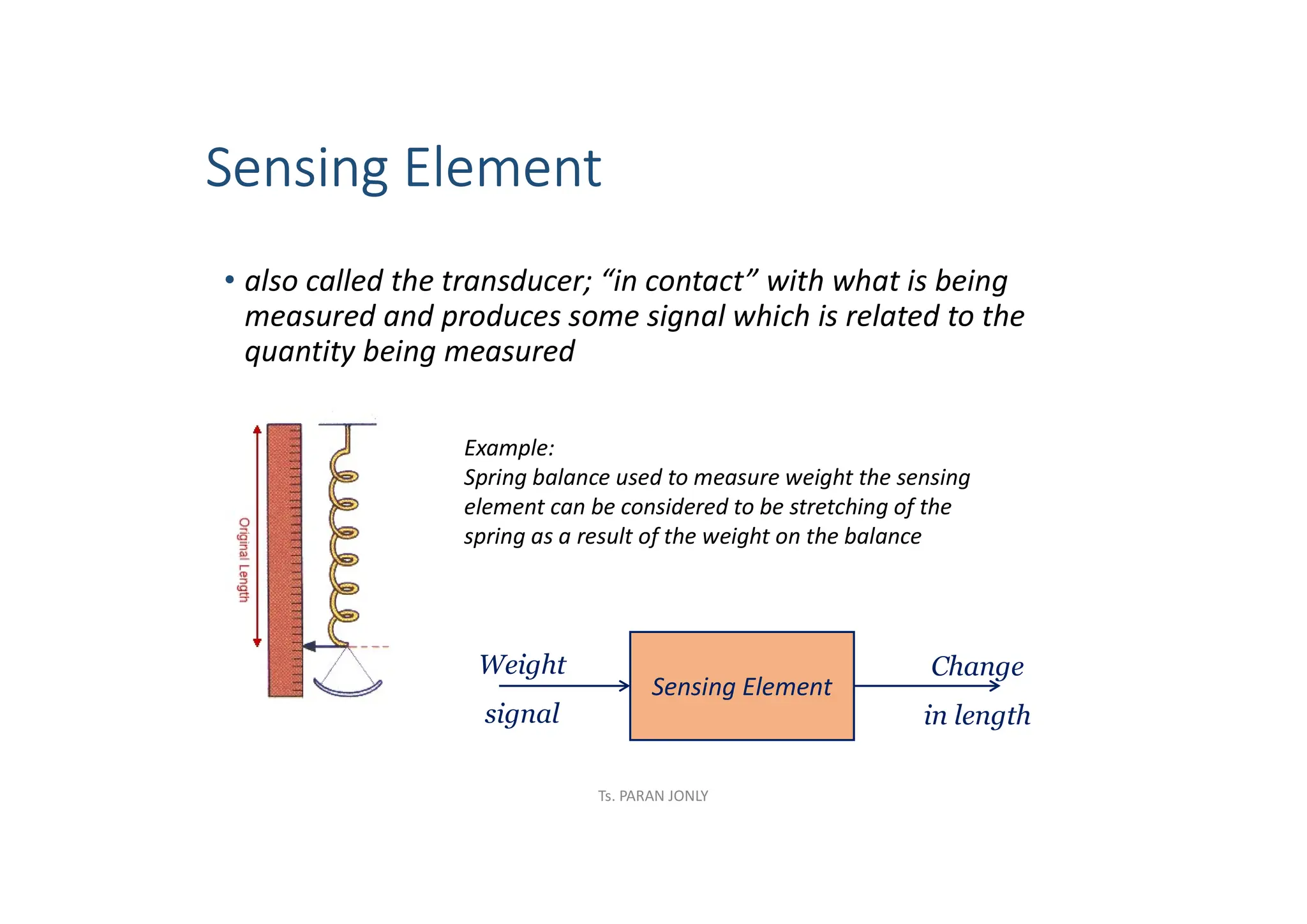
Sensing Element
• also called the transducer; “in contact” with what is being
measured and produces some signal which is related to the
quantity being measured
Sensing Element
Weight
signal
Change
in length
Example:
Spring balance used to measure weight the sensing
element can be considered to be stretching of the
spring as a result of the weight on the balance
Ts. PARAN JONLY
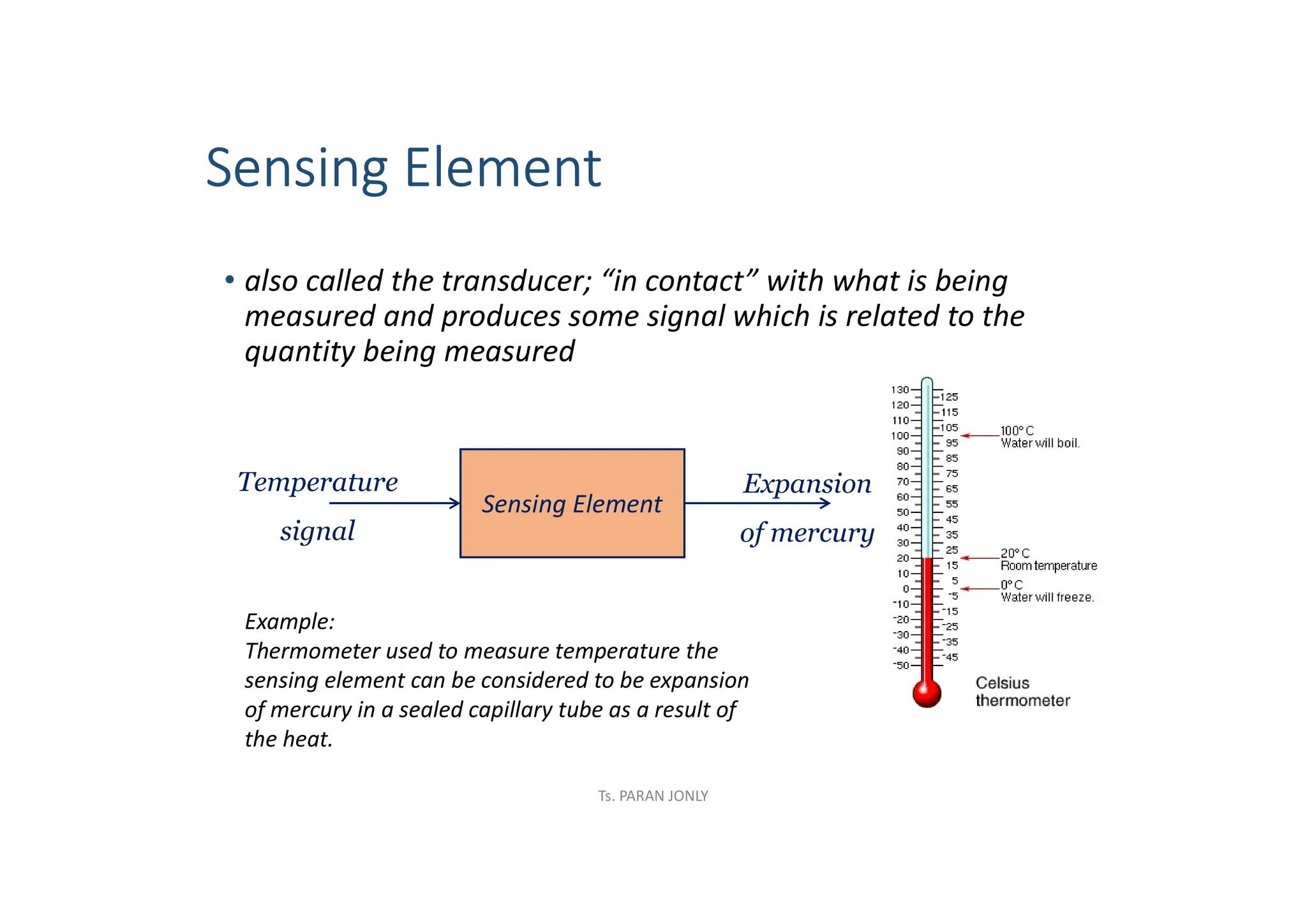
Sensing Element
• also called the transducer; “in contact” with what is being
measured and produces some signal which is related to the
quantity being measured
Example:
Thermometer used to measure temperature the
sensing element can be considered to be expansion
of mercury in a sealed capillary tube as a result of
the heat.
Sensing Element
Temperature
signal
Expansion
of mercury
Ts. PARAN JONLY
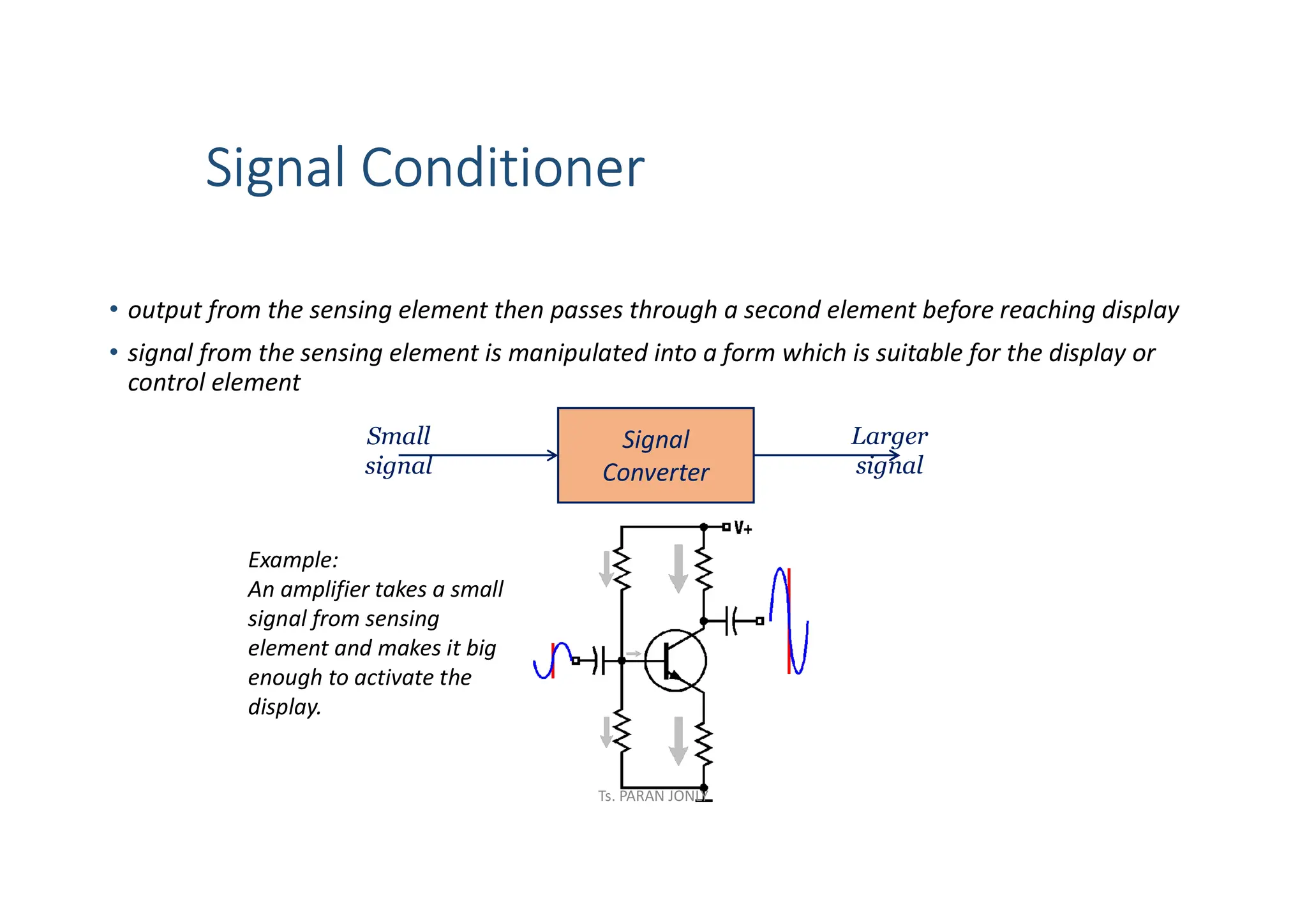
Signal Conditioner
• output from the sensing element then passes through a second element before reaching display
• signal from the sensing element is manipulated into a form which is suitable for the display or
control element
Signal
Converter
Small
signal
Larger
signal
Example:
An amplifier takes a small
signal from sensing
element and makes it big
enough to activate the
display.
Ts. PARAN JONLY
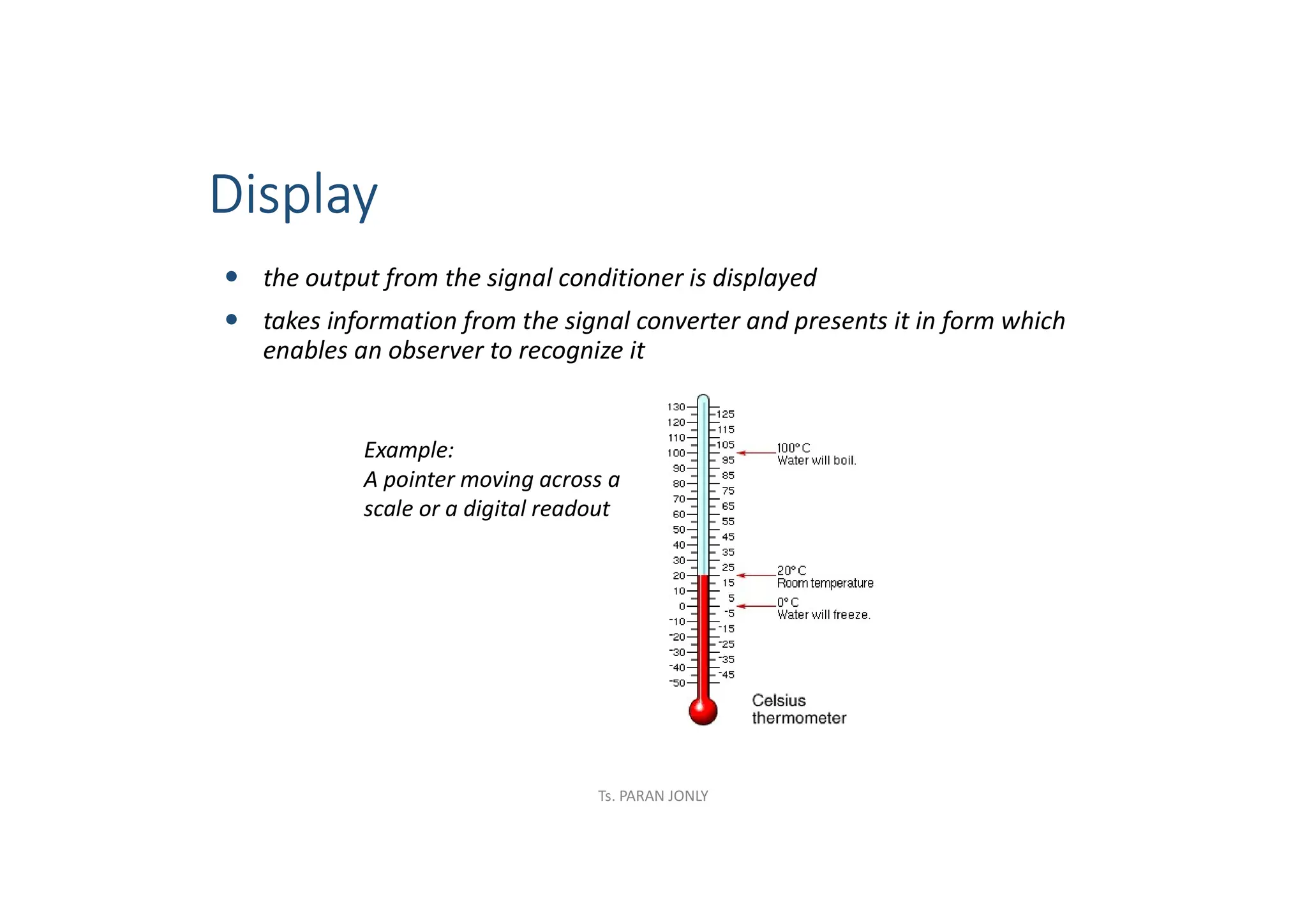
Display
 the output from the signal conditioner is displayed
 takes information from the signal converter and presents it in form which
enables an observer to recognize it
Example:
A pointer moving across a
scale or a digital readout
Ts. PARAN JONLY
What are common terms used to describe
the performance of measurement systems?
1. Accuracy
2. Precision
3. Error
4. Repeatability
5. Reliability
6. Reproducibility
7. Sensitivity
8. Stability
9. Drift
10. Resolution
11. Range and span
12. Dead Space
13. Dead Time
14. Threshold
15. Lag
16. Hysteresis
Ts. PARAN JONLY
Performance Terminology
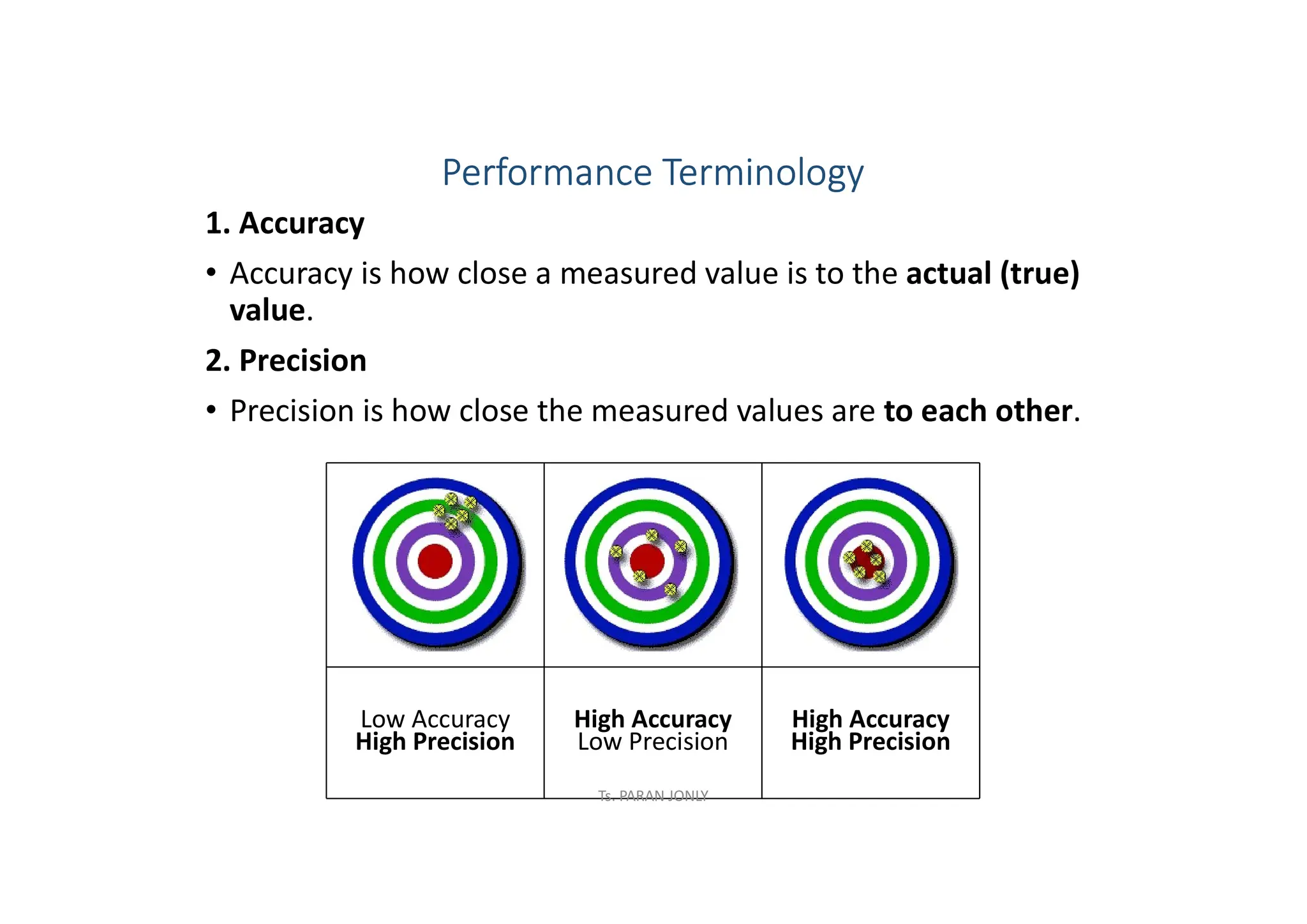
1. Accuracy
• Accuracy is how close a measured value is to the actual (true)
value.
2. Precision
• Precision is how close the measured values are to each other.
Low Accuracy
High Precision
High Accuracy
Low Precision
High Accuracy
High Precision
Ts. PARAN JONLY
Performance Terminology
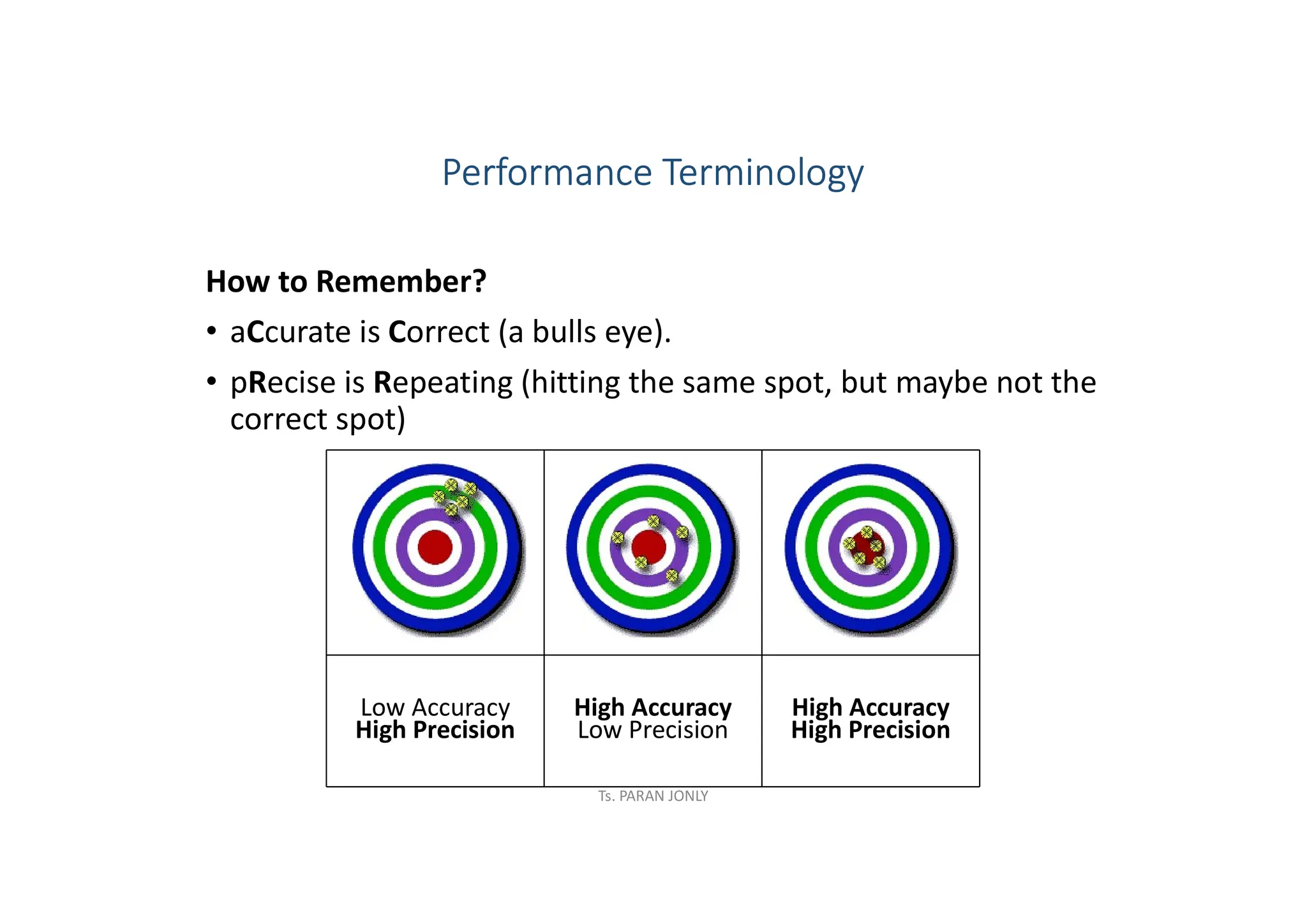
How to Remember?
• aCcurate is Correct (a bulls eye).
• pRecise is Repeating (hitting the same spot, but maybe not the
correct spot)
Low Accuracy
High Precision
High Accuracy
Low Precision
High Accuracy
High Precision
Ts. PARAN JONLY
3. Error
The difference between the result of the measurement and
the true value of the quantity being measured
Example 1: Thermometer given a value of 34oC.
 But the true value of the temperature is 33oC
 Then the error is +1oC.
Example 2: Sensor’s resistance true change of 10.5Ω.
 But the given value of the changed resistance is 10.2Ω.
 Hence, the error is -0.3Ω.
Error = Measured Value – True Value
Performance Terms
Ts. PARAN JONLY
4. Repeatability
 instrument’s ability to display the same reading for repeated
applications of the same value of the quantity being
measured.
 Example: If an ammeter was being measure a constant
current and gave four successive readings; 3.20A, 3.15A,
3.25A, and 3.20A, then there can be an error with any one
reading due to lack of repeatability.
Performance Terminology
Ts. PARAN JONLY
5. Reliability
 probability that the instrumentation will operate to an
agreed level of performance under the conditions specified
for its use.
 Example: an instrument for measuring a load might have an
accuracy of ±4% now and still ±4% six months later, while a
less reliable instrument might have deteriorated and the
accuracy become ±5%.
Performance Terminology
Ts. PARAN JONLY
6. Reproducibility
 or stability of an instrument is its ability to display same
reading when it is used to measure a constant quantity over
a period of time or when that quantity is measured on a
number of occasions.
Performance Terminology
Ts. PARAN JONLY
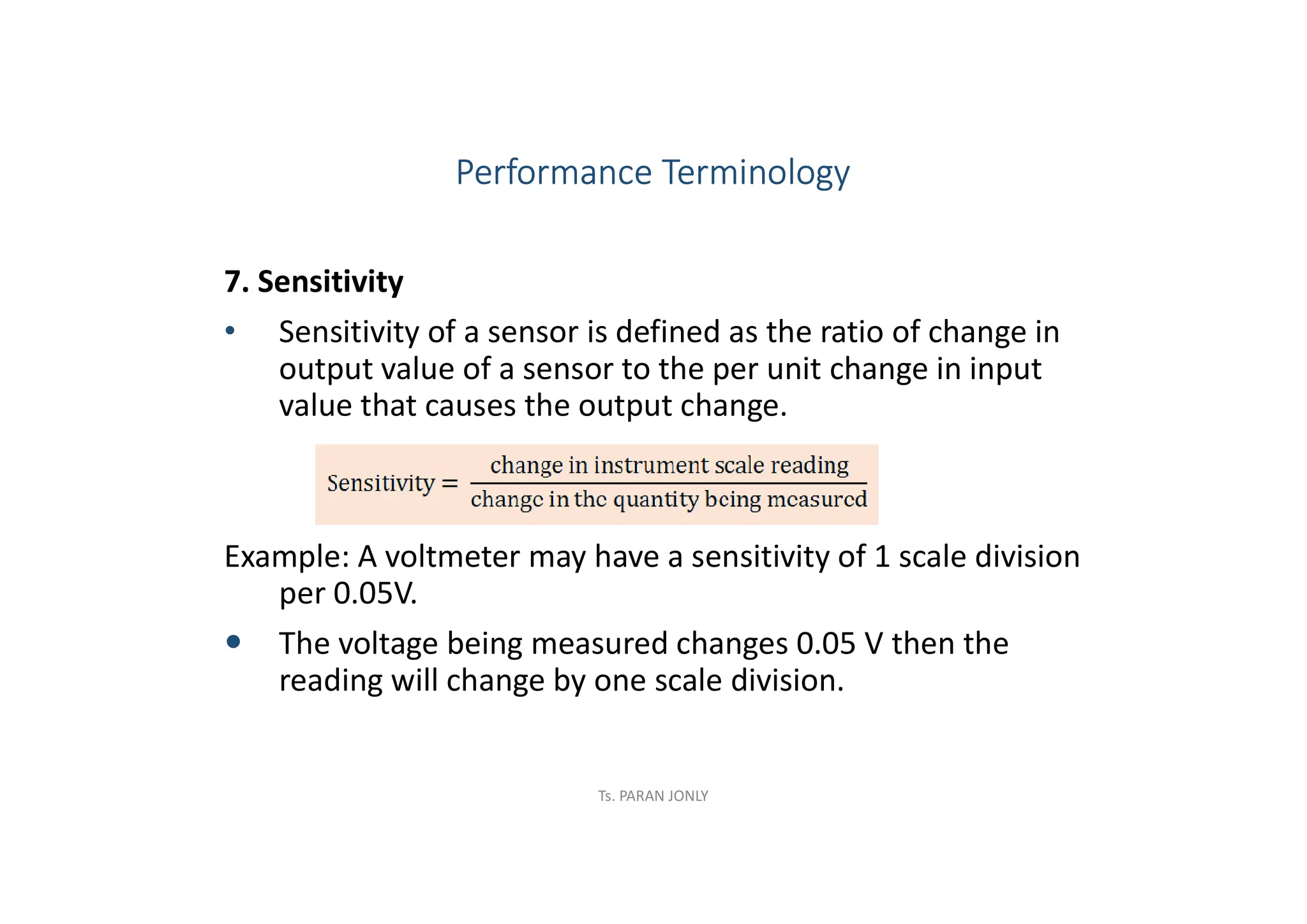
7. Sensitivity
• Sensitivity of a sensor is defined as the ratio of change in
output value of a sensor to the per unit change in input
value that causes the output change.
Example: A voltmeter may have a sensitivity of 1 scale division
per 0.05V.
 The voltage being measured changes 0.05 V then the
reading will change by one scale division.
Performance Terminology
Ts. PARAN JONLY
8. Stability
• Ability to give the same output when used to measure a constant input over a
period of time.
9. Drift
• to describe the change in output that occurs over time.
Performance Terminology
Ts. PARAN JONLY
10. Resolution
 Resolution is the smallest detectable incremental change of
input parameter that can be detected in the output signal.
Resolution can be expressed either as a proportion of the
full-scale reading or in absolute terms.
 Example:
if a LVDT sensor measures a displacement up to 20 mm and it
provides an output as a number between 1 and 100 then the
resolution of the sensor device is 0.2 mm.
Performance Terminology
Ts. PARAN JONLY
11. Range and Span
 The range of a transducer defines the limits between which
the input can vary.
 The span is the maximum value of the input minus the
minimum value.
 Example:
A load cell for the measurement of forces might have a range
of 0 to 50kN and a span of 50kN.
Performance Terminology
Ts. PARAN JONLY
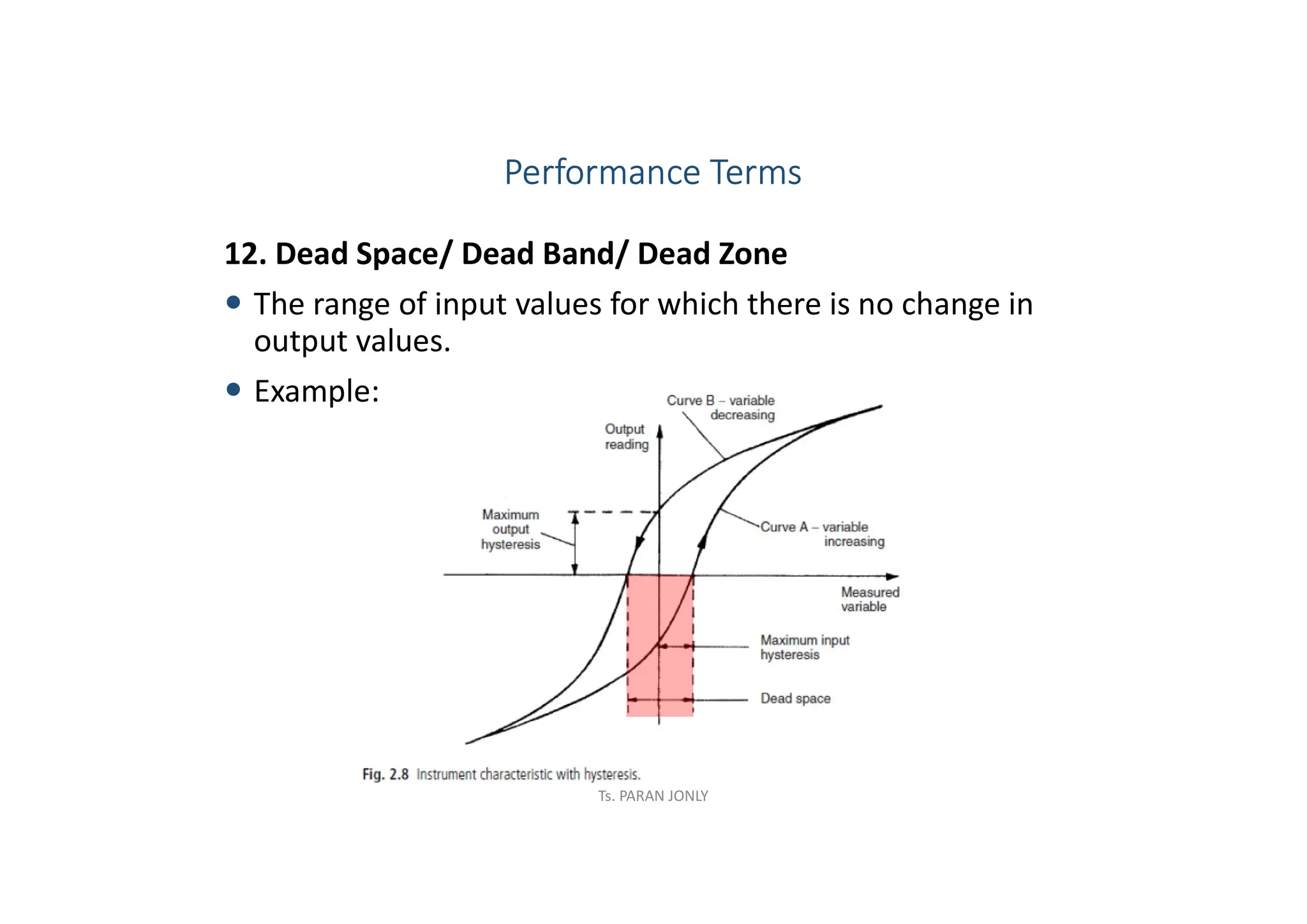
12. Dead Space/ Dead Band/ Dead Zone
 The range of input values for which there is no change in
output values.
 Example:
Performance Terms
Ts. PARAN JONLY
13. Dead Time
• The length of time from the application of an input until
the output begins to respond and change.
14. Threshold
 when the quantity is being measured is gradually increased
from zero, a certain minimum level might have to be reached
before the instrument responds and gives a detectable
reading.
 Example: Pressure gauge might not respond until the
pressure has risen to about 1 kPa
Performance Terms
Ts. PARAN JONLY
15. Lag
 when the quantity being measured changes a certain time
might have to elapse before the measuring instrument
responds to the change
Performance Terms
Ts. PARAN JONLY
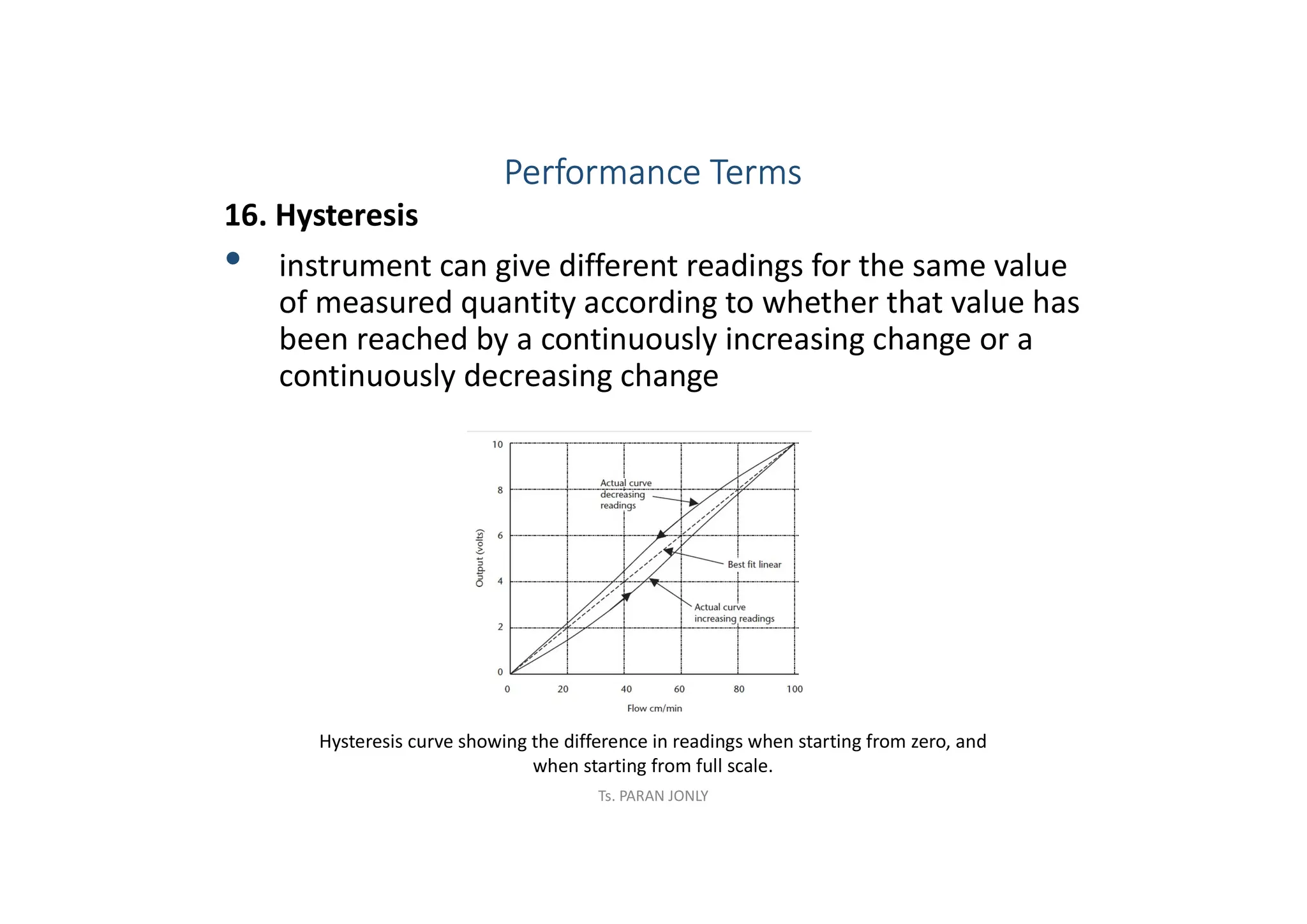
16. Hysteresis
• instrument can give different readings for the same value
of measured quantity according to whether that value has
been reached by a continuously increasing change or a
continuously decreasing change
Performance Terms
Hysteresis curve showing the difference in readings when starting from zero, and
when starting from full scale.
Ts. PARAN JONLY
What are common sources of error that
can occur with measurement systems?
1. Construction errors
2. Non-linearity errors
3. Operating errors
4. Environmental errors
5. Ageing errors
6. Insertion errors
7. Random and Systematic errors
Ts. PARAN JONLY
Sources of Error
Construction errors
can be cause by tolerances in the dimensions of components
and electrical components used in the manufacture of an
instrument
Ts. PARAN JONLY
Sources of Error
Non-linearity errors
linear scale: the reading given is directly proportional to the
distance or angle moved by a pointer across the scale
in many instances however, though a linear scale is used the
relationship is not perfectly linear and so errors occur
Ts. PARAN JONLY
Sources of Error
Operating errors
Parallax errors: common errors occur with instruments that
have pointers moving across scales, and results from the scale
and pointer not being in the same plane.
Ts. PARAN JONLY
Sources of Error
Environmental errors
errors that can arise as a result of environmental effects
which are not taken account of
Ts. PARAN JONLY
Sources of Error
Ageing errors
a consequence of instruments getting older is that
some components may deteriorate and their values change
also build-up of deposits may occur on surface which can
affect contact resistance and insulation.
Ts. PARAN JONLY
Sources of Error
Insertion errors
results from the insertion of the instrument into the
position to measure a quantity affecting its value
Ts. PARAN JONLY
Sources of Error
Random errors:
• can vary in a random manner between successive readings
of the same quantity
• might be due to operation error
• can be overcome by repeated readings being taken and an
average calculated
Ts. PARAN JONLY
Sources of Error
Systematic errors:
• do not vary from one reading to another.
• may be result of construction or non-linearity errors and so
indicated in accuracy stated for an instrument by the
manufacturer.
Ts. PARAN JONLY
Functional Element of
Measurement System
CEE2163
Instrumentation and Control
Part 1.2
Ts. PARAN JONLY
In this Part 1.2, you will learn:
Basic Instrumentation System
 Describe and illustrate the functional elements of engineering
measurement system
Ts. PARAN JONLY
Methods of Measurement
vDIRECT METHODS
In these methods, the unknown quantity (called the measurand )
is directly compared against a standard.
vINDIRECT METHOD
Measurements by direct methods are not always possible, feasible
and practicable. In engineering applications measurement systems
are used which require need of indirect method for measurement
purposes.
Ts. PARAN JONLY
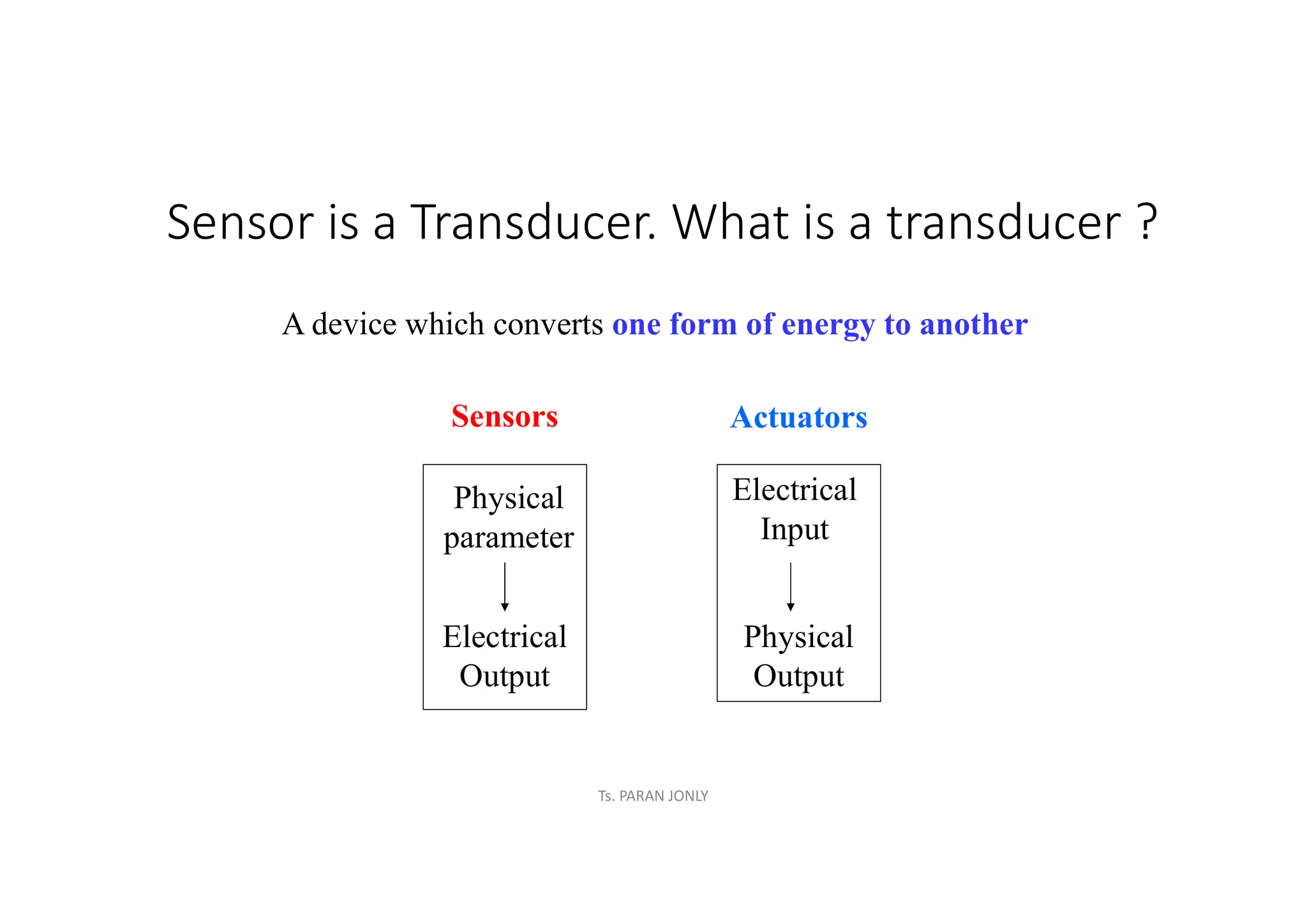
Sensor is a Transducer. What is a transducer ?
A device which converts one form of energy to another
Actuators
Sensors
Physical
parameter
Electrical
Output
Electrical
Input
Physical
Output
Ts. PARAN JONLY
Definitions of Sensor and Transducer
SENSOR: a device that detects a change in a physical stimulus and turns
it into a signal which can be measured or recorded.
TRANSDUCER: is 'a device that transfers power from one system to
another in the same or in the different form.
(The word sensor is derived from entire meaning 'to perceive'
and 'transducer' is from transducer meaning 'to lead across)
A sensible distinction is to use 'sensor' for the sensing element itself and
'transducer' for the sensing element plus any associated circuitry. All
transducers would thus contain a sensor and most (though not all)
sensors would also be transducers.
Ts. PARAN JONLY
Sensors and Transducers
A dictionary definition (Chambers Twentieth Century) of ‘sensor’ is ‘a device that detects a change in a physical
stimulus and turns it into a signal which can be measured or recorded’; a corresponding definition of
‘transducer’ is ‘a device that transfers power from one system to another in the same or in different form’.
The sensor is the part of an instrument used to detect a change in the quantity being measured.
There are three important elements in industrial measurement system: sensors, signal conditioners, and display
unit.
Some common examples of sensing elements are to be found in
I. a liquid in glass thermometer
II. a bourdon tube pressure gauge
From our basic conditions for an instrument system, namely sensors – signal conditioner – display units we can
identify the sensor for each of the above instruments.
Ts. PARAN JONLY
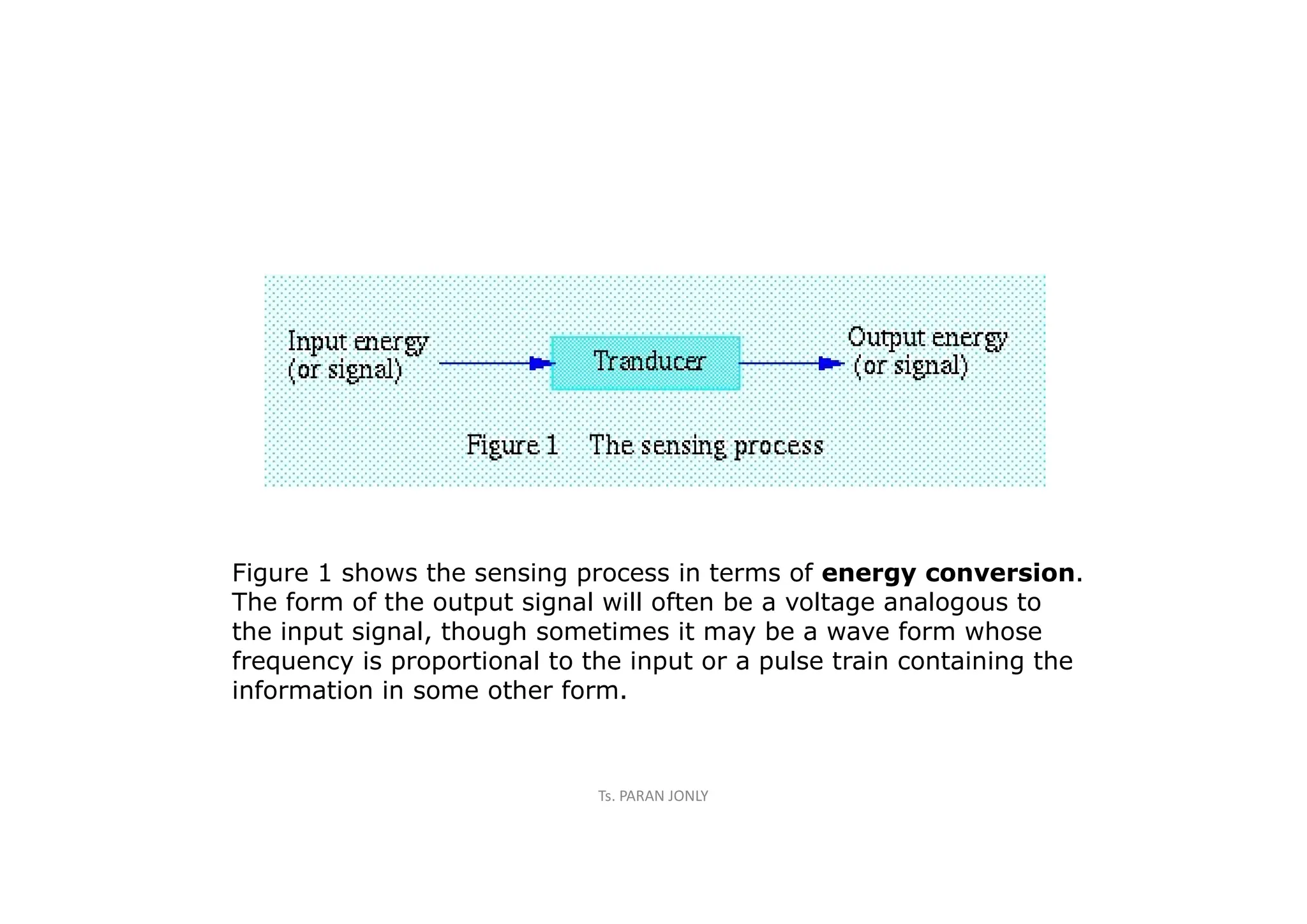
Figure 1 shows the sensing process in terms of energy conversion.
The form of the output signal will often be a voltage analogous to
the input signal, though sometimes it may be a wave form whose
frequency is proportional to the input or a pulse train containing the
information in some other form.
Ts. PARAN JONLY
Instrumentation is used to measure
many parameters (physical values).
These parameters include:
ü Pressure, either differential
or static
ü Flow
ü Temperature
ü Levels of liquids, etc.
ü Density
ü Viscosity
ü Other mechanical
properties of materials
ü Properties of ionising
radiation
ü Frequency
ü Current
ü Voltage
ü Inductance
ü Capacitance
ü Resistivity
ü Chemical composition
ü Chemical properties
ü Properties of light
ü Vibration
ü Weight
Ts. PARAN JONLY
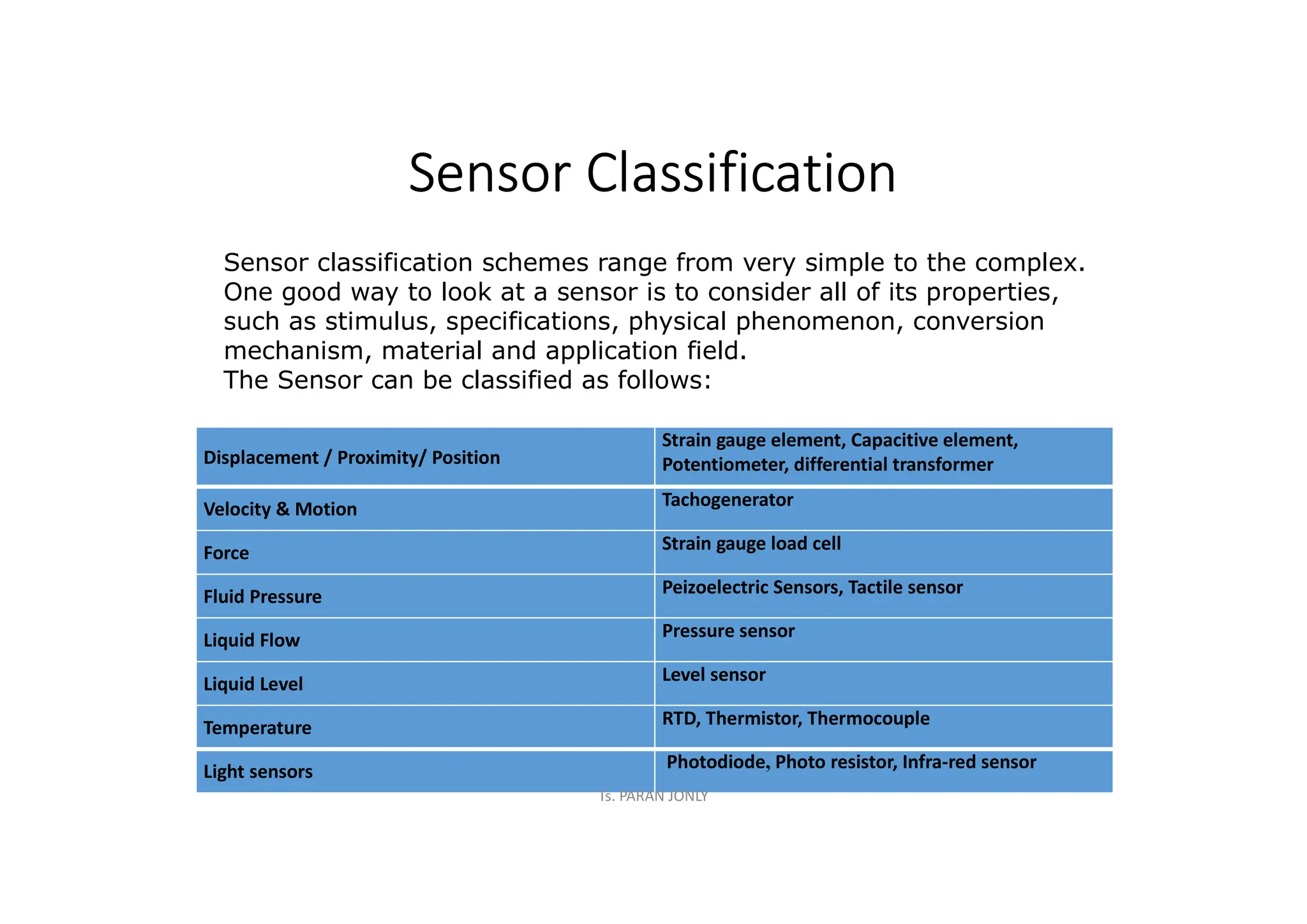
Sensor Classification
Sensor classification schemes range from very simple to the complex.
One good way to look at a sensor is to consider all of its properties,
such as stimulus, specifications, physical phenomenon, conversion
mechanism, material and application field.
The Sensor can be classified as follows:
Displacement / Proximity/ Position
Strain gauge element, Capacitive element,
Potentiometer, differential transformer
Velocity & Motion Tachogenerator
Force Strain gauge load cell
Fluid Pressure Peizoelectric Sensors, Tactile sensor
Liquid Flow Pressure sensor
Liquid Level Level sensor
Temperature RTD, Thermistor, Thermocouple
Light sensors Photodiode, Photo resistor, Infra-red sensor
Ts. PARAN JONLY
Sensor Selection
Any sensor is based on a simple concept that physical
property of a sensor must be altered by an external stimulus
to cause that property either to produce an electric signal or
to modulate (to modify) an external electric signal.
Quite often, the same stimulus may be measured by using
quite different physical phenomena, and subsequently, by
different sensors.
Selection criteria depend on many factors, such as availability,
cost, power consumption, environmental conditions, etc.
The best choice can be done only after all variables are
considered.
Ts. PARAN JONLY
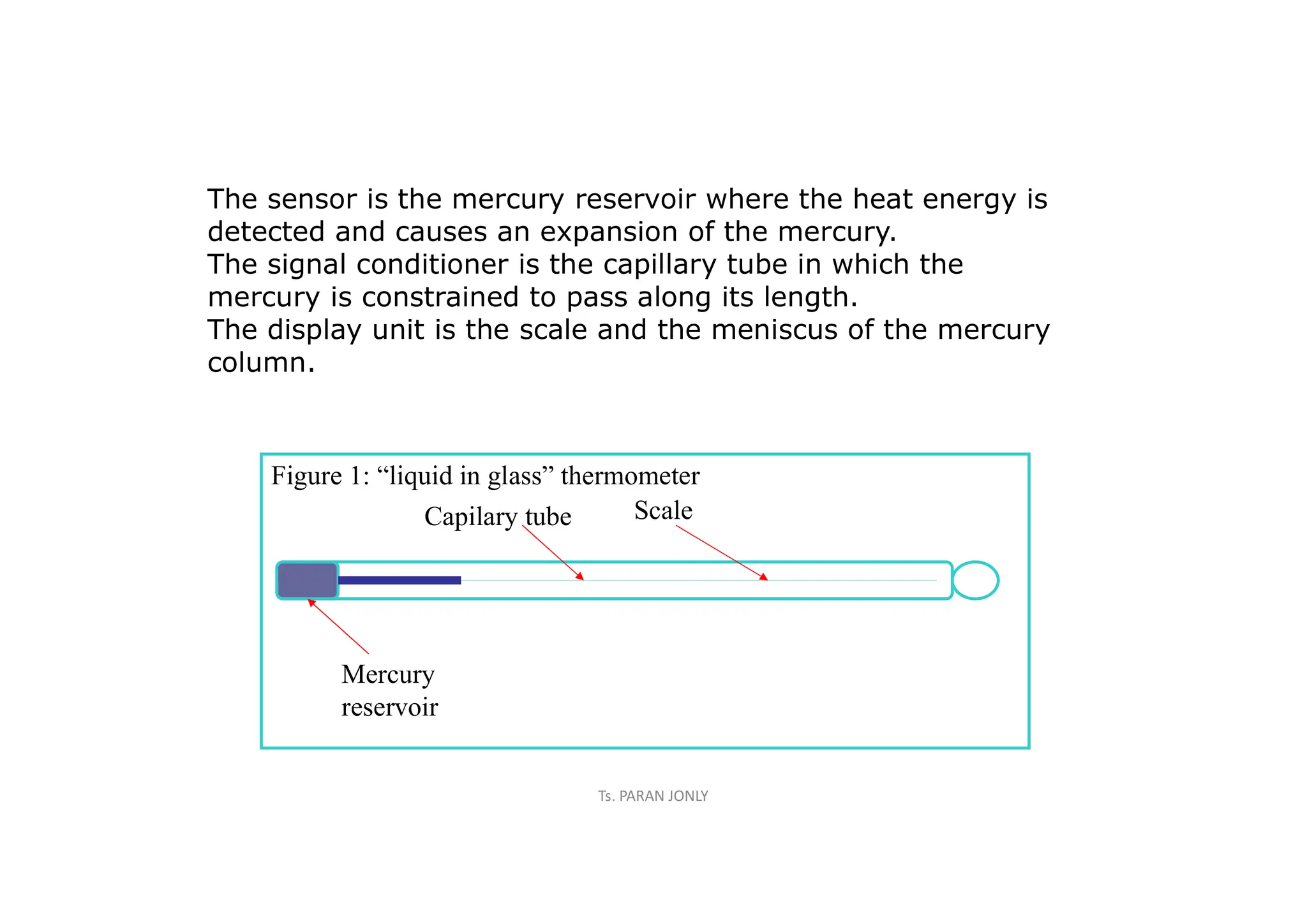
Figure 1: “liquid in glass” thermometer
Capilary tube Scale
Mercury
reservoir
The sensor is the mercury reservoir where the heat energy is
detected and causes an expansion of the mercury.
The signal conditioner is the capillary tube in which the
mercury is constrained to pass along its length.
The display unit is the scale and the meniscus of the mercury
column.
Ts. PARAN JONLY
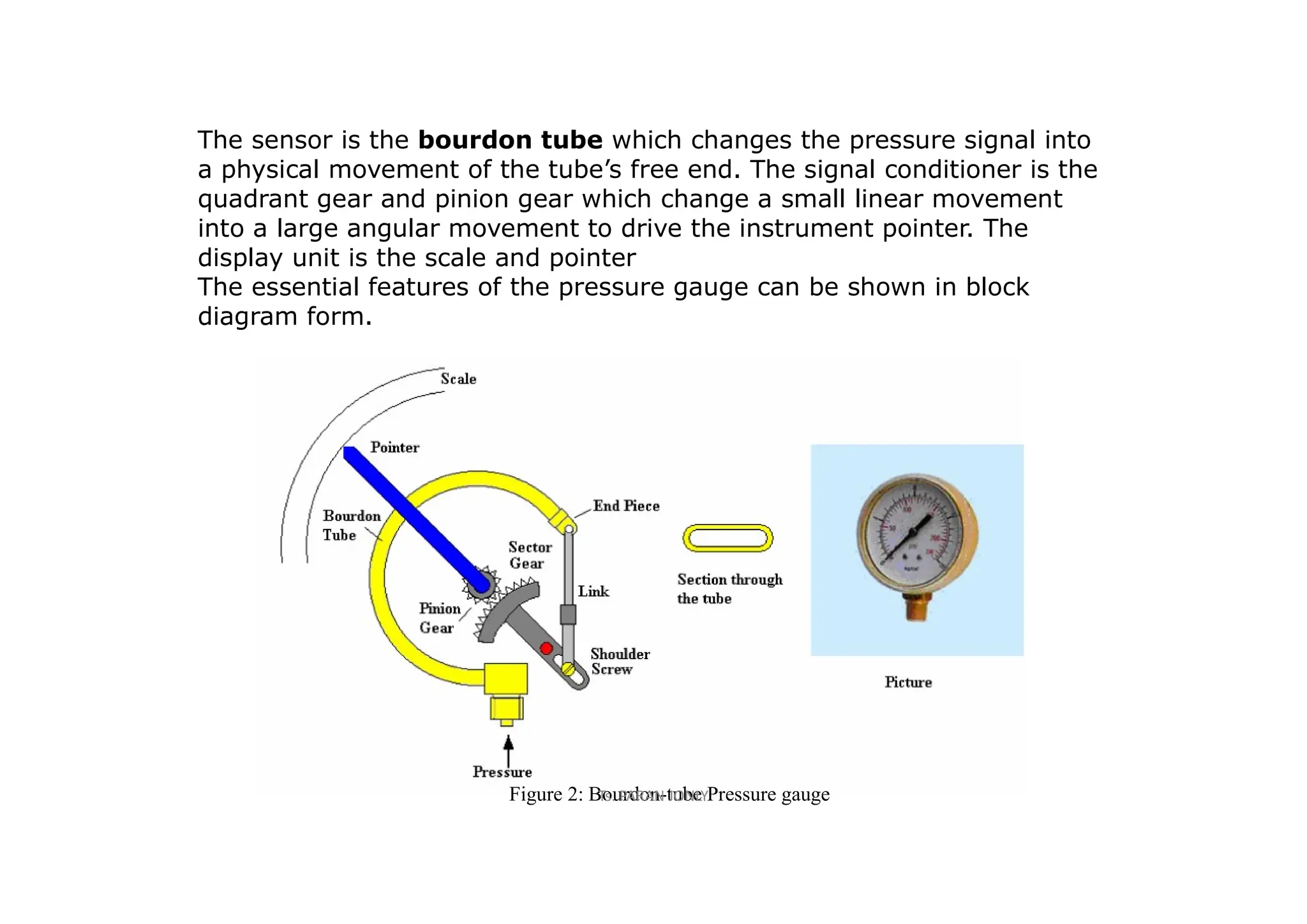
The sensor is the bourdon tube which changes the pressure signal into
a physical movement of the tube’s free end. The signal conditioner is the
quadrant gear and pinion gear which change a small linear movement
into a large angular movement to drive the instrument pointer. The
display unit is the scale and pointer
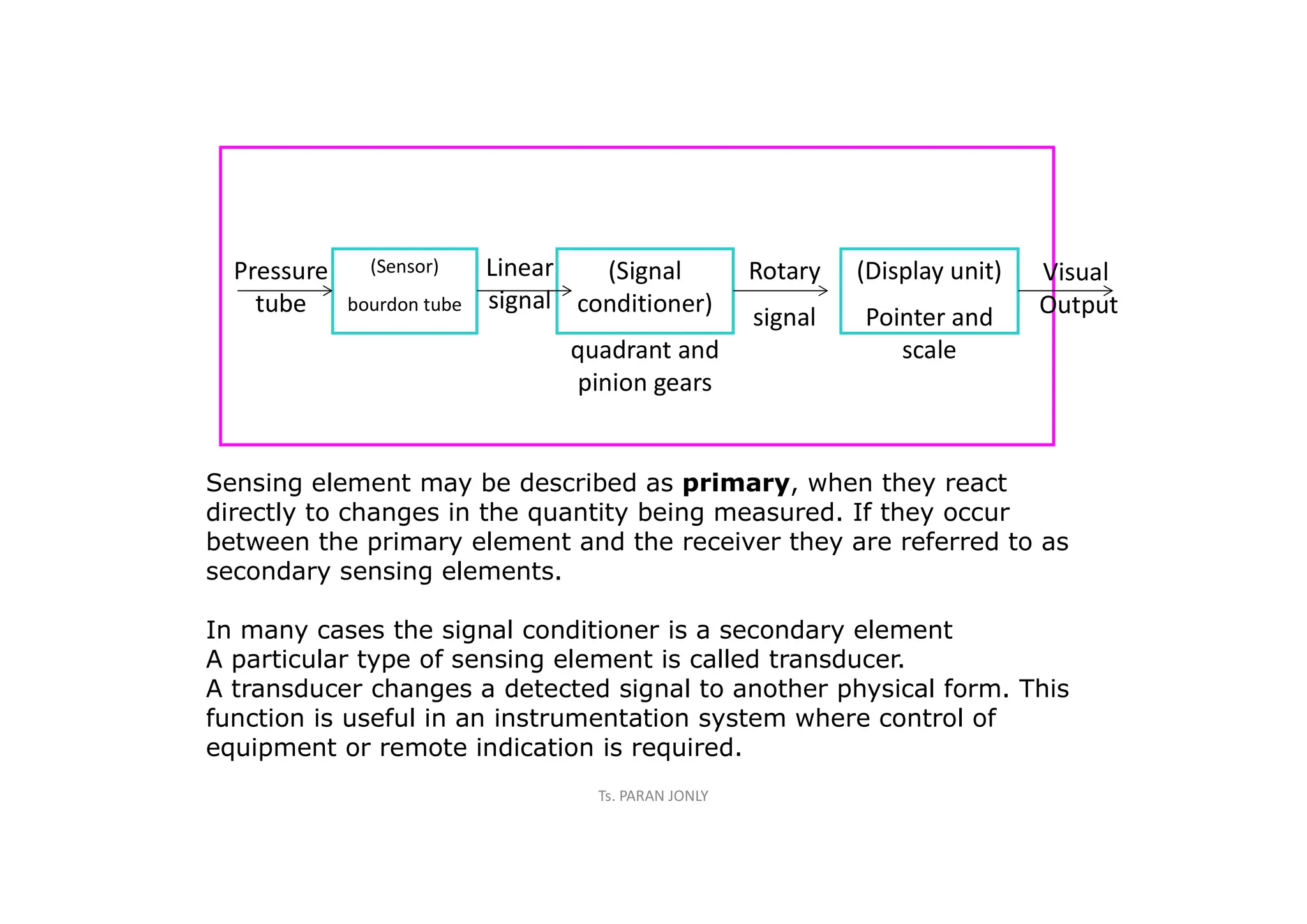
The essential features of the pressure gauge can be shown in block
diagram form.
Figure 2: Bourdon-tube Pressure gauge
Ts. PARAN JONLY
(Sensor)
bourdon tube
(Signal
conditioner)
quadrant and
pinion gears
(Display unit)
Pointer and
scale
Linear
signal
Rotary
signal
Pressure
tube
Visual
Output
Sensing element may be described as primary, when they react
directly to changes in the quantity being measured. If they occur
between the primary element and the receiver they are referred to as
secondary sensing elements.
In many cases the signal conditioner is a secondary element
A particular type of sensing element is called transducer.
A transducer changes a detected signal to another physical form. This
function is useful in an instrumentation system where control of
equipment or remote indication is required.
Ts. PARAN JONLY
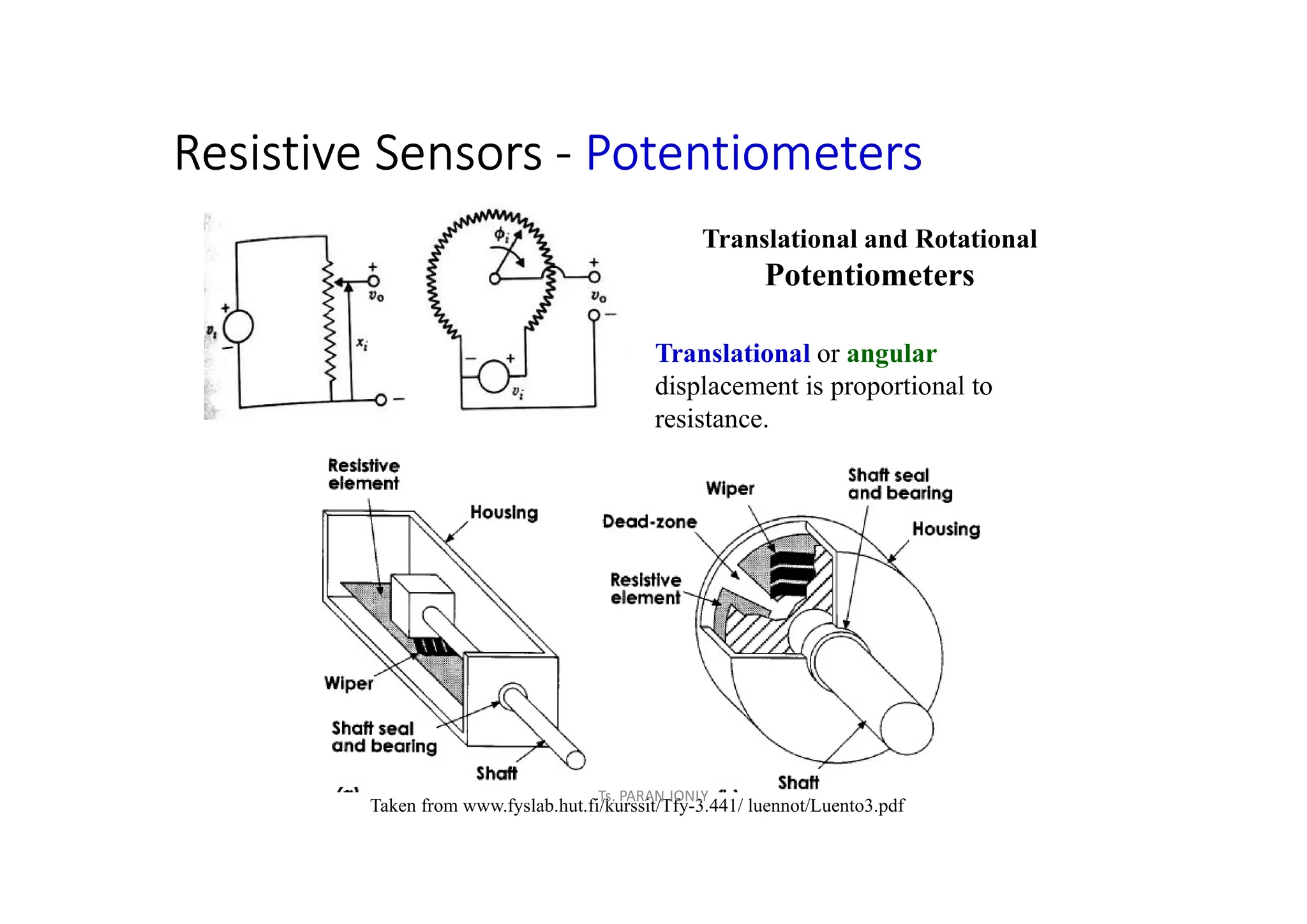
Resistive Sensors - Potentiometers
Translational and Rotational
Potentiometers
Translational or angular
displacement is proportional to
resistance.
Taken from www.fyslab.hut.fi/kurssit/Tfy-3.441/ luennot/Luento3.pdf
Ts. PARAN JONLY
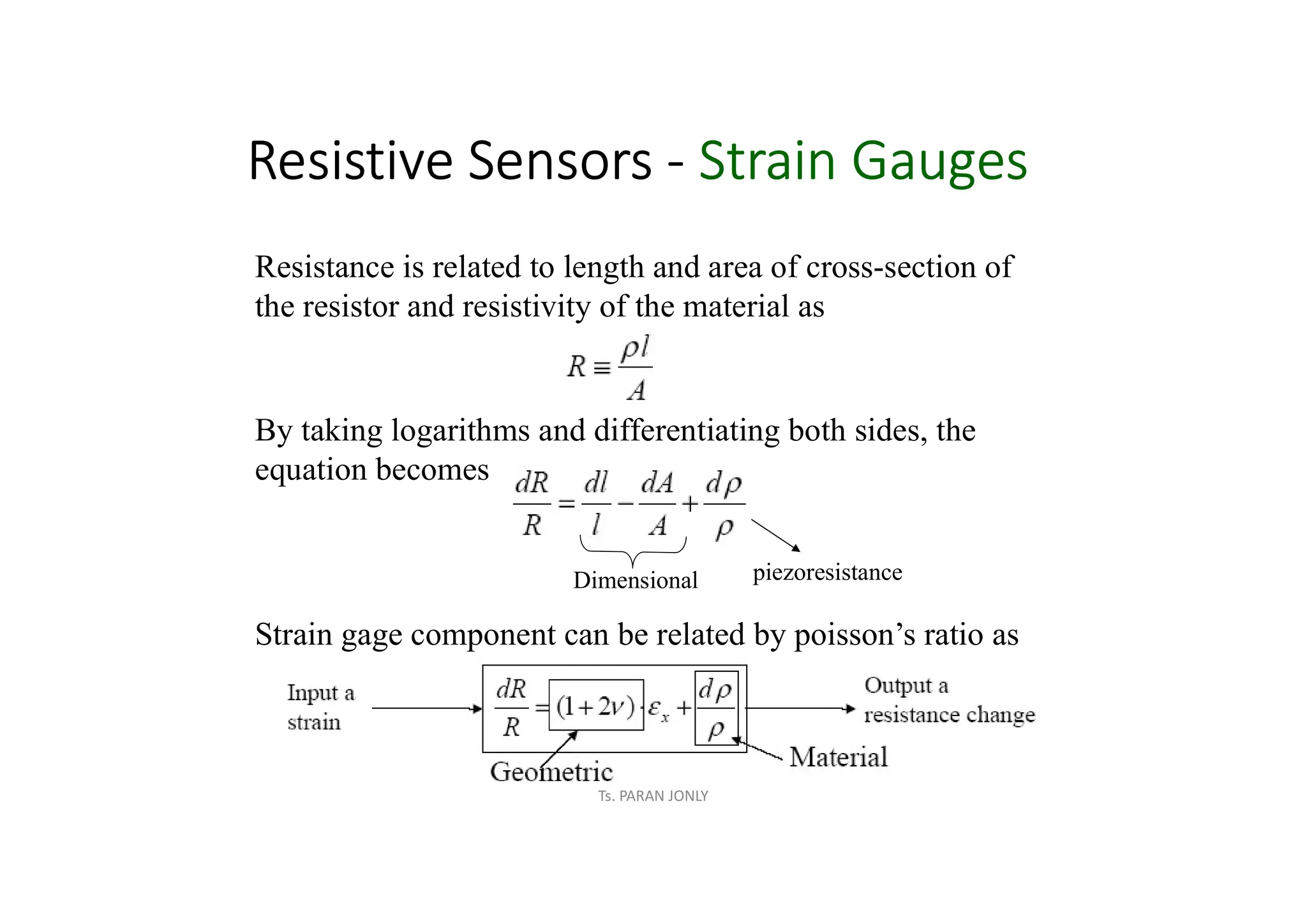
Resistive Sensors - Strain Gauges
Resistance is related to length and area of cross-section of
the resistor and resistivity of the material as
By taking logarithms and differentiating both sides, the
equation becomes
Dimensional piezoresistance
Strain gage component can be related by poisson’s ratio as
Ts. PARAN JONLY
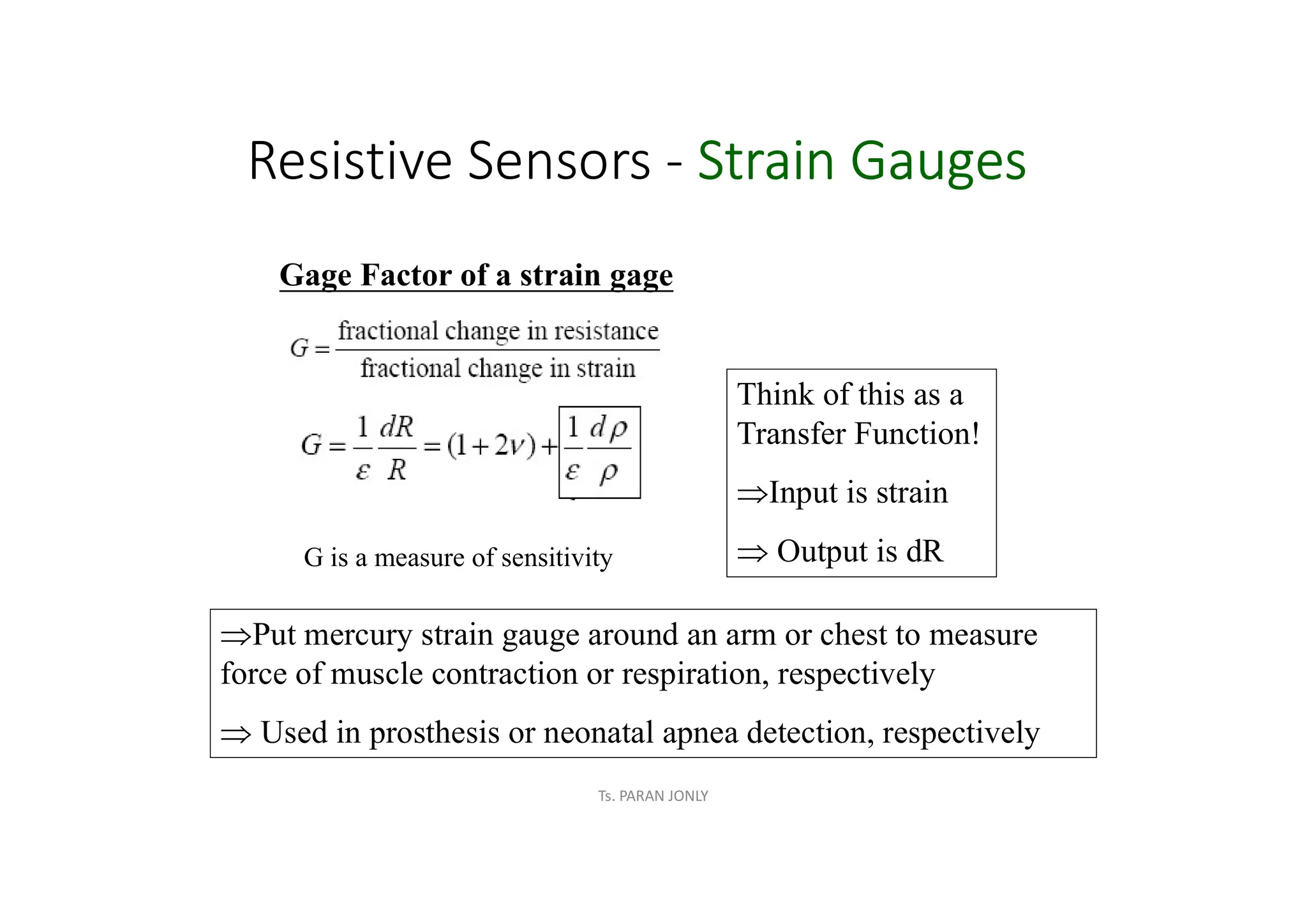
Resistive Sensors - Strain Gauges
Gage Factor of a strain gage
G is a measure of sensitivity
Think of this as a
Transfer Function!
ÞInput is strain
Þ Output is dR
ÞPut mercury strain gauge around an arm or chest to measure
force of muscle contraction or respiration, respectively
Þ Used in prosthesis or neonatal apnea detection, respectively
Ts. PARAN JONLY
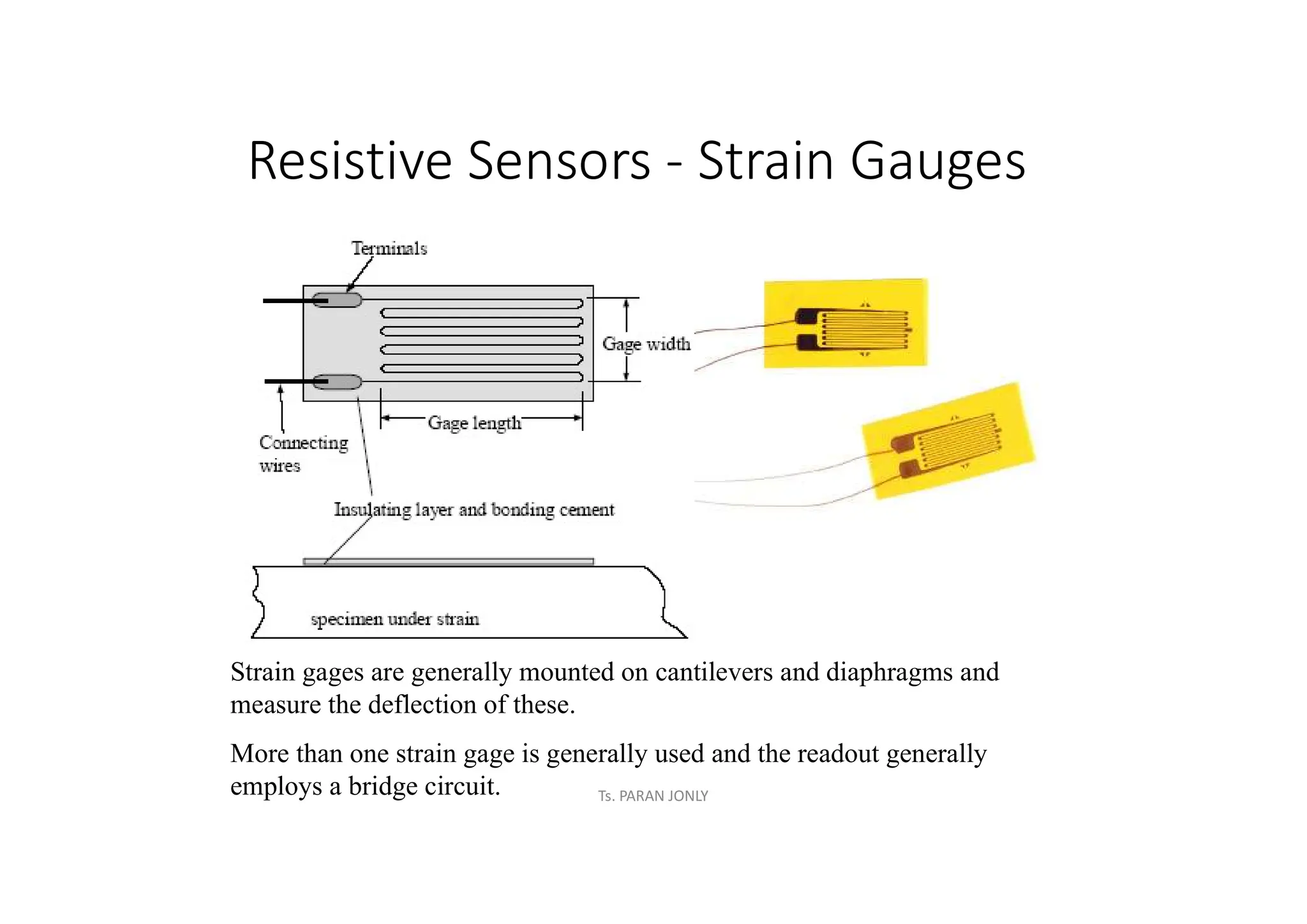
Resistive Sensors - Strain Gauges
Strain gages are generally mounted on cantilevers and diaphragms and
measure the deflection of these.
More than one strain gage is generally used and the readout generally
employs a bridge circuit. Ts. PARAN JONLY
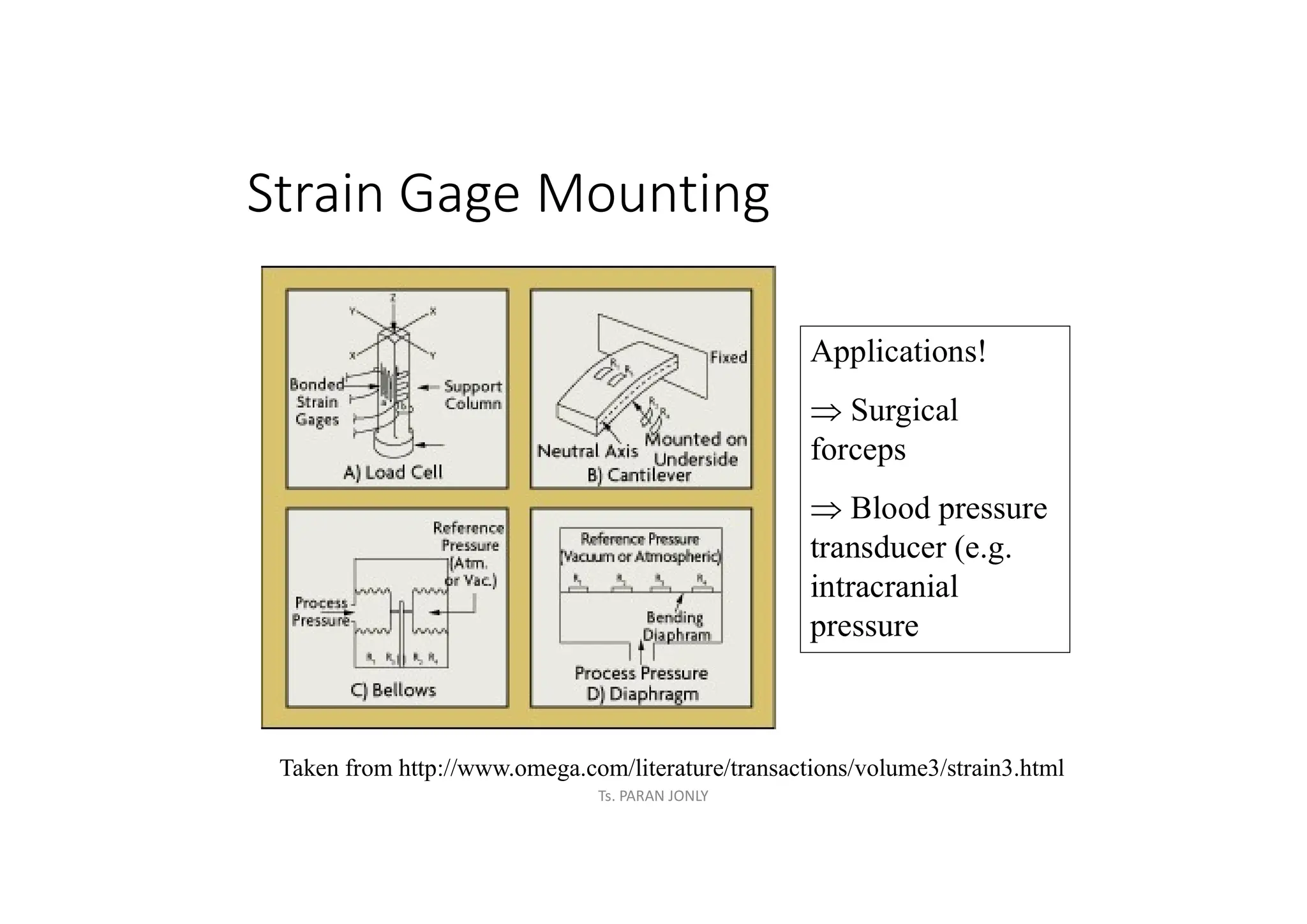
Strain Gage Mounting
Taken from http://www.omega.com/literature/transactions/volume3/strain3.html
Applications!
Þ Surgical
forceps
Þ Blood pressure
transducer (e.g.
intracranial
pressure
Ts. PARAN JONLY
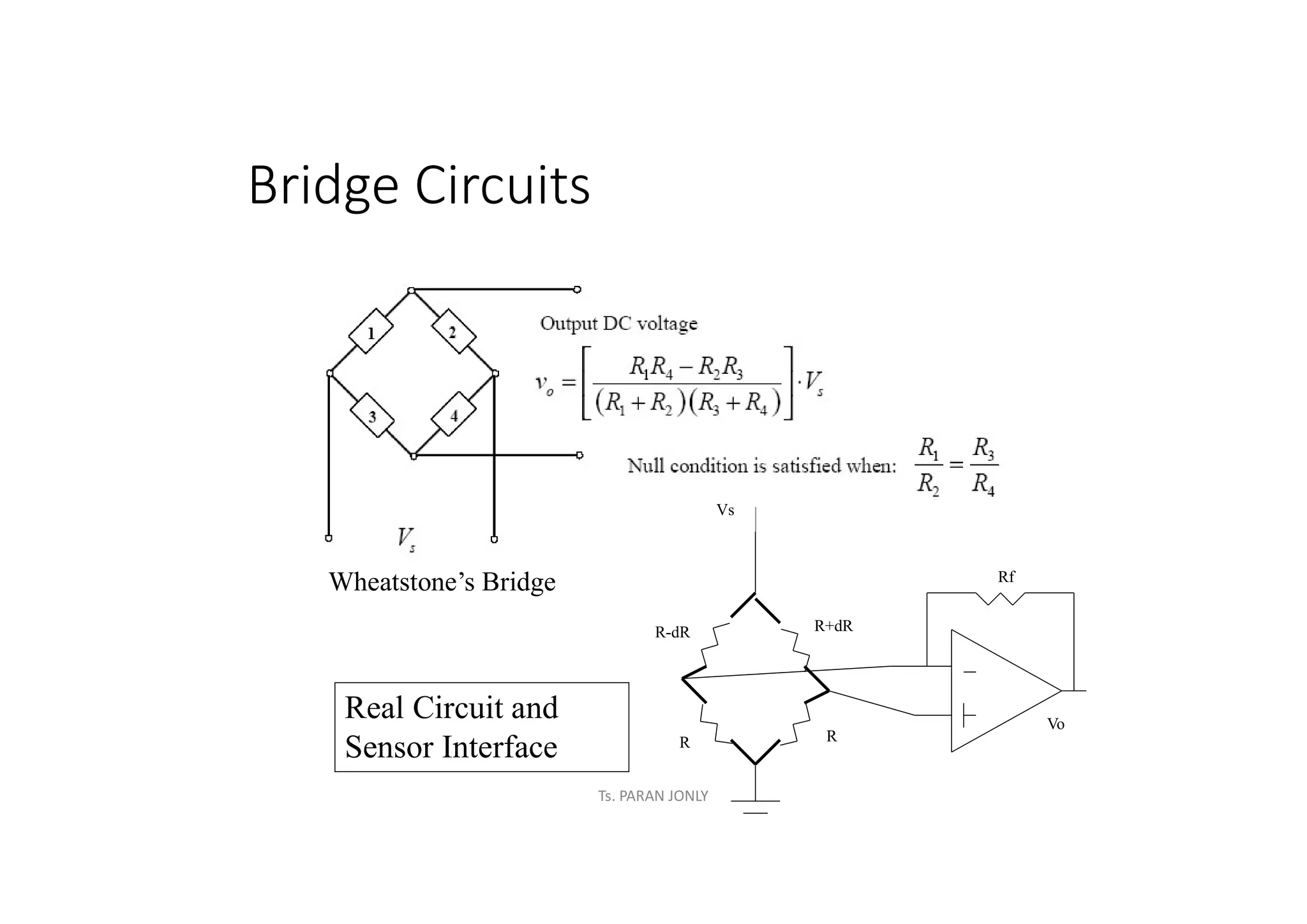
Bridge Circuits
Wheatstone’s Bridge
R-dR R+dR
R
Rf
Vs
R
Vo
Real Circuit and
Sensor Interface
Ts. PARAN JONLY
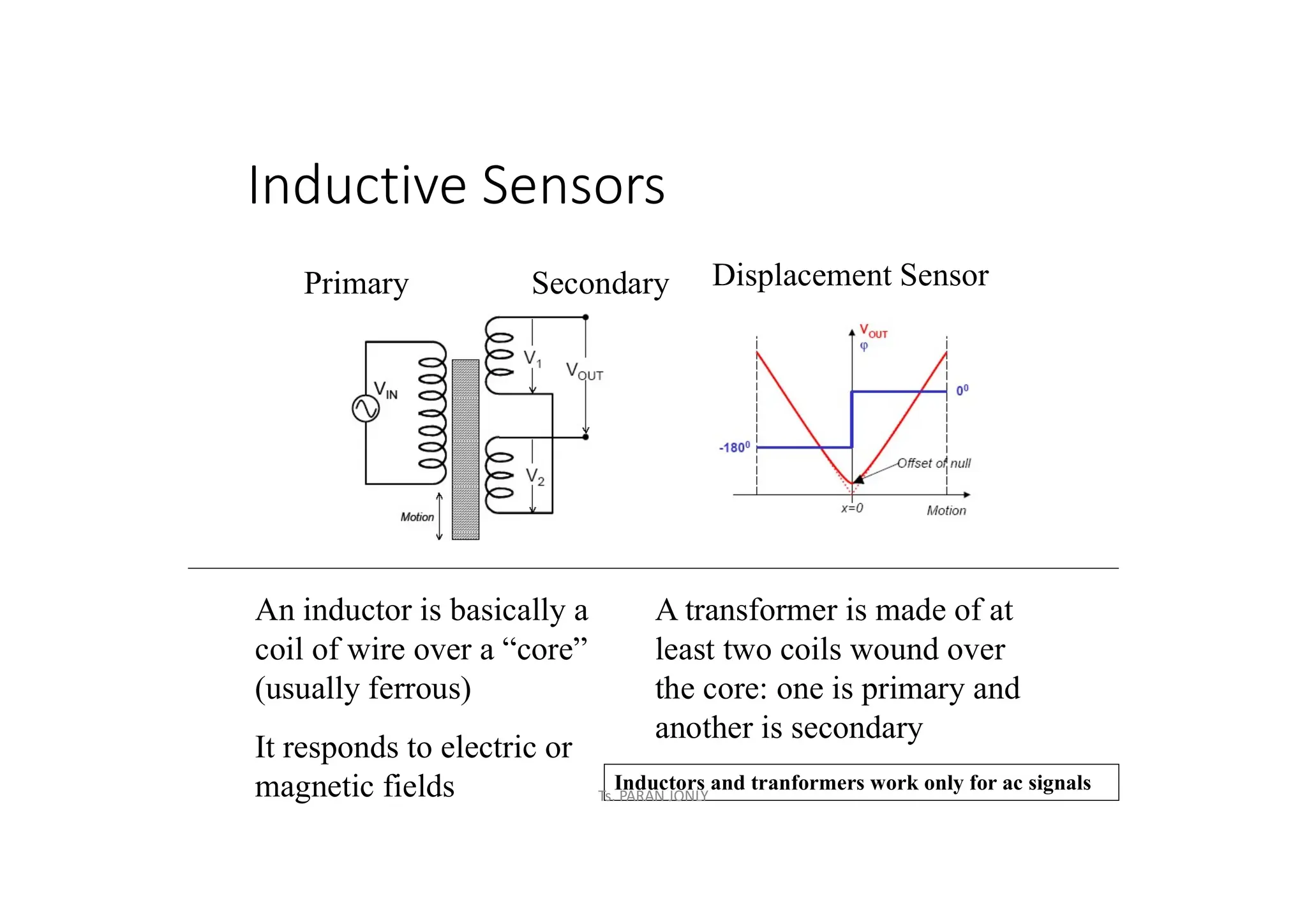
Inductive Sensors
An inductor is basically a
coil of wire over a “core”
(usually ferrous)
It responds to electric or
magnetic fields
A transformer is made of at
least two coils wound over
the core: one is primary and
another is secondary
Primary Secondary Displacement Sensor
Inductors and tranformers work only for ac signals
Ts. PARAN JONLY
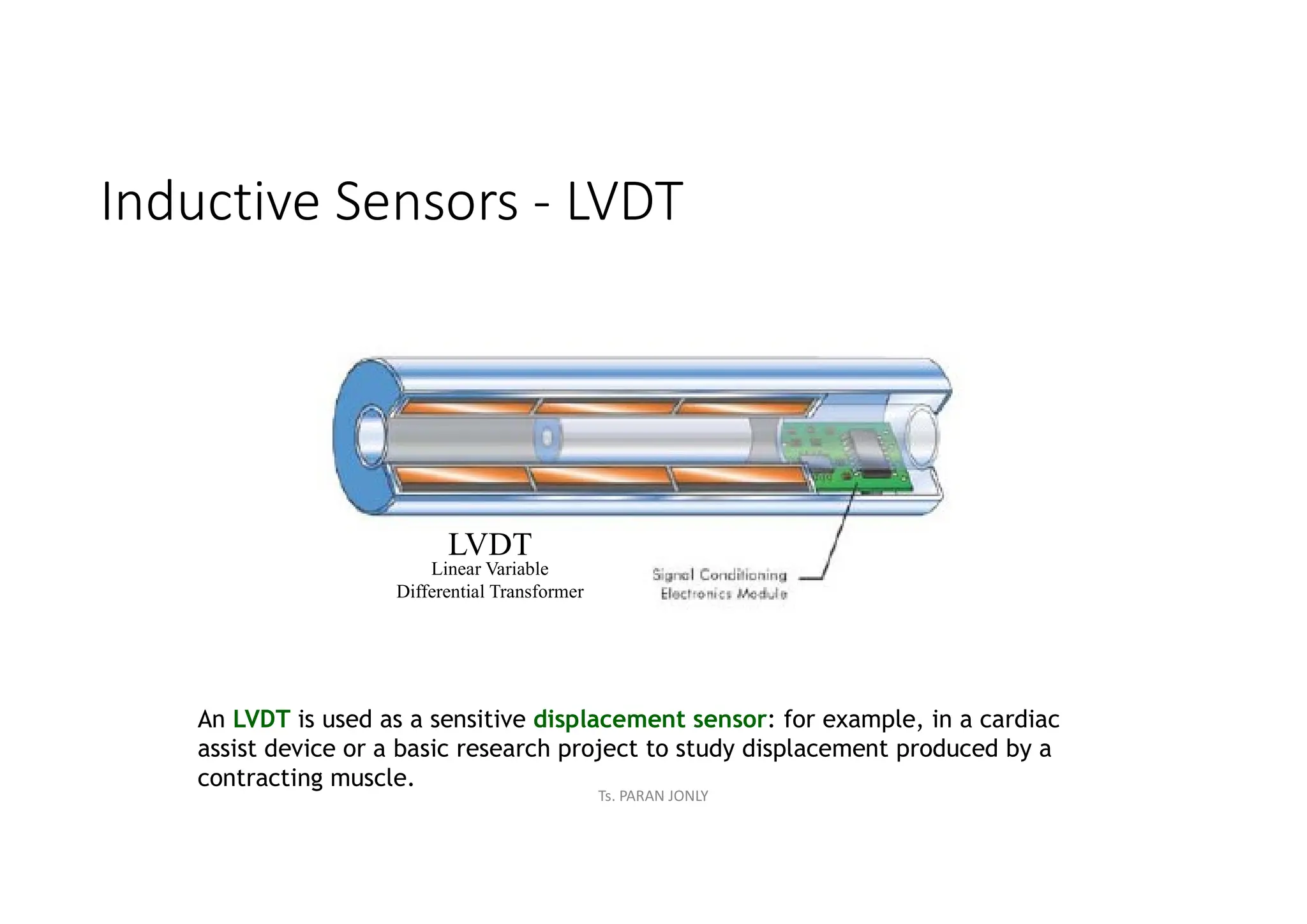
Inductive Sensors - LVDT
LVDT
Linear Variable
Differential Transformer
An LVDT is used as a sensitive displacement sensor: for example, in a cardiac
assist device or a basic research project to study displacement produced by a
contracting muscle.
Ts. PARAN JONLY
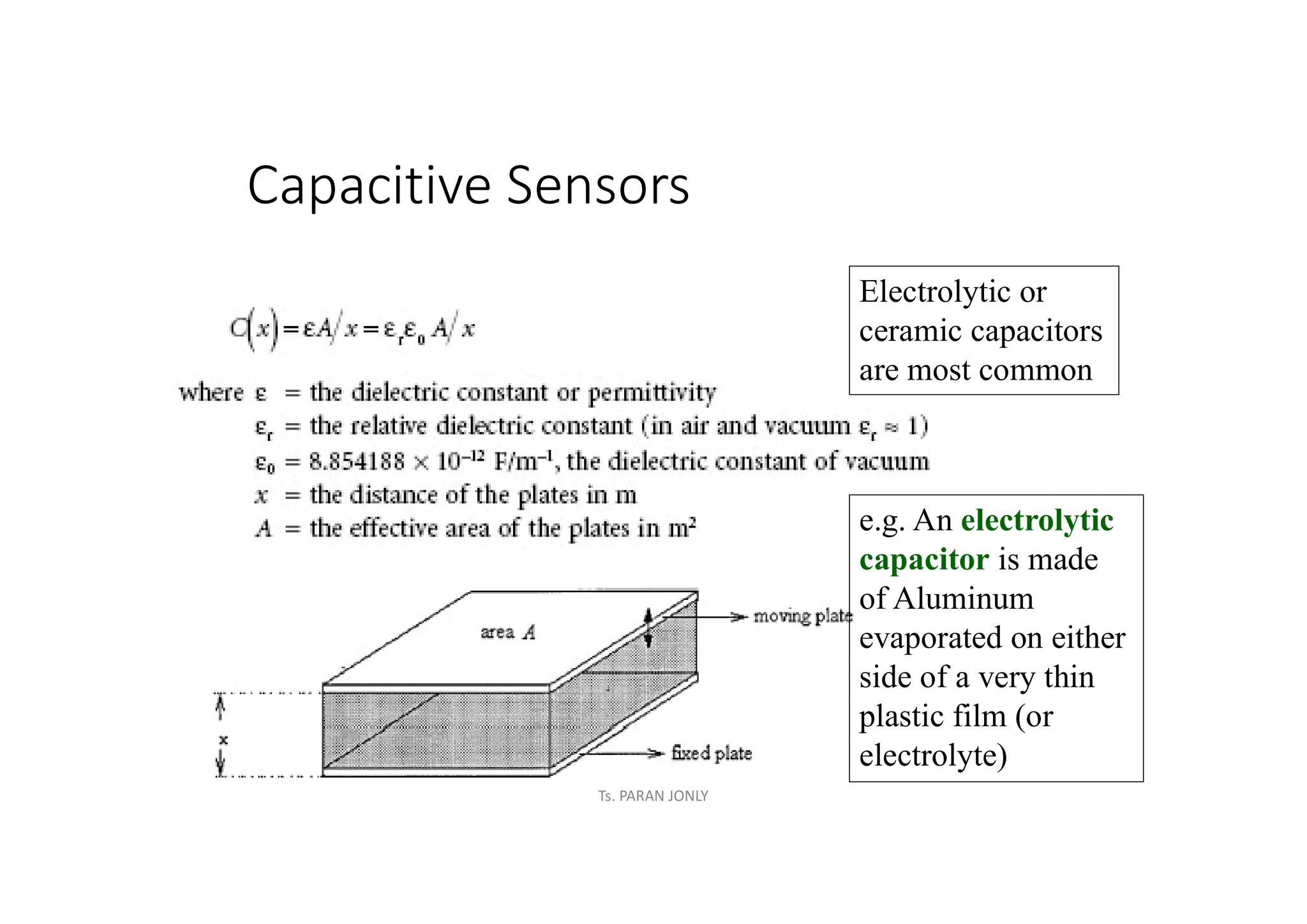
Capacitive Sensors
e.g. An electrolytic
capacitor is made
of Aluminum
evaporated on either
side of a very thin
plastic film (or
electrolyte)
Electrolytic or
ceramic capacitors
are most common
Ts. PARAN JONLY
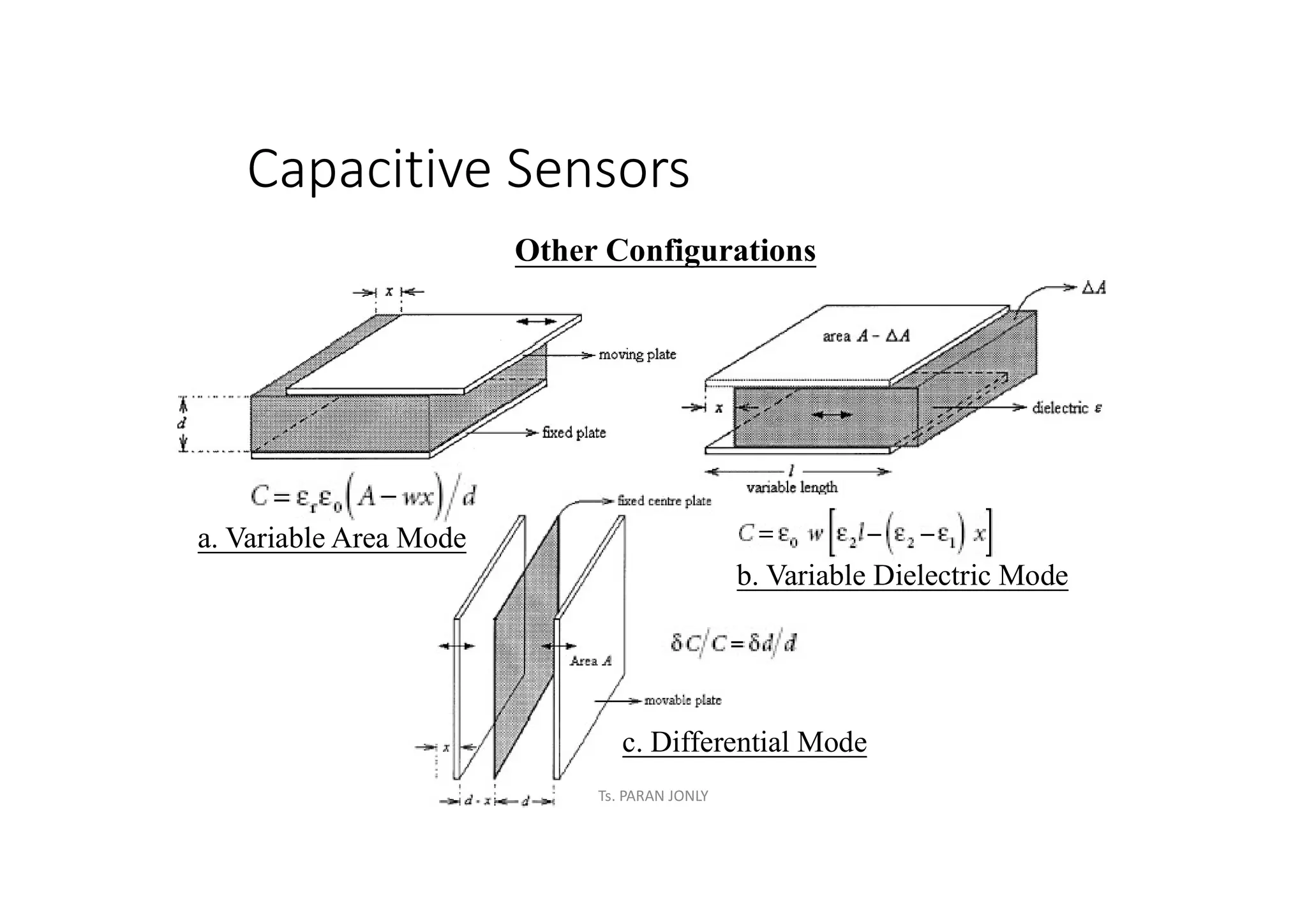
Capacitive Sensors
Other Configurations
c. Differential Mode
b. Variable Dielectric Mode
a. Variable Area Mode
Ts. PARAN JONLY
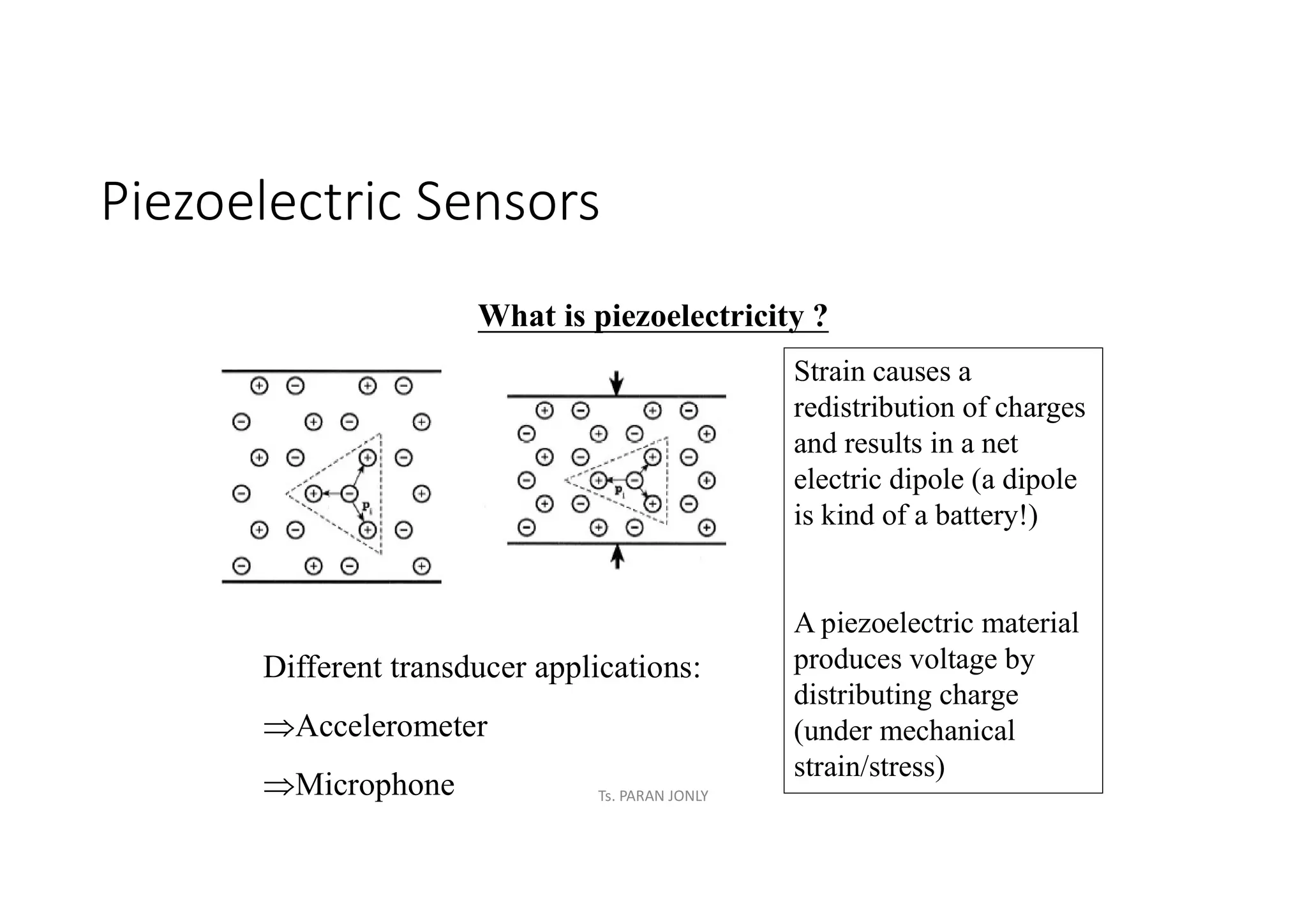
Piezoelectric Sensors
What is piezoelectricity ?
Strain causes a
redistribution of charges
and results in a net
electric dipole (a dipole
is kind of a battery!)
A piezoelectric material
produces voltage by
distributing charge
(under mechanical
strain/stress)
Different transducer applications:
ÞAccelerometer
ÞMicrophone Ts. PARAN JONLY
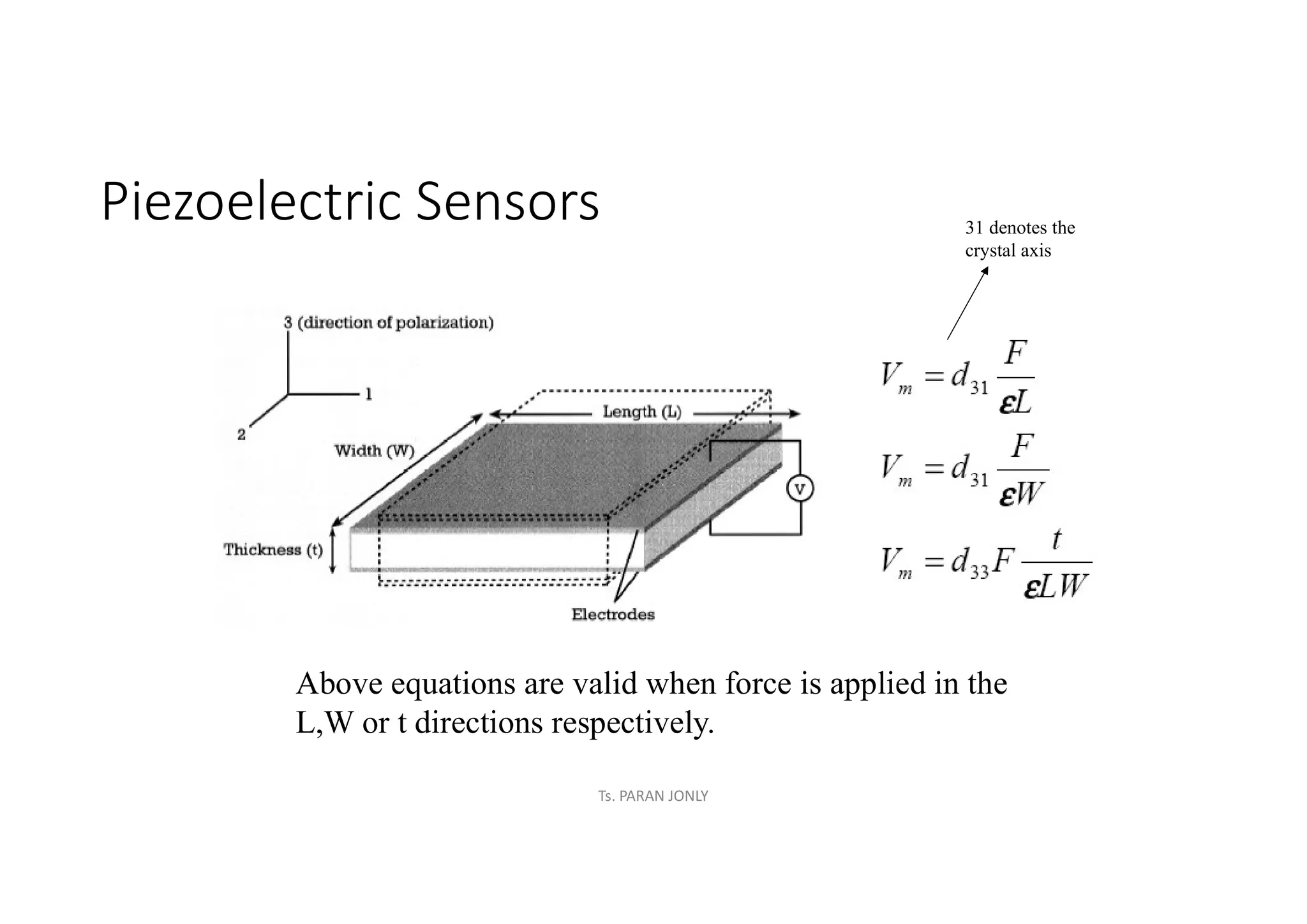
Piezoelectric Sensors
Above equations are valid when force is applied in the
L,W or t directions respectively.
31 denotes the
crystal axis
Ts. PARAN JONLY
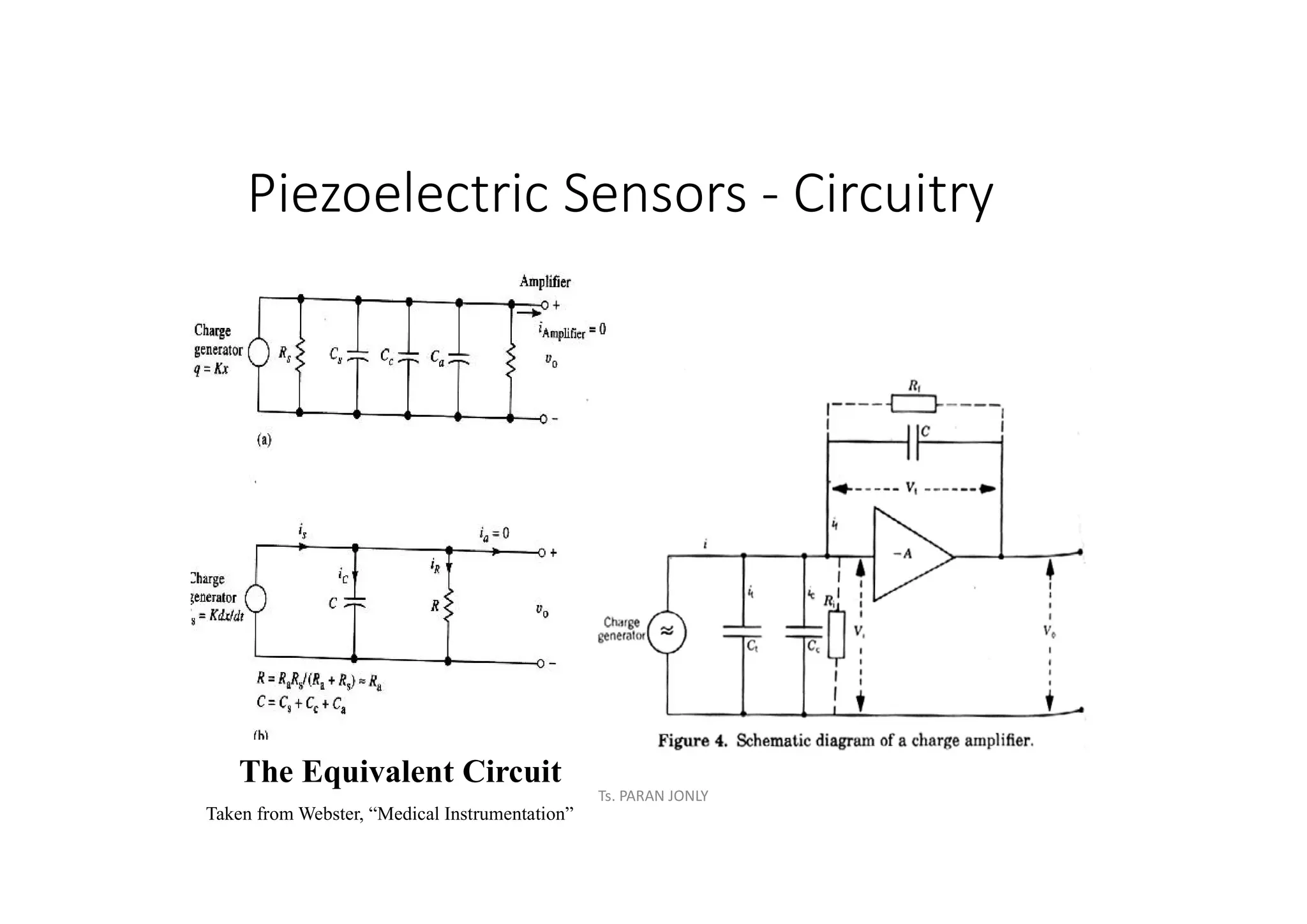
Piezoelectric Sensors - Circuitry
The Equivalent Circuit
Taken from Webster, “Medical Instrumentation”
Ts. PARAN JONLY
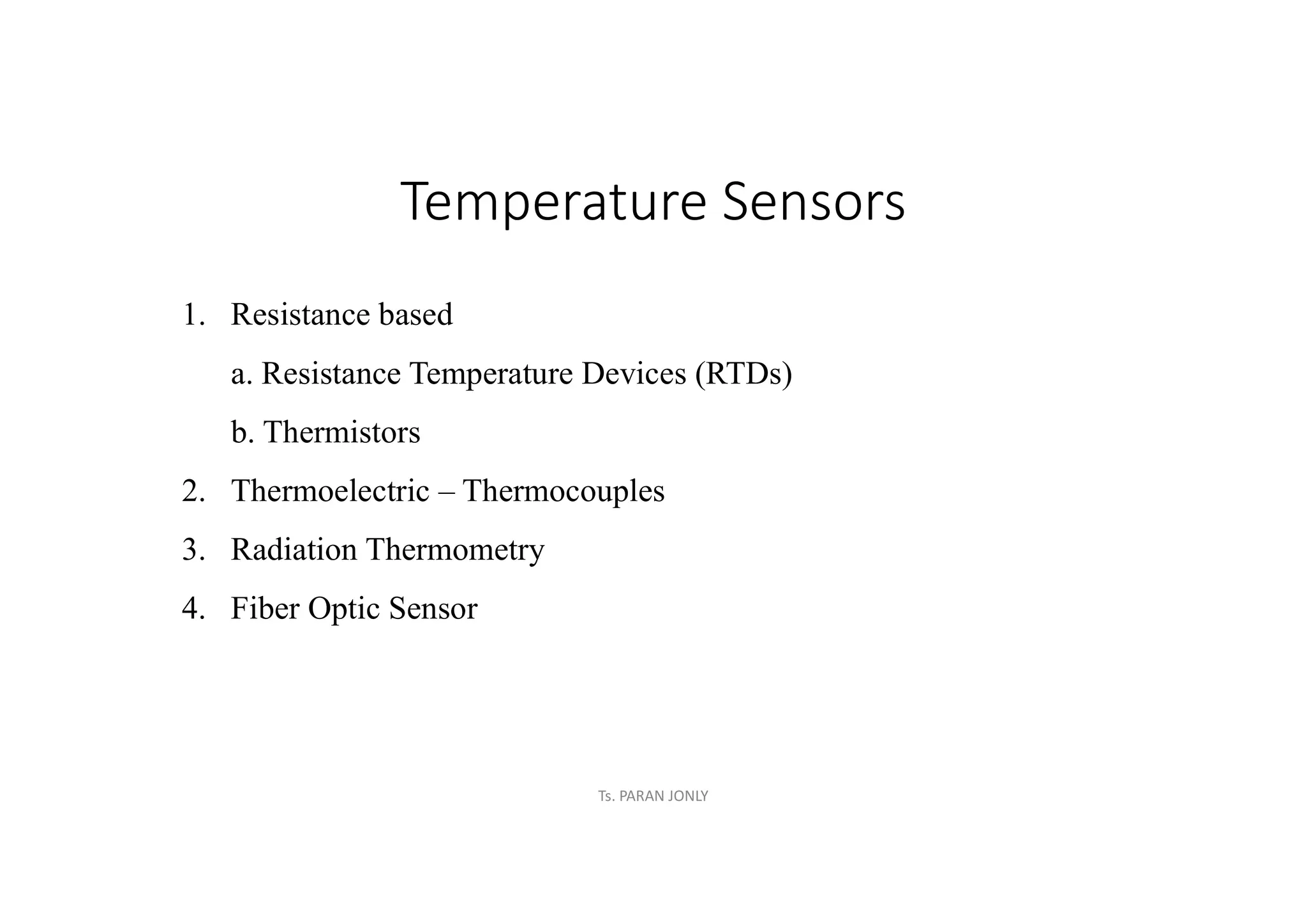
Temperature Sensors
1. Resistance based
a. Resistance Temperature Devices (RTDs)
b. Thermistors
2. Thermoelectric – Thermocouples
3. Radiation Thermometry
4. Fiber Optic Sensor
Ts. PARAN JONLY
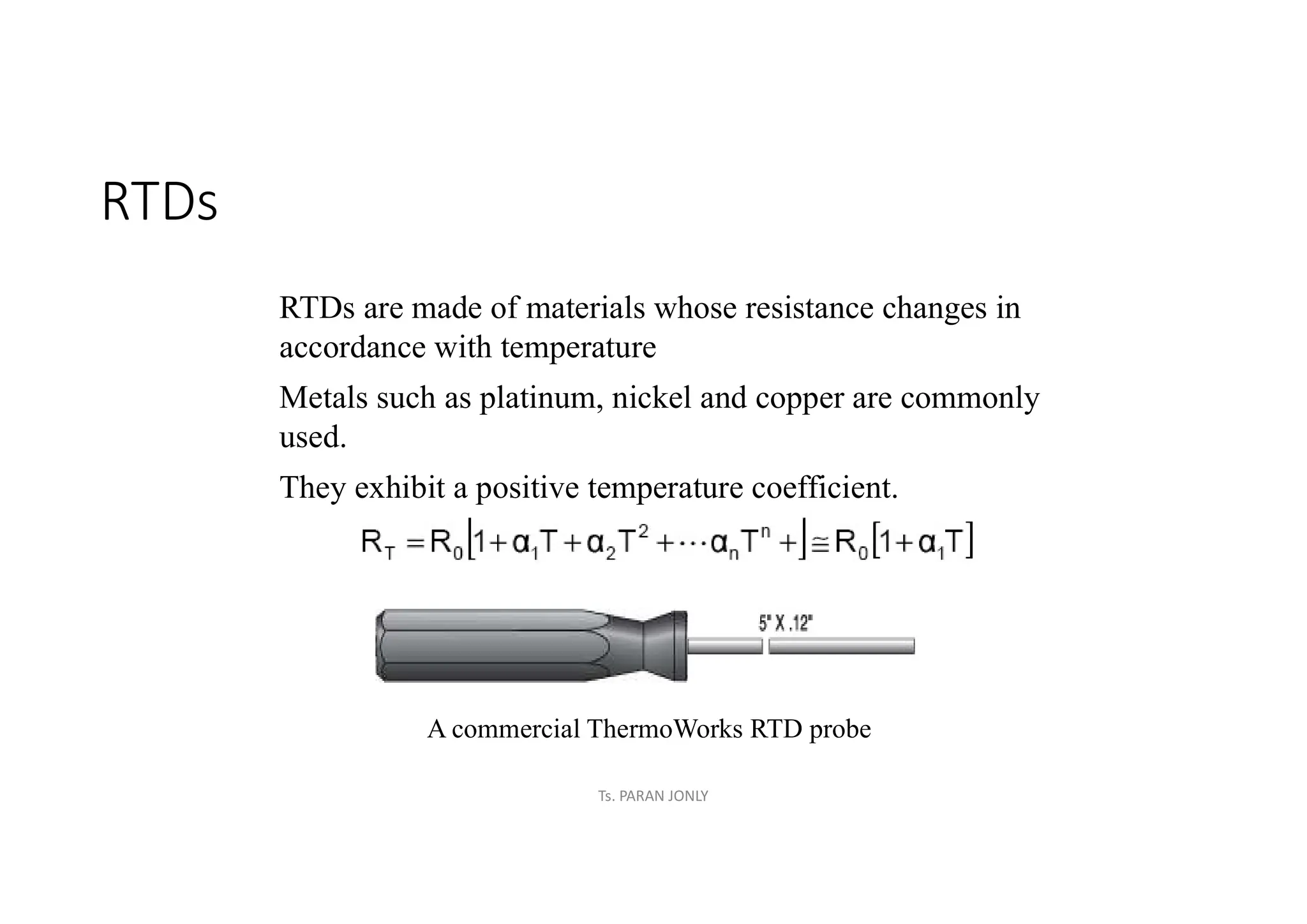
RTDs
RTDs are made of materials whose resistance changes in
accordance with temperature
Metals such as platinum, nickel and copper are commonly
used.
They exhibit a positive temperature coefficient.
A commercial ThermoWorks RTD probe
Ts. PARAN JONLY
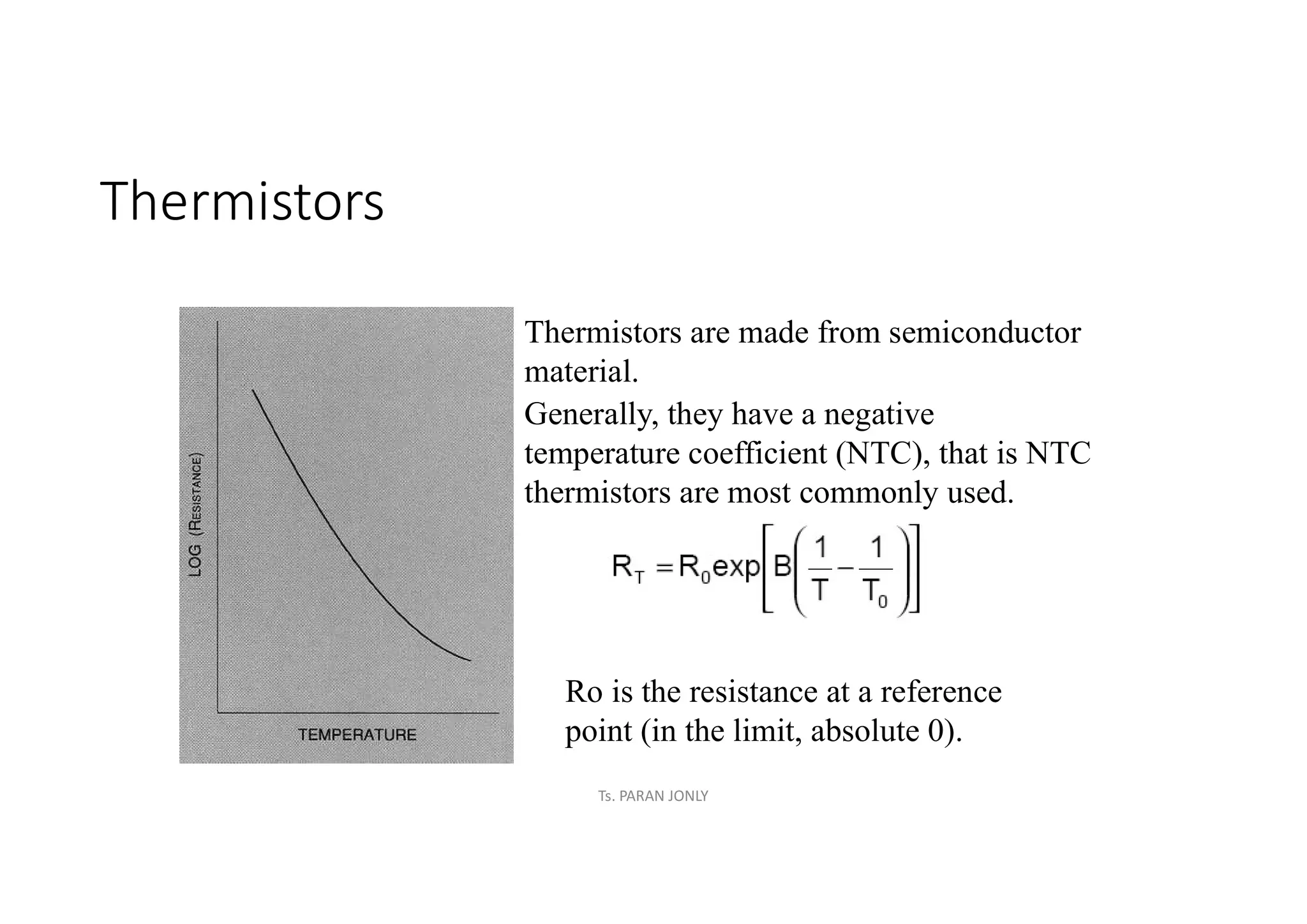
Thermistors
Thermistors are made from semiconductor
material.
Generally, they have a negative
temperature coefficient (NTC), that is NTC
thermistors are most commonly used.
Ro is the resistance at a reference
point (in the limit, absolute 0).
Ts. PARAN JONLY
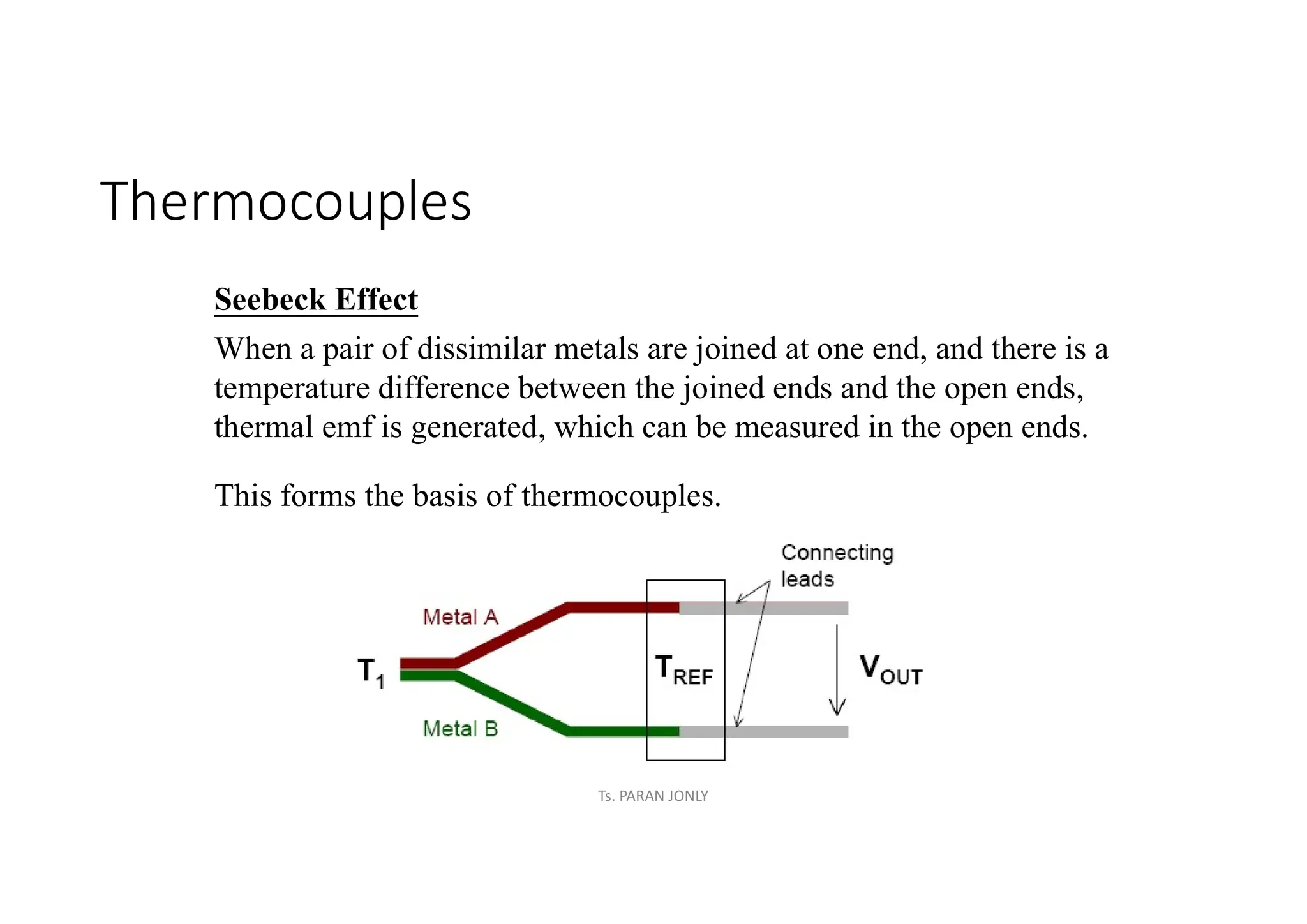
Thermocouples
Seebeck Effect
When a pair of dissimilar metals are joined at one end, and there is a
temperature difference between the joined ends and the open ends,
thermal emf is generated, which can be measured in the open ends.
This forms the basis of thermocouples.
Ts. PARAN JONLY
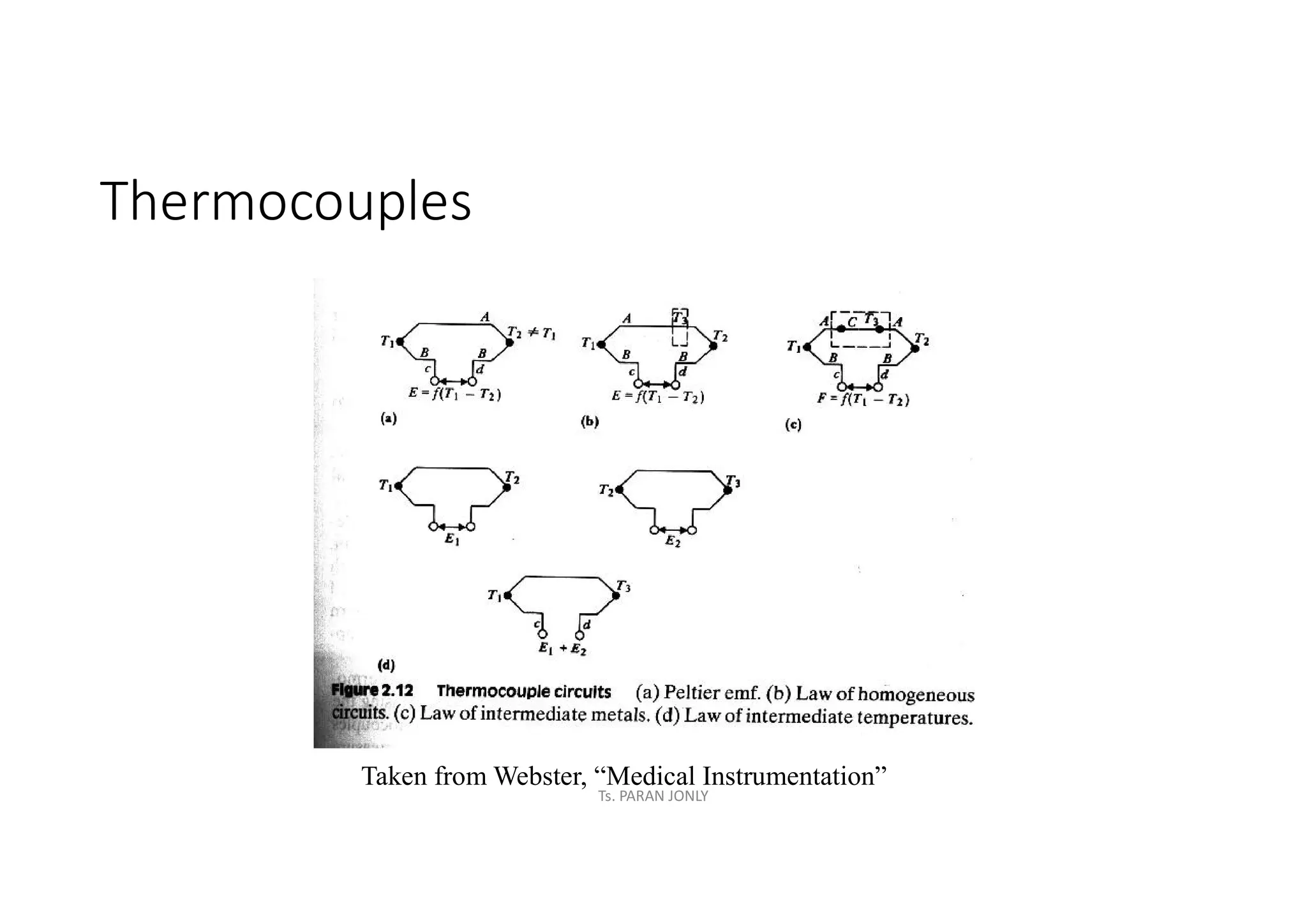
Thermocouples
Taken from Webster, “Medical Instrumentation”
Ts. PARAN JONLY
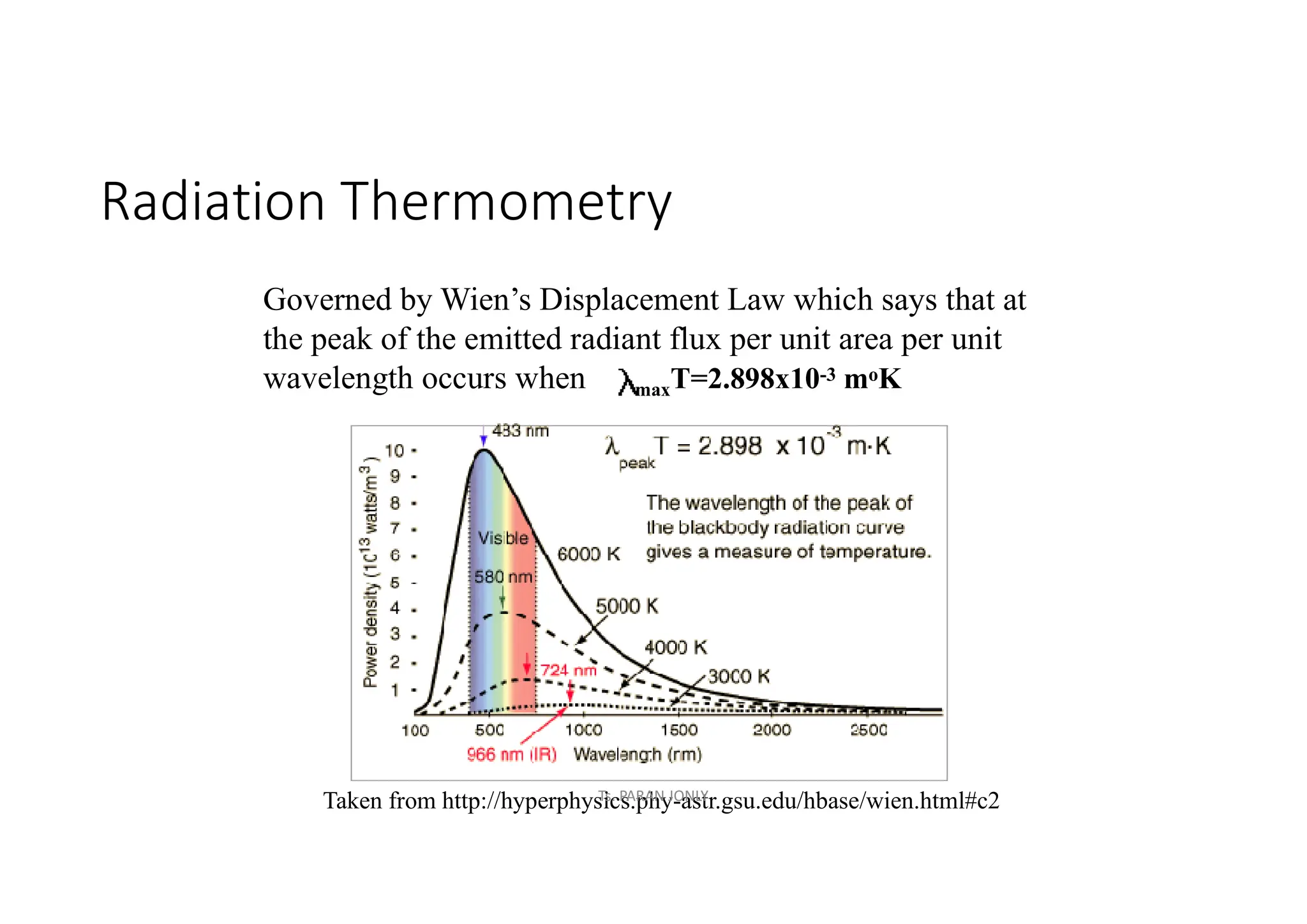
Radiation Thermometry
Governed by Wien’s Displacement Law which says that at
the peak of the emitted radiant flux per unit area per unit
wavelength occurs when maxT=2.898x10⁻³ moK
Taken from http://hyperphysics.phy-astr.gsu.edu/hbase/wien.html#c2
Ts. PARAN JONLY
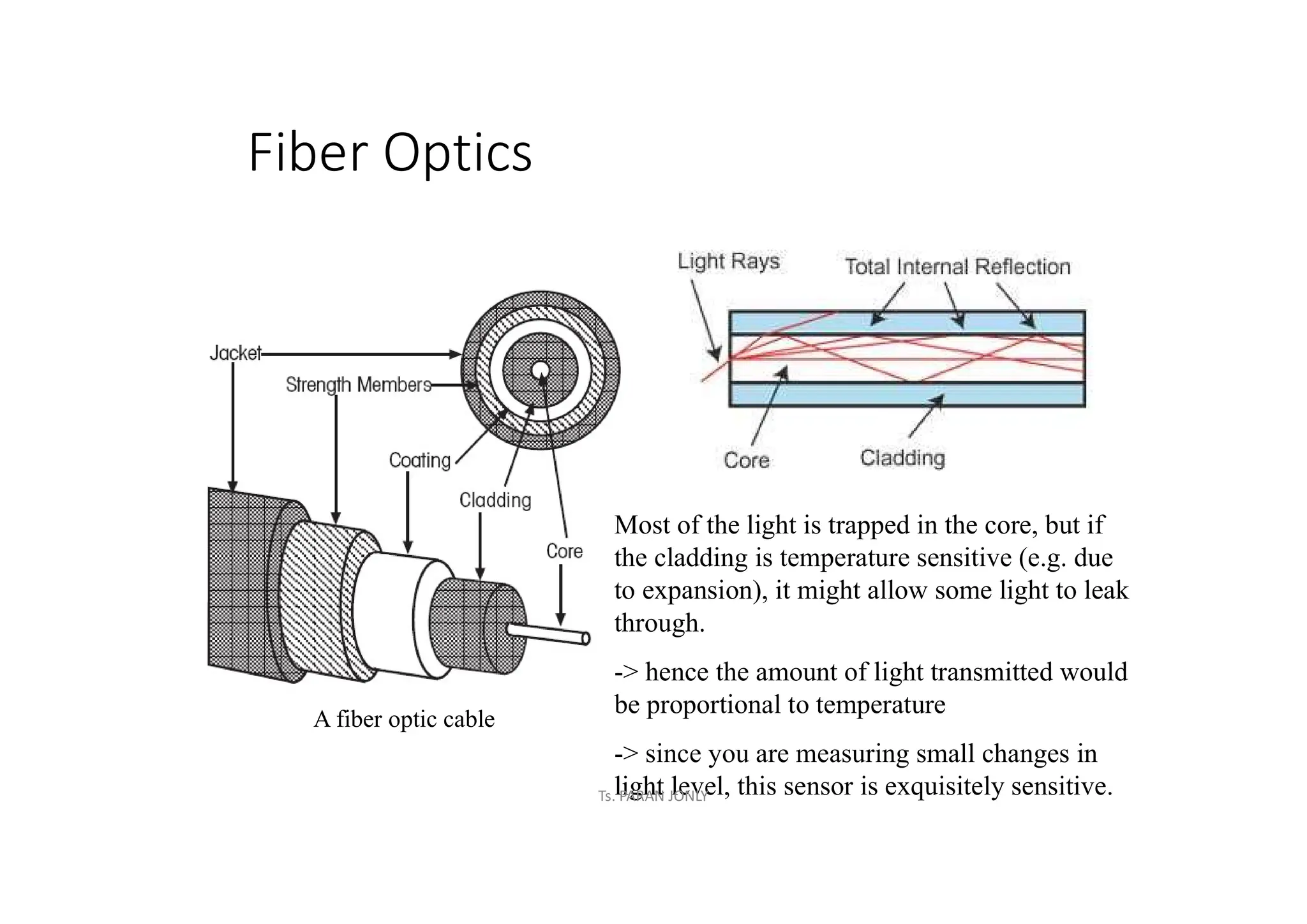
Fiber Optics
A fiber optic cable
Most of the light is trapped in the core, but if
the cladding is temperature sensitive (e.g. due
to expansion), it might allow some light to leak
through.
-> hence the amount of light transmitted would
be proportional to temperature
-> since you are measuring small changes in
light level, this sensor is exquisitely sensitive.
Ts. PARAN JONLY
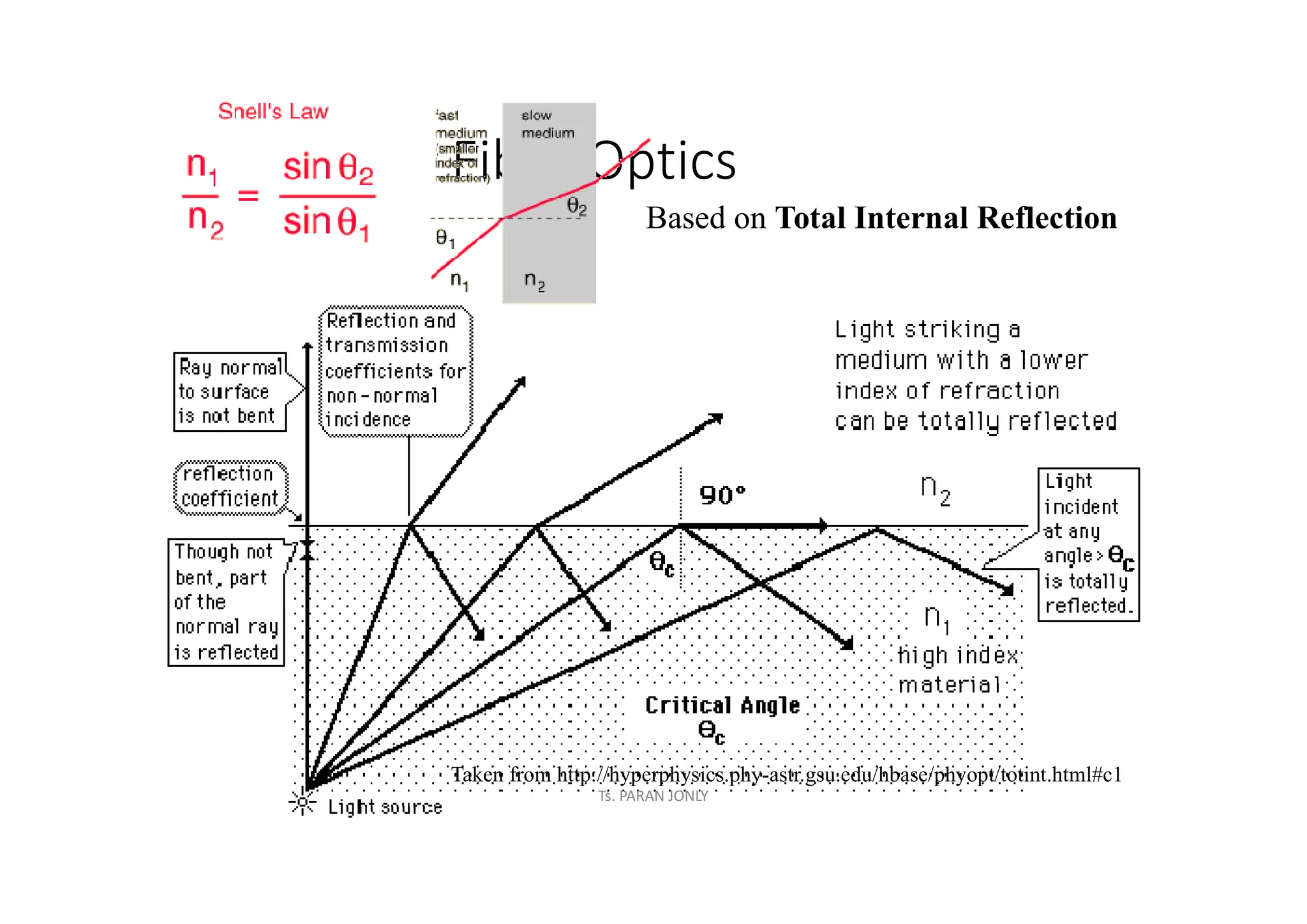
Fiber Optics
Based on Total Internal Reflection
Taken from http://hyperphysics.phy-astr.gsu.edu/hbase/phyopt/totint.html#c1
Ts. PARAN JONLY
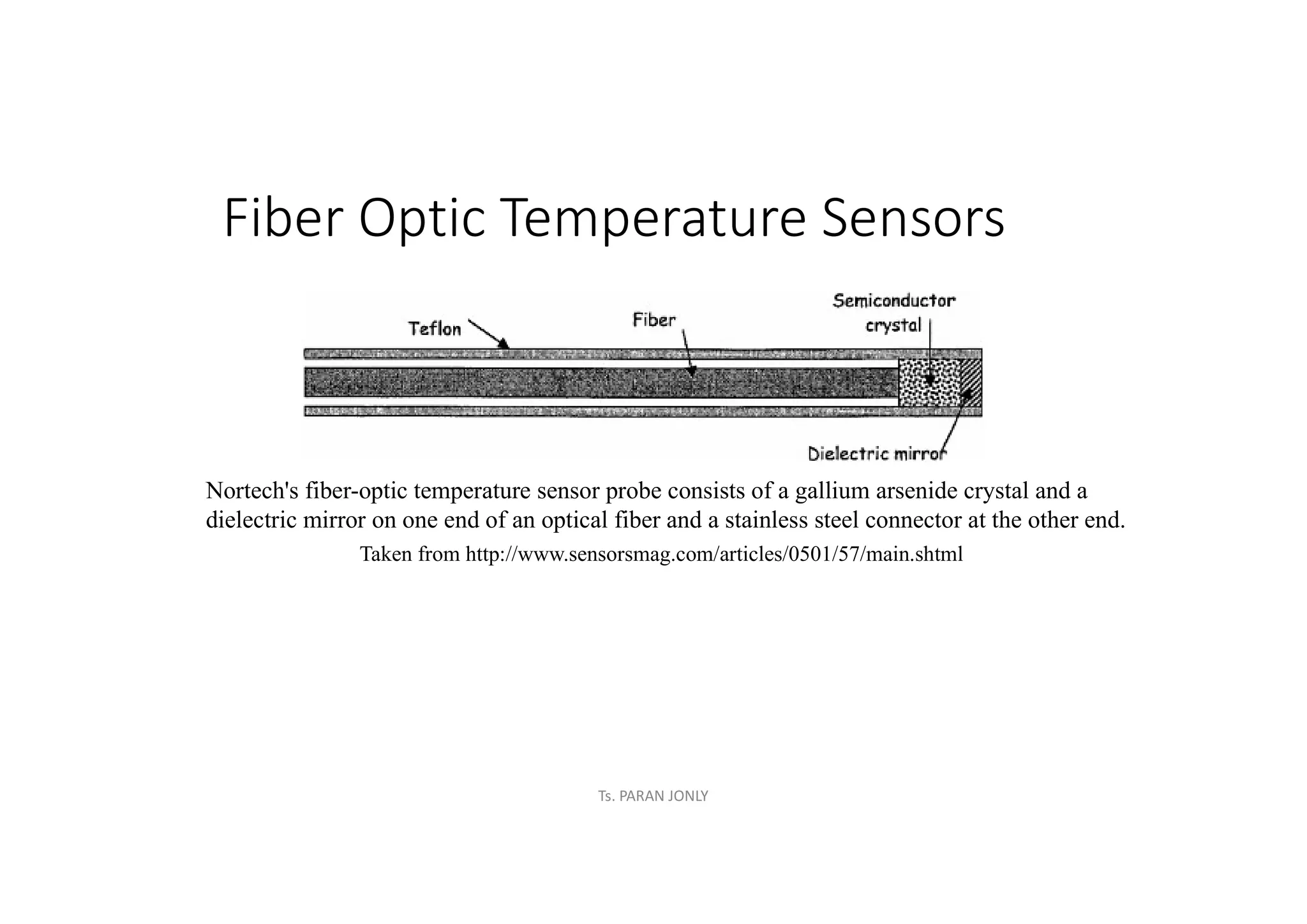
Fiber Optic Temperature Sensors
Nortech's fiber-optic temperature sensor probe consists of a gallium arsenide crystal and a
dielectric mirror on one end of an optical fiber and a stainless steel connector at the other end.
Taken from http://www.sensorsmag.com/articles/0501/57/main.shtml
Ts. PARAN JONLY
Other Physical Sensors
Photoemissive sensors
Photoconductive sensors (LDRs)
Photovoltaic sensors
Ts. PARAN JONLY
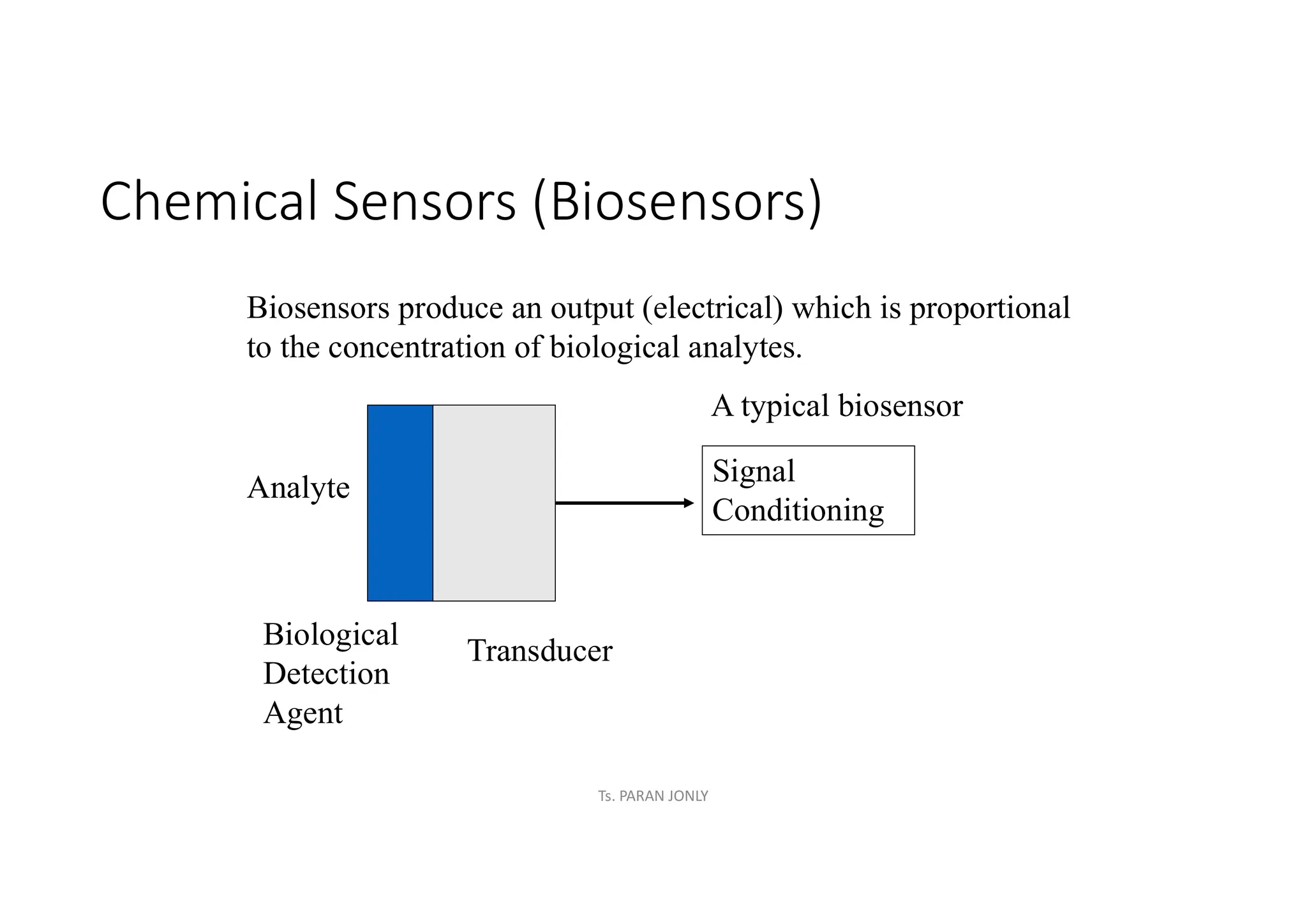
Chemical Sensors (Biosensors)
Biosensors produce an output (electrical) which is proportional
to the concentration of biological analytes.
A typical biosensor
Signal
Conditioning
Analyte
Biological
Detection
Agent
Transducer
Ts. PARAN JONLY
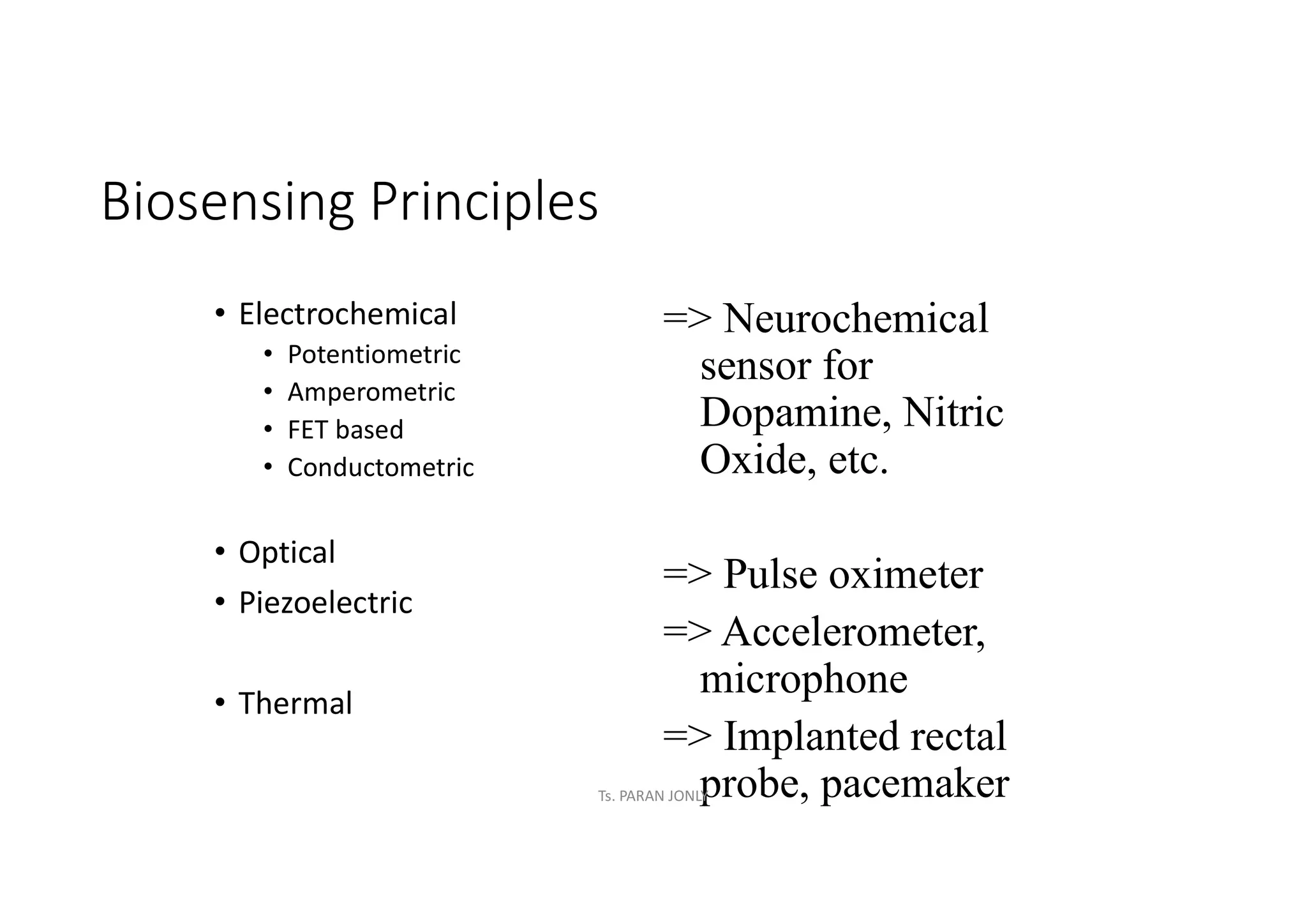
Biosensing Principles
• Electrochemical
• Potentiometric
• Amperometric
• FET based
• Conductometric
• Optical
• Piezoelectric
• Thermal
=> Neurochemical
sensor for
Dopamine, Nitric
Oxide, etc.
=> Pulse oximeter
=> Accelerometer,
microphone
=> Implanted rectal
probe, pacemaker
Ts. PARAN JONLY
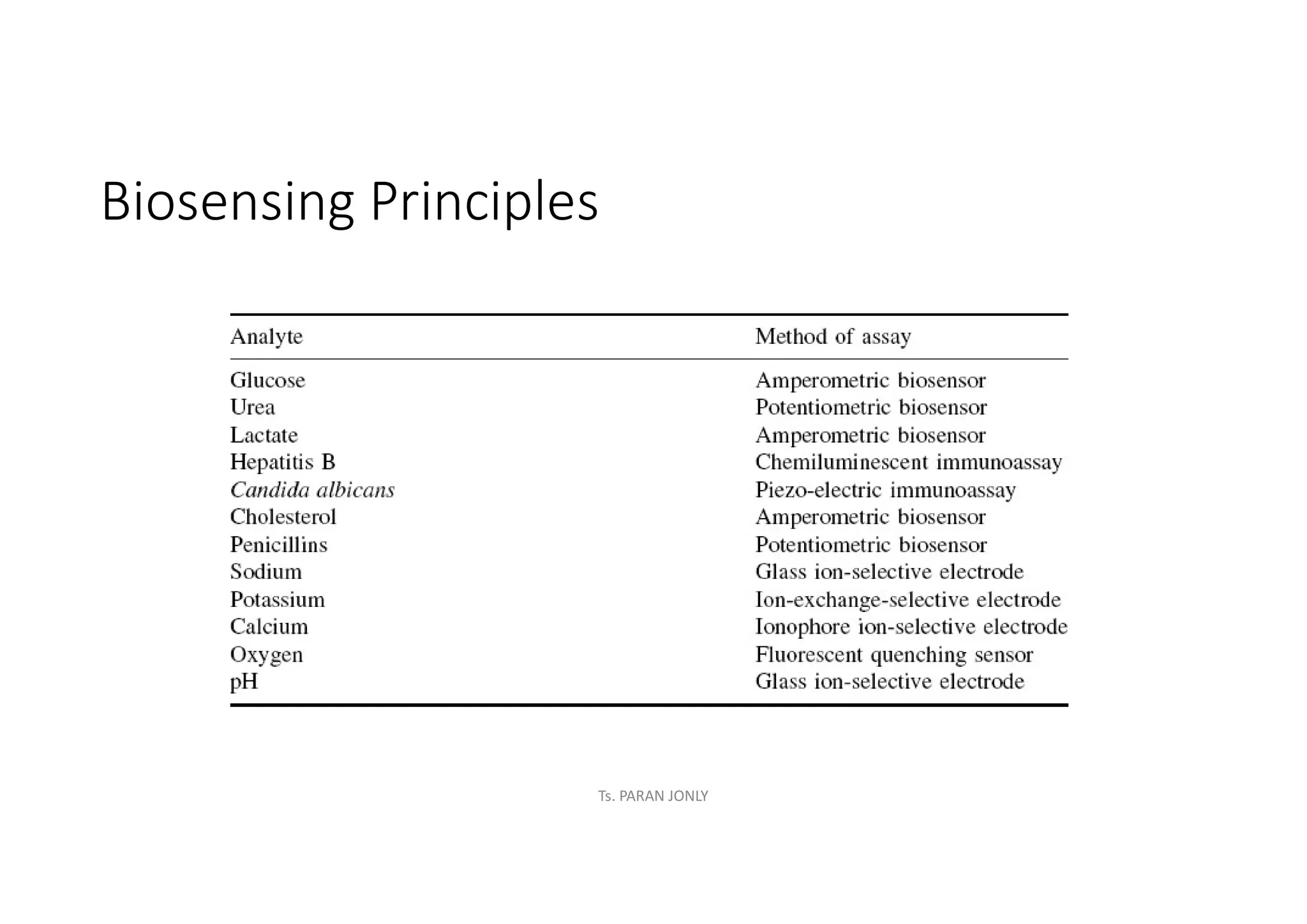
Biosensing Principles
Ts. PARAN JONLY
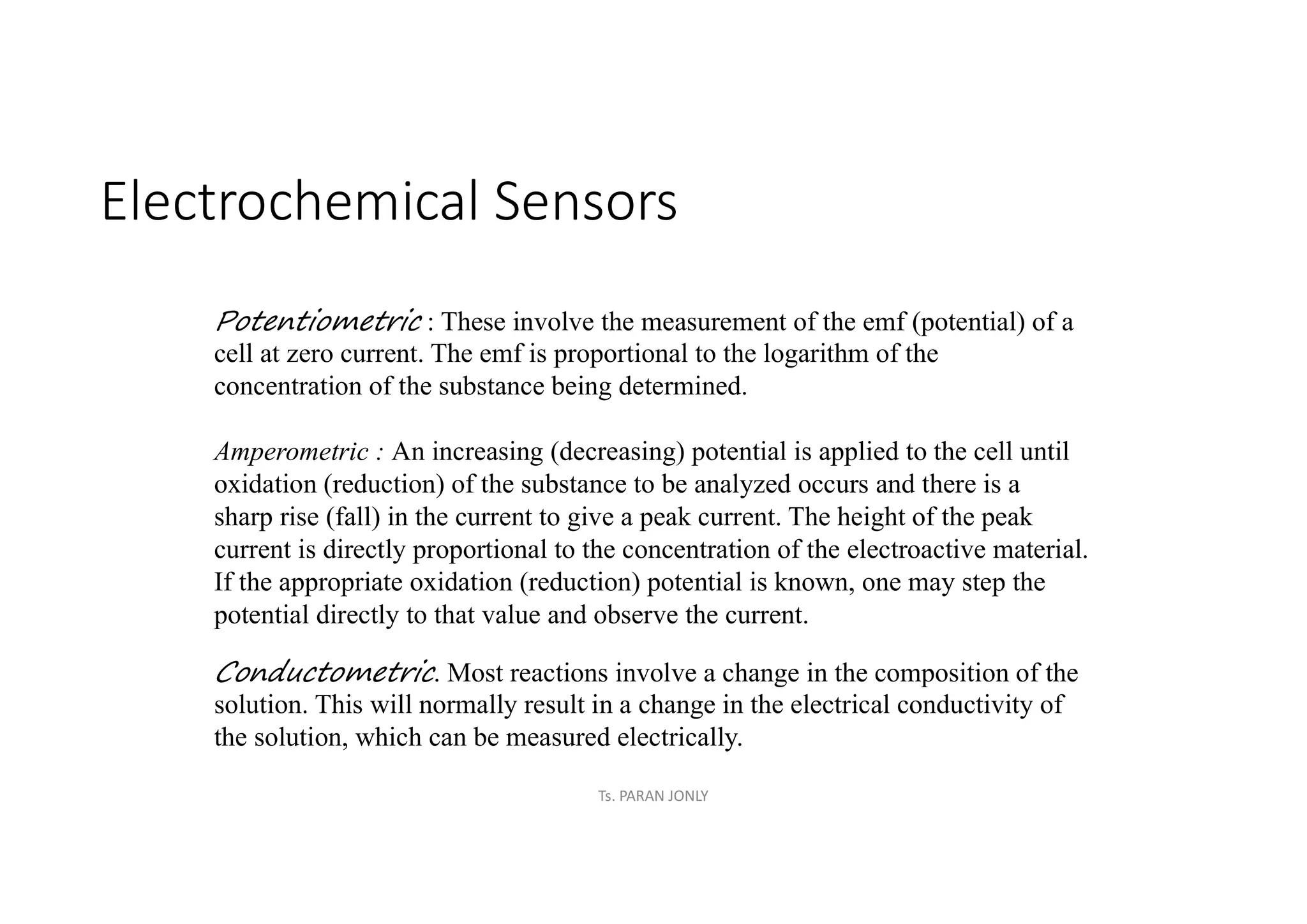
Electrochemical Sensors
Potentiometric : These involve the measurement of the emf (potential) of a
cell at zero current. The emf is proportional to the logarithm of the
concentration of the substance being determined.
Amperometric : An increasing (decreasing) potential is applied to the cell until
oxidation (reduction) of the substance to be analyzed occurs and there is a
sharp rise (fall) in the current to give a peak current. The height of the peak
current is directly proportional to the concentration of the electroactive material.
If the appropriate oxidation (reduction) potential is known, one may step the
potential directly to that value and observe the current.
Conductometric. Most reactions involve a change in the composition of the
solution. This will normally result in a change in the electrical conductivity of
the solution, which can be measured electrically.
Ts. PARAN JONLY
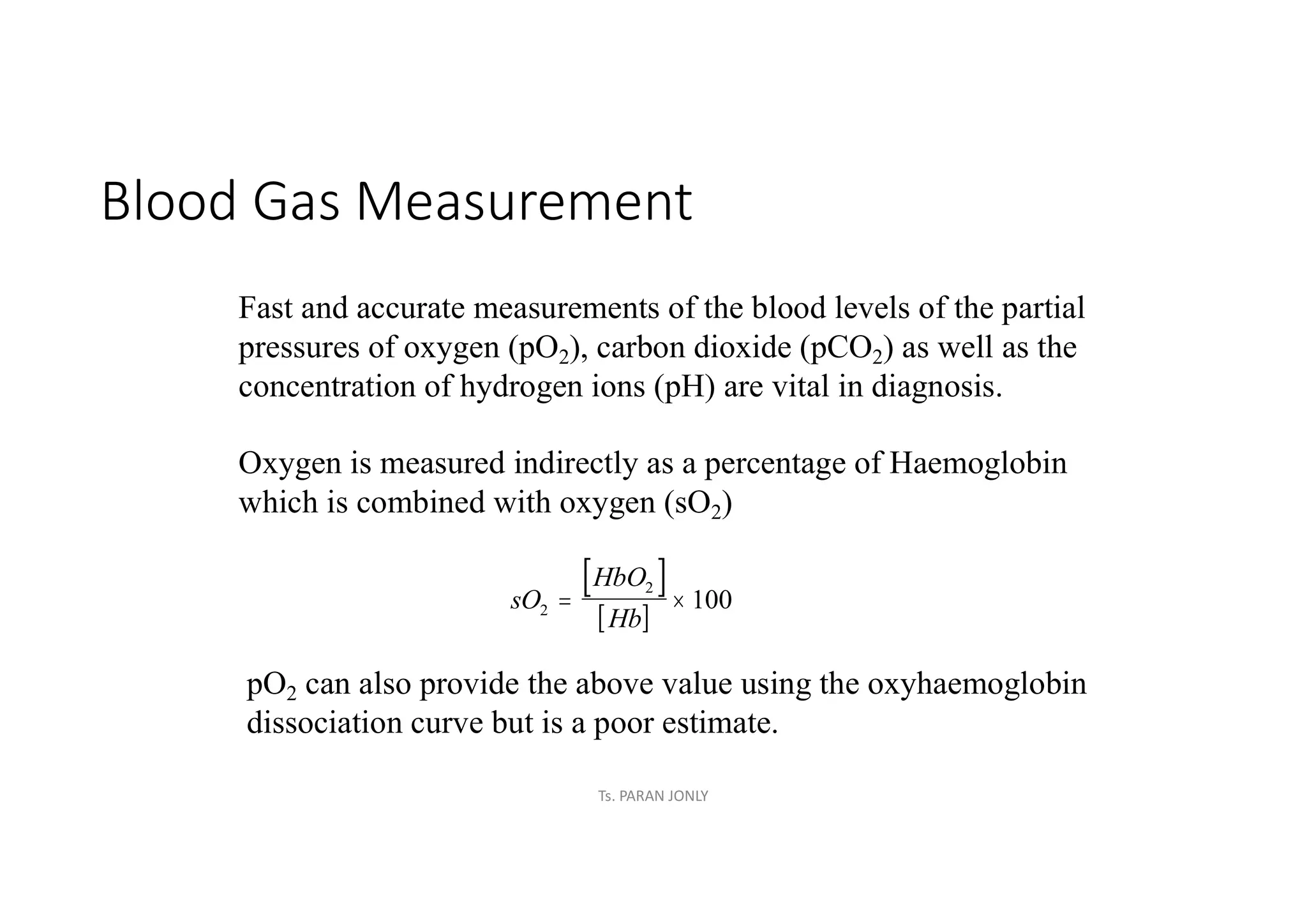
Blood Gas Measurement
Fast and accurate measurements of the blood levels of the partial
pressures of oxygen (pO2), carbon dioxide (pCO2) as well as the
concentration of hydrogen ions (pH) are vital in diagnosis.
Oxygen is measured indirectly as a percentage of Haemoglobin
which is combined with oxygen (sO2)
 
 
sO
HbO
Hb
2
2
100
 
pO2 can also provide the above value using the oxyhaemoglobin
dissociation curve but is a poor estimate.
Ts. PARAN JONLY
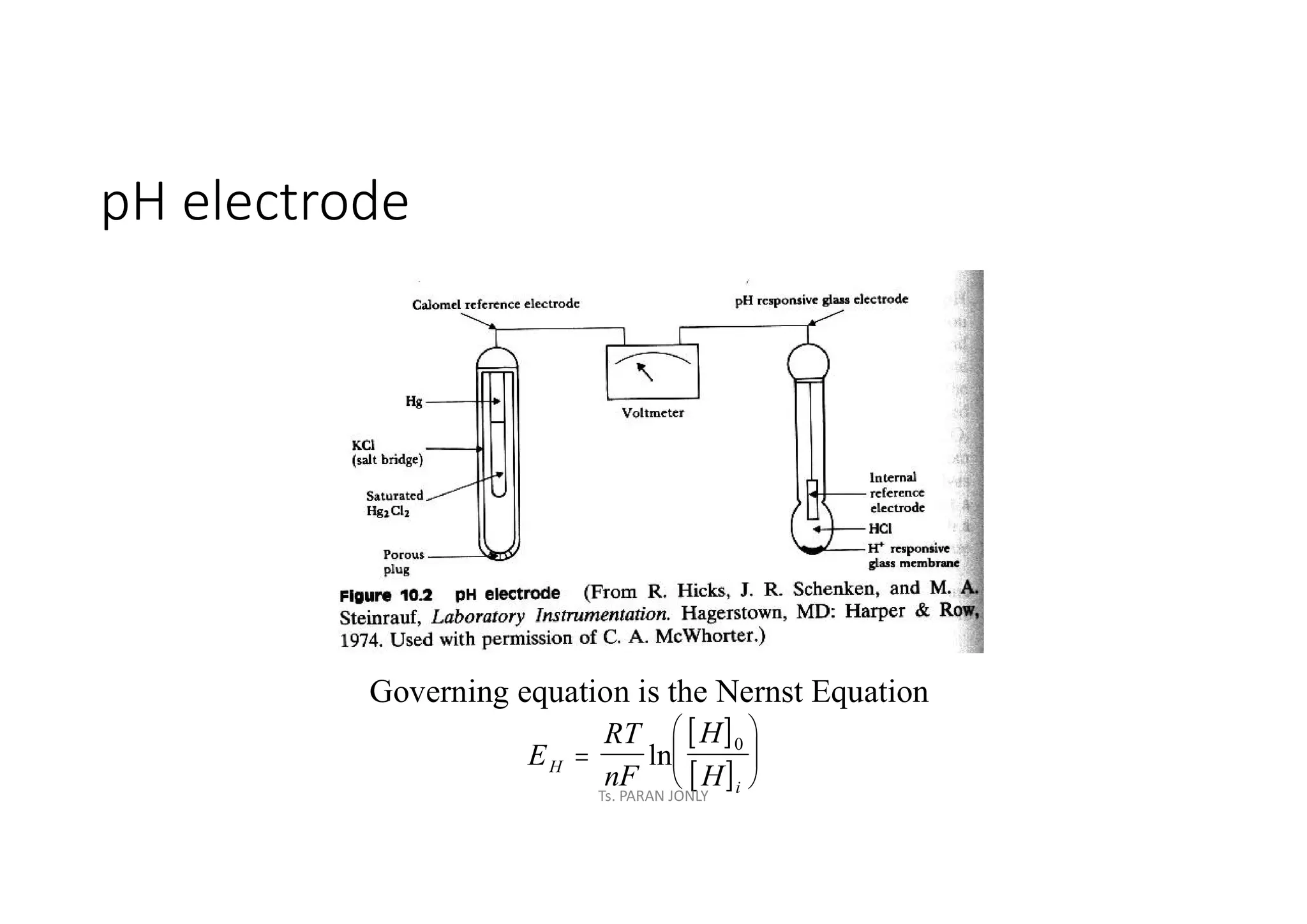
pH electrode
Governing equation is the Nernst Equation
 
 
E
RT
nF
H
H
H
i







ln
0
Ts. PARAN JONLY
pCO2 Electrode
The measurement of pCO2 is based on its linear relationship
with pH over the range of 10 to 90 mm Hg.
H O CO H CO H HCO
2 2 2 3 3
   
 
The dissociation constant is given by
  
k
H HCO
a pCO


 
3
2
Taking logarithms
pH = log[HCO3
-] – log k – log a – log pCO2
Ts. PARAN JONLY
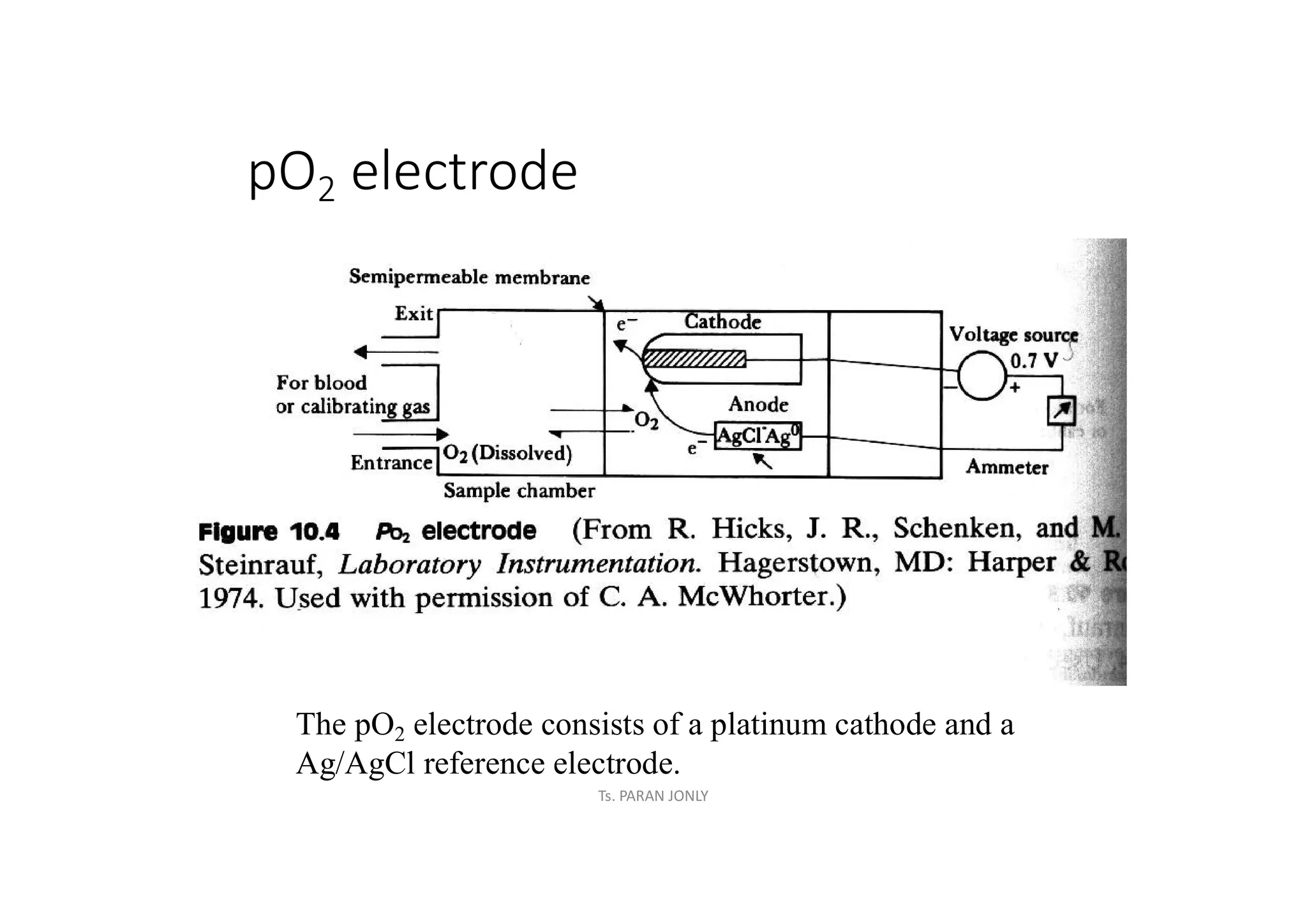
pO2 electrode
The pO2 electrode consists of a platinum cathode and a
Ag/AgCl reference electrode.
Ts. PARAN JONLY
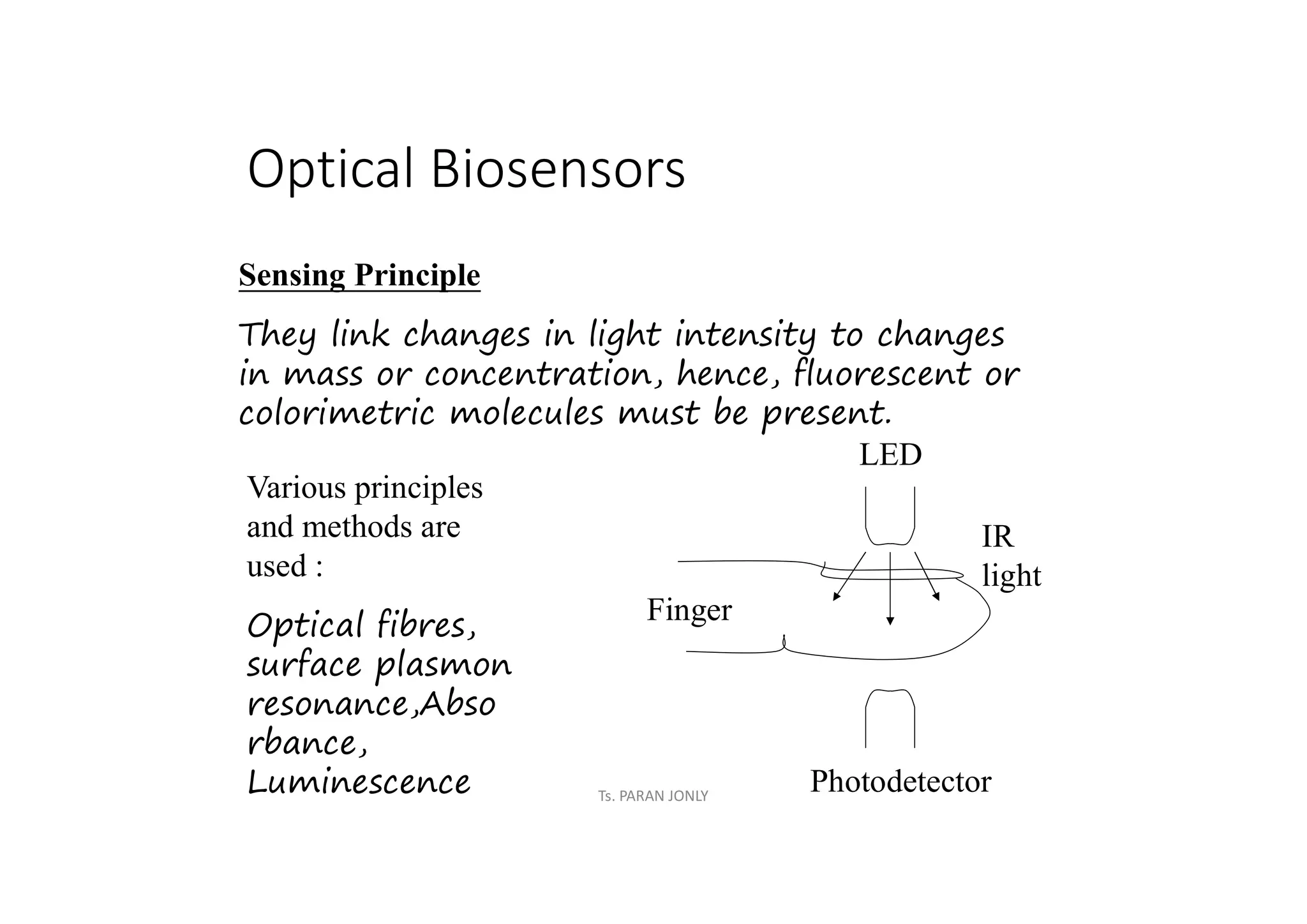
Optical Biosensors
Sensing Principle
They link changes in light intensity to changes
in mass or concentration, hence, fluorescent or
colorimetric molecules must be present.
Various principles
and methods are
used :
Optical fibres,
surface plasmon
resonance,Abso
rbance,
Luminescence
LED
Photodetector
Finger
IR
light
Ts. PARAN JONLY
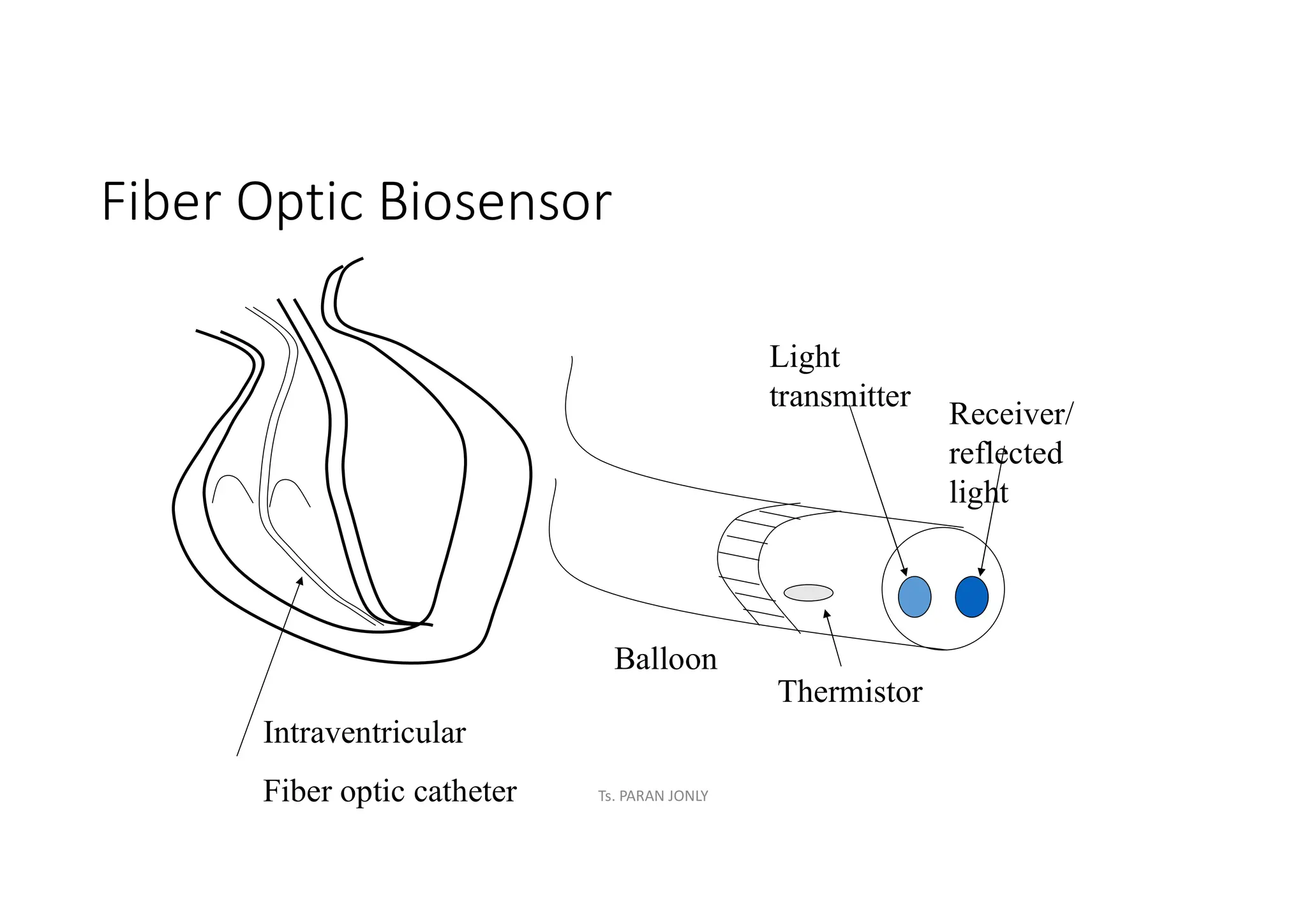
Fiber Optic Biosensor
Balloon
Thermistor
Light
transmitter
Receiver/
reflected
light
Intraventricular
Fiber optic catheter Ts. PARAN JONLY
Absorption/Fluorescence
Different dyes show peaks of different values at different
concentrations when the absorbance or excitation is plotted
against wavelength.
Phenol Red is a pH sensitive reversible dye whose relative
absorbance (indicated by ratio of green and red light
transmitted) is used to measure pH.
HPTS is an irreversible fluorescent dye used to measure pH.
Similarly, there are fluorescent dyes which can be used to
measure O2 and CO2 levels.
Ts. PARAN JONLY
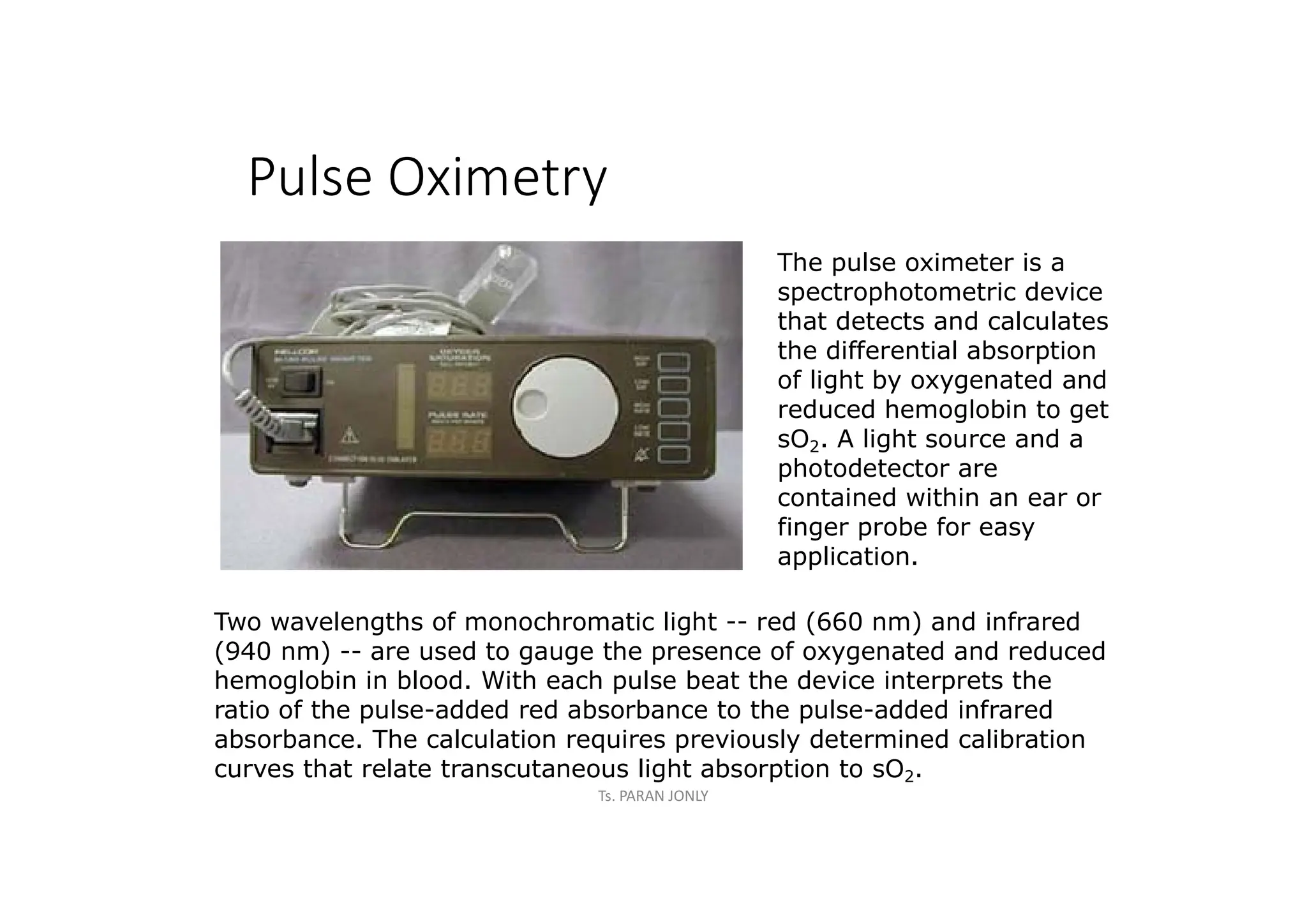
Pulse Oximetry
Two wavelengths of monochromatic light -- red (660 nm) and infrared
(940 nm) -- are used to gauge the presence of oxygenated and reduced
hemoglobin in blood. With each pulse beat the device interprets the
ratio of the pulse-added red absorbance to the pulse-added infrared
absorbance. The calculation requires previously determined calibration
curves that relate transcutaneous light absorption to sO2.
The pulse oximeter is a
spectrophotometric device
that detects and calculates
the differential absorption
of light by oxygenated and
reduced hemoglobin to get
sO2. A light source and a
photodetector are
contained within an ear or
finger probe for easy
application.
Ts. PARAN JONLY
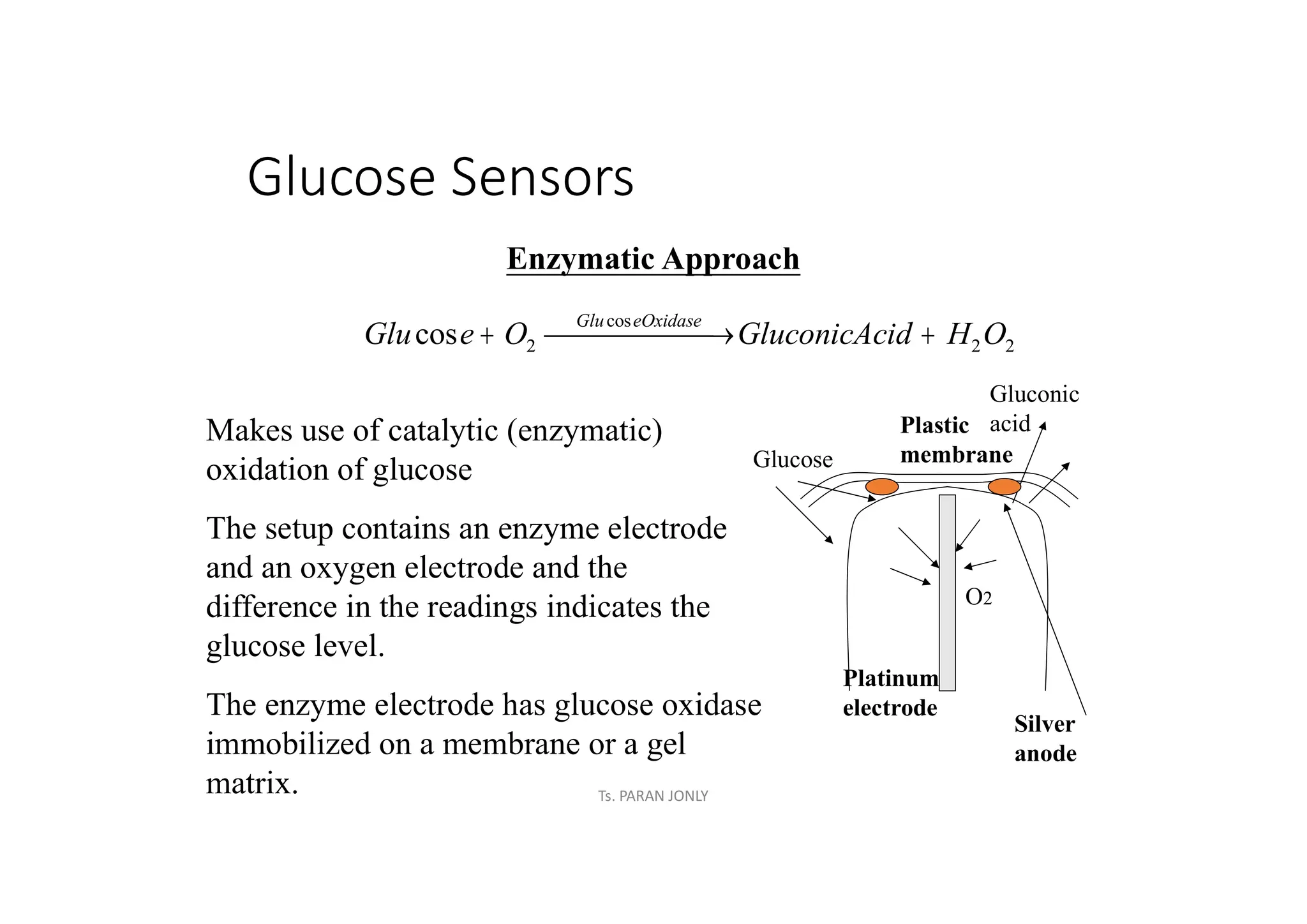
Glucose Sensors
Enzymatic Approach
Glu e O GluconicAcid H O
Glu eOxidase
cos
cos
  
 
2 2 2
Makes use of catalytic (enzymatic)
oxidation of glucose
The setup contains an enzyme electrode
and an oxygen electrode and the
difference in the readings indicates the
glucose level.
The enzyme electrode has glucose oxidase
immobilized on a membrane or a gel
matrix.
Platinum
electrode
Plastic
membrane
Glucose
O2
Gluconic
acid
Silver
anode
Ts. PARAN JONLY
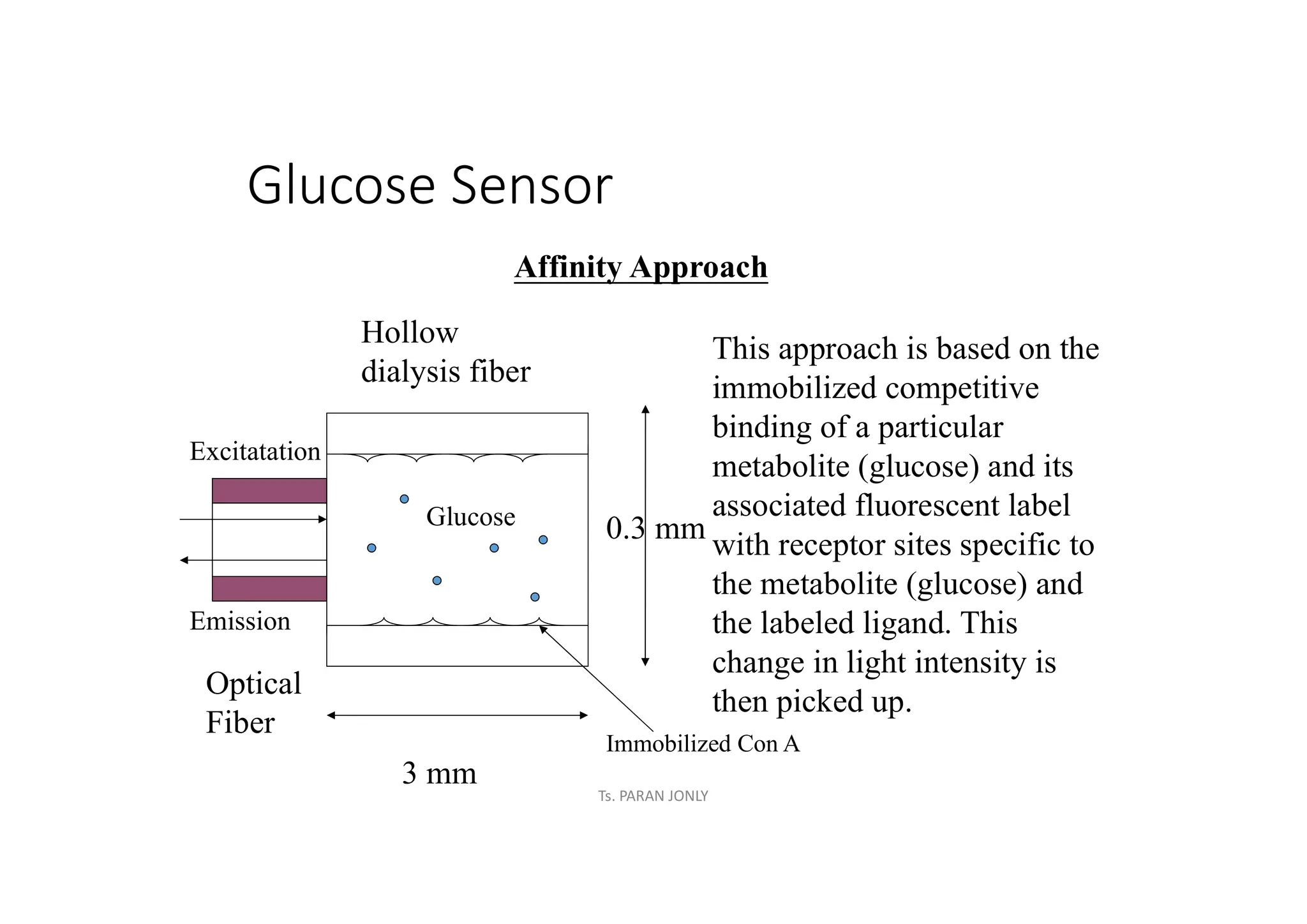
Glucose Sensor
Affinity Approach
This approach is based on the
immobilized competitive
binding of a particular
metabolite (glucose) and its
associated fluorescent label
with receptor sites specific to
the metabolite (glucose) and
the labeled ligand. This
change in light intensity is
then picked up.
3 mm
0.3 mm
Hollow
dialysis fiber
Immobilized Con A
Excitatation
Emission
Optical
Fiber
Glucose
Ts. PARAN JONLY
Acoustic, sound, vibration
ü Geophone
ü Hydrophone
ü Lace Sensor a guitar pickup
ü Microphone
Ts. PARAN JONLY
Automotive, transportation
1. Air–fuel ratio meter
2. Blind spot monitor
3. Crankshaft position sensor, A crank sensor is an electronic device used in
an internal combustion engine to monitor the position or rotational speed
of the crankshaft.
4. Curb feeler, used to warn driver of curbs
5. Defect detector, used on railroads to detect axle and signal problems in
passing trains
6. Engine coolant temperature sensor, or ECT sensor, used to measure the
engine temperature
7. Hall effect sensor, used to time the speed of wheels and shafts
8. MAP sensor, Manifold Absolute Pressure, used in regulating fuel metering.
Ts. PARAN JONLY
Automotive, transportation
9. Mass flow sensor, or mass airflow (MAF) sensor, used to tell the ECU the
mass of air entering the engine
10. Oxygen sensor, used to monitor the amount of oxygen in the exhaust
11. Parking sensors, used to alert the driver of unseen obstacles during
parking manoeuvres
12. Radar gun, used to detect the speed of other objects
13. Speedometer, used measure the instantaneous speed of a land vehicle
14. Speed sensor, used to detect the speed of an object
15. Throttle position sensor, used to monitor the position of the throttle in an
internal combustion engine
16. Tire-pressure monitoring sensor, used to monitor the air pressure inside
the tires
17. Torque sensor, or torque transducer or torquemeter measures torque
(twisting force) on a rotating system.
Ts. PARAN JONLY
Automotive, transportation
18.Transmission fluid temperature sensor, used to measure the temperature
of the transmission fluid
19.Turbine speed sensor (TSS), or input speed sensor (ISS), used to measure
the rotational speed of the input shaft or torque converter
20.Variable reluctance sensor, used to measure position and speed of moving
metal components
21.Vehicle speed sensor (VSS), used to measure the speed of the vehicle
22.Water sensor or water-in-fuel sensor, used to indicate the presence of
water in fuel
23.Wheel speed sensor, used for reading the speed of a vehicle's wheel
rotation
Ts. PARAN JONLY
Chemical
1. Breathalyzer
2. Carbon dioxide sensor
3. Carbon monoxide detector
4. Catalytic bead sensor
5. Chemical field-effect transistor
6. Chemiresistor
7. Electrochemical gas sensor
8. Electronic nose
9. Electrolyte–insulator–semiconduct
or sensor
10.Fluorescent chloride sensors
11.Holographic sensor
12.Hydrocarbon dew point analyzer
13.Hydrogen sensor
14.Hydrogen sulfide sensor
15.Infrared point sensor
16.Ion-selective electrode
17.Nondispersive infrared sensor
18.Microwave chemistry sensor
19.Nitrogen oxide sensor
20.Olfactometer
21.Optode
22.Oxygen sensor
23.Ozone monitor
24.Pellistor
25.pH glass electrode
26.Potentiometric sensor
27.Redox electrode
28.Smoke detector
29.Zinc oxide nanorod sensor
Ts. PARAN JONLY
Electric current, electric potential, magnetic, radio
1. Current sensor
2. Daly detector
3. Electroscope
4. Electron multiplier
5. Faraday cup
6. Galvanometer
7. Hall effect sensor
8. Hall probe
9. Magnetic anomaly detector
10. Magnetometer
11. MEMS magnetic field sensor
12. Metal detector
13. Planar Hall sensor
14. Radio direction finder
15. Voltage detector
Ts. PARAN JONLY
Flow, fluid velocity
1. Air flow meter
2. Anemometer
3. Flow sensor
4. Gas meter
5. Mass flow sensor
6. Water meter
Ts. PARAN JONLY
Ionizing radiation, subatomic particles
1. Cloud chamber
2. Geiger counter
3. Neutron detection
Ts. PARAN JONLY
Navigation instruments
1. Air speed indicator
2. Altimeter
3. Attitude indicator
4. Depth gauge
5. Fluxgate compass
6. Gyroscope
7. Inertial navigation system
8. Inertial reference unit
9. Magnetic compass
10.MHD sensor
11.Ring laser gyroscope
12.Turn coordinator
13.TiaLinx sensor
14.Variometer
15.Vibrating structure gyroscope
16.Yaw rate sensor
Ts. PARAN JONLY
Position, angle, displacement, distance, speed,
acceleration
1. Auxanometer
2. Capacitive displacement sensor
3. Capacitive sensing
4. Free fall sensor
5. Gravimeter
6. Gyroscopic sensor
7. Impact sensor
8. Inclinometer
9. Integrated circuit piezoelectric sensor
10.Laser rangefinder
11.Laser surface velocimeter
12.LIDAR
13.Linear encoder
14.Linear variable differential transformer (LVDT)
15.Liquid capacitive inclinometers
Ts. PARAN JONLY
Position, angle, displacement, distance, speed,
acceleration
16. Odometer
17.Photoelectric sensor
18.Piezocapactive sensor
19.Piezoelectric accelerometer
20.Position sensor
21.Rate sensor
22.Rotary encoder
23.Rotary variable differential transformer
24.Selsyn
25.Shock detector
26.Shock data logger
27.Stretch sensor
28.Tilt sensor
29.Tachometer
30.Ultrasonic thickness gauge
31.Variable reluctance sensor
32.Velocity receiver Ts. PARAN JONLY
Optical, light, imaging, photon
1. Charge-coupled device
2. CMOS sensor
3. Colorimeter
4. Contact image sensor
5. Electro-optical sensor
6. Flame detector
7. Infra-red sensor
8. Kinetic inductance detector
9. LED as light sensor
10.Light-addressable potentiometric
sensor
11.Nichols radiometer
12.Fiber optic sensors
13.Optical position sensor
14.Photodetector
15.Photodiode
16.Photomultiplier tubes
17.Phototransistor
18.Photoelectric sensor
19.Photoionization detector
20.Photomultiplier
21.Photoresistor
22.Photoswitch
23.Phototube
24.Scintillometer
25.Shack-Hartmann
26.Single-photon avalanche
diode
27.Superconducting nanowire
single-photon detector
28.Transition edge sensor
29.Visible light photon counter
30.Wavefront sensor
Ts. PARAN JONLY
Pressure
1. Barograph
2. Barometer
3. Boost gauge
4. Bourdon gauge
5. Hot filament ionization gauge
6. Ionization gauge
7. McLeod gauge
8. Oscillating U-tube
9. Permanent Downhole Gauge
10. Piezometer
11. Pirani gauge
12. Pressure sensor
13. Pressure gauge
14. Tactile sensor
15. Time pressure gauge
Ts. PARAN JONLY
Force, density, level
1. Bhangmeter
2. Hydrometer
3. Force gauge and Force Sensor
4. Level sensor
5. Load cell
6. Magnetic level gauge
7. Nuclear density gauge
8. Piezocapactive pressure sensor
9. Piezoelectric sensor
10.Strain gauge
11.Torque sensor
12.Viscometer
Ts. PARAN JONLY
Thermal, heat, temperature
1. Bolometer
2. Bimetallic strip
3. Calorimeter
4. Exhaust gas temperature gauge
5. Flame detection
6. Gardon gauge
7. Golay cell
8. Heat flux sensor
9. Infrared thermometer
10.Microbolometer
11.Microwave radiometer
12.Net radiometer
13.Quartz thermometer
14.Resistance temperature detector
15.Resistance thermometer
16.Silicon bandgap temperature sensor
17.Special sensor microwave/imager
18.Temperature gauge
19.Thermistor
20.Thermocouple
21.Thermometer
22.Pyrometer
Ts. PARAN JONLY
Proximity, presence
1. Alarm sensor
2. Doppler radar
3. Motion detector
4. Occupancy sensor
5. Proximity sensor
6. Passive infrared sensor
7. Reed switch
8. Stud finder
9. Triangulation sensor
10.Touch switch
11.Wired glove
Ts. PARAN JONLY
Sensor technology
1. Active pixel sensor
2. Back-illuminated sensor
3. Biochip
4. Biosensor
5. Capacitance probe
6. Capacitance sensor
7. Catadioptric sensor
8. Carbon paste electrode
9. Digital sensors
10. Displacement receiver
11. Electromechanical film
12. Electro-optical sensor
13. Fabry–Pérot interferometer
14. Fisheries acoustics
15. Image sensor
16. Image sensor format
17. Inductive sensor
18. Intelligent sensor
19. Lab-on-a-chip
20. Leaf sensor
21. Machine vision
22. Microelectromechanical systems
23. Photoelasticity
24. Quantum sensor
25. Radar
26. Ground-penetrating radar
27. Stretch sensor
28. Synthetic aperture radar
29. Radar tracker
30. Sensor array
31. Sensor fusion
32. Sensor grid
33. Sensor node
34. Soft sensor
Ts. PARAN JONLY
Sensor technology
35. Sonar
36. Staring array
37. Transducer
38. Ultrasonic sensor
39. Video sensor
40. Visual sensor network
41. Wheatstone bridge
42. Wireless sensor network
Ts. PARAN JONLY
Other sensors and sensor related properties and
concepts
1. Actigraphy
2. Air pollution sensor
3. Analog image processing
4. Atomic force microscopy
5. Atomic Gravitational Wave Interferometric Sensor
6. Altitude control (spacecraft),Horizon sensor, Earth sensor, Sun sensor
7. Catadioptric sensor
8. Chemoreceptor
9. Compressive sensing
10. Cryogenic particle detectors
11. Dew warning
12. Diffusion tensor imaging
13. Digital holography
14. Electronic tongue
15. Fine Guidance Sensor
16. Flat panel detector
Ts. PARAN JONLY
Other sensors and sensor related properties and
concepts
17. Functional magnetic resonance imaging
18. Glass break detector
19. Heartbeat sensor
20. Hyperspectral sensors
21. IRIS (Biosensor), Interferometric Reflectance Imaging Sensor
22. Laser beam profiler
23. Littoral Airborne Sensor/Hyperspectral
24. LORROS
25. Millimeter wave scanner
26. Magnetic resonance imaging
27. Moire deflectometry
28. Molecular sensor
29. Nanosensor
30. Nano-tetherball Sensor
31. Omnidirectional camera
32. Organoleptic sensors
33. Optical coherence tomography
Ts. PARAN JONLY
Other sensors and sensor related properties and concepts
34. Phase unwrapping techniques
35. Polygraph Truth Detection
36. Positron emission tomography
37. Push broom scanner
38. Quantization (signal processing)
39. Range imaging
40. Scanning SQUID microscope
41. Single-Photon Emission Computed Tomography (SPECT)
42. Smartdust
43. SQUID, Superconducting quantum interference device
44. SSIES, Special Sensors-Ions, Electrons, and Scintillation thermal plasma analysis
package
45. SSMIS, Special Sensor Microwave Imager / Sounder
46. Structured-light 3D scanner
47. Sun sensor, Attitude control (spacecraft)
48. Superconducting nanowire single-photon detector
49. Thin-film thickness monitor
50. Time-of-flight camera
51. TriDAR, Triangulation and LIDAR Automated Rendezvous and Docking
52. Unattended Ground Sensors Ts. PARAN JONLY
Discussion & Presentation
Based on the classification of the measurement sensors, list down 3
SENSORS and then explain the
1. construction
2. operation
3. application of the sensors
Ts. PARAN JONLY
CLASS OF MEASUREMENTS
1. Temperature -
2. Level -
3. Flow -
4. Pressure -
110
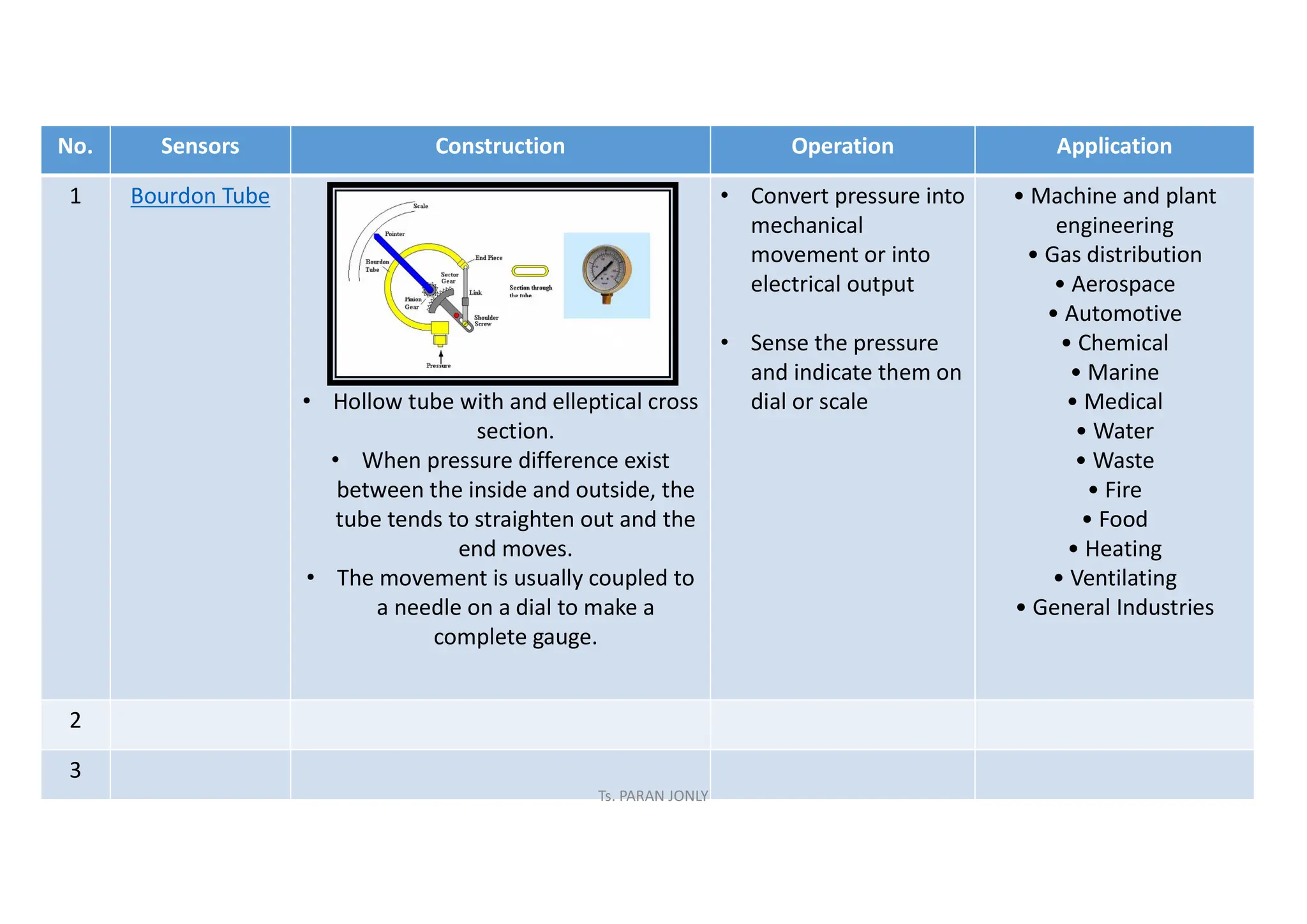
No. Sensors Construction Operation Application
1 Bourdon Tube
• Hollow tube with and elleptical cross
section.
• When pressure difference exist
between the inside and outside, the
tube tends to straighten out and the
end moves.
• The movement is usually coupled to
a needle on a dial to make a
complete gauge.
• Convert pressure into
mechanical
movement or into
electrical output
• Sense the pressure
and indicate them on
dial or scale
• Machine and plant
engineering
• Gas distribution
• Aerospace
• Automotive
• Chemical
• Marine
• Medical
• Water
• Waste
• Fire
• Food
• Heating
• Ventilating
• General Industries
2
3
Ts. PARAN JONLY
SENSOR/TRANSDUCER
CALCULATION
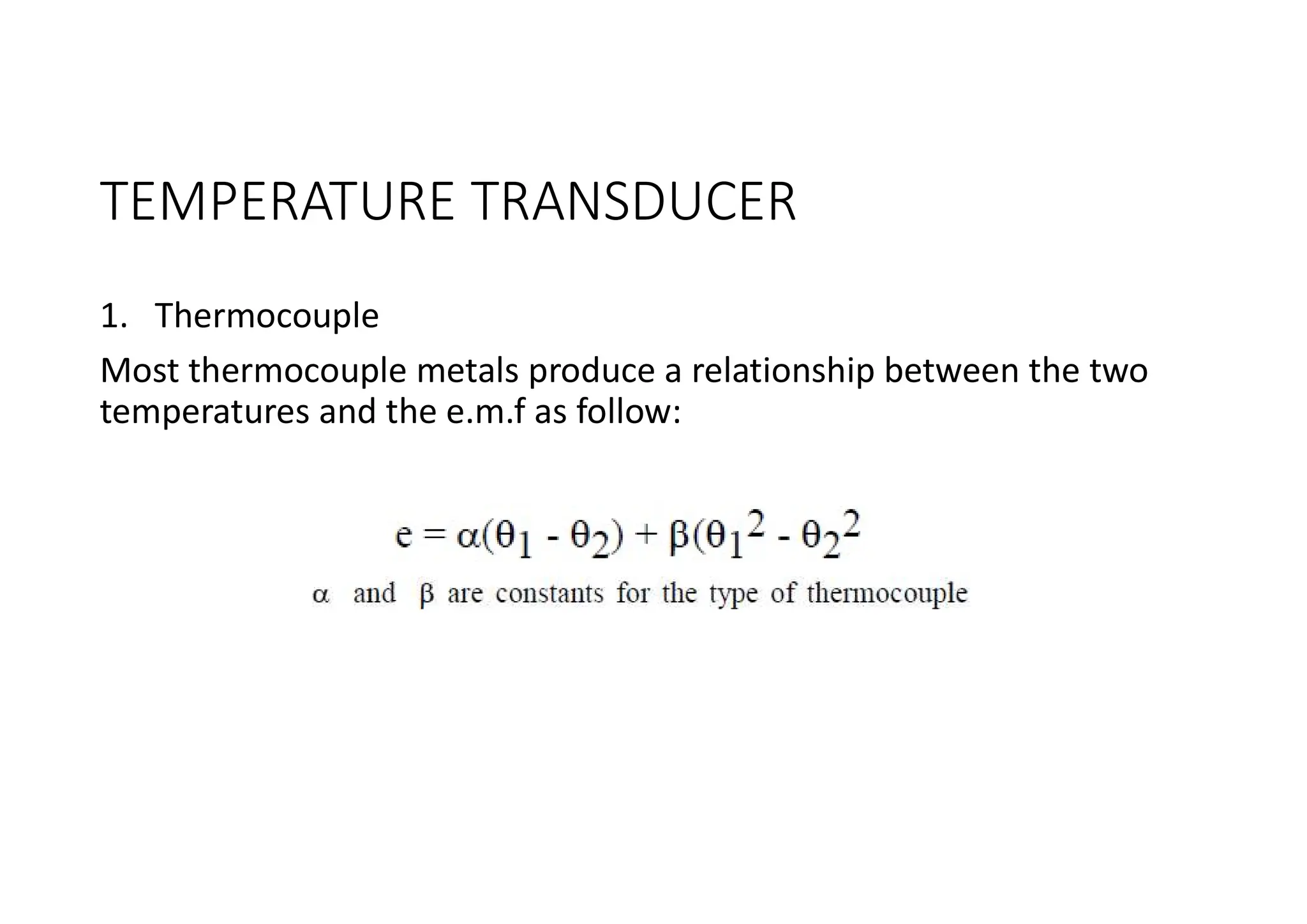
TEMPERATURE TRANSDUCER
1. Thermocouple
Most thermocouple metals produce a relationship between the two
temperatures and the e.m.f as follow:
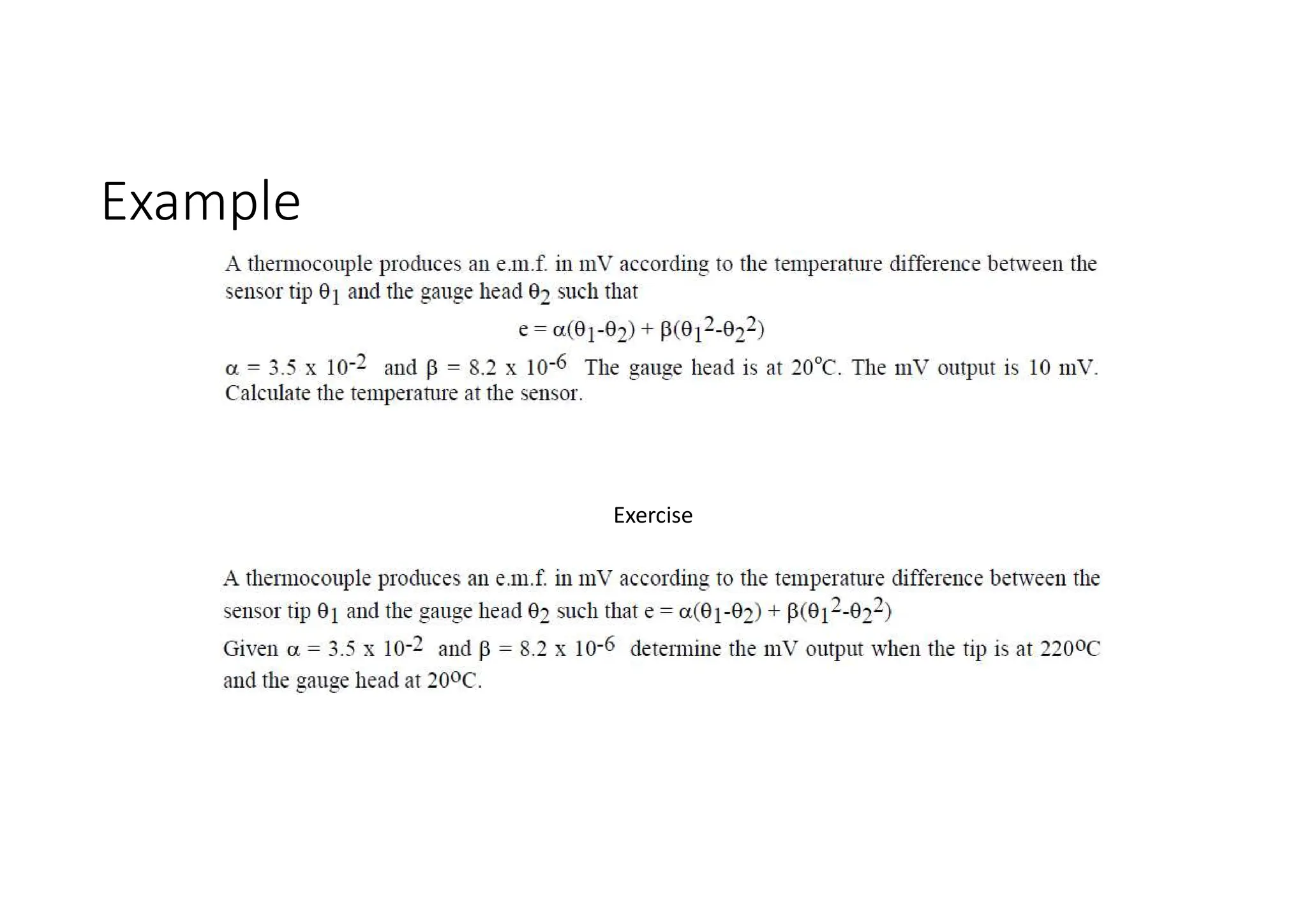
Example
Exercise
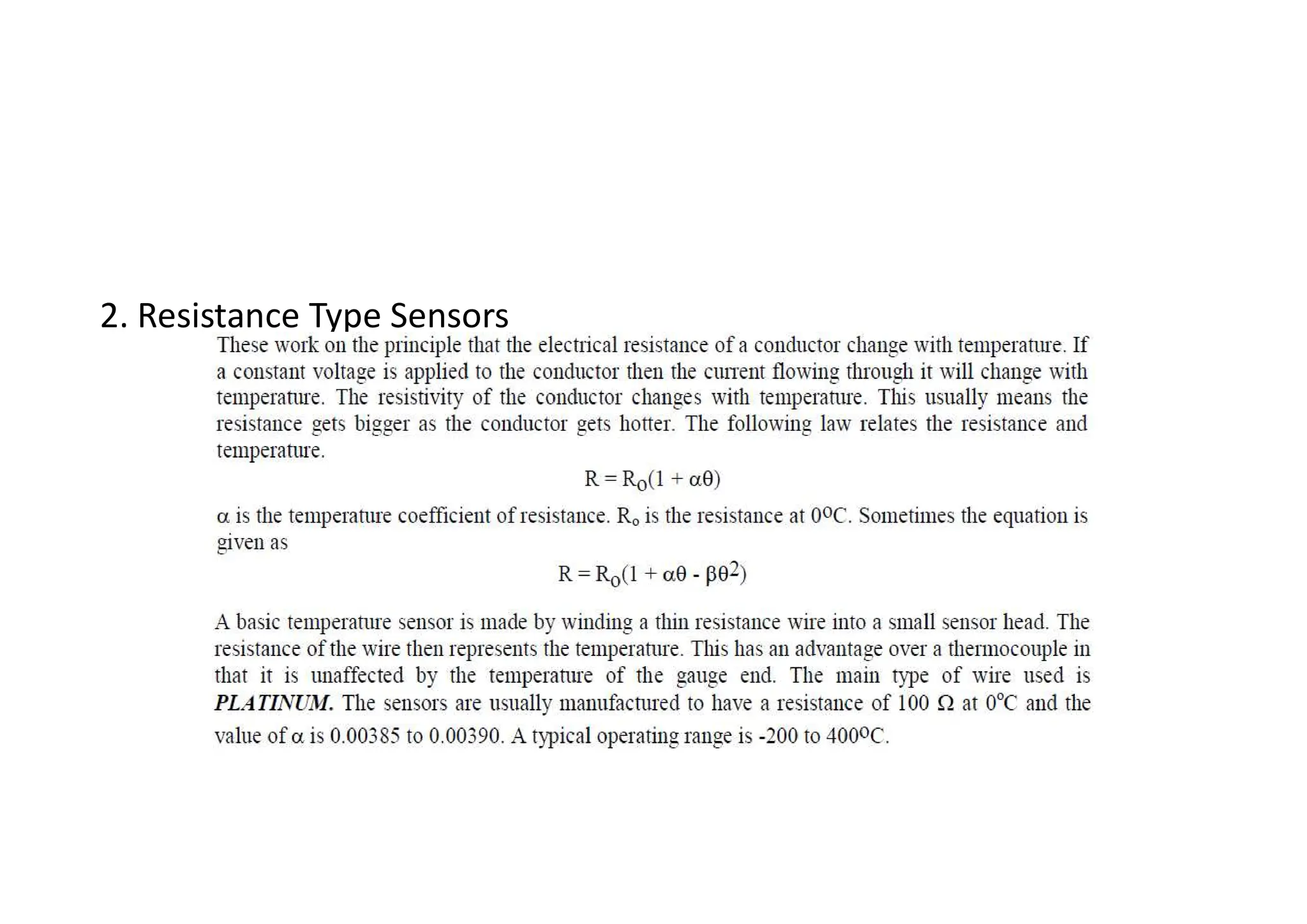
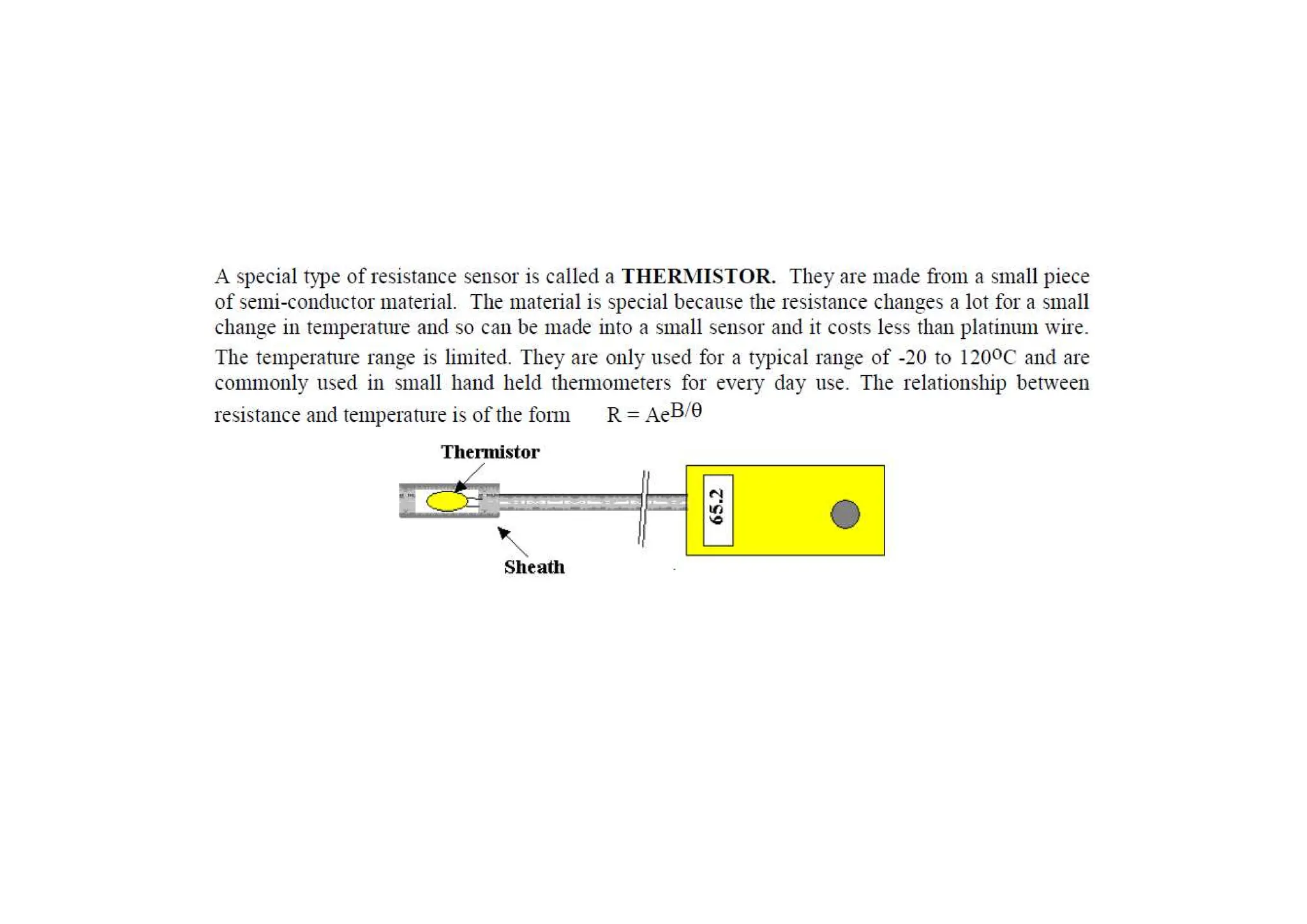
2. Resistance Type Sensors
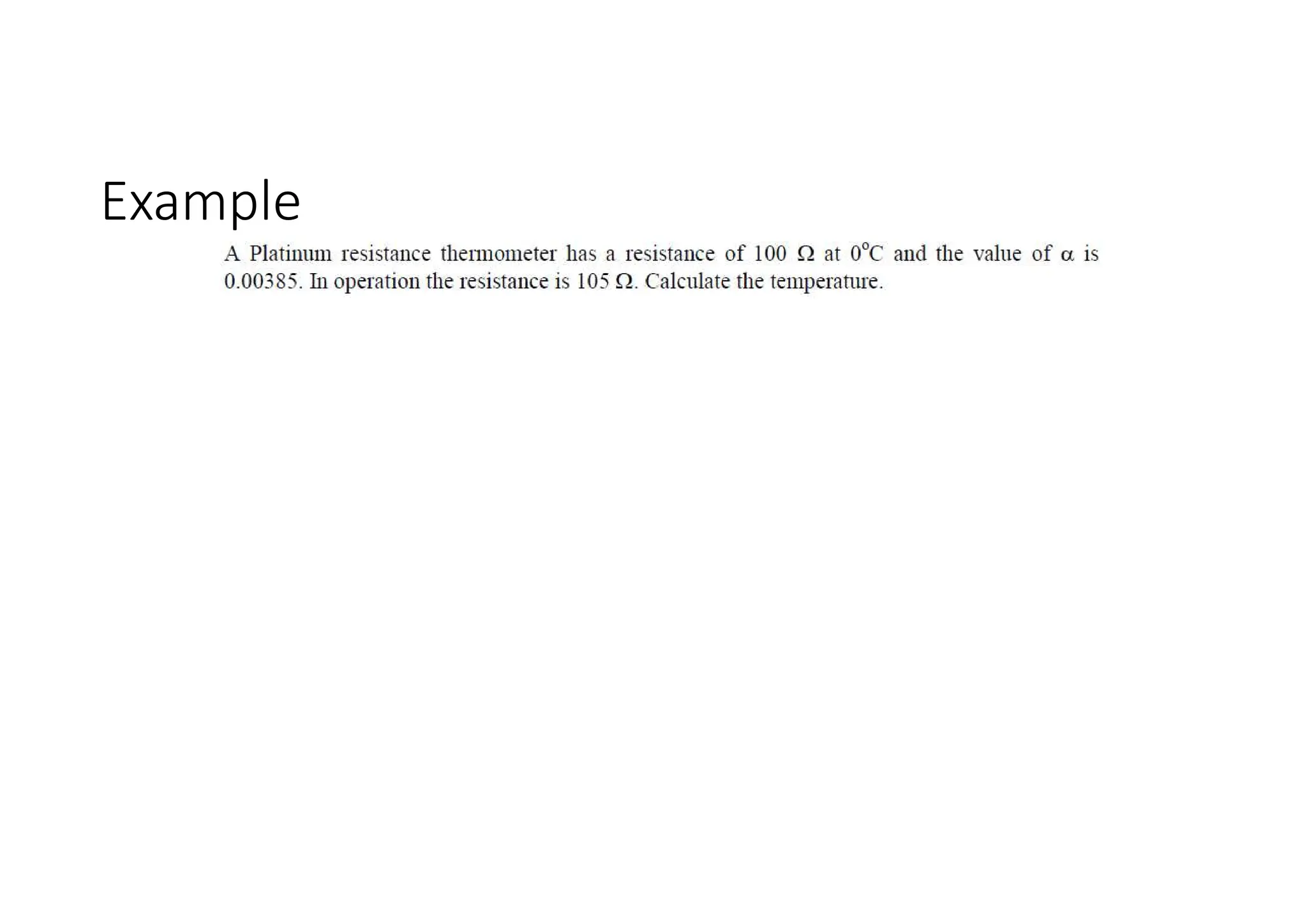
Example
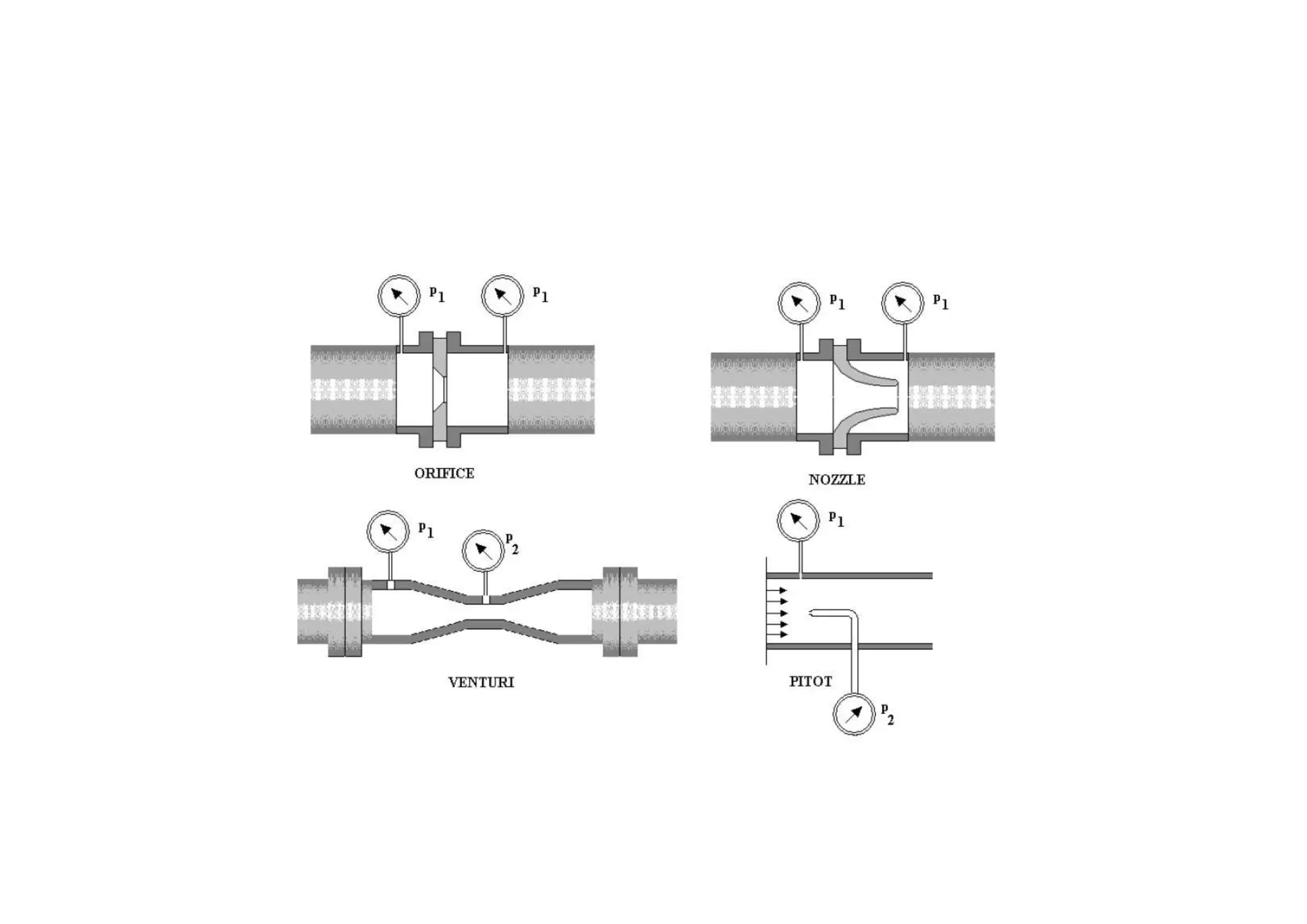
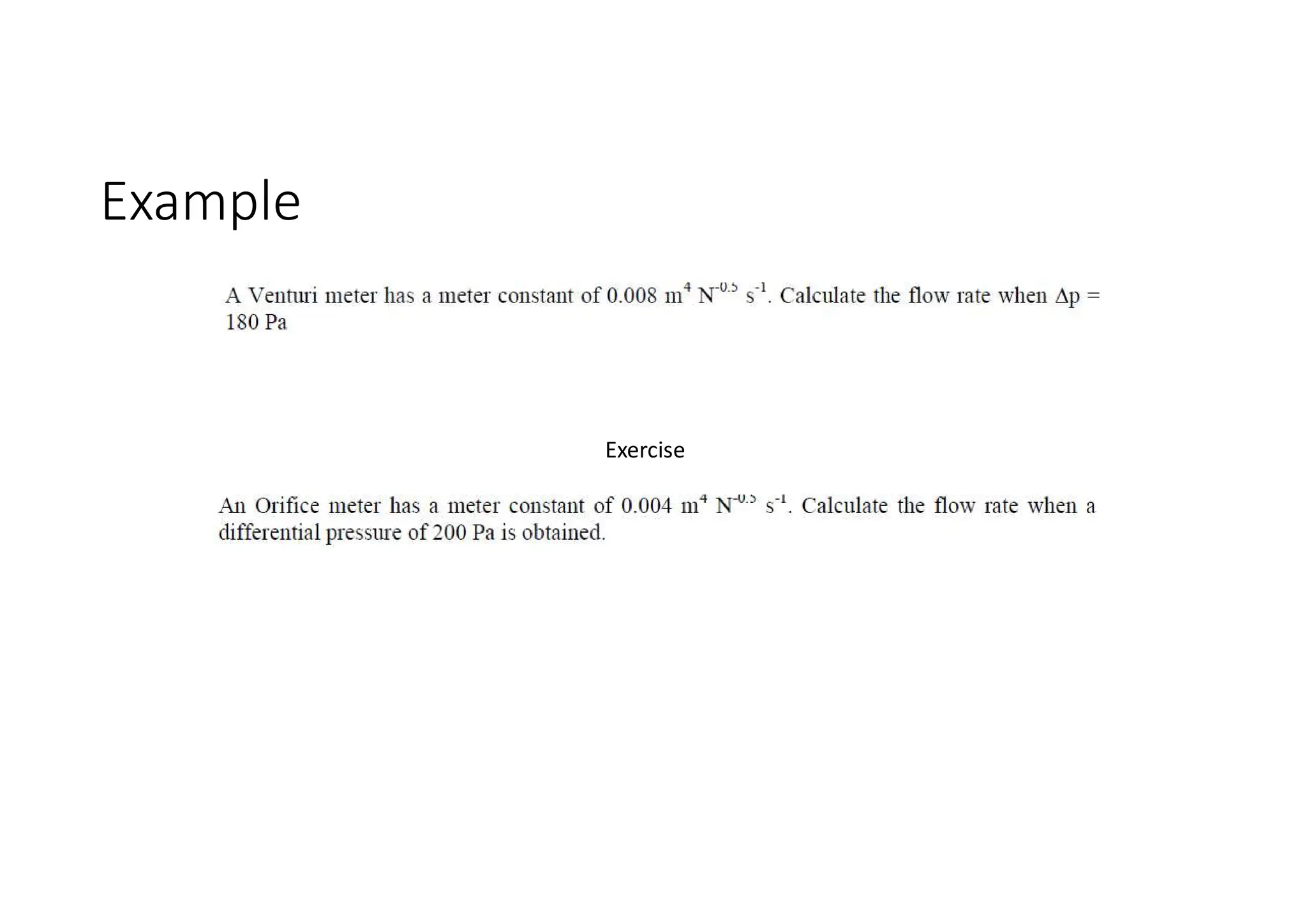
FLOW METERS
Differential Pressure Flow Meter
1. Orifice meters
2. Venturi meters
3. Nozzle meters
4. Pitot tube
Example
Exercise
Signal Conditioner
CEE2163
Instrumentation and Control
Part 1.3
Ts. PARAN JONLY
In this Part 1.3, you will learn:
Signal Conditioning
• Introduction to signal conditioning
• Bridge circuits
• Amplifiers
• Protection
• Filters
Ts. PARAN JONLY
Ts. PARAN JONLY
ELECTRICAL MEASUREMENT SYSTEM
WHY?
1. Easy to transmit signal from measurement site
the data collection site
2. Easy to amplify, filter and modify
3. Easy to record the signal
Ts. PARAN JONLY
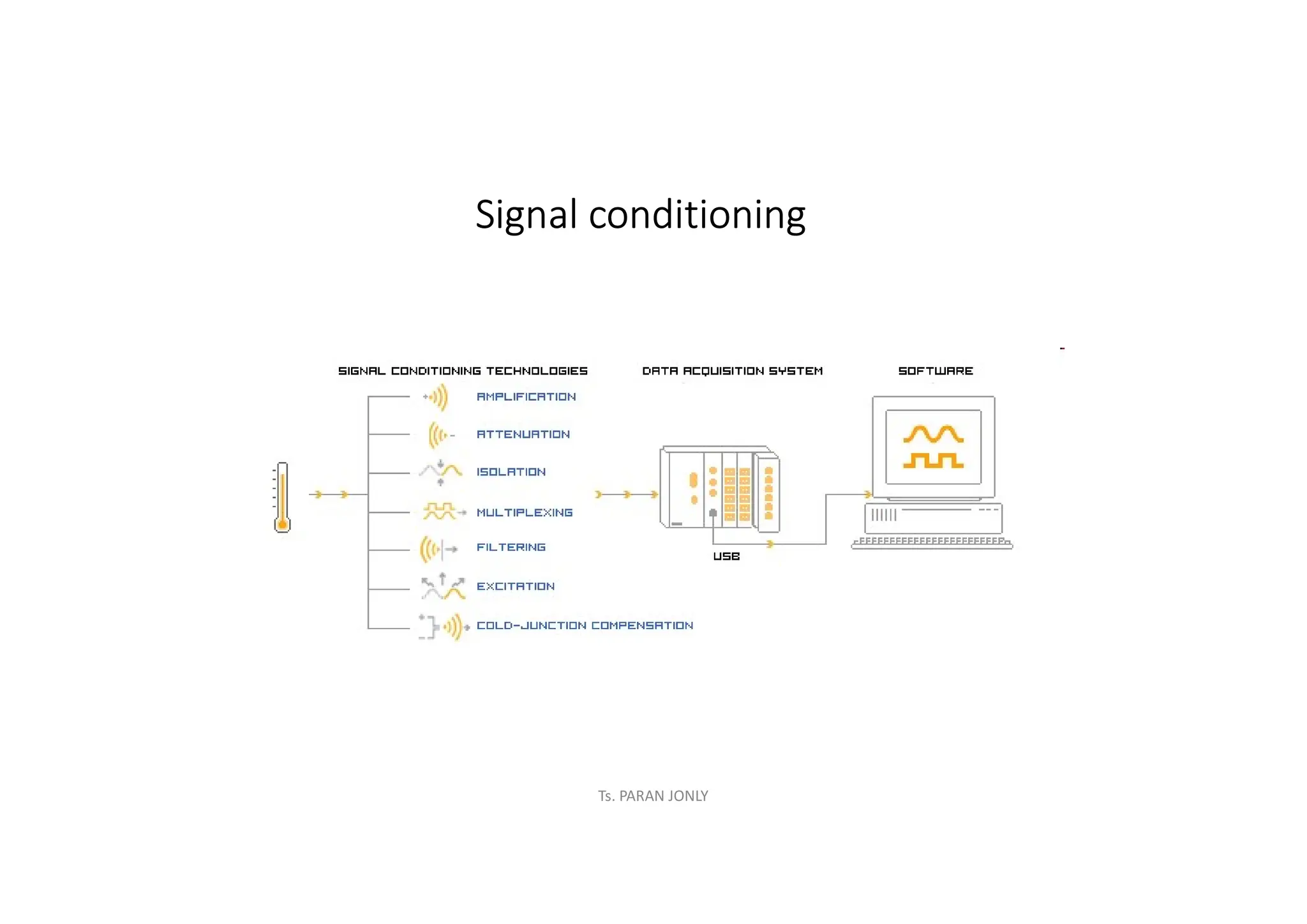
Signal conditioning
• Used in factory or machine automation : to convert sensor or
transducer measurement signal levels to industry standard control
signals
• Provide computer and control system manufacturers a common
communication method to effectively receive and transmit
measurement and control data
• Examples of measurement data : temperature or AC/DC voltage/current
signals from various transducers
• Examples of control data : on/off signals for a heating element or
proportional signals for a valve actuator.
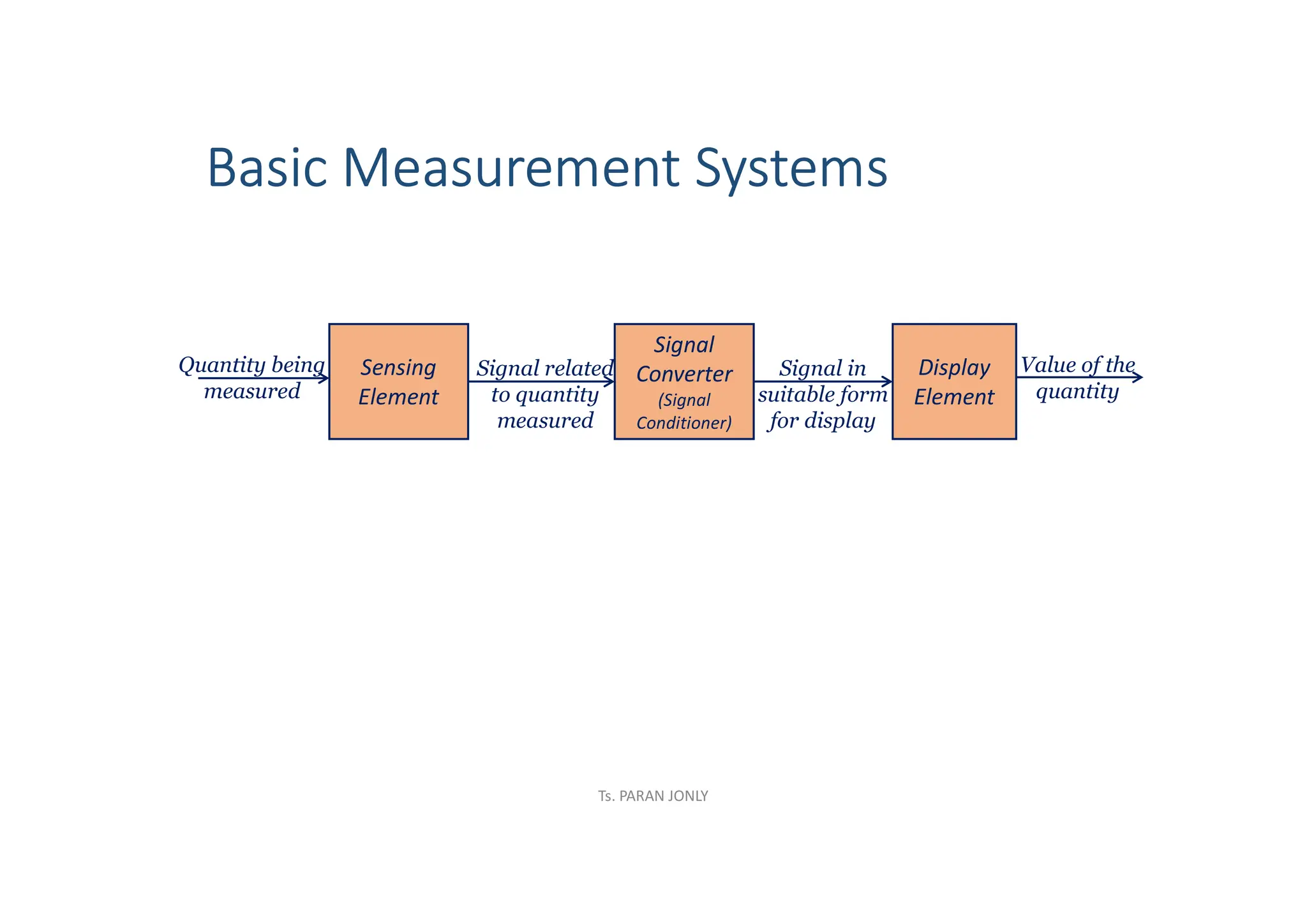
Basic Measurement Systems
Sensing
Element
Quantity being
measured
Signal related
to quantity
measured
Signal
Converter
(Signal
Conditioner)
Display
Element
Signal in
suitable form
for display
Value of the
quantity
Ts. PARAN JONLY
Signal Conditioning
• Signal conditioning is a basic component of all measurement devices.
• It converts incoming measurements into a form acceptable to
digitization hardware.
• Signal conditioning not only defines what types of signals the system
can accept, but also defines what additional features the system has
to offer.
Ts. PARAN JONLY
Ts. PARAN JONLY
Signal conditioning
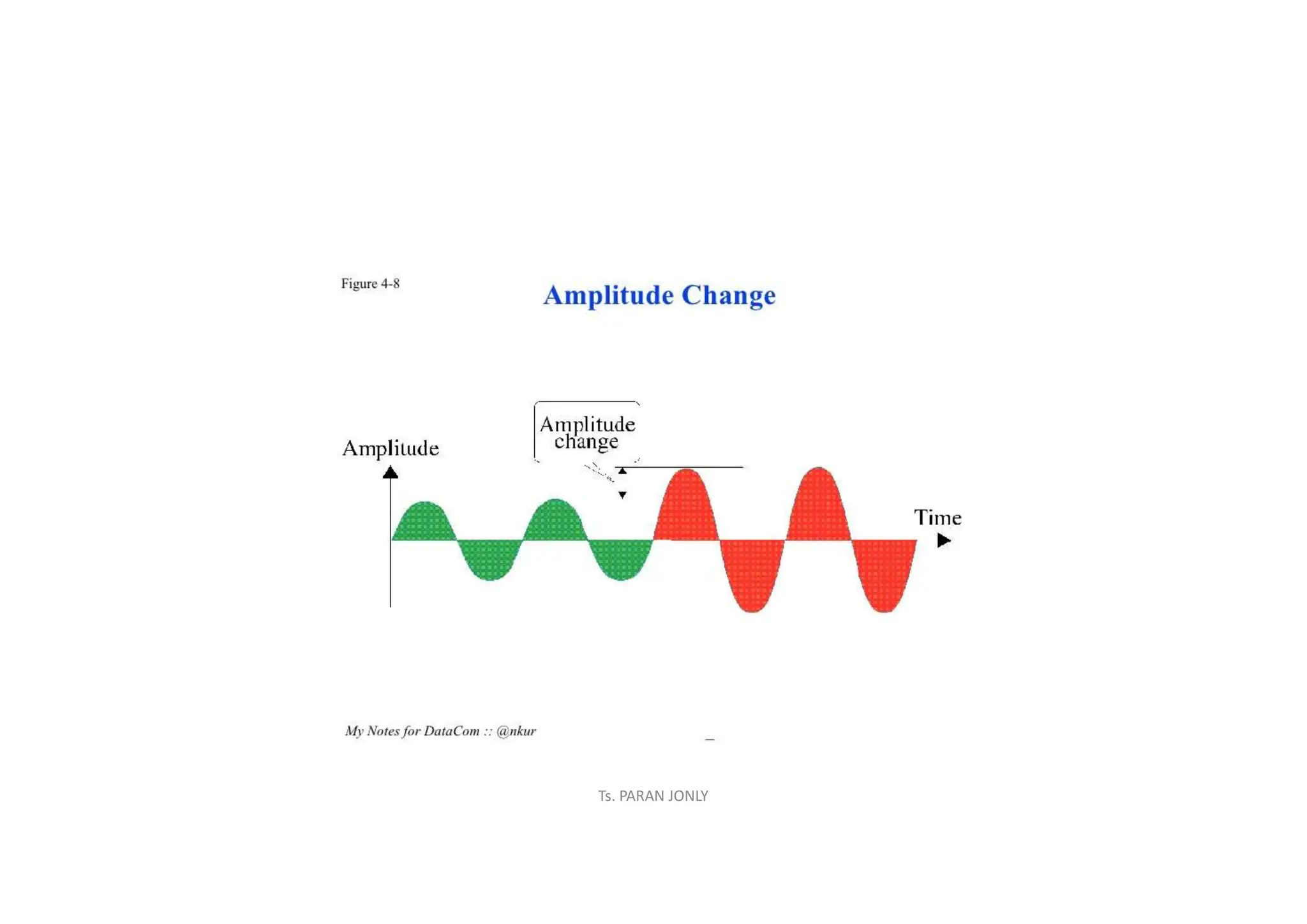
Amplification
• Amplification increases signal amplitude before digitization occurs.
• Amplification increases the measurement accuracy of small signals
and reduces the effects of surrounding noise sources.
• Converting a 0-10mV signal to a 0 -10V signal is an example of
amplification.
Ts. PARAN JONLY
Ts. PARAN JONLY
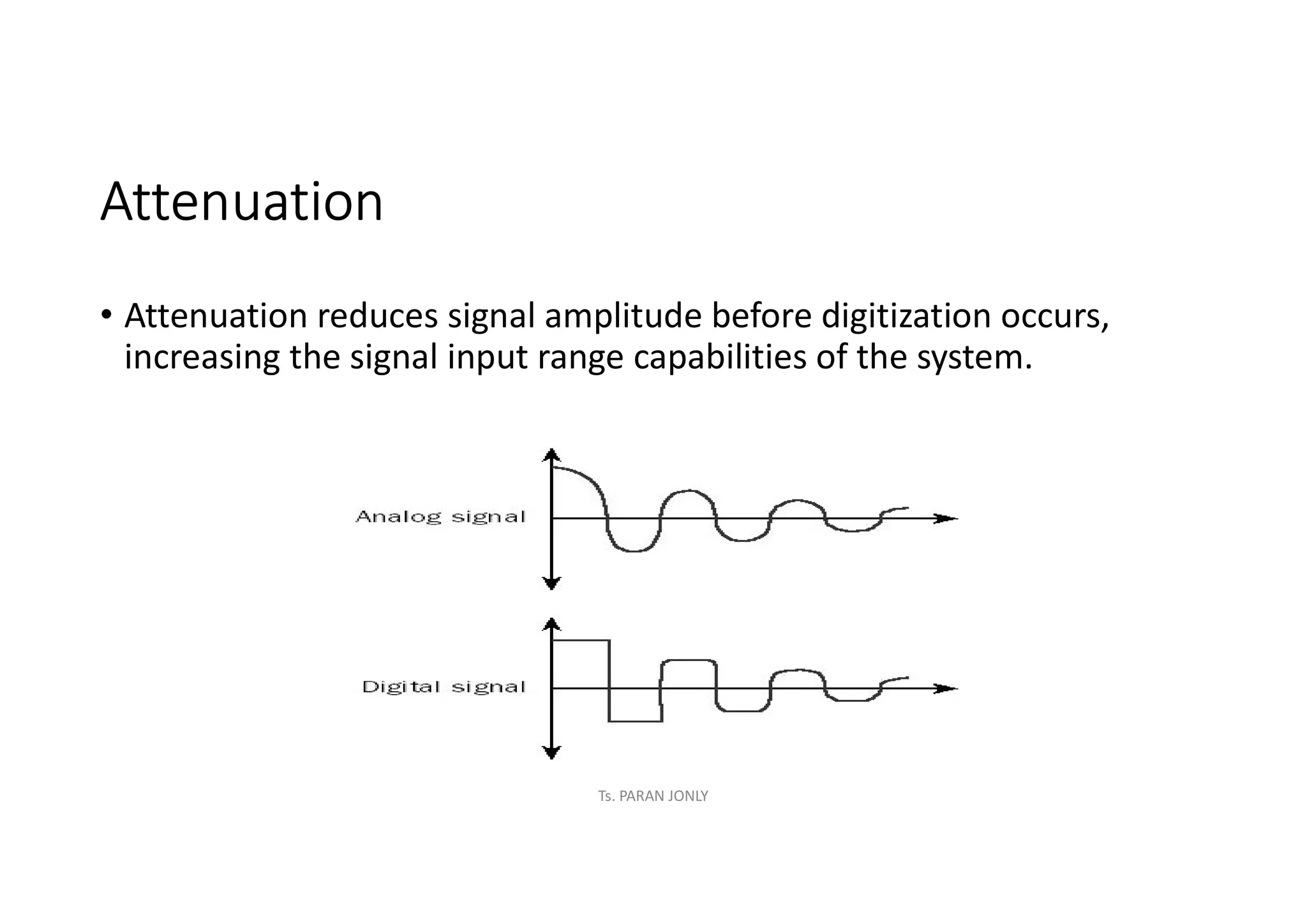
Attenuation
• Attenuation reduces signal amplitude before digitization occurs,
increasing the signal input range capabilities of the system.
Ts. PARAN JONLY
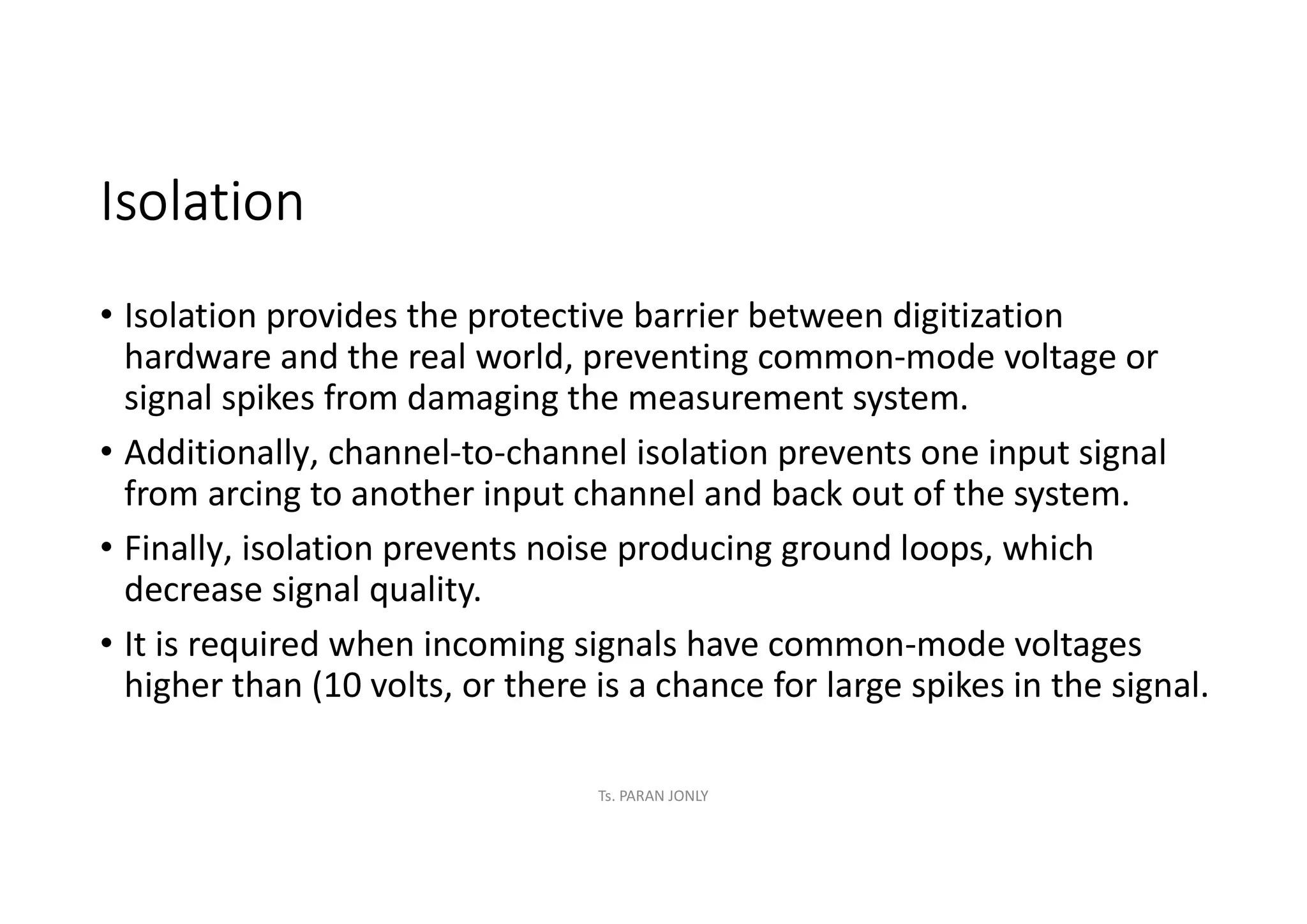
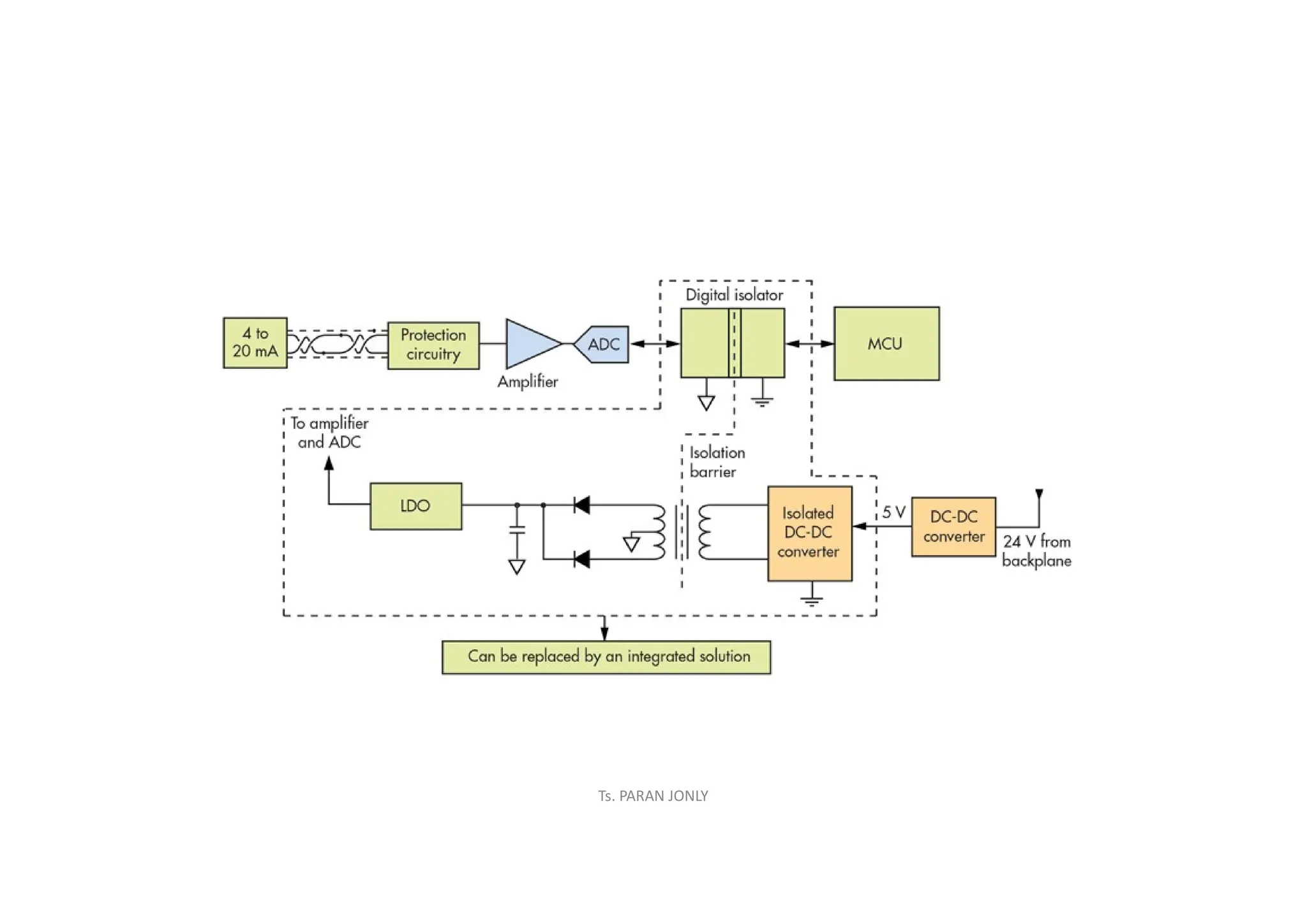
Isolation
• Isolation provides the protective barrier between digitization
hardware and the real world, preventing common-mode voltage or
signal spikes from damaging the measurement system.
• Additionally, channel-to-channel isolation prevents one input signal
from arcing to another input channel and back out of the system.
• Finally, isolation prevents noise producing ground loops, which
decrease signal quality.
• It is required when incoming signals have common-mode voltages
higher than (10 volts, or there is a chance for large spikes in the signal.
Ts. PARAN JONLY
Ts. PARAN JONLY
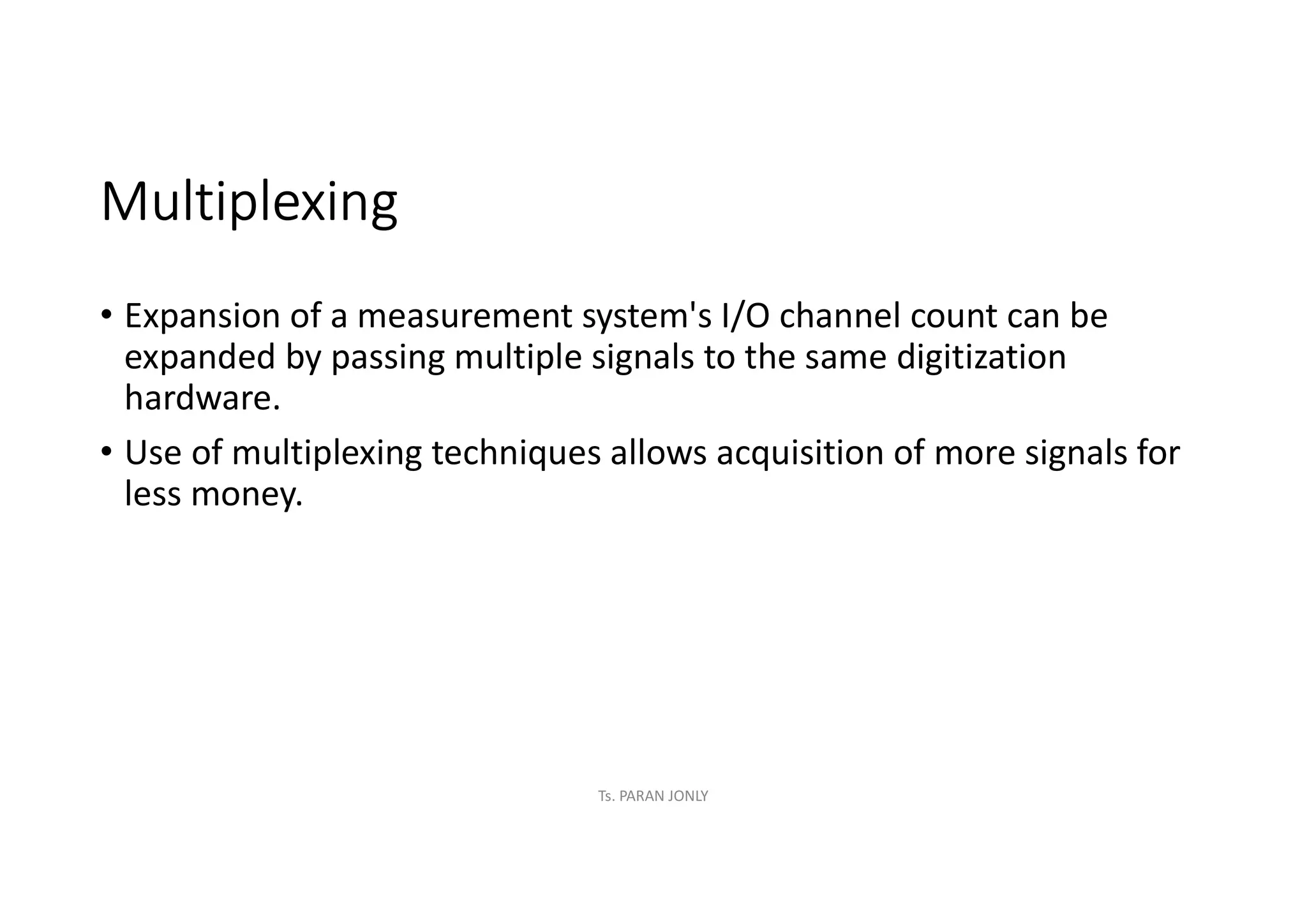
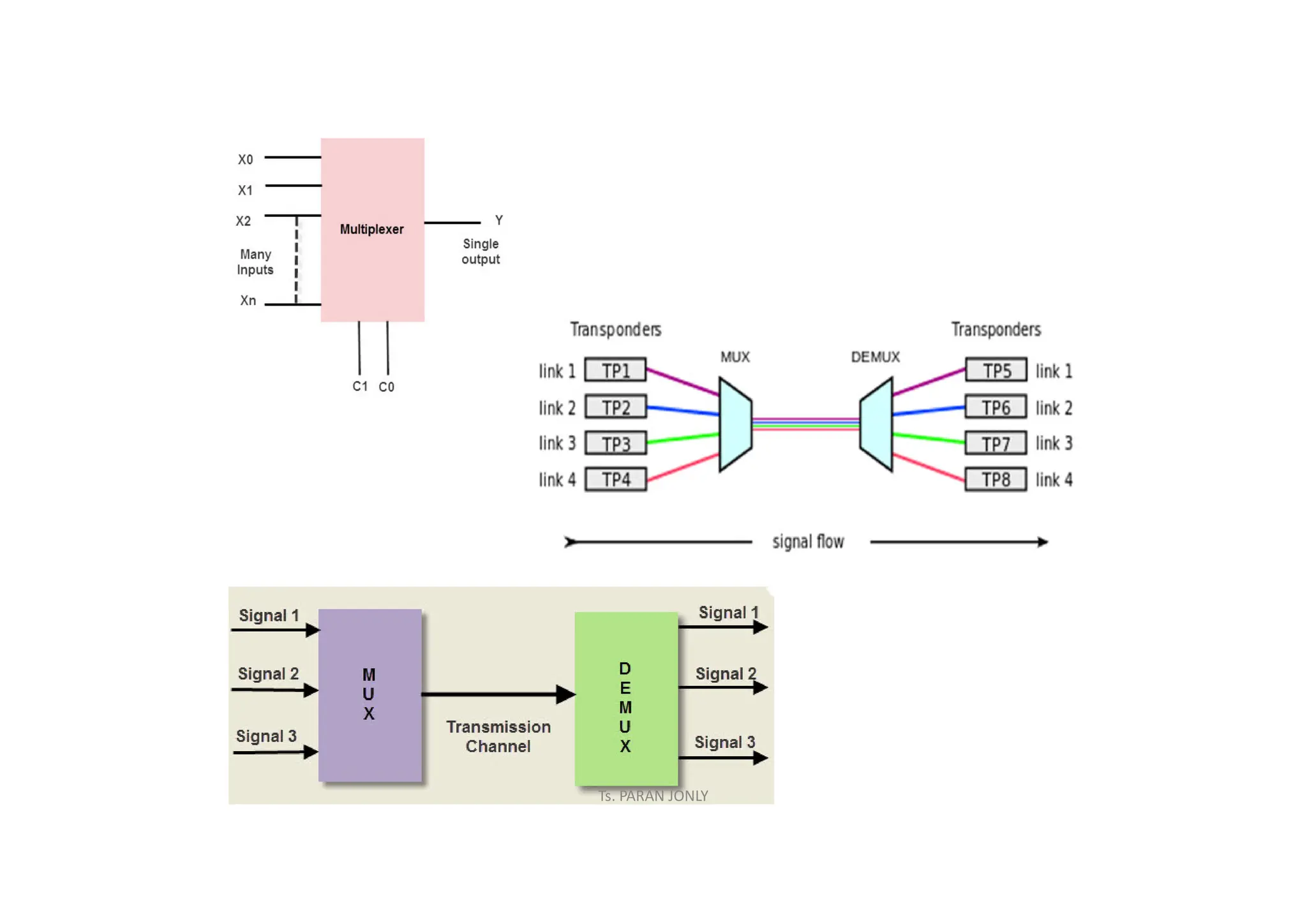
Multiplexing
• Expansion of a measurement system's I/O channel count can be
expanded by passing multiple signals to the same digitization
hardware.
• Use of multiplexing techniques allows acquisition of more signals for
less money.
Ts. PARAN JONLY
Ts. PARAN JONLY
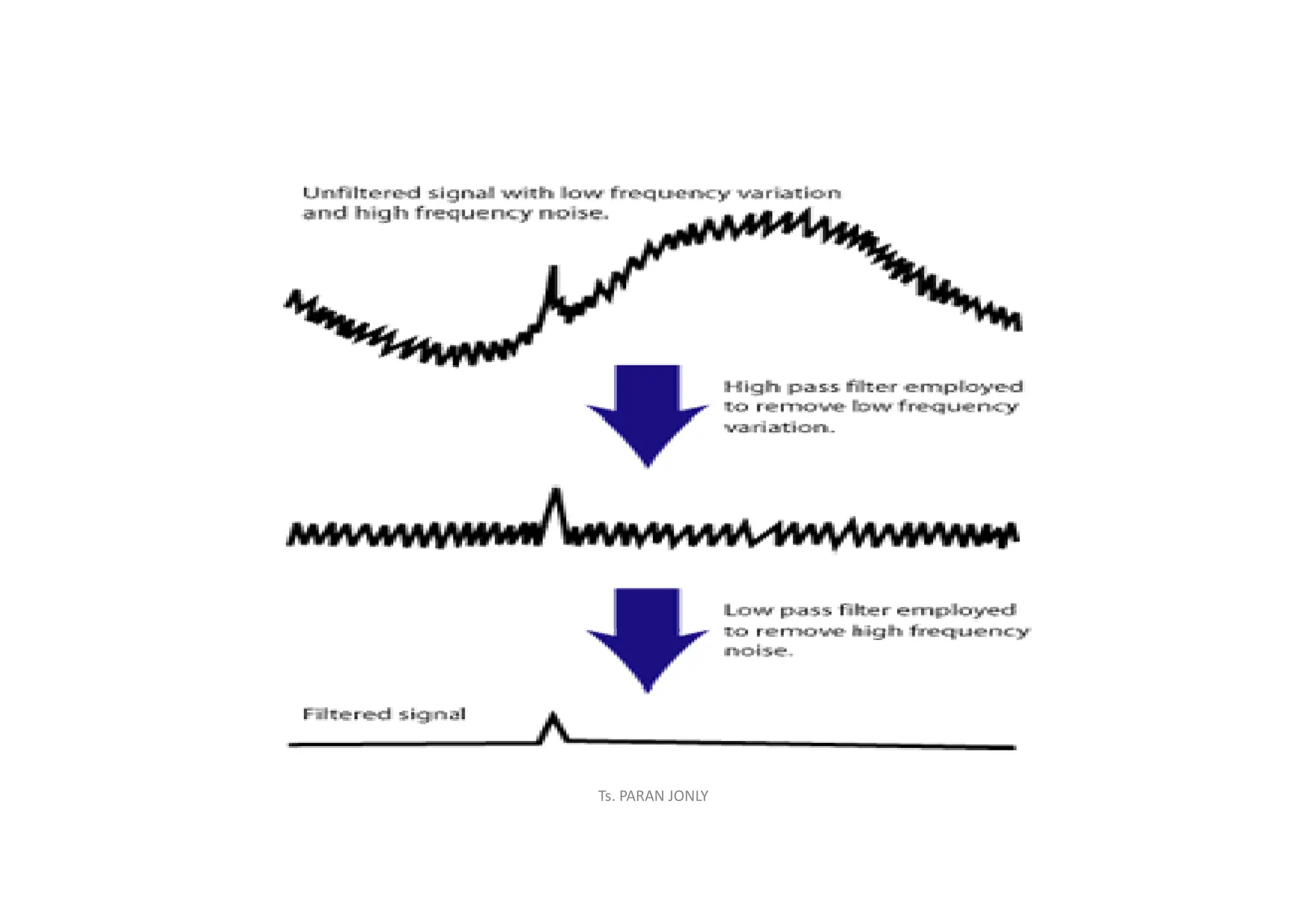
Filtering
• The filtering process blocks unwanted signal frequencies arising from
external noise sources (generators, motors, power lines, etc.) from
incoming signals.
• Proper filtering also prevents anti-aliasing, where higher frequency
components of a signal appear as lower frequency components.
Ts. PARAN JONLY
Ts. PARAN JONLY
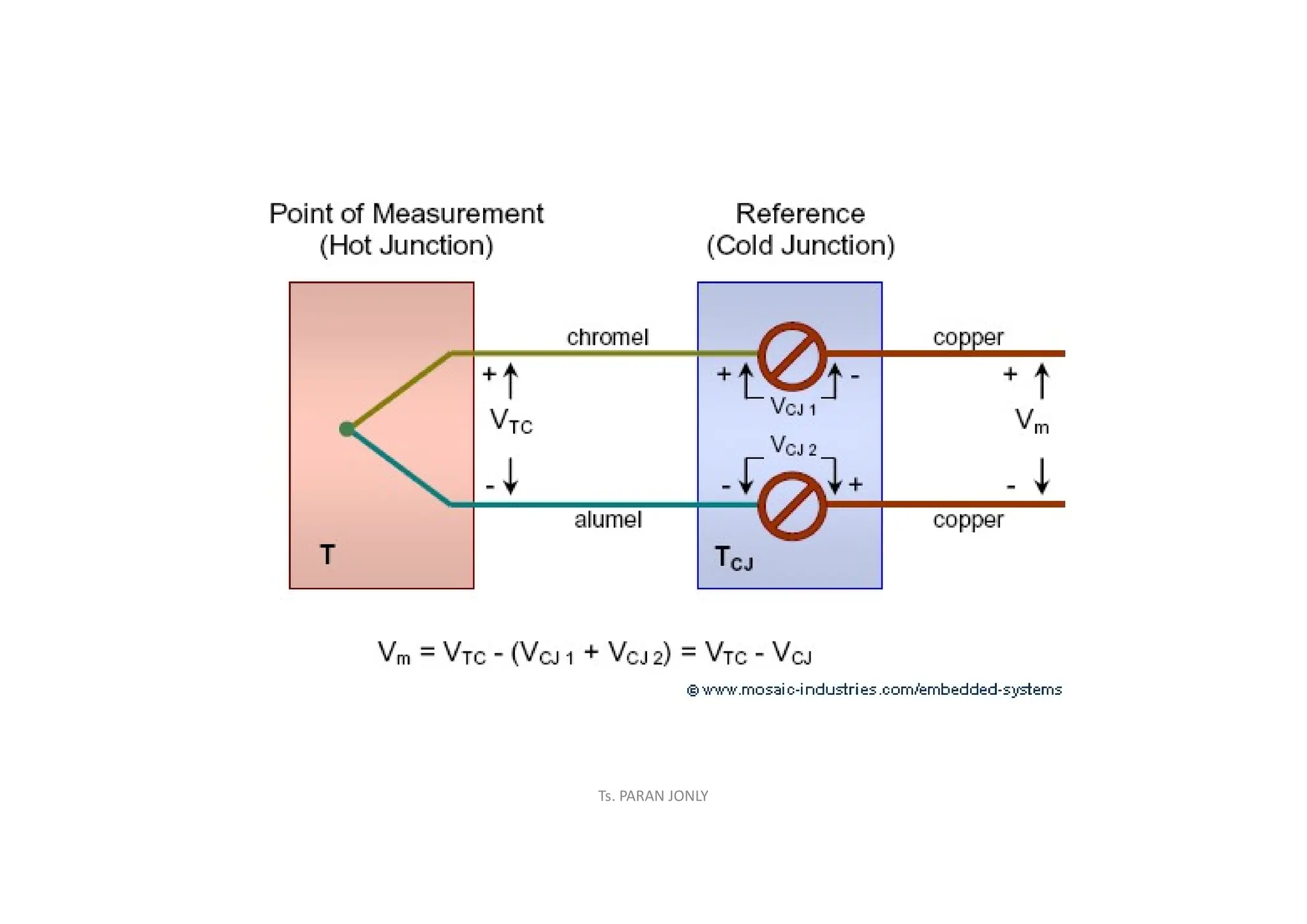
Cold-Junction Compensation
• This specific type of signal conditioning is required by thermocouples.
• Cold-junction compensation removes small voltage errors caused by
connecting a thermocouple using terminal blocks made of different
metals than the T/C itself.
• It does this by reading the ambient temperature at the point where
the thermocouple connects to the system.
Ts. PARAN JONLY
Ts. PARAN JONLY
Ts. PARAN JONLY
Bridge circuits
Ts. PARAN JONLY
Bridge circuits
• Used to convert impedance variations into voltage
variations
• Can be design so the voltage produced varies around zero
• Amplification can be used to increase voltage level for
increased sensitivity to variation of impedance
Ts. PARAN JONLY
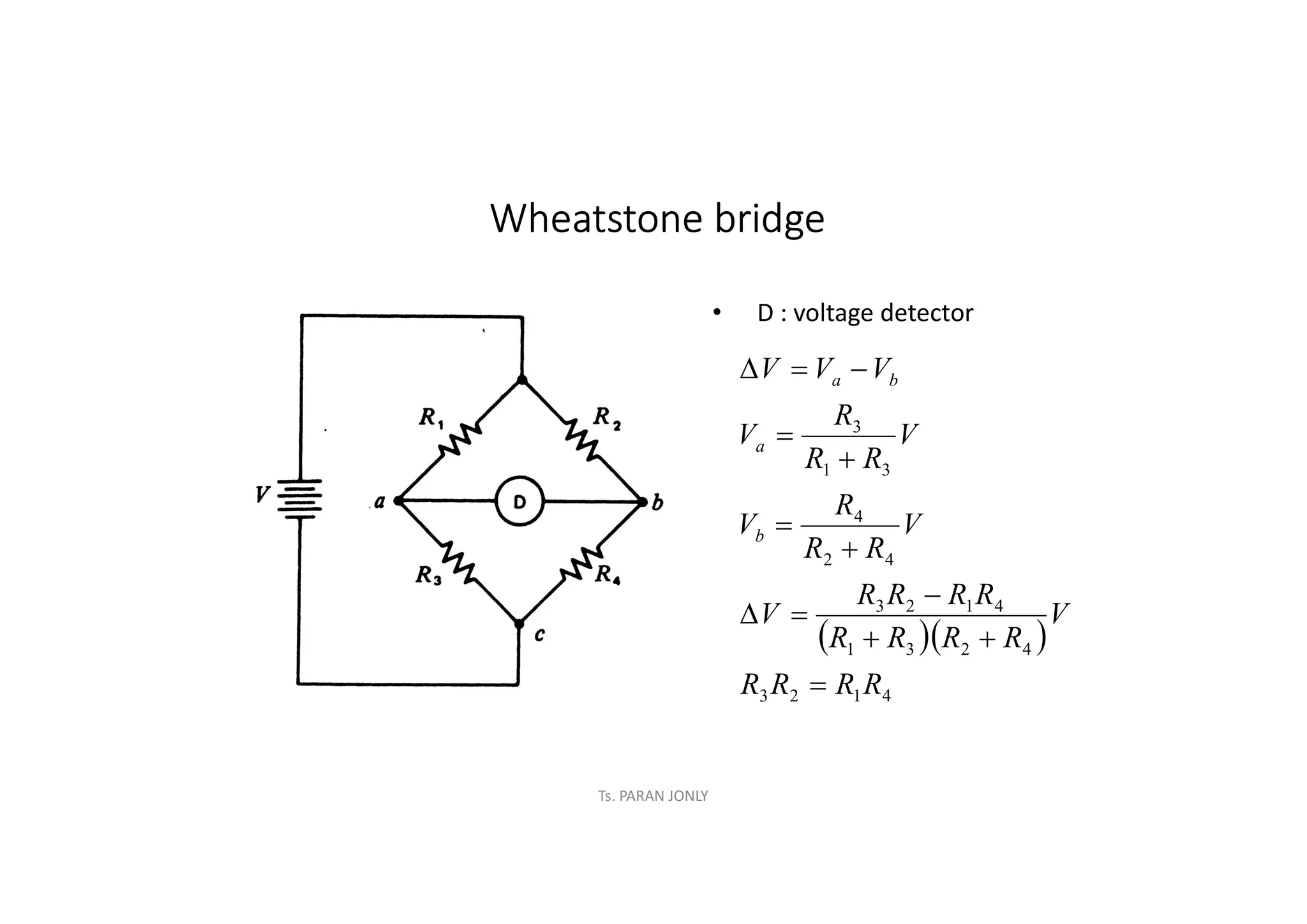
Wheatstone bridge
• D : voltage detector
  
4
1
2
3
4
2
3
1
4
1
2
3
4
2
4
3
1
3
R
R
R
R
V
R
R
R
R
R
R
R
R
V
V
R
R
R
V
V
R
R
R
V
V
V
V
b
a
b
a













Ts. PARAN JONLY
Bridge resolution
• Resolution function of detector : to determine the bridge
offset
• Resistance resolution : resistance change in 1 arm bridge
that causes an offset voltage equal to detector resolution
• Detector can measure change of 100 µV
Ts. PARAN JONLY
Resolution
• The smallest discernible change in input; the smallest
change in input that manifests itself as perceptible
change in output that can be measured (example :
0.000 1 mm)
• Primary factor in deciding precision
• Good resolution does not imply in good precision
Ts. PARAN JONLY
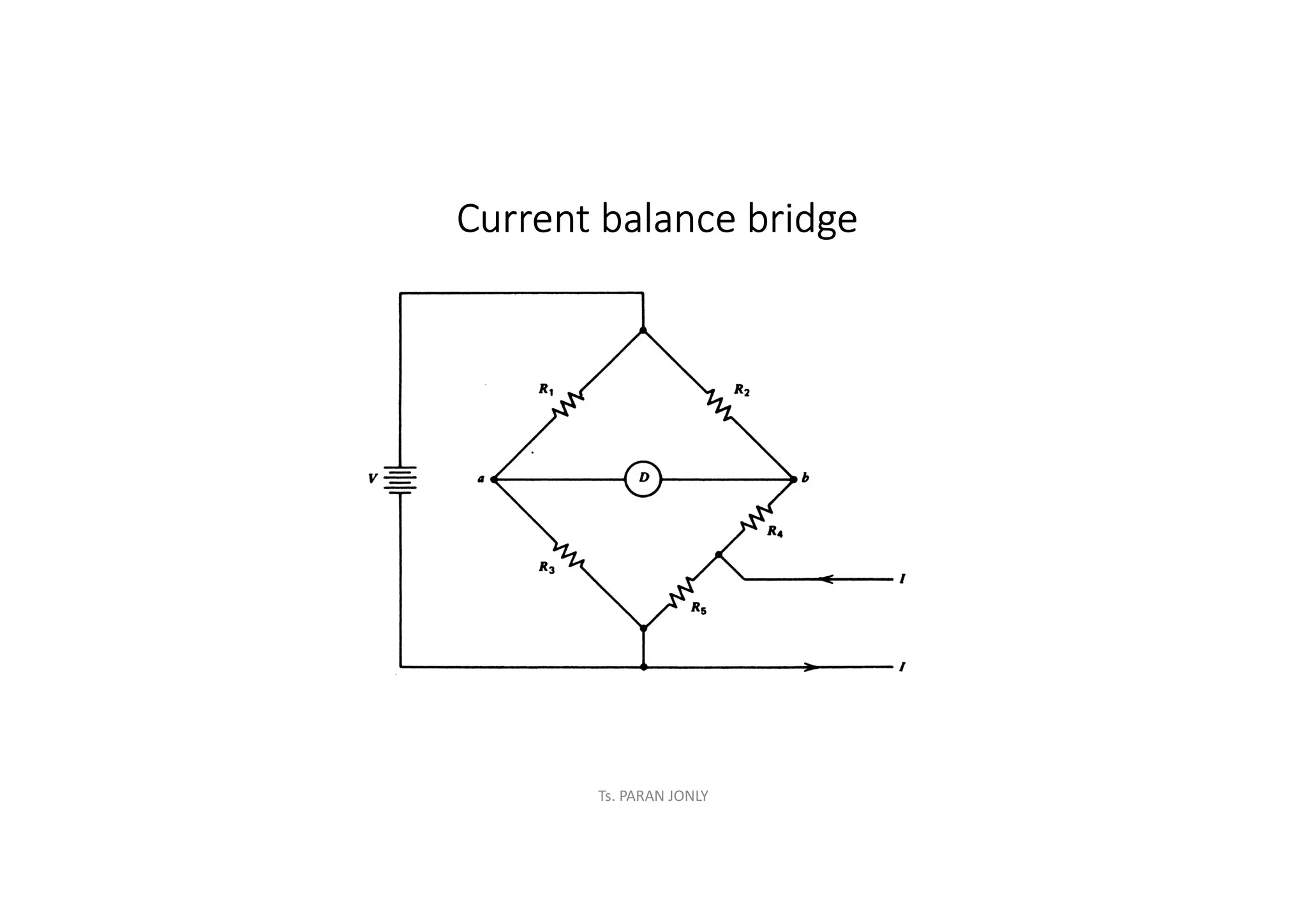
Current balance bridge
Ts. PARAN JONLY
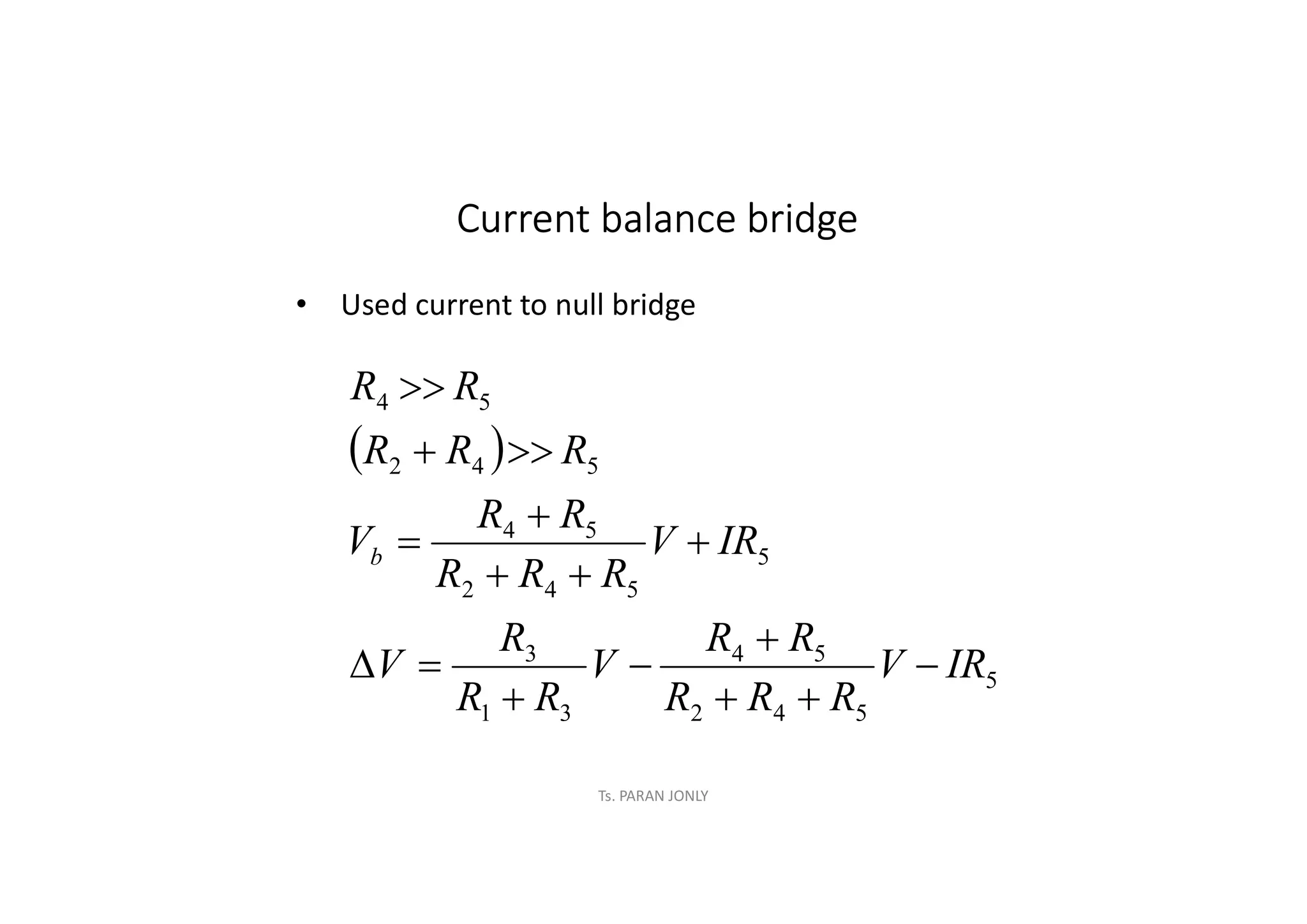
Current balance bridge
• Used current to null bridge
 
5
5
4
2
5
4
3
1
3
5
5
4
2
5
4
5
4
2
5
4
IR
V
R
R
R
R
R
V
R
R
R
V
IR
V
R
R
R
R
R
V
R
R
R
R
R
b
















Ts. PARAN JONLY
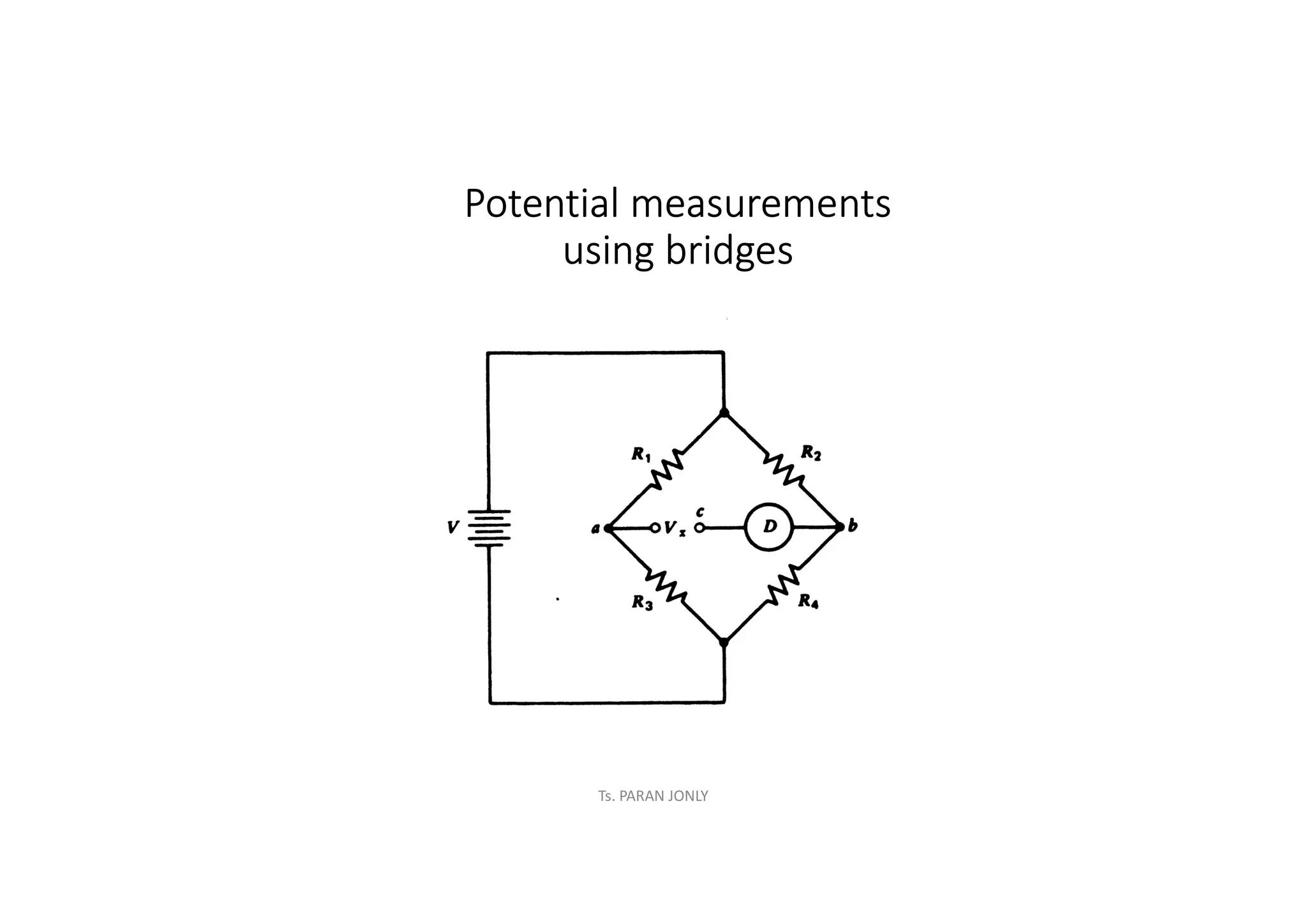
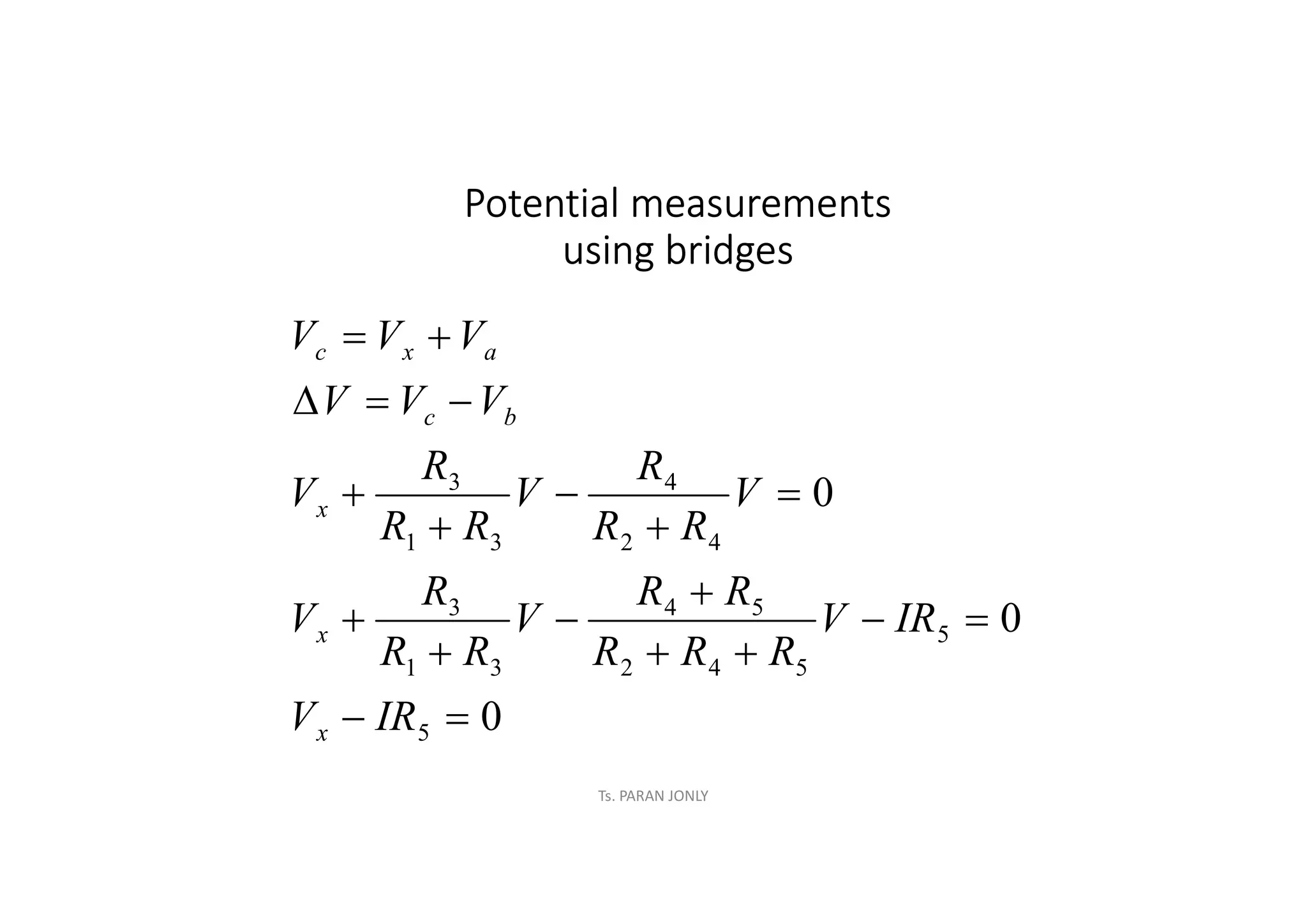
Potential measurements
using bridges
Ts. PARAN JONLY
Potential measurements
using bridges
0
0
0
5
5
5
4
2
5
4
3
1
3
4
2
4
3
1
3




















IR
V
IR
V
R
R
R
R
R
V
R
R
R
V
V
R
R
R
V
R
R
R
V
V
V
V
V
V
V
x
x
x
b
c
a
x
c
Ts. PARAN JONLY
Amplifiers
Ts. PARAN JONLY
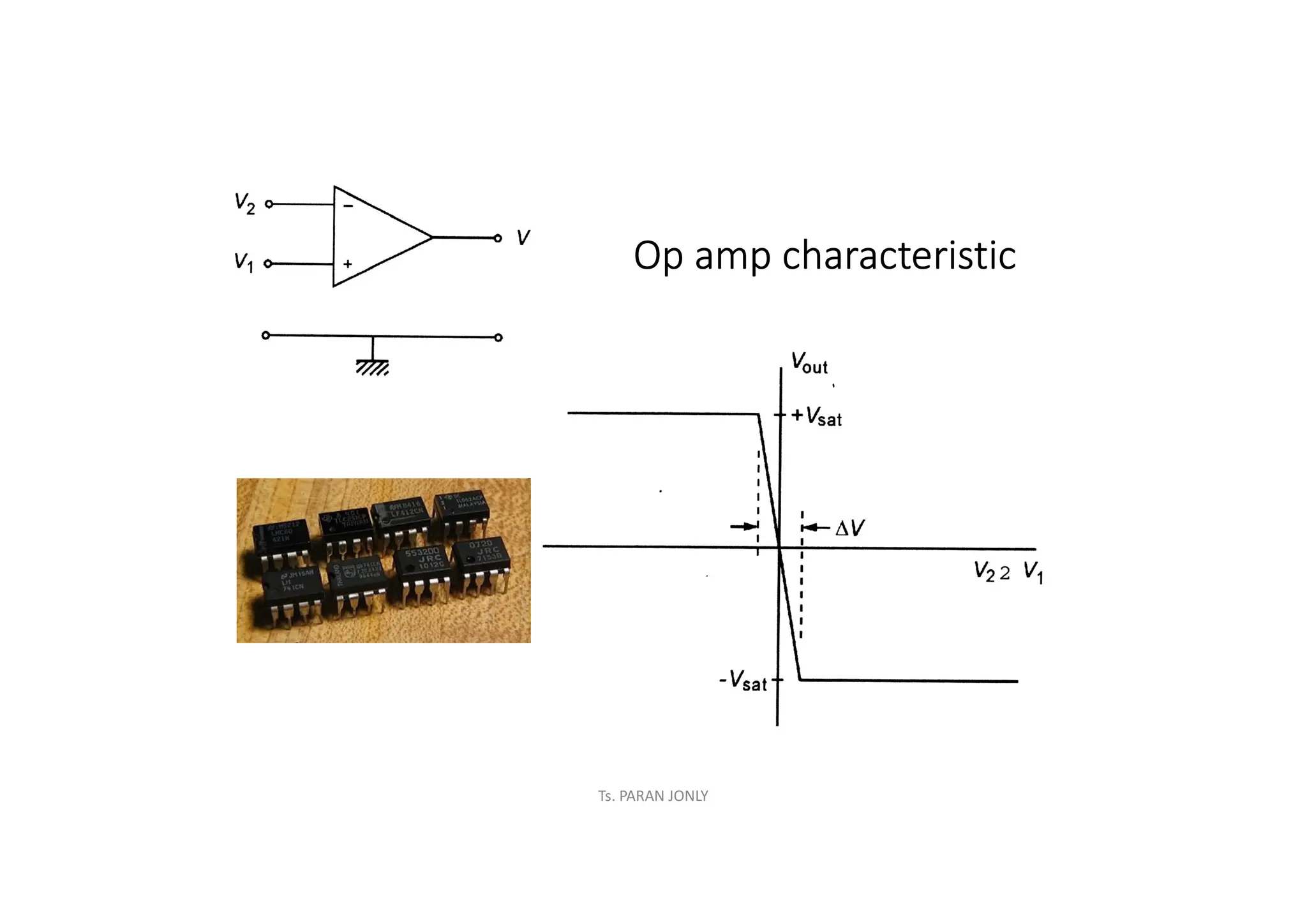
Op amp characteristic
Ts. PARAN JONLY
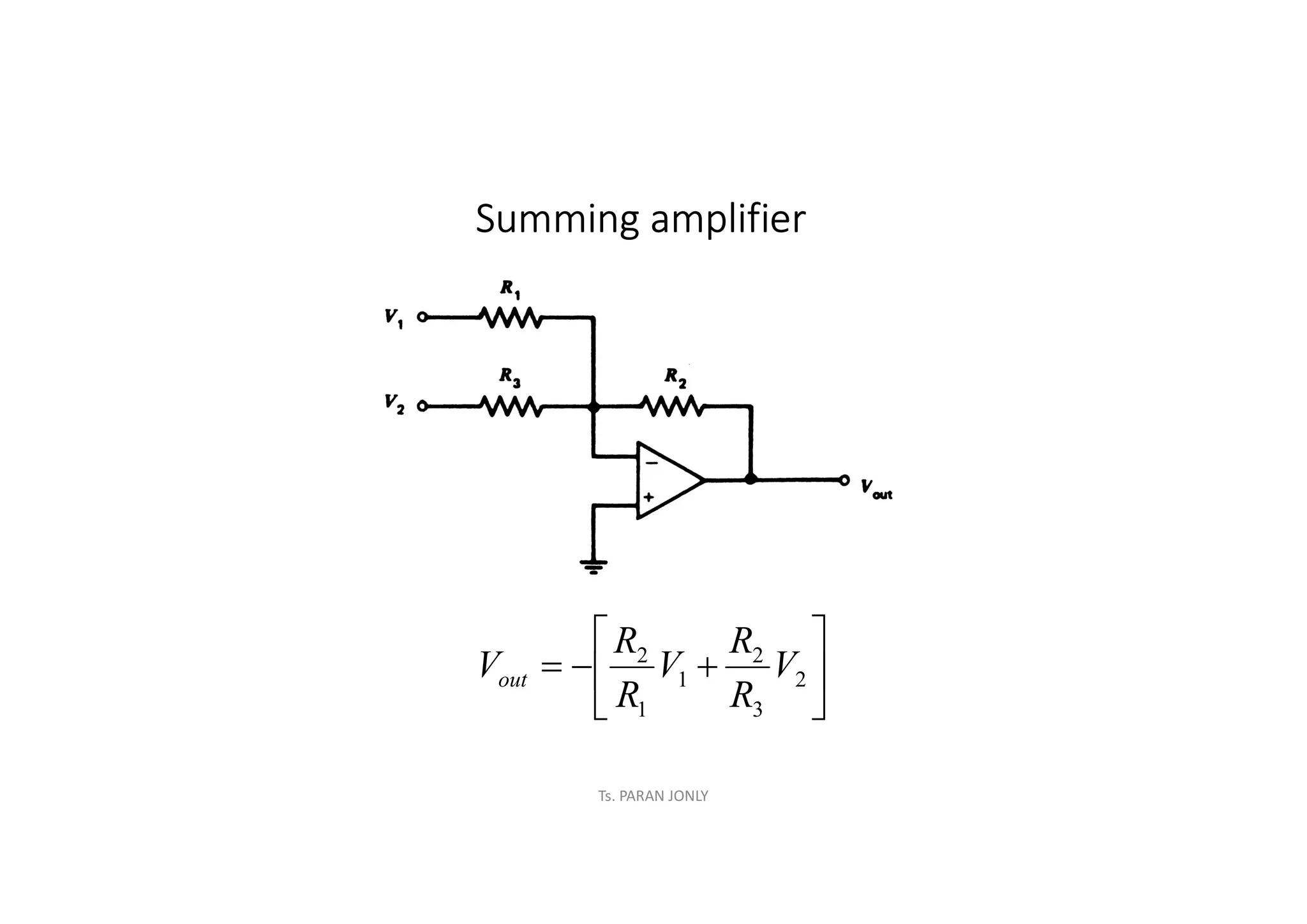
Summing amplifier








 2
3
2
1
1
2
V
R
R
V
R
R
Vout
Ts. PARAN JONLY
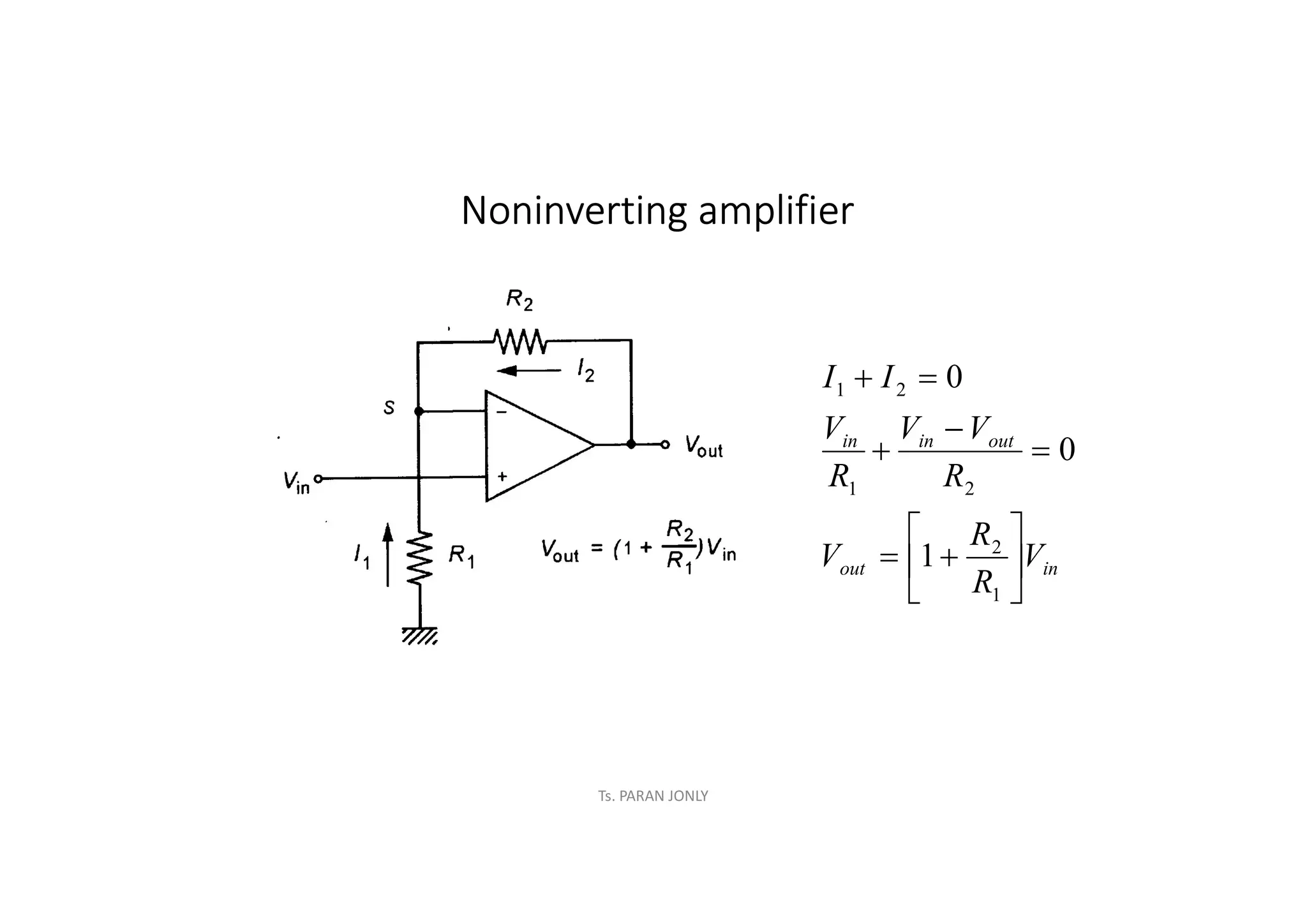
Noninverting amplifier
in
out
out
in
in
V
R
R
V
R
V
V
R
V
I
I













1
2
2
1
2
1
1
0
0
Ts. PARAN JONLY
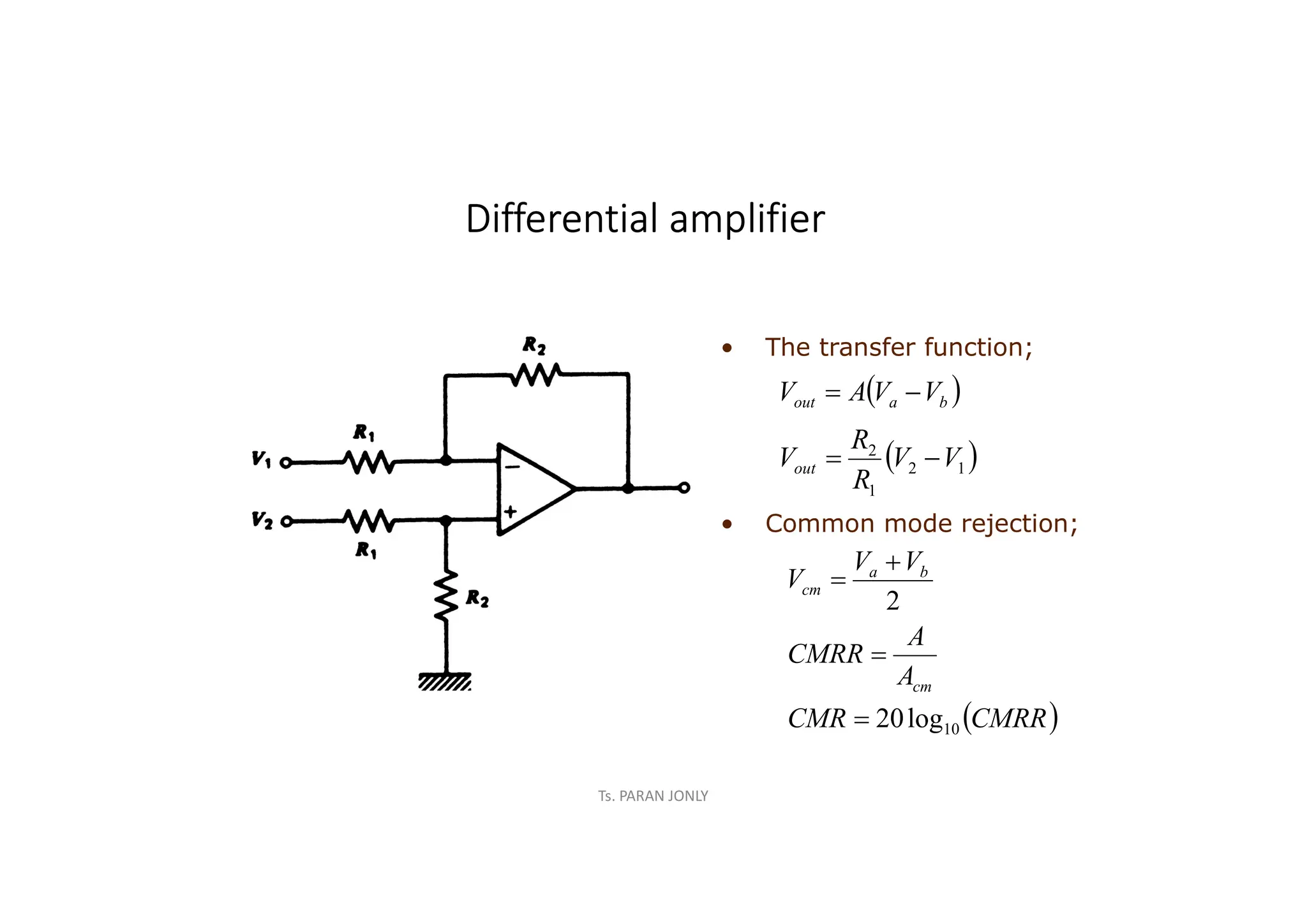
Differential amplifier
 
CMRR
CMR
A
A
CMRR
V
V
V
cm
b
a
cm
10
log
20
2




 
b
a
out V
V
A
V 

• The transfer function;
• Common mode rejection;
 
1
2
1
2
V
V
R
R
Vout 

Ts. PARAN JONLY
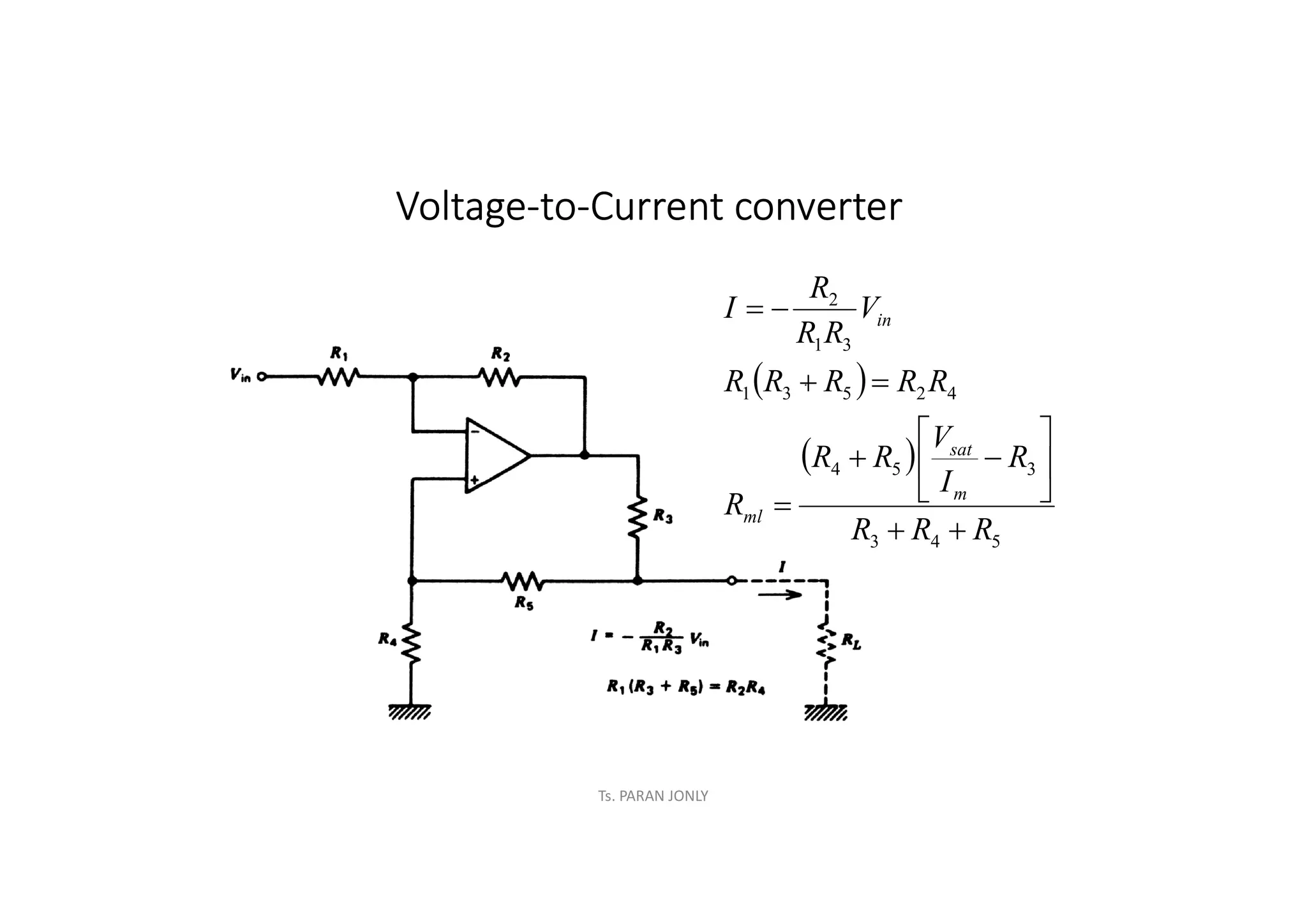
Voltage-to-Current converter
 
 
5
4
3
3
5
4
4
2
5
3
1
3
1
2
R
R
R
R
I
V
R
R
R
R
R
R
R
R
V
R
R
R
I
m
sat
ml
in















Ts. PARAN JONLY
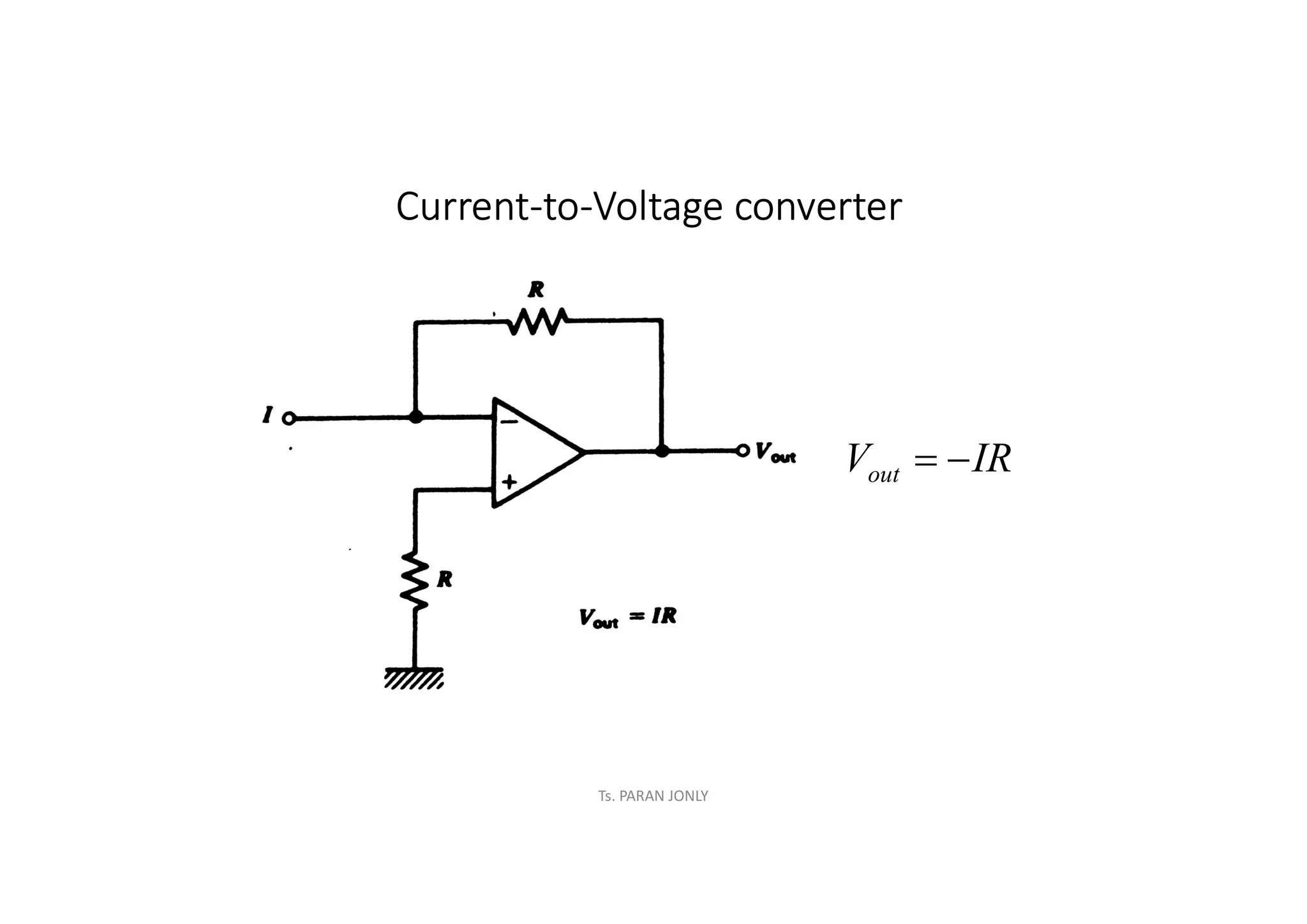
Current-to-Voltage converter
IR
Vout 

Ts. PARAN JONLY
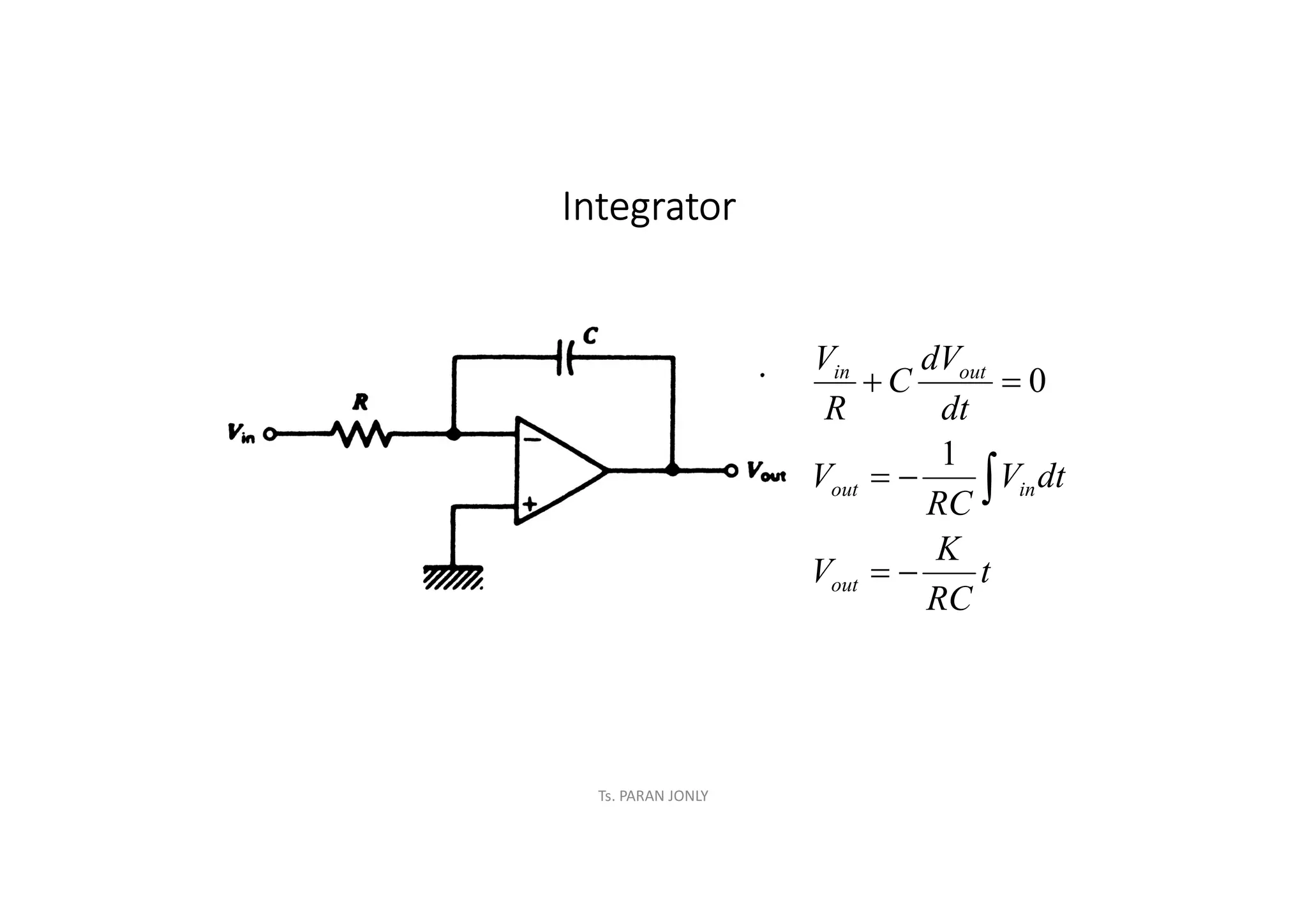
Integrator
t
RC
K
V
dt
V
RC
V
dt
dV
C
R
V
out
in
out
out
in







1
0
Ts. PARAN JONLY
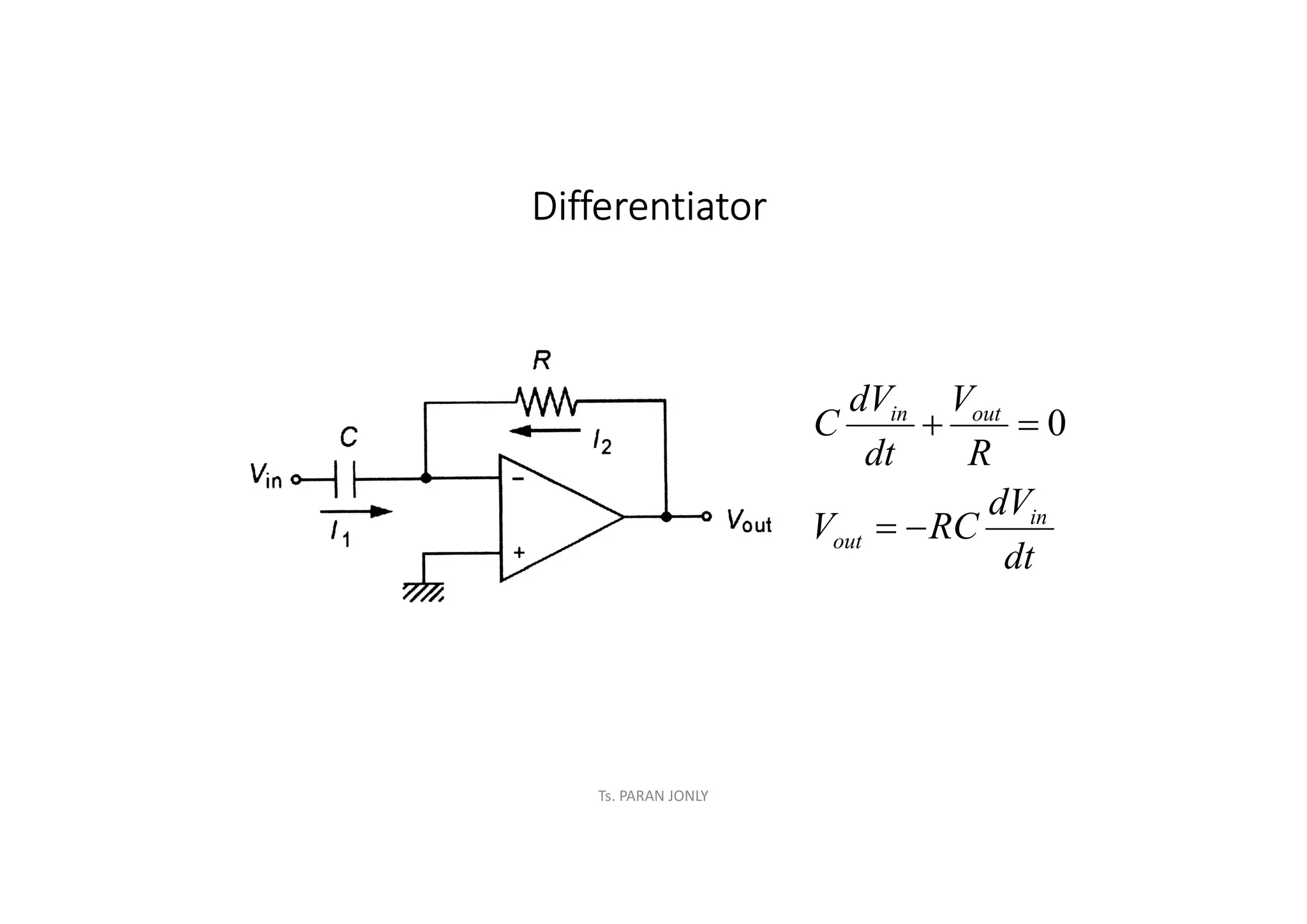
Differentiator
dt
dV
RC
V
R
V
dt
dV
C
in
out
out
in



 0
Ts. PARAN JONLY
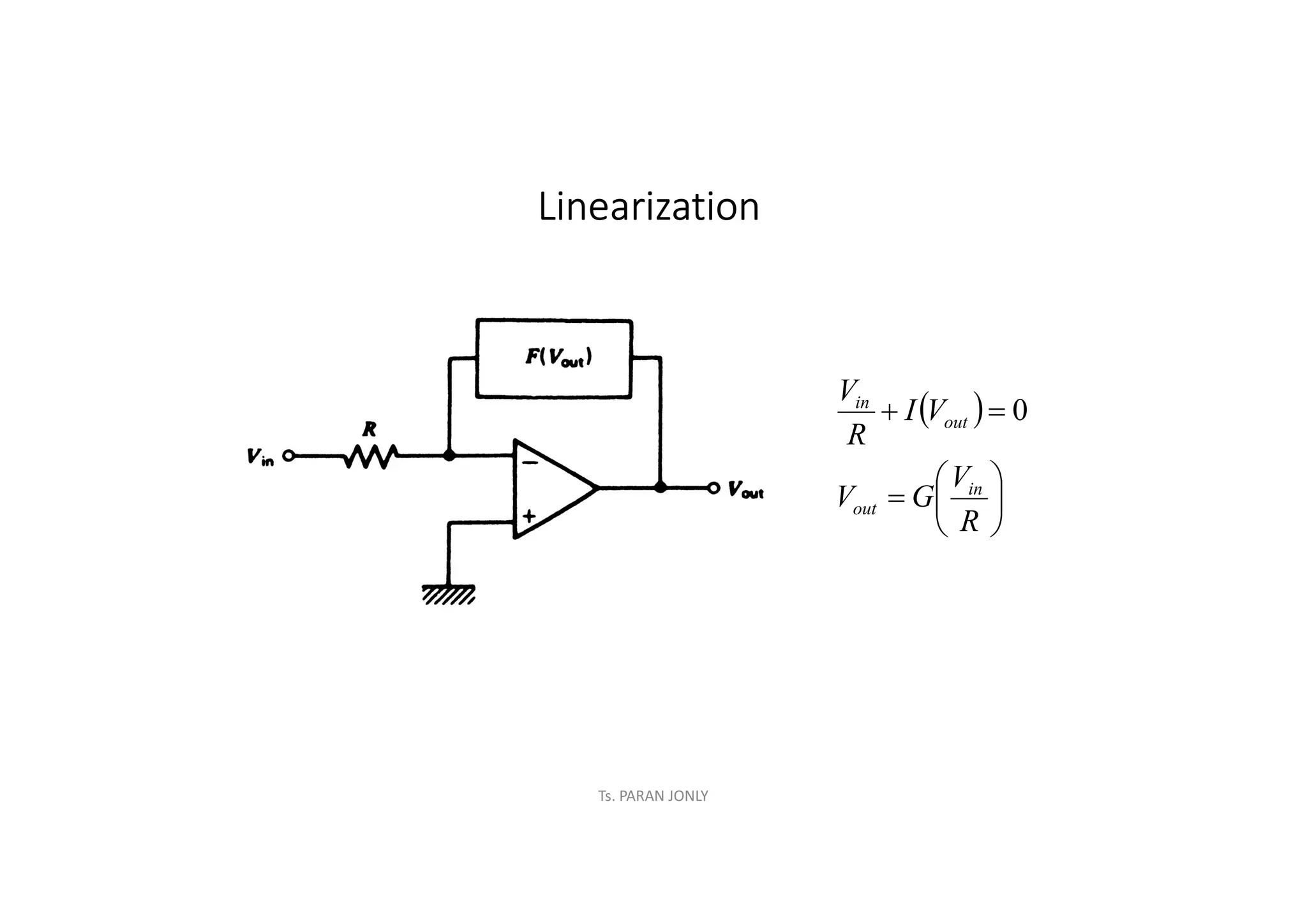
Linearization
 









R
V
G
V
V
I
R
V
in
out
out
in
0
Ts. PARAN JONLY
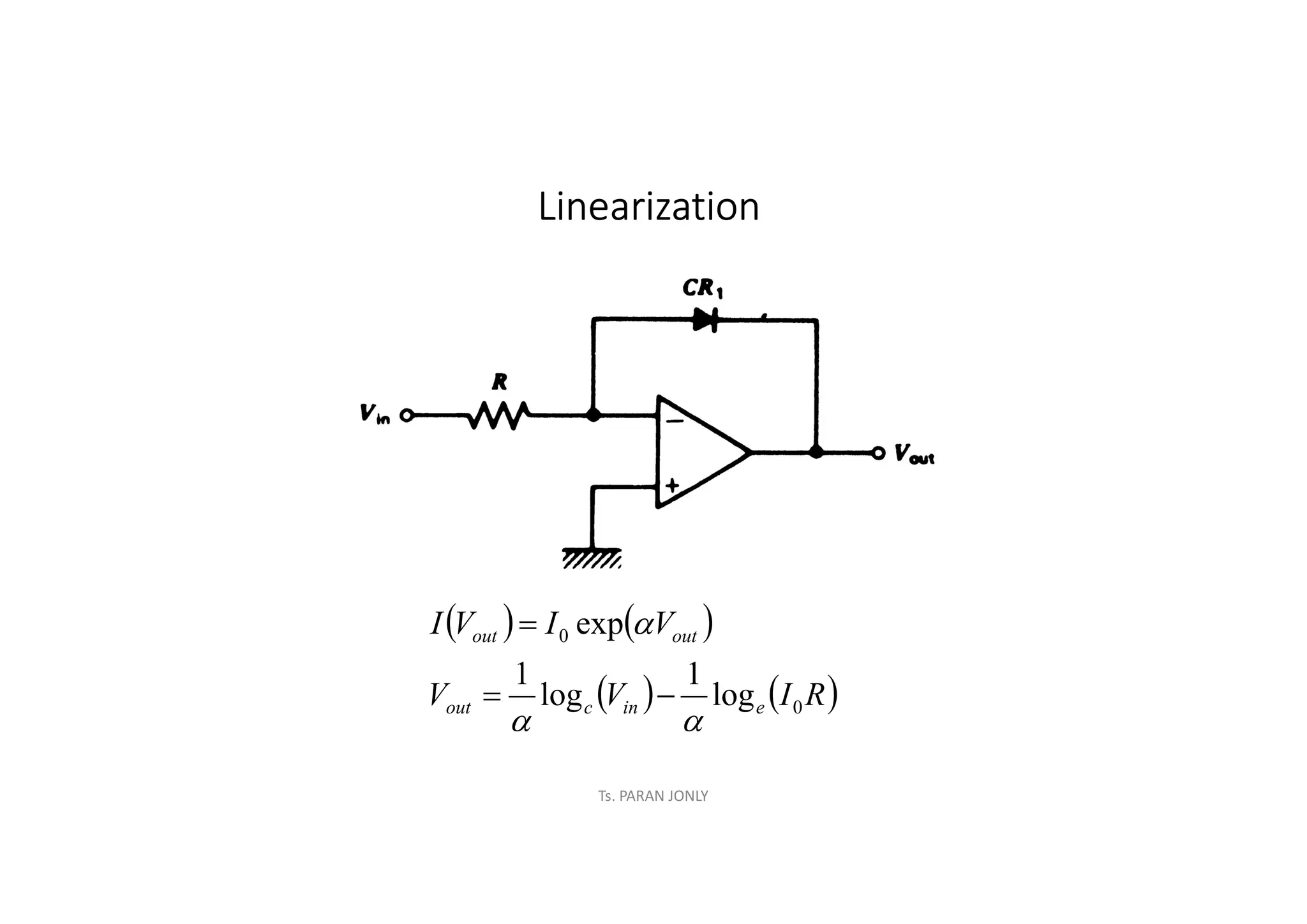
Linearization
   
   
R
I
V
V
V
I
V
I
e
in
c
out
out
out
0
0
log
1
log
1
exp






Ts. PARAN JONLY
Filters
Ts. PARAN JONLY
Filters
• Filter : a circuit that is designed to pass signals with
desired frequencies and reject or attenuate others
• 4 types of filters:
1. Low-pass filter: passes low frequencies and stops
high frequencies
2. High-pass filter: passes high frequencies and
rejects low frequencies
3. Band-pass filter: passes frequencies within a
frequency band and blocks or attenuates
frequencies outside the band
4. Band-reject filter: passes frequencies outside a
frequency band and blocks or attenuates
frequencies within the band
Ts. PARAN JONLY
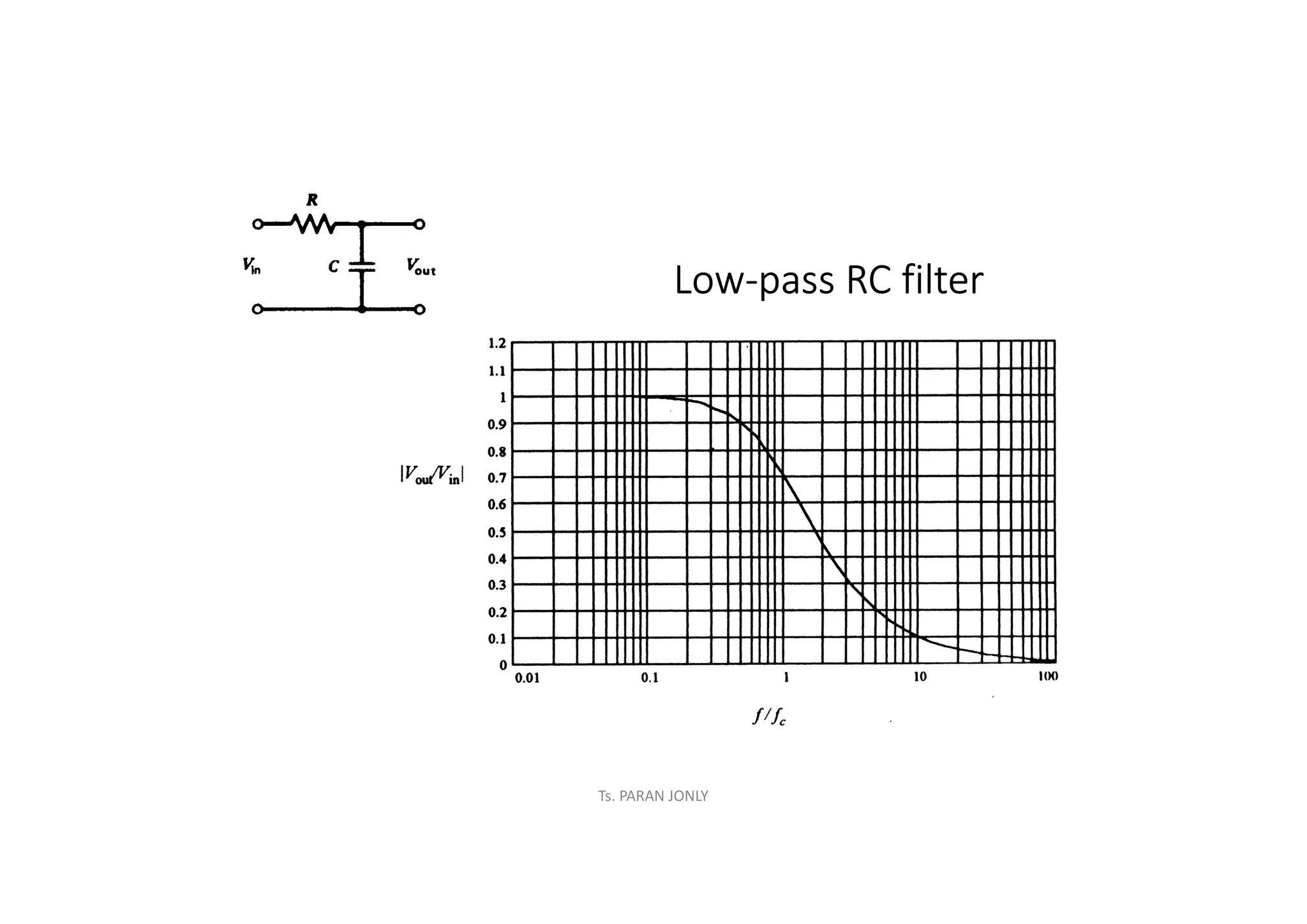
Low-pass RC filter
Ts. PARAN JONLY
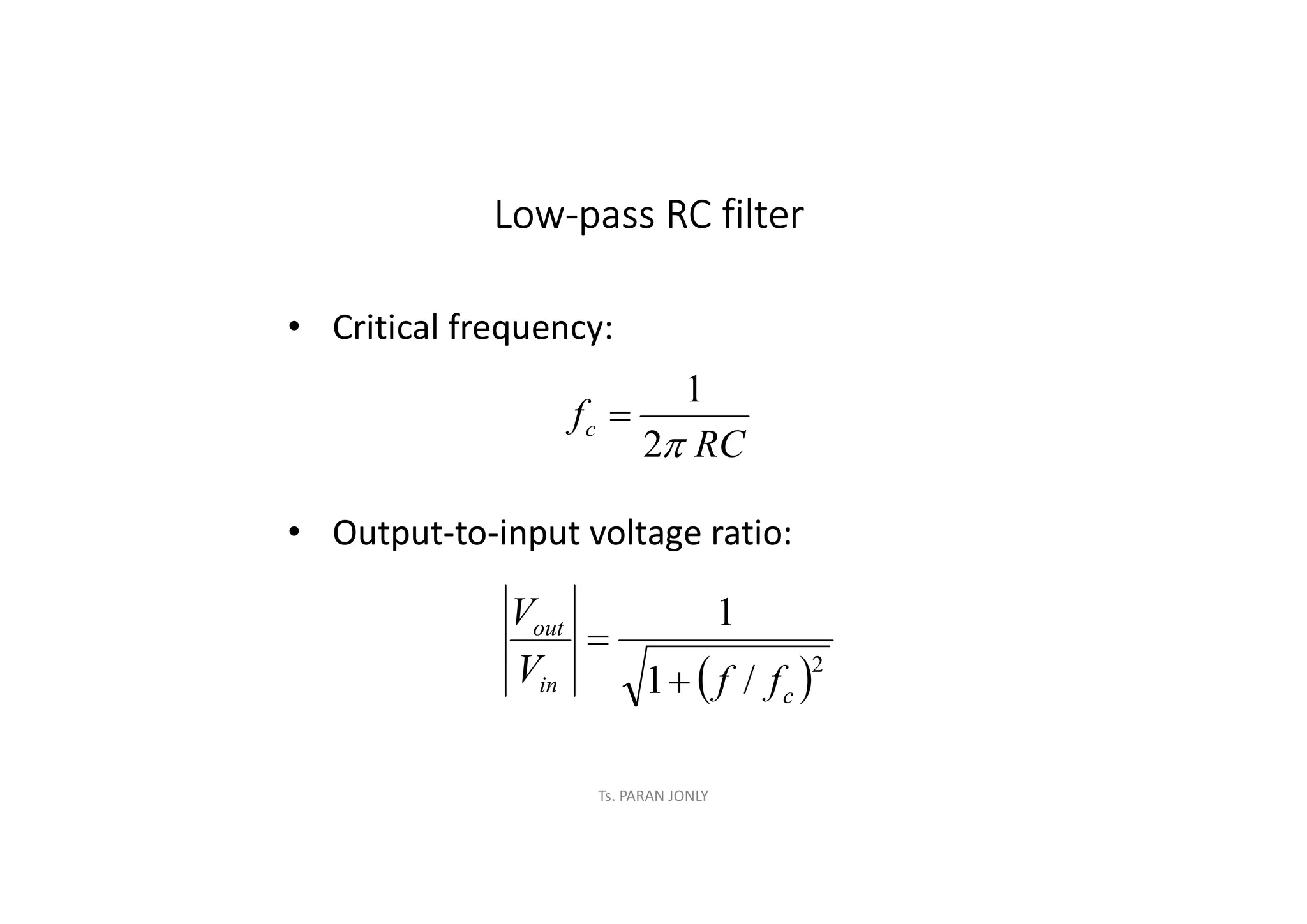
Low-pass RC filter
• Critical frequency:
• Output-to-input voltage ratio:
RC
fc

2
1

 2
/
1
1
c
in
out
f
f
V
V


Ts. PARAN JONLY
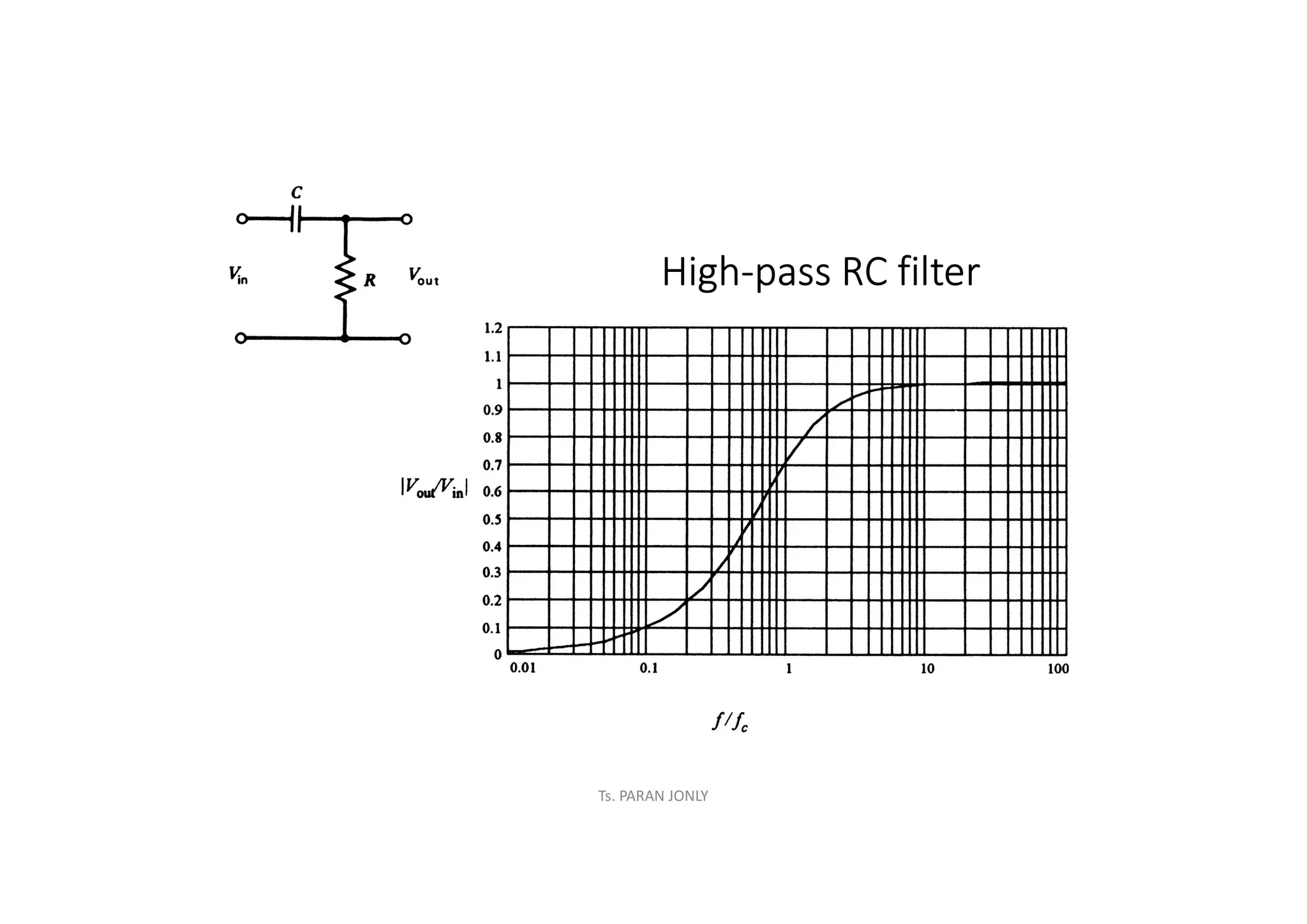
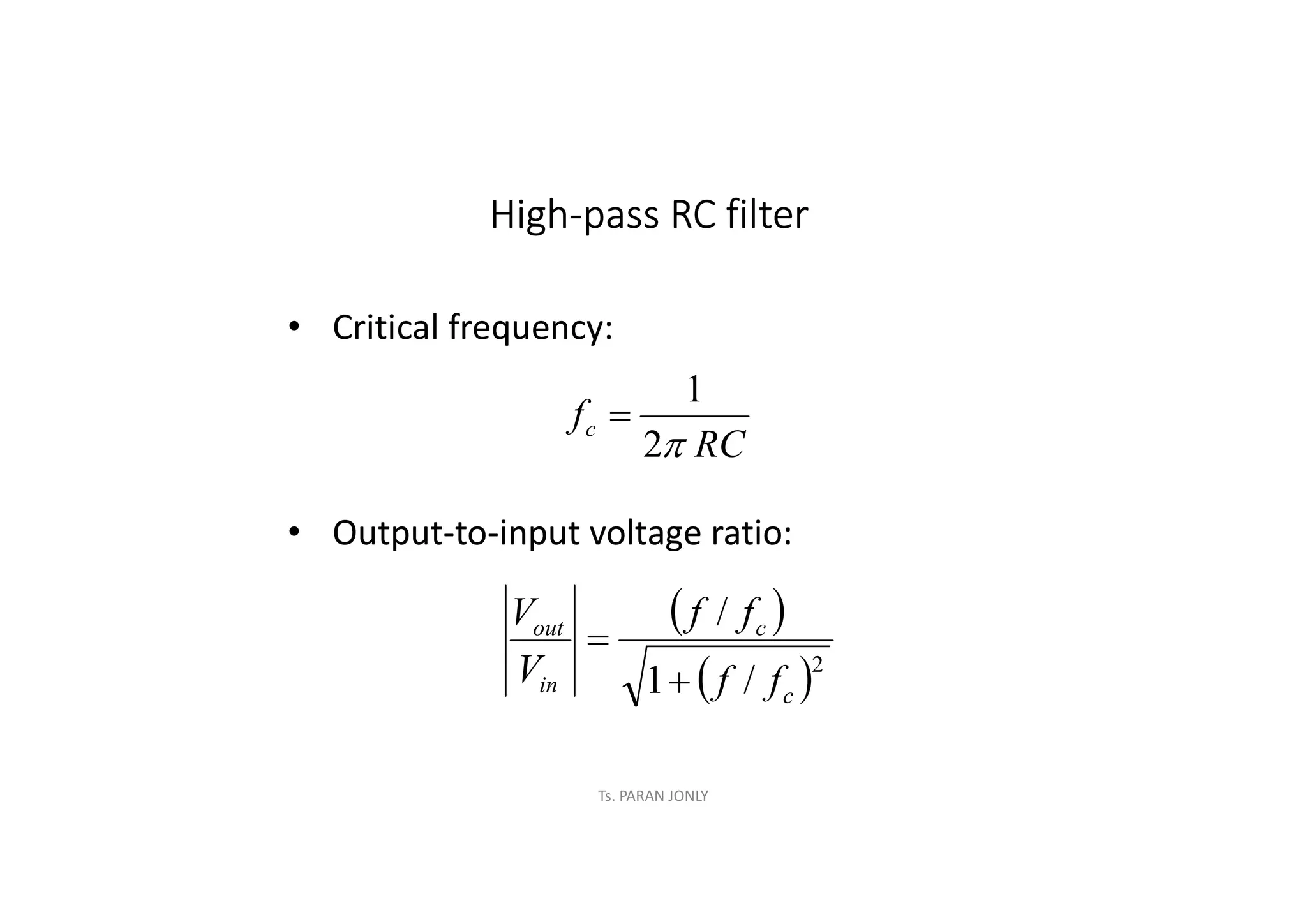
High-pass RC filter
Ts. PARAN JONLY
High-pass RC filter
• Critical frequency:
• Output-to-input voltage ratio:
RC
fc

2
1

 
 2
/
1
/
c
c
in
out
f
f
f
f
V
V


Ts. PARAN JONLY
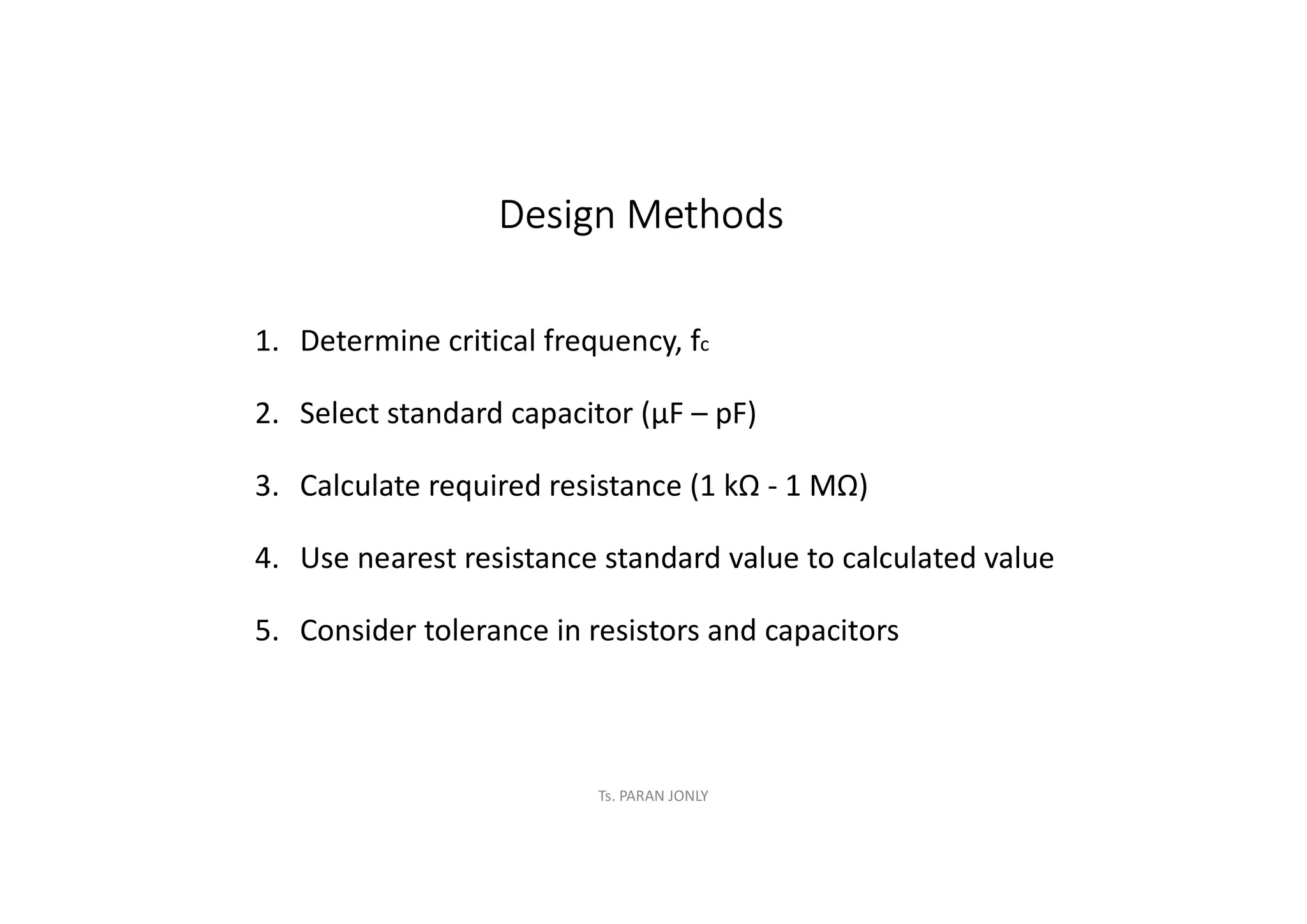
Design Methods
1. Determine critical frequency, fc
2. Select standard capacitor (µF – pF)
3. Calculate required resistance (1 kΩ - 1 MΩ)
4. Use nearest resistance standard value to calculated value
5. Consider tolerance in resistors and capacitors
Ts. PARAN JONLY
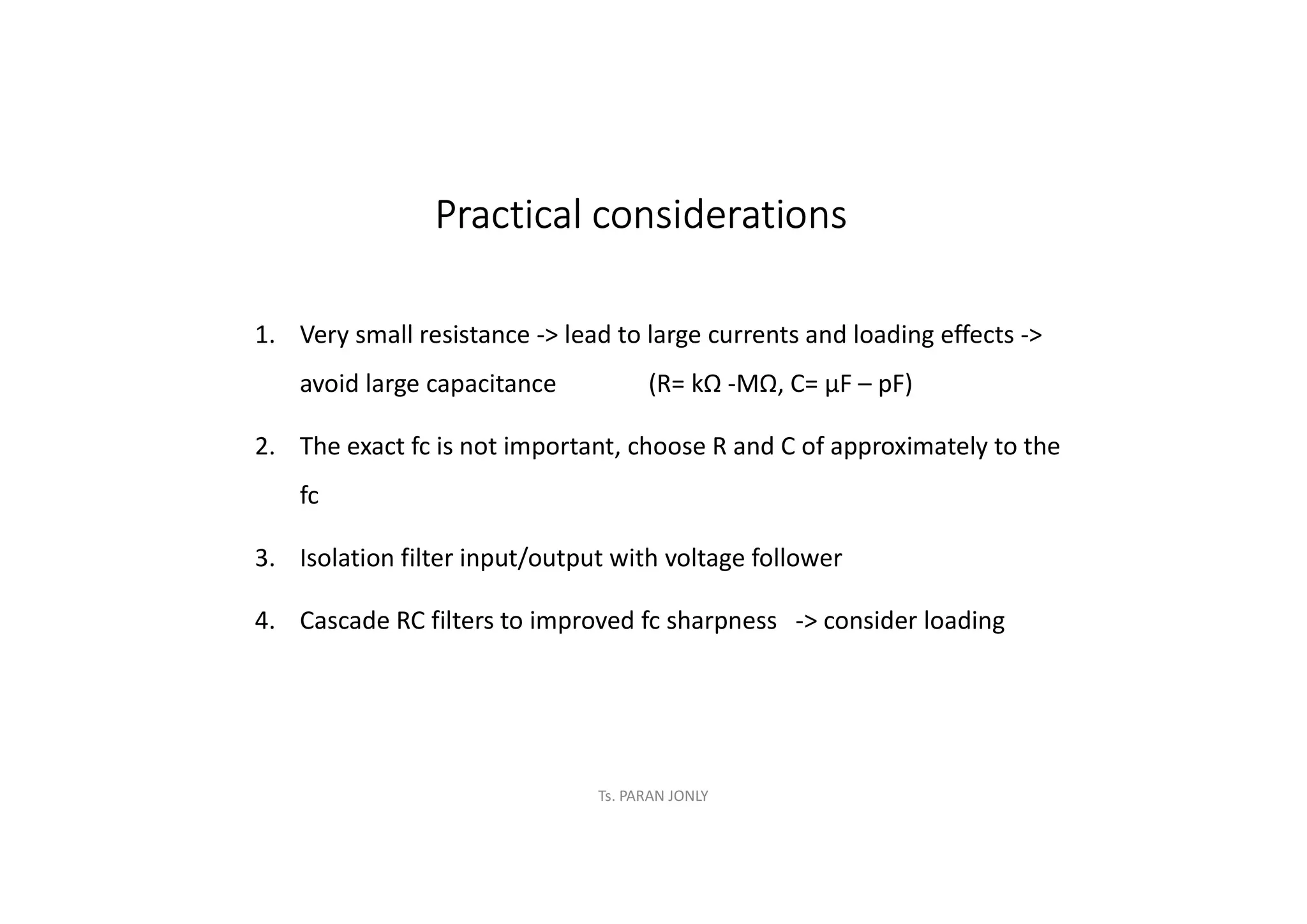
Practical considerations
1. Very small resistance -> lead to large currents and loading effects ->
avoid large capacitance (R= kΩ -MΩ, C= µF – pF)
2. The exact fc is not important, choose R and C of approximately to the
fc
3. Isolation filter input/output with voltage follower
4. Cascade RC filters to improved fc sharpness -> consider loading
Ts. PARAN JONLY
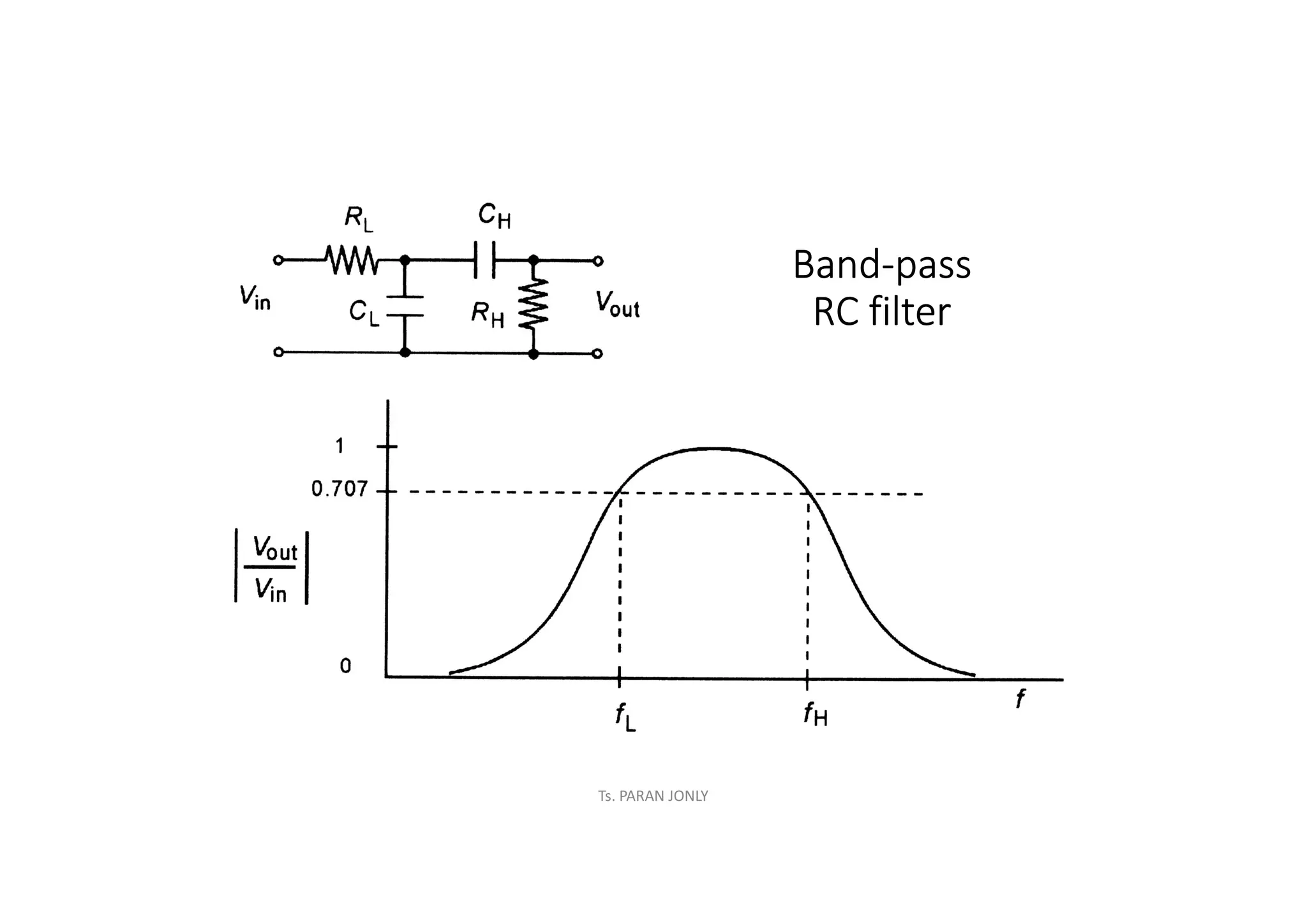
Band-pass
RC filter
Ts. PARAN JONLY
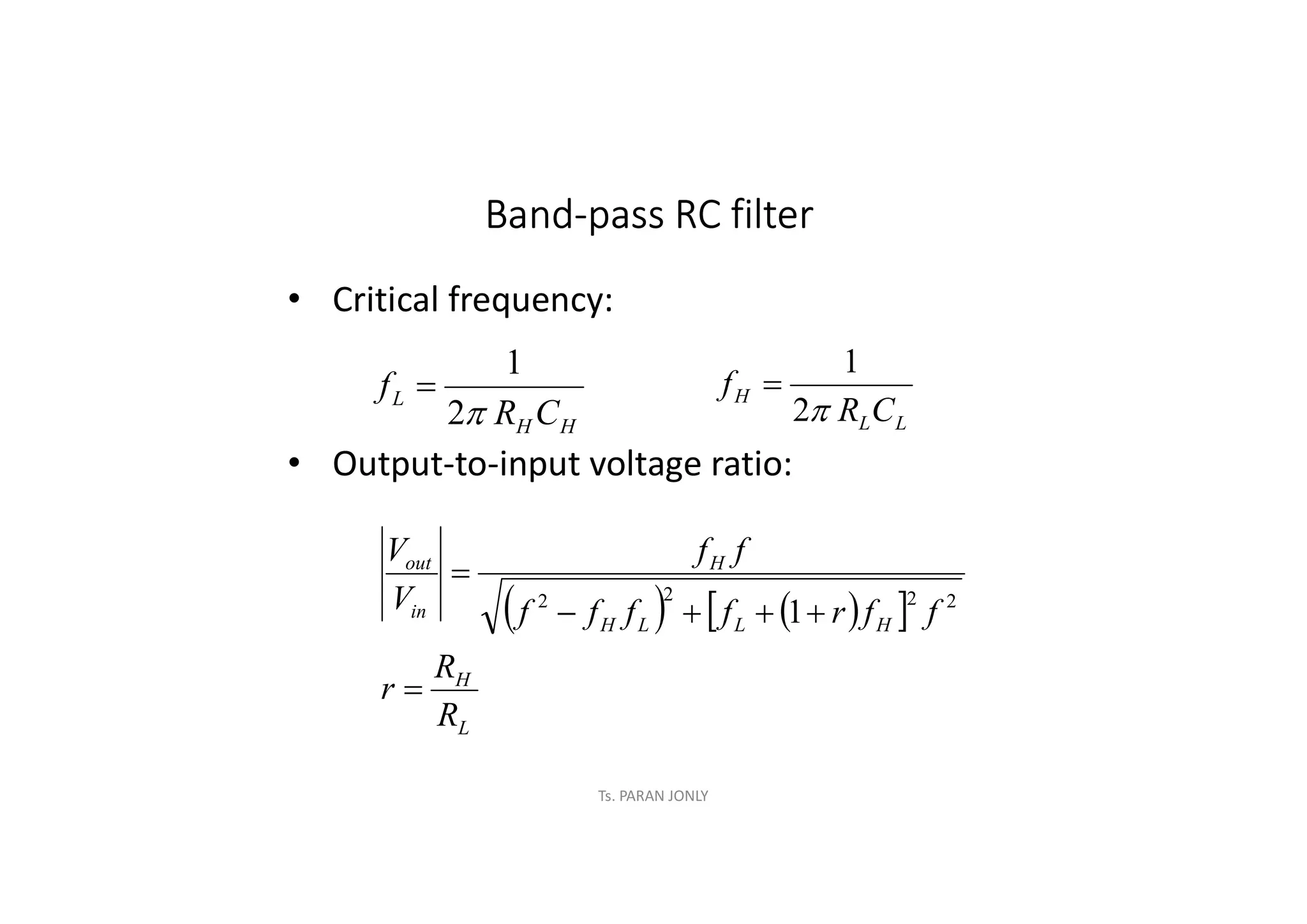
Band-pass RC filter
• Critical frequency:
• Output-to-input voltage ratio:
H
H
L
C
R
f

2
1

   
 
L
H
H
L
L
H
H
in
out
R
R
r
f
f
r
f
f
f
f
f
f
V
V






2
2
2
2
1
L
L
H
C
R
f

2
1

Ts. PARAN JONLY
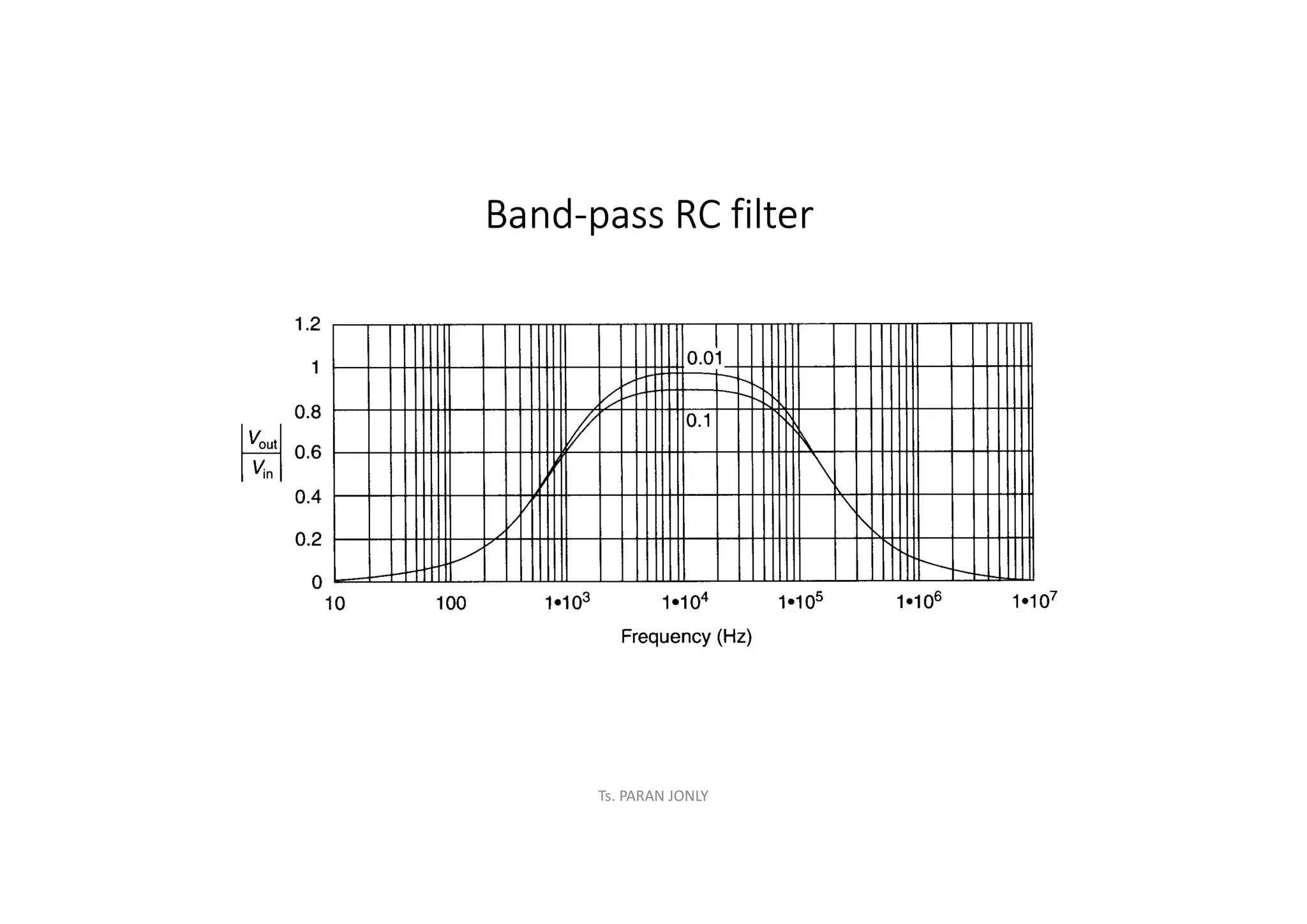
Band-pass RC filter
Ts. PARAN JONLY
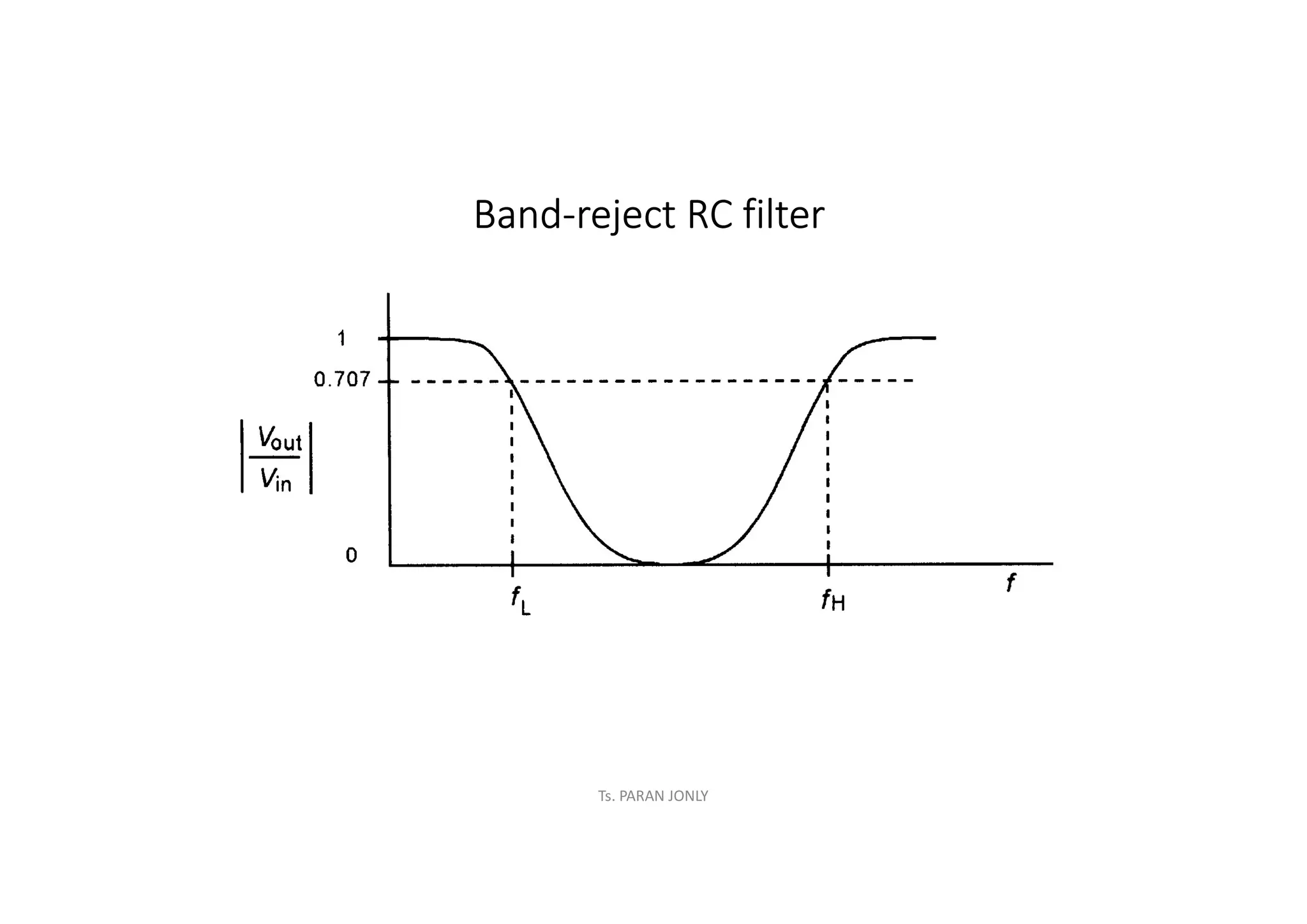
Band-reject RC filter
Ts. PARAN JONLY
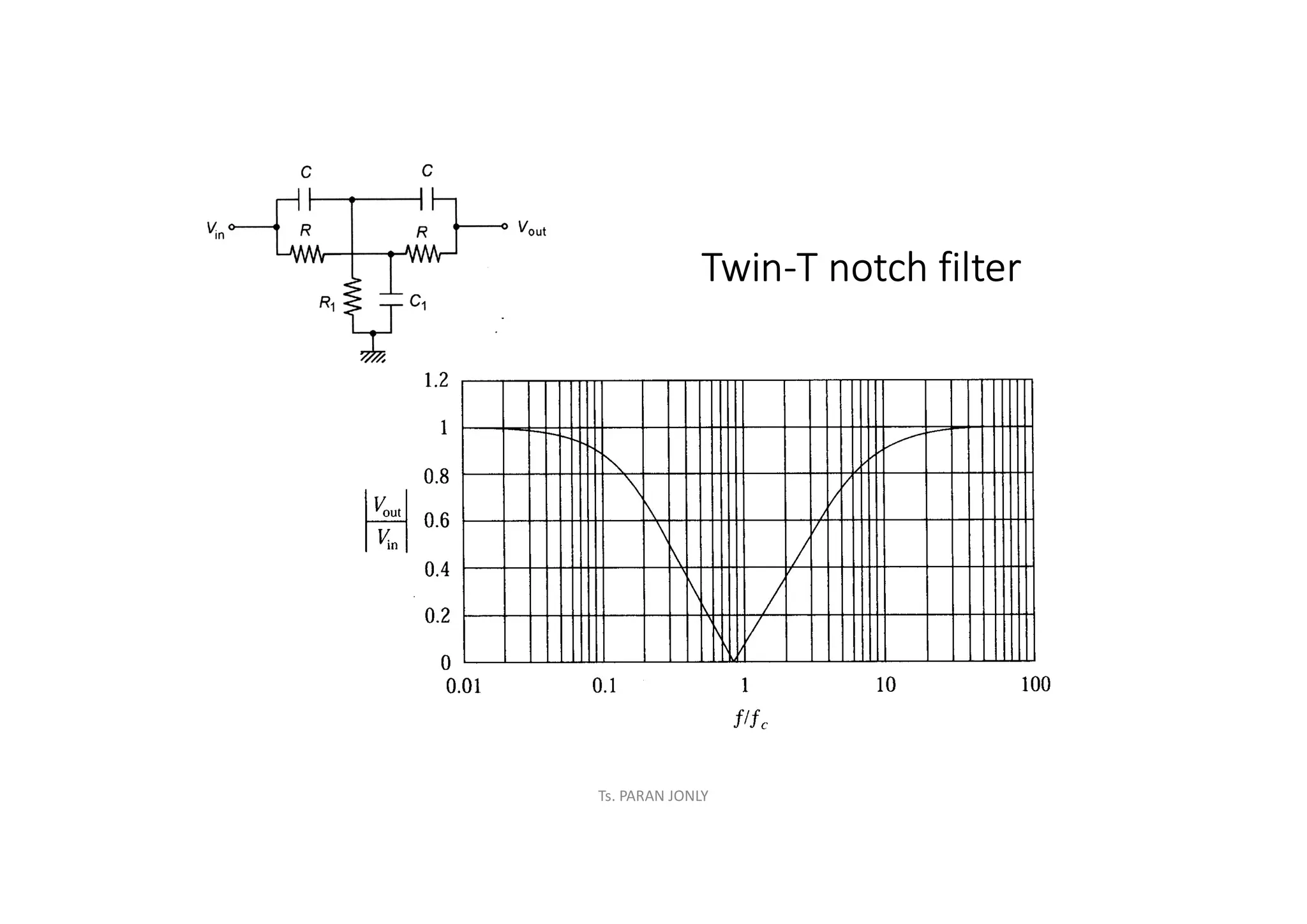
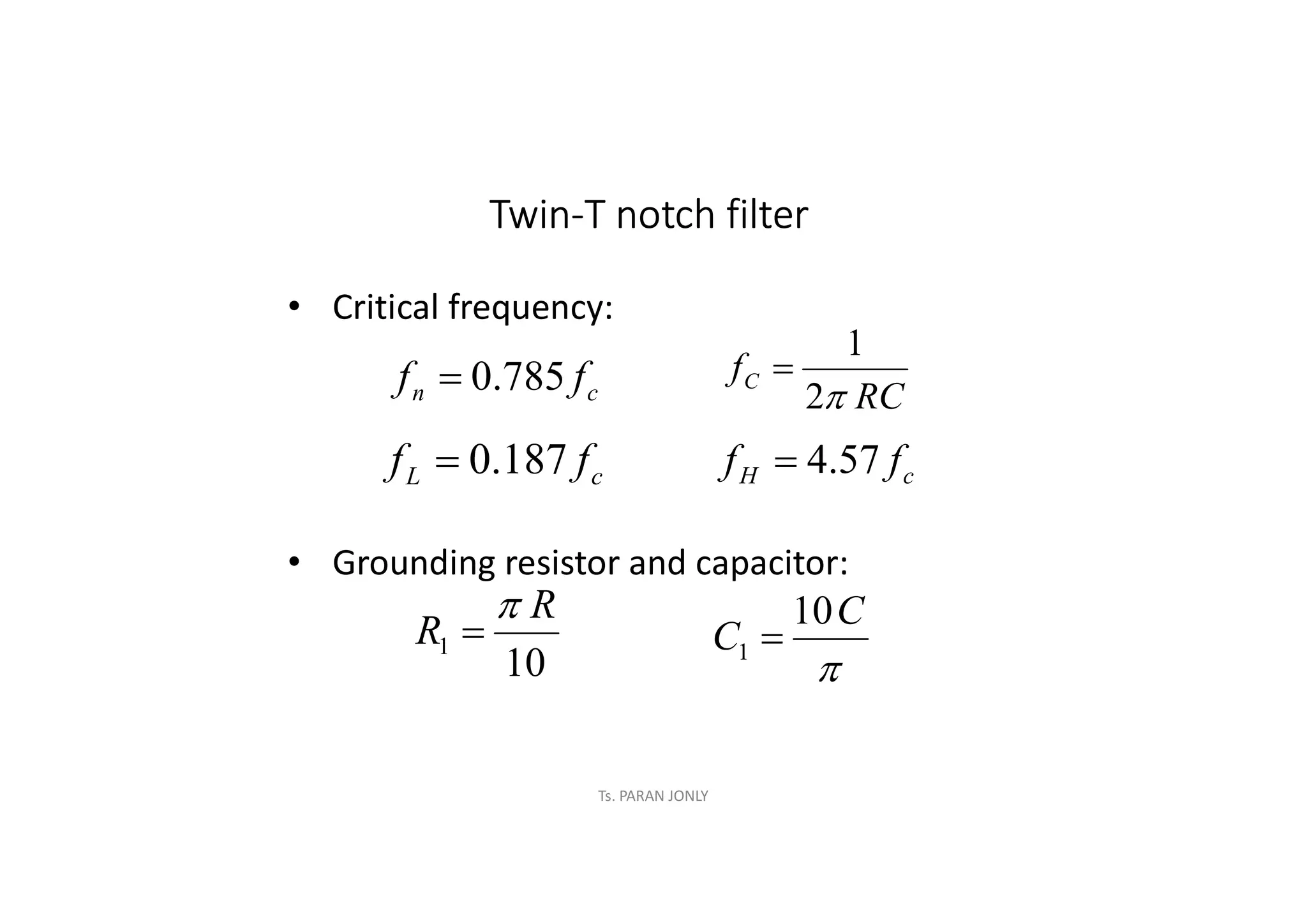
Twin-T notch filter
Ts. PARAN JONLY
Twin-T notch filter
• Critical frequency:
• Grounding resistor and capacitor:
c
n f
f 785
.
0
 RC
fC

2
1

c
H f
f 57
.
4

c
L f
f 187
.
0

10
1
R
R



C
C
10
1 
Analog to Digital Converter
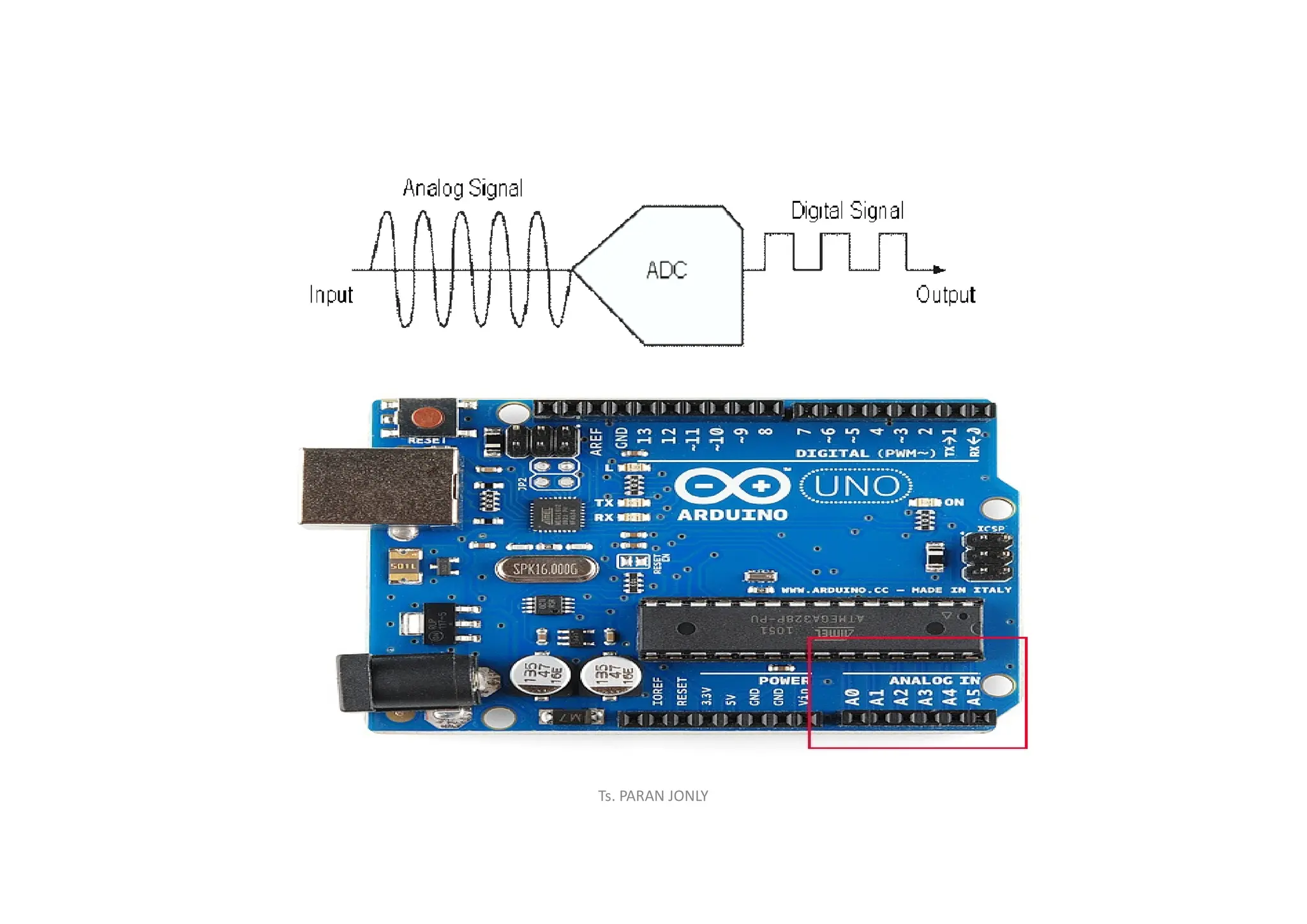
• Analog-to-Digital converters (ADC) translate analog signals, real world
signals like temperature, pressure, voltage, current, distance, or light
intensity, into a digital representation of that signal.
• This digital representation can then be processed, manipulated,
computed, transmitted or stored.
Ts. PARAN JONLY
Ts. PARAN JONLY
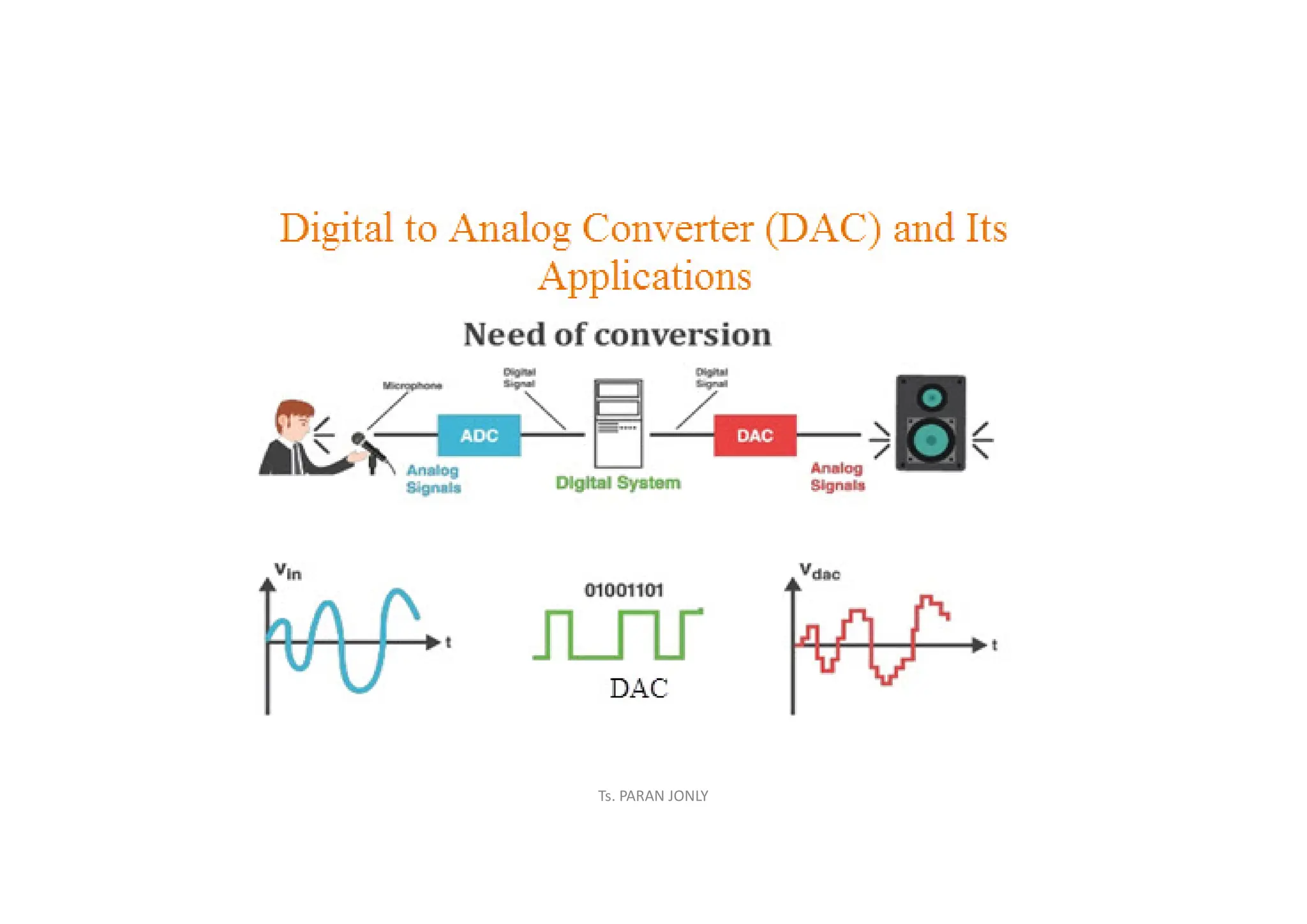
Digital to Analog Converter
• Digital to analog converting is a process where digital signals that
have a few (usually two) defined states are turned into analog signals,
which have a theoretically infinite number of states.
• A Digital to Analog Converter, or DAC, is an electronic device that
converts a digital code to an analog signal such as a voltage, current,
or electric charge.
• Due to their cost, digital to analog converters are mostly
manufactured on an integrated circuit (IC).
Ts. PARAN JONLY
Ts. PARAN JONLY
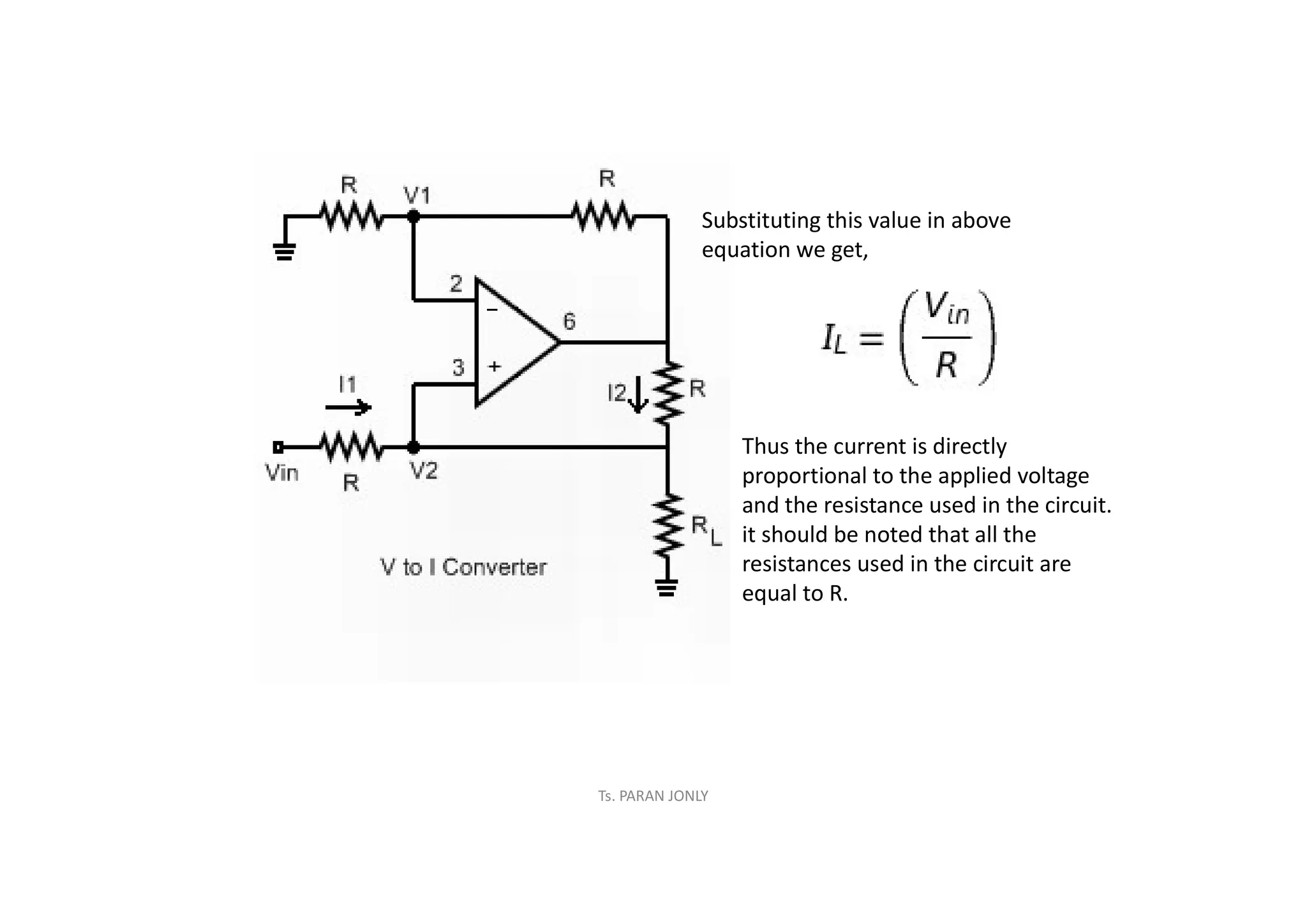
Voltage to Current Converter
• In this circuit the load is grounded and the current through the load
can be calculated as follows.
Ts. PARAN JONLY
• The current through the load is given by,
• The gain of the amplifier is
• So,
Ts. PARAN JONLY
Substituting this value in above
equation we get,
Thus the current is directly
proportional to the applied voltage
and the resistance used in the circuit.
it should be noted that all the
resistances used in the circuit are
equal to R.
Ts. PARAN JONLY
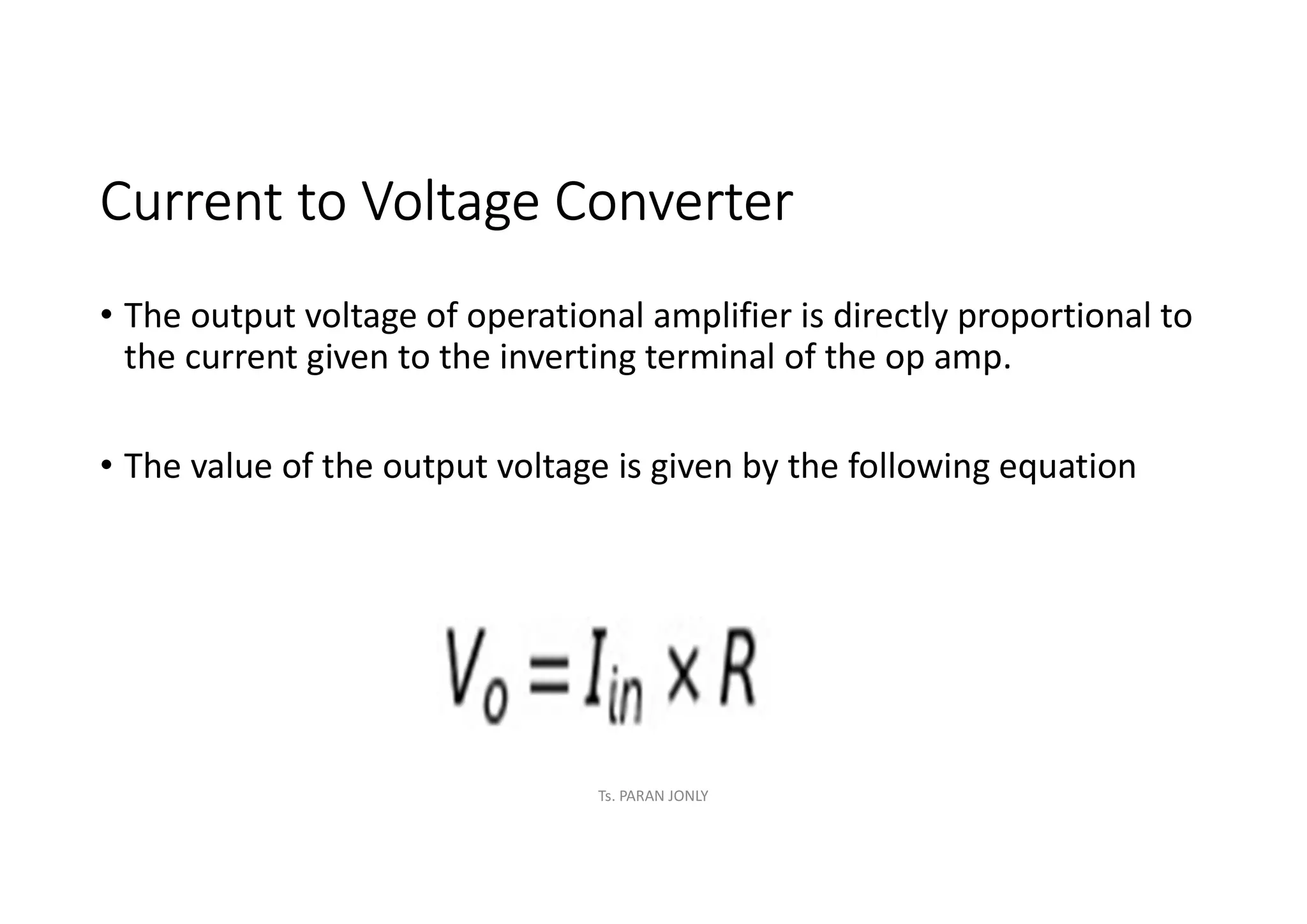
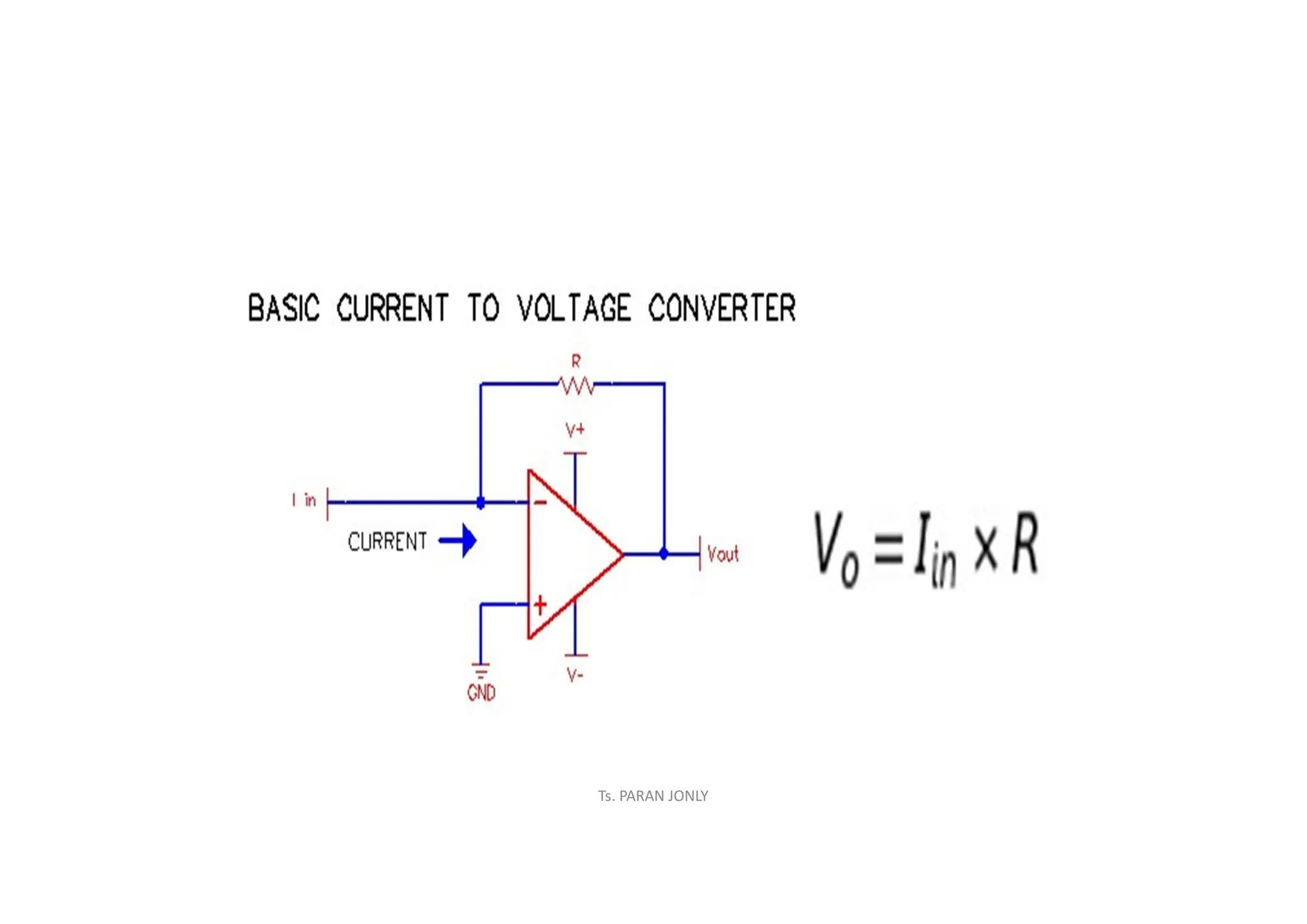
Current to Voltage Converter
• The output voltage of operational amplifier is directly proportional to
the current given to the inverting terminal of the op amp.
• The value of the output voltage is given by the following equation
Ts. PARAN JONLY
Ts. PARAN JONLY
Display Unit
CEE2163
Instrumentation and Control
Part 1.4
Ts. PARAN JONLY
In this Part 1.4, you will learn:
Display Unit
• Timer/Counter
• LED Bargraph Display
• Moving Coil Meter
Ts. PARAN JONLY
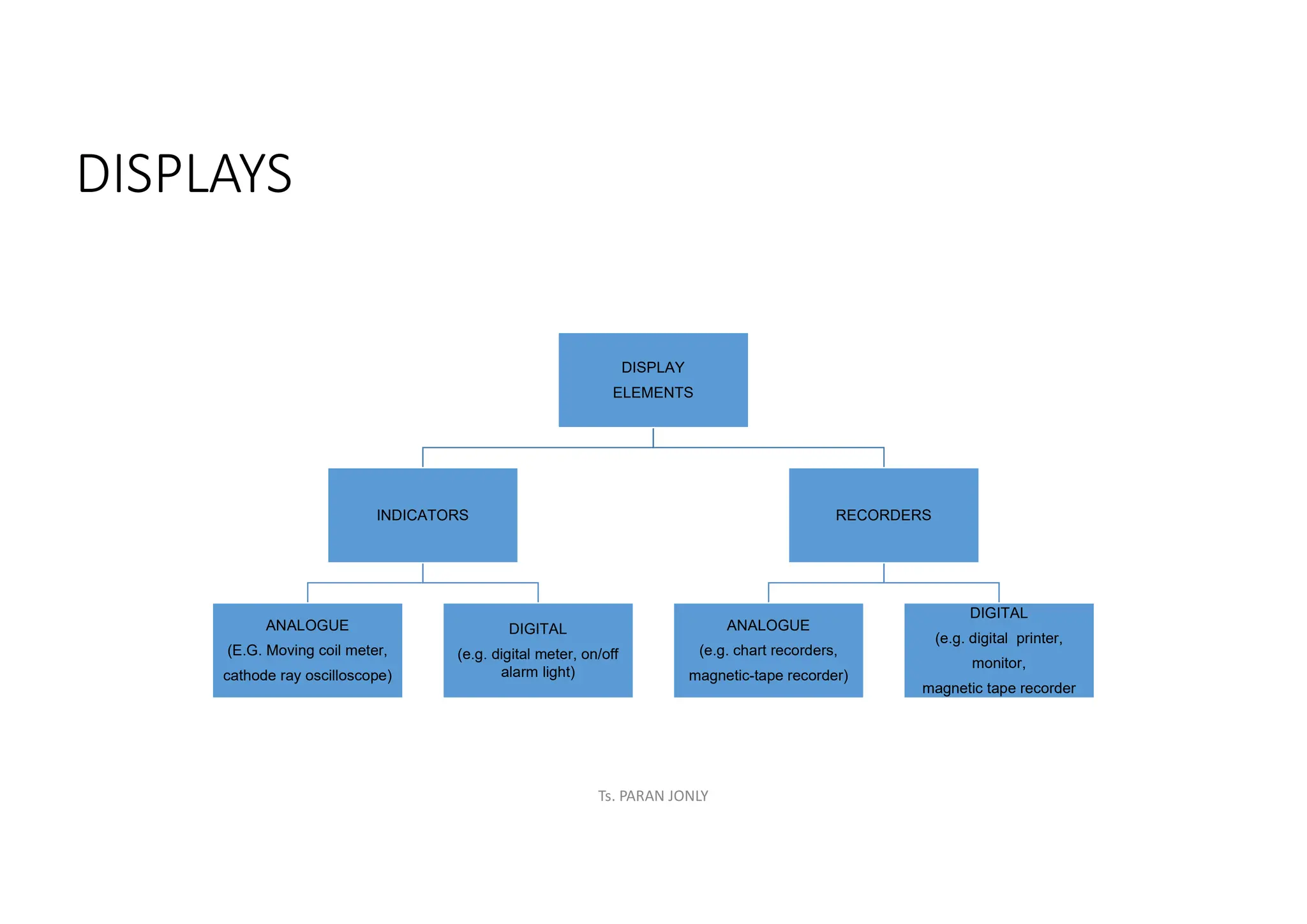
DISPLAYS
DISPLAY
ELEMENTS
INDICATORS
ANALOGUE
(E.G. Moving coil meter,
cathode ray oscilloscope)
DIGITAL
(e.g. digital meter, on/off
alarm light)
RECORDERS
ANALOGUE
(e.g. chart recorders,
magnetic-tape recorder)
DIGITAL
(e.g. digital printer,
monitor,
magnetic tape recorder
Ts. PARAN JONLY
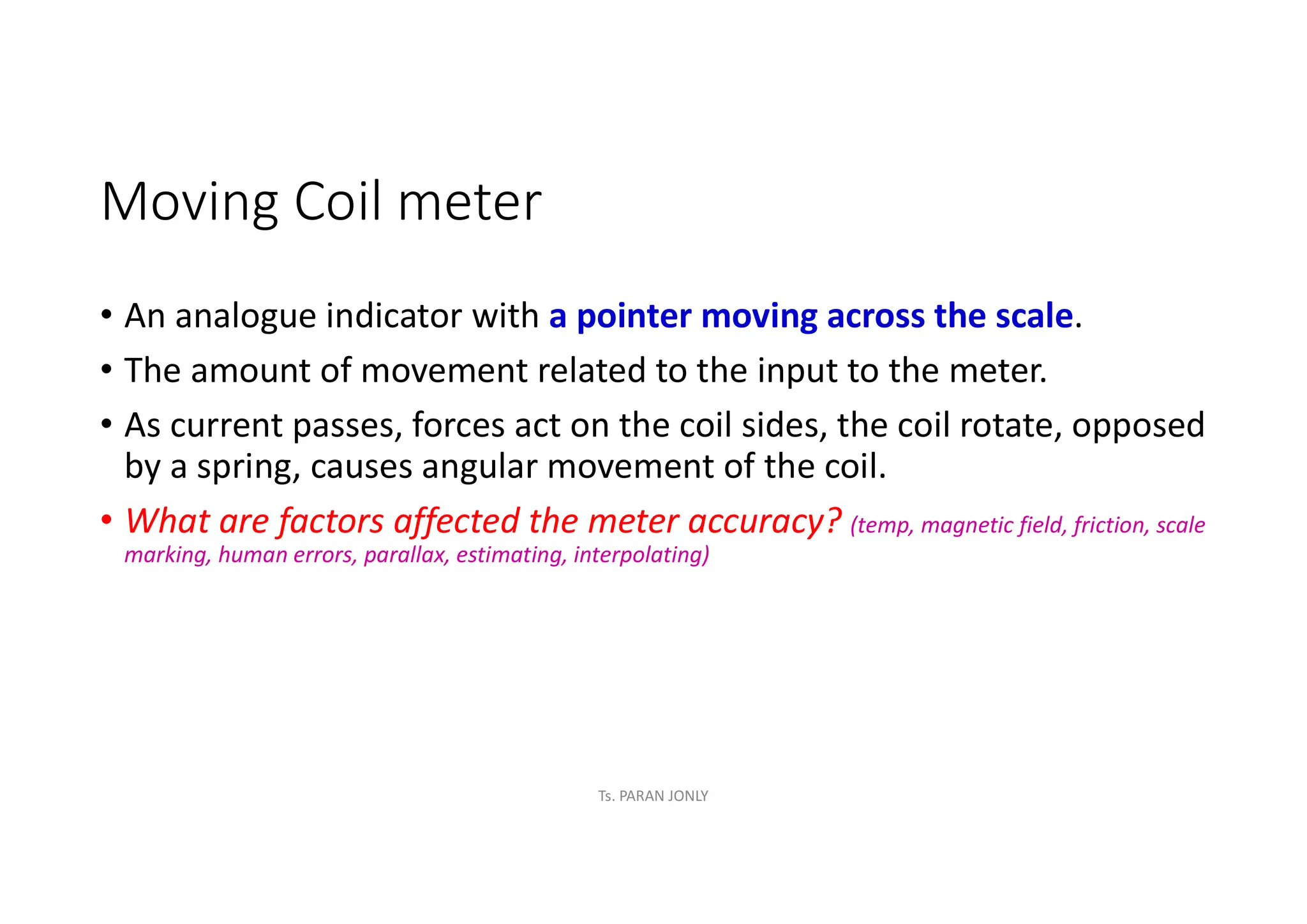
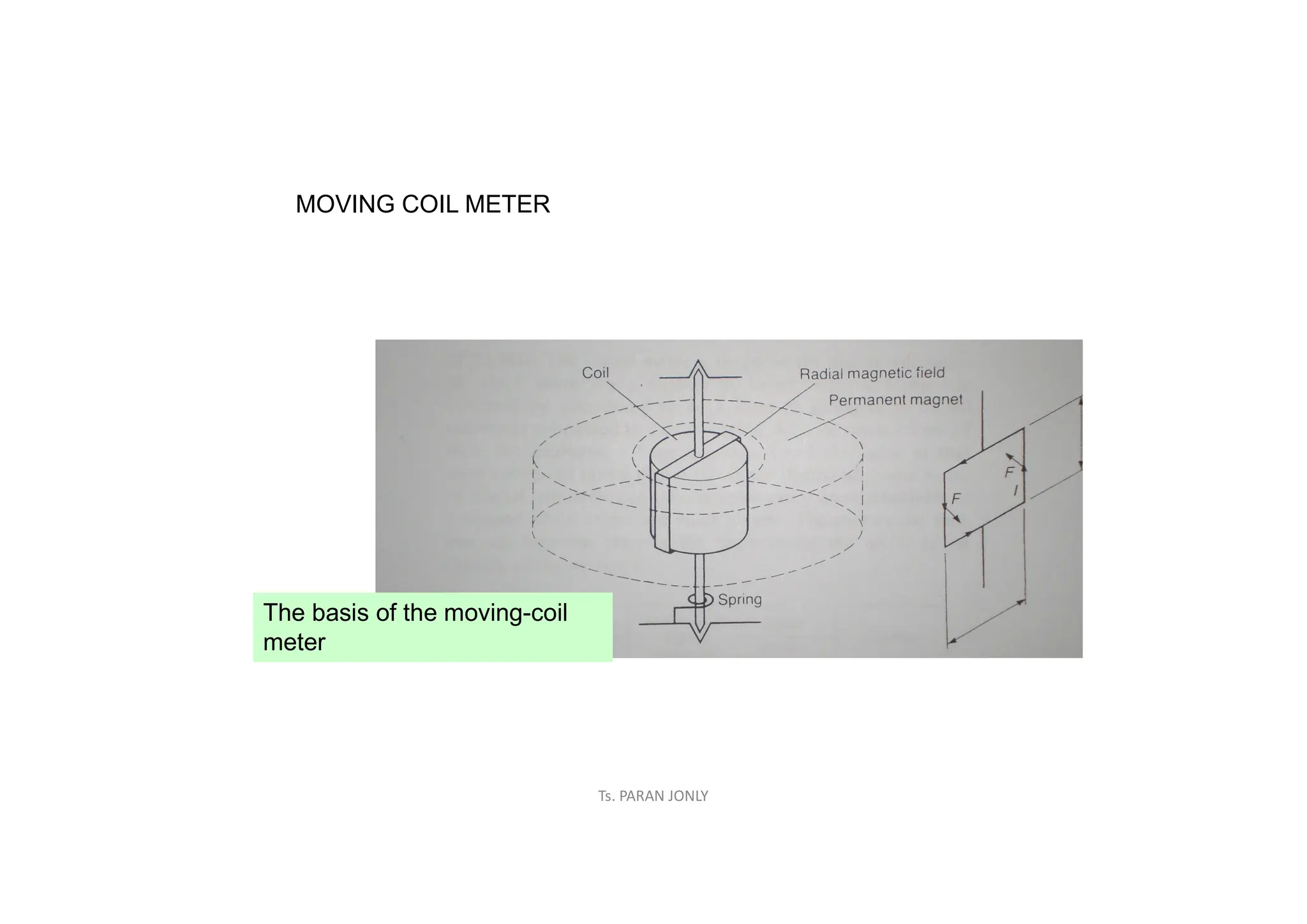
Moving Coil meter
• An analogue indicator with a pointer moving across the scale.
• The amount of movement related to the input to the meter.
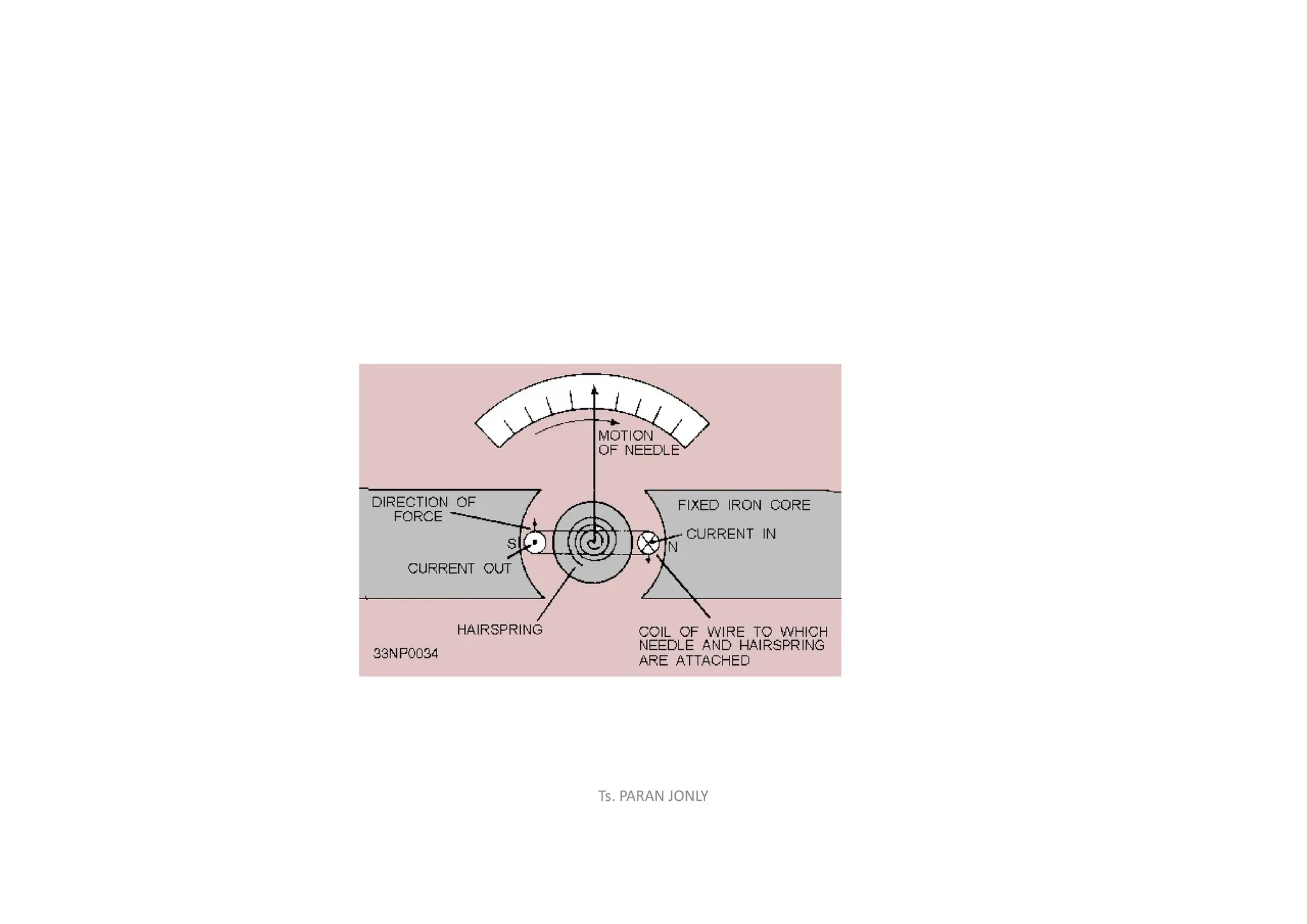
• As current passes, forces act on the coil sides, the coil rotate, opposed
by a spring, causes angular movement of the coil.
• What are factors affected the meter accuracy? (temp, magnetic field, friction, scale
marking, human errors, parallax, estimating, interpolating)
Ts. PARAN JONLY
The basis of the moving-coil
meter
MOVING COIL METER
Ts. PARAN JONLY
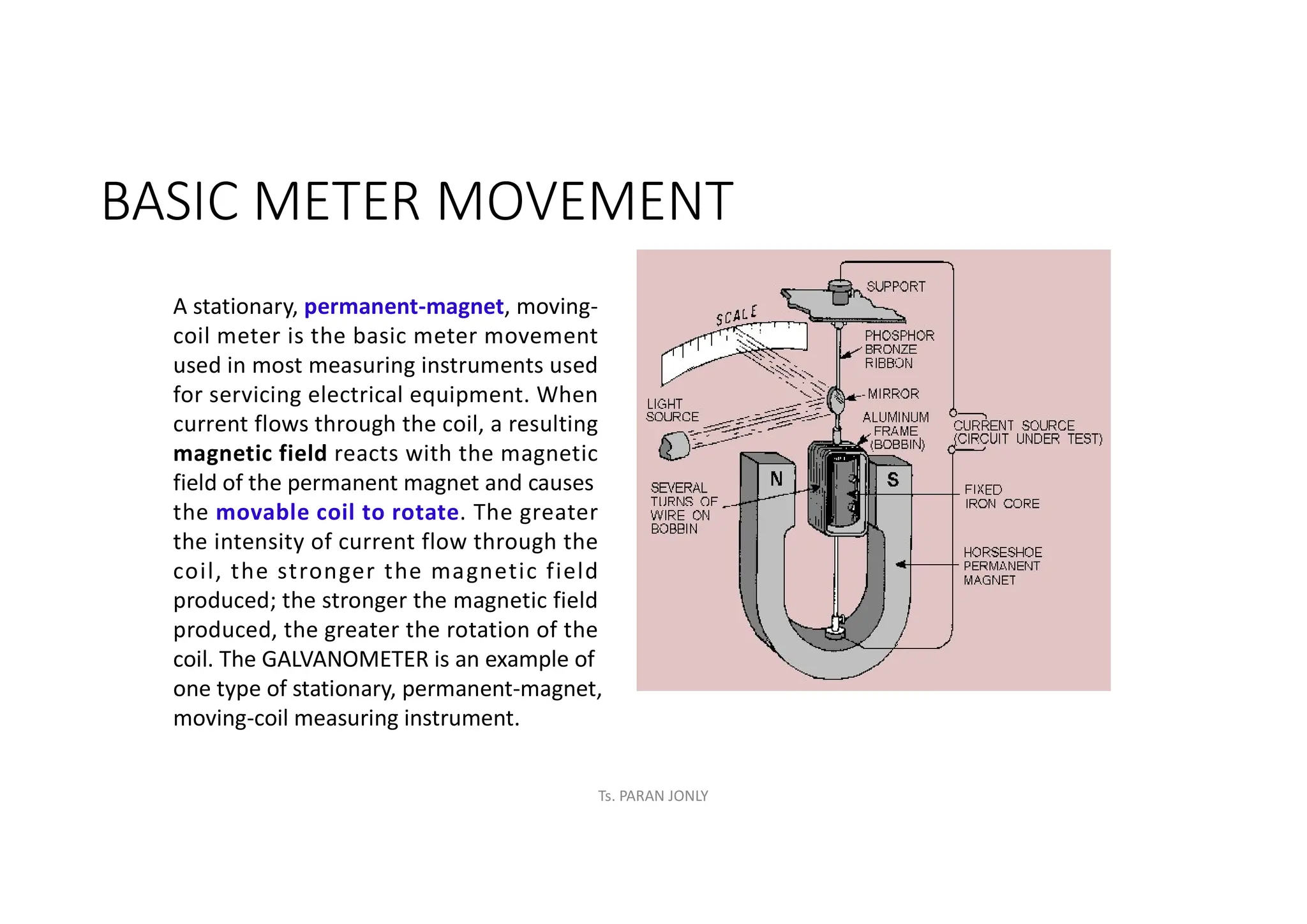
BASIC METER MOVEMENT
A stationary, permanent-magnet, moving-
coil meter is the basic meter movement
used in most measuring instruments used
for servicing electrical equipment. When
current flows through the coil, a resulting
magnetic field reacts with the magnetic
field of the permanent magnet and causes
the movable coil to rotate. The greater
the intensity of current flow through the
coil, the stronger the magnetic field
produced; the stronger the magnetic field
produced, the greater the rotation of the
coil. The GALVANOMETER is an example of
one type of stationary, permanent-magnet,
moving-coil measuring instrument.
Ts. PARAN JONLY
Ts. PARAN JONLY
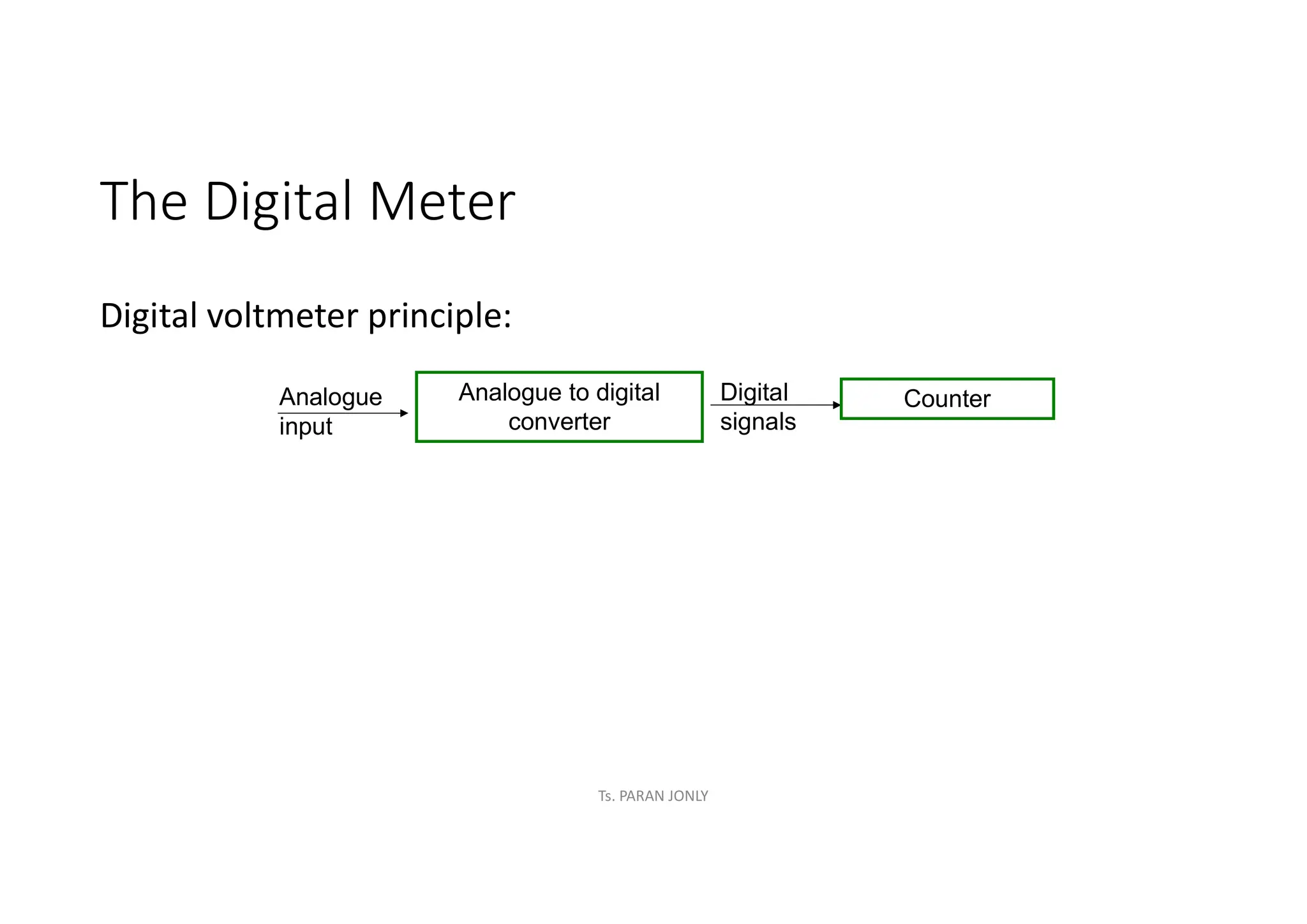
The Digital Meter
Analogue to digital
converter
Analogue
input
Digital voltmeter principle:
Digital
signals
Counter
Ts. PARAN JONLY
On-off displays
• To indicate certain condition has been reached in measurement.
• E.g bell, colored light, flashing light
Ts. PARAN JONLY
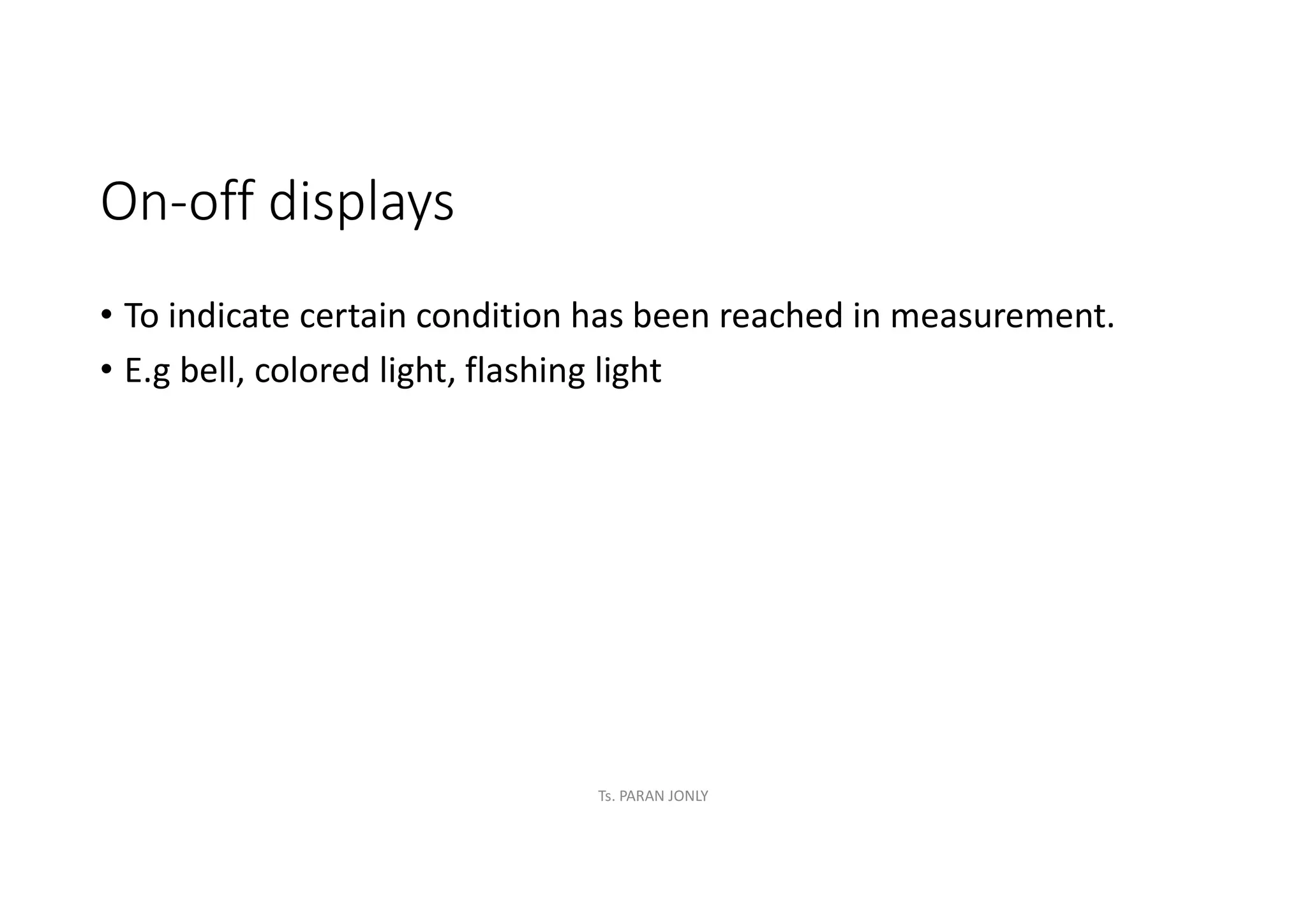
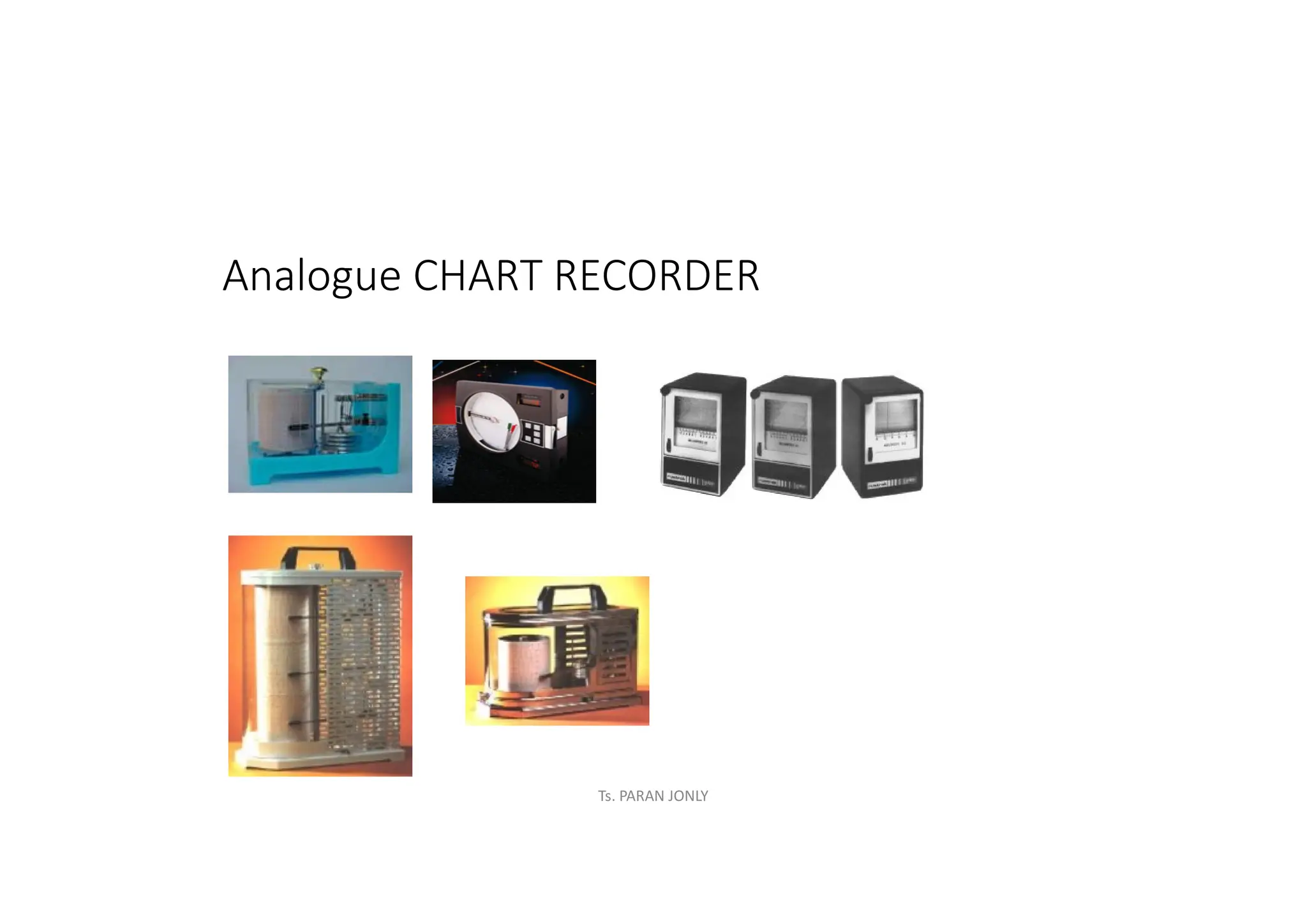
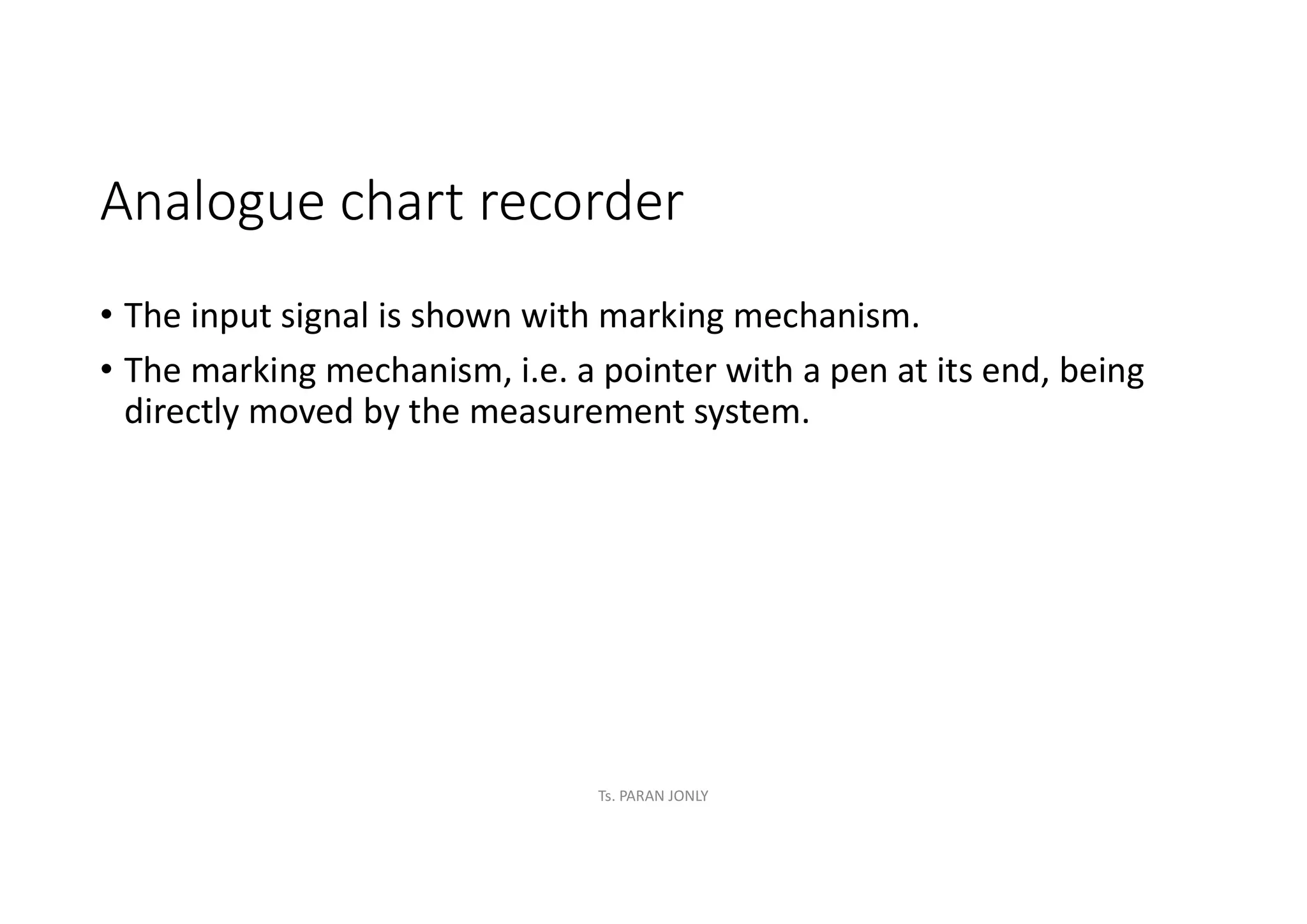
Analogue CHART RECORDER
Ts. PARAN JONLY
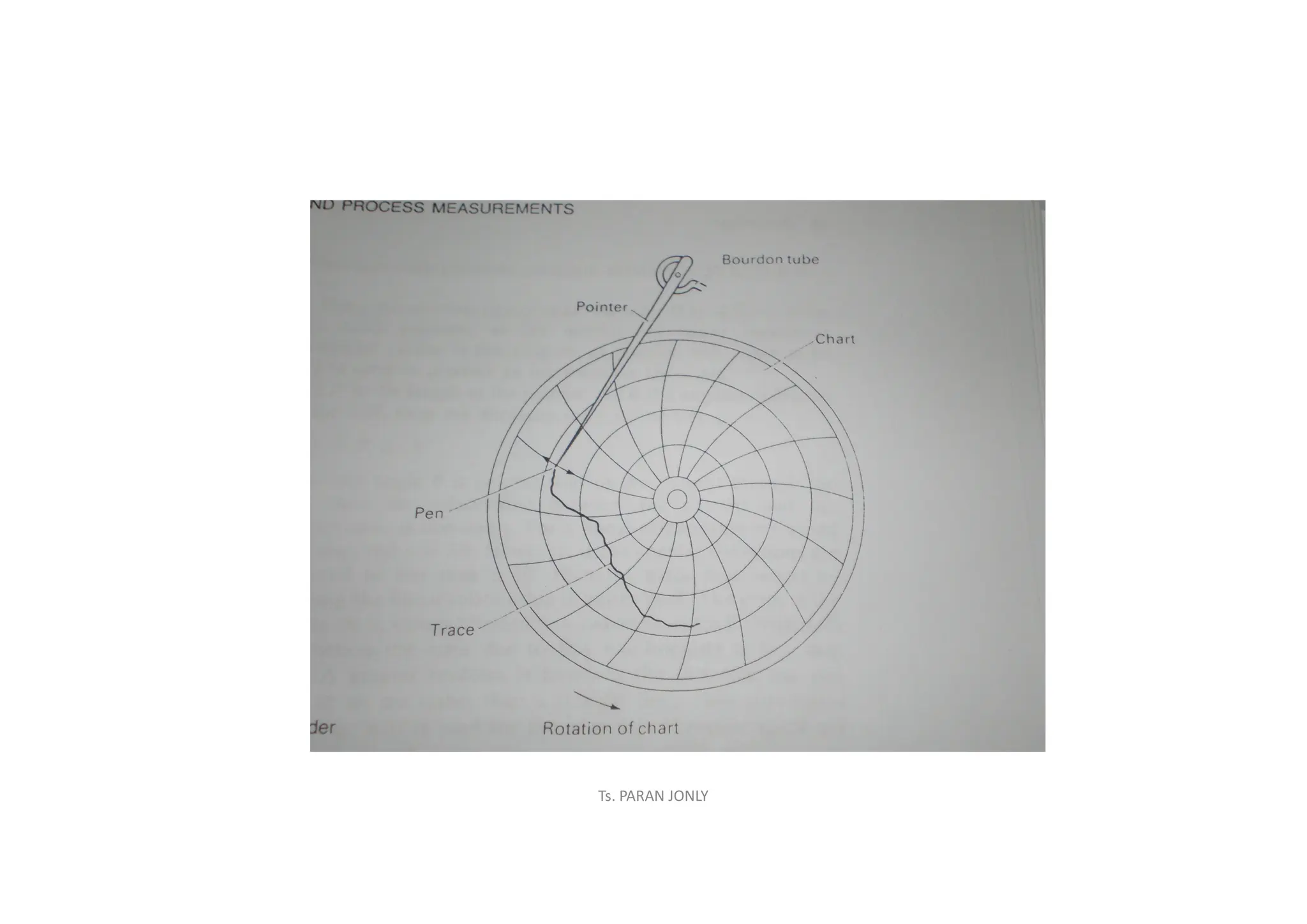
Analogue chart recorder
• The input signal is shown with marking mechanism.
• The marking mechanism, i.e. a pointer with a pen at its end, being
directly moved by the measurement system.
Ts. PARAN JONLY
Ts. PARAN JONLY
Potentiometric recorder
• Is a closed loop recorder, the position of a pen is monitored by a slider which
moves along a linear potentiometer.
• The position of the potentiometer determine the potential applied to an amplifier.
The signal produced is the difference of the from the measurement system.
• The signal is used to operate a motor which control the pen movement.
• This recorder has higher accuracies but slower response times, only be used for a
slowly changing signal.
• Error: dead band (0.3%)
Ts. PARAN JONLY
Example
• A chart recorder is to be used to monitor the temperatures of liquids
in a number of vessels. The temperatures do not vary rapidly with
time. A potentiometer chart recorder has been suggested. Would this
be suitable?
Ts. PARAN JONLY
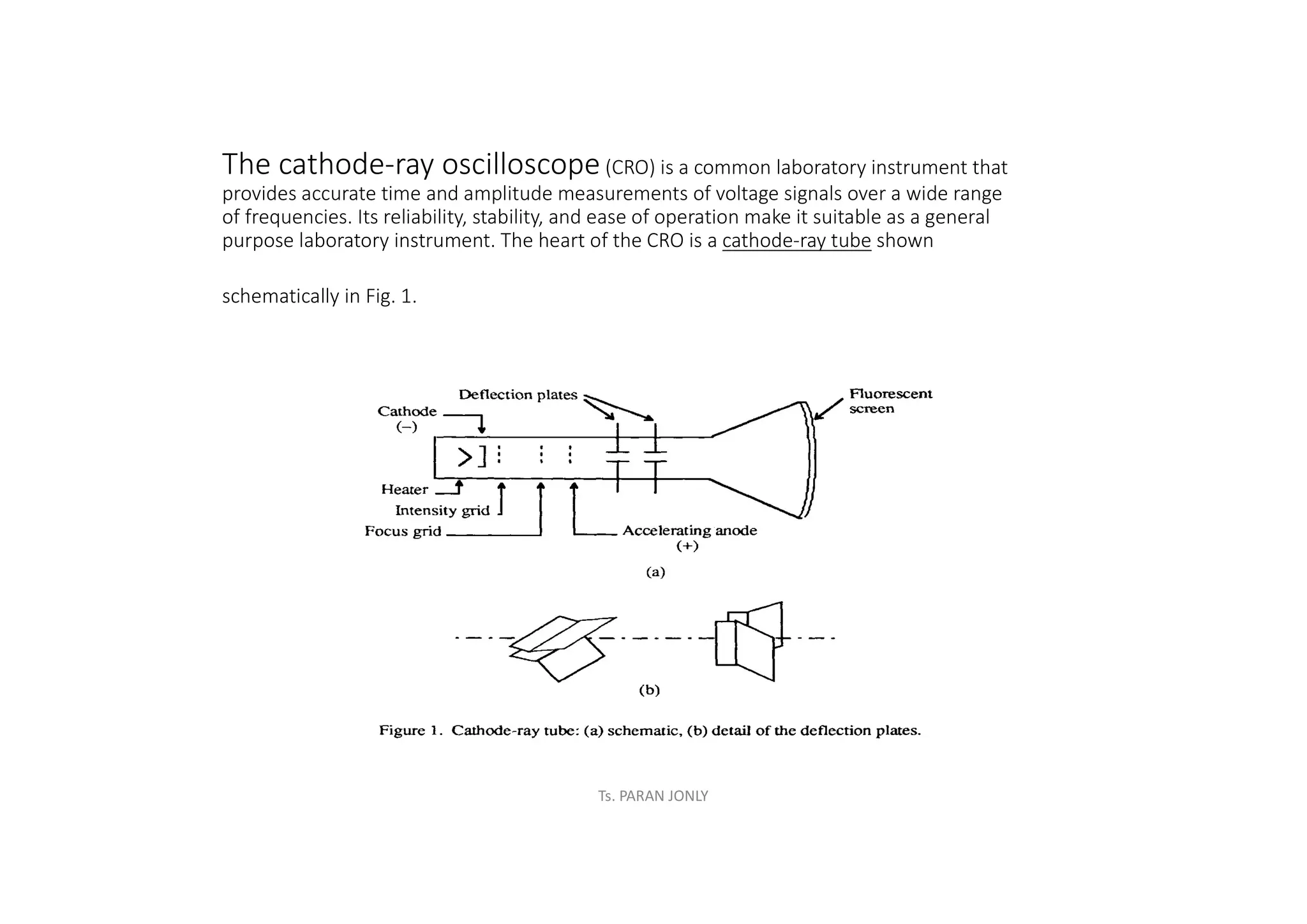
The cathode-ray oscilloscope(CRO) is a common laboratory instrument that
provides accurate time and amplitude measurements of voltage signals over a wide range
of frequencies. Its reliability, stability, and ease of operation make it suitable as a general
purpose laboratory instrument. The heart of the CRO is a cathode-ray tube shown
schematically in Fig. 1.
Ts. PARAN JONLY
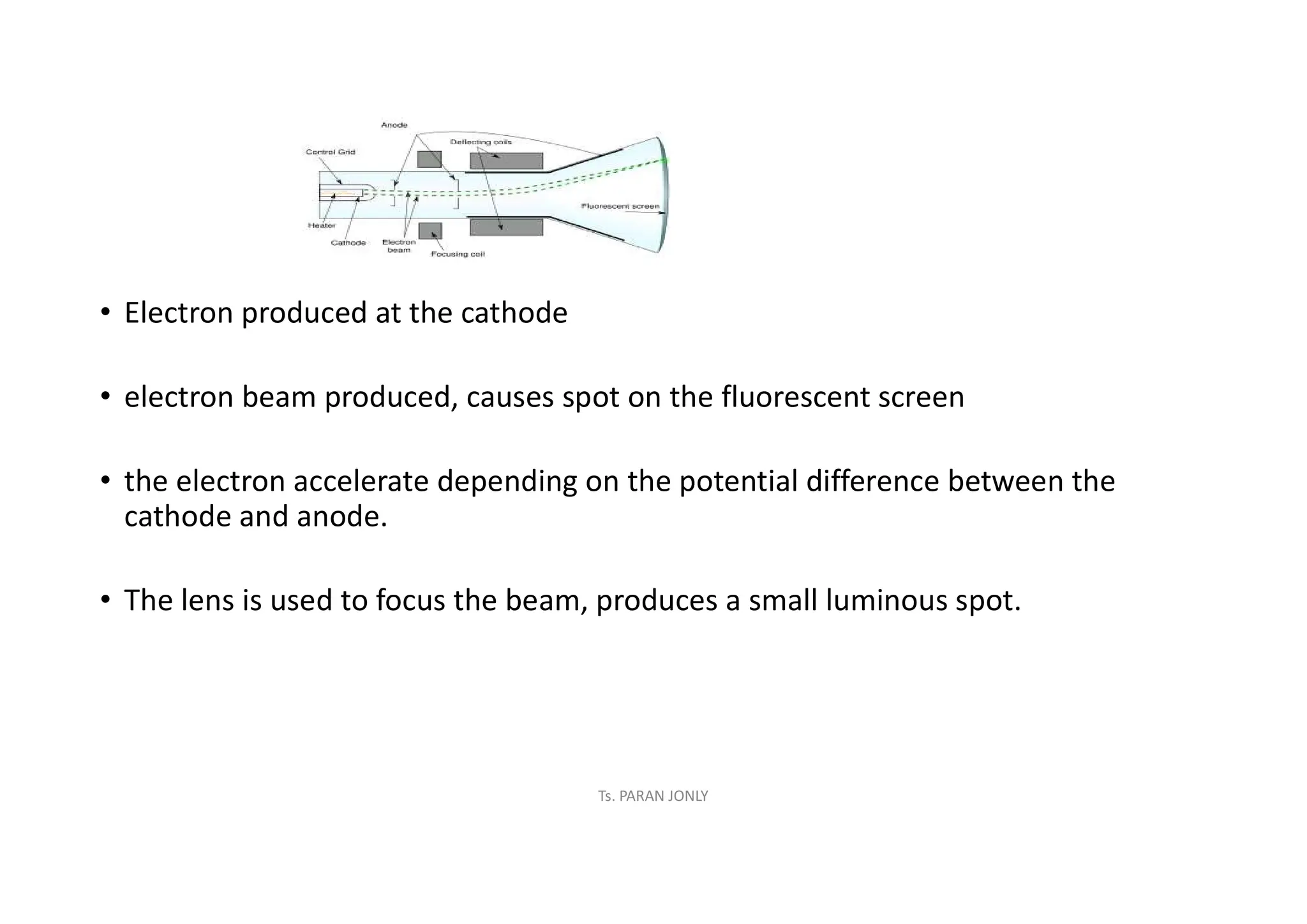
• Electron produced at the cathode
• electron beam produced, causes spot on the fluorescent screen
• the electron accelerate depending on the potential difference between the
cathode and anode.
• The lens is used to focus the beam, produces a small luminous spot.
Ts. PARAN JONLY
Monitors
• A display device which uses cathode ray tube to display letters or
alphabet and numbers, graphica and pictorial data.
• The picture produces because of the electron beam travel being
switch off and on by an input (i.e. from the measurement system)
Ts. PARAN JONLY
Magnetic recorder
• Used to record both analogue and digital signal.
• A recording head consists of a coil wound on a core of ferromagnetic
material
• The input is electrical signal, which
Ts. PARAN JONLY
Digital printers
• Gives records in the form of numbers, letters or special characters.
• Various version of printers.
• E.g. dot-matrix printer, which consists of print head with numbers of
vertical line pins. Each pin controlled by an electromagnetic. The
character is formed by moving the print head across the paper. The
pin head the better the quality.
Ts. PARAN JONLY

Investigate Engineering Measurement Systems

  • 1.
    LEARNING OUTCOME 1: INVESTIGATEENGINEERING MEASUREMENT SYSTEMS CERTIFICATE IN ELECTRICAL AND ELECTRONIC ENGINEERING INSTRUMENTATION & CONTROL CEE 3023 Ts. PARAN JONLY
  • 2.
    Introduction • Instrumentation isthe branch of engineering that deals with measurement and control. • An instrument is a device that measures or manipulates process physical variables such as flow, temperature, level, or pressure etc. Instruments include many varied contrivances which can be as simple as valves and transmitters, and as complex as analyzers. • Instruments often comprise control systems of varied processes. • The control of processes is one of the main branches of applied instrumentation. • Control instrumentation includes devices such as solenoids, valves, circuit breakers, and relays. • These devices are able to change a field parameter, and provide remote or automated control capabilities. Ts. PARAN JONLY
  • 3.
    • Instrumentation playsa significant role in both gathering information from the field and changing the field parameters, and as such are a key part of control loops. Ts. PARAN JONLY
  • 4.
    In this Part1.1, you will learn: Basic Instrumentation System  What are the needs of instrumentation for making measurements?  What are common terms used to describe the performance of measurement systems?  What are common sources of error that can occur with measurement systems? Ts. PARAN JONLY
  • 5.
    What are theneeds of instrumentation for making measurements? Essentially 3 different ways instrumentation is used for making measurements: 1. Obtaining data about some event or item marking out of an item for machining and involve measurements of lengths and angles. Ts. PARAN JONLY
  • 6.
    What are theneeds of instrumentation for making measurements? Essentially 3 different ways instrumentation is used for making measurements: 2. Inspecting an item to see if it matches the specification determine whether item being produced has the right dimensions, shape, electrical resistance, etc. that have been specified for the item Ts. PARAN JONLY
  • 7.
    What are theneeds of instrumentation for making measurements? Essentially 3 different ways instrumentation is used for making measurements: 3. Making measurements to ensure that a process is kept under control to ensure the proper control of process. i.e. of process measurements: A process may involve taking a hot liquid from a tank. The level of the liquid in the tank and the temperature have to be continually monitored. Ts. PARAN JONLY
  • 8.
    Basic Terminologies Sensors • Sensorsare electronics devices that measure the physical quantity or produces a signal relating to the quantity being measured • Physical quantities can be temperature, pressure, light, current, weight etc. • Process: Series of continuous or regularly recurring steps or actions intended to achieve a predetermined result, as in heat treating metal, or manufacturing acid. • Transducer (sensor): Element which converts one form of Energy to Other form. • Primary Transducer: Transducer which converts the Process parameter to a form readable by Secondary Transducer. Eg: Orifice plate • Secondary Transducer: Transducer or transmitter which responds to a measured variable and converts it to a standardized transmission signal which is a function only of the measurement. Eg: DP Transmitter Ts. PARAN JONLY
  • 9.
    Basic Measurement Systems Example:A digital thermometer system Sensing Element Quantity being measured Signal related to quantity measured Signal Converter (Signal Conditioner) Display Element Signal in suitable form for display Sensor Temperature Potential different Amplifier Display Bigger voltage Value of the quantity Value of the quantity Ts. PARAN JONLY
  • 10.
    Sensing Element • alsocalled the transducer; “in contact” with what is being measured and produces some signal which is related to the quantity being measured Sensing Element Weight signal Change in length Example: Spring balance used to measure weight the sensing element can be considered to be stretching of the spring as a result of the weight on the balance Ts. PARAN JONLY
  • 11.
    Sensing Element • alsocalled the transducer; “in contact” with what is being measured and produces some signal which is related to the quantity being measured Example: Thermometer used to measure temperature the sensing element can be considered to be expansion of mercury in a sealed capillary tube as a result of the heat. Sensing Element Temperature signal Expansion of mercury Ts. PARAN JONLY
  • 12.
    Signal Conditioner • outputfrom the sensing element then passes through a second element before reaching display • signal from the sensing element is manipulated into a form which is suitable for the display or control element Signal Converter Small signal Larger signal Example: An amplifier takes a small signal from sensing element and makes it big enough to activate the display. Ts. PARAN JONLY
  • 13.
    Display  the outputfrom the signal conditioner is displayed  takes information from the signal converter and presents it in form which enables an observer to recognize it Example: A pointer moving across a scale or a digital readout Ts. PARAN JONLY
  • 14.
    What are commonterms used to describe the performance of measurement systems? 1. Accuracy 2. Precision 3. Error 4. Repeatability 5. Reliability 6. Reproducibility 7. Sensitivity 8. Stability 9. Drift 10. Resolution 11. Range and span 12. Dead Space 13. Dead Time 14. Threshold 15. Lag 16. Hysteresis Ts. PARAN JONLY
  • 15.
    Performance Terminology 1. Accuracy •Accuracy is how close a measured value is to the actual (true) value. 2. Precision • Precision is how close the measured values are to each other. Low Accuracy High Precision High Accuracy Low Precision High Accuracy High Precision Ts. PARAN JONLY
  • 16.
    Performance Terminology How toRemember? • aCcurate is Correct (a bulls eye). • pRecise is Repeating (hitting the same spot, but maybe not the correct spot) Low Accuracy High Precision High Accuracy Low Precision High Accuracy High Precision Ts. PARAN JONLY
  • 17.
    3. Error The differencebetween the result of the measurement and the true value of the quantity being measured Example 1: Thermometer given a value of 34oC.  But the true value of the temperature is 33oC  Then the error is +1oC. Example 2: Sensor’s resistance true change of 10.5Ω.  But the given value of the changed resistance is 10.2Ω.  Hence, the error is -0.3Ω. Error = Measured Value – True Value Performance Terms Ts. PARAN JONLY
  • 18.
    4. Repeatability  instrument’sability to display the same reading for repeated applications of the same value of the quantity being measured.  Example: If an ammeter was being measure a constant current and gave four successive readings; 3.20A, 3.15A, 3.25A, and 3.20A, then there can be an error with any one reading due to lack of repeatability. Performance Terminology Ts. PARAN JONLY
  • 19.
    5. Reliability  probabilitythat the instrumentation will operate to an agreed level of performance under the conditions specified for its use.  Example: an instrument for measuring a load might have an accuracy of ±4% now and still ±4% six months later, while a less reliable instrument might have deteriorated and the accuracy become ±5%. Performance Terminology Ts. PARAN JONLY
  • 20.
    6. Reproducibility  orstability of an instrument is its ability to display same reading when it is used to measure a constant quantity over a period of time or when that quantity is measured on a number of occasions. Performance Terminology Ts. PARAN JONLY
  • 21.
    7. Sensitivity • Sensitivityof a sensor is defined as the ratio of change in output value of a sensor to the per unit change in input value that causes the output change. Example: A voltmeter may have a sensitivity of 1 scale division per 0.05V.  The voltage being measured changes 0.05 V then the reading will change by one scale division. Performance Terminology Ts. PARAN JONLY
  • 22.
    8. Stability • Abilityto give the same output when used to measure a constant input over a period of time. 9. Drift • to describe the change in output that occurs over time. Performance Terminology Ts. PARAN JONLY
  • 23.
    10. Resolution  Resolutionis the smallest detectable incremental change of input parameter that can be detected in the output signal. Resolution can be expressed either as a proportion of the full-scale reading or in absolute terms.  Example: if a LVDT sensor measures a displacement up to 20 mm and it provides an output as a number between 1 and 100 then the resolution of the sensor device is 0.2 mm. Performance Terminology Ts. PARAN JONLY
  • 24.
    11. Range andSpan  The range of a transducer defines the limits between which the input can vary.  The span is the maximum value of the input minus the minimum value.  Example: A load cell for the measurement of forces might have a range of 0 to 50kN and a span of 50kN. Performance Terminology Ts. PARAN JONLY
  • 25.
    12. Dead Space/Dead Band/ Dead Zone  The range of input values for which there is no change in output values.  Example: Performance Terms Ts. PARAN JONLY
  • 26.
    13. Dead Time •The length of time from the application of an input until the output begins to respond and change. 14. Threshold  when the quantity is being measured is gradually increased from zero, a certain minimum level might have to be reached before the instrument responds and gives a detectable reading.  Example: Pressure gauge might not respond until the pressure has risen to about 1 kPa Performance Terms Ts. PARAN JONLY
  • 27.
    15. Lag  whenthe quantity being measured changes a certain time might have to elapse before the measuring instrument responds to the change Performance Terms Ts. PARAN JONLY
  • 28.
    16. Hysteresis • instrumentcan give different readings for the same value of measured quantity according to whether that value has been reached by a continuously increasing change or a continuously decreasing change Performance Terms Hysteresis curve showing the difference in readings when starting from zero, and when starting from full scale. Ts. PARAN JONLY
  • 29.
    What are commonsources of error that can occur with measurement systems? 1. Construction errors 2. Non-linearity errors 3. Operating errors 4. Environmental errors 5. Ageing errors 6. Insertion errors 7. Random and Systematic errors Ts. PARAN JONLY
  • 30.
    Sources of Error Constructionerrors can be cause by tolerances in the dimensions of components and electrical components used in the manufacture of an instrument Ts. PARAN JONLY
  • 31.
    Sources of Error Non-linearityerrors linear scale: the reading given is directly proportional to the distance or angle moved by a pointer across the scale in many instances however, though a linear scale is used the relationship is not perfectly linear and so errors occur Ts. PARAN JONLY
  • 32.
    Sources of Error Operatingerrors Parallax errors: common errors occur with instruments that have pointers moving across scales, and results from the scale and pointer not being in the same plane. Ts. PARAN JONLY
  • 33.
    Sources of Error Environmentalerrors errors that can arise as a result of environmental effects which are not taken account of Ts. PARAN JONLY
  • 34.
    Sources of Error Ageingerrors a consequence of instruments getting older is that some components may deteriorate and their values change also build-up of deposits may occur on surface which can affect contact resistance and insulation. Ts. PARAN JONLY
  • 35.
    Sources of Error Insertionerrors results from the insertion of the instrument into the position to measure a quantity affecting its value Ts. PARAN JONLY
  • 36.
    Sources of Error Randomerrors: • can vary in a random manner between successive readings of the same quantity • might be due to operation error • can be overcome by repeated readings being taken and an average calculated Ts. PARAN JONLY
  • 37.
    Sources of Error Systematicerrors: • do not vary from one reading to another. • may be result of construction or non-linearity errors and so indicated in accuracy stated for an instrument by the manufacturer. Ts. PARAN JONLY
  • 38.
    Functional Element of MeasurementSystem CEE2163 Instrumentation and Control Part 1.2 Ts. PARAN JONLY
  • 39.
    In this Part1.2, you will learn: Basic Instrumentation System  Describe and illustrate the functional elements of engineering measurement system Ts. PARAN JONLY
  • 40.
    Methods of Measurement vDIRECTMETHODS In these methods, the unknown quantity (called the measurand ) is directly compared against a standard. vINDIRECT METHOD Measurements by direct methods are not always possible, feasible and practicable. In engineering applications measurement systems are used which require need of indirect method for measurement purposes. Ts. PARAN JONLY
  • 41.
    Sensor is aTransducer. What is a transducer ? A device which converts one form of energy to another Actuators Sensors Physical parameter Electrical Output Electrical Input Physical Output Ts. PARAN JONLY
  • 42.
    Definitions of Sensorand Transducer SENSOR: a device that detects a change in a physical stimulus and turns it into a signal which can be measured or recorded. TRANSDUCER: is 'a device that transfers power from one system to another in the same or in the different form. (The word sensor is derived from entire meaning 'to perceive' and 'transducer' is from transducer meaning 'to lead across) A sensible distinction is to use 'sensor' for the sensing element itself and 'transducer' for the sensing element plus any associated circuitry. All transducers would thus contain a sensor and most (though not all) sensors would also be transducers. Ts. PARAN JONLY
  • 43.
    Sensors and Transducers Adictionary definition (Chambers Twentieth Century) of ‘sensor’ is ‘a device that detects a change in a physical stimulus and turns it into a signal which can be measured or recorded’; a corresponding definition of ‘transducer’ is ‘a device that transfers power from one system to another in the same or in different form’. The sensor is the part of an instrument used to detect a change in the quantity being measured. There are three important elements in industrial measurement system: sensors, signal conditioners, and display unit. Some common examples of sensing elements are to be found in I. a liquid in glass thermometer II. a bourdon tube pressure gauge From our basic conditions for an instrument system, namely sensors – signal conditioner – display units we can identify the sensor for each of the above instruments. Ts. PARAN JONLY
  • 44.
    Figure 1 showsthe sensing process in terms of energy conversion. The form of the output signal will often be a voltage analogous to the input signal, though sometimes it may be a wave form whose frequency is proportional to the input or a pulse train containing the information in some other form. Ts. PARAN JONLY
  • 45.
    Instrumentation is usedto measure many parameters (physical values). These parameters include: ü Pressure, either differential or static ü Flow ü Temperature ü Levels of liquids, etc. ü Density ü Viscosity ü Other mechanical properties of materials ü Properties of ionising radiation ü Frequency ü Current ü Voltage ü Inductance ü Capacitance ü Resistivity ü Chemical composition ü Chemical properties ü Properties of light ü Vibration ü Weight Ts. PARAN JONLY
  • 46.
    Sensor Classification Sensor classificationschemes range from very simple to the complex. One good way to look at a sensor is to consider all of its properties, such as stimulus, specifications, physical phenomenon, conversion mechanism, material and application field. The Sensor can be classified as follows: Displacement / Proximity/ Position Strain gauge element, Capacitive element, Potentiometer, differential transformer Velocity & Motion Tachogenerator Force Strain gauge load cell Fluid Pressure Peizoelectric Sensors, Tactile sensor Liquid Flow Pressure sensor Liquid Level Level sensor Temperature RTD, Thermistor, Thermocouple Light sensors Photodiode, Photo resistor, Infra-red sensor Ts. PARAN JONLY
  • 47.
    Sensor Selection Any sensoris based on a simple concept that physical property of a sensor must be altered by an external stimulus to cause that property either to produce an electric signal or to modulate (to modify) an external electric signal. Quite often, the same stimulus may be measured by using quite different physical phenomena, and subsequently, by different sensors. Selection criteria depend on many factors, such as availability, cost, power consumption, environmental conditions, etc. The best choice can be done only after all variables are considered. Ts. PARAN JONLY
  • 48.
    Figure 1: “liquidin glass” thermometer Capilary tube Scale Mercury reservoir The sensor is the mercury reservoir where the heat energy is detected and causes an expansion of the mercury. The signal conditioner is the capillary tube in which the mercury is constrained to pass along its length. The display unit is the scale and the meniscus of the mercury column. Ts. PARAN JONLY
  • 49.
    The sensor isthe bourdon tube which changes the pressure signal into a physical movement of the tube’s free end. The signal conditioner is the quadrant gear and pinion gear which change a small linear movement into a large angular movement to drive the instrument pointer. The display unit is the scale and pointer The essential features of the pressure gauge can be shown in block diagram form. Figure 2: Bourdon-tube Pressure gauge Ts. PARAN JONLY
  • 50.
    (Sensor) bourdon tube (Signal conditioner) quadrant and piniongears (Display unit) Pointer and scale Linear signal Rotary signal Pressure tube Visual Output Sensing element may be described as primary, when they react directly to changes in the quantity being measured. If they occur between the primary element and the receiver they are referred to as secondary sensing elements. In many cases the signal conditioner is a secondary element A particular type of sensing element is called transducer. A transducer changes a detected signal to another physical form. This function is useful in an instrumentation system where control of equipment or remote indication is required. Ts. PARAN JONLY
  • 51.
    Resistive Sensors -Potentiometers Translational and Rotational Potentiometers Translational or angular displacement is proportional to resistance. Taken from www.fyslab.hut.fi/kurssit/Tfy-3.441/ luennot/Luento3.pdf Ts. PARAN JONLY
  • 52.
    Resistive Sensors -Strain Gauges Resistance is related to length and area of cross-section of the resistor and resistivity of the material as By taking logarithms and differentiating both sides, the equation becomes Dimensional piezoresistance Strain gage component can be related by poisson’s ratio as Ts. PARAN JONLY
  • 53.
    Resistive Sensors -Strain Gauges Gage Factor of a strain gage G is a measure of sensitivity Think of this as a Transfer Function! ÞInput is strain Þ Output is dR ÞPut mercury strain gauge around an arm or chest to measure force of muscle contraction or respiration, respectively Þ Used in prosthesis or neonatal apnea detection, respectively Ts. PARAN JONLY
  • 54.
    Resistive Sensors -Strain Gauges Strain gages are generally mounted on cantilevers and diaphragms and measure the deflection of these. More than one strain gage is generally used and the readout generally employs a bridge circuit. Ts. PARAN JONLY
  • 55.
    Strain Gage Mounting Takenfrom http://www.omega.com/literature/transactions/volume3/strain3.html Applications! Þ Surgical forceps Þ Blood pressure transducer (e.g. intracranial pressure Ts. PARAN JONLY
  • 56.
    Bridge Circuits Wheatstone’s Bridge R-dRR+dR R Rf Vs R Vo Real Circuit and Sensor Interface Ts. PARAN JONLY
  • 57.
    Inductive Sensors An inductoris basically a coil of wire over a “core” (usually ferrous) It responds to electric or magnetic fields A transformer is made of at least two coils wound over the core: one is primary and another is secondary Primary Secondary Displacement Sensor Inductors and tranformers work only for ac signals Ts. PARAN JONLY
  • 58.
    Inductive Sensors -LVDT LVDT Linear Variable Differential Transformer An LVDT is used as a sensitive displacement sensor: for example, in a cardiac assist device or a basic research project to study displacement produced by a contracting muscle. Ts. PARAN JONLY
  • 59.
    Capacitive Sensors e.g. Anelectrolytic capacitor is made of Aluminum evaporated on either side of a very thin plastic film (or electrolyte) Electrolytic or ceramic capacitors are most common Ts. PARAN JONLY
  • 60.
    Capacitive Sensors Other Configurations c.Differential Mode b. Variable Dielectric Mode a. Variable Area Mode Ts. PARAN JONLY
  • 61.
    Piezoelectric Sensors What ispiezoelectricity ? Strain causes a redistribution of charges and results in a net electric dipole (a dipole is kind of a battery!) A piezoelectric material produces voltage by distributing charge (under mechanical strain/stress) Different transducer applications: ÞAccelerometer ÞMicrophone Ts. PARAN JONLY
  • 62.
    Piezoelectric Sensors Above equationsare valid when force is applied in the L,W or t directions respectively. 31 denotes the crystal axis Ts. PARAN JONLY
  • 63.
    Piezoelectric Sensors -Circuitry The Equivalent Circuit Taken from Webster, “Medical Instrumentation” Ts. PARAN JONLY
  • 64.
    Temperature Sensors 1. Resistancebased a. Resistance Temperature Devices (RTDs) b. Thermistors 2. Thermoelectric – Thermocouples 3. Radiation Thermometry 4. Fiber Optic Sensor Ts. PARAN JONLY
  • 65.
    RTDs RTDs are madeof materials whose resistance changes in accordance with temperature Metals such as platinum, nickel and copper are commonly used. They exhibit a positive temperature coefficient. A commercial ThermoWorks RTD probe Ts. PARAN JONLY
  • 66.
    Thermistors Thermistors are madefrom semiconductor material. Generally, they have a negative temperature coefficient (NTC), that is NTC thermistors are most commonly used. Ro is the resistance at a reference point (in the limit, absolute 0). Ts. PARAN JONLY
  • 67.
    Thermocouples Seebeck Effect When apair of dissimilar metals are joined at one end, and there is a temperature difference between the joined ends and the open ends, thermal emf is generated, which can be measured in the open ends. This forms the basis of thermocouples. Ts. PARAN JONLY
  • 68.
    Thermocouples Taken from Webster,“Medical Instrumentation” Ts. PARAN JONLY
  • 69.
    Radiation Thermometry Governed byWien’s Displacement Law which says that at the peak of the emitted radiant flux per unit area per unit wavelength occurs when maxT=2.898x10⁻³ moK Taken from http://hyperphysics.phy-astr.gsu.edu/hbase/wien.html#c2 Ts. PARAN JONLY
  • 70.
    Fiber Optics A fiberoptic cable Most of the light is trapped in the core, but if the cladding is temperature sensitive (e.g. due to expansion), it might allow some light to leak through. -> hence the amount of light transmitted would be proportional to temperature -> since you are measuring small changes in light level, this sensor is exquisitely sensitive. Ts. PARAN JONLY
  • 71.
    Fiber Optics Based onTotal Internal Reflection Taken from http://hyperphysics.phy-astr.gsu.edu/hbase/phyopt/totint.html#c1 Ts. PARAN JONLY
  • 72.
    Fiber Optic TemperatureSensors Nortech's fiber-optic temperature sensor probe consists of a gallium arsenide crystal and a dielectric mirror on one end of an optical fiber and a stainless steel connector at the other end. Taken from http://www.sensorsmag.com/articles/0501/57/main.shtml Ts. PARAN JONLY
  • 73.
    Other Physical Sensors Photoemissivesensors Photoconductive sensors (LDRs) Photovoltaic sensors Ts. PARAN JONLY
  • 74.
    Chemical Sensors (Biosensors) Biosensorsproduce an output (electrical) which is proportional to the concentration of biological analytes. A typical biosensor Signal Conditioning Analyte Biological Detection Agent Transducer Ts. PARAN JONLY
  • 75.
    Biosensing Principles • Electrochemical •Potentiometric • Amperometric • FET based • Conductometric • Optical • Piezoelectric • Thermal => Neurochemical sensor for Dopamine, Nitric Oxide, etc. => Pulse oximeter => Accelerometer, microphone => Implanted rectal probe, pacemaker Ts. PARAN JONLY
  • 76.
  • 77.
    Electrochemical Sensors Potentiometric :These involve the measurement of the emf (potential) of a cell at zero current. The emf is proportional to the logarithm of the concentration of the substance being determined. Amperometric : An increasing (decreasing) potential is applied to the cell until oxidation (reduction) of the substance to be analyzed occurs and there is a sharp rise (fall) in the current to give a peak current. The height of the peak current is directly proportional to the concentration of the electroactive material. If the appropriate oxidation (reduction) potential is known, one may step the potential directly to that value and observe the current. Conductometric. Most reactions involve a change in the composition of the solution. This will normally result in a change in the electrical conductivity of the solution, which can be measured electrically. Ts. PARAN JONLY
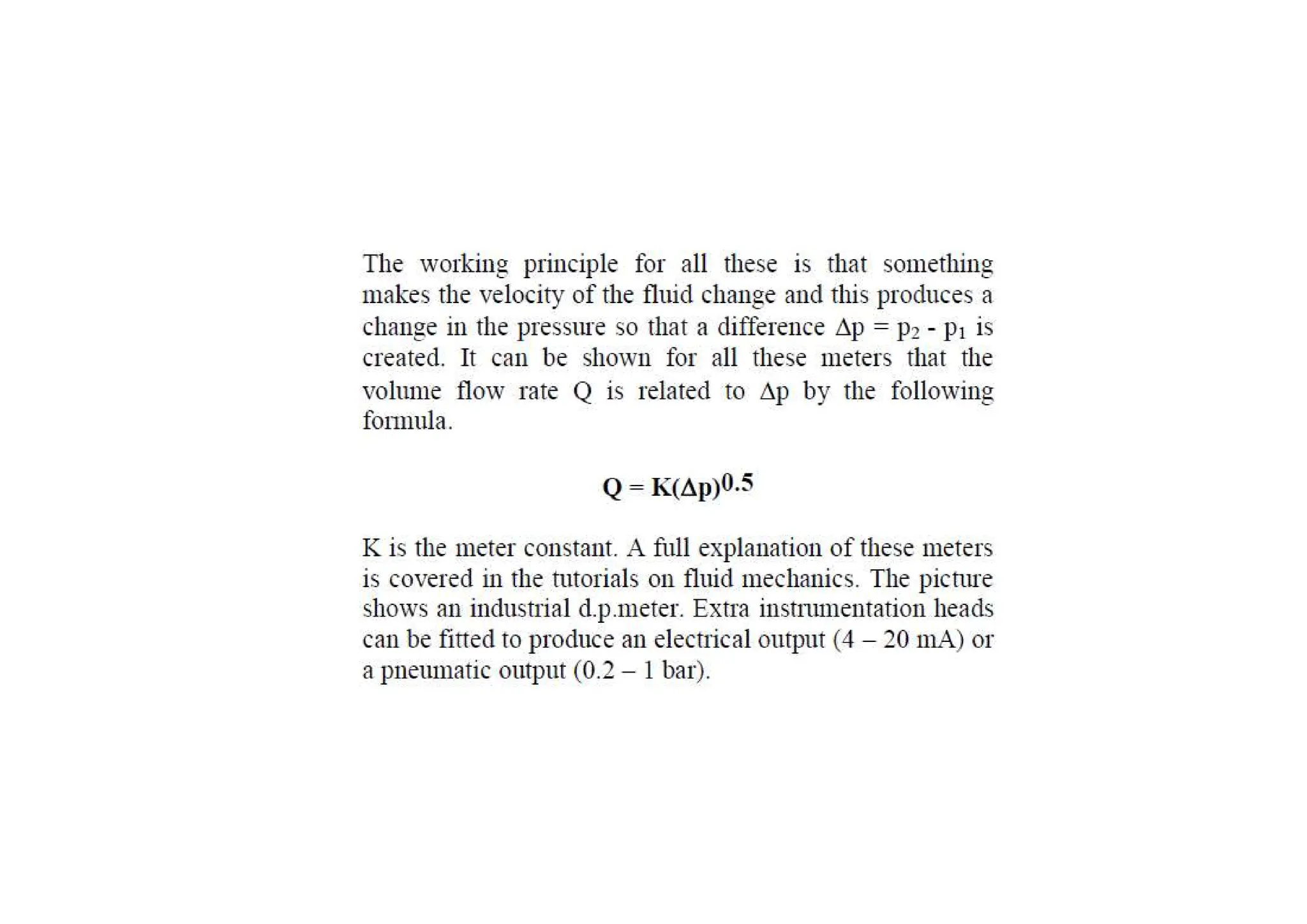
  • 78.
    Blood Gas Measurement Fastand accurate measurements of the blood levels of the partial pressures of oxygen (pO2), carbon dioxide (pCO2) as well as the concentration of hydrogen ions (pH) are vital in diagnosis. Oxygen is measured indirectly as a percentage of Haemoglobin which is combined with oxygen (sO2)     sO HbO Hb 2 2 100   pO2 can also provide the above value using the oxyhaemoglobin dissociation curve but is a poor estimate. Ts. PARAN JONLY
  • 79.
    pH electrode Governing equationis the Nernst Equation     E RT nF H H H i        ln 0 Ts. PARAN JONLY
  • 80.
    pCO2 Electrode The measurementof pCO2 is based on its linear relationship with pH over the range of 10 to 90 mm Hg. H O CO H CO H HCO 2 2 2 3 3       The dissociation constant is given by    k H HCO a pCO     3 2 Taking logarithms pH = log[HCO3 -] – log k – log a – log pCO2 Ts. PARAN JONLY
  • 81.
    pO2 electrode The pO2electrode consists of a platinum cathode and a Ag/AgCl reference electrode. Ts. PARAN JONLY
  • 82.
    Optical Biosensors Sensing Principle Theylink changes in light intensity to changes in mass or concentration, hence, fluorescent or colorimetric molecules must be present. Various principles and methods are used : Optical fibres, surface plasmon resonance,Abso rbance, Luminescence LED Photodetector Finger IR light Ts. PARAN JONLY
  • 83.
  • 84.
    Absorption/Fluorescence Different dyes showpeaks of different values at different concentrations when the absorbance or excitation is plotted against wavelength. Phenol Red is a pH sensitive reversible dye whose relative absorbance (indicated by ratio of green and red light transmitted) is used to measure pH. HPTS is an irreversible fluorescent dye used to measure pH. Similarly, there are fluorescent dyes which can be used to measure O2 and CO2 levels. Ts. PARAN JONLY
  • 85.
    Pulse Oximetry Two wavelengthsof monochromatic light -- red (660 nm) and infrared (940 nm) -- are used to gauge the presence of oxygenated and reduced hemoglobin in blood. With each pulse beat the device interprets the ratio of the pulse-added red absorbance to the pulse-added infrared absorbance. The calculation requires previously determined calibration curves that relate transcutaneous light absorption to sO2. The pulse oximeter is a spectrophotometric device that detects and calculates the differential absorption of light by oxygenated and reduced hemoglobin to get sO2. A light source and a photodetector are contained within an ear or finger probe for easy application. Ts. PARAN JONLY
  • 86.
    Glucose Sensors Enzymatic Approach Glue O GluconicAcid H O Glu eOxidase cos cos      2 2 2 Makes use of catalytic (enzymatic) oxidation of glucose The setup contains an enzyme electrode and an oxygen electrode and the difference in the readings indicates the glucose level. The enzyme electrode has glucose oxidase immobilized on a membrane or a gel matrix. Platinum electrode Plastic membrane Glucose O2 Gluconic acid Silver anode Ts. PARAN JONLY
  • 87.
    Glucose Sensor Affinity Approach Thisapproach is based on the immobilized competitive binding of a particular metabolite (glucose) and its associated fluorescent label with receptor sites specific to the metabolite (glucose) and the labeled ligand. This change in light intensity is then picked up. 3 mm 0.3 mm Hollow dialysis fiber Immobilized Con A Excitatation Emission Optical Fiber Glucose Ts. PARAN JONLY
  • 88.
    Acoustic, sound, vibration üGeophone ü Hydrophone ü Lace Sensor a guitar pickup ü Microphone Ts. PARAN JONLY
  • 89.
    Automotive, transportation 1. Air–fuelratio meter 2. Blind spot monitor 3. Crankshaft position sensor, A crank sensor is an electronic device used in an internal combustion engine to monitor the position or rotational speed of the crankshaft. 4. Curb feeler, used to warn driver of curbs 5. Defect detector, used on railroads to detect axle and signal problems in passing trains 6. Engine coolant temperature sensor, or ECT sensor, used to measure the engine temperature 7. Hall effect sensor, used to time the speed of wheels and shafts 8. MAP sensor, Manifold Absolute Pressure, used in regulating fuel metering. Ts. PARAN JONLY
  • 90.
    Automotive, transportation 9. Massflow sensor, or mass airflow (MAF) sensor, used to tell the ECU the mass of air entering the engine 10. Oxygen sensor, used to monitor the amount of oxygen in the exhaust 11. Parking sensors, used to alert the driver of unseen obstacles during parking manoeuvres 12. Radar gun, used to detect the speed of other objects 13. Speedometer, used measure the instantaneous speed of a land vehicle 14. Speed sensor, used to detect the speed of an object 15. Throttle position sensor, used to monitor the position of the throttle in an internal combustion engine 16. Tire-pressure monitoring sensor, used to monitor the air pressure inside the tires 17. Torque sensor, or torque transducer or torquemeter measures torque (twisting force) on a rotating system. Ts. PARAN JONLY
  • 91.
    Automotive, transportation 18.Transmission fluidtemperature sensor, used to measure the temperature of the transmission fluid 19.Turbine speed sensor (TSS), or input speed sensor (ISS), used to measure the rotational speed of the input shaft or torque converter 20.Variable reluctance sensor, used to measure position and speed of moving metal components 21.Vehicle speed sensor (VSS), used to measure the speed of the vehicle 22.Water sensor or water-in-fuel sensor, used to indicate the presence of water in fuel 23.Wheel speed sensor, used for reading the speed of a vehicle's wheel rotation Ts. PARAN JONLY
  • 92.
    Chemical 1. Breathalyzer 2. Carbondioxide sensor 3. Carbon monoxide detector 4. Catalytic bead sensor 5. Chemical field-effect transistor 6. Chemiresistor 7. Electrochemical gas sensor 8. Electronic nose 9. Electrolyte–insulator–semiconduct or sensor 10.Fluorescent chloride sensors 11.Holographic sensor 12.Hydrocarbon dew point analyzer 13.Hydrogen sensor 14.Hydrogen sulfide sensor 15.Infrared point sensor 16.Ion-selective electrode 17.Nondispersive infrared sensor 18.Microwave chemistry sensor 19.Nitrogen oxide sensor 20.Olfactometer 21.Optode 22.Oxygen sensor 23.Ozone monitor 24.Pellistor 25.pH glass electrode 26.Potentiometric sensor 27.Redox electrode 28.Smoke detector 29.Zinc oxide nanorod sensor Ts. PARAN JONLY
  • 93.
    Electric current, electricpotential, magnetic, radio 1. Current sensor 2. Daly detector 3. Electroscope 4. Electron multiplier 5. Faraday cup 6. Galvanometer 7. Hall effect sensor 8. Hall probe 9. Magnetic anomaly detector 10. Magnetometer 11. MEMS magnetic field sensor 12. Metal detector 13. Planar Hall sensor 14. Radio direction finder 15. Voltage detector Ts. PARAN JONLY
  • 94.
    Flow, fluid velocity 1.Air flow meter 2. Anemometer 3. Flow sensor 4. Gas meter 5. Mass flow sensor 6. Water meter Ts. PARAN JONLY
  • 95.
    Ionizing radiation, subatomicparticles 1. Cloud chamber 2. Geiger counter 3. Neutron detection Ts. PARAN JONLY
  • 96.
    Navigation instruments 1. Airspeed indicator 2. Altimeter 3. Attitude indicator 4. Depth gauge 5. Fluxgate compass 6. Gyroscope 7. Inertial navigation system 8. Inertial reference unit 9. Magnetic compass 10.MHD sensor 11.Ring laser gyroscope 12.Turn coordinator 13.TiaLinx sensor 14.Variometer 15.Vibrating structure gyroscope 16.Yaw rate sensor Ts. PARAN JONLY
  • 97.
    Position, angle, displacement,distance, speed, acceleration 1. Auxanometer 2. Capacitive displacement sensor 3. Capacitive sensing 4. Free fall sensor 5. Gravimeter 6. Gyroscopic sensor 7. Impact sensor 8. Inclinometer 9. Integrated circuit piezoelectric sensor 10.Laser rangefinder 11.Laser surface velocimeter 12.LIDAR 13.Linear encoder 14.Linear variable differential transformer (LVDT) 15.Liquid capacitive inclinometers Ts. PARAN JONLY
  • 98.
    Position, angle, displacement,distance, speed, acceleration 16. Odometer 17.Photoelectric sensor 18.Piezocapactive sensor 19.Piezoelectric accelerometer 20.Position sensor 21.Rate sensor 22.Rotary encoder 23.Rotary variable differential transformer 24.Selsyn 25.Shock detector 26.Shock data logger 27.Stretch sensor 28.Tilt sensor 29.Tachometer 30.Ultrasonic thickness gauge 31.Variable reluctance sensor 32.Velocity receiver Ts. PARAN JONLY
  • 99.
    Optical, light, imaging,photon 1. Charge-coupled device 2. CMOS sensor 3. Colorimeter 4. Contact image sensor 5. Electro-optical sensor 6. Flame detector 7. Infra-red sensor 8. Kinetic inductance detector 9. LED as light sensor 10.Light-addressable potentiometric sensor 11.Nichols radiometer 12.Fiber optic sensors 13.Optical position sensor 14.Photodetector 15.Photodiode 16.Photomultiplier tubes 17.Phototransistor 18.Photoelectric sensor 19.Photoionization detector 20.Photomultiplier 21.Photoresistor 22.Photoswitch 23.Phototube 24.Scintillometer 25.Shack-Hartmann 26.Single-photon avalanche diode 27.Superconducting nanowire single-photon detector 28.Transition edge sensor 29.Visible light photon counter 30.Wavefront sensor Ts. PARAN JONLY
  • 100.
    Pressure 1. Barograph 2. Barometer 3.Boost gauge 4. Bourdon gauge 5. Hot filament ionization gauge 6. Ionization gauge 7. McLeod gauge 8. Oscillating U-tube 9. Permanent Downhole Gauge 10. Piezometer 11. Pirani gauge 12. Pressure sensor 13. Pressure gauge 14. Tactile sensor 15. Time pressure gauge Ts. PARAN JONLY
  • 101.
    Force, density, level 1.Bhangmeter 2. Hydrometer 3. Force gauge and Force Sensor 4. Level sensor 5. Load cell 6. Magnetic level gauge 7. Nuclear density gauge 8. Piezocapactive pressure sensor 9. Piezoelectric sensor 10.Strain gauge 11.Torque sensor 12.Viscometer Ts. PARAN JONLY
  • 102.
    Thermal, heat, temperature 1.Bolometer 2. Bimetallic strip 3. Calorimeter 4. Exhaust gas temperature gauge 5. Flame detection 6. Gardon gauge 7. Golay cell 8. Heat flux sensor 9. Infrared thermometer 10.Microbolometer 11.Microwave radiometer 12.Net radiometer 13.Quartz thermometer 14.Resistance temperature detector 15.Resistance thermometer 16.Silicon bandgap temperature sensor 17.Special sensor microwave/imager 18.Temperature gauge 19.Thermistor 20.Thermocouple 21.Thermometer 22.Pyrometer Ts. PARAN JONLY
  • 103.
    Proximity, presence 1. Alarmsensor 2. Doppler radar 3. Motion detector 4. Occupancy sensor 5. Proximity sensor 6. Passive infrared sensor 7. Reed switch 8. Stud finder 9. Triangulation sensor 10.Touch switch 11.Wired glove Ts. PARAN JONLY
  • 104.
    Sensor technology 1. Activepixel sensor 2. Back-illuminated sensor 3. Biochip 4. Biosensor 5. Capacitance probe 6. Capacitance sensor 7. Catadioptric sensor 8. Carbon paste electrode 9. Digital sensors 10. Displacement receiver 11. Electromechanical film 12. Electro-optical sensor 13. Fabry–Pérot interferometer 14. Fisheries acoustics 15. Image sensor 16. Image sensor format 17. Inductive sensor 18. Intelligent sensor 19. Lab-on-a-chip 20. Leaf sensor 21. Machine vision 22. Microelectromechanical systems 23. Photoelasticity 24. Quantum sensor 25. Radar 26. Ground-penetrating radar 27. Stretch sensor 28. Synthetic aperture radar 29. Radar tracker 30. Sensor array 31. Sensor fusion 32. Sensor grid 33. Sensor node 34. Soft sensor Ts. PARAN JONLY
  • 105.
    Sensor technology 35. Sonar 36.Staring array 37. Transducer 38. Ultrasonic sensor 39. Video sensor 40. Visual sensor network 41. Wheatstone bridge 42. Wireless sensor network Ts. PARAN JONLY
  • 106.
    Other sensors andsensor related properties and concepts 1. Actigraphy 2. Air pollution sensor 3. Analog image processing 4. Atomic force microscopy 5. Atomic Gravitational Wave Interferometric Sensor 6. Altitude control (spacecraft),Horizon sensor, Earth sensor, Sun sensor 7. Catadioptric sensor 8. Chemoreceptor 9. Compressive sensing 10. Cryogenic particle detectors 11. Dew warning 12. Diffusion tensor imaging 13. Digital holography 14. Electronic tongue 15. Fine Guidance Sensor 16. Flat panel detector Ts. PARAN JONLY
  • 107.
    Other sensors andsensor related properties and concepts 17. Functional magnetic resonance imaging 18. Glass break detector 19. Heartbeat sensor 20. Hyperspectral sensors 21. IRIS (Biosensor), Interferometric Reflectance Imaging Sensor 22. Laser beam profiler 23. Littoral Airborne Sensor/Hyperspectral 24. LORROS 25. Millimeter wave scanner 26. Magnetic resonance imaging 27. Moire deflectometry 28. Molecular sensor 29. Nanosensor 30. Nano-tetherball Sensor 31. Omnidirectional camera 32. Organoleptic sensors 33. Optical coherence tomography Ts. PARAN JONLY
  • 108.
    Other sensors andsensor related properties and concepts 34. Phase unwrapping techniques 35. Polygraph Truth Detection 36. Positron emission tomography 37. Push broom scanner 38. Quantization (signal processing) 39. Range imaging 40. Scanning SQUID microscope 41. Single-Photon Emission Computed Tomography (SPECT) 42. Smartdust 43. SQUID, Superconducting quantum interference device 44. SSIES, Special Sensors-Ions, Electrons, and Scintillation thermal plasma analysis package 45. SSMIS, Special Sensor Microwave Imager / Sounder 46. Structured-light 3D scanner 47. Sun sensor, Attitude control (spacecraft) 48. Superconducting nanowire single-photon detector 49. Thin-film thickness monitor 50. Time-of-flight camera 51. TriDAR, Triangulation and LIDAR Automated Rendezvous and Docking 52. Unattended Ground Sensors Ts. PARAN JONLY
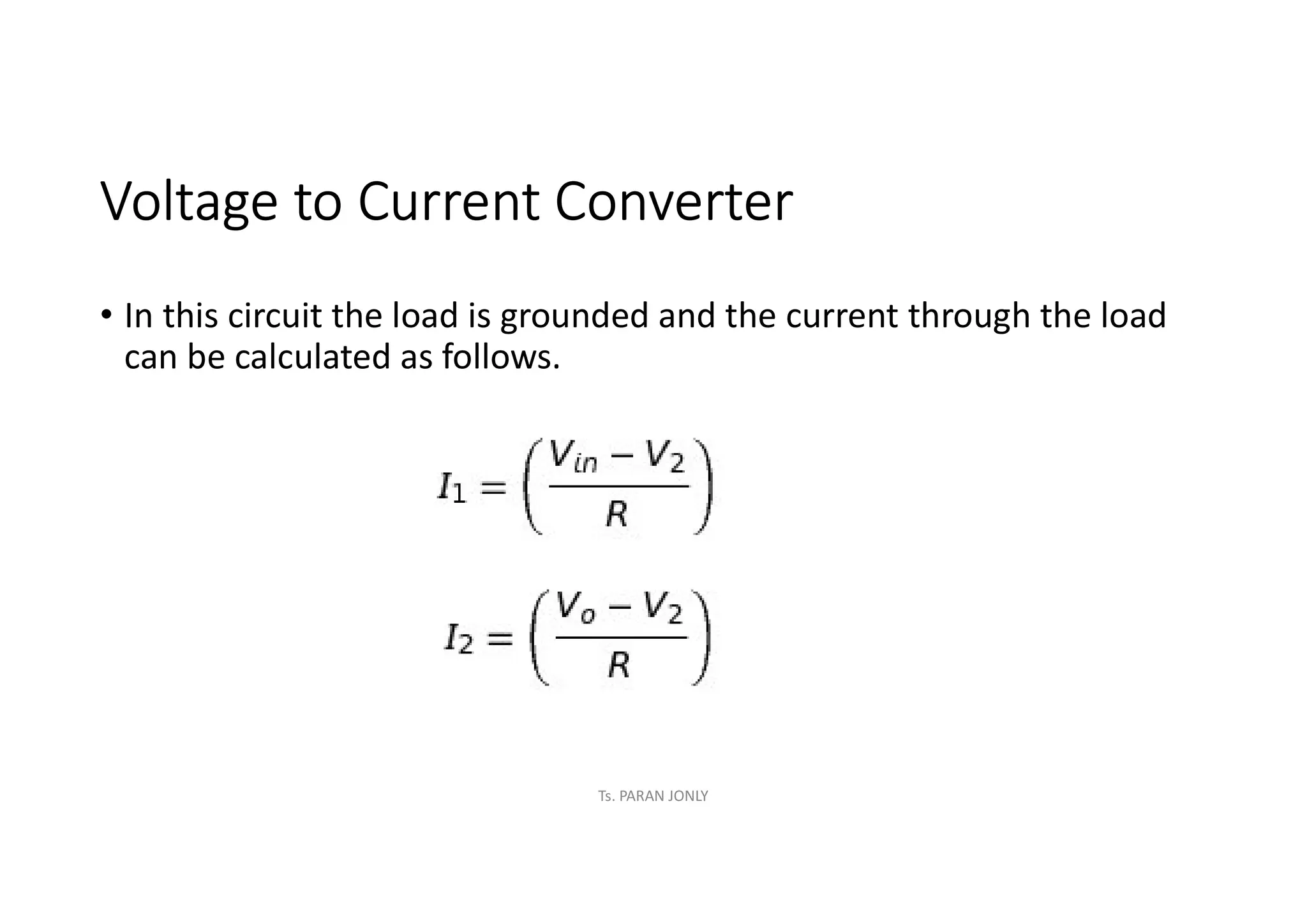
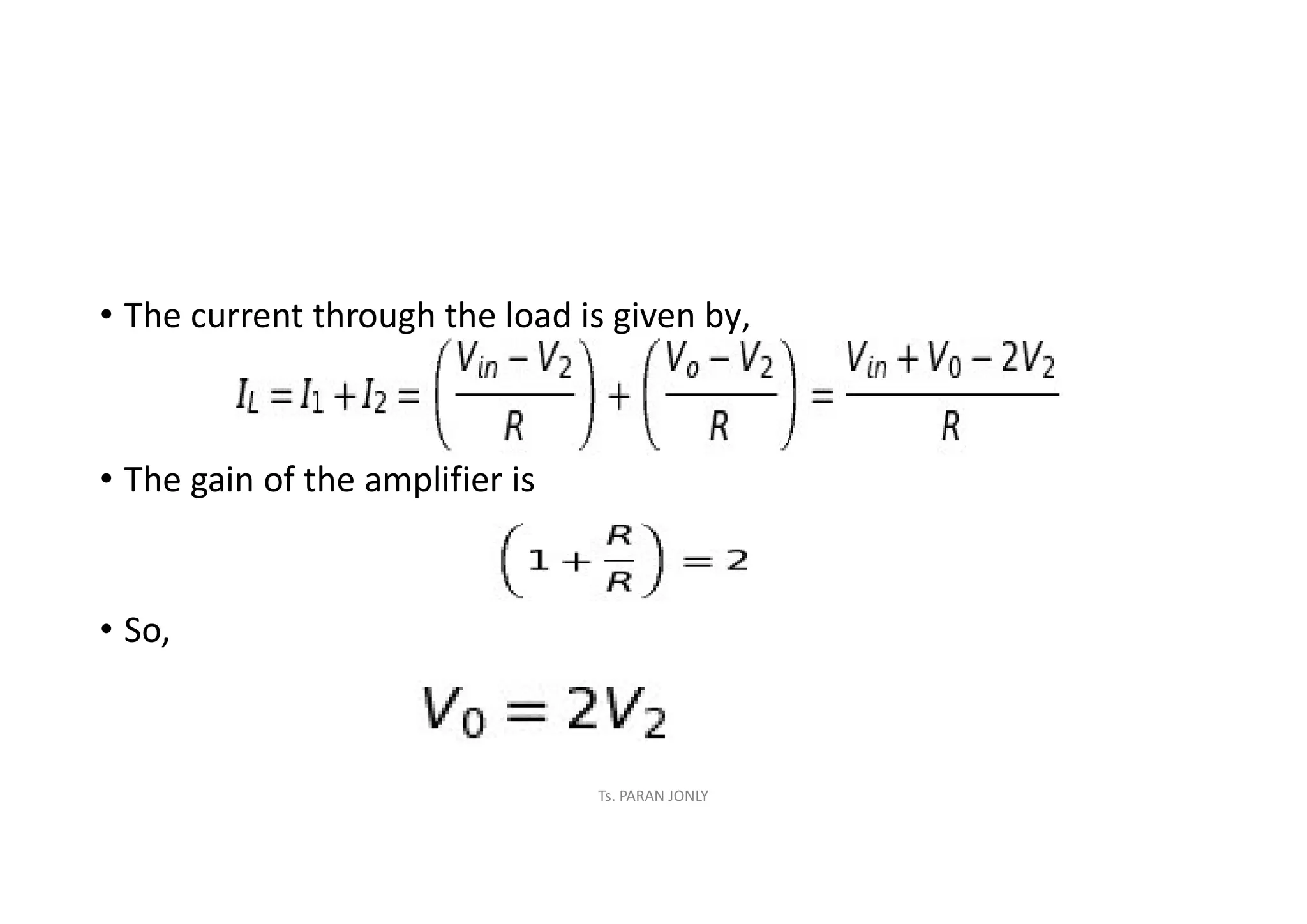
  • 109.
    Discussion & Presentation Basedon the classification of the measurement sensors, list down 3 SENSORS and then explain the 1. construction 2. operation 3. application of the sensors Ts. PARAN JONLY
  • 110.
    CLASS OF MEASUREMENTS 1.Temperature - 2. Level - 3. Flow - 4. Pressure - 110
  • 111.
    No. Sensors ConstructionOperation Application 1 Bourdon Tube • Hollow tube with and elleptical cross section. • When pressure difference exist between the inside and outside, the tube tends to straighten out and the end moves. • The movement is usually coupled to a needle on a dial to make a complete gauge. • Convert pressure into mechanical movement or into electrical output • Sense the pressure and indicate them on dial or scale • Machine and plant engineering • Gas distribution • Aerospace • Automotive • Chemical • Marine • Medical • Water • Waste • Fire • Food • Heating • Ventilating • General Industries 2 3 Ts. PARAN JONLY
  • 112.
  • 113.
    TEMPERATURE TRANSDUCER 1. Thermocouple Mostthermocouple metals produce a relationship between the two temperatures and the e.m.f as follow:
  • 114.
  • 115.
  • 117.
  • 118.
    FLOW METERS Differential PressureFlow Meter 1. Orifice meters 2. Venturi meters 3. Nozzle meters 4. Pitot tube
  • 121.
  • 122.
    Signal Conditioner CEE2163 Instrumentation andControl Part 1.3 Ts. PARAN JONLY
  • 123.
    In this Part1.3, you will learn: Signal Conditioning • Introduction to signal conditioning • Bridge circuits • Amplifiers • Protection • Filters Ts. PARAN JONLY
  • 124.
    Ts. PARAN JONLY ELECTRICALMEASUREMENT SYSTEM WHY? 1. Easy to transmit signal from measurement site the data collection site 2. Easy to amplify, filter and modify 3. Easy to record the signal
  • 125.
    Ts. PARAN JONLY Signalconditioning • Used in factory or machine automation : to convert sensor or transducer measurement signal levels to industry standard control signals • Provide computer and control system manufacturers a common communication method to effectively receive and transmit measurement and control data • Examples of measurement data : temperature or AC/DC voltage/current signals from various transducers • Examples of control data : on/off signals for a heating element or proportional signals for a valve actuator.
  • 126.
    Basic Measurement Systems Sensing Element Quantitybeing measured Signal related to quantity measured Signal Converter (Signal Conditioner) Display Element Signal in suitable form for display Value of the quantity Ts. PARAN JONLY
  • 127.
    Signal Conditioning • Signalconditioning is a basic component of all measurement devices. • It converts incoming measurements into a form acceptable to digitization hardware. • Signal conditioning not only defines what types of signals the system can accept, but also defines what additional features the system has to offer. Ts. PARAN JONLY
  • 128.
  • 129.
    Amplification • Amplification increasessignal amplitude before digitization occurs. • Amplification increases the measurement accuracy of small signals and reduces the effects of surrounding noise sources. • Converting a 0-10mV signal to a 0 -10V signal is an example of amplification. Ts. PARAN JONLY
  • 130.
  • 131.
    Attenuation • Attenuation reducessignal amplitude before digitization occurs, increasing the signal input range capabilities of the system. Ts. PARAN JONLY
  • 132.
    Isolation • Isolation providesthe protective barrier between digitization hardware and the real world, preventing common-mode voltage or signal spikes from damaging the measurement system. • Additionally, channel-to-channel isolation prevents one input signal from arcing to another input channel and back out of the system. • Finally, isolation prevents noise producing ground loops, which decrease signal quality. • It is required when incoming signals have common-mode voltages higher than (10 volts, or there is a chance for large spikes in the signal. Ts. PARAN JONLY
  • 133.
  • 134.
    Multiplexing • Expansion ofa measurement system's I/O channel count can be expanded by passing multiple signals to the same digitization hardware. • Use of multiplexing techniques allows acquisition of more signals for less money. Ts. PARAN JONLY
  • 135.
  • 136.
    Filtering • The filteringprocess blocks unwanted signal frequencies arising from external noise sources (generators, motors, power lines, etc.) from incoming signals. • Proper filtering also prevents anti-aliasing, where higher frequency components of a signal appear as lower frequency components. Ts. PARAN JONLY
  • 137.
  • 138.
    Cold-Junction Compensation • Thisspecific type of signal conditioning is required by thermocouples. • Cold-junction compensation removes small voltage errors caused by connecting a thermocouple using terminal blocks made of different metals than the T/C itself. • It does this by reading the ambient temperature at the point where the thermocouple connects to the system. Ts. PARAN JONLY
  • 139.
  • 140.
  • 141.
    Ts. PARAN JONLY Bridgecircuits • Used to convert impedance variations into voltage variations • Can be design so the voltage produced varies around zero • Amplification can be used to increase voltage level for increased sensitivity to variation of impedance
  • 142.
    Ts. PARAN JONLY Wheatstonebridge • D : voltage detector    4 1 2 3 4 2 3 1 4 1 2 3 4 2 4 3 1 3 R R R R V R R R R R R R R V V R R R V V R R R V V V V b a b a             
  • 143.
    Ts. PARAN JONLY Bridgeresolution • Resolution function of detector : to determine the bridge offset • Resistance resolution : resistance change in 1 arm bridge that causes an offset voltage equal to detector resolution • Detector can measure change of 100 µV
  • 144.
    Ts. PARAN JONLY Resolution •The smallest discernible change in input; the smallest change in input that manifests itself as perceptible change in output that can be measured (example : 0.000 1 mm) • Primary factor in deciding precision • Good resolution does not imply in good precision
  • 145.
  • 146.
    Ts. PARAN JONLY Currentbalance bridge • Used current to null bridge   5 5 4 2 5 4 3 1 3 5 5 4 2 5 4 5 4 2 5 4 IR V R R R R R V R R R V IR V R R R R R V R R R R R b                
  • 147.
    Ts. PARAN JONLY Potentialmeasurements using bridges
  • 148.
    Ts. PARAN JONLY Potentialmeasurements using bridges 0 0 0 5 5 5 4 2 5 4 3 1 3 4 2 4 3 1 3                     IR V IR V R R R R R V R R R V V R R R V R R R V V V V V V V x x x b c a x c
  • 149.
  • 150.
    Ts. PARAN JONLY Opamp characteristic
  • 151.
    Ts. PARAN JONLY Summingamplifier          2 3 2 1 1 2 V R R V R R Vout
  • 152.
    Ts. PARAN JONLY Noninvertingamplifier in out out in in V R R V R V V R V I I              1 2 2 1 2 1 1 0 0
  • 153.
    Ts. PARAN JONLY Differentialamplifier   CMRR CMR A A CMRR V V V cm b a cm 10 log 20 2       b a out V V A V   • The transfer function; • Common mode rejection;   1 2 1 2 V V R R Vout  
  • 154.
    Ts. PARAN JONLY Voltage-to-Currentconverter     5 4 3 3 5 4 4 2 5 3 1 3 1 2 R R R R I V R R R R R R R R V R R R I m sat ml in               
  • 155.
    Ts. PARAN JONLY Current-to-Voltageconverter IR Vout  
  • 156.
  • 157.
  • 158.
    Ts. PARAN JONLY Linearization           R V G V V I R V in out out in 0
  • 159.
    Ts. PARAN JONLY Linearization        R I V V V I V I e in c out out out 0 0 log 1 log 1 exp      
  • 160.
  • 161.
    Ts. PARAN JONLY Filters •Filter : a circuit that is designed to pass signals with desired frequencies and reject or attenuate others • 4 types of filters: 1. Low-pass filter: passes low frequencies and stops high frequencies 2. High-pass filter: passes high frequencies and rejects low frequencies 3. Band-pass filter: passes frequencies within a frequency band and blocks or attenuates frequencies outside the band 4. Band-reject filter: passes frequencies outside a frequency band and blocks or attenuates frequencies within the band
  • 162.
  • 163.
    Ts. PARAN JONLY Low-passRC filter • Critical frequency: • Output-to-input voltage ratio: RC fc  2 1   2 / 1 1 c in out f f V V  
  • 164.
  • 165.
    Ts. PARAN JONLY High-passRC filter • Critical frequency: • Output-to-input voltage ratio: RC fc  2 1     2 / 1 / c c in out f f f f V V  
  • 166.
    Ts. PARAN JONLY DesignMethods 1. Determine critical frequency, fc 2. Select standard capacitor (µF – pF) 3. Calculate required resistance (1 kΩ - 1 MΩ) 4. Use nearest resistance standard value to calculated value 5. Consider tolerance in resistors and capacitors
  • 167.
    Ts. PARAN JONLY Practicalconsiderations 1. Very small resistance -> lead to large currents and loading effects -> avoid large capacitance (R= kΩ -MΩ, C= µF – pF) 2. The exact fc is not important, choose R and C of approximately to the fc 3. Isolation filter input/output with voltage follower 4. Cascade RC filters to improved fc sharpness -> consider loading
  • 168.
  • 169.
    Ts. PARAN JONLY Band-passRC filter • Critical frequency: • Output-to-input voltage ratio: H H L C R f  2 1        L H H L L H H in out R R r f f r f f f f f f V V       2 2 2 2 1 L L H C R f  2 1 
  • 170.
  • 171.
  • 172.
  • 173.
    Ts. PARAN JONLY Twin-Tnotch filter • Critical frequency: • Grounding resistor and capacitor: c n f f 785 . 0  RC fC  2 1  c H f f 57 . 4  c L f f 187 . 0  10 1 R R    C C 10 1 
  • 174.
    Analog to DigitalConverter • Analog-to-Digital converters (ADC) translate analog signals, real world signals like temperature, pressure, voltage, current, distance, or light intensity, into a digital representation of that signal. • This digital representation can then be processed, manipulated, computed, transmitted or stored. Ts. PARAN JONLY
  • 175.
  • 176.
    Digital to AnalogConverter • Digital to analog converting is a process where digital signals that have a few (usually two) defined states are turned into analog signals, which have a theoretically infinite number of states. • A Digital to Analog Converter, or DAC, is an electronic device that converts a digital code to an analog signal such as a voltage, current, or electric charge. • Due to their cost, digital to analog converters are mostly manufactured on an integrated circuit (IC). Ts. PARAN JONLY
  • 177.
  • 178.
    Voltage to CurrentConverter • In this circuit the load is grounded and the current through the load can be calculated as follows. Ts. PARAN JONLY
  • 179.
    • The currentthrough the load is given by, • The gain of the amplifier is • So, Ts. PARAN JONLY
  • 180.
    Substituting this valuein above equation we get, Thus the current is directly proportional to the applied voltage and the resistance used in the circuit. it should be noted that all the resistances used in the circuit are equal to R. Ts. PARAN JONLY
  • 181.
    Current to VoltageConverter • The output voltage of operational amplifier is directly proportional to the current given to the inverting terminal of the op amp. • The value of the output voltage is given by the following equation Ts. PARAN JONLY
  • 182.
  • 183.
    Display Unit CEE2163 Instrumentation andControl Part 1.4 Ts. PARAN JONLY
  • 184.
    In this Part1.4, you will learn: Display Unit • Timer/Counter • LED Bargraph Display • Moving Coil Meter Ts. PARAN JONLY
  • 185.
    DISPLAYS DISPLAY ELEMENTS INDICATORS ANALOGUE (E.G. Moving coilmeter, cathode ray oscilloscope) DIGITAL (e.g. digital meter, on/off alarm light) RECORDERS ANALOGUE (e.g. chart recorders, magnetic-tape recorder) DIGITAL (e.g. digital printer, monitor, magnetic tape recorder Ts. PARAN JONLY
  • 186.
    Moving Coil meter •An analogue indicator with a pointer moving across the scale. • The amount of movement related to the input to the meter. • As current passes, forces act on the coil sides, the coil rotate, opposed by a spring, causes angular movement of the coil. • What are factors affected the meter accuracy? (temp, magnetic field, friction, scale marking, human errors, parallax, estimating, interpolating) Ts. PARAN JONLY
  • 187.
    The basis ofthe moving-coil meter MOVING COIL METER Ts. PARAN JONLY
  • 188.
    BASIC METER MOVEMENT Astationary, permanent-magnet, moving- coil meter is the basic meter movement used in most measuring instruments used for servicing electrical equipment. When current flows through the coil, a resulting magnetic field reacts with the magnetic field of the permanent magnet and causes the movable coil to rotate. The greater the intensity of current flow through the coil, the stronger the magnetic field produced; the stronger the magnetic field produced, the greater the rotation of the coil. The GALVANOMETER is an example of one type of stationary, permanent-magnet, moving-coil measuring instrument. Ts. PARAN JONLY
  • 189.
  • 190.
    The Digital Meter Analogueto digital converter Analogue input Digital voltmeter principle: Digital signals Counter Ts. PARAN JONLY
  • 191.
    On-off displays • Toindicate certain condition has been reached in measurement. • E.g bell, colored light, flashing light Ts. PARAN JONLY
  • 192.
  • 193.
    Analogue chart recorder •The input signal is shown with marking mechanism. • The marking mechanism, i.e. a pointer with a pen at its end, being directly moved by the measurement system. Ts. PARAN JONLY
  • 194.
  • 195.
    Potentiometric recorder • Isa closed loop recorder, the position of a pen is monitored by a slider which moves along a linear potentiometer. • The position of the potentiometer determine the potential applied to an amplifier. The signal produced is the difference of the from the measurement system. • The signal is used to operate a motor which control the pen movement. • This recorder has higher accuracies but slower response times, only be used for a slowly changing signal. • Error: dead band (0.3%) Ts. PARAN JONLY
  • 196.
    Example • A chartrecorder is to be used to monitor the temperatures of liquids in a number of vessels. The temperatures do not vary rapidly with time. A potentiometer chart recorder has been suggested. Would this be suitable? Ts. PARAN JONLY
  • 197.
    The cathode-ray oscilloscope(CRO)is a common laboratory instrument that provides accurate time and amplitude measurements of voltage signals over a wide range of frequencies. Its reliability, stability, and ease of operation make it suitable as a general purpose laboratory instrument. The heart of the CRO is a cathode-ray tube shown schematically in Fig. 1. Ts. PARAN JONLY
  • 198.
    • Electron producedat the cathode • electron beam produced, causes spot on the fluorescent screen • the electron accelerate depending on the potential difference between the cathode and anode. • The lens is used to focus the beam, produces a small luminous spot. Ts. PARAN JONLY
  • 199.
    Monitors • A displaydevice which uses cathode ray tube to display letters or alphabet and numbers, graphica and pictorial data. • The picture produces because of the electron beam travel being switch off and on by an input (i.e. from the measurement system) Ts. PARAN JONLY
  • 200.
    Magnetic recorder • Usedto record both analogue and digital signal. • A recording head consists of a coil wound on a core of ferromagnetic material • The input is electrical signal, which Ts. PARAN JONLY
  • 201.
    Digital printers • Givesrecords in the form of numbers, letters or special characters. • Various version of printers. • E.g. dot-matrix printer, which consists of print head with numbers of vertical line pins. Each pin controlled by an electromagnetic. The character is formed by moving the print head across the paper. The pin head the better the quality. Ts. PARAN JONLY