© Copyright National University of Singapore. All Rights Reserved.
Lecture 11
Machine Learning and AI
CN 5111
Lecturer: Dr Xiaonan Wang
Assistant Professor
Department of Chemical and Biomolecular Engineering
National University of Singapore
NUS Faculty of Engineering, Block E5, Unit #03-04
+65 6601 6221 (Tel) chewxia@nus.edu.sg
1
© Copyright National University of Singapore. All Rights Reserved.
Outline
•  Recap
•  An Overview of Machine Learning
Applications
Learning system model
Methods and Algorithms
•  Deep Learning
what and how
2
© Copyright National University of Singapore. All Rights Reserved. 3
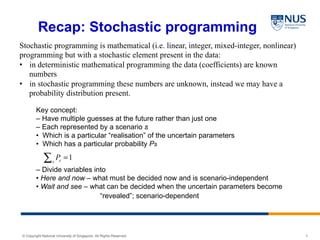
Stochastic programming is mathematical (i.e. linear, integer, mixed-integer, nonlinear)
programming but with a stochastic element present in the data:
•  in deterministic mathematical programming the data (coefficients) are known
numbers
•  in stochastic programming these numbers are unknown, instead we may have a
probability distribution present.
Key concept:
– Have multiple guesses at the future rather than just one
– Each represented by a scenario s
• Which is a particular “realisation” of the uncertain parameters
• Which has a particular probability Ps
– Divide variables into
• Here and now – what must be decided now and is scenario-independent
• Wait and see – what can be decided when the uncertain parameters become
“revealed”; scenario-dependent
Recap: Stochastic programming
1ss
P =∑
© Copyright National University of Singapore. All Rights Reserved. 4
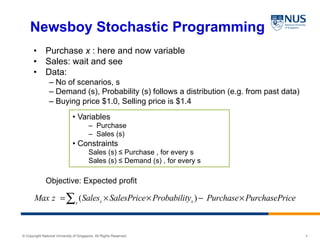
Newsboy Stochastic Programming
•  Purchase x : here and now variable
•  Sales: wait and see
•  Data:
– No of scenarios, s
– Demand (s), Probability (s) follows a distribution (e.g. from past data)
– Buying price $1.0, Selling price is $1.4
Objective: Expected profit
( )s ss
Max z Sales SalesPrice Probability Purchase PurchasePrice= × × − ×∑
• Variables
– Purchase
– Sales (s)
• Constraints
Sales (s) ≤ Purchase , for every s
Sales (s) ≤ Demand (s) , for every s
© Copyright National University of Singapore. All Rights Reserved. 5
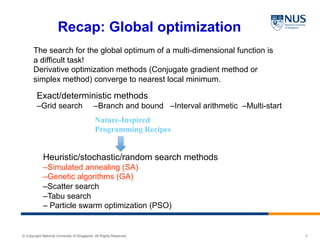
The search for the global optimum of a multi-dimensional function is
a difficult task!
Derivative optimization methods (Conjugate gradient method or
simplex method) converge to nearest local minimum.
Exact/deterministic methods
–Grid search –Branch and bound –Interval arithmetic –Multi-start
Heuristic/stochastic/random search methods
–Simulated annealing (SA)
–Genetic algorithms (GA)
–Scatter search
–Tabu search
– Particle swarm optimization (PSO)
Recap: Global optimization
Nature-Inspired
Programming Recipes
© Copyright National University of Singapore. All Rights Reserved. 6
Recap: Simulated Annealing (SA)
1.  Start at a given state s0 (point in multi-dimensional parameter space).
Compute cost or energy E(s0). Set temperature to T.
2. Consider somewhat different state s1. Corresponding cost or energy is E(s1).
3. If E(s1) < E(s0), switch from state s0 to state s1. Otherwise: compute
transition probability. Compute random number p uniformly distributed in
interval [0,1]. If p < P ( ) switch to new state s1. Otherwise, stay at s0.
4. Go to 2. (Lower temperature T after a number of steps have been made.)
Remarks: If temperature T is not too small, one cannot get trapped in a local
minimum.
The probability is:
– Proportional to the energy difference
– Modulated through a temperature parameter T
• for T→∞ the probability of any move approaches 1
• for T→0 the probability of any move approaches 0
0 1( )/
0 1( ) E E T
P s s e− −
→ =
0 1s s→
© Copyright National University of Singapore. All Rights Reserved. 7
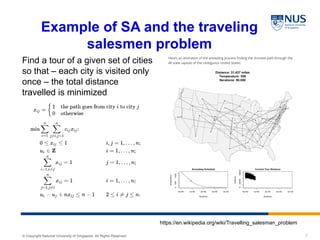
Example of SA and the traveling
salesmen problem
Find a tour of a given set of cities
so that – each city is visited only
once – the total distance
travelled is minimized
https://en.wikipedia.org/wiki/Travelling_salesman_problem
© Copyright National University of Singapore. All Rights Reserved. 8
Recap: Genetic Algorithm
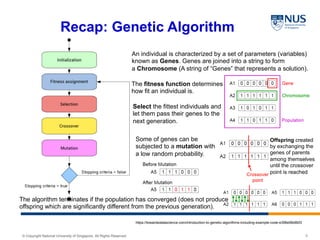
An individual is characterized by a set of parameters (variables)
known as Genes. Genes are joined into a string to form
a Chromosome (A string of “Genes” that represents a solution).
The fitness function determines
how fit an individual is.
Select the fittest individuals and
let them pass their genes to the
next generation.
Offspring created
by exchanging the
genes of parents
among themselves
until the crossover
point is reached
Some of genes can be
subjected to a mutation with
a low random probability.
The algorithm terminates if the population has converged (does not produce
offspring which are significantly different from the previous generation).
https://towardsdatascience.com/introduction-to-genetic-algorithms-including-example-code-e396e98d8bf3
© Copyright National University of Singapore. All Rights Reserved. 9
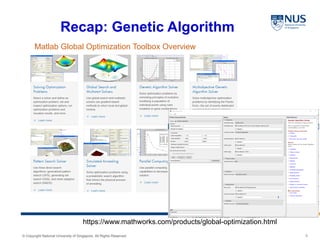
Recap: Genetic Algorithm
Matlab Global Optimization Toolbox Overview
https://www.mathworks.com/products/global-optimization.html
© Copyright National University of Singapore. All Rights Reserved.
Machine Learning
10
© Copyright National University of Singapore. All Rights Reserved. 11
Machine Learning
- Grew out of work in AI
- New capability for computers
Examples:
- Database mining
Large datasets from growth of automation/web.
E.g., Web click data, medical records, biology, engineering
- Applications can’t program by hand.
E.g., Autonomous helicopter, handwriting recognition, most of
Natural Language Processing (NLP), Computer Vision.
- Self-customizing programs
E.g., Amazon, Netflix product recommendations
- Understanding human learning (brain, real AI).
Machine Learning
The ML MOOC and deeplearning.ai’s Deep Learning Specialization
teach a lot of technical algorithms by Andrew Ng.
© Copyright National University of Singapore. All Rights Reserved. 12
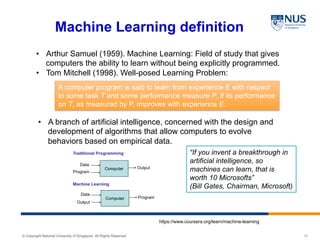
•  Arthur Samuel (1959). Machine Learning: Field of study that gives
computers the ability to learn without being explicitly programmed.
•  Tom Mitchell (1998). Well-posed Learning Problem:
A computer program is said to learn from experience E with respect
to some task T and some performance measure P, if its performance
on T, as measured by P, improves with experience E.
https://www.coursera.org/learn/machine-learning
•  A branch of artificial intelligence, concerned with the design and
development of algorithms that allow computers to evolve
behaviors based on empirical data.
“If you invent a breakthrough in
artificial intelligence, so
machines can learn, that is
worth 10 Microsofts”
(Bill Gates, Chairman, Microsoft)
Machine Learning definition
© Copyright National University of Singapore. All Rights Reserved. 13
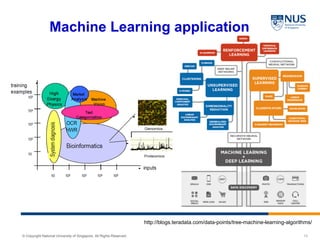
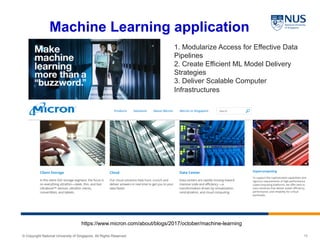
Machine Learning application
http://blogs.teradata.com/data-points/tree-machine-learning-algorithms/
© Copyright National University of Singapore. All Rights Reserved. 14
Machine Learning application
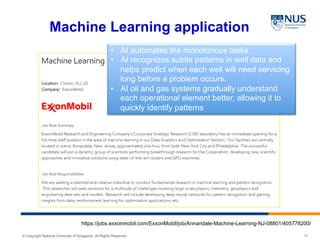
•  AI automates the monotonous tasks.
•  AI recognizes subtle patterns in well data and
helps predict when each well will need servicing
long before a problem occurs.
•  AI oil and gas systems gradually understand
each operational element better, allowing it to
quickly identify patterns
https://jobs.exxonmobil.com/ExxonMobil/job/Annandale-Machine-Learning-NJ-08801/405778200/
© Copyright National University of Singapore. All Rights Reserved. 15
Machine Learning application
https://www.micron.com/about/blogs/2017/october/machine-learning
1. Modularize Access for Effective Data
Pipelines
2. Create Efficient ML Model Delivery
Strategies
3. Deliver Scalable Computer
Infrastructures
© Copyright National University of Singapore. All Rights Reserved. 16
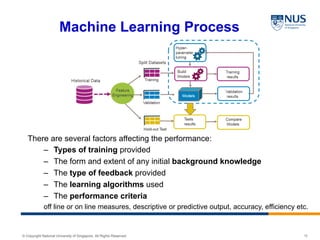
Machine Learning Process
There are several factors affecting the performance:
–  Types of training provided
–  The form and extent of any initial background knowledge
–  The type of feedback provided
–  The learning algorithms used
–  The performance criteria
off line or on line measures, descriptive or predictive output, accuracy, efficiency etc.
© Copyright National University of Singapore. All Rights Reserved. 17
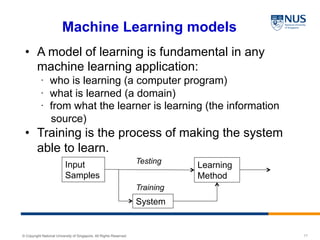
Machine Learning models
•  A model of learning is fundamental in any
machine learning application:
·  who is learning (a computer program)
·  what is learned (a domain)
·  from what the learner is learning (the information
source)
•  Training is the process of making the system
able to learn.
Input
Samples
Learning
Method
System
Training
Testing
© Copyright National University of Singapore. All Rights Reserved. 18
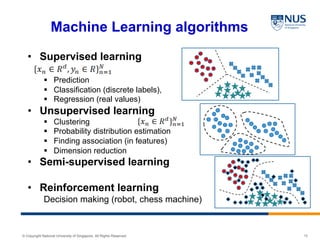
Machine Learning algorithms
•  Supervised learning
§  Prediction
§  Classification (discrete labels),
§  Regression (real values)
•  Unsupervised learning
§  Clustering
§  Probability distribution estimation
§  Finding association (in features)
§  Dimension reduction
•  Semi-supervised learning
•  Reinforcement learning
Decision making (robot, chess machine)
© Copyright National University of Singapore. All Rights Reserved. 19
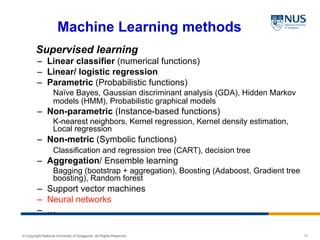
Supervised learning
–  Linear classifier (numerical functions)
–  Linear/ logistic regression
–  Parametric (Probabilistic functions)
Naïve Bayes, Gaussian discriminant analysis (GDA), Hidden Markov
models (HMM), Probabilistic graphical models
–  Non-parametric (Instance-based functions)
K-nearest neighbors, Kernel regression, Kernel density estimation,
Local regression
–  Non-metric (Symbolic functions)
Classification and regression tree (CART), decision tree
–  Aggregation/ Ensemble learning
Bagging (bootstrap + aggregation), Boosting (Adaboost, Gradient tree
boosting), Random forest
–  Support vector machines
–  Neural networks
–  …
Machine Learning methods
© Copyright National University of Singapore. All Rights Reserved. 20
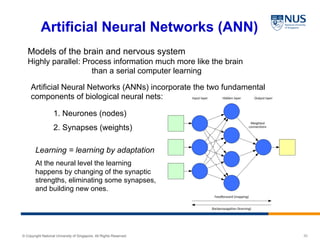
Artificial Neural Networks (ANN)
Models of the brain and nervous system
Highly parallel: Process information much more like the brain
than a serial computer learning
Artificial Neural Networks (ANNs) incorporate the two fundamental
components of biological neural nets:
1. Neurones (nodes)
2. Synapses (weights)
Learning = learning by adaptation
At the neural level the learning
happens by changing of the synaptic
strengths, eliminating some synapses,
and building new ones.
© Copyright National University of Singapore. All Rights Reserved. 21
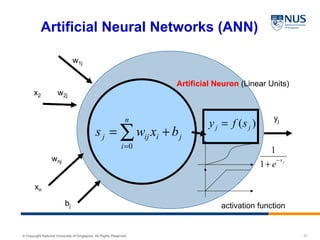
activation function
x2
xn
w1j
w2j
wnj
j
n
i
iijj bxws += ∑=0
)( jj sfy =
yj
bj
js
e
−
+1
1
Artificial Neuron (Linear Units)
Artificial Neural Networks (ANN)
© Copyright National University of Singapore. All Rights Reserved. 22
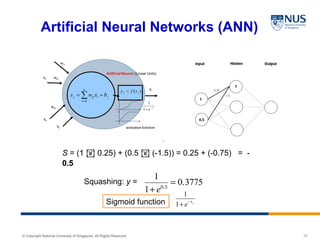
S = (1 ! 0.25) + (0.5 ! (-1.5)) = 0.25 + (-0.75) = -
0.5
0.3775
1
1
5.0
=
+ e
Squashing: y =
Artificial Neural Networks (ANN)
Sigmoid function js
e
−
+1
1
© Copyright National University of Singapore. All Rights Reserved. 23
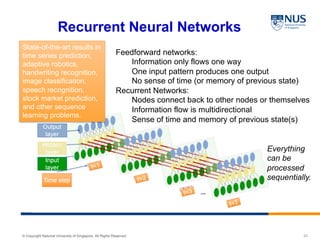
Recurrent Neural Networks
Feedforward networks:
Information only flows one way
One input pattern produces one output
No sense of time (or memory of previous state)
Recurrent Networks:
Nodes connect back to other nodes or themselves
Information flow is multidirectional
Sense of time and memory of previous state(s)
State-of-the-art results in
time series prediction,
adaptive robotics,
handwriting recognition,
image classification,
speech recognition,
stock market prediction,
and other sequence
learning problems.
Everything
can be
processed
sequentially.
© Copyright National University of Singapore. All Rights Reserved. 24
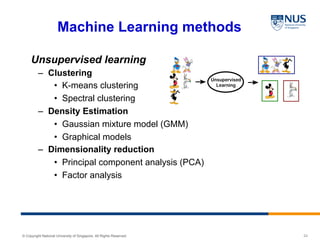
Unsupervised learning
–  Clustering
•  K-means clustering
•  Spectral clustering
–  Density Estimation
•  Gaussian mixture model (GMM)
•  Graphical models
–  Dimensionality reduction
•  Principal component analysis (PCA)
•  Factor analysis
Machine Learning methods
© Copyright National University of Singapore. All Rights Reserved. 25
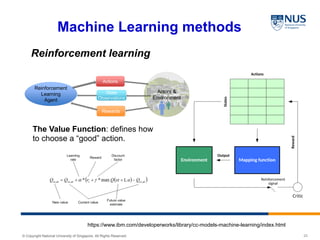
Machine Learning methods
https://www.ibm.com/developerworks/library/cc-models-machine-learning/index.html
Reinforcement learning
The Value Function: defines how
to choose a “good” action.
© Copyright National University of Singapore. All Rights Reserved. 26
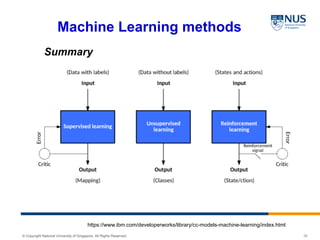
Machine Learning methods
https://www.ibm.com/developerworks/library/cc-models-machine-learning/index.html
Summary
© Copyright National University of Singapore. All Rights Reserved.
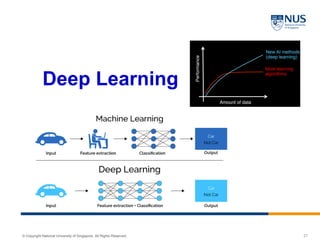
Deep Learning
27
© Copyright National University of Singapore. All Rights Reserved. 28
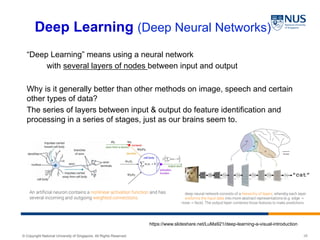
Deep Learning (Deep Neural Networks)
“Deep Learning” means using a neural network
with several layers of nodes between input and output
Why is it generally better than other methods on image, speech and certain
other types of data?
The series of layers between input & output do feature identification and
processing in a series of stages, just as our brains seem to.
https://www.slideshare.net/LuMa921/deep-learning-a-visual-introduction
© Copyright National University of Singapore. All Rights Reserved. 29
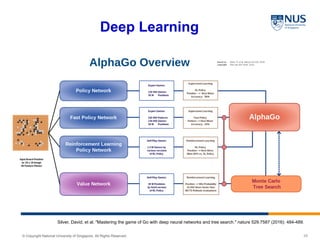
Deep Learning
Silver, David, et al. "Mastering the game of Go with deep neural networks and tree search." nature 529.7587 (2016): 484-489.
© Copyright National University of Singapore. All Rights Reserved. 30
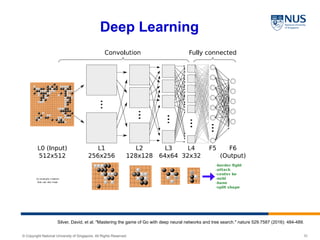
Deep Learning
Silver, David, et al. "Mastering the game of Go with deep neural networks and tree search." nature 529.7587 (2016): 484-489.
© Copyright National University of Singapore. All Rights Reserved. 31
Deep Learning software
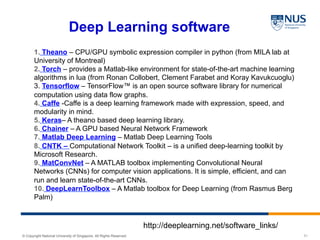
1.  Theano – CPU/GPU symbolic expression compiler in python (from MILA lab at
University of Montreal)
2.  Torch – provides a Matlab-like environment for state-of-the-art machine learning
algorithms in lua (from Ronan Collobert, Clement Farabet and Koray Kavukcuoglu)
3. Tensorflow – TensorFlow™ is an open source software library for numerical
computation using data flow graphs.
4.  Caffe -Caffe is a deep learning framework made with expression, speed, and
modularity in mind.
5.  Keras– A theano based deep learning library.
6.  Chainer – A GPU based Neural Network Framework
7.  Matlab Deep Learning – Matlab Deep Learning Tools
8.  CNTK – Computational Network Toolkit – is a unified deep-learning toolkit by
Microsoft Research.
9.  MatConvNet – A MATLAB toolbox implementing Convolutional Neural
Networks (CNNs) for computer vision applications. It is simple, efficient, and can
run and learn state-of-the-art CNNs.
10.  DeepLearnToolbox – A Matlab toolbox for Deep Learning (from Rasmus Berg
Palm)
http://deeplearning.net/software_links/
© Copyright National University of Singapore. All Rights Reserved.
Thank you
Happy Learning!
Lecturer: Dr Xiaonan Wang
Assistant Professor
Department of Chemical and Biomolecular Engineering
National University of Singapore
NUS Faculty of Engineering, Block E5, Unit #03-04
+65 6601 6221 (Tel) chewxia@nus.edu.sg
32

Lecture on AI and Machine Learning

  • 1.
    © Copyright NationalUniversity of Singapore. All Rights Reserved. Lecture 11 Machine Learning and AI CN 5111 Lecturer: Dr Xiaonan Wang Assistant Professor Department of Chemical and Biomolecular Engineering National University of Singapore NUS Faculty of Engineering, Block E5, Unit #03-04 +65 6601 6221 (Tel) chewxia@nus.edu.sg 1
  • 2.
    © Copyright NationalUniversity of Singapore. All Rights Reserved. Outline •  Recap •  An Overview of Machine Learning Applications Learning system model Methods and Algorithms •  Deep Learning what and how 2
  • 3.
    © Copyright NationalUniversity of Singapore. All Rights Reserved. 3 Stochastic programming is mathematical (i.e. linear, integer, mixed-integer, nonlinear) programming but with a stochastic element present in the data: •  in deterministic mathematical programming the data (coefficients) are known numbers •  in stochastic programming these numbers are unknown, instead we may have a probability distribution present. Key concept: – Have multiple guesses at the future rather than just one – Each represented by a scenario s • Which is a particular “realisation” of the uncertain parameters • Which has a particular probability Ps – Divide variables into • Here and now – what must be decided now and is scenario-independent • Wait and see – what can be decided when the uncertain parameters become “revealed”; scenario-dependent Recap: Stochastic programming 1ss P =∑
  • 4.
    © Copyright NationalUniversity of Singapore. All Rights Reserved. 4 Newsboy Stochastic Programming •  Purchase x : here and now variable •  Sales: wait and see •  Data: – No of scenarios, s – Demand (s), Probability (s) follows a distribution (e.g. from past data) – Buying price $1.0, Selling price is $1.4 Objective: Expected profit ( )s ss Max z Sales SalesPrice Probability Purchase PurchasePrice= × × − ×∑ • Variables – Purchase – Sales (s) • Constraints Sales (s) ≤ Purchase , for every s Sales (s) ≤ Demand (s) , for every s
  • 5.
    © Copyright NationalUniversity of Singapore. All Rights Reserved. 5 The search for the global optimum of a multi-dimensional function is a difficult task! Derivative optimization methods (Conjugate gradient method or simplex method) converge to nearest local minimum. Exact/deterministic methods –Grid search –Branch and bound –Interval arithmetic –Multi-start Heuristic/stochastic/random search methods –Simulated annealing (SA) –Genetic algorithms (GA) –Scatter search –Tabu search – Particle swarm optimization (PSO) Recap: Global optimization Nature-Inspired Programming Recipes
  • 6.
    © Copyright NationalUniversity of Singapore. All Rights Reserved. 6 Recap: Simulated Annealing (SA) 1.  Start at a given state s0 (point in multi-dimensional parameter space). Compute cost or energy E(s0). Set temperature to T. 2. Consider somewhat different state s1. Corresponding cost or energy is E(s1). 3. If E(s1) < E(s0), switch from state s0 to state s1. Otherwise: compute transition probability. Compute random number p uniformly distributed in interval [0,1]. If p < P ( ) switch to new state s1. Otherwise, stay at s0. 4. Go to 2. (Lower temperature T after a number of steps have been made.) Remarks: If temperature T is not too small, one cannot get trapped in a local minimum. The probability is: – Proportional to the energy difference – Modulated through a temperature parameter T • for T→∞ the probability of any move approaches 1 • for T→0 the probability of any move approaches 0 0 1( )/ 0 1( ) E E T P s s e− − → = 0 1s s→
  • 7.
    © Copyright NationalUniversity of Singapore. All Rights Reserved. 7 Example of SA and the traveling salesmen problem Find a tour of a given set of cities so that – each city is visited only once – the total distance travelled is minimized https://en.wikipedia.org/wiki/Travelling_salesman_problem
  • 8.
    © Copyright NationalUniversity of Singapore. All Rights Reserved. 8 Recap: Genetic Algorithm An individual is characterized by a set of parameters (variables) known as Genes. Genes are joined into a string to form a Chromosome (A string of “Genes” that represents a solution). The fitness function determines how fit an individual is. Select the fittest individuals and let them pass their genes to the next generation. Offspring created by exchanging the genes of parents among themselves until the crossover point is reached Some of genes can be subjected to a mutation with a low random probability. The algorithm terminates if the population has converged (does not produce offspring which are significantly different from the previous generation). https://towardsdatascience.com/introduction-to-genetic-algorithms-including-example-code-e396e98d8bf3
  • 9.
    © Copyright NationalUniversity of Singapore. All Rights Reserved. 9 Recap: Genetic Algorithm Matlab Global Optimization Toolbox Overview https://www.mathworks.com/products/global-optimization.html
  • 10.
    © Copyright NationalUniversity of Singapore. All Rights Reserved. Machine Learning 10
  • 11.
    © Copyright NationalUniversity of Singapore. All Rights Reserved. 11 Machine Learning - Grew out of work in AI - New capability for computers Examples: - Database mining Large datasets from growth of automation/web. E.g., Web click data, medical records, biology, engineering - Applications can’t program by hand. E.g., Autonomous helicopter, handwriting recognition, most of Natural Language Processing (NLP), Computer Vision. - Self-customizing programs E.g., Amazon, Netflix product recommendations - Understanding human learning (brain, real AI). Machine Learning The ML MOOC and deeplearning.ai’s Deep Learning Specialization teach a lot of technical algorithms by Andrew Ng.
  • 12.
    © Copyright NationalUniversity of Singapore. All Rights Reserved. 12 •  Arthur Samuel (1959). Machine Learning: Field of study that gives computers the ability to learn without being explicitly programmed. •  Tom Mitchell (1998). Well-posed Learning Problem: A computer program is said to learn from experience E with respect to some task T and some performance measure P, if its performance on T, as measured by P, improves with experience E. https://www.coursera.org/learn/machine-learning •  A branch of artificial intelligence, concerned with the design and development of algorithms that allow computers to evolve behaviors based on empirical data. “If you invent a breakthrough in artificial intelligence, so machines can learn, that is worth 10 Microsofts” (Bill Gates, Chairman, Microsoft) Machine Learning definition
  • 13.
    © Copyright NationalUniversity of Singapore. All Rights Reserved. 13 Machine Learning application http://blogs.teradata.com/data-points/tree-machine-learning-algorithms/
  • 14.
    © Copyright NationalUniversity of Singapore. All Rights Reserved. 14 Machine Learning application •  AI automates the monotonous tasks. •  AI recognizes subtle patterns in well data and helps predict when each well will need servicing long before a problem occurs. •  AI oil and gas systems gradually understand each operational element better, allowing it to quickly identify patterns https://jobs.exxonmobil.com/ExxonMobil/job/Annandale-Machine-Learning-NJ-08801/405778200/
  • 15.
    © Copyright NationalUniversity of Singapore. All Rights Reserved. 15 Machine Learning application https://www.micron.com/about/blogs/2017/october/machine-learning 1. Modularize Access for Effective Data Pipelines 2. Create Efficient ML Model Delivery Strategies 3. Deliver Scalable Computer Infrastructures
  • 16.
    © Copyright NationalUniversity of Singapore. All Rights Reserved. 16 Machine Learning Process There are several factors affecting the performance: –  Types of training provided –  The form and extent of any initial background knowledge –  The type of feedback provided –  The learning algorithms used –  The performance criteria off line or on line measures, descriptive or predictive output, accuracy, efficiency etc.
  • 17.
    © Copyright NationalUniversity of Singapore. All Rights Reserved. 17 Machine Learning models •  A model of learning is fundamental in any machine learning application: ·  who is learning (a computer program) ·  what is learned (a domain) ·  from what the learner is learning (the information source) •  Training is the process of making the system able to learn. Input Samples Learning Method System Training Testing
  • 18.
    © Copyright NationalUniversity of Singapore. All Rights Reserved. 18 Machine Learning algorithms •  Supervised learning §  Prediction §  Classification (discrete labels), §  Regression (real values) •  Unsupervised learning §  Clustering §  Probability distribution estimation §  Finding association (in features) §  Dimension reduction •  Semi-supervised learning •  Reinforcement learning Decision making (robot, chess machine)
  • 19.
    © Copyright NationalUniversity of Singapore. All Rights Reserved. 19 Supervised learning –  Linear classifier (numerical functions) –  Linear/ logistic regression –  Parametric (Probabilistic functions) Naïve Bayes, Gaussian discriminant analysis (GDA), Hidden Markov models (HMM), Probabilistic graphical models –  Non-parametric (Instance-based functions) K-nearest neighbors, Kernel regression, Kernel density estimation, Local regression –  Non-metric (Symbolic functions) Classification and regression tree (CART), decision tree –  Aggregation/ Ensemble learning Bagging (bootstrap + aggregation), Boosting (Adaboost, Gradient tree boosting), Random forest –  Support vector machines –  Neural networks –  … Machine Learning methods
  • 20.
    © Copyright NationalUniversity of Singapore. All Rights Reserved. 20 Artificial Neural Networks (ANN) Models of the brain and nervous system Highly parallel: Process information much more like the brain than a serial computer learning Artificial Neural Networks (ANNs) incorporate the two fundamental components of biological neural nets: 1. Neurones (nodes) 2. Synapses (weights) Learning = learning by adaptation At the neural level the learning happens by changing of the synaptic strengths, eliminating some synapses, and building new ones.
  • 21.
    © Copyright NationalUniversity of Singapore. All Rights Reserved. 21 activation function x2 xn w1j w2j wnj j n i iijj bxws += ∑=0 )( jj sfy = yj bj js e − +1 1 Artificial Neuron (Linear Units) Artificial Neural Networks (ANN)
  • 22.
    © Copyright NationalUniversity of Singapore. All Rights Reserved. 22 S = (1 ! 0.25) + (0.5 ! (-1.5)) = 0.25 + (-0.75) = - 0.5 0.3775 1 1 5.0 = + e Squashing: y = Artificial Neural Networks (ANN) Sigmoid function js e − +1 1
  • 23.
    © Copyright NationalUniversity of Singapore. All Rights Reserved. 23 Recurrent Neural Networks Feedforward networks: Information only flows one way One input pattern produces one output No sense of time (or memory of previous state) Recurrent Networks: Nodes connect back to other nodes or themselves Information flow is multidirectional Sense of time and memory of previous state(s) State-of-the-art results in time series prediction, adaptive robotics, handwriting recognition, image classification, speech recognition, stock market prediction, and other sequence learning problems. Everything can be processed sequentially.
  • 24.
    © Copyright NationalUniversity of Singapore. All Rights Reserved. 24 Unsupervised learning –  Clustering •  K-means clustering •  Spectral clustering –  Density Estimation •  Gaussian mixture model (GMM) •  Graphical models –  Dimensionality reduction •  Principal component analysis (PCA) •  Factor analysis Machine Learning methods
  • 25.
    © Copyright NationalUniversity of Singapore. All Rights Reserved. 25 Machine Learning methods https://www.ibm.com/developerworks/library/cc-models-machine-learning/index.html Reinforcement learning The Value Function: defines how to choose a “good” action.
  • 26.
    © Copyright NationalUniversity of Singapore. All Rights Reserved. 26 Machine Learning methods https://www.ibm.com/developerworks/library/cc-models-machine-learning/index.html Summary
  • 27.
    © Copyright NationalUniversity of Singapore. All Rights Reserved. Deep Learning 27
  • 28.
    © Copyright NationalUniversity of Singapore. All Rights Reserved. 28 Deep Learning (Deep Neural Networks) “Deep Learning” means using a neural network with several layers of nodes between input and output Why is it generally better than other methods on image, speech and certain other types of data? The series of layers between input & output do feature identification and processing in a series of stages, just as our brains seem to. https://www.slideshare.net/LuMa921/deep-learning-a-visual-introduction
  • 29.
    © Copyright NationalUniversity of Singapore. All Rights Reserved. 29 Deep Learning Silver, David, et al. "Mastering the game of Go with deep neural networks and tree search." nature 529.7587 (2016): 484-489.
  • 30.
    © Copyright NationalUniversity of Singapore. All Rights Reserved. 30 Deep Learning Silver, David, et al. "Mastering the game of Go with deep neural networks and tree search." nature 529.7587 (2016): 484-489.
  • 31.
    © Copyright NationalUniversity of Singapore. All Rights Reserved. 31 Deep Learning software 1.  Theano – CPU/GPU symbolic expression compiler in python (from MILA lab at University of Montreal) 2.  Torch – provides a Matlab-like environment for state-of-the-art machine learning algorithms in lua (from Ronan Collobert, Clement Farabet and Koray Kavukcuoglu) 3. Tensorflow – TensorFlow™ is an open source software library for numerical computation using data flow graphs. 4.  Caffe -Caffe is a deep learning framework made with expression, speed, and modularity in mind. 5.  Keras– A theano based deep learning library. 6.  Chainer – A GPU based Neural Network Framework 7.  Matlab Deep Learning – Matlab Deep Learning Tools 8.  CNTK – Computational Network Toolkit – is a unified deep-learning toolkit by Microsoft Research. 9.  MatConvNet – A MATLAB toolbox implementing Convolutional Neural Networks (CNNs) for computer vision applications. It is simple, efficient, and can run and learn state-of-the-art CNNs. 10.  DeepLearnToolbox – A Matlab toolbox for Deep Learning (from Rasmus Berg Palm) http://deeplearning.net/software_links/
  • 32.
    © Copyright NationalUniversity of Singapore. All Rights Reserved. Thank you Happy Learning! Lecturer: Dr Xiaonan Wang Assistant Professor Department of Chemical and Biomolecular Engineering National University of Singapore NUS Faculty of Engineering, Block E5, Unit #03-04 +65 6601 6221 (Tel) chewxia@nus.edu.sg 32