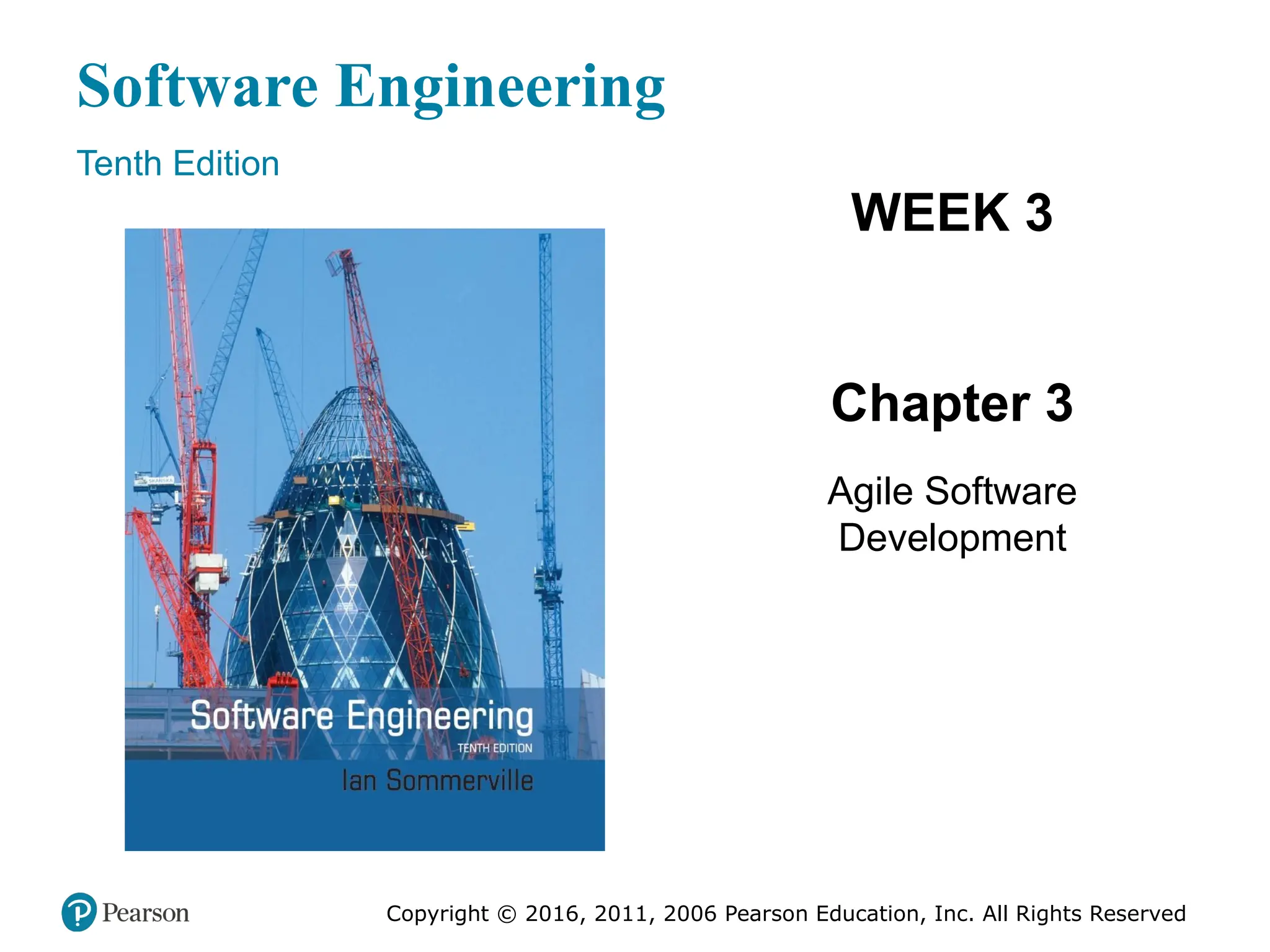
Software Engineering
Tenth Edition
WEEK 3
Chapter 3
Agile Software
Development
Copyright © 2016, 2011, 2006 Pearson Education, Inc. All Rights Reserved
Copyright © 2016, 2012, 2009 by Pearson Education, Inc.
All Rights Reserved
Medical Law and Ethics, Fifth Edition
Bonnie F. Fremgen
Copyright © 2016, 2011, 2006 Pearson Education, Inc. All Rights Reserved
Learning Objectives
3.1 Agile methods
3.2 Agile development techniques
3.3 Agile project management
Copyright © 2016, 2012, 2009 by Pearson Education, Inc.
All Rights Reserved
Medical Law and Ethics, Fifth Edition
Bonnie F. Fremgen
Copyright © 2016, 2011, 2006 Pearson Education, Inc. All Rights Reserved
Rapid Software Development
• Rapid development and delivery is now often the most
important requirement for software systems
– Businesses operate in a fast –changing requirement and it
is practically impossible to produce a set of stable software
requirements
– Software has to evolve quickly to reflect changing
business needs.
• Plan-driven development is essential for some types of system
but does not meet these business needs.
• Agile development methods emerged in the late 1990s whose
aim was to radically reduce the delivery time for working
software systems
Copyright © 2016, 2012, 2009 by Pearson Education, Inc.
All Rights Reserved
Medical Law and Ethics, Fifth Edition
Bonnie F. Fremgen
Copyright © 2016, 2011, 2006 Pearson Education, Inc. All Rights Reserved
Agile Development
• Program specification, design and implementation are
inter-leaved
• The system is developed as a series of versions or
increments with stakeholders involved in version
specification and evaluation
• Frequent delivery of new versions for evaluation
• Extensive tool support (e.g. automated testing tools) used
to support development.
• Minimal documentation – focus on working code
Copyright © 2016, 2011, 2006 Pearson Education, Inc. All Rights Reserved
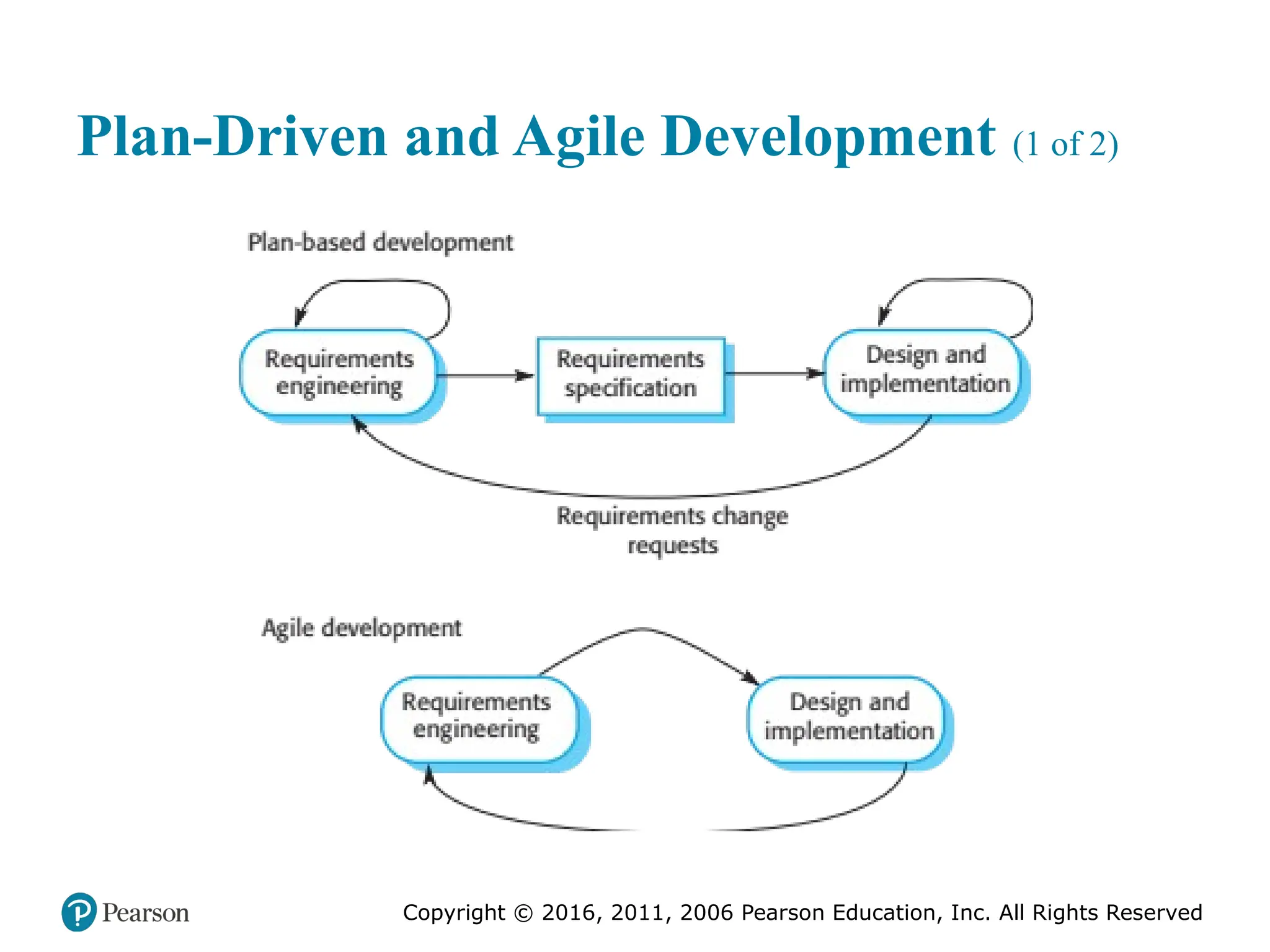
Plan-Driven and Agile Development (1 of 2)
Copyright © 2016, 2012, 2009 by Pearson Education, Inc.
All Rights Reserved
Medical Law and Ethics, Fifth Edition
Bonnie F. Fremgen
Copyright © 2016, 2011, 2006 Pearson Education, Inc. All Rights Reserved
Plan-Driven and Agile Development(2 of 2)
• Plan-driven development
– A plan-driven approach to software engineering is based
around separate development stages with the outputs to
be produced and each of these stages are planned in
advance.
– Not necessarily waterfall model – plan-driven, incremental
development is possible
– Iteration occurs within activities.
• Agile development
– Specification, design, implementation and testing are inter-
leaved and the outputs from the development process are
decided through a process of negotiation during the
software development process.
Copyright © 2016, 2011, 2006 Pearson Education, Inc. All Rights Reserved
Agile Methods
Copyright © 2016, 2012, 2009 by Pearson Education, Inc.
All Rights Reserved
Medical Law and Ethics, Fifth Edition
Bonnie F. Fremgen
Copyright © 2016, 2011, 2006 Pearson Education, Inc. All Rights Reserved
Agile Methods
• Dissatisfaction with the overheads involved in software
design methods of the 1980s and 1990s led to the
creation of agile methods. These methods:
– Focus on the code rather than the design
– Are based on an iterative approach to software development
– Are intended to deliver working software quickly and evolve this
quickly to meet changing requirements.
• The aim of agile methods is to reduce overheads in the
software process (e.g. by limiting documentation) and to
be able to respond quickly to changing requirements
without excessive rework.
Copyright © 2016, 2012, 2009 by Pearson Education, Inc.
All Rights Reserved
Medical Law and Ethics, Fifth Edition
Bonnie F. Fremgen
Copyright © 2016, 2011, 2006 Pearson Education, Inc. All Rights Reserved
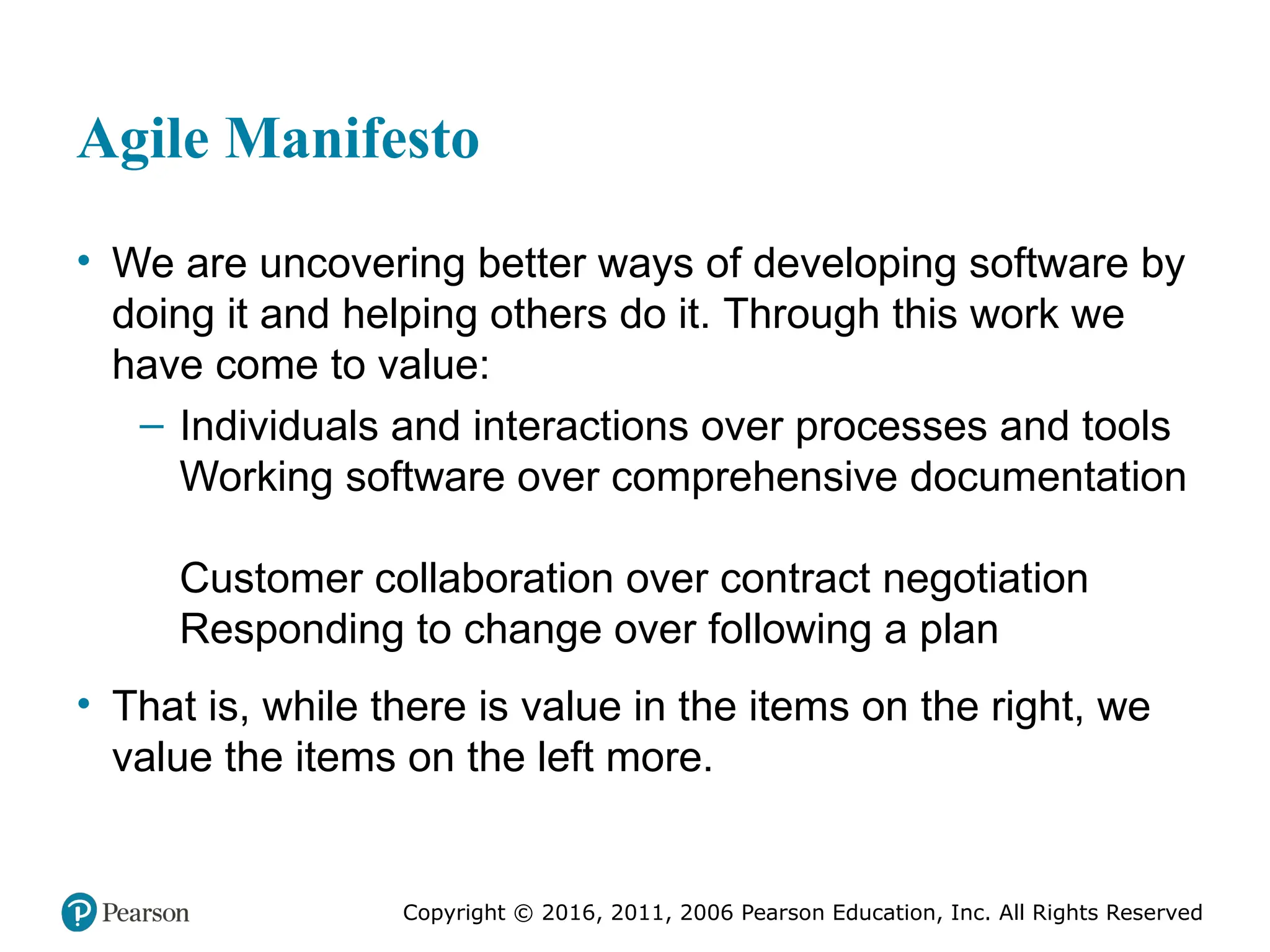
Agile Manifesto
• We are uncovering better ways of developing software by
doing it and helping others do it. Through this work we
have come to value:
– Individuals and interactions over processes and tools
Working software over comprehensive documentation
Customer collaboration over contract negotiation
Responding to change over following a plan
• That is, while there is value in the items on the right, we
value the items on the left more.
Copyright © 2016, 2011, 2006 Pearson Education, Inc. All Rights Reserved
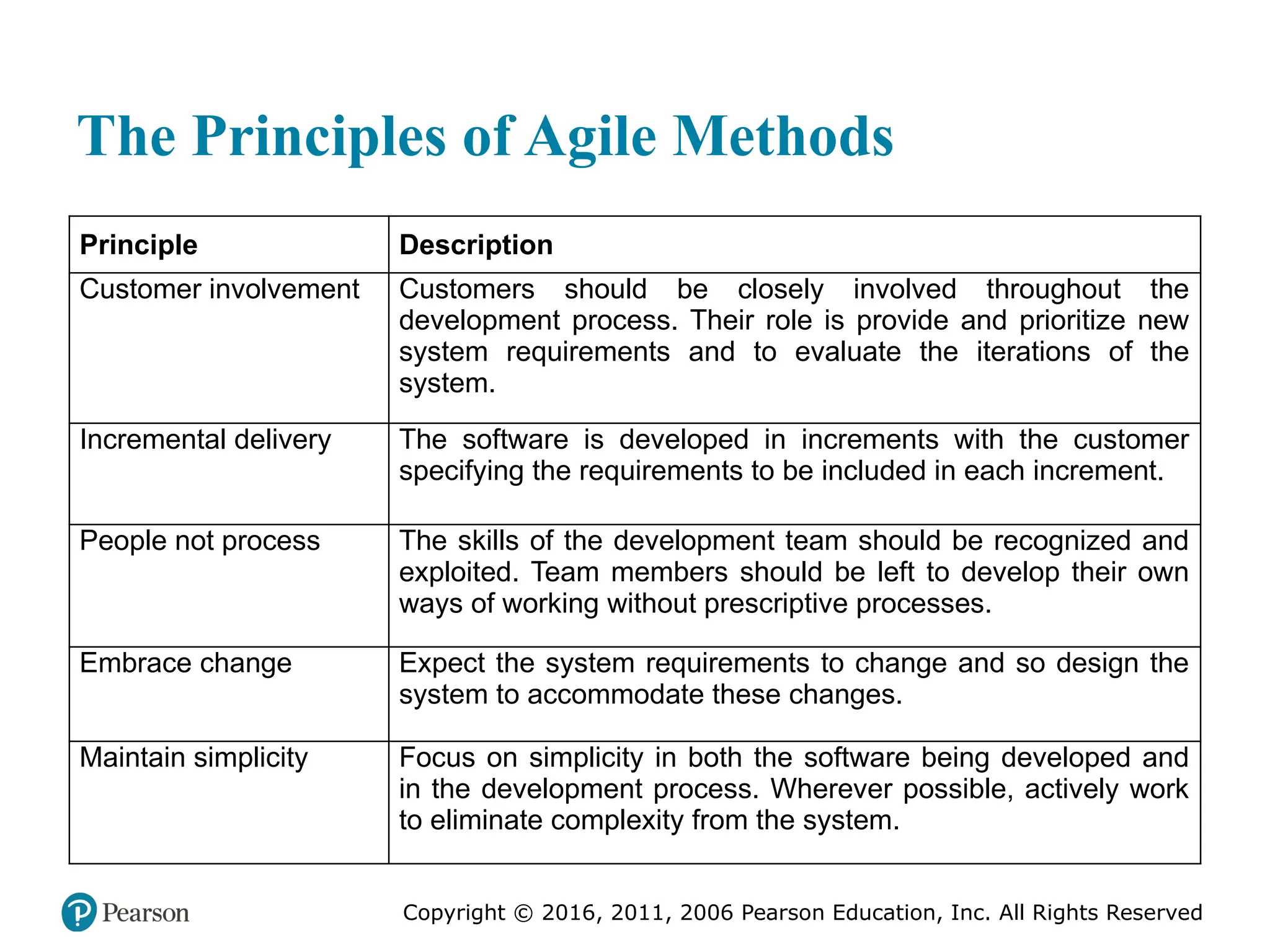
The Principles of Agile Methods
Principle Description
Customer involvement Customers should be closely involved throughout the
development process. Their role is provide and prioritize new
system requirements and to evaluate the iterations of the
system.
Incremental delivery The software is developed in increments with the customer
specifying the requirements to be included in each increment.
People not process The skills of the development team should be recognized and
exploited. Team members should be left to develop their own
ways of working without prescriptive processes.
Embrace change Expect the system requirements to change and so design the
system to accommodate these changes.
Maintain simplicity Focus on simplicity in both the software being developed and
in the development process. Wherever possible, actively work
to eliminate complexity from the system.
Copyright © 2016, 2012, 2009 by Pearson Education, Inc.
All Rights Reserved
Medical Law and Ethics, Fifth Edition
Bonnie F. Fremgen
Copyright © 2016, 2011, 2006 Pearson Education, Inc. All Rights Reserved
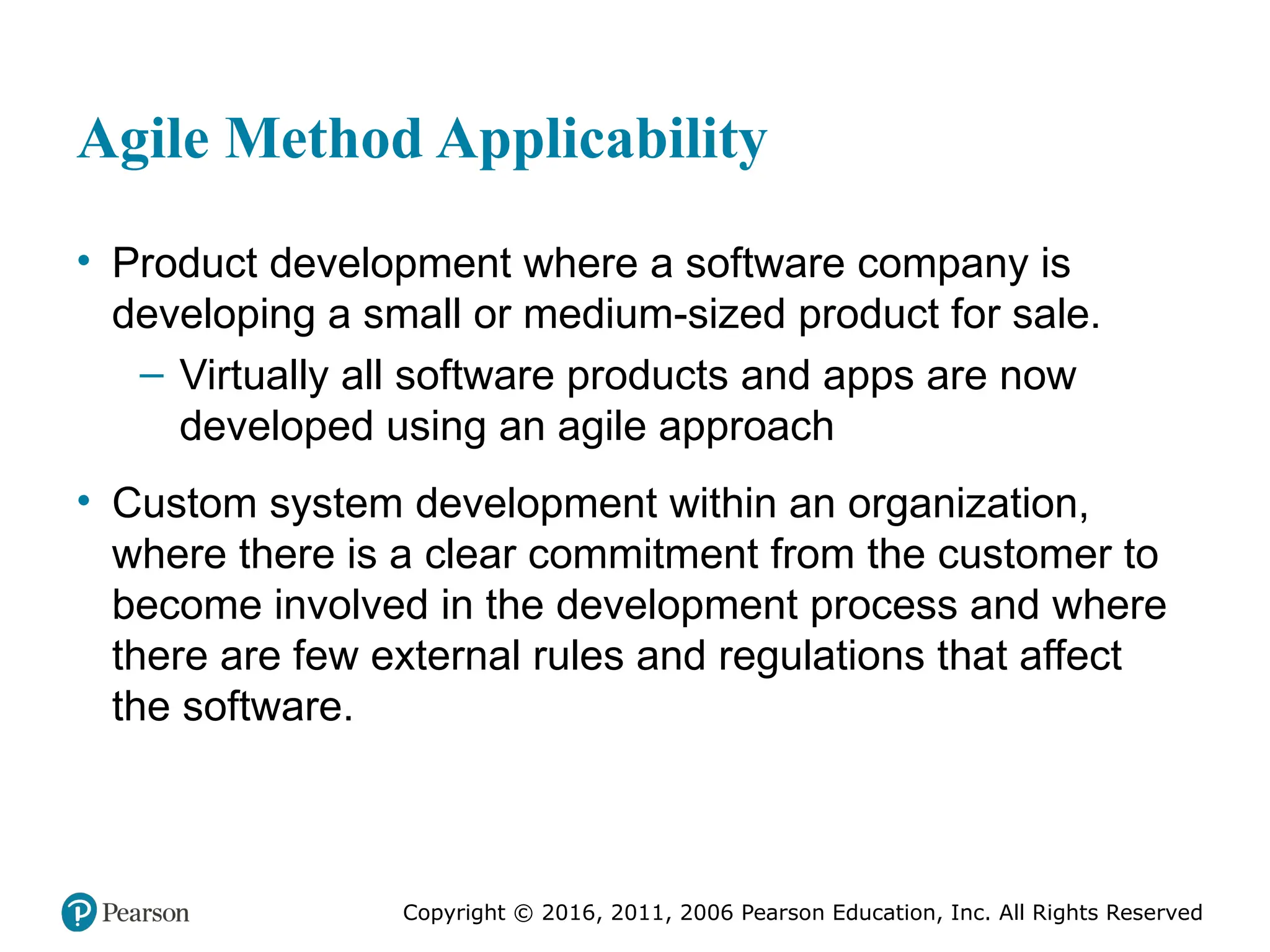
Agile Method Applicability
• Product development where a software company is
developing a small or medium-sized product for sale.
– Virtually all software products and apps are now
developed using an agile approach
• Custom system development within an organization,
where there is a clear commitment from the customer to
become involved in the development process and where
there are few external rules and regulations that affect
the software.
Copyright © 2016, 2011, 2006 Pearson Education, Inc. All Rights Reserved
Agile Development Techniques
Copyright © 2016, 2012, 2009 by Pearson Education, Inc.
All Rights Reserved
Medical Law and Ethics, Fifth Edition
Bonnie F. Fremgen
Copyright © 2016, 2011, 2006 Pearson Education, Inc. All Rights Reserved
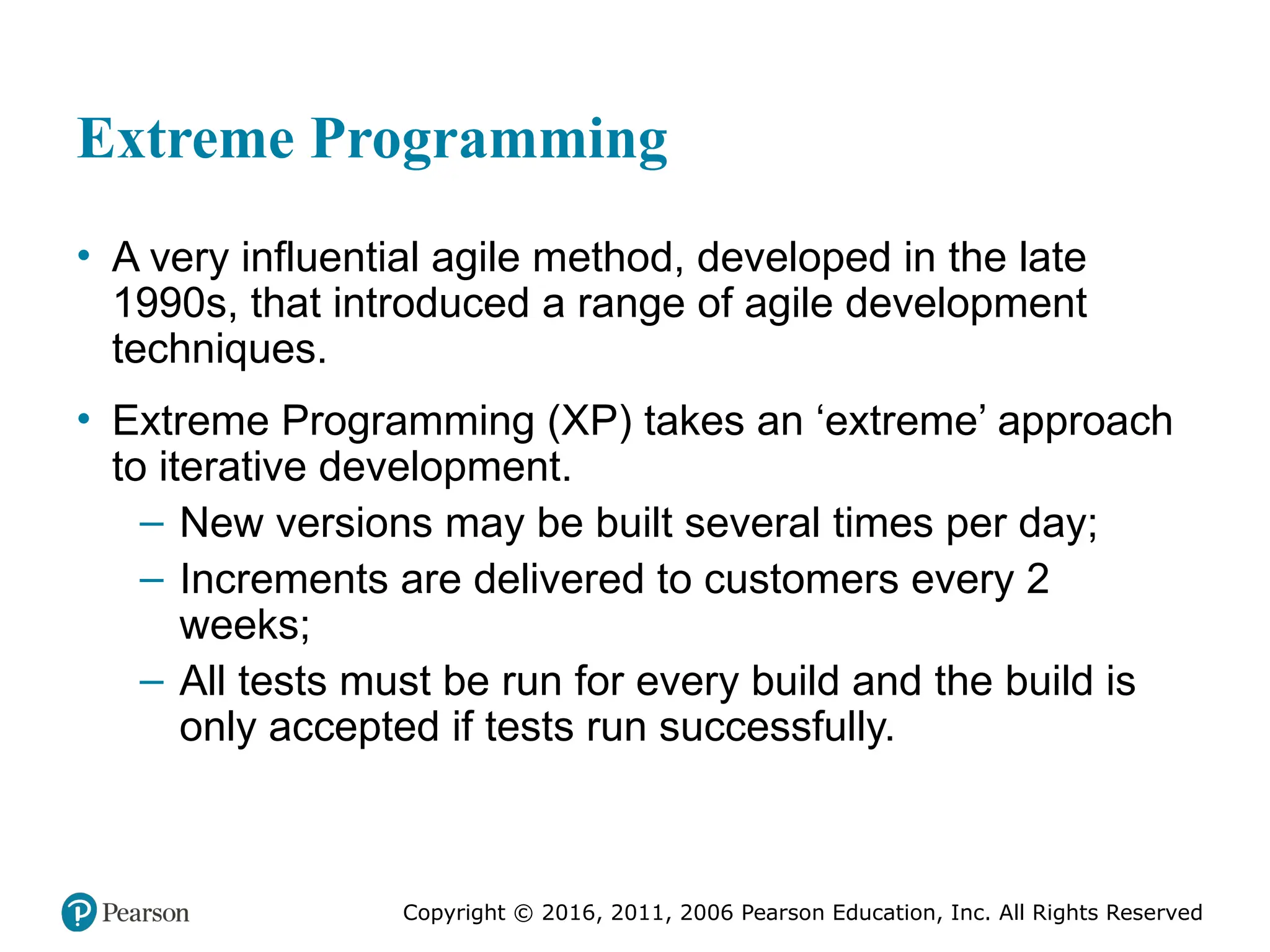
Extreme Programming
• A very influential agile method, developed in the late
1990s, that introduced a range of agile development
techniques.
• Extreme Programming (XP) takes an ‘extreme’ approach
to iterative development.
– New versions may be built several times per day;
– Increments are delivered to customers every 2
weeks;
– All tests must be run for every build and the build is
only accepted if tests run successfully.
Copyright © 2016, 2012, 2009 by Pearson Education, Inc.
All Rights Reserved
Medical Law and Ethics, Fifth Edition
Bonnie F. Fremgen
Copyright © 2016, 2011, 2006 Pearson Education, Inc. All Rights Reserved
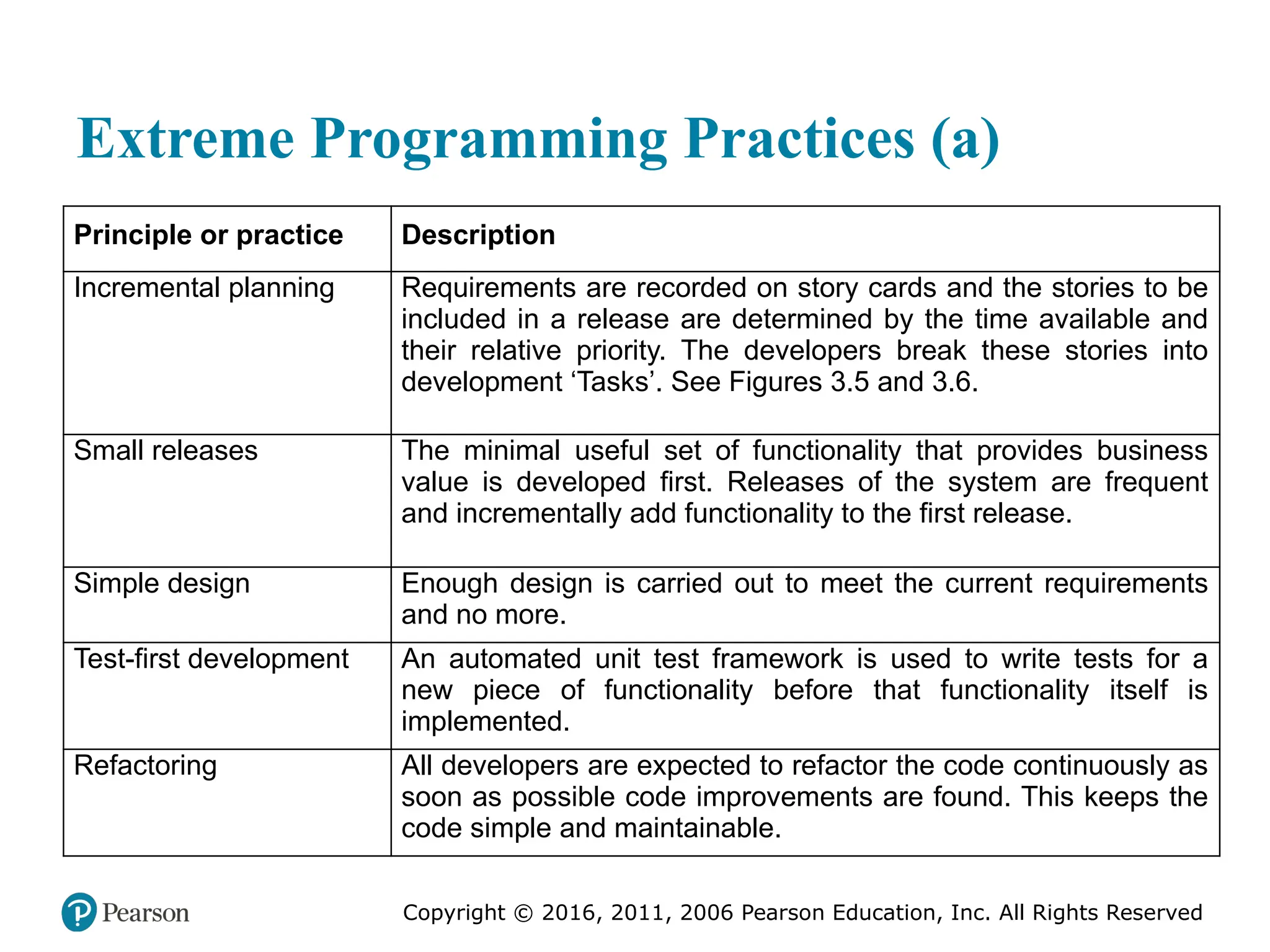
Extreme Programming Practices (a)
Principle or practice Description
Incremental planning Requirements are recorded on story cards and the stories to be
included in a release are determined by the time available and
their relative priority. The developers break these stories into
development ‘Tasks’. See Figures 3.5 and 3.6.
Small releases The minimal useful set of functionality that provides business
value is developed first. Releases of the system are frequent
and incrementally add functionality to the first release.
Simple design Enough design is carried out to meet the current requirements
and no more.
Test-first development An automated unit test framework is used to write tests for a
new piece of functionality before that functionality itself is
implemented.
Refactoring All developers are expected to refactor the code continuously as
soon as possible code improvements are found. This keeps the
code simple and maintainable.
Copyright © 2016, 2012, 2009 by Pearson Education, Inc.
All Rights Reserved
Medical Law and Ethics, Fifth Edition
Bonnie F. Fremgen
Copyright © 2016, 2011, 2006 Pearson Education, Inc. All Rights Reserved
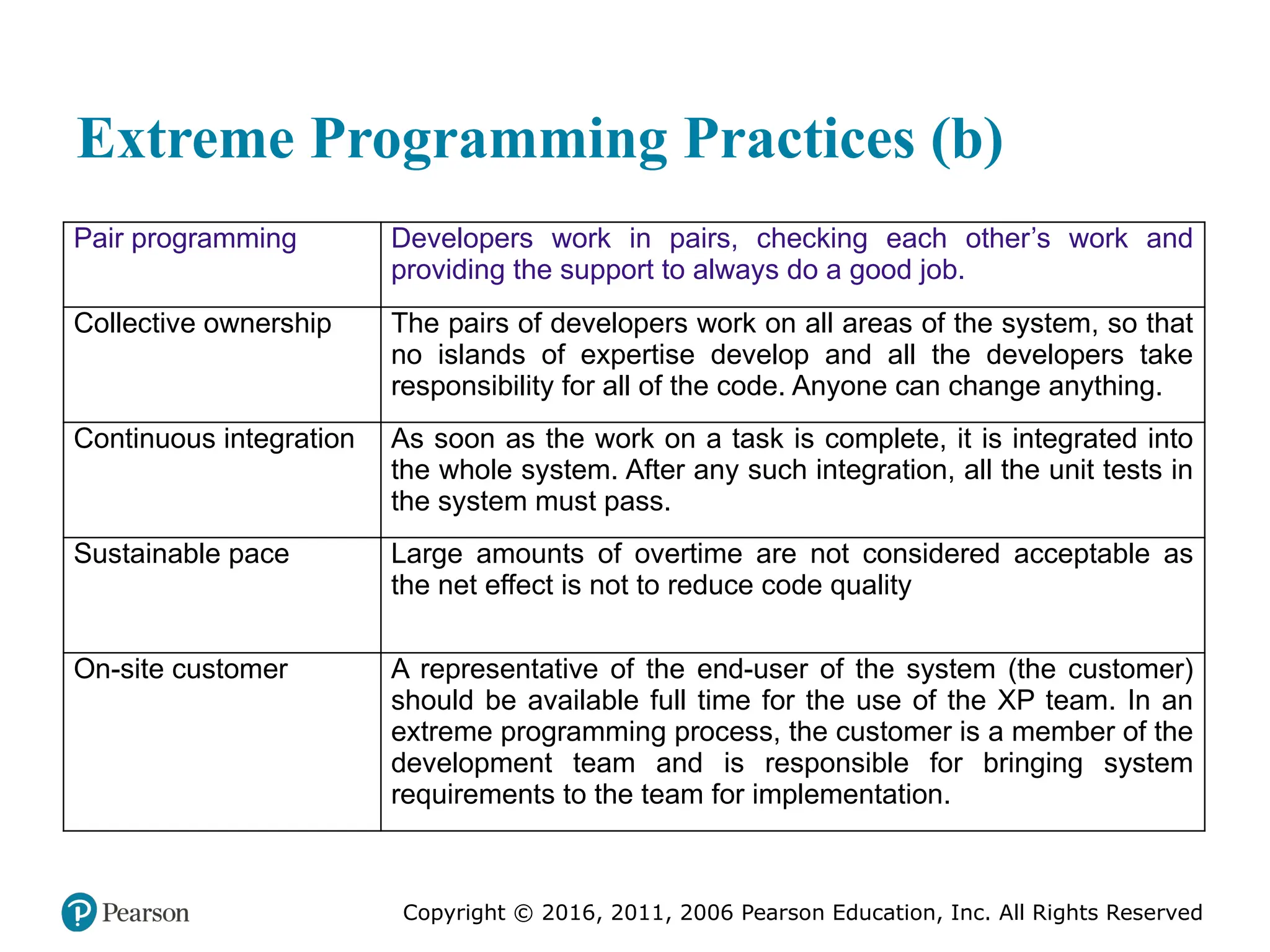
Extreme Programming Practices (b)
Pair programming Developers work in pairs, checking each other’s work and
providing the support to always do a good job.
Collective ownership The pairs of developers work on all areas of the system, so that
no islands of expertise develop and all the developers take
responsibility for all of the code. Anyone can change anything.
Continuous integration As soon as the work on a task is complete, it is integrated into
the whole system. After any such integration, all the unit tests in
the system must pass.
Sustainable pace Large amounts of overtime are not considered acceptable as
the net effect is not to reduce code quality
On-site customer A representative of the end-user of the system (the customer)
should be available full time for the use of the XP team. In an
extreme programming process, the customer is a member of the
development team and is responsible for bringing system
requirements to the team for implementation.
Copyright © 2016, 2012, 2009 by Pearson Education, Inc.
All Rights Reserved
Medical Law and Ethics, Fifth Edition
Bonnie F. Fremgen
Copyright © 2016, 2011, 2006 Pearson Education, Inc. All Rights Reserved
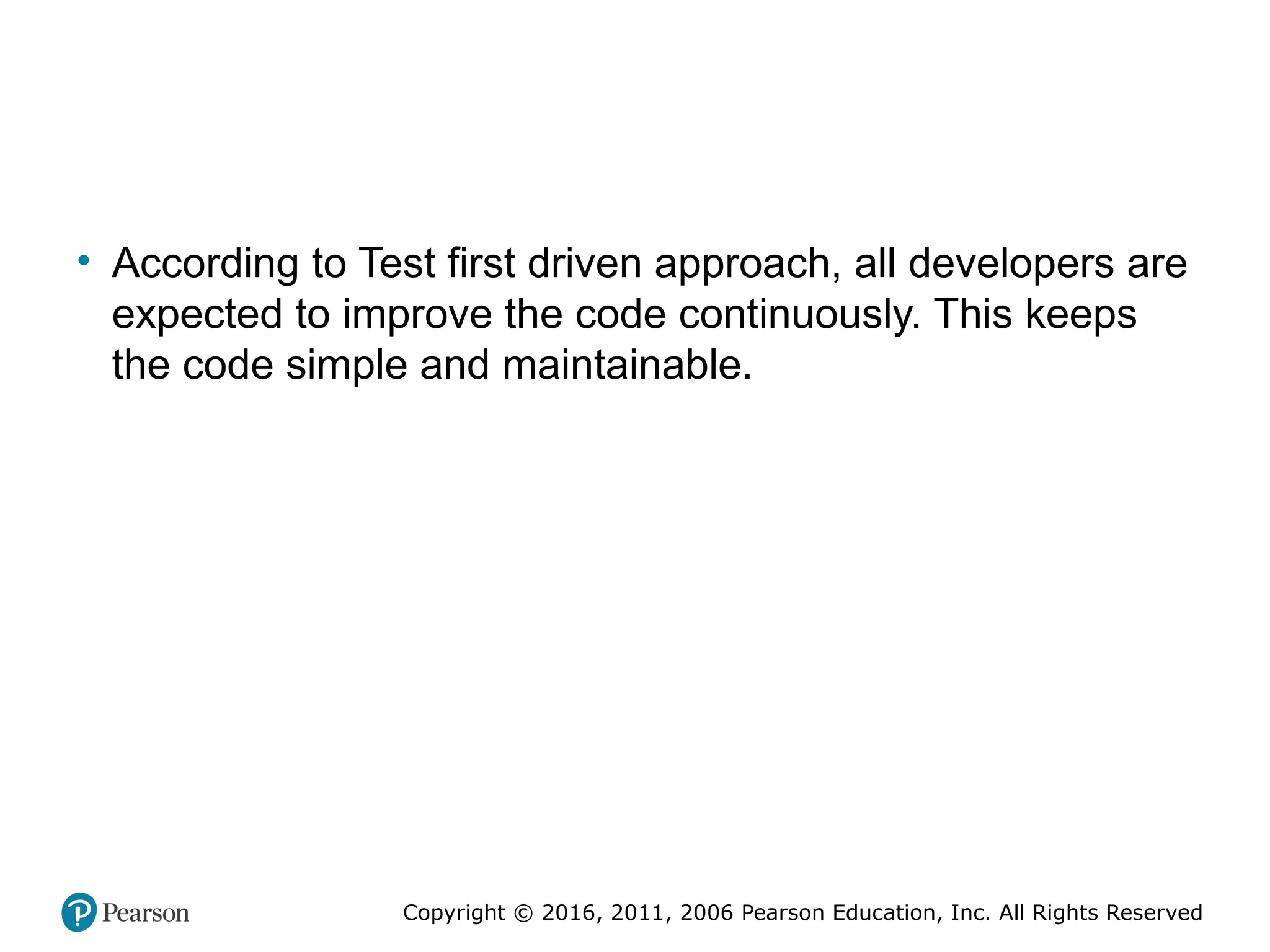
• According to Test first driven approach, all developers are
expected to improve the code continuously. This keeps
the code simple and maintainable.
Copyright © 2016, 2012, 2009 by Pearson Education, Inc.
All Rights Reserved
Medical Law and Ethics, Fifth Edition
Bonnie F. Fremgen
Copyright © 2016, 2011, 2006 Pearson Education, Inc. All Rights Reserved
• Pair programming helps develop common ownership of
code and spreads knowledge across the team. It also
encourages the whole team to improve the system code.
Copyright © 2016, 2012, 2009 by Pearson Education, Inc.
All Rights Reserved
Medical Law and Ethics, Fifth Edition
Bonnie F. Fremgen
Copyright © 2016, 2011, 2006 Pearson Education, Inc. All Rights Reserved
• The sharing of knowledge that happens during Pair
Programming is very important as it reduces the overall
risks to a project when team members leave.
Copyright © 2016, 2012, 2009 by Pearson Education, Inc.
All Rights Reserved
Medical Law and Ethics, Fifth Edition
Bonnie F. Fremgen
Copyright © 2016, 2011, 2006 Pearson Education, Inc. All Rights Reserved
XP and Agile Principles
• Incremental development is supported through small,
frequent system releases.
• Customer involvement means full-time customer
engagement with the team.
• People not process through pair programming, collective
ownership and a process that avoids long working hours.
• Change supported through regular system releases.
• Maintaining simplicity through constant refactoring of
code.
Copyright © 2016, 2012, 2009 by Pearson Education, Inc.
All Rights Reserved
Medical Law and Ethics, Fifth Edition
Bonnie F. Fremgen
Copyright © 2016, 2011, 2006 Pearson Education, Inc. All Rights Reserved
Refactoring (1 of 2)
• Conventional wisdom in software engineering is to design
for change. It is worth spending time and effort
anticipating changes as this reduces costs later in the life
cycle.
• XP, however, maintains that this is not worthwhile as
changes cannot be reliably anticipated.
• Rather, it proposes constant code improvement
(refactoring) to make changes easier when they must be
implemented.
Copyright © 2016, 2012, 2009 by Pearson Education, Inc.
All Rights Reserved
Medical Law and Ethics, Fifth Edition
Bonnie F. Fremgen
Copyright © 2016, 2011, 2006 Pearson Education, Inc. All Rights Reserved
Refactoring (2 of 2)
• Programming team look for possible software
improvements and make these improvements even
where there is no immediate need for them.
• This improves the understandability of the software and
so reduces the need for documentation.
• Changes are easier to make because the code is well-
structured and clear.
• However, some changes requires architecture refactoring
and this is much more expensive.
Copyright © 2016, 2012, 2009 by Pearson Education, Inc.
All Rights Reserved
Medical Law and Ethics, Fifth Edition
Bonnie F. Fremgen
Copyright © 2016, 2011, 2006 Pearson Education, Inc. All Rights Reserved
Examples of Refactoring
• Re-organization of a class hierarchy to remove duplicate
code.
• Tidying up and renaming attributes and methods to make
them easier to understand.
• The replacement of inline code with calls to methods that
have been included in a program library.
Copyright © 2016, 2012, 2009 by Pearson Education, Inc.
All Rights Reserved
Medical Law and Ethics, Fifth Edition
Bonnie F. Fremgen
Copyright © 2016, 2011, 2006 Pearson Education, Inc. All Rights Reserved
Test-first Development
• Testing is central to XP and XP has developed an
approach where the program is tested after every change
has been made.
• XP testing features:
– Test-first development.
– Incremental test development from scenarios.
– User involvement in test development and validation.
– Automated test harnesses are used to run all
component tests each time that a new release is built.
Copyright © 2016, 2012, 2009 by Pearson Education, Inc.
All Rights Reserved
Medical Law and Ethics, Fifth Edition
Bonnie F. Fremgen
Copyright © 2016, 2011, 2006 Pearson Education, Inc. All Rights Reserved
Test-Driven Development
• Writing tests before code clarifies the requirements to be
implemented.
• Tests are written as programs rather than data so that
they can be executed automatically. The test includes a
check that it has executed correctly.
– Usually relies on a testing framework such as Junit.
• All previous and new tests are run automatically when
new functionality is added, thus checking that the new
functionality has not introduced errors.
Copyright © 2016, 2012, 2009 by Pearson Education, Inc.
All Rights Reserved
Medical Law and Ethics, Fifth Edition
Bonnie F. Fremgen
Copyright © 2016, 2011, 2006 Pearson Education, Inc. All Rights Reserved
Customer Involvement
• The role of the customer in the testing process is to help
develop acceptance tests for the stories that are to be
implemented in the next release of the system.
• The customer who is part of the team writes tests as
development proceeds. All new code is therefore
validated to ensure that it is what the customer needs.
• However, people adopting the customer role have limited
time available and so cannot work full-time with the
development team. They may feel that providing the
requirements was enough of a contribution and so may
be reluctant to get involved in the testing process.
Copyright © 2016, 2012, 2009 by Pearson Education, Inc.
All Rights Reserved
Medical Law and Ethics, Fifth Edition
Bonnie F. Fremgen
Copyright © 2016, 2011, 2006 Pearson Education, Inc. All Rights Reserved
Test Automation
• Test automation means that tests are written as executable
components before the task is implemented
– These testing components should be stand-alone, should
simulate the submission of input to be tested and should
check that the result meets the output specification. An
automated test framework (e.g. Junit) is a system that
makes it easy to write executable tests and submit a set of
tests for execution.
• As testing is automated, there is always a set of tests that can
be quickly and easily executed
– Whenever any functionality is added to the system, the
tests can be run and problems that the new code has
introduced can be caught immediately.
Copyright © 2016, 2012, 2009 by Pearson Education, Inc.
All Rights Reserved
Medical Law and Ethics, Fifth Edition
Bonnie F. Fremgen
Copyright © 2016, 2011, 2006 Pearson Education, Inc. All Rights Reserved
Problems with Test-First Development
• Programmers prefer programming to testing and sometimes
they take short cuts when writing tests. For example, they may
write incomplete tests that do not check for all possible
exceptions that may occur.
• Some tests can be very difficult to write incrementally. For
example, in a complex user interface, it is often difficult to write
unit tests for the code that implements the ‘display logic’ and
workflow between screens.
• It difficult to judge the completeness of a set of tests. Although
you may have a lot of system tests, your test set may not
provide complete coverage.
Copyright © 2016, 2012, 2009 by Pearson Education, Inc.
All Rights Reserved
Medical Law and Ethics, Fifth Edition
Bonnie F. Fremgen
Copyright © 2016, 2011, 2006 Pearson Education, Inc. All Rights Reserved
Pair Programming (1 of 2)
• Pair programming involves programmers working in
pairs, developing code together.
• This helps develop common ownership of code and
spreads knowledge across the team.
• It serves as an informal review process as each line of
code is looked at by more than 1 person.
• It encourages refactoring as the whole team can benefit
from improving the system code.
Copyright © 2016, 2012, 2009 by Pearson Education, Inc.
All Rights Reserved
Medical Law and Ethics, Fifth Edition
Bonnie F. Fremgen
Copyright © 2016, 2011, 2006 Pearson Education, Inc. All Rights Reserved
Pair Programming (2 of 2)
• In pair programming, programmers sit together at the
same computer to develop the software.
• Pairs are created dynamically so that all team members
work with each other during the development process.
• The sharing of knowledge that happens during pair
programming is very important as it reduces the overall
risks to a project when team members leave.
• Pair programming is not necessarily inefficient and there
is some evidence that suggests that a pair working
together is more efficient than 2 programmers working
separately.
Copyright © 2016, 2011, 2006 Pearson Education, Inc. All Rights Reserved
Agile Project Management
Copyright © 2016, 2012, 2009 by Pearson Education, Inc.
All Rights Reserved
Medical Law and Ethics, Fifth Edition
Bonnie F. Fremgen
Copyright © 2016, 2011, 2006 Pearson Education, Inc. All Rights Reserved
Agile Project Management
• The principal responsibility of software project managers
is to manage the project so that the software is delivered
on time and within the planned budget for the project.
• The standard approach to project management is plan-
driven. Managers draw up a plan for the project showing
what should be delivered, when it should be delivered
and who will work on the development of the project
deliverables.
• Agile project management requires a different approach,
which is adapted to incremental development and the
practices used in agile methods.
Copyright © 2016, 2012, 2009 by Pearson Education, Inc.
All Rights Reserved
Medical Law and Ethics, Fifth Edition
Bonnie F. Fremgen
Copyright © 2016, 2011, 2006 Pearson Education, Inc. All Rights Reserved
Scrum
• Scrum is an agile method that focuses on managing iterative
development rather than specific agile practices.
• There are three phases in Scrum.
– The initial phase is an outline planning phase where you
establish the general objectives for the project and design
the software architecture.
– This is followed by a series of sprint cycles, where each
cycle develops an increment of the system.
– The project closure phase wraps up the project, completes
required documentation such as system help frames and
user manuals and assesses the lessons learned from the
project.
Copyright © 2016, 2012, 2009 by Pearson Education, Inc.
All Rights Reserved
Medical Law and Ethics, Fifth Edition
Bonnie F. Fremgen
Copyright © 2016, 2011, 2006 Pearson Education, Inc. All Rights Reserved
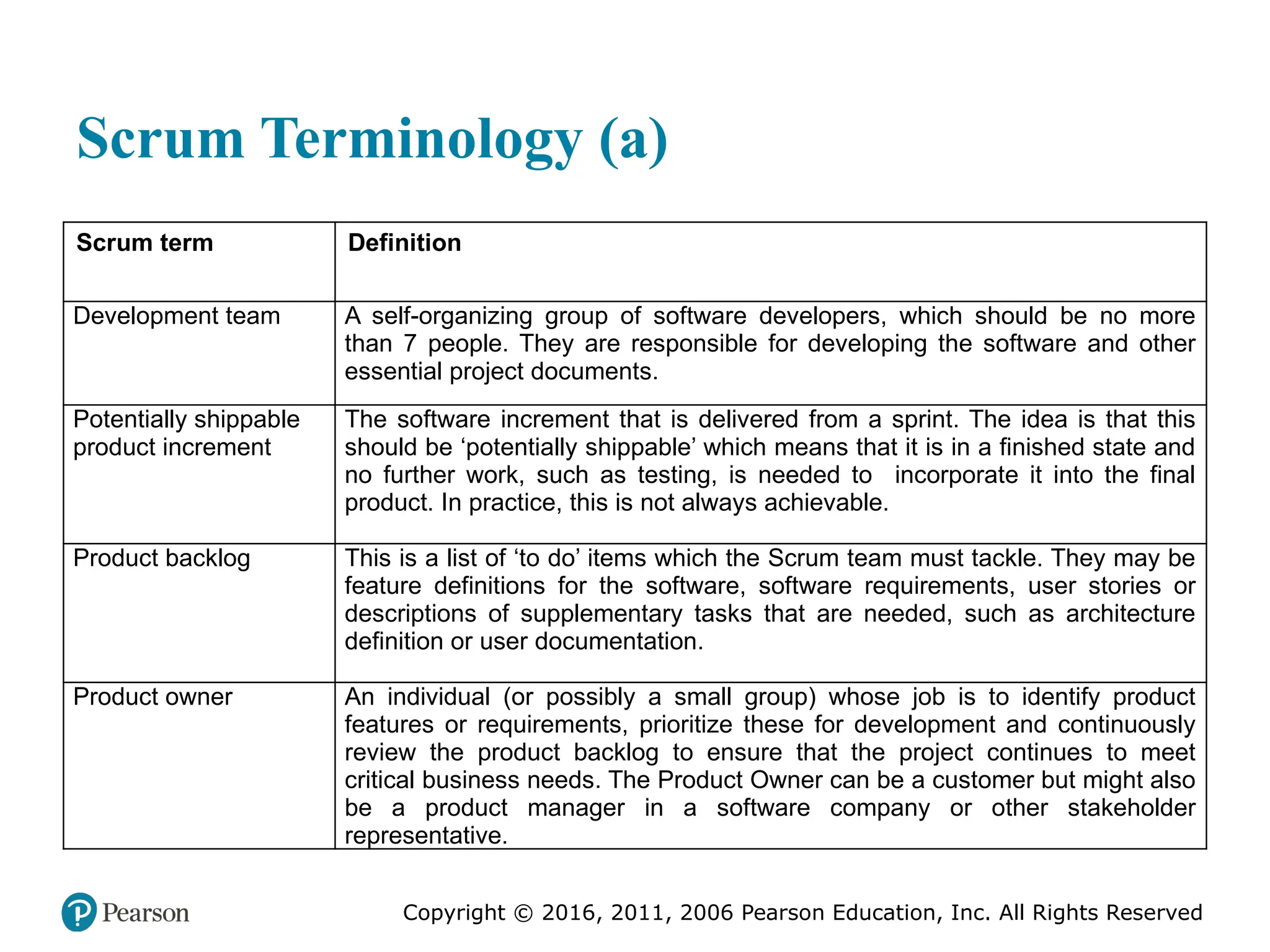
Scrum Terminology (a)
Scrum term Definition
Development team A self-organizing group of software developers, which should be no more
than 7 people. They are responsible for developing the software and other
essential project documents.
Potentially shippable
product increment
The software increment that is delivered from a sprint. The idea is that this
should be ‘potentially shippable’ which means that it is in a finished state and
no further work, such as testing, is needed to incorporate it into the final
product. In practice, this is not always achievable.
Product backlog This is a list of ‘to do’ items which the Scrum team must tackle. They may be
feature definitions for the software, software requirements, user stories or
descriptions of supplementary tasks that are needed, such as architecture
definition or user documentation.
Product owner An individual (or possibly a small group) whose job is to identify product
features or requirements, prioritize these for development and continuously
review the product backlog to ensure that the project continues to meet
critical business needs. The Product Owner can be a customer but might also
be a product manager in a software company or other stakeholder
representative.
Copyright © 2016, 2012, 2009 by Pearson Education, Inc.
All Rights Reserved
Medical Law and Ethics, Fifth Edition
Bonnie F. Fremgen
Copyright © 2016, 2011, 2006 Pearson Education, Inc. All Rights Reserved
Scrum Terminology (b)
Scrum term Definition
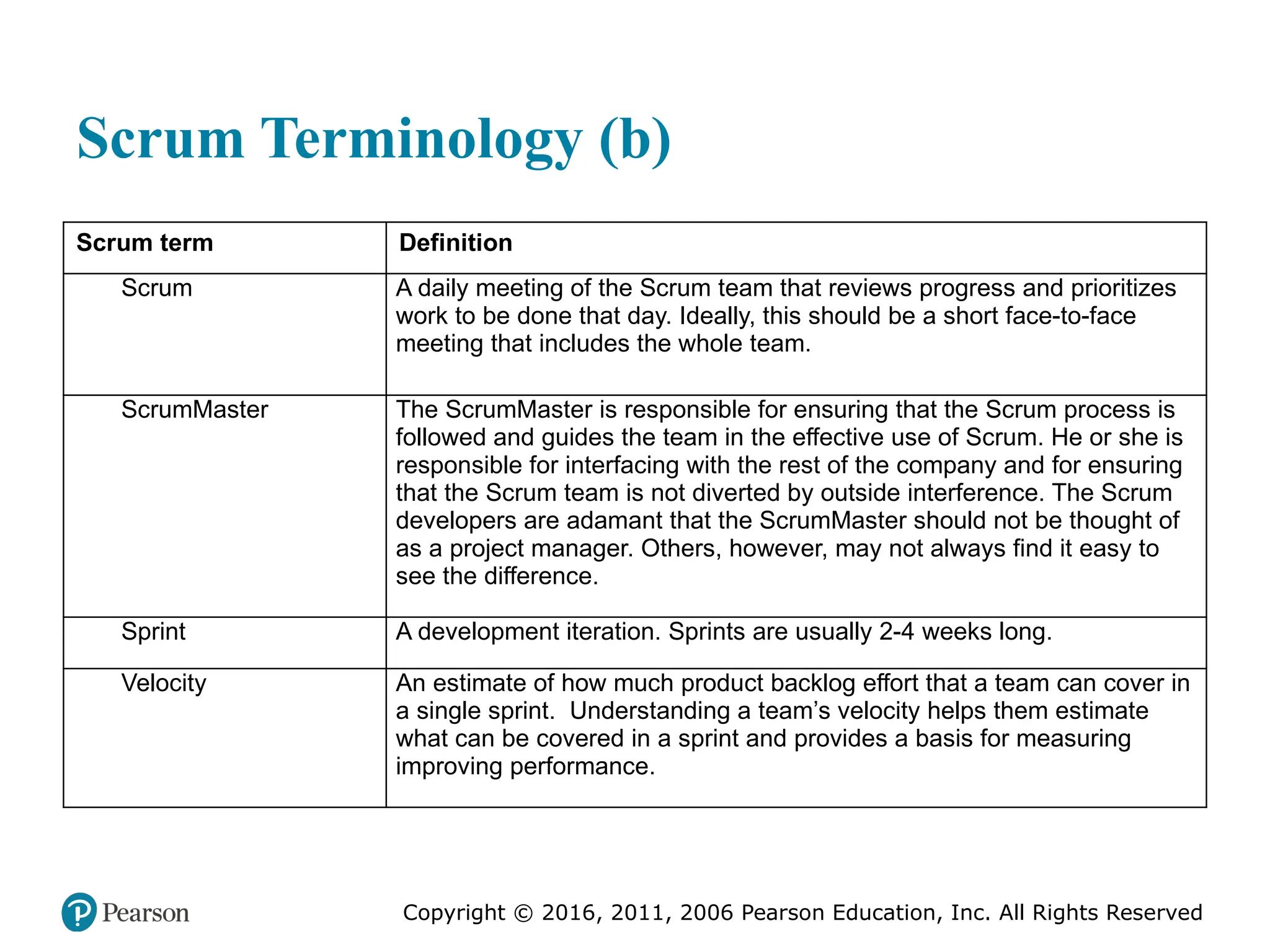
Scrum A daily meeting of the Scrum team that reviews progress and prioritizes
work to be done that day. Ideally, this should be a short face-to-face
meeting that includes the whole team.
ScrumMaster The ScrumMaster is responsible for ensuring that the Scrum process is
followed and guides the team in the effective use of Scrum. He or she is
responsible for interfacing with the rest of the company and for ensuring
that the Scrum team is not diverted by outside interference. The Scrum
developers are adamant that the ScrumMaster should not be thought of
as a project manager. Others, however, may not always find it easy to
see the difference.
Sprint A development iteration. Sprints are usually 2-4 weeks long.
Velocity An estimate of how much product backlog effort that a team can cover in
a single sprint. Understanding a team’s velocity helps them estimate
what can be covered in a sprint and provides a basis for measuring
improving performance.
Copyright © 2016, 2011, 2006 Pearson Education, Inc. All Rights Reserved
Scrum Sprint Cycle
Copyright © 2016, 2012, 2009 by Pearson Education, Inc.
All Rights Reserved
Medical Law and Ethics, Fifth Edition
Bonnie F. Fremgen
Copyright © 2016, 2011, 2006 Pearson Education, Inc. All Rights Reserved
The Scrum Sprint Cycle
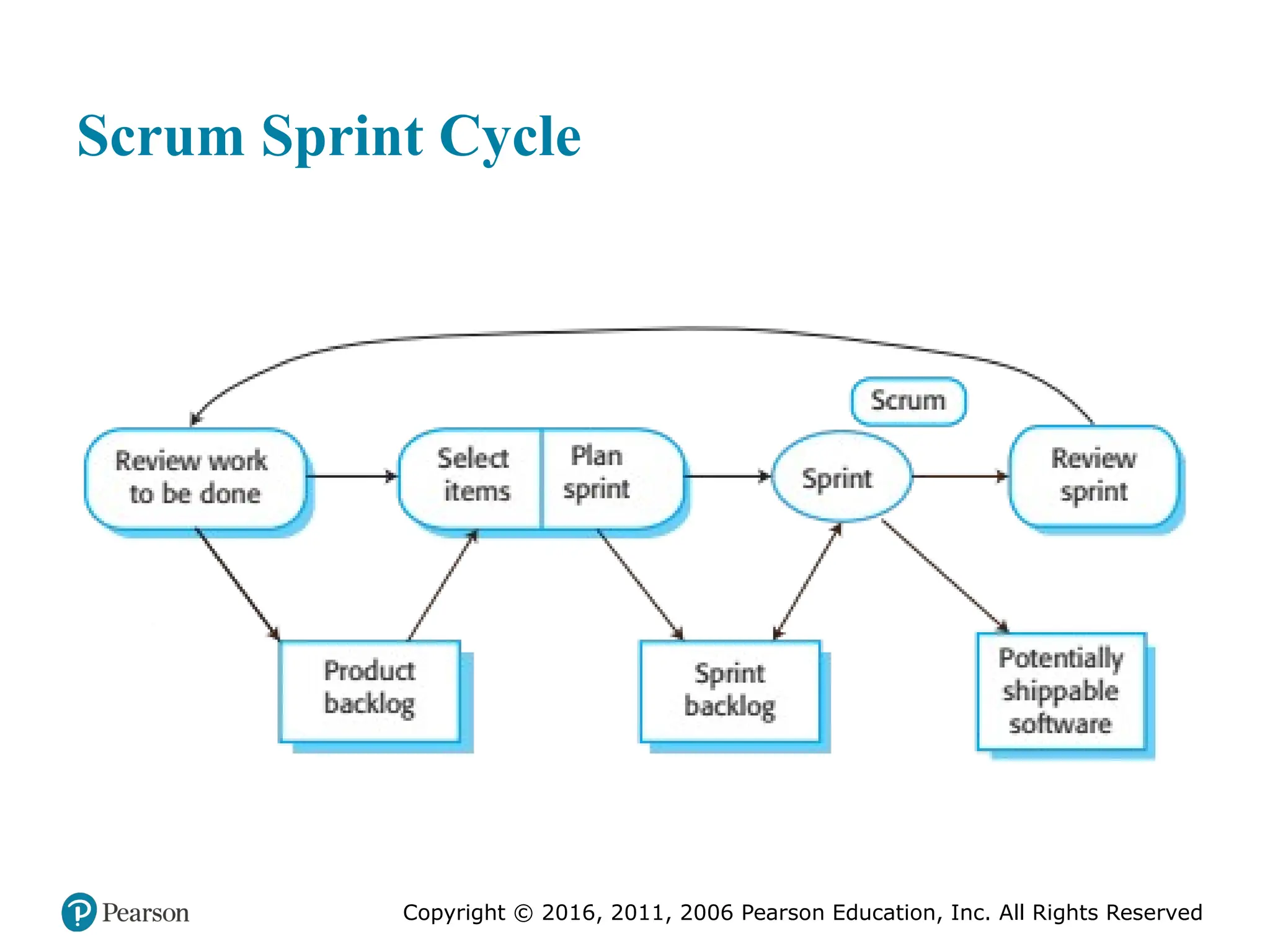
• Sprints are fixed length, normally 2-4 weeks.
• The starting point for planning is the product backlog,
which is the list of work to be done on the project.
• The selection phase involves all of the project team who
work with the customer to select the features and
functionality from the product backlog to be developed
during the sprint.
Copyright © 2016, 2012, 2009 by Pearson Education, Inc.
All Rights Reserved
Medical Law and Ethics, Fifth Edition
Bonnie F. Fremgen
Copyright © 2016, 2011, 2006 Pearson Education, Inc. All Rights Reserved
The Sprint Cycle
• Once these are agreed, the team organize themselves to
develop the software.
• During this stage the team is isolated from the customer
and the organization, with all communications channelled
through the so-called ‘Scrum master’.
• The role of the Scrum master is to protect the
development team from external distractions.
• At the end of the sprint, the work done is reviewed and
presented to stakeholders. The next sprint cycle then
begins.
Copyright © 2016, 2012, 2009 by Pearson Education, Inc.
All Rights Reserved
Medical Law and Ethics, Fifth Edition
Bonnie F. Fremgen
Copyright © 2016, 2011, 2006 Pearson Education, Inc. All Rights Reserved
Teamwork in Scrum
• The ‘Scrum master’ is a facilitator who arranges daily
meetings, tracks the backlog of work to be done, records
decisions, measures progress against the backlog and
communicates with customers and management outside of the
team.
• The whole team attends short daily meetings (Scrums) where
all team members share information, describe their progress
since the last meeting, problems that have arisen and what is
planned for the following day.
– This means that everyone on the team knows what is
going on and, if problems arise, can re-plan short-term
work to cope with them.
Copyright © 2016, 2012, 2009 by Pearson Education, Inc.
All Rights Reserved
Medical Law and Ethics, Fifth Edition
Bonnie F. Fremgen
Copyright © 2016, 2011, 2006 Pearson Education, Inc. All Rights Reserved
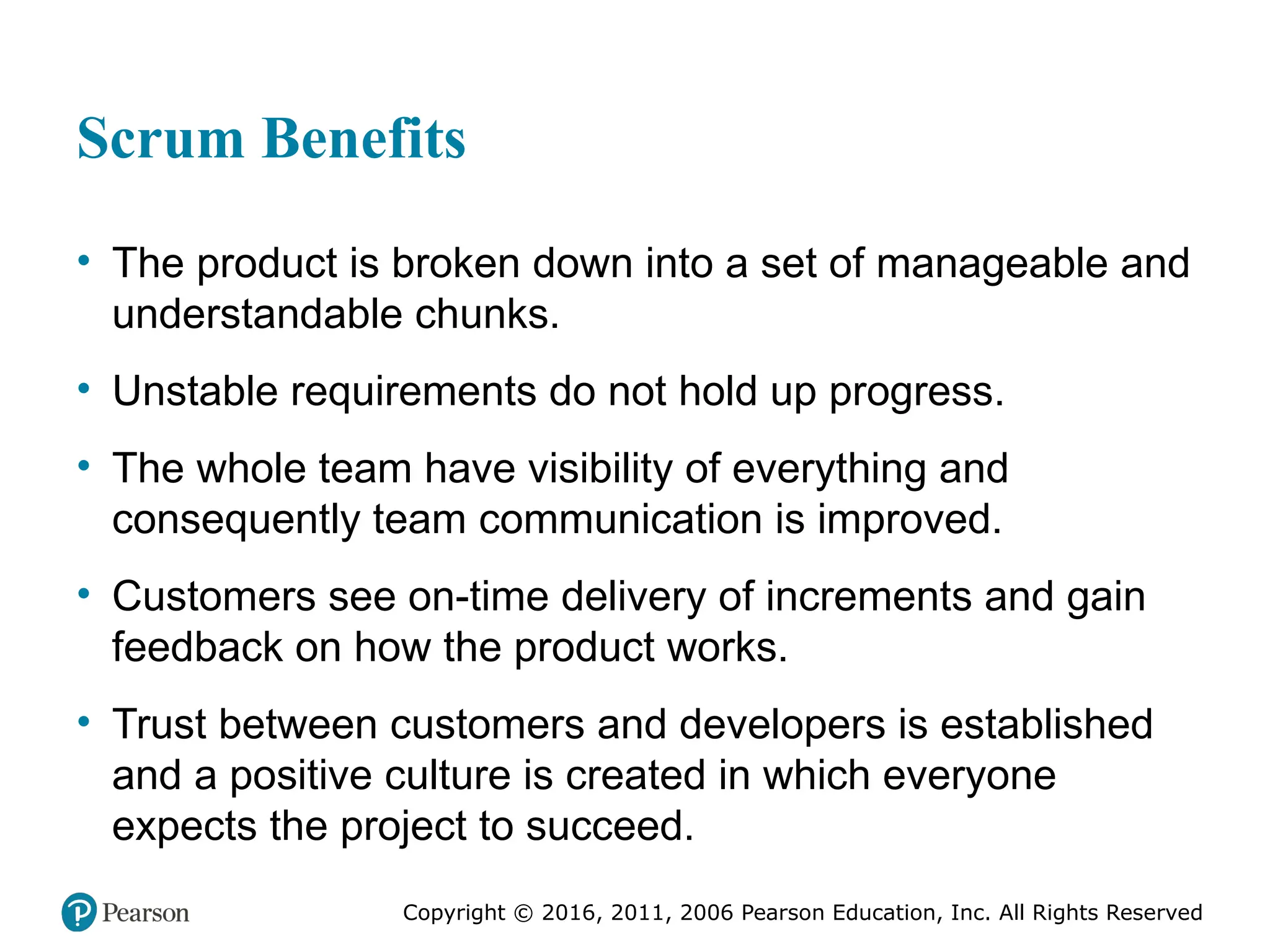
Scrum Benefits
• The product is broken down into a set of manageable and
understandable chunks.
• Unstable requirements do not hold up progress.
• The whole team have visibility of everything and
consequently team communication is improved.
• Customers see on-time delivery of increments and gain
feedback on how the product works.
• Trust between customers and developers is established
and a positive culture is created in which everyone
expects the project to succeed.
Copyright © 2016, 2012, 2009 by Pearson Education, Inc.
All Rights Reserved
Medical Law and Ethics, Fifth Edition
Bonnie F. Fremgen
Copyright © 2016, 2011, 2006 Pearson Education, Inc. All Rights Reserved
Key Points (1 of 2)
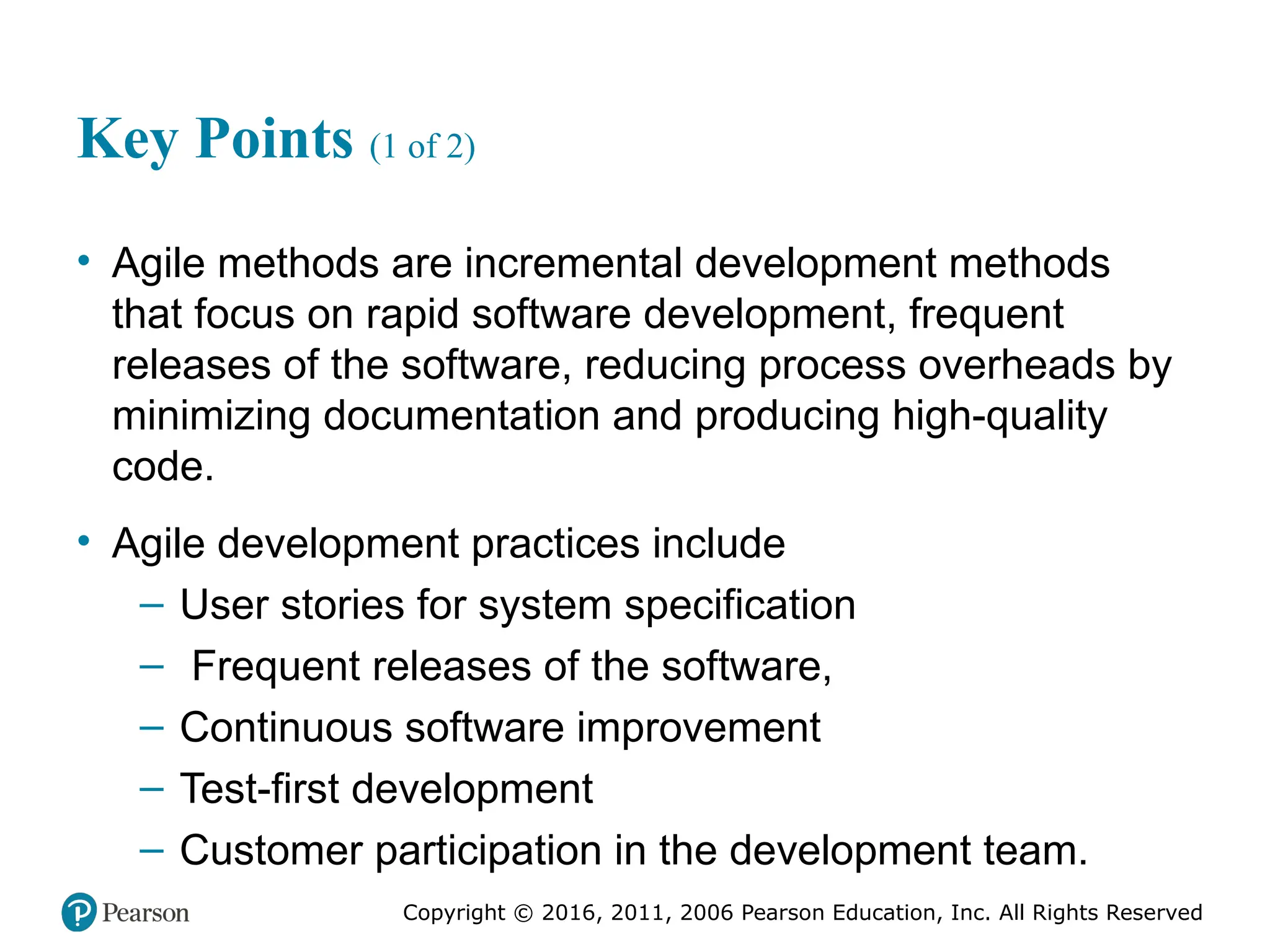
• Agile methods are incremental development methods
that focus on rapid software development, frequent
releases of the software, reducing process overheads by
minimizing documentation and producing high-quality
code.
• Agile development practices include
– User stories for system specification
– Frequent releases of the software,
– Continuous software improvement
– Test-first development
– Customer participation in the development team.
Copyright © 2016, 2012, 2009 by Pearson Education, Inc.
All Rights Reserved
Medical Law and Ethics, Fifth Edition
Bonnie F. Fremgen
Copyright © 2016, 2011, 2006 Pearson Education, Inc. All Rights Reserved
Key Points (2 of 2)
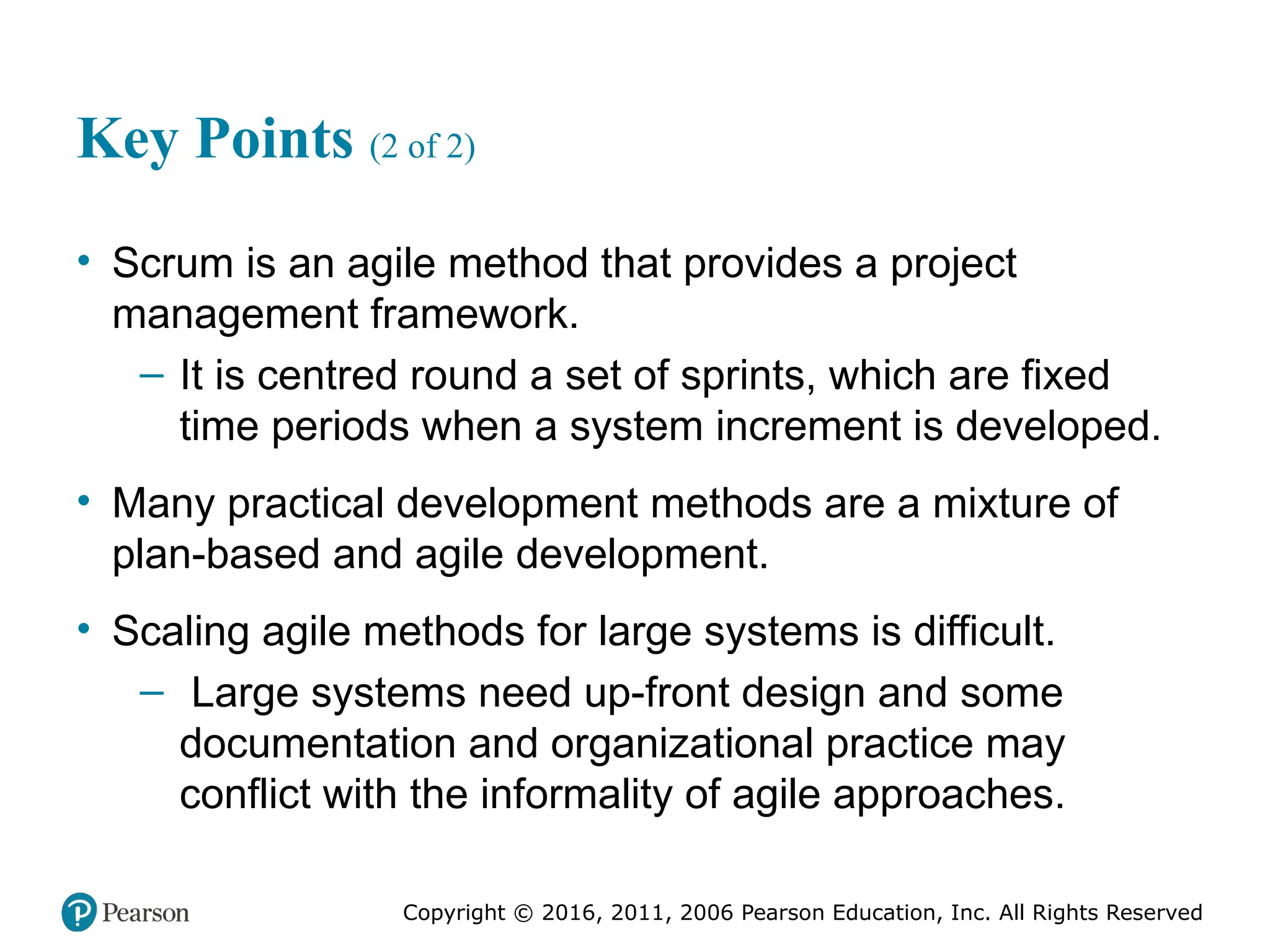
• Scrum is an agile method that provides a project
management framework.
– It is centred round a set of sprints, which are fixed
time periods when a system increment is developed.
• Many practical development methods are a mixture of
plan-based and agile development.
• Scaling agile methods for large systems is difficult.
– Large systems need up-front design and some
documentation and organizational practice may
conflict with the informality of agile approaches.
Copyright © 2016, 2012, 2009 by Pearson Education, Inc.
All Rights Reserved
Medical Law and Ethics, Fifth Edition
Bonnie F. Fremgen
Copyright © 2016, 2011, 2006 Pearson Education, Inc. All Rights Reserved
Copyright

Week 3 - Agile software development.pptx

  • 1.
    Software Engineering Tenth Edition WEEK3 Chapter 3 Agile Software Development Copyright © 2016, 2011, 2006 Pearson Education, Inc. All Rights Reserved
  • 2.
    Copyright © 2016,2012, 2009 by Pearson Education, Inc. All Rights Reserved Medical Law and Ethics, Fifth Edition Bonnie F. Fremgen Copyright © 2016, 2011, 2006 Pearson Education, Inc. All Rights Reserved Learning Objectives 3.1 Agile methods 3.2 Agile development techniques 3.3 Agile project management
  • 3.
    Copyright © 2016,2012, 2009 by Pearson Education, Inc. All Rights Reserved Medical Law and Ethics, Fifth Edition Bonnie F. Fremgen Copyright © 2016, 2011, 2006 Pearson Education, Inc. All Rights Reserved Rapid Software Development • Rapid development and delivery is now often the most important requirement for software systems – Businesses operate in a fast –changing requirement and it is practically impossible to produce a set of stable software requirements – Software has to evolve quickly to reflect changing business needs. • Plan-driven development is essential for some types of system but does not meet these business needs. • Agile development methods emerged in the late 1990s whose aim was to radically reduce the delivery time for working software systems
  • 4.
    Copyright © 2016,2012, 2009 by Pearson Education, Inc. All Rights Reserved Medical Law and Ethics, Fifth Edition Bonnie F. Fremgen Copyright © 2016, 2011, 2006 Pearson Education, Inc. All Rights Reserved Agile Development • Program specification, design and implementation are inter-leaved • The system is developed as a series of versions or increments with stakeholders involved in version specification and evaluation • Frequent delivery of new versions for evaluation • Extensive tool support (e.g. automated testing tools) used to support development. • Minimal documentation – focus on working code
  • 5.
    Copyright © 2016,2011, 2006 Pearson Education, Inc. All Rights Reserved Plan-Driven and Agile Development (1 of 2)
  • 6.
    Copyright © 2016,2012, 2009 by Pearson Education, Inc. All Rights Reserved Medical Law and Ethics, Fifth Edition Bonnie F. Fremgen Copyright © 2016, 2011, 2006 Pearson Education, Inc. All Rights Reserved Plan-Driven and Agile Development(2 of 2) • Plan-driven development – A plan-driven approach to software engineering is based around separate development stages with the outputs to be produced and each of these stages are planned in advance. – Not necessarily waterfall model – plan-driven, incremental development is possible – Iteration occurs within activities. • Agile development – Specification, design, implementation and testing are inter- leaved and the outputs from the development process are decided through a process of negotiation during the software development process.
  • 7.
    Copyright © 2016,2011, 2006 Pearson Education, Inc. All Rights Reserved Agile Methods
  • 8.
    Copyright © 2016,2012, 2009 by Pearson Education, Inc. All Rights Reserved Medical Law and Ethics, Fifth Edition Bonnie F. Fremgen Copyright © 2016, 2011, 2006 Pearson Education, Inc. All Rights Reserved Agile Methods • Dissatisfaction with the overheads involved in software design methods of the 1980s and 1990s led to the creation of agile methods. These methods: – Focus on the code rather than the design – Are based on an iterative approach to software development – Are intended to deliver working software quickly and evolve this quickly to meet changing requirements. • The aim of agile methods is to reduce overheads in the software process (e.g. by limiting documentation) and to be able to respond quickly to changing requirements without excessive rework.
  • 9.
    Copyright © 2016,2012, 2009 by Pearson Education, Inc. All Rights Reserved Medical Law and Ethics, Fifth Edition Bonnie F. Fremgen Copyright © 2016, 2011, 2006 Pearson Education, Inc. All Rights Reserved Agile Manifesto • We are uncovering better ways of developing software by doing it and helping others do it. Through this work we have come to value: – Individuals and interactions over processes and tools Working software over comprehensive documentation Customer collaboration over contract negotiation Responding to change over following a plan • That is, while there is value in the items on the right, we value the items on the left more.
  • 10.
    Copyright © 2016,2011, 2006 Pearson Education, Inc. All Rights Reserved The Principles of Agile Methods Principle Description Customer involvement Customers should be closely involved throughout the development process. Their role is provide and prioritize new system requirements and to evaluate the iterations of the system. Incremental delivery The software is developed in increments with the customer specifying the requirements to be included in each increment. People not process The skills of the development team should be recognized and exploited. Team members should be left to develop their own ways of working without prescriptive processes. Embrace change Expect the system requirements to change and so design the system to accommodate these changes. Maintain simplicity Focus on simplicity in both the software being developed and in the development process. Wherever possible, actively work to eliminate complexity from the system.
  • 11.
    Copyright © 2016,2012, 2009 by Pearson Education, Inc. All Rights Reserved Medical Law and Ethics, Fifth Edition Bonnie F. Fremgen Copyright © 2016, 2011, 2006 Pearson Education, Inc. All Rights Reserved Agile Method Applicability • Product development where a software company is developing a small or medium-sized product for sale. – Virtually all software products and apps are now developed using an agile approach • Custom system development within an organization, where there is a clear commitment from the customer to become involved in the development process and where there are few external rules and regulations that affect the software.
  • 12.
    Copyright © 2016,2011, 2006 Pearson Education, Inc. All Rights Reserved Agile Development Techniques
  • 13.
    Copyright © 2016,2012, 2009 by Pearson Education, Inc. All Rights Reserved Medical Law and Ethics, Fifth Edition Bonnie F. Fremgen Copyright © 2016, 2011, 2006 Pearson Education, Inc. All Rights Reserved Extreme Programming • A very influential agile method, developed in the late 1990s, that introduced a range of agile development techniques. • Extreme Programming (XP) takes an ‘extreme’ approach to iterative development. – New versions may be built several times per day; – Increments are delivered to customers every 2 weeks; – All tests must be run for every build and the build is only accepted if tests run successfully.
  • 14.
    Copyright © 2016,2012, 2009 by Pearson Education, Inc. All Rights Reserved Medical Law and Ethics, Fifth Edition Bonnie F. Fremgen Copyright © 2016, 2011, 2006 Pearson Education, Inc. All Rights Reserved Extreme Programming Practices (a) Principle or practice Description Incremental planning Requirements are recorded on story cards and the stories to be included in a release are determined by the time available and their relative priority. The developers break these stories into development ‘Tasks’. See Figures 3.5 and 3.6. Small releases The minimal useful set of functionality that provides business value is developed first. Releases of the system are frequent and incrementally add functionality to the first release. Simple design Enough design is carried out to meet the current requirements and no more. Test-first development An automated unit test framework is used to write tests for a new piece of functionality before that functionality itself is implemented. Refactoring All developers are expected to refactor the code continuously as soon as possible code improvements are found. This keeps the code simple and maintainable.
  • 15.
    Copyright © 2016,2012, 2009 by Pearson Education, Inc. All Rights Reserved Medical Law and Ethics, Fifth Edition Bonnie F. Fremgen Copyright © 2016, 2011, 2006 Pearson Education, Inc. All Rights Reserved Extreme Programming Practices (b) Pair programming Developers work in pairs, checking each other’s work and providing the support to always do a good job. Collective ownership The pairs of developers work on all areas of the system, so that no islands of expertise develop and all the developers take responsibility for all of the code. Anyone can change anything. Continuous integration As soon as the work on a task is complete, it is integrated into the whole system. After any such integration, all the unit tests in the system must pass. Sustainable pace Large amounts of overtime are not considered acceptable as the net effect is not to reduce code quality On-site customer A representative of the end-user of the system (the customer) should be available full time for the use of the XP team. In an extreme programming process, the customer is a member of the development team and is responsible for bringing system requirements to the team for implementation.
  • 16.
    Copyright © 2016,2012, 2009 by Pearson Education, Inc. All Rights Reserved Medical Law and Ethics, Fifth Edition Bonnie F. Fremgen Copyright © 2016, 2011, 2006 Pearson Education, Inc. All Rights Reserved • According to Test first driven approach, all developers are expected to improve the code continuously. This keeps the code simple and maintainable.
  • 17.
    Copyright © 2016,2012, 2009 by Pearson Education, Inc. All Rights Reserved Medical Law and Ethics, Fifth Edition Bonnie F. Fremgen Copyright © 2016, 2011, 2006 Pearson Education, Inc. All Rights Reserved • Pair programming helps develop common ownership of code and spreads knowledge across the team. It also encourages the whole team to improve the system code.
  • 18.
    Copyright © 2016,2012, 2009 by Pearson Education, Inc. All Rights Reserved Medical Law and Ethics, Fifth Edition Bonnie F. Fremgen Copyright © 2016, 2011, 2006 Pearson Education, Inc. All Rights Reserved • The sharing of knowledge that happens during Pair Programming is very important as it reduces the overall risks to a project when team members leave.
  • 19.
    Copyright © 2016,2012, 2009 by Pearson Education, Inc. All Rights Reserved Medical Law and Ethics, Fifth Edition Bonnie F. Fremgen Copyright © 2016, 2011, 2006 Pearson Education, Inc. All Rights Reserved XP and Agile Principles • Incremental development is supported through small, frequent system releases. • Customer involvement means full-time customer engagement with the team. • People not process through pair programming, collective ownership and a process that avoids long working hours. • Change supported through regular system releases. • Maintaining simplicity through constant refactoring of code.
  • 20.
    Copyright © 2016,2012, 2009 by Pearson Education, Inc. All Rights Reserved Medical Law and Ethics, Fifth Edition Bonnie F. Fremgen Copyright © 2016, 2011, 2006 Pearson Education, Inc. All Rights Reserved Refactoring (1 of 2) • Conventional wisdom in software engineering is to design for change. It is worth spending time and effort anticipating changes as this reduces costs later in the life cycle. • XP, however, maintains that this is not worthwhile as changes cannot be reliably anticipated. • Rather, it proposes constant code improvement (refactoring) to make changes easier when they must be implemented.
  • 21.
    Copyright © 2016,2012, 2009 by Pearson Education, Inc. All Rights Reserved Medical Law and Ethics, Fifth Edition Bonnie F. Fremgen Copyright © 2016, 2011, 2006 Pearson Education, Inc. All Rights Reserved Refactoring (2 of 2) • Programming team look for possible software improvements and make these improvements even where there is no immediate need for them. • This improves the understandability of the software and so reduces the need for documentation. • Changes are easier to make because the code is well- structured and clear. • However, some changes requires architecture refactoring and this is much more expensive.
  • 22.
    Copyright © 2016,2012, 2009 by Pearson Education, Inc. All Rights Reserved Medical Law and Ethics, Fifth Edition Bonnie F. Fremgen Copyright © 2016, 2011, 2006 Pearson Education, Inc. All Rights Reserved Examples of Refactoring • Re-organization of a class hierarchy to remove duplicate code. • Tidying up and renaming attributes and methods to make them easier to understand. • The replacement of inline code with calls to methods that have been included in a program library.
  • 23.
    Copyright © 2016,2012, 2009 by Pearson Education, Inc. All Rights Reserved Medical Law and Ethics, Fifth Edition Bonnie F. Fremgen Copyright © 2016, 2011, 2006 Pearson Education, Inc. All Rights Reserved Test-first Development • Testing is central to XP and XP has developed an approach where the program is tested after every change has been made. • XP testing features: – Test-first development. – Incremental test development from scenarios. – User involvement in test development and validation. – Automated test harnesses are used to run all component tests each time that a new release is built.
  • 24.
    Copyright © 2016,2012, 2009 by Pearson Education, Inc. All Rights Reserved Medical Law and Ethics, Fifth Edition Bonnie F. Fremgen Copyright © 2016, 2011, 2006 Pearson Education, Inc. All Rights Reserved Test-Driven Development • Writing tests before code clarifies the requirements to be implemented. • Tests are written as programs rather than data so that they can be executed automatically. The test includes a check that it has executed correctly. – Usually relies on a testing framework such as Junit. • All previous and new tests are run automatically when new functionality is added, thus checking that the new functionality has not introduced errors.
  • 25.
    Copyright © 2016,2012, 2009 by Pearson Education, Inc. All Rights Reserved Medical Law and Ethics, Fifth Edition Bonnie F. Fremgen Copyright © 2016, 2011, 2006 Pearson Education, Inc. All Rights Reserved Customer Involvement • The role of the customer in the testing process is to help develop acceptance tests for the stories that are to be implemented in the next release of the system. • The customer who is part of the team writes tests as development proceeds. All new code is therefore validated to ensure that it is what the customer needs. • However, people adopting the customer role have limited time available and so cannot work full-time with the development team. They may feel that providing the requirements was enough of a contribution and so may be reluctant to get involved in the testing process.
  • 26.
    Copyright © 2016,2012, 2009 by Pearson Education, Inc. All Rights Reserved Medical Law and Ethics, Fifth Edition Bonnie F. Fremgen Copyright © 2016, 2011, 2006 Pearson Education, Inc. All Rights Reserved Test Automation • Test automation means that tests are written as executable components before the task is implemented – These testing components should be stand-alone, should simulate the submission of input to be tested and should check that the result meets the output specification. An automated test framework (e.g. Junit) is a system that makes it easy to write executable tests and submit a set of tests for execution. • As testing is automated, there is always a set of tests that can be quickly and easily executed – Whenever any functionality is added to the system, the tests can be run and problems that the new code has introduced can be caught immediately.
  • 27.
    Copyright © 2016,2012, 2009 by Pearson Education, Inc. All Rights Reserved Medical Law and Ethics, Fifth Edition Bonnie F. Fremgen Copyright © 2016, 2011, 2006 Pearson Education, Inc. All Rights Reserved Problems with Test-First Development • Programmers prefer programming to testing and sometimes they take short cuts when writing tests. For example, they may write incomplete tests that do not check for all possible exceptions that may occur. • Some tests can be very difficult to write incrementally. For example, in a complex user interface, it is often difficult to write unit tests for the code that implements the ‘display logic’ and workflow between screens. • It difficult to judge the completeness of a set of tests. Although you may have a lot of system tests, your test set may not provide complete coverage.
  • 28.
    Copyright © 2016,2012, 2009 by Pearson Education, Inc. All Rights Reserved Medical Law and Ethics, Fifth Edition Bonnie F. Fremgen Copyright © 2016, 2011, 2006 Pearson Education, Inc. All Rights Reserved Pair Programming (1 of 2) • Pair programming involves programmers working in pairs, developing code together. • This helps develop common ownership of code and spreads knowledge across the team. • It serves as an informal review process as each line of code is looked at by more than 1 person. • It encourages refactoring as the whole team can benefit from improving the system code.
  • 29.
    Copyright © 2016,2012, 2009 by Pearson Education, Inc. All Rights Reserved Medical Law and Ethics, Fifth Edition Bonnie F. Fremgen Copyright © 2016, 2011, 2006 Pearson Education, Inc. All Rights Reserved Pair Programming (2 of 2) • In pair programming, programmers sit together at the same computer to develop the software. • Pairs are created dynamically so that all team members work with each other during the development process. • The sharing of knowledge that happens during pair programming is very important as it reduces the overall risks to a project when team members leave. • Pair programming is not necessarily inefficient and there is some evidence that suggests that a pair working together is more efficient than 2 programmers working separately.
  • 30.
    Copyright © 2016,2011, 2006 Pearson Education, Inc. All Rights Reserved Agile Project Management
  • 31.
    Copyright © 2016,2012, 2009 by Pearson Education, Inc. All Rights Reserved Medical Law and Ethics, Fifth Edition Bonnie F. Fremgen Copyright © 2016, 2011, 2006 Pearson Education, Inc. All Rights Reserved Agile Project Management • The principal responsibility of software project managers is to manage the project so that the software is delivered on time and within the planned budget for the project. • The standard approach to project management is plan- driven. Managers draw up a plan for the project showing what should be delivered, when it should be delivered and who will work on the development of the project deliverables. • Agile project management requires a different approach, which is adapted to incremental development and the practices used in agile methods.
  • 32.
    Copyright © 2016,2012, 2009 by Pearson Education, Inc. All Rights Reserved Medical Law and Ethics, Fifth Edition Bonnie F. Fremgen Copyright © 2016, 2011, 2006 Pearson Education, Inc. All Rights Reserved Scrum • Scrum is an agile method that focuses on managing iterative development rather than specific agile practices. • There are three phases in Scrum. – The initial phase is an outline planning phase where you establish the general objectives for the project and design the software architecture. – This is followed by a series of sprint cycles, where each cycle develops an increment of the system. – The project closure phase wraps up the project, completes required documentation such as system help frames and user manuals and assesses the lessons learned from the project.
  • 33.
    Copyright © 2016,2012, 2009 by Pearson Education, Inc. All Rights Reserved Medical Law and Ethics, Fifth Edition Bonnie F. Fremgen Copyright © 2016, 2011, 2006 Pearson Education, Inc. All Rights Reserved Scrum Terminology (a) Scrum term Definition Development team A self-organizing group of software developers, which should be no more than 7 people. They are responsible for developing the software and other essential project documents. Potentially shippable product increment The software increment that is delivered from a sprint. The idea is that this should be ‘potentially shippable’ which means that it is in a finished state and no further work, such as testing, is needed to incorporate it into the final product. In practice, this is not always achievable. Product backlog This is a list of ‘to do’ items which the Scrum team must tackle. They may be feature definitions for the software, software requirements, user stories or descriptions of supplementary tasks that are needed, such as architecture definition or user documentation. Product owner An individual (or possibly a small group) whose job is to identify product features or requirements, prioritize these for development and continuously review the product backlog to ensure that the project continues to meet critical business needs. The Product Owner can be a customer but might also be a product manager in a software company or other stakeholder representative.
  • 34.
    Copyright © 2016,2012, 2009 by Pearson Education, Inc. All Rights Reserved Medical Law and Ethics, Fifth Edition Bonnie F. Fremgen Copyright © 2016, 2011, 2006 Pearson Education, Inc. All Rights Reserved Scrum Terminology (b) Scrum term Definition Scrum A daily meeting of the Scrum team that reviews progress and prioritizes work to be done that day. Ideally, this should be a short face-to-face meeting that includes the whole team. ScrumMaster The ScrumMaster is responsible for ensuring that the Scrum process is followed and guides the team in the effective use of Scrum. He or she is responsible for interfacing with the rest of the company and for ensuring that the Scrum team is not diverted by outside interference. The Scrum developers are adamant that the ScrumMaster should not be thought of as a project manager. Others, however, may not always find it easy to see the difference. Sprint A development iteration. Sprints are usually 2-4 weeks long. Velocity An estimate of how much product backlog effort that a team can cover in a single sprint. Understanding a team’s velocity helps them estimate what can be covered in a sprint and provides a basis for measuring improving performance.
  • 35.
    Copyright © 2016,2011, 2006 Pearson Education, Inc. All Rights Reserved Scrum Sprint Cycle
  • 36.
    Copyright © 2016,2012, 2009 by Pearson Education, Inc. All Rights Reserved Medical Law and Ethics, Fifth Edition Bonnie F. Fremgen Copyright © 2016, 2011, 2006 Pearson Education, Inc. All Rights Reserved The Scrum Sprint Cycle • Sprints are fixed length, normally 2-4 weeks. • The starting point for planning is the product backlog, which is the list of work to be done on the project. • The selection phase involves all of the project team who work with the customer to select the features and functionality from the product backlog to be developed during the sprint.
  • 37.
    Copyright © 2016,2012, 2009 by Pearson Education, Inc. All Rights Reserved Medical Law and Ethics, Fifth Edition Bonnie F. Fremgen Copyright © 2016, 2011, 2006 Pearson Education, Inc. All Rights Reserved The Sprint Cycle • Once these are agreed, the team organize themselves to develop the software. • During this stage the team is isolated from the customer and the organization, with all communications channelled through the so-called ‘Scrum master’. • The role of the Scrum master is to protect the development team from external distractions. • At the end of the sprint, the work done is reviewed and presented to stakeholders. The next sprint cycle then begins.
  • 38.
    Copyright © 2016,2012, 2009 by Pearson Education, Inc. All Rights Reserved Medical Law and Ethics, Fifth Edition Bonnie F. Fremgen Copyright © 2016, 2011, 2006 Pearson Education, Inc. All Rights Reserved Teamwork in Scrum • The ‘Scrum master’ is a facilitator who arranges daily meetings, tracks the backlog of work to be done, records decisions, measures progress against the backlog and communicates with customers and management outside of the team. • The whole team attends short daily meetings (Scrums) where all team members share information, describe their progress since the last meeting, problems that have arisen and what is planned for the following day. – This means that everyone on the team knows what is going on and, if problems arise, can re-plan short-term work to cope with them.
  • 39.
    Copyright © 2016,2012, 2009 by Pearson Education, Inc. All Rights Reserved Medical Law and Ethics, Fifth Edition Bonnie F. Fremgen Copyright © 2016, 2011, 2006 Pearson Education, Inc. All Rights Reserved Scrum Benefits • The product is broken down into a set of manageable and understandable chunks. • Unstable requirements do not hold up progress. • The whole team have visibility of everything and consequently team communication is improved. • Customers see on-time delivery of increments and gain feedback on how the product works. • Trust between customers and developers is established and a positive culture is created in which everyone expects the project to succeed.
  • 40.
    Copyright © 2016,2012, 2009 by Pearson Education, Inc. All Rights Reserved Medical Law and Ethics, Fifth Edition Bonnie F. Fremgen Copyright © 2016, 2011, 2006 Pearson Education, Inc. All Rights Reserved Key Points (1 of 2) • Agile methods are incremental development methods that focus on rapid software development, frequent releases of the software, reducing process overheads by minimizing documentation and producing high-quality code. • Agile development practices include – User stories for system specification – Frequent releases of the software, – Continuous software improvement – Test-first development – Customer participation in the development team.
  • 41.
    Copyright © 2016,2012, 2009 by Pearson Education, Inc. All Rights Reserved Medical Law and Ethics, Fifth Edition Bonnie F. Fremgen Copyright © 2016, 2011, 2006 Pearson Education, Inc. All Rights Reserved Key Points (2 of 2) • Scrum is an agile method that provides a project management framework. – It is centred round a set of sprints, which are fixed time periods when a system increment is developed. • Many practical development methods are a mixture of plan-based and agile development. • Scaling agile methods for large systems is difficult. – Large systems need up-front design and some documentation and organizational practice may conflict with the informality of agile approaches.
  • 42.
    Copyright © 2016,2012, 2009 by Pearson Education, Inc. All Rights Reserved Medical Law and Ethics, Fifth Edition Bonnie F. Fremgen Copyright © 2016, 2011, 2006 Pearson Education, Inc. All Rights Reserved Copyright

Editor's Notes

  • #1 If this PowerPoint presentation contains mathematical equations, you may need to check that your computer has the following installed: 1) MathType Plugin 2) Math Player (free versions available) 3) NVDA Reader (free versions available)