![ANALYSIS OF THE INTEL RANDOM NUMBER GENERATOR CRYPTOGRAPHY RESEARCH
2
however, be computationally infeasible to
distinguish a good PRNG from a perfect RNG.
For example, a PRNG seeded with 256-bits
of entropy (or one with a 256-bit state) cannot
produce more than 256 bits of true randomness.
An attacker who can guess the seed data can
predict the entire PRNG output. Guessing a 256-
bit seed value is computationally infeasible,
however, so it is possible that such a PRNG
could be used in cryptographic applications.
Examples of PRNGs designed for cryptographic
applications include MD5Random and
SHA1Random (which respectively hold 128 bits
and 160 bits of state) in the BSAFETM,3
cryptographic toolkit.
Although properly-implemented and seeded
PRNGs are suitable for most cryptographic
applications, great care must be taken in the
development, testing, and selection of PRNG
algorithms. It is critical that a PRNG be properly
seeded from a reliable source. For example,
most PRNGs included in standard software
libraries use predictable seed or state values or
produce output that can be distinguished from
random data.
3. The Need for TRNGs
A true random number generator (TRNG)
uses a non-deterministic source to produce
randomness. Most operate by measuring
unpredictable natural processes, such as thermal
(resistance or shot) noise, atmospheric noise, or
nuclear decay. The entropy, trustworthiness, and
performance all depend on the TRNG design.
A PRNG by itself will be insecure without a
TRNG for seeding. Seeding requires a source of
true randomness, since it is impossible to create
true randomness from within a deterministic
system.
On computers without a hardware RNG,
programmers typically try to obtain entropy for
seed data using existing peripherals. The most
common techniques involve timing user
3
BSAFE is a software toolkit available from RSA
Data Security, Inc.
processes, but these methods are awkward and
slow. For example, PGP4
version 6.02 requires
that users spend about 15 seconds entering
random keystrokes or mouse movements to
produce a new key. Methods involving user
timing require inelegant user interfaces and
cannot be used (or become insecure) when
controlled by automated scripts. Some
applications use hard drive seek times, but
factors such as the drive technology, disk
caches, and system timer resolution limits
require careful consideration. Measurements of
system activity, delays, configuration data, etc.
are also sometimes used.
Overall, true random number generators
implemented using conventional hardware tend
to be slow, difficult to implement, require user
involvement, and often provide unknown
amounts of true entropy. These methods also
make assumptions about the hardware that are
not guaranteed. For example, operation timing
measurements may not contain the expected
amount of randomness under all system
configurations. Techniques that rely on user
events may not be reliable in unattended
systems such as
servers.
Even though
it is possible for
applications to
produce their own
secure random
data, many do not.
Reviews by
Cryptography Research frequently identify
weaknesses in random number generation.
Similarly, Christopher Allen and Tim Dierks of
Consensus Development report that “most
common problems [found in software security
reviews] were related to random number
seeding.”5
Bruce Schneier writes, “Good
random-number generators are hard to design,
because their security often depends on the
4
PGP is available from Network Associates, Inc.
5
Dierks, T., and Allen, C., “Lessons from Doing
Source Code Reviews of Commercial Products,”
Consensus Development, 1997.
Anyone who considers
arithmetical methods of
producing random digits
is, of course, in a state of
sin.
– John Von Neumann (1951)](https://image.slidesharecdn.com/intelrng-180506031734/85/Intel-Random-Number-Generator-2-320.jpg)
![ANALYSIS OF THE INTEL RANDOM NUMBER GENERATOR CRYPTOGRAPHY RESEARCH
4
the signals sampled from two adjacent resistors.
Circuitry used for amplification or signal
handling should preserve as many of the
components of randomness as possible. Intel’s
design was found to have a high degree of
linearity and bandwidth for passing high
frequency signals to later stages.
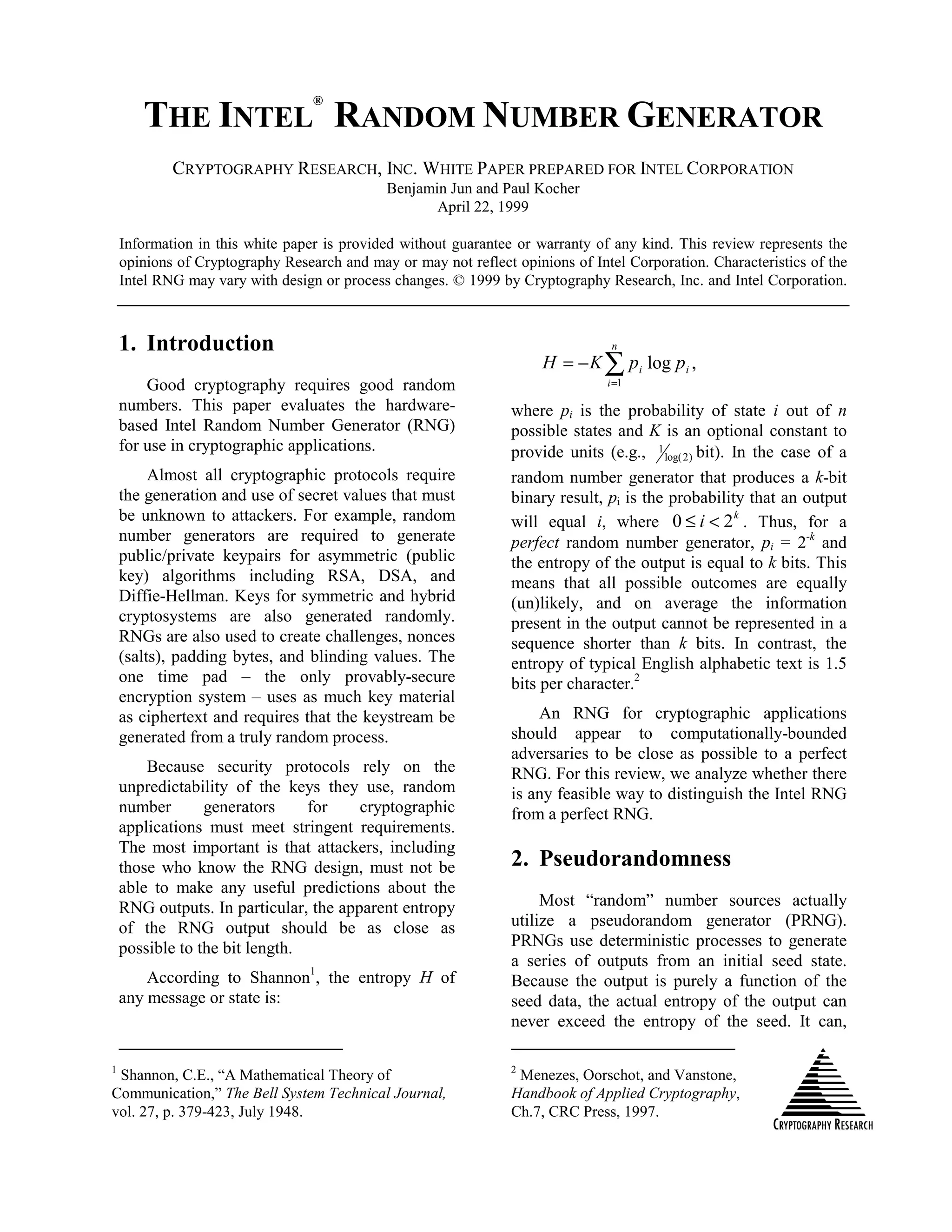
4.2. Dual Oscillator Architecture
The Intel RNG uses a random source that is
derived from two free-running oscillators, one
fast and one much slower. The thermal noise
source is used to modulate the frequency of the
slower clock. The variable, noise-modulated
slower clock is used to trigger measurements of
the fast clock. Drift between the two clocks thus
provides the source of random binary digits.
Similar RNG designs using independent
oscillators are well known.9,10
Thermal Noise
Low-frequency
oscillator
High-frequency oscillator
0
1
Data to corrector = 1
Figure 2: Overview of dual-oscillator design (frequency
ratio not to scale)
The slow oscillator frequency must be
significantly perturbed by the noise source, in
addition to any pseudorandom environmental,
electrical, or manufacturing conditions.
Recorded histograms of modulated frequency
9
Velichko, S. “Random-number Generator Prefers
Imperfect Clocks.” EDN Access, 1996.
(http://ednmag.com/reg/1996/112196/23_di04.cfm).
10
Hoffman, Eric. Random Number Generator, 1996,
U.S. Patent 5,706,208.
resemble a normal distribution. The modulated
frequency has standard deviation that spans
approximately 10-20 high frequency clock
periods; indicating that the sampling process is
significantly varied by the random source.
Provided that a significant random component is
present in the low-speed oscillator, additional
nonrandom effects should not reduce the quality
of the RNG output. For example, environmental
interference should only add additional
unpredictability to the results. Intel reports that
the modulation bandwidth is approximately 2
times the variable oscillator’s center frequency.
This fast response preserves useful components
of high frequency noise from the random
source.
The oscillators used in the Intel RNG have
center frequency ratios on the order of 1:100. If
both run without drift, the sampled bits could be
“colored” with beats periodicity at multiples of
the ratio. Statistical tests were used to try to
locate such beats in the sampled bitstream, but
could not be detected in over 108
output bits.
4.3. Digital Post-Processing
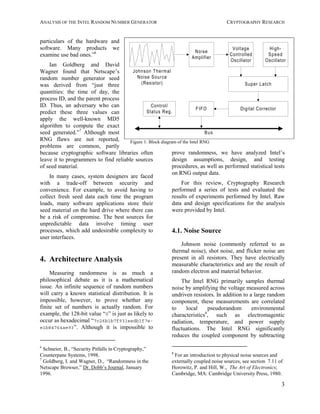
The initial random measurements are
processed by a hardware corrector based on a
concept proposed by John von Neumann to
produce a balanced distribution of “0” and “1”
bits.11
A von Neumann corrector converts pairs
of bits into output bits by converting the bit pair
[0,1] into an output 1, converting [1,0] into an
output 0, and outputting nothing for [0,0] or
[1,1].
Input bits Output
0,0 none
0,1 1
1,0 0
1,1 none
Figure 3: Von Neumann corrector
11
The hardware corrector design is patent pending by
Intel Corporation.](https://image.slidesharecdn.com/intelrng-180506031734/85/Intel-Random-Number-Generator-4-320.jpg)

This white paper evaluates the Intel hardware-based random number generator (RNG) for cryptographic applications, emphasizing the importance of good random numbers in maintaining security protocols. It discusses the architecture, including noise sources and dual-oscillator design, while also noting the reliance on true random number generators (TRNGs) for seeding pseudorandom number generators (PRNGs). Extensive statistical tests were performed to assess the RNG's output, revealing deviations in spectral analyses but confirming its overall effectiveness for cryptographic uses.


![Getting Started with Apache Spark: Big Data Made Simple [Free Meetup]](https://cdn.slidesharecdn.com/ss_thumbnails/apachesparkgettingstarted-260203175547-8361bcc3-thumbnail.jpg?width=640&height=640&fit=bounds)