• PRESENTED TO:
• DR. PD RATHI
• PRESENTED BY:
• SHIKHAR MARMAT
The foreign trade of India is guided by the
Export Import policy of govt. of India.
Regulated by the foreign trade development
and regulatory Act 1992.
Exim policy contain various policy decision
with respect to import and export from the
country.
It is prepared and announced by the central
government.
•EXIM Policy is the export import policy of the
government that is announced every five
years.
• It is also known as the Foreign Trade Policy.
• Every year the government announces a
supplement to this policy.
It aims to developing export potential,
improving export performance, encourage
foreign trade & creating favourable balance of
payment position.
To establish the framework for globalization.
To promote internationally competitive import
subsitution and self reliance
To encourage the attainment of high &
internationally accepted standards of quality.
The Foreign Trade Policy for the period 2009-
2014 was announced on 27th August 2009 at
a time when the world was emerging from the
shadow of a challenging economic period, the
worst we have seen in the last 7 decades.
Economies and markets across the world
were in turmoil, causing sharp contraction in
international trade, adversely impacting global
investment flows, rendering over 50 million
people jobless.
EXIM POLICY (2009-
2014)
The key objective for the Foreign Trade Policy
was to arrest the declining exports and reverse
the trend.
To double India’s exports of goods and
services by 2014.
To double India’s share in global merchandise
trade by 2020 as long term aim of this policy. I
Simplification of the application procedure for
availing various benefits.
Export target : $ 200 billions for 2010-2011.
Export growth rate :15% for next two years
and 25% there after.
 In an aim to make India a diamond
international trading hub, it is planned to
establish “Diamond Bourse(s)”.
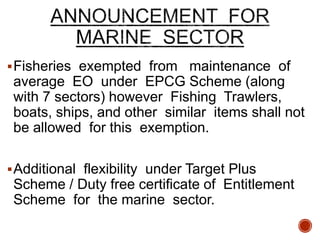
Fisheries exempted from maintenance of
average EO under EPCG Scheme (along
with 7 sectors) however Fishing Trawlers,
boats, ships, and other similar items shall not
be allowed for this exemption.
Additional flexibility under Target Plus
Scheme / Duty free certificate of Entitlement
Scheme for the marine sector.
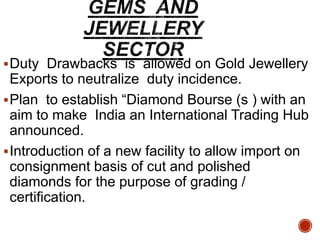
Duty Drawbacks is allowed on Gold Jewellery
Exports to neutralize duty incidence.
Plan to establish “Diamond Bourse (s ) with an
aim to make India an International Trading Hub
announced.
Introduction of a new facility to allow import on
consignment basis of cut and polished
diamonds for the purpose of grading /
certification.
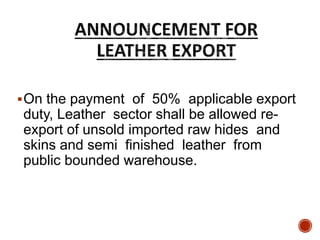
On the payment of 50% applicable export
duty, Leather sector shall be allowed re-
export of unsold imported raw hides and
skins and semi finished leather from
public bounded warehouse.
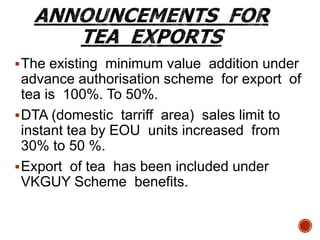
The existing minimum value addition under
advance authorisation scheme for export of
tea is 100%. To 50%.
DTA (domestic tarriff area) sales limit to
instant tea by EOU units increased from
30% to 50 %.
Export of tea has been included under
VKGUY Scheme benefits.
Export Obligation Period for advance
authorization issued increased from
existing 6 months to 36 months.
Pharma sector included under MLFPS for
countries in Africa and Latin America and
some countries in Oceania and Far East.
A Directorate of Trade Remedy Measure shall
be set up , which will enable support to Indian
industry and exporters , especially the Micro
Small & medium Enterprises MSMEs in
availing their rights through trade remedy
instruments.
There is provision for state run banks to
provide dollar credits.
The Export-Import Bank of India The Export-
Import Bank of India, also known as Exim
Bank of India leading export finance institution
in the country.
The bank was set up in the year 1982 under
the Export-Import Bank of India Act 1981.
The bank offers wide-ranging services for
enhancing the prospect of Indian project
exports.
It plays the role of source of financial,
promoter ,coordinator & consultation of India’s
Foreign Trade.
THANK YOU!

EXIM POLICY

  • 1.
    • PRESENTED TO: •DR. PD RATHI • PRESENTED BY: • SHIKHAR MARMAT
  • 2.
    The foreign tradeof India is guided by the Export Import policy of govt. of India. Regulated by the foreign trade development and regulatory Act 1992. Exim policy contain various policy decision with respect to import and export from the country. It is prepared and announced by the central government.
  • 3.
    •EXIM Policy isthe export import policy of the government that is announced every five years. • It is also known as the Foreign Trade Policy. • Every year the government announces a supplement to this policy.
  • 4.
    It aims todeveloping export potential, improving export performance, encourage foreign trade & creating favourable balance of payment position. To establish the framework for globalization. To promote internationally competitive import subsitution and self reliance To encourage the attainment of high & internationally accepted standards of quality.
  • 5.
    The Foreign TradePolicy for the period 2009- 2014 was announced on 27th August 2009 at a time when the world was emerging from the shadow of a challenging economic period, the worst we have seen in the last 7 decades. Economies and markets across the world were in turmoil, causing sharp contraction in international trade, adversely impacting global investment flows, rendering over 50 million people jobless. EXIM POLICY (2009- 2014)
  • 6.
    The key objectivefor the Foreign Trade Policy was to arrest the declining exports and reverse the trend. To double India’s exports of goods and services by 2014. To double India’s share in global merchandise trade by 2020 as long term aim of this policy. I Simplification of the application procedure for availing various benefits.
  • 7.
    Export target :$ 200 billions for 2010-2011. Export growth rate :15% for next two years and 25% there after.  In an aim to make India a diamond international trading hub, it is planned to establish “Diamond Bourse(s)”.
  • 8.
    Fisheries exempted frommaintenance of average EO under EPCG Scheme (along with 7 sectors) however Fishing Trawlers, boats, ships, and other similar items shall not be allowed for this exemption. Additional flexibility under Target Plus Scheme / Duty free certificate of Entitlement Scheme for the marine sector.
  • 9.
    Duty Drawbacks isallowed on Gold Jewellery Exports to neutralize duty incidence. Plan to establish “Diamond Bourse (s ) with an aim to make India an International Trading Hub announced. Introduction of a new facility to allow import on consignment basis of cut and polished diamonds for the purpose of grading / certification.
  • 10.
    On the paymentof 50% applicable export duty, Leather sector shall be allowed re- export of unsold imported raw hides and skins and semi finished leather from public bounded warehouse.
  • 11.
    The existing minimumvalue addition under advance authorisation scheme for export of tea is 100%. To 50%. DTA (domestic tarriff area) sales limit to instant tea by EOU units increased from 30% to 50 %. Export of tea has been included under VKGUY Scheme benefits.
  • 12.
    Export Obligation Periodfor advance authorization issued increased from existing 6 months to 36 months. Pharma sector included under MLFPS for countries in Africa and Latin America and some countries in Oceania and Far East.
  • 13.
    A Directorate ofTrade Remedy Measure shall be set up , which will enable support to Indian industry and exporters , especially the Micro Small & medium Enterprises MSMEs in availing their rights through trade remedy instruments. There is provision for state run banks to provide dollar credits.
  • 14.
    The Export-Import Bankof India The Export- Import Bank of India, also known as Exim Bank of India leading export finance institution in the country. The bank was set up in the year 1982 under the Export-Import Bank of India Act 1981. The bank offers wide-ranging services for enhancing the prospect of Indian project exports. It plays the role of source of financial, promoter ,coordinator & consultation of India’s Foreign Trade.
  • 15.