INTERNATIONALTRADE
Hello!
I AM DEBANJAN
BHATTACHARYYA
I am here to give a
presentation.
1.
International trade
let’s start with the first set of slides
Topics we will come across
✘Defination Of International Trade
✘Importance of International Trade
✘Risks in International Trade
✘WTO and its functions.
✘Trade barriers and the types.
What is international trade ???
International trade is exchange of capital,
goods, and services across international
borders or territories. In most countries, it
represents a significant share of gross
domestic product (GDP). While international
trade has been present throughout much of
history (see Silk Road, Amber Road), its
economic, social, and political importance has
been on the rise in recent centuries.
(a) Without
international trade,
nations would be
limited to the
goods and services
produced within
their own borders.
Importance of International trade
(b) International trade
is the backbone of our
modern, commercial
world, as producers in
various nations try to
profit from an
expanded market,
rather than be limited
to selling within their
own borders.
Risks in International Trade
✘Buyer insolvency
✘Credit risk (allowing the buyer to take possession of goods
prior to payment);
✘War and other uncontrollable events.
✘Regulatory risk (e.g., a change in rules that prevents the
transaction);
✘Political risk (change in leadership interfering with
transactions or prices); and
✘In addition, international trade also faces the risk of
unfavorable exchange rate movements
World Trde Organisation
.
The World Trade Organization
(WTO) establishes rules of trade among its
member nations. To this end, the WTO also
handles trade disputes, monitors trade policies,
provides technical assistance for developing
countries and cooperates with other international
trade organizations.
The WTO was created on January 1, 1995, and
is headquartered in Geneva, Switzerland. The
WTO replaced the General Agreement on Tariffs
and Trade (GATT), which was created in 1948.
GATT primarily regulated the trade of goods; the
WTO regulates the trade of services and
intellectual property as well. GATT still exists as
the WTO's umbrella treaty for trade in goods.
WTO : WHAT THEY DO ??
(a)Dispute
settlement
(b) Investment
and Trade
(c) Trade Policy
Reviews.
(d)
Implementation
and Monitoring
Trade.
(e)Building
Trade Capacity.
Limitations of International trade
✘Rapid Depletion of Exhaustible Natural
Resources
✘Import of Harmful Goods
✘Over Specialization:
✘Danger of Starvation
✘ Language Diversity
Trade Barriers
✘Trade barriers are government-induced restrictions
on international trade.[1] The barriers can take many
forms, including the following:
✘Tariffs
✘Non-tariff barriers to trade
Subsidies2]
Trade restriction
Tariffs : Types Of Tariffs
✘Import and export tariff : A tax levied on imports or exports
of a company.
✘Transit Tariffs : A tax levied on goods passing through the
country.
✘Specific Duty : A tariff based on the number of Items being
imported.
✘Compound Duty : A tariff consisting of both specific and ad
valorem duty.
✘Ad valorem : Based on a percentage of the value imported
goods.
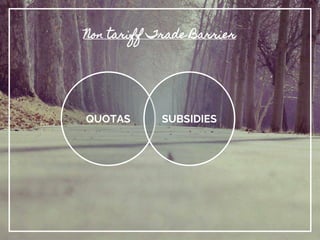
Non tariff Trade Barrier
QUOTAS SUBSIDIES
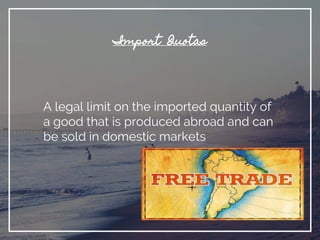
Import Quotas
A legal limit on the imported quantity of
a good that is produced abroad and can
be sold in domestic markets
Export Subsidies
✘Government payments made to
domestic firms to encourage exports.
Reasons for Trade Barriers
•
• Domestic Employment
• Low foreign wages
• Infant Industry
• Unfair Trade
• National Security
THE END

International trade ppt[1]

  • 1.
  • 2.
    Hello! I AM DEBANJAN BHATTACHARYYA Iam here to give a presentation.
  • 3.
    1. International trade let’s startwith the first set of slides
  • 4.
    Topics we willcome across ✘Defination Of International Trade ✘Importance of International Trade ✘Risks in International Trade ✘WTO and its functions. ✘Trade barriers and the types.
  • 5.
    What is internationaltrade ??? International trade is exchange of capital, goods, and services across international borders or territories. In most countries, it represents a significant share of gross domestic product (GDP). While international trade has been present throughout much of history (see Silk Road, Amber Road), its economic, social, and political importance has been on the rise in recent centuries.
  • 6.
    (a) Without international trade, nationswould be limited to the goods and services produced within their own borders. Importance of International trade (b) International trade is the backbone of our modern, commercial world, as producers in various nations try to profit from an expanded market, rather than be limited to selling within their own borders.
  • 7.
    Risks in InternationalTrade ✘Buyer insolvency ✘Credit risk (allowing the buyer to take possession of goods prior to payment); ✘War and other uncontrollable events. ✘Regulatory risk (e.g., a change in rules that prevents the transaction); ✘Political risk (change in leadership interfering with transactions or prices); and ✘In addition, international trade also faces the risk of unfavorable exchange rate movements
  • 8.
    World Trde Organisation . TheWorld Trade Organization (WTO) establishes rules of trade among its member nations. To this end, the WTO also handles trade disputes, monitors trade policies, provides technical assistance for developing countries and cooperates with other international trade organizations. The WTO was created on January 1, 1995, and is headquartered in Geneva, Switzerland. The WTO replaced the General Agreement on Tariffs and Trade (GATT), which was created in 1948. GATT primarily regulated the trade of goods; the WTO regulates the trade of services and intellectual property as well. GATT still exists as the WTO's umbrella treaty for trade in goods.
  • 9.
    WTO : WHATTHEY DO ?? (a)Dispute settlement (b) Investment and Trade (c) Trade Policy Reviews. (d) Implementation and Monitoring Trade. (e)Building Trade Capacity.
  • 10.
    Limitations of Internationaltrade ✘Rapid Depletion of Exhaustible Natural Resources ✘Import of Harmful Goods ✘Over Specialization: ✘Danger of Starvation ✘ Language Diversity
  • 11.
    Trade Barriers ✘Trade barriersare government-induced restrictions on international trade.[1] The barriers can take many forms, including the following: ✘Tariffs ✘Non-tariff barriers to trade Subsidies2] Trade restriction
  • 12.
    Tariffs : TypesOf Tariffs ✘Import and export tariff : A tax levied on imports or exports of a company. ✘Transit Tariffs : A tax levied on goods passing through the country. ✘Specific Duty : A tariff based on the number of Items being imported. ✘Compound Duty : A tariff consisting of both specific and ad valorem duty. ✘Ad valorem : Based on a percentage of the value imported goods.
  • 13.
    Non tariff TradeBarrier QUOTAS SUBSIDIES
  • 14.
    Import Quotas A legallimit on the imported quantity of a good that is produced abroad and can be sold in domestic markets
  • 15.
    Export Subsidies ✘Government paymentsmade to domestic firms to encourage exports.
  • 16.
    Reasons for TradeBarriers • • Domestic Employment • Low foreign wages • Infant Industry • Unfair Trade • National Security
  • 17.