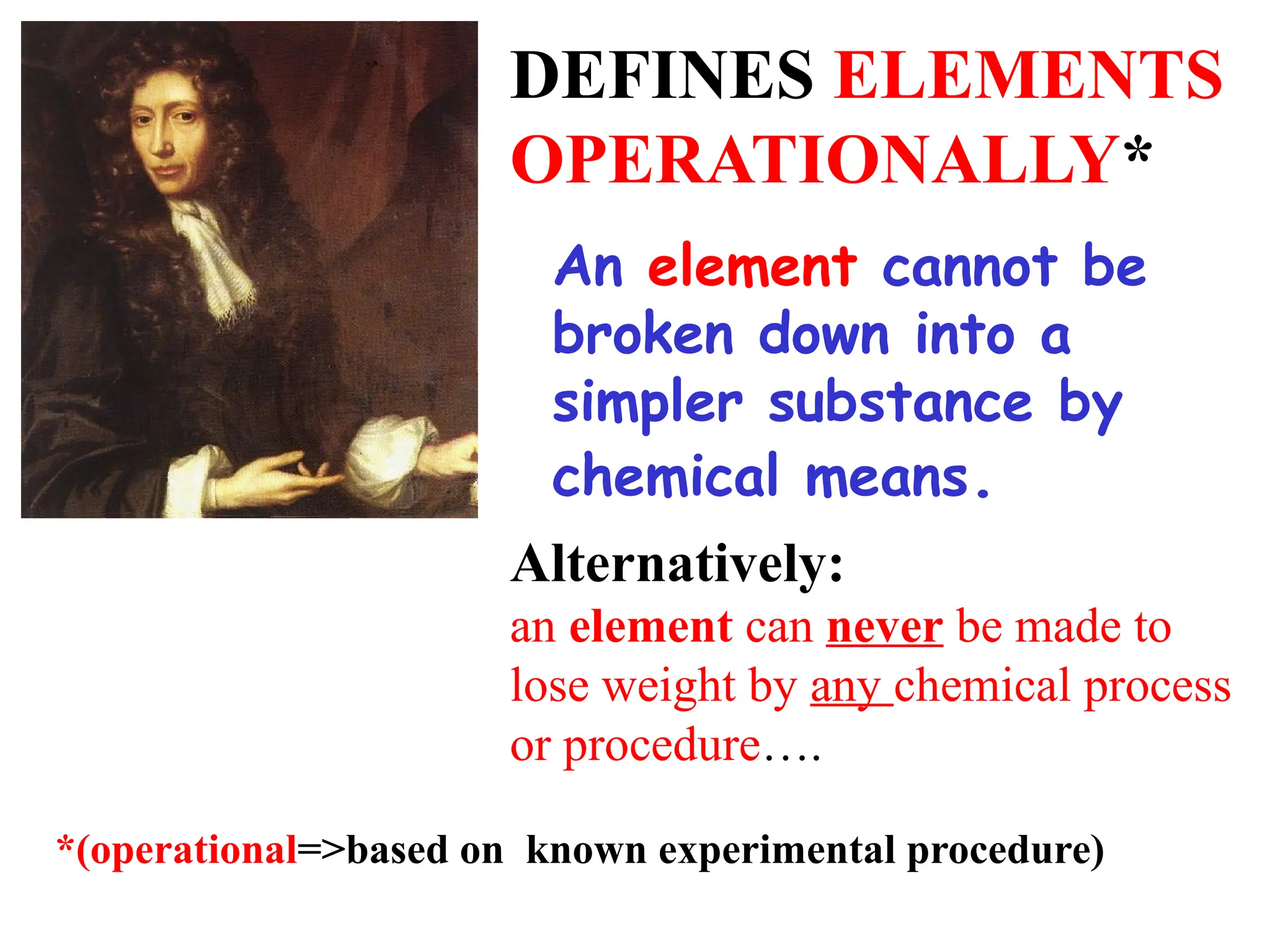
An element cannot be
broken down into a
simpler substance by
chemical means.
Alternatively:
an element can never be made to
lose weight by any chemical process
or procedure….
*(operational=>based on known experimental procedure)
DEFINES ELEMENTS
OPERATIONALLY*
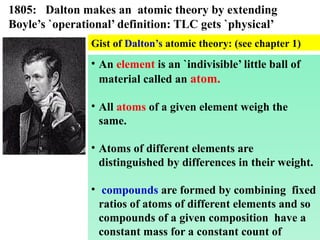
1805: Dalton makes an atomic theory by extending
Boyle’s `operational’ definition: TLC gets `physical’
• An element is an `indivisible’ little ball of
material called an atom.
• All atoms of a given element weigh the
same.
• Atoms of different elements are
distinguished by differences in their weight.
• compounds are formed by combining fixed
ratios of atoms of different elements and so
compounds of a given composition have a
constant mass for a constant count of
Gist of Dalton’s atomic theory: (see chapter 1)
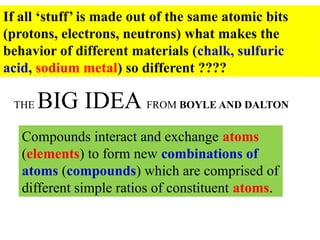
If all ‘stuff’ is made out of the same atomic bits
(protons, electrons, neutrons) what makes the
behavior of different materials (chalk, sulfuric
acid, sodium metal) so different ????
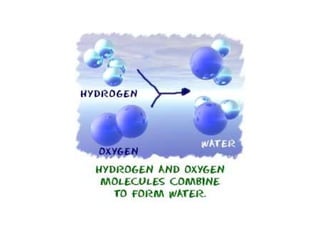
Compounds interact and exchange atoms
(elements) to form new combinations of
atoms (compounds) which are comprised of
different simple ratios of constituent atoms.
THE BIG IDEA FROM BOYLE AND DALTON
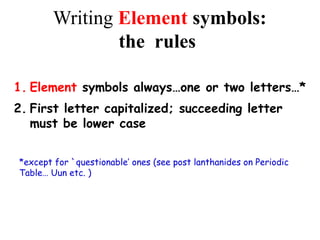
Writing Element symbols:
the rules
1. Element symbols always…one or two letters…*
2. First letter capitalized; succeeding letter
must be lower case
*except for `questionable’ ones (see post lanthanides on Periodic
Table… Uun etc. )
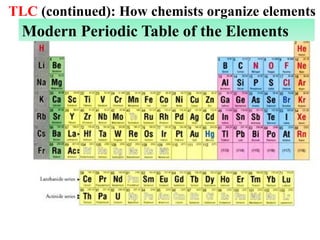
TLC (continued): How chemists organize elements
Modern Periodic Table of the Elements
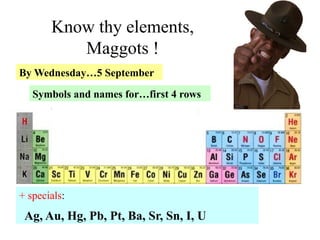
Know thy elements,
Maggots !
+ specials:
Ag, Au, Hg, Pb, Pt, Ba, Sr, Sn, I, U
By Wednesday…5 September
Symbols and names for…first 4 rows
Connection of atomic structure to chemistry
• All atoms of a given element weigh the same.
Dalton’s & Boyle’s elements: 1805
…elements defined by mass
• Atoms of different elements are distinguished by
differences in their weight.
Modern atom…..post 1913
...elements defined by proton count
• . All atoms of a given element have the same proton
count.
• Atoms of different elements have different proton counts.
Why not stick with the weight ????
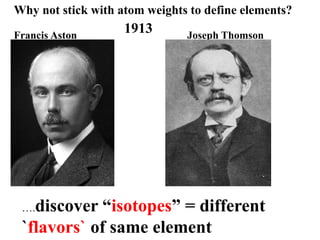
Francis Aston Joseph Thomson
Why not stick with atom weights to define elements?
….discover “isotopes” = different
`flavors` of same element
1913
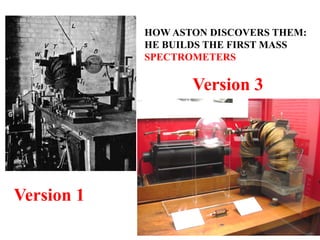
HOW ASTON DISCOVERS THEM:
HE BUILDS THE FIRST MASS
SPECTROMETERS
Version 1
Version 3
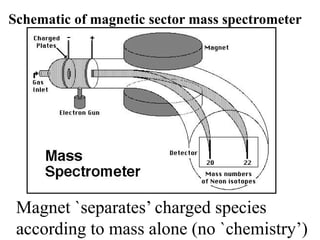
Magnet `separates’ charged species
according to mass alone (no `chemistry’)
Schematic of magnetic sector mass spectrometer
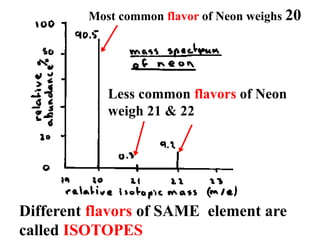
Most common flavor of Neon weighs 20
Less common flavors of Neon
weigh 21 & 22
Different flavors of SAME element are
called ISOTOPES
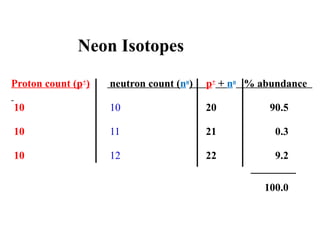
Neon Isotopes
Proton count (p+
) neutron count (no
) p+
+ no
% abundance
10 10 20 90.5
10 11 21 0.3
10 12 22 9.2
100.0
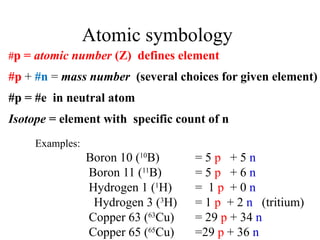
Atomic symbology
#p = atomic number (Z) defines element
#p + #n = mass number (several choices for given element)
#p = #e in neutral atom
Isotope = element with specific count of n
Examples:
Boron 10 (10
B) = 5 p + 5 n
Boron 11 (11
B) = 5 p + 6 n
Hydrogen 1 (1
H) = 1 p + 0 n
Hydrogen 3 (3
H) = 1 p + 2 n (tritium)
Copper 63 (63
Cu) = 29 p + 34 n
Copper 65 (65
Cu) =29 p + 36 n
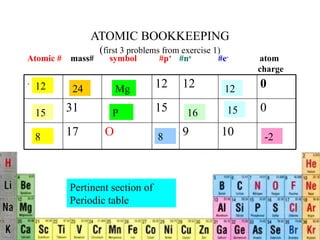
ATOMIC BOOKKEEPING
(first 3 problems from exercise 1)
. 12 12 0
31 15 0
17 O 9 10
Atomic # mass# symbol #p+
#no
#e-
atom
charge
12 24 12
Mg
15 15
16
P
8 8 -2
Pertinent section of
Periodic table
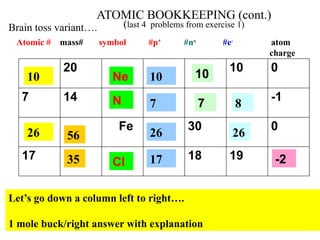
20 10 0
7 14 -1
Fe 30 0
17 18 19
10
26 56
35
Ne
N
Cl
10
Atomic # mass# symbol #p+
#no
#e-
atom
charge
7
26
17
10
7 8
26
-2
ATOMIC BOOKKEEPING (cont.)
(last 4 problems from exercise 1)
Brain toss variant….
Let’s go down a column left to right….
1 mole buck/right answer with explanation
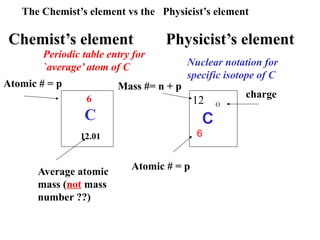
6
C
12.01
12 O
C
6
Periodic table entry for
`average’ atom of C Nuclear notation for
specific isotope of C
Average atomic
mass (not mass
number ??)
Atomic # = p Mass #= n + p
Atomic # = p
charge
The Chemist’s element vs the Physicist’s element
Chemist’s element Physicist’s element
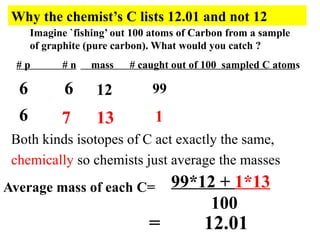
Why the chemist’s C lists 12.01 and not 12
# p # n mass # caught out of 100 sampled C atoms
6 6 99
Imagine `fishing’ out 100 atoms of Carbon from a sample
of graphite (pure carbon). What would you catch ?
12
6 7 13 1
Both kinds isotopes of C act exactly the same,
chemically so chemists just average the masses
Average mass of each C= 99*12 + 1*13
100
= 12.01
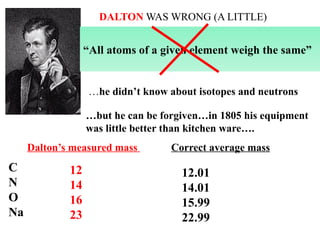
“All atoms of a given element weigh the same”
DALTON WAS WRONG (A LITTLE)
…he didn’t know about isotopes and neutrons
…but he can be forgiven…in 1805 his equipment
was little better than kitchen ware….
Dalton’s measured mass Correct average mass
C
N
O
Na
12
14
16
23
12.01
14.01
15.99
22.99
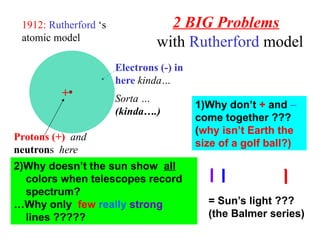
2 BIG Problems
with Rutherford model
Protons (+) and
neutrons here
Electrons (-) in
here kinda…
Sorta …
(kinda….)
2)Why doesn’t the sun show all
colors when telescopes record
spectrum?
…Why only few really strong
lines ?????
1)Why don’t + and –
come together ???
(why isn’t Earth the
size of a golf ball?)
= Sun’s light ???
(the Balmer series)
+
1912: Rutherford ‘s
atomic model

Lecture 4 element intro.pptxxxxxxxxxxxx

  • 1.
    An element cannotbe broken down into a simpler substance by chemical means. Alternatively: an element can never be made to lose weight by any chemical process or procedure…. *(operational=>based on known experimental procedure) DEFINES ELEMENTS OPERATIONALLY*
  • 2.
    1805: Dalton makesan atomic theory by extending Boyle’s `operational’ definition: TLC gets `physical’ • An element is an `indivisible’ little ball of material called an atom. • All atoms of a given element weigh the same. • Atoms of different elements are distinguished by differences in their weight. • compounds are formed by combining fixed ratios of atoms of different elements and so compounds of a given composition have a constant mass for a constant count of Gist of Dalton’s atomic theory: (see chapter 1)
  • 3.
    If all ‘stuff’is made out of the same atomic bits (protons, electrons, neutrons) what makes the behavior of different materials (chalk, sulfuric acid, sodium metal) so different ???? Compounds interact and exchange atoms (elements) to form new combinations of atoms (compounds) which are comprised of different simple ratios of constituent atoms. THE BIG IDEA FROM BOYLE AND DALTON
  • 5.
    Writing Element symbols: therules 1. Element symbols always…one or two letters…* 2. First letter capitalized; succeeding letter must be lower case *except for `questionable’ ones (see post lanthanides on Periodic Table… Uun etc. )
  • 6.
    TLC (continued): Howchemists organize elements Modern Periodic Table of the Elements
  • 7.
    Know thy elements, Maggots! + specials: Ag, Au, Hg, Pb, Pt, Ba, Sr, Sn, I, U By Wednesday…5 September Symbols and names for…first 4 rows
  • 8.
    Connection of atomicstructure to chemistry • All atoms of a given element weigh the same. Dalton’s & Boyle’s elements: 1805 …elements defined by mass • Atoms of different elements are distinguished by differences in their weight. Modern atom…..post 1913 ...elements defined by proton count • . All atoms of a given element have the same proton count. • Atoms of different elements have different proton counts. Why not stick with the weight ????
  • 9.
    Francis Aston JosephThomson Why not stick with atom weights to define elements? ….discover “isotopes” = different `flavors` of same element 1913
  • 10.
    HOW ASTON DISCOVERSTHEM: HE BUILDS THE FIRST MASS SPECTROMETERS Version 1 Version 3
  • 11.
    Magnet `separates’ chargedspecies according to mass alone (no `chemistry’) Schematic of magnetic sector mass spectrometer
  • 12.
    Most common flavorof Neon weighs 20 Less common flavors of Neon weigh 21 & 22 Different flavors of SAME element are called ISOTOPES
  • 13.
    Neon Isotopes Proton count(p+ ) neutron count (no ) p+ + no % abundance 10 10 20 90.5 10 11 21 0.3 10 12 22 9.2 100.0
  • 14.
    Atomic symbology #p =atomic number (Z) defines element #p + #n = mass number (several choices for given element) #p = #e in neutral atom Isotope = element with specific count of n Examples: Boron 10 (10 B) = 5 p + 5 n Boron 11 (11 B) = 5 p + 6 n Hydrogen 1 (1 H) = 1 p + 0 n Hydrogen 3 (3 H) = 1 p + 2 n (tritium) Copper 63 (63 Cu) = 29 p + 34 n Copper 65 (65 Cu) =29 p + 36 n
  • 15.
    ATOMIC BOOKKEEPING (first 3problems from exercise 1) . 12 12 0 31 15 0 17 O 9 10 Atomic # mass# symbol #p+ #no #e- atom charge 12 24 12 Mg 15 15 16 P 8 8 -2 Pertinent section of Periodic table
  • 16.
    20 10 0 714 -1 Fe 30 0 17 18 19 10 26 56 35 Ne N Cl 10 Atomic # mass# symbol #p+ #no #e- atom charge 7 26 17 10 7 8 26 -2 ATOMIC BOOKKEEPING (cont.) (last 4 problems from exercise 1) Brain toss variant…. Let’s go down a column left to right…. 1 mole buck/right answer with explanation
  • 17.
    6 C 12.01 12 O C 6 Periodic tableentry for `average’ atom of C Nuclear notation for specific isotope of C Average atomic mass (not mass number ??) Atomic # = p Mass #= n + p Atomic # = p charge The Chemist’s element vs the Physicist’s element Chemist’s element Physicist’s element
  • 18.
    Why the chemist’sC lists 12.01 and not 12 # p # n mass # caught out of 100 sampled C atoms 6 6 99 Imagine `fishing’ out 100 atoms of Carbon from a sample of graphite (pure carbon). What would you catch ? 12 6 7 13 1 Both kinds isotopes of C act exactly the same, chemically so chemists just average the masses Average mass of each C= 99*12 + 1*13 100 = 12.01
  • 19.
    “All atoms ofa given element weigh the same” DALTON WAS WRONG (A LITTLE) …he didn’t know about isotopes and neutrons …but he can be forgiven…in 1805 his equipment was little better than kitchen ware…. Dalton’s measured mass Correct average mass C N O Na 12 14 16 23 12.01 14.01 15.99 22.99
  • 20.
    2 BIG Problems withRutherford model Protons (+) and neutrons here Electrons (-) in here kinda… Sorta … (kinda….) 2)Why doesn’t the sun show all colors when telescopes record spectrum? …Why only few really strong lines ????? 1)Why don’t + and – come together ??? (why isn’t Earth the size of a golf ball?) = Sun’s light ??? (the Balmer series) + 1912: Rutherford ‘s atomic model