Marketing for Startups in High-Tech
       Marketing for High-Tech Startups

R. Paul Singh –                   rpaulsingh

Entrepreneur


                          CyLAN

                                               1
AGENDA
What   has changed in Software business?
4Ps of Marketing
Product
Distribution
Pricing and Revenue Model
Promotion & Customer Acquisition
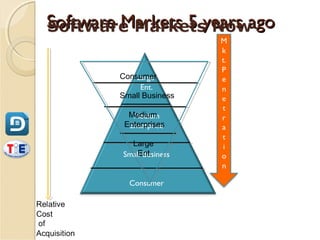
Software Markets 5 years ago

        Consumer
            Large
             Ent.
        Small Business

          Medium
           Medium
         Enterprises
          Enterprise

           Large
             Ent.
         Small Business


          Consumer
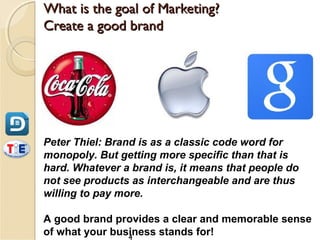
What is the goal of Marketing?
Create a good brand


Peter Thiel: Brand is as a classic code word for
monopoly. But getting more specific than that is
hard. Whatever a brand is, it means that people do
not see products as interchangeable and are thus
willing to pay more.

A good brand provides a clear and memorable sense
of what your business stands for!
                4
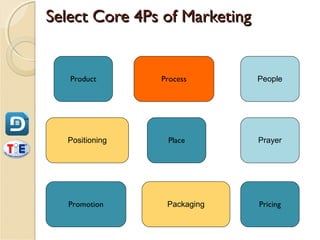
Select Core 4Ps of Marketing


   Product      Process        People


  Positioning    Place         Prayer


   Promotion     Packaging     Pricing
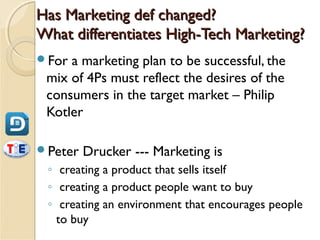
Has Marketing def changed?
What differentiates High-Tech Marketing?
For a marketing plan to be successful, the
 mix of 4Ps must reflect the desires of the
 consumers in the target market – Philip
 Kotler

Peter   Drucker --- Marketing is
 ◦ creating a product that sells itself
 ◦ creating a product people want to buy
 ◦ creating an environment that encourages people
   to buy
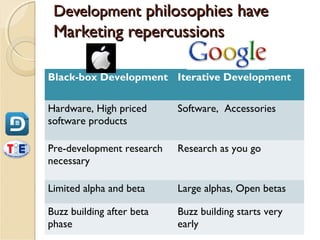
Development philosophies have
 Marketing repercussions

Black-box Development Iterative Development

Hardware, High priced      Software, Accessories
software products

Pre-development research   Research as you go
necessary

Limited alpha and beta     Large alphas, Open betas

Buzz building after beta   Buzz building starts very
phase                      early
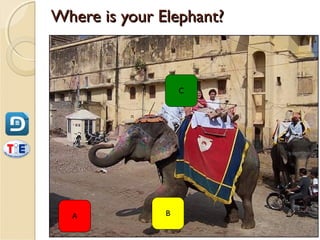
Where is your Elephant?


                   C


  A            B
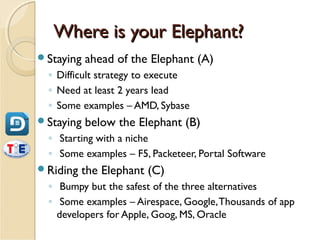
Where is your Elephant?
Staying   ahead of the Elephant (A)
  ◦ Difficult strategy to execute
  ◦ Need at least 2 years lead
  ◦ Some examples – AMD, Sybase
Staying   below the Elephant (B)
  ◦ Starting with a niche
  ◦ Some examples – F5, Packeteer, Portal Software
Riding   the Elephant (C)
  ◦ Bumpy but the safest of the three alternatives
  ◦ Some examples – Airespace, Google, Thousands of app
    developers for Apple, Goog, MS, Oracle
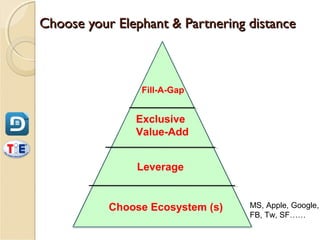
Choose your Elephant & Partnering distance


                Fill-A-Gap


               Exclusive
               Value-Add


               Leverage


           Choose Ecosystem (s)   MS, Apple, Google,
                                  FB, Tw, SF……
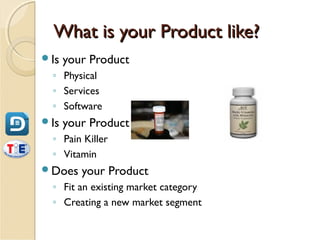
What is your Product like?
Is   your Product
 ◦ Physical
 ◦ Services
 ◦ Software
Is   your Product
 ◦ Pain Killer
 ◦ Vitamin
Does    your Product
 ◦ Fit an existing market category
 ◦ Creating a new market segment
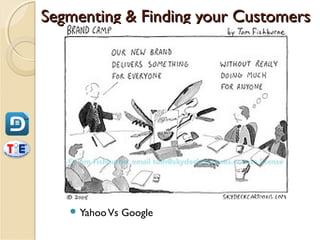
Segmenting & Finding your Customers


    Yahoo Vs   Google
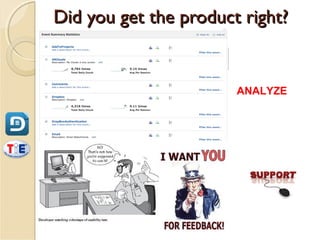
Did you get the product right?


                       ANALYZE
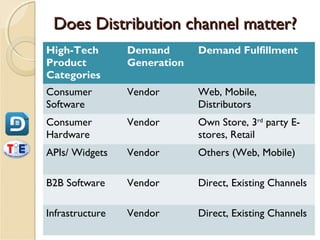
Does Distribution channel matter?
High-Tech        Demand       Demand Fulfillment
Product          Generation
Categories
Consumer         Vendor       Web, Mobile,
Software                      Distributors
Consumer         Vendor       Own Store, 3rd party E-
Hardware                      stores, Retail
APIs/ Widgets    Vendor       Others (Web, Mobile)

B2B Software     Vendor       Direct, Existing Channels

Infrastructure   Vendor       Direct, Existing Channels
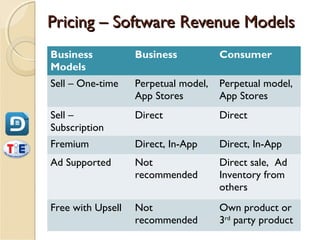
Pricing – Software Revenue Models
Business           Business           Consumer
Models
Sell – One-time    Perpetual model,   Perpetual model,
                   App Stores         App Stores
Sell –             Direct             Direct
Subscription
Fremium            Direct, In-App     Direct, In-App
Ad Supported       Not                Direct sale, Ad
                   recommended        Inventory from
                                      others
Free with Upsell   Not                Own product or
                   recommended        3rd party product
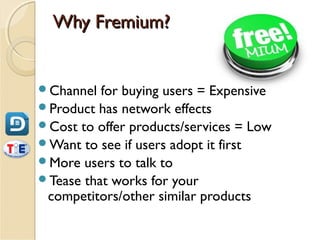
Why Fremium?


Channel  for buying users = Expensive
Product has network effects
Cost to offer products/services = Low
Want to see if users adopt it first
More users to talk to
Tease that works for your
 competitors/other similar products
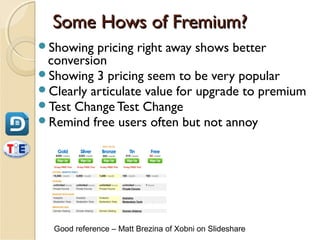
Some Hows of Fremium?
Showing  pricing right away shows better
 conversion
Showing 3 pricing seem to be very popular
Clearly articulate value for upgrade to premium
Test Change Test Change
Remind free users often but not annoy


  Good reference – Matt Brezina of Xobni on Slideshare
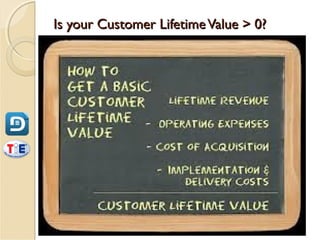
Is your Customer Lifetime Value > 0?
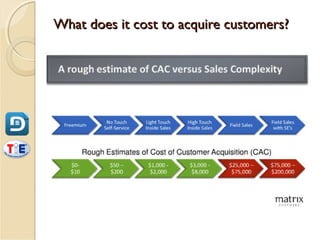
What does it cost to acquire customers?
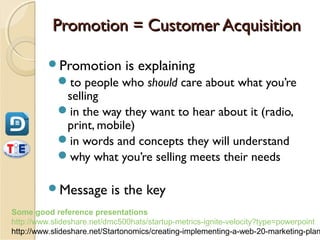
Promotion = Customer Acquisition

         Promotion           is explaining
            to people who should care about what you’re
             selling
            in the way they want to hear about it (radio,
             print, mobile)
            in words and concepts they will understand
            why what you’re selling meets their needs

         Message          is the key
Some good reference presentations
http://www.slideshare.net/dmc500hats/startup-metrics-ignite-velocity?type=powerpoint
http://www.slideshare.net/Startonomics/creating-implementing-a-web-20-marketing-plan
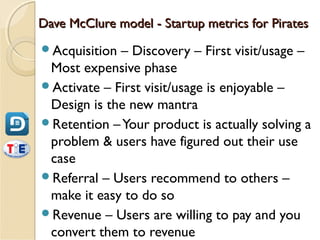
Dave McClure model - Startup metrics for Pirates
Acquisition – Discovery – First visit/usage –
 Most expensive phase
Activate – First visit/usage is enjoyable –
 Design is the new mantra
Retention – Your product is actually solving a
 problem & users have figured out their use
 case
Referral – Users recommend to others –
 make it easy to do so
Revenue – Users are willing to pay and you
 convert them to revenue
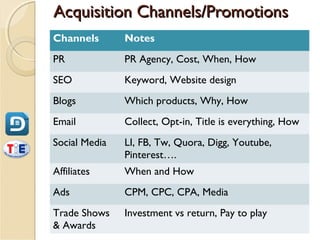
Acquisition Channels/Promotions
Channels       Notes
PR             PR Agency, Cost, When, How
SEO            Keyword, Website design
Blogs          Which products, Why, How
Email          Collect, Opt-in, Title is everything, How
Social Media   LI, FB, Tw, Quora, Digg, Youtube,
               Pinterest….
Affiliates     When and How
Ads            CPM, CPC, CPA, Media
Trade Shows    Investment vs return, Pay to play
& Awards
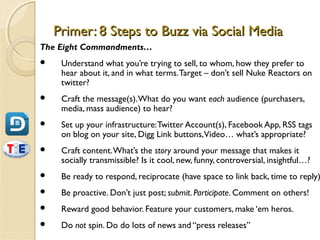
Primer: 8 Steps to Buzz via Social Media
The Eight Commandments…
    Understand what you’re trying to sell, to whom, how they prefer to
     hear about it, and in what terms. Target – don’t sell Nuke Reactors on
     twitter?
    Craft the message(s). What do you want each audience (purchasers,
     media, mass audience) to hear?
    Set up your infrastructure: Twitter Account(s), Facebook App, RSS tags
     on blog on your site, Digg Link buttons,Video… what’s appropriate?
    Craft content. What’s the story around your message that makes it
     socially transmissible? Is it cool, new, funny, controversial, insightful…?
    Be ready to respond, reciprocate (have space to link back, time to reply)
    Be proactive. Don’t just post; submit. Participate. Comment on others!
    Reward good behavior. Feature your customers, make ‘em heros.
    Do not spin. Do do lots of news and “press releases”
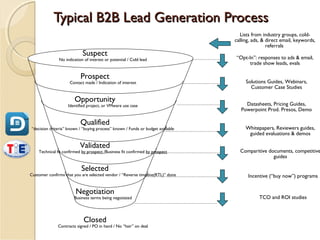
Typical B2B Lead Generation Process
                                                                                     Lists from industry groups, cold-
                                                                                  calling, ads, & direct email, keywords,
                                                                                                  referrals
                            Suspect                                               “Opt-In”: responses to ads & email,
               No indication of interest or potential / Cold lead
                                                                                        trade show leads, evals

                           Prospect
                     Contact made / Indication of interest                             Solutions Guides, Webinars,
                                                                                         Customer Case Studies

                        Opportunity                                                    Datasheets, Pricing Guides,
                    Identified project, or VMware use case
                                                                                     Powerpoint Prod. Presos, Demo

                           Qualified
 “decision criteria” known / “buying process” known / Funds or budget available        Whitepapers, Reviewers guides,
                                                                                        guided evaluations & demos

                           Validated
    Technical fit confirmed by prospect /Business fit confirmed by prospect         Comparitive documents, competitive
                                                                                                  guides

                            Selected
Customer confirms that you are selected vendor / “Reverse timeline(RTL)” done           Incentive (“buy now”) programs


                         Negotiation
                        Business terms being negotiated                                      TCO and ROI studies


                             Closed
               Contracts signed / PO in hand / No “hair” on deal
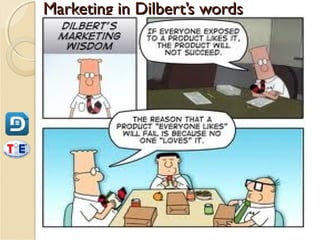
Marketing in Dilbert’s words
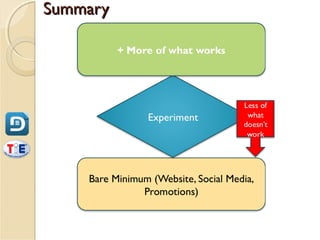
Summary

Marketing for High-Tech Startups presented at UC Berkeley

  • 1.
    Marketing for Startupsin High-Tech Marketing for High-Tech Startups R. Paul Singh – rpaulsingh Entrepreneur CyLAN 1
  • 2.
    AGENDA What has changed in Software business? 4Ps of Marketing Product Distribution Pricing and Revenue Model Promotion & Customer Acquisition
  • 3.
    Software Markets 5years ago Consumer Large Ent. Small Business Medium Medium Enterprises Enterprise Large Ent. Small Business Consumer
  • 4.
    What is thegoal of Marketing? Create a good brand Peter Thiel: Brand is as a classic code word for monopoly. But getting more specific than that is hard. Whatever a brand is, it means that people do not see products as interchangeable and are thus willing to pay more. A good brand provides a clear and memorable sense of what your business stands for! 4
  • 5.
    Select Core 4Psof Marketing Product Process People Positioning Place Prayer Promotion Packaging Pricing
  • 6.
    Has Marketing defchanged? What differentiates High-Tech Marketing? For a marketing plan to be successful, the mix of 4Ps must reflect the desires of the consumers in the target market – Philip Kotler Peter Drucker --- Marketing is ◦ creating a product that sells itself ◦ creating a product people want to buy ◦ creating an environment that encourages people to buy
  • 7.
    Development philosophies have Marketing repercussions Black-box Development Iterative Development Hardware, High priced Software, Accessories software products Pre-development research Research as you go necessary Limited alpha and beta Large alphas, Open betas Buzz building after beta Buzz building starts very phase early
  • 8.
    Where is yourElephant? C A B
  • 9.
    Where is yourElephant? Staying ahead of the Elephant (A) ◦ Difficult strategy to execute ◦ Need at least 2 years lead ◦ Some examples – AMD, Sybase Staying below the Elephant (B) ◦ Starting with a niche ◦ Some examples – F5, Packeteer, Portal Software Riding the Elephant (C) ◦ Bumpy but the safest of the three alternatives ◦ Some examples – Airespace, Google, Thousands of app developers for Apple, Goog, MS, Oracle
  • 10.
    Choose your Elephant& Partnering distance Fill-A-Gap Exclusive Value-Add Leverage Choose Ecosystem (s) MS, Apple, Google, FB, Tw, SF……
  • 11.
    What is yourProduct like? Is your Product ◦ Physical ◦ Services ◦ Software Is your Product ◦ Pain Killer ◦ Vitamin Does your Product ◦ Fit an existing market category ◦ Creating a new market segment
  • 12.
    Segmenting & Findingyour Customers  Yahoo Vs Google
  • 13.
    Did you getthe product right? ANALYZE
  • 14.
    Does Distribution channelmatter? High-Tech Demand Demand Fulfillment Product Generation Categories Consumer Vendor Web, Mobile, Software Distributors Consumer Vendor Own Store, 3rd party E- Hardware stores, Retail APIs/ Widgets Vendor Others (Web, Mobile) B2B Software Vendor Direct, Existing Channels Infrastructure Vendor Direct, Existing Channels
  • 15.
    Pricing – SoftwareRevenue Models Business Business Consumer Models Sell – One-time Perpetual model, Perpetual model, App Stores App Stores Sell – Direct Direct Subscription Fremium Direct, In-App Direct, In-App Ad Supported Not Direct sale, Ad recommended Inventory from others Free with Upsell Not Own product or recommended 3rd party product
  • 16.
    Why Fremium? Channel for buying users = Expensive Product has network effects Cost to offer products/services = Low Want to see if users adopt it first More users to talk to Tease that works for your competitors/other similar products
  • 17.
    Some Hows ofFremium? Showing pricing right away shows better conversion Showing 3 pricing seem to be very popular Clearly articulate value for upgrade to premium Test Change Test Change Remind free users often but not annoy Good reference – Matt Brezina of Xobni on Slideshare
  • 18.
    Is your CustomerLifetime Value > 0?
  • 19.
    What does itcost to acquire customers?
  • 20.
    Promotion = CustomerAcquisition Promotion is explaining to people who should care about what you’re selling in the way they want to hear about it (radio, print, mobile) in words and concepts they will understand why what you’re selling meets their needs Message is the key Some good reference presentations http://www.slideshare.net/dmc500hats/startup-metrics-ignite-velocity?type=powerpoint http://www.slideshare.net/Startonomics/creating-implementing-a-web-20-marketing-plan
  • 21.
    Dave McClure model- Startup metrics for Pirates Acquisition – Discovery – First visit/usage – Most expensive phase Activate – First visit/usage is enjoyable – Design is the new mantra Retention – Your product is actually solving a problem & users have figured out their use case Referral – Users recommend to others – make it easy to do so Revenue – Users are willing to pay and you convert them to revenue
  • 22.
    Acquisition Channels/Promotions Channels Notes PR PR Agency, Cost, When, How SEO Keyword, Website design Blogs Which products, Why, How Email Collect, Opt-in, Title is everything, How Social Media LI, FB, Tw, Quora, Digg, Youtube, Pinterest…. Affiliates When and How Ads CPM, CPC, CPA, Media Trade Shows Investment vs return, Pay to play & Awards
  • 23.
    Primer: 8 Stepsto Buzz via Social Media The Eight Commandments…  Understand what you’re trying to sell, to whom, how they prefer to hear about it, and in what terms. Target – don’t sell Nuke Reactors on twitter?  Craft the message(s). What do you want each audience (purchasers, media, mass audience) to hear?  Set up your infrastructure: Twitter Account(s), Facebook App, RSS tags on blog on your site, Digg Link buttons,Video… what’s appropriate?  Craft content. What’s the story around your message that makes it socially transmissible? Is it cool, new, funny, controversial, insightful…?  Be ready to respond, reciprocate (have space to link back, time to reply)  Be proactive. Don’t just post; submit. Participate. Comment on others!  Reward good behavior. Feature your customers, make ‘em heros.  Do not spin. Do do lots of news and “press releases”
  • 24.
    Typical B2B LeadGeneration Process Lists from industry groups, cold- calling, ads, & direct email, keywords, referrals Suspect “Opt-In”: responses to ads & email, No indication of interest or potential / Cold lead trade show leads, evals Prospect Contact made / Indication of interest Solutions Guides, Webinars, Customer Case Studies Opportunity Datasheets, Pricing Guides, Identified project, or VMware use case Powerpoint Prod. Presos, Demo Qualified “decision criteria” known / “buying process” known / Funds or budget available Whitepapers, Reviewers guides, guided evaluations & demos Validated Technical fit confirmed by prospect /Business fit confirmed by prospect Comparitive documents, competitive guides Selected Customer confirms that you are selected vendor / “Reverse timeline(RTL)” done Incentive (“buy now”) programs Negotiation Business terms being negotiated TCO and ROI studies Closed Contracts signed / PO in hand / No “hair” on deal
  • 25.
  • 26.