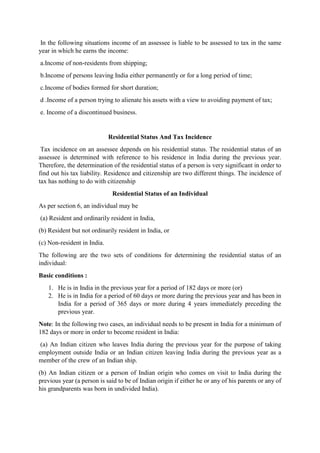
This document defines key terms related to the assessment of income tax in India. It explains that an assessment is the procedure by which an assessee's income is determined by the Assessing Officer. An assessee refers to any person whose income or loss is assessed. A deemed assessee is one who is considered an assessee for another person, while an assessee in default fails to fulfill their duties under tax law. The document also defines person, assessment year, previous year, and outlines the various categories of residential status and their implications for tax incidence: resident and ordinarily resident, resident but not ordinarily resident, and non-resident.
![IMPORTANT DEFINITIONS
Assessment [Section 2(8)]
This is the procedure by which the income of an assessee is determined by the
Assessing Officer. The process of calculation of tax liability is known as Assessment.
It can be Self-Assessment or Re-Assessment.
Assessee : Section 2(7)
Every person in respect of whom, any proceeding under the act has been taken for the
assessment of his income or of the income of any other person in respect of which he is
assessable or of the loss sustained by him or by such other person or the amount of refund due
to him or to such other person may be called an assessee.
Deemed Assessee: A person who is deemed to be an assessee for some other person is
called “Deemed Assessee”.
Assessee In Default: When a person is responsible for doing any work under the Income
Tax Act and he fails to do it, he is called an “Assessee in default”.
Person : Section 2(31)
The term “person” includes:
1.An individual;
2. An Hindu undivided family;
3.A company;
4.A firm;
5.An association of persons or a body of individuals , whether incorporated or not;
6.A local authority; and
7. Every artificial juridical person not falling with in any of the preceding categories.
Assessment Year :Section 2(9)
“Assessment year” means the period starting from April 1 and ending on March 31 of
the next year. Eg: Assessment year 2016-17 which commences on April 1, 2016 and ends on
March 31, 2017. Income of previous year of an assessee is taxed during the assessment year at
the rates prescribed by the relevant Finance Act for tax rates.
Previous year : section3
Income earned in a particular year is taxable in the next year. The year in which income
is earned is known as previous year and the next year in which income is taxable is known as
assessment year. In other words, previous year is the financial year immediately proceeding
the assessment year. Exceptions 9 to the general rule that previous year’s income is taxable
during the assessment year](https://image.slidesharecdn.com/o6twc2m8rlgxjpzfli1c-income-tax-notes-240228101400-c0a42f2e/85/Income_Tax-Basic-Definition_-B-Com-students-docx-1-320.jpg)
![IMPORTANT DEFINITIONS
Assessment [Section 2(8)]
This is the procedure by which the income of an assessee is determined by the
Assessing Officer. The process of calculation of tax liability is known as Assessment.
It can be Self-Assessment or Re-Assessment.
Assessee : Section 2(7)
Every person in respect of whom, any proceeding under the act has been taken for the
assessment of his income or of the income of any other person in respect of which he is
assessable or of the loss sustained by him or by such other person or the amount of refund due
to him or to such other person may be called an assessee.
Deemed Assessee: A person who is deemed to be an assessee for some other person is
called “Deemed Assessee”.
Assessee In Default: When a person is responsible for doing any work under the Income
Tax Act and he fails to do it, he is called an “Assessee in default”.
Person : Section 2(31)
The term “person” includes:
1.An individual;
2. An Hindu undivided family;
3.A company;
4.A firm;
5.An association of persons or a body of individuals , whether incorporated or not;
6.A local authority; and
7. Every artificial juridical person not falling with in any of the preceding categories.
Assessment Year :Section 2(9)
“Assessment year” means the period starting from April 1 and ending on March 31 of
the next year. Eg: Assessment year 2016-17 which commences on April 1, 2016 and ends on
March 31, 2017. Income of previous year of an assessee is taxed during the assessment year at
the rates prescribed by the relevant Finance Act for tax rates.
Previous year : section3
Income earned in a particular year is taxable in the next year. The year in which income
is earned is known as previous year and the next year in which income is taxable is known as
assessment year. In other words, previous year is the financial year immediately proceeding
the assessment year. Exceptions 9 to the general rule that previous year’s income is taxable
during the assessment year](https://image.slidesharecdn.com/o6twc2m8rlgxjpzfli1c-income-tax-notes-240228101400-c0a42f2e/75/Income_Tax-Basic-Definition_-B-Com-students-docx-1-2048.jpg)
![Additional Conditions:
(i) He has been resident in India in at least 2 out of 10 previous years [according to
basic condition noted above] immediately preceding the relevant previous year.
AND
(ii) He has been in India for a period of 730 days or more during 7 years immediately
preceeding the relevant previous year.
Resident
An individual is said to be resident in India if he satisfies any one of the basic conditions.
Resident And Ordinarily Resident
An individual is said to be resident and ordinarily resident in India if he satisfies any one
of the basic conditions and both of the additional conditions.
Resident But Not Ordinarily Resident Sec 6(6)
An individual is said to be resident but not ordinarily resident in India if he satisfies any
one of the basic conditions but not satisfies both of the additional conditions.
Non-Resident Sec 2(30)
An individual is a non-resident in India if he satisfies none of the basic conditions.](https://image.slidesharecdn.com/o6twc2m8rlgxjpzfli1c-income-tax-notes-240228101400-c0a42f2e/85/Income_Tax-Basic-Definition_-B-Com-students-docx-3-320.jpg)


