Course Introduction
Theories of Landscape Architecture
By Prof. Binyi LIU
Dr. Jieqiong WANG
Dr. Zheng CHEN
Dr. Yujia ZHAI
Lecture & Tutorial: Monday 13:30-15:00 @ D3, CAUP
 MLArch Lecture: Theories of Landscape Architecture
 Semester 1, 2016-2017
 Course by Prof. Binyi LIU
 Coordinator and lecturer: Dr. Jieqiong WANG (Echo)
 Lecture Room: D3 (Monday 13:30-15:00)
 Email: echowangwang@qq.com
 Phone: 156 189 60032
 Guest lecturers and tutors: Dr. Zheng CHEN and Dr. Yujia ZHAI
 Dr. Zheng CHEN: zhengchen@tongji.edu.cn
Dr. Yujia ZHAI: zhai@tongji.edu.cn
Introduction
Two Books
Thompson I H. Ecology, Community and
Delight: Sources of values in landscape
architecture[M]. Taylor & Francis, 2000.
Liu, B. Y. 2005. Modern Landscape Planning
and Design [M], Southeast University Press.
Me…
 1999/09—2004/06,Bachelor of LA, CAUP, Tongji University
 2004/09—2007/02,Master of Urban Planning and Design, CAUP, Tongji
University
 2007/03—2008/02,Planner and Landscape Architect, Project Manager, PJAR
Shanghai Office
 2008/02—2013/01,PhD, MSD, The University of Melbourne, Australia
 2008/06—2010/09,Environmental Planner and Chinese Project Coordinator, LAB
Architects Studio, Australia, Melbourne Office
 2008/08—2011/05,Tutor and Guest Lecturer, The University of Melbourne
 2013/07—,Lecturer, Department of Landscape Studies, CAUP, Tongji University
 2014/09—,Head Assistant (Postgraduates), Department of Landscape Studies,
CAUP, Tongji University
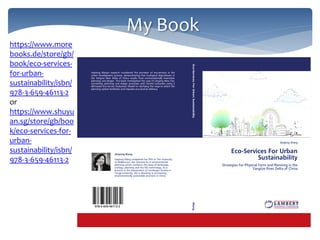
https://www.more
books.de/store/gb/
book/eco-services-
for-urban-
sustainability/isbn/
978-3-659-46113-2
or
https://www.shuyu
an.sg/store/gb/boo
k/eco-services-for-
urban-
sustainability/isbn/
978-3-659-46113-2
My Book
Dr. Yujia ZHAI
zhai@tongji.edu.cn
Dr. Zheng CHEN
zhengchen@tongji.edu.cn
Team
Students Introduction
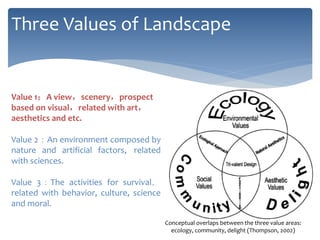
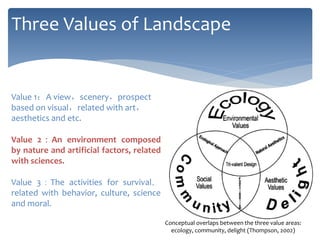
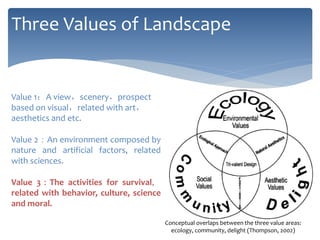
Value 1:A view,scenery,prospect
based on visual,related with art,
aesthetics and etc.
Value 2:An environment composed by
nature and artificial factors, related
with sciences.
Value 3:The activities for survival,
related with behavior, culture, science
and moral.
Three Values of Landscape
Conceptual overlaps between the three value areas:
ecology, community, delight (Thompson, 2002)
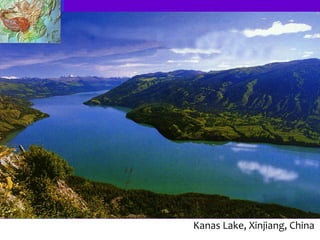
Kanas Lake, Xinjiang, China
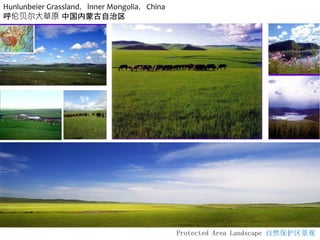
Protected Area Landscape 自然保护区景观
Hunlunbeier Grassland,lnner Mongolia,China
呼伦贝尔大草原 中国内蒙古自治区
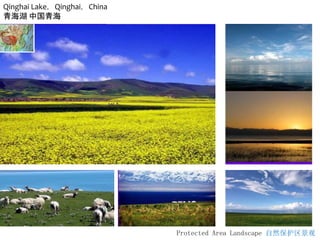
Protected Area Landscape 自然保护区景观
Qinghai Lake,Qinghai,China
青海湖 中国青海
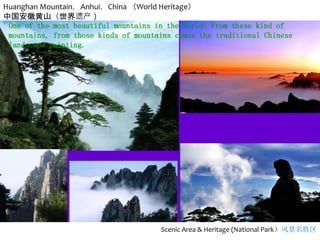
Scenic Area & Heritage (National Park)风景名胜区
Huanghan Mountain,Anhui,China (World Heritage)
中国安徽黄山(世界遗产)
Value 1:A view,scenery,prospect
based on visual,related with art,
aesthetics and etc.
Value 2:An environment composed
by nature and artificial factors, related
with sciences.
Value 3:The activities for survival,
related with behavior, culture, science
and moral.
Three Values of Landscape
Conceptual overlaps between the three value areas:
ecology, community, delight (Thompson, 2002)
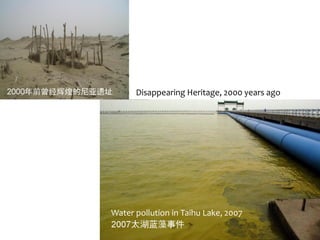
Water pollution in Taihu Lake, 2007
Disappearing Heritage, 2000 years ago
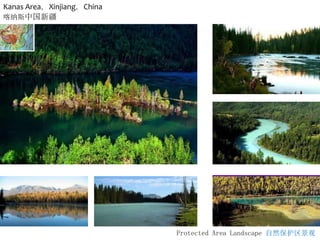
Protected Area Landscape 自然保护区景观
Kanas Area,Xinjiang,China
喀纳斯中国新疆
Value 1:A view,scenery,prospect
based on visual,related with art,
aesthetics and etc.
Value 2:An environment composed by
nature and artificial factors, related
with sciences.
Value 3:The activities for survival,
related with behavior, culture, science
and moral.
Three Values of Landscape
Conceptual overlaps between the three value areas:
ecology, community, delight (Thompson, 2002)
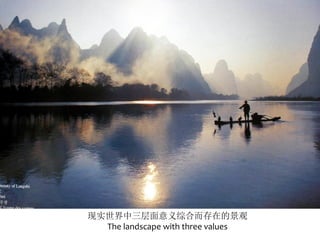
现实世界中三层面意义综合而存在的景观
The landscape with three values
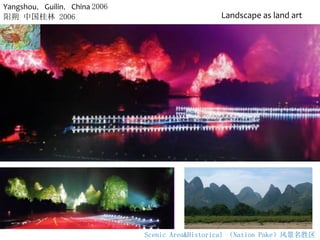
Landscape as land art
Scenic Area&Historical (Nation Pake)风景名胜区
Yangshou,Guilin,China 2006
阳朔 中国桂林 2006
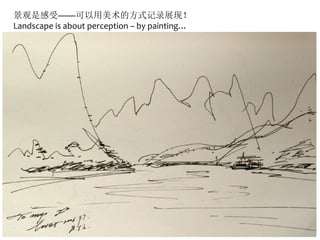
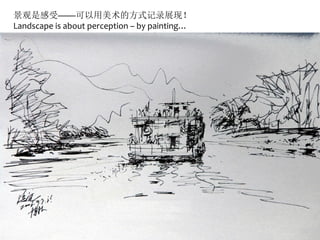
景观是感受——可以用美术的方式记录展现!
Landscape is about perception – by painting…
景观是感受——可以用美术的方式记录展现!
Landscape is about perception – by painting…
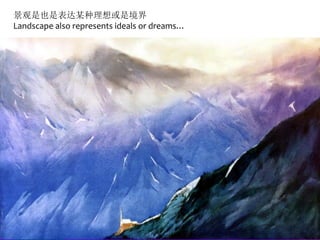
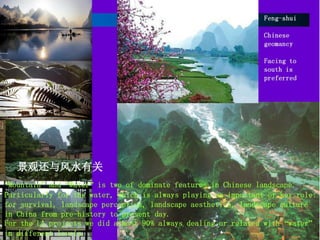
景观是也是表达某种理想或是境界
Landscape also represents ideals or dreams…
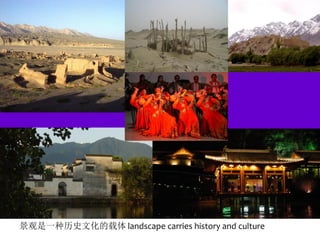
景观是一种历史文化的载体 landscape carries history and culture
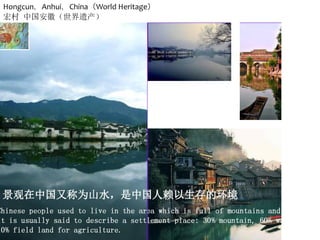
Hongcun,Anhui,China(World Heritage)
宏村 中国安徽(世界遗产)
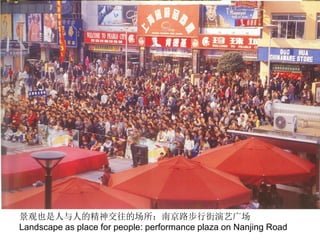
景观也是人与人的精神交往的场所:南京路步行街演艺广场
Landscape as place for people: performance plaza on Nanjing Road
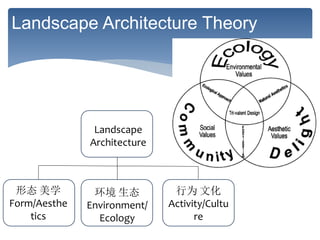
Landscape Architecture Theory
Landscape
Architecture
形态 美学
Form/Aesthe
tics
环境 生态
Environment/
Ecology
行为 文化
Activity/Cultu
re
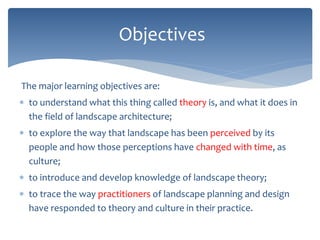
The major learning objectives are:
 to understand what this thing called theory is, and what it does in
the field of landscape architecture;
 to explore the way that landscape has been perceived by its
people and how those perceptions have changed with time, as
culture;
 to introduce and develop knowledge of landscape theory;
 to trace the way practitioners of landscape planning and design
have responded to theory and culture in their practice.
Objectives
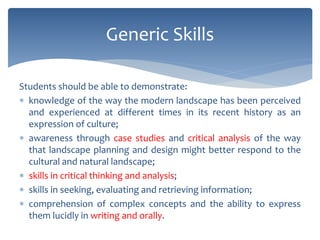
Students should be able to demonstrate:
 knowledge of the way the modern landscape has been perceived
and experienced at different times in its recent history as an
expression of culture;
 awareness through case studies and critical analysis of the way
that landscape planning and design might better respond to the
cultural and natural landscape;
 skills in critical thinking and analysis;
 skills in seeking, evaluating and retrieving information;
 comprehension of complex concepts and the ability to express
them lucidly in writing and orally.
Generic Skills
 The course operates in a variety of modes, e.g. as lecture sessions at the
University, as tutorial and presentations at the University, and as field
work on site.
 Lectures and tutorials at D3 lecture room @ 13:30-15:00.
Venues and Times
Schedule
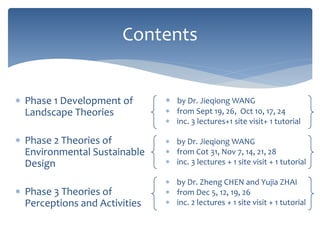
 Phase 1 Development of
Landscape Theories
 Phase 2 Theories of
Environmental Sustainable
Design
 Phase 3 Theories of
Perceptions and Activities
Contents
 by Dr. Jieqiong WANG
 from Sept 19, 26, Oct 10, 17, 24
 inc. 3 lectures+1 site visit+ 1 tutorial
 by Dr. Jieqiong WANG
 from Cot 31, Nov 7, 14, 21, 28
 inc. 3 lectures + 1 site visit + 1 tutorial
 by Dr. Zheng CHEN and Yujia ZHAI
 from Dec 5, 12, 19, 26
 inc. 2 lectures + 1 site visit + 1 tutorial
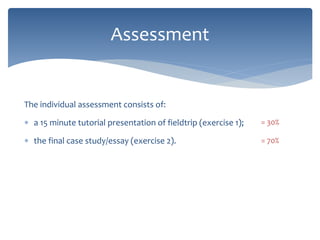
The individual assessment consists of:
 a 15 minute tutorial presentation of fieldtrip (exercise 1);
 the final case study/essay (exercise 2).
Assessment
= 30%
= 70%
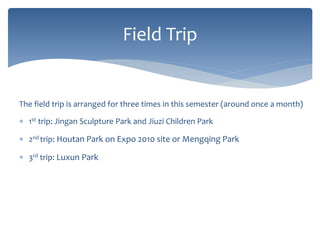
The field trip is arranged for three times in this semester (around once a month)
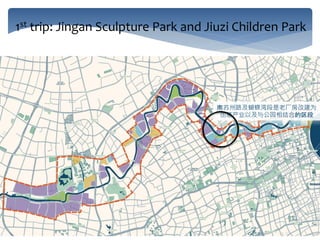
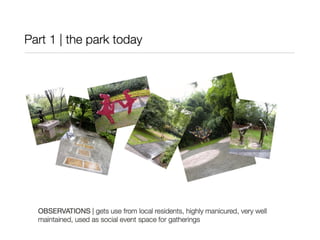
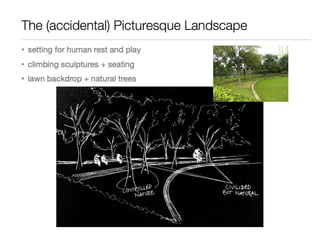
 1st trip: Jingan Sculpture Park and Jiuzi Children Park
 2nd trip: Houtan Park on Expo 2010 site or Mengqing Park
 3rd trip: Luxun Park
Field Trip
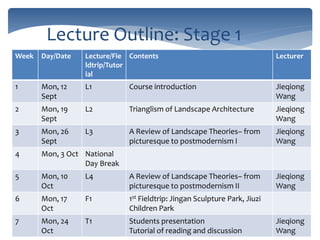
Lecture Outline: Stage 1
Week Day/Date Lecture/Fie
ldtrip/Tutor
ial
Contents Lecturer
1 Mon, 12
Sept
L1 Course introduction Jieqiong
Wang
2 Mon, 19
Sept
L2 Trianglism of Landscape Architecture Jieqiong
Wang
3 Mon, 26
Sept
L3 A Review of Landscape Theories– from
picturesque to postmodernism I
Jieqiong
Wang
4 Mon, 3 Oct National
Day Break
5 Mon, 10
Oct
L4 A Review of Landscape Theories– from
picturesque to postmodernism II
Jieqiong
Wang
6 Mon, 17
Oct
F1 1st Fieldtrip: Jingan Sculpture Park, Jiuzi
Children Park
7 Mon, 24
Oct
T1 Students presentation
Tutorial of reading and discussion
Jieqiong
Wang
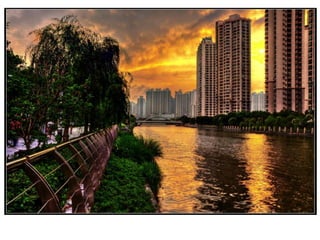
南苏州路及蝴蝶湾段是老厂房改建为
创意产业以及与公园相结合的区段
1st trip: Jingan Sculpture Park and Jiuzi Children Park
Readings for lecture 2 (week 2)
 1) Thompson, I H. 2002, Ecology, Community and Delight: a trivalent approach to
landscape education. Landscape and Urban Planning, 60(2):81-93
Readings for lecture 3 (week 4)
 1) Meinig, D. W. (1979). The Beholding Eye: Ten Versions of the Same Scene. in
Meinig. D. (ed) The Interpretation of Ordinary Landscapes, New York: Oxford
University Press, pp 38-48.
 2) Sim, J. (2001). Landscape Design Theory Primer: Exploration and Expectation
in Landscape Design. Brisbane, School of Design and Built Environment,
Queensland University of Technology.
 3) Meyer, E. (1994). Landscape Architecture as Modern Other and Postmodern
Ground, in Edquist H. & V. Bird (eds). The Culture of Landscape Architecture,
Melbourne, Edge Publishing: pp 13-34.
Further Reading (TBC)
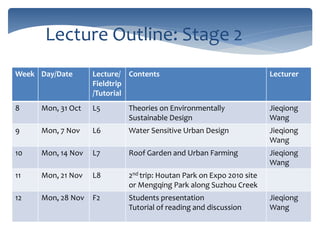
Lecture Outline: Stage 2
Week Day/Date Lecture/
Fieldtrip
/Tutorial
Contents Lecturer
8 Mon, 31 Oct L5 Theories on Environmentally
Sustainable Design
Jieqiong
Wang
9 Mon, 7 Nov L6 Water Sensitive Urban Design Jieqiong
Wang
10 Mon, 14 Nov L7 Roof Garden and Urban Farming Jieqiong
Wang
11 Mon, 21 Nov L8 2nd trip: Houtan Park on Expo 2010 site
or Mengqing Park along Suzhou Creek
12 Mon, 28 Nov F2 Students presentation
Tutorial of reading and discussion
Jieqiong
Wang
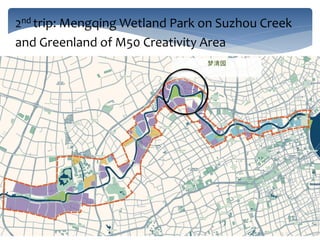
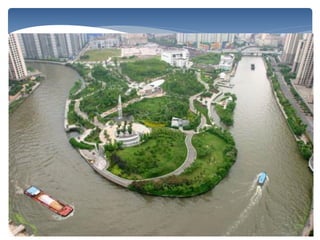
梦清园
2nd trip: Mengqing Wetland Park on Suzhou Creek
and Greenland of M50 Creativity Area
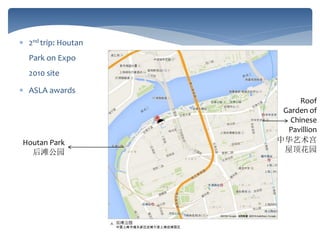
 2nd trip: Houtan
Park on Expo
2010 site
 ASLA awards
Houtan Park
后滩公园
Roof
Garden of
Chinese
Pavillion
中华艺术宫
屋顶花园
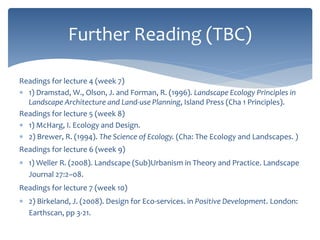
Readings for lecture 4 (week 7)
 1) Dramstad, W., Olson, J. and Forman, R. (1996). Landscape Ecology Principles in
Landscape Architecture and Land-use Planning, Island Press (Cha 1 Principles).
Readings for lecture 5 (week 8)
 1) McHarg, I. Ecology and Design.
 2) Brewer, R. (1994). The Science of Ecology. (Cha: The Ecology and Landscapes. )
Readings for lecture 6 (week 9)
 1) Weller R. (2008). Landscape (Sub)Urbanism in Theory and Practice. Landscape
Journal 27:2–08.
Readings for lecture 7 (week 10)
 2) Birkeland, J. (2008). Design for Eco-services. in Positive Development. London:
Earthscan, pp 3-21.
Further Reading (TBC)
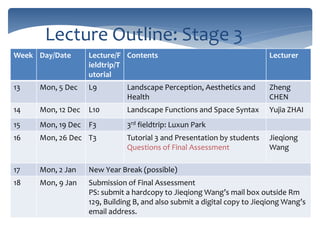
Lecture Outline: Stage 3
Week Day/Date Lecture/F
ieldtrip/T
utorial
Contents Lecturer
13 Mon, 5 Dec L9 Landscape Perception, Aesthetics and
Health
Zheng
CHEN
14 Mon, 12 Dec L10 Landscape Functions and Space Syntax Yujia ZHAI
15 Mon, 19 Dec F3 3rd fieldtrip: Luxun Park
16 Mon, 26 Dec T3 Tutorial 3 and Presentation by students
Questions of Final Assessment
Jieqiong
Wang
17 Mon, 2 Jan New Year Break (possible)
18 Mon, 9 Jan Submission of Final Assessment
PS: submit a hardcopy to Jieqiong Wang’s mail box outside Rm
129, Building B, and also submit a digital copy to Jieqiong Wang’s
email address.
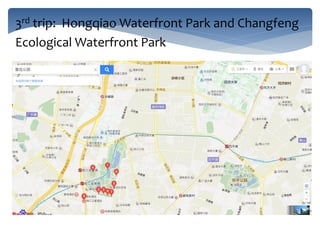
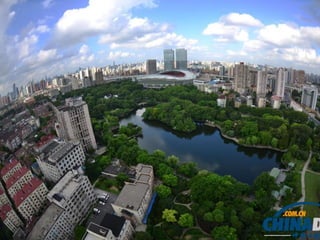
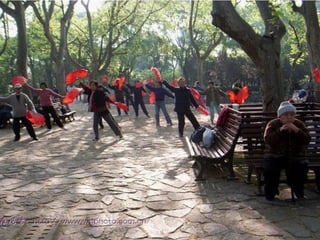
3rd trip: Hongqiao Waterfront Park and Changfeng
Ecological Waterfront Park
Further Reading (TBC)
Readings for lecture 6 (week 13)
 1) Olin, L. (1988). Form, Meaning and Expression in Landscape Architecture, in
Landscape Journal 7(1): pp 149-68.
Readings for lecture 7 (week 14)
 Zeisel, J. Inquiry by Design: Tools for Environement-behavior Research
Questions?

Lecture 1_landscape archi theory.pdf

  • 1.
    Course Introduction Theories ofLandscape Architecture By Prof. Binyi LIU Dr. Jieqiong WANG Dr. Zheng CHEN Dr. Yujia ZHAI Lecture & Tutorial: Monday 13:30-15:00 @ D3, CAUP
  • 2.
     MLArch Lecture:Theories of Landscape Architecture  Semester 1, 2016-2017  Course by Prof. Binyi LIU  Coordinator and lecturer: Dr. Jieqiong WANG (Echo)  Lecture Room: D3 (Monday 13:30-15:00)  Email: echowangwang@qq.com  Phone: 156 189 60032  Guest lecturers and tutors: Dr. Zheng CHEN and Dr. Yujia ZHAI  Dr. Zheng CHEN: zhengchen@tongji.edu.cn Dr. Yujia ZHAI: zhai@tongji.edu.cn Introduction
  • 3.
    Two Books Thompson IH. Ecology, Community and Delight: Sources of values in landscape architecture[M]. Taylor & Francis, 2000. Liu, B. Y. 2005. Modern Landscape Planning and Design [M], Southeast University Press.
  • 4.
    Me…  1999/09—2004/06,Bachelor ofLA, CAUP, Tongji University  2004/09—2007/02,Master of Urban Planning and Design, CAUP, Tongji University  2007/03—2008/02,Planner and Landscape Architect, Project Manager, PJAR Shanghai Office  2008/02—2013/01,PhD, MSD, The University of Melbourne, Australia  2008/06—2010/09,Environmental Planner and Chinese Project Coordinator, LAB Architects Studio, Australia, Melbourne Office  2008/08—2011/05,Tutor and Guest Lecturer, The University of Melbourne  2013/07—,Lecturer, Department of Landscape Studies, CAUP, Tongji University  2014/09—,Head Assistant (Postgraduates), Department of Landscape Studies, CAUP, Tongji University
  • 5.
  • 6.
    Dr. Yujia ZHAI zhai@tongji.edu.cn Dr.Zheng CHEN zhengchen@tongji.edu.cn Team
  • 7.
  • 8.
    Value 1:A view,scenery,prospect basedon visual,related with art, aesthetics and etc. Value 2:An environment composed by nature and artificial factors, related with sciences. Value 3:The activities for survival, related with behavior, culture, science and moral. Three Values of Landscape Conceptual overlaps between the three value areas: ecology, community, delight (Thompson, 2002)
  • 9.
  • 10.
    Protected Area Landscape自然保护区景观 Hunlunbeier Grassland,lnner Mongolia,China 呼伦贝尔大草原 中国内蒙古自治区
  • 11.
    Protected Area Landscape自然保护区景观 Qinghai Lake,Qinghai,China 青海湖 中国青海
  • 12.
    Scenic Area &Heritage (National Park)风景名胜区 Huanghan Mountain,Anhui,China (World Heritage) 中国安徽黄山(世界遗产)
  • 13.
    Value 1:A view,scenery,prospect basedon visual,related with art, aesthetics and etc. Value 2:An environment composed by nature and artificial factors, related with sciences. Value 3:The activities for survival, related with behavior, culture, science and moral. Three Values of Landscape Conceptual overlaps between the three value areas: ecology, community, delight (Thompson, 2002)
  • 14.
    Water pollution inTaihu Lake, 2007 Disappearing Heritage, 2000 years ago
  • 15.
    Protected Area Landscape自然保护区景观 Kanas Area,Xinjiang,China 喀纳斯中国新疆
  • 16.
    Value 1:A view,scenery,prospect basedon visual,related with art, aesthetics and etc. Value 2:An environment composed by nature and artificial factors, related with sciences. Value 3:The activities for survival, related with behavior, culture, science and moral. Three Values of Landscape Conceptual overlaps between the three value areas: ecology, community, delight (Thompson, 2002)
  • 17.
  • 18.
    Landscape as landart Scenic Area&Historical (Nation Pake)风景名胜区 Yangshou,Guilin,China 2006 阳朔 中国桂林 2006
  • 19.
  • 20.
  • 21.
  • 24.
  • 25.
  • 27.
  • 29.
    Landscape Architecture Theory Landscape Architecture 形态美学 Form/Aesthe tics 环境 生态 Environment/ Ecology 行为 文化 Activity/Cultu re
  • 30.
    The major learningobjectives are:  to understand what this thing called theory is, and what it does in the field of landscape architecture;  to explore the way that landscape has been perceived by its people and how those perceptions have changed with time, as culture;  to introduce and develop knowledge of landscape theory;  to trace the way practitioners of landscape planning and design have responded to theory and culture in their practice. Objectives
  • 31.
    Students should beable to demonstrate:  knowledge of the way the modern landscape has been perceived and experienced at different times in its recent history as an expression of culture;  awareness through case studies and critical analysis of the way that landscape planning and design might better respond to the cultural and natural landscape;  skills in critical thinking and analysis;  skills in seeking, evaluating and retrieving information;  comprehension of complex concepts and the ability to express them lucidly in writing and orally. Generic Skills
  • 32.
     The courseoperates in a variety of modes, e.g. as lecture sessions at the University, as tutorial and presentations at the University, and as field work on site.  Lectures and tutorials at D3 lecture room @ 13:30-15:00. Venues and Times
  • 33.
  • 34.
     Phase 1Development of Landscape Theories  Phase 2 Theories of Environmental Sustainable Design  Phase 3 Theories of Perceptions and Activities Contents  by Dr. Jieqiong WANG  from Sept 19, 26, Oct 10, 17, 24  inc. 3 lectures+1 site visit+ 1 tutorial  by Dr. Jieqiong WANG  from Cot 31, Nov 7, 14, 21, 28  inc. 3 lectures + 1 site visit + 1 tutorial  by Dr. Zheng CHEN and Yujia ZHAI  from Dec 5, 12, 19, 26  inc. 2 lectures + 1 site visit + 1 tutorial
  • 35.
    The individual assessmentconsists of:  a 15 minute tutorial presentation of fieldtrip (exercise 1);  the final case study/essay (exercise 2). Assessment = 30% = 70%
  • 36.
    The field tripis arranged for three times in this semester (around once a month)  1st trip: Jingan Sculpture Park and Jiuzi Children Park  2nd trip: Houtan Park on Expo 2010 site or Mengqing Park  3rd trip: Luxun Park Field Trip
  • 37.
    Lecture Outline: Stage1 Week Day/Date Lecture/Fie ldtrip/Tutor ial Contents Lecturer 1 Mon, 12 Sept L1 Course introduction Jieqiong Wang 2 Mon, 19 Sept L2 Trianglism of Landscape Architecture Jieqiong Wang 3 Mon, 26 Sept L3 A Review of Landscape Theories– from picturesque to postmodernism I Jieqiong Wang 4 Mon, 3 Oct National Day Break 5 Mon, 10 Oct L4 A Review of Landscape Theories– from picturesque to postmodernism II Jieqiong Wang 6 Mon, 17 Oct F1 1st Fieldtrip: Jingan Sculpture Park, Jiuzi Children Park 7 Mon, 24 Oct T1 Students presentation Tutorial of reading and discussion Jieqiong Wang
  • 38.
  • 42.
    Readings for lecture2 (week 2)  1) Thompson, I H. 2002, Ecology, Community and Delight: a trivalent approach to landscape education. Landscape and Urban Planning, 60(2):81-93 Readings for lecture 3 (week 4)  1) Meinig, D. W. (1979). The Beholding Eye: Ten Versions of the Same Scene. in Meinig. D. (ed) The Interpretation of Ordinary Landscapes, New York: Oxford University Press, pp 38-48.  2) Sim, J. (2001). Landscape Design Theory Primer: Exploration and Expectation in Landscape Design. Brisbane, School of Design and Built Environment, Queensland University of Technology.  3) Meyer, E. (1994). Landscape Architecture as Modern Other and Postmodern Ground, in Edquist H. & V. Bird (eds). The Culture of Landscape Architecture, Melbourne, Edge Publishing: pp 13-34. Further Reading (TBC)
  • 43.
    Lecture Outline: Stage2 Week Day/Date Lecture/ Fieldtrip /Tutorial Contents Lecturer 8 Mon, 31 Oct L5 Theories on Environmentally Sustainable Design Jieqiong Wang 9 Mon, 7 Nov L6 Water Sensitive Urban Design Jieqiong Wang 10 Mon, 14 Nov L7 Roof Garden and Urban Farming Jieqiong Wang 11 Mon, 21 Nov L8 2nd trip: Houtan Park on Expo 2010 site or Mengqing Park along Suzhou Creek 12 Mon, 28 Nov F2 Students presentation Tutorial of reading and discussion Jieqiong Wang
  • 44.
    梦清园 2nd trip: MengqingWetland Park on Suzhou Creek and Greenland of M50 Creativity Area
  • 47.
     2nd trip:Houtan Park on Expo 2010 site  ASLA awards Houtan Park 后滩公园 Roof Garden of Chinese Pavillion 中华艺术宫 屋顶花园
  • 48.
    Readings for lecture4 (week 7)  1) Dramstad, W., Olson, J. and Forman, R. (1996). Landscape Ecology Principles in Landscape Architecture and Land-use Planning, Island Press (Cha 1 Principles). Readings for lecture 5 (week 8)  1) McHarg, I. Ecology and Design.  2) Brewer, R. (1994). The Science of Ecology. (Cha: The Ecology and Landscapes. ) Readings for lecture 6 (week 9)  1) Weller R. (2008). Landscape (Sub)Urbanism in Theory and Practice. Landscape Journal 27:2–08. Readings for lecture 7 (week 10)  2) Birkeland, J. (2008). Design for Eco-services. in Positive Development. London: Earthscan, pp 3-21. Further Reading (TBC)
  • 49.
    Lecture Outline: Stage3 Week Day/Date Lecture/F ieldtrip/T utorial Contents Lecturer 13 Mon, 5 Dec L9 Landscape Perception, Aesthetics and Health Zheng CHEN 14 Mon, 12 Dec L10 Landscape Functions and Space Syntax Yujia ZHAI 15 Mon, 19 Dec F3 3rd fieldtrip: Luxun Park 16 Mon, 26 Dec T3 Tutorial 3 and Presentation by students Questions of Final Assessment Jieqiong Wang 17 Mon, 2 Jan New Year Break (possible) 18 Mon, 9 Jan Submission of Final Assessment PS: submit a hardcopy to Jieqiong Wang’s mail box outside Rm 129, Building B, and also submit a digital copy to Jieqiong Wang’s email address.
  • 50.
    3rd trip: HongqiaoWaterfront Park and Changfeng Ecological Waterfront Park
  • 53.
    Further Reading (TBC) Readingsfor lecture 6 (week 13)  1) Olin, L. (1988). Form, Meaning and Expression in Landscape Architecture, in Landscape Journal 7(1): pp 149-68. Readings for lecture 7 (week 14)  Zeisel, J. Inquiry by Design: Tools for Environement-behavior Research
  • 54.