CSC 339 Data Communication and computer Networks
Network Layer: IP Addressesing
CSC-339
Data Communications and Computer Networks
1
CSC 339 Data Communication and computer Networks
What is an IPV4 Address?
2
CSC 339 Data Communication and computer Networks
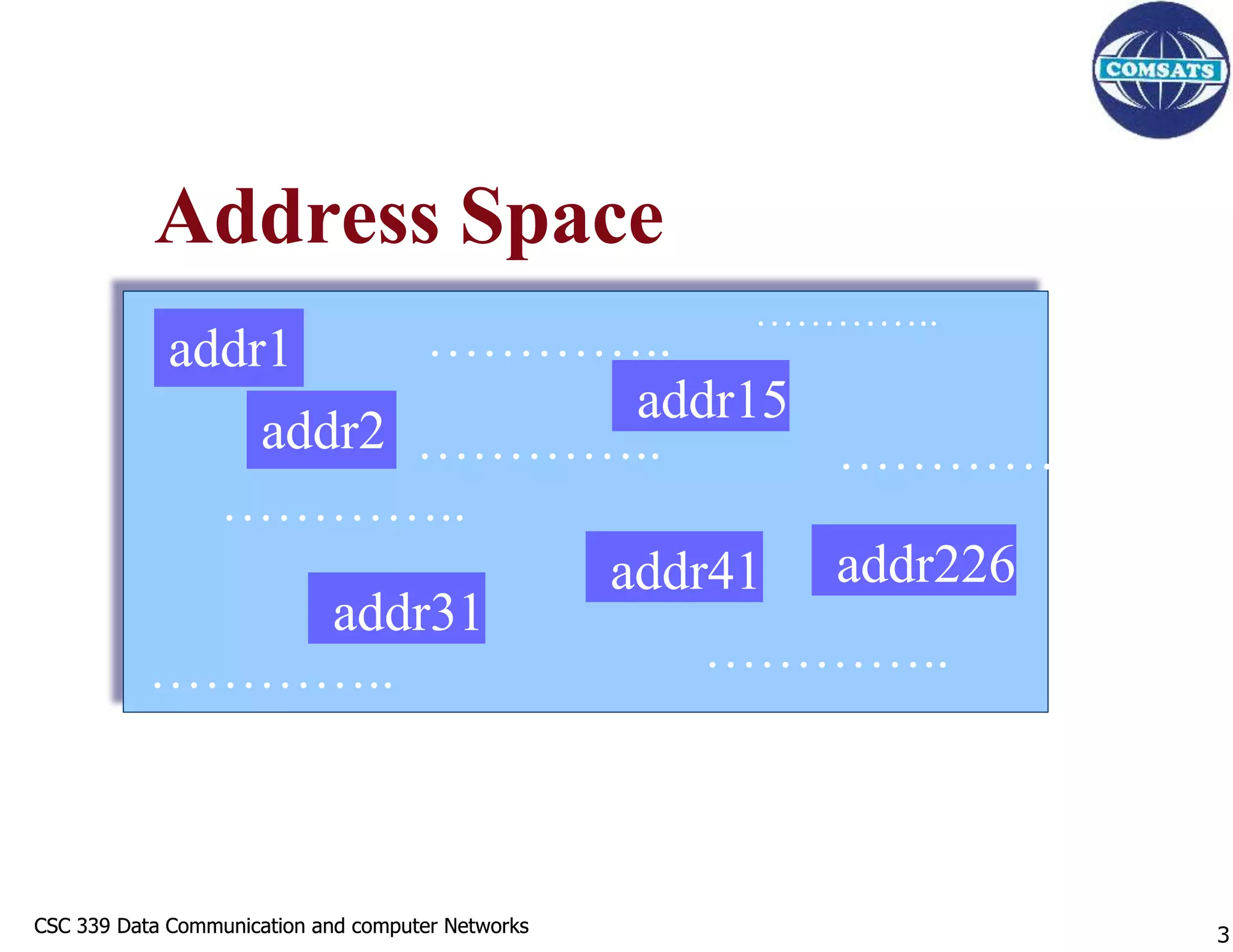
Address Space
addr15
addr1
addr2
addr41
addr31
addr226
…………..
…………..
…………..
…………..
…………..
…………..
…………..
3
CSC 339 Data Communication and computer Networks
Address space rule
…………..
…………..
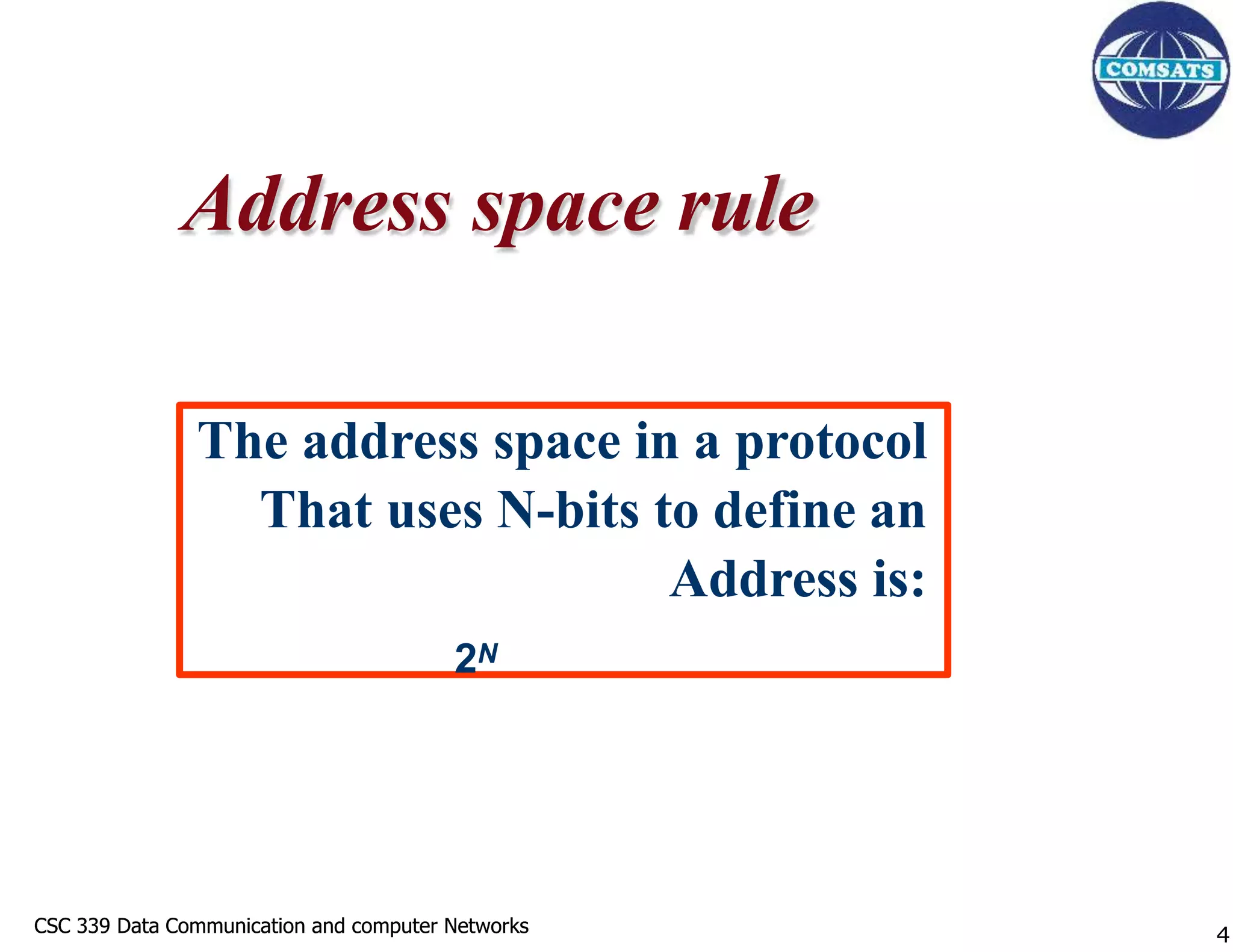
The address space in a protocol
That uses N-bits to define an
Address is:
2N
4
CSC 339 Data Communication and computer Networks
The address space of IPv4 is
232
or
4,294,967,296.
IPv4 address space
5
CSC 339 Data Communication and computer Networks
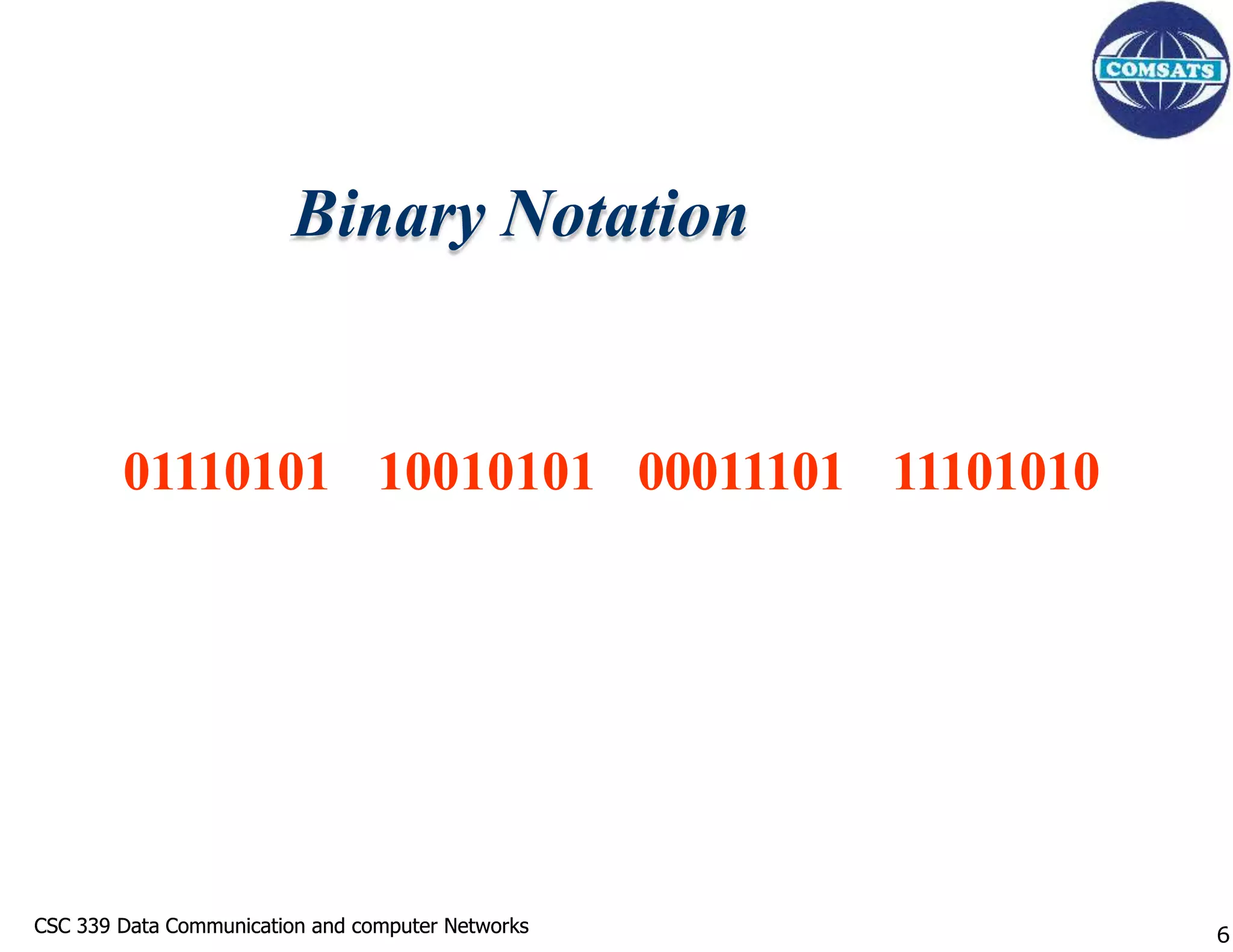
01110101 10010101 00011101 11101010
Binary Notation
6
CSC 339 Data Communication and computer Networks
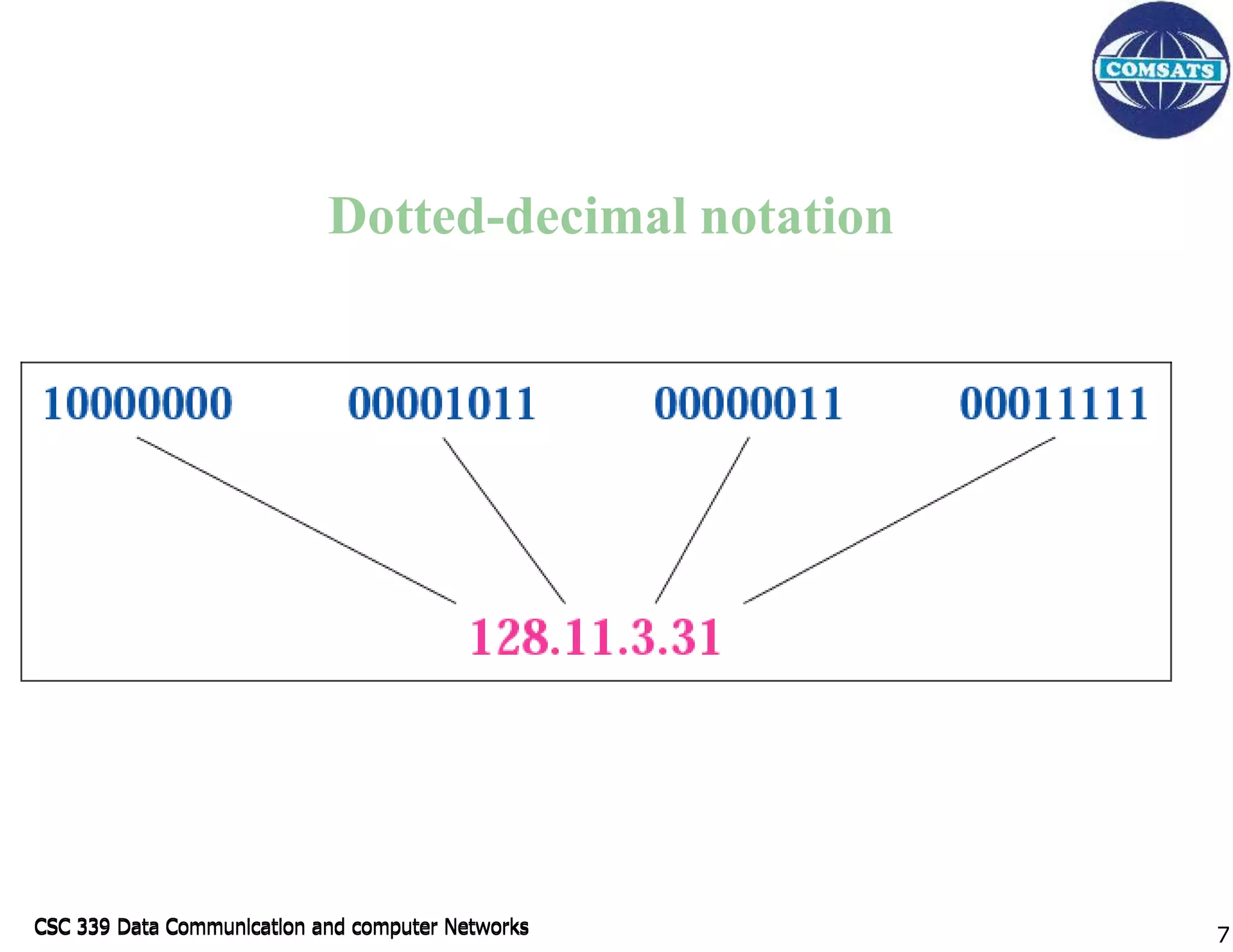
Dotted-decimal notation
7
CSC 339 Data Communication and computer Networks
Example 3
Solution
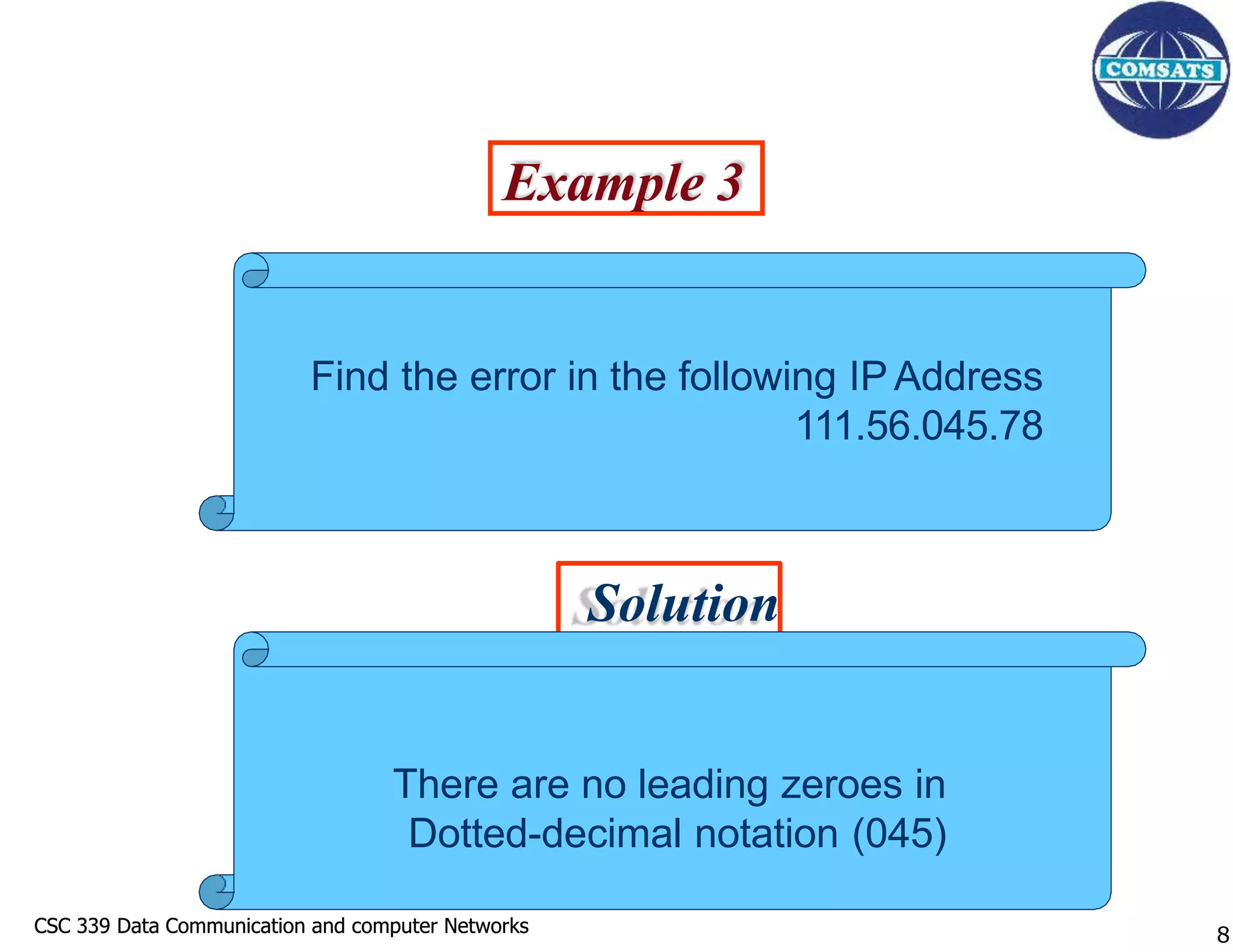
Find the error in the following IP Address
111.56.045.78
There are no leading zeroes in
Dotted-decimal notation (045)
8
CSC 339 Data Communication and computer Networks
Example 3 (continued)
Solution
Find the error in the following IP Address
75.45.301.14
In decimal notation each number <= 255
301 is out of the range
9
CSC 339 Data Communication and computer Networks
CLASSFUL
ADDRESSING
10
CSC 339 Data Communication and computer Networks
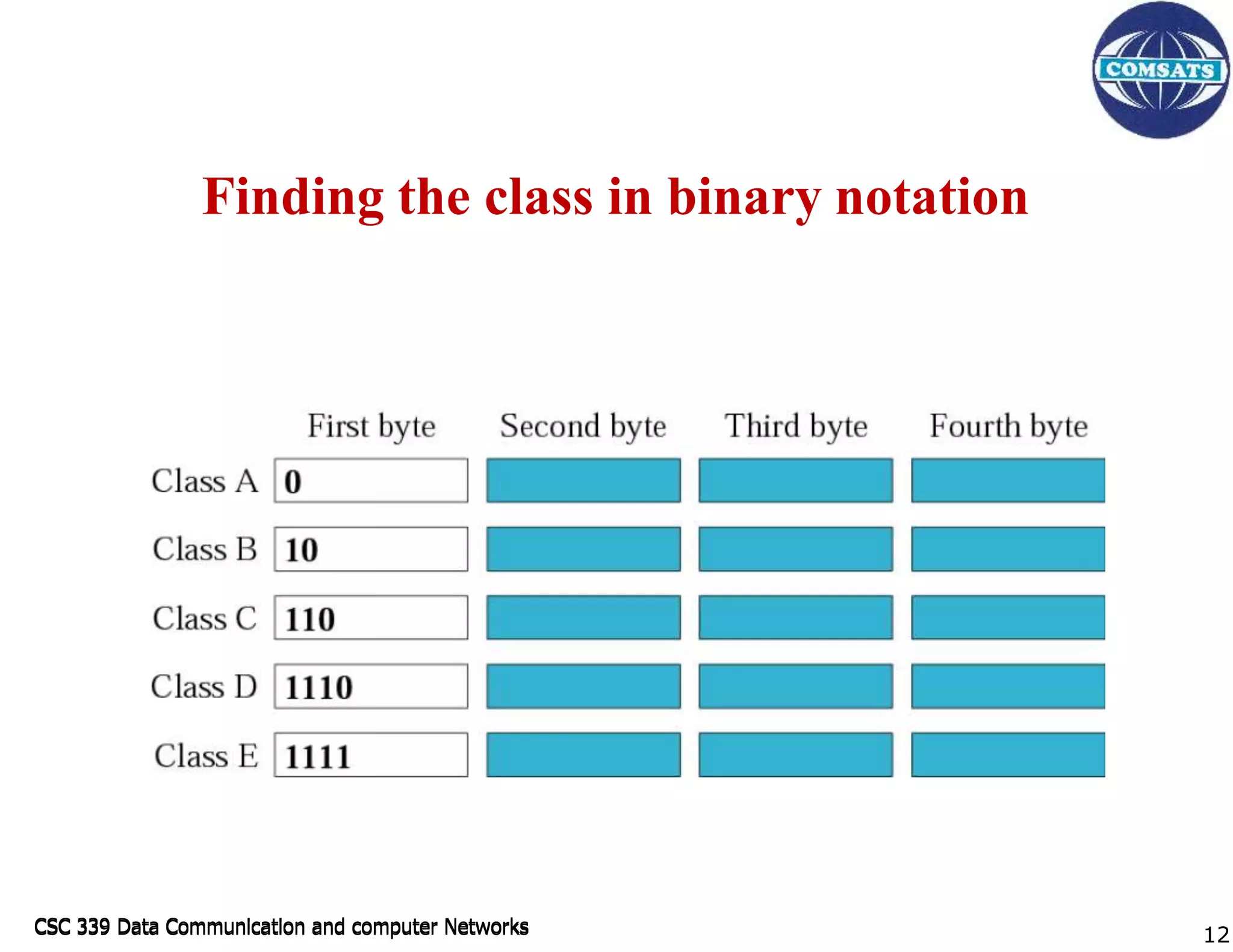
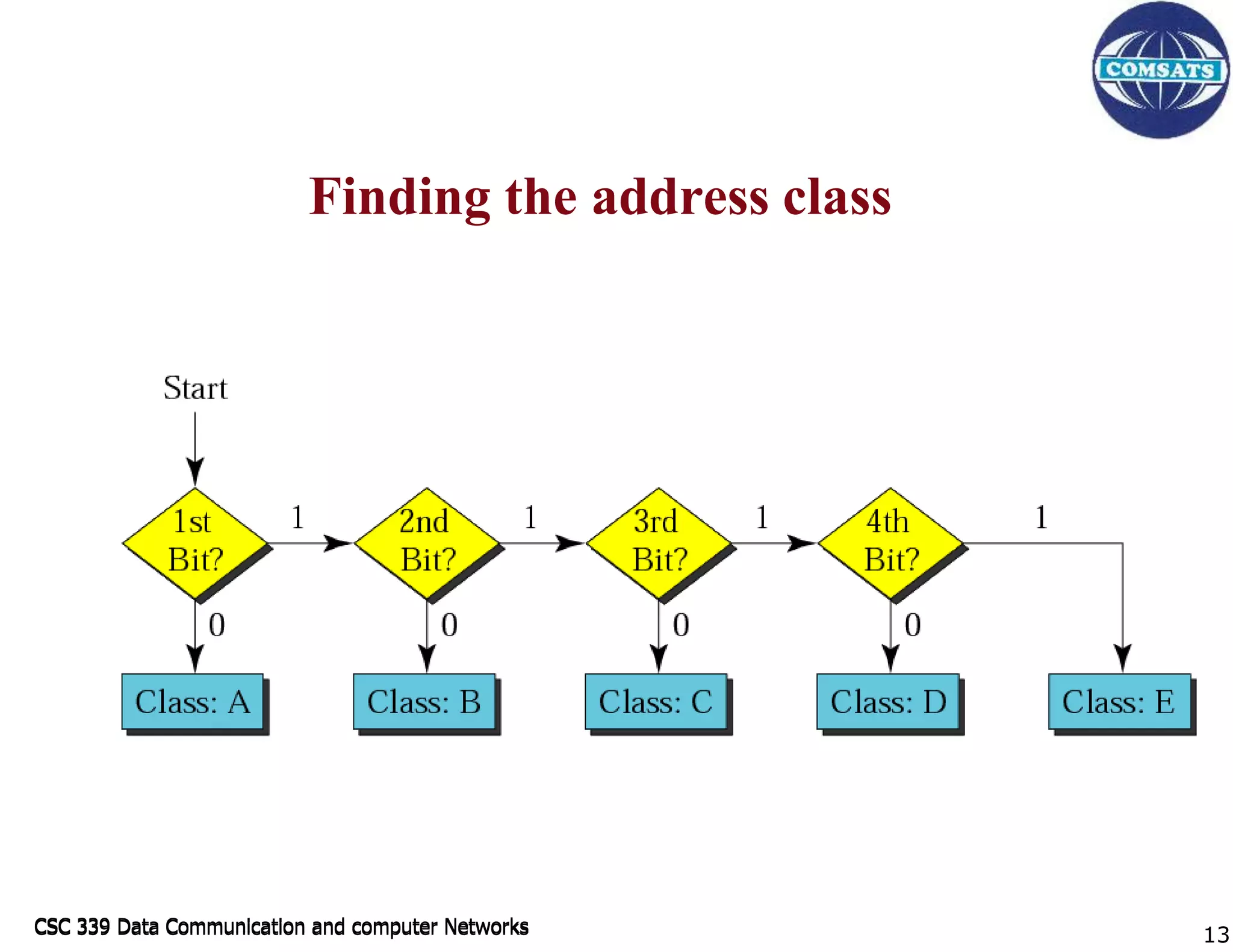
In classful addressing the address space is
divided into 5 classes:
A, B, C, D, and E.
11
CSC 339 Data Communication and computer Networks
Finding the class in binary notation
12
CSC 339 Data Communication and computer Networks
Finding the address class
13
CSC 339 Data Communication and computer Networks
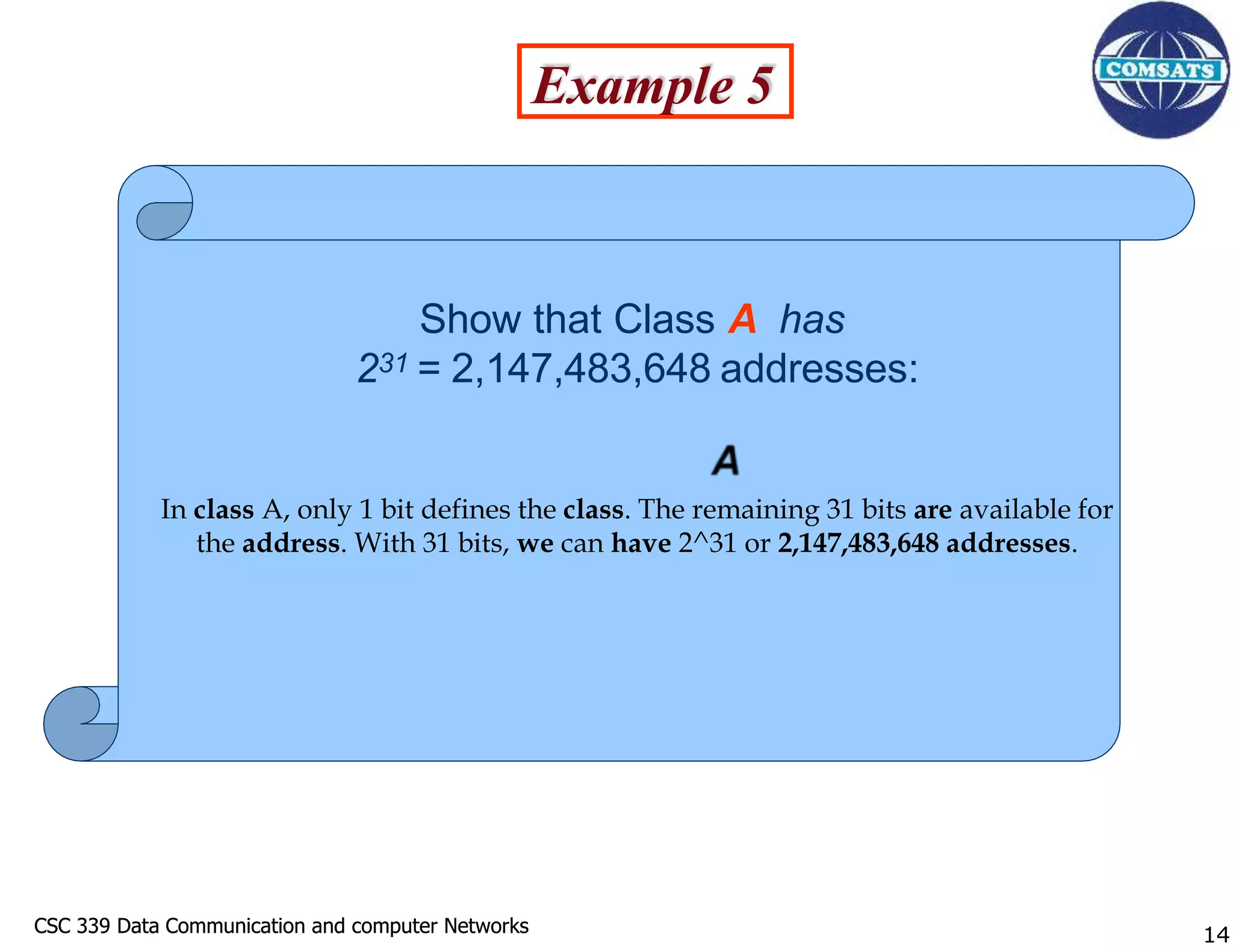
Show that Class A has
231 = 2,147,483,648 addresses:
In class A, only 1 bit defines the class. The remaining 31 bits are available for
the address. With 31 bits, we can have 2^31 or 2,147,483,648 addresses.
Example 5
14
CSC 339 Data Communication and computer Networks
CSC 339 Data Communication and computer Networks 15
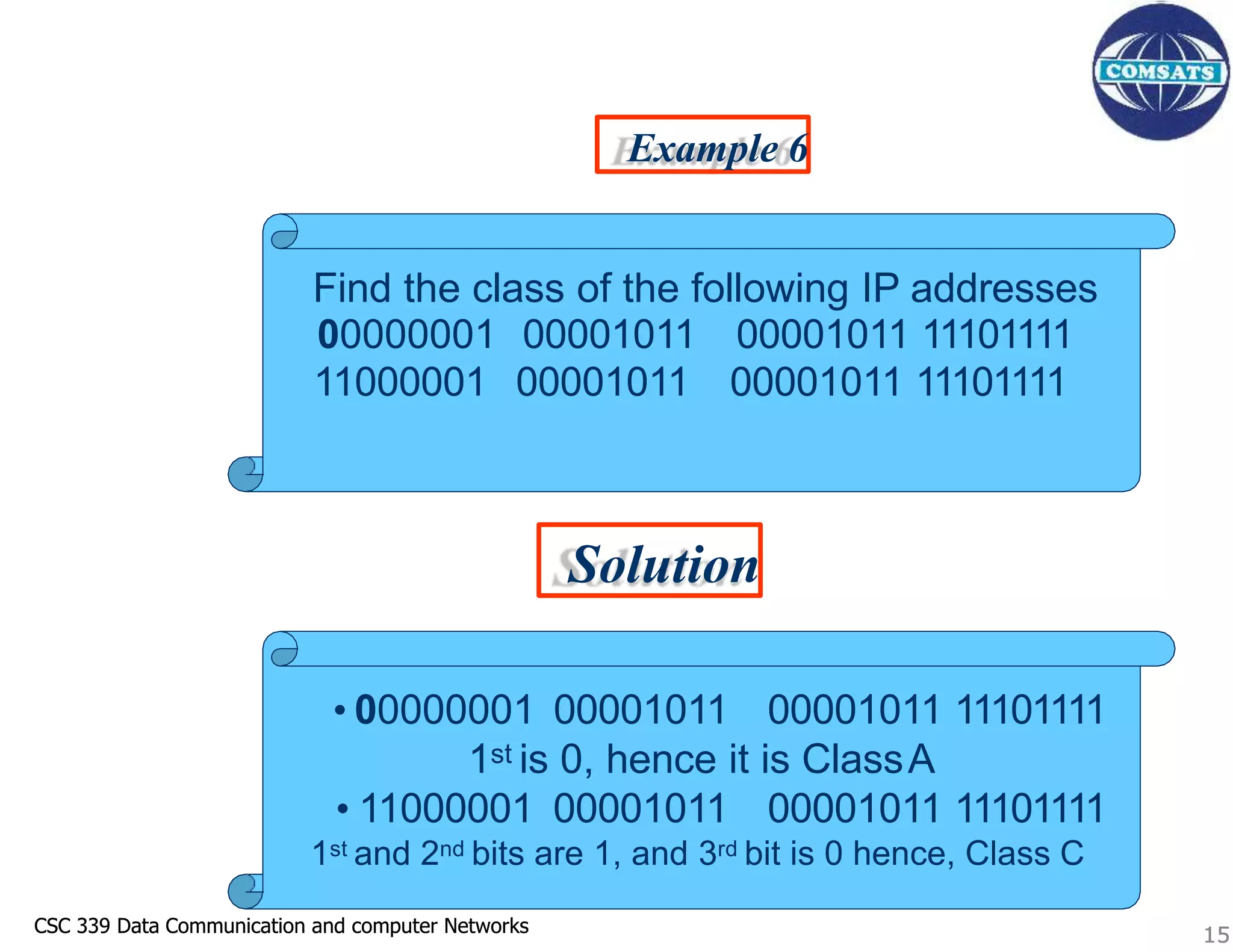
Example 6
Solution
Find the class of the following IP addresses
00000001 00001011 00001011 11101111
11000001 00001011 00001011 11101111
• 00000001 00001011 00001011 11101111
1st is 0, hence it is ClassA
• 11000001 00001011 00001011 11101111
1st and 2nd bits are 1, and 3rd bit is 0 hence, Class C
15
CSC 339 Data Communication and computer Networks
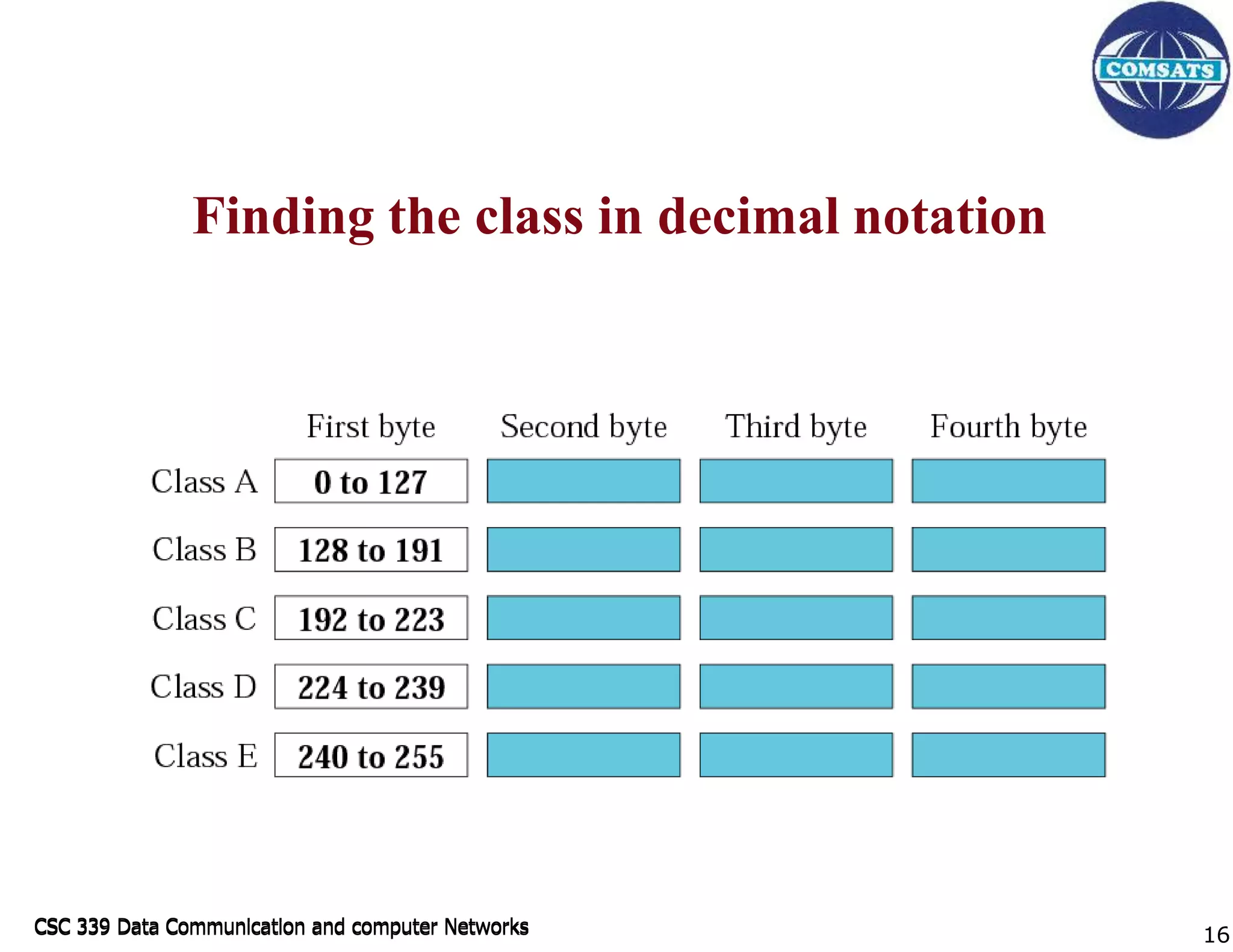
Finding the class in decimal notation
16
CSC 339 Data Communication and computer Networks
CSC 339 Data Communication and computer Networks 17
Example 7
Solution
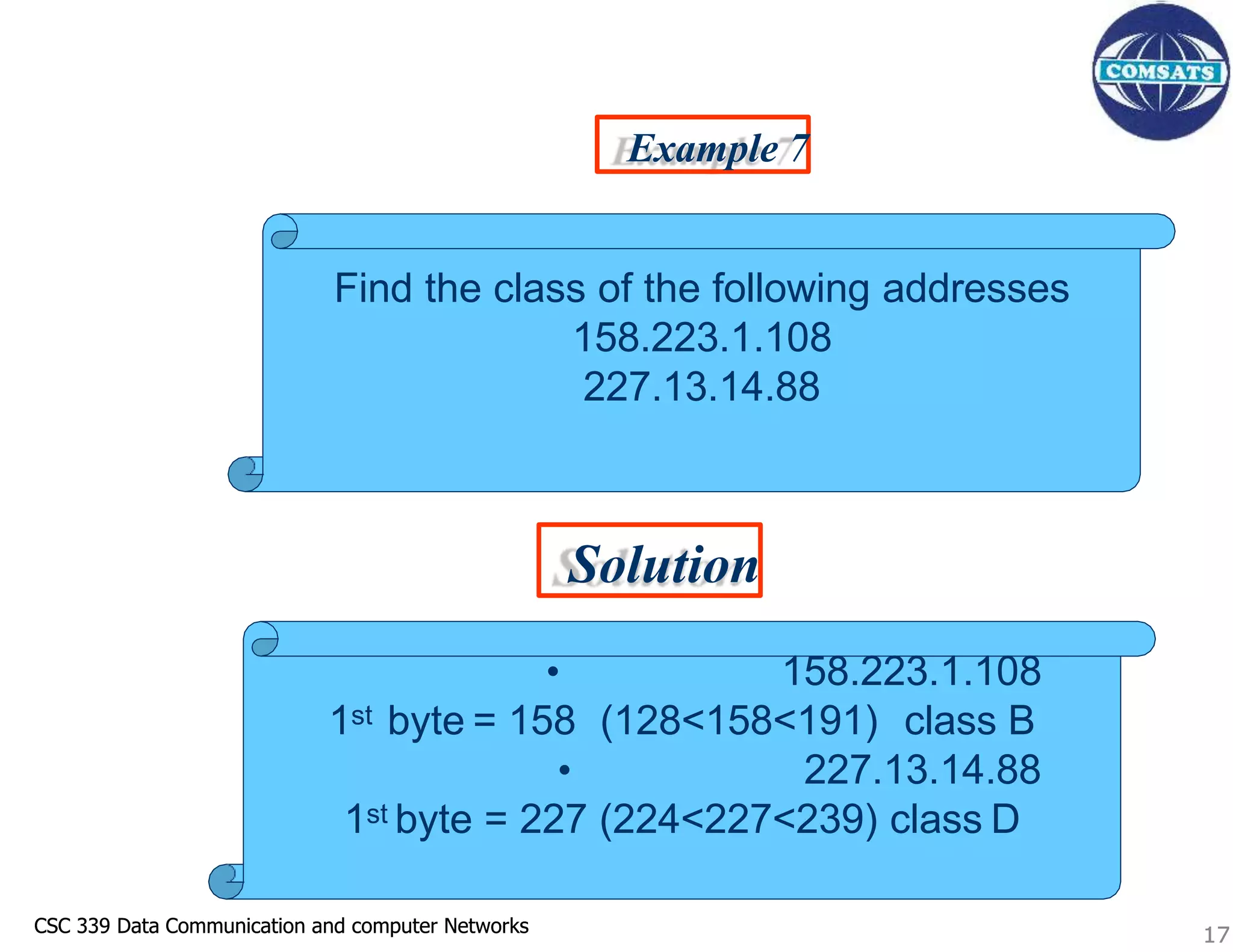
Find the class of the following addresses
158.223.1.108
227.13.14.88
• 158.223.1.108
1st byte = 158 (128<158<191) class B
• 227.13.14.88
1st byte = 227 (224<227<239) class D
17
CSC 339 Data Communication and computer Networks
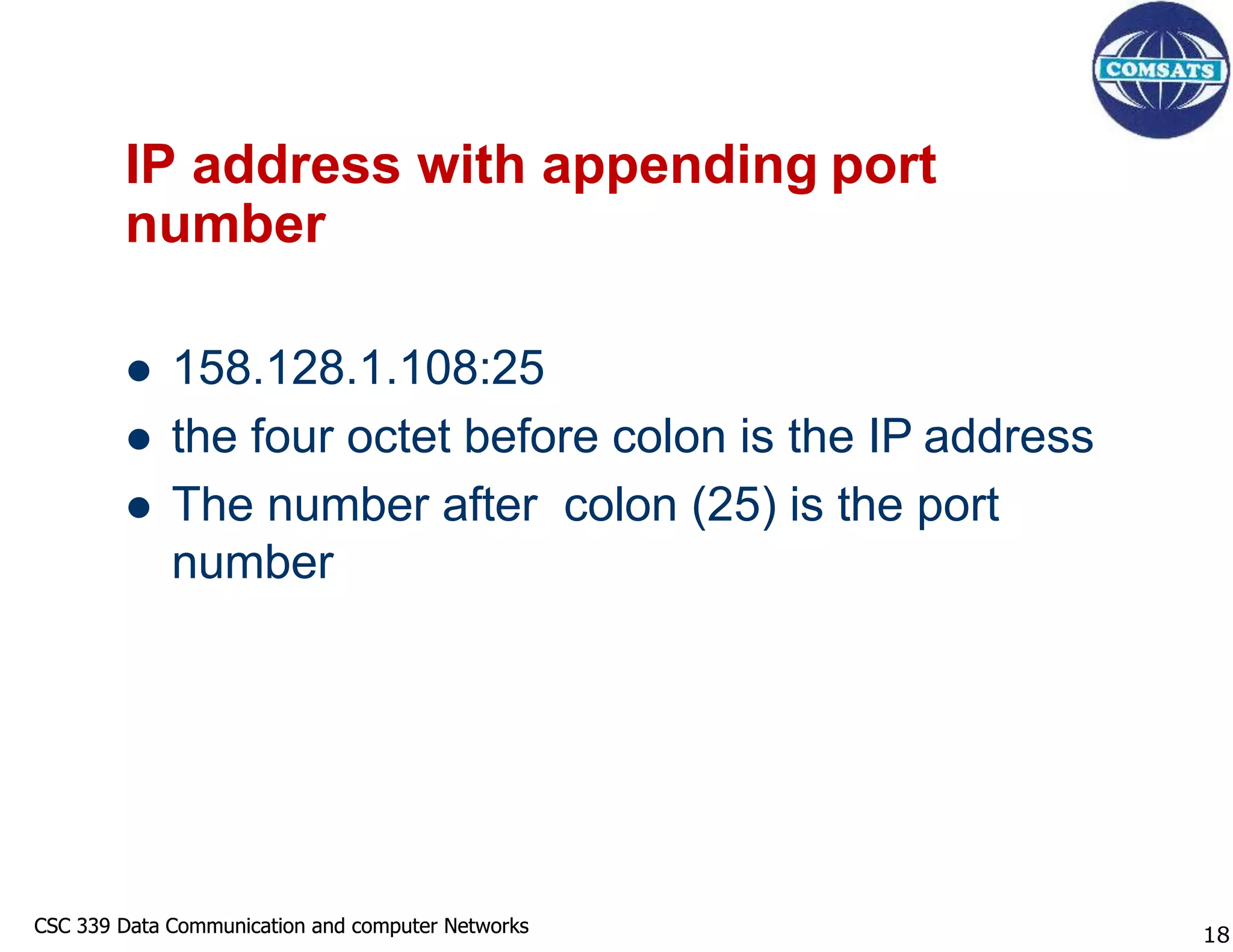
IP address with appending port
number
 158.128.1.108:25
 the four octet before colon is the IP address
 The number after colon (25) is the port
number
18
CSC 339 Data Communication and computer Networks
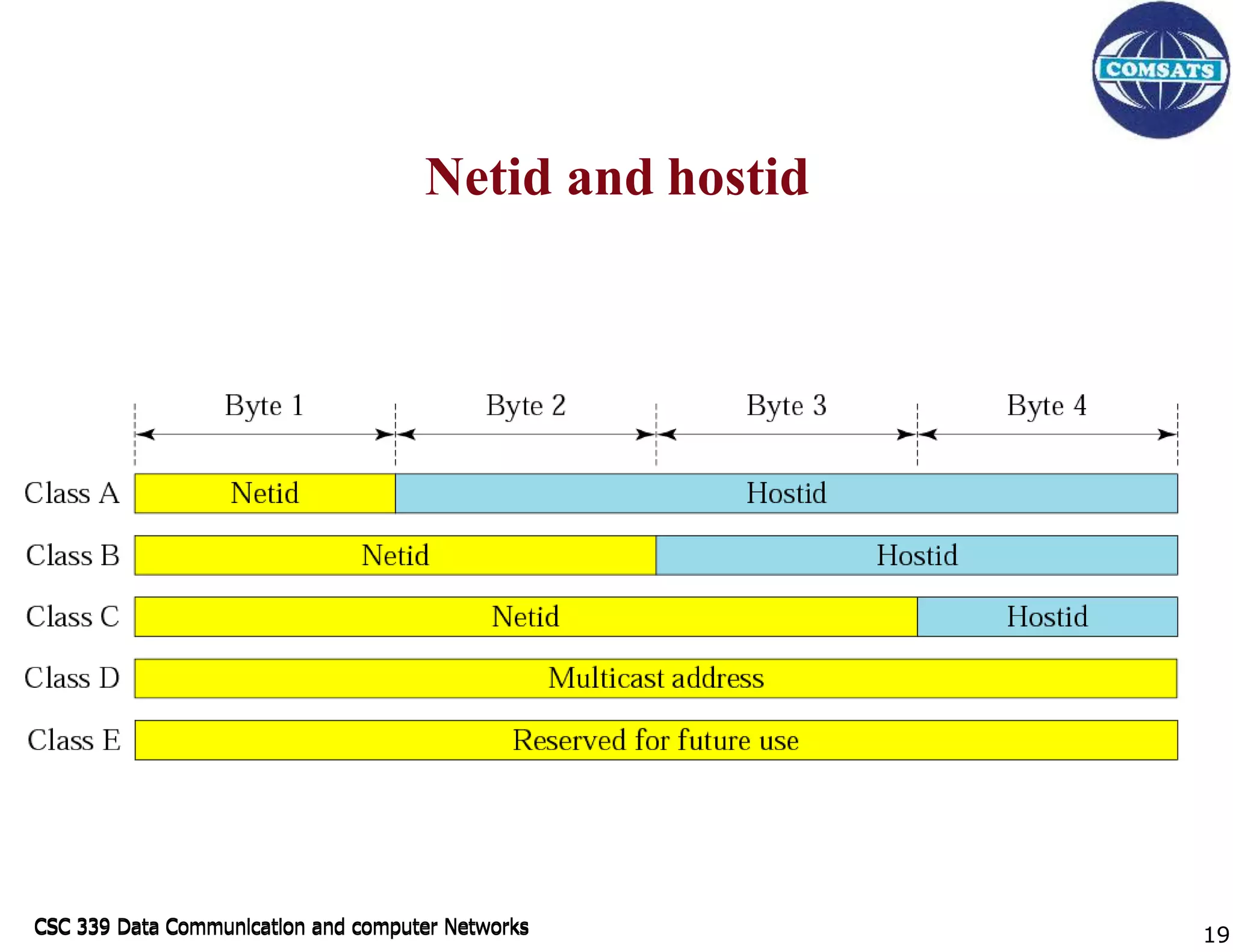
Netid and hostid
19
CSC 339 Data Communication and computer Networks
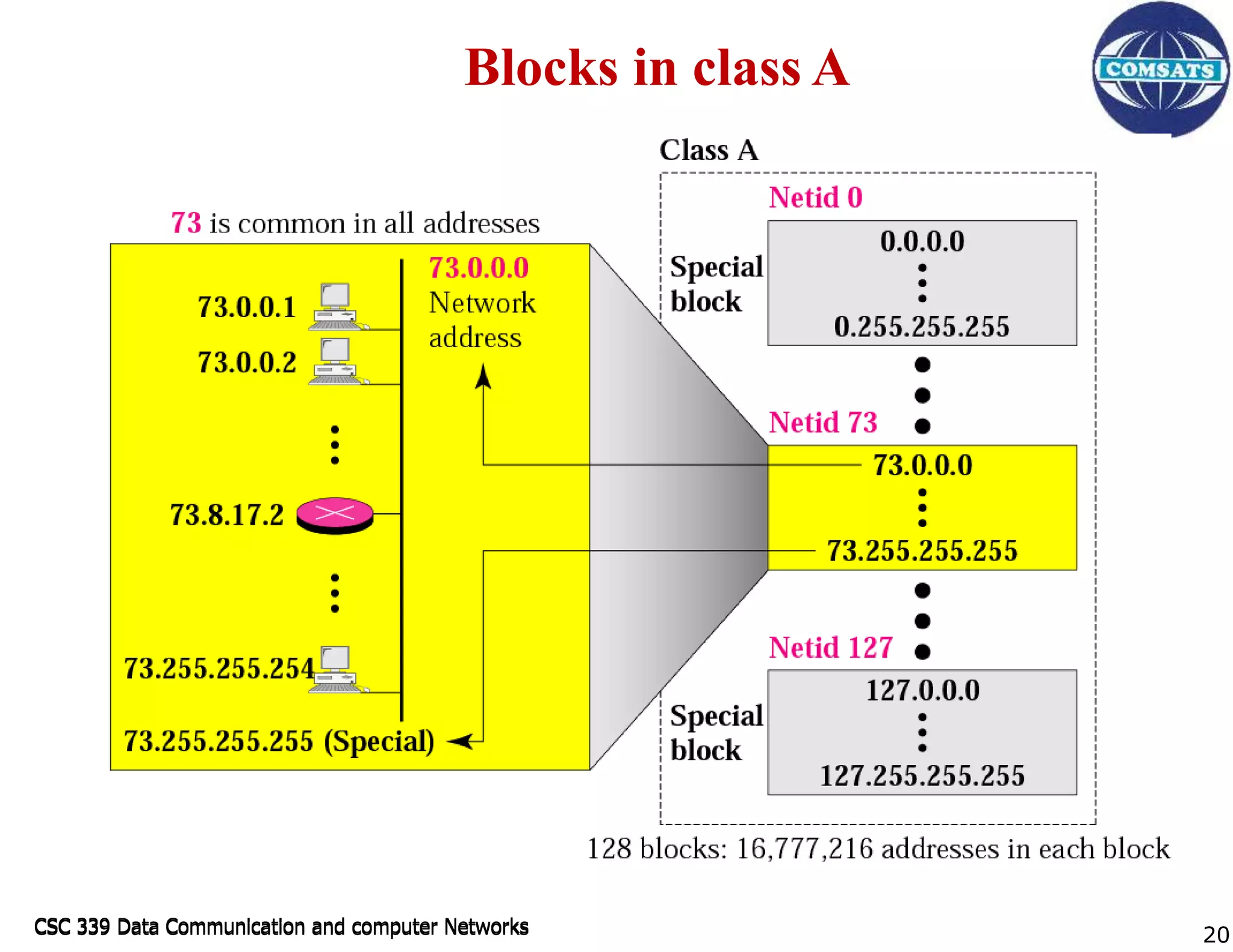
Blocks in class A
20
CSC 339 Data Communication and computer Networks
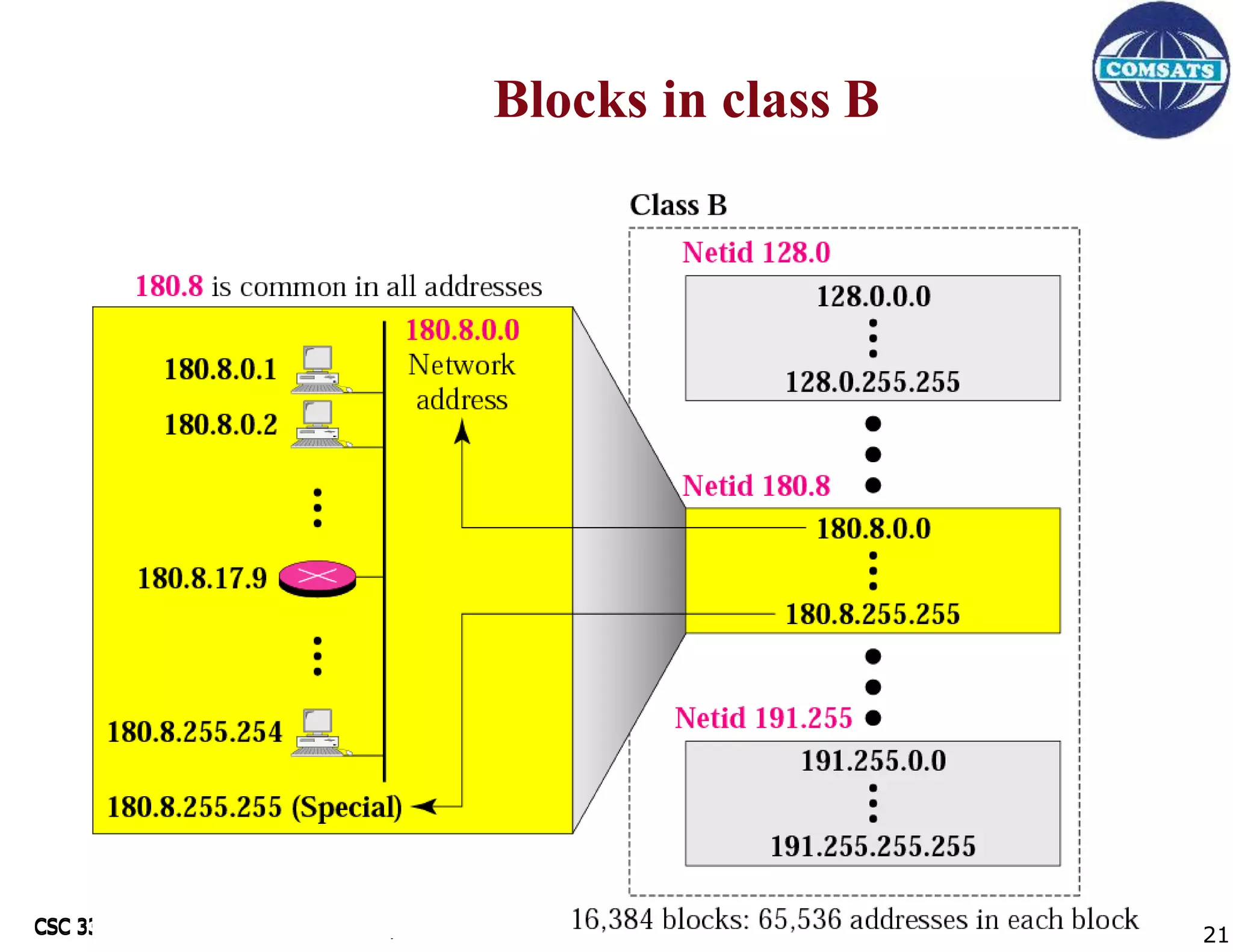
Blocks in class B
21
CSC 339 Data Communication and computer Networks
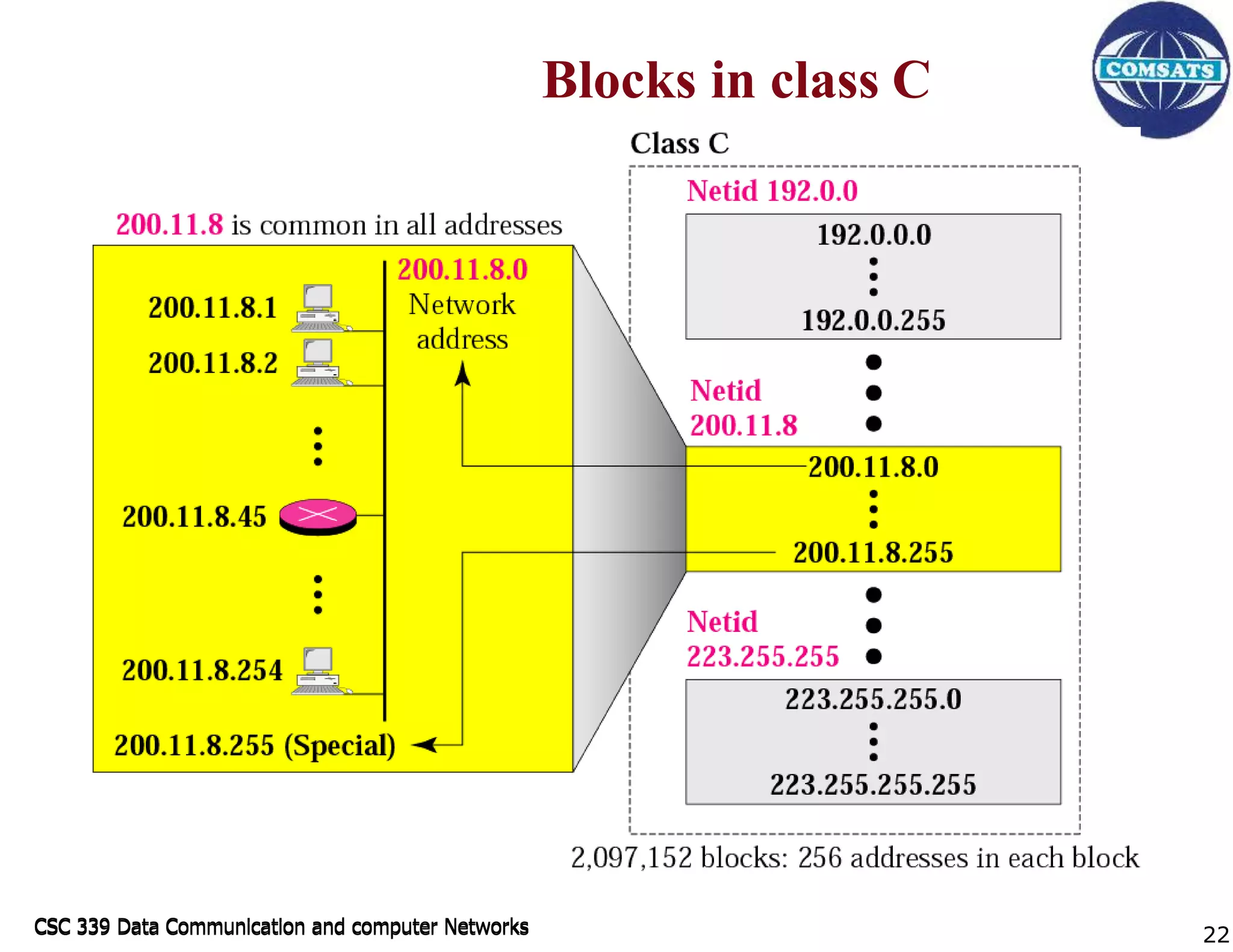
Blocks in class C
22
CSC 339 Data Communication and computer Networks
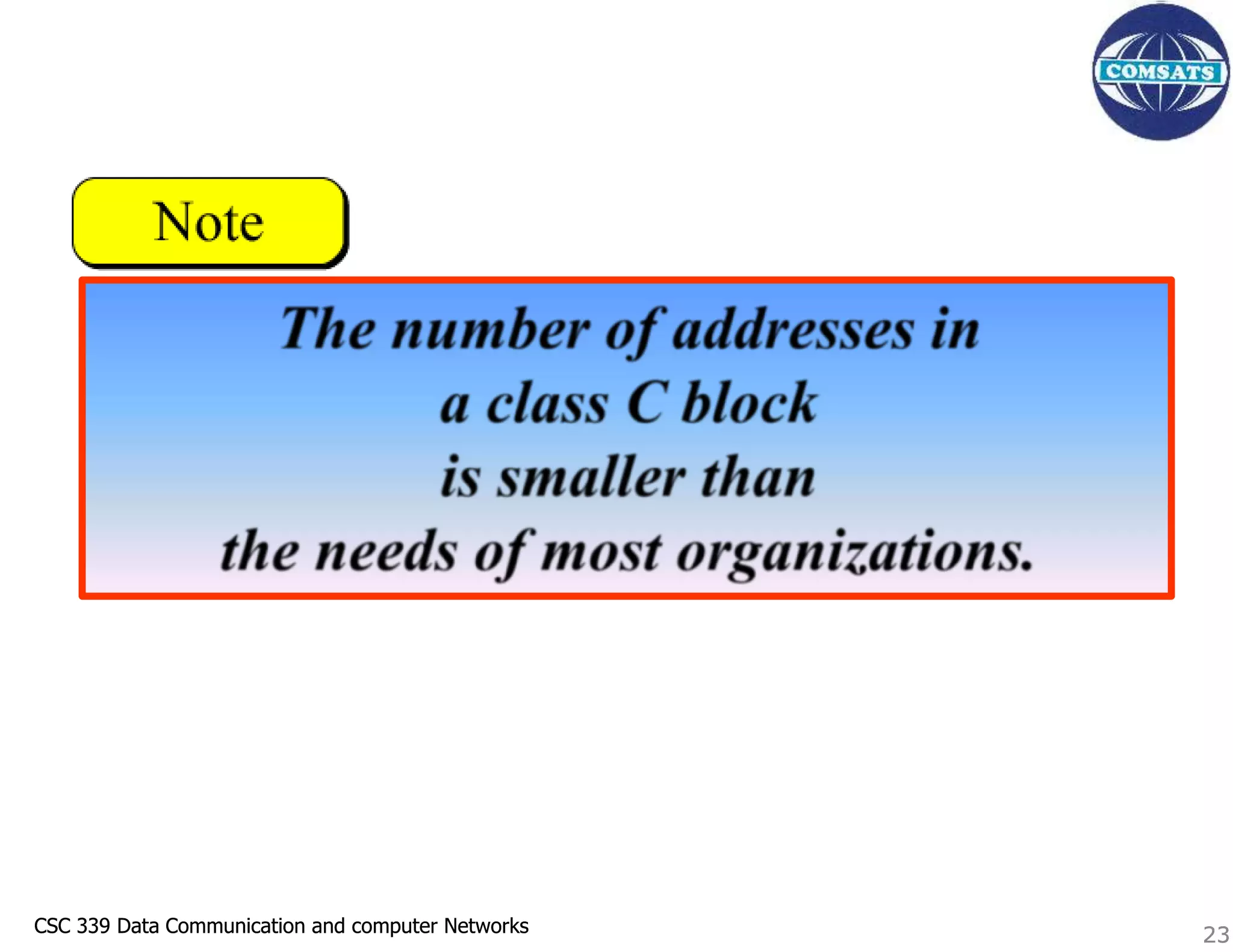
CSC 339 Data Communication and computer Networks 23
23
CSC 339 Data Communication and computer Networks
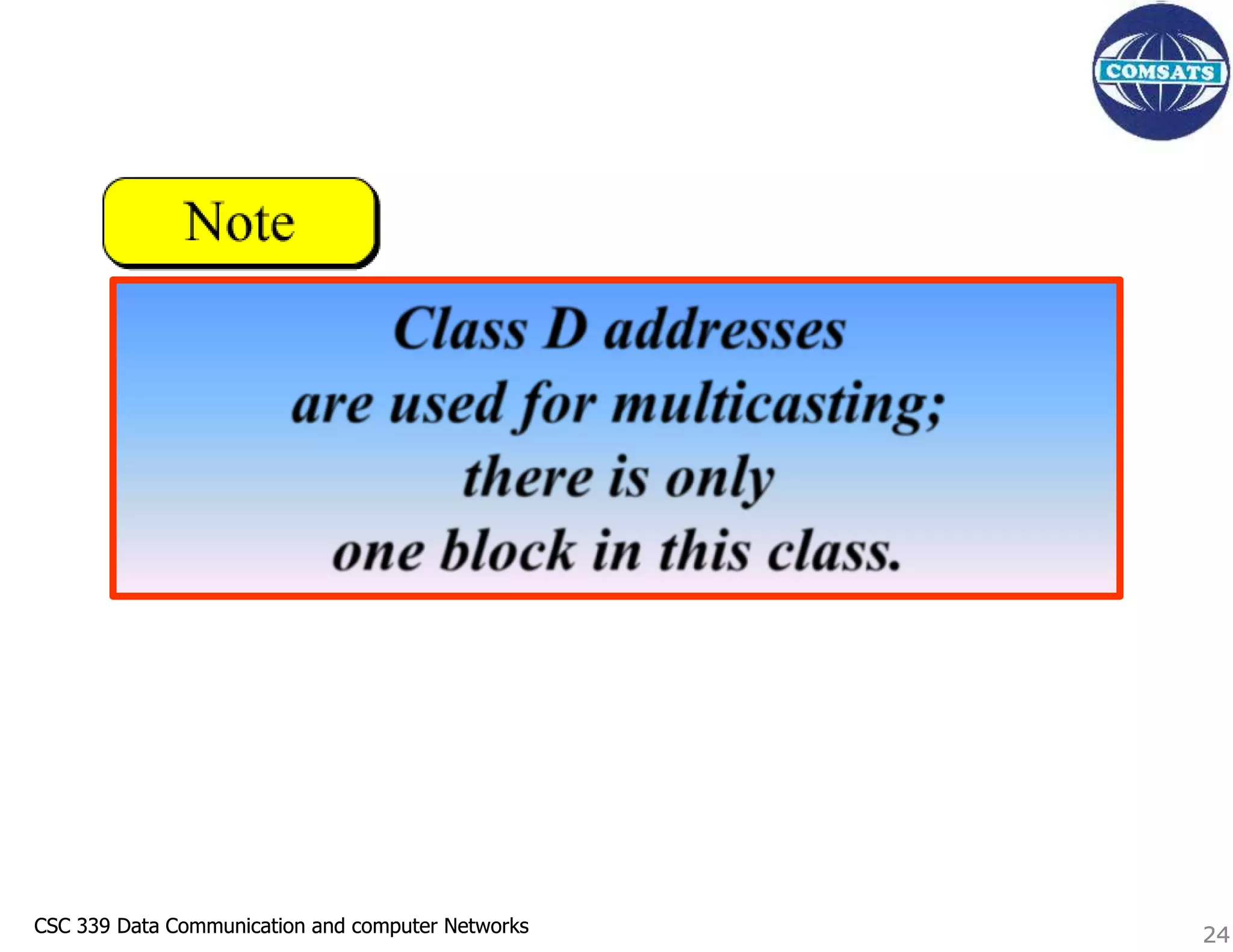
CSC 339 Data Communication and computer Networks 24
24
CSC 339 Data Communication and computer Networks
CSC 339 Data Communication and computer Networks 25
CSC 339 Data Communication and computer Networks
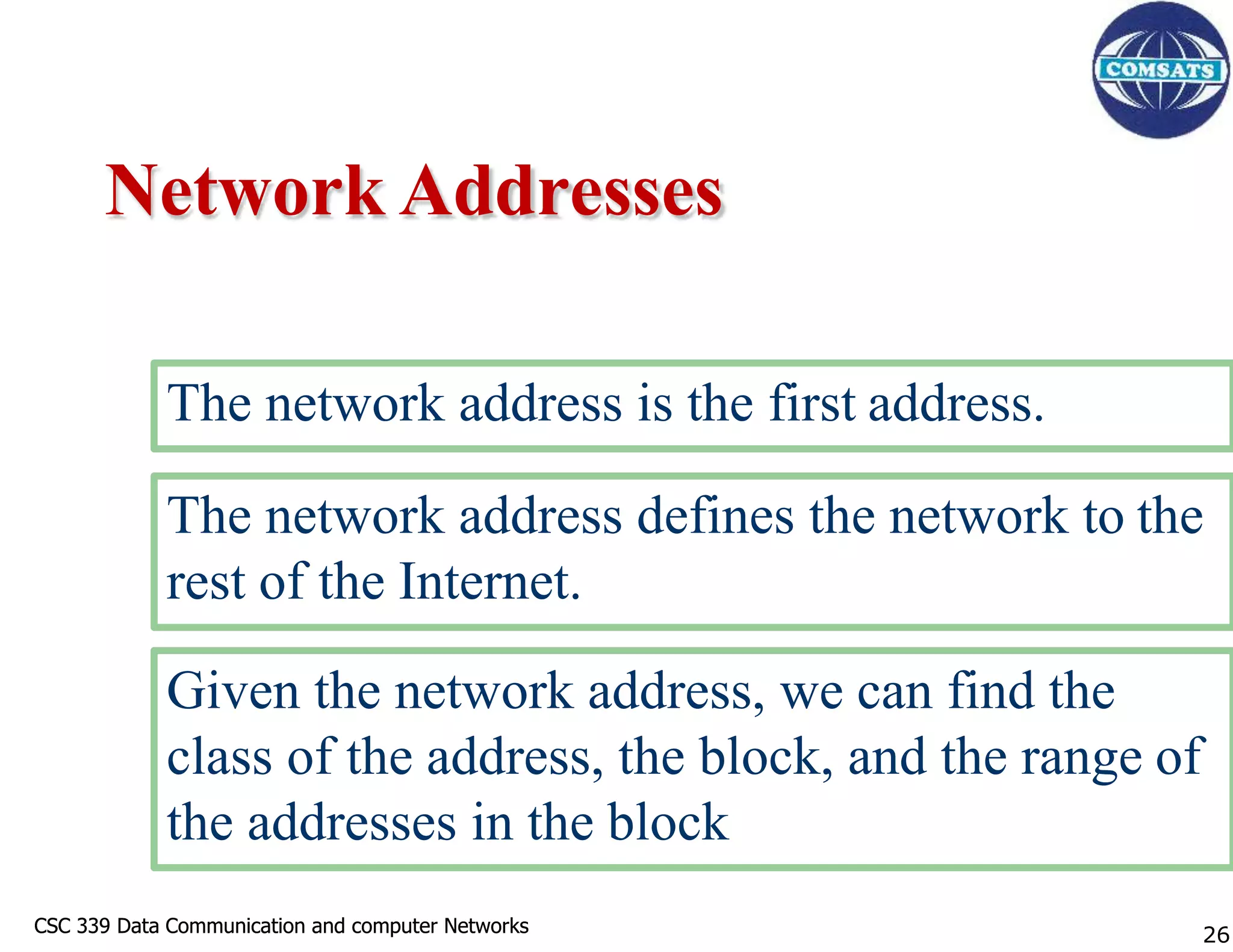
Network Addresses
The network address is the first address.
The network address defines the network to the
rest of the Internet.
Given the network address, we can find the
class of the address, the block, and the range of
the addresses in the block
26
CSC 339 Data Communication and computer Networks
CSC 339 Data Communication and computer Networks 27
27
CSC 339 Data Communication and computer Networks
CSC 339 Data Communication and computer Networks 28
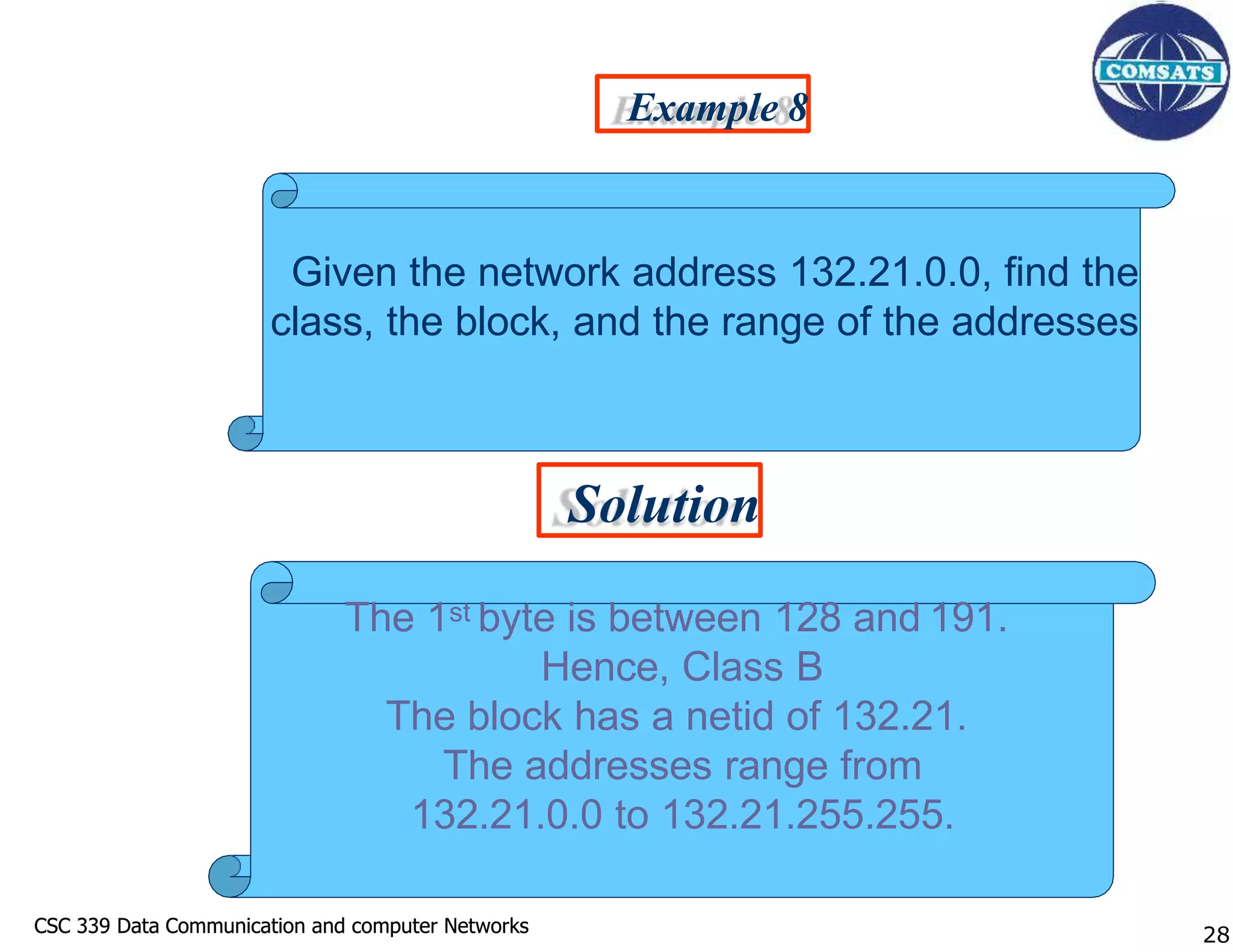
Example 8
Solution
Given the network address 132.21.0.0, find the
class, the block, and the range of the addresses
The 1st byte is between 128 and 191.
Hence, Class B
The block has a netid of 132.21.
The addresses range from
132.21.0.0 to 132.21.255.255.
CSC 339 Data Communication and computer Networks
Mask
• A mask is a 32-bit binary number.
• The mask is ANDeD with IP address to get
• The block address (Network address)
• Mask And IP address = BlockAddress
29
CSC 339 Data Communication and computer Networks
Default Mask
 Class A default mask is 255.0.0.0
 Class B default mask is 255.255.0.0
 Class C Default mask 255.255.255.0
30
CSC 339 Data Communication and computer Networks
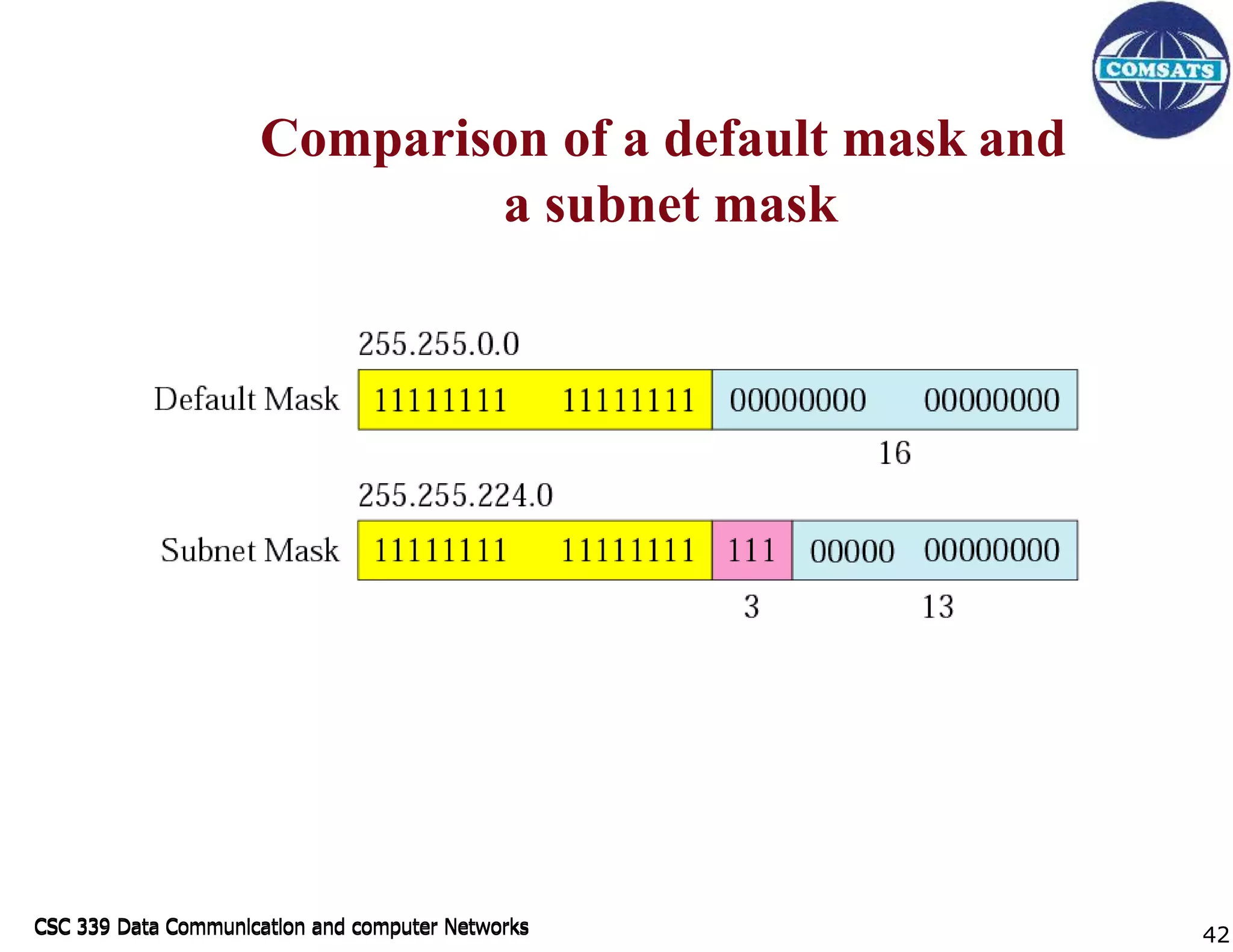
Subnet Mask
 An IP address has 2 parts:
– The Network identification.
– The Host identification.
 Frequently, the Network & Host portions of
the address need to be separately extracted.
 In most cases, if you know the address class,
it’s easy to separate the 2 portions.
31
CSC 339 Data Communication and computer Networks
Subnet Mask
(Cont.)
 With the rapid growth of the internet & the ever-
increasing demand for new addresses, the standard
address class structure has been expanded by
borrowing bits from the Host portion to allow for more
Networks.
 Under this addressing scheme, called Subnetting,
separating the Network & Host requires a special
process called Subnet Masking.
32
CSC 339 Data Communication and computer Networks
Subnet Mask (Cont.)
 The subnet masking process was developed
to identify & extract the Network part of the
address.
 A subnet mask, which contains a binary bit pattern
of ones & zeros, is applied to an address to
determine whether the address is on the local
Network.
 If it is not, the process of routing it to an outside
network begins.
33
CSC 339 Data Communication and computer Networks
Subnet Mask (Cont.)
 The function of a subnet mask is to determine whether
an IP address exists on the local network or whether it
must be routed outside the local network.
 It is applied to a message’s destination address to
extract the network address.
 If the extracted network address matches the local
network ID, the destination is located on the local
network.
34
CSC 339 Data Communication and computer Networks
Subnet Mask (Cont.)
 However, if they don’t match, the message
must be routed outside the local network.
 The process used to apply the subnet mask
involves Boolean Algebra to filter out non-
matching bits to identify the network address.
35
CSC 339 Data Communication and computer Networks
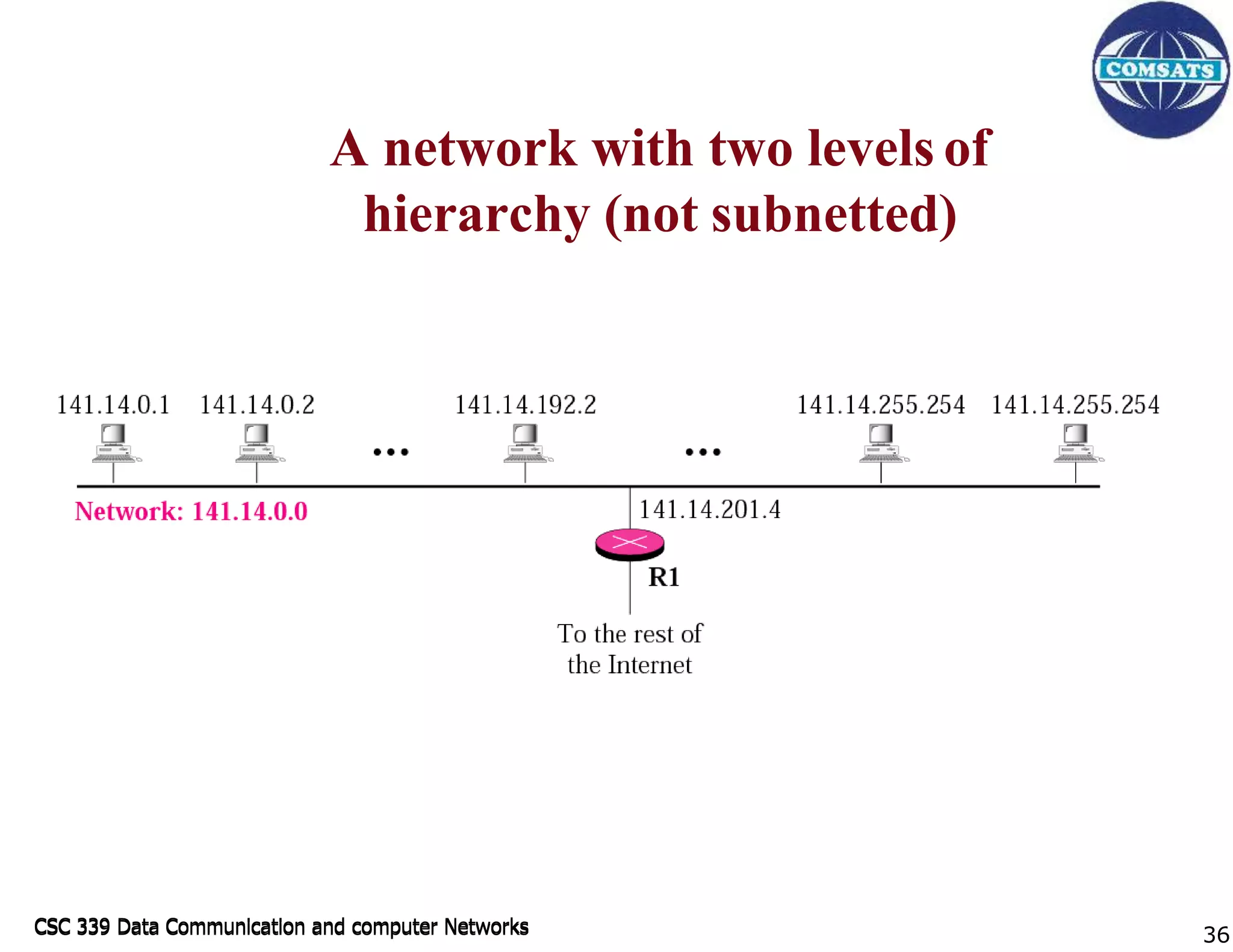
A network with two levels of
hierarchy (not subnetted)
36
CSC 339 Data Communication and computer Networks
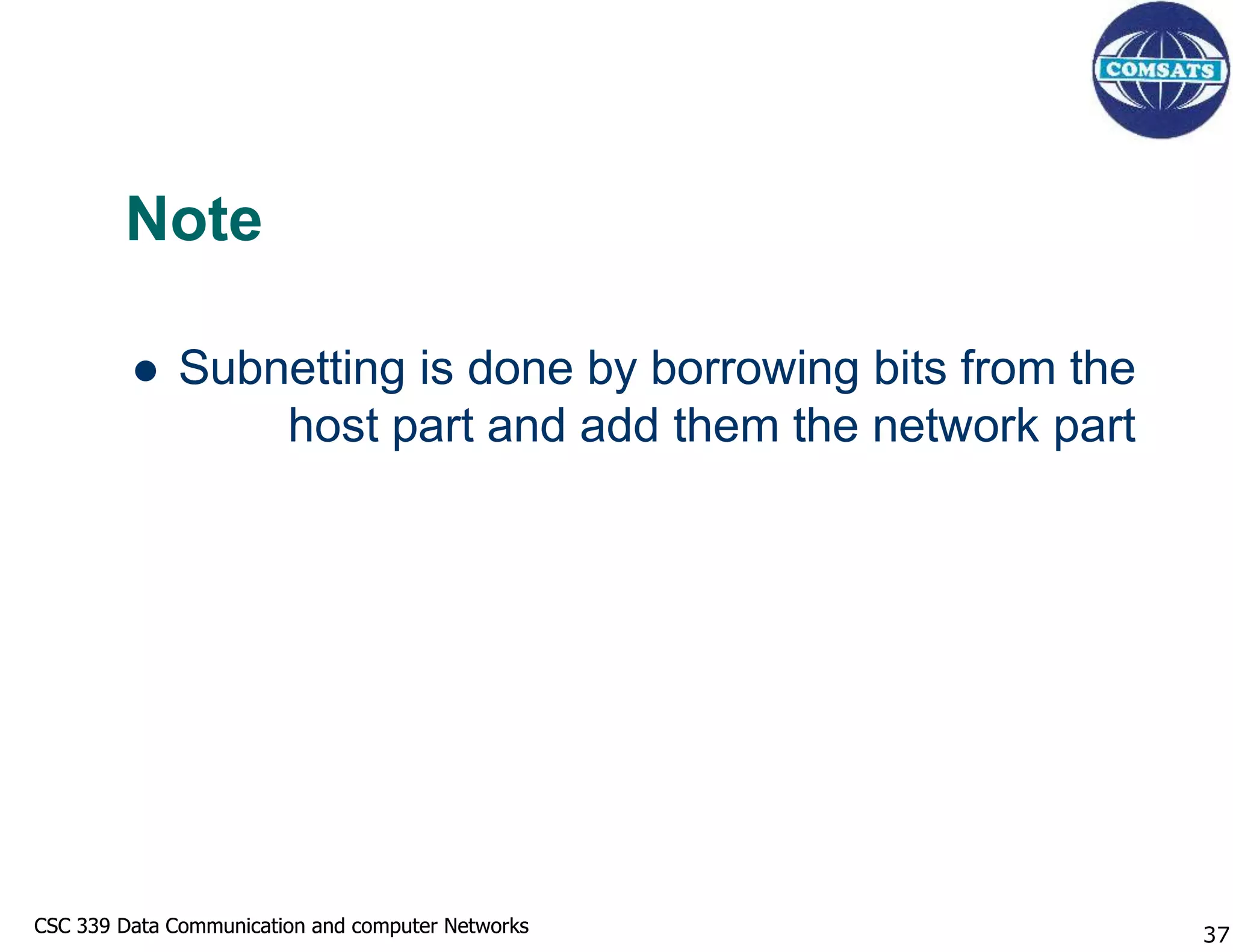
Note
 Subnetting is done by borrowing bits from the
host part and add them the network part
37
CSC 339 Data Communication and computer Networks
Example 9
What is the subnetwork address if the
destination address is 200.45.34.56 and the
subnet mask is 255.255.240.0?
38
CSC 339 Data Communication and computer Networks
Solution
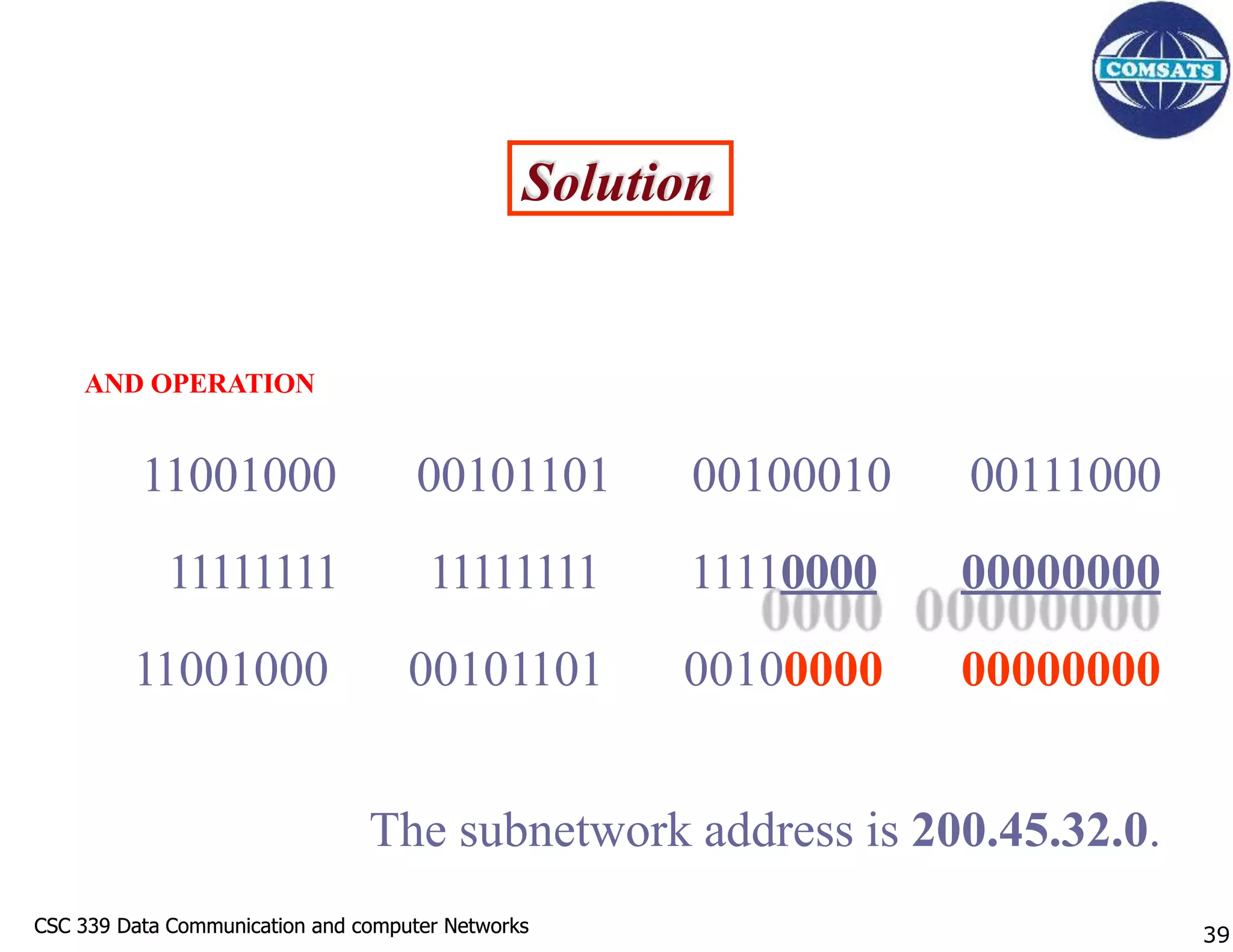
AND OPERATION
11001000 00101101 00100010 00111000
11111111 11111111 11110000 00000000
11001000 00101101 00100000 00000000
The subnetwork address is 200.45.32.0.
39
CSC 339 Data Communication and computer Networks
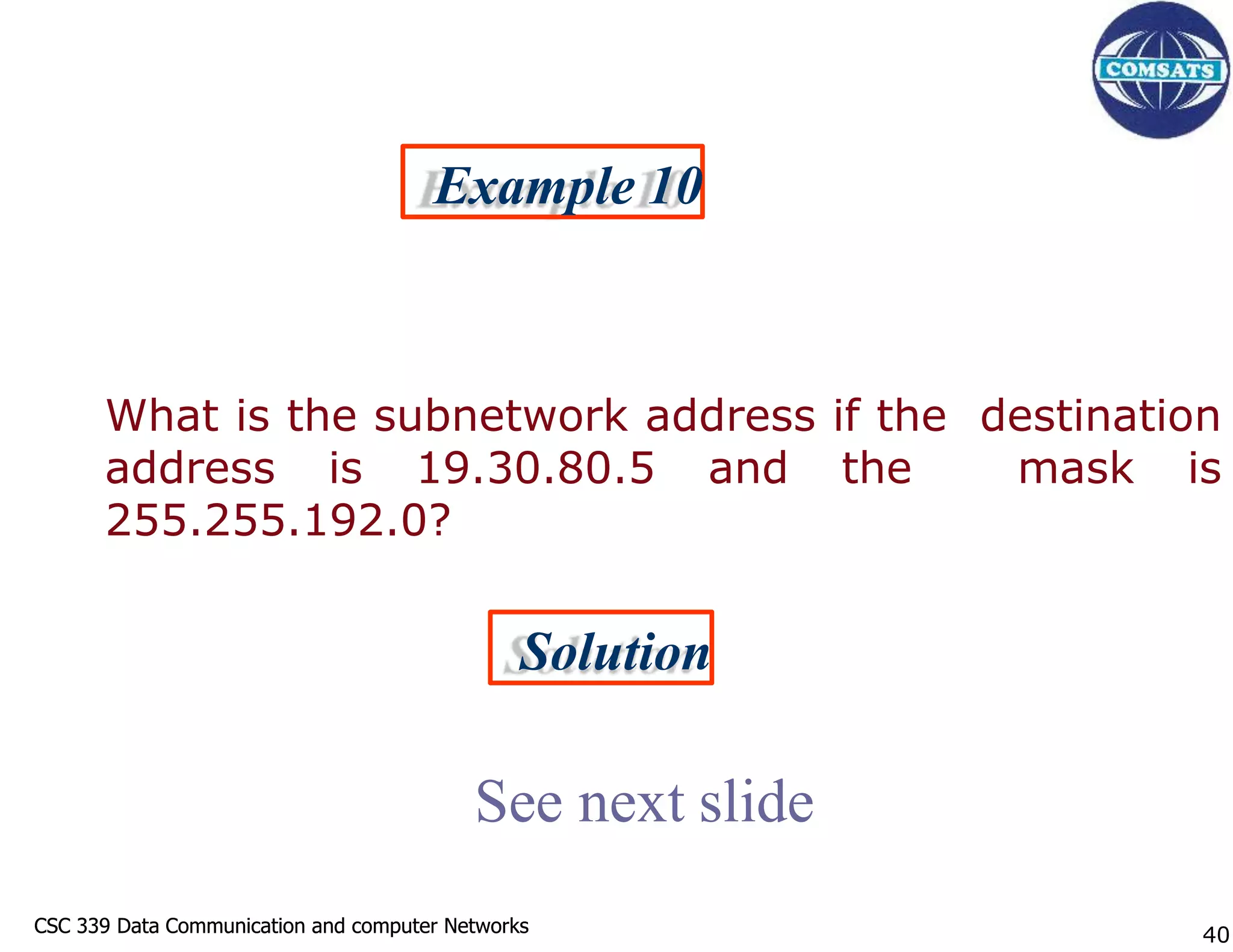
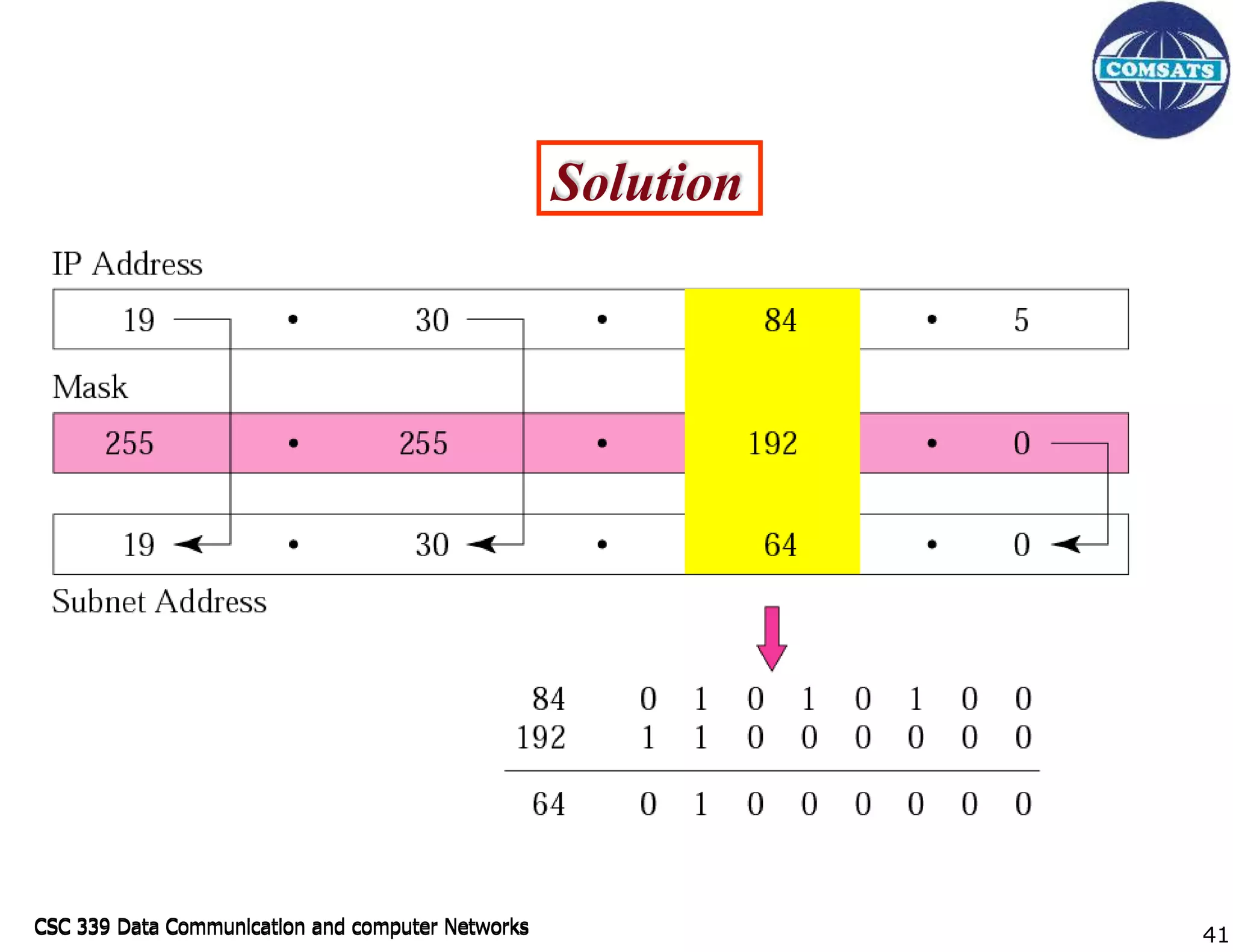
Example 10
What is the subnetwork address if the destination
address is 19.30.80.5 and the mask is
255.255.192.0?
Solution
See next slide
40
CSC 339 Data Communication and computer Networks
Solution
41
CSC 339 Data Communication and computer Networks
Comparison of a default mask and
a subnet mask
42
CSC 339 Data Communication and computer Networks
CSC 339 Data Communication and computer Networks 43
CSC 339 Data Communication and computer Networks
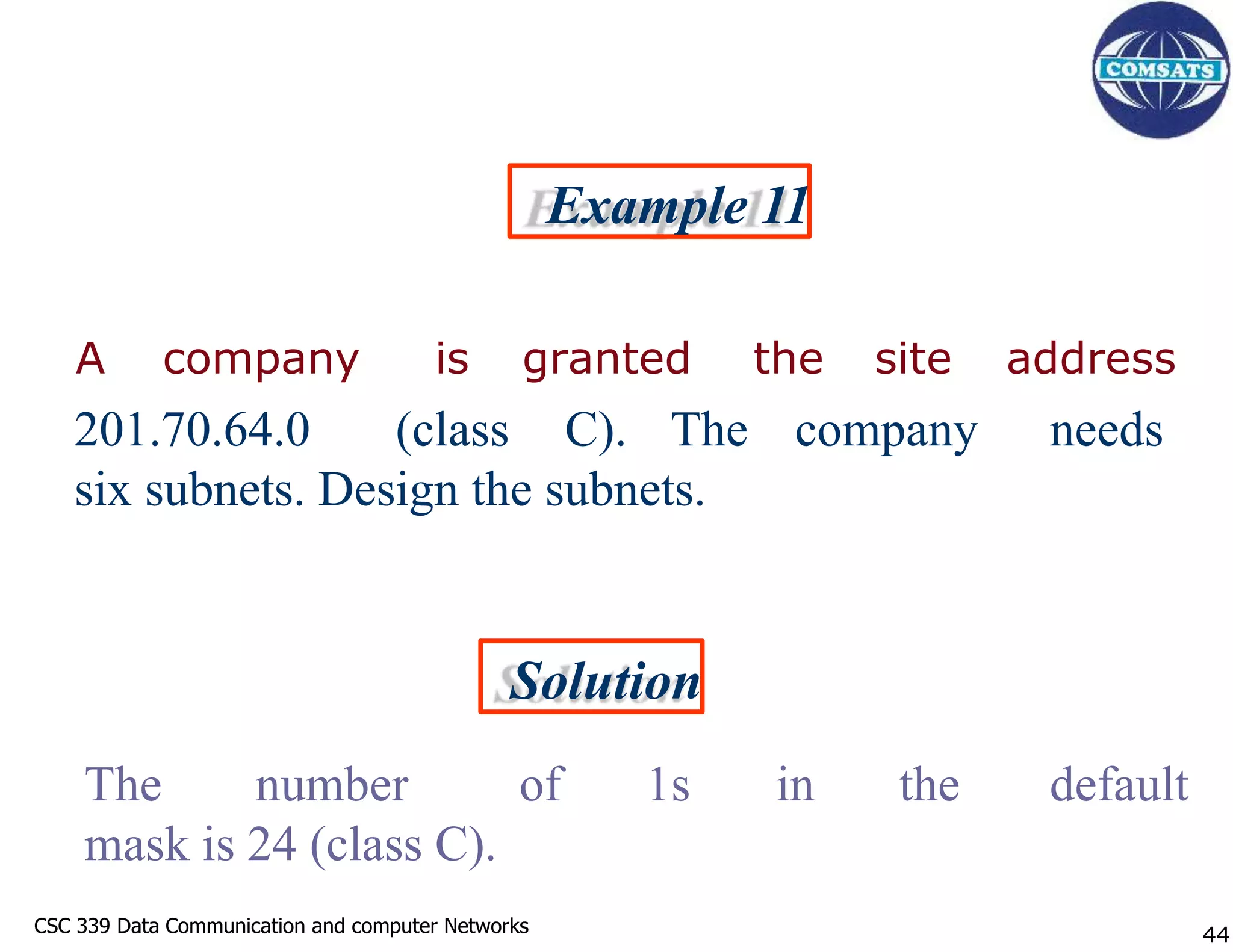
Example 11
A company is granted the site address
201.70.64.0 (class C). The company needs
six subnets. Design the subnets.
Solution
The number of 1s in the default
mask is 24 (class C).
44
CSC 339 Data Communication and computer Networks
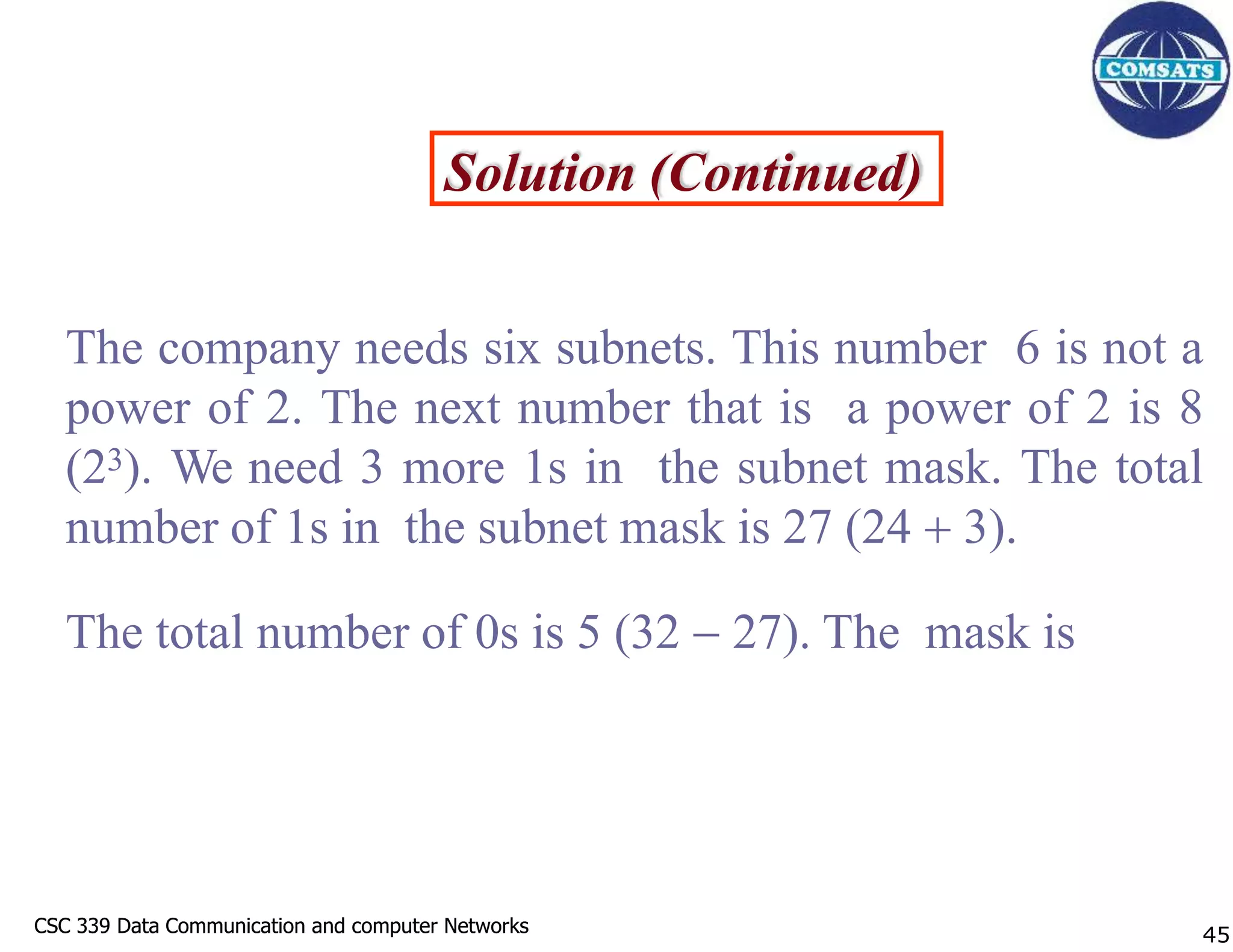
Solution (Continued)
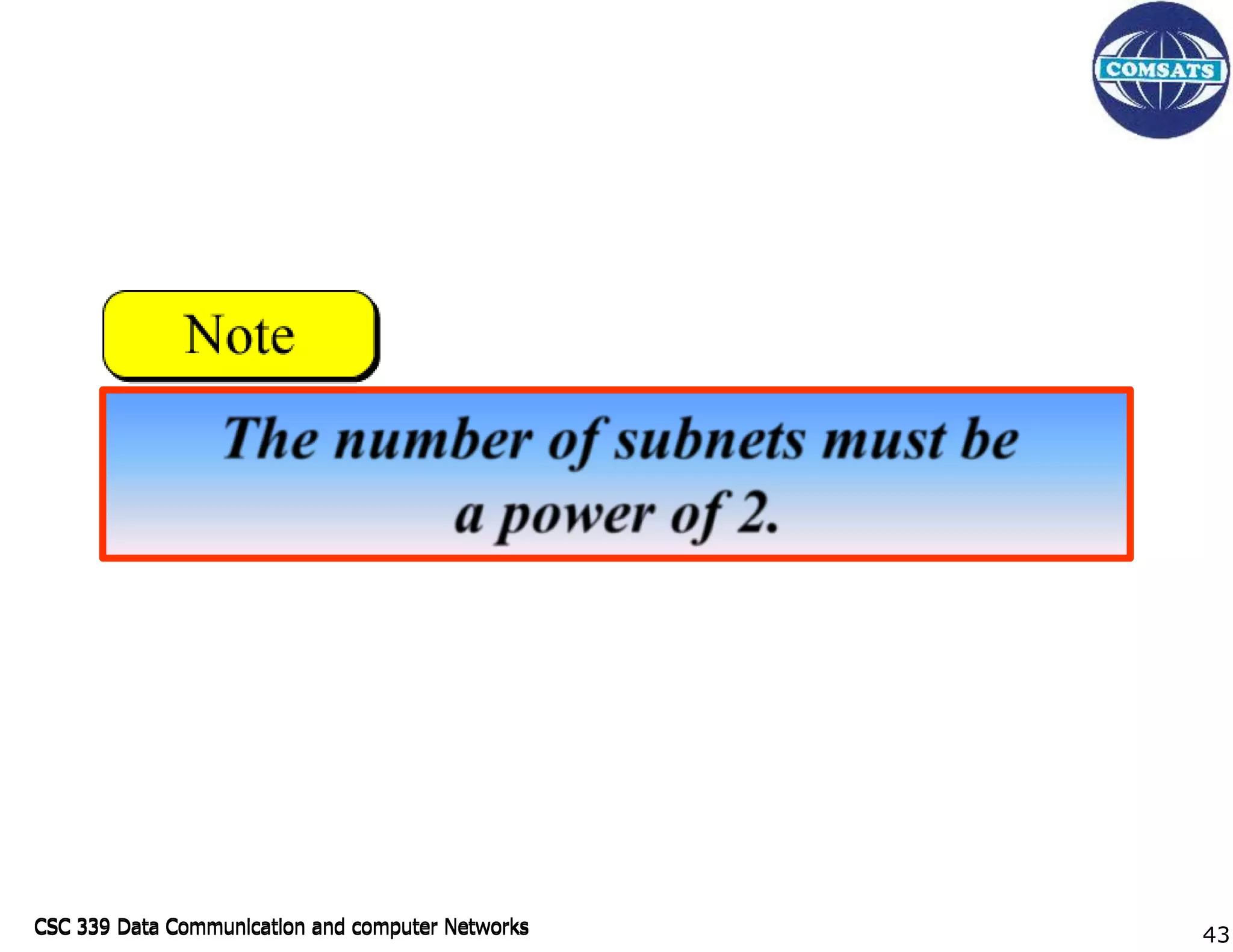
The company needs six subnets. This number 6 is not a
power of 2. The next number that is a power of 2 is 8
(23). We need 3 more 1s in the subnet mask. The total
number of 1s in the subnet mask is 27 (24  3).
The total number of 0s is 5 (32  27). The mask is
45
CSC 339 Data Communication and computer Networks
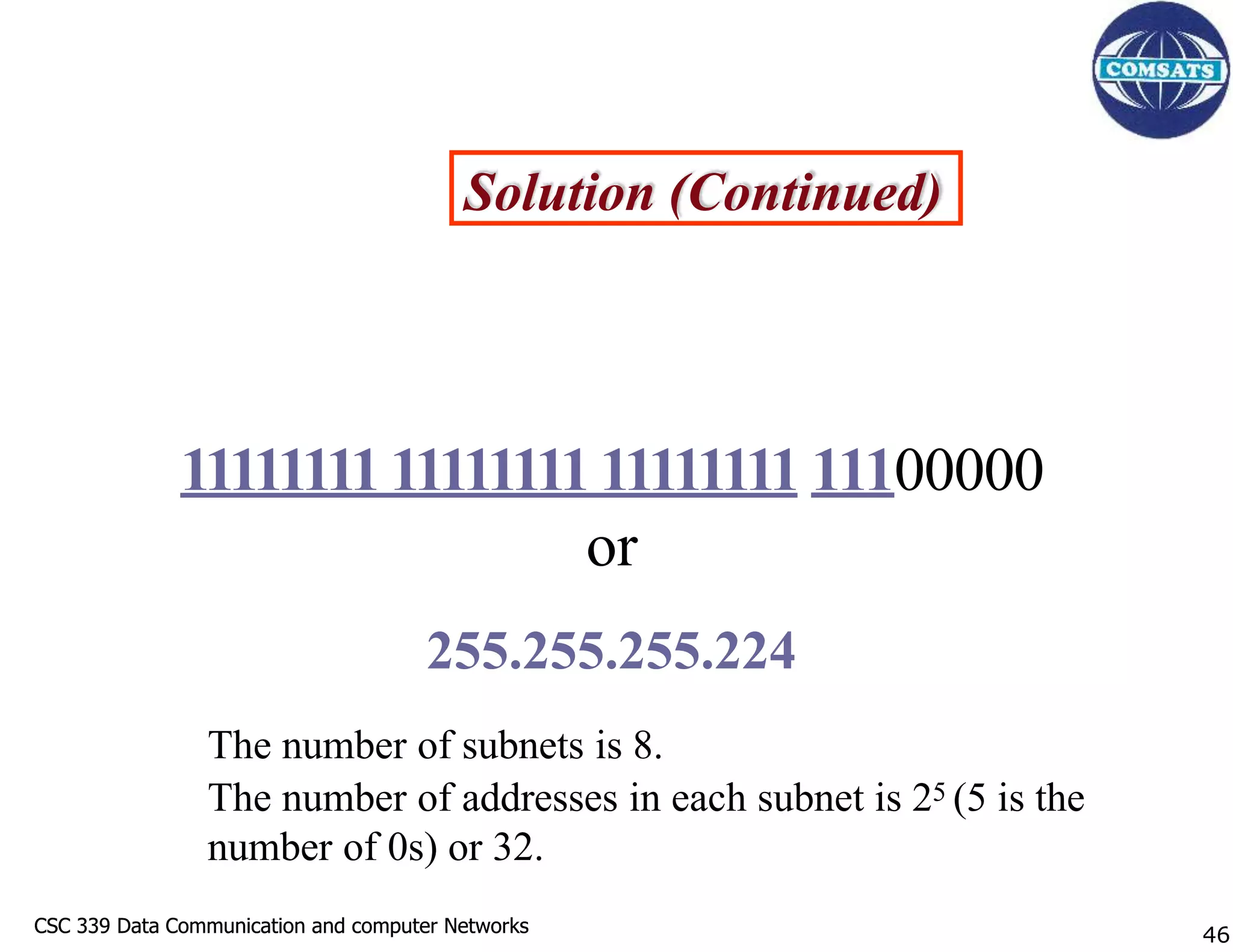
Solution (Continued)
111111111111111111111111 11100000
or
255.255.255.224
The number of subnets is 8.
The number of addresses in each subnet is 25 (5 is the
number of 0s) or 32.
46
CSC 339 Data Communication and computer Networks
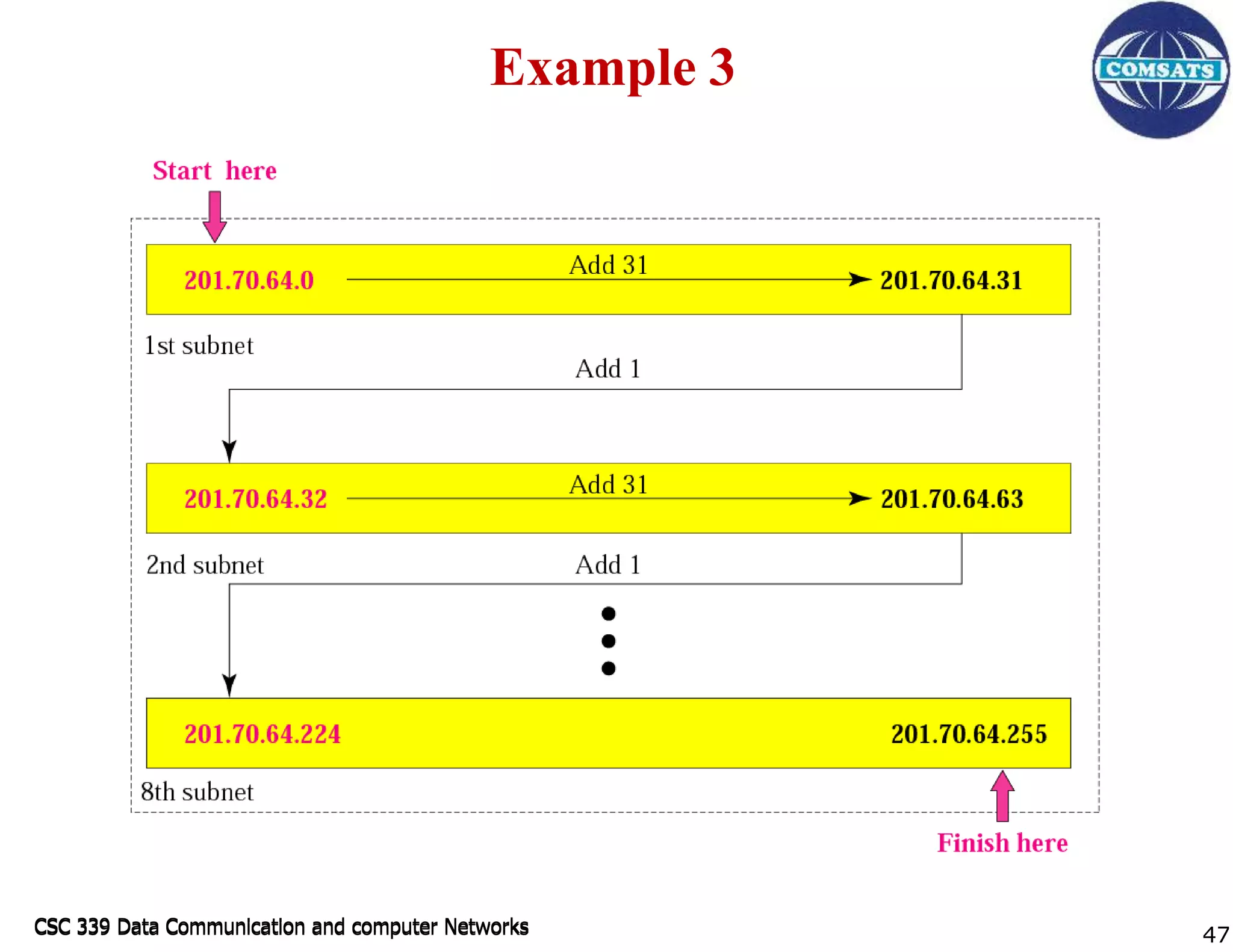
Example 3
47
CSC 339 Data Communication and computer Networks
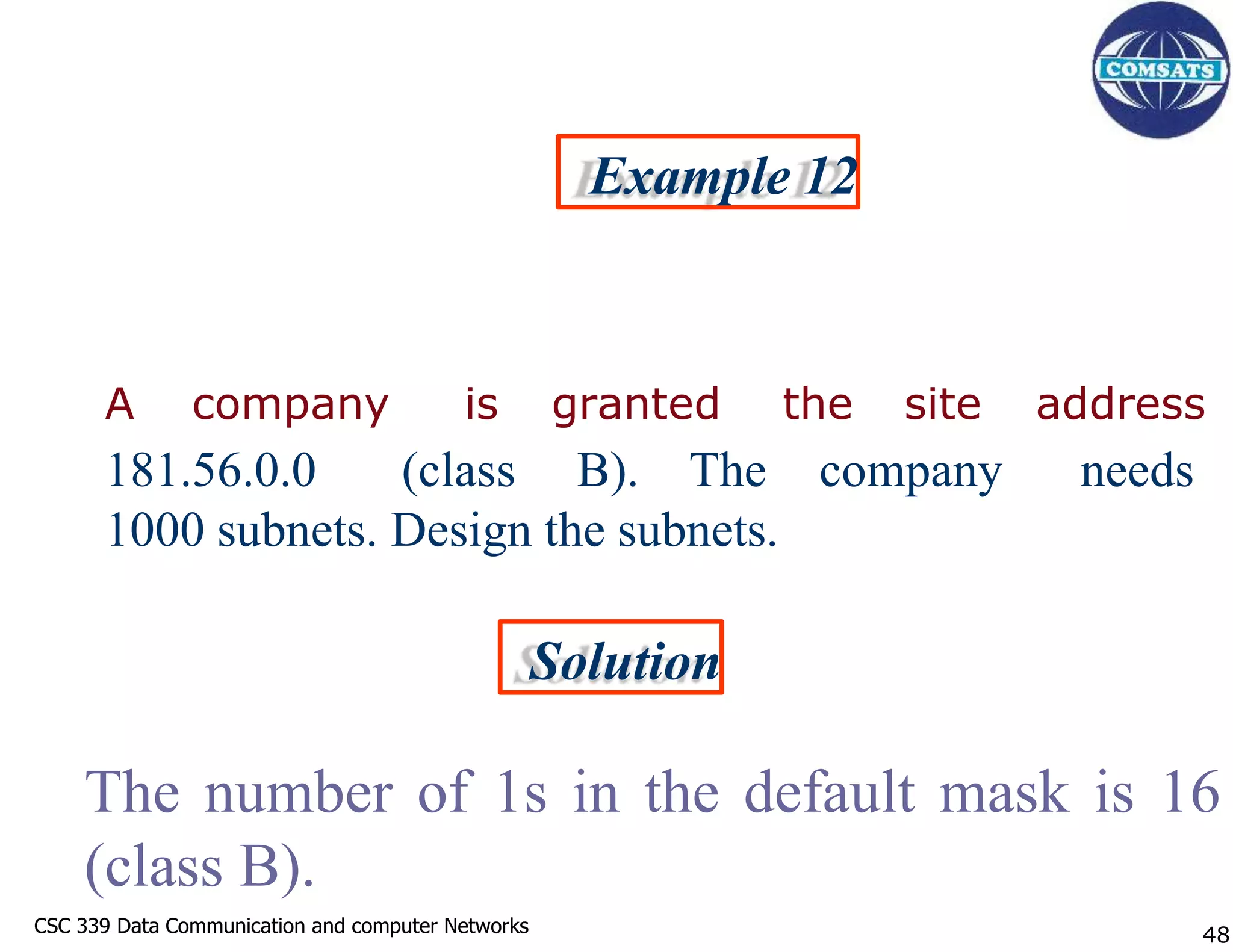
Example 12
A company is granted the site address
181.56.0.0 (class B). The company needs
1000 subnets. Design the subnets.
Solution
The number of 1s in the default mask is 16
(class B).
48
CSC 339 Data Communication and computer Networks
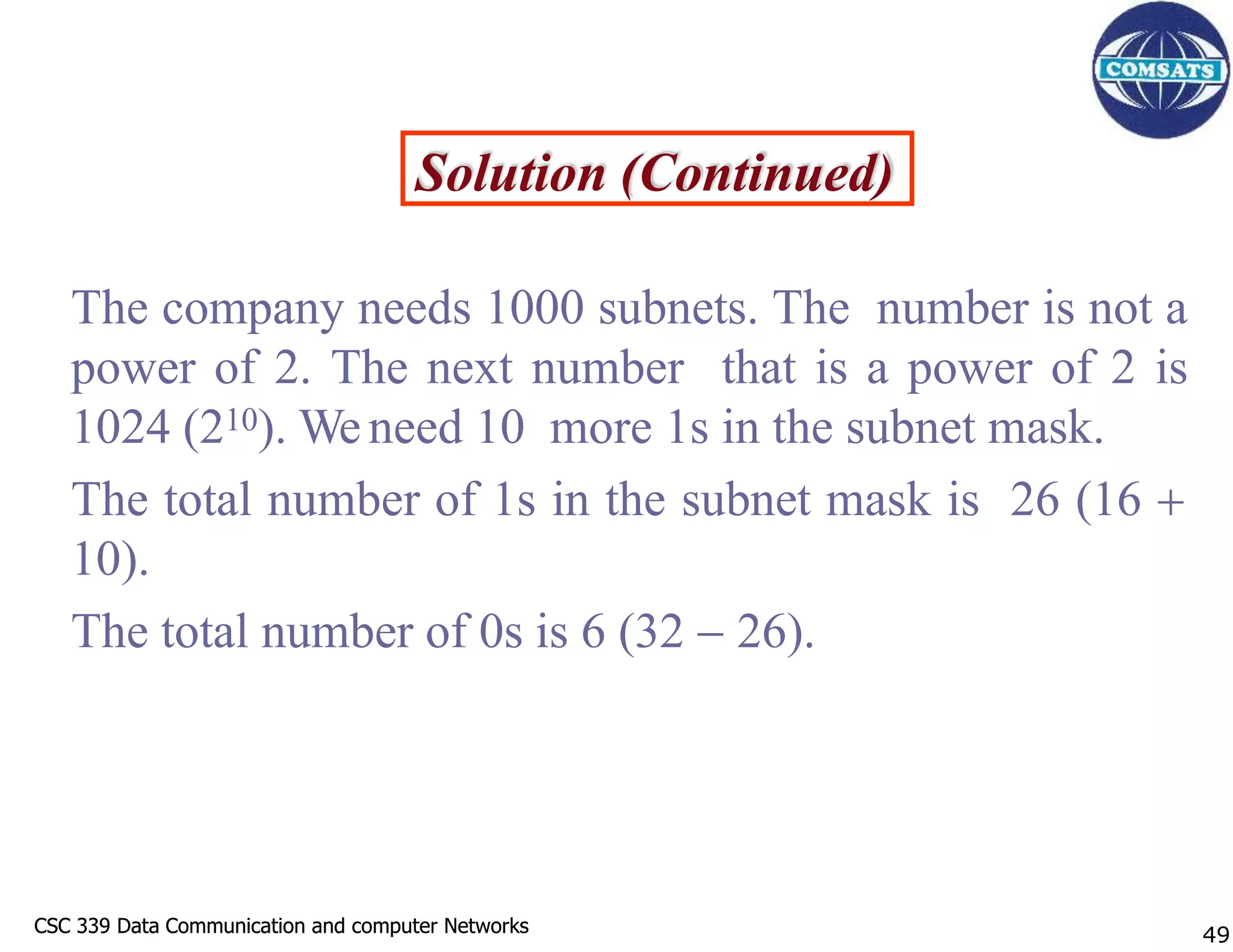
Solution (Continued)
The company needs 1000 subnets. The number is not a
power of 2. The next number that is a power of 2 is
1024 (210). Weneed 10 more 1s in the subnet mask.
The total number of 1s in the subnet mask is 26 (16 
10).
The total number of 0s is 6 (32  26).
49
CSC 339 Data Communication and computer Networks
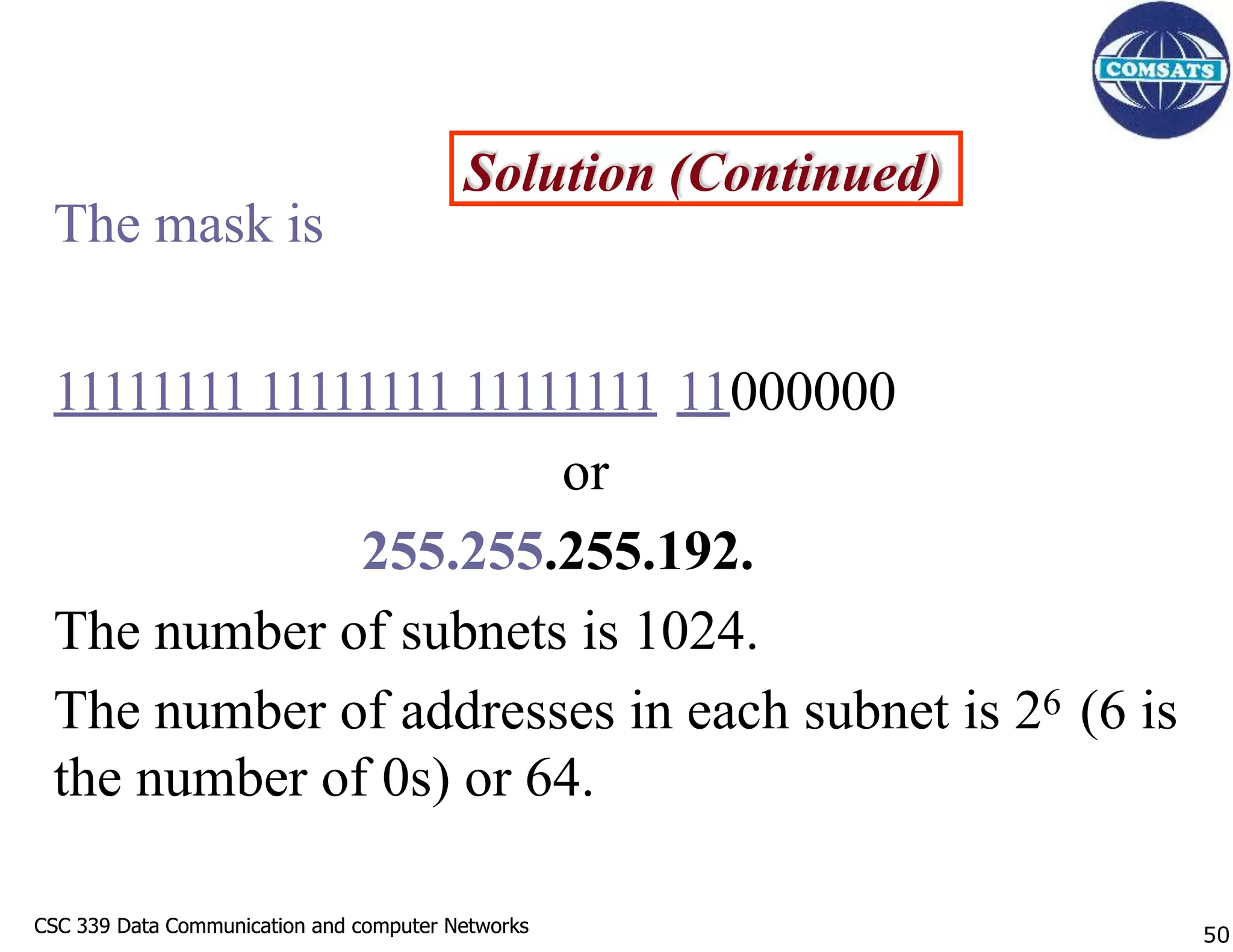
Solution (Continued)
The mask is
11111111 11111111 11111111 11000000
or
255.255.255.192.
The number of subnets is 1024.
The number of addresses in each subnet is 26 (6 is
the number of 0s) or 64.
50
CSC 339 Data Communication and computer Networks
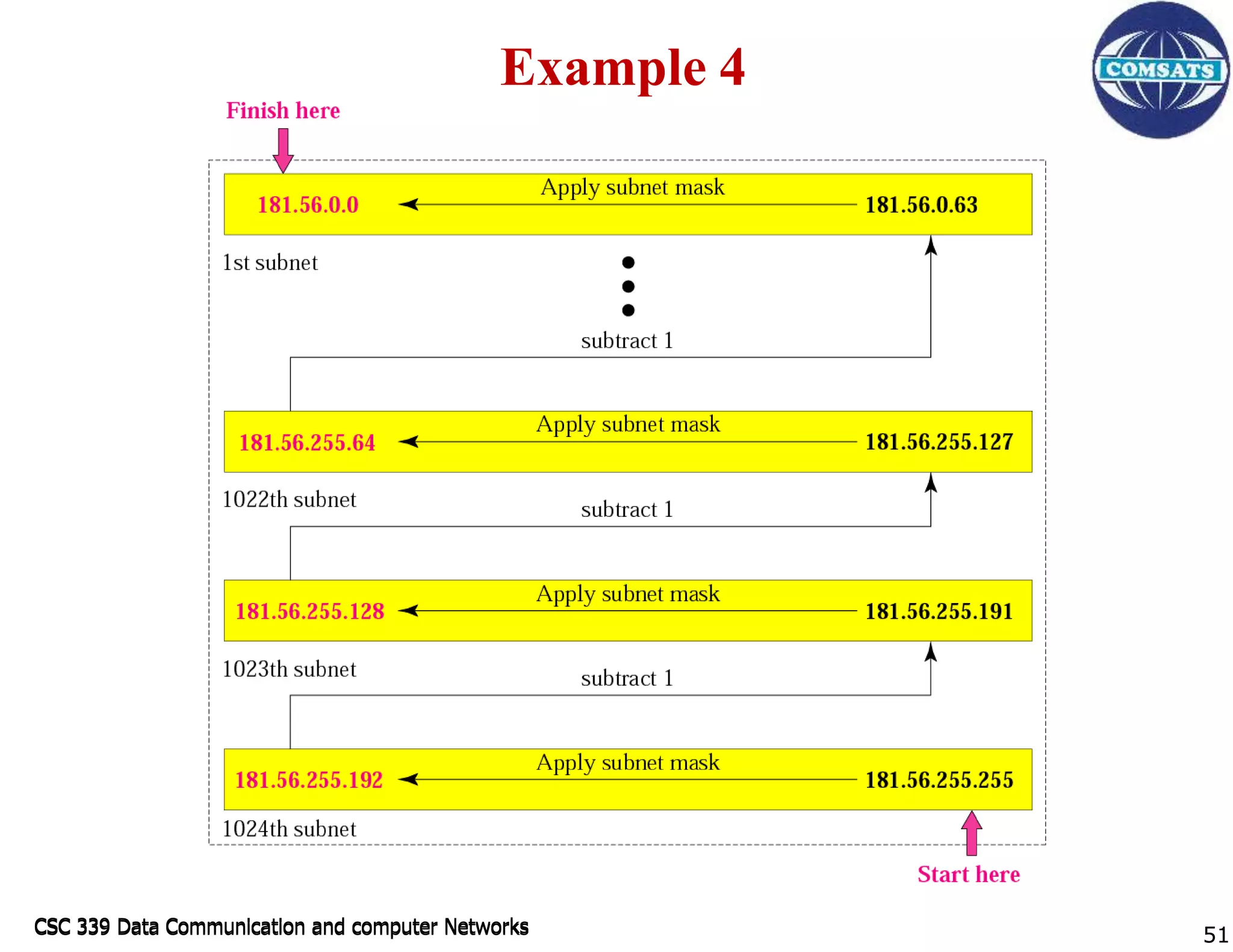
Example 4
51
CSC 339 Data Communication and computer Networks
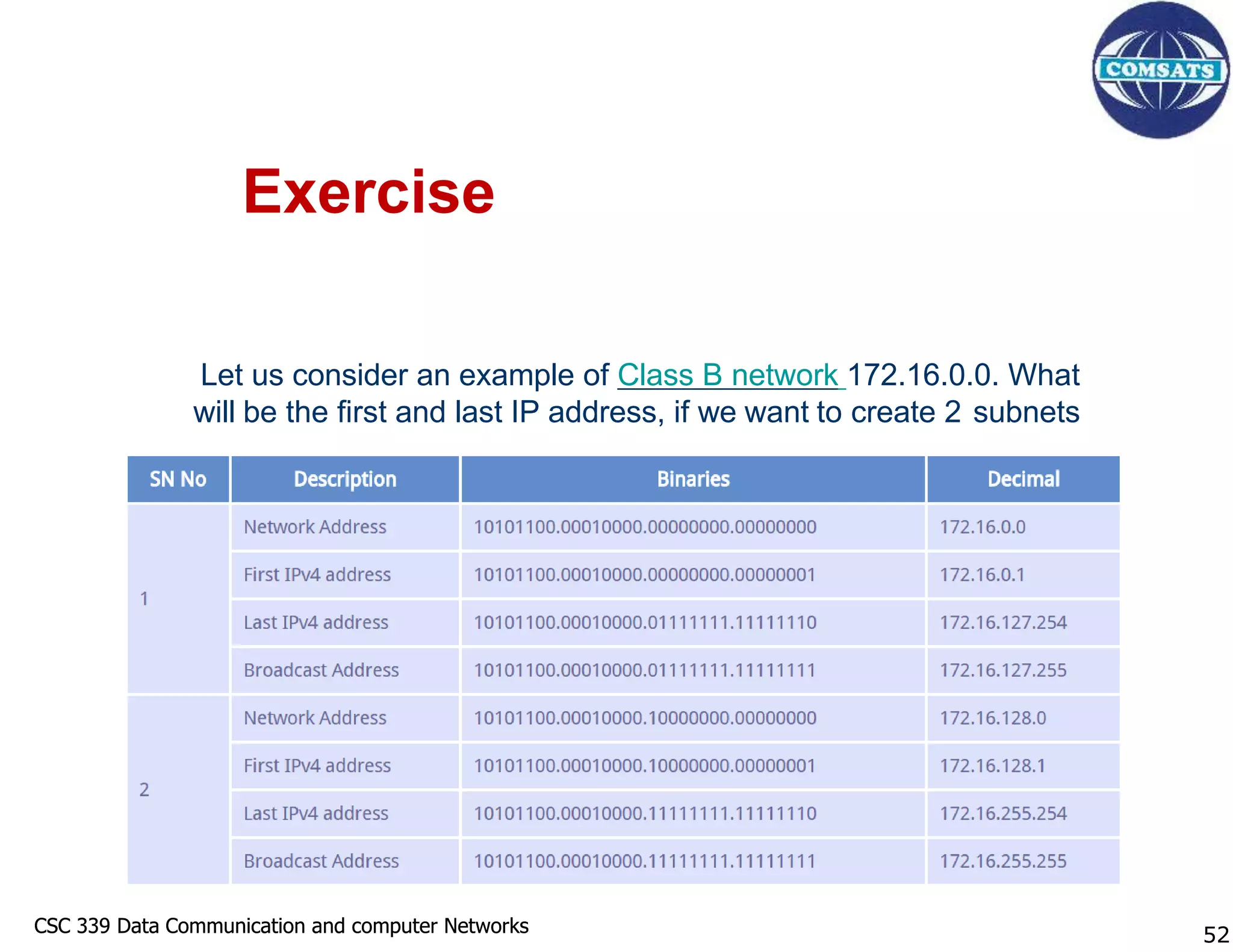
Let us consider an example of Class B network 172.16.0.0. What
will be the first and last IP address, if we want to create 2 subnets
Exercise
52
CSC 339 Data Communication and computer Networks
Exercise
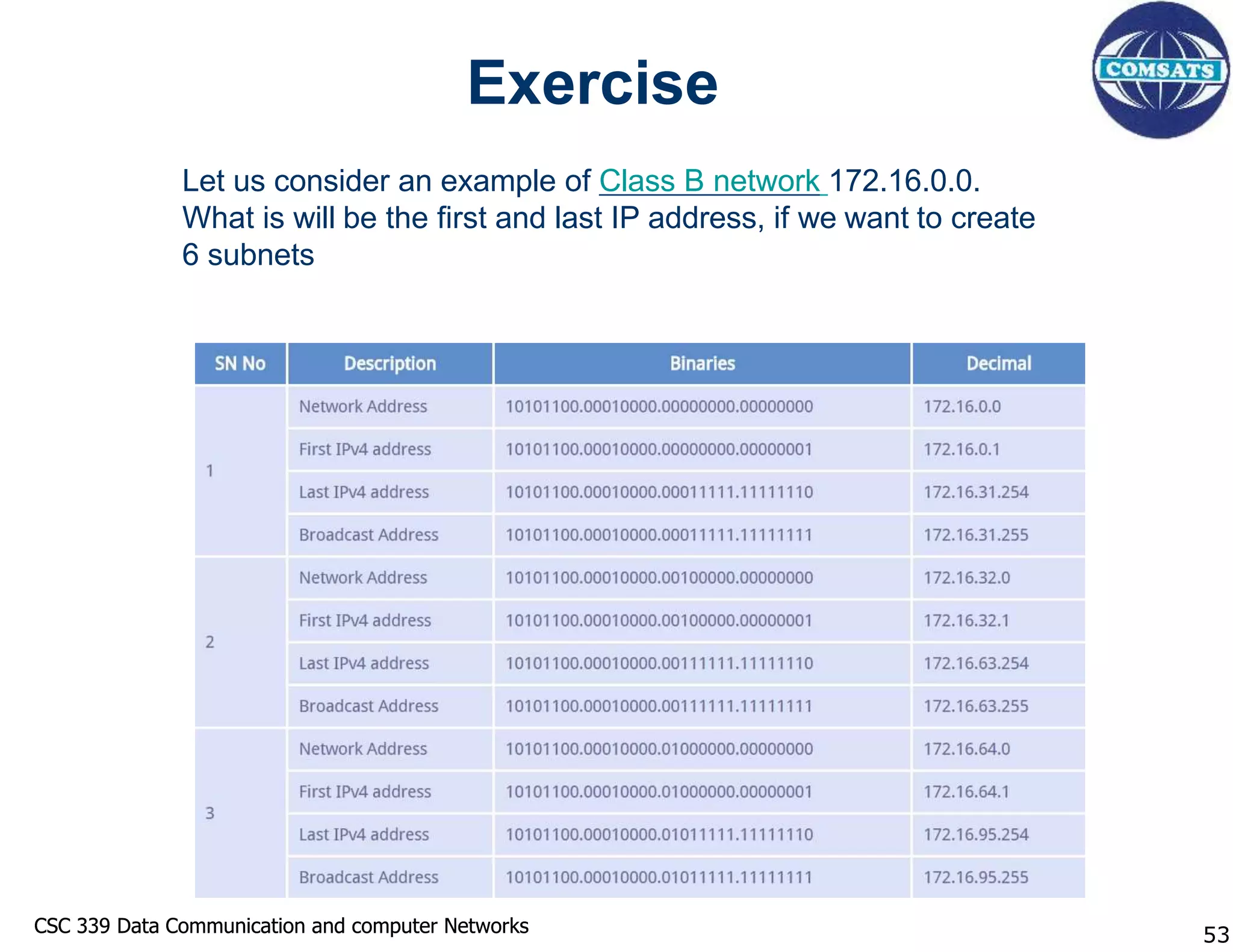
Let us consider an example of Class B network 172.16.0.0.
What is will be the first and last IP address, if we want to create
6 subnets
53
CSC 339 Data Communication and computer Networks
SUPERNETTING
54
CSC 339 Data Communication and computer Networks
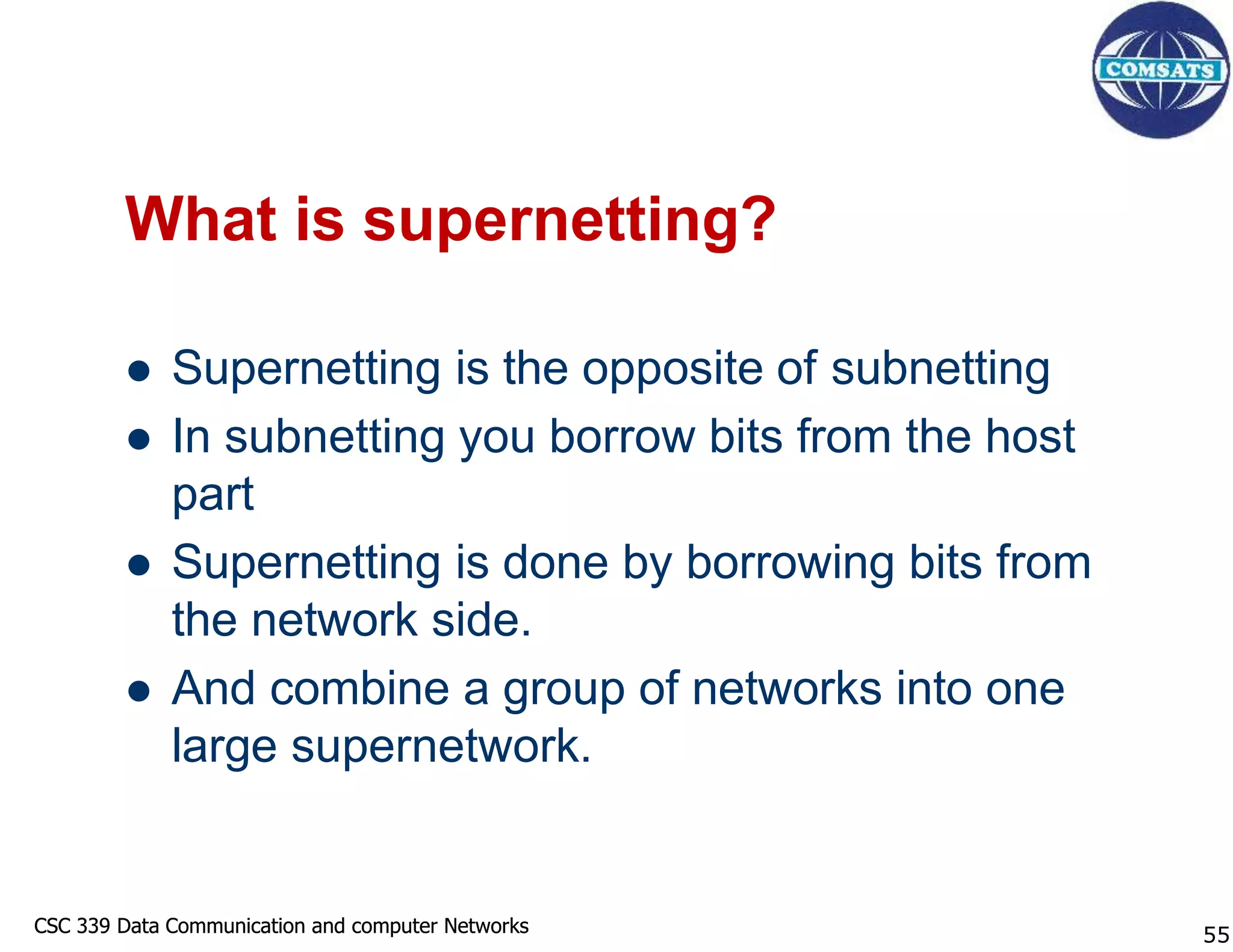
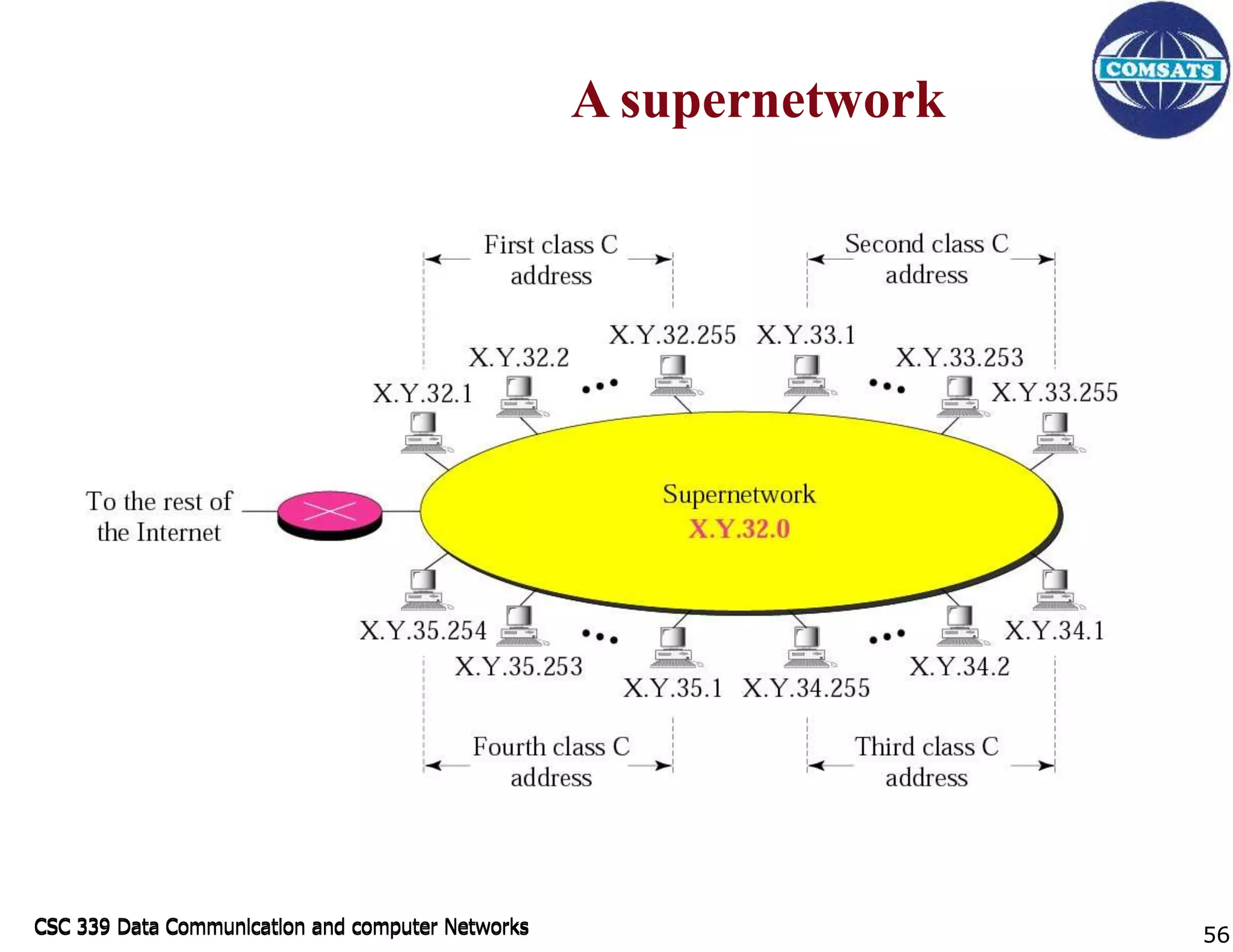
What is supernetting?
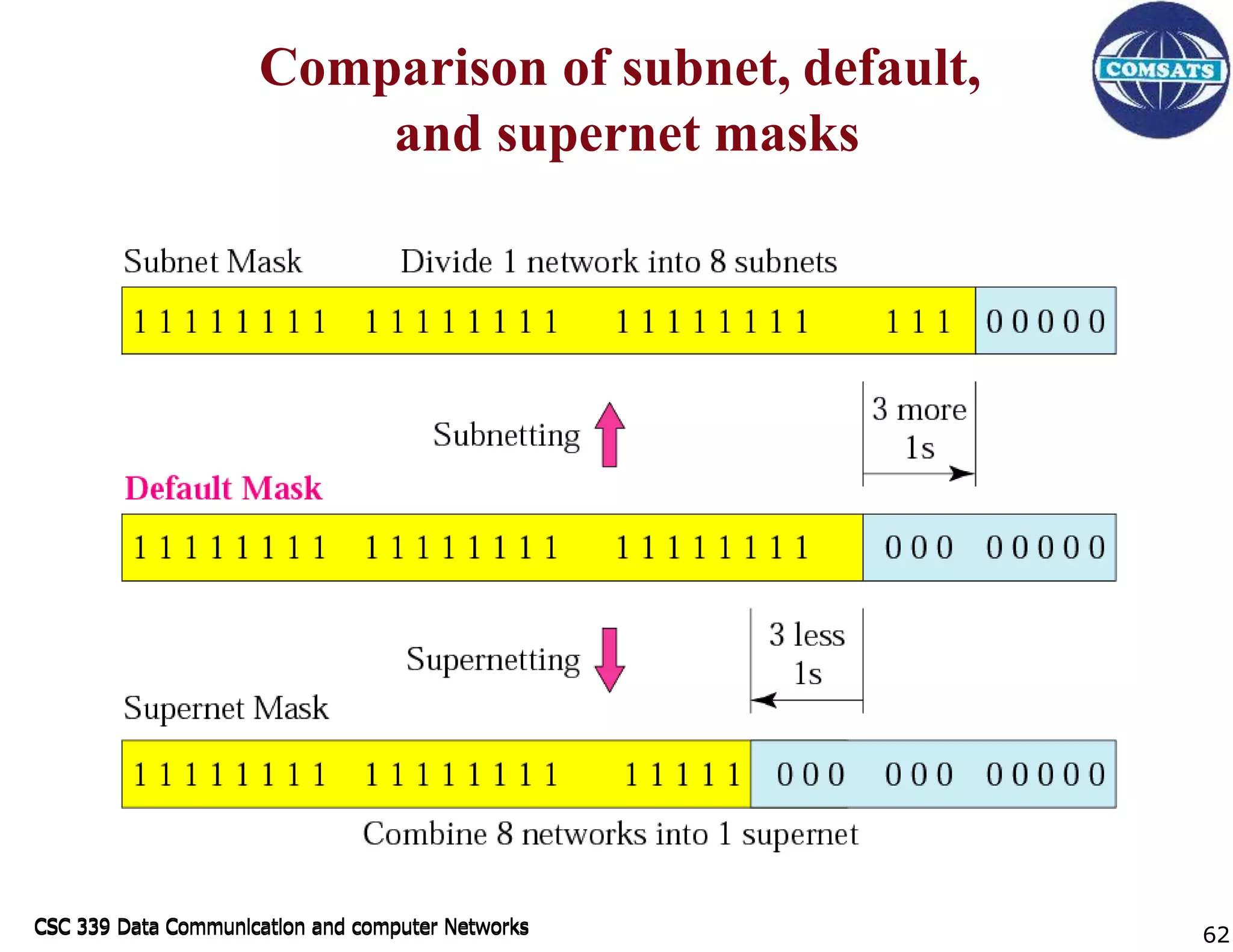
 Supernetting is the opposite of subnetting
 In subnetting you borrow bits from the host
part
 Supernetting is done by borrowing bits from
the network side.
 And combine a group of networks into one
large supernetwork.
55
CSC 339 Data Communication and computer Networks
A supernetwork
56
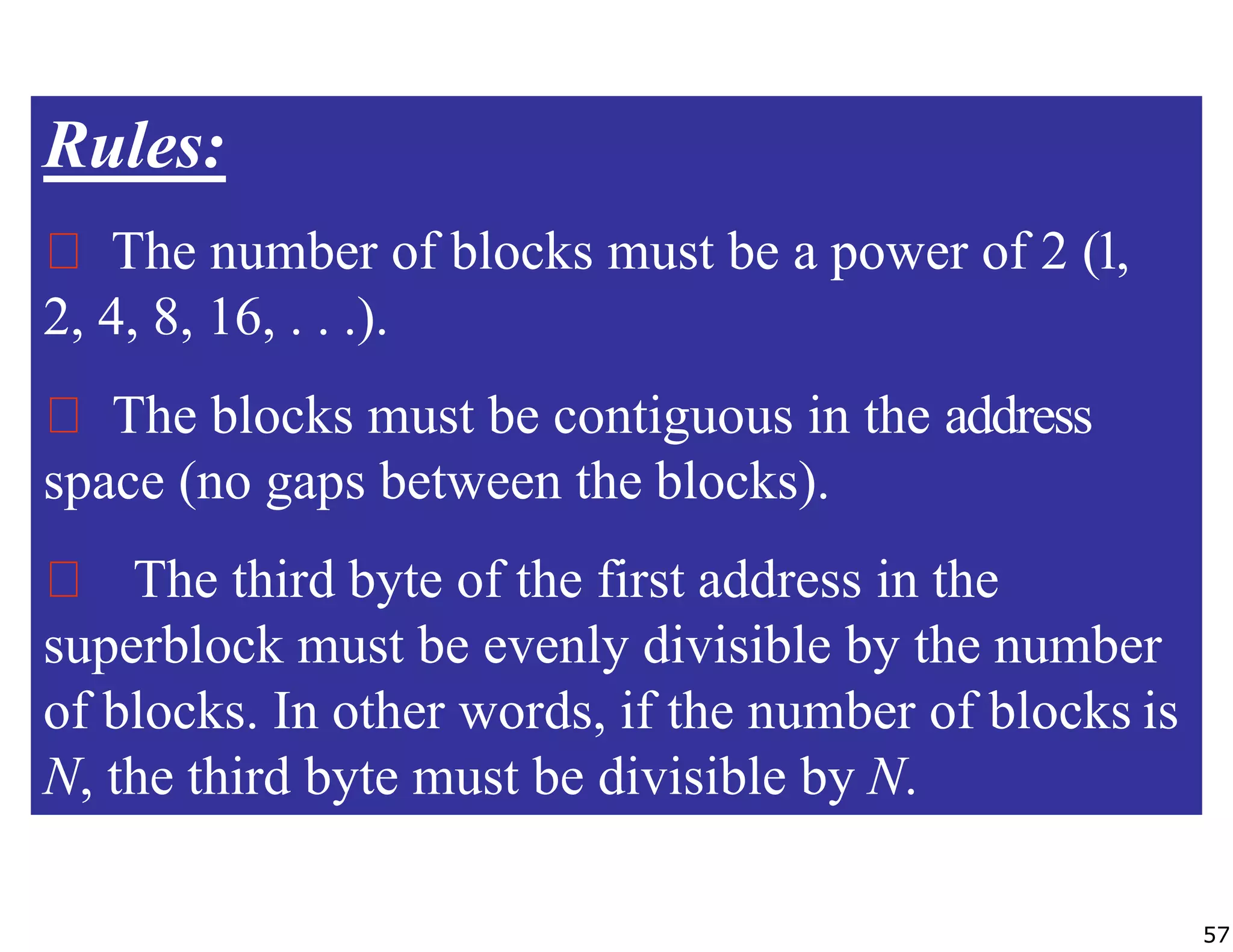
Rules:
The number of blocks must be a power of 2 (1,
2, 4, 8, 16, . . .).
The blocks must be contiguous in the address
space (no gaps between the blocks).
The third byte of the first address in the
superblock must be evenly divisible by the number
of blocks. In other words, if the number of blocks is
N, the third byte must be divisible by N.
57
CSC 339 Data Communication and computer Networks
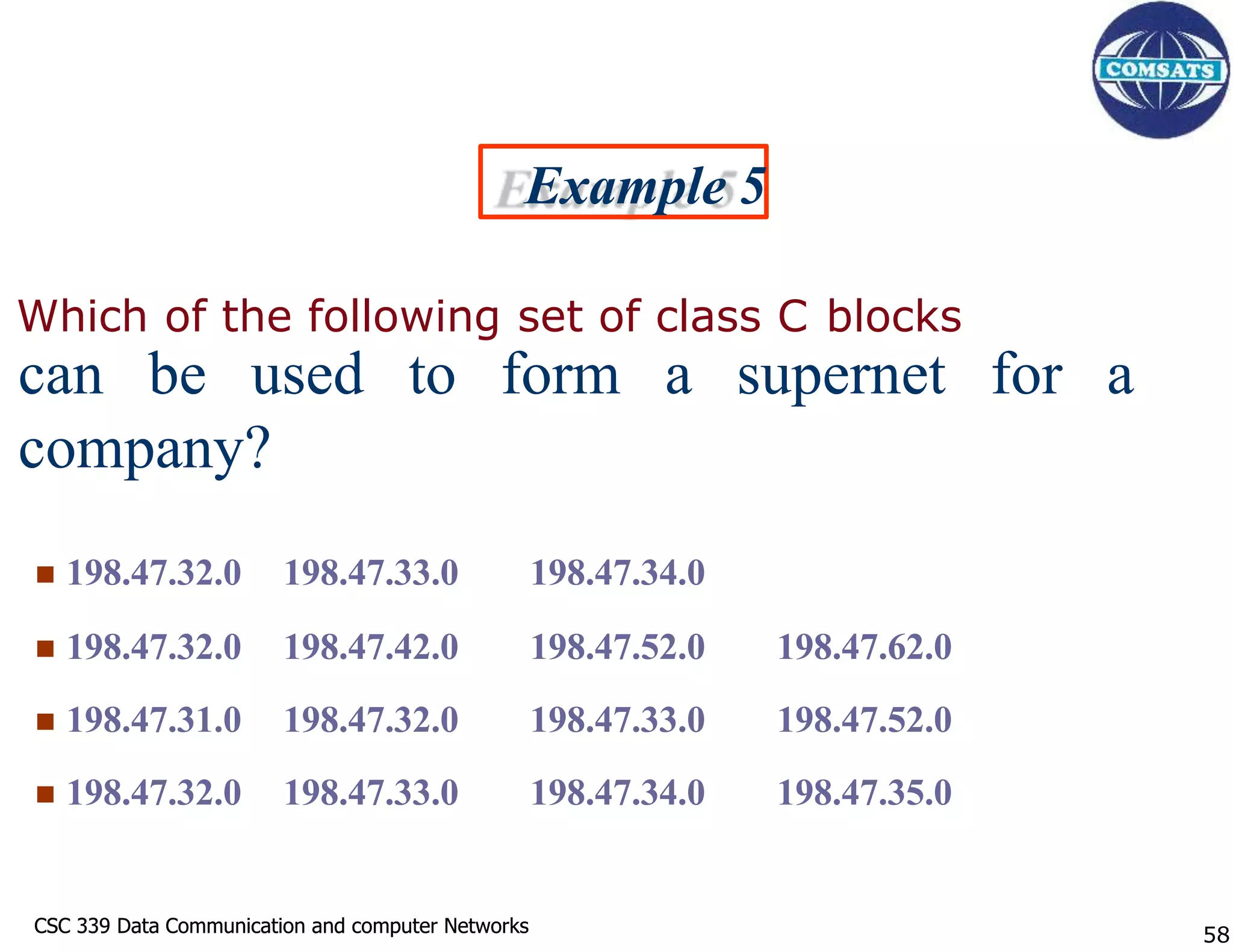
Example 5
Which of the following set of class C blocks
can be used to form a supernet for a
company?
 198.47.32.0 198.47.33.0 198.47.34.0
 198.47.32.0 198.47.42.0 198.47.52.0 198.47.62.0
 198.47.31.0 198.47.32.0 198.47.33.0 198.47.52.0
 198.47.32.0 198.47.33.0 198.47.34.0 198.47.35.0
58
CSC 339 Data Communication and computer Networks
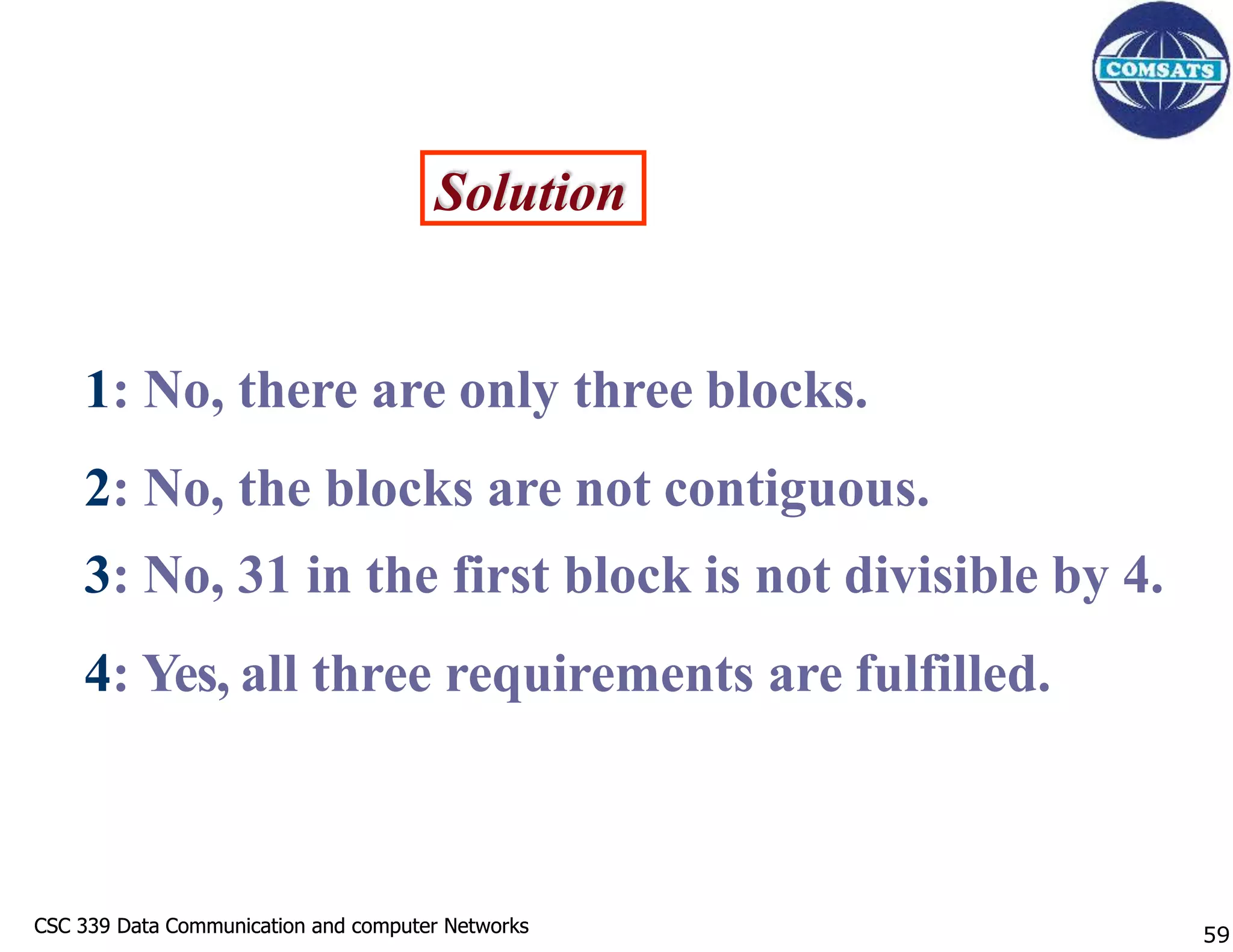
Solution
1: No, there are only three blocks.
2: No, the blocks are not contiguous.
3: No, 31 in the first block is not divisible by 4.
4: Yes, all three requirements are fulfilled.
59
CSC 339 Data Communication and computer Networks
CSC 339 Data Communication and computer Networks 60
60
CSC 339 Data Communication and computer Networks
CSC 339 Data Communication and computer Networks 61
In supernetting,
we need the first address of
the supernet
and the supernet mask to
define the range of addresses.
61
CSC 339 Data Communication and computer Networks
Comparison of subnet, default,
and supernet masks
62
CSC 339 Data Communication and computer Networks
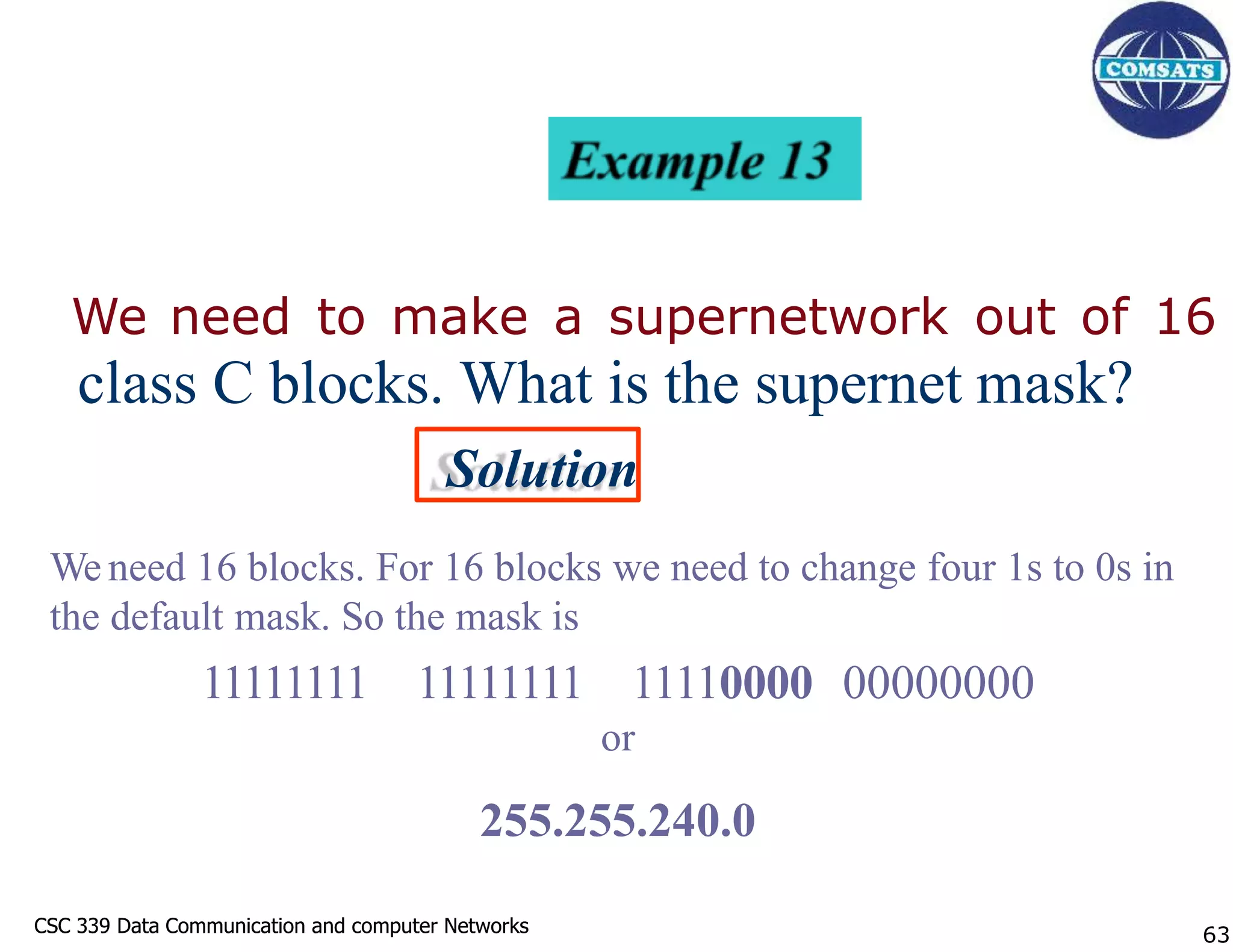
We need to make a supernetwork out of 16
class C blocks. What is the supernet mask?
Solution
We need 16 blocks. For 16 blocks we need to change four 1s to 0s in
the default mask. So the mask is
11111111 11111111 11110000 00000000
or
255.255.240.0
63
CSC 339 Data Communication and computer Networks
Example 14
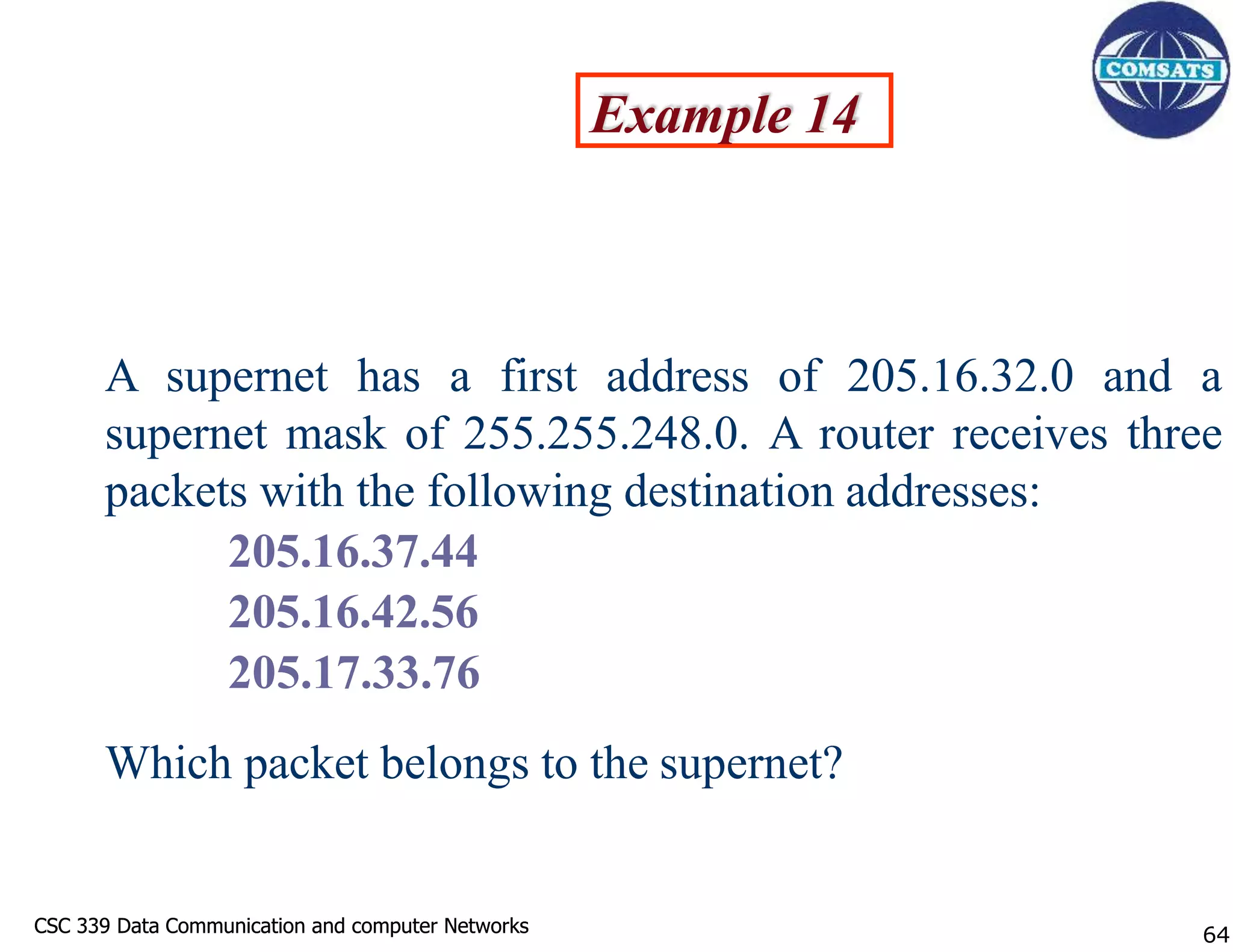
A supernet has a first address of 205.16.32.0 and a
supernet mask of 255.255.248.0. A router receives three
packets with the following destination addresses:
205.16.37.44
205.16.42.56
205.17.33.76
Which packet belongs to the supernet?
64
CSC 339 Data Communication and computer Networks
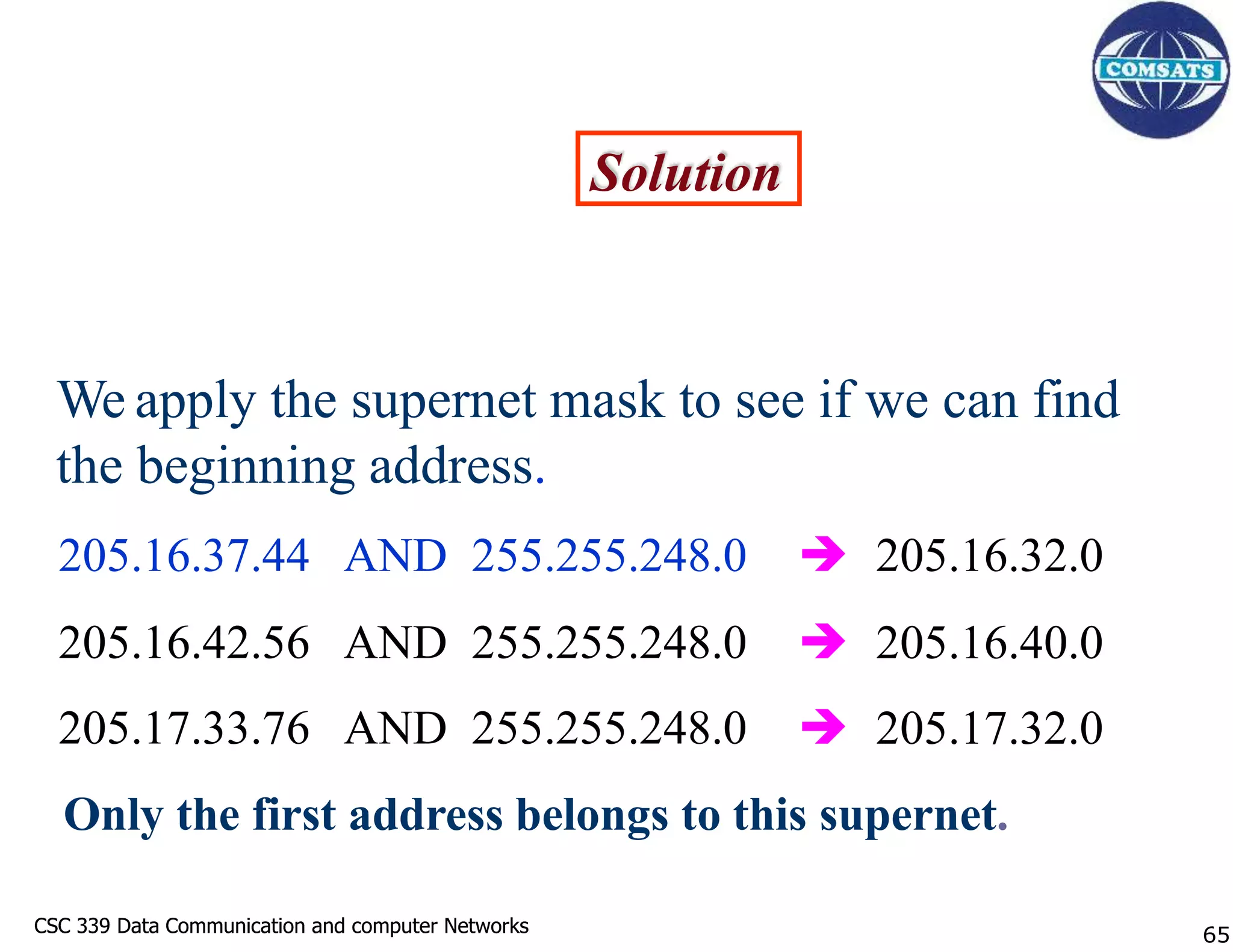
Solution
We apply the supernet mask to see if we can find
the beginning address.
205.16.37.44 AND 255.255.248.0
205.16.42.56 AND 255.255.248.0
205.17.33.76 AND 255.255.248.0
 205.16.32.0
 205.16.40.0
 205.17.32.0
Only the first address belongs to this supernet.
65
CSC 339 Data Communication and computer Networks
Example 15
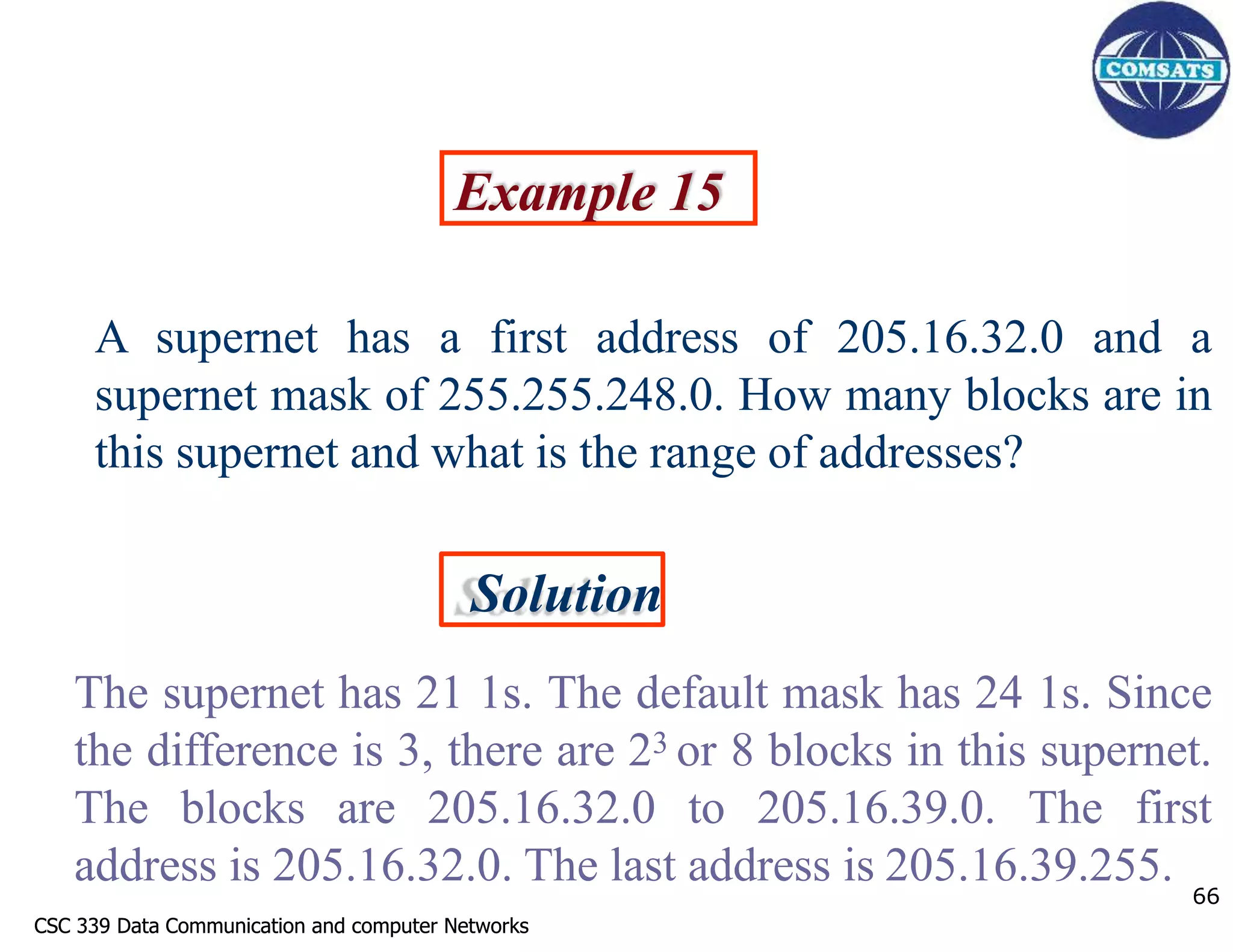
A supernet has a first address of 205.16.32.0 and a
supernet mask of 255.255.248.0. How many blocks are in
this supernet and what is the range of addresses?
Solution
The supernet has 21 1s. The default mask has 24 1s. Since
the difference is 3, there are 23 or 8 blocks in this supernet.
The blocks are 205.16.32.0 to 205.16.39.0. The first
address is 205.16.32.0. The last address is 205.16.39.255. 66

Lecture 19 and 20 IP Addressing.pptx

  • 1.
    CSC 339 DataCommunication and computer Networks CSC 339 Data Communication and computer Networks Network Layer: IP Addressesing CSC-339 Data Communications and Computer Networks 1
  • 2.
    CSC 339 DataCommunication and computer Networks CSC 339 Data Communication and computer Networks What is an IPV4 Address? 2
  • 3.
    CSC 339 DataCommunication and computer Networks CSC 339 Data Communication and computer Networks Address Space addr15 addr1 addr2 addr41 addr31 addr226 ………….. ………….. ………….. ………….. ………….. ………….. ………….. 3
  • 4.
    CSC 339 DataCommunication and computer Networks CSC 339 Data Communication and computer Networks Address space rule ………….. ………….. The address space in a protocol That uses N-bits to define an Address is: 2N 4
  • 5.
    CSC 339 DataCommunication and computer Networks CSC 339 Data Communication and computer Networks The address space of IPv4 is 232 or 4,294,967,296. IPv4 address space 5
  • 6.
    CSC 339 DataCommunication and computer Networks CSC 339 Data Communication and computer Networks 01110101 10010101 00011101 11101010 Binary Notation 6
  • 7.
    CSC 339 DataCommunication and computer Networks CSC 339 Data Communication and computer Networks Dotted-decimal notation 7
  • 8.
    CSC 339 DataCommunication and computer Networks CSC 339 Data Communication and computer Networks Example 3 Solution Find the error in the following IP Address 111.56.045.78 There are no leading zeroes in Dotted-decimal notation (045) 8
  • 9.
    CSC 339 DataCommunication and computer Networks CSC 339 Data Communication and computer Networks Example 3 (continued) Solution Find the error in the following IP Address 75.45.301.14 In decimal notation each number <= 255 301 is out of the range 9
  • 10.
    CSC 339 DataCommunication and computer Networks CSC 339 Data Communication and computer Networks CLASSFUL ADDRESSING 10
  • 11.
    CSC 339 DataCommunication and computer Networks CSC 339 Data Communication and computer Networks In classful addressing the address space is divided into 5 classes: A, B, C, D, and E. 11
  • 12.
    CSC 339 DataCommunication and computer Networks CSC 339 Data Communication and computer Networks Finding the class in binary notation 12
  • 13.
    CSC 339 DataCommunication and computer Networks CSC 339 Data Communication and computer Networks Finding the address class 13
  • 14.
    CSC 339 DataCommunication and computer Networks CSC 339 Data Communication and computer Networks Show that Class A has 231 = 2,147,483,648 addresses: In class A, only 1 bit defines the class. The remaining 31 bits are available for the address. With 31 bits, we can have 2^31 or 2,147,483,648 addresses. Example 5 14
  • 15.
    CSC 339 DataCommunication and computer Networks CSC 339 Data Communication and computer Networks 15 Example 6 Solution Find the class of the following IP addresses 00000001 00001011 00001011 11101111 11000001 00001011 00001011 11101111 • 00000001 00001011 00001011 11101111 1st is 0, hence it is ClassA • 11000001 00001011 00001011 11101111 1st and 2nd bits are 1, and 3rd bit is 0 hence, Class C 15
  • 16.
    CSC 339 DataCommunication and computer Networks CSC 339 Data Communication and computer Networks Finding the class in decimal notation 16
  • 17.
    CSC 339 DataCommunication and computer Networks CSC 339 Data Communication and computer Networks 17 Example 7 Solution Find the class of the following addresses 158.223.1.108 227.13.14.88 • 158.223.1.108 1st byte = 158 (128<158<191) class B • 227.13.14.88 1st byte = 227 (224<227<239) class D 17
  • 18.
    CSC 339 DataCommunication and computer Networks CSC 339 Data Communication and computer Networks IP address with appending port number  158.128.1.108:25  the four octet before colon is the IP address  The number after colon (25) is the port number 18
  • 19.
    CSC 339 DataCommunication and computer Networks CSC 339 Data Communication and computer Networks Netid and hostid 19
  • 20.
    CSC 339 DataCommunication and computer Networks CSC 339 Data Communication and computer Networks Blocks in class A 20
  • 21.
    CSC 339 DataCommunication and computer Networks CSC 339 Data Communication and computer Networks Blocks in class B 21
  • 22.
    CSC 339 DataCommunication and computer Networks CSC 339 Data Communication and computer Networks Blocks in class C 22
  • 23.
    CSC 339 DataCommunication and computer Networks CSC 339 Data Communication and computer Networks 23 23
  • 24.
    CSC 339 DataCommunication and computer Networks CSC 339 Data Communication and computer Networks 24 24
  • 25.
    CSC 339 DataCommunication and computer Networks CSC 339 Data Communication and computer Networks 25
  • 26.
    CSC 339 DataCommunication and computer Networks CSC 339 Data Communication and computer Networks Network Addresses The network address is the first address. The network address defines the network to the rest of the Internet. Given the network address, we can find the class of the address, the block, and the range of the addresses in the block 26
  • 27.
    CSC 339 DataCommunication and computer Networks CSC 339 Data Communication and computer Networks 27 27
  • 28.
    CSC 339 DataCommunication and computer Networks CSC 339 Data Communication and computer Networks 28 Example 8 Solution Given the network address 132.21.0.0, find the class, the block, and the range of the addresses The 1st byte is between 128 and 191. Hence, Class B The block has a netid of 132.21. The addresses range from 132.21.0.0 to 132.21.255.255.
  • 29.
    CSC 339 DataCommunication and computer Networks CSC 339 Data Communication and computer Networks Mask • A mask is a 32-bit binary number. • The mask is ANDeD with IP address to get • The block address (Network address) • Mask And IP address = BlockAddress 29
  • 30.
    CSC 339 DataCommunication and computer Networks CSC 339 Data Communication and computer Networks Default Mask  Class A default mask is 255.0.0.0  Class B default mask is 255.255.0.0  Class C Default mask 255.255.255.0 30
  • 31.
    CSC 339 DataCommunication and computer Networks CSC 339 Data Communication and computer Networks Subnet Mask  An IP address has 2 parts: – The Network identification. – The Host identification.  Frequently, the Network & Host portions of the address need to be separately extracted.  In most cases, if you know the address class, it’s easy to separate the 2 portions. 31
  • 32.
    CSC 339 DataCommunication and computer Networks CSC 339 Data Communication and computer Networks Subnet Mask (Cont.)  With the rapid growth of the internet & the ever- increasing demand for new addresses, the standard address class structure has been expanded by borrowing bits from the Host portion to allow for more Networks.  Under this addressing scheme, called Subnetting, separating the Network & Host requires a special process called Subnet Masking. 32
  • 33.
    CSC 339 DataCommunication and computer Networks CSC 339 Data Communication and computer Networks Subnet Mask (Cont.)  The subnet masking process was developed to identify & extract the Network part of the address.  A subnet mask, which contains a binary bit pattern of ones & zeros, is applied to an address to determine whether the address is on the local Network.  If it is not, the process of routing it to an outside network begins. 33
  • 34.
    CSC 339 DataCommunication and computer Networks CSC 339 Data Communication and computer Networks Subnet Mask (Cont.)  The function of a subnet mask is to determine whether an IP address exists on the local network or whether it must be routed outside the local network.  It is applied to a message’s destination address to extract the network address.  If the extracted network address matches the local network ID, the destination is located on the local network. 34
  • 35.
    CSC 339 DataCommunication and computer Networks CSC 339 Data Communication and computer Networks Subnet Mask (Cont.)  However, if they don’t match, the message must be routed outside the local network.  The process used to apply the subnet mask involves Boolean Algebra to filter out non- matching bits to identify the network address. 35
  • 36.
    CSC 339 DataCommunication and computer Networks CSC 339 Data Communication and computer Networks A network with two levels of hierarchy (not subnetted) 36
  • 37.
    CSC 339 DataCommunication and computer Networks CSC 339 Data Communication and computer Networks Note  Subnetting is done by borrowing bits from the host part and add them the network part 37
  • 38.
    CSC 339 DataCommunication and computer Networks CSC 339 Data Communication and computer Networks Example 9 What is the subnetwork address if the destination address is 200.45.34.56 and the subnet mask is 255.255.240.0? 38
  • 39.
    CSC 339 DataCommunication and computer Networks CSC 339 Data Communication and computer Networks Solution AND OPERATION 11001000 00101101 00100010 00111000 11111111 11111111 11110000 00000000 11001000 00101101 00100000 00000000 The subnetwork address is 200.45.32.0. 39
  • 40.
    CSC 339 DataCommunication and computer Networks CSC 339 Data Communication and computer Networks Example 10 What is the subnetwork address if the destination address is 19.30.80.5 and the mask is 255.255.192.0? Solution See next slide 40
  • 41.
    CSC 339 DataCommunication and computer Networks CSC 339 Data Communication and computer Networks Solution 41
  • 42.
    CSC 339 DataCommunication and computer Networks CSC 339 Data Communication and computer Networks Comparison of a default mask and a subnet mask 42
  • 43.
    CSC 339 DataCommunication and computer Networks CSC 339 Data Communication and computer Networks 43
  • 44.
    CSC 339 DataCommunication and computer Networks CSC 339 Data Communication and computer Networks Example 11 A company is granted the site address 201.70.64.0 (class C). The company needs six subnets. Design the subnets. Solution The number of 1s in the default mask is 24 (class C). 44
  • 45.
    CSC 339 DataCommunication and computer Networks CSC 339 Data Communication and computer Networks Solution (Continued) The company needs six subnets. This number 6 is not a power of 2. The next number that is a power of 2 is 8 (23). We need 3 more 1s in the subnet mask. The total number of 1s in the subnet mask is 27 (24  3). The total number of 0s is 5 (32  27). The mask is 45
  • 46.
    CSC 339 DataCommunication and computer Networks CSC 339 Data Communication and computer Networks Solution (Continued) 111111111111111111111111 11100000 or 255.255.255.224 The number of subnets is 8. The number of addresses in each subnet is 25 (5 is the number of 0s) or 32. 46
  • 47.
    CSC 339 DataCommunication and computer Networks CSC 339 Data Communication and computer Networks Example 3 47
  • 48.
    CSC 339 DataCommunication and computer Networks CSC 339 Data Communication and computer Networks Example 12 A company is granted the site address 181.56.0.0 (class B). The company needs 1000 subnets. Design the subnets. Solution The number of 1s in the default mask is 16 (class B). 48
  • 49.
    CSC 339 DataCommunication and computer Networks CSC 339 Data Communication and computer Networks Solution (Continued) The company needs 1000 subnets. The number is not a power of 2. The next number that is a power of 2 is 1024 (210). Weneed 10 more 1s in the subnet mask. The total number of 1s in the subnet mask is 26 (16  10). The total number of 0s is 6 (32  26). 49
  • 50.
    CSC 339 DataCommunication and computer Networks CSC 339 Data Communication and computer Networks Solution (Continued) The mask is 11111111 11111111 11111111 11000000 or 255.255.255.192. The number of subnets is 1024. The number of addresses in each subnet is 26 (6 is the number of 0s) or 64. 50
  • 51.
    CSC 339 DataCommunication and computer Networks CSC 339 Data Communication and computer Networks Example 4 51
  • 52.
    CSC 339 DataCommunication and computer Networks CSC 339 Data Communication and computer Networks Let us consider an example of Class B network 172.16.0.0. What will be the first and last IP address, if we want to create 2 subnets Exercise 52
  • 53.
    CSC 339 DataCommunication and computer Networks CSC 339 Data Communication and computer Networks Exercise Let us consider an example of Class B network 172.16.0.0. What is will be the first and last IP address, if we want to create 6 subnets 53
  • 54.
    CSC 339 DataCommunication and computer Networks CSC 339 Data Communication and computer Networks SUPERNETTING 54
  • 55.
    CSC 339 DataCommunication and computer Networks CSC 339 Data Communication and computer Networks What is supernetting?  Supernetting is the opposite of subnetting  In subnetting you borrow bits from the host part  Supernetting is done by borrowing bits from the network side.  And combine a group of networks into one large supernetwork. 55
  • 56.
    CSC 339 DataCommunication and computer Networks CSC 339 Data Communication and computer Networks A supernetwork 56
  • 57.
    Rules: The number ofblocks must be a power of 2 (1, 2, 4, 8, 16, . . .). The blocks must be contiguous in the address space (no gaps between the blocks). The third byte of the first address in the superblock must be evenly divisible by the number of blocks. In other words, if the number of blocks is N, the third byte must be divisible by N. 57
  • 58.
    CSC 339 DataCommunication and computer Networks CSC 339 Data Communication and computer Networks Example 5 Which of the following set of class C blocks can be used to form a supernet for a company?  198.47.32.0 198.47.33.0 198.47.34.0  198.47.32.0 198.47.42.0 198.47.52.0 198.47.62.0  198.47.31.0 198.47.32.0 198.47.33.0 198.47.52.0  198.47.32.0 198.47.33.0 198.47.34.0 198.47.35.0 58
  • 59.
    CSC 339 DataCommunication and computer Networks CSC 339 Data Communication and computer Networks Solution 1: No, there are only three blocks. 2: No, the blocks are not contiguous. 3: No, 31 in the first block is not divisible by 4. 4: Yes, all three requirements are fulfilled. 59
  • 60.
    CSC 339 DataCommunication and computer Networks CSC 339 Data Communication and computer Networks 60 60
  • 61.
    CSC 339 DataCommunication and computer Networks CSC 339 Data Communication and computer Networks 61 In supernetting, we need the first address of the supernet and the supernet mask to define the range of addresses. 61
  • 62.
    CSC 339 DataCommunication and computer Networks CSC 339 Data Communication and computer Networks Comparison of subnet, default, and supernet masks 62
  • 63.
    CSC 339 DataCommunication and computer Networks CSC 339 Data Communication and computer Networks We need to make a supernetwork out of 16 class C blocks. What is the supernet mask? Solution We need 16 blocks. For 16 blocks we need to change four 1s to 0s in the default mask. So the mask is 11111111 11111111 11110000 00000000 or 255.255.240.0 63
  • 64.
    CSC 339 DataCommunication and computer Networks CSC 339 Data Communication and computer Networks Example 14 A supernet has a first address of 205.16.32.0 and a supernet mask of 255.255.248.0. A router receives three packets with the following destination addresses: 205.16.37.44 205.16.42.56 205.17.33.76 Which packet belongs to the supernet? 64
  • 65.
    CSC 339 DataCommunication and computer Networks CSC 339 Data Communication and computer Networks Solution We apply the supernet mask to see if we can find the beginning address. 205.16.37.44 AND 255.255.248.0 205.16.42.56 AND 255.255.248.0 205.17.33.76 AND 255.255.248.0  205.16.32.0  205.16.40.0  205.17.32.0 Only the first address belongs to this supernet. 65
  • 66.
    CSC 339 DataCommunication and computer Networks CSC 339 Data Communication and computer Networks Example 15 A supernet has a first address of 205.16.32.0 and a supernet mask of 255.255.248.0. How many blocks are in this supernet and what is the range of addresses? Solution The supernet has 21 1s. The default mask has 24 1s. Since the difference is 3, there are 23 or 8 blocks in this supernet. The blocks are 205.16.32.0 to 205.16.39.0. The first address is 205.16.32.0. The last address is 205.16.39.255. 66

Editor's Notes

  • #2 As we know, most of the applications like HTTP, FTP requires reliability. Furthermore, we know that TCP provides reliability Service. Before going in to the detail how TCP reliability mechanism works. Lets built a reliable data transfer protocol step by step in order to understand the underlying challenges, which are addressed by TCP.
  • #6 232 or 4,294,967,296