Link layer and LANs: our goals
understand principles
behind link layer services:
• error detection, correction
• sharing a broadcast channel:
multiple access
• link layer addressing
• local area networks:
Ethernet, VLANs
Link Layer: 6-1
Link layer, LANs: roadmap
introduction
 error detection, correction
 multiple access protocols
 LANs
• addressing, ARP
• Ethernet
• switches
• VLANs
Link Layer: 6-2
Link layer: introduction
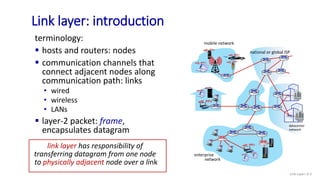
terminology:
 hosts and routers: nodes
 communication channels that
connect adjacent nodes along
communication path: links
• wired
• wireless
• LANs
 layer-2 packet: frame,
encapsulates datagram
mobile network
enterprise
network
national or global ISP
datacenter
network
link layer has responsibility of
transferring datagram from one node
to physically adjacent node over a link
Link Layer: 6-3
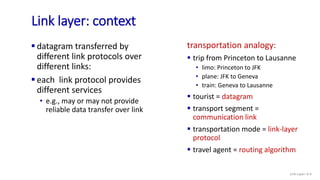
Link layer: context
 datagram transferred by
different link protocols over
different links:
 each link protocol provides
different services
• e.g., may or may not provide
reliable data transfer over link
transportation analogy:
 trip from Princeton to Lausanne
• limo: Princeton to JFK
• plane: JFK to Geneva
• train: Geneva to Lausanne
 tourist = datagram
 transport segment =
communication link
 transportation mode = link-layer
protocol
 travel agent = routing algorithm
Link Layer: 6-4
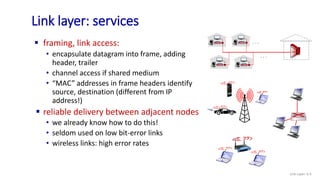
Link layer: services
 framing, link access:
• encapsulate datagram into frame, adding
header, trailer
• channel access if shared medium
• “MAC” addresses in frame headers identify
source, destination (different from IP
address!)
 reliable delivery between adjacent nodes
• we already know how to do this!
• seldom used on low bit-error links
• wireless links: high error rates
…
…
Link Layer: 6-5
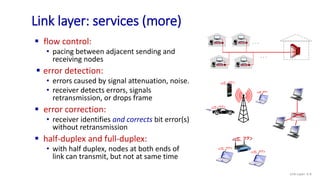
Link layer: services (more)
 flow control:
• pacing between adjacent sending and
receiving nodes
 error detection:
• errors caused by signal attenuation, noise.
• receiver detects errors, signals
retransmission, or drops frame
 error correction:
• receiver identifies and corrects bit error(s)
without retransmission
 half-duplex and full-duplex:
• with half duplex, nodes at both ends of
link can transmit, but not at same time
…
…
Link Layer: 6-6
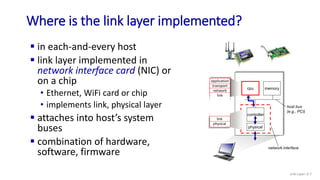
Where is the link layer implemented?
 in each-and-every host
 link layer implemented in
network interface card (NIC) or
on a chip
• Ethernet, WiFi card or chip
• implements link, physical layer
 attaches into host’s system
buses
 combination of hardware,
software, firmware
controller
physical
cpu memory
host bus
(e.g., PCI)
network interface
application
transport
network
link
link
physical
Link Layer: 6-7
controller
physical
memory CPU
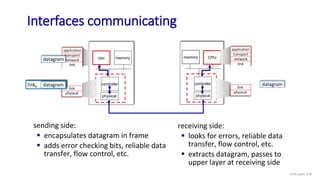
Interfaces communicating
controller
physical
cpu memory
application
transport
network
link
link
physical
application
transport
network
link
link
physical
sending side:
 encapsulates datagram in frame
 adds error checking bits, reliable data
transfer, flow control, etc.
receiving side:
 looks for errors, reliable data
transfer, flow control, etc.
 extracts datagram, passes to
upper layer at receiving side
linkh
linkh datagram
datagram
datagram
Link Layer: 6-8
Link layer, LANs: roadmap
 a day in the life of a web
request
 introduction
error detection, correction
 multiple access protocols
 LANs
• addressing, ARP
• Ethernet
• switches
• VLANs
 link virtualization: MPLS
 data center networking
Link Layer: 6-9
Error detection
Link Layer: 6-10
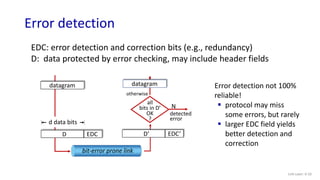
EDC: error detection and correction bits (e.g., redundancy)
D: data protected by error checking, may include header fields
Error detection not 100%
reliable!
 protocol may miss
some errors, but rarely
 larger EDC field yields
better detection and
correction
datagram
D EDC
d data bits
bit-error prone link
D’ EDC’
all
bits in D’
OK
?
N
detected
error
otherwise
datagram
Parity checking
Link Layer: 6-11
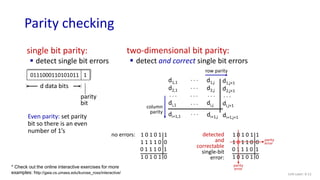
single bit parity:
 detect single bit errors
0111000110101011 1
parity
bit
d data bits
two-dimensional bit parity:
 detect and correct single bit errors
d1,1
d2,1
di,1
. . .
d1,j+1
d2,j+1
di,j+1
. . .
. . .
d1,j
d2,j
di,j
. . .
di+1,1 di+1,j+1
di+1,j
. . .
. . .
. . .
. . .
row parity
column
parity
0 1 1 1 0 1
1 0 1 0 1 1
1 1 1 1 0 0
1 0 1 0 1 0
no errors:
0 1 1 1 0 1
1 0 1 0 1 1
1 0 1 1 0 0
1 0 1 0 1 0
parity
error
parity
error
detected
and
correctable
single-bit
error:
Even parity: set parity
bit so there is an even
number of 1’s
* Check out the online interactive exercises for more
examples: http://gaia.cs.umass.edu/kurose_ross/interactive/
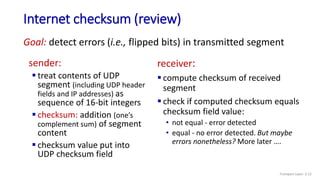
Internet checksum (review)
sender:
 treat contents of UDP
segment (including UDP header
fields and IP addresses) as
sequence of 16-bit integers
 checksum: addition (one’s
complement sum) of segment
content
 checksum value put into
UDP checksum field
receiver:
 compute checksum of received
segment
 check if computed checksum equals
checksum field value:
• not equal - error detected
• equal - no error detected. But maybe
errors nonetheless? More later ….
Goal: detect errors (i.e., flipped bits) in transmitted segment
Transport Layer: 3-12
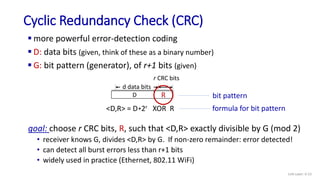
Cyclic Redundancy Check (CRC)
 more powerful error-detection coding
 D: data bits (given, think of these as a binary number)
 G: bit pattern (generator), of r+1 bits (given)
Link Layer: 6-13
goal: choose r CRC bits, R, such that <D,R> exactly divisible by G (mod 2)
• receiver knows G, divides <D,R> by G. If non-zero remainder: error detected!
• can detect all burst errors less than r+1 bits
• widely used in practice (Ethernet, 802.11 WiFi)
r CRC bits
d data bits
D R
<D,R> = D 2r XOR R
*
bit pattern
formula for bit pattern
Link Layer: 6-14
Cyclic Redundancy Check (CRC): example
We want:
D.2r XOR R = nG
* Check out the online interactive exercises for more examples: http://gaia.cs.umass.edu/kurose_ross/interactive/
D.2r
G
R = remainder [ ]
or equivalently:
D.2r = nG XOR R
or equivalently:
if we divide D.2r by G, want
remainder R to satisfy:
1 0 0 1
1 0 1 0
1 0 1
0 0 0
1 0 0 1
1 0 0 1
1 0 0 1
0 0 0
1 1 0
1 1 0 0
1 0 1 0
0 1 1
0 1 1
D
R
1 0 0 1
G
0 0 0
1 0 1 1 1 0
2r
*
1 0 1
Link layer, LANs: roadmap
 a day in the life of a web
request
 introduction
 error detection, correction
multiple access protocols
 LANs
• addressing, ARP
• Ethernet
• switches
• VLANs
 link virtualization: MPLS
 data center networking
Link Layer: 6-15
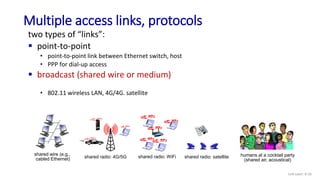
Multiple access links, protocols
Link Layer: 6-16
two types of “links”:
 point-to-point
• point-to-point link between Ethernet switch, host
• PPP for dial-up access
 broadcast (shared wire or medium)
• 802.11 wireless LAN, 4G/4G. satellite
shared wire (e.g.,
cabled Ethernet) shared radio: WiFi shared radio: satellite humans at a cocktail party
(shared air, acoustical)
shared radio: 4G/5G
Multiple access protocols
Link Layer: 6-17
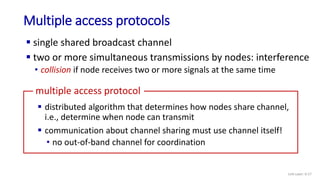
 single shared broadcast channel
 two or more simultaneous transmissions by nodes: interference
• collision if node receives two or more signals at the same time
 distributed algorithm that determines how nodes share channel,
i.e., determine when node can transmit
 communication about channel sharing must use channel itself!
• no out-of-band channel for coordination
multiple access protocol
An ideal multiple access protocol
Link Layer: 6-18
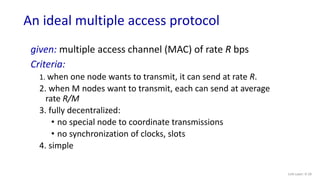
given: multiple access channel (MAC) of rate R bps
Criteria:
1. when one node wants to transmit, it can send at rate R.
2. when M nodes want to transmit, each can send at average
rate R/M
3. fully decentralized:
• no special node to coordinate transmissions
• no synchronization of clocks, slots
4. simple
MAC protocols: taxonomy
Link Layer: 6-19
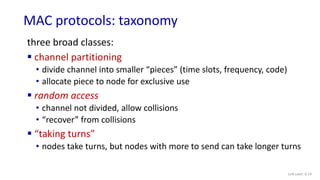
three broad classes:
 channel partitioning
• divide channel into smaller “pieces” (time slots, frequency, code)
• allocate piece to node for exclusive use
 random access
• channel not divided, allow collisions
• “recover” from collisions
 “taking turns”
• nodes take turns, but nodes with more to send can take longer turns
Channel partitioning MAC protocols: TDMA
Link Layer: 6-20
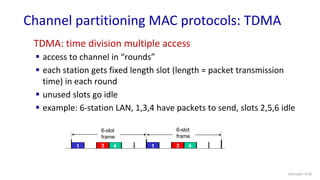
TDMA: time division multiple access
 access to channel in “rounds”
 each station gets fixed length slot (length = packet transmission
time) in each round
 unused slots go idle
 example: 6-station LAN, 1,3,4 have packets to send, slots 2,5,6 idle
1 3 4 1 3 4
6-slot
frame
6-slot
frame
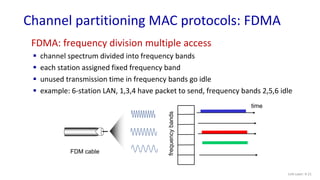
Channel partitioning MAC protocols: FDMA
Link Layer: 6-21
FDMA: frequency division multiple access
 channel spectrum divided into frequency bands
 each station assigned fixed frequency band
 unused transmission time in frequency bands go idle
 example: 6-station LAN, 1,3,4 have packet to send, frequency bands 2,5,6 idle
frequency
bands
FDM cable
Random access protocols
Link Layer: 6-22
 when node has packet to send
• transmit at full channel data rate R.
• no a priori coordination among nodes
 two or more transmitting nodes: “collision”
 random access MAC protocol specifies:
• how to detect collisions
• how to recover from collisions (e.g., via delayed retransmissions)
 examples of random access MAC protocols:
• ALOHA, slotted ALOHA
• CSMA, CSMA/CD, CSMA/CA
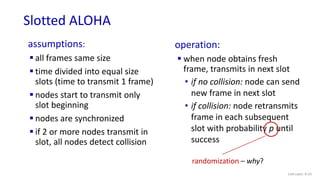
Slotted ALOHA
Link Layer: 6-23
assumptions:
 all frames same size
 time divided into equal size
slots (time to transmit 1 frame)
 nodes start to transmit only
slot beginning
 nodes are synchronized
 if 2 or more nodes transmit in
slot, all nodes detect collision
operation:
 when node obtains fresh
frame, transmits in next slot
• if no collision: node can send
new frame in next slot
• if collision: node retransmits
frame in each subsequent
slot with probability p until
success
randomization – why?
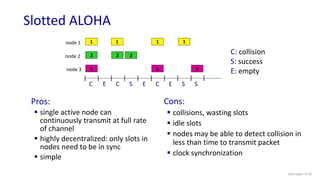
Slotted ALOHA
Link Layer: 6-24
Pros:
 single active node can
continuously transmit at full rate
of channel
 highly decentralized: only slots in
nodes need to be in sync
 simple
Cons:
 collisions, wasting slots
 idle slots
 nodes may be able to detect collision in
less than time to transmit packet
 clock synchronization
1 1 1 1
2
3
2 2
3 3
node 1
node 2
node 3
C C C
S S S
E E E
C: collision
S: success
E: empty
Pure ALOHA
Link Layer: 6-25
 unslotted Aloha: simpler, no synchronization
• when frame first arrives: transmit immediately
 collision probability increases with no synchronization:
• frame sent at t0 collides with other frames sent in [t0-1,t0+1]
t0 + 1
t0 - 1 t0
will overlap
with end of
i’s frame
will overlap
with start of
i’s frame
 pure Aloha efficiency: 18% !
CSMA (carrier sense multiple access)
Link Layer: 6-26
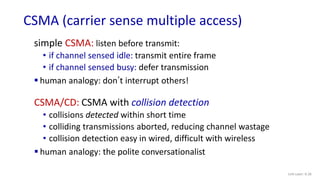
simple CSMA: listen before transmit:
• if channel sensed idle: transmit entire frame
• if channel sensed busy: defer transmission
 human analogy: don’t interrupt others!
CSMA/CD: CSMA with collision detection
• collisions detected within short time
• colliding transmissions aborted, reducing channel wastage
• collision detection easy in wired, difficult with wireless
 human analogy: the polite conversationalist
CSMA: collisions
Link Layer: 6-27
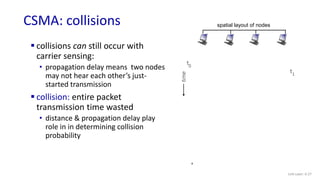
 collisions can still occur with
carrier sensing:
• propagation delay means two nodes
may not hear each other’s just-
started transmission
 collision: entire packet
transmission time wasted
• distance & propagation delay play
role in in determining collision
probability
spatial layout of nodes
CSMA/CD:
Link Layer: 6-28
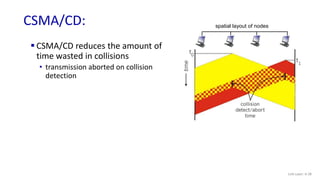
 CSMA/CD reduces the amount of
time wasted in collisions
• transmission aborted on collision
detection
spatial layout of nodes
Ethernet CSMA/CD algorithm
Link Layer: 6-29
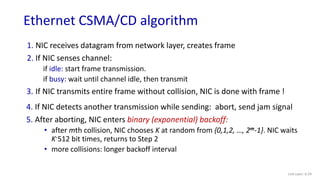
1. NIC receives datagram from network layer, creates frame
2. If NIC senses channel:
if idle: start frame transmission.
if busy: wait until channel idle, then transmit
3. If NIC transmits entire frame without collision, NIC is done with frame !
4. If NIC detects another transmission while sending: abort, send jam signal
5. After aborting, NIC enters binary (exponential) backoff:
• after mth collision, NIC chooses K at random from {0,1,2, …, 2m-1}. NIC waits
K·512 bit times, returns to Step 2
• more collisions: longer backoff interval
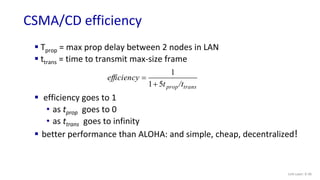
CSMA/CD efficiency
Link Layer: 6-30
 Tprop = max prop delay between 2 nodes in LAN
 ttrans = time to transmit max-size frame
 efficiency goes to 1
• as tprop goes to 0
• as ttrans goes to infinity
 better performance than ALOHA: and simple, cheap, decentralized!
trans
prop/t
t
efficiency
5
1
1


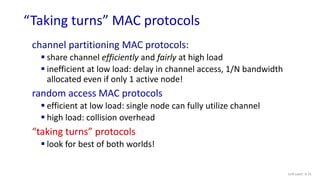
“Taking turns” MAC protocols
Link Layer: 6-31
channel partitioning MAC protocols:
 share channel efficiently and fairly at high load
 inefficient at low load: delay in channel access, 1/N bandwidth
allocated even if only 1 active node!
random access MAC protocols
 efficient at low load: single node can fully utilize channel
 high load: collision overhead
“taking turns” protocols
 look for best of both worlds!
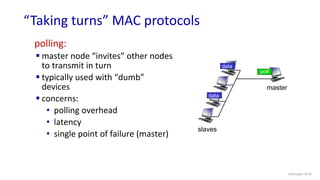
“Taking turns” MAC protocols
Link Layer: 6-32
polling:
 master node “invites” other nodes
to transmit in turn
 typically used with “dumb”
devices
 concerns:
• polling overhead
• latency
• single point of failure (master)
master
slaves
poll
data
data
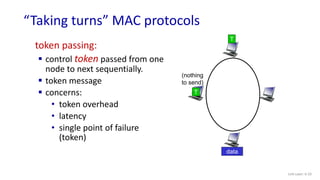
“Taking turns” MAC protocols
Link Layer: 6-33
token passing:
 control token passed from one
node to next sequentially.
 token message
 concerns:
• token overhead
• latency
• single point of failure
(token)
T
data
(nothing
to send)
T
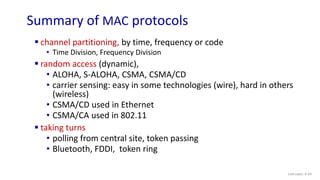
Summary of MAC protocols
Link Layer: 6-34
 channel partitioning, by time, frequency or code
• Time Division, Frequency Division
 random access (dynamic),
• ALOHA, S-ALOHA, CSMA, CSMA/CD
• carrier sensing: easy in some technologies (wire), hard in others
(wireless)
• CSMA/CD used in Ethernet
• CSMA/CA used in 802.11
 taking turns
• polling from central site, token passing
• Bluetooth, FDDI, token ring

Lecture 25 Link Layer - Error detection and Multiple Access.pptx

  • 1.
    Link layer andLANs: our goals understand principles behind link layer services: • error detection, correction • sharing a broadcast channel: multiple access • link layer addressing • local area networks: Ethernet, VLANs Link Layer: 6-1
  • 2.
    Link layer, LANs:roadmap introduction  error detection, correction  multiple access protocols  LANs • addressing, ARP • Ethernet • switches • VLANs Link Layer: 6-2
  • 3.
    Link layer: introduction terminology: hosts and routers: nodes  communication channels that connect adjacent nodes along communication path: links • wired • wireless • LANs  layer-2 packet: frame, encapsulates datagram mobile network enterprise network national or global ISP datacenter network link layer has responsibility of transferring datagram from one node to physically adjacent node over a link Link Layer: 6-3
  • 4.
    Link layer: context datagram transferred by different link protocols over different links:  each link protocol provides different services • e.g., may or may not provide reliable data transfer over link transportation analogy:  trip from Princeton to Lausanne • limo: Princeton to JFK • plane: JFK to Geneva • train: Geneva to Lausanne  tourist = datagram  transport segment = communication link  transportation mode = link-layer protocol  travel agent = routing algorithm Link Layer: 6-4
  • 5.
    Link layer: services framing, link access: • encapsulate datagram into frame, adding header, trailer • channel access if shared medium • “MAC” addresses in frame headers identify source, destination (different from IP address!)  reliable delivery between adjacent nodes • we already know how to do this! • seldom used on low bit-error links • wireless links: high error rates … … Link Layer: 6-5
  • 6.
    Link layer: services(more)  flow control: • pacing between adjacent sending and receiving nodes  error detection: • errors caused by signal attenuation, noise. • receiver detects errors, signals retransmission, or drops frame  error correction: • receiver identifies and corrects bit error(s) without retransmission  half-duplex and full-duplex: • with half duplex, nodes at both ends of link can transmit, but not at same time … … Link Layer: 6-6
  • 7.
    Where is thelink layer implemented?  in each-and-every host  link layer implemented in network interface card (NIC) or on a chip • Ethernet, WiFi card or chip • implements link, physical layer  attaches into host’s system buses  combination of hardware, software, firmware controller physical cpu memory host bus (e.g., PCI) network interface application transport network link link physical Link Layer: 6-7
  • 8.
    controller physical memory CPU Interfaces communicating controller physical cpumemory application transport network link link physical application transport network link link physical sending side:  encapsulates datagram in frame  adds error checking bits, reliable data transfer, flow control, etc. receiving side:  looks for errors, reliable data transfer, flow control, etc.  extracts datagram, passes to upper layer at receiving side linkh linkh datagram datagram datagram Link Layer: 6-8
  • 9.
    Link layer, LANs:roadmap  a day in the life of a web request  introduction error detection, correction  multiple access protocols  LANs • addressing, ARP • Ethernet • switches • VLANs  link virtualization: MPLS  data center networking Link Layer: 6-9
  • 10.
    Error detection Link Layer:6-10 EDC: error detection and correction bits (e.g., redundancy) D: data protected by error checking, may include header fields Error detection not 100% reliable!  protocol may miss some errors, but rarely  larger EDC field yields better detection and correction datagram D EDC d data bits bit-error prone link D’ EDC’ all bits in D’ OK ? N detected error otherwise datagram
  • 11.
    Parity checking Link Layer:6-11 single bit parity:  detect single bit errors 0111000110101011 1 parity bit d data bits two-dimensional bit parity:  detect and correct single bit errors d1,1 d2,1 di,1 . . . d1,j+1 d2,j+1 di,j+1 . . . . . . d1,j d2,j di,j . . . di+1,1 di+1,j+1 di+1,j . . . . . . . . . . . . row parity column parity 0 1 1 1 0 1 1 0 1 0 1 1 1 1 1 1 0 0 1 0 1 0 1 0 no errors: 0 1 1 1 0 1 1 0 1 0 1 1 1 0 1 1 0 0 1 0 1 0 1 0 parity error parity error detected and correctable single-bit error: Even parity: set parity bit so there is an even number of 1’s * Check out the online interactive exercises for more examples: http://gaia.cs.umass.edu/kurose_ross/interactive/
  • 12.
    Internet checksum (review) sender: treat contents of UDP segment (including UDP header fields and IP addresses) as sequence of 16-bit integers  checksum: addition (one’s complement sum) of segment content  checksum value put into UDP checksum field receiver:  compute checksum of received segment  check if computed checksum equals checksum field value: • not equal - error detected • equal - no error detected. But maybe errors nonetheless? More later …. Goal: detect errors (i.e., flipped bits) in transmitted segment Transport Layer: 3-12
  • 13.
    Cyclic Redundancy Check(CRC)  more powerful error-detection coding  D: data bits (given, think of these as a binary number)  G: bit pattern (generator), of r+1 bits (given) Link Layer: 6-13 goal: choose r CRC bits, R, such that <D,R> exactly divisible by G (mod 2) • receiver knows G, divides <D,R> by G. If non-zero remainder: error detected! • can detect all burst errors less than r+1 bits • widely used in practice (Ethernet, 802.11 WiFi) r CRC bits d data bits D R <D,R> = D 2r XOR R * bit pattern formula for bit pattern
  • 14.
    Link Layer: 6-14 CyclicRedundancy Check (CRC): example We want: D.2r XOR R = nG * Check out the online interactive exercises for more examples: http://gaia.cs.umass.edu/kurose_ross/interactive/ D.2r G R = remainder [ ] or equivalently: D.2r = nG XOR R or equivalently: if we divide D.2r by G, want remainder R to satisfy: 1 0 0 1 1 0 1 0 1 0 1 0 0 0 1 0 0 1 1 0 0 1 1 0 0 1 0 0 0 1 1 0 1 1 0 0 1 0 1 0 0 1 1 0 1 1 D R 1 0 0 1 G 0 0 0 1 0 1 1 1 0 2r * 1 0 1
  • 15.
    Link layer, LANs:roadmap  a day in the life of a web request  introduction  error detection, correction multiple access protocols  LANs • addressing, ARP • Ethernet • switches • VLANs  link virtualization: MPLS  data center networking Link Layer: 6-15
  • 16.
    Multiple access links,protocols Link Layer: 6-16 two types of “links”:  point-to-point • point-to-point link between Ethernet switch, host • PPP for dial-up access  broadcast (shared wire or medium) • 802.11 wireless LAN, 4G/4G. satellite shared wire (e.g., cabled Ethernet) shared radio: WiFi shared radio: satellite humans at a cocktail party (shared air, acoustical) shared radio: 4G/5G
  • 17.
    Multiple access protocols LinkLayer: 6-17  single shared broadcast channel  two or more simultaneous transmissions by nodes: interference • collision if node receives two or more signals at the same time  distributed algorithm that determines how nodes share channel, i.e., determine when node can transmit  communication about channel sharing must use channel itself! • no out-of-band channel for coordination multiple access protocol
  • 18.
    An ideal multipleaccess protocol Link Layer: 6-18 given: multiple access channel (MAC) of rate R bps Criteria: 1. when one node wants to transmit, it can send at rate R. 2. when M nodes want to transmit, each can send at average rate R/M 3. fully decentralized: • no special node to coordinate transmissions • no synchronization of clocks, slots 4. simple
  • 19.
    MAC protocols: taxonomy LinkLayer: 6-19 three broad classes:  channel partitioning • divide channel into smaller “pieces” (time slots, frequency, code) • allocate piece to node for exclusive use  random access • channel not divided, allow collisions • “recover” from collisions  “taking turns” • nodes take turns, but nodes with more to send can take longer turns
  • 20.
    Channel partitioning MACprotocols: TDMA Link Layer: 6-20 TDMA: time division multiple access  access to channel in “rounds”  each station gets fixed length slot (length = packet transmission time) in each round  unused slots go idle  example: 6-station LAN, 1,3,4 have packets to send, slots 2,5,6 idle 1 3 4 1 3 4 6-slot frame 6-slot frame
  • 21.
    Channel partitioning MACprotocols: FDMA Link Layer: 6-21 FDMA: frequency division multiple access  channel spectrum divided into frequency bands  each station assigned fixed frequency band  unused transmission time in frequency bands go idle  example: 6-station LAN, 1,3,4 have packet to send, frequency bands 2,5,6 idle frequency bands FDM cable
  • 22.
    Random access protocols LinkLayer: 6-22  when node has packet to send • transmit at full channel data rate R. • no a priori coordination among nodes  two or more transmitting nodes: “collision”  random access MAC protocol specifies: • how to detect collisions • how to recover from collisions (e.g., via delayed retransmissions)  examples of random access MAC protocols: • ALOHA, slotted ALOHA • CSMA, CSMA/CD, CSMA/CA
  • 23.
    Slotted ALOHA Link Layer:6-23 assumptions:  all frames same size  time divided into equal size slots (time to transmit 1 frame)  nodes start to transmit only slot beginning  nodes are synchronized  if 2 or more nodes transmit in slot, all nodes detect collision operation:  when node obtains fresh frame, transmits in next slot • if no collision: node can send new frame in next slot • if collision: node retransmits frame in each subsequent slot with probability p until success randomization – why?
  • 24.
    Slotted ALOHA Link Layer:6-24 Pros:  single active node can continuously transmit at full rate of channel  highly decentralized: only slots in nodes need to be in sync  simple Cons:  collisions, wasting slots  idle slots  nodes may be able to detect collision in less than time to transmit packet  clock synchronization 1 1 1 1 2 3 2 2 3 3 node 1 node 2 node 3 C C C S S S E E E C: collision S: success E: empty
  • 25.
    Pure ALOHA Link Layer:6-25  unslotted Aloha: simpler, no synchronization • when frame first arrives: transmit immediately  collision probability increases with no synchronization: • frame sent at t0 collides with other frames sent in [t0-1,t0+1] t0 + 1 t0 - 1 t0 will overlap with end of i’s frame will overlap with start of i’s frame  pure Aloha efficiency: 18% !
  • 26.
    CSMA (carrier sensemultiple access) Link Layer: 6-26 simple CSMA: listen before transmit: • if channel sensed idle: transmit entire frame • if channel sensed busy: defer transmission  human analogy: don’t interrupt others! CSMA/CD: CSMA with collision detection • collisions detected within short time • colliding transmissions aborted, reducing channel wastage • collision detection easy in wired, difficult with wireless  human analogy: the polite conversationalist
  • 27.
    CSMA: collisions Link Layer:6-27  collisions can still occur with carrier sensing: • propagation delay means two nodes may not hear each other’s just- started transmission  collision: entire packet transmission time wasted • distance & propagation delay play role in in determining collision probability spatial layout of nodes
  • 28.
    CSMA/CD: Link Layer: 6-28 CSMA/CD reduces the amount of time wasted in collisions • transmission aborted on collision detection spatial layout of nodes
  • 29.
    Ethernet CSMA/CD algorithm LinkLayer: 6-29 1. NIC receives datagram from network layer, creates frame 2. If NIC senses channel: if idle: start frame transmission. if busy: wait until channel idle, then transmit 3. If NIC transmits entire frame without collision, NIC is done with frame ! 4. If NIC detects another transmission while sending: abort, send jam signal 5. After aborting, NIC enters binary (exponential) backoff: • after mth collision, NIC chooses K at random from {0,1,2, …, 2m-1}. NIC waits K·512 bit times, returns to Step 2 • more collisions: longer backoff interval
  • 30.
    CSMA/CD efficiency Link Layer:6-30  Tprop = max prop delay between 2 nodes in LAN  ttrans = time to transmit max-size frame  efficiency goes to 1 • as tprop goes to 0 • as ttrans goes to infinity  better performance than ALOHA: and simple, cheap, decentralized! trans prop/t t efficiency 5 1 1  
  • 31.
    “Taking turns” MACprotocols Link Layer: 6-31 channel partitioning MAC protocols:  share channel efficiently and fairly at high load  inefficient at low load: delay in channel access, 1/N bandwidth allocated even if only 1 active node! random access MAC protocols  efficient at low load: single node can fully utilize channel  high load: collision overhead “taking turns” protocols  look for best of both worlds!
  • 32.
    “Taking turns” MACprotocols Link Layer: 6-32 polling:  master node “invites” other nodes to transmit in turn  typically used with “dumb” devices  concerns: • polling overhead • latency • single point of failure (master) master slaves poll data data
  • 33.
    “Taking turns” MACprotocols Link Layer: 6-33 token passing:  control token passed from one node to next sequentially.  token message  concerns: • token overhead • latency • single point of failure (token) T data (nothing to send) T
  • 34.
    Summary of MACprotocols Link Layer: 6-34  channel partitioning, by time, frequency or code • Time Division, Frequency Division  random access (dynamic), • ALOHA, S-ALOHA, CSMA, CSMA/CD • carrier sensing: easy in some technologies (wire), hard in others (wireless) • CSMA/CD used in Ethernet • CSMA/CA used in 802.11  taking turns • polling from central site, token passing • Bluetooth, FDDI, token ring

Editor's Notes

  • #6 Q: why both link-level and end-end reliability?