Albugo candida
White Blisters of Amaranthus
Taxonomic characters
Asexual reproduction
Sexual reproduction
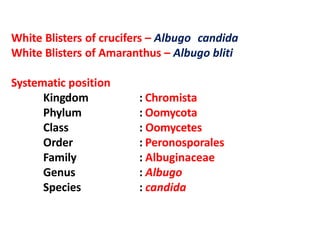
White Blisters of crucifers – Albugo candida
White Blisters of Amaranthus – Albugo bliti
Systematic position
Kingdom
Phylum
Class
Order
Family
Genus
Species
: Chromista
: Oomycota
: Oomycetes
: Peronosporales
: Albuginaceae
: Albugo
: candida
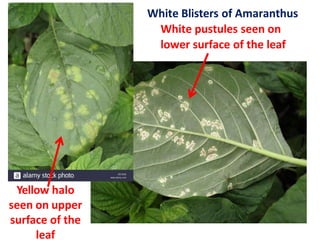
Yellow halo
seen on upper
surface of the
leaf
White Blisters of Amaranthus
White pustules seen on
lower surface of the leaf
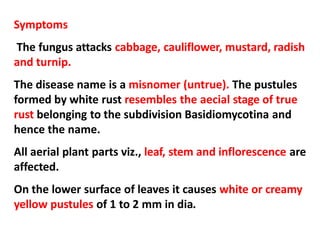
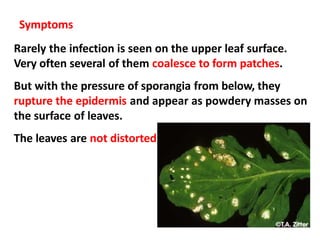
Symptoms
The fungus attacks cabbage, cauliflower, mustard, radish
and turnip.
The disease name is a misnomer (untrue). The pustules
formed by white rust resembles the aecial stage of true
rust belonging to the subdivision Basidiomycotina and
hence the name.
All aerial plant parts viz., leaf, stem and inflorescence are
affected.
On the lower surface of leaves it causes white or creamy
yellow pustules of 1 to 2 mm in dia.
Symptoms
Rarely the infection is seen on the upper leaf surface.
Very often several of them coalesce to form patches.
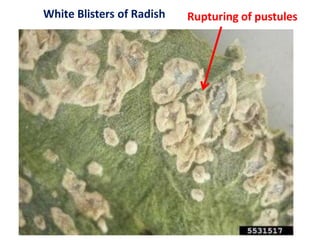
But with the pressure of sporangia from below, they
rupture the epidermis and appear as powdery masses on
the surface of leaves.
The leaves are not distorted.
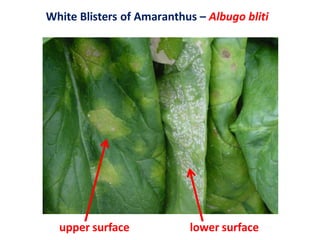
White Blisters of Amaranthus – Albugo bliti
upper surface lower surface
White Blisters of Radish Rupturing of pustules
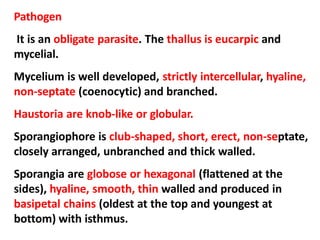
Pathogen
It is an obligate parasite. The thallus is eucarpic and
mycelial.
Mycelium is well developed, strictly intercellular, hyaline,
non-septate (coenocytic) and branched.
Haustoria are knob-like or globular.
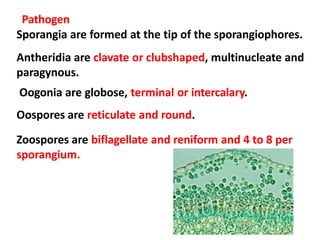
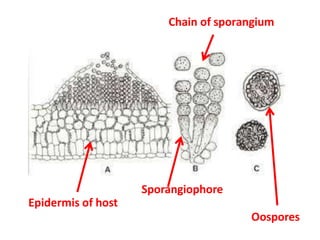
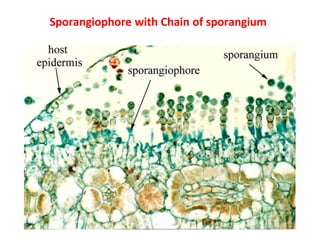
Sporangiophore is club-shaped, short, erect, non-septate,
closely arranged, unbranched and thick walled.
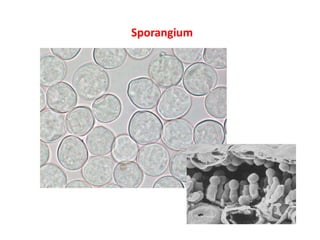
Sporangia are globose or hexagonal (flattened at the
sides), hyaline, smooth, thin walled and produced in
basipetal chains (oldest at the top and youngest at
bottom) with isthmus.
Pathogen
Sporangia are formed at the tip of the sporangiophores.
Antheridia are clavate or clubshaped, multinucleate and
paragynous.
Oogonia are globose, terminal or intercalary.
Oospores are reticulate and round.
Zoospores are biflagellate and reniform and 4 to 8 per
sporangium.
Sporangiophore
Epidermis of host
Oospores
Chain of sporangium
Sporangiophore with Chain of sporangium
Sporangium
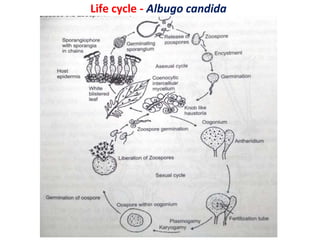
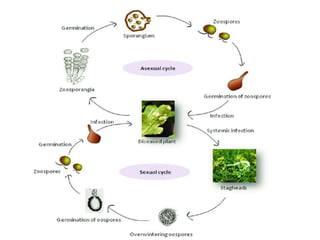
Life cycle - Albugo candida
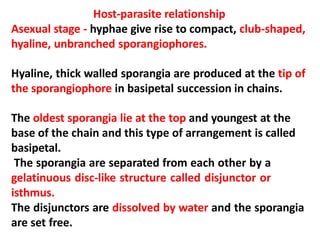
Host-parasite relationship
Asexual stage - hyphae give rise to compact, club-shaped,
hyaline, unbranched sporangiophores.
Hyaline, thick walled sporangia are produced at the tip of
the sporangiophore in basipetal succession in chains.
The oldest sporangia lie at the top and youngest at the
base of the chain and this type of arrangement is called
basipetal.
The sporangia are separated from each other by a
gelatinuous disc-like structure called disjunctor or
isthmus.
The disjunctors are dissolved by water and the sporangia
are set free.
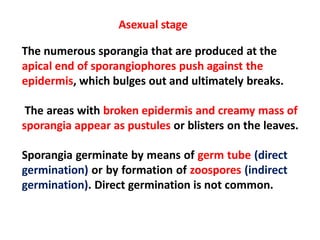
Asexual stage
The numerous sporangia that are produced at the
apical end of sporangiophores push against the
epidermis, which bulges out and ultimately breaks.
The areas with broken epidermis and creamy mass of
sporangia appear as pustules or blisters on the leaves.
Sporangia germinate by means of germ tube (direct
germination) or by formation of zoospores (indirect
germination). Direct germination is not common.
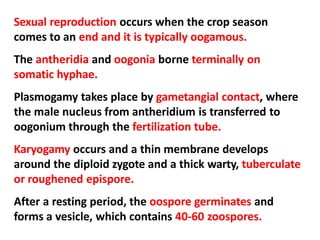
Sexual reproduction occurs when the crop season
comes to an end and it is typically oogamous.
The antheridia and oogonia borne terminally on
somatic hyphae.
Plasmogamy takes place by gametangial contact, where
the male nucleus from antheridium is transferred to
oogonium through the fertilization tube.
Karyogamy occurs and a thin membrane develops
around the diploid zygote and a thick warty, tuberculate
or roughened epispore.
After a resting period, the oospore germinates and
forms a vesicle, which contains 40-60 zoospores.
Sexual reproduction
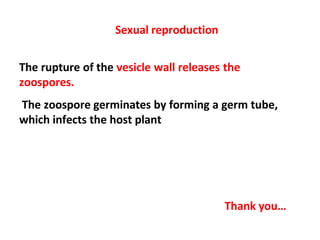
The rupture of the vesicle wall releases the
zoospores.
The zoospore germinates by forming a germ tube,
which infects the host plant
Thank you…
Fill in the blanks:
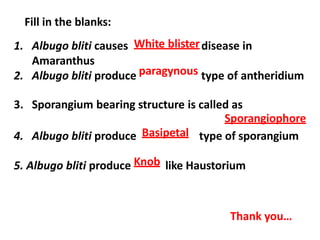
1. Albugo bliti causes White blisterdisease in
Amaranthus
2. Albugo bliti produce paragynous type of antheridium
3. Sporangium bearing structure is called as
Sporangiophore
4. Albugo bliti produce Basipetal type of sporangium
5. Albugo bliti produce Knob like Haustorium
Thank you…

Lecture 16 Albugo candida.pptx

  • 2.
    Albugo candida White Blistersof Amaranthus Taxonomic characters Asexual reproduction Sexual reproduction
  • 3.
    White Blisters ofcrucifers – Albugo candida White Blisters of Amaranthus – Albugo bliti Systematic position Kingdom Phylum Class Order Family Genus Species : Chromista : Oomycota : Oomycetes : Peronosporales : Albuginaceae : Albugo : candida
  • 4.
    Yellow halo seen onupper surface of the leaf White Blisters of Amaranthus White pustules seen on lower surface of the leaf
  • 5.
    Symptoms The fungus attackscabbage, cauliflower, mustard, radish and turnip. The disease name is a misnomer (untrue). The pustules formed by white rust resembles the aecial stage of true rust belonging to the subdivision Basidiomycotina and hence the name. All aerial plant parts viz., leaf, stem and inflorescence are affected. On the lower surface of leaves it causes white or creamy yellow pustules of 1 to 2 mm in dia.
  • 6.
    Symptoms Rarely the infectionis seen on the upper leaf surface. Very often several of them coalesce to form patches. But with the pressure of sporangia from below, they rupture the epidermis and appear as powdery masses on the surface of leaves. The leaves are not distorted.
  • 7.
    White Blisters ofAmaranthus – Albugo bliti upper surface lower surface
  • 8.
    White Blisters ofRadish Rupturing of pustules
  • 9.
    Pathogen It is anobligate parasite. The thallus is eucarpic and mycelial. Mycelium is well developed, strictly intercellular, hyaline, non-septate (coenocytic) and branched. Haustoria are knob-like or globular. Sporangiophore is club-shaped, short, erect, non-septate, closely arranged, unbranched and thick walled. Sporangia are globose or hexagonal (flattened at the sides), hyaline, smooth, thin walled and produced in basipetal chains (oldest at the top and youngest at bottom) with isthmus.
  • 10.
    Pathogen Sporangia are formedat the tip of the sporangiophores. Antheridia are clavate or clubshaped, multinucleate and paragynous. Oogonia are globose, terminal or intercalary. Oospores are reticulate and round. Zoospores are biflagellate and reniform and 4 to 8 per sporangium.
  • 11.
  • 12.
  • 13.
  • 14.
    Life cycle -Albugo candida
  • 16.
    Host-parasite relationship Asexual stage- hyphae give rise to compact, club-shaped, hyaline, unbranched sporangiophores. Hyaline, thick walled sporangia are produced at the tip of the sporangiophore in basipetal succession in chains. The oldest sporangia lie at the top and youngest at the base of the chain and this type of arrangement is called basipetal. The sporangia are separated from each other by a gelatinuous disc-like structure called disjunctor or isthmus. The disjunctors are dissolved by water and the sporangia are set free.
  • 17.
    Asexual stage The numeroussporangia that are produced at the apical end of sporangiophores push against the epidermis, which bulges out and ultimately breaks. The areas with broken epidermis and creamy mass of sporangia appear as pustules or blisters on the leaves. Sporangia germinate by means of germ tube (direct germination) or by formation of zoospores (indirect germination). Direct germination is not common.
  • 18.
    Sexual reproduction occurswhen the crop season comes to an end and it is typically oogamous. The antheridia and oogonia borne terminally on somatic hyphae. Plasmogamy takes place by gametangial contact, where the male nucleus from antheridium is transferred to oogonium through the fertilization tube. Karyogamy occurs and a thin membrane develops around the diploid zygote and a thick warty, tuberculate or roughened epispore. After a resting period, the oospore germinates and forms a vesicle, which contains 40-60 zoospores.
  • 19.
    Sexual reproduction The ruptureof the vesicle wall releases the zoospores. The zoospore germinates by forming a germ tube, which infects the host plant Thank you…
  • 20.
    Fill in theblanks: 1. Albugo bliti causes White blisterdisease in Amaranthus 2. Albugo bliti produce paragynous type of antheridium 3. Sporangium bearing structure is called as Sporangiophore 4. Albugo bliti produce Basipetal type of sporangium 5. Albugo bliti produce Knob like Haustorium Thank you…