Lecture #14: Buffer Overflow Attack
Program and OS Security -Part III
Dr.Ramchandra Mangrulkar
September 3, 2020
Dr.Ramchandra Mangrulkar Lecture #14: Buffer Overflow Attack September 3, 2020 1 / 12
Contents
Non-Malicious programming errors:
Buffer overflow
Incomplete Mediation
Race Condition
Covert Channel
Dr.Ramchandra Mangrulkar Lecture #14: Buffer Overflow Attack September 3, 2020 2 / 12
Buffer
A buffer contains data that is stored for a short amount of time,
typically in the computer’s memory (RAM)
Hold data right before it is used
Download an audio or video file from the Internet, it may load
the first 20% of it into a buffer and then begin to play.
clip plays back, the computer continually downloads the rest of
the clip and stores it in the buffer
Whats Advantage?
Audio or Video will stall or skip when there is network
congestion.
Dr.Ramchandra Mangrulkar Lecture #14: Buffer Overflow Attack September 3, 2020 3 / 12
Buffer Overflow
Buffer overflow errors are characterized by the overwriting of
memory fragments of the process, which should have never been
modified intentionally or unintentionally.
Overwriting values of the IP (Instruction Pointer), BP (Base
Pointer) and other registers causes exceptions, segmentation
faults, and other errors to occur.
These errors end execution of the application in an unexpected
way
Buffer overflow errors occur when we operate on buffers of char
type.
Dr.Ramchandra Mangrulkar Lecture #14: Buffer Overflow Attack September 3, 2020 4 / 12
Types of Buffer Overflow Attacks
Stack-based buffer overflows are more common, and leverage
stack memory that only exists during the execution time of a
function.
Heap-based attacks are harder to carry out and involve flooding
the memory space allocated for a program beyond memory used
for current runtime operations.
Dr.Ramchandra Mangrulkar Lecture #14: Buffer Overflow Attack September 3, 2020 5 / 12
Example of Buffer Overflow
Source1
Dr.Ramchandra Mangrulkar Lecture #14: Buffer Overflow Attack September 3, 2020 6 / 12
Example of Buffer Overflow
Dr.Ramchandra Mangrulkar Lecture #14: Buffer Overflow Attack September 3, 2020 7 / 12
Buffer Overflow Analysis
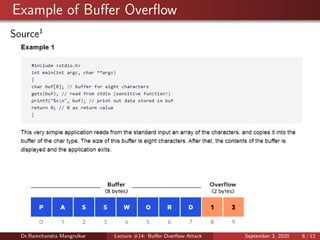
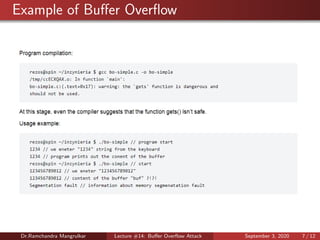
The program calls a function, which operates on the char type
buffer and does no checks against overflowing the size assigned
to this buffer. As a result, it is possible to intentionally or
unintentionally store more data in the buffer, which will cause an
error. The following question arises: The buffer stores only eight
characters, so why did function printf() display twelve?.
The answer comes from the process memory organisation. Four
characters which overflowed the buffer also overwrite the value
stored in one of the registers, which was necessary for the
correct function return. Memory continuity resulted in printing
out the data stored in this memory area.
Dr.Ramchandra Mangrulkar Lecture #14: Buffer Overflow Attack September 3, 2020 8 / 12
How are buffer overflow errors are made?
gets()   > fgets() - read characters
strcpy()   > strncpy() - copy content of the buffer
strcat()   > strncat() - buffer concatenation
sprintf()   > snprintf() - fill buffer with data of different types
(f)scanf() - read from STDIN
getwd() - return working directory
realpath() - return absolute (full) path
Dr.Ramchandra Mangrulkar Lecture #14: Buffer Overflow Attack September 3, 2020 9 / 12
What Programming Languages are More
Vulnerable
C and C++ are two languages that are highly susceptible to
buffer overflow attacks, as they don’t have built-in safeguards
against overwriting or accessing data in their memory.
Mac OSX, Windows, and Linux all use code written in C and
C++.
Languages such as PERL, Java, JavaScript, and C use built-in
safety mechanisms that minimize the likelihood of buffer
overflow.
Dr.Ramchandra Mangrulkar Lecture #14: Buffer Overflow Attack September 3, 2020 10 / 12
How to Prevent Buffer Overflows
Address space randomization (ASLR)—randomly moves around
the address space locations of data regions. Typically, buffer
overflow attacks need to know the locality of executable code,
and randomizing address spaces makes this virtually impossible.
Data execution prevention—flags certain areas of memory as
non-executable or executable, which stops an attack from
running code in a non-executable region.
Structured exception handler overwrite protection
(SEHOP)—helps stop malicious code from attacking Structured
Exception Handling (SEH), a built-in system for managing
hardware and software exceptions. It thus prevents an attacker
from being able to make use of the SEH overwrite exploitation
technique.
Dr.Ramchandra Mangrulkar Lecture #14: Buffer Overflow Attack September 3, 2020 11 / 12
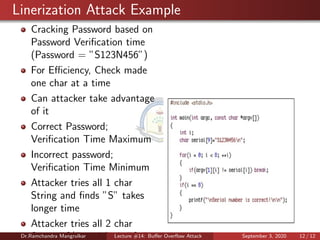
Linerization Attack Example
Cracking Password based on
Password Verification time
(Password = ”S123N456”)
For Efficiency, Check made
one char at a time
Can attacker take advantage
of it
Correct Password;
Verification Time Maximum
Incorrect password;
Verification Time Minimum
Attacker tries all 1 char
String and finds ”S” takes
longer time
Attacker tries all 2 char
String ”S*” and finds ”S1”Dr.Ramchandra Mangrulkar Lecture #14: Buffer Overflow Attack September 3, 2020 12 / 12

Lecture #15: Buffer Overflow Attack (Non Malicious Attack)

  • 1.
    Lecture #14: BufferOverflow Attack Program and OS Security -Part III Dr.Ramchandra Mangrulkar September 3, 2020 Dr.Ramchandra Mangrulkar Lecture #14: Buffer Overflow Attack September 3, 2020 1 / 12
  • 2.
    Contents Non-Malicious programming errors: Bufferoverflow Incomplete Mediation Race Condition Covert Channel Dr.Ramchandra Mangrulkar Lecture #14: Buffer Overflow Attack September 3, 2020 2 / 12
  • 3.
    Buffer A buffer containsdata that is stored for a short amount of time, typically in the computer’s memory (RAM) Hold data right before it is used Download an audio or video file from the Internet, it may load the first 20% of it into a buffer and then begin to play. clip plays back, the computer continually downloads the rest of the clip and stores it in the buffer Whats Advantage? Audio or Video will stall or skip when there is network congestion. Dr.Ramchandra Mangrulkar Lecture #14: Buffer Overflow Attack September 3, 2020 3 / 12
  • 4.
    Buffer Overflow Buffer overflowerrors are characterized by the overwriting of memory fragments of the process, which should have never been modified intentionally or unintentionally. Overwriting values of the IP (Instruction Pointer), BP (Base Pointer) and other registers causes exceptions, segmentation faults, and other errors to occur. These errors end execution of the application in an unexpected way Buffer overflow errors occur when we operate on buffers of char type. Dr.Ramchandra Mangrulkar Lecture #14: Buffer Overflow Attack September 3, 2020 4 / 12
  • 5.
    Types of BufferOverflow Attacks Stack-based buffer overflows are more common, and leverage stack memory that only exists during the execution time of a function. Heap-based attacks are harder to carry out and involve flooding the memory space allocated for a program beyond memory used for current runtime operations. Dr.Ramchandra Mangrulkar Lecture #14: Buffer Overflow Attack September 3, 2020 5 / 12
  • 6.
    Example of BufferOverflow Source1 Dr.Ramchandra Mangrulkar Lecture #14: Buffer Overflow Attack September 3, 2020 6 / 12
  • 7.
    Example of BufferOverflow Dr.Ramchandra Mangrulkar Lecture #14: Buffer Overflow Attack September 3, 2020 7 / 12
  • 8.
    Buffer Overflow Analysis Theprogram calls a function, which operates on the char type buffer and does no checks against overflowing the size assigned to this buffer. As a result, it is possible to intentionally or unintentionally store more data in the buffer, which will cause an error. The following question arises: The buffer stores only eight characters, so why did function printf() display twelve?. The answer comes from the process memory organisation. Four characters which overflowed the buffer also overwrite the value stored in one of the registers, which was necessary for the correct function return. Memory continuity resulted in printing out the data stored in this memory area. Dr.Ramchandra Mangrulkar Lecture #14: Buffer Overflow Attack September 3, 2020 8 / 12
  • 9.
    How are bufferoverflow errors are made? gets()   > fgets() - read characters strcpy()   > strncpy() - copy content of the buffer strcat()   > strncat() - buffer concatenation sprintf()   > snprintf() - fill buffer with data of different types (f)scanf() - read from STDIN getwd() - return working directory realpath() - return absolute (full) path Dr.Ramchandra Mangrulkar Lecture #14: Buffer Overflow Attack September 3, 2020 9 / 12
  • 10.
    What Programming Languagesare More Vulnerable C and C++ are two languages that are highly susceptible to buffer overflow attacks, as they don’t have built-in safeguards against overwriting or accessing data in their memory. Mac OSX, Windows, and Linux all use code written in C and C++. Languages such as PERL, Java, JavaScript, and C use built-in safety mechanisms that minimize the likelihood of buffer overflow. Dr.Ramchandra Mangrulkar Lecture #14: Buffer Overflow Attack September 3, 2020 10 / 12
  • 11.
    How to PreventBuffer Overflows Address space randomization (ASLR)—randomly moves around the address space locations of data regions. Typically, buffer overflow attacks need to know the locality of executable code, and randomizing address spaces makes this virtually impossible. Data execution prevention—flags certain areas of memory as non-executable or executable, which stops an attack from running code in a non-executable region. Structured exception handler overwrite protection (SEHOP)—helps stop malicious code from attacking Structured Exception Handling (SEH), a built-in system for managing hardware and software exceptions. It thus prevents an attacker from being able to make use of the SEH overwrite exploitation technique. Dr.Ramchandra Mangrulkar Lecture #14: Buffer Overflow Attack September 3, 2020 11 / 12
  • 12.
    Linerization Attack Example CrackingPassword based on Password Verification time (Password = ”S123N456”) For Efficiency, Check made one char at a time Can attacker take advantage of it Correct Password; Verification Time Maximum Incorrect password; Verification Time Minimum Attacker tries all 1 char String and finds ”S” takes longer time Attacker tries all 2 char String ”S*” and finds ”S1”Dr.Ramchandra Mangrulkar Lecture #14: Buffer Overflow Attack September 3, 2020 12 / 12