DISCOVER . LEARN . EMPOWER
INSTITUTE ENGINEERING
DEPARTMENT ACADEMIC UNIT-1
Bachelor of Engineering (Computer Science & Engineering)
Subject Name Basics Electrical & Electronics Engineering
Subject Code 22ELH-101
By
Navjeet kaur
Lecture No. 6
Introduction to Magnetic Circuit
2
Lecture
Objectives
S. No. Objectives
1 To make student aware about the basic concept of magnetic circuit
2 To aware about importance of magnetic circuit
3 To provide knowledge about different terminologies of magnetic circuit
4 To make familiar with types of magnetic circuit.
5 To give brief knowledge about applications of magnetic circuit.
https://library.automationdirect.com/basic-
electrical-theory/
3
Course
Objectives
S. No. Objectives
1 To meet students with basic knowledge of dc circuits, electromagnetism and ac fundamentals.
2
To aware about introduction to single and three phase ac circuit with their construction and
working principles.
3 To provide knowledge about electrical and electronics engineering fundamentals.
4
To acquire specific knowledge skills so as to comprehend how electric, magnetic and electronic
circuits are applied in practice.
https://library.automationdirect.com/basic-
electrical-theory/
4
Course
Outcomes
CO
Numbe
r
Title Level
CO1
Identify the different types of electrical elements and the basic op-amp
circuit elements and to illustrate the various types of motors, transducers
and batteries.
Remember
CO2
Understand basic principles of transformers, transducers, op-amps, DC
and AC motors and to compare the different methods for analyzing
electrical and magnetic circuits.
Understand
CO3
Derive the relationships between parameters in electric and magnetic
circuits and motors and to determine specifications of op-amps.
Analyze
CO4
Solve the basic problems related to electric circuits, magnetic circuits and
motors and to assess the characteristics of different configurations of op-
amps.
Evaluate
CO5
Design the different applications of transducers, motors as well as the op-
amps like adders, subtractor and comparators. Create
https://library.automationdirect.com/basic-
electrical-theory/
Content
 Introduction to magnetic circuit
 Terms used in magnetic circuit
 Magnetic field and magnetic field lines
 Concept of Magnetomotive force and magnetic flux
 Concept of Magnetic field intensity and magnetic reluctance
 Concept of Magnetic permeance and magnetic permeability
 Faraday’s Laws
5
What is Magnetic Circuit?
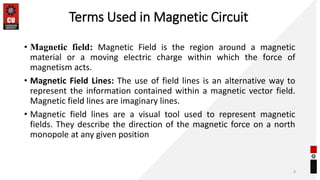
• The closed path followed by magnetic lines of forces is called
the magnetic circuit.
• In the magnetic circuit, magnetic flux or magnetic lines of force
starts from a point and ends at the same point after completing its
path.
• Flux is generated by magnets, it can be a permanent magnet or
electromagnets.
• A magnetic circuit is made up of magnetic materials having high
permeability such as iron, soft steel, etc.
• Magnetic circuits are used in various devices like electric motor,
transformers, relays, generators galvanometer, etc.
6
Magnetic Circuit
7
https://www.slideshare.net/MohammedWarisSenan1/magnetic-circuit-70563432
Fig.1 Magnetic Circuit
Terms Used in Magnetic Circuit
• Magnetic field: Magnetic Field is the region around a magnetic
material or a moving electric charge within which the force of
magnetism acts.
• Magnetic Field Lines: The use of field lines is an alternative way to
represent the information contained within a magnetic vector field.
Magnetic field lines are imaginary lines.
• Magnetic field lines are a visual tool used to represent magnetic
fields. They describe the direction of the magnetic force on a north
monopole at any given position
8
Terms Used in Magnetic Circuit
• Magnetomotive Force (MMF): The current flowing in an electric
circuit is due to the existence of electoromotive
force similarly magnetomotive force (MMF) is required to drive
the magnetic flux in the magnetic circuit.
• The magnetic pressure, which sets up the magnetic flux in a magnetic
circuit is called Magnetomotive Force.
• The SI unit of MMF is Ampere-turn (AT), and their CGS unit is G (gilbert).
9
Terms Used in Magnetic Circuit
10
https://circuitglobe.com/what-is-magnetomotive-force.html
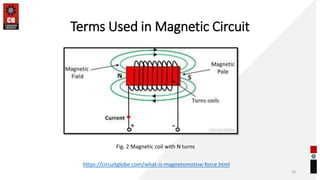
Fig. 2 Magnetic coil with N turns
Terms Used in Magnetic Circuit
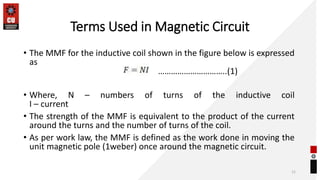
• The MMF for the inductive coil shown in the figure below is expressed
as
• Where, N – numbers of turns of the inductive coil
I – current
• The strength of the MMF is equivalent to the product of the current
around the turns and the number of turns of the coil.
• As per work law, the MMF is defined as the work done in moving the
unit magnetic pole (1weber) once around the magnetic circuit.
11
…………………………..(1)
Terms Used in Magnetic Circuit
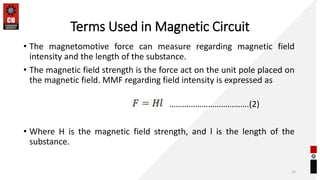
• The magnetomotive force can measure regarding magnetic field
intensity and the length of the substance.
• The magnetic field strength is the force act on the unit pole placed on
the magnetic field. MMF regarding field intensity is expressed as
• Where H is the magnetic field strength, and l is the length of the
substance.
12
……………………………….(2)
Terms Used in Magnetic Circuit
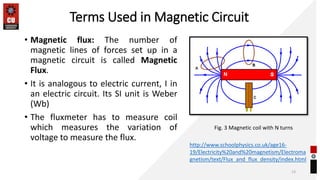
• Magnetic flux: The number of
magnetic lines of forces set up in a
magnetic circuit is called Magnetic
Flux.
• It is analogous to electric current, I in
an electric circuit. Its SI unit is Weber
(Wb)
• The fluxmeter has to measure coil
which measures the variation of
voltage to measure the flux.
13
http://www.schoolphysics.co.uk/age16-
19/Electricity%20and%20magnetism/Electroma
gnetism/text/Flux_and_flux_density/index.html
Fig. 3 Magnetic coil with N turns
Terms Used in Magnetic Circuit
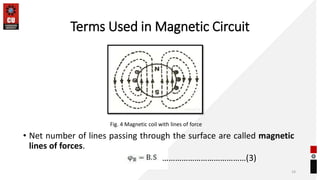
• Net number of lines passing through the surface are called magnetic
lines of forces.
14
Fig. 4 Magnetic coil with lines of force
…………………………………(3)
Terms Used in Magnetic Circuit
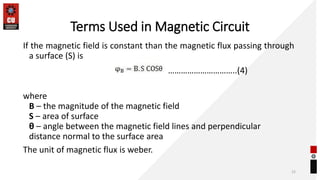
If the magnetic field is constant than the magnetic flux passing through
a surface (S) is
where
B – the magnitude of the magnetic field
S – area of surface
θ – angle between the magnetic field lines and perpendicular
distance normal to the surface area
The unit of magnetic flux is weber.
15
…………………………..(4)
Terms Used in Magnetic Circuit
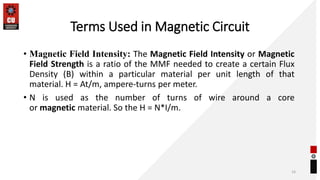
• Magnetic Field Intensity: The Magnetic Field Intensity or Magnetic
Field Strength is a ratio of the MMF needed to create a certain Flux
Density (B) within a particular material per unit length of that
material. H = At/m, ampere-turns per meter.
• N is used as the number of turns of wire around a core
or magnetic material. So the H = N*I/m.
16
Terms Used in Magnetic Circuit
17
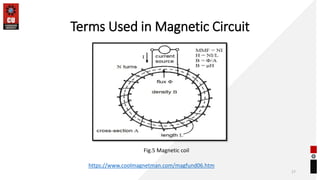
https://www.coolmagnetman.com/magfund06.htm
Fig.5 Magnetic coil
Terms Used in Magnetic Circuit
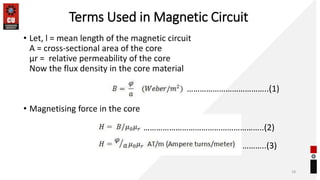
• Let, l = mean length of the magnetic circuit
A = cross-sectional area of the core
µr = relative permeability of the core
Now the flux density in the core material
• Magnetising force in the core
18
………………………………..(1)
………………………………………………..(2)
………..(3)
Terms Used in Magnetic Circuit
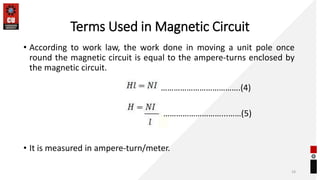
• According to work law, the work done in moving a unit pole once
round the magnetic circuit is equal to the ampere-turns enclosed by
the magnetic circuit.
• It is measured in ampere-turn/meter.
19
……………………………….(4)
………………………...……(5)
Terms Used in Magnetic Circuit
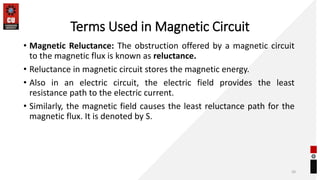
• Magnetic Reluctance: The obstruction offered by a magnetic circuit
to the magnetic flux is known as reluctance.
• Reluctance in magnetic circuit stores the magnetic energy.
• Also in an electric circuit, the electric field provides the least
resistance path to the electric current.
• Similarly, the magnetic field causes the least reluctance path for the
magnetic flux. It is denoted by S.
20
Terms Used in Magnetic Circuit
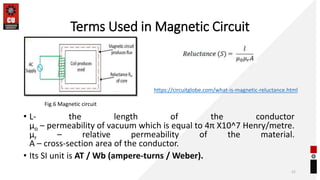
• L- the length of the conductor
μo – permeability of vacuum which is equal to 4π Χ10^7 Henry/metre.
μr – relative permeability of the material.
A – cross-section area of the conductor.
• Its SI unit is AT / Wb (ampere-turns / Weber).
21
https://circuitglobe.com/what-is-magnetic-reluctance.html
Fig.6 Magnetic circuit
Terms Used in Magnetic Circuit
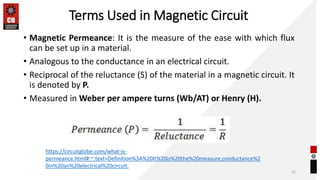
• Magnetic Permeance: It is the measure of the ease with which flux
can be set up in a material.
• Analogous to the conductance in an electrical circuit.
• Reciprocal of the reluctance (S) of the material in a magnetic circuit. It
is denoted by P.
• Measured in Weber per ampere turns (Wb/AT) or Henry (H).
22
https://circuitglobe.com/what-is-
permeance.html#:~:text=Definition%3A%20It%20is%20the%20measure,conductance%2
0in%20an%20electrical%20circuit.
Terms Used in Magnetic Circuit
• Magnetic Permeability: The magnetic permeability is defined as the
property of the material to allow the magnetic line of force to pass
through it.
• It supports the development of the magnetic field.
• SI unit is Henry per meter (H/M or Hm2) or newton per ampere
square (N-A2).
• It is directly proportional to the number of lines passing through it.
• The permeability of the air or vacuum is represented by μ0 which is
equal to 4π×10-7 H/m.
23
Terms Used in Magnetic Circuit
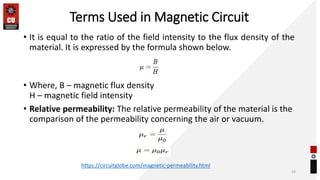
• It is equal to the ratio of the field intensity to the flux density of the
material. It is expressed by the formula shown below.
• Where, B – magnetic flux density
H – magnetic field intensity
• Relative permeability: The relative permeability of the material is the
comparison of the permeability concerning the air or vacuum.
24
https://circuitglobe.com/magnetic-permeability.html
Applications of Magnetic Circuit
 These are used in motors and generators.
 These are used in speakers.
 These are used in transformers.
 Magnetic strip are used in bank ATM cards, library cards etc.
 These are preferred for tape recorders.
 These are used in magnetic resonance imaging (MRI)
machines.
25
Faraday’s Laws of Electromagnetic Induction
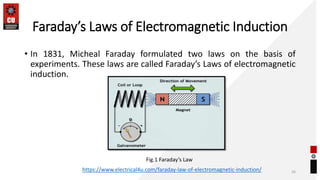
• In 1831, Micheal Faraday formulated two laws on the basis of
experiments. These laws are called Faraday’s Laws of electromagnetic
induction.
26
https://www.electrical4u.com/faraday-law-of-electromagnetic-induction/
Fig.1 Faraday’s Law
Laws of Electromagnetic Induction
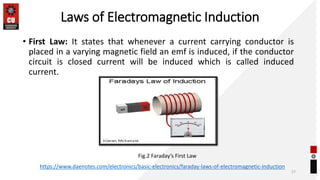
• First Law: It states that whenever a current carrying conductor is
placed in a varying magnetic field an emf is induced, if the conductor
circuit is closed current will be induced which is called induced
current.
27
https://www.daenotes.com/electronics/basic-electronics/faraday-laws-of-electromagnetic-induction
Fig.2 Faraday’s First Law
Laws of Electromagnetic Induction
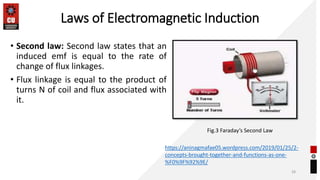
• Second law: Second law states that an
induced emf is equal to the rate of
change of flux linkages.
• Flux linkage is equal to the product of
turns N of coil and flux associated with
it.
28
https://aninagmafae05.wordpress.com/2019/01/25/2-
concepts-brought-together-and-functions-as-one-
%F0%9F%92%9E/
Fig.3 Faraday’s Second Law
Derivation of Electromagnetic Induction
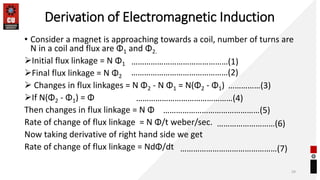
• Consider a magnet is approaching towards a coil, number of turns are
N in a coil and flux are Φ1 and Φ2.
Initial flux linkage = N Φ1
Final flux linkage = N Φ2
 Changes in flux linkages = N Φ2 - N Φ1 = N(Φ2 - Φ1)
If N(Φ2 - Φ1) = Φ
Then changes in flux linkage = N Φ
Rate of change of flux linkage = N Φ/t weber/sec.
Now taking derivative of right hand side we get
Rate of change of flux linkage = NdΦ/dt
29
………………………………………(1)
………………………………………(2)
……………(3)
………………………………………(4)
………………………………………(5)
………………………(6)
………………………………………(7)
Derivation of Electromagnetic Induction
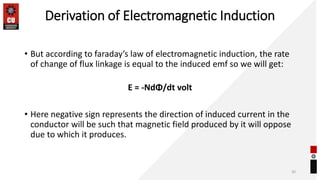
• But according to faraday’s law of electromagnetic induction, the rate
of change of flux linkage is equal to the induced emf so we will get:
E = -NdΦ/dt volt
• Here negative sign represents the direction of induced current in the
conductor will be such that magnetic field produced by it will oppose
due to which it produces.
30
How to increase EMF induced in a coil
• By increasing the number of turns in the coil.
• By increasing magnetic field strength B.
• By increasing the speed of the relative motion between the coil and
the magnet – the coil will cut the lines of flux at a faster rate, so more
induced emf would be produced.
31
Application of Faraday’s Law
The function of power transformer is based on faraday’s law.
The basic working principle of the electrical generator is Faraday’s
law of mutual induction.
The Induction cooker is the fastest way of cooking. It also works on
the principle of mutual induction.
Electromagnetic Flow Meter is used to measure the velocity of
certain fluids.
32
Summary
Introduction to magnetic circuit.
Different terms used in magnetic circuit.
Concept of mmf and magnetic flux.
Concept of magnetic permeance and magnetic permeability.
Types of magnetic circuit.
Applications of magnetic circuit.
33
Frequently Asked Questions
What is the difference between mmf and emf?
Define magnetic field intensity and reluctance.
What do you mean by magnetic permeance?
Classify the types of magnetic circuit.
Write down the applications of magnetic circuit.
34
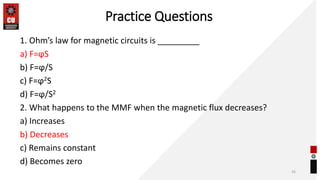
Practice Questions
1. Ohm’s law for magnetic circuits is _________
a) F=ϕS
b) F=ϕ/S
c) F=ϕ2S
d) F=ϕ/S2
2. What happens to the MMF when the magnetic flux decreases?
a) Increases
b) Decreases
c) Remains constant
d) Becomes zero
35
Practice Questions
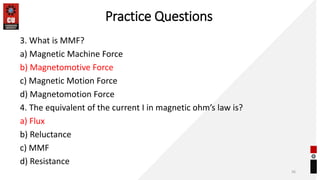
3. What is MMF?
a) Magnetic Machine Force
b) Magnetomotive Force
c) Magnetic Motion Force
d) Magnetomotion Force
4. The equivalent of the current I in magnetic ohm’s law is?
a) Flux
b) Reluctance
c) MMF
d) Resistance
36
To make students understand
• Concepts of magnetic circuits
with its various terms
• Classification of magnetic circuit.
• Applications of magnetic circuit.
37
LEARNING
OUTCOMES
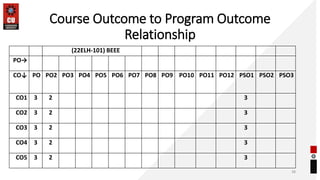
Course Outcome to Program Outcome
Relationship
38
(22ELH-101) BEEE
PO→
CO↓ PO
1
PO2 PO3 PO4 PO5 PO6 PO7 PO8 PO9 PO10 PO11 PO12 PSO1 PSO2 PSO3
CO1 3 2 3
CO2 3 2 3
CO3 3 2 3
CO4 3 2 3
CO5 3 2 3
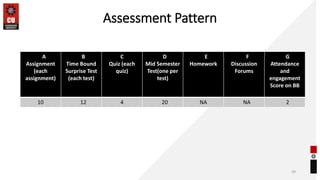
Assessment Pattern
39
A
Assignment
(each
assignment)
B
Time Bound
Surprise Test
(each test)
C
Quiz (each
quiz)
D
Mid Semester
Test(one per
test)
E
Homework
F
Discussion
Forums
G
Attendance
and
engagement
Score on BB
10 12 4 20 NA NA 2
References
https://circuitglobe.com/what-is-a-magnetic-circuit.html
https://circuitglobe.com/what-is-magnetic-flux.html
https://circuitglobe.com/what-is-magnetomotive-force.html
https://circuitglobe.com/what-is-permeance.html
https://circuitglobe.com/what-is-magnetomotive-force.html
https://circuitglobe.com/what-is-parallel-magnetic-circuit.html
https://www.britannica.com/science/magnetic-circuit
40
THANK YOU
For queries
Email: navjeetkaur.ee@cumail.in

Lecture 1.2.1.pptx

  • 1.
    DISCOVER . LEARN. EMPOWER INSTITUTE ENGINEERING DEPARTMENT ACADEMIC UNIT-1 Bachelor of Engineering (Computer Science & Engineering) Subject Name Basics Electrical & Electronics Engineering Subject Code 22ELH-101 By Navjeet kaur Lecture No. 6 Introduction to Magnetic Circuit
  • 2.
    2 Lecture Objectives S. No. Objectives 1To make student aware about the basic concept of magnetic circuit 2 To aware about importance of magnetic circuit 3 To provide knowledge about different terminologies of magnetic circuit 4 To make familiar with types of magnetic circuit. 5 To give brief knowledge about applications of magnetic circuit. https://library.automationdirect.com/basic- electrical-theory/
  • 3.
    3 Course Objectives S. No. Objectives 1To meet students with basic knowledge of dc circuits, electromagnetism and ac fundamentals. 2 To aware about introduction to single and three phase ac circuit with their construction and working principles. 3 To provide knowledge about electrical and electronics engineering fundamentals. 4 To acquire specific knowledge skills so as to comprehend how electric, magnetic and electronic circuits are applied in practice. https://library.automationdirect.com/basic- electrical-theory/
  • 4.
    4 Course Outcomes CO Numbe r Title Level CO1 Identify thedifferent types of electrical elements and the basic op-amp circuit elements and to illustrate the various types of motors, transducers and batteries. Remember CO2 Understand basic principles of transformers, transducers, op-amps, DC and AC motors and to compare the different methods for analyzing electrical and magnetic circuits. Understand CO3 Derive the relationships between parameters in electric and magnetic circuits and motors and to determine specifications of op-amps. Analyze CO4 Solve the basic problems related to electric circuits, magnetic circuits and motors and to assess the characteristics of different configurations of op- amps. Evaluate CO5 Design the different applications of transducers, motors as well as the op- amps like adders, subtractor and comparators. Create https://library.automationdirect.com/basic- electrical-theory/
  • 5.
    Content  Introduction tomagnetic circuit  Terms used in magnetic circuit  Magnetic field and magnetic field lines  Concept of Magnetomotive force and magnetic flux  Concept of Magnetic field intensity and magnetic reluctance  Concept of Magnetic permeance and magnetic permeability  Faraday’s Laws 5
  • 6.
    What is MagneticCircuit? • The closed path followed by magnetic lines of forces is called the magnetic circuit. • In the magnetic circuit, magnetic flux or magnetic lines of force starts from a point and ends at the same point after completing its path. • Flux is generated by magnets, it can be a permanent magnet or electromagnets. • A magnetic circuit is made up of magnetic materials having high permeability such as iron, soft steel, etc. • Magnetic circuits are used in various devices like electric motor, transformers, relays, generators galvanometer, etc. 6
  • 7.
  • 8.
    Terms Used inMagnetic Circuit • Magnetic field: Magnetic Field is the region around a magnetic material or a moving electric charge within which the force of magnetism acts. • Magnetic Field Lines: The use of field lines is an alternative way to represent the information contained within a magnetic vector field. Magnetic field lines are imaginary lines. • Magnetic field lines are a visual tool used to represent magnetic fields. They describe the direction of the magnetic force on a north monopole at any given position 8
  • 9.
    Terms Used inMagnetic Circuit • Magnetomotive Force (MMF): The current flowing in an electric circuit is due to the existence of electoromotive force similarly magnetomotive force (MMF) is required to drive the magnetic flux in the magnetic circuit. • The magnetic pressure, which sets up the magnetic flux in a magnetic circuit is called Magnetomotive Force. • The SI unit of MMF is Ampere-turn (AT), and their CGS unit is G (gilbert). 9
  • 10.
    Terms Used inMagnetic Circuit 10 https://circuitglobe.com/what-is-magnetomotive-force.html Fig. 2 Magnetic coil with N turns
  • 11.
    Terms Used inMagnetic Circuit • The MMF for the inductive coil shown in the figure below is expressed as • Where, N – numbers of turns of the inductive coil I – current • The strength of the MMF is equivalent to the product of the current around the turns and the number of turns of the coil. • As per work law, the MMF is defined as the work done in moving the unit magnetic pole (1weber) once around the magnetic circuit. 11 …………………………..(1)
  • 12.
    Terms Used inMagnetic Circuit • The magnetomotive force can measure regarding magnetic field intensity and the length of the substance. • The magnetic field strength is the force act on the unit pole placed on the magnetic field. MMF regarding field intensity is expressed as • Where H is the magnetic field strength, and l is the length of the substance. 12 ……………………………….(2)
  • 13.
    Terms Used inMagnetic Circuit • Magnetic flux: The number of magnetic lines of forces set up in a magnetic circuit is called Magnetic Flux. • It is analogous to electric current, I in an electric circuit. Its SI unit is Weber (Wb) • The fluxmeter has to measure coil which measures the variation of voltage to measure the flux. 13 http://www.schoolphysics.co.uk/age16- 19/Electricity%20and%20magnetism/Electroma gnetism/text/Flux_and_flux_density/index.html Fig. 3 Magnetic coil with N turns
  • 14.
    Terms Used inMagnetic Circuit • Net number of lines passing through the surface are called magnetic lines of forces. 14 Fig. 4 Magnetic coil with lines of force …………………………………(3)
  • 15.
    Terms Used inMagnetic Circuit If the magnetic field is constant than the magnetic flux passing through a surface (S) is where B – the magnitude of the magnetic field S – area of surface θ – angle between the magnetic field lines and perpendicular distance normal to the surface area The unit of magnetic flux is weber. 15 …………………………..(4)
  • 16.
    Terms Used inMagnetic Circuit • Magnetic Field Intensity: The Magnetic Field Intensity or Magnetic Field Strength is a ratio of the MMF needed to create a certain Flux Density (B) within a particular material per unit length of that material. H = At/m, ampere-turns per meter. • N is used as the number of turns of wire around a core or magnetic material. So the H = N*I/m. 16
  • 17.
    Terms Used inMagnetic Circuit 17 https://www.coolmagnetman.com/magfund06.htm Fig.5 Magnetic coil
  • 18.
    Terms Used inMagnetic Circuit • Let, l = mean length of the magnetic circuit A = cross-sectional area of the core µr = relative permeability of the core Now the flux density in the core material • Magnetising force in the core 18 ………………………………..(1) ………………………………………………..(2) ………..(3)
  • 19.
    Terms Used inMagnetic Circuit • According to work law, the work done in moving a unit pole once round the magnetic circuit is equal to the ampere-turns enclosed by the magnetic circuit. • It is measured in ampere-turn/meter. 19 ……………………………….(4) ………………………...……(5)
  • 20.
    Terms Used inMagnetic Circuit • Magnetic Reluctance: The obstruction offered by a magnetic circuit to the magnetic flux is known as reluctance. • Reluctance in magnetic circuit stores the magnetic energy. • Also in an electric circuit, the electric field provides the least resistance path to the electric current. • Similarly, the magnetic field causes the least reluctance path for the magnetic flux. It is denoted by S. 20
  • 21.
    Terms Used inMagnetic Circuit • L- the length of the conductor μo – permeability of vacuum which is equal to 4π Χ10^7 Henry/metre. μr – relative permeability of the material. A – cross-section area of the conductor. • Its SI unit is AT / Wb (ampere-turns / Weber). 21 https://circuitglobe.com/what-is-magnetic-reluctance.html Fig.6 Magnetic circuit
  • 22.
    Terms Used inMagnetic Circuit • Magnetic Permeance: It is the measure of the ease with which flux can be set up in a material. • Analogous to the conductance in an electrical circuit. • Reciprocal of the reluctance (S) of the material in a magnetic circuit. It is denoted by P. • Measured in Weber per ampere turns (Wb/AT) or Henry (H). 22 https://circuitglobe.com/what-is- permeance.html#:~:text=Definition%3A%20It%20is%20the%20measure,conductance%2 0in%20an%20electrical%20circuit.
  • 23.
    Terms Used inMagnetic Circuit • Magnetic Permeability: The magnetic permeability is defined as the property of the material to allow the magnetic line of force to pass through it. • It supports the development of the magnetic field. • SI unit is Henry per meter (H/M or Hm2) or newton per ampere square (N-A2). • It is directly proportional to the number of lines passing through it. • The permeability of the air or vacuum is represented by μ0 which is equal to 4π×10-7 H/m. 23
  • 24.
    Terms Used inMagnetic Circuit • It is equal to the ratio of the field intensity to the flux density of the material. It is expressed by the formula shown below. • Where, B – magnetic flux density H – magnetic field intensity • Relative permeability: The relative permeability of the material is the comparison of the permeability concerning the air or vacuum. 24 https://circuitglobe.com/magnetic-permeability.html
  • 25.
    Applications of MagneticCircuit  These are used in motors and generators.  These are used in speakers.  These are used in transformers.  Magnetic strip are used in bank ATM cards, library cards etc.  These are preferred for tape recorders.  These are used in magnetic resonance imaging (MRI) machines. 25
  • 26.
    Faraday’s Laws ofElectromagnetic Induction • In 1831, Micheal Faraday formulated two laws on the basis of experiments. These laws are called Faraday’s Laws of electromagnetic induction. 26 https://www.electrical4u.com/faraday-law-of-electromagnetic-induction/ Fig.1 Faraday’s Law
  • 27.
    Laws of ElectromagneticInduction • First Law: It states that whenever a current carrying conductor is placed in a varying magnetic field an emf is induced, if the conductor circuit is closed current will be induced which is called induced current. 27 https://www.daenotes.com/electronics/basic-electronics/faraday-laws-of-electromagnetic-induction Fig.2 Faraday’s First Law
  • 28.
    Laws of ElectromagneticInduction • Second law: Second law states that an induced emf is equal to the rate of change of flux linkages. • Flux linkage is equal to the product of turns N of coil and flux associated with it. 28 https://aninagmafae05.wordpress.com/2019/01/25/2- concepts-brought-together-and-functions-as-one- %F0%9F%92%9E/ Fig.3 Faraday’s Second Law
  • 29.
    Derivation of ElectromagneticInduction • Consider a magnet is approaching towards a coil, number of turns are N in a coil and flux are Φ1 and Φ2. Initial flux linkage = N Φ1 Final flux linkage = N Φ2  Changes in flux linkages = N Φ2 - N Φ1 = N(Φ2 - Φ1) If N(Φ2 - Φ1) = Φ Then changes in flux linkage = N Φ Rate of change of flux linkage = N Φ/t weber/sec. Now taking derivative of right hand side we get Rate of change of flux linkage = NdΦ/dt 29 ………………………………………(1) ………………………………………(2) ……………(3) ………………………………………(4) ………………………………………(5) ………………………(6) ………………………………………(7)
  • 30.
    Derivation of ElectromagneticInduction • But according to faraday’s law of electromagnetic induction, the rate of change of flux linkage is equal to the induced emf so we will get: E = -NdΦ/dt volt • Here negative sign represents the direction of induced current in the conductor will be such that magnetic field produced by it will oppose due to which it produces. 30
  • 31.
    How to increaseEMF induced in a coil • By increasing the number of turns in the coil. • By increasing magnetic field strength B. • By increasing the speed of the relative motion between the coil and the magnet – the coil will cut the lines of flux at a faster rate, so more induced emf would be produced. 31
  • 32.
    Application of Faraday’sLaw The function of power transformer is based on faraday’s law. The basic working principle of the electrical generator is Faraday’s law of mutual induction. The Induction cooker is the fastest way of cooking. It also works on the principle of mutual induction. Electromagnetic Flow Meter is used to measure the velocity of certain fluids. 32
  • 33.
    Summary Introduction to magneticcircuit. Different terms used in magnetic circuit. Concept of mmf and magnetic flux. Concept of magnetic permeance and magnetic permeability. Types of magnetic circuit. Applications of magnetic circuit. 33
  • 34.
    Frequently Asked Questions Whatis the difference between mmf and emf? Define magnetic field intensity and reluctance. What do you mean by magnetic permeance? Classify the types of magnetic circuit. Write down the applications of magnetic circuit. 34
  • 35.
    Practice Questions 1. Ohm’slaw for magnetic circuits is _________ a) F=ϕS b) F=ϕ/S c) F=ϕ2S d) F=ϕ/S2 2. What happens to the MMF when the magnetic flux decreases? a) Increases b) Decreases c) Remains constant d) Becomes zero 35
  • 36.
    Practice Questions 3. Whatis MMF? a) Magnetic Machine Force b) Magnetomotive Force c) Magnetic Motion Force d) Magnetomotion Force 4. The equivalent of the current I in magnetic ohm’s law is? a) Flux b) Reluctance c) MMF d) Resistance 36
  • 37.
    To make studentsunderstand • Concepts of magnetic circuits with its various terms • Classification of magnetic circuit. • Applications of magnetic circuit. 37 LEARNING OUTCOMES
  • 38.
    Course Outcome toProgram Outcome Relationship 38 (22ELH-101) BEEE PO→ CO↓ PO 1 PO2 PO3 PO4 PO5 PO6 PO7 PO8 PO9 PO10 PO11 PO12 PSO1 PSO2 PSO3 CO1 3 2 3 CO2 3 2 3 CO3 3 2 3 CO4 3 2 3 CO5 3 2 3
  • 39.
    Assessment Pattern 39 A Assignment (each assignment) B Time Bound SurpriseTest (each test) C Quiz (each quiz) D Mid Semester Test(one per test) E Homework F Discussion Forums G Attendance and engagement Score on BB 10 12 4 20 NA NA 2
  • 40.
  • 41.
    THANK YOU For queries Email:navjeetkaur.ee@cumail.in