BASIC ELECTRICAL, ELECTRONICS AND
INSTRUMENTATION ENGINEERING
Dr P THARCIS, ASP/ECE
UNIT II
MAGNETIC CIRCUITS
AND
ELECTRICAL INSTALLATIONS
◦ Magnetic circuits-definitions-MMF, flux, reluctance, magnetic field
intensity, flux density, fringing, self and mutual inductances-simple
problems.
◦ Domestic wiring, types of wires and cables, earthing, protective
devices- switch fuse unit- Miniature circuit breaker-moulded case
circuit breaker- earth leakage circuit breaker, safety precautions and
First Aid
Magnetic circuits-Definitions-MMF
◦ MMF stands for "Magnetomotive Force”.
◦ MMF represents the force that establishes a magnetic flux in a magnetic circuit.
◦ It's measured in ampere-turns (At).
◦ Here are some key definitions related to MMF and magnetic circuits:
1.Magnetic Flux (Φ):
Magnetic flux is the total magnetic field passing through a surface. It's measured in
Weber (Wb).
2. Reluctance (R):
Reluctance is the opposition to the establishment of magnetic flux in a material. It's
analogous to resistance in electrical circuits and is measured in ampere-turns per
weber (At/Wb).
3. Ohm's Law for Magnetic Circuits:
It states that the MMF (Φ) in a magnetic circuit is equal to the product of the current
passing through the circuit and the reluctance of the material. This can be
represented as:
MMF (Φ) = Current (I) * Reluctance (R)
4. Ampere's Law for Magnetic Circuits:
Ampere's law for magnetic circuits is analogous to Ohm's law for electrical circuits.
It states that the MMF around a closed loop in a magnetic circuit is equal to the total
current passing through that loop.
∑ MMF = ∑(NI)
◦ Where:
• ∑ MMF is the total magnetomotive force around the circuit.
• N is the number of turns in each coil.
• I is the current flowing through each coil.
Magnetic Field Intensity (H):
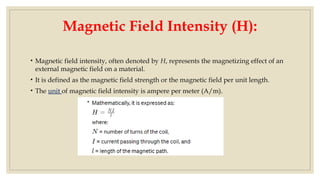
• Magnetic field intensity, often denoted by H, represents the magnetizing effect of an
external magnetic field on a material.
• It is defined as the magnetic field strength or the magnetic field per unit length.
• The unit of magnetic field intensity is ampere per meter (A/m).
Magnetic Flux Density (B)
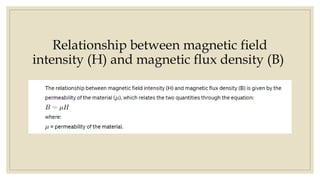
Relationship between magnetic field
intensity (H) and magnetic flux density (B)
Fringing:
• Fringing refers to the phenomenon where the magnetic field lines associated with an
inductor or a magnetic component extend beyond the core material.
• In idealized models, magnetic field lines are assumed to be entirely contained within
the core material. However, in practical scenarios, some magnetic field lines extend
into the surrounding air or other nearby materials.
• Fringing affects the effective inductance of the component and needs to be considered
inaccurate designs, especially for high-frequency applications or when precise
inductance values are required.
Self-Inductance (L):
• Self-inductance is a property of an electrical conductor or coil that induces a voltage
in itself when the current flowing through it changes.
• It quantifies the ability of a conductor to oppose changes in the current flowing
through it by generating a back electromotive force (emf) proportional to the rate of
change of current.
• Mathematically, self-inductance is expressed as:
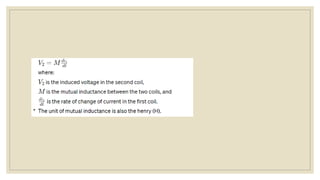
Mutual Inductance (M):
• Mutual inductance refers to the induction of a voltage in one coil (or
conductor) due to the changing current in another nearby coil (or
conductor).
• It quantifies the coupling between two coils or conductors and is a
measure of how effectively the magnetic field produced by one coil
links with the turns of another coil.
• Mathematically, mutual inductance is expressed as:
Domestic wiring
BE3252 BASIC ELECTRICAL, ELECTRONICS AND INSTRUMENTATION ENGINEERING UNIT 2.pptx

BE3252 BASIC ELECTRICAL, ELECTRONICS AND INSTRUMENTATION ENGINEERING UNIT 2.pptx

  • 1.
    BASIC ELECTRICAL, ELECTRONICSAND INSTRUMENTATION ENGINEERING Dr P THARCIS, ASP/ECE
  • 2.
    UNIT II MAGNETIC CIRCUITS AND ELECTRICALINSTALLATIONS ◦ Magnetic circuits-definitions-MMF, flux, reluctance, magnetic field intensity, flux density, fringing, self and mutual inductances-simple problems. ◦ Domestic wiring, types of wires and cables, earthing, protective devices- switch fuse unit- Miniature circuit breaker-moulded case circuit breaker- earth leakage circuit breaker, safety precautions and First Aid
  • 6.
    Magnetic circuits-Definitions-MMF ◦ MMFstands for "Magnetomotive Force”. ◦ MMF represents the force that establishes a magnetic flux in a magnetic circuit. ◦ It's measured in ampere-turns (At). ◦ Here are some key definitions related to MMF and magnetic circuits: 1.Magnetic Flux (Φ): Magnetic flux is the total magnetic field passing through a surface. It's measured in Weber (Wb). 2. Reluctance (R): Reluctance is the opposition to the establishment of magnetic flux in a material. It's analogous to resistance in electrical circuits and is measured in ampere-turns per weber (At/Wb).
  • 7.
    3. Ohm's Lawfor Magnetic Circuits: It states that the MMF (Φ) in a magnetic circuit is equal to the product of the current passing through the circuit and the reluctance of the material. This can be represented as: MMF (Φ) = Current (I) * Reluctance (R) 4. Ampere's Law for Magnetic Circuits: Ampere's law for magnetic circuits is analogous to Ohm's law for electrical circuits. It states that the MMF around a closed loop in a magnetic circuit is equal to the total current passing through that loop. ∑ MMF = ∑(NI) ◦ Where: • ∑ MMF is the total magnetomotive force around the circuit. • N is the number of turns in each coil. • I is the current flowing through each coil.
  • 8.
    Magnetic Field Intensity(H): • Magnetic field intensity, often denoted by H, represents the magnetizing effect of an external magnetic field on a material. • It is defined as the magnetic field strength or the magnetic field per unit length. • The unit of magnetic field intensity is ampere per meter (A/m).
  • 9.
  • 10.
    Relationship between magneticfield intensity (H) and magnetic flux density (B)
  • 11.
    Fringing: • Fringing refersto the phenomenon where the magnetic field lines associated with an inductor or a magnetic component extend beyond the core material. • In idealized models, magnetic field lines are assumed to be entirely contained within the core material. However, in practical scenarios, some magnetic field lines extend into the surrounding air or other nearby materials. • Fringing affects the effective inductance of the component and needs to be considered inaccurate designs, especially for high-frequency applications or when precise inductance values are required.
  • 12.
    Self-Inductance (L): • Self-inductanceis a property of an electrical conductor or coil that induces a voltage in itself when the current flowing through it changes. • It quantifies the ability of a conductor to oppose changes in the current flowing through it by generating a back electromotive force (emf) proportional to the rate of change of current. • Mathematically, self-inductance is expressed as:
  • 13.
    Mutual Inductance (M): •Mutual inductance refers to the induction of a voltage in one coil (or conductor) due to the changing current in another nearby coil (or conductor). • It quantifies the coupling between two coils or conductors and is a measure of how effectively the magnetic field produced by one coil links with the turns of another coil. • Mathematically, mutual inductance is expressed as:
  • 15.