Prof Monika Shah(NU) 1
Code Generation
Course : 2CS701/IT794 – Compiler
Construction
Prof Monika Shah
Nirma University
Ref : Ch.9 Compilers Principles, Techniques, and Tools by Alfred Aho, Ravi Sethi, and Jeffrey Ullman
Prof Monika Shah(NU) 3
Machine independent asm to machine dependent
Lexical Analysis
Syntax Analysis
Semantic Analysis
Intermediate Code
Generation
Optimization
Code Generation
Source
Program
Assembly
Code
IR to low-level IR
Symbol
Table
Front
end
Back
end
Optimization
Token stream
AST or Parse tree
AST or Annotted Parse tree
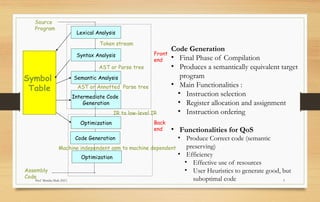
Code Generation
• Final Phase of Compilation
• Produces a semantically equivalent target
program
• Main Functionalities :
• Instruction selection
• Register allocation and assignment
• Instruction ordering
• Functionalities for QoS
• Produce Correct code (semantic
preserving)
• Efficiency
• Effective use of resources
• User Heuristics to generate good, but
suboptimal code
4.
Prof Monika Shah(NU) 4
Major functionalities of Code Generation
• Instruction selection
Choose semantically equivalent target machine instructions for the IR
statement
Choose cost effective instructions to implement the IR statements
• Register allocation and assignment
• Register allocation: selecting the set of variables that will reside in
registers at each point in the program
• Resister assignment: selecting specific register that a variable reside in
• Instruction ordering
Decide schedule of Instruction (Challenging for Parallel )
5.
Prof Monika Shah(NU) 5
Issues in design of Code Generation phase
• Input to Code Generator
• Target Program
• Memory Management
• Instruction Selection
• Register Allocation
• Schedule order of Instructions
• Approaches
6.
Prof Monika Shah(NU) 6
Issues in Code Generation design
Input to Code Generation
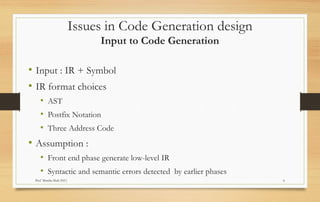
• Input : IR + Symbol
• IR format choices
• AST
• Postfix Notation
• Three Address Code
• Assumption :
• Front end phase generate low-level IR
• Syntactic and semantic errors detected by earlier phases
7.
Prof Monika Shah(NU) 7
Issues in Code Generation design
Target Program (Output)
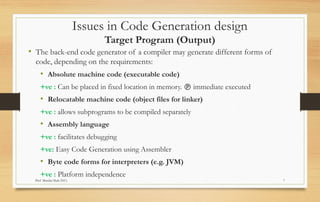
• The back-end code generator of a compiler may generate different forms of
code, depending on the requirements:
• Absolute machine code (executable code)
+ve : Can be placed in fixed location in memory. immediate executed
• Relocatable machine code (object files for linker)
+ve : allows subprograms to be compiled separately
• Assembly language
+ve : facilitates debugging
+ve: Easy Code Generation using Assembler
• Byte code forms for interpreters (e.g. JVM)
+ve : Platform independence
8.
Prof Monika Shah(NU) 8
The Target Machine
• Implementing code generation requires thorough understanding
of the target machine architecture and its instruction set
• Our (hypothetical) machine:
• Byte-addressable (word = 4 bytes)
• Has n general purpose registers R0, R1, …, Rn-1
• Two-address instructions of the form
op source, destination
Issues in Code Generation design
Target Program (Output)
9.
Prof Monika Shah(NU) 9
The Target Machine: Op-codes and Address Modes
• Op-codes (op), for example
MOV (move content of source to destination)
ADD (add content of source to destination)
SUB (subtract content of source from dest.)
• Address modes
Mode Form Address Added Cost
Absolute M M 1
Register R R 0
Indexed c(R) c+contents(R) 1
Indirect register *R contents(R) 0
Indirect indexed *c(R) contents(c+contents(R)) 1
Literal #c N/A 1
10.
Prof Monika Shah(NU) 10
Instruction Costs
• Machine is a simple, non-super-scalar processor with fixed
instruction costs
• Realistic machines have deep pipelines, I-cache, D-cache,
etc.
• Define the cost of instruction
= 1 + cost(source-mode) + cost(destination-mode)
11.
Prof Monika Shah(NU) 11
Instruction Operation Cost
MOV R0,R1 Store content(R0) into register R1 1
MOV R0,M Store content(R0) into memory location M 2
MOV M,R0 Store content(M) into register R0 2
MOV 4(R0),M Store contents(4+contents(R0)) into M 3
MOV *4(R0),M Store contents(contents(4+contents(R0))) into M 3
MOV #1,R0 Store 1 into R0 2
ADD 4(R0),*12(R1) Add contents(4+contents(R0))
to value at location contents(12+contents(R1)) 3
Examples
12.
Prof Monika Shah(NU)
12
Instruction Selection
• Instruction selection is important to obtain efficient code
• Suppose we translate three-address code
x:=y+z
to: MOV y,R0
ADD z,R0
MOV R0,x
a:=a+1 MOV a,R0
ADD #1,R0
MOV R0,a
ADD #1,a INC a
Cost = 6
Cost = 3 Cost = 2
Better Best
Issues in Code Generation design
Target Program (Output)
13.
Prof Monika Shah(NU) 13
Instruction Selection: Utilizing Addressing Modes
• Suppose we translate a:=b+c into
MOV b,R0
ADD c,R0
MOV R0,a
• Assuming addresses of a, b, and c are stored in R0, R1, and R2
MOV *R1,*R0
ADD *R2,*R0
• Assuming R1 and R2 contain values of b and c
ADD R2,R1
MOV R1,a
Issues in Code Generation design
Cost = 6
Cost = 2
Cost = 3
14.
Prof Monika Shah(NU) 14
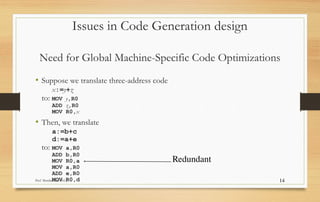
Need for Global Machine-Specific Code Optimizations
• Suppose we translate three-address code
x:=y+z
to: MOV y,R0
ADD z,R0
MOV R0,x
• Then, we translate
a:=b+c
d:=a+e
to: MOV a,R0
ADD b,R0
MOV R0,a
MOV a,R0
ADD e,R0
MOV R0,d
Redundant
Issues in Code Generation design
15.
Prof Monika Shah(NU) 15
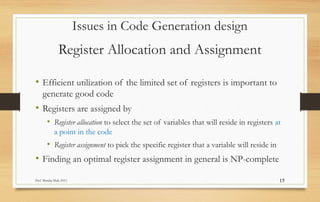
Register Allocation and Assignment
• Efficient utilization of the limited set of registers is important to
generate good code
• Registers are assigned by
• Register allocation to select the set of variables that will reside in registers at
a point in the code
• Register assignment to pick the specific register that a variable will reside in
• Finding an optimal register assignment in general is NP-complete
Issues in Code Generation design
16.
Prof Monika Shah(NU)
16
Example
t:=a*b
t:=t+a
t:=t/d
MOV a,R1
MUL b,R1
ADD a,R1
DIV d,R1
MOV R1,t
t:=a*b
t:=t+a
t:=t/d
MOV a,R0
MOV R0,R1
MUL b,R1
ADD R0,R1
DIV d,R1
MOV R1,t
{ R1=t } { R0=a, R1=t }
17.
Prof Monika Shah(NU)
17
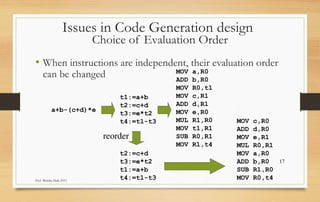
Choice of Evaluation Order
• When instructions are independent, their evaluation order
can be changed
t1:=a+b
t2:=c+d
t3:=e*t2
t4:=t1-t3
a+b-(c+d)*e
MOV a,R0
ADD b,R0
MOV R0,t1
MOV c,R1
ADD d,R1
MOV e,R0
MUL R1,R0
MOV t1,R1
SUB R0,R1
MOV R1,t4
t2:=c+d
t3:=e*t2
t1:=a+b
t4:=t1-t3
MOV c,R0
ADD d,R0
MOV e,R1
MUL R0,R1
MOV a,R0
ADD b,R0
SUB R1,R0
MOV R0,t4
reorder
Issues in Code Generation design
18.
Prof Monika Shah(NU) 18
• Mapping names in source program to memory address
is done by Code Generator phase
• Labels in three address code need to be converted to
addresses of Instructions
• Back patching technique
Issues in Code Generation design
Memory Mapping