READING:
AN INTRODUCTION
TSL 591
LECTURE 1
DEFINITION OF READING
• WHAT DO WE READ?
• VARIOUS FORMS OF PRINTED & ELECTRONIC
MATERIALS SEEN OR SENSED
• LETTERS, SYMBOLS, PICTURES
• CODE
• WHAT DOES READING LEAD TO?
• RESPONSES
• KNOWLEDGE, NEW UNDERSTANDING,
PERFORM REQUIRED ACTION
• DECODE
READING IS
• A complex conscious and unconscious mental
process in which the reader uses a variety of
strategies to reconstruct the meaning that the author
is assumed to have intended, based on data from the
text and from the reader’s prior knowledge
(Mikulecky, 2011)
• Reading is understood as a complex
combination processes.
• These processes are:
1. A rapid and efficient process
2. A comprehending process
3. An interactive process
4. A strategic process
Cont.
5. A flexible process
6. A purposeful process
7. An evaluative process
8. A learning process
9. A linguistic process
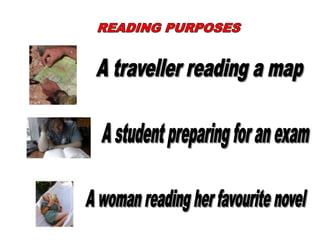
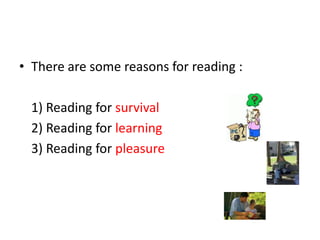
• There are some reasons for reading :
1) Reading for survival
2) Reading for learning
3) Reading for pleasure
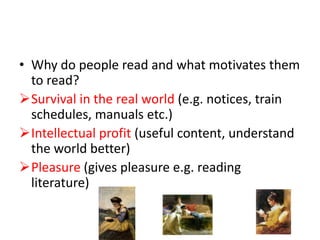
• Why do people read and what motivates them
to read?
Survival in the real world (e.g. notices, train
schedules, manuals etc.)
Intellectual profit (useful content, understand
the world better)
Pleasure (gives pleasure e.g. reading
literature)
TYPES OF READER
• Experienced readers make judgments during
activity about the degree of care and
attention which the material warrants.
• Effective reading means a flexible and
appropriate response to the material in hand,
and this is always guided by the reader’s
purpose.
TYPES OF READER (cont.)
• The strategies fluent readers use:
1. Notice the distinctive features in letters,
words, and meanings.
2. Read to get the meaning rather than to
identify individual letters or words.
3. Guess and take risks to predict meaning.
4. Take an active role and apply their knowledge
of the world and the topic in attempting to
understand.
Cont.
5. Make use of redundancies – orthographic, syntactic,
and/or semantic repetitions of information – to reduce
uncertainty about meaning.
6. Maintain enough speed to overcome the limitations of
visual processing and memory systems.
7. Constantly switch their thoughts back and forth
between the text and what they already know in an
effort to understand.
Implications for instruction
• L2 students who are learning to read in
different settings, at different institutions, and
with varying levels of instructional training
and resource support, will have different
learning goals generally, and varying
comprehension goals with each task they
carry out - there is no single “one size fits all”
set of recommendations for reading
instructions
Cont.
• When L2 students read specific texts in
classroom contexts, they will engage in
varying types of reading that reflect differing
tasks, texts, and instructional objectives – the
problems may not be an inability to
comprehend but a lack of awareness of the
real goals for that reading task.
Cont.
• The various components of a complex
definition for skilled reading suggest that long-
term curricular goals for L2 need to address
relevant language-knowledge resources.

Lecture 1 reading an introduction

  • 1.
  • 2.
    DEFINITION OF READING •WHAT DO WE READ? • VARIOUS FORMS OF PRINTED & ELECTRONIC MATERIALS SEEN OR SENSED • LETTERS, SYMBOLS, PICTURES • CODE
  • 4.
    • WHAT DOESREADING LEAD TO? • RESPONSES • KNOWLEDGE, NEW UNDERSTANDING, PERFORM REQUIRED ACTION • DECODE
  • 5.
    READING IS • Acomplex conscious and unconscious mental process in which the reader uses a variety of strategies to reconstruct the meaning that the author is assumed to have intended, based on data from the text and from the reader’s prior knowledge (Mikulecky, 2011)
  • 6.
    • Reading isunderstood as a complex combination processes. • These processes are: 1. A rapid and efficient process 2. A comprehending process 3. An interactive process 4. A strategic process
  • 7.
    Cont. 5. A flexibleprocess 6. A purposeful process 7. An evaluative process 8. A learning process 9. A linguistic process
  • 9.
    • There aresome reasons for reading : 1) Reading for survival 2) Reading for learning 3) Reading for pleasure
  • 10.
    • Why dopeople read and what motivates them to read? Survival in the real world (e.g. notices, train schedules, manuals etc.) Intellectual profit (useful content, understand the world better) Pleasure (gives pleasure e.g. reading literature)
  • 11.
    TYPES OF READER •Experienced readers make judgments during activity about the degree of care and attention which the material warrants. • Effective reading means a flexible and appropriate response to the material in hand, and this is always guided by the reader’s purpose.
  • 12.
    TYPES OF READER(cont.) • The strategies fluent readers use: 1. Notice the distinctive features in letters, words, and meanings. 2. Read to get the meaning rather than to identify individual letters or words. 3. Guess and take risks to predict meaning. 4. Take an active role and apply their knowledge of the world and the topic in attempting to understand.
  • 13.
    Cont. 5. Make useof redundancies – orthographic, syntactic, and/or semantic repetitions of information – to reduce uncertainty about meaning. 6. Maintain enough speed to overcome the limitations of visual processing and memory systems. 7. Constantly switch their thoughts back and forth between the text and what they already know in an effort to understand.
  • 14.
    Implications for instruction •L2 students who are learning to read in different settings, at different institutions, and with varying levels of instructional training and resource support, will have different learning goals generally, and varying comprehension goals with each task they carry out - there is no single “one size fits all” set of recommendations for reading instructions
  • 15.
    Cont. • When L2students read specific texts in classroom contexts, they will engage in varying types of reading that reflect differing tasks, texts, and instructional objectives – the problems may not be an inability to comprehend but a lack of awareness of the real goals for that reading task.
  • 16.
    Cont. • The variouscomponents of a complex definition for skilled reading suggest that long- term curricular goals for L2 need to address relevant language-knowledge resources.