GAMIFICATION
CP1405
1
SUBJECT DESCRIPTION
• Students are introduced to the concepts and techniques of using serious
gamesand gamificationto achieve business
goalsin areas such as marketing, human resources management,
productivity enhancement, training, customer engagement, and innovation.
• The subject will draw upon real-world case studiesto identify
effective strategies, techniquesand metrics
for serious game and gamification.
• Legal and ethical issues related to serious games and
gamification are identified.
2
SUBJECT OUTCOMES
Explain and evaluate serious games and
gamification techniques and applications.
Apply concepts of motivation and user-based
design to gamification.
Apply concepts and techniques of gamification
to achieve business goals.
3
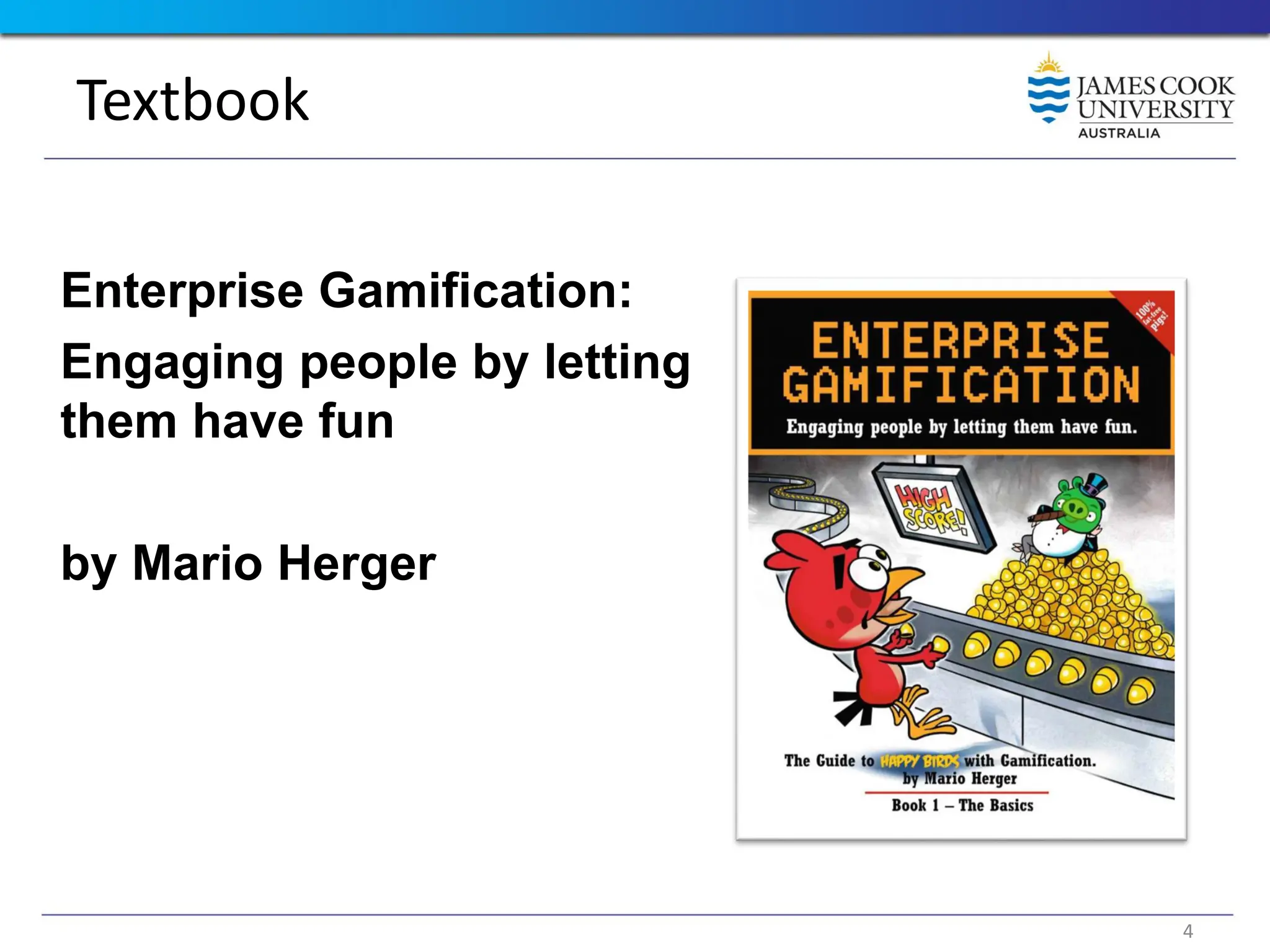
Textbook
Enterprise Gamification:
Engaging people by letting
them have fun
by Mario Herger
4
Additional Resources
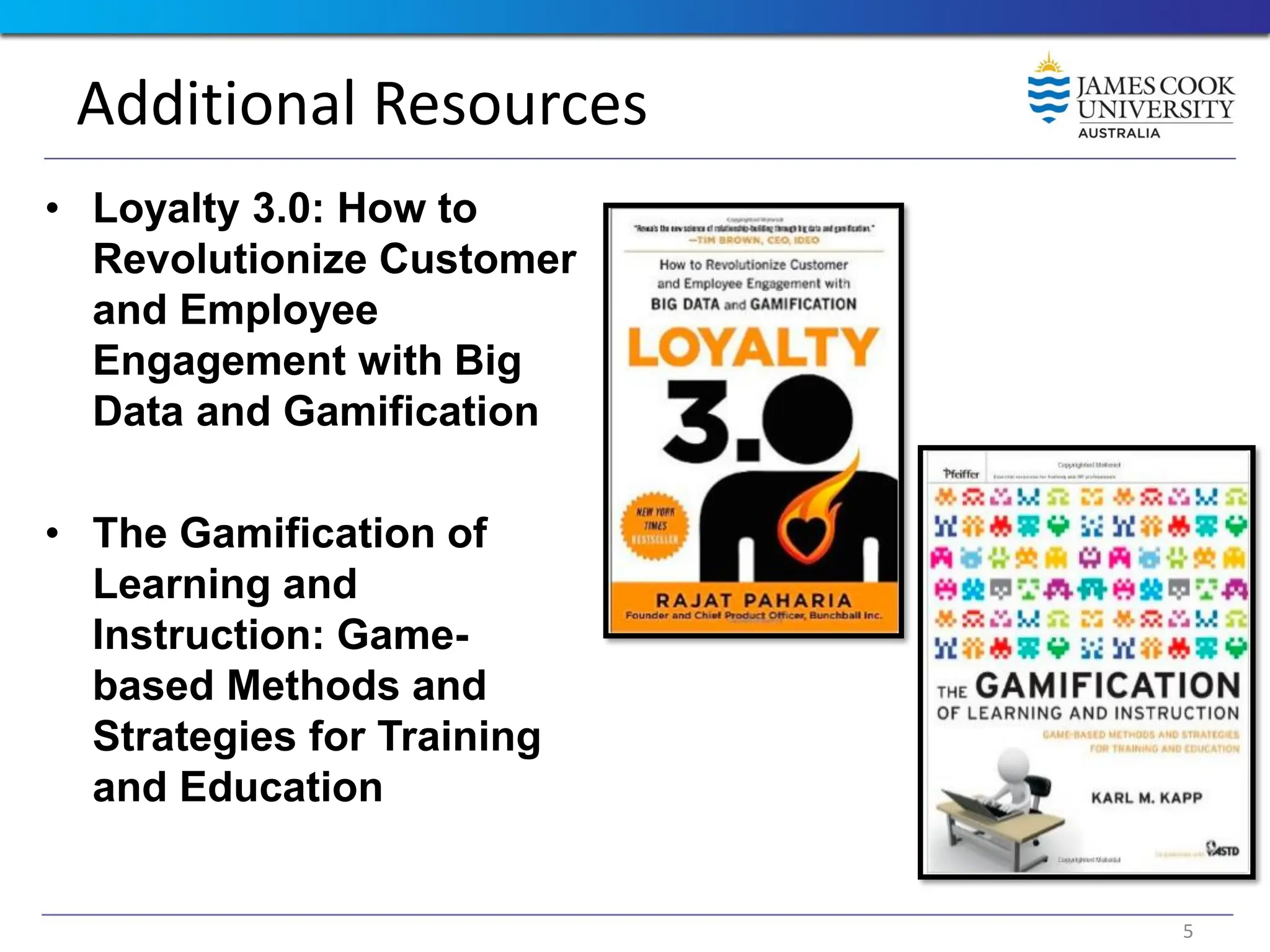
• Loyalty 3.0: How to
Revolutionize Customer
and Employee
Engagement with Big
Data and Gamification
• The Gamification of
Learning and
Instruction: Game-
based Methods and
Strategies for Training
and Education
5
Additional Resources
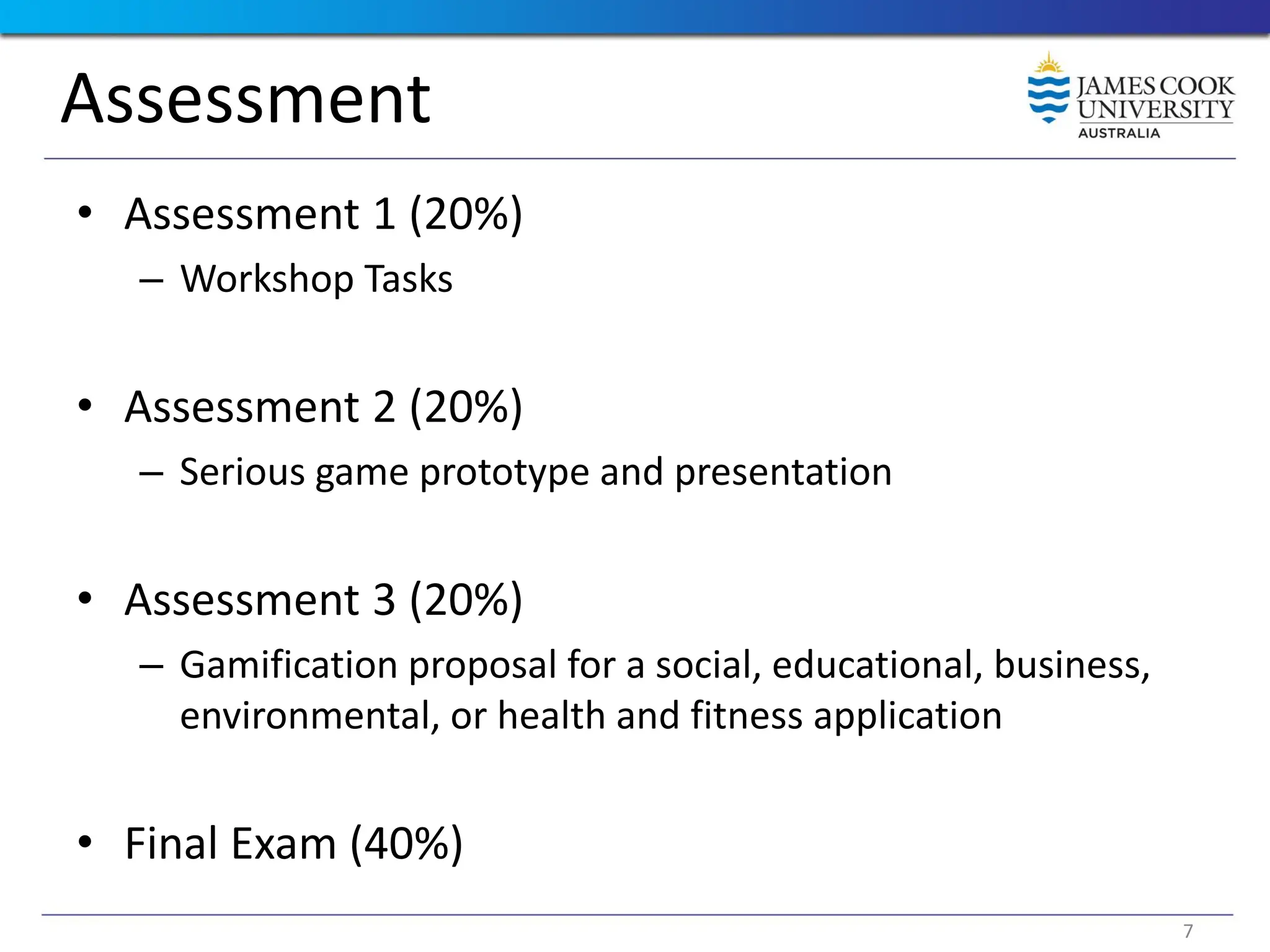
• Rules of Play: Game
Design Fundamentals
• By Katie Salen Tekinbaş and
Eric Zimmerman
6
Assessment
• Assessment 1 (20%)
– Workshop Tasks
• Assessment 2 (20%)
– Serious game prototype and presentation
• Assessment 3 (20%)
– Gamification proposal for a social, educational, business,
environmental, or health and fitness application
• Final Exam (40%)
7
Learning Objectives
What are gamification and serious games
Why might they be valuable
Understanding what makes game “fun” and how to translate this
into a gamified experience that is useful in a social, educational
or business context
Applications of serious games and gamification
8
Definitions
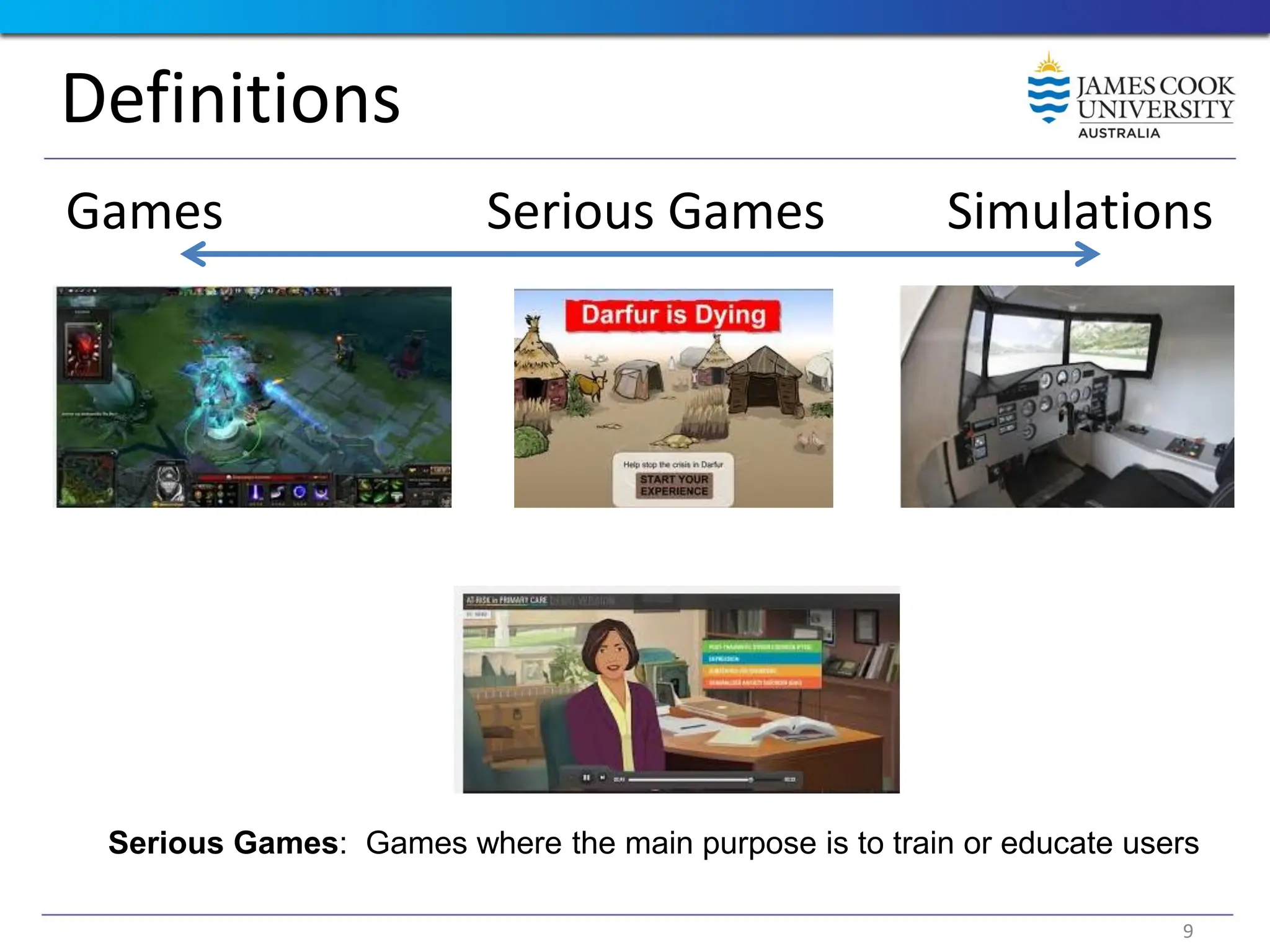
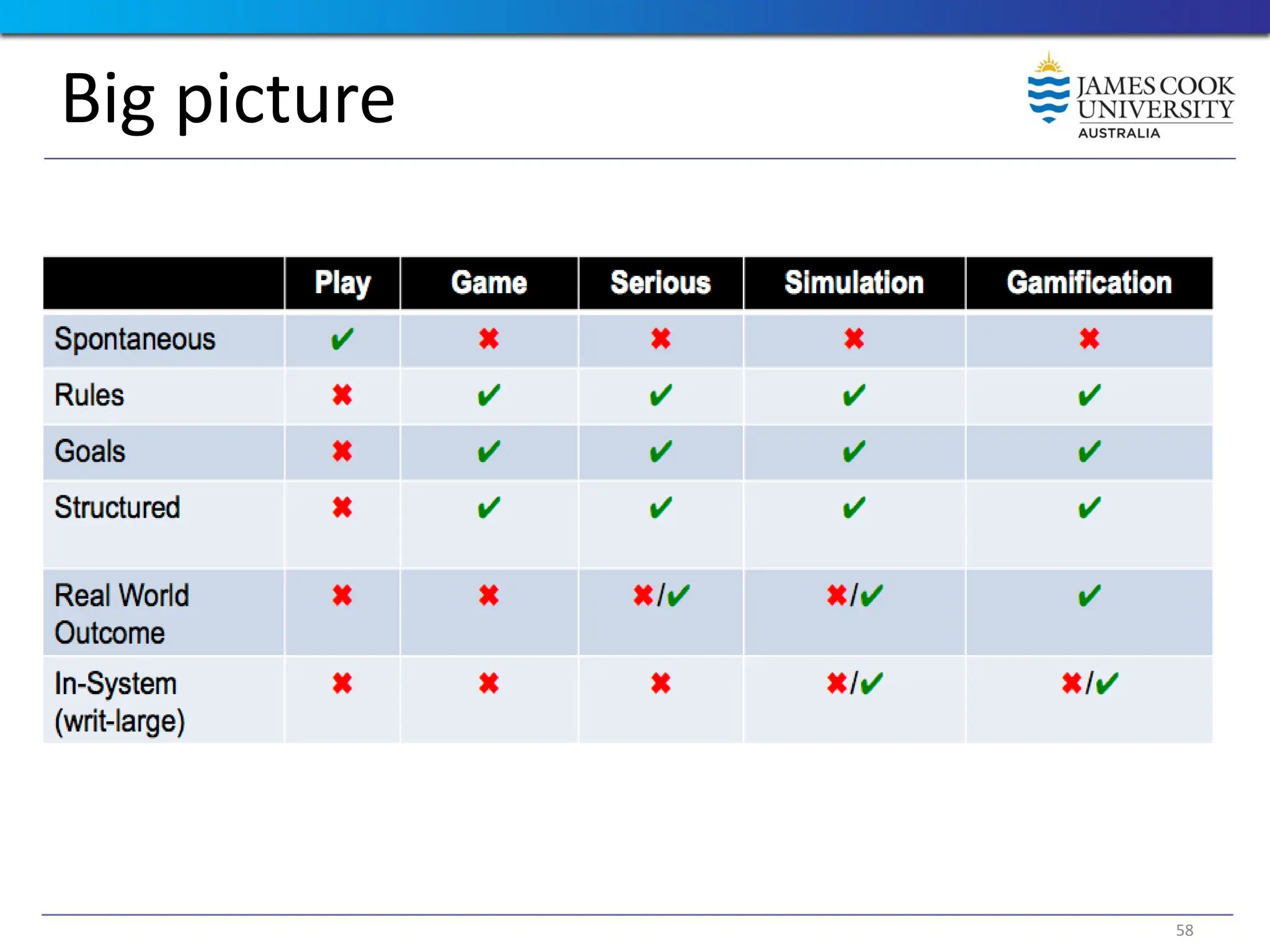
Games Serious Games Simulations
Serious Games: Games where the main purpose is to train or educate users
9
Games
Abstract challenge, defined by rules, interactivity,
and feedback, that results in a quantifiable
outcome, often eliciting an emotional reaction.
--- Dr. Karl Kapp
10
Serious Games
Games where the main purpose is to train or educate users
What distinguishes a serious game from a non-serious
game is an indirect “real world” outcome.
11
12
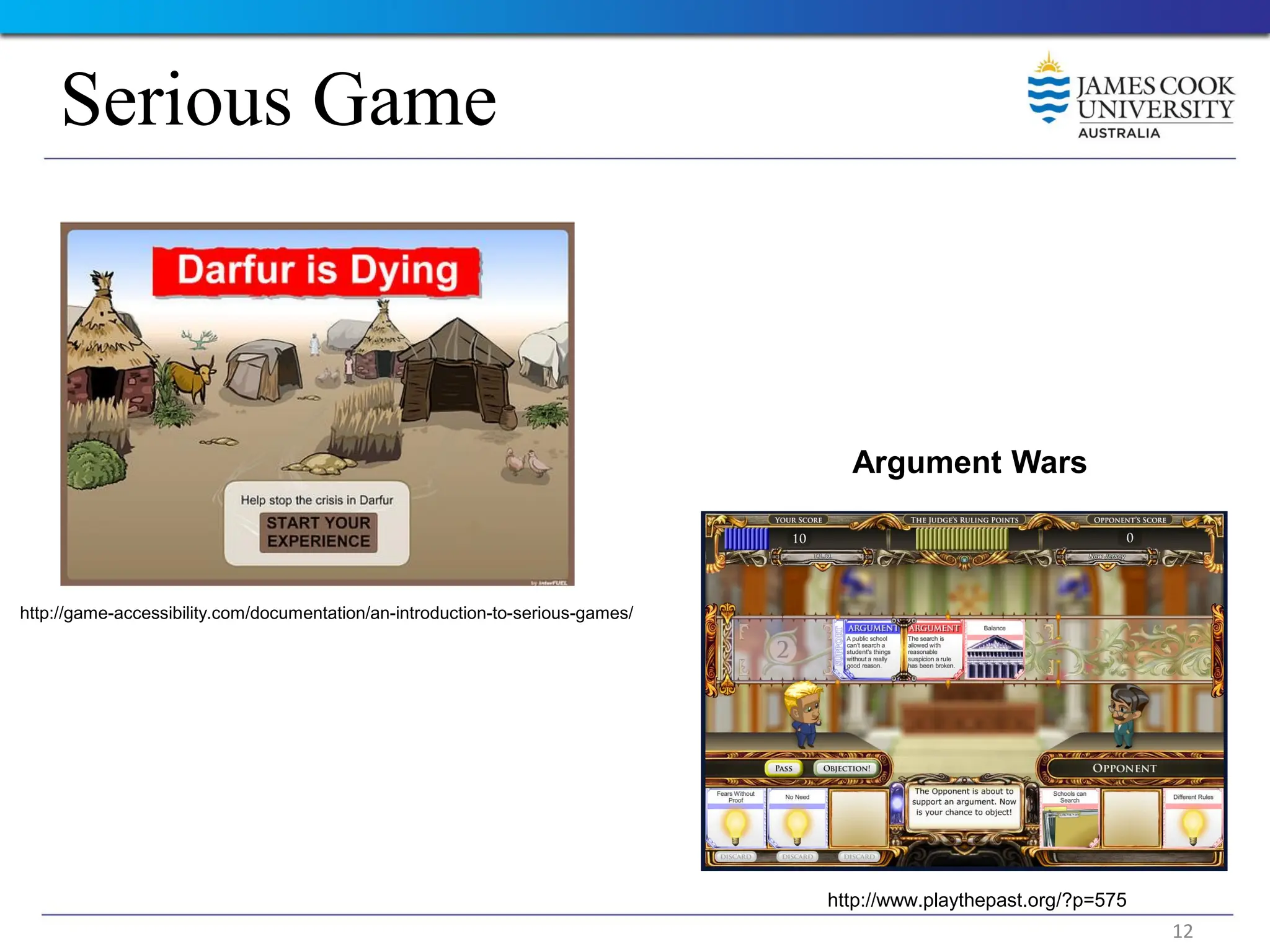
Serious Game
http://www.playthepast.org/?p=575
http://game-accessibility.com/documentation/an-introduction-to-serious-games/
Argument Wars
Simulation
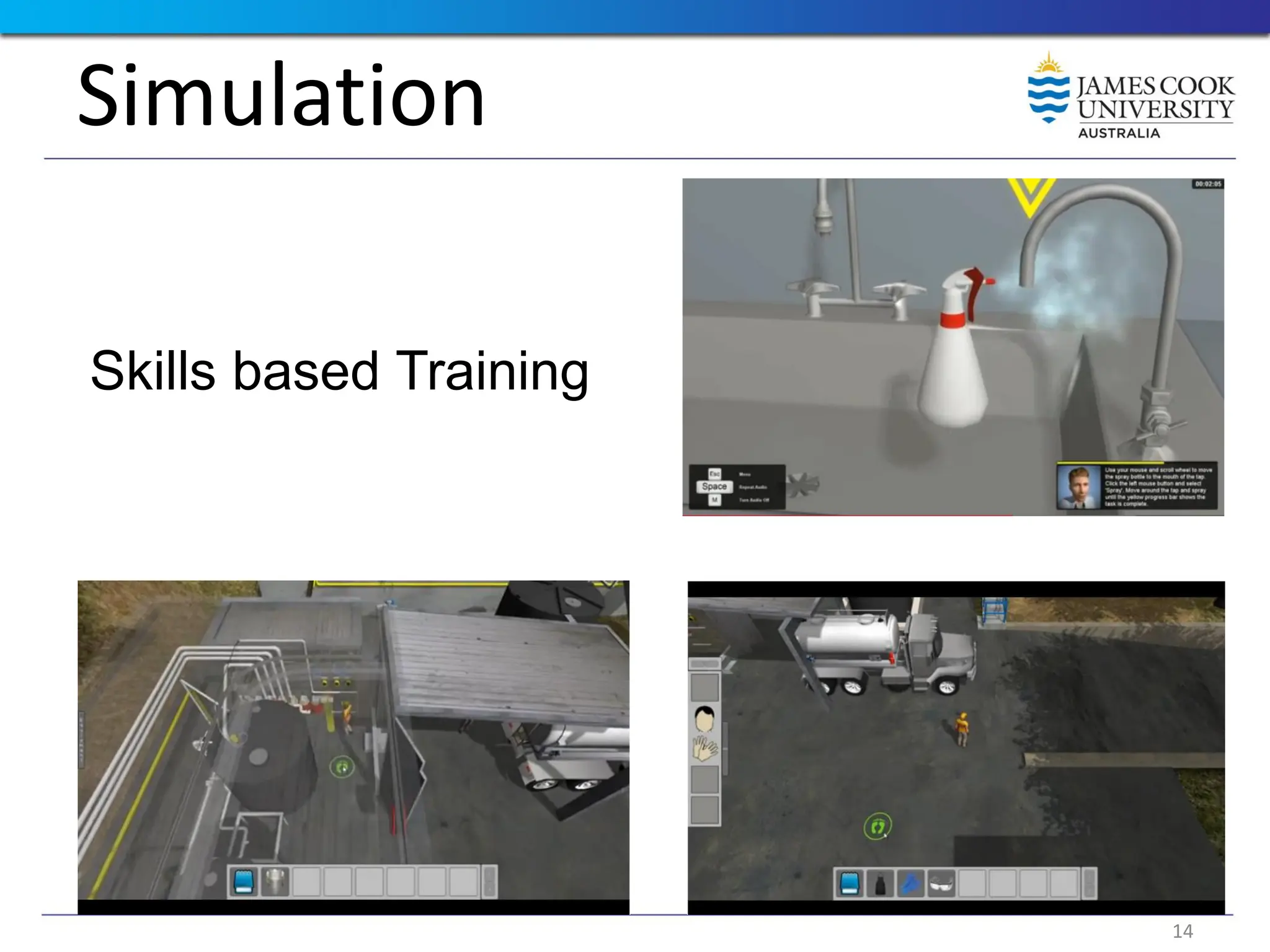
A simulation accurately looks, feels, and
behaves close to something in the real world
A simulation can be studied or used to train
people in a real-world setting.
13
Simulation
Skills based Training
14
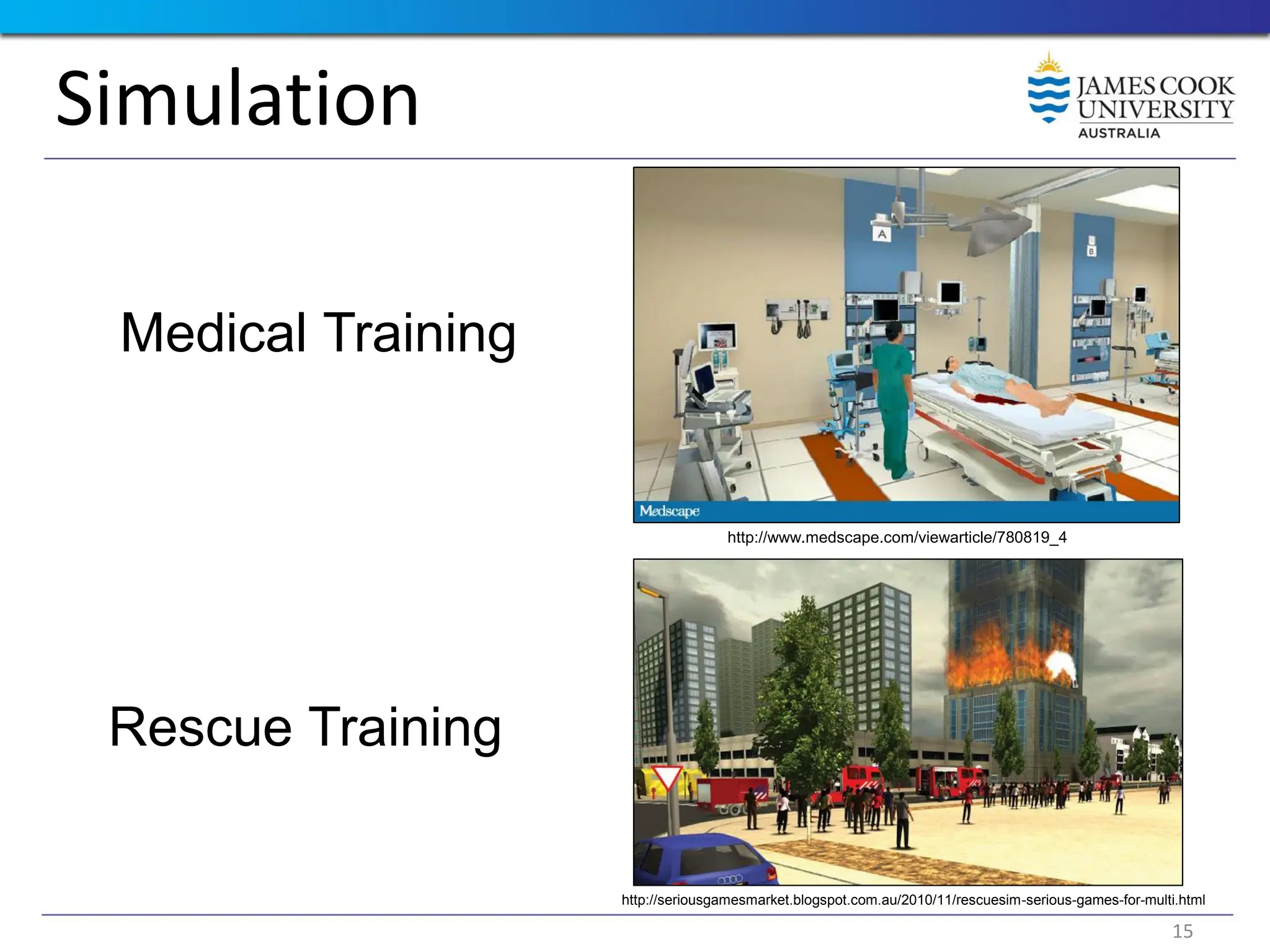
Simulation
Medical Training
Rescue Training
http://seriousgamesmarket.blogspot.com.au/2010/11/rescuesim-serious-games-for-multi.html
http://www.medscape.com/viewarticle/780819_4
15
16
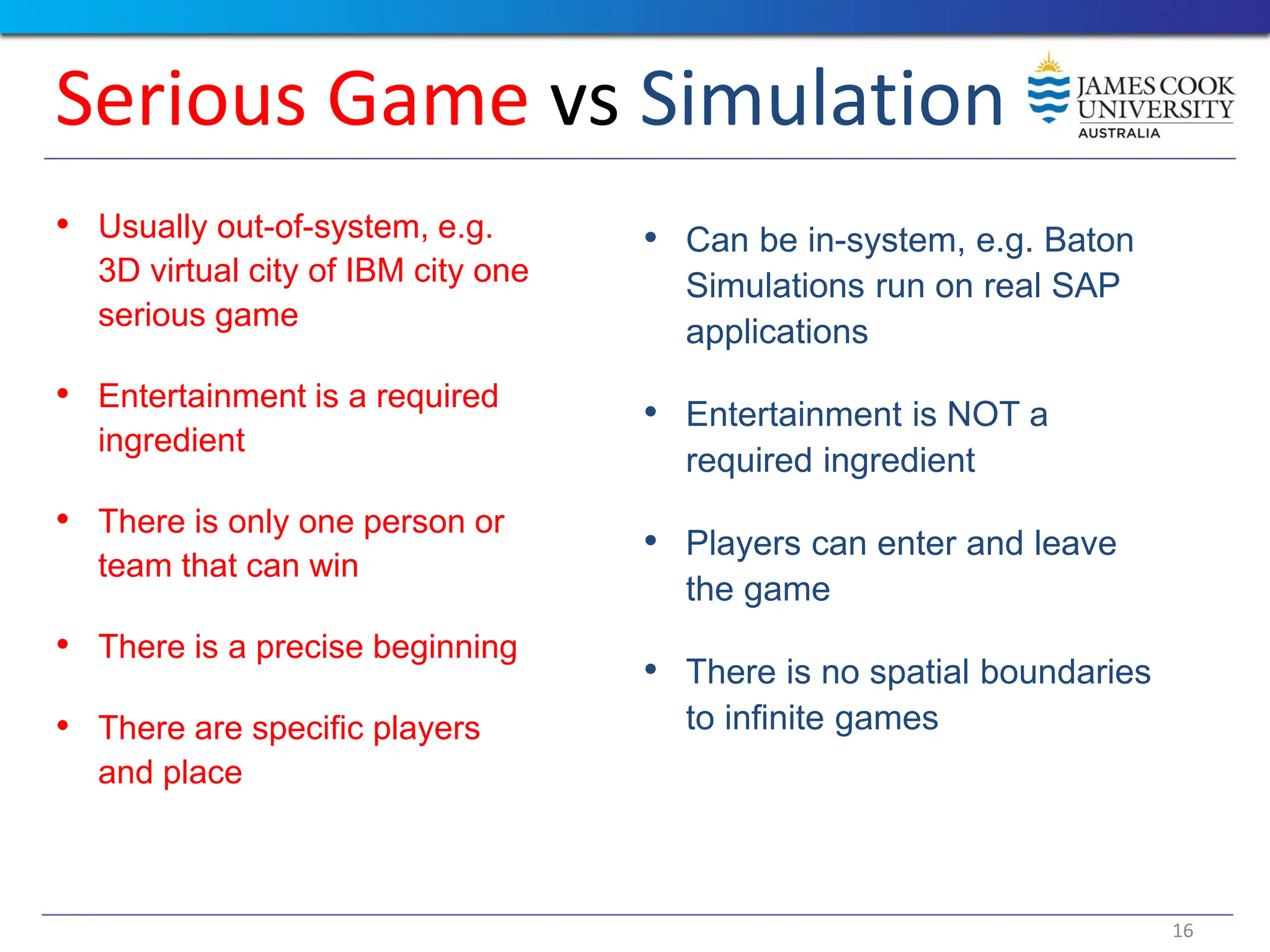
Serious Game vs Simulation
• Usually out-of-system, e.g.
3D virtual city of IBM city one
serious game
• Entertainment is a required
ingredient
• There is only one person or
team that can win
• There is a precise beginning
• There are specific players
and place
• Can be in-system, e.g. Baton
Simulations run on real SAP
applications
• Entertainment is NOT a
required ingredient
• Players can enter and leave
the game
• There is no spatial boundaries
to infinite games
17
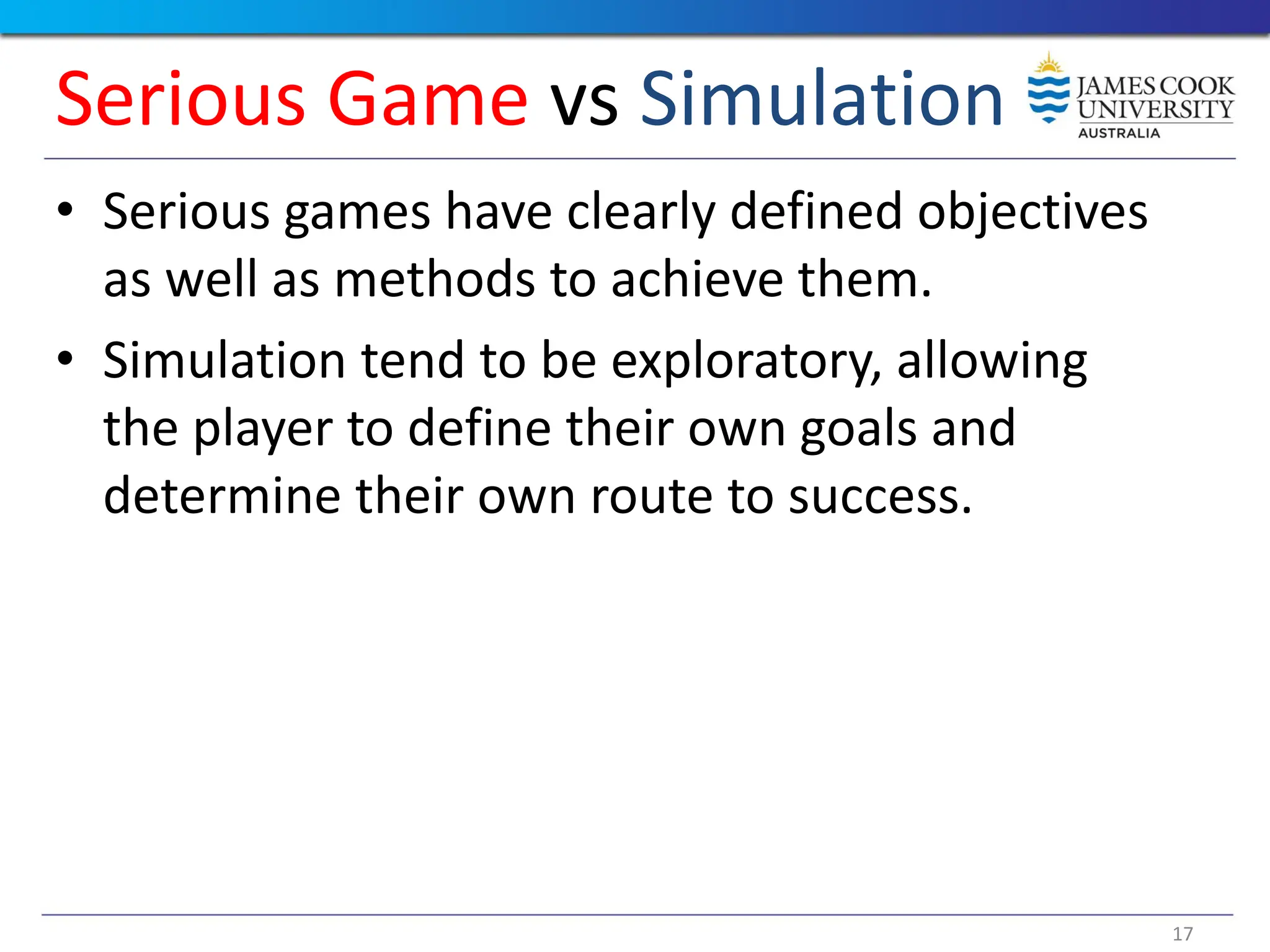
• Serious games have clearly defined objectives
as well as methods to achieve them.
• Simulation tend to be exploratory, allowing
the player to define their own goals and
determine their own route to success.
Serious Game vs Simulation
Gamification
Using game-based mechanics, aesthetics and
game thinking to engage people, motivate action,
promote learning, and solve problems.
--- Dr. Karl Kapp
18
Gamification
• Gamification is the use of game design
techniques & mechanics to solve problems
and engage audiences.
• Gamification strives to encourage users to
engage in desired behaviors in connection
with non-game applications.
• Can be very powerful tool to change attitudes
and affect behavioral change.
19
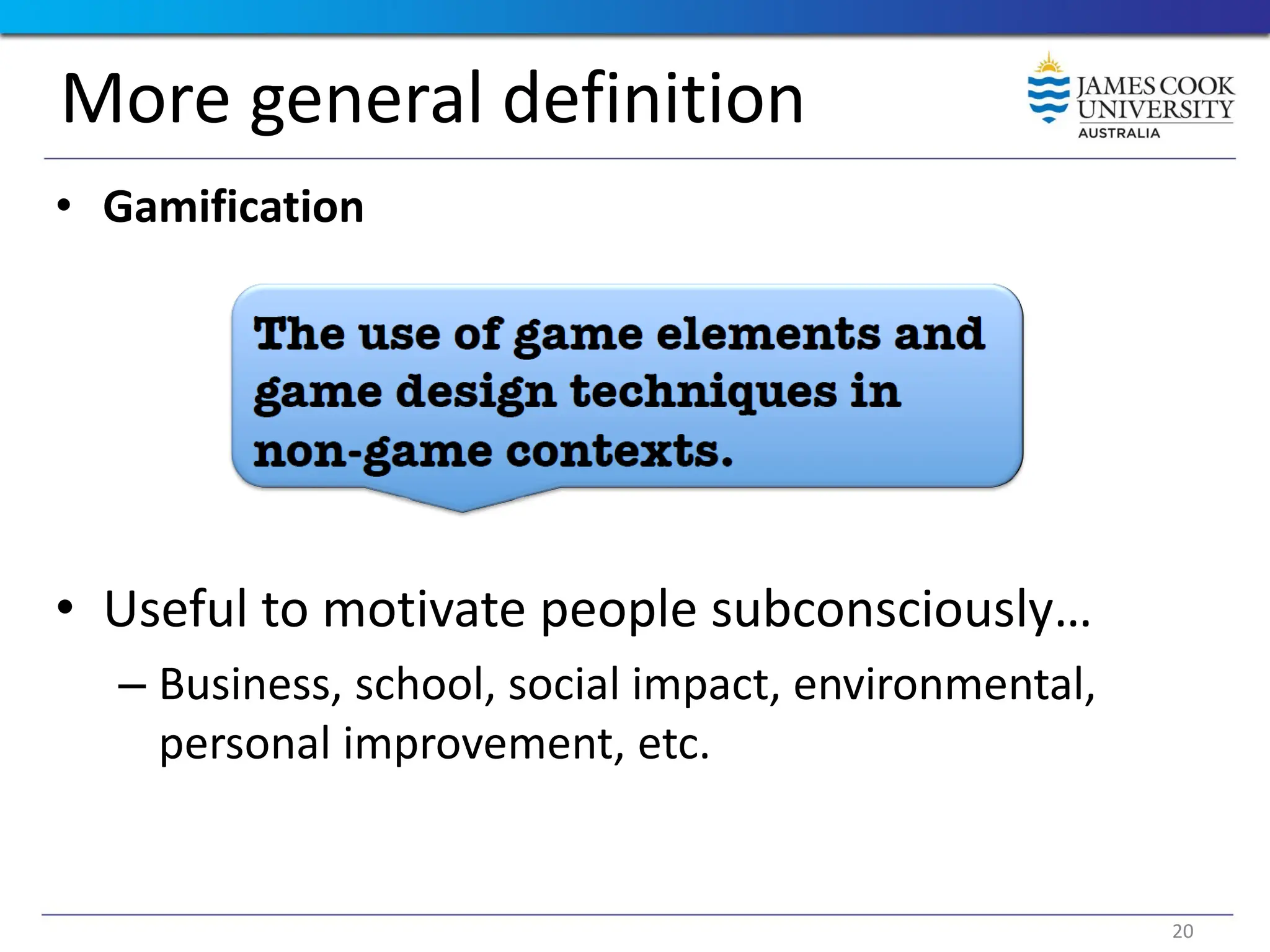
More general definition
• Gamification
• Useful to motivate people subconsciously…
– Business, school, social impact, environmental,
personal improvement, etc.
20
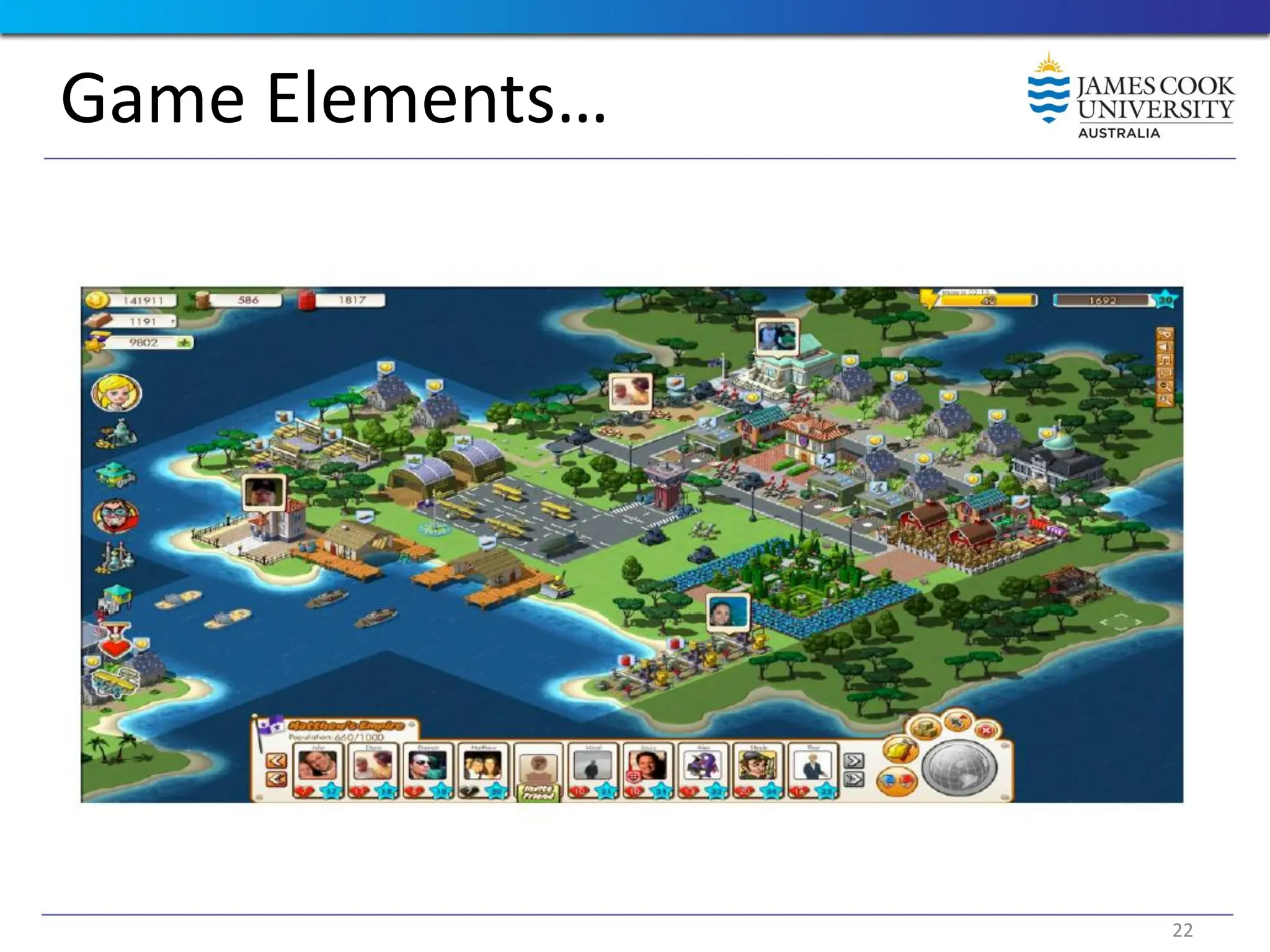
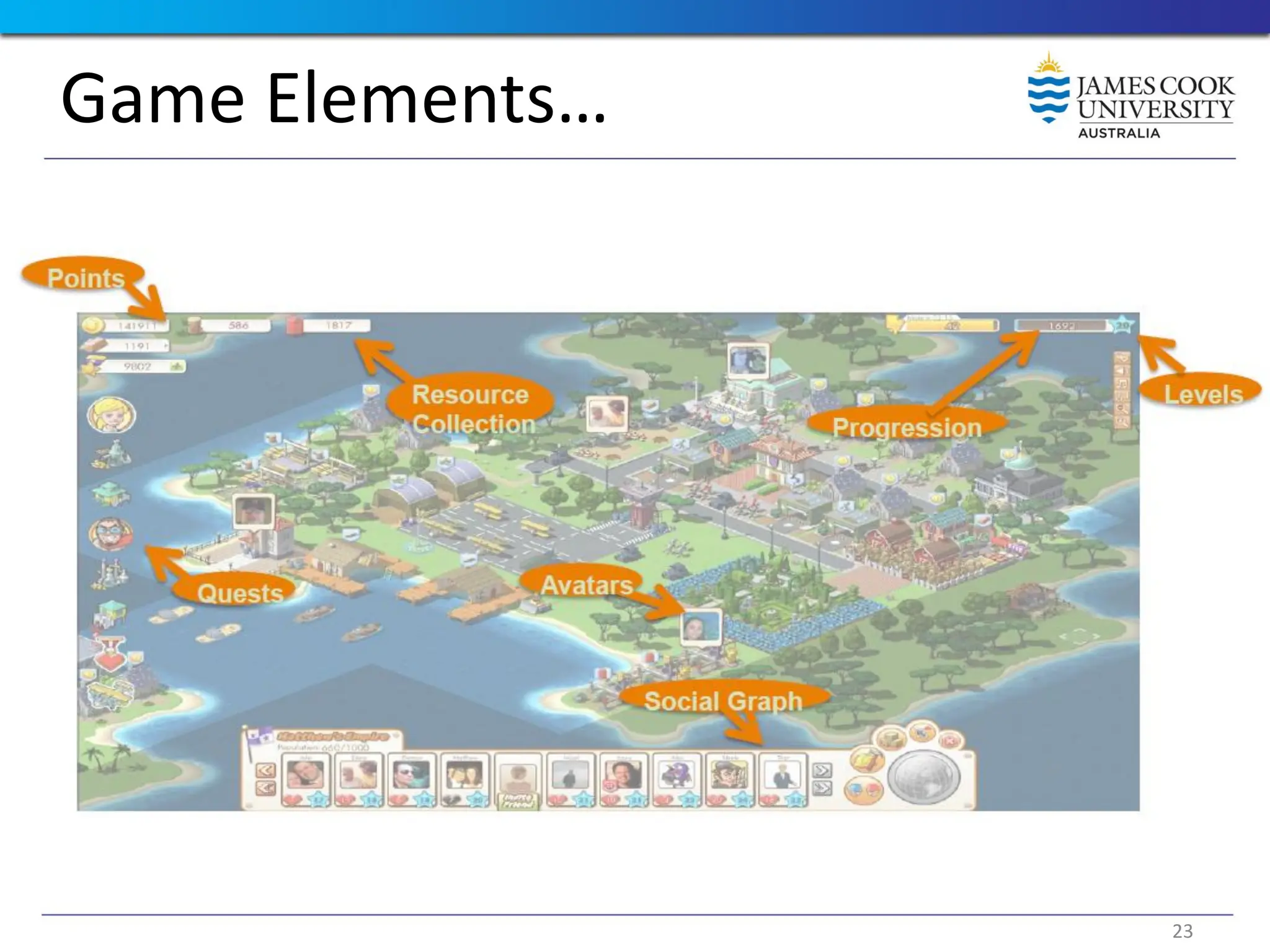
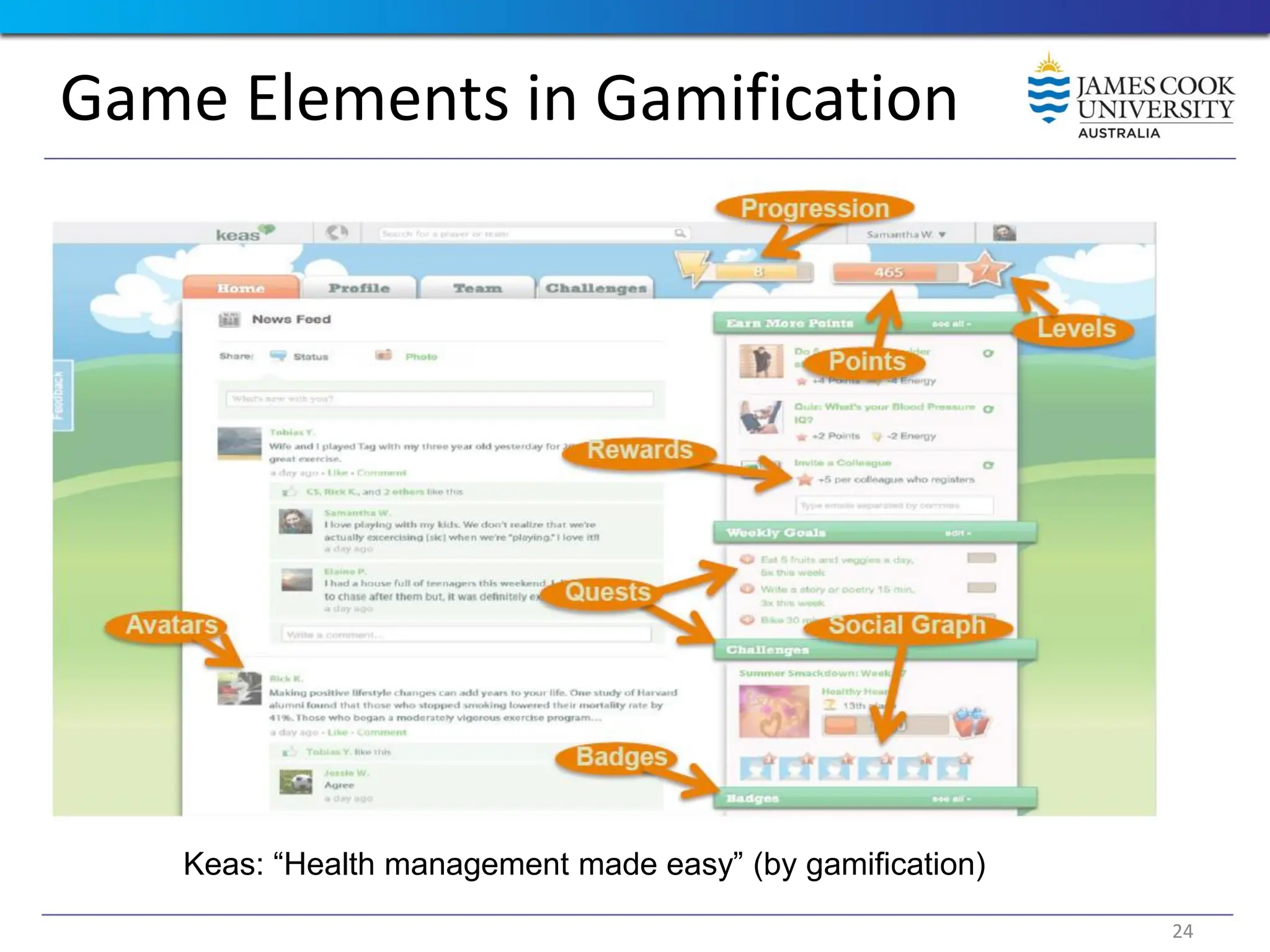
Game Elements
What game elements can we take from games to apply
to other non-game applications
21
Game Elements…
22
Game Elements…
23
Game Elements in Gamification
Keas: “Health management made easy” (by gamification)
24
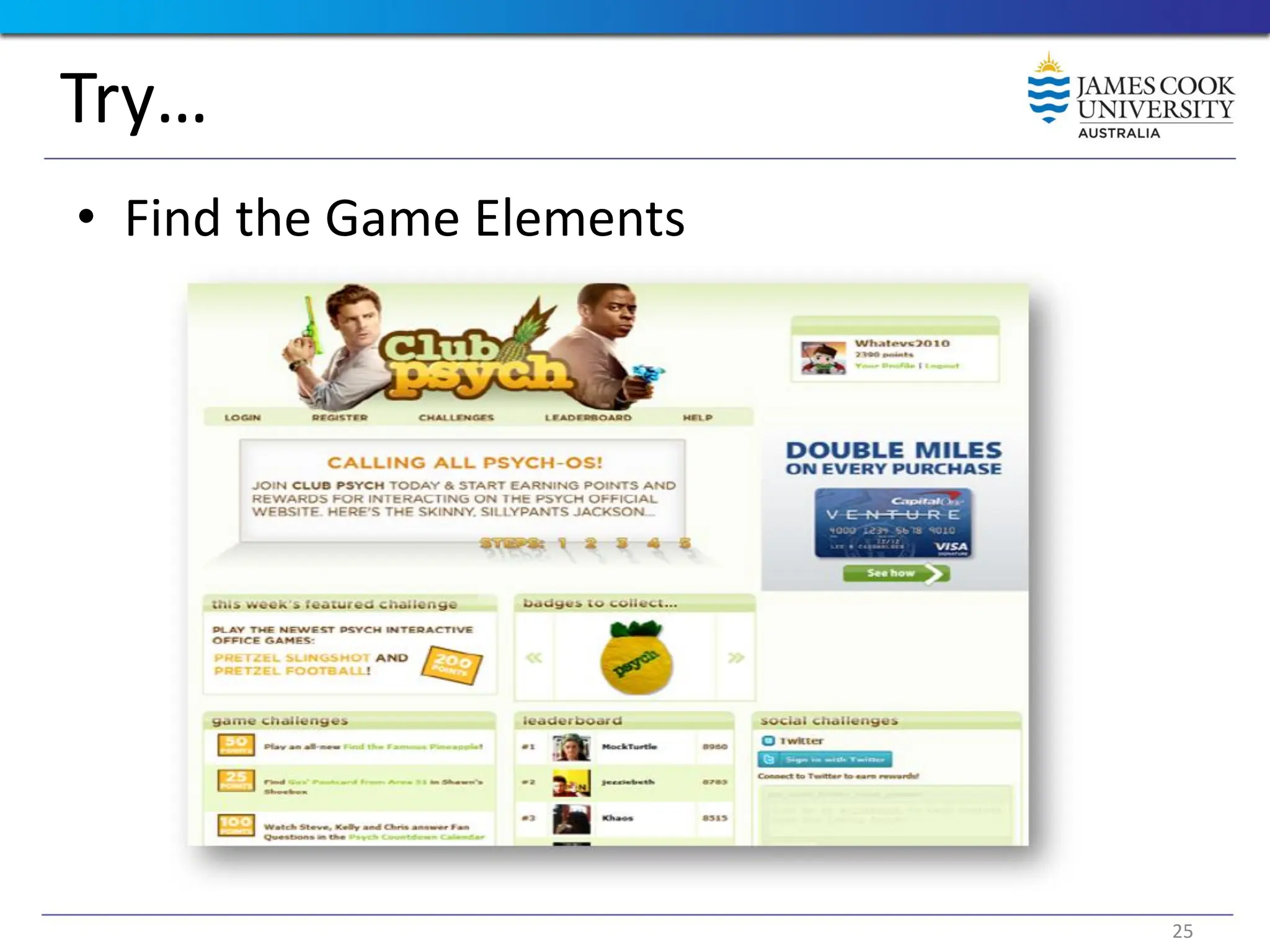
Try…
• Find the Game Elements
25
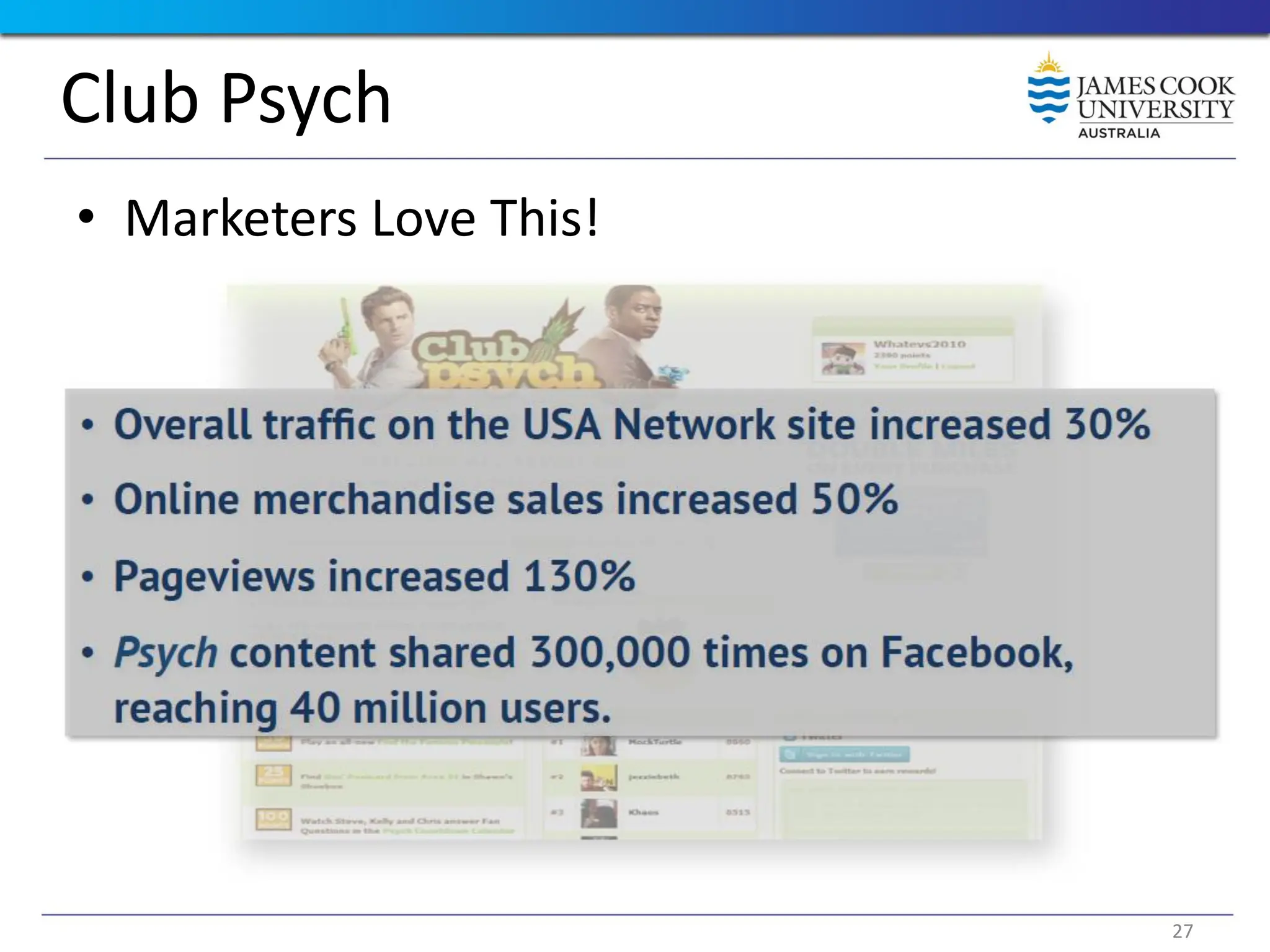
Club Psych
• Marketers Love This!
27
Gamification
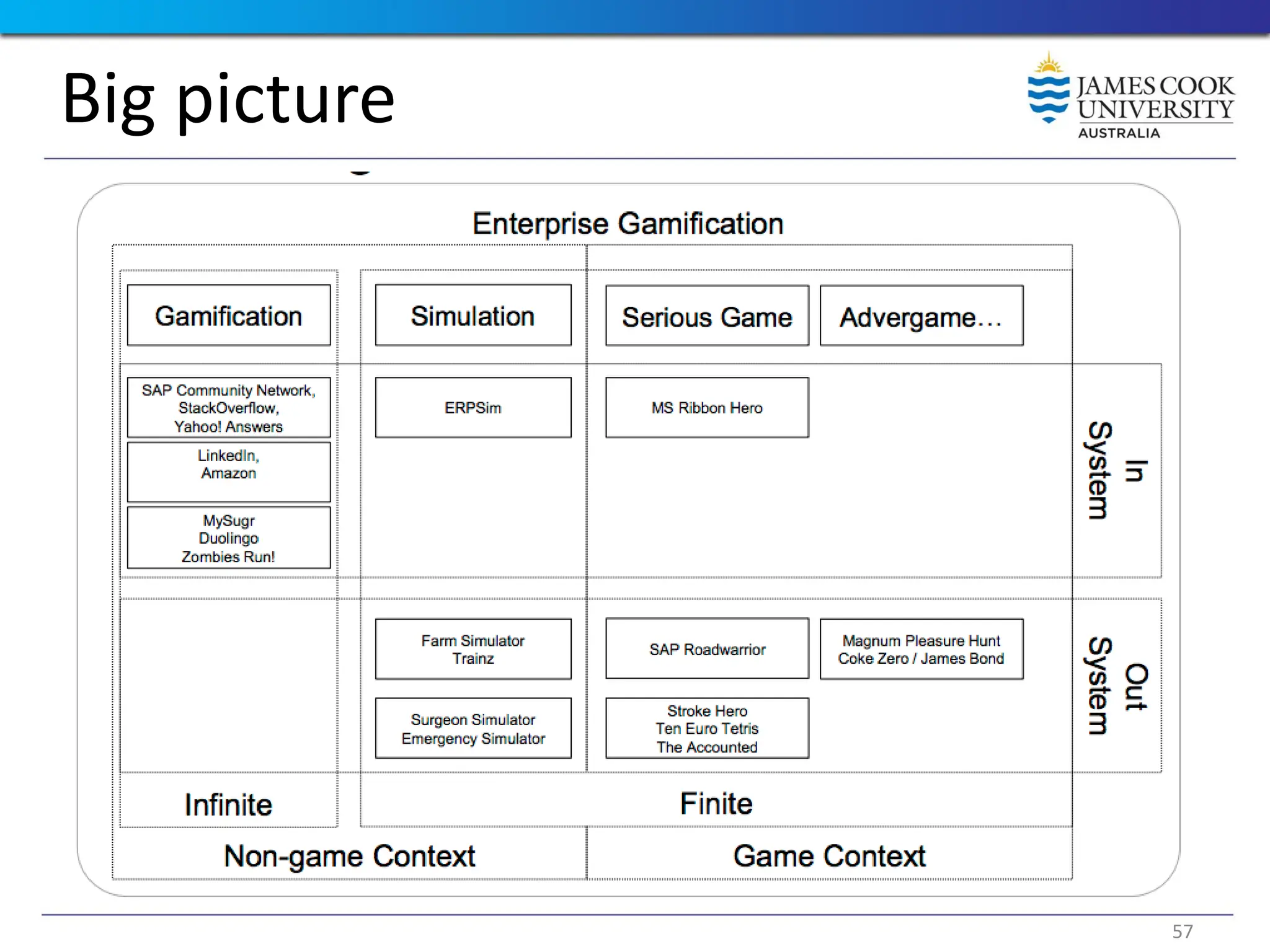
Enterprise Gamification
28
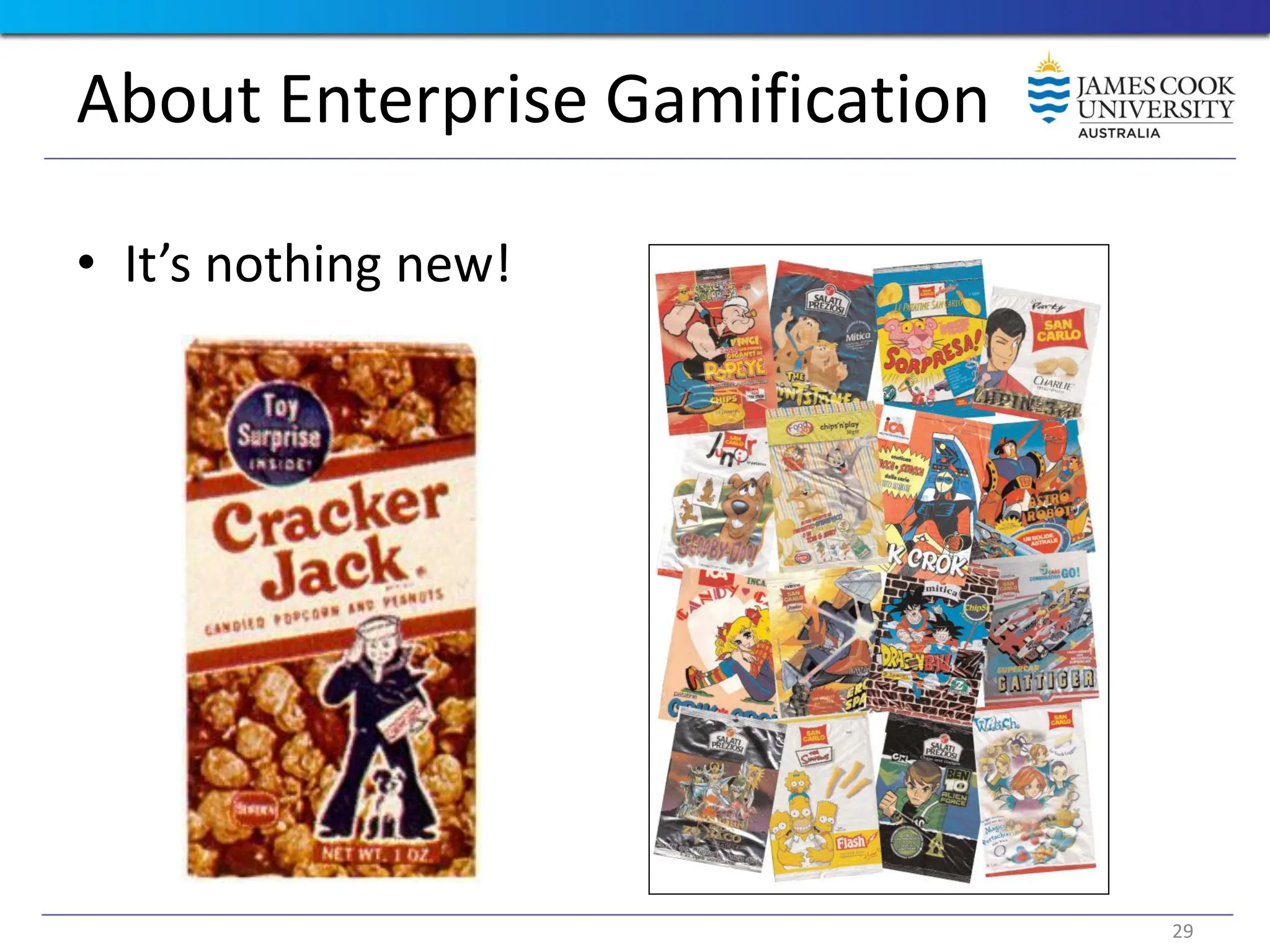
About Enterprise Gamification
• It’s nothing new!
29
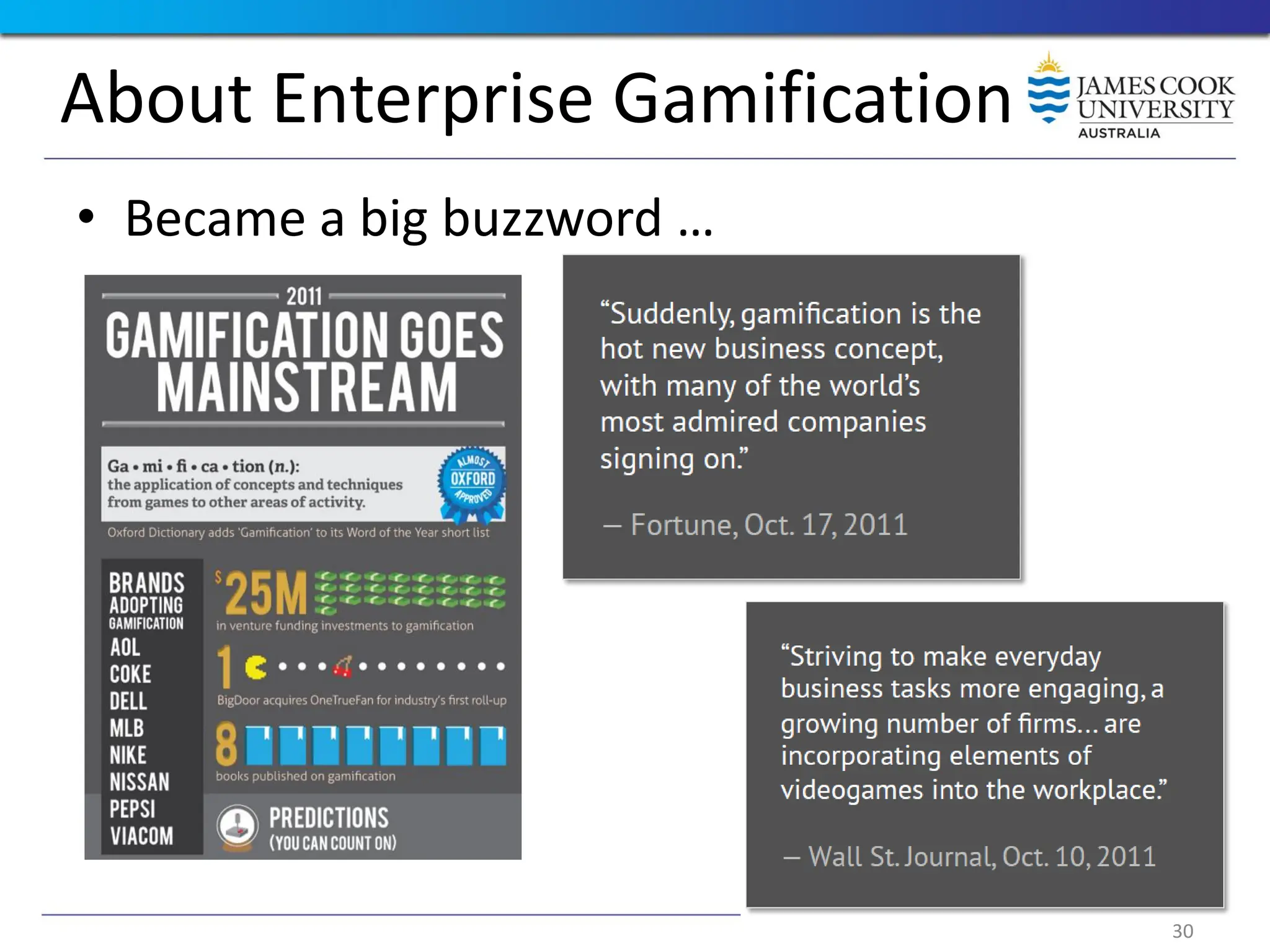
About Enterprise Gamification
• Became a big buzzword …
30
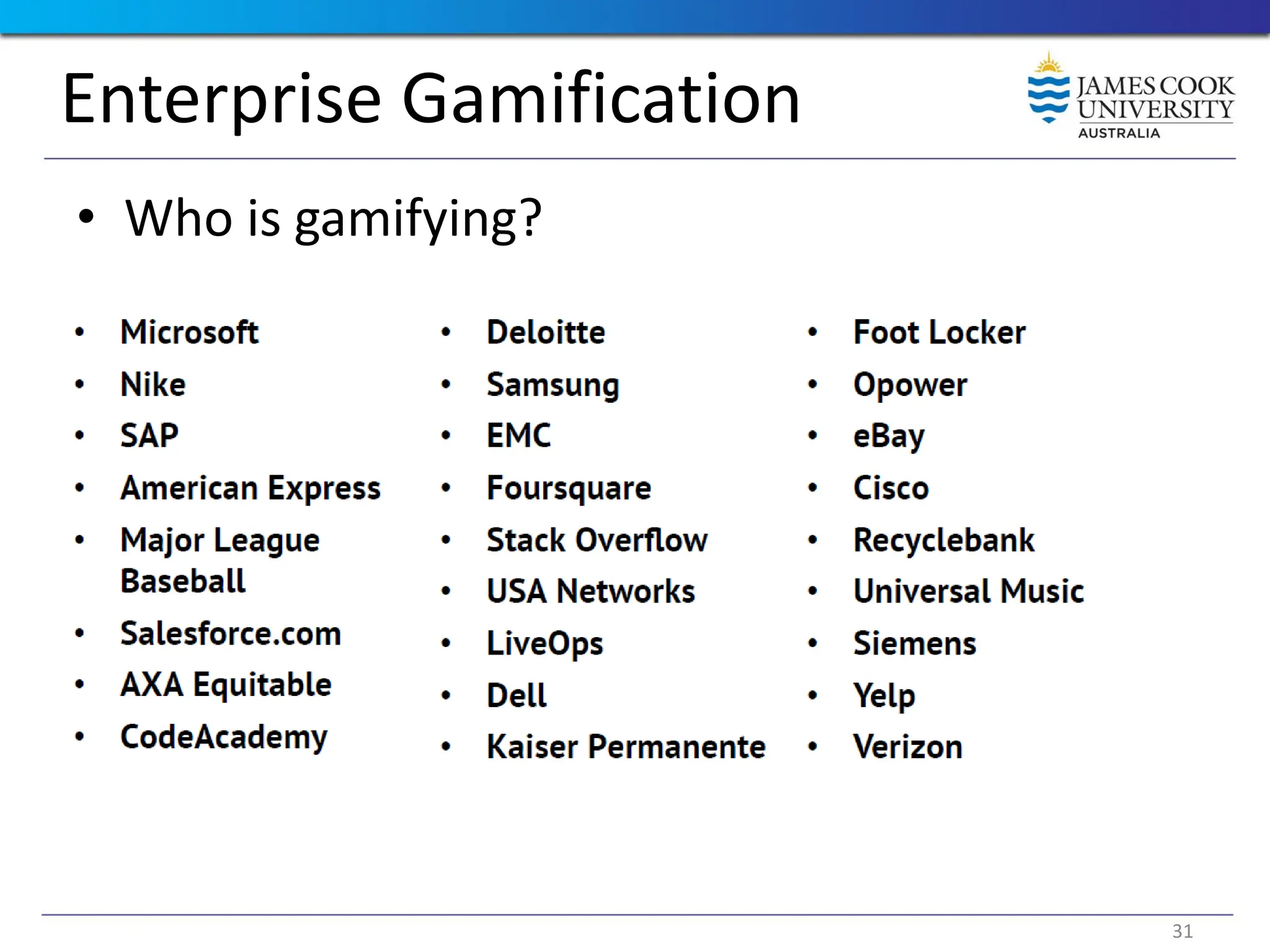
Enterprise Gamification
• Who is gamifying?
31
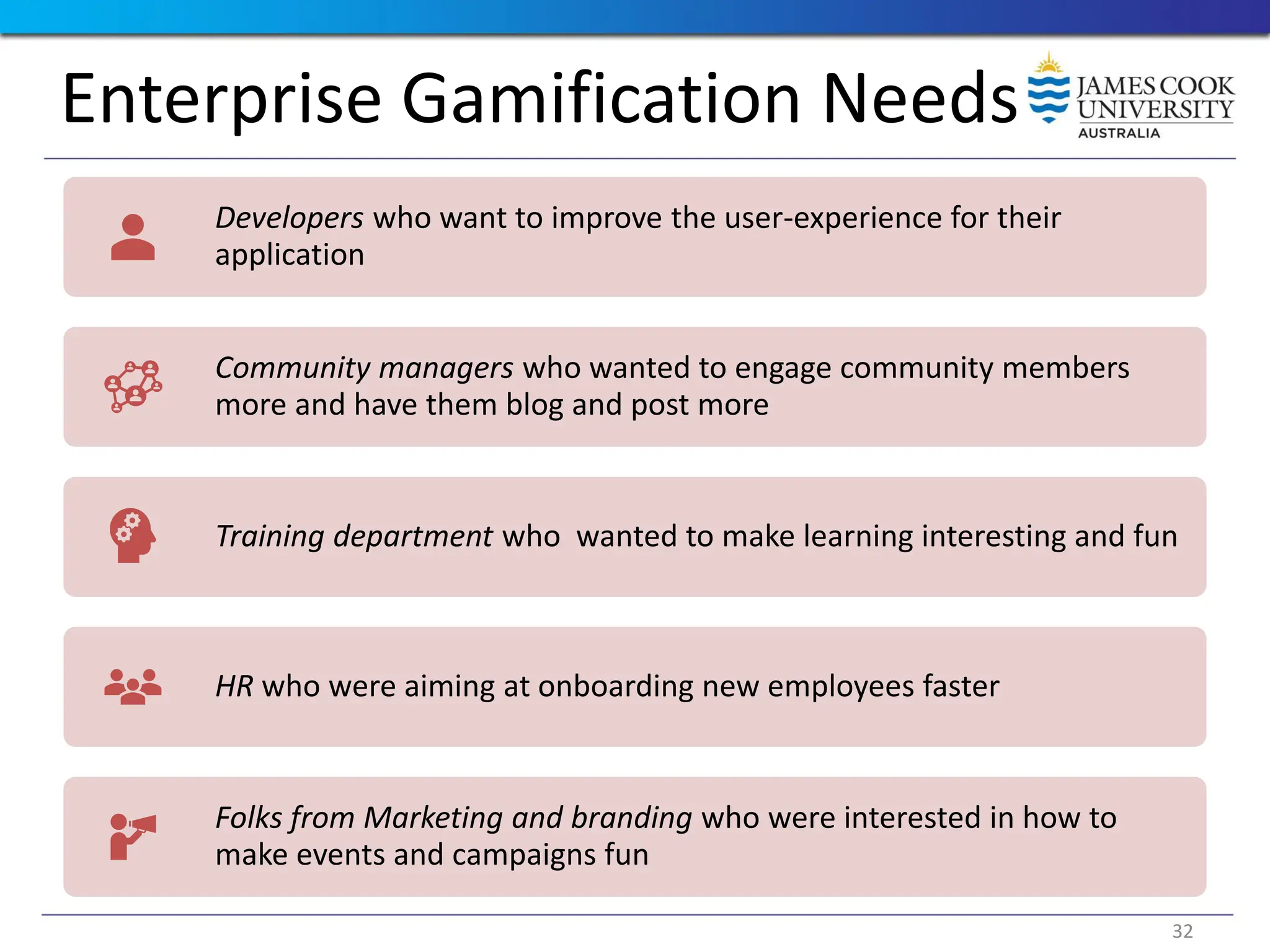
Enterprise Gamification Needs
Developers who want to improve the user-experience for their
application
Community managers who wanted to engage community members
more and have them blog and post more
Training department who wanted to make learning interesting and fun
HR who were aiming at onboarding new employees faster
Folks from Marketing and branding who were interested in how to
make events and campaigns fun
32
Enterprise gamification
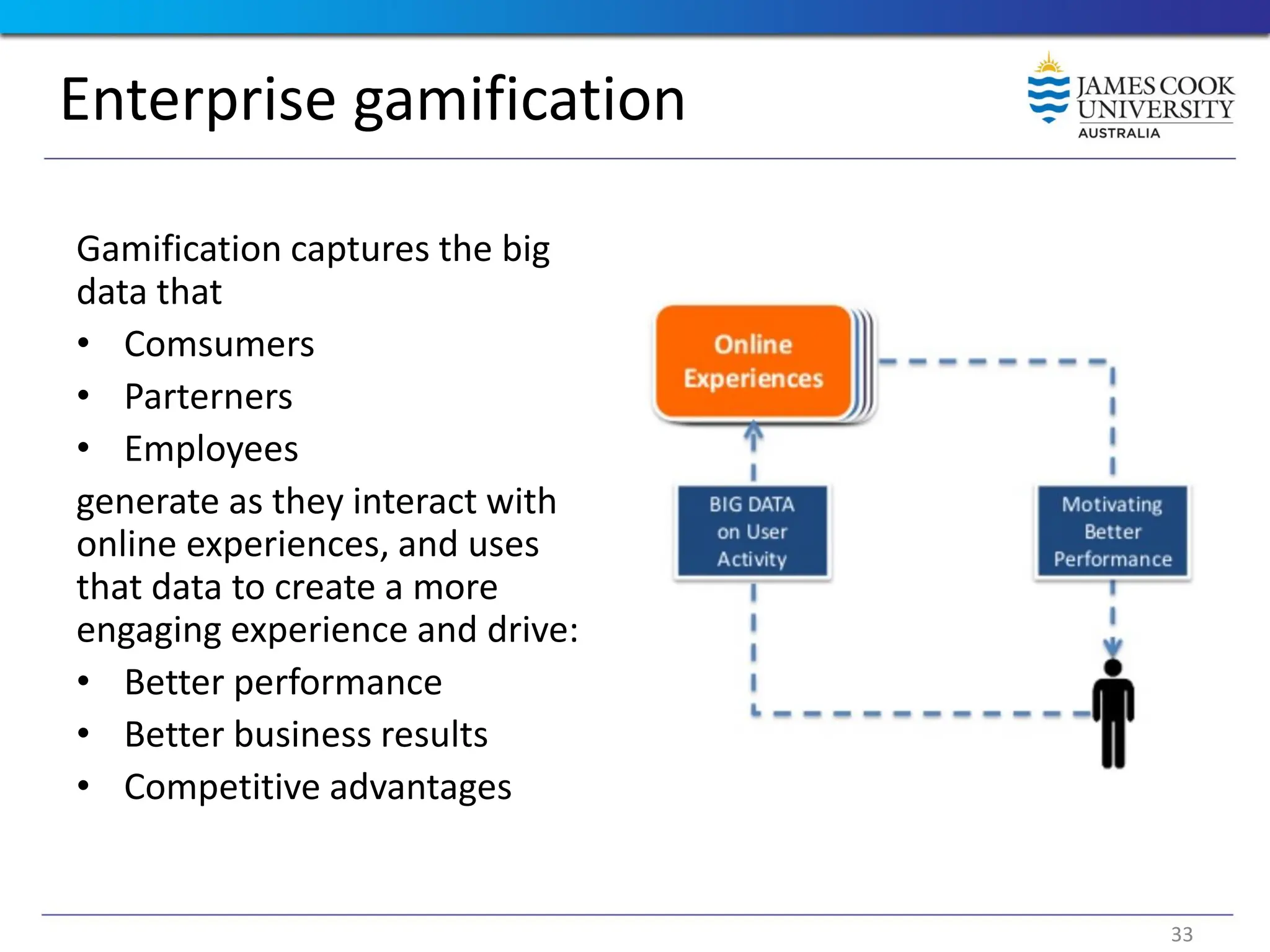
Gamification captures the big
data that
• Comsumers
• Parterners
• Employees
generate as they interact with
online experiences, and uses
that data to create a more
engaging experience and drive:
• Better performance
• Better business results
• Competitive advantages
33
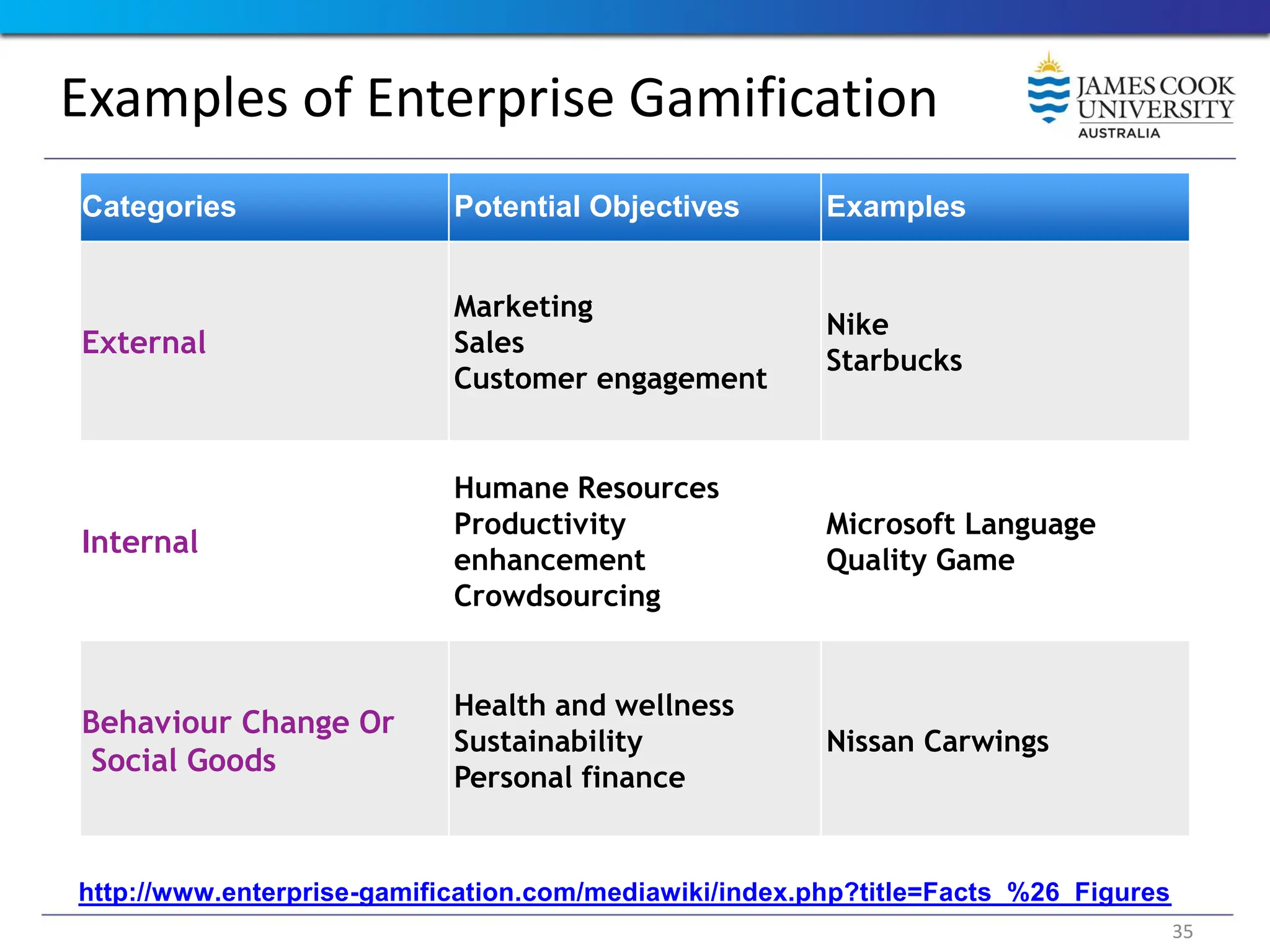
Categories of Enterprise Gamification
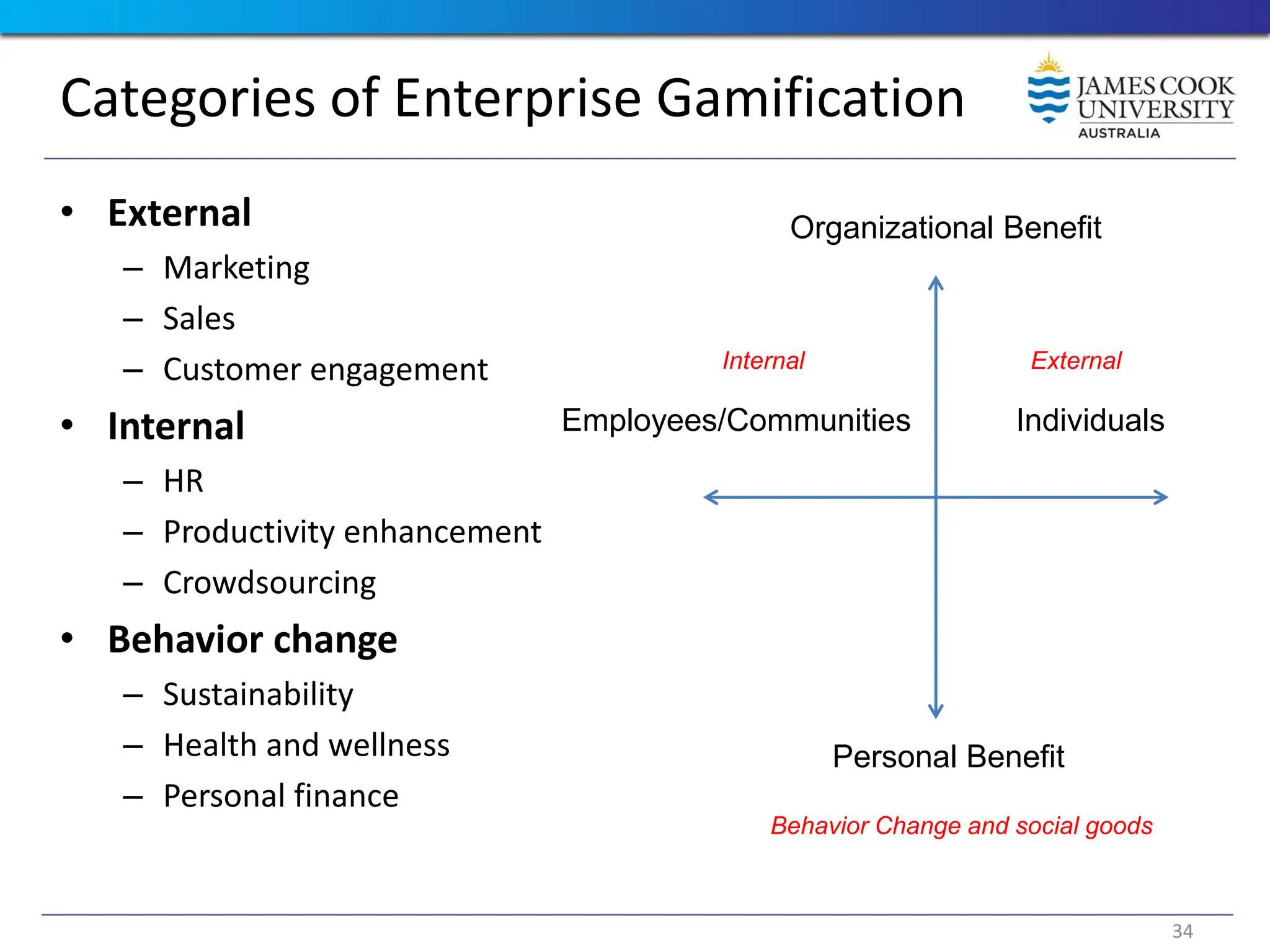
• External
– Marketing
– Sales
– Customer engagement
• Internal
– HR
– Productivity enhancement
– Crowdsourcing
• Behavior change
– Sustainability
– Health and wellness
– Personal finance
Organizational Benefit
Personal Benefit
Individuals
Employees/Communities
External
Internal
Behavior Change and social goods
34
Examples of Enterprise Gamification
35
Categories Potential Objectives Examples
External
Marketing
Sales
Customer engagement
Nike
Starbucks
Internal
Humane Resources
Productivity
enhancement
Crowdsourcing
Microsoft Language
Quality Game
Behaviour Change Or
Social Goods
Health and wellness
Sustainability
Personal finance
Nissan Carwings
More examples of gamifications:
http://www.enterprise-gamification.com/mediawiki/index.php?title=Facts_%26_Figures
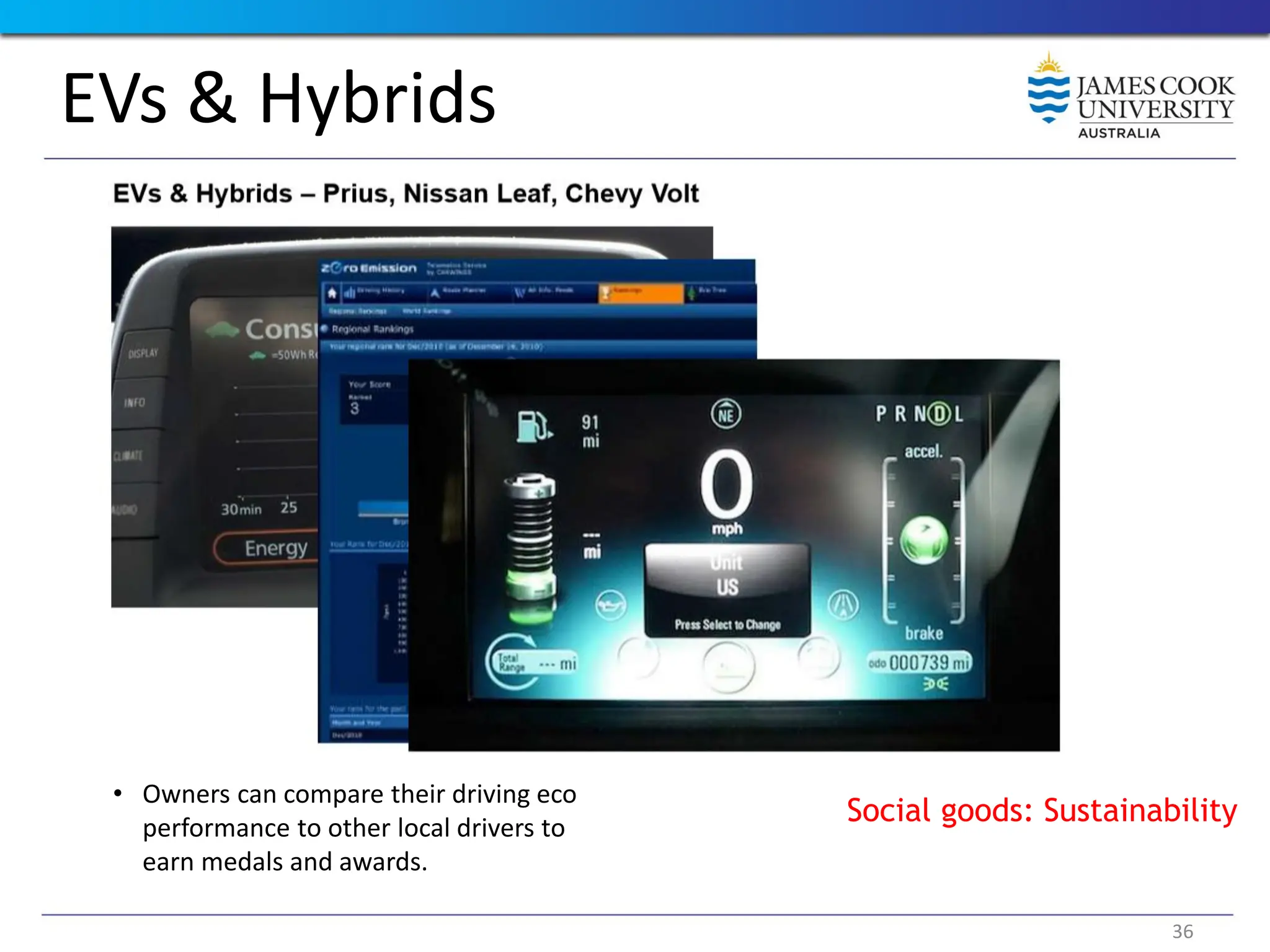
EVs & Hybrids
36
Social goods: Sustainability
• Owners can compare their driving eco
performance to other local drivers to
earn medals and awards.
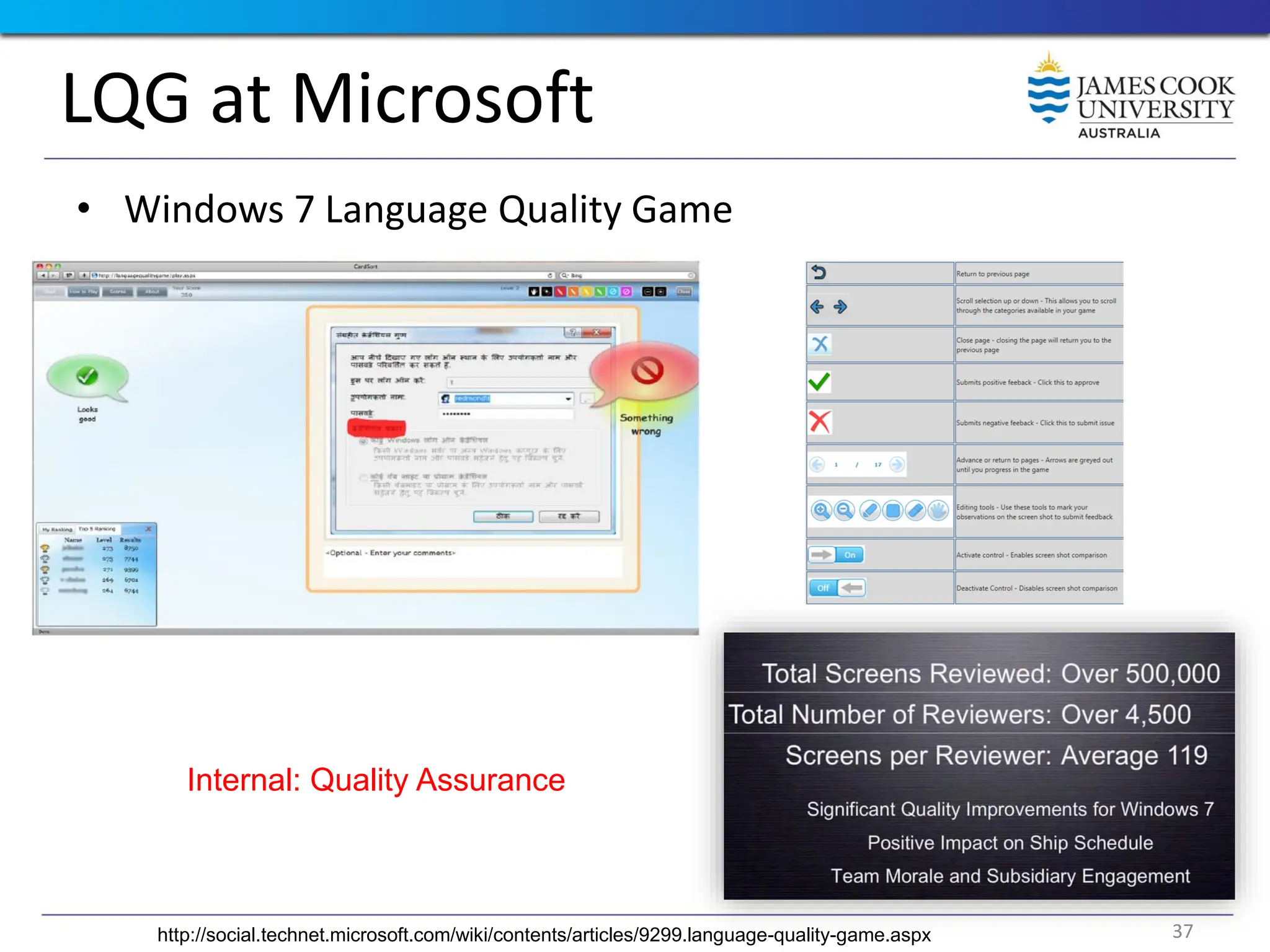
LQG at Microsoft
• Windows 7 Language Quality Game
Internal: Quality Assurance
http://social.technet.microsoft.com/wiki/contents/articles/9299.language-quality-game.aspx 37
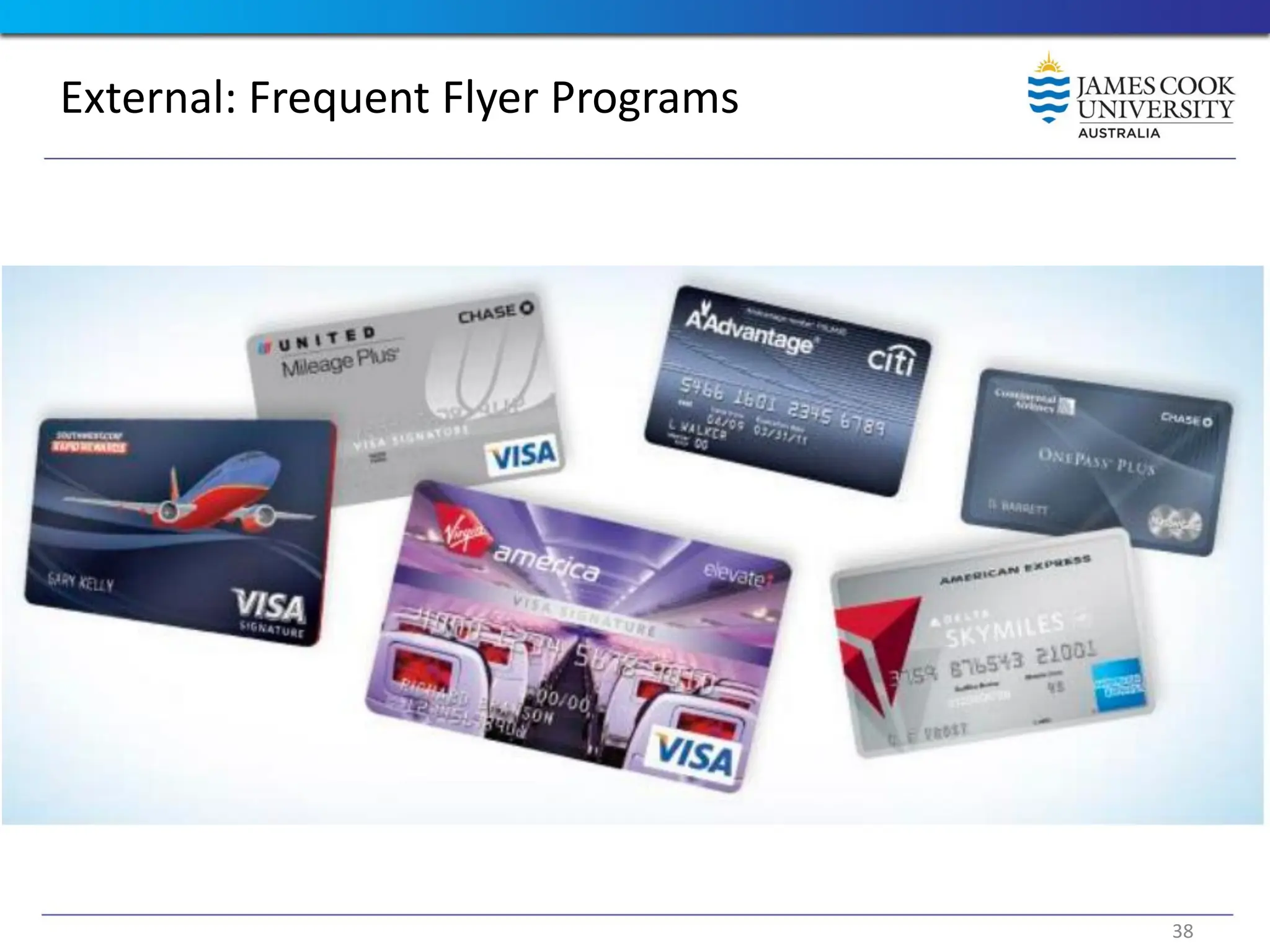
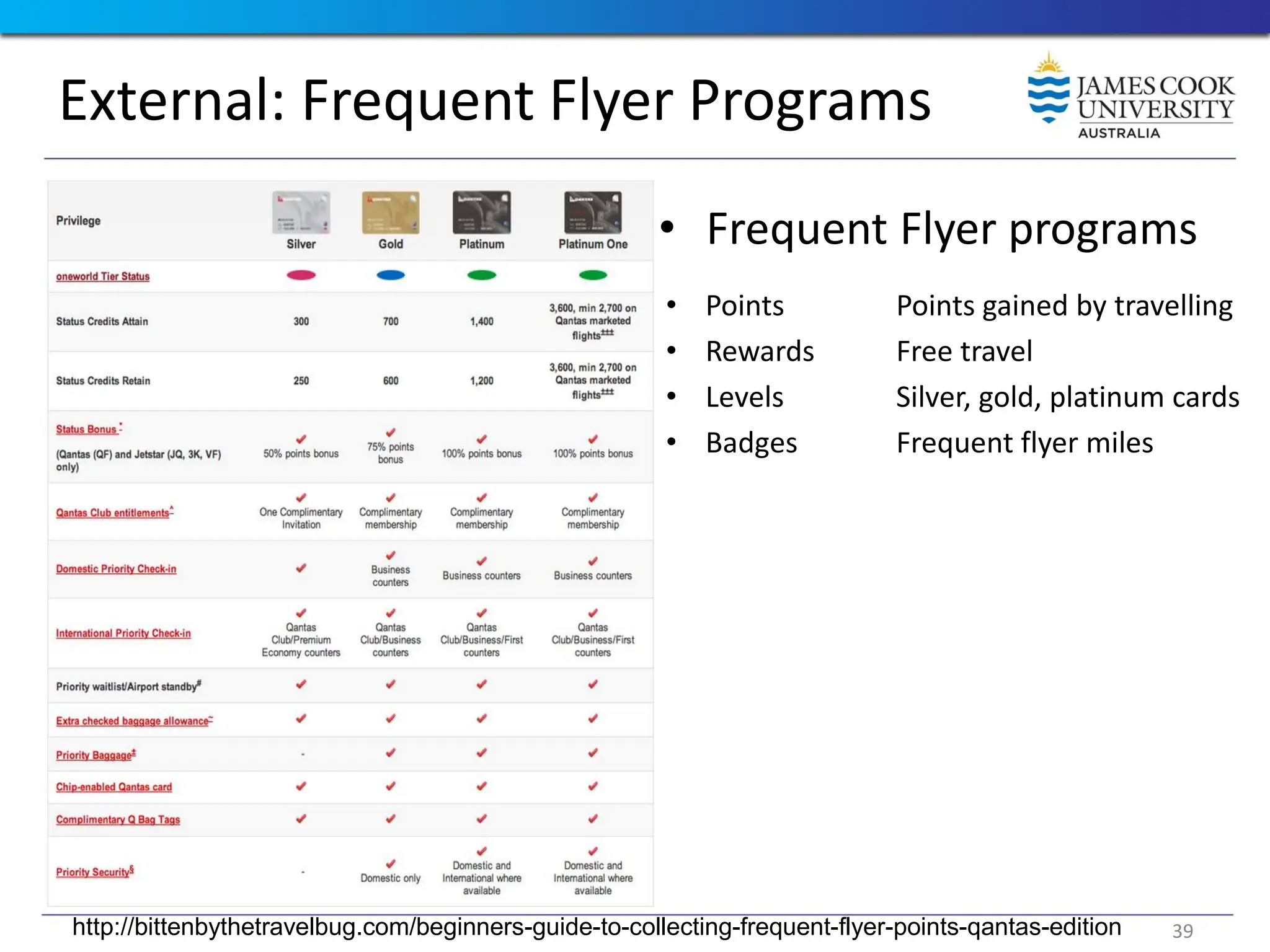
External: Frequent Flyer Programs
38
External: Frequent Flyer Programs
• Frequent Flyer programs
• Points Points gained by travelling
• Rewards Free travel
• Levels Silver, gold, platinum cards
• Badges Frequent flyer miles
39
http://bittenbythetravelbug.com/beginners-guide-to-collecting-frequent-flyer-points-qantas-edition
External: Frequent Flyer Programs
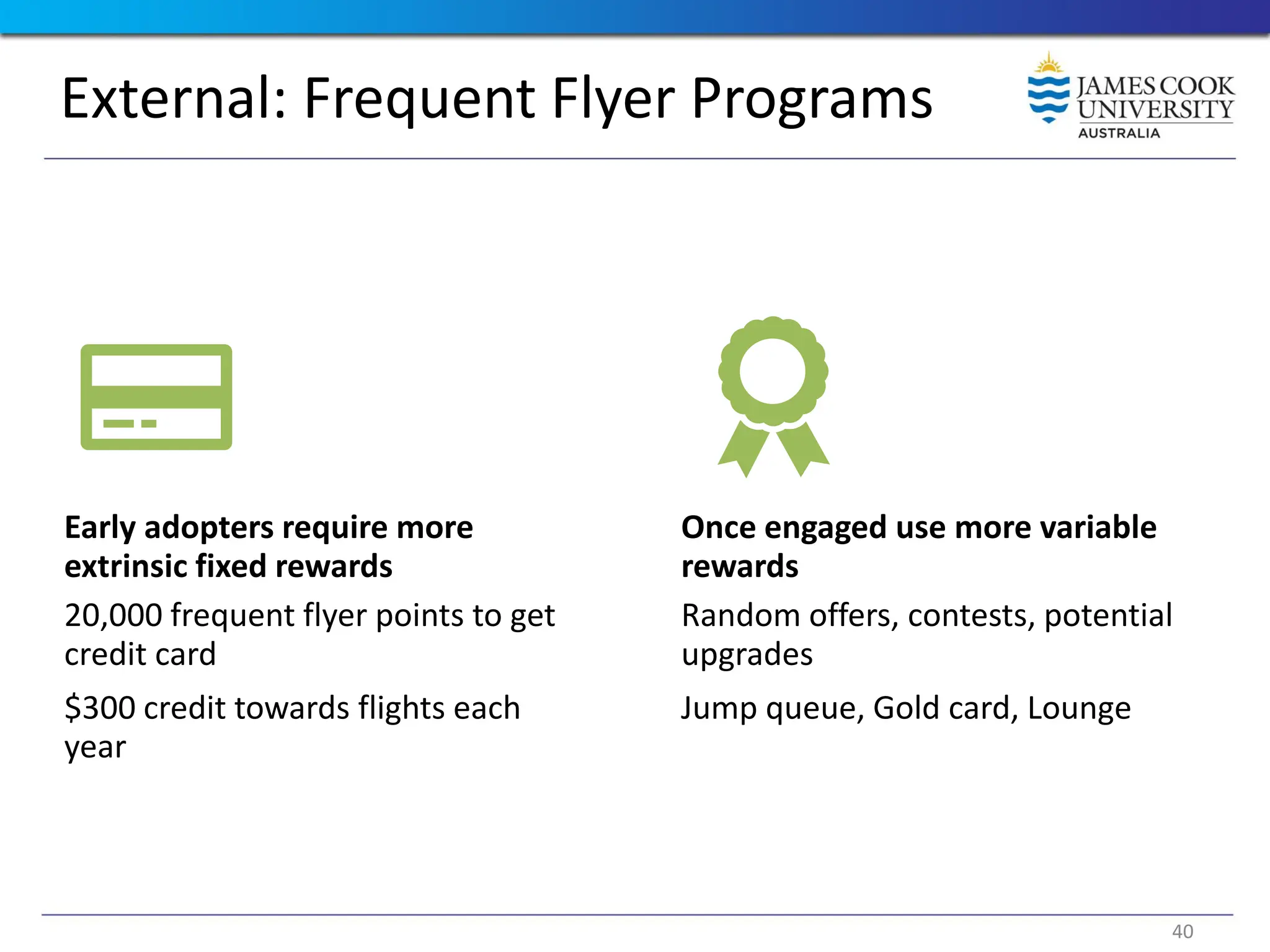
Early adopters require more
extrinsic fixed rewards
20,000 frequent flyer points to get
credit card
$300 credit towards flights each
year
Once engaged use more variable
rewards
Random offers, contests, potential
upgrades
Jump queue, Gold card, Lounge
40
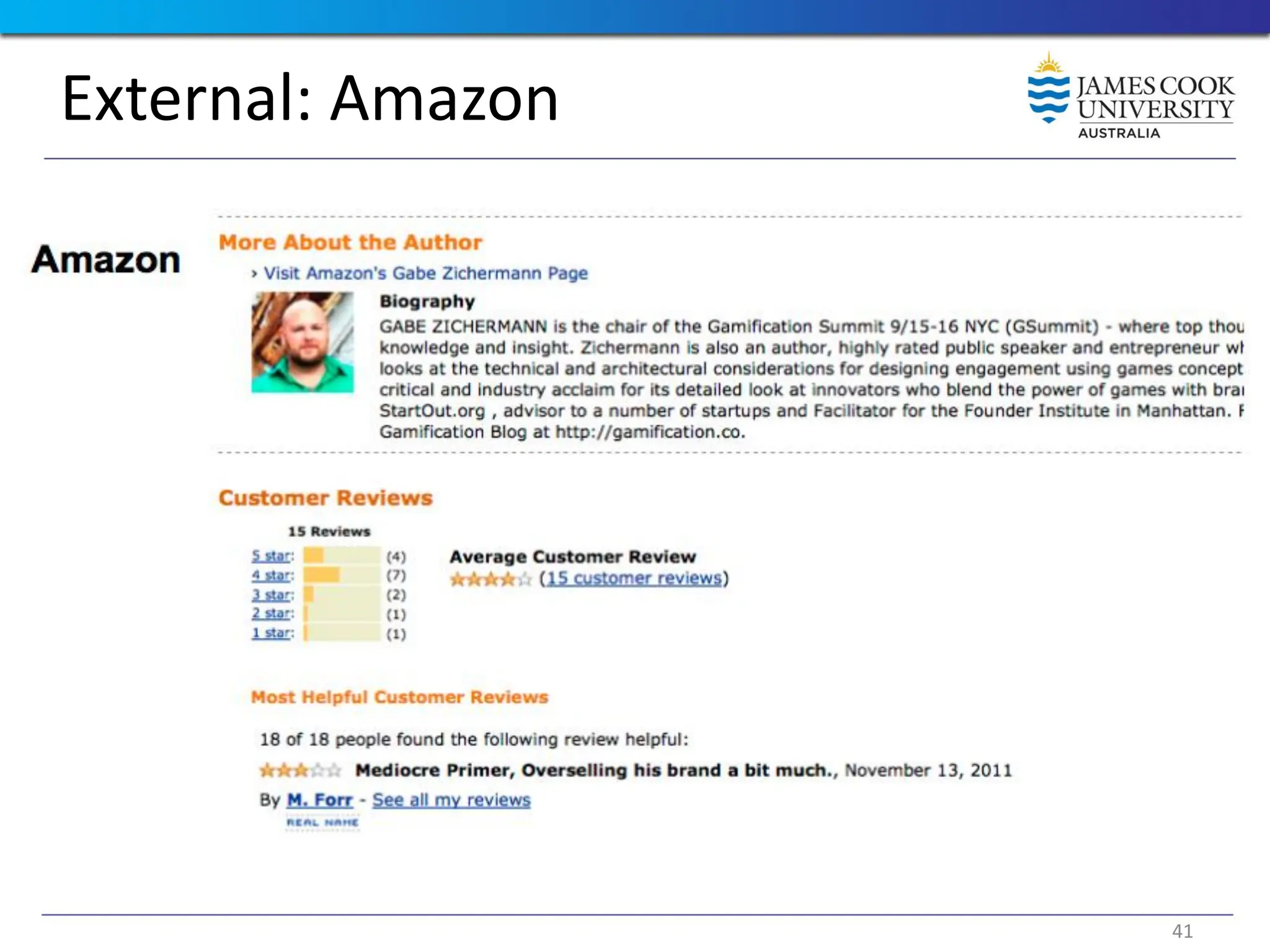
External: Amazon
41
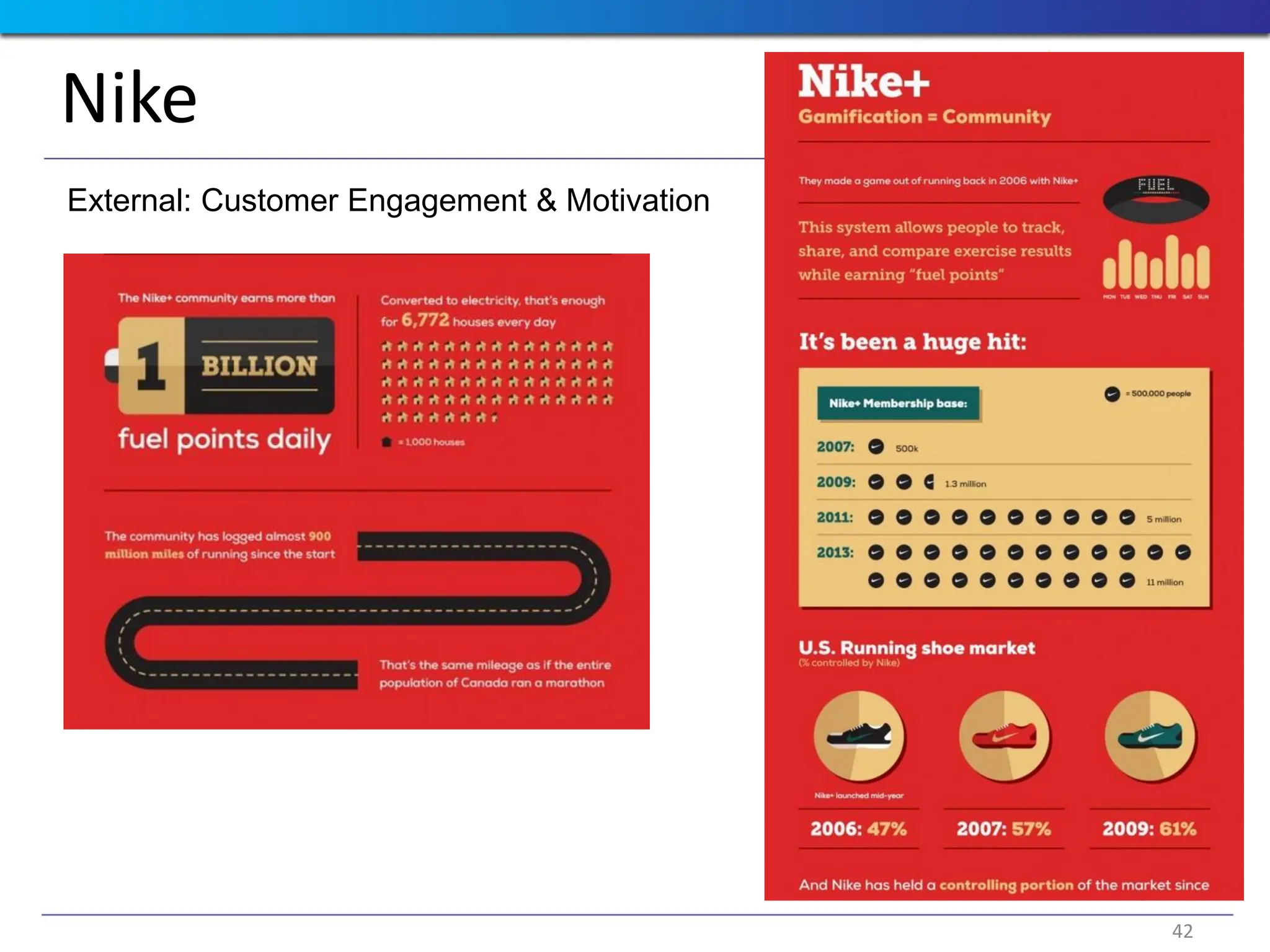
Nike
External: Customer Engagement & Motivation
42
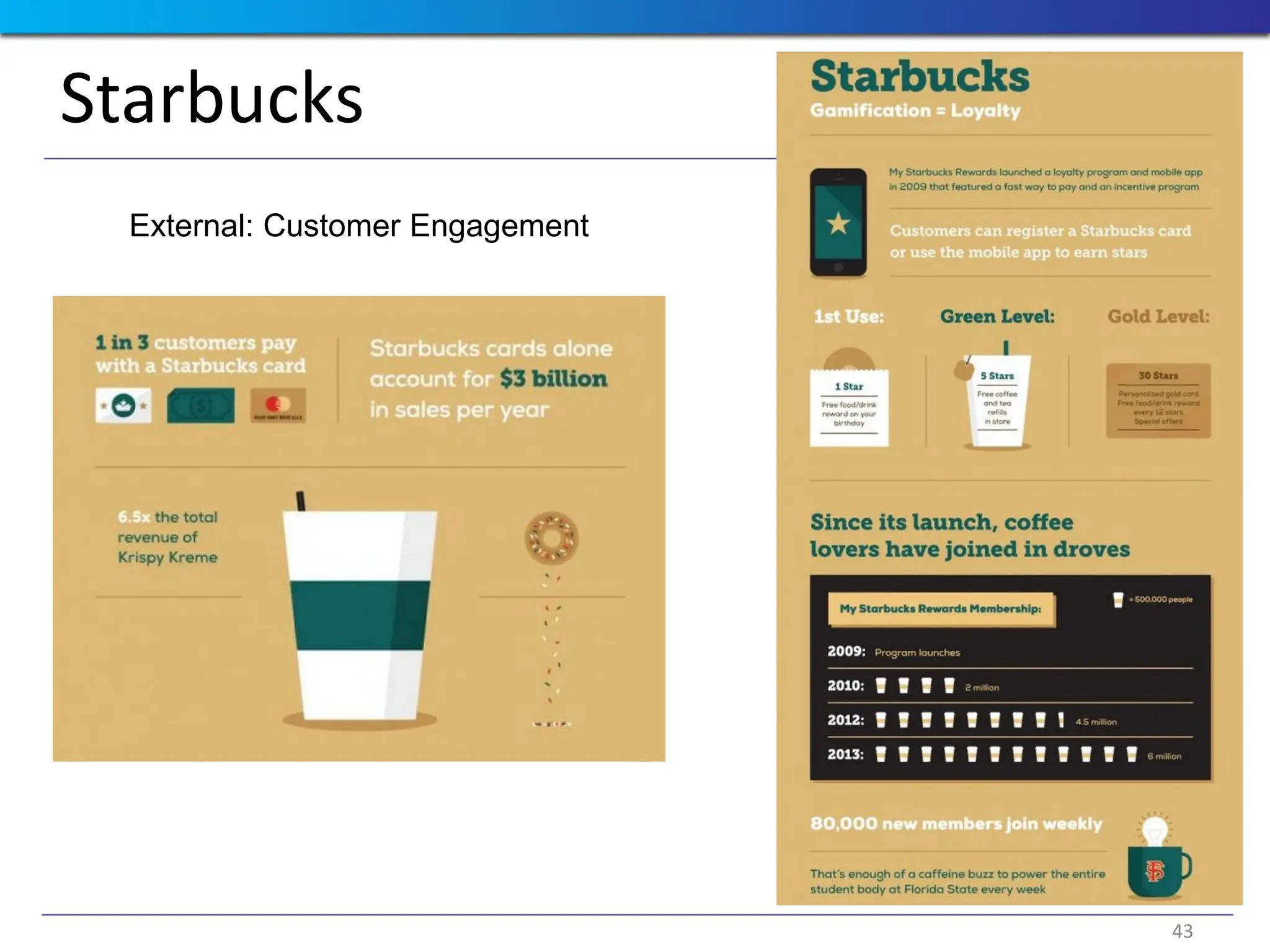
Starbucks
External: Customer Engagement
43
Enterprise Gamification
• Business application areas using gamification:
– Customer Services & Experience
– Loyalty
– Creativity & Productivity
– Employee Engagement & Wellness
– On-boarding & Training
– Product Awareness / Knowledge
– Recruitment
– Sale
44
Gamification
Non-Business Applications
45
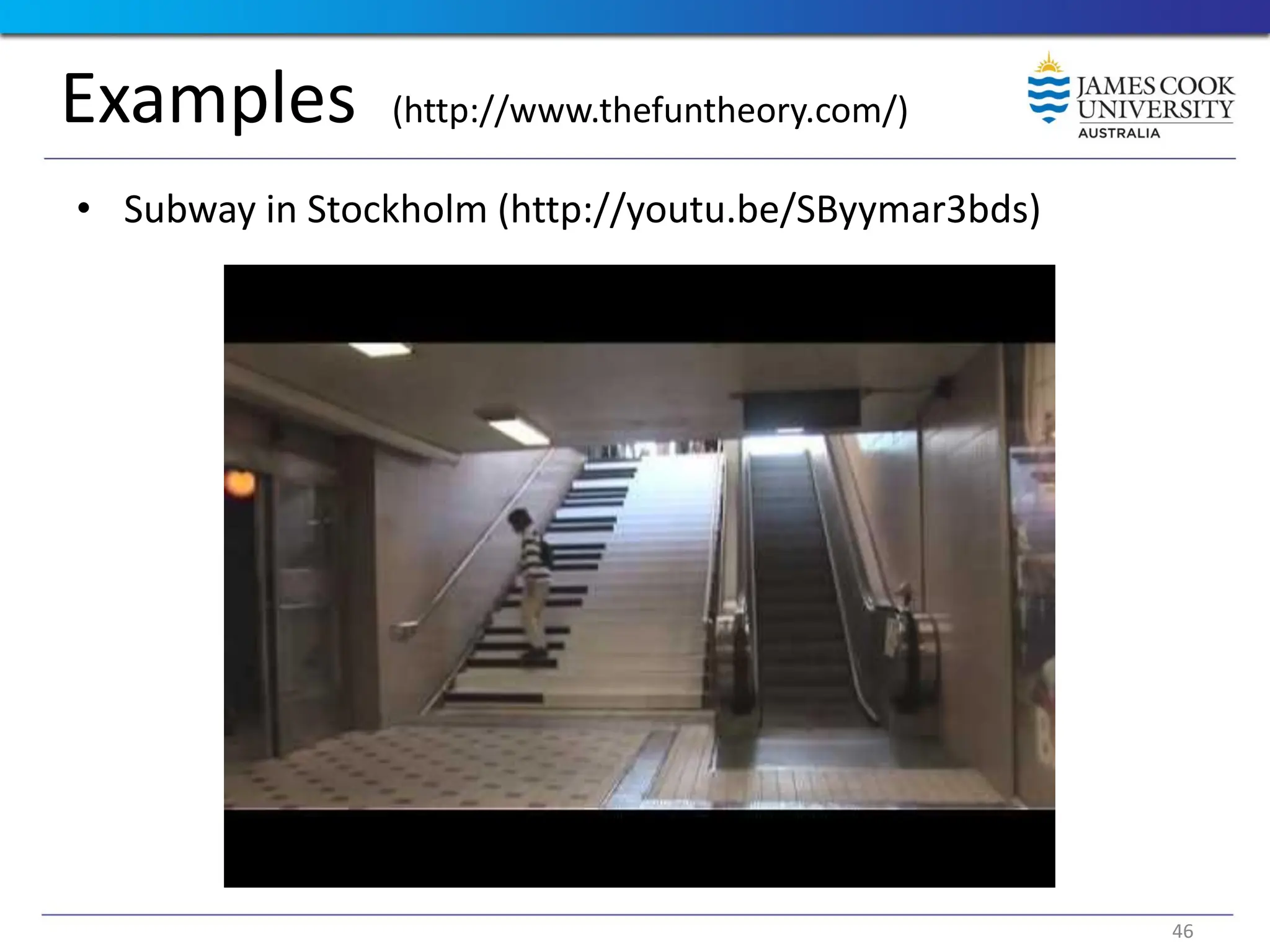
Examples (http://www.thefuntheory.com/)
• Subway in Stockholm (http://youtu.be/SByymar3bds)
46
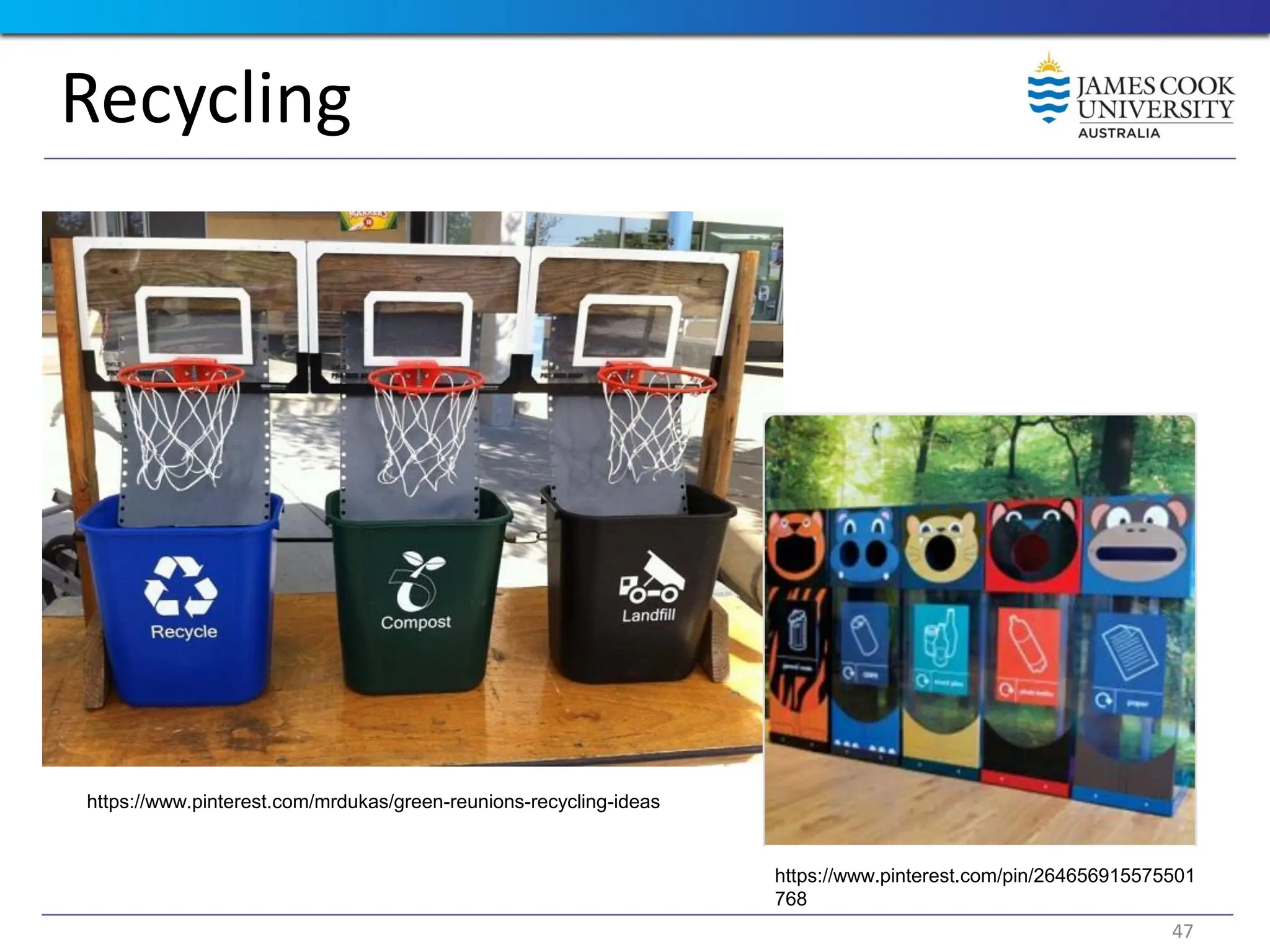
Recycling
https://www.pinterest.com/mrdukas/green-reunions-recycling-ideas
https://www.pinterest.com/pin/264656915575501
768
47
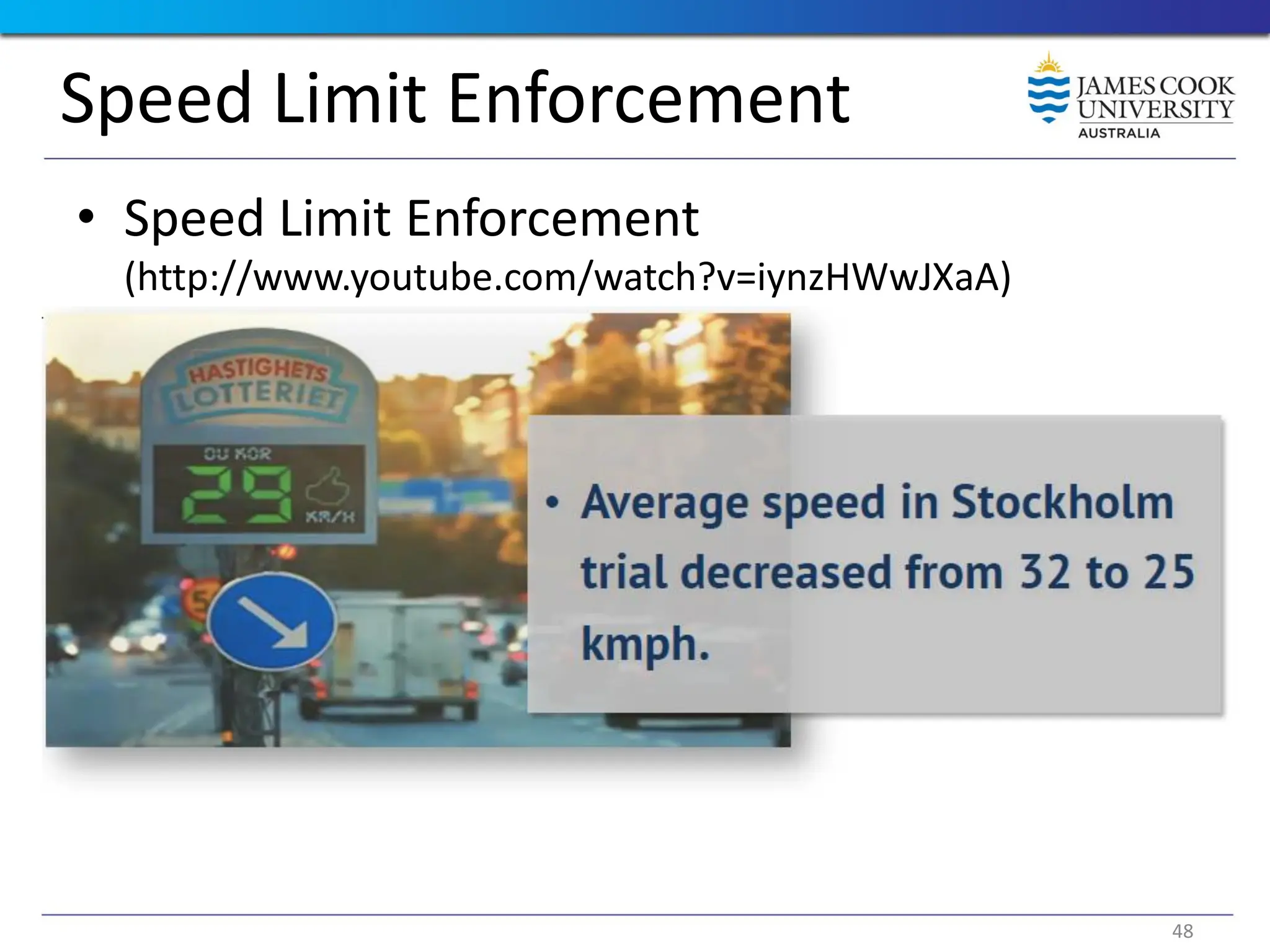
Speed Limit Enforcement
• Speed Limit Enforcement
(http://www.youtube.com/watch?v=iynzHWwJXaA)
48
Gamification
History
49
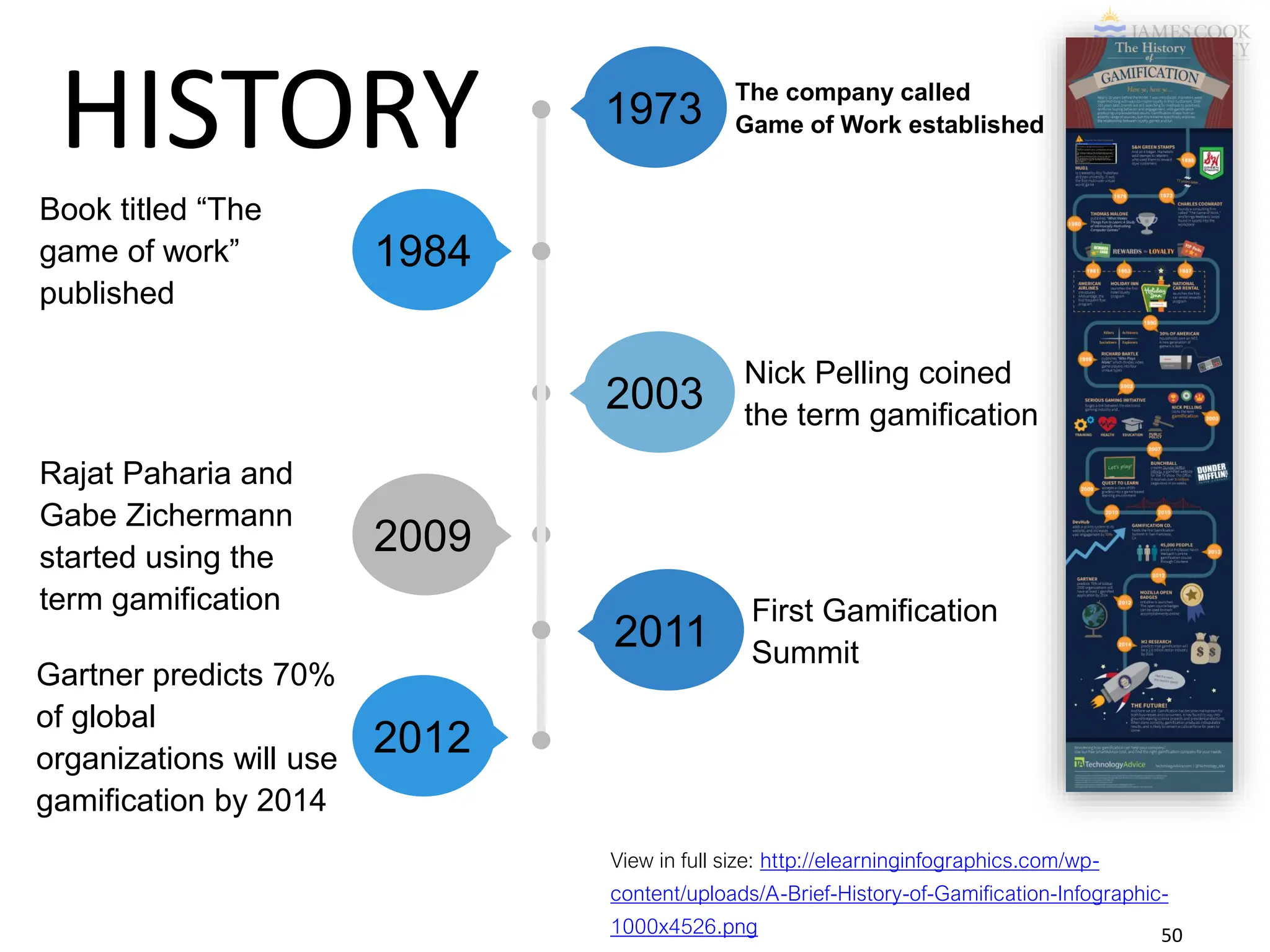
HISTORY
View in full size: http://elearninginfographics.com/wp-
content/uploads/A-Brief-History-of-Gamification-Infographic-
1000x4526.png
1973
The company called
Game of Work established
2003
Nick Pelling coined
the term gamification
1984
Book titled “The
game of work”
published
2009
Rajat Paharia and
Gabe Zichermann
started using the
term gamification
2011
First Gamification
Summit
2012
Gartner predicts 70%
of global
organizations will use
gamification by 2014
50
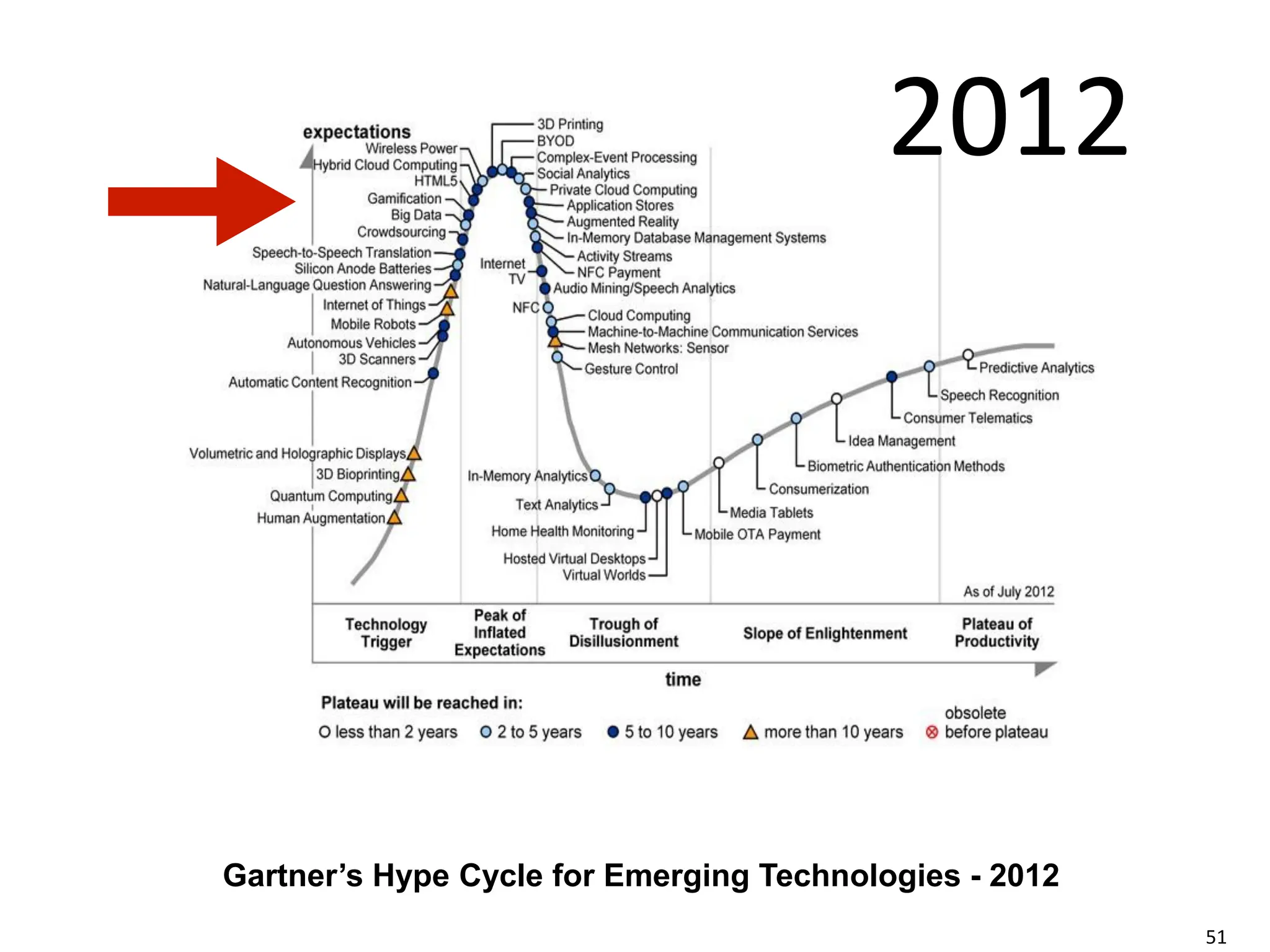
2012
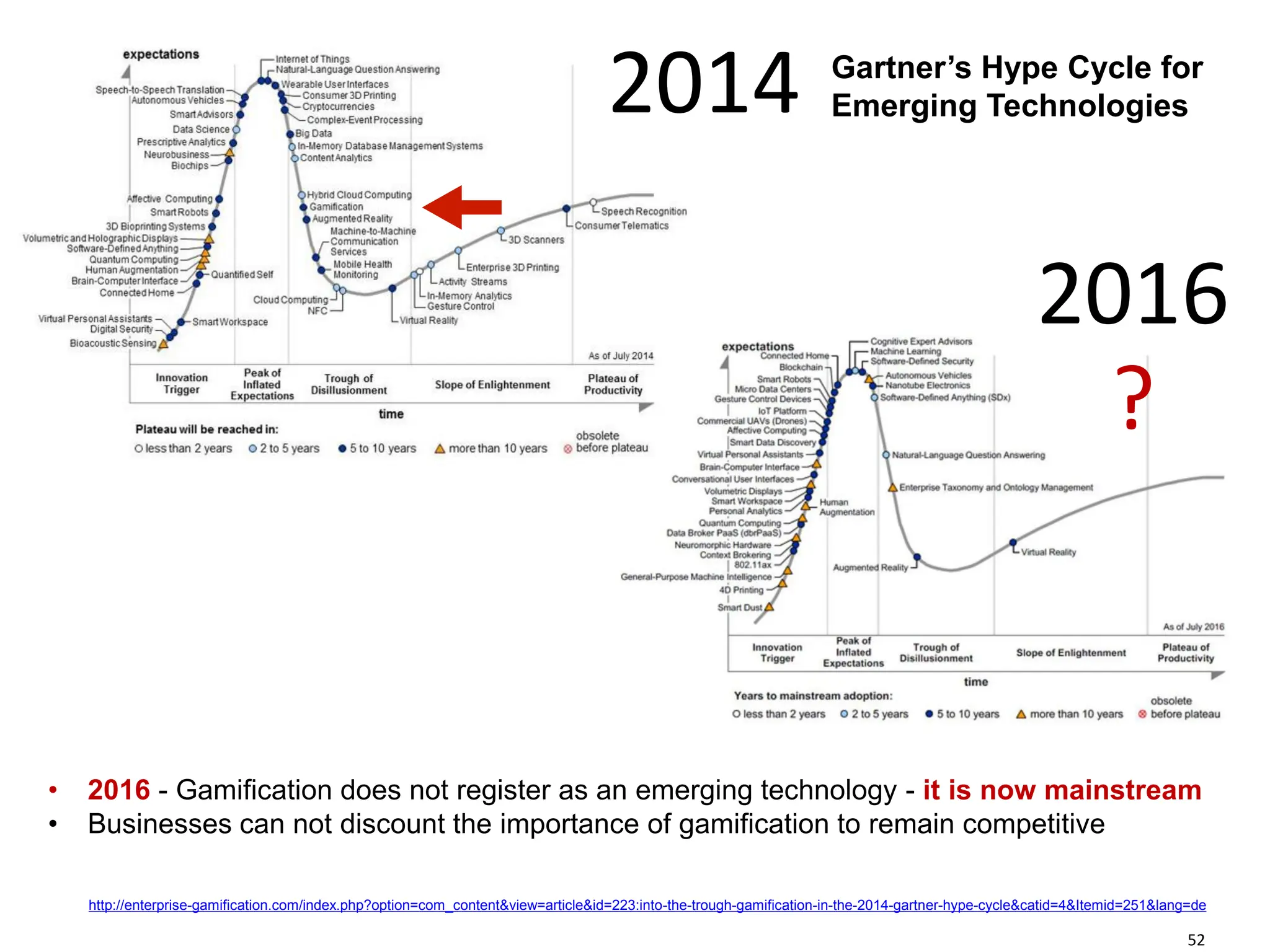
Gartner’s Hype Cycle for Emerging Technologies - 2012
51
http://enterprise-gamification.com/index.php?option=com_content&view=article&id=223:into-the-trough-gamification-in-the-2014-gartner-hype-cycle&catid=4&Itemid=251&lang=de
• 2016 - Gamification does not register as an emerging technology - it is now mainstream
• Businesses can not discount the importance of gamification to remain competitive
Gartner’s Hype Cycle for
Emerging Technologies
2014
2016
?
52
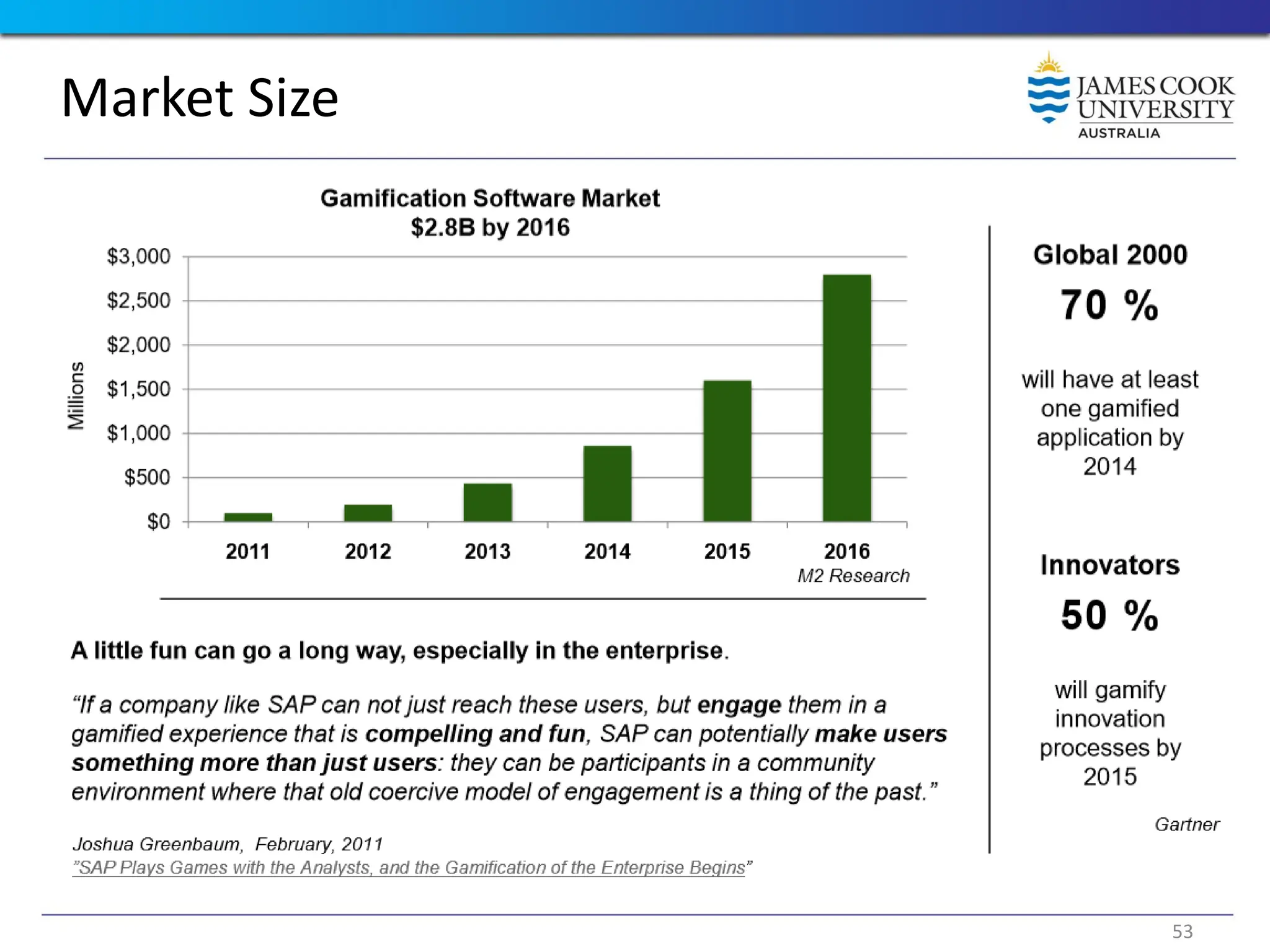
Market Size
53
Gartner’s Gamification 2020
• In Gartner’s gamification 2020 report, they predict that
gamification combined with other emerging trends and
technologies will have significant impacts on:
– Innovation
– The design of employee performance
– The globalization of advanced education
– The gamification of personal development
– The emergence of customer engagement platforms
54
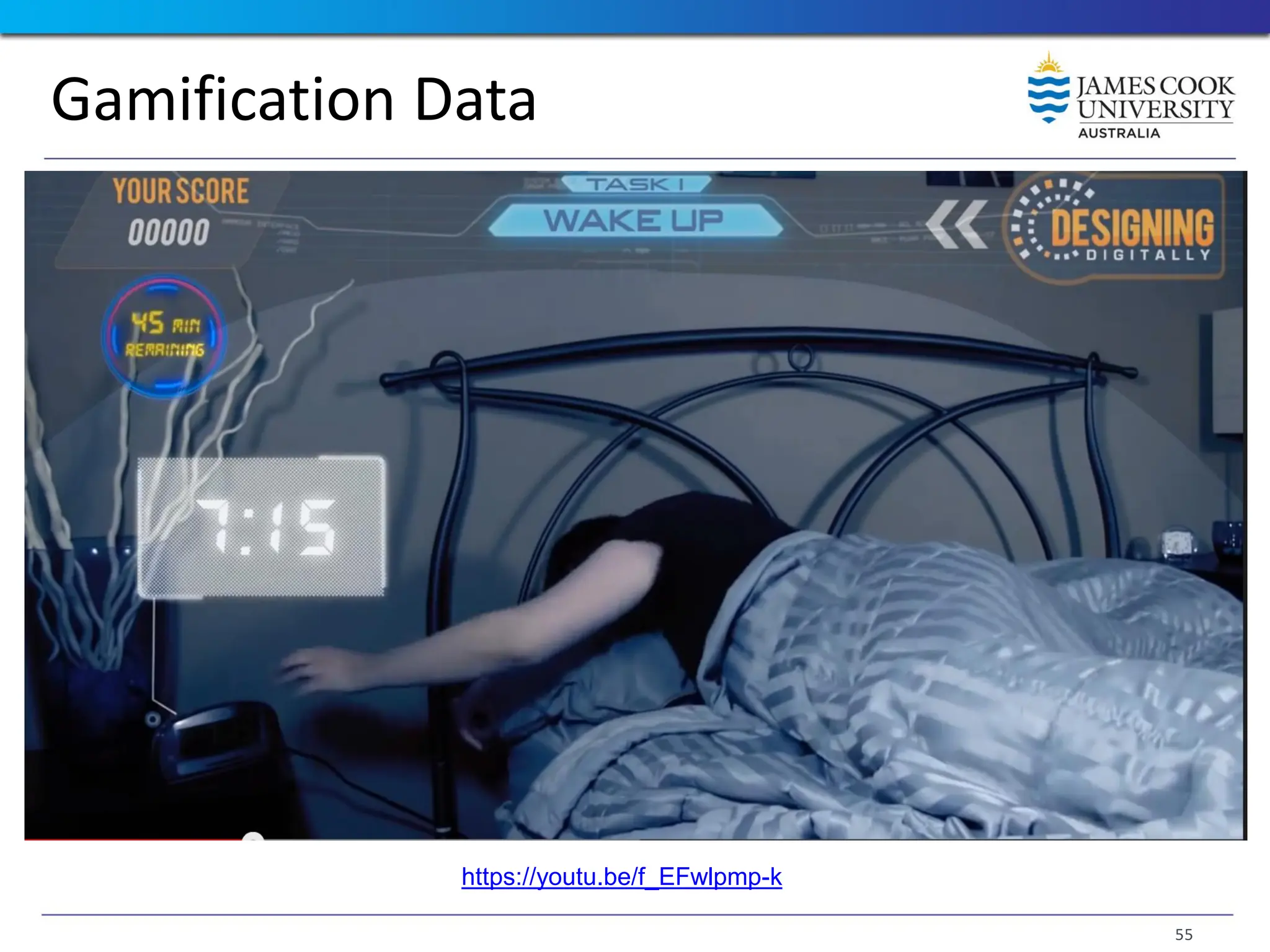
Gamification Data
https://youtu.be/f_EFwlpmp-k
55
Big picture
Games can do much more than just entertain us.
Adding the elements and principles that games use to
non-game tasks in many domains (business,
educational, social goods, environmental) can help
increase the engagement and efficiency.
56
Big picture
57
Big picture
58

Lecture 1 - Introduction(1) - GAMIFICATION.pdf