MS698–3: Sediment transport processes in coastal environments
Instructor: Courtney K. Harris
February 4, 2003

Lecture 4: Bottom Roughness in Coastal Environments
• Hydraulic roughness (z0 ) vs. Physical roughness (kb ).
• Roughness elements: Nikuradse, ripples, biogenic, saltation.
• Predicting roughness.

Class business
• Reading list; revised syllabus on web-site.
• Term paper topics due in next two weeks.
• First problem set will be handed out next week.

Bottom Roughness
The roughness of the sea floor varies over several orders of magnitude, from
the diameter of a sediment grain to the size of large sand waves. The sediment
bed is usually mobile and responds to energetic flows, and its roughness in turn
impacts the flow. Hydrodynamics over mobile beds therefore involves feedbacks
between the sea floor and overlying flows.
In the literature, you will see references to both the “physical roughness”
(often called kb ) and they “hydrodynamic roughness”, z0 . Both have units
of length (m, cm, etc.). The “physical roughness” is a physically meaningful
quantity- such as sediment grain size, ripple dimension, etc. Hydrodynamic
roughness, z0 , is related to physical roughness, and to flow structure, but it is
really a mathematical construct. It is the height, z, at which a velocity profile,
u(z), would go to zero if it were extrapolated towards the boundary.

Roughness elements
Sea-bed roughness forms a hierarchy from smallest-to-largest that can include:
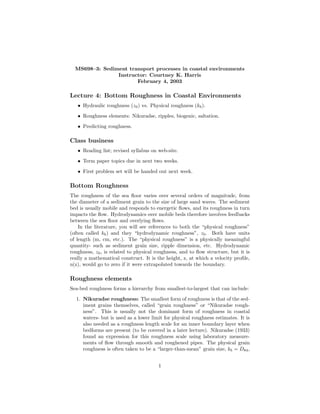
1. Nikuradse roughness: The smallest form of roughness is that of the sediment grains themselves, called “grain roughness” or “Nikuradse roughness”. This is usually not the dominant form of roughness in coastal
waters- but is used as a lower limit for physical roughness estimates. It is
also needed as a roughness length scale for an inner boundary layer when
bedforms are present (to be covered in a later lecture). Nikuradse (1933)
found an expression for this roughness scale using laboratory measurements of flow through smooth and roughened pipes. The physical grain
roughness is often taken to be a “larger-than-mean” grain size, kb = D84 ,
1
e.g. Under rough turbulent flows, the hydrodynamic roughness due to
sediment grains is z0gr = kb /30 (Nikuradse, 1933).
2. Biogenic roughness: Sea-bed roughness is also generated by biology.
Benthic organisms build mounds and dig burrows that roughen the sea
floor. Organisms that extend into the flow (worm tubes, grasses) act
as roughness elements themselves. It is very difficult to predict length
scales associated with biogenic roughness, but it often dominates in muddy
environments. In such cases, photographs of the sea-bed, intuition, and
parameter fitting are ways to estimate biogenic roughness. Wheatcroft
(1994) used stereographic photos of the sediment bed to constrain the
heights and mobility of mounds and burrows built by benthic organisms.
Roughness generated by biology also responds to energetic flows and can
exhibit feedback between the benthos and flow. Energetic flows can degrade biogenic structures, encourage benthic organisms to burrow into the
sediment, or collapse grass beds. For the case of roughness in the forms
of biogenically-formed mounds and burrows, Harris and Wiberg (1997)
included an estimate of biogenic roughness based on initial topography
and bed shear stress to model a muddy site on the continental shelf of
Northern California.
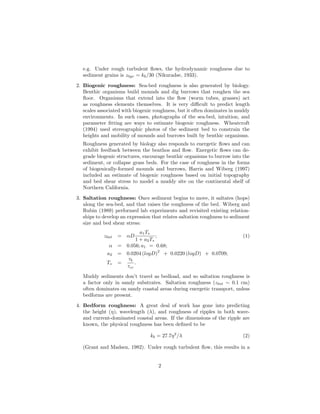
3. Saltation roughness: Once sediment begins to move, it saltates (hops)
along the sea-bed, and that raises the roughness of the bed. Wiberg and
Rubin (1989) performed lab experiments and revisited existing relationships to develop an expression that relates saltation roughness to sediment
size and bed shear stress:
z0st

a1 T∗
;
1 + a2 T∗
0.056; a1 = 0.68;
2
0.0204 (logD) + 0.0220 (logD) + 0.0709;
τb
.
τcr

= αD

α
a2

=
=

T∗

=

(1)

Muddy sediments don’t travel as bedload, and so saltation roughness is
a factor only in sandy substrates. Saltation roughness (z0st ∼ 0.1 cm)
often dominates on sandy coastal areas during energetic transport, unless
bedforms are present.
4. Bedform roughness: A great deal of work has gone into predicting
the height (η), wavelength (λ), and roughness of ripples in both waveand current-dominated coastal areas. If the dimensions of the ripple are
known, the physical roughness has been defined to be
kb = 27.7η 2 /λ

(2)

(Grant and Madsen, 1982). Under rough turbulent flow, this results in a

2
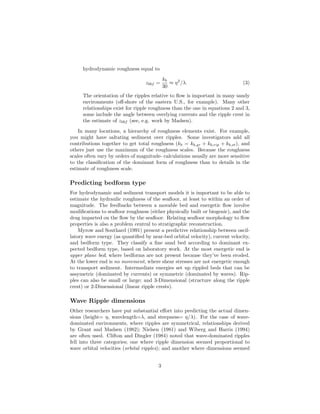
hydrodynamic roughness equal to
z0bf =

kb
≈ η 2 /λ.
30

(3)

The orientation of the ripples relative to flow is important in many sandy
environments (off-shore of the eastern U.S., for example). Many other
relationships exist for ripple roughness than the one in equations 2 and 3,
some include the angle between overlying currents and the ripple crest in
the estimate of z0bf (see, e.g. work by Madsen).
In many locations, a hierarchy of roughness elements exist. For example,
you might have saltating sediment over ripples. Some investigators add all
contributions together to get total roughness (kb = kb,gr + kb,rip + kb,st ), and
others just use the maximum of the roughness scales. Because the roughness
scales often vary by orders of magnitude- calculations usually are more sensitive
to the classification of the dominant form of roughness than to details in the
estimate of roughness scale.

Predicting bedform type
For hydrodynamic and sediment transport models it is important to be able to
estimate the hydraulic roughness of the seafloor, at least to within an order of
magnitude. The feedbacks between a movable bed and energetic flow involve
modifications to seafloor roughness (either physically built or biogenic), and the
drag imparted on the flow by the seafloor. Relating seafloor morphology to flow
properties is also a problem central to stratigraphic reconstruction.
Myrow and Southard (1991) present a predictive relationship between oscillatory wave energy (as quantified by near-bed orbital velocity), current velocity,
and bedform type. They classify a fine sand bed according to dominant expected bedform type, based on laboratory work. At the most energetic end is
upper plane bed; where bedforms are not present because they’ve been eroded.
At the lower end is no movement, where shear stresses are not energetic enough
to transport sediment. Intermediate energies set up rippled beds that can be
assymetric (dominated by currents) or symmetric (dominated by waves). Ripples can also be small or large; and 3-Dimensional (structure along the ripple
crest) or 2-Dimensional (linear ripple crests).

Wave Ripple dimensions
Other researchers have put substantial effort into predicting the actual dimensions (height= η, wavelength=λ, and steepness= η/λ). For the case of wavedominated environments, where ripples are symmetrical, relationships derived
by Grant and Madsen (1982); Nielsen (1981) and Wiberg and Harris (1994)
are often used. Clifton and Dingler (1984) noted that wave-dominated ripples
fell into three categories; one where ripple dimension seemed proportional to
wave orbital velocities (orbital ripples); and another where dimensions seemed
3
proportional to grain size (anorbital ripples), and a third, transitional region
(suborbital ripples). Most lab data fell into the orbital – to – suborbital range;
whereas field data seemed to fall into anorbital – to – suborbital range.
The contribution of Wiberg and Harris (1994) was to lump all available ripple
data (from field and laboratory measurements) into one set of relationships; but
noting that ripple morphology might depend on the relative scale of ripple height
(η) compared to wave boundary layer height (δw ), instead of being dependent
on whether the measurements were from a field or lab setting. The Traykovski
et al. (1999) paper that we will read for Thursday has data of a type unavailable
10 years ago when we worked on Wiberg and Harris (1994).

Ripple dimensions: combined flows
Ripples formed under unidirectional flow tend to have dimensions proportional
to a characteristic grain size of the bed; but then degrade when flows get very
energetic as ripple crests are eroded. Li and Amos (1998) develop a series of
relationships that predict ripple height and steepness for flows that have significant steady (current) and oscillatory (wave) components. Their results were
derived from data from the Scotian Shelf; where tidal currents often overwhelm
wave orbital motions.

References
Clifton, H. E. and Dingler, J. R. (1984). Wave-formed structures and paleoenvironmental reconstruction. Marine Geology, 60:165–198.
Grant, W. D. and Madsen, O. S. (1982). Movable bed roughness in unsteady
oscillatory flow. Journal of Geophysical Research, 87(C1):469–481.
Harris, C. K. and Wiberg, P. L. (1997). Approaches to quantifying long-term
continental shelf sediment transport with an example from the northern California STRESS mid-shelf site. Continental Shelf Research, 17(11):1389–1418.
Li, M. Z. and Amos, C. L. (1998). Predicting ripple geometry and bed roughness under combined waves and currents in a continental shelf environment.
Continental Shelf Research, 18:941–970.
Myrow, P. M. and Southard, J. B. (1991). Combined-flow model for vertical
stratification sequences in shallow marine storm-deposited beds. Journal of
Sedimentary Petrology, 61(2):202–210.
Nielsen, P. (1981). Dynamics and geometry of wave-dominated ripples. Journal
of Geophysical Research, 86:6467–6472.
Nikuradse, J. (1933). Stromungsgesetz in rauhren rohren, vdi-forschungsheft
361. (English translation: Laws of flow in rough pipes), 1950. Technical report,
NACA Technical Memo 1292. National Advisory Commission for Aeronautics,
Washinton, DC.
4
Traykovski, P., Irish, J., Hay, A., and Lynch, J. (1999). Geometry, migration,
and evolution of wave orbital ripples at LEO-15. Journal of Geophysical
Research, 104:1505–1524.
Wheatcroft, R. A. (1994). Temporal variation in bed configuration and onedimensional bottom roughness at the mid-shelf STRESS site. Continental
Shelf Research, 14(10/11):1167–1190.
Wiberg, P. L. and Harris, C. K. (1994). Ripple geometry in wave dominated
environments. Journal of Geophysical Research, 99(C4):775–789.
Wiberg, P. L. and Rubin, D. M. (1989). Bed roughness produced by saltating
sediment. Journal of Geophysical Research, 94:5011–5016.

5

Lecture 04

  • 1.
    MS698–3: Sediment transportprocesses in coastal environments Instructor: Courtney K. Harris February 4, 2003 Lecture 4: Bottom Roughness in Coastal Environments • Hydraulic roughness (z0 ) vs. Physical roughness (kb ). • Roughness elements: Nikuradse, ripples, biogenic, saltation. • Predicting roughness. Class business • Reading list; revised syllabus on web-site. • Term paper topics due in next two weeks. • First problem set will be handed out next week. Bottom Roughness The roughness of the sea floor varies over several orders of magnitude, from the diameter of a sediment grain to the size of large sand waves. The sediment bed is usually mobile and responds to energetic flows, and its roughness in turn impacts the flow. Hydrodynamics over mobile beds therefore involves feedbacks between the sea floor and overlying flows. In the literature, you will see references to both the “physical roughness” (often called kb ) and they “hydrodynamic roughness”, z0 . Both have units of length (m, cm, etc.). The “physical roughness” is a physically meaningful quantity- such as sediment grain size, ripple dimension, etc. Hydrodynamic roughness, z0 , is related to physical roughness, and to flow structure, but it is really a mathematical construct. It is the height, z, at which a velocity profile, u(z), would go to zero if it were extrapolated towards the boundary. Roughness elements Sea-bed roughness forms a hierarchy from smallest-to-largest that can include: 1. Nikuradse roughness: The smallest form of roughness is that of the sediment grains themselves, called “grain roughness” or “Nikuradse roughness”. This is usually not the dominant form of roughness in coastal waters- but is used as a lower limit for physical roughness estimates. It is also needed as a roughness length scale for an inner boundary layer when bedforms are present (to be covered in a later lecture). Nikuradse (1933) found an expression for this roughness scale using laboratory measurements of flow through smooth and roughened pipes. The physical grain roughness is often taken to be a “larger-than-mean” grain size, kb = D84 , 1
  • 2.
    e.g. Under roughturbulent flows, the hydrodynamic roughness due to sediment grains is z0gr = kb /30 (Nikuradse, 1933). 2. Biogenic roughness: Sea-bed roughness is also generated by biology. Benthic organisms build mounds and dig burrows that roughen the sea floor. Organisms that extend into the flow (worm tubes, grasses) act as roughness elements themselves. It is very difficult to predict length scales associated with biogenic roughness, but it often dominates in muddy environments. In such cases, photographs of the sea-bed, intuition, and parameter fitting are ways to estimate biogenic roughness. Wheatcroft (1994) used stereographic photos of the sediment bed to constrain the heights and mobility of mounds and burrows built by benthic organisms. Roughness generated by biology also responds to energetic flows and can exhibit feedback between the benthos and flow. Energetic flows can degrade biogenic structures, encourage benthic organisms to burrow into the sediment, or collapse grass beds. For the case of roughness in the forms of biogenically-formed mounds and burrows, Harris and Wiberg (1997) included an estimate of biogenic roughness based on initial topography and bed shear stress to model a muddy site on the continental shelf of Northern California. 3. Saltation roughness: Once sediment begins to move, it saltates (hops) along the sea-bed, and that raises the roughness of the bed. Wiberg and Rubin (1989) performed lab experiments and revisited existing relationships to develop an expression that relates saltation roughness to sediment size and bed shear stress: z0st a1 T∗ ; 1 + a2 T∗ 0.056; a1 = 0.68; 2 0.0204 (logD) + 0.0220 (logD) + 0.0709; τb . τcr = αD α a2 = = T∗ = (1) Muddy sediments don’t travel as bedload, and so saltation roughness is a factor only in sandy substrates. Saltation roughness (z0st ∼ 0.1 cm) often dominates on sandy coastal areas during energetic transport, unless bedforms are present. 4. Bedform roughness: A great deal of work has gone into predicting the height (η), wavelength (λ), and roughness of ripples in both waveand current-dominated coastal areas. If the dimensions of the ripple are known, the physical roughness has been defined to be kb = 27.7η 2 /λ (2) (Grant and Madsen, 1982). Under rough turbulent flow, this results in a 2
  • 3.
    hydrodynamic roughness equalto z0bf = kb ≈ η 2 /λ. 30 (3) The orientation of the ripples relative to flow is important in many sandy environments (off-shore of the eastern U.S., for example). Many other relationships exist for ripple roughness than the one in equations 2 and 3, some include the angle between overlying currents and the ripple crest in the estimate of z0bf (see, e.g. work by Madsen). In many locations, a hierarchy of roughness elements exist. For example, you might have saltating sediment over ripples. Some investigators add all contributions together to get total roughness (kb = kb,gr + kb,rip + kb,st ), and others just use the maximum of the roughness scales. Because the roughness scales often vary by orders of magnitude- calculations usually are more sensitive to the classification of the dominant form of roughness than to details in the estimate of roughness scale. Predicting bedform type For hydrodynamic and sediment transport models it is important to be able to estimate the hydraulic roughness of the seafloor, at least to within an order of magnitude. The feedbacks between a movable bed and energetic flow involve modifications to seafloor roughness (either physically built or biogenic), and the drag imparted on the flow by the seafloor. Relating seafloor morphology to flow properties is also a problem central to stratigraphic reconstruction. Myrow and Southard (1991) present a predictive relationship between oscillatory wave energy (as quantified by near-bed orbital velocity), current velocity, and bedform type. They classify a fine sand bed according to dominant expected bedform type, based on laboratory work. At the most energetic end is upper plane bed; where bedforms are not present because they’ve been eroded. At the lower end is no movement, where shear stresses are not energetic enough to transport sediment. Intermediate energies set up rippled beds that can be assymetric (dominated by currents) or symmetric (dominated by waves). Ripples can also be small or large; and 3-Dimensional (structure along the ripple crest) or 2-Dimensional (linear ripple crests). Wave Ripple dimensions Other researchers have put substantial effort into predicting the actual dimensions (height= η, wavelength=λ, and steepness= η/λ). For the case of wavedominated environments, where ripples are symmetrical, relationships derived by Grant and Madsen (1982); Nielsen (1981) and Wiberg and Harris (1994) are often used. Clifton and Dingler (1984) noted that wave-dominated ripples fell into three categories; one where ripple dimension seemed proportional to wave orbital velocities (orbital ripples); and another where dimensions seemed 3
  • 4.
    proportional to grainsize (anorbital ripples), and a third, transitional region (suborbital ripples). Most lab data fell into the orbital – to – suborbital range; whereas field data seemed to fall into anorbital – to – suborbital range. The contribution of Wiberg and Harris (1994) was to lump all available ripple data (from field and laboratory measurements) into one set of relationships; but noting that ripple morphology might depend on the relative scale of ripple height (η) compared to wave boundary layer height (δw ), instead of being dependent on whether the measurements were from a field or lab setting. The Traykovski et al. (1999) paper that we will read for Thursday has data of a type unavailable 10 years ago when we worked on Wiberg and Harris (1994). Ripple dimensions: combined flows Ripples formed under unidirectional flow tend to have dimensions proportional to a characteristic grain size of the bed; but then degrade when flows get very energetic as ripple crests are eroded. Li and Amos (1998) develop a series of relationships that predict ripple height and steepness for flows that have significant steady (current) and oscillatory (wave) components. Their results were derived from data from the Scotian Shelf; where tidal currents often overwhelm wave orbital motions. References Clifton, H. E. and Dingler, J. R. (1984). Wave-formed structures and paleoenvironmental reconstruction. Marine Geology, 60:165–198. Grant, W. D. and Madsen, O. S. (1982). Movable bed roughness in unsteady oscillatory flow. Journal of Geophysical Research, 87(C1):469–481. Harris, C. K. and Wiberg, P. L. (1997). Approaches to quantifying long-term continental shelf sediment transport with an example from the northern California STRESS mid-shelf site. Continental Shelf Research, 17(11):1389–1418. Li, M. Z. and Amos, C. L. (1998). Predicting ripple geometry and bed roughness under combined waves and currents in a continental shelf environment. Continental Shelf Research, 18:941–970. Myrow, P. M. and Southard, J. B. (1991). Combined-flow model for vertical stratification sequences in shallow marine storm-deposited beds. Journal of Sedimentary Petrology, 61(2):202–210. Nielsen, P. (1981). Dynamics and geometry of wave-dominated ripples. Journal of Geophysical Research, 86:6467–6472. Nikuradse, J. (1933). Stromungsgesetz in rauhren rohren, vdi-forschungsheft 361. (English translation: Laws of flow in rough pipes), 1950. Technical report, NACA Technical Memo 1292. National Advisory Commission for Aeronautics, Washinton, DC. 4
  • 5.
    Traykovski, P., Irish,J., Hay, A., and Lynch, J. (1999). Geometry, migration, and evolution of wave orbital ripples at LEO-15. Journal of Geophysical Research, 104:1505–1524. Wheatcroft, R. A. (1994). Temporal variation in bed configuration and onedimensional bottom roughness at the mid-shelf STRESS site. Continental Shelf Research, 14(10/11):1167–1190. Wiberg, P. L. and Harris, C. K. (1994). Ripple geometry in wave dominated environments. Journal of Geophysical Research, 99(C4):775–789. Wiberg, P. L. and Rubin, D. M. (1989). Bed roughness produced by saltating sediment. Journal of Geophysical Research, 94:5011–5016. 5