6.087 Lecture 3 – January 13, 2010
Review
Blocks and Compound Statements
Control Flow
Conditional Statements
Loops
Functions
Modular Programming
Variable Scope
Static Variables
Register Variables
1
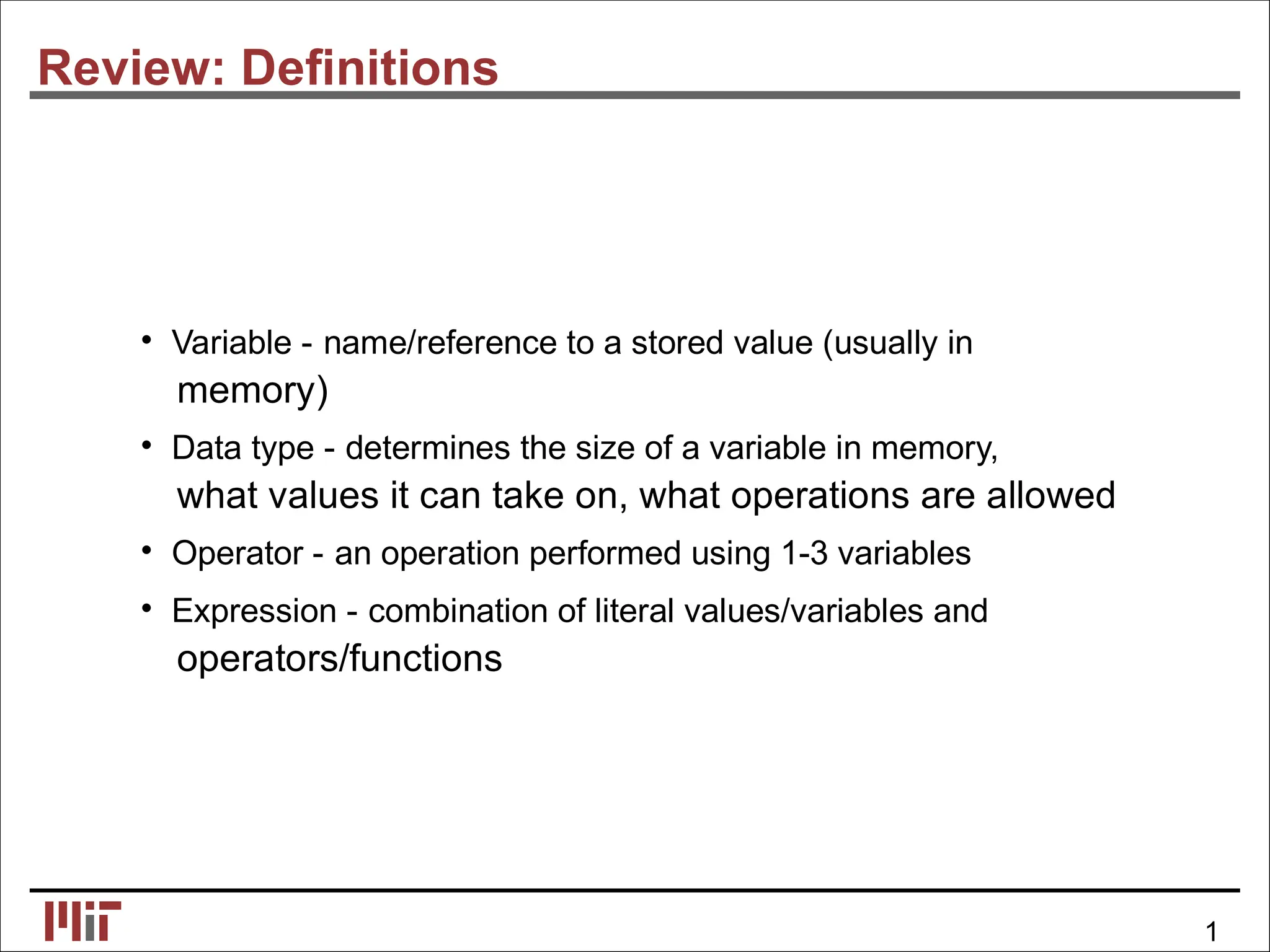
Review: Definitions
• Variable - name/reference to a stored value (usually in
memory)
• Data type - determines the size of a variable in memory,
what values it can take on, what operations are allowed
• Operator - an operation performed using 1-3 variables
• Expression - combination of literal values/variables and
operators/functions
1
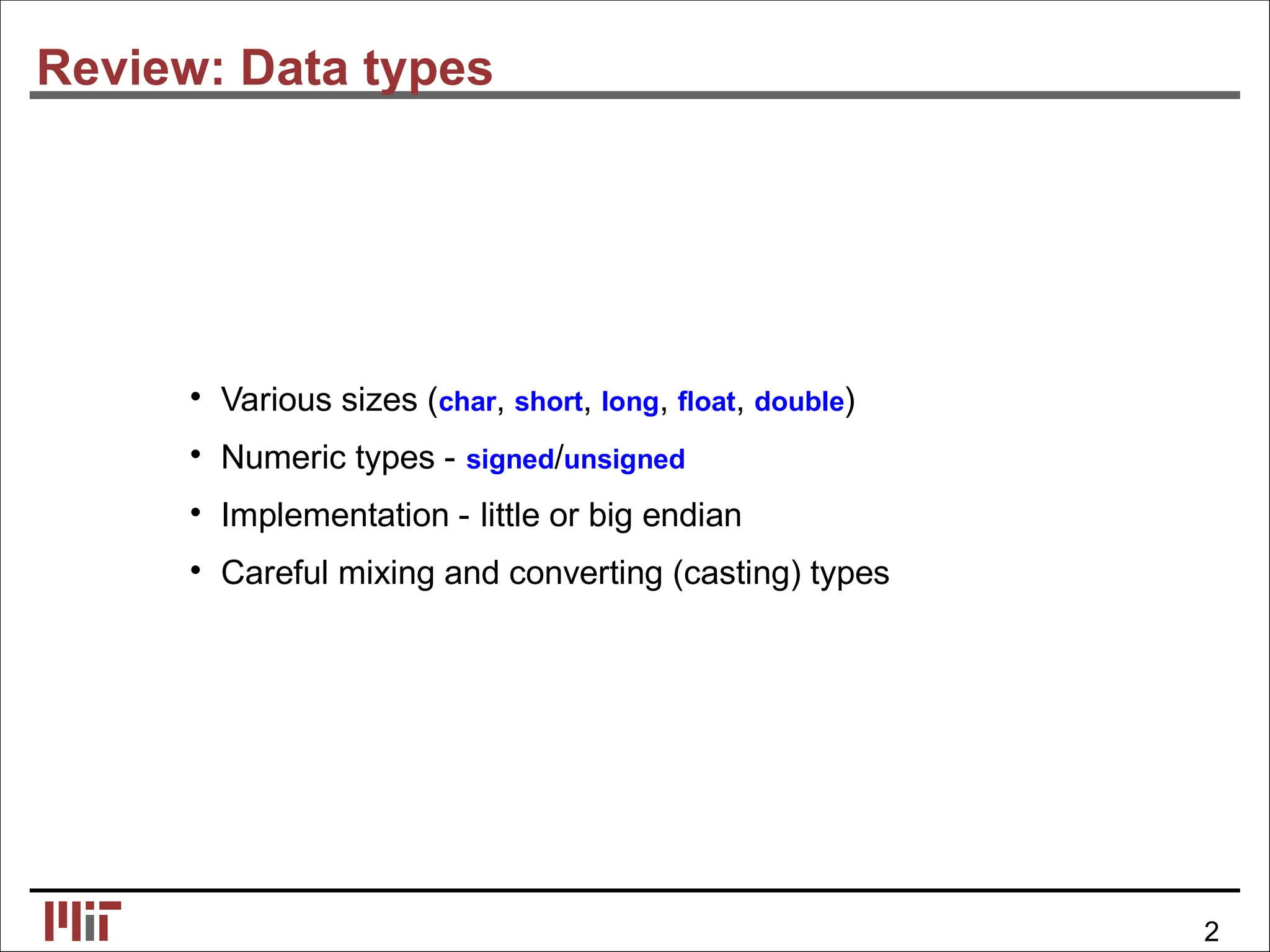
Review: Data types
• Various sizes (char, short, long, float, double)
• Numeric types - signed/unsigned
• Implementation - little or big endian
• Careful mixing and converting (casting) types
2
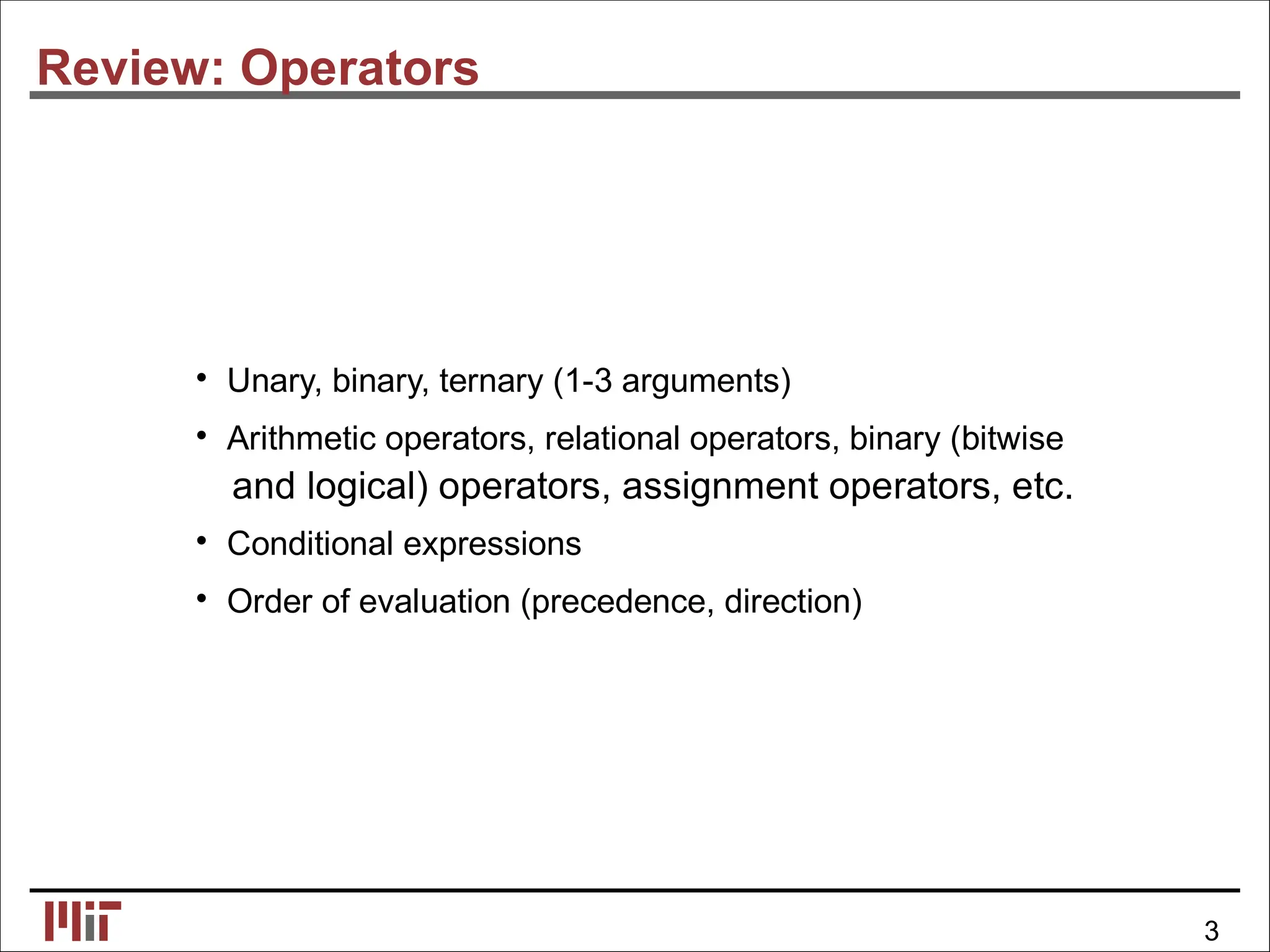
Review: Operators
• Unary, binary, ternary (1-3 arguments)
• Arithmetic operators, relational operators, binary (bitwise
and logical) operators, assignment operators, etc.
• Conditional expressions
• Order of evaluation (precedence, direction)
3
6.087 Lecture 3 – January 13, 2010
Review
Blocks and Compound Statements
Control Flow
Conditional Statements
Loops
Functions
Modular Programming
Variable Scope
Static Variables
Register Variables
4
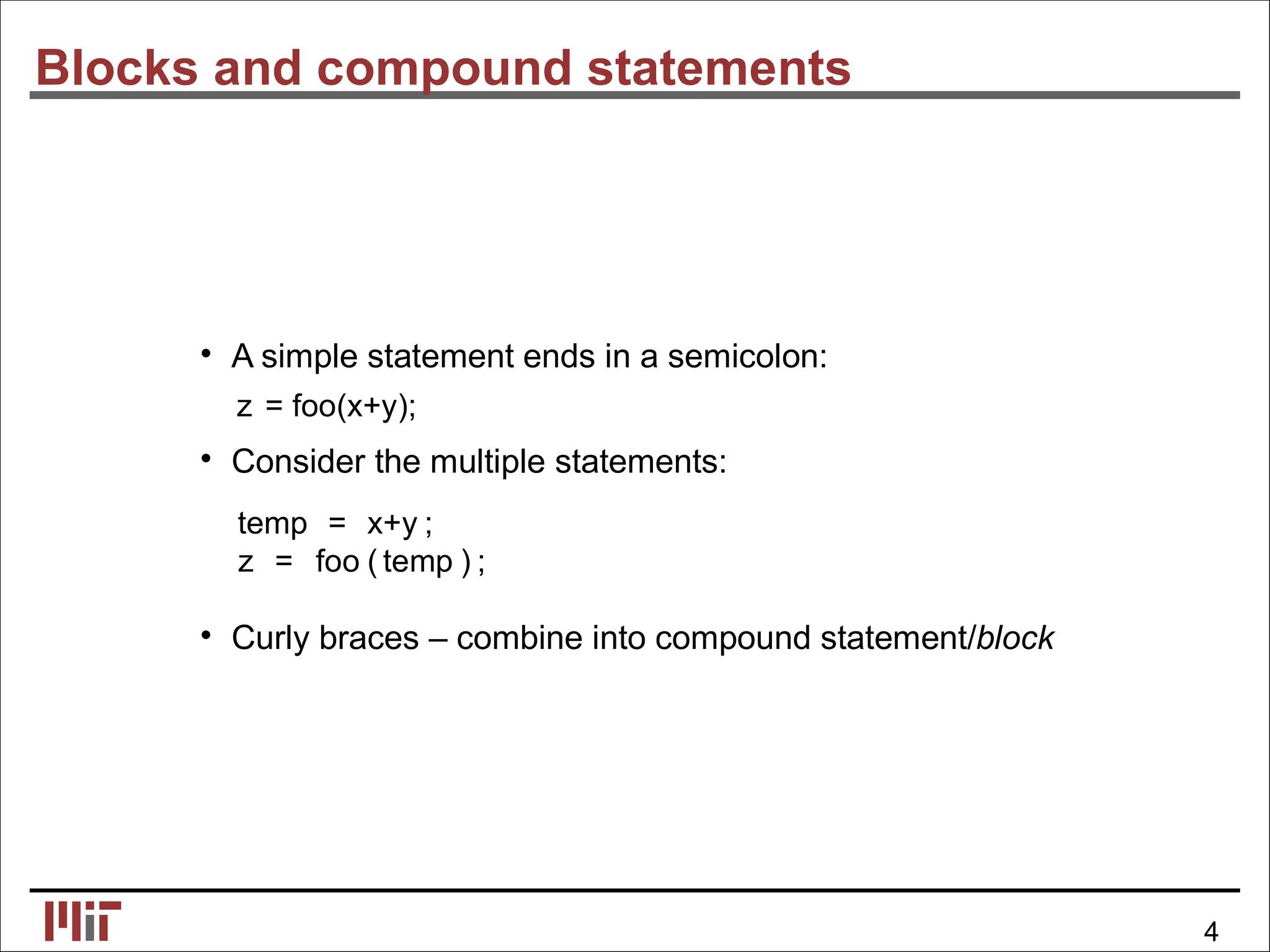
Blocks and compound statements
• A simple statement ends in a semicolon:
z = foo(x+y);
• Consider the multiple statements:
temp = x+y ;
z = foo ( temp ) ;
• Curly braces – combine into compound statement/block
4
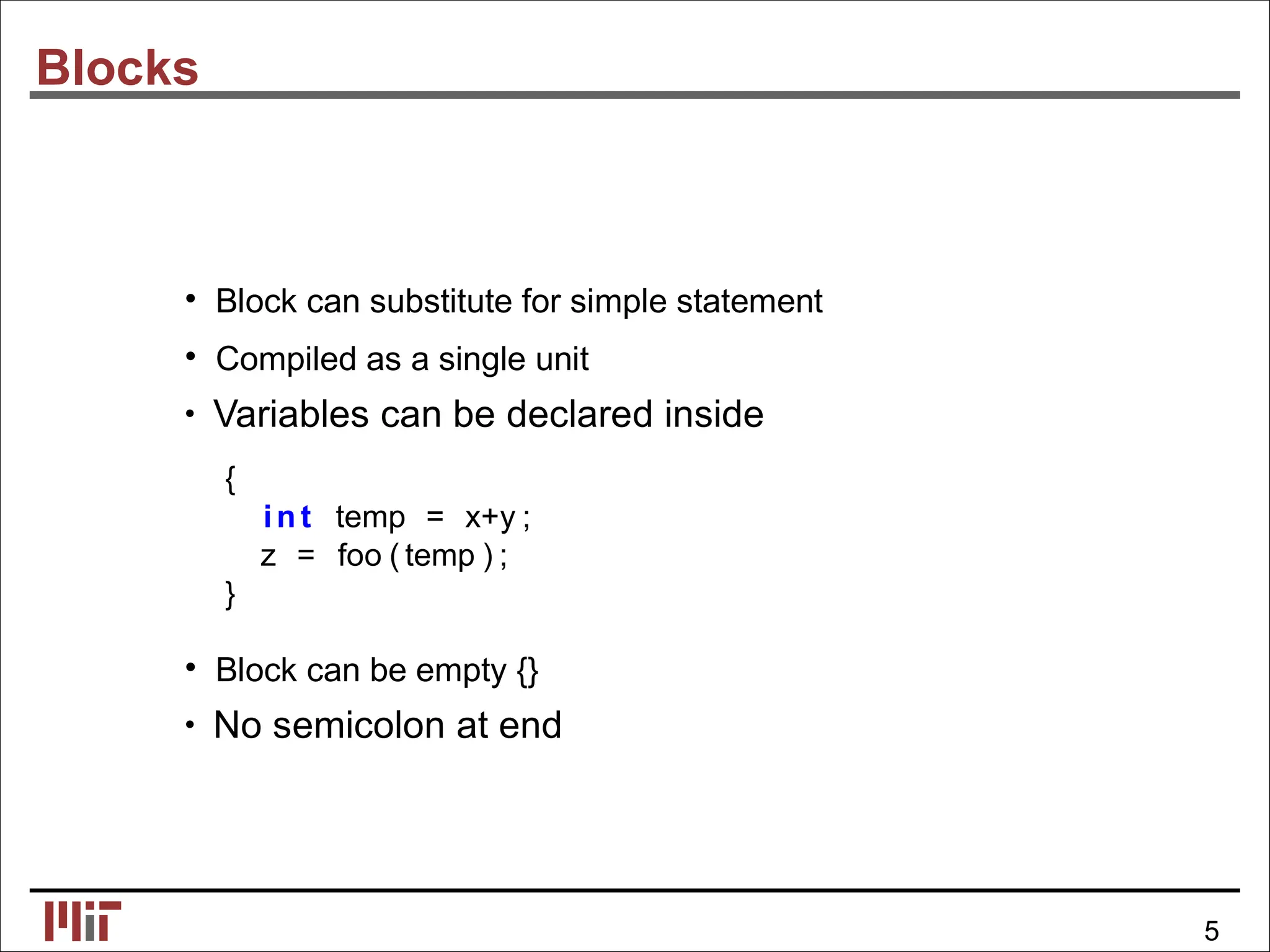
Blocks
• Block can substitute for simple statement
• Compiled as a single unit
• Variables can be declared inside
{
in t temp = x+y ;
z = foo ( temp ) ;
}
• Block can be empty {}
• No semicolon at end
5
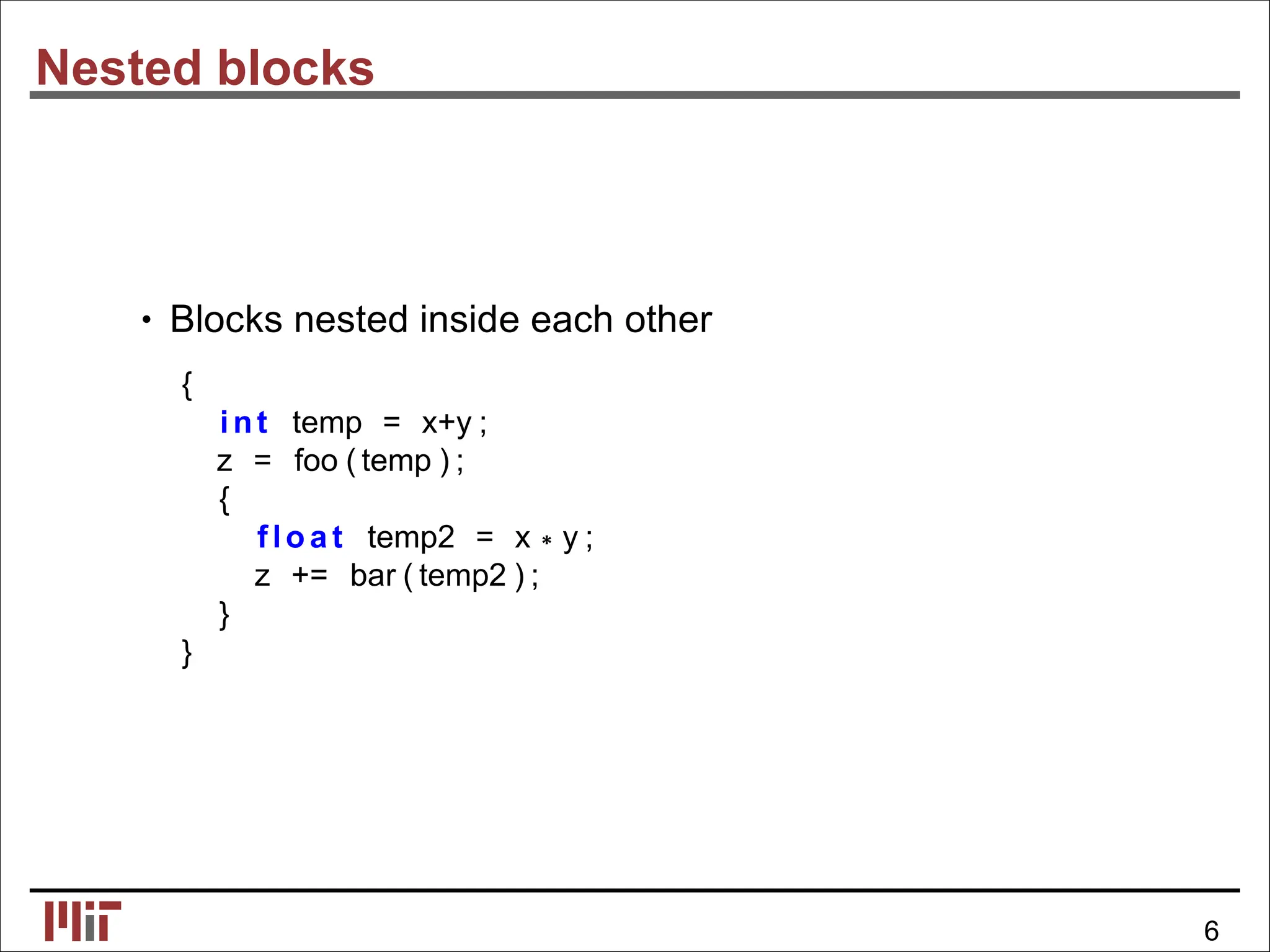
Nested blocks
• Blocks nested inside each other
{
int temp = x+y ;
z = foo ( temp ) ;
{
flo a t temp2 = x∗y ;
z += bar ( temp2 ) ;
}
}
6
6.087 Lecture 3 – January 13, 2010
Review
Blocks and Compound Statements
Control Flow
Conditional Statements
Loops
Functions
Modular Programming
Variable Scope
Static Variables
Register Variables
7
Control conditions
• Unlike C++ or Java, no boolean type (in C89/C90)
• in C99, bool type available (use stdbool.h)
• Condition is an expression (or series of expressions)
e.g. n < 3 or x < y || z < y
• Expression is non-zero ⇒ condition true
• Expression must be numeric (or a pointer)
const char s t r [ ] = "some text" ;
i f ( s t r ) / ∗ s t r i n g i s not n u l l ∗ /
return 0;
7
Conditional statements
• The if statement
• The switch statement
8
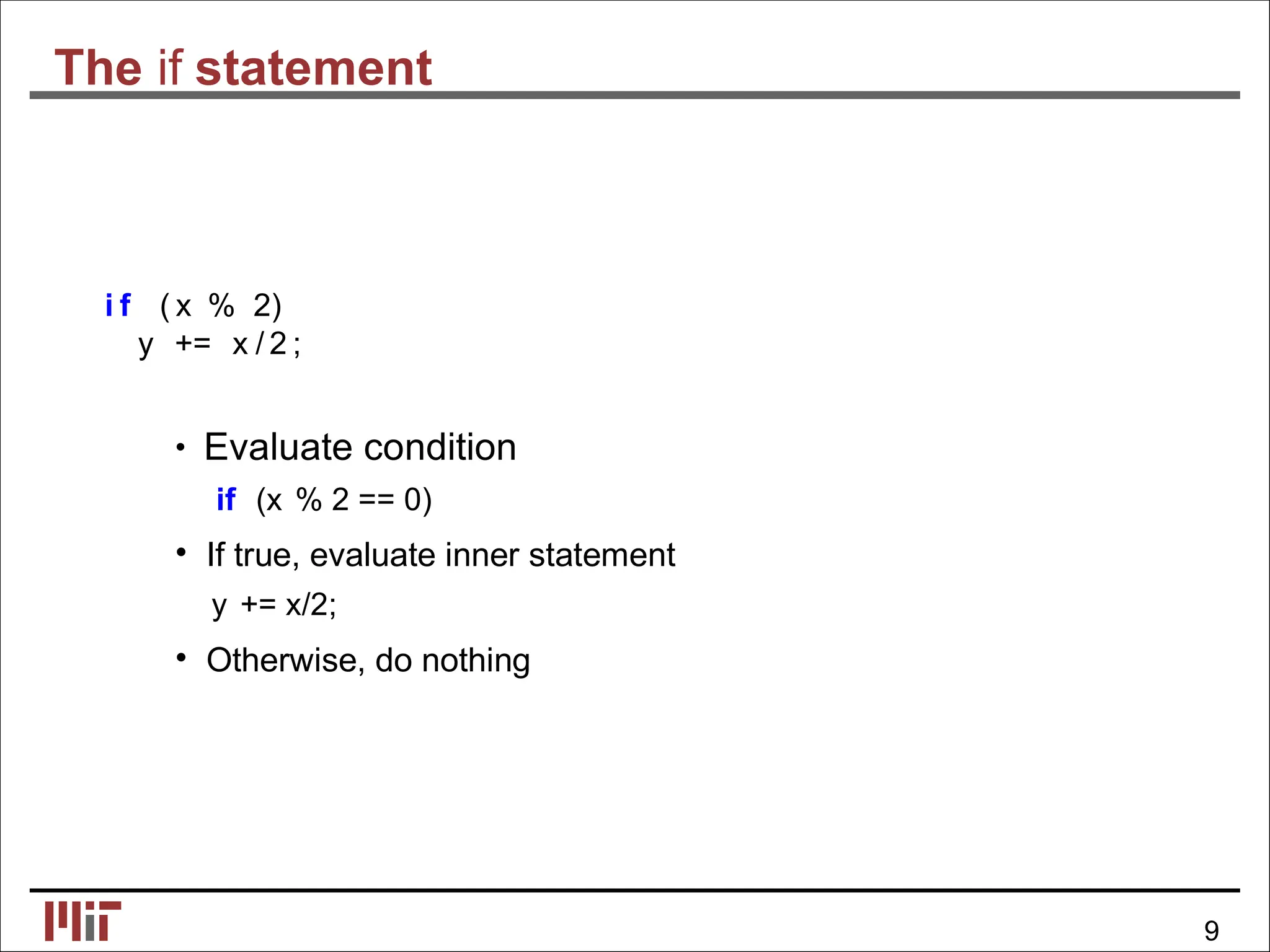
The if statement
i f ( x % 2)
y += x / 2 ;
• Evaluate condition
if (x % 2 == 0)
• If true, evaluate inner statement
y += x/2;
• Otherwise, do nothing
9
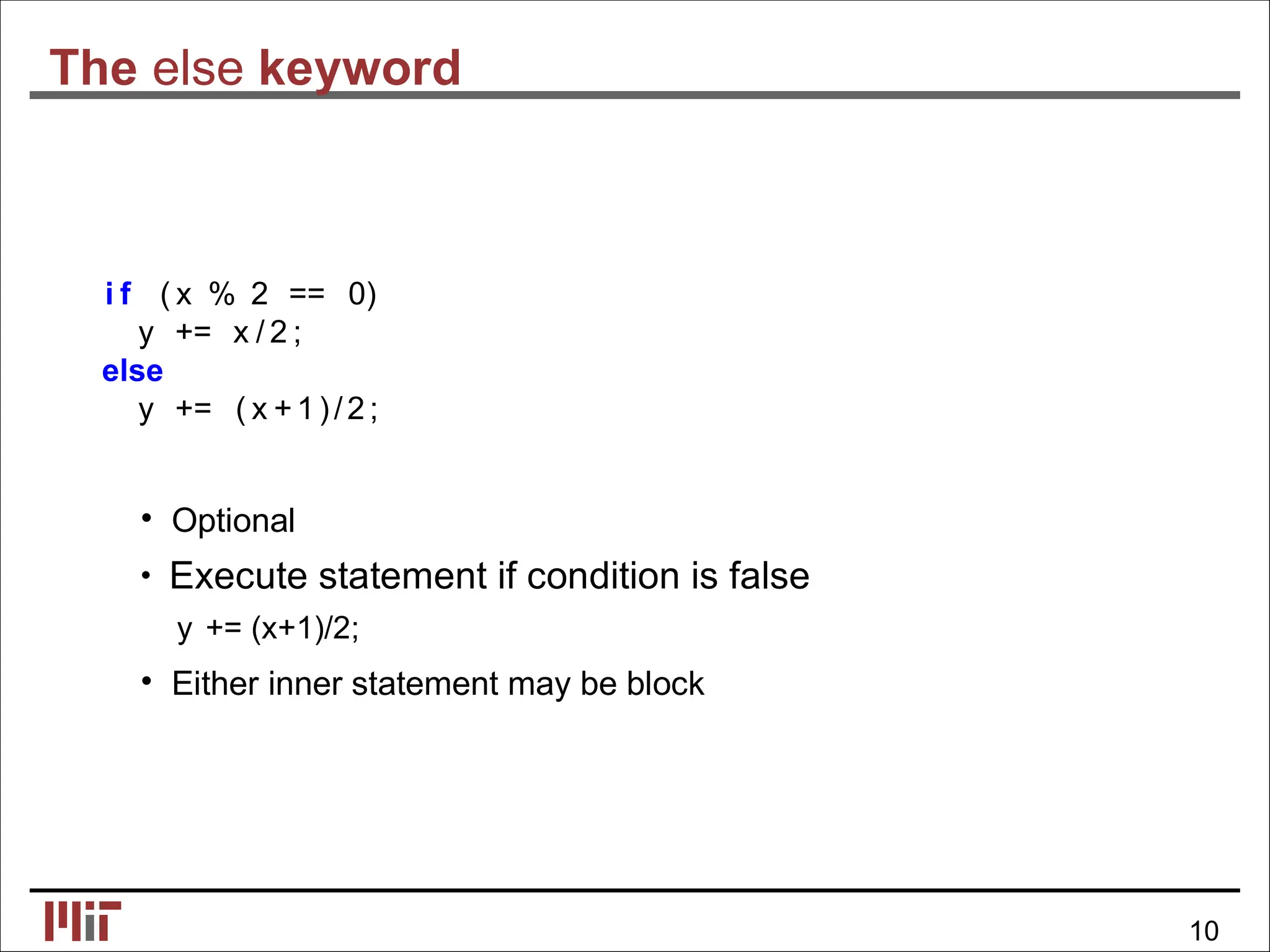
The else keyword
i f ( x % 2 == 0)
y += x / 2 ;
else
y += ( x +1)/2 ;
• Optional
• Execute statement if condition is false
y += (x+1)/2;
• Either inner statement may be block
10
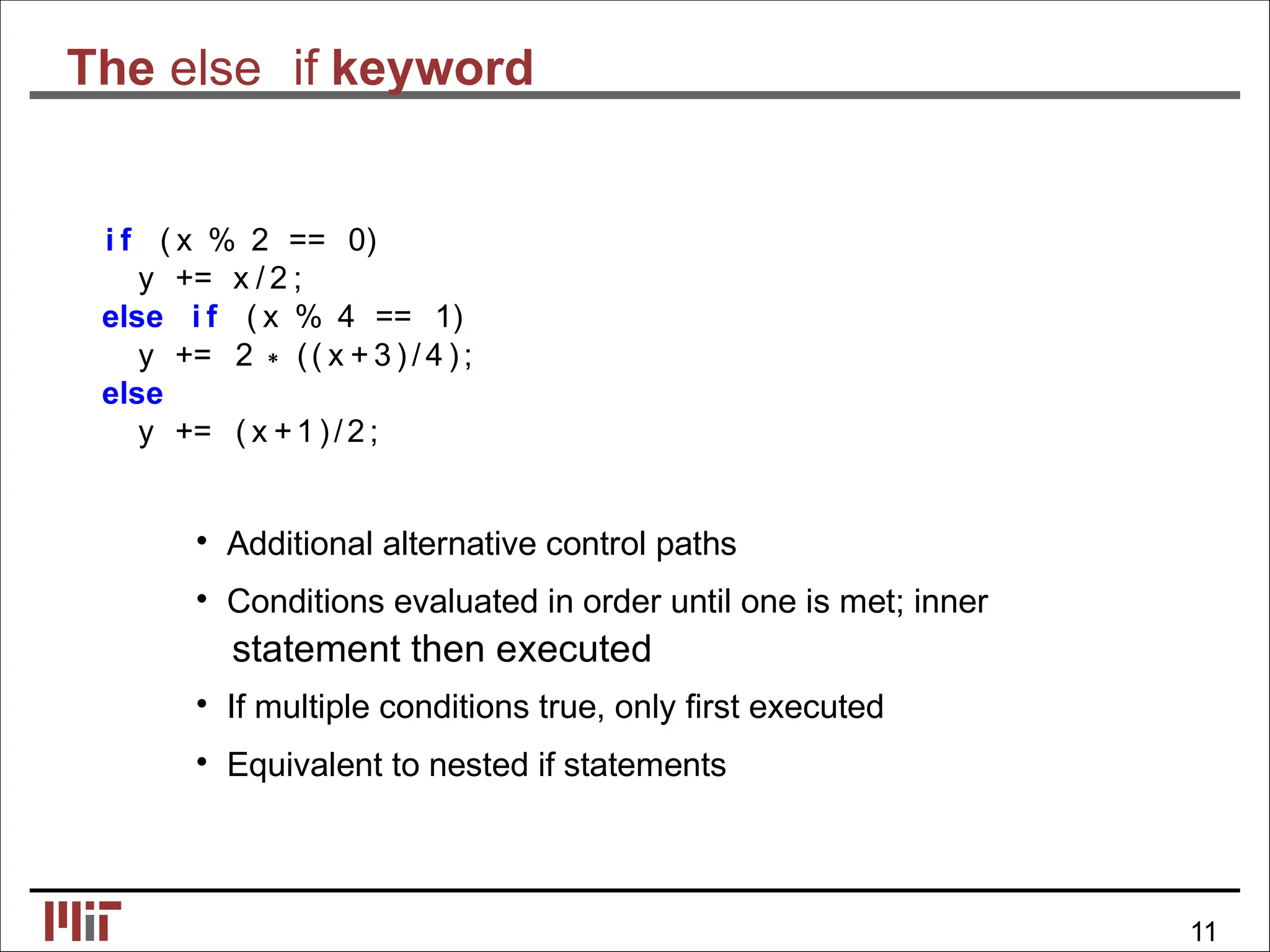
The else if keyword
i f ( x % 2 == 0)
y += x / 2 ;
else i f ( x % 4 == 1)
y += 2∗ (( x + 3 ) / 4 ) ;
else
y += ( x +1 )/2 ;
• Additional alternative control paths
• Conditions evaluated in order until one is met; inner
statement then executed
• If multiple conditions true, only first executed
• Equivalent to nested if statements
11
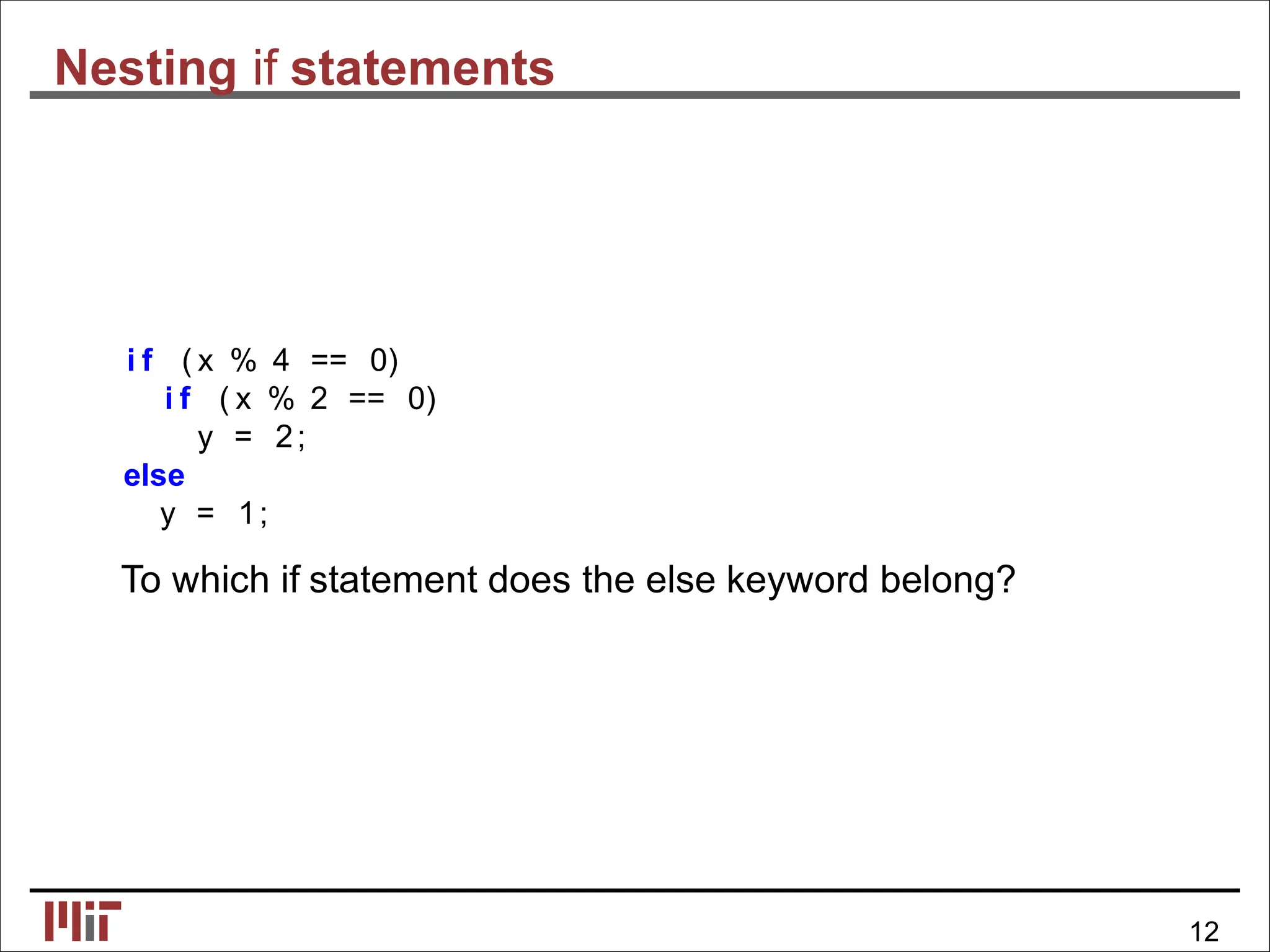
Nesting if statements
i f ( x % 4 == 0)
i f ( x % 2 == 0)
y = 2;
else
y = 1;
To which if statement does the else keyword belong?
12
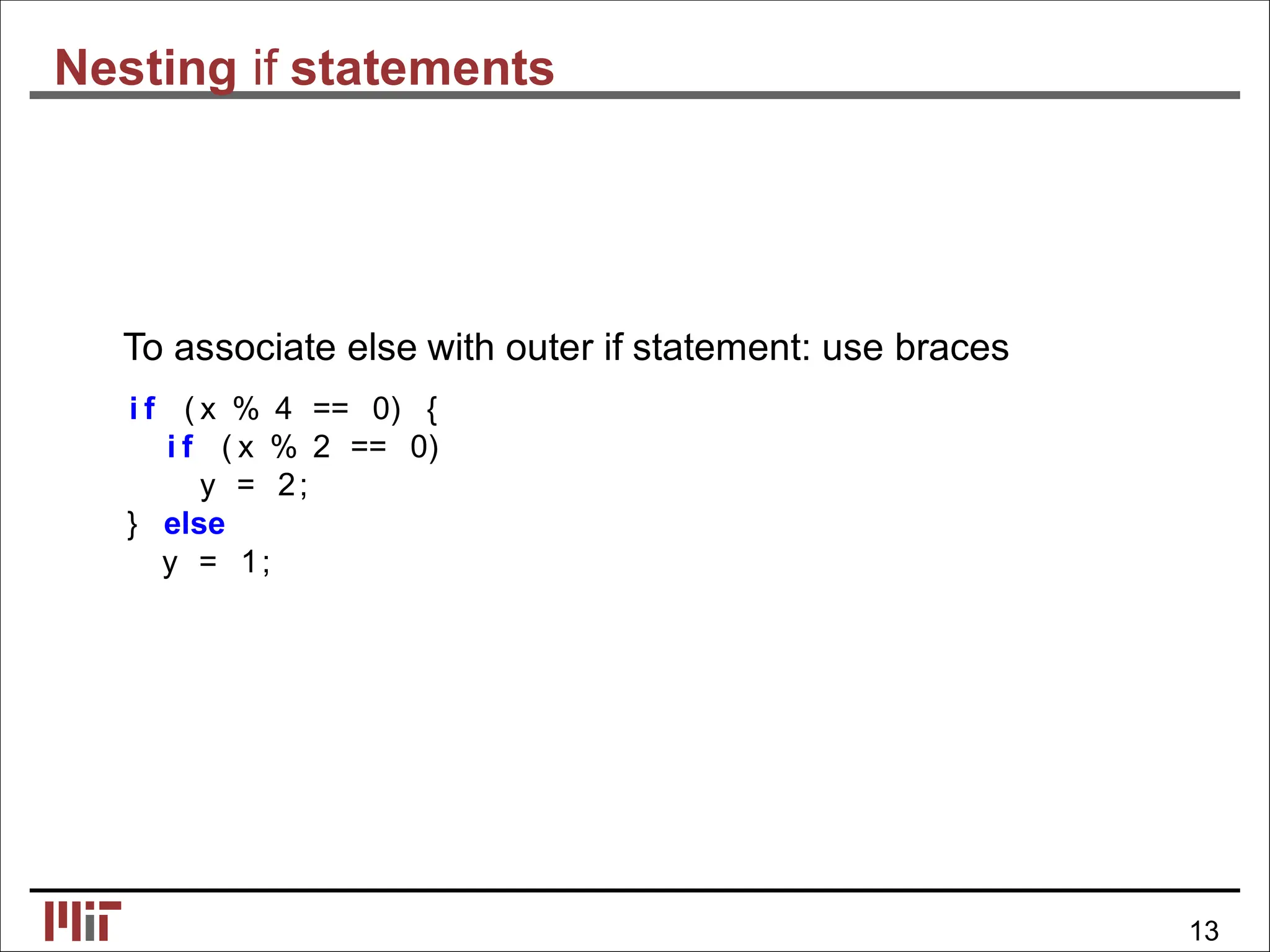
Nesting if statements
To associate else with outer if statement: use braces
i f ( x % 4 == 0) {
i f ( x % 2 == 0)
y = 2;
} else
y = 1;
13
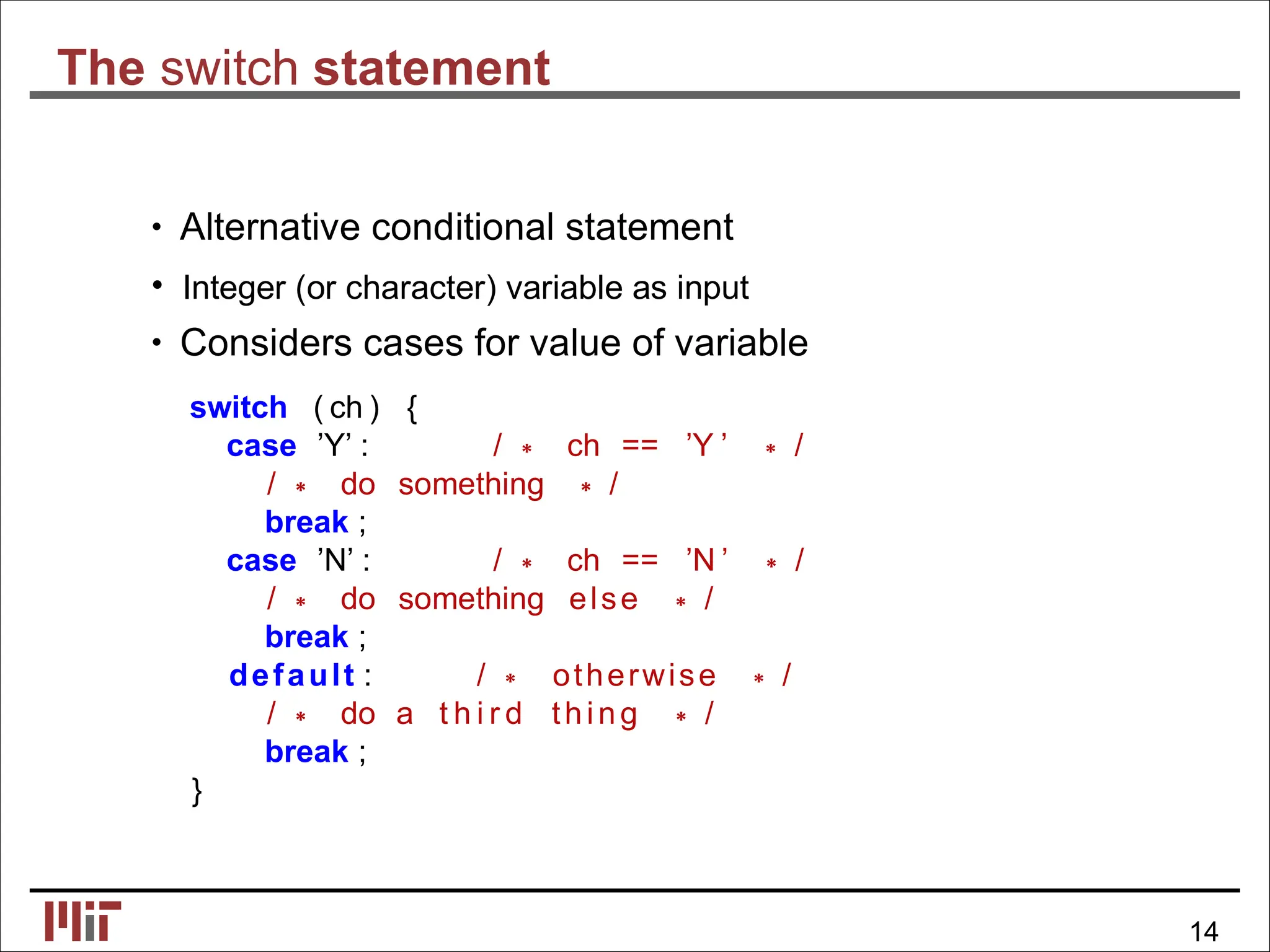
The switch statement
• Alternative conditional statement
• Integer (or character) variable as input
• Considers cases for value of variable
switch ( ch ) {
case ’Y’ : / ∗ ch == ’Y ’ ∗ /
/ ∗ do something ∗ /
break ;
case ’N’ : / ∗ ch == ’N ’ ∗ /
/ ∗ do something else ∗ /
break ;
default : / ∗ otherwise ∗ /
/ ∗ do a t h i r d thing ∗ /
break ;
}
14
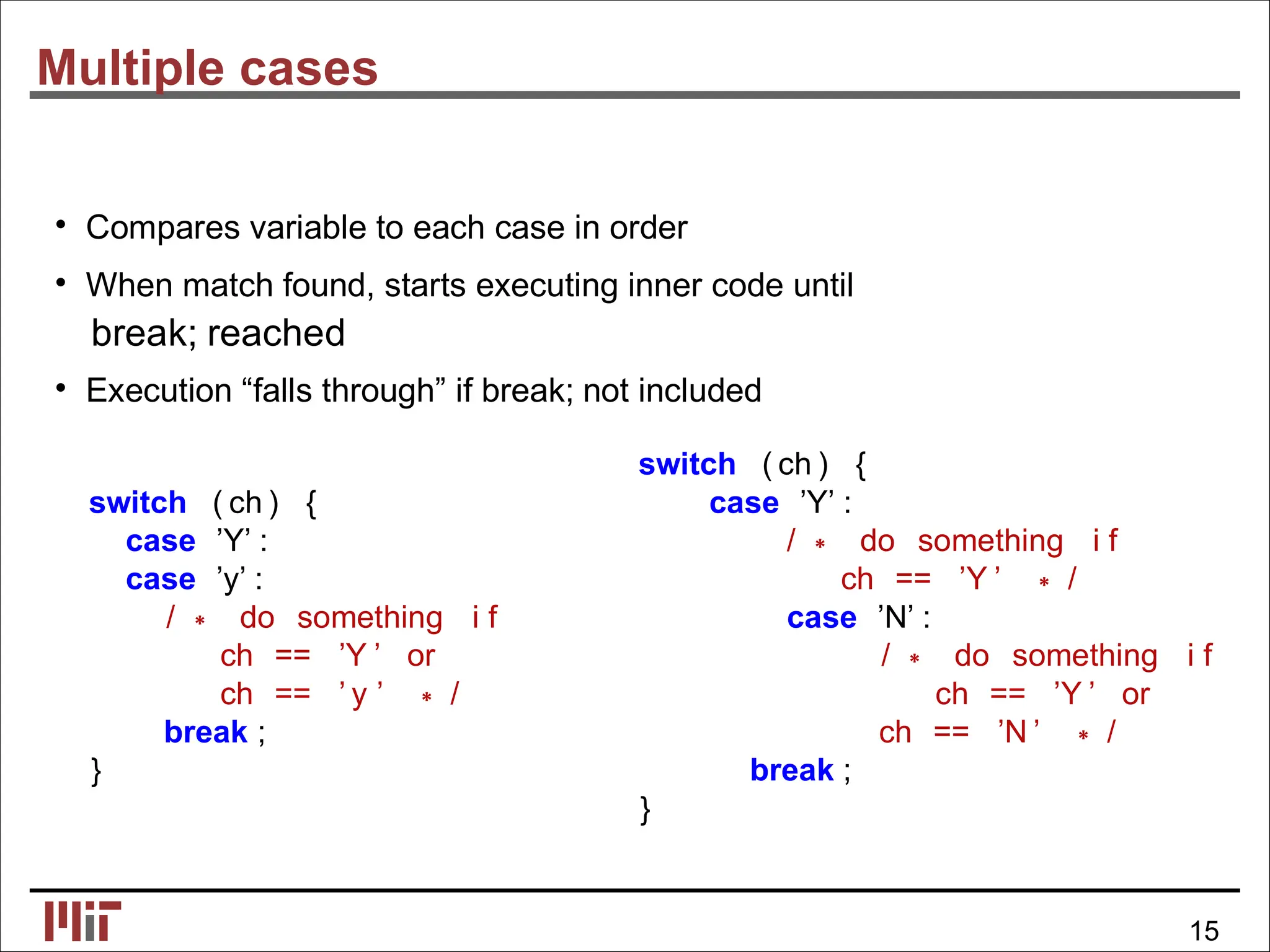
Multiple cases
• Compares variable to each case in order
• When match found, starts executing inner code until
break; reached
• Execution “falls through” if break; not included
switch ( ch ) {
switch ( ch ) { case ’Y’ :
case ’Y’ : / ∗ do something i f
case ’y’ : ch == ’Y ’ ∗ /
/ ∗ do something i f case ’N’ :
ch == ’Y ’ or / ∗ do something i f
ch == ’ y ’ ∗ / ch == ’Y ’ or
break ; ch == ’N ’ ∗ /
} break ;
}
15
The switch statement
• Contents of switch statement a block
• Case labels: different entry points into block
• Similar to labels used with goto keyword (next lecture. . . )
16
Loop statements
• The while loop
• The for loop
• The do-while loop
• The break and continue keywords
17
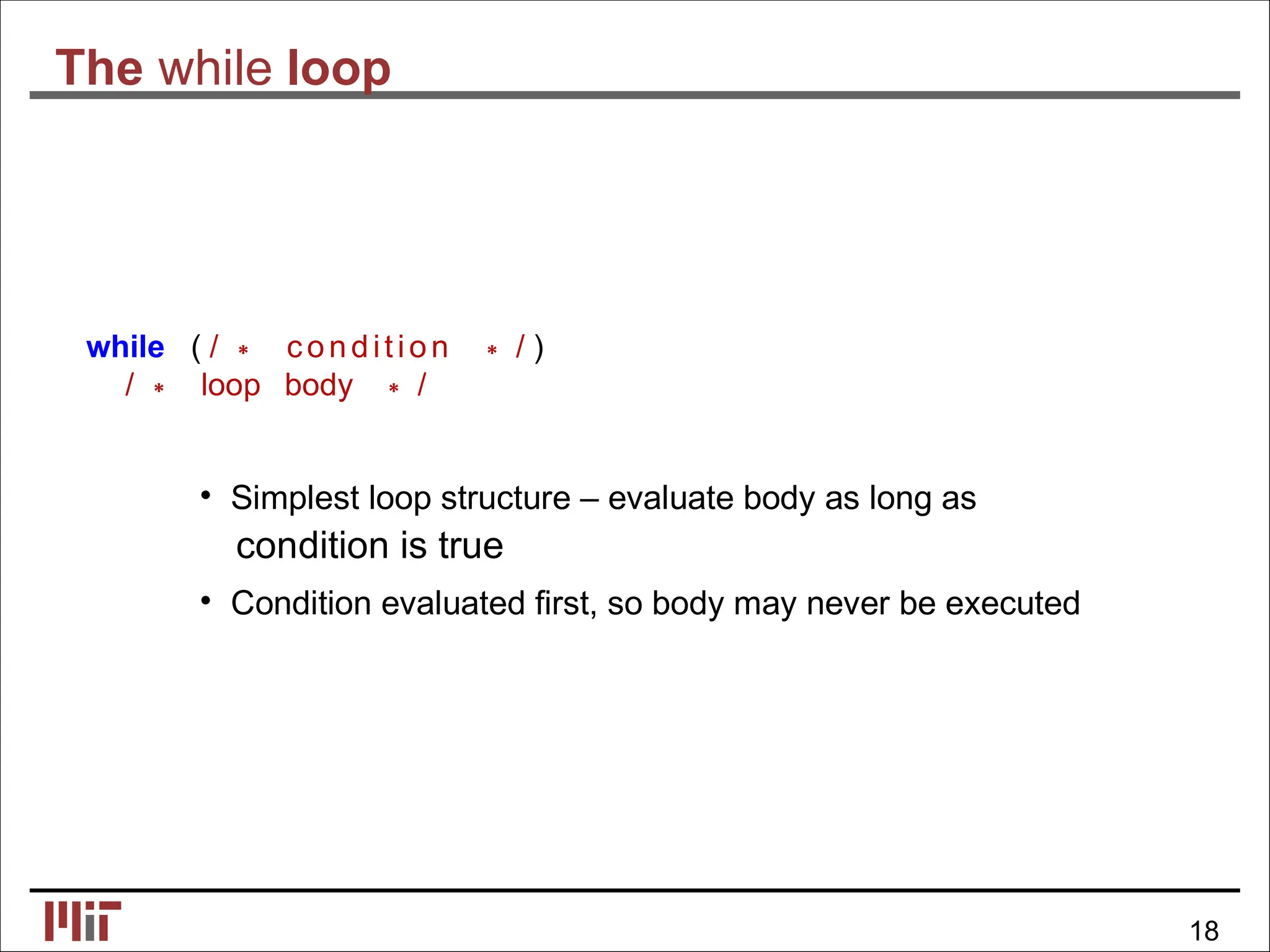
The while loop
while ( / ∗ condition ∗ / )
/ ∗ loop body ∗ /
• Simplest loop structure – evaluate body as long as
condition is true
• Condition evaluated first, so body may never be executed
18
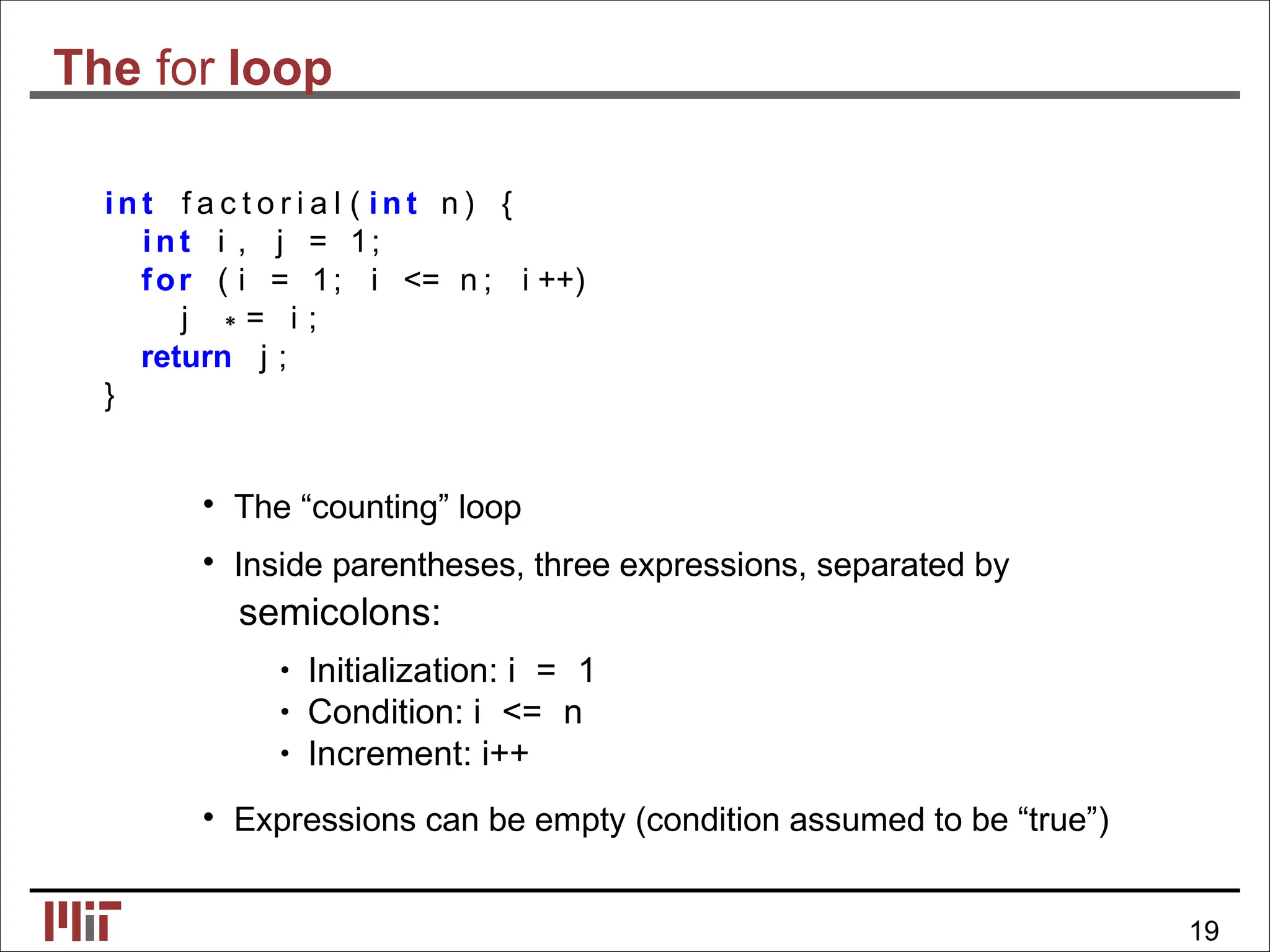
The for loop
in t f a c t o r i a l ( in t n ) {
int i , j = 1;
for ( i = 1; i <= n ; i ++)
j ∗= i ;
return j ;
}
• The “counting” loop
• Inside parentheses, three expressions, separated by
semicolons:
• Initialization: i = 1
• Condition: i <= n
• Increment: i++
• Expressions can be empty (condition assumed to be “true”)
19
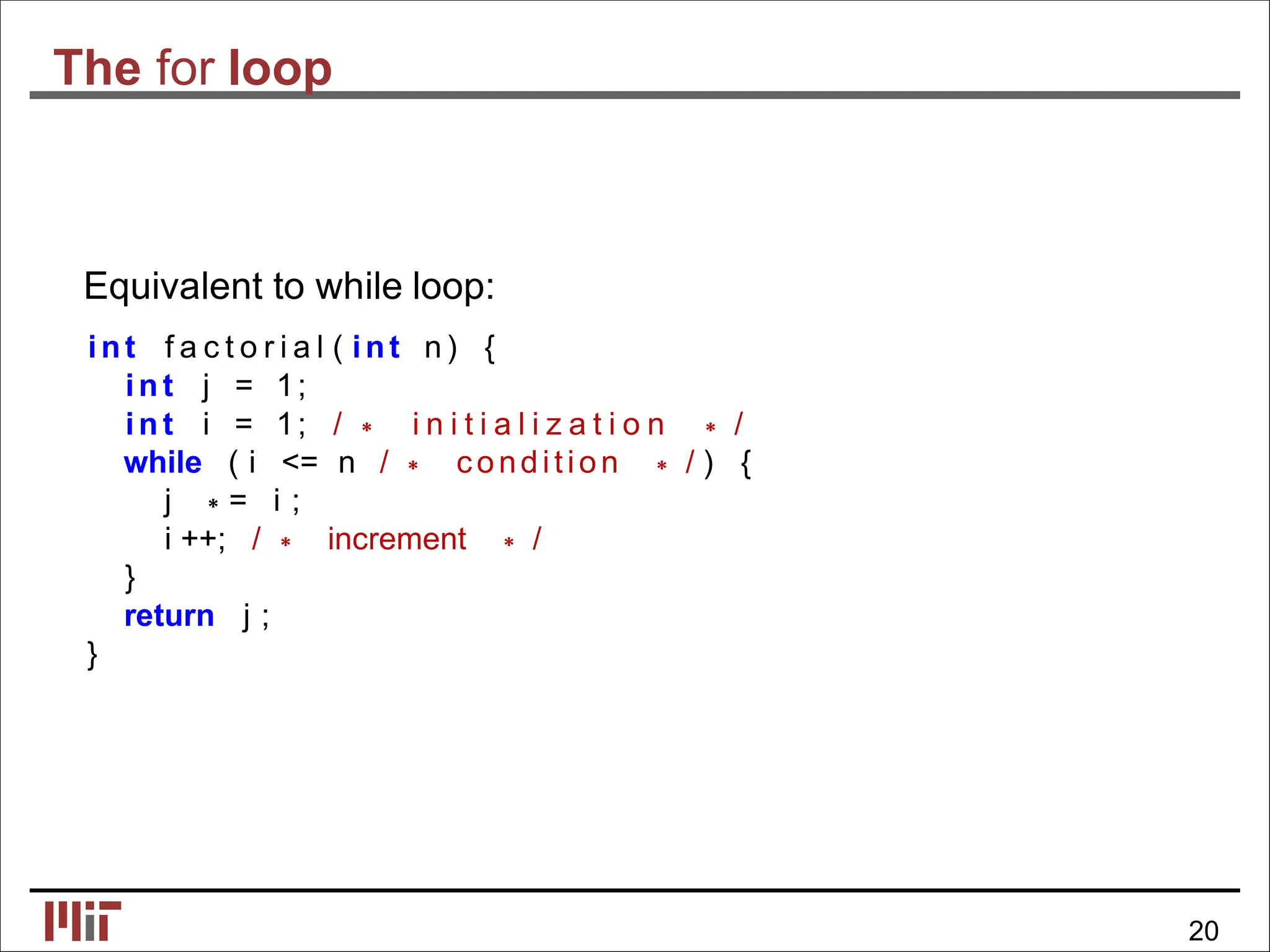
The for loop
Equivalent to while loop:
int f a c t o r i a l ( int n ) {
in t j = 1;
in t i = 1; / ∗ i n i t i a l i z a t i o n ∗ /
while ( i <= n / ∗ condition ∗ / ) {
j ∗= i ;
i ++; / ∗ increment ∗ /
}
return j ;
}
20
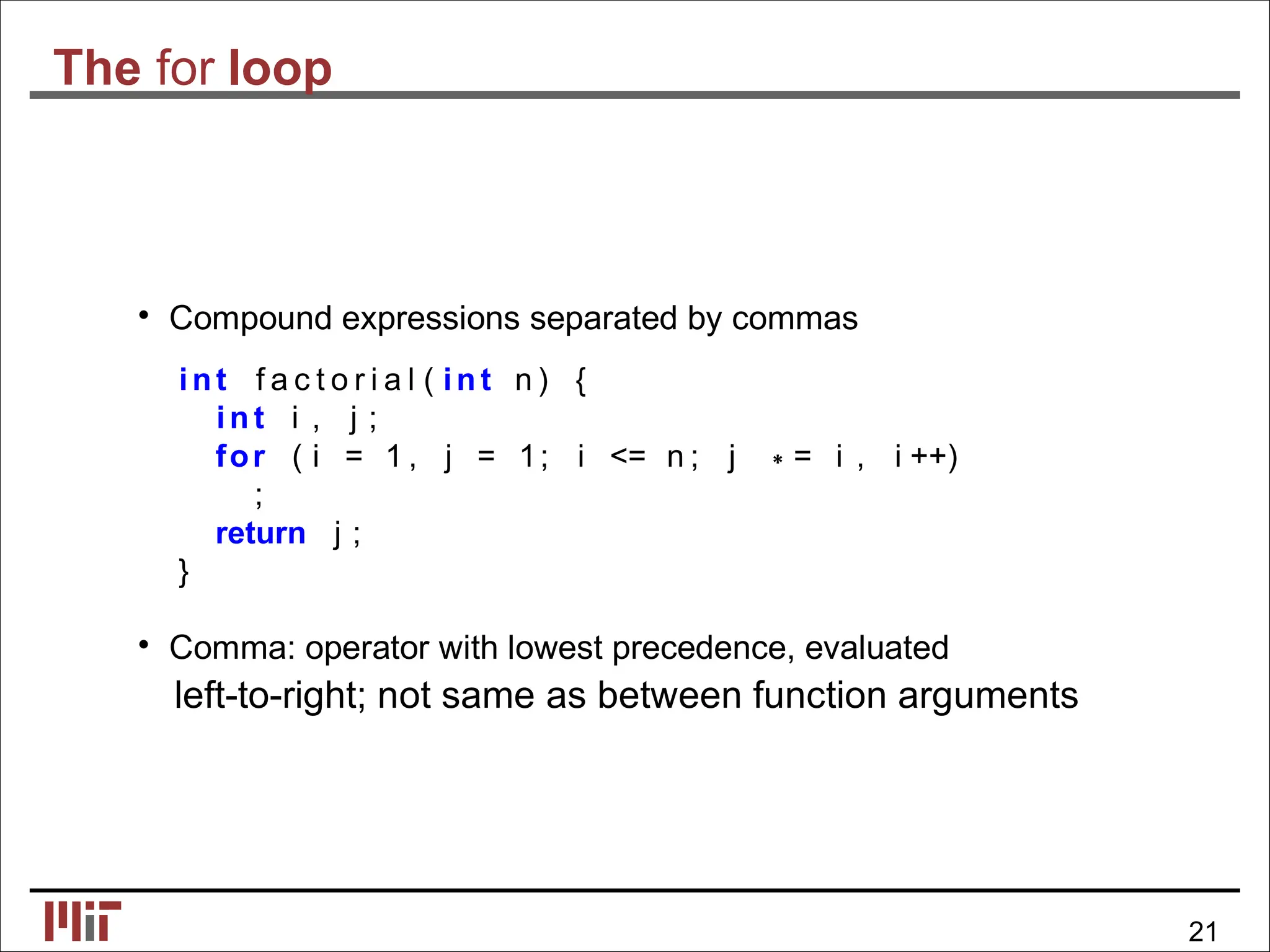
The for loop
• Compound expressions separated by commas
int f a c t o r i a l ( in t n ) {
in t i , j ;
for ( i = 1 , j = 1; i <= n ; j ∗= i , i ++)
;
return j ;
}
• Comma: operator with lowest precedence, evaluated
left-to-right; not same as between function arguments
21
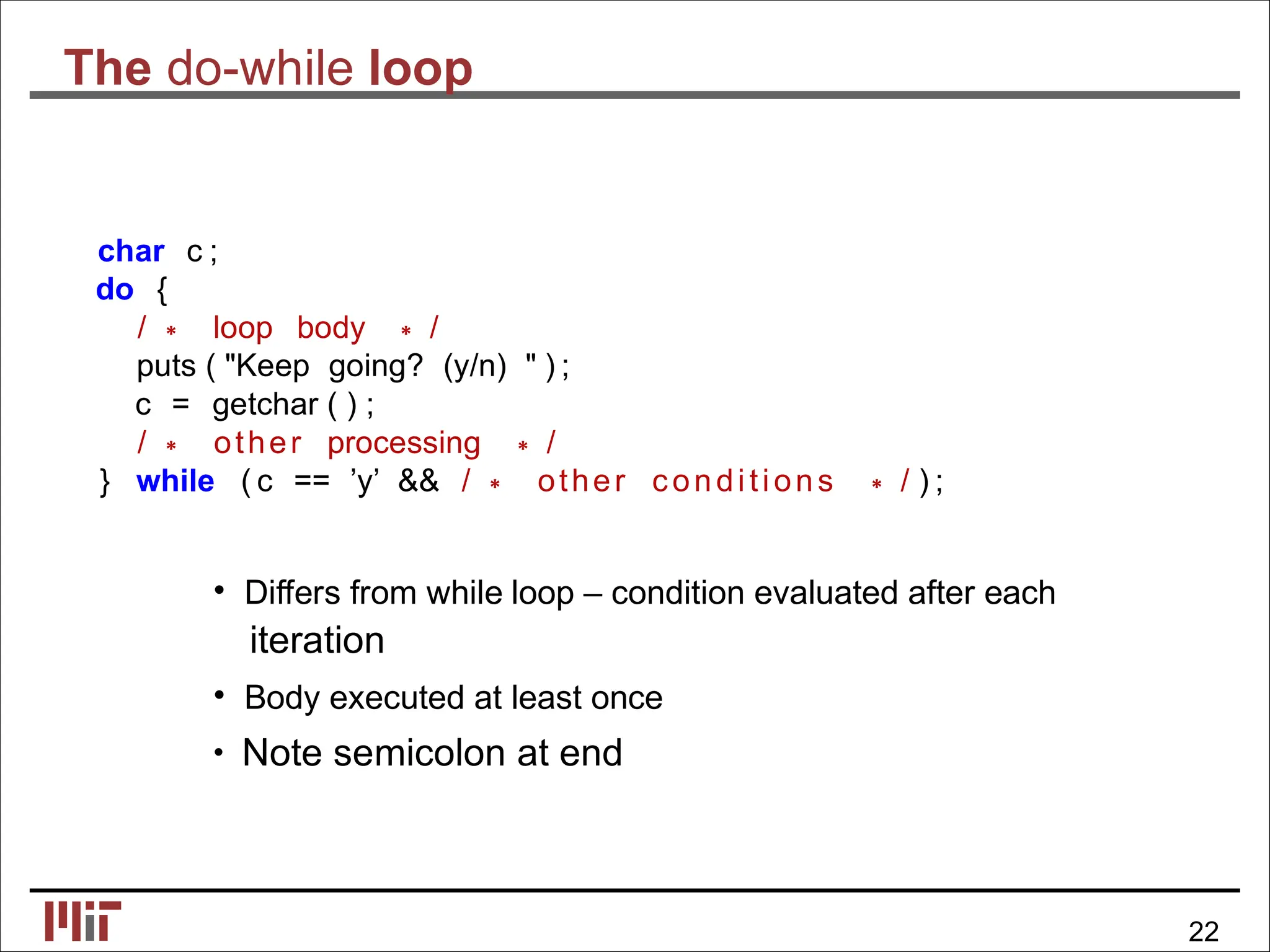
The do-while loop
char c ;
do {
/ ∗ loop body ∗ /
puts ( "Keep going? (y/n) " ) ;
c = getchar ( ) ;
/ ∗ other processing ∗ /
} while ( c == ’y’ && / ∗ other conditions ∗ / ) ;
• Differs from while loop – condition evaluated after each
iteration
• Body executed at least once
• Note semicolon at end
22
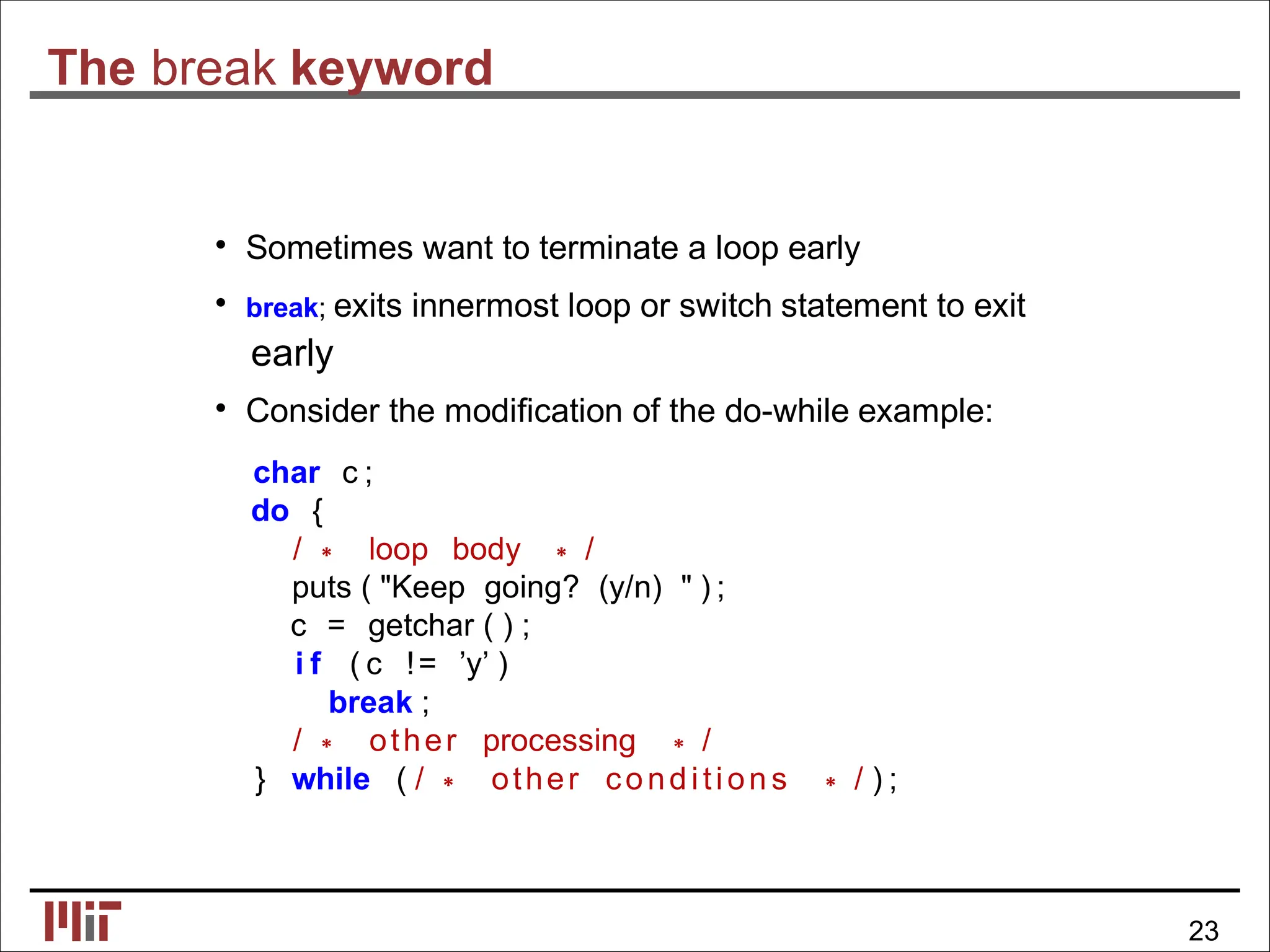
The break keyword
• Sometimes want to terminate a loop early
• break; exits innermost loop or switch statement to exit
early
• Consider the modification of the do-while example:
char c ;
do {
/ ∗ loop body ∗ /
puts ( "Keep going? (y/n) " ) ;
c = getchar ( ) ;
i f ( c != ’y’ )
break ;
/ ∗ other processing ∗ /
} while ( / ∗ other condition s ∗ / ) ;
23
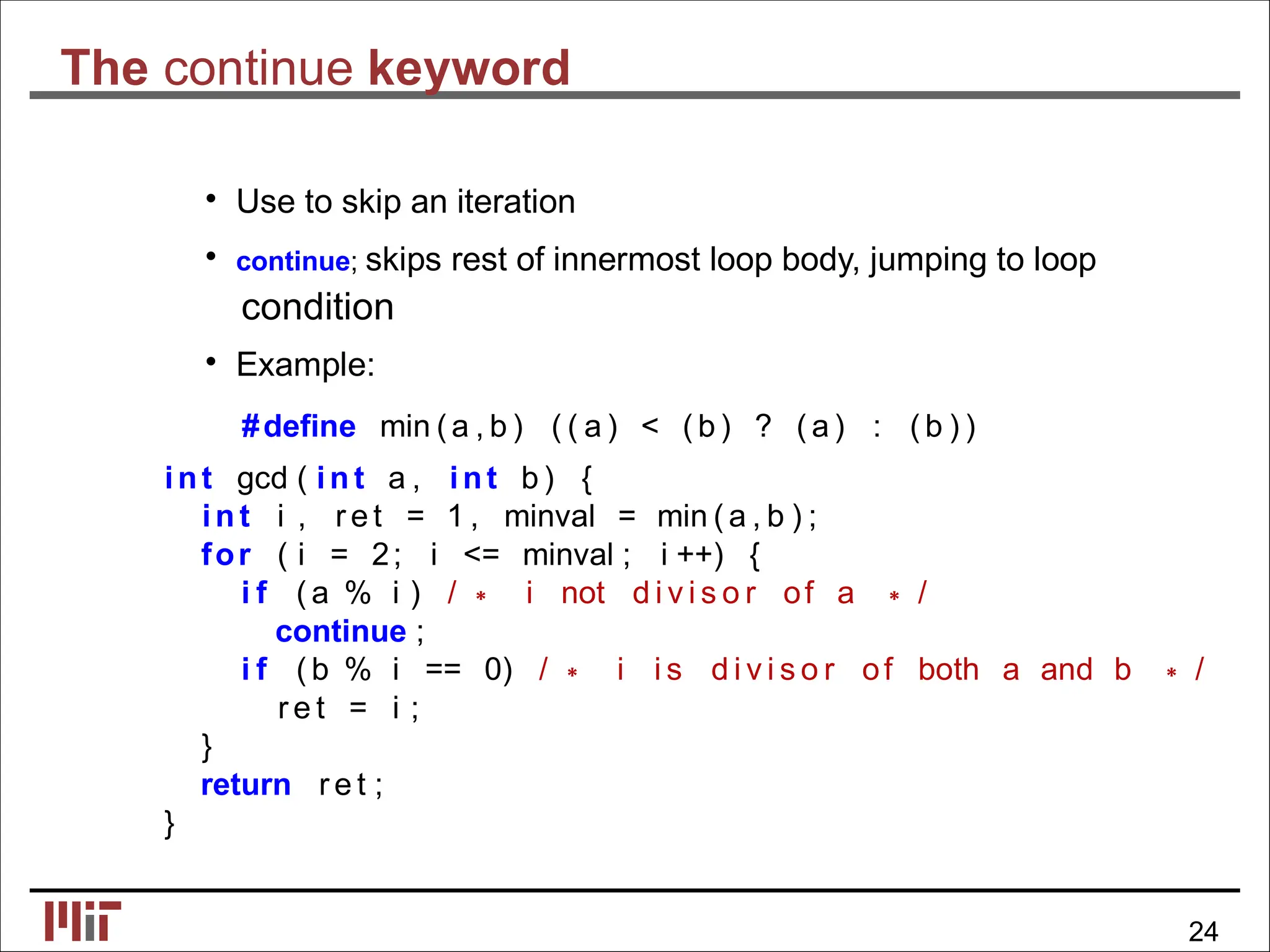
The continue keyword
• Use to skip an iteration
• continue; skips rest of innermost loop body, jumping to loop
condition
• Example:
#define min (a , b ) ( ( a ) < ( b ) ? ( a ) : ( b ) )
int gcd ( in t a , int b ) {
in t i , r e t = 1 , minval = min ( a , b ) ;
for ( i = 2; i <= minval ; i ++) {
i f ( a % i ) / ∗ i not d i v i s o r of a ∗ /
continue ;
i f ( b % i == 0) / ∗ i i s d i v i s o r of both a and b ∗ /
r e t = i ;
}
return r e t ;
}
24
6.087 Lecture 3 – January 13, 2010
Review
Blocks and Compound Statements
Control Flow
Conditional Statements
Loops
Functions
Modular Programming
Variable Scope
Static Variables
Register Variables
25
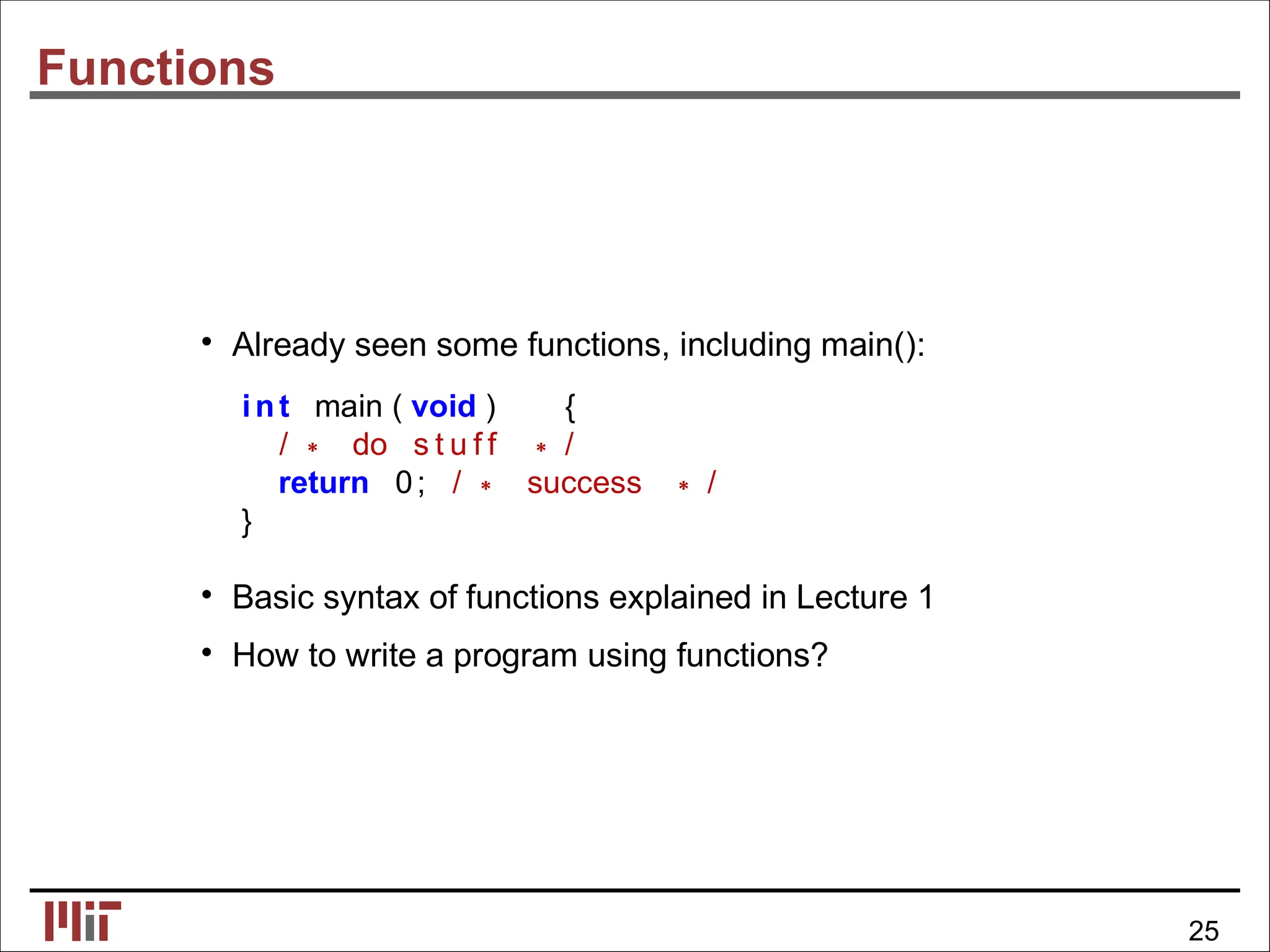
Functions
• Already seen some functions, including main():
int main ( void ) {
/ ∗ do s t u f f ∗ /
return 0; / ∗ success ∗ /
}
• Basic syntax of functions explained in Lecture 1
• How to write a program using functions?
25
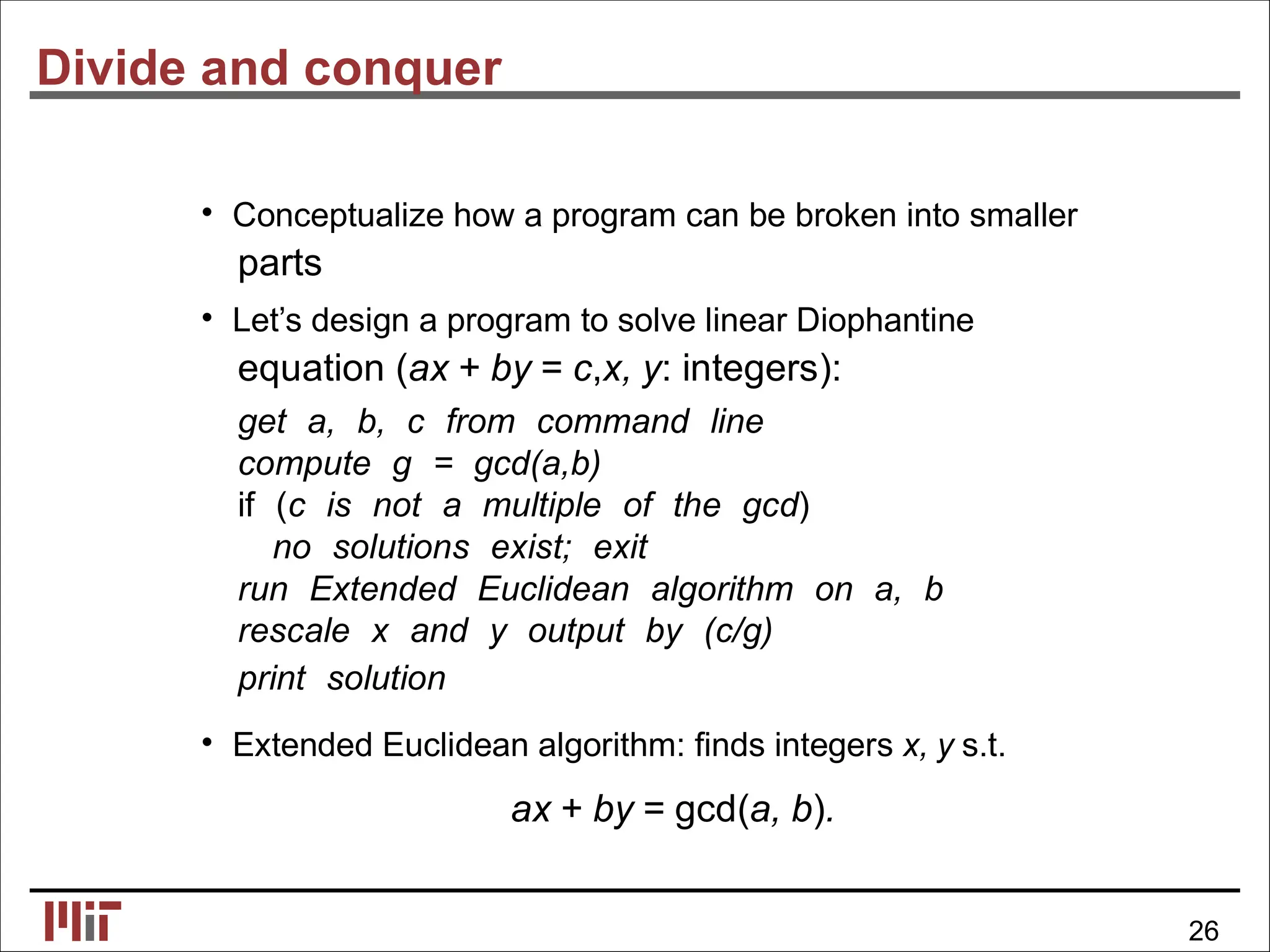
Divide and conquer
• Conceptualize how a program can be broken into smaller
parts
• Let’s design a program to solve linear Diophantine
equation (ax + by = c,x, y: integers):
get a, b, c from command line
compute g = gcd(a,b)
if (c is not a multiple of the gcd)
no solutions exist; exit
run Extended Euclidean algorithm on a, b
rescale x and y output by (c/g)
print solution
• Extended Euclidean algorithm: finds integers x, y s.t.
ax + by = gcd(a, b).
26
Computing the gcd
• Compute the gcd using the Euclidean algorithm:
in t gcd ( int a , int b ) {
while ( b ) { / ∗ i f a < b , performs swap ∗ /
in t temp = b ;
b = a % b ;
a = temp ;
}
return a ;
}
• Algorithm relies on gcd(a, b) = gcd(b, a mod b), for natural
numbers a > b.
[Knuth, D. E. The Art of Computer Programming, Volume 1: Fundamental
Algorithms. 3rd ed. Addison-Wesley, 1997.]
27
© Addison Wesley. All rights reserved. This content is excluded from our Creative Commons license.
For more information, see http://ocw.mit.edu/fairuse.
Extended Euclidean algorithm
Pseudocode for Extended Euclidean algorithm:
Initialize state variables (x,y)
if (a < b)
swap(a,b)
while (b > 0) {
compute quotient, remainder
update state variables (x,y)
}
return gcd and state variables (x,y)
[Menezes, A. J., et al. Handbook of Applied Cryptography. CRC Press, 1996.]
28
© CRC Press. All rights reserved. This content is excluded from our Creative Commons license.
For more information, see http://ocw.mit.edu/fairuse.
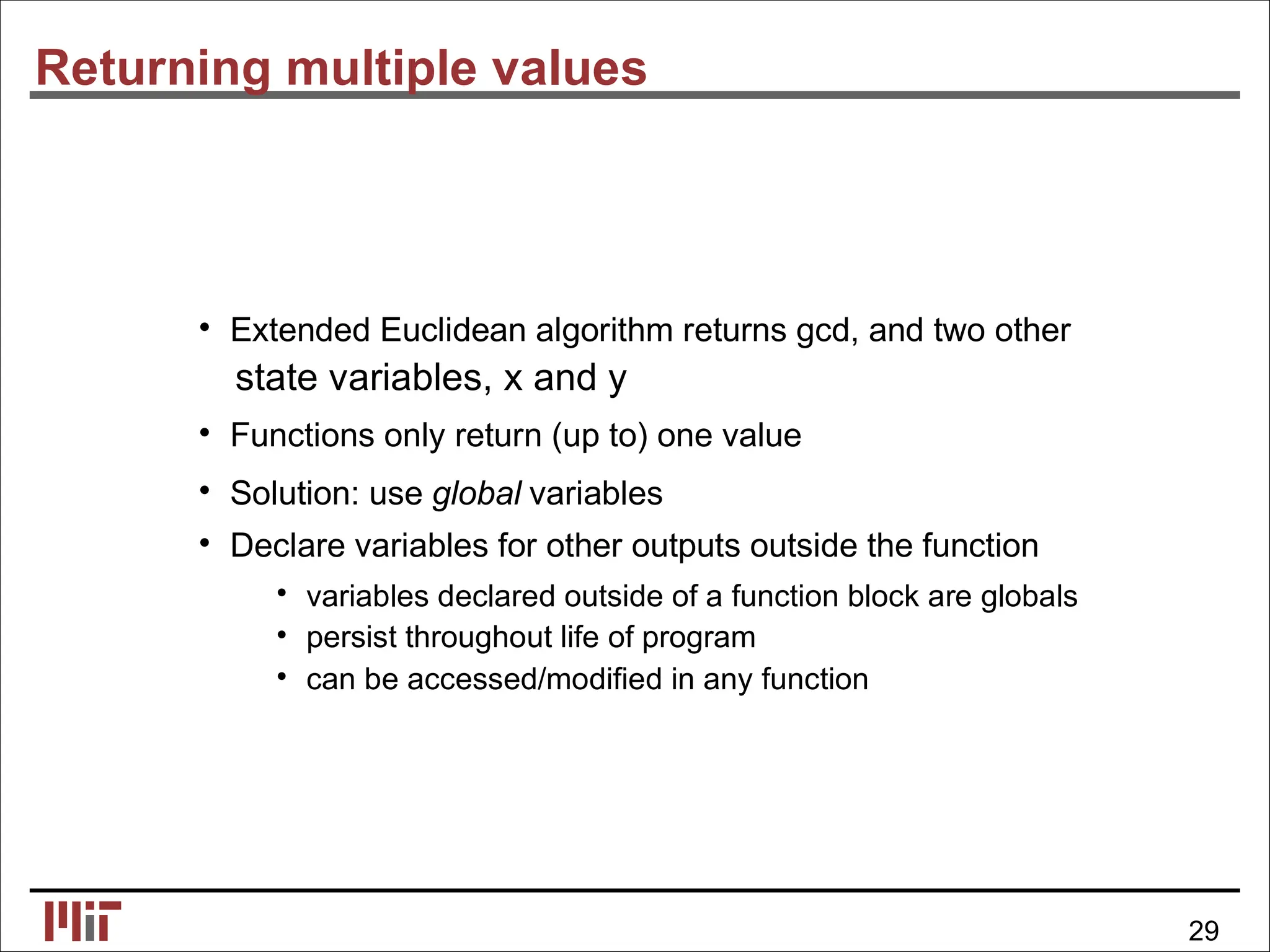
Returning multiple values
• Extended Euclidean algorithm returns gcd, and two other
state variables, x and y
• Functions only return (up to) one value
• Solution: use global variables
• Declare variables for other outputs outside the function
• variables declared outside of a function block are globals
• persist throughout life of program
• can be accessed/modified in any function
29
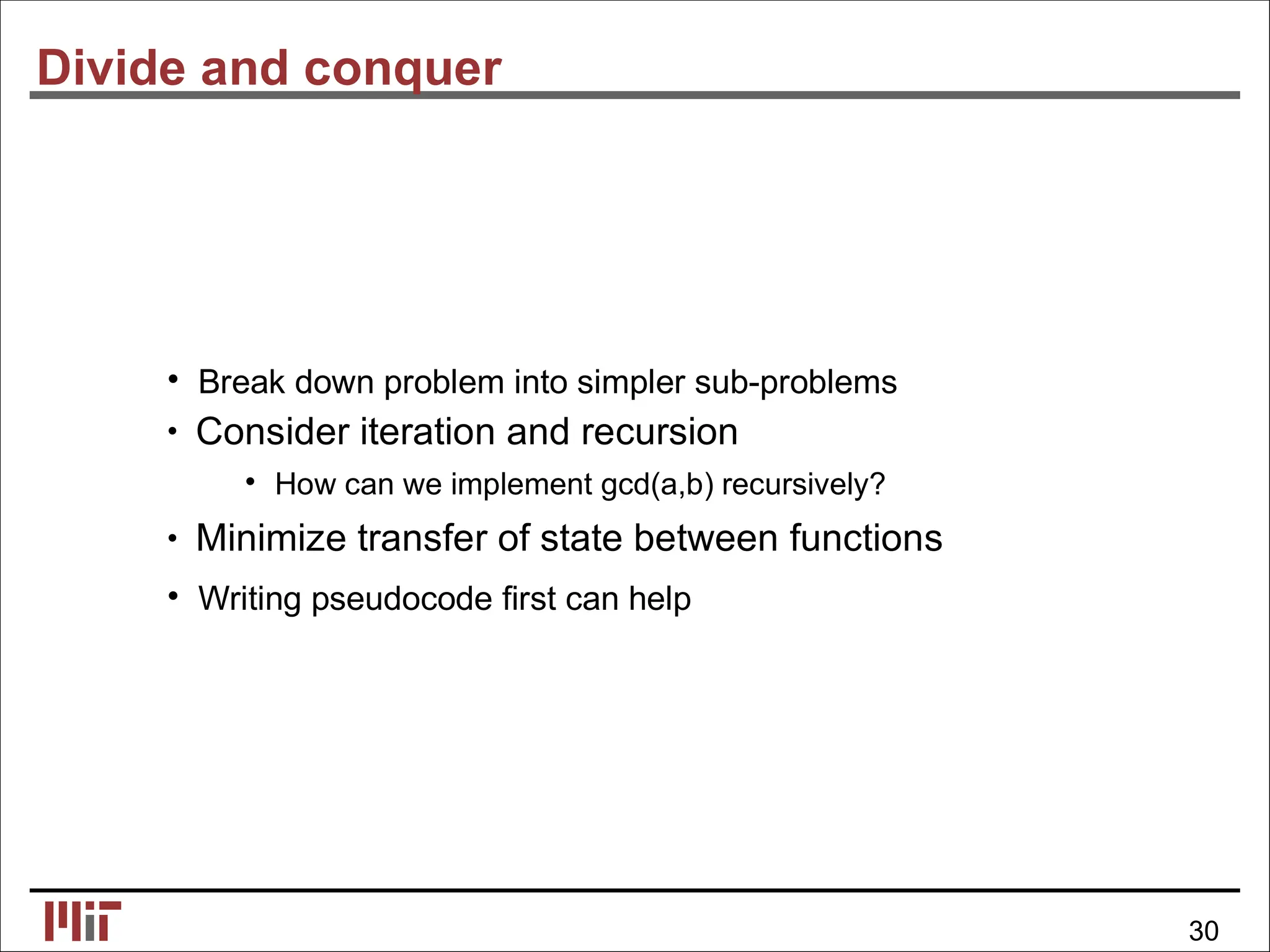
Divide and conquer
• Break down problem into simpler sub-problems
• Consider iteration and recursion
• How can we implement gcd(a,b) recursively?
• Minimize transfer of state between functions
• Writing pseudocode first can help
30
6.087 Lecture 3 – January 13, 2010
Review
Blocks and Compound Statements
Control Flow
Conditional Statements
Loops
Functions
Modular Programming
Variable Scope
Static Variables
Register Variables
31
Programming modules in C
• C programs do not need to be monolithic
• Module: interface and implementation
• interface: header files
• implementation: auxilliary source/object files
• Same concept carries over to external libraries (next
week. . . )
31
The Euclid module
• Euclid’s algorithms useful in many contexts
• Would like to include functionality in many programs
• Solution: make a module for Euclid’s algorithms
• Need to write header file (.h) and source file (.c)
32
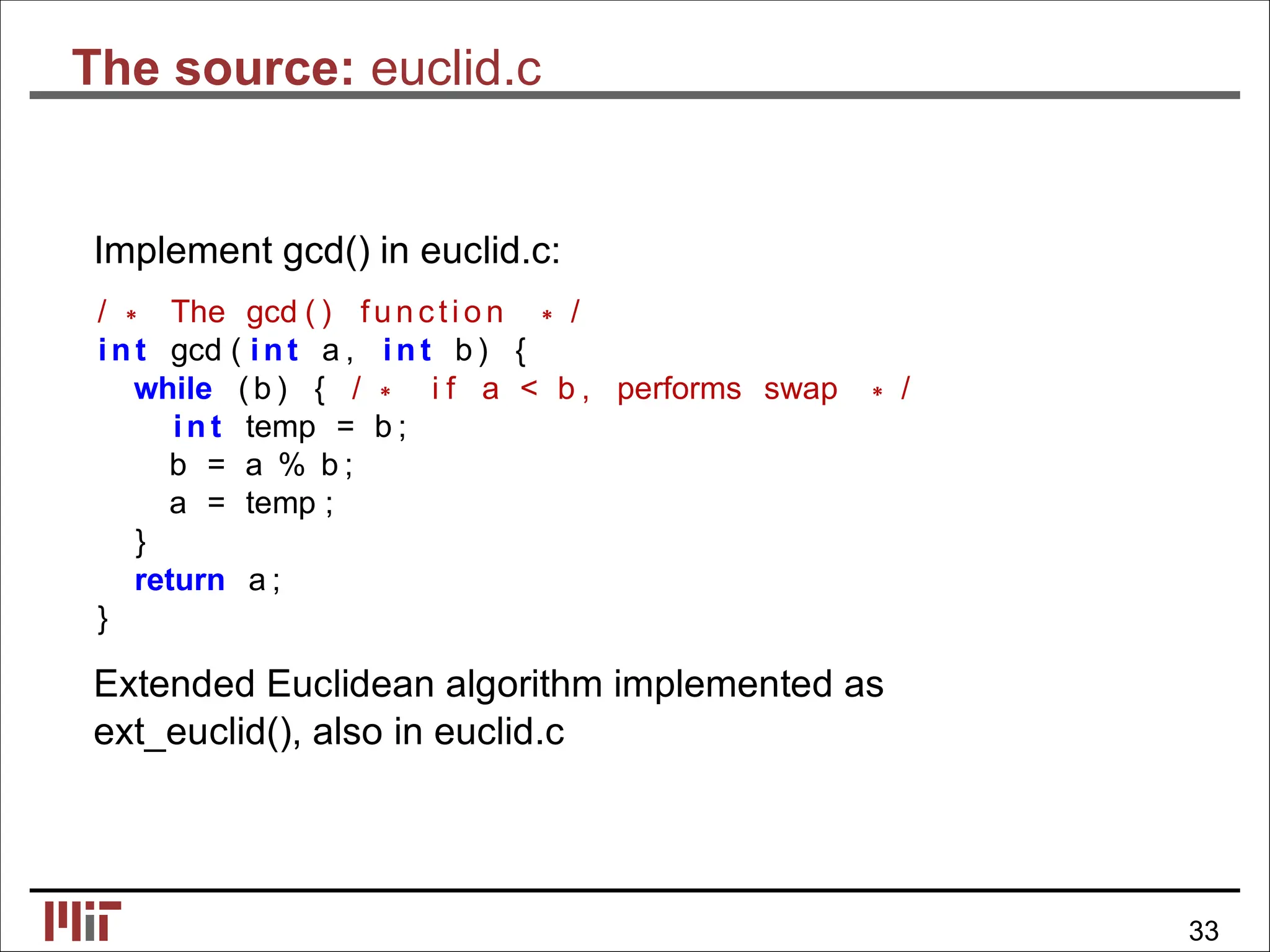
The source: euclid.c
Implement gcd() in euclid.c:
/ ∗ The gcd ( ) fun cti o n ∗ /
in t gcd ( int a , in t b ) {
while ( b ) { / ∗ i f a < b , performs swap ∗ /
in t temp = b ;
b = a % b ;
a = temp ;
}
return a ;
}
Extended Euclidean algorithm implemented as
ext_euclid(), also in euclid.c
33
The extern keyword
• Need to inform other source files about functions/global
variables in euclid.c
• For functions: put function prototypes in a header file
• For variables: re-declare the global variable using the
extern keyword in header file
• extern informs compiler that variable defined somewhere
else
• Enables access/modifying of global variable from other
source files
34
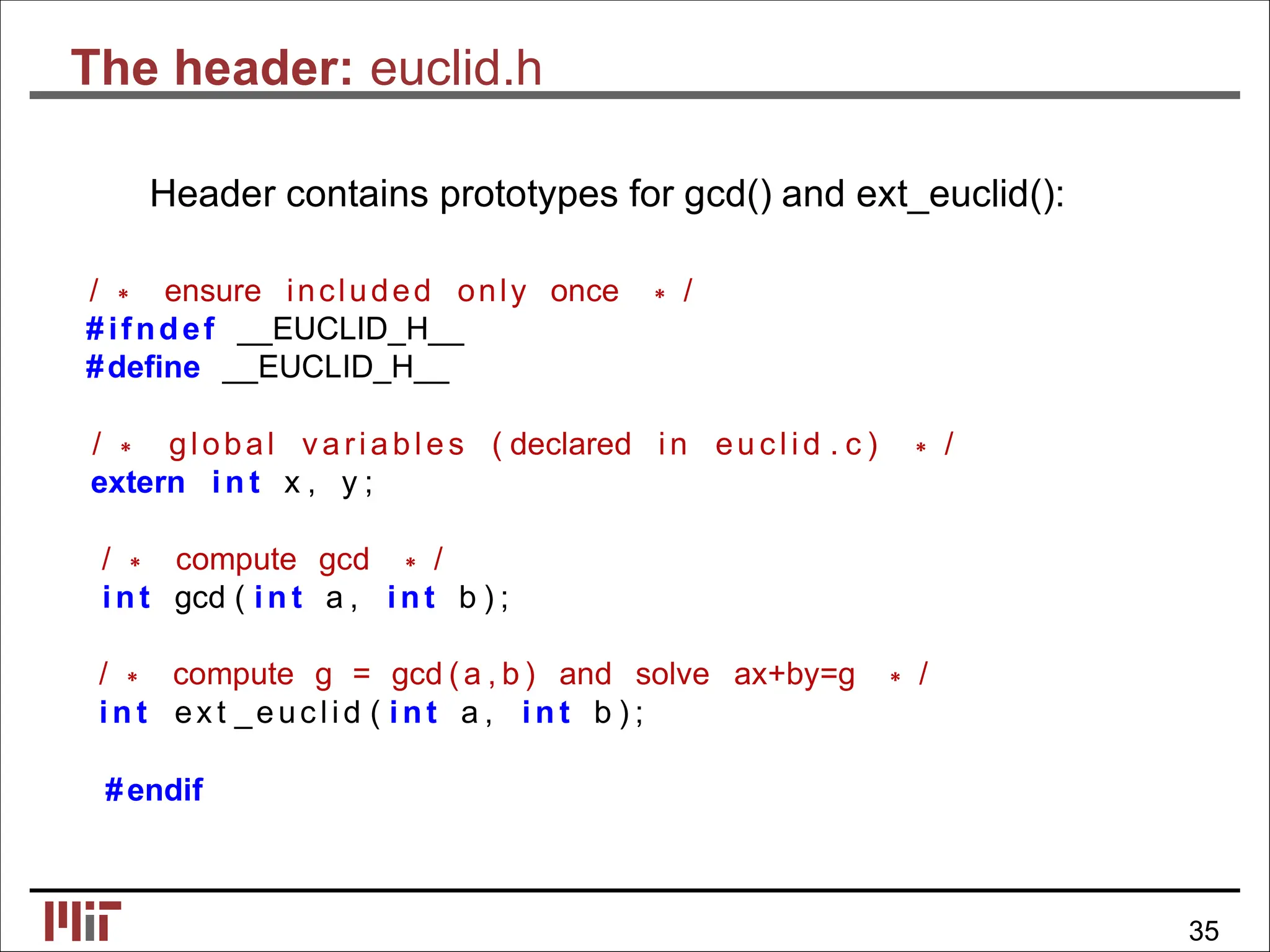
The header: euclid.h
Header contains prototypes for gcd() and ext_euclid():
/ ∗ ensure included only once ∗ /
# ifndef __EUCLID_H__
#define __EUCLID_H__
/ ∗ global variables ( declared in eu clid . c ) ∗ /
extern in t x , y ;
/ ∗ compute gcd ∗ /
int gcd ( in t a , int b ) ;
/ ∗ compute g = gcd (a , b ) and solve ax+by=g ∗ /
in t ex t _euclid ( int a , in t b ) ;
#endif
35
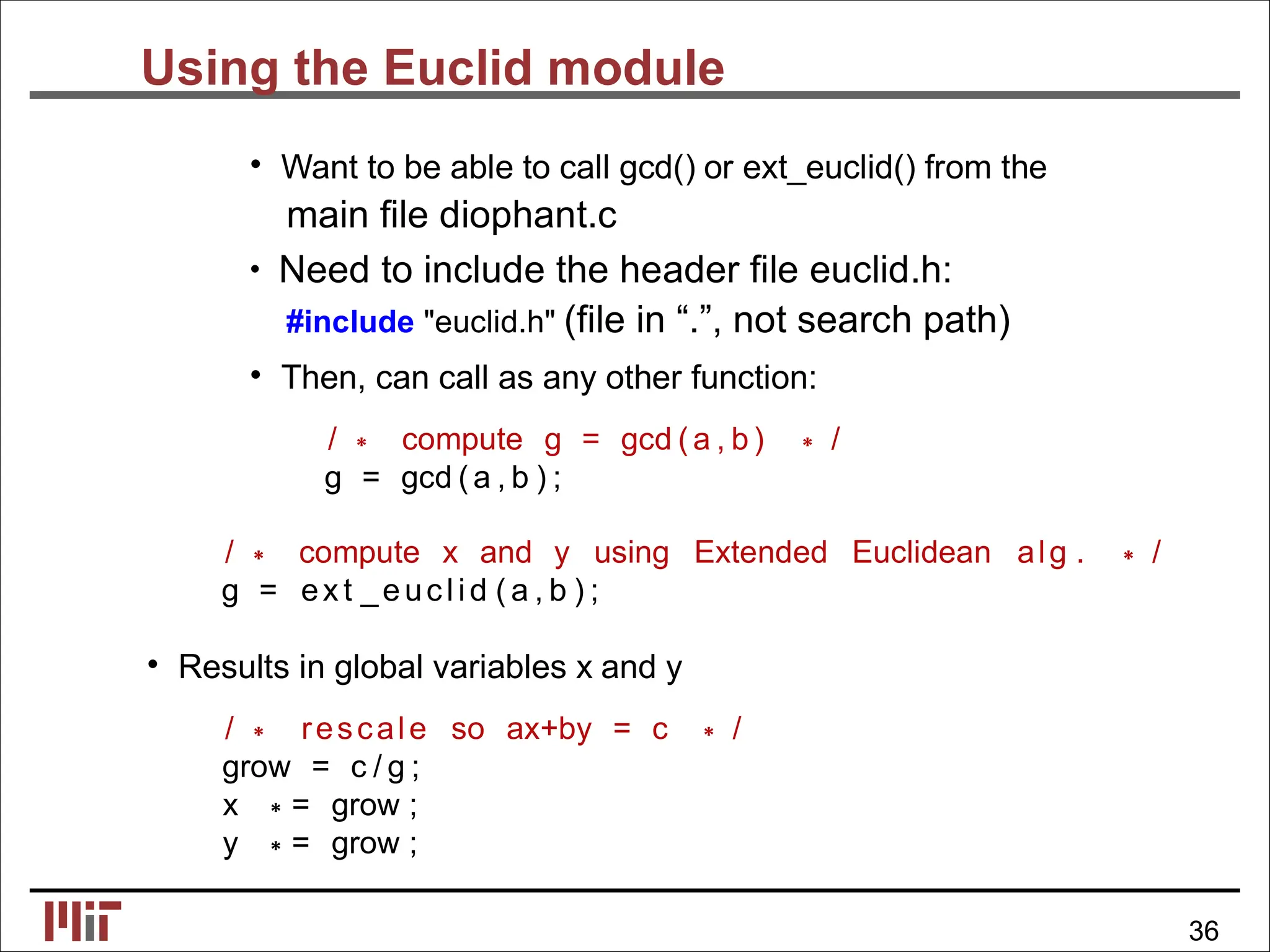
Using the Euclid module
• Want to be able to call gcd() or ext_euclid() from the
main file diophant.c
• Need to include the header file euclid.h:
#include "euclid.h" (file in “.”, not search path)
• Then, can call as any other function:
/ ∗ compute g = gcd (a , b ) ∗ /
g = gcd (a , b ) ;
/ ∗ compute x and y using Extended Euclidean alg . ∗ /
g = ex t _euclid ( a , b ) ;
• Results in global variables x and y
/ ∗ rescale so ax+by = c ∗ /
grow = c / g ;
x ∗= grow ;
y ∗= grow ;
36
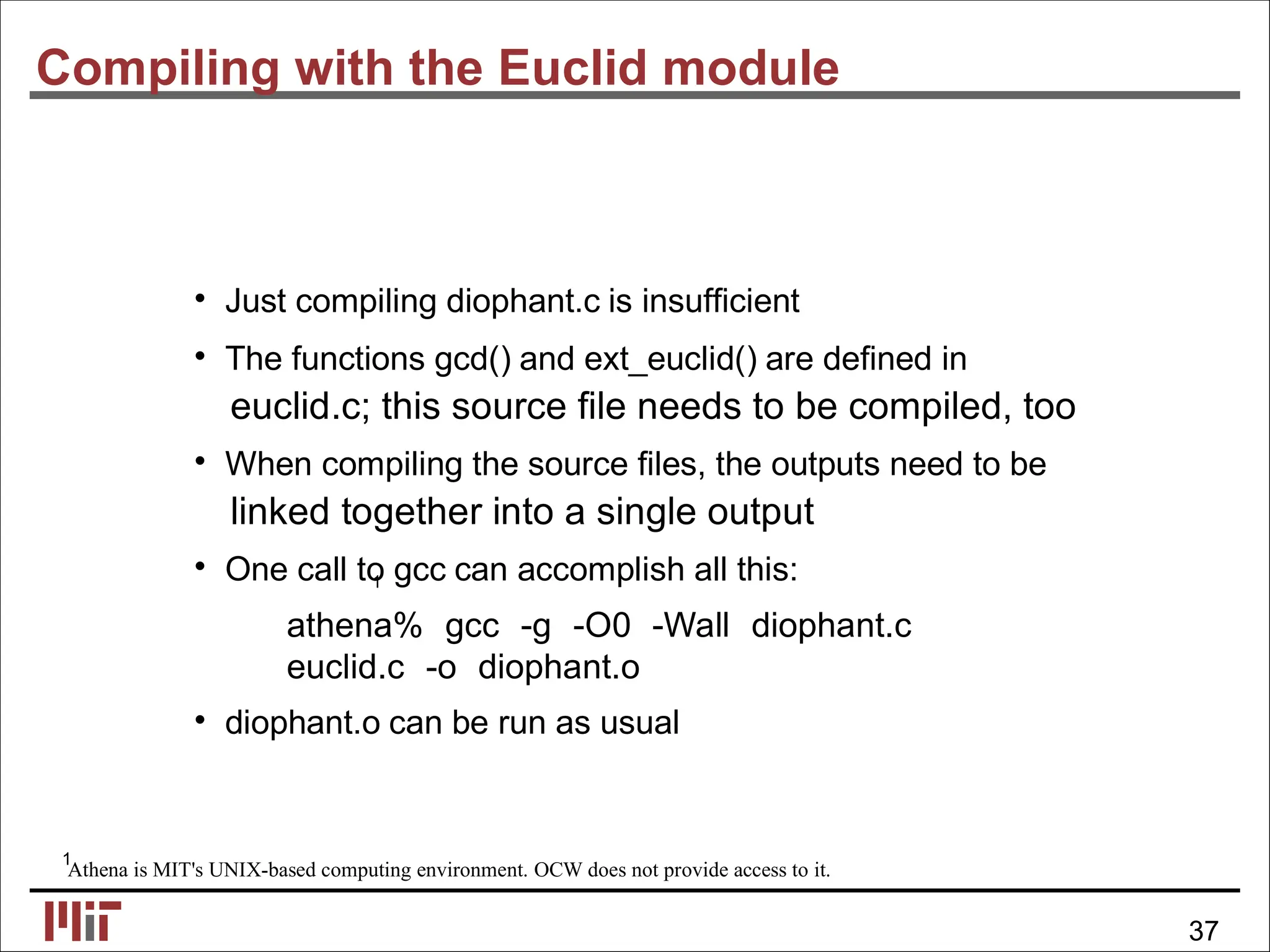
Compiling with the Euclid module
• Just compiling diophant.c is insufficient
• The functions gcd() and ext_euclid() are defined in
euclid.c; this source file needs to be compiled, too
• When compiling the source files, the outputs need to be
linked together into a single output
• One call to gcc can accomplish all this:
athena% gcc -g -O0 -Wall diophant.c
euclid.c -o diophant.o
• diophant.o can be run as usual
Athena is MIT's UNIX-based computing environment. OCW does not provide access to it.
37
1
1
6.087 Lecture 3 – January 13, 2010
Review
Blocks and Compound Statements
Control Flow
Conditional Statements
Loops
Functions
Modular Programming
Variable Scope
Static Variables
Register Variables
38
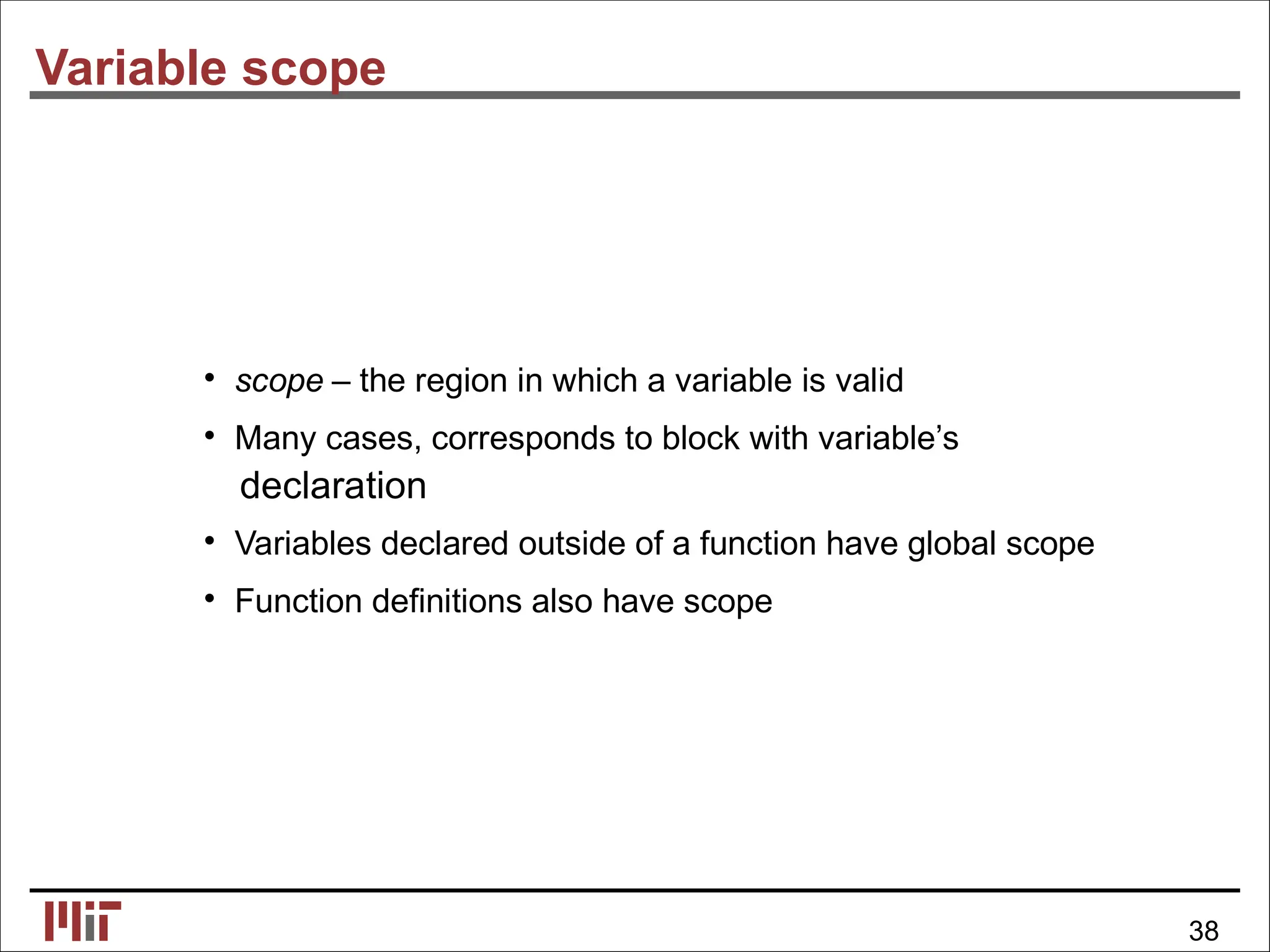
Variable scope
• scope – the region in which a variable is valid
• Many cases, corresponds to block with variable’s
declaration
• Variables declared outside of a function have global scope
• Function definitions also have scope
38
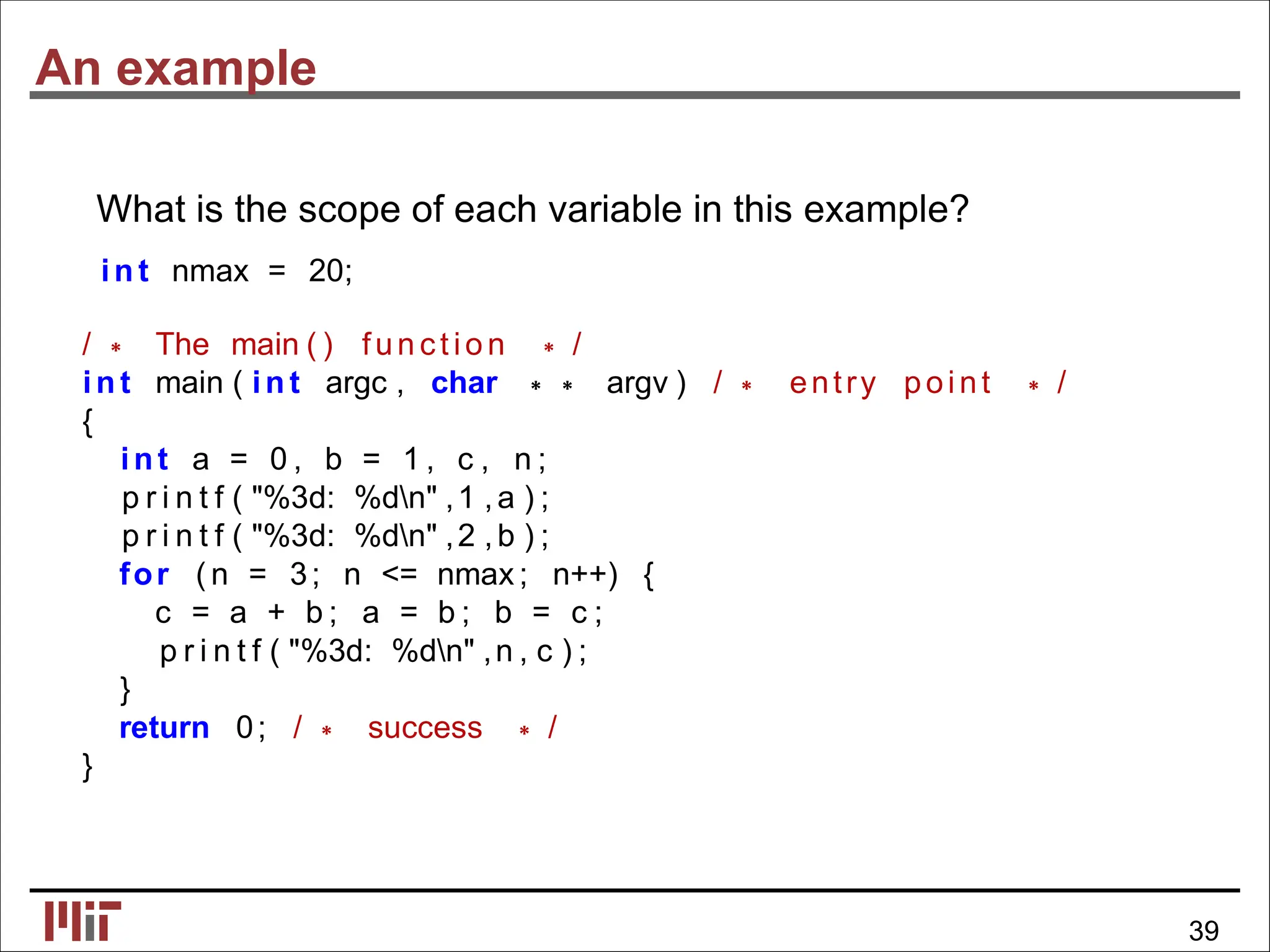
An example
What is the scope of each variable in this example?
in t nmax = 20;
/ ∗ The main ( ) fun ct io n ∗ /
in t main ( in t argc , char ∗∗ argv ) / ∗ entry point ∗ /
{
int a = 0 , b = 1 , c , n ;
p r i n t f ( "%3d: %dn" ,1 ,a ) ;
p r i n t f ( "%3d: %dn" ,2 ,b ) ;
for ( n = 3; n <= nmax ; n++) {
c = a + b ; a = b ; b = c ;
p r i n t f ( "%3d: %dn" ,n , c ) ;
}
return 0; / ∗ success ∗ /
}
39
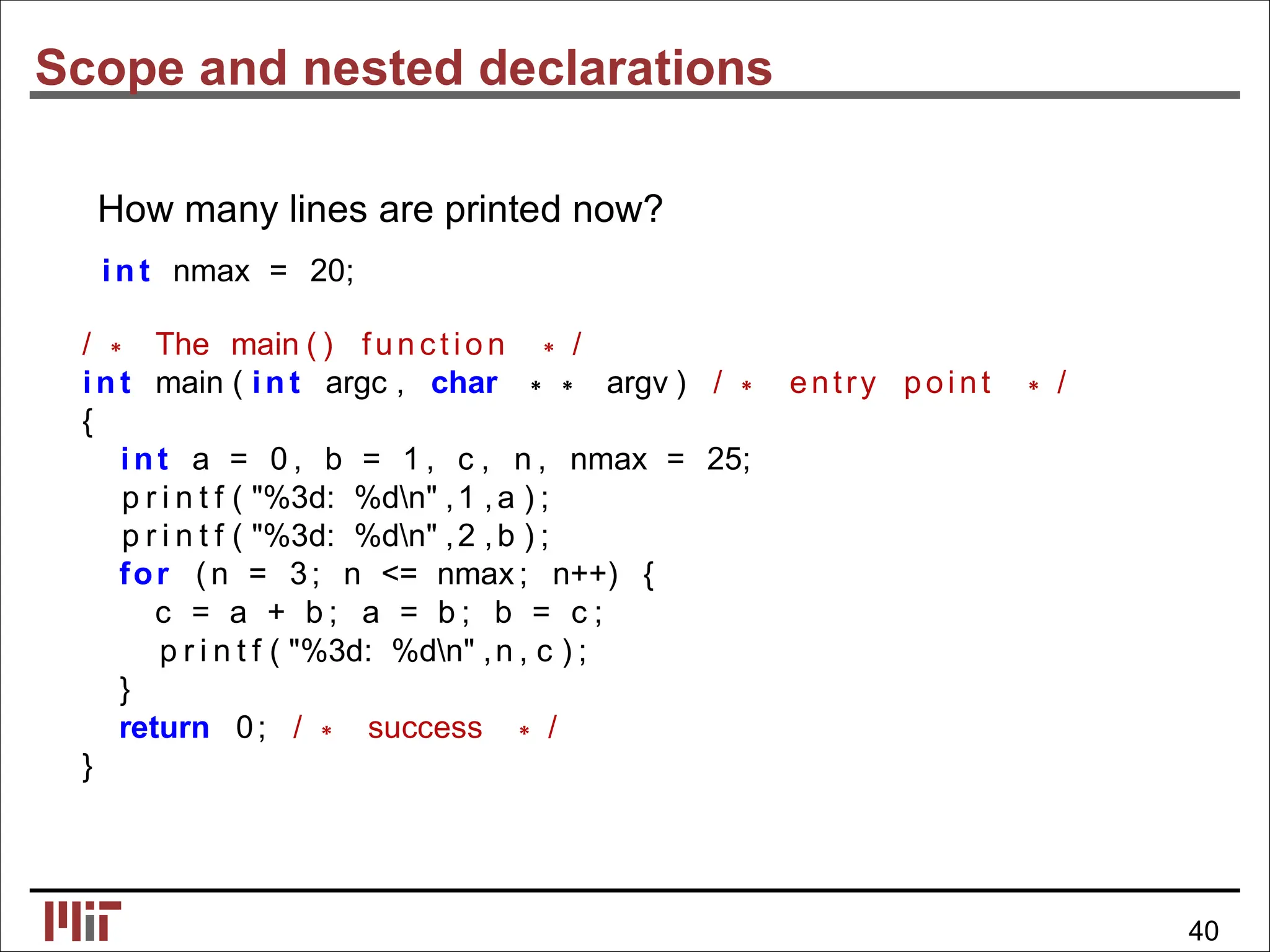
Scope and nested declarations
How many lines are printed now?
in t nmax = 20;
/ ∗ The main ( ) fun ct io n ∗ /
in t main ( in t argc , char ∗∗ argv ) / ∗ entry point ∗ /
{
int a = 0 , b = 1 , c , n , nmax = 25;
p r i n t f ( "%3d: %dn" ,1 ,a ) ;
p r i n t f ( "%3d: %dn" ,2 ,b ) ;
for ( n = 3; n <= nmax ; n++) {
c = a + b ; a = b ; b = c ;
p r i n t f ( "%3d: %dn" ,n , c ) ;
}
return 0; / ∗ success ∗ /
}
40
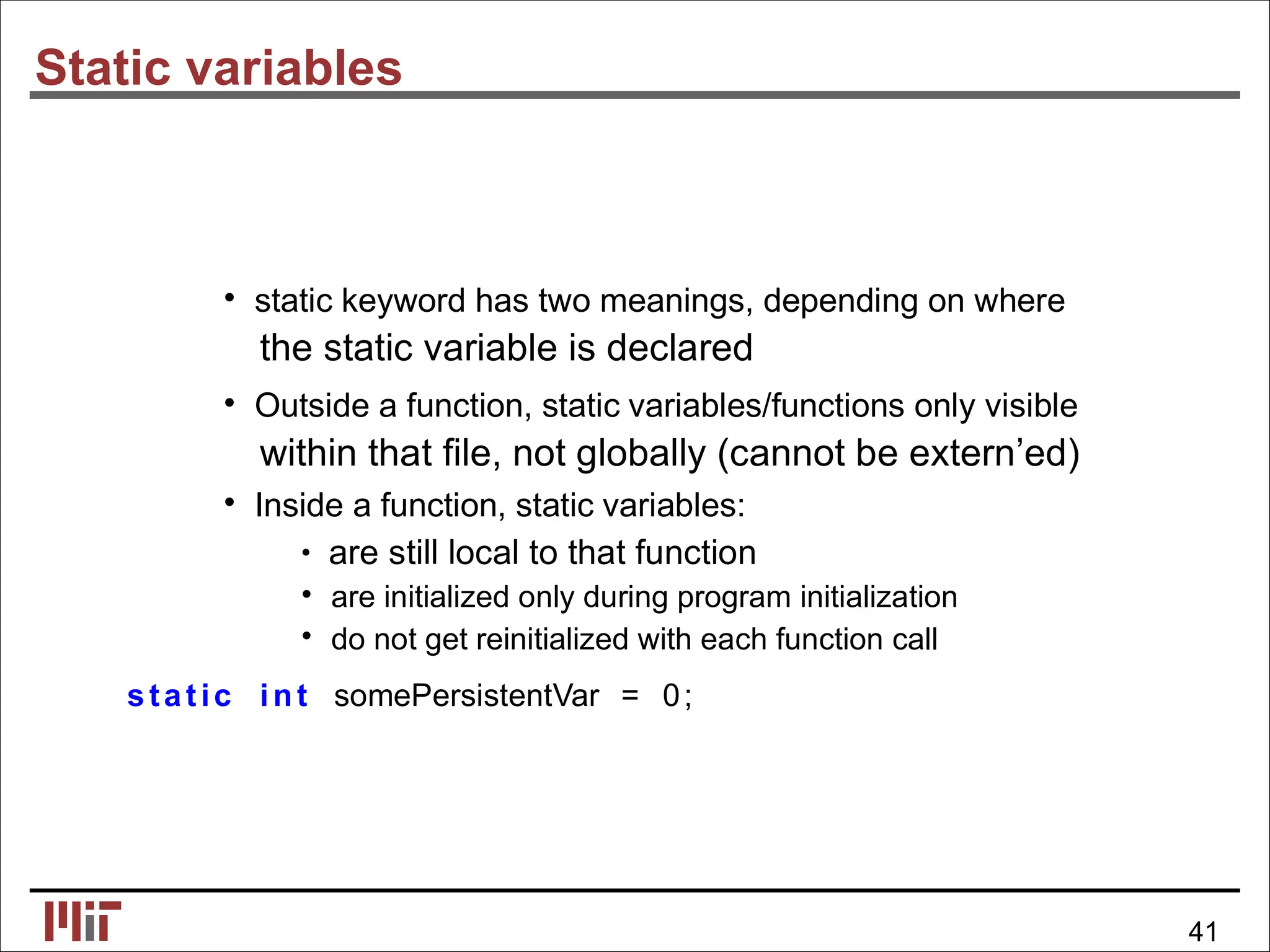
Static variables
• static keyword has two meanings, depending on where
the static variable is declared
• Outside a function, static variables/functions only visible
within that file, not globally (cannot be extern’ed)
• Inside a function, static variables:
• are still local to that function
• are initialized only during program initialization
• do not get reinitialized with each function call
static int somePersistentVar = 0;
41
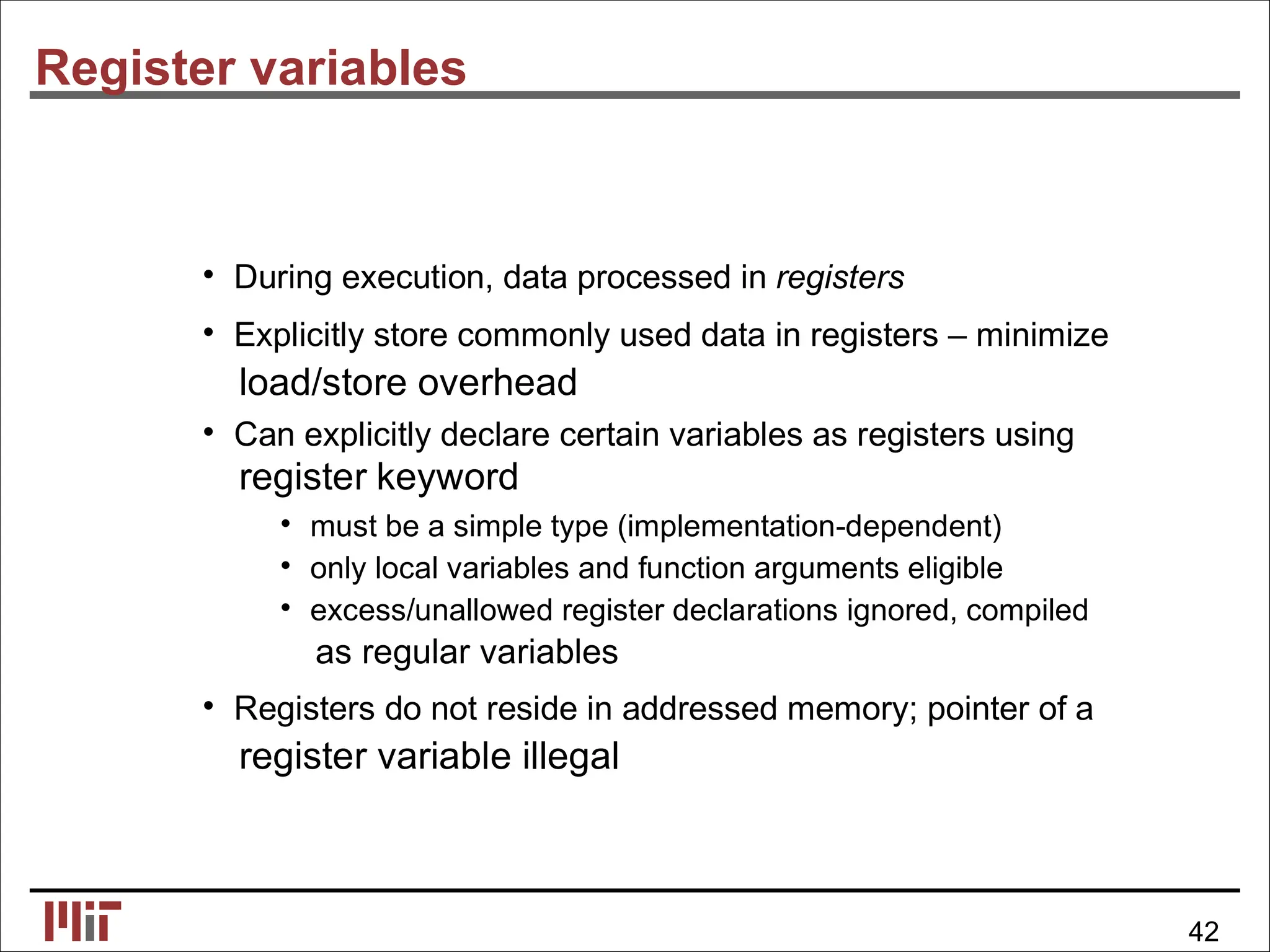
Register variables
• During execution, data processed in registers
• Explicitly store commonly used data in registers – minimize
load/store overhead
• Can explicitly declare certain variables as registers using
register keyword
• must be a simple type (implementation-dependent)
• only local variables and function arguments eligible
• excess/unallowed register declarations ignored, compiled
as regular variables
• Registers do not reside in addressed memory; pointer of a
register variable illegal
42
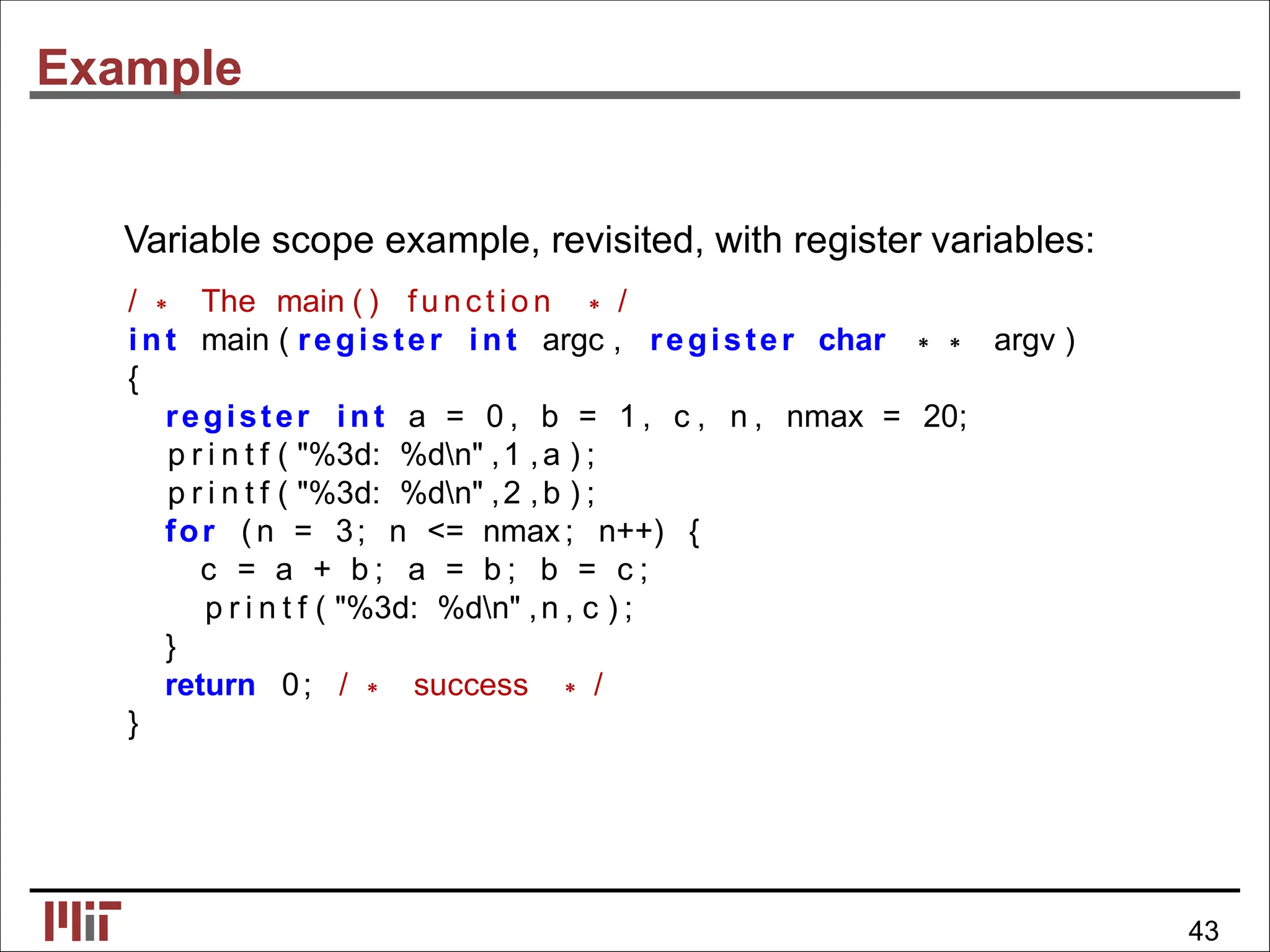
Example
Variable scope example, revisited, with register variables:
/ ∗ The main ( ) fu nct io n ∗ /
int main ( register int argc , register char ∗∗ argv )
{
register int a = 0 , b = 1 , c , n , nmax = 20;
p r i n t f ( "%3d: %dn" ,1 ,a ) ;
p r i n t f ( "%3d: %dn" ,2 ,b ) ;
for ( n = 3; n <= nmax ; n++) {
c = a + b ; a = b ; b = c ;
p r i n t f ( "%3d: %dn" ,n , c ) ;
}
return 0; / ∗ success ∗ /
}
43
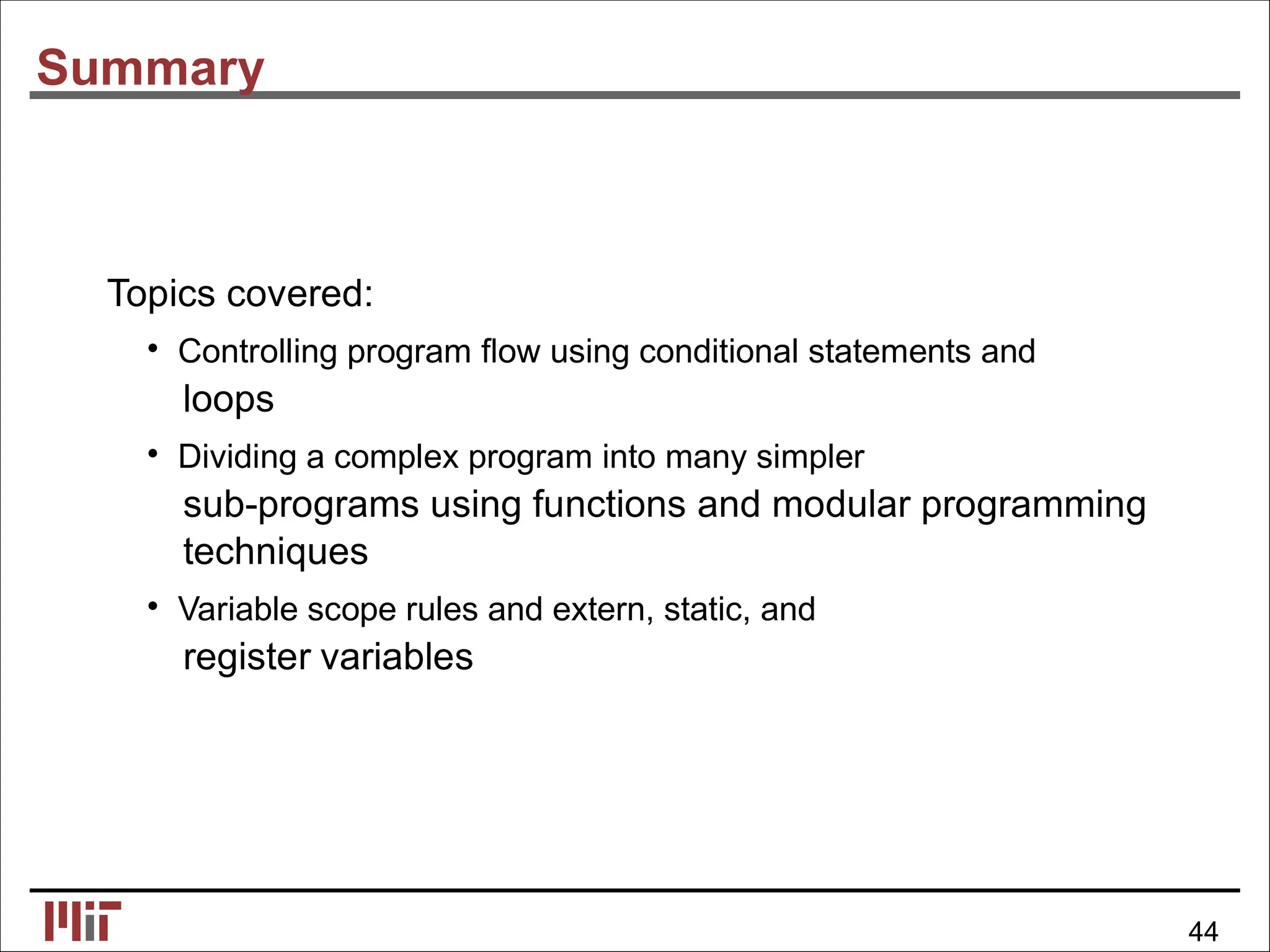
Summary
Topics covered:
• Controlling program flow using conditional statements and
loops
• Dividing a complex program into many simpler
sub-programs using functions and modular programming
techniques
• Variable scope rules and extern, static, and
register variables
44
MIT OpenCourseWare
http://ocw.mit.edu
6.087 Practical Programming in C
January (IAP) 2010
For information about citing these materials or our Terms of Use,visit: http://ocw.mit.edu/terms.

Lecture 03 Programming C for Beginners 001

  • 1.
    6.087 Lecture 3– January 13, 2010 Review Blocks and Compound Statements Control Flow Conditional Statements Loops Functions Modular Programming Variable Scope Static Variables Register Variables 1
  • 2.
    Review: Definitions • Variable- name/reference to a stored value (usually in memory) • Data type - determines the size of a variable in memory, what values it can take on, what operations are allowed • Operator - an operation performed using 1-3 variables • Expression - combination of literal values/variables and operators/functions 1
  • 3.
    Review: Data types •Various sizes (char, short, long, float, double) • Numeric types - signed/unsigned • Implementation - little or big endian • Careful mixing and converting (casting) types 2
  • 4.
    Review: Operators • Unary,binary, ternary (1-3 arguments) • Arithmetic operators, relational operators, binary (bitwise and logical) operators, assignment operators, etc. • Conditional expressions • Order of evaluation (precedence, direction) 3
  • 5.
    6.087 Lecture 3– January 13, 2010 Review Blocks and Compound Statements Control Flow Conditional Statements Loops Functions Modular Programming Variable Scope Static Variables Register Variables 4
  • 6.
    Blocks and compoundstatements • A simple statement ends in a semicolon: z = foo(x+y); • Consider the multiple statements: temp = x+y ; z = foo ( temp ) ; • Curly braces – combine into compound statement/block 4
  • 7.
    Blocks • Block cansubstitute for simple statement • Compiled as a single unit • Variables can be declared inside { in t temp = x+y ; z = foo ( temp ) ; } • Block can be empty {} • No semicolon at end 5
  • 8.
    Nested blocks • Blocksnested inside each other { int temp = x+y ; z = foo ( temp ) ; { flo a t temp2 = x∗y ; z += bar ( temp2 ) ; } } 6
  • 9.
    6.087 Lecture 3– January 13, 2010 Review Blocks and Compound Statements Control Flow Conditional Statements Loops Functions Modular Programming Variable Scope Static Variables Register Variables 7
  • 10.
    Control conditions • UnlikeC++ or Java, no boolean type (in C89/C90) • in C99, bool type available (use stdbool.h) • Condition is an expression (or series of expressions) e.g. n < 3 or x < y || z < y • Expression is non-zero ⇒ condition true • Expression must be numeric (or a pointer) const char s t r [ ] = "some text" ; i f ( s t r ) / ∗ s t r i n g i s not n u l l ∗ / return 0; 7
  • 11.
    Conditional statements • Theif statement • The switch statement 8
  • 12.
    The if statement if ( x % 2) y += x / 2 ; • Evaluate condition if (x % 2 == 0) • If true, evaluate inner statement y += x/2; • Otherwise, do nothing 9
  • 13.
    The else keyword if ( x % 2 == 0) y += x / 2 ; else y += ( x +1)/2 ; • Optional • Execute statement if condition is false y += (x+1)/2; • Either inner statement may be block 10
  • 14.
    The else ifkeyword i f ( x % 2 == 0) y += x / 2 ; else i f ( x % 4 == 1) y += 2∗ (( x + 3 ) / 4 ) ; else y += ( x +1 )/2 ; • Additional alternative control paths • Conditions evaluated in order until one is met; inner statement then executed • If multiple conditions true, only first executed • Equivalent to nested if statements 11
  • 15.
    Nesting if statements if ( x % 4 == 0) i f ( x % 2 == 0) y = 2; else y = 1; To which if statement does the else keyword belong? 12
  • 16.
    Nesting if statements Toassociate else with outer if statement: use braces i f ( x % 4 == 0) { i f ( x % 2 == 0) y = 2; } else y = 1; 13
  • 17.
    The switch statement •Alternative conditional statement • Integer (or character) variable as input • Considers cases for value of variable switch ( ch ) { case ’Y’ : / ∗ ch == ’Y ’ ∗ / / ∗ do something ∗ / break ; case ’N’ : / ∗ ch == ’N ’ ∗ / / ∗ do something else ∗ / break ; default : / ∗ otherwise ∗ / / ∗ do a t h i r d thing ∗ / break ; } 14
  • 18.
    Multiple cases • Comparesvariable to each case in order • When match found, starts executing inner code until break; reached • Execution “falls through” if break; not included switch ( ch ) { switch ( ch ) { case ’Y’ : case ’Y’ : / ∗ do something i f case ’y’ : ch == ’Y ’ ∗ / / ∗ do something i f case ’N’ : ch == ’Y ’ or / ∗ do something i f ch == ’ y ’ ∗ / ch == ’Y ’ or break ; ch == ’N ’ ∗ / } break ; } 15
  • 19.
    The switch statement •Contents of switch statement a block • Case labels: different entry points into block • Similar to labels used with goto keyword (next lecture. . . ) 16
  • 20.
    Loop statements • Thewhile loop • The for loop • The do-while loop • The break and continue keywords 17
  • 21.
    The while loop while( / ∗ condition ∗ / ) / ∗ loop body ∗ / • Simplest loop structure – evaluate body as long as condition is true • Condition evaluated first, so body may never be executed 18
  • 22.
    The for loop int f a c t o r i a l ( in t n ) { int i , j = 1; for ( i = 1; i <= n ; i ++) j ∗= i ; return j ; } • The “counting” loop • Inside parentheses, three expressions, separated by semicolons: • Initialization: i = 1 • Condition: i <= n • Increment: i++ • Expressions can be empty (condition assumed to be “true”) 19
  • 23.
    The for loop Equivalentto while loop: int f a c t o r i a l ( int n ) { in t j = 1; in t i = 1; / ∗ i n i t i a l i z a t i o n ∗ / while ( i <= n / ∗ condition ∗ / ) { j ∗= i ; i ++; / ∗ increment ∗ / } return j ; } 20
  • 24.
    The for loop •Compound expressions separated by commas int f a c t o r i a l ( in t n ) { in t i , j ; for ( i = 1 , j = 1; i <= n ; j ∗= i , i ++) ; return j ; } • Comma: operator with lowest precedence, evaluated left-to-right; not same as between function arguments 21
  • 25.
    The do-while loop charc ; do { / ∗ loop body ∗ / puts ( "Keep going? (y/n) " ) ; c = getchar ( ) ; / ∗ other processing ∗ / } while ( c == ’y’ && / ∗ other conditions ∗ / ) ; • Differs from while loop – condition evaluated after each iteration • Body executed at least once • Note semicolon at end 22
  • 26.
    The break keyword •Sometimes want to terminate a loop early • break; exits innermost loop or switch statement to exit early • Consider the modification of the do-while example: char c ; do { / ∗ loop body ∗ / puts ( "Keep going? (y/n) " ) ; c = getchar ( ) ; i f ( c != ’y’ ) break ; / ∗ other processing ∗ / } while ( / ∗ other condition s ∗ / ) ; 23
  • 27.
    The continue keyword •Use to skip an iteration • continue; skips rest of innermost loop body, jumping to loop condition • Example: #define min (a , b ) ( ( a ) < ( b ) ? ( a ) : ( b ) ) int gcd ( in t a , int b ) { in t i , r e t = 1 , minval = min ( a , b ) ; for ( i = 2; i <= minval ; i ++) { i f ( a % i ) / ∗ i not d i v i s o r of a ∗ / continue ; i f ( b % i == 0) / ∗ i i s d i v i s o r of both a and b ∗ / r e t = i ; } return r e t ; } 24
  • 28.
    6.087 Lecture 3– January 13, 2010 Review Blocks and Compound Statements Control Flow Conditional Statements Loops Functions Modular Programming Variable Scope Static Variables Register Variables 25
  • 29.
    Functions • Already seensome functions, including main(): int main ( void ) { / ∗ do s t u f f ∗ / return 0; / ∗ success ∗ / } • Basic syntax of functions explained in Lecture 1 • How to write a program using functions? 25
  • 30.
    Divide and conquer •Conceptualize how a program can be broken into smaller parts • Let’s design a program to solve linear Diophantine equation (ax + by = c,x, y: integers): get a, b, c from command line compute g = gcd(a,b) if (c is not a multiple of the gcd) no solutions exist; exit run Extended Euclidean algorithm on a, b rescale x and y output by (c/g) print solution • Extended Euclidean algorithm: finds integers x, y s.t. ax + by = gcd(a, b). 26
  • 31.
    Computing the gcd •Compute the gcd using the Euclidean algorithm: in t gcd ( int a , int b ) { while ( b ) { / ∗ i f a < b , performs swap ∗ / in t temp = b ; b = a % b ; a = temp ; } return a ; } • Algorithm relies on gcd(a, b) = gcd(b, a mod b), for natural numbers a > b. [Knuth, D. E. The Art of Computer Programming, Volume 1: Fundamental Algorithms. 3rd ed. Addison-Wesley, 1997.] 27 © Addison Wesley. All rights reserved. This content is excluded from our Creative Commons license. For more information, see http://ocw.mit.edu/fairuse.
  • 32.
    Extended Euclidean algorithm Pseudocodefor Extended Euclidean algorithm: Initialize state variables (x,y) if (a < b) swap(a,b) while (b > 0) { compute quotient, remainder update state variables (x,y) } return gcd and state variables (x,y) [Menezes, A. J., et al. Handbook of Applied Cryptography. CRC Press, 1996.] 28 © CRC Press. All rights reserved. This content is excluded from our Creative Commons license. For more information, see http://ocw.mit.edu/fairuse.
  • 33.
    Returning multiple values •Extended Euclidean algorithm returns gcd, and two other state variables, x and y • Functions only return (up to) one value • Solution: use global variables • Declare variables for other outputs outside the function • variables declared outside of a function block are globals • persist throughout life of program • can be accessed/modified in any function 29
  • 34.
    Divide and conquer •Break down problem into simpler sub-problems • Consider iteration and recursion • How can we implement gcd(a,b) recursively? • Minimize transfer of state between functions • Writing pseudocode first can help 30
  • 35.
    6.087 Lecture 3– January 13, 2010 Review Blocks and Compound Statements Control Flow Conditional Statements Loops Functions Modular Programming Variable Scope Static Variables Register Variables 31
  • 36.
    Programming modules inC • C programs do not need to be monolithic • Module: interface and implementation • interface: header files • implementation: auxilliary source/object files • Same concept carries over to external libraries (next week. . . ) 31
  • 37.
    The Euclid module •Euclid’s algorithms useful in many contexts • Would like to include functionality in many programs • Solution: make a module for Euclid’s algorithms • Need to write header file (.h) and source file (.c) 32
  • 38.
    The source: euclid.c Implementgcd() in euclid.c: / ∗ The gcd ( ) fun cti o n ∗ / in t gcd ( int a , in t b ) { while ( b ) { / ∗ i f a < b , performs swap ∗ / in t temp = b ; b = a % b ; a = temp ; } return a ; } Extended Euclidean algorithm implemented as ext_euclid(), also in euclid.c 33
  • 39.
    The extern keyword •Need to inform other source files about functions/global variables in euclid.c • For functions: put function prototypes in a header file • For variables: re-declare the global variable using the extern keyword in header file • extern informs compiler that variable defined somewhere else • Enables access/modifying of global variable from other source files 34
  • 40.
    The header: euclid.h Headercontains prototypes for gcd() and ext_euclid(): / ∗ ensure included only once ∗ / # ifndef __EUCLID_H__ #define __EUCLID_H__ / ∗ global variables ( declared in eu clid . c ) ∗ / extern in t x , y ; / ∗ compute gcd ∗ / int gcd ( in t a , int b ) ; / ∗ compute g = gcd (a , b ) and solve ax+by=g ∗ / in t ex t _euclid ( int a , in t b ) ; #endif 35
  • 41.
    Using the Euclidmodule • Want to be able to call gcd() or ext_euclid() from the main file diophant.c • Need to include the header file euclid.h: #include "euclid.h" (file in “.”, not search path) • Then, can call as any other function: / ∗ compute g = gcd (a , b ) ∗ / g = gcd (a , b ) ; / ∗ compute x and y using Extended Euclidean alg . ∗ / g = ex t _euclid ( a , b ) ; • Results in global variables x and y / ∗ rescale so ax+by = c ∗ / grow = c / g ; x ∗= grow ; y ∗= grow ; 36
  • 42.
    Compiling with theEuclid module • Just compiling diophant.c is insufficient • The functions gcd() and ext_euclid() are defined in euclid.c; this source file needs to be compiled, too • When compiling the source files, the outputs need to be linked together into a single output • One call to gcc can accomplish all this: athena% gcc -g -O0 -Wall diophant.c euclid.c -o diophant.o • diophant.o can be run as usual Athena is MIT's UNIX-based computing environment. OCW does not provide access to it. 37 1 1
  • 43.
    6.087 Lecture 3– January 13, 2010 Review Blocks and Compound Statements Control Flow Conditional Statements Loops Functions Modular Programming Variable Scope Static Variables Register Variables 38
  • 44.
    Variable scope • scope– the region in which a variable is valid • Many cases, corresponds to block with variable’s declaration • Variables declared outside of a function have global scope • Function definitions also have scope 38
  • 45.
    An example What isthe scope of each variable in this example? in t nmax = 20; / ∗ The main ( ) fun ct io n ∗ / in t main ( in t argc , char ∗∗ argv ) / ∗ entry point ∗ / { int a = 0 , b = 1 , c , n ; p r i n t f ( "%3d: %dn" ,1 ,a ) ; p r i n t f ( "%3d: %dn" ,2 ,b ) ; for ( n = 3; n <= nmax ; n++) { c = a + b ; a = b ; b = c ; p r i n t f ( "%3d: %dn" ,n , c ) ; } return 0; / ∗ success ∗ / } 39
  • 46.
    Scope and nesteddeclarations How many lines are printed now? in t nmax = 20; / ∗ The main ( ) fun ct io n ∗ / in t main ( in t argc , char ∗∗ argv ) / ∗ entry point ∗ / { int a = 0 , b = 1 , c , n , nmax = 25; p r i n t f ( "%3d: %dn" ,1 ,a ) ; p r i n t f ( "%3d: %dn" ,2 ,b ) ; for ( n = 3; n <= nmax ; n++) { c = a + b ; a = b ; b = c ; p r i n t f ( "%3d: %dn" ,n , c ) ; } return 0; / ∗ success ∗ / } 40
  • 47.
    Static variables • statickeyword has two meanings, depending on where the static variable is declared • Outside a function, static variables/functions only visible within that file, not globally (cannot be extern’ed) • Inside a function, static variables: • are still local to that function • are initialized only during program initialization • do not get reinitialized with each function call static int somePersistentVar = 0; 41
  • 48.
    Register variables • Duringexecution, data processed in registers • Explicitly store commonly used data in registers – minimize load/store overhead • Can explicitly declare certain variables as registers using register keyword • must be a simple type (implementation-dependent) • only local variables and function arguments eligible • excess/unallowed register declarations ignored, compiled as regular variables • Registers do not reside in addressed memory; pointer of a register variable illegal 42
  • 49.
    Example Variable scope example,revisited, with register variables: / ∗ The main ( ) fu nct io n ∗ / int main ( register int argc , register char ∗∗ argv ) { register int a = 0 , b = 1 , c , n , nmax = 20; p r i n t f ( "%3d: %dn" ,1 ,a ) ; p r i n t f ( "%3d: %dn" ,2 ,b ) ; for ( n = 3; n <= nmax ; n++) { c = a + b ; a = b ; b = c ; p r i n t f ( "%3d: %dn" ,n , c ) ; } return 0; / ∗ success ∗ / } 43
  • 50.
    Summary Topics covered: • Controllingprogram flow using conditional statements and loops • Dividing a complex program into many simpler sub-programs using functions and modular programming techniques • Variable scope rules and extern, static, and register variables 44
  • 51.
    MIT OpenCourseWare http://ocw.mit.edu 6.087 PracticalProgramming in C January (IAP) 2010 For information about citing these materials or our Terms of Use,visit: http://ocw.mit.edu/terms.