Balanced Binary Search
Trees
Balanced Binary Search Trees
• A balanced binary search tree (BST) is a type of BST where
the difference in height between the left and right subtrees
of any/every node is at most one.
• This balance ensures that operations like insertion, deletion,
and lookup can be performed in (log ) time, where is
𝑂 𝑛 𝑛
the number of nodes in the tree.
Why Balance Matters
• In a regular BST, the tree can become skewed (like a linked
list) if elements are inserted in a sorted order.
• This skewness results in ( ) time complexity for
𝑂 𝑛
operations.
• A balanced BST ensures the height remains logarithmic
relative to the number of nodes, maintaining efficient
operations.
Balanced Binary Search Trees - Types
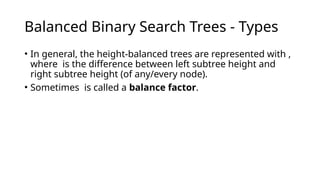
• In general, the height-balanced trees are represented with ,
where is the difference between left subtree height and
right subtree height (of any/every node).
• Sometimes is called a balance factor.
Balanced Binary Search Trees - Types
• AVL Tree
• Red-Black Tree
• B-Tree
Balanced Binary Search Trees -
Applications
• Databases: For indexing and quick data access (B-Trees).
• File Systems: For managing and organizing files efficiently
(B-Trees).
• Memory Management: In operating systems for
maintaining free memory blocks (AVL Trees).
AVL Trees
• AVL stands for Adelson-Velskii (or Velsky) and Landis
• Which of the following trees is an AVL and which is not?
AVL Trees - Rotations
• When the tree structure changes (e.g., with insertion or
deletion), we need to modify the tree to restore the AVL tree
property.
• This is done using rotations.
• There are two types of rotations
• Single
• Double
AVL Trees - Rotations
• If the AVL tree property is violated at a node X, it means that
the heights of left(X) and right(X) differ by 2.
• Rotations is the technique used for restoring the AVL tree
property.
• This means we need to apply the rotations for the node X (at
which the AVL tree property is violated).
• In general, we start at the node inserted and travel up the
tree, updating the balance information at every node on the
path.
AVL Trees – Types of Violations
• Let us assume the node that must be rebalanced is X.
• Since any node has at most two children, and a height imbalance
requires that X’s two subtree heights differ by two, we can easily
observe that a violation might occur in four cases:
1. An insertion into the left subtree of the left child of X
2. An insertion into the right subtree of the left child of X.
3. An insertion into the left subtree of the right child of X.
4. An insertion into the right subtree of the right child of X.
• Cases 1 and 4 are symmetric and easily solved with single
rotations. Similarly, cases 2 and 3 are also symmetric and can be
solved with double rotations (needs two single rotations).
AVL Trees – Types of Violations
1. An insertion into the left subtree of the left child of X
2. An insertion into the right subtree of the left child of X.
3. An insertion into the left subtree of the right child of X.
4. An insertion into the right subtree of the right child of X.
• Cases 1 and 4 are symmetric and easily solved with single
rotations.
• Similarly, cases 2 and 3 are also symmetric and can be
solved with double rotations (needs two single rotations).
AVL Trees – Single Rotations
Right Rotation (R-Rotation) [Case 1]:
AVL Trees – Single Rotations
Right Rotation (R-Rotation) [Case 1]:
• After the insertion of 7 in the original AVL tree on the left,
node 9 becomes unbalanced. So, we do a single left-left
rotation at 9.
AVL Trees – Single Rotations
Left Rotation (R-Rotation) [Case 4]:
AVL Trees – Single Rotations
Left Rotation (R-Rotation) [Case 4]:
AVL Trees – Double Rotations
Left Right Rotation (LR
Rotation) [Case-2]:
• For case-2 and case-3 single
rotation does not fix the
problem. We need to
perform two rotations.
AVL Trees – Double Rotations
Left Right Rotation (LR Rotation) [Case-2]:
AVL Trees – Double Rotations
Right Left Rotation (RL
Rotation) [Case-3]:
• Similar to case-2, we need to
perform two rotations to fix
this scenario.
AVL Trees – Double Rotations
Right Left Rotation (RL Rotation) [Case-3]:

Lec 08 - Balanced BSTs and AVL Tree.pptx

  • 1.
  • 2.
    Balanced Binary SearchTrees • A balanced binary search tree (BST) is a type of BST where the difference in height between the left and right subtrees of any/every node is at most one. • This balance ensures that operations like insertion, deletion, and lookup can be performed in (log ) time, where is 𝑂 𝑛 𝑛 the number of nodes in the tree.
  • 3.
    Why Balance Matters •In a regular BST, the tree can become skewed (like a linked list) if elements are inserted in a sorted order. • This skewness results in ( ) time complexity for 𝑂 𝑛 operations. • A balanced BST ensures the height remains logarithmic relative to the number of nodes, maintaining efficient operations.
  • 4.
    Balanced Binary SearchTrees - Types • In general, the height-balanced trees are represented with , where is the difference between left subtree height and right subtree height (of any/every node). • Sometimes is called a balance factor.
  • 5.
    Balanced Binary SearchTrees - Types • AVL Tree • Red-Black Tree • B-Tree
  • 6.
    Balanced Binary SearchTrees - Applications • Databases: For indexing and quick data access (B-Trees). • File Systems: For managing and organizing files efficiently (B-Trees). • Memory Management: In operating systems for maintaining free memory blocks (AVL Trees).
  • 7.
    AVL Trees • AVLstands for Adelson-Velskii (or Velsky) and Landis • Which of the following trees is an AVL and which is not?
  • 8.
    AVL Trees -Rotations • When the tree structure changes (e.g., with insertion or deletion), we need to modify the tree to restore the AVL tree property. • This is done using rotations. • There are two types of rotations • Single • Double
  • 9.
    AVL Trees -Rotations • If the AVL tree property is violated at a node X, it means that the heights of left(X) and right(X) differ by 2. • Rotations is the technique used for restoring the AVL tree property. • This means we need to apply the rotations for the node X (at which the AVL tree property is violated). • In general, we start at the node inserted and travel up the tree, updating the balance information at every node on the path.
  • 10.
    AVL Trees –Types of Violations • Let us assume the node that must be rebalanced is X. • Since any node has at most two children, and a height imbalance requires that X’s two subtree heights differ by two, we can easily observe that a violation might occur in four cases: 1. An insertion into the left subtree of the left child of X 2. An insertion into the right subtree of the left child of X. 3. An insertion into the left subtree of the right child of X. 4. An insertion into the right subtree of the right child of X. • Cases 1 and 4 are symmetric and easily solved with single rotations. Similarly, cases 2 and 3 are also symmetric and can be solved with double rotations (needs two single rotations).
  • 11.
    AVL Trees –Types of Violations 1. An insertion into the left subtree of the left child of X 2. An insertion into the right subtree of the left child of X. 3. An insertion into the left subtree of the right child of X. 4. An insertion into the right subtree of the right child of X. • Cases 1 and 4 are symmetric and easily solved with single rotations. • Similarly, cases 2 and 3 are also symmetric and can be solved with double rotations (needs two single rotations).
  • 12.
    AVL Trees –Single Rotations Right Rotation (R-Rotation) [Case 1]:
  • 13.
    AVL Trees –Single Rotations Right Rotation (R-Rotation) [Case 1]: • After the insertion of 7 in the original AVL tree on the left, node 9 becomes unbalanced. So, we do a single left-left rotation at 9.
  • 14.
    AVL Trees –Single Rotations Left Rotation (R-Rotation) [Case 4]:
  • 15.
    AVL Trees –Single Rotations Left Rotation (R-Rotation) [Case 4]:
  • 16.
    AVL Trees –Double Rotations Left Right Rotation (LR Rotation) [Case-2]: • For case-2 and case-3 single rotation does not fix the problem. We need to perform two rotations.
  • 17.
    AVL Trees –Double Rotations Left Right Rotation (LR Rotation) [Case-2]:
  • 18.
    AVL Trees –Double Rotations Right Left Rotation (RL Rotation) [Case-3]: • Similar to case-2, we need to perform two rotations to fix this scenario.
  • 19.
    AVL Trees –Double Rotations Right Left Rotation (RL Rotation) [Case-3]: