CLE1004 SOIL MECHANICS AND
FOUNDATION ENGINEERING
Dr. Divya Priya
Department of Structural and Geotechnical
Engineering
SCE, VIT, Vellore
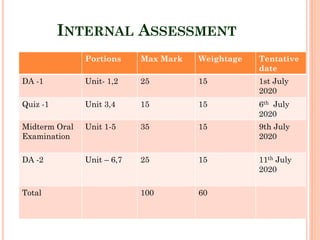
INTERNAL ASSESSMENT
3
Portions Max Mark Weightage Tentative
date
DA -1 Unit- 1,2 25 15 1st July
2020
Quiz -1 Unit 3,4 15 15 6th July
2020
Midterm Oral
Examination
Unit 1-5 35 15 9th July
2020
DA -2 Unit – 6,7 25 15 11th July
2020
Total 100 60
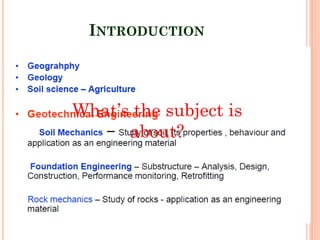
INTRODUCTION
4
What’s the subject is
about?
IMPORTANCE
5
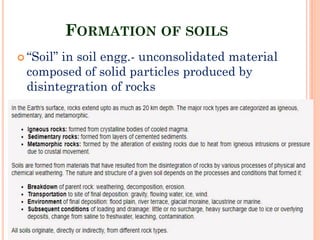
FORMATION OF SOILS
 “Soil” in soil engg.- unconsolidated material
composed of solid particles produced by
disintegration of rocks
6
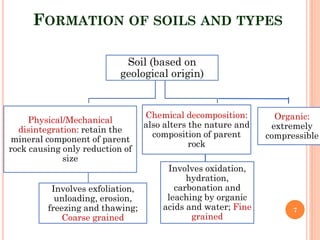
FORMATION OF SOILS AND TYPES
Soil (based on
geological origin)
Physical/Mechanical
disintegration: retain the
mineral component of parent
rock causing only reduction of
size
Involves exfoliation,
unloading, erosion,
freezing and thawing;
Coarse grained
Chemical decomposition:
also alters the nature and
composition of parent
rock
Involves oxidation,
hydration,
carbonation and
leaching by organic
acids and water; Fine
grained
Organic:
extremely
compressible
7
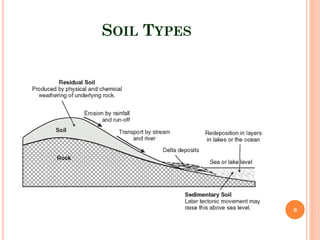
SOIL TYPES
8
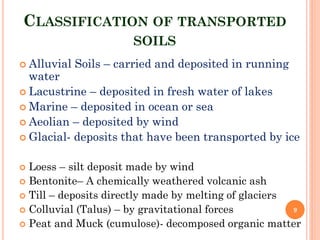
CLASSIFICATION OF TRANSPORTED
SOILS
 Alluvial Soils – carried and deposited in running
water
 Lacustrine – deposited in fresh water of lakes
 Marine – deposited in ocean or sea
 Aeolian – deposited by wind
 Glacial- deposits that have been transported by ice
 Loess – silt deposit made by wind
 Bentonite– A chemically weathered volcanic ash
 Till – deposits directly made by melting of glaciers
 Colluvial (Talus) – by gravitational forces
 Peat and Muck (cumulose)- decomposed organic matter
9
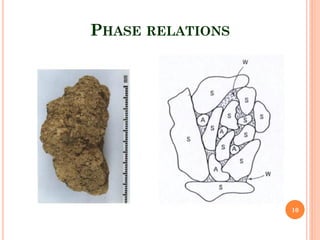
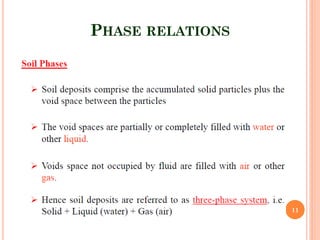
PHASE RELATIONS
10
PHASE RELATIONS
11
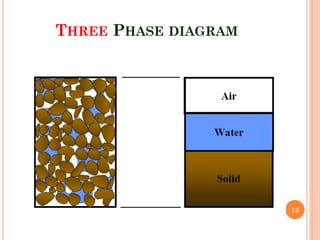
THREE PHASE DIAGRAM
12
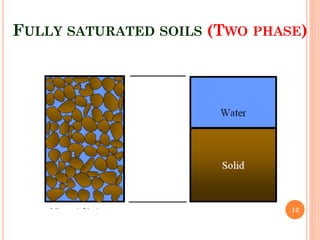
FULLY SATURATED SOILS (TWO PHASE)
13
DRY SOILS (TWO PHASE)[OVEN DRIED]
14
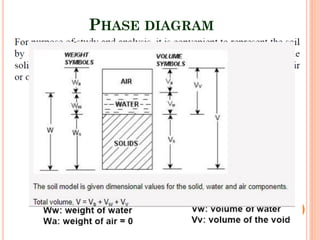
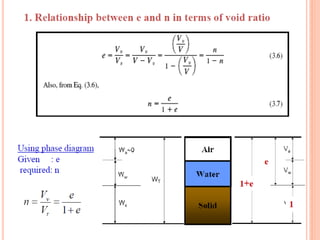
PHASE DIAGRAM
15
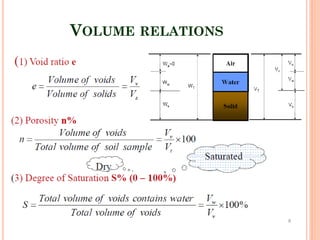
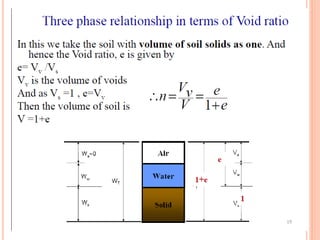
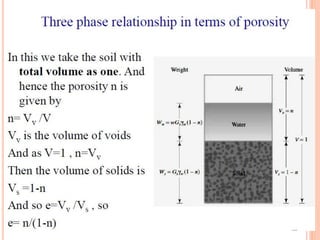
VOLUME RELATIONS
16
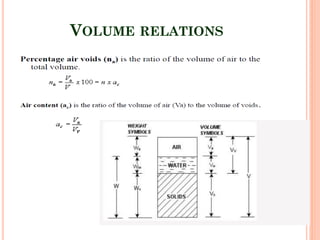
VOLUME RELATIONS
17
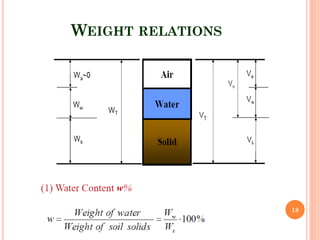
WEIGHT RELATIONS
18
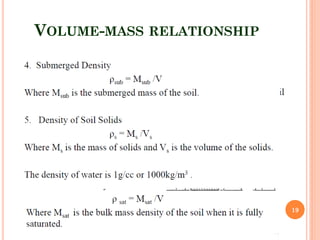
VOLUME-MASS RELATIONSHIP
19
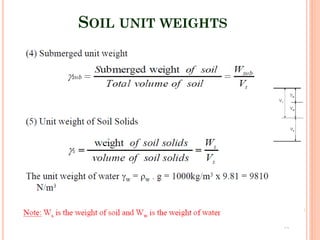
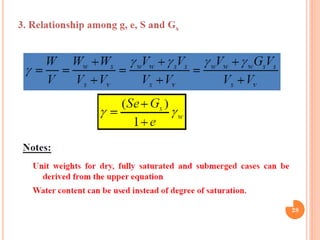
SOIL UNIT WEIGHTS
20
21
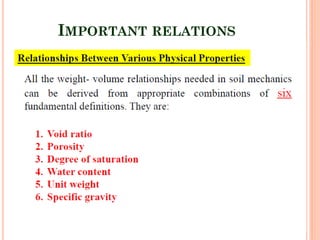
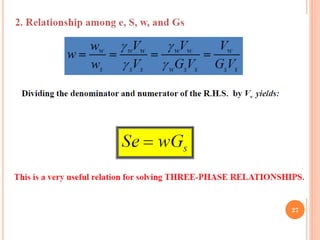
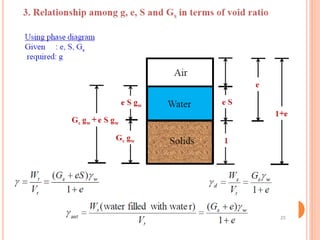
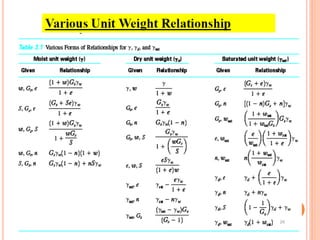
IMPORTANT RELATIONS
22
23
24
25
26
27
28
29
30
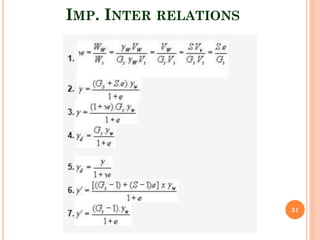
IMP. INTER RELATIONS
31
32
33
34
35
36
WATER CONTENT DETERMINATION
 Oven drying method
 Torsion balance method
 Pyconometer method
 Sand bath method and
 Calcium Carbide/ Rapid moisture meter
method
37
WATER CONTENT DETERMINATION
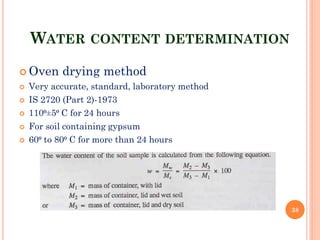
 Oven drying method
 Very accurate, standard, laboratory method
 IS 2720 (Part 2)-1973
 110⁰±5⁰ C for 24 hours
 For soil containing gypsum
 60⁰ to 80⁰ C for more than 24 hours
38
WATER CONTENT DETERMINATION
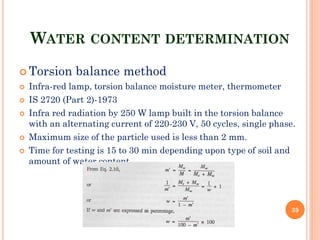
 Torsion balance method
 Infra-red lamp, torsion balance moisture meter, thermometer
 IS 2720 (Part 2)-1973
 Infra red radiation by 250 W lamp built in the torsion balance
with an alternating current of 220-230 V, 50 cycles, single phase.
 Maximum size of the particle used is less than 2 mm.
 Time for testing is 15 to 30 min depending upon type of soil and
amount of water content
39
WATER CONTENT DETERMINATION
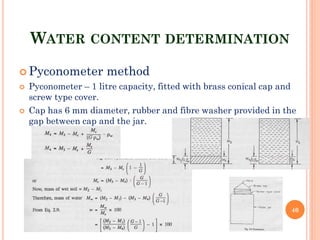
 Pyconometer method
 Pyconometer – 1 litre capacity, fitted with brass conical cap and
screw type cover.
 Cap has 6 mm diameter, rubber and fibre washer provided in the
gap between cap and the jar.
40
WATER CONTENT DETERMINATION
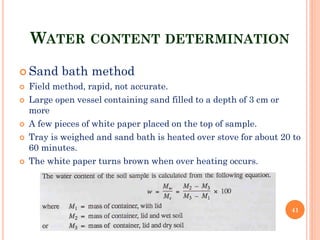
 Sand bath method
 Field method, rapid, not accurate.
 Large open vessel containing sand filled to a depth of 3 cm or
more
 A few pieces of white paper placed on the top of sample.
 Tray is weighed and sand bath is heated over stove for about 20 to
60 minutes.
 The white paper turns brown when over heating occurs.
41
WATER CONTENT DETERMINATION
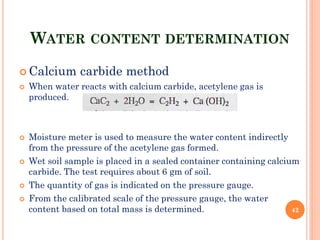
 Calcium carbide method
 When water reacts with calcium carbide, acetylene gas is
produced.
 Moisture meter is used to measure the water content indirectly
from the pressure of the acetylene gas formed.
 Wet soil sample is placed in a sealed container containing calcium
carbide. The test requires about 6 gm of soil.
 The quantity of gas is indicated on the pressure gauge.
 From the calibrated scale of the pressure gauge, the water
content based on total mass is determined. 42
SPECIFIC GRAVITY DETERMINATION
 Density bottle method
 Pyconometer method
 Measuring flask method
 Gas jar method
 Shrinkage limit method
43
UNIT WEIGHT DETERMINATION
 Water displacement method
 Submerged mass density method
 Core cutter method
 Sand replacement method
 Water balloon method
 Radiation method
44
SOIL CLASSIFICATION
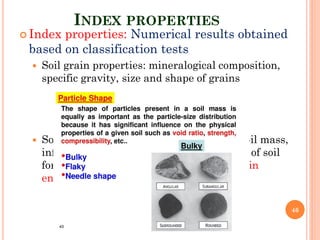
INDEX PROPERTIES
 Index properties: Numerical results obtained
based on classification tests
 Soil grain properties: mineralogical composition,
specific gravity, size and shape of grains
 Soil aggregate properties: dependent on soil mass,
influenced by the soil stress history, mode of soil
formation and soil structure. Significance in
engineering practice.
46

Lec1_introduction&phase relations.pdf

  • 1.
    CLE1004 SOIL MECHANICSAND FOUNDATION ENGINEERING Dr. Divya Priya Department of Structural and Geotechnical Engineering SCE, VIT, Vellore
  • 2.
    INTERNAL ASSESSMENT 3 Portions MaxMark Weightage Tentative date DA -1 Unit- 1,2 25 15 1st July 2020 Quiz -1 Unit 3,4 15 15 6th July 2020 Midterm Oral Examination Unit 1-5 35 15 9th July 2020 DA -2 Unit – 6,7 25 15 11th July 2020 Total 100 60
  • 3.
  • 4.
  • 5.
    FORMATION OF SOILS “Soil” in soil engg.- unconsolidated material composed of solid particles produced by disintegration of rocks 6
  • 6.
    FORMATION OF SOILSAND TYPES Soil (based on geological origin) Physical/Mechanical disintegration: retain the mineral component of parent rock causing only reduction of size Involves exfoliation, unloading, erosion, freezing and thawing; Coarse grained Chemical decomposition: also alters the nature and composition of parent rock Involves oxidation, hydration, carbonation and leaching by organic acids and water; Fine grained Organic: extremely compressible 7
  • 7.
  • 8.
    CLASSIFICATION OF TRANSPORTED SOILS Alluvial Soils – carried and deposited in running water  Lacustrine – deposited in fresh water of lakes  Marine – deposited in ocean or sea  Aeolian – deposited by wind  Glacial- deposits that have been transported by ice  Loess – silt deposit made by wind  Bentonite– A chemically weathered volcanic ash  Till – deposits directly made by melting of glaciers  Colluvial (Talus) – by gravitational forces  Peat and Muck (cumulose)- decomposed organic matter 9
  • 9.
  • 10.
  • 11.
  • 12.
    FULLY SATURATED SOILS(TWO PHASE) 13
  • 13.
    DRY SOILS (TWOPHASE)[OVEN DRIED] 14
  • 14.
  • 15.
  • 16.
  • 17.
  • 18.
  • 19.
  • 20.
  • 21.
  • 22.
  • 23.
  • 24.
  • 25.
  • 26.
  • 27.
  • 28.
  • 29.
  • 30.
  • 31.
  • 32.
  • 33.
  • 34.
  • 35.
  • 36.
    WATER CONTENT DETERMINATION Oven drying method  Torsion balance method  Pyconometer method  Sand bath method and  Calcium Carbide/ Rapid moisture meter method 37
  • 37.
    WATER CONTENT DETERMINATION Oven drying method  Very accurate, standard, laboratory method  IS 2720 (Part 2)-1973  110⁰±5⁰ C for 24 hours  For soil containing gypsum  60⁰ to 80⁰ C for more than 24 hours 38
  • 38.
    WATER CONTENT DETERMINATION Torsion balance method  Infra-red lamp, torsion balance moisture meter, thermometer  IS 2720 (Part 2)-1973  Infra red radiation by 250 W lamp built in the torsion balance with an alternating current of 220-230 V, 50 cycles, single phase.  Maximum size of the particle used is less than 2 mm.  Time for testing is 15 to 30 min depending upon type of soil and amount of water content 39
  • 39.
    WATER CONTENT DETERMINATION Pyconometer method  Pyconometer – 1 litre capacity, fitted with brass conical cap and screw type cover.  Cap has 6 mm diameter, rubber and fibre washer provided in the gap between cap and the jar. 40
  • 40.
    WATER CONTENT DETERMINATION Sand bath method  Field method, rapid, not accurate.  Large open vessel containing sand filled to a depth of 3 cm or more  A few pieces of white paper placed on the top of sample.  Tray is weighed and sand bath is heated over stove for about 20 to 60 minutes.  The white paper turns brown when over heating occurs. 41
  • 41.
    WATER CONTENT DETERMINATION Calcium carbide method  When water reacts with calcium carbide, acetylene gas is produced.  Moisture meter is used to measure the water content indirectly from the pressure of the acetylene gas formed.  Wet soil sample is placed in a sealed container containing calcium carbide. The test requires about 6 gm of soil.  The quantity of gas is indicated on the pressure gauge.  From the calibrated scale of the pressure gauge, the water content based on total mass is determined. 42
  • 42.
    SPECIFIC GRAVITY DETERMINATION Density bottle method  Pyconometer method  Measuring flask method  Gas jar method  Shrinkage limit method 43
  • 43.
    UNIT WEIGHT DETERMINATION Water displacement method  Submerged mass density method  Core cutter method  Sand replacement method  Water balloon method  Radiation method 44
  • 44.
  • 45.
    INDEX PROPERTIES  Indexproperties: Numerical results obtained based on classification tests  Soil grain properties: mineralogical composition, specific gravity, size and shape of grains  Soil aggregate properties: dependent on soil mass, influenced by the soil stress history, mode of soil formation and soil structure. Significance in engineering practice. 46