Lecture 0: Generalized Network Flows:
               Theory, Algorithms, and Applications

                          Wai-Shing Luk (陆伟成)

                                 Fudan University


                             2012 年 8 月 11 日


W.-S. Luk (Fudan Univ.)   Lecture 0: Generalized Network Flows   2012 年 8 月 11 日   1 / 10
Motivation


  Q. Why this topic is important?
  A. Well, “network” is everywhere:
         Transportation network, logistics network
         Power network (smart grid)
         Electronics circuits
         Wireless network
         Social network
         Neural network, Bayesian network
         and ...more


W.-S. Luk (Fudan Univ.)     Lecture 0: Generalized Network Flows   2012 年 8 月 11 日   2 / 10
Motivation (cont’d)


  Q. Why should I learn it as it is already a “mature” topic?
  A. At least we still need to know
         How to choose the existing algorithms wisely
         How to transform a problem into a standard network flow formulation
         How to handle new problems: e.g. non-linear problems.


W.-S. Luk (Fudan Univ.)   Lecture 0: Generalized Network Flows   2012 年 8 月 11 日   3 / 10
Motivation (cont’d)


  Q. What are the limitations of the existing algorithms?
  A. The existing algorithms
         mostly handle linear problems, whereas most engineering problems are
         non-linear.
         can handle only single parameter (for parametric problems), whereas
         most realistic problems are multi-parameter.
         mostly rely on finding “cycles” rather than “cuts”. Dual problems are
         first transformed into their primal counterparts via Lagrange duality
         theory, which make the problem more complicated.


W.-S. Luk (Fudan Univ.)    Lecture 0: Generalized Network Flows   2012 年 8 月 11 日   4 / 10
Motivation (cont’d)


  Q. Why should I learn this course instead of many others?
  A In this course, we will
         explain the concept using “Discrete Calculus”
         describe how to transform a problem into a standard network flow
         formulation.
         describe the fundamental mechanism of algorithms so that we can
         tackle new problems.


W.-S. Luk (Fudan Univ.)    Lecture 0: Generalized Network Flows   2012 年 8 月 11 日   5 / 10
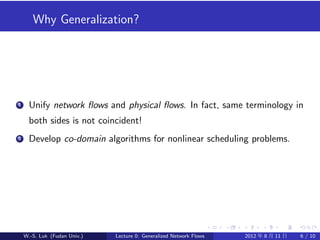
Why Generalization?


1     Unify network flows and physical flows. In fact, same terminology in
      both sides is not coincident!
2     Develop co-domain algorithms for nonlinear scheduling problems.


    W.-S. Luk (Fudan Univ.)   Lecture 0: Generalized Network Flows   2012 年 8 月 11 日   6 / 10
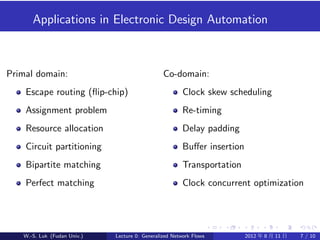
Applications in Electronic Design Automation


Primal domain:                                  Co-domain:
    Escape routing (flip-chip)                           Clock skew scheduling
    Assignment problem                                  Re-timing
    Resource allocation                                 Delay padding
    Circuit partitioning                                Buffer insertion
    Bipartite matching                                  Transportation
    Perfect matching                                    Clock concurrent optimization


   W.-S. Luk (Fudan Univ.)   Lecture 0: Generalized Network Flows         2012 年 8 月 11 日   7 / 10
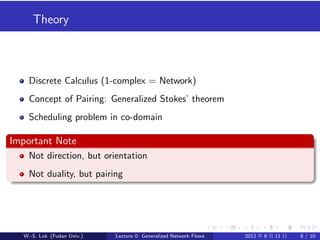
Theory


    Discrete Calculus (1-complex = Network)
    Concept of Pairing: Generalized Stokes’ theorem
    Scheduling problem in co-domain

Important Note
    Not direction, but orientation
    Not duality, but pairing


  W.-S. Luk (Fudan Univ.)   Lecture 0: Generalized Network Flows   2012 年 8 月 11 日   8 / 10
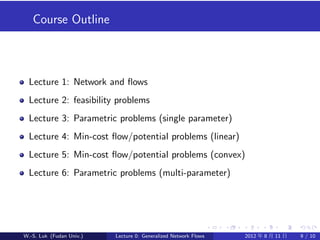
Course Outline


  Lecture 1: Network and flows
  Lecture 2: feasibility problems
  Lecture 3: Parametric problems (single parameter)
  Lecture 4: Min-cost flow/potential problems (linear)
  Lecture 5: Min-cost flow/potential problems (convex)
  Lecture 6: Parametric problems (multi-parameter)


W.-S. Luk (Fudan Univ.)   Lecture 0: Generalized Network Flows   2012 年 8 月 11 日   9 / 10
References

1     R. T. Rockafellar, Network flows and monotropic optimization, John Wiley
      and & Sons, 1984.

2     Network optimization

3     Network flows: theory, algorithms and applications

4     S. M. Burns, Performance Analysis and Optimization of Asynchronous
      Circuits. PhD thesis, CalTech, Pasadena, CA, December 1991.

5     N. E. Young, R. E. Tarjan, and J. B. Orlin, “Faster parametric shortest path
      and minimum balance algorithms,” Networks, 1991.

6     Yi Wang, Wai-Shing Luk et al., Yield-driven clock skew scheduling

7     Yan-Ling Zhi, Wai-Shing Luk et al., Multi-domain clock skew scheduling

    W.-S. Luk (Fudan Univ.)   Lecture 0: Generalized Network Flows   2012 年 8 月 11 日   10 / 10

Lec00 generalized network flows

  • 1.
    Lecture 0: GeneralizedNetwork Flows: Theory, Algorithms, and Applications Wai-Shing Luk (陆伟成) Fudan University 2012 年 8 月 11 日 W.-S. Luk (Fudan Univ.) Lecture 0: Generalized Network Flows 2012 年 8 月 11 日 1 / 10
  • 2.
    Motivation Q.Why this topic is important? A. Well, “network” is everywhere: Transportation network, logistics network Power network (smart grid) Electronics circuits Wireless network Social network Neural network, Bayesian network and ...more W.-S. Luk (Fudan Univ.) Lecture 0: Generalized Network Flows 2012 年 8 月 11 日 2 / 10
  • 3.
    Motivation (cont’d) Q. Why should I learn it as it is already a “mature” topic? A. At least we still need to know How to choose the existing algorithms wisely How to transform a problem into a standard network flow formulation How to handle new problems: e.g. non-linear problems. W.-S. Luk (Fudan Univ.) Lecture 0: Generalized Network Flows 2012 年 8 月 11 日 3 / 10
  • 4.
    Motivation (cont’d) Q. What are the limitations of the existing algorithms? A. The existing algorithms mostly handle linear problems, whereas most engineering problems are non-linear. can handle only single parameter (for parametric problems), whereas most realistic problems are multi-parameter. mostly rely on finding “cycles” rather than “cuts”. Dual problems are first transformed into their primal counterparts via Lagrange duality theory, which make the problem more complicated. W.-S. Luk (Fudan Univ.) Lecture 0: Generalized Network Flows 2012 年 8 月 11 日 4 / 10
  • 5.
    Motivation (cont’d) Q. Why should I learn this course instead of many others? A In this course, we will explain the concept using “Discrete Calculus” describe how to transform a problem into a standard network flow formulation. describe the fundamental mechanism of algorithms so that we can tackle new problems. W.-S. Luk (Fudan Univ.) Lecture 0: Generalized Network Flows 2012 年 8 月 11 日 5 / 10
  • 6.
    Why Generalization? 1 Unify network flows and physical flows. In fact, same terminology in both sides is not coincident! 2 Develop co-domain algorithms for nonlinear scheduling problems. W.-S. Luk (Fudan Univ.) Lecture 0: Generalized Network Flows 2012 年 8 月 11 日 6 / 10
  • 7.
    Applications in ElectronicDesign Automation Primal domain: Co-domain: Escape routing (flip-chip) Clock skew scheduling Assignment problem Re-timing Resource allocation Delay padding Circuit partitioning Buffer insertion Bipartite matching Transportation Perfect matching Clock concurrent optimization W.-S. Luk (Fudan Univ.) Lecture 0: Generalized Network Flows 2012 年 8 月 11 日 7 / 10
  • 8.
    Theory Discrete Calculus (1-complex = Network) Concept of Pairing: Generalized Stokes’ theorem Scheduling problem in co-domain Important Note Not direction, but orientation Not duality, but pairing W.-S. Luk (Fudan Univ.) Lecture 0: Generalized Network Flows 2012 年 8 月 11 日 8 / 10
  • 9.
    Course Outline Lecture 1: Network and flows Lecture 2: feasibility problems Lecture 3: Parametric problems (single parameter) Lecture 4: Min-cost flow/potential problems (linear) Lecture 5: Min-cost flow/potential problems (convex) Lecture 6: Parametric problems (multi-parameter) W.-S. Luk (Fudan Univ.) Lecture 0: Generalized Network Flows 2012 年 8 月 11 日 9 / 10
  • 10.
    References 1 R. T. Rockafellar, Network flows and monotropic optimization, John Wiley and & Sons, 1984. 2 Network optimization 3 Network flows: theory, algorithms and applications 4 S. M. Burns, Performance Analysis and Optimization of Asynchronous Circuits. PhD thesis, CalTech, Pasadena, CA, December 1991. 5 N. E. Young, R. E. Tarjan, and J. B. Orlin, “Faster parametric shortest path and minimum balance algorithms,” Networks, 1991. 6 Yi Wang, Wai-Shing Luk et al., Yield-driven clock skew scheduling 7 Yan-Ling Zhi, Wai-Shing Luk et al., Multi-domain clock skew scheduling W.-S. Luk (Fudan Univ.) Lecture 0: Generalized Network Flows 2012 年 8 月 11 日 10 / 10