Lecture 4: Min-Cost Linear Problems

                          Wai-Shing Luk (陆伟成)

                                 Fudan University


                              2012 年 8 月 13 日


W.-S. Luk (Fudan Univ.)    Lecture 4: Min-Cost Linear Problems   2012 年 8 月 13 日   1 / 18
Elementary Optimal Problems

Elementary Flow Problem:                       Elementary Potential Problem:

    min       dT x + p                                    max b T u − (c T y + q)
    s. t. c ≤ x,                                          s. t. y ≤ d,
              AT x = b, b(V ) = 0                                  Au = y

Theorem
The problems are dual to each other if
p + q = −c T d, (x − c)T (d − y ) = 0, c ≤ x, y ≤ d

Proof.
Since b T u = (AT x)T u = x T Au = x T y , [min] − [max] = (d T x + p) −
(b T u − [c T y + q]) = d T x + c T y − x T y + p + q = (x − c)T (d − y ) ≥ 0
[min] - [max] when equality holds.
   W.-S. Luk (Fudan Univ.)   Lecture 4: Min-Cost Linear Problems         2012 年 8 月 13 日   2 / 18
Remark 1


  We can formulate a linear problem either in its primal form or in its
  dual form, depending on which one is more appropriate, for example,
         whether design variables are in integral domain:
                max-flow problem (i.e. d T = [−1, −1, · · · , −1]T ) may be better to be
                solved by a dual method.


W.-S. Luk (Fudan Univ.)       Lecture 4: Min-Cost Linear Problems   2012 年 8 月 13 日   3 / 18
Linear Optimal Problems

Optimal Flow Problem:                          Optimal Potential Problem:

    min       dT x + p                                    max b T u − (c T y + q)
    s. t. c − ≤ x ≤ c + ,                                 s. t. d − ≤ y ≤ d + ,
              AT x = b, b(V ) = 0                                  Au = y

By modifying the network:
     This problem can be reduced to the elementary case [?, pp.275–276]
     Piecewise linear convex cost can be reduced to this linear problem [?,
     p.239,p.260]

The problem has been studied extensively with a lot of applications.

   W.-S. Luk (Fudan Univ.)   Lecture 4: Min-Cost Linear Problems        2012 年 8 月 13 日   4 / 18
Remark


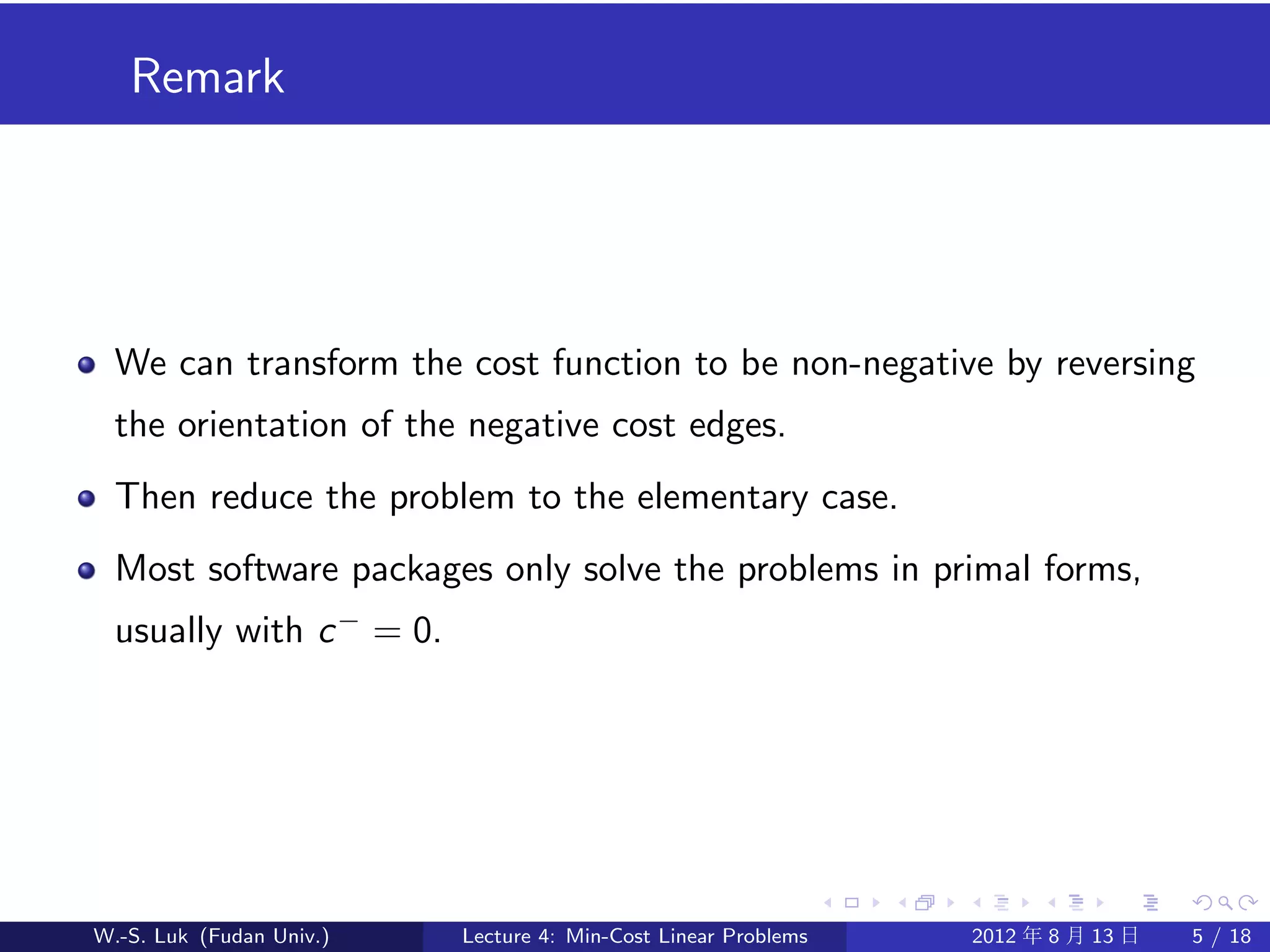
  We can transform the cost function to be non-negative by reversing
  the orientation of the negative cost edges.
  Then reduce the problem to the elementary case.
  Most software packages only solve the problems in primal forms,
  usually with c − = 0.


W.-S. Luk (Fudan Univ.)   Lecture 4: Min-Cost Linear Problems   2012 年 8 月 13 日   5 / 18
Algorithms for Optimal Flow Problems


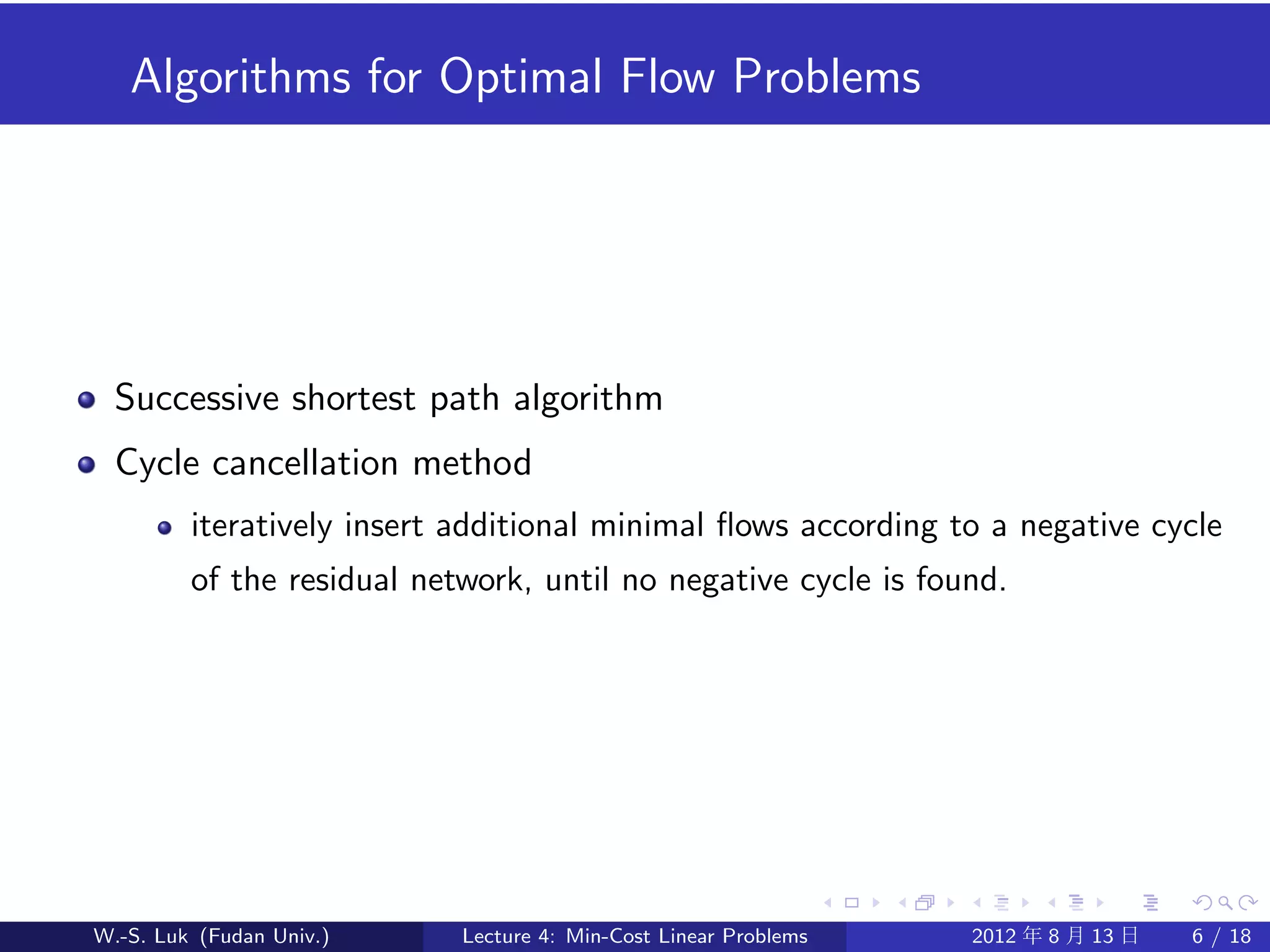
  Successive shortest path algorithm
  Cycle cancellation method
         iteratively insert additional minimal flows according to a negative cycle
         of the residual network, until no negative cycle is found.


W.-S. Luk (Fudan Univ.)     Lecture 4: Min-Cost Linear Problems   2012 年 8 月 13 日   6 / 18
For Special Cases


  Max flow problem (d = −[1, · · · , 1])
         Ford-Fulkerson algorithm: iteratively insert additional minimal flows
         according to an argument path of the residual network, until no
         argument path of the residual network is found.
         Preflow Push-Relabel algorithm (dual method???)
  Matching problems ([c − , c + ] = [0, 1])
         Edmond’s blossom algorithm


W.-S. Luk (Fudan Univ.)    Lecture 4: Min-Cost Linear Problems   2012 年 8 月 13 日   7 / 18
Min-Cost Flow Problem (MCFP1)


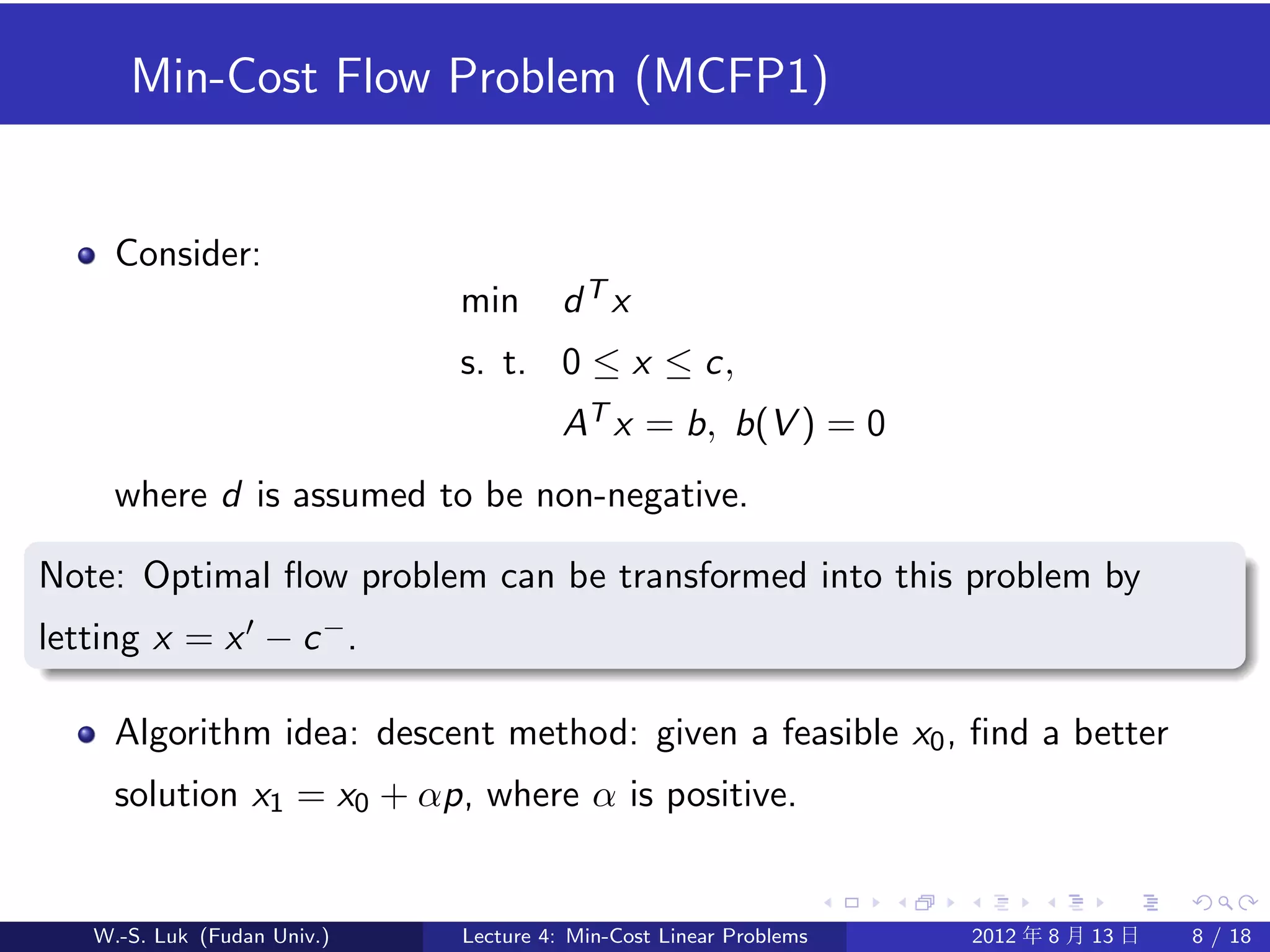
     Consider:
                             min       dT x
                             s. t. 0 ≤ x ≤ c,
                                       AT x = b, b(V ) = 0
     where d is assumed to be non-negative.

Note: Optimal flow problem can be transformed into this problem by
letting x = x − c − .

     Algorithm idea: descent method: given a feasible x0 , find a better
     solution x1 = x0 + αp, where α is positive.


   W.-S. Luk (Fudan Univ.)   Lecture 4: Min-Cost Linear Problems   2012 年 8 月 13 日   8 / 18
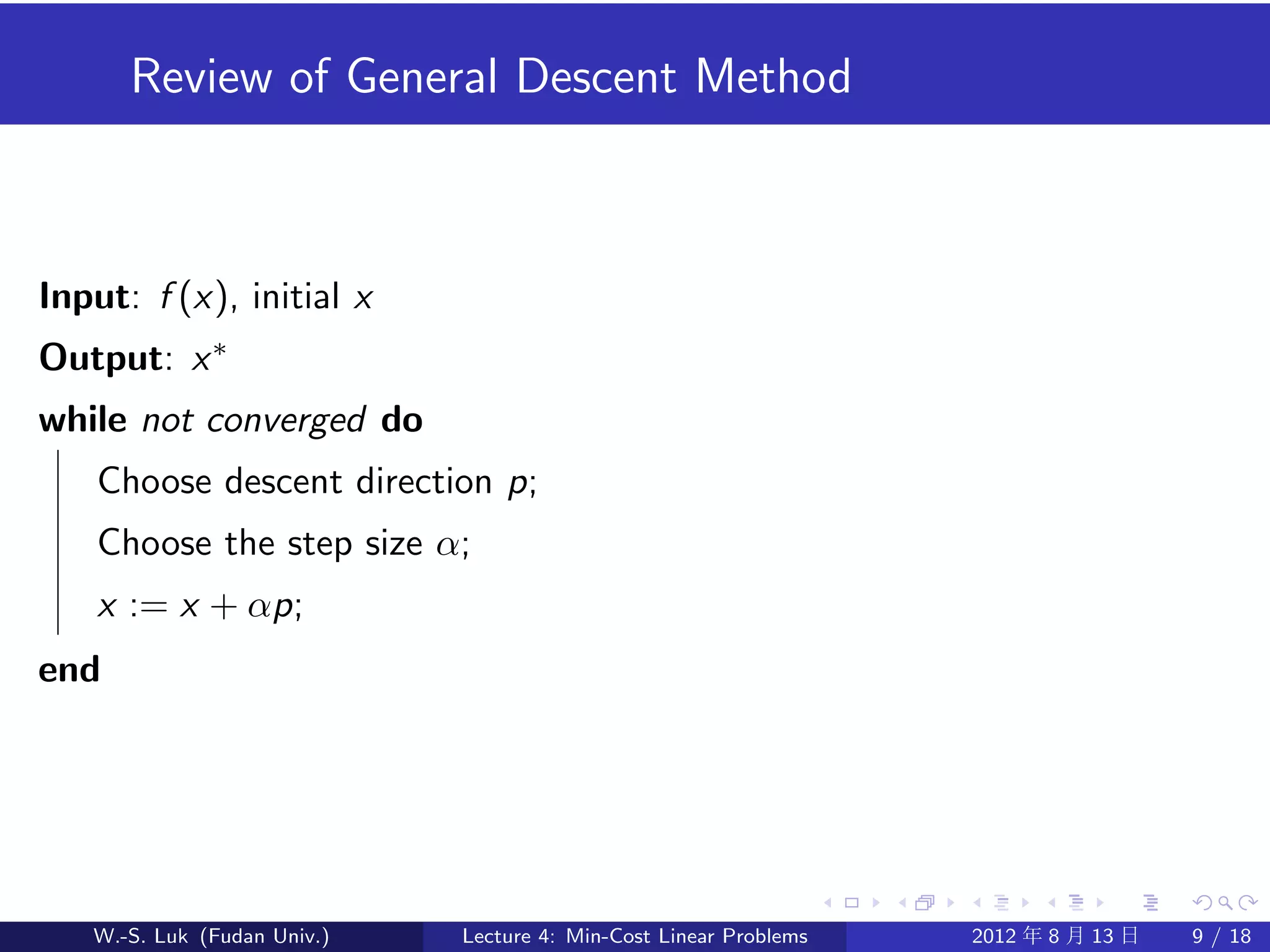
Review of General Descent Method


Input: f (x), initial x
Output: x ∗
while not converged do
    Choose descent direction p;
    Choose the step size α;
    x := x + αp;
end


   W.-S. Luk (Fudan Univ.)   Lecture 4: Min-Cost Linear Problems   2012 年 8 月 13 日   9 / 18
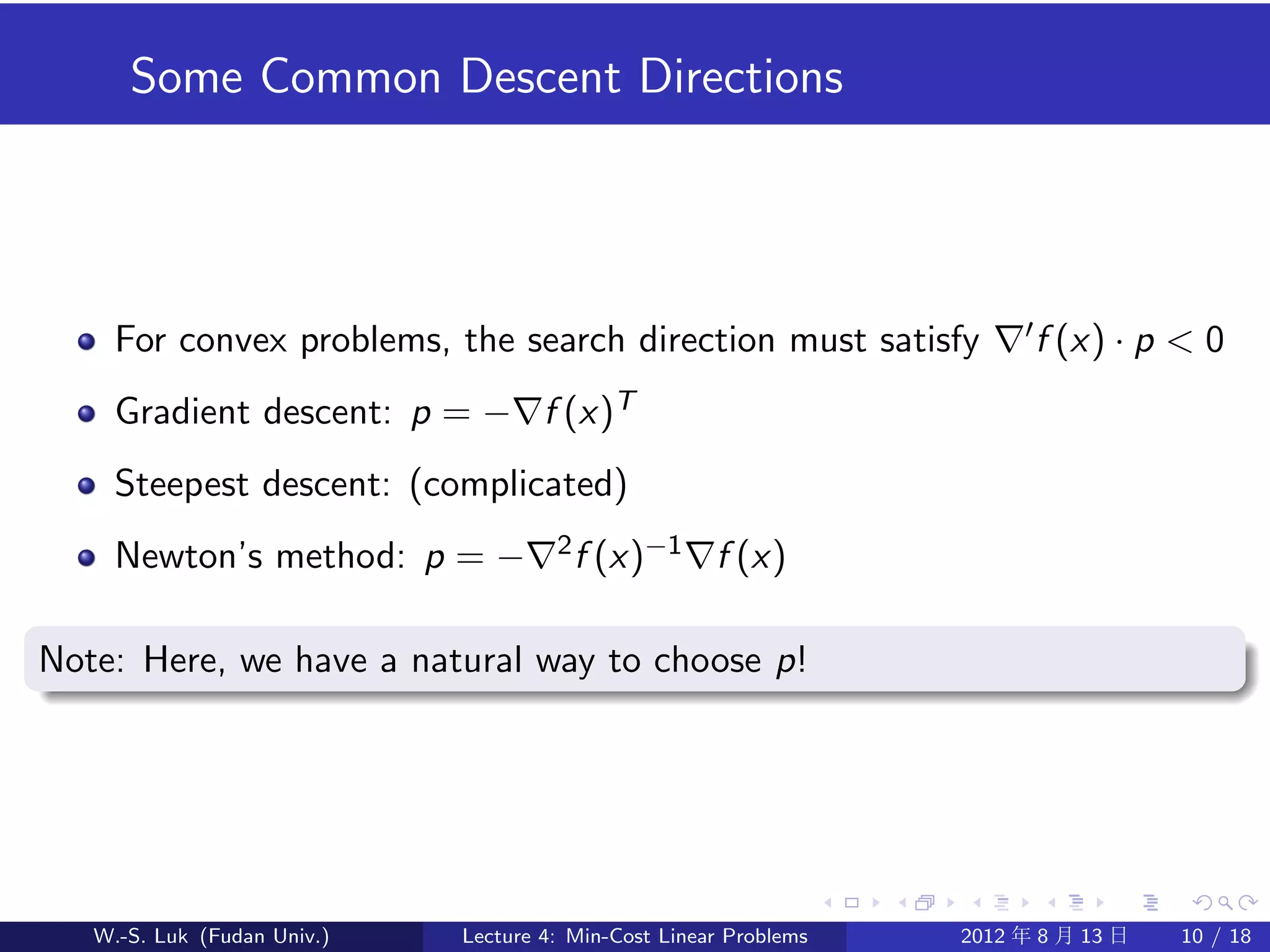
Some Common Descent Directions


     For convex problems, the search direction must satisfy              f (x) · p < 0
     Gradient descent: p = − f (x)T
     Steepest descent: (complicated)
     Newton’s method: p = −           2 f (x)−1       f (x)

Note: Here, we have a natural way to choose p!


   W.-S. Luk (Fudan Univ.)   Lecture 4: Min-Cost Linear Problems   2012 年 8 月 13 日   10 / 18
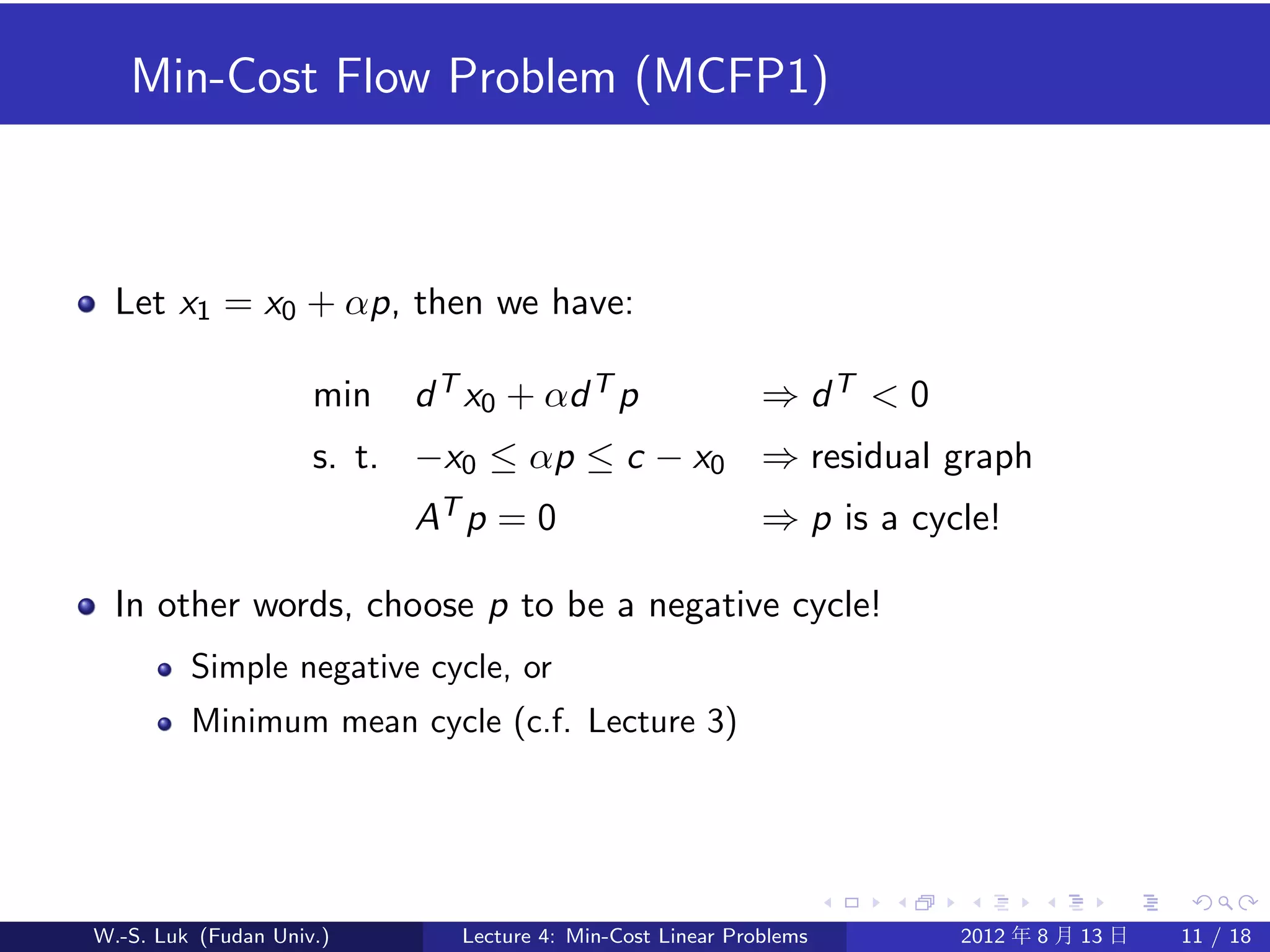
Min-Cost Flow Problem (MCFP1)


  Let x1 = x0 + αp, then we have:

                     min   d T x0 + αd T p                  ⇒ dT < 0
                     s. t. −x0 ≤ αp ≤ c − x0 ⇒ residual graph
                           AT p = 0                         ⇒ p is a cycle!

  In other words, choose p to be a negative cycle!
         Simple negative cycle, or
         Minimum mean cycle (c.f. Lecture 3)


W.-S. Luk (Fudan Univ.)       Lecture 4: Min-Cost Linear Problems       2012 年 8 月 13 日   11 / 18
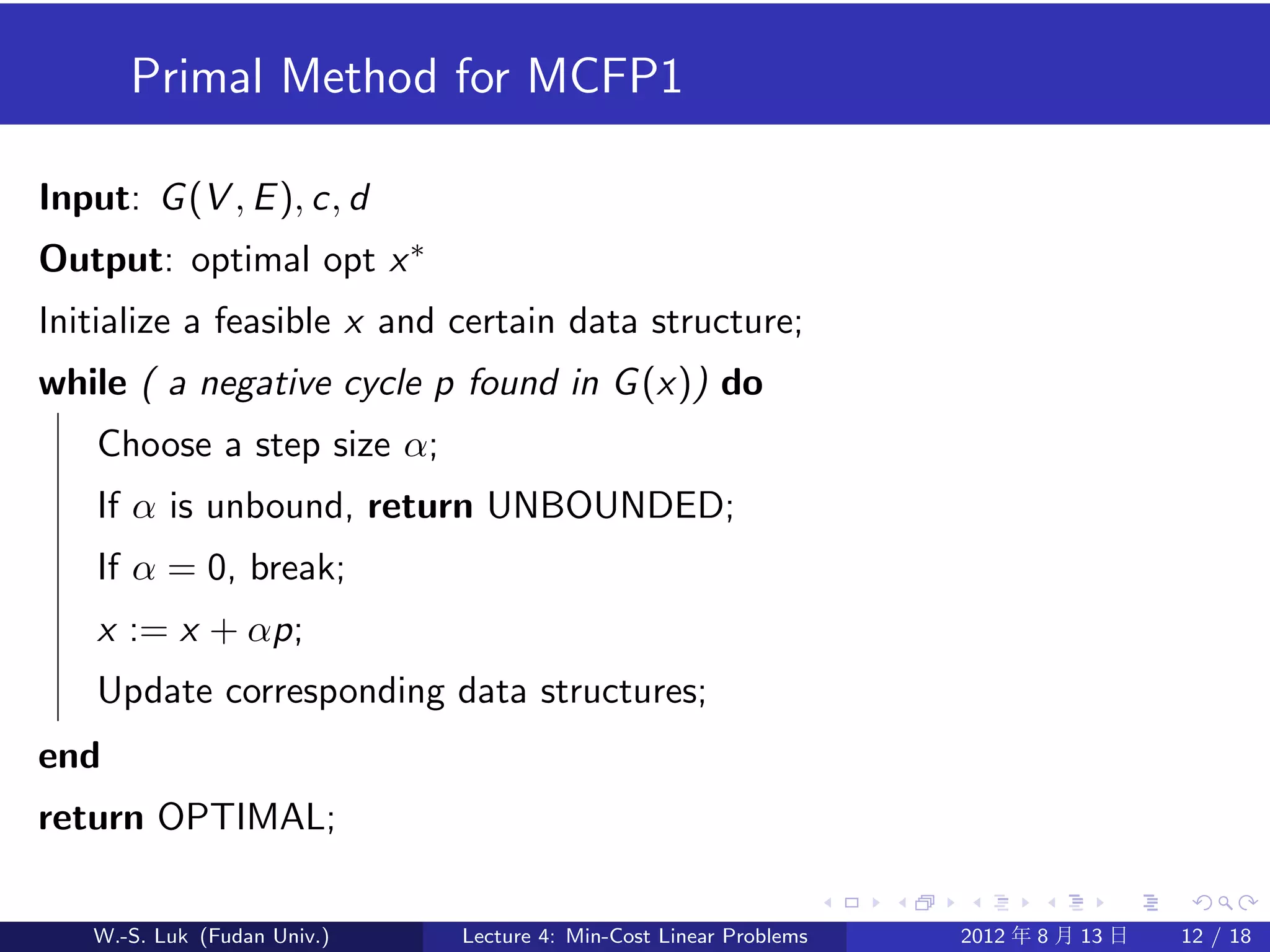
Primal Method for MCFP1

Input: G (V , E ), c, d
Output: optimal opt x ∗
Initialize a feasible x and certain data structure;
while ( a negative cycle p found in G (x)) do
    Choose a step size α;
    If α is unbound, return UNBOUNDED;
    If α = 0, break;
    x := x + αp;
    Update corresponding data structures;
end
return OPTIMAL;

   W.-S. Luk (Fudan Univ.)   Lecture 4: Min-Cost Linear Problems   2012 年 8 月 13 日   12 / 18
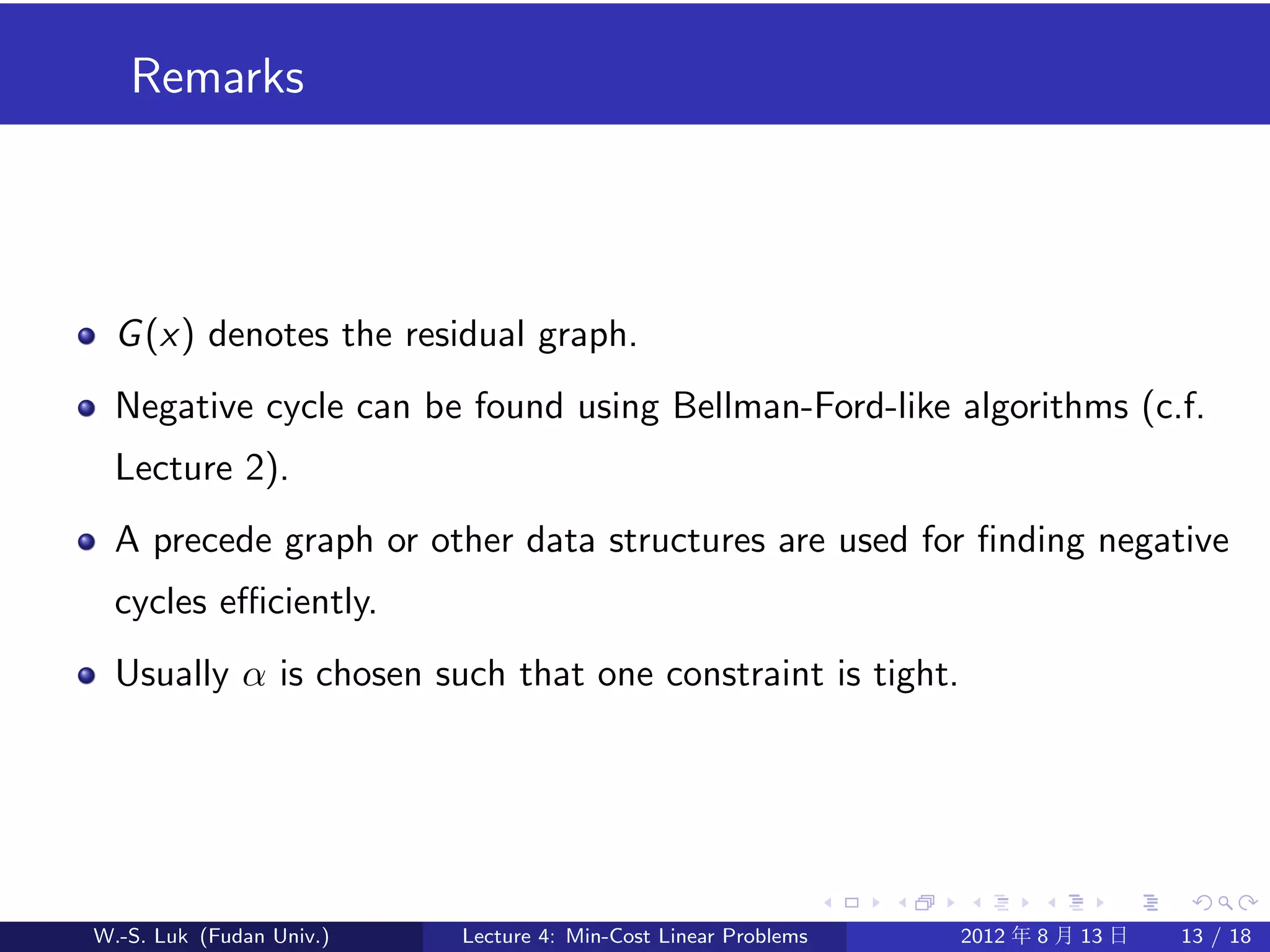
Remarks


  G (x) denotes the residual graph.
  Negative cycle can be found using Bellman-Ford-like algorithms (c.f.
  Lecture 2).
  A precede graph or other data structures are used for finding negative
  cycles efficiently.
  Usually α is chosen such that one constraint is tight.


W.-S. Luk (Fudan Univ.)   Lecture 4: Min-Cost Linear Problems   2012 年 8 月 13 日   13 / 18
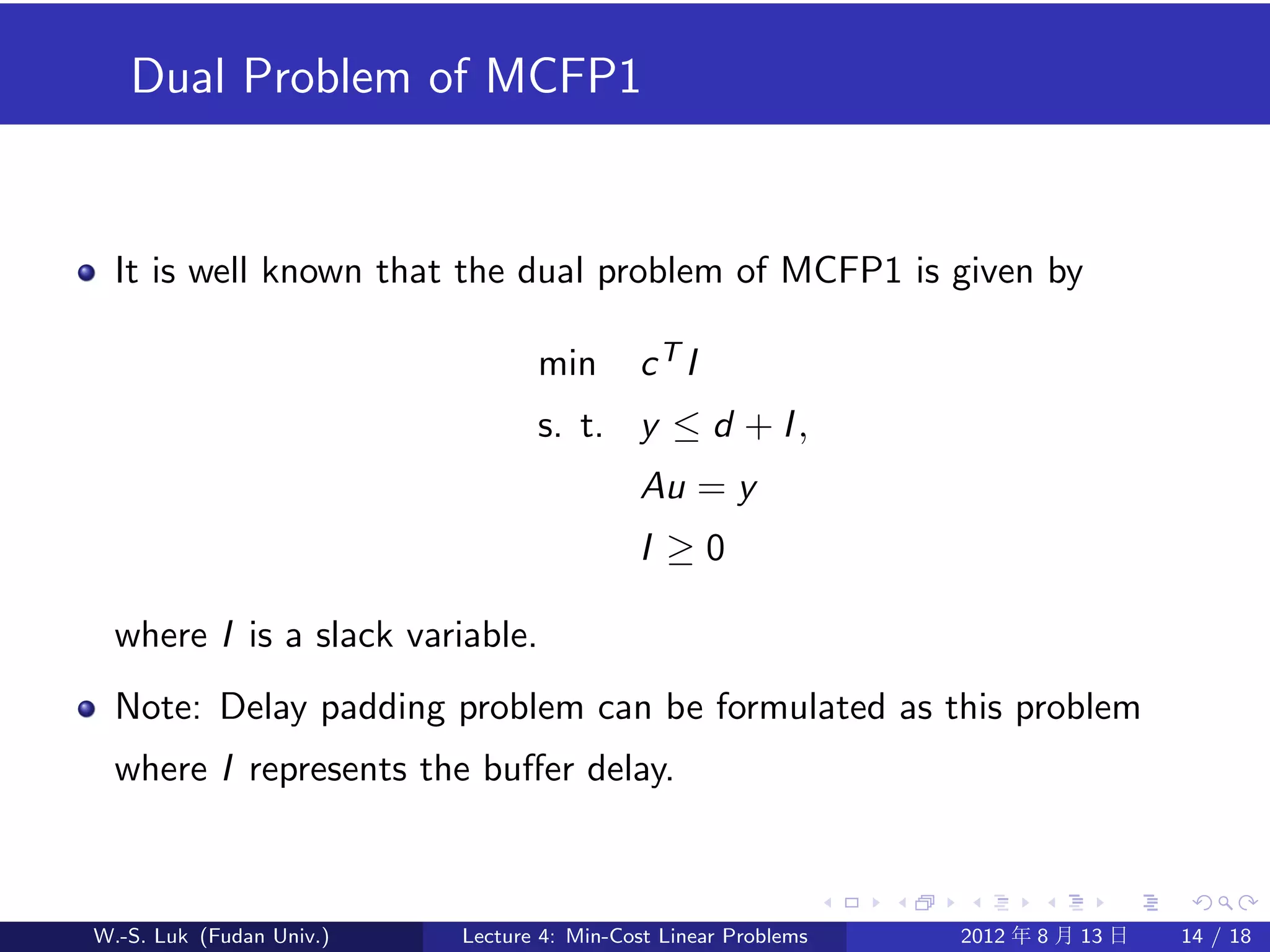
Dual Problem of MCFP1


  It is well known that the dual problem of MCFP1 is given by

                                 min       cT I
                                 s. t. y ≤ d + I ,
                                           Au = y
                                           I ≥0

  where I is a slack variable.
  Note: Delay padding problem can be formulated as this problem
  where I represents the buffer delay.


W.-S. Luk (Fudan Univ.)   Lecture 4: Min-Cost Linear Problems   2012 年 8 月 13 日   14 / 18
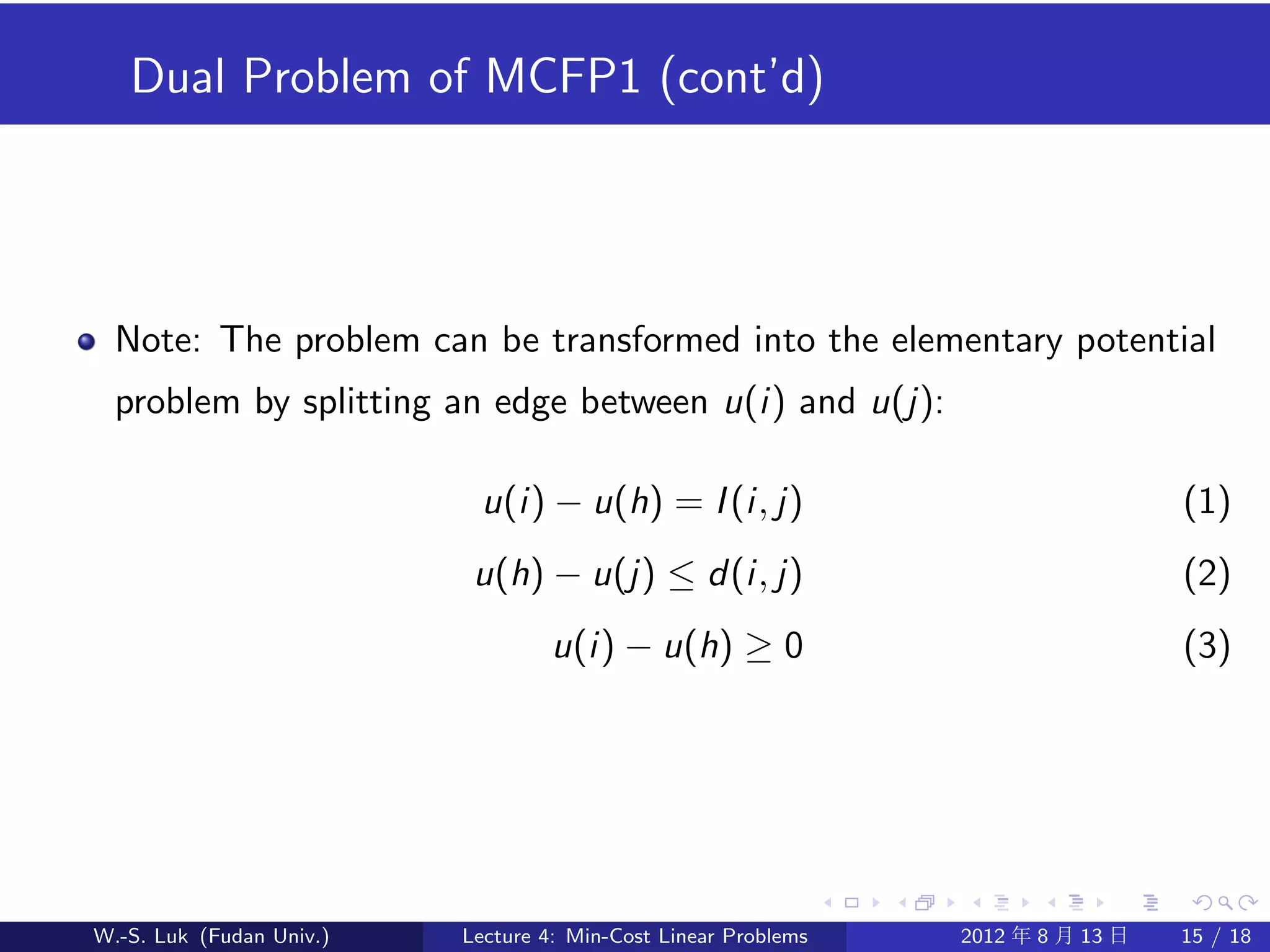
Dual Problem of MCFP1 (cont’d)


  Note: The problem can be transformed into the elementary potential
  problem by splitting an edge between u(i) and u(j):

                           u(i) − u(h) = I (i, j)                                 (1)
                           u(h) − u(j) ≤ d(i, j)                                  (2)
                                   u(i) − u(h) ≥ 0                                (3)


W.-S. Luk (Fudan Univ.)   Lecture 4: Min-Cost Linear Problems   2012 年 8 月 13 日   15 / 18
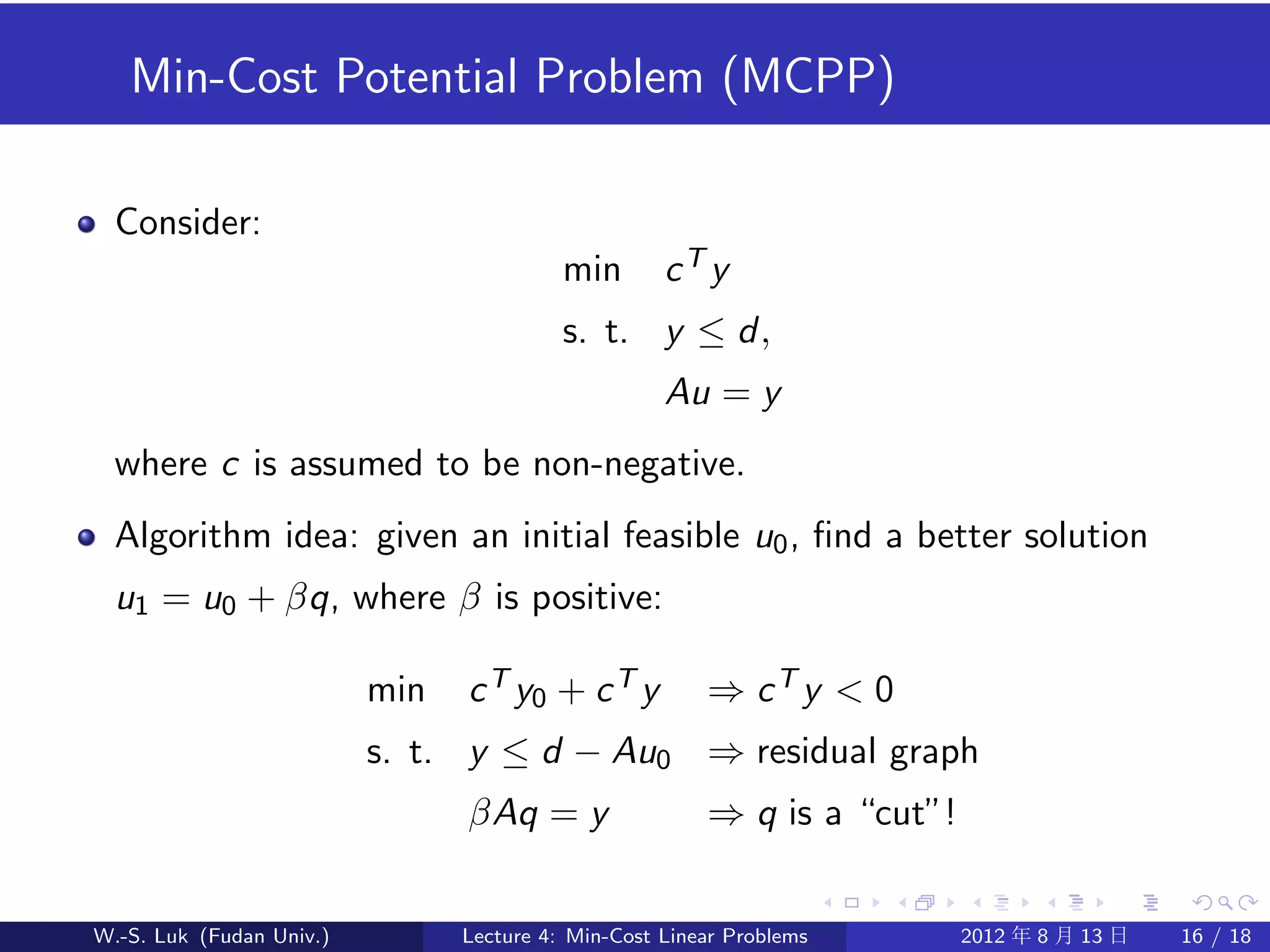
Min-Cost Potential Problem (MCPP)

  Consider:
                                          min       cT y
                                          s. t. y ≤ d,
                                                    Au = y
  where c is assumed to be non-negative.
  Algorithm idea: given an initial feasible u0 , find a better solution
  u1 = u0 + βq, where β is positive:

                          min   c T y0 + c T y          ⇒ cT y < 0
                          s. t. y ≤ d − Au0 ⇒ residual graph
                                βAq = y                 ⇒ q is a “cut”!


W.-S. Luk (Fudan Univ.)         Lecture 4: Min-Cost Linear Problems       2012 年 8 月 13 日   16 / 18
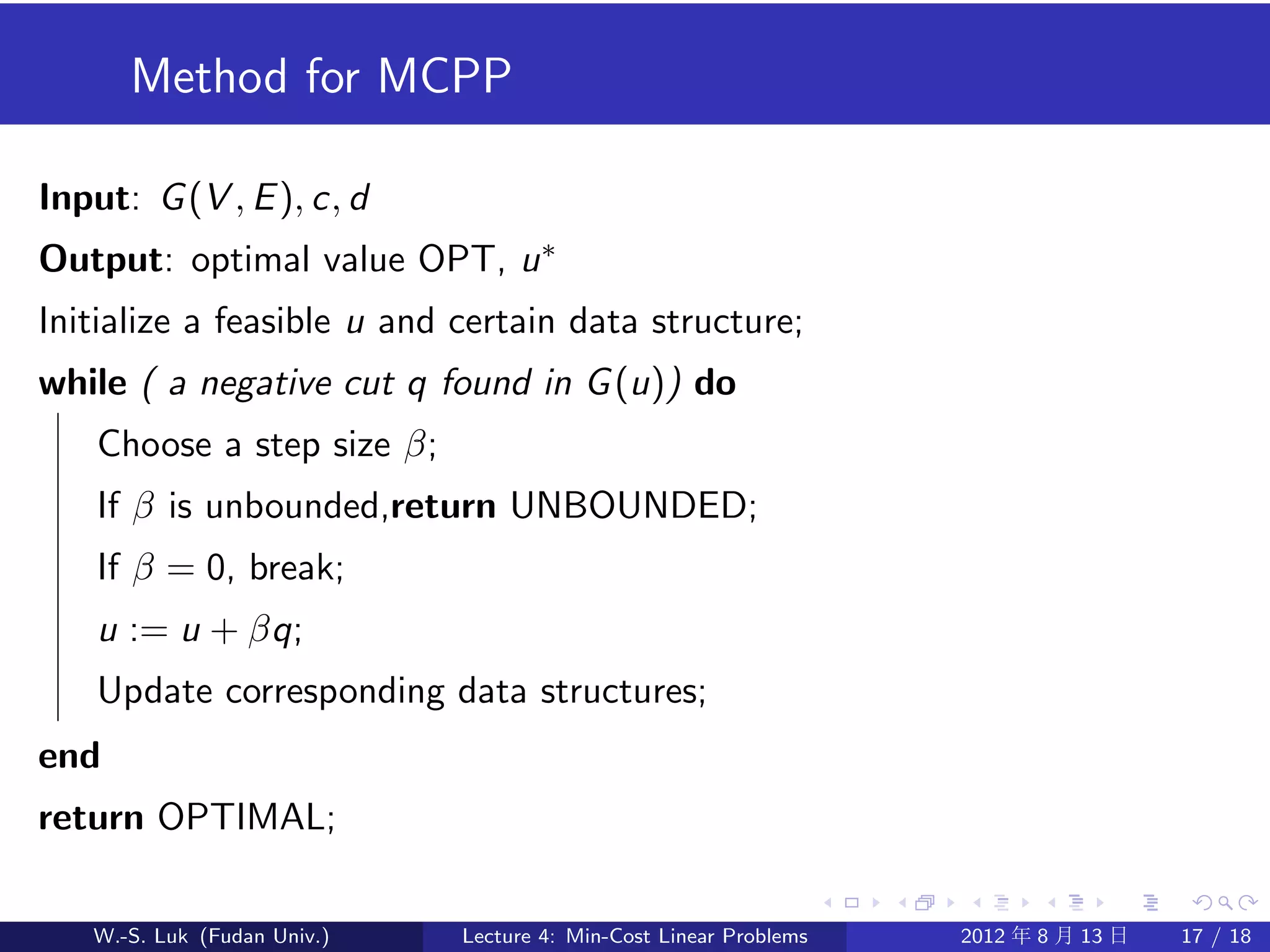
Method for MCPP

Input: G (V , E ), c, d
Output: optimal value OPT, u ∗
Initialize a feasible u and certain data structure;
while ( a negative cut q found in G (u)) do
    Choose a step size β;
    If β is unbounded,return UNBOUNDED;
    If β = 0, break;
    u := u + βq;
    Update corresponding data structures;
end
return OPTIMAL;

   W.-S. Luk (Fudan Univ.)   Lecture 4: Min-Cost Linear Problems   2012 年 8 月 13 日   17 / 18
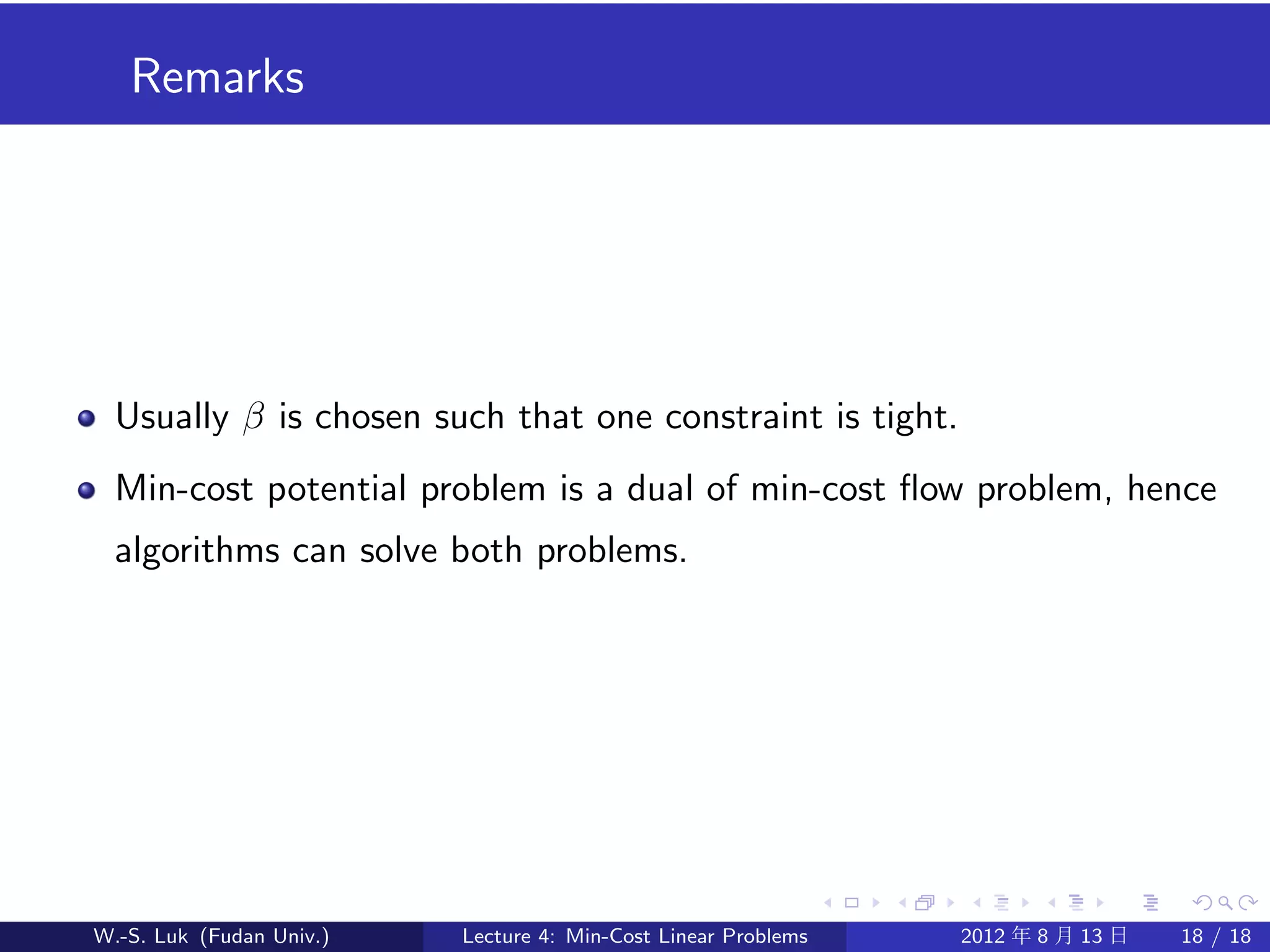
Remarks


  Usually β is chosen such that one constraint is tight.
  Min-cost potential problem is a dual of min-cost flow problem, hence
  algorithms can solve both problems.


W.-S. Luk (Fudan Univ.)   Lecture 4: Min-Cost Linear Problems   2012 年 8 月 13 日   18 / 18

Lec04 min cost linear problems

  • 1.
    Lecture 4: Min-CostLinear Problems Wai-Shing Luk (陆伟成) Fudan University 2012 年 8 月 13 日 W.-S. Luk (Fudan Univ.) Lecture 4: Min-Cost Linear Problems 2012 年 8 月 13 日 1 / 18
  • 2.
    Elementary Optimal Problems ElementaryFlow Problem: Elementary Potential Problem: min dT x + p max b T u − (c T y + q) s. t. c ≤ x, s. t. y ≤ d, AT x = b, b(V ) = 0 Au = y Theorem The problems are dual to each other if p + q = −c T d, (x − c)T (d − y ) = 0, c ≤ x, y ≤ d Proof. Since b T u = (AT x)T u = x T Au = x T y , [min] − [max] = (d T x + p) − (b T u − [c T y + q]) = d T x + c T y − x T y + p + q = (x − c)T (d − y ) ≥ 0 [min] - [max] when equality holds. W.-S. Luk (Fudan Univ.) Lecture 4: Min-Cost Linear Problems 2012 年 8 月 13 日 2 / 18
  • 3.
    Remark 1 We can formulate a linear problem either in its primal form or in its dual form, depending on which one is more appropriate, for example, whether design variables are in integral domain: max-flow problem (i.e. d T = [−1, −1, · · · , −1]T ) may be better to be solved by a dual method. W.-S. Luk (Fudan Univ.) Lecture 4: Min-Cost Linear Problems 2012 年 8 月 13 日 3 / 18
  • 4.
    Linear Optimal Problems OptimalFlow Problem: Optimal Potential Problem: min dT x + p max b T u − (c T y + q) s. t. c − ≤ x ≤ c + , s. t. d − ≤ y ≤ d + , AT x = b, b(V ) = 0 Au = y By modifying the network: This problem can be reduced to the elementary case [?, pp.275–276] Piecewise linear convex cost can be reduced to this linear problem [?, p.239,p.260] The problem has been studied extensively with a lot of applications. W.-S. Luk (Fudan Univ.) Lecture 4: Min-Cost Linear Problems 2012 年 8 月 13 日 4 / 18
  • 5.
    Remark Wecan transform the cost function to be non-negative by reversing the orientation of the negative cost edges. Then reduce the problem to the elementary case. Most software packages only solve the problems in primal forms, usually with c − = 0. W.-S. Luk (Fudan Univ.) Lecture 4: Min-Cost Linear Problems 2012 年 8 月 13 日 5 / 18
  • 6.
    Algorithms for OptimalFlow Problems Successive shortest path algorithm Cycle cancellation method iteratively insert additional minimal flows according to a negative cycle of the residual network, until no negative cycle is found. W.-S. Luk (Fudan Univ.) Lecture 4: Min-Cost Linear Problems 2012 年 8 月 13 日 6 / 18
  • 7.
    For Special Cases Max flow problem (d = −[1, · · · , 1]) Ford-Fulkerson algorithm: iteratively insert additional minimal flows according to an argument path of the residual network, until no argument path of the residual network is found. Preflow Push-Relabel algorithm (dual method???) Matching problems ([c − , c + ] = [0, 1]) Edmond’s blossom algorithm W.-S. Luk (Fudan Univ.) Lecture 4: Min-Cost Linear Problems 2012 年 8 月 13 日 7 / 18
  • 8.
    Min-Cost Flow Problem(MCFP1) Consider: min dT x s. t. 0 ≤ x ≤ c, AT x = b, b(V ) = 0 where d is assumed to be non-negative. Note: Optimal flow problem can be transformed into this problem by letting x = x − c − . Algorithm idea: descent method: given a feasible x0 , find a better solution x1 = x0 + αp, where α is positive. W.-S. Luk (Fudan Univ.) Lecture 4: Min-Cost Linear Problems 2012 年 8 月 13 日 8 / 18
  • 9.
    Review of GeneralDescent Method Input: f (x), initial x Output: x ∗ while not converged do Choose descent direction p; Choose the step size α; x := x + αp; end W.-S. Luk (Fudan Univ.) Lecture 4: Min-Cost Linear Problems 2012 年 8 月 13 日 9 / 18
  • 10.
    Some Common DescentDirections For convex problems, the search direction must satisfy f (x) · p < 0 Gradient descent: p = − f (x)T Steepest descent: (complicated) Newton’s method: p = − 2 f (x)−1 f (x) Note: Here, we have a natural way to choose p! W.-S. Luk (Fudan Univ.) Lecture 4: Min-Cost Linear Problems 2012 年 8 月 13 日 10 / 18
  • 11.
    Min-Cost Flow Problem(MCFP1) Let x1 = x0 + αp, then we have: min d T x0 + αd T p ⇒ dT < 0 s. t. −x0 ≤ αp ≤ c − x0 ⇒ residual graph AT p = 0 ⇒ p is a cycle! In other words, choose p to be a negative cycle! Simple negative cycle, or Minimum mean cycle (c.f. Lecture 3) W.-S. Luk (Fudan Univ.) Lecture 4: Min-Cost Linear Problems 2012 年 8 月 13 日 11 / 18
  • 12.
    Primal Method forMCFP1 Input: G (V , E ), c, d Output: optimal opt x ∗ Initialize a feasible x and certain data structure; while ( a negative cycle p found in G (x)) do Choose a step size α; If α is unbound, return UNBOUNDED; If α = 0, break; x := x + αp; Update corresponding data structures; end return OPTIMAL; W.-S. Luk (Fudan Univ.) Lecture 4: Min-Cost Linear Problems 2012 年 8 月 13 日 12 / 18
  • 13.
    Remarks G(x) denotes the residual graph. Negative cycle can be found using Bellman-Ford-like algorithms (c.f. Lecture 2). A precede graph or other data structures are used for finding negative cycles efficiently. Usually α is chosen such that one constraint is tight. W.-S. Luk (Fudan Univ.) Lecture 4: Min-Cost Linear Problems 2012 年 8 月 13 日 13 / 18
  • 14.
    Dual Problem ofMCFP1 It is well known that the dual problem of MCFP1 is given by min cT I s. t. y ≤ d + I , Au = y I ≥0 where I is a slack variable. Note: Delay padding problem can be formulated as this problem where I represents the buffer delay. W.-S. Luk (Fudan Univ.) Lecture 4: Min-Cost Linear Problems 2012 年 8 月 13 日 14 / 18
  • 15.
    Dual Problem ofMCFP1 (cont’d) Note: The problem can be transformed into the elementary potential problem by splitting an edge between u(i) and u(j): u(i) − u(h) = I (i, j) (1) u(h) − u(j) ≤ d(i, j) (2) u(i) − u(h) ≥ 0 (3) W.-S. Luk (Fudan Univ.) Lecture 4: Min-Cost Linear Problems 2012 年 8 月 13 日 15 / 18
  • 16.
    Min-Cost Potential Problem(MCPP) Consider: min cT y s. t. y ≤ d, Au = y where c is assumed to be non-negative. Algorithm idea: given an initial feasible u0 , find a better solution u1 = u0 + βq, where β is positive: min c T y0 + c T y ⇒ cT y < 0 s. t. y ≤ d − Au0 ⇒ residual graph βAq = y ⇒ q is a “cut”! W.-S. Luk (Fudan Univ.) Lecture 4: Min-Cost Linear Problems 2012 年 8 月 13 日 16 / 18
  • 17.
    Method for MCPP Input:G (V , E ), c, d Output: optimal value OPT, u ∗ Initialize a feasible u and certain data structure; while ( a negative cut q found in G (u)) do Choose a step size β; If β is unbounded,return UNBOUNDED; If β = 0, break; u := u + βq; Update corresponding data structures; end return OPTIMAL; W.-S. Luk (Fudan Univ.) Lecture 4: Min-Cost Linear Problems 2012 年 8 月 13 日 17 / 18
  • 18.
    Remarks Usuallyβ is chosen such that one constraint is tight. Min-cost potential problem is a dual of min-cost flow problem, hence algorithms can solve both problems. W.-S. Luk (Fudan Univ.) Lecture 4: Min-Cost Linear Problems 2012 年 8 月 13 日 18 / 18