UNIVERSIDAD DE LAS FUERZAS ARMADAS
"ESPE"
ASSESSMENT AND EVALUATION
NRC: 18234
Nombre: Joselyn Matilde Zambrano Mero
Language assessment is a systematic
process of gathering information about
a person's language abilities. It plays a
crucial role in education, employment,
and various professional contexts. The
principles of language assessment are
designed to ensure fairness, validity,
reliability, and practicality.
Assessmen
t
Terminolog
y
• Negative Student Perception:
Students often perceive tests
negatively due to fear of
failure.
• Teacher Perspective: Tests are
a standard way for teachers to
gauge student learning.
• Importance of Context: Tests
should not be seen as
punishment but rather as a
part of the learning experience.
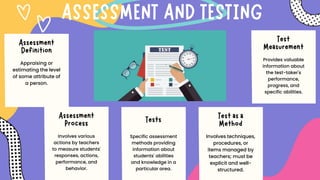
Provides valuable
information about
the test-taker's
performance,
progress, and
specific abilities.
Appraising or
estimating the level
of some attribute of
a person.
Involves various
actions by teachers
to measure students'
responses, actions,
performance, and
behavior.
Specific assessment
methods providing
information about
students' abilities
and knowledge in a
particular area.
Involves techniques,
procedures, or
items managed by
teachers; must be
explicit and well-
structured.
Spontaneous
measurement without
grading criteria, focusing
on identifying challenges
and providing constructive
feedback.
Structured measurement
with specific criteria, often
involving tests, quizzes,
and questionnaires.
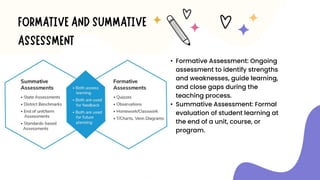
• Formative Assessment: Ongoing
assessment to identify strengths
and weaknesses, guide learning,
and close gaps during the
teaching process.
• Summative Assessment: Formal
evaluation of student learning at
the end of a unit, course, or
program.
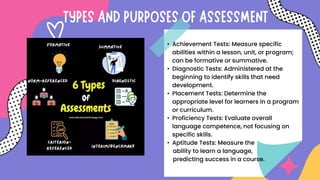
• Achievement Tests: Measure specific
abilities within a lesson, unit, or program;
can be formative or summative.
• Diagnostic Tests: Administered at the
beginning to identify skills that need
development.
• Placement Tests: Determine the
appropriate level for learners in a program
or curriculum.
• Proficiency Tests: Evaluate overall
language competence, not focusing on
specific skills.
• Aptitude Tests: Measure the
ability to learn a language,
predicting success in a course.
• Practicality: Concerned with the administrative
aspects of assessment, including cost, time, and
resource usage.
• Reliability: Focuses on the consistency of test
results, considering learner-related, inter-rater,
and test administration reliability.
• Validity: Ensures that a test measures what it
intends to measure, covering content-related,
criterion-related, and construct-related validity.
• Authenticity: Refers to the realism and relevance
of a test or assignment to real-world situations.
• Washback Effect: The impact of tests on
teaching practices, influencing how teachers
prepare students and shaping the learning
process

Principles of Language Assessment

  • 1.
    UNIVERSIDAD DE LASFUERZAS ARMADAS "ESPE" ASSESSMENT AND EVALUATION NRC: 18234 Nombre: Joselyn Matilde Zambrano Mero
  • 2.
    Language assessment isa systematic process of gathering information about a person's language abilities. It plays a crucial role in education, employment, and various professional contexts. The principles of language assessment are designed to ensure fairness, validity, reliability, and practicality.
  • 3.
    Assessmen t Terminolog y • Negative StudentPerception: Students often perceive tests negatively due to fear of failure. • Teacher Perspective: Tests are a standard way for teachers to gauge student learning. • Importance of Context: Tests should not be seen as punishment but rather as a part of the learning experience.
  • 4.
    Provides valuable information about thetest-taker's performance, progress, and specific abilities. Appraising or estimating the level of some attribute of a person. Involves various actions by teachers to measure students' responses, actions, performance, and behavior. Specific assessment methods providing information about students' abilities and knowledge in a particular area. Involves techniques, procedures, or items managed by teachers; must be explicit and well- structured.
  • 6.
    Spontaneous measurement without grading criteria,focusing on identifying challenges and providing constructive feedback. Structured measurement with specific criteria, often involving tests, quizzes, and questionnaires.
  • 7.
    • Formative Assessment:Ongoing assessment to identify strengths and weaknesses, guide learning, and close gaps during the teaching process. • Summative Assessment: Formal evaluation of student learning at the end of a unit, course, or program.
  • 8.
    • Achievement Tests:Measure specific abilities within a lesson, unit, or program; can be formative or summative. • Diagnostic Tests: Administered at the beginning to identify skills that need development. • Placement Tests: Determine the appropriate level for learners in a program or curriculum. • Proficiency Tests: Evaluate overall language competence, not focusing on specific skills. • Aptitude Tests: Measure the ability to learn a language, predicting success in a course.
  • 9.
    • Practicality: Concernedwith the administrative aspects of assessment, including cost, time, and resource usage. • Reliability: Focuses on the consistency of test results, considering learner-related, inter-rater, and test administration reliability. • Validity: Ensures that a test measures what it intends to measure, covering content-related, criterion-related, and construct-related validity. • Authenticity: Refers to the realism and relevance of a test or assignment to real-world situations. • Washback Effect: The impact of tests on teaching practices, influencing how teachers prepare students and shaping the learning process