Principles of language
assessment
UNIVERSIDAD DE LAS FUERZAS ARMADAS ESPE
Pedagogy in National and Foreign Language
“Assessment and Evaluation”
Name: José Núñez
Course: 8th semester
Tutor: Carlos Espin
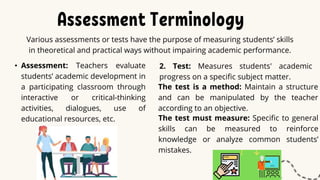
Assessment Terminology
Various assessments or tests have the purpose of measuring students’ skills
in theoretical and practical ways without impairing academic performance.
• Assessment: Teachers evaluate
students’ academic development in
a participating classroom through
interactive or critical-thinking
activities, dialogues, use of
educational resources, etc.
2. Test: Measures students' academic
progress on a specific subject matter.
The test is a method: Maintain a structure
and can be manipulated by the teacher
according to an objective.
The test must measure: Specific to general
skills can be measured to reinforce
knowledge or analyze common students’
mistakes.
Assessment Terminology
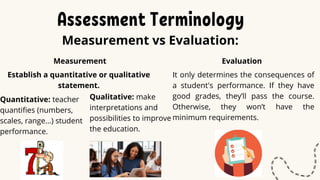
Evaluation
Measurement
Measurement vs Evaluation:
Establish a quantitative or qualitative
statement.
Quantitative: teacher
quantifies (numbers,
scales, range...) student
performance.
Qualitative: make
interpretations and
possibilities to improve
the education.
It only determines the consequences of
a student's performance. If they have
good grades, they’ll pass the course.
Otherwise, they won’t have the
minimum requirements.
Assessment Terminology
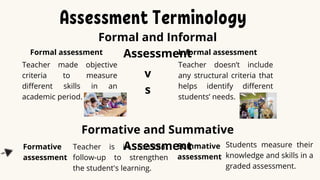
Formal assessment
Formal and Informal
Assessment
Formative and Summative
Assessment
Informal assessment
Teacher doesn’t include
any structural criteria that
helps identify different
students’ needs.
Teacher made objective
criteria to measure
different skills in an
academic period.
v
s
Formative
assessment
Summative
assessment
Teacher is in constant
follow-up to strengthen
the student's learning.
Students measure their
knowledge and skills in a
graded assessment.
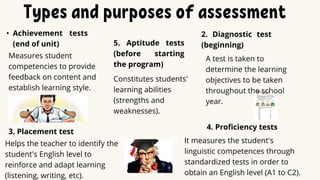
Types and purposes of assessment
• Achievement tests
(end of unit)
2. Diagnostic test
(beginning)
3. Placement test
4. Proficiency tests
5. Aptitude tests
(before starting
the program)
Measures student
competencies to provide
feedback on content and
establish learning style.
A test is taken to
determine the learning
objectives to be taken
throughout the school
year.
Helps the teacher to identify the
student's English level to
reinforce and adapt learning
(listening, writing, etc).
It measures the student's
linguistic competences through
standardized tests in order to
obtain an English level (A1 to C2).
Constitutes students'
learning abilities
(strengths and
weaknesses).
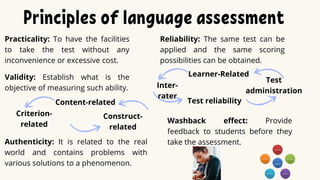
Reliability: The same test can be
applied and the same scoring
possibilities can be obtained.
Learner-Related
Inter-
rater
Test
administration
Criterion-
related
Principles of language assessment
Practicality: To have the facilities
to take the test without any
inconvenience or excessive cost.
Validity: Establish what is the
objective of measuring such ability.
Washback effect: Provide
feedback to students before they
take the assessment.
Authenticity: It is related to the real
world and contains problems with
various solutions to a phenomenon.
Test reliability
Content-related
Construct-
related
Bibliography
Augsteem, S. (2021). 6 Types of Assessment (and How to Use Them).
https://www.prodigygame.com/main-en/blog/types-of-assessment/
(2004). Formative and Summative Assessment
https://www.niu.edu/citl/resources/guides/instructional-
guide/formative-and-summative-assessment.shtml
Staake, J. (2023). Types of Assessments for Education (Plus How
and When To Use Them)
https://www.niu.edu/citl/resources/guides/instructional-
guide/formative-and-summative-assessment.shtml

Principles of language assessment

  • 1.
    Principles of language assessment UNIVERSIDADDE LAS FUERZAS ARMADAS ESPE Pedagogy in National and Foreign Language “Assessment and Evaluation” Name: José Núñez Course: 8th semester Tutor: Carlos Espin
  • 2.
    Assessment Terminology Various assessmentsor tests have the purpose of measuring students’ skills in theoretical and practical ways without impairing academic performance. • Assessment: Teachers evaluate students’ academic development in a participating classroom through interactive or critical-thinking activities, dialogues, use of educational resources, etc. 2. Test: Measures students' academic progress on a specific subject matter. The test is a method: Maintain a structure and can be manipulated by the teacher according to an objective. The test must measure: Specific to general skills can be measured to reinforce knowledge or analyze common students’ mistakes.
  • 3.
    Assessment Terminology Evaluation Measurement Measurement vsEvaluation: Establish a quantitative or qualitative statement. Quantitative: teacher quantifies (numbers, scales, range...) student performance. Qualitative: make interpretations and possibilities to improve the education. It only determines the consequences of a student's performance. If they have good grades, they’ll pass the course. Otherwise, they won’t have the minimum requirements.
  • 4.
    Assessment Terminology Formal assessment Formaland Informal Assessment Formative and Summative Assessment Informal assessment Teacher doesn’t include any structural criteria that helps identify different students’ needs. Teacher made objective criteria to measure different skills in an academic period. v s Formative assessment Summative assessment Teacher is in constant follow-up to strengthen the student's learning. Students measure their knowledge and skills in a graded assessment.
  • 5.
    Types and purposesof assessment • Achievement tests (end of unit) 2. Diagnostic test (beginning) 3. Placement test 4. Proficiency tests 5. Aptitude tests (before starting the program) Measures student competencies to provide feedback on content and establish learning style. A test is taken to determine the learning objectives to be taken throughout the school year. Helps the teacher to identify the student's English level to reinforce and adapt learning (listening, writing, etc). It measures the student's linguistic competences through standardized tests in order to obtain an English level (A1 to C2). Constitutes students' learning abilities (strengths and weaknesses).
  • 6.
    Reliability: The sametest can be applied and the same scoring possibilities can be obtained. Learner-Related Inter- rater Test administration Criterion- related Principles of language assessment Practicality: To have the facilities to take the test without any inconvenience or excessive cost. Validity: Establish what is the objective of measuring such ability. Washback effect: Provide feedback to students before they take the assessment. Authenticity: It is related to the real world and contains problems with various solutions to a phenomenon. Test reliability Content-related Construct- related
  • 7.
    Bibliography Augsteem, S. (2021).6 Types of Assessment (and How to Use Them). https://www.prodigygame.com/main-en/blog/types-of-assessment/ (2004). Formative and Summative Assessment https://www.niu.edu/citl/resources/guides/instructional- guide/formative-and-summative-assessment.shtml Staake, J. (2023). Types of Assessments for Education (Plus How and When To Use Them) https://www.niu.edu/citl/resources/guides/instructional- guide/formative-and-summative-assessment.shtml