Learning to Learn
Troy	Tuttle
Lean	Agile	Coach
KanFlow.com
troy@kanflow.com
@troytuttlelinkedin.com/in/troytuttle
”Learning is not compulsory... neither
is survival.”
- W. Edwards Deming
"Without theory, experience has no meaning.
Without theory, one has no questions to ask.
Hence without theory there is no learning"
- W. Edwards Deming
What Do I Do?
@troytuttle
This image cannot currently be displayed.
LeanAgileKC.com
AgileHoodKC.org
meetup.com/LeanCoffeeKC/
Troy	Tuttle
Lean	Agile	Coach
KanFlow.com
troy@kanflow.com
Say What? Learning…?
Much of the knowledge around Learning is how
individuals learn new things -- how our brains work,
learning styles, better teaching techniques, etc.
@troytuttle
This talk will explore Learning in terms of building
the capability for teams and organizations to
change course.
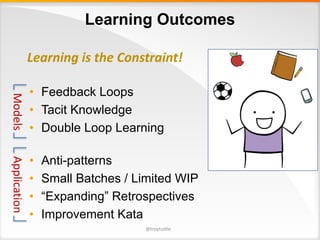
Learning Outcomes
• Feedback Loops
• Tacit Knowledge
• Double Loop Learning
• Anti-patterns
• Small Batches / Limited WIP
• “Expanding” Retrospectives
• Improvement Kata
ModelsApplication
Learning	is	the	Constraint!
@troytuttle
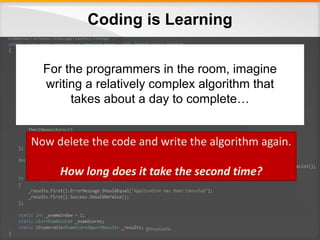
Coding is Learning
For the programmers in the room, imagine
writing a relatively complex algorithm that
takes about a day to complete…
Now	delete	the	code	and	write	the	algorithm	again.	
How	long	does	it	take	the	second	time?
@troytuttle
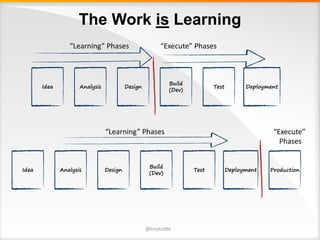
The Work is Learning
Idea Analysis Design
Build
(Dev)
Test
“Learning”	Phases “Execute”	Phases
Deployment
Idea Analysis Design
Build
(Dev)
Test Deployment
“Learning”	Phases “Execute”	
Phases
Production
@troytuttle
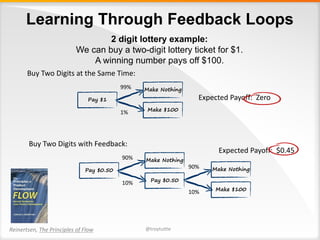
Learning Through Feedback Loops
2 digit lottery example:
We can buy a two-digit lottery ticket for $1.
A winning number pays off $100.
Buy	Two	Digits	at	the	Same	Time:
Pay $1
Make Nothing
Make $100
99%
1%
Buy	Two	Digits	with	Feedback:
Pay $0.50
Make Nothing
Pay $0.50
90%
10%
Make Nothing
Make $100
90%
10%
Expected	Payoff:		Zero
Expected	Payoff:		$0.45
Reinertsen,	The	Principles	of	Flow @troytuttle
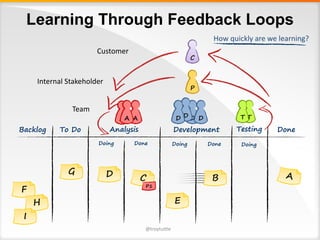
Learning Through Feedback Loops
Doing
DoneBacklog
F
E
I
DevelopmentTo Do
Done Doing Done
G D
A D
P1
B
T
TestingAnalysis
Doing
Team
P
Internal	Stakeholder
C
Customer	
How	quickly	are	we	learning?
@troytuttle
AA DD D T
Learning Through Feedback Loops
“It's	in	the	doing	of	the	work	that	we	
discover	the	work	we	must	do”
- Woody	Zuill
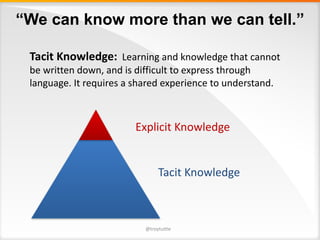
“We can know more than we can tell.”
Tacit	Knowledge: Learning	and	knowledge	that	cannot	
be	written	down,	and	is	difficult	to	express	through	
language.	It	requires	a	shared	experience	to	understand.
Tacit	Knowledge
Explicit	Knowledge
@troytuttle
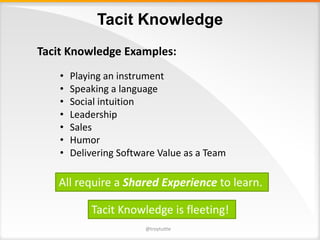
Tacit Knowledge
Tacit	Knowledge	Examples:
• Playing	an	instrument
• Speaking	a	language
• Social	intuition
• Leadership	
• Sales
• Humor
• Delivering	Software	Value	as	a	Team
All	require	a	Shared	Experience to	learn.
@troytuttle
Tacit	Knowledge	is	fleeting!
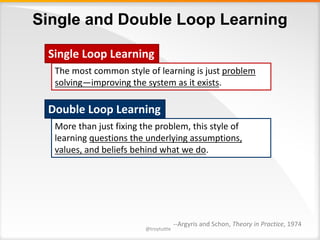
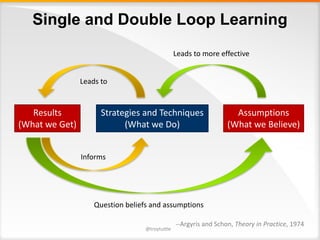
Single and Double Loop Learning
The	most	common	style	of	learning	is	just	problem	
solving—improving	the	system	as	it	exists.
Single	Loop	Learning
More	than	just	fixing	the	problem,	this	style	of	
learning	questions	the	underlying	assumptions,	
values,	and	beliefs	behind	what	we	do.
Double	Loop	Learning
--Argyris and	Schon,	Theory	in	Practice,	1974
@troytuttle
Single and Double Loop Learning
Results
(What	we	Get)
Strategies	and	Techniques
(What	we	Do)
Assumptions
(What	we	Believe)
Leads	to
Informs
Leads	to	more	effective
Question	beliefs	and	assumptions
--Argyris and	Schon,	Theory	in	Practice,	1974
@troytuttle
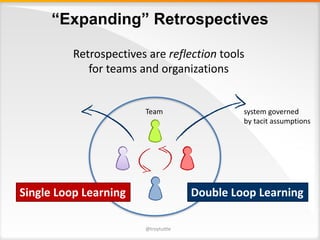
“Expanding” Retrospectives
Retrospectives	are	reflection tools	
for	teams	and	organizations
Single	Loop	Learning Double	Loop	Learning
Team system	governed	
by	tacit	assumptions
@troytuttle
Learning Anti-patterns
@troytuttle
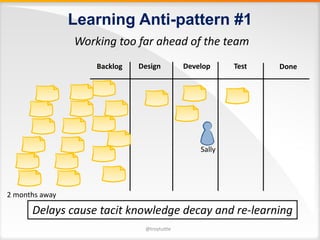
Learning Anti-pattern #1
@troytuttle	
Working	too	far	ahead	of	the	team
Backlog Design Develop Test Done
Delays	cause	tacit	knowledge	decay	and	re-learning
Sally
2	months	away
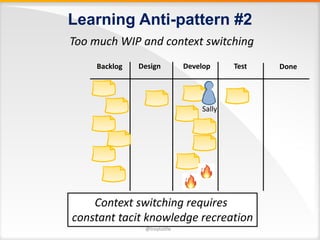
Learning Anti-pattern #2
@troytuttle	
Too	much	WIP	and	context	switching
Backlog Design Develop Test Done
Context	switching	requires	
constant	tacit	knowledge	recreation
Sally
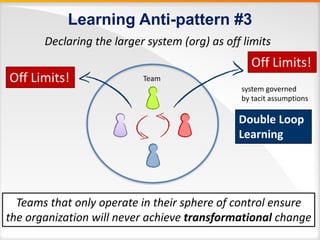
Learning Anti-pattern #3
Declaring	the	larger	system	(org)	as	off	limits
Teams	that	only	operate	in	their	sphere	of	control	ensure	
the	organization	will	never	achieve	transformational change
Double	Loop	
Learning
Team
system	governed	
by	tacit	assumptions
Off	Limits!
Off	Limits!
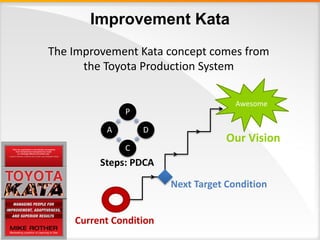
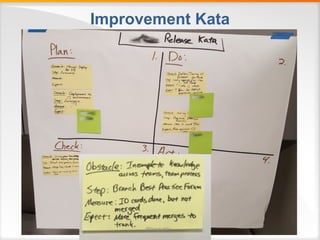
Improvement Kata
Awesome
Current	Condition
Our	Vision
Next	Target	Condition
Steps:	PDCA
P
D
C
A
The	Improvement	Kata	concept	comes	from	
the	Toyota	Production	System
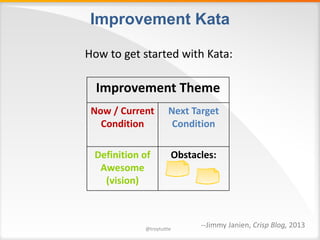
Improvement Kata
How	to	get	started	with	Kata:
Improvement Theme
Now	/ Current	
Condition
Next	Target
Condition
Definition	of	
Awesome
(vision)
Obstacles:
--Jimmy	Janien,	Crisp	Blog,	2013@troytuttle
Improvement Kata
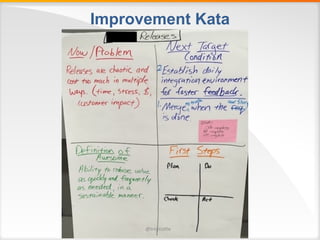
Practical	Toyota	Kata Format:
@troytuttle
Improvement Kata
@troytuttle
Application of Learning Models
ü Feedback	loops	enable	learning
ü Small	batches	allow	us	to	accelerate	feedback	loops
ü Much	of	our	Knowledge	is	Tacit,	so	we	must	act	on	it	
before	it	evaporates.
ü Reflection	tools	like	“expanding”	retrospectives	
enable	double	loop	learning
ü Improvement	Kata	provides	structure	for	single	and	
double	loop	learning
@troytuttle
Learning to Learn
Troy	Tuttle
Lean	Agile	Coach
KanFlow.com
troy@kanflow.com
@troytuttlelinkedin.com/in/troytuttle
”Learning is not compulsory... neither
is survival.”
- W. Edwards Deming
"Without theory, experience has no meaning.
Without theory, one has no questions to ask.
Hence without theory there is no learning"
- W. Edwards Deming

Learning to Learn