How your life in
college can be easier
learn
Learning to
Read, underline, make
summaries, prepare mind maps
If you read your textbook at least 7 times,
you’ll be fine.
Read again and again
Is it the answer? .
Read, underline, make summaries
prepare mind maps
I you read your textbook at least 7 times, you’ll
be fine.
Read again and again
Is it the answer? NO!
Overlearning
• When we read the same notes again and again,
they become familiar
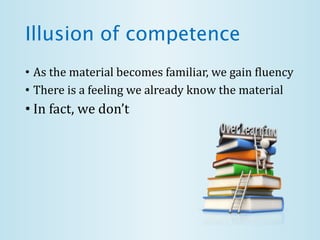
Illusion of competence
• As the material becomes familiar, we gain fluency
• There is a feeling we already know the material
• In fact, we don’t
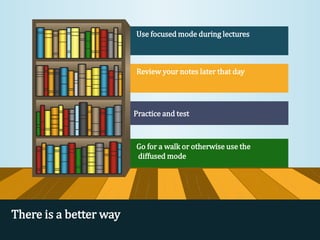
Use focused mode during lectures
Review your notes later that day
Practice and test
Go for a walk or otherwise use the
diffused mode
There is a better way
Focused mode
• Allows the mind to
recognize familiar
patterns
• Problems related to
these patterns are easily
solved
• Works in a sequencial
way – step by step
reasoning
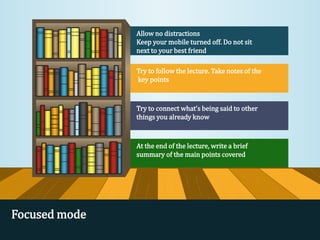
Allow no distractions
Keep your mobile turned off. Do not sit
next to your best friend
Try to follow the lecture. Take notes of the
key points
Try to connect what’s being said to other
things you already know
At the end of the lecture, write a brief
summary of the main points covered
Focused mode
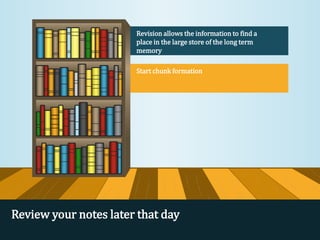
Revision allows the information to find a
place in the large store of the long term
memory
Start chunk formation
Review your notes later that day
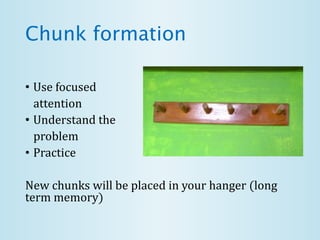
Chunk formation
• Use focused
attention
• Understand the
problem
• Practice
New chunks will be placed in your hanger (long
term memory)
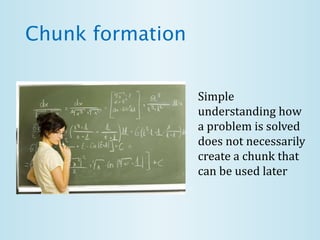
Chunk formation
Simple
understanding how
a problem is solved
does not necessarily
create a chunk that
can be used later
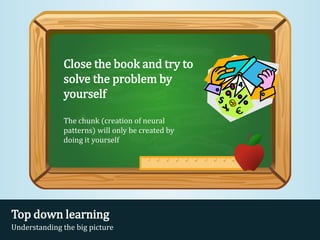
Close the book and try to
solve the problem by
yourself
The chunk (creation of neural
patterns) will only be created by
doing it yourself
Top down learning
Understanding the big picture
Practice
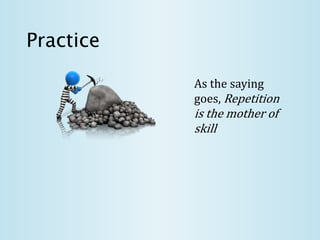
As the saying
goes, Repetition
is the mother of
skill
Deliberate Practice
Focus on the most difficult part
Spaced repetition
Review frequently
Bottom up learning
How the chunk fits in the big picture .
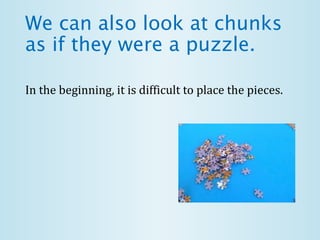
We can also look at chunks
as if they were a puzzle.
In the beginning, it is difficult to place the pieces.
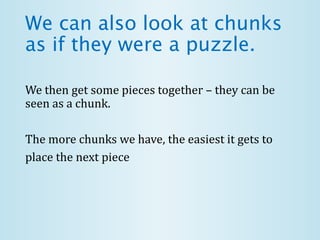
We can also look at chunks
as if they were a puzzle.
We then get some pieces together – they can be
seen as a chunk.
The more chunks we have, the easiest it gets to
place the next piece
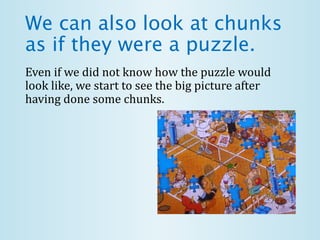
We can also look at chunks
as if they were a puzzle.
Even if we did not know how the puzzle would
look like, we start to see the big picture after
having done some chunks.
If you think it is difficult to
find the will to do the
Practice…
Use a Pomodoro
• Find a place where you can be concentrated
• Shut out all interruptions
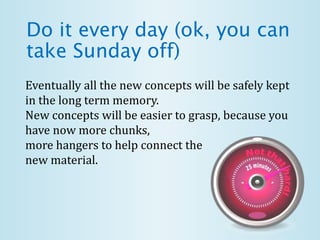
• Work for 25 minutes
Use flashcards
Test yourself
• Do it consistently for short periods of time
• Recall will allow the information to
be stored in the long term memory
• Use manual or computarized
flash cards
• In any case, make your own – you
are the only person to know what you need to
learn!
Do it every day (ok, you can
take Sunday off)
Eventually all the new concepts will be safely kept
in the long term memory.
New concepts will be easier to grasp, because you
have now more chunks,
more hangers to help connect the
new material.
Revisions
• Recall and think about the material in
different places than the one
where you first learned it
• It increases the neural
connections
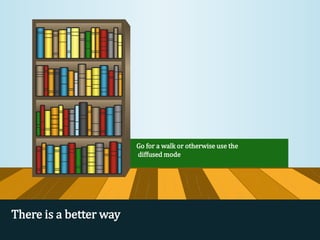
Go for a walk or otherwise use the
diffused mode
There is a better way
Diffused mode
• Now it is time for your brain to work on the
material at his own pace
• You can take a nap, go for a walk, go clean your
room , and your brain will be working on the
material
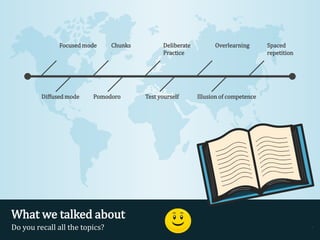
What we talked about
Do you recall all the topics?
Focused mode Chunks
.
OverlearningDeliberate
Practice
Spaced
repetition
Diffused mode Pomodoro Test yourself Illusion of competence
.
Happy learning!
.
Don’t forget your diffused time!
Credits
• Content is based on the materials covered in
the course “Learning how to learn”, Dr. Barbara
Oakley and Dr. Terrence Sejnowski
• PowerPoint presentation template:Presenter
Media
• Cliparts – Presenter Media and Office.com
• Photographs – my own

Learning how to learn

  • 1.
    How your lifein college can be easier learn Learning to
  • 2.
    Read, underline, make summaries,prepare mind maps If you read your textbook at least 7 times, you’ll be fine. Read again and again Is it the answer? .
  • 3.
    Read, underline, makesummaries prepare mind maps I you read your textbook at least 7 times, you’ll be fine. Read again and again Is it the answer? NO!
  • 4.
    Overlearning • When weread the same notes again and again, they become familiar
  • 5.
    Illusion of competence •As the material becomes familiar, we gain fluency • There is a feeling we already know the material • In fact, we don’t
  • 6.
    Use focused modeduring lectures Review your notes later that day Practice and test Go for a walk or otherwise use the diffused mode There is a better way
  • 7.
    Focused mode • Allowsthe mind to recognize familiar patterns • Problems related to these patterns are easily solved • Works in a sequencial way – step by step reasoning
  • 8.
    Allow no distractions Keepyour mobile turned off. Do not sit next to your best friend Try to follow the lecture. Take notes of the key points Try to connect what’s being said to other things you already know At the end of the lecture, write a brief summary of the main points covered Focused mode
  • 9.
    Revision allows theinformation to find a place in the large store of the long term memory Start chunk formation Review your notes later that day
  • 10.
    Chunk formation • Usefocused attention • Understand the problem • Practice New chunks will be placed in your hanger (long term memory)
  • 11.
    Chunk formation Simple understanding how aproblem is solved does not necessarily create a chunk that can be used later
  • 12.
    Close the bookand try to solve the problem by yourself The chunk (creation of neural patterns) will only be created by doing it yourself Top down learning Understanding the big picture
  • 13.
    Practice As the saying goes,Repetition is the mother of skill
  • 14.
    Deliberate Practice Focus onthe most difficult part Spaced repetition Review frequently Bottom up learning How the chunk fits in the big picture .
  • 15.
    We can alsolook at chunks as if they were a puzzle. In the beginning, it is difficult to place the pieces.
  • 16.
    We can alsolook at chunks as if they were a puzzle. We then get some pieces together – they can be seen as a chunk. The more chunks we have, the easiest it gets to place the next piece
  • 17.
    We can alsolook at chunks as if they were a puzzle. Even if we did not know how the puzzle would look like, we start to see the big picture after having done some chunks.
  • 18.
    If you thinkit is difficult to find the will to do the Practice…
  • 19.
    Use a Pomodoro •Find a place where you can be concentrated • Shut out all interruptions • Work for 25 minutes
  • 20.
    Use flashcards Test yourself •Do it consistently for short periods of time • Recall will allow the information to be stored in the long term memory • Use manual or computarized flash cards • In any case, make your own – you are the only person to know what you need to learn!
  • 21.
    Do it everyday (ok, you can take Sunday off) Eventually all the new concepts will be safely kept in the long term memory. New concepts will be easier to grasp, because you have now more chunks, more hangers to help connect the new material.
  • 22.
    Revisions • Recall andthink about the material in different places than the one where you first learned it • It increases the neural connections
  • 23.
    Go for awalk or otherwise use the diffused mode There is a better way
  • 24.
    Diffused mode • Nowit is time for your brain to work on the material at his own pace • You can take a nap, go for a walk, go clean your room , and your brain will be working on the material
  • 25.
    What we talkedabout Do you recall all the topics? Focused mode Chunks . OverlearningDeliberate Practice Spaced repetition Diffused mode Pomodoro Test yourself Illusion of competence .
  • 26.
  • 27.
    Credits • Content isbased on the materials covered in the course “Learning how to learn”, Dr. Barbara Oakley and Dr. Terrence Sejnowski • PowerPoint presentation template:Presenter Media • Cliparts – Presenter Media and Office.com • Photographs – my own