PLAYING FOR
KEEPSG A M E D E S I G N A N D I M P L E M E N T A T I O N F O R L O N G - T E R M L E A R N I N G
C A T H E R I N E F A H E Y , M L I S
S A L E M S T A T E U N I V E R S I T Y
M A R C E L A Y . I S U S T E R , M L I S
M C G I L L U N I V E R S I T Y
READY, SET...
GAMES AND INFORMATION LITERACY
Learning through games
VS
Games that teach mechanics or test knowledge
(scavenger hunts, library Jeopardy)
THE GREAT INFORMATION LITERACY
GAME AT SSU
• Designed for Summer Bridge Academy 2015
○ Program for Students on Conditional Acceptance (6 weeks)
○ Information Literacy Course (1.15 hs a week x 5 weeks) taught by librarians.
• No class prep between classes
• Teams investigate a topic or “mystery” in depth, gaining access to research tools as
they advance levels.
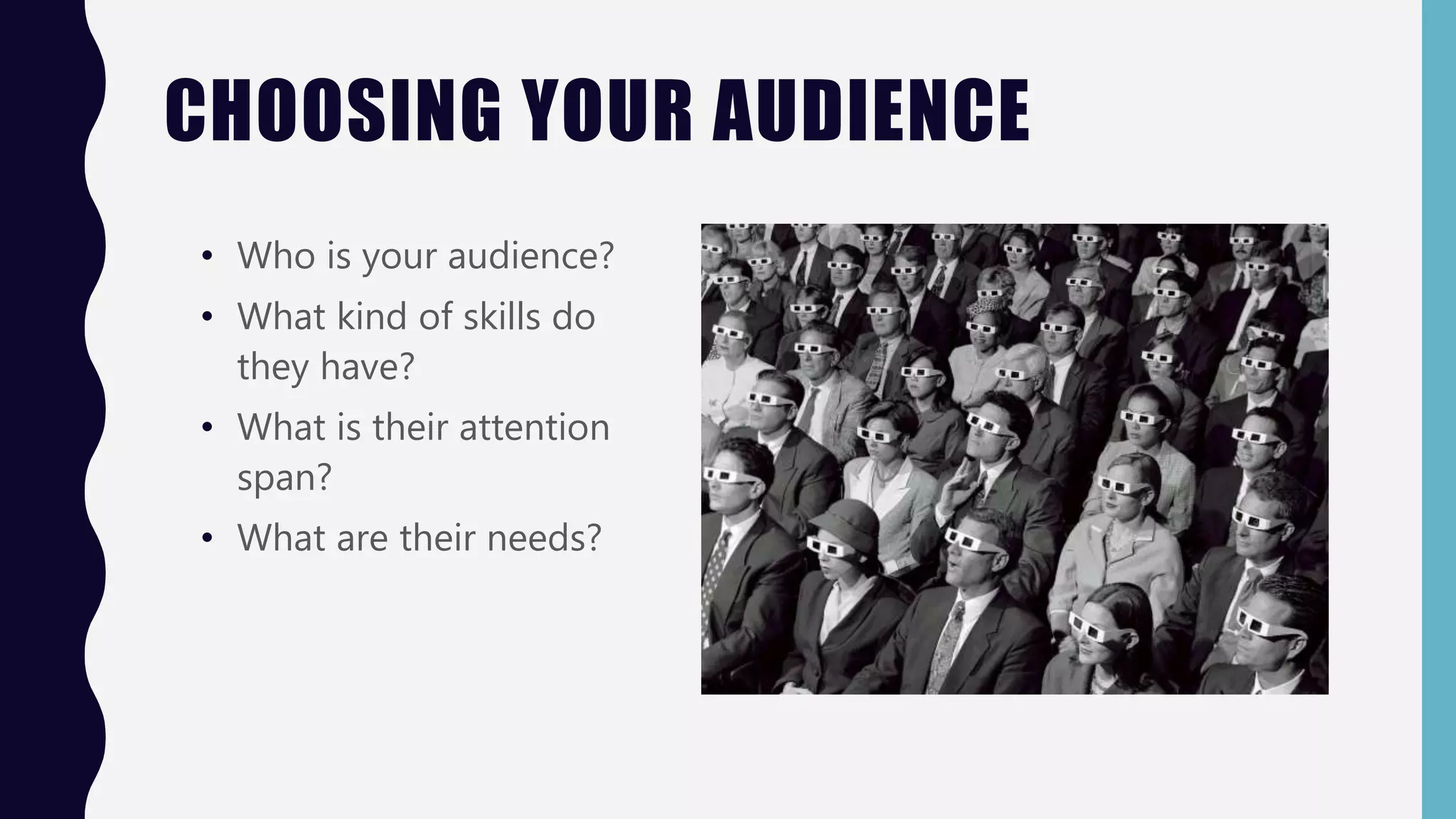
CHOOSING YOUR AUDIENCE
• Who is your audience?
• What kind of skills do
they have?
• What is their attention
span?
• What are their needs?
SETTING LEARNING OBJECTIVES
• What is the overarching goal?
• What do you expect
participants to learn?
Keep it simple and realistic
THE NEW ACRL FRAMEWORK
Six Frames:
• Authority Is Constructed and Contextual
• Information Creation as a Process
• Information Has Value
• Research as Inquiry
• Scholarship as Conversation
• Searching as Strategic Exploration
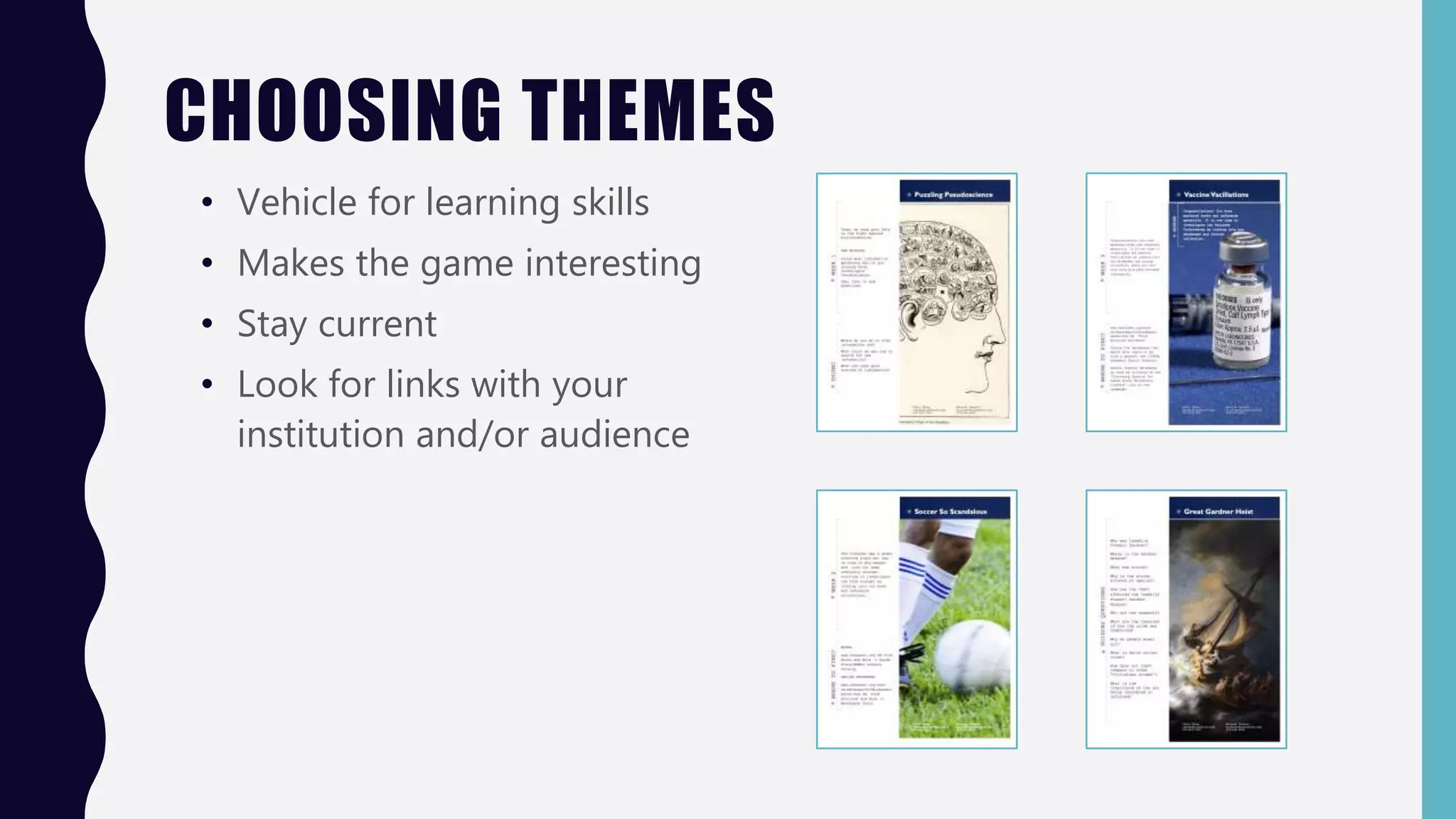
CHOOSING THEMES
• Vehicle for learning skills
• Makes the game interesting
• Stay current
• Look for links with your
institution and/or audience
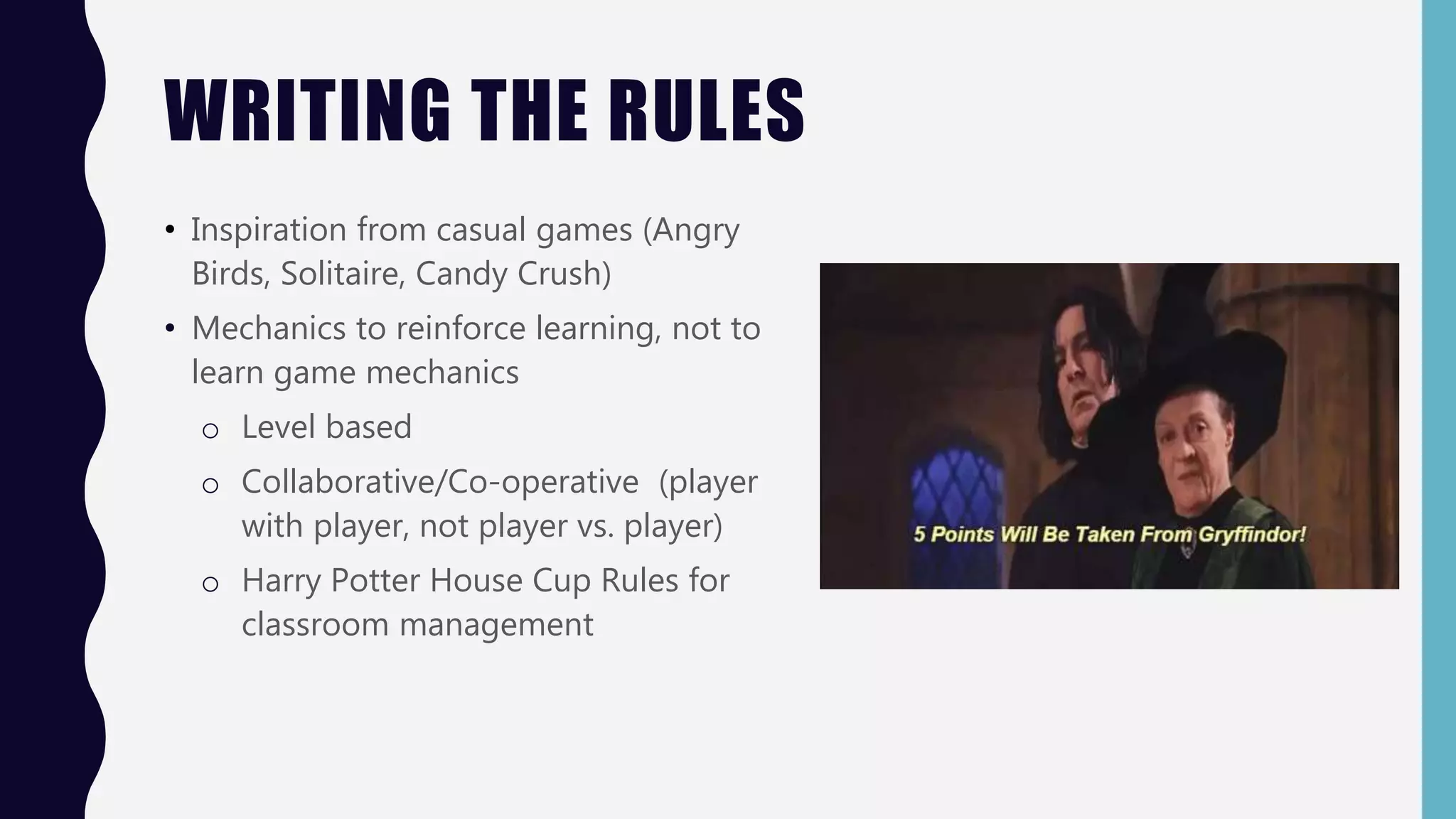
WRITING THE RULES
• Inspiration from casual games (Angry
Birds, Solitaire, Candy Crush)
• Mechanics to reinforce learning, not to
learn game mechanics
o Level based
o Collaborative/Co-operative (player
with player, not player vs. player)
o Harry Potter House Cup Rules for
classroom management
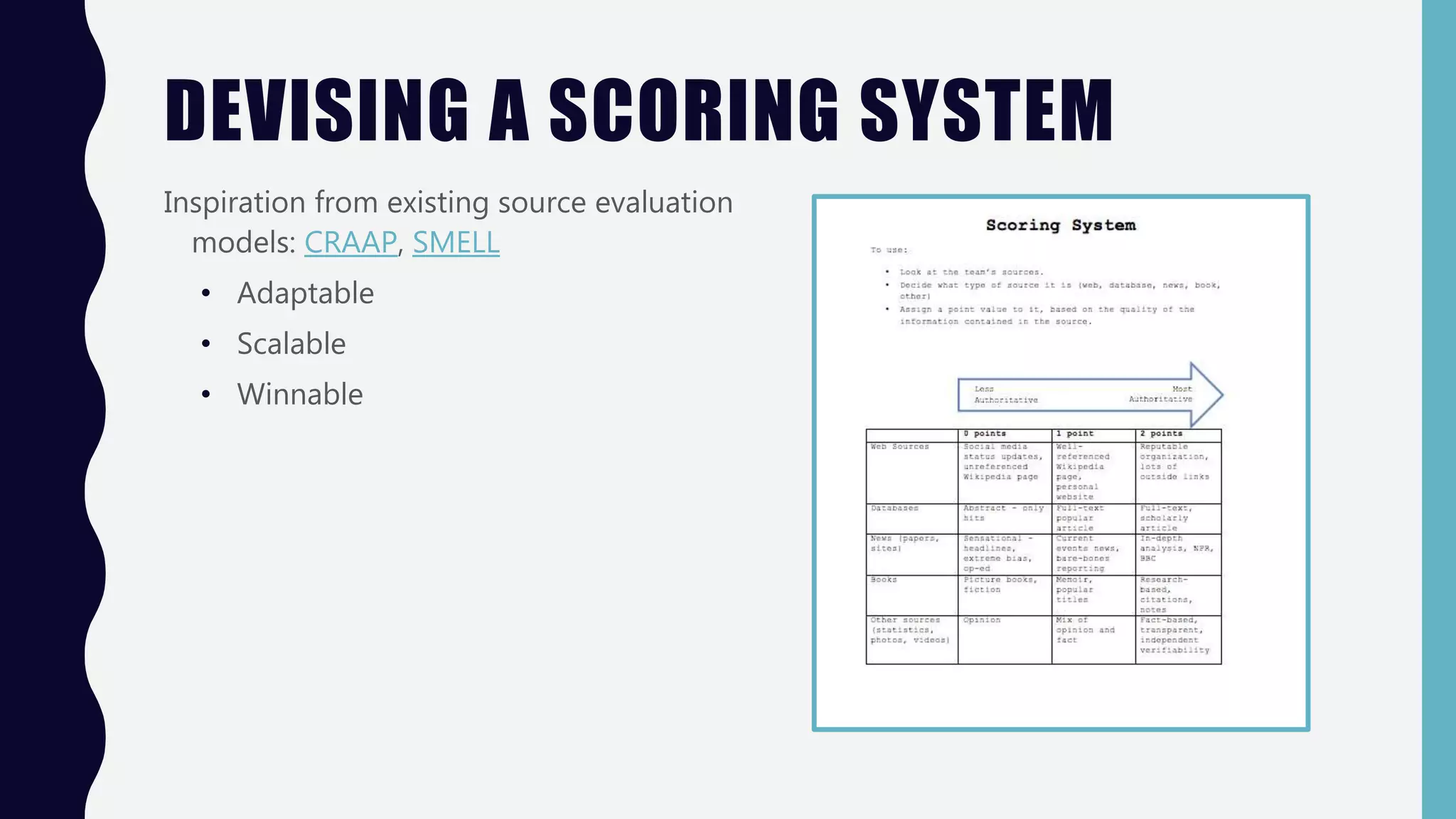
DEVISING A SCORING SYSTEM
Inspiration from existing source evaluation
models: CRAAP, SMELL
• Adaptable
• Scalable
• Winnable
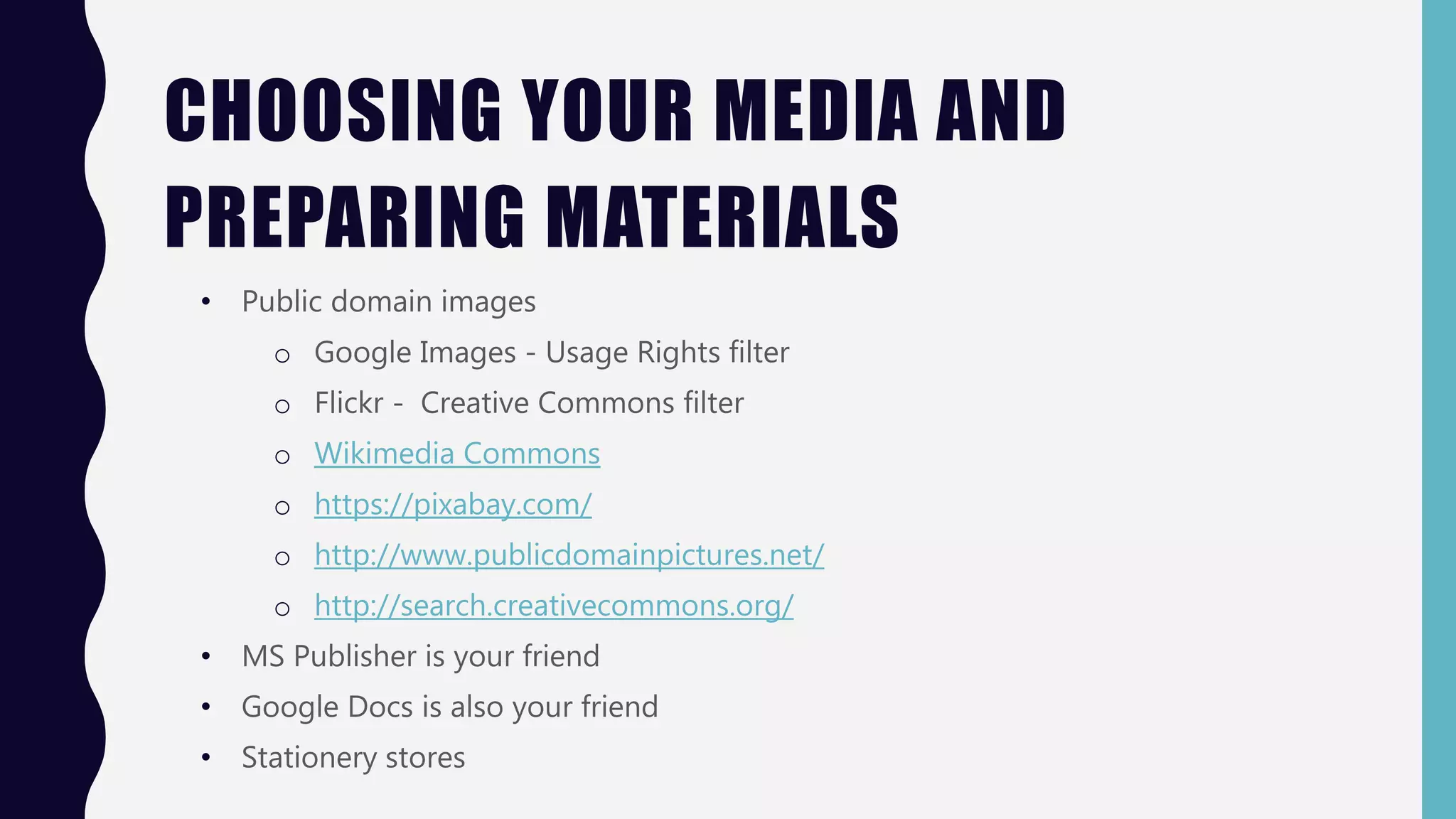
CHOOSING YOUR MEDIA AND
PREPARING MATERIALS
• Public domain images
o Google Images - Usage Rights filter
o Flickr - Creative Commons filter
o Wikimedia Commons
o https://pixabay.com/
o http://www.publicdomainpictures.net/
o http://search.creativecommons.org/
• MS Publisher is your friend
• Google Docs is also your friend
• Stationery stores
...GO!
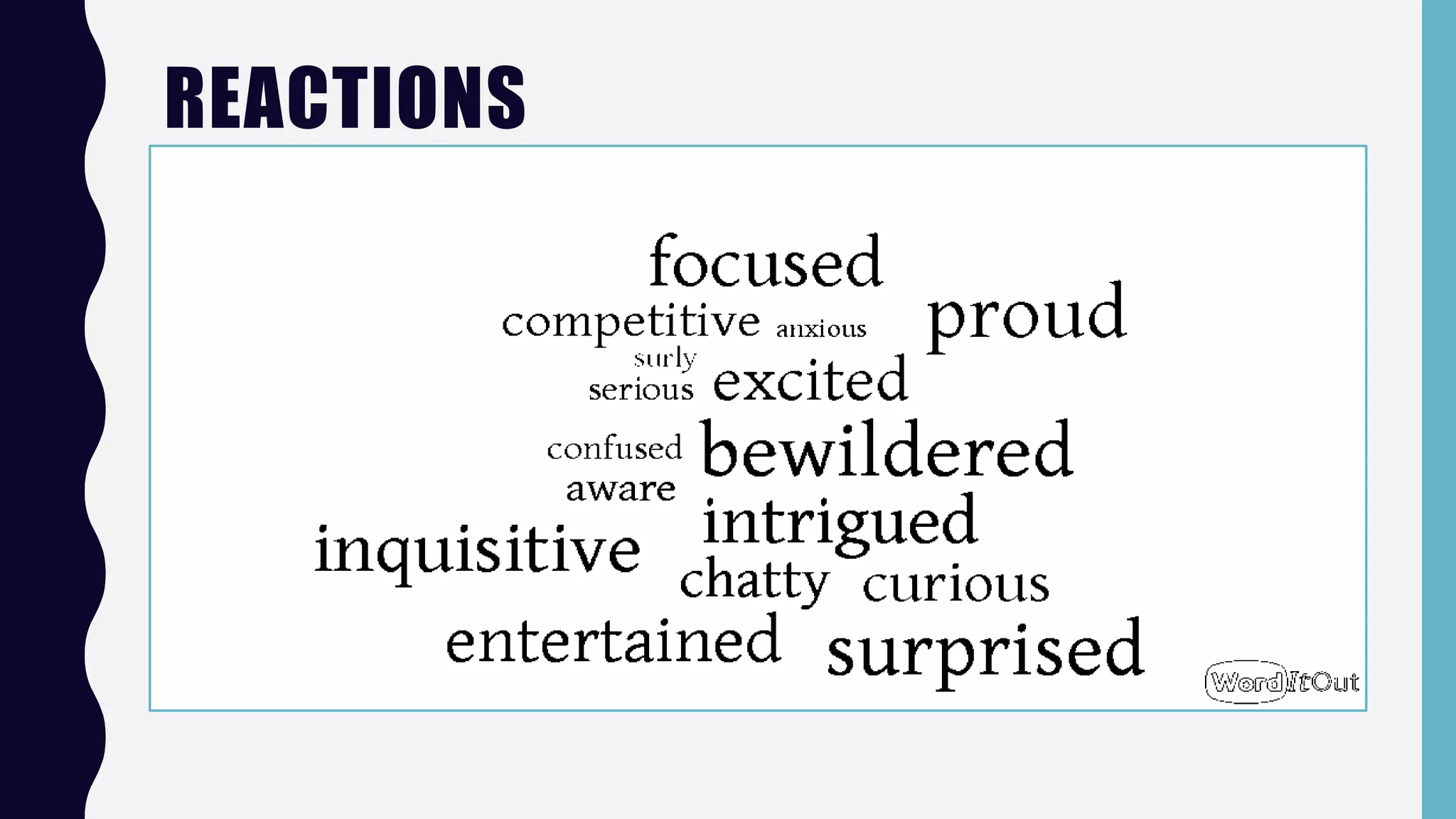
REACTIONS
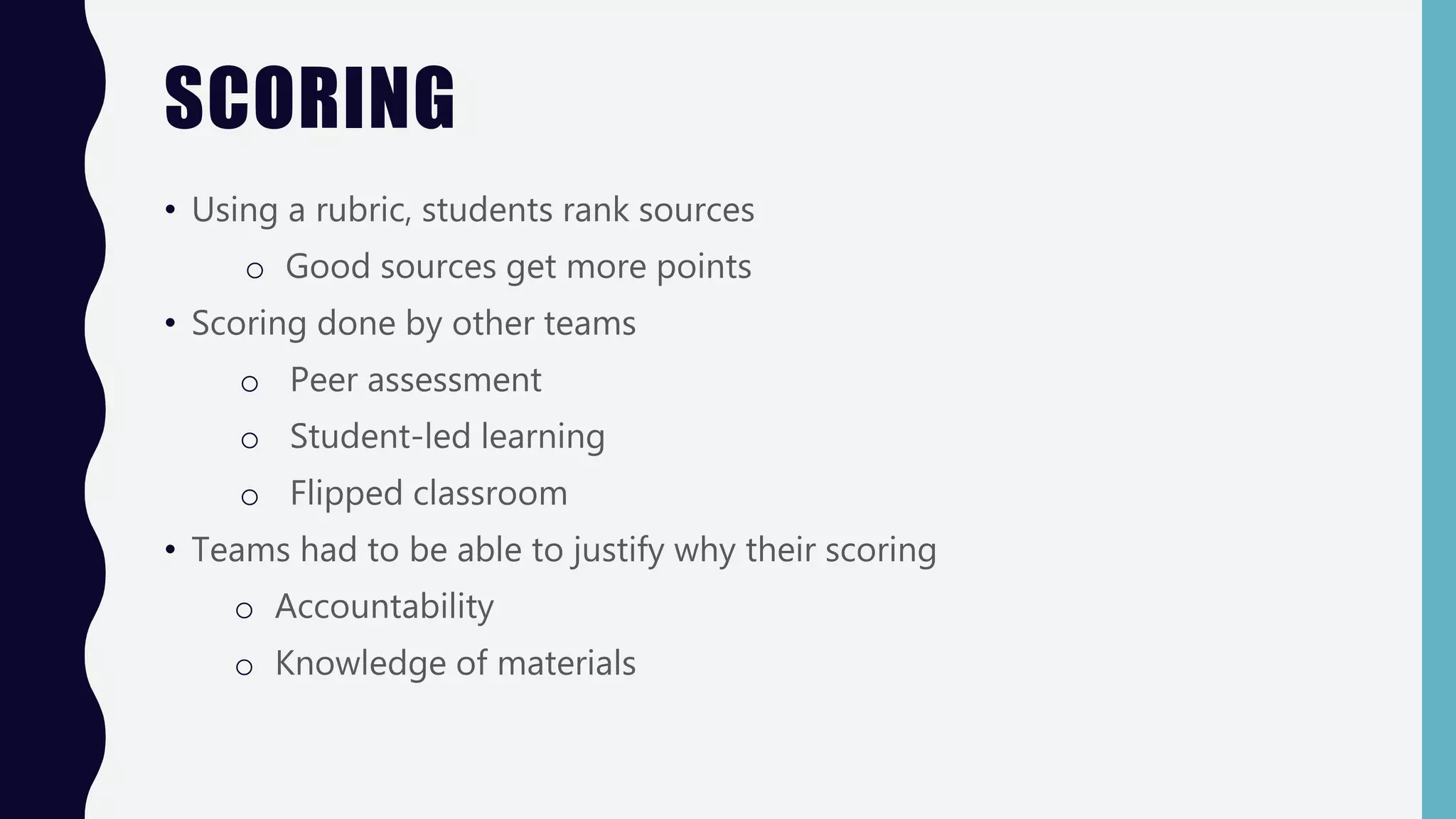
SCORING
• Using a rubric, students rank sources
o Good sources get more points
• Scoring done by other teams
o Peer assessment
o Student-led learning
o Flipped classroom
• Teams had to be able to justify why their scoring
o Accountability
o Knowledge of materials
PRIZES
• DO NOT make it all about the
prizes
• They do not need to be
expensive
• The next level is the reward
SUCCESSES
• Game was implemented by three other
librarians
• Game can be easily used in subsequent
years (just change the themes)
• High levels of student engagement
• Ownership over learning
• Serendipitous learning led to valuable
lessons
• Covered the entire curriculum
• Immediate assessment
Oh, I get why
we are doing
this!
I can't use my
cellphone, I'm in
the library class!
LESSONS LEARNED
• Playtest. Playtest. Playtest.
• Describe the mystery scenarios more fully
• More focused themes
• Monitor time carefully
• Coordinate rules and prizes with other
librarians
BONUS ROUND
CREATE YOUR OWN GAME
Planning
• Who are your players?
• What do you want to accomplish?
– What is Winning?
– What are they Learning?
• How much time do you have?
– One-shot class vs. semester?
Constraints:
• No Trivia Games
• Playable with pencil & paper (and library computer)
QUESTIONS?
COMMENTS?
CONCERNS?
COLLABORATIVE GAMES
• Pandemic
https://boardgamegeek.com/boardgame/30549/pandemic
• Escape the Room Games
https://en.wikipedia.org/wiki/Real-life_room_escape
CASUAL GAMES
• Solitaire/Patience
https://en.wikipedia.org/wiki/Patience_(game)
• Candy Crush Saga
http://candycrushsaga.com/
CLASSIC LIBRARY GAMES
• Scavenger hunts – e.g. Library Amazing Race
http://www.geneseo.edu/~costello/website/Amazing%20Race_lesson.pdf
• MLA Jeopardy
http://web.arc.losrios.edu/~library/mla_jeopardy.ppt
• The Library Game (gamification of library usage and services)
http://librarygame.co.uk/
GAMIFICATION IN LIBRARIES
• Designing Gamification in the Right Way. (2015). Library Technology
Reports, 51(2), 29-35.
• Gamification in Education and Libraries. (2015). Library Technology Reports,
51(2), 20-28.
• Walsh, A.(2014). The potential for using gamification in academic libraries
in order to increase student engagement and achievement. Nordic Journal
of Information Literacy in Higher Education 6(1): 39-51.
GAMES IN EDUCATION
• Faiella, F., & Ricciardi, M. (2015). Gamification and learning A review of
issues and research. Journal Of E-Learning & Knowledge Society, 11(3), 13-
21.
• Holmes, J. B., & Gee, E. R. (2016). A framework for understanding game-
based teaching and learning. On The Horizon, 24(1), 1-16.
doi:10.1108/OTH-11-2015-0069
THANK YOU!
C A T H E R I N E F A H E Y
C F A H E Y @ S A L E M S T A T E . E D U
M A R C E L A Y . I S U S T E R
M A R C E L A . I S U S T E R @ M C G I L L . C A

Playing for keeps: Game design and implementation for long-term learning - Catherine Fahey & Marcela I Isuster

  • 1.
    PLAYING FOR KEEPSG AM E D E S I G N A N D I M P L E M E N T A T I O N F O R L O N G - T E R M L E A R N I N G C A T H E R I N E F A H E Y , M L I S S A L E M S T A T E U N I V E R S I T Y M A R C E L A Y . I S U S T E R , M L I S M C G I L L U N I V E R S I T Y
  • 2.
  • 3.
    GAMES AND INFORMATIONLITERACY Learning through games VS Games that teach mechanics or test knowledge (scavenger hunts, library Jeopardy)
  • 4.
    THE GREAT INFORMATIONLITERACY GAME AT SSU • Designed for Summer Bridge Academy 2015 ○ Program for Students on Conditional Acceptance (6 weeks) ○ Information Literacy Course (1.15 hs a week x 5 weeks) taught by librarians. • No class prep between classes • Teams investigate a topic or “mystery” in depth, gaining access to research tools as they advance levels.
  • 5.
    CHOOSING YOUR AUDIENCE •Who is your audience? • What kind of skills do they have? • What is their attention span? • What are their needs?
  • 6.
    SETTING LEARNING OBJECTIVES •What is the overarching goal? • What do you expect participants to learn? Keep it simple and realistic
  • 7.
    THE NEW ACRLFRAMEWORK Six Frames: • Authority Is Constructed and Contextual • Information Creation as a Process • Information Has Value • Research as Inquiry • Scholarship as Conversation • Searching as Strategic Exploration
  • 8.
    CHOOSING THEMES • Vehiclefor learning skills • Makes the game interesting • Stay current • Look for links with your institution and/or audience
  • 9.
    WRITING THE RULES •Inspiration from casual games (Angry Birds, Solitaire, Candy Crush) • Mechanics to reinforce learning, not to learn game mechanics o Level based o Collaborative/Co-operative (player with player, not player vs. player) o Harry Potter House Cup Rules for classroom management
  • 10.
    DEVISING A SCORINGSYSTEM Inspiration from existing source evaluation models: CRAAP, SMELL • Adaptable • Scalable • Winnable
  • 11.
    CHOOSING YOUR MEDIAAND PREPARING MATERIALS • Public domain images o Google Images - Usage Rights filter o Flickr - Creative Commons filter o Wikimedia Commons o https://pixabay.com/ o http://www.publicdomainpictures.net/ o http://search.creativecommons.org/ • MS Publisher is your friend • Google Docs is also your friend • Stationery stores
  • 12.
  • 13.
  • 14.
    SCORING • Using arubric, students rank sources o Good sources get more points • Scoring done by other teams o Peer assessment o Student-led learning o Flipped classroom • Teams had to be able to justify why their scoring o Accountability o Knowledge of materials
  • 15.
    PRIZES • DO NOTmake it all about the prizes • They do not need to be expensive • The next level is the reward
  • 16.
    SUCCESSES • Game wasimplemented by three other librarians • Game can be easily used in subsequent years (just change the themes) • High levels of student engagement • Ownership over learning • Serendipitous learning led to valuable lessons • Covered the entire curriculum • Immediate assessment Oh, I get why we are doing this! I can't use my cellphone, I'm in the library class!
  • 17.
    LESSONS LEARNED • Playtest.Playtest. Playtest. • Describe the mystery scenarios more fully • More focused themes • Monitor time carefully • Coordinate rules and prizes with other librarians
  • 18.
  • 19.
    CREATE YOUR OWNGAME Planning • Who are your players? • What do you want to accomplish? – What is Winning? – What are they Learning? • How much time do you have? – One-shot class vs. semester? Constraints: • No Trivia Games • Playable with pencil & paper (and library computer)
  • 20.
  • 21.
    COLLABORATIVE GAMES • Pandemic https://boardgamegeek.com/boardgame/30549/pandemic •Escape the Room Games https://en.wikipedia.org/wiki/Real-life_room_escape
  • 22.
  • 23.
    CLASSIC LIBRARY GAMES •Scavenger hunts – e.g. Library Amazing Race http://www.geneseo.edu/~costello/website/Amazing%20Race_lesson.pdf • MLA Jeopardy http://web.arc.losrios.edu/~library/mla_jeopardy.ppt • The Library Game (gamification of library usage and services) http://librarygame.co.uk/
  • 24.
    GAMIFICATION IN LIBRARIES •Designing Gamification in the Right Way. (2015). Library Technology Reports, 51(2), 29-35. • Gamification in Education and Libraries. (2015). Library Technology Reports, 51(2), 20-28. • Walsh, A.(2014). The potential for using gamification in academic libraries in order to increase student engagement and achievement. Nordic Journal of Information Literacy in Higher Education 6(1): 39-51.
  • 25.
    GAMES IN EDUCATION •Faiella, F., & Ricciardi, M. (2015). Gamification and learning A review of issues and research. Journal Of E-Learning & Knowledge Society, 11(3), 13- 21. • Holmes, J. B., & Gee, E. R. (2016). A framework for understanding game- based teaching and learning. On The Horizon, 24(1), 1-16. doi:10.1108/OTH-11-2015-0069
  • 26.
    THANK YOU! C AT H E R I N E F A H E Y C F A H E Y @ S A L E M S T A T E . E D U M A R C E L A Y . I S U S T E R M A R C E L A . I S U S T E R @ M C G I L L . C A