Digital Humanities
Interview Presentation: Learning Technologies
and Resources Manager
Fred Riley
fred.riley@gmail.com
www.fredriley.org.uk
18th
May 2015
Vision thing
“Outline your vision for ‘Digital Humanities’ and
how the Learning and Teaching Support Unit can
contribute to its development and
implementation.”
What is DH?
● “By digital humanities, we mean research that uses
information technology as a central part of its methodology,
for creating and/or processing data.” - Oxford Univ DH Centre
● "For me [Digital Humanities] has to do with the work that gets
done at the crossroads of digital media and traditional
humanistic study. And that happens in two different ways. On
the one hand, it’s bringing the tools and techniques of digital
media to bear on traditional humanistic questions. But it’s also
bringing humanistic modes of inquiry to bear on digital
media." - Kathleen Fitzpatrick, quoted in
Wikipedia: Digital Humanities
What is DH? (2)
● Back to the future (Humbul)
● Extending Humanities research with processing power, but also...
● creating new fields of study
– a “paradigm shift” (Kuhn) in Humanities research?
● Cross-disciplinary!
● Quantitative and qualitative enhancement of Humanities research
● Not just text but multimedia, virtual worlds, “digital paleography”.
● Computing integral to Humanities research?
DH example: Virtual worlds
● Plato's cave
● Pudding Lane
– Cited in JDH Spring 2014, “Exploring and Designing
Virtual Worlds”
● Virtual recreations of historical sites
– VR exploration enhancing textual research
– new perspectives (literally)
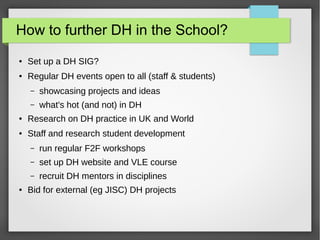
How to further DH in the School?
● Promote DH directly to staff and students
● Set up a DH SIG
● Regular DH events open to all (staff & students)
– showcasing projects and ideas
– what's hot (and not) in DH
● Research on DH practice in UK and World
● Staff and research student development
– run regular F2F workshops
– set up DH website and VLE course
– recruit DH mentors in disciplines
● Bid for external (eg JISC) DH projects
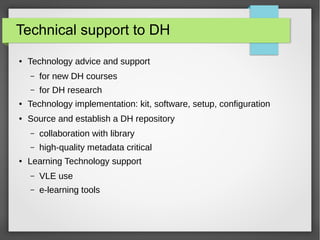
Technical support to DH
● Technology advice and support
– for new DH courses
– for DH research
● Technology implementation: kit, software, setup, configuration
● Source and establish a DH repository
– collaboration with library
– high-quality metadata critical
● Learning Technology support
– VLE use
– e-learning tools
References
● Wikipedia: Digital Humanities
● Digital Humanities Quarterly
● Journal of Digital Humanities
● Wikipedia: Alliance of Digital Humanities
– ADHO online
● What are the digital humanities? Oxford Univ DH centre
● Humbul
Links
● centerNet: International network of DH centres
● digital.humanities@oxford
● King's College DH Centre
● Nottingham University DH Centre
FINE
The End
(also available on Slideshare)

Learning tech mgr_presentation

  • 1.
    Digital Humanities Interview Presentation:Learning Technologies and Resources Manager Fred Riley fred.riley@gmail.com www.fredriley.org.uk 18th May 2015
  • 2.
    Vision thing “Outline yourvision for ‘Digital Humanities’ and how the Learning and Teaching Support Unit can contribute to its development and implementation.”
  • 3.
    What is DH? ●“By digital humanities, we mean research that uses information technology as a central part of its methodology, for creating and/or processing data.” - Oxford Univ DH Centre ● "For me [Digital Humanities] has to do with the work that gets done at the crossroads of digital media and traditional humanistic study. And that happens in two different ways. On the one hand, it’s bringing the tools and techniques of digital media to bear on traditional humanistic questions. But it’s also bringing humanistic modes of inquiry to bear on digital media." - Kathleen Fitzpatrick, quoted in Wikipedia: Digital Humanities
  • 4.
    What is DH?(2) ● Back to the future (Humbul) ● Extending Humanities research with processing power, but also... ● creating new fields of study – a “paradigm shift” (Kuhn) in Humanities research? ● Cross-disciplinary! ● Quantitative and qualitative enhancement of Humanities research ● Not just text but multimedia, virtual worlds, “digital paleography”. ● Computing integral to Humanities research?
  • 5.
    DH example: Virtualworlds ● Plato's cave ● Pudding Lane – Cited in JDH Spring 2014, “Exploring and Designing Virtual Worlds” ● Virtual recreations of historical sites – VR exploration enhancing textual research – new perspectives (literally)
  • 6.
    How to furtherDH in the School? ● Promote DH directly to staff and students ● Set up a DH SIG ● Regular DH events open to all (staff & students) – showcasing projects and ideas – what's hot (and not) in DH ● Research on DH practice in UK and World ● Staff and research student development – run regular F2F workshops – set up DH website and VLE course – recruit DH mentors in disciplines ● Bid for external (eg JISC) DH projects
  • 7.
    Technical support toDH ● Technology advice and support – for new DH courses – for DH research ● Technology implementation: kit, software, setup, configuration ● Source and establish a DH repository – collaboration with library – high-quality metadata critical ● Learning Technology support – VLE use – e-learning tools
  • 8.
    References ● Wikipedia: DigitalHumanities ● Digital Humanities Quarterly ● Journal of Digital Humanities ● Wikipedia: Alliance of Digital Humanities – ADHO online ● What are the digital humanities? Oxford Univ DH centre ● Humbul
  • 9.
    Links ● centerNet: Internationalnetwork of DH centres ● digital.humanities@oxford ● King's College DH Centre ● Nottingham University DH Centre
  • 10.