Understand the development and
principles and editing
Auguste and Louis Lumière came from Lyon in France, where they worked in their father's photographic factory. In
1894, they saw Edison's kinetoscope in Paris, and decided to design a camera of their own. By February of the next
year they had produced a working model of their ciné camera, which they called a cinématographe. The machine was
in fact not only a camera but could be used, together with a magic lantern, to project the films which the brothers
had taken.


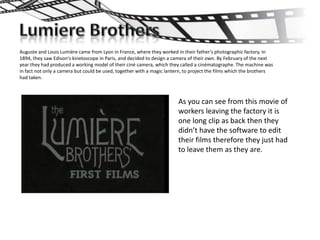
                                                                        As you can see from this movie of
                                                                        workers leaving the factory it is
                                                                        one long clip as back then they
                                                                        didn’t have the software to edit
                                                                        their films therefore they just had
                                                                        to leave them as they are.
D. W. Griffith was a premier pioneering American film director. He is best known as the director of the Ku Klux Klan
epic 1915 film The Birth of a Nation and the subsequent film Intolerance.


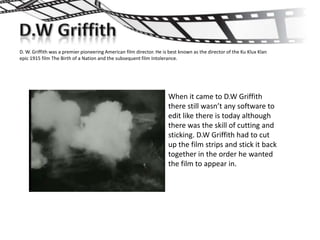
                                                                     When it came to D.W Griffith
                                                                     there still wasn’t any software to
                                                                     edit like there is today although
                                                                     there was the skill of cutting and
                                                                     sticking. D.W Griffith had to cut
                                                                     up the film strips and stick it back
                                                                     together in the order he wanted
                                                                     the film to appear in.
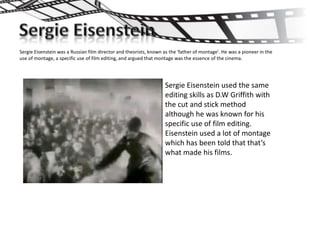
Sergie Eisenstein was a Russian film director and theorists, known as the 'father of montage'. He was a pioneer in the
use of montage, a specific use of film editing, and argued that montage was the essence of the cinema.


                                                                   Sergie Eisenstein used the same
                                                                   editing skills as D.W Griffith with
                                                                   the cut and stick method
                                                                   although he was known for his
                                                                   specific use of film editing.
                                                                   Eisenstein used a lot of montage
                                                                   which has been told that that’s
                                                                   what made his films.
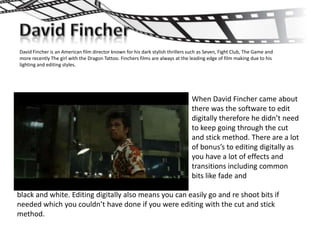
David Fincher is an American film director known for his dark stylish thrillers such as Seven, Fight Club, The Game and
more recently The girl with the Dragon Tattoo. Finchers films are always at the leading edge of film making due to his
lighting and editing styles.


                                                                                When David Fincher came about
                                                                                there was the software to edit
                                                                                digitally therefore he didn’t need
                                                                                to keep going through the cut
                                                                                and stick method. There are a lot
                                                                                of bonus’s to editing digitally as
                                                                                you have a lot of effects and
                                                                                transitions including common
                                                                                bits like fade and

black and white. Editing digitally also means you can easily go and re shoot bits if
needed which you couldn’t have done if you were editing with the cut and stick
method.
Joining images is an editing form that creates a meaning.
Alfred Hitchcock has some great example of this. Take Psycho for
example at about 43 seconds in the clip below you see how
joining images can create tension in the scene.
http://www.youtube.com/watch?v=5bieIiX5KLQ
When controlling tempo editors will usually control the length of shot as
long shots will slow down the pace of a scene and short takes quicken the
pace. Romance use long scenes a lot whereas action uses quick scenes as
everything move much faster. The average shot length used to be between
5.15 or 5.20 where as studies have suggested that shots have gained pace
and the average shot length is now somewhere between 4.75 and 7.80
seconds.
http://www.youtube.com/watch?v=7vThuwa5RZU - Casablanca
http://www.youtube.com/watch?v=BGCMfprPJoA – Sherlock Holmes
These clip from casablanca and Sherlock Holmes are good examples of how
the length of can slow down or speed up the pace of scenes
Another way editors change the tempo is by using shot transitions.
The most common of these transitions are
 – Cut from a to b which is just a simple movement using no dazzle effect this is shown in the clip
     from eastenders http://www.youtube.com/watch?v=ttsYAZ05JlY. Cut from a to b will quicken
     a scene so is often used in action.
 – Fade in/fade out which is when the screen dips to either black or white before returning to
     the next cut.
 – Dissolve which is done by overlapping the shots. The main reason someone would use a
     dissolve transition would be to show a connection between two places. You could also use it
     in a flash back or dream sequence.
A scene with long takes can often also suggest a sudden change in mood so it doesn’t always have
to be short takes.
Fades change the pace in films as they slow down the scene so
aren’t really used in scenes that action occur. Fades aren’t very
common in films for this reason but some films will use them to
introduce a scene such as a memory, fantasy or dream.
Timing of shot can be cut away to emphasis a reaction or response to
something for example it could start of with a two shot then cut to close up for
a facial expression of a character, another example would be cutting from a
close up to a long shot. This is used in the same example as I gave for joining of
images http://www.youtube.com/watch?v=5bieIiX5KLQ.
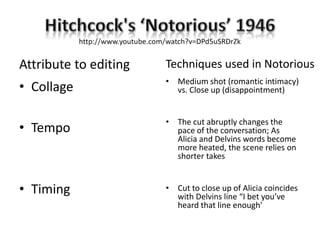
Attribute to editing   Techniques used in Notorious
                       • Medium shot (romantic intimacy)
• Collage                vs. Close up (disappointment)


                       • The cut abruptly changes the
• Tempo                  pace of the conversation; As
                         Alicia and Delvins words become
                         more heated, the scene relies on
                         shorter takes


• Timing               • Cut to close up of Alicia coincides
                         with Delvins line “I bet you’ve
                         heard that line enough’
Narrative describes a sequence of events there for narrative sequencing is
use a lot in film and TV. Some films jumble up the narrative which is called
‘Madias res’ this term is used in the film Fight club for example.
Linear editing is also used a lot in films as it tells the story as it happens, this
is the most common in Hollywood films, although most films now use it.
Linear editing is basically a sequence going from beginning to end.
Condensing time - Collages use condensed time as the director doesn’t want
to drag it to the actual time represented. The scene in Spiderman where he is
thinking of a costume uses condensed editing as it speeds up hours, days or
years in the characters live.
Expanding time – Sometimes an editor or director will want to drag out the
scene beyond the actual time represented, for an example there may be a
group of people sat around when a bomb goes off but before the bomb goes
off there will be lots of other shots going on for example some of the bomb
ticking and some of the people but in actual time the bomb would go off and
everyone would die and that would be it.
Media Res – As I mentioned while talking about Editing and Timing media res is when
the story or narrative is all jumbled up.
Flashbacks – Flash backs are basically images from the past for example someone
could be doing something in the present when suddenly its interrupted by images that
have taken place in the past.
Flash-forwards – It’s uncommon for flash forwards to occur in films as they can be
really confusing and are only really understood when the event has happened in the
actual time. A good example of this is easy rider (Captain America is interrupted as he
talks by a shot of burning debris on the side of the road. Only later will viewers realise
that the debris is from CA motorcycle crash at the end of the film)
Time and Space
Editing draws the viewers attention to the detail need to make the scene for example in the
close up used in this clip of the very first close up the close up makes the scene more
understandable as it may be confusing without it -
http://www.youtube.com/watch?v=Q2X_BZpnWFc.

Another example of how the editing draws the viewers attention to the detail is ‘Return of the
king’. The editing follows the lightening of the Pyres across a mountain range in a majestic call
of arms. This makes the viewer notice a number of things:
 – Characters gaze
 – Group dynamics of a scene
 – The mood of a conversation
Shot reverse shot
A shot reverse shot is used a lot in film as it can show a conversation between
two people or even one person speaks while the other just sits and listens.
Most shot reverse shots use an over the shoulder shot to see the speaker so it
doesn’t look like the actors speaking to the camera. A good example of shot
reverse shot is the scene in love actually with the “carol singers”.
http://www.youtube.com/watch?v=FFnSgPC-VXA
Eye line shot is a shot that looks like its out of the viewer vision. This draws
 the viewers into the characters thought process and emotional state. For
 example if someone had taken something that may effect their head an
 eye line shot may show this by going out of focus or shakey.
Cutaways are different in the way that cutaways aren’t character
 centered, the on screen appearance of an object does not depend on the
 character seeing it in the previous shot.
Continuity is the process of cutting to keep the flow of the shot together as
fluidly as possible not showing the whole footage. This would include things
such as:
• Wardrobe
• Lighting
• Audio
• Movement
• Props
• And other elements.
The 180 degree rule says the cameras should remain on the same side of an
imaginary line. The rule enforces continuity of the film. For example if your
filming someone running from the right side of the frame to the left side the
next shot has to be from the same side so the runner is again running from
the right to left.
Learning outcome 1 - Understand the development and principles and editing

Learning outcome 1 - Understand the development and principles and editing

  • 1.
    Understand the developmentand principles and editing
  • 3.
    Auguste and LouisLumière came from Lyon in France, where they worked in their father's photographic factory. In 1894, they saw Edison's kinetoscope in Paris, and decided to design a camera of their own. By February of the next year they had produced a working model of their ciné camera, which they called a cinématographe. The machine was in fact not only a camera but could be used, together with a magic lantern, to project the films which the brothers had taken. As you can see from this movie of workers leaving the factory it is one long clip as back then they didn’t have the software to edit their films therefore they just had to leave them as they are.
  • 4.
    D. W. Griffithwas a premier pioneering American film director. He is best known as the director of the Ku Klux Klan epic 1915 film The Birth of a Nation and the subsequent film Intolerance. When it came to D.W Griffith there still wasn’t any software to edit like there is today although there was the skill of cutting and sticking. D.W Griffith had to cut up the film strips and stick it back together in the order he wanted the film to appear in.
  • 5.
    Sergie Eisenstein wasa Russian film director and theorists, known as the 'father of montage'. He was a pioneer in the use of montage, a specific use of film editing, and argued that montage was the essence of the cinema. Sergie Eisenstein used the same editing skills as D.W Griffith with the cut and stick method although he was known for his specific use of film editing. Eisenstein used a lot of montage which has been told that that’s what made his films.
  • 6.
    David Fincher isan American film director known for his dark stylish thrillers such as Seven, Fight Club, The Game and more recently The girl with the Dragon Tattoo. Finchers films are always at the leading edge of film making due to his lighting and editing styles. When David Fincher came about there was the software to edit digitally therefore he didn’t need to keep going through the cut and stick method. There are a lot of bonus’s to editing digitally as you have a lot of effects and transitions including common bits like fade and black and white. Editing digitally also means you can easily go and re shoot bits if needed which you couldn’t have done if you were editing with the cut and stick method.
  • 9.
    Joining images isan editing form that creates a meaning. Alfred Hitchcock has some great example of this. Take Psycho for example at about 43 seconds in the clip below you see how joining images can create tension in the scene. http://www.youtube.com/watch?v=5bieIiX5KLQ
  • 10.
    When controlling tempoeditors will usually control the length of shot as long shots will slow down the pace of a scene and short takes quicken the pace. Romance use long scenes a lot whereas action uses quick scenes as everything move much faster. The average shot length used to be between 5.15 or 5.20 where as studies have suggested that shots have gained pace and the average shot length is now somewhere between 4.75 and 7.80 seconds. http://www.youtube.com/watch?v=7vThuwa5RZU - Casablanca http://www.youtube.com/watch?v=BGCMfprPJoA – Sherlock Holmes These clip from casablanca and Sherlock Holmes are good examples of how the length of can slow down or speed up the pace of scenes
  • 11.
    Another way editorschange the tempo is by using shot transitions. The most common of these transitions are – Cut from a to b which is just a simple movement using no dazzle effect this is shown in the clip from eastenders http://www.youtube.com/watch?v=ttsYAZ05JlY. Cut from a to b will quicken a scene so is often used in action. – Fade in/fade out which is when the screen dips to either black or white before returning to the next cut. – Dissolve which is done by overlapping the shots. The main reason someone would use a dissolve transition would be to show a connection between two places. You could also use it in a flash back or dream sequence. A scene with long takes can often also suggest a sudden change in mood so it doesn’t always have to be short takes.
  • 12.
    Fades change thepace in films as they slow down the scene so aren’t really used in scenes that action occur. Fades aren’t very common in films for this reason but some films will use them to introduce a scene such as a memory, fantasy or dream.
  • 13.
    Timing of shotcan be cut away to emphasis a reaction or response to something for example it could start of with a two shot then cut to close up for a facial expression of a character, another example would be cutting from a close up to a long shot. This is used in the same example as I gave for joining of images http://www.youtube.com/watch?v=5bieIiX5KLQ.
  • 14.
    Attribute to editing Techniques used in Notorious • Medium shot (romantic intimacy) • Collage vs. Close up (disappointment) • The cut abruptly changes the • Tempo pace of the conversation; As Alicia and Delvins words become more heated, the scene relies on shorter takes • Timing • Cut to close up of Alicia coincides with Delvins line “I bet you’ve heard that line enough’
  • 16.
    Narrative describes asequence of events there for narrative sequencing is use a lot in film and TV. Some films jumble up the narrative which is called ‘Madias res’ this term is used in the film Fight club for example. Linear editing is also used a lot in films as it tells the story as it happens, this is the most common in Hollywood films, although most films now use it. Linear editing is basically a sequence going from beginning to end.
  • 17.
    Condensing time -Collages use condensed time as the director doesn’t want to drag it to the actual time represented. The scene in Spiderman where he is thinking of a costume uses condensed editing as it speeds up hours, days or years in the characters live. Expanding time – Sometimes an editor or director will want to drag out the scene beyond the actual time represented, for an example there may be a group of people sat around when a bomb goes off but before the bomb goes off there will be lots of other shots going on for example some of the bomb ticking and some of the people but in actual time the bomb would go off and everyone would die and that would be it.
  • 18.
    Media Res –As I mentioned while talking about Editing and Timing media res is when the story or narrative is all jumbled up. Flashbacks – Flash backs are basically images from the past for example someone could be doing something in the present when suddenly its interrupted by images that have taken place in the past. Flash-forwards – It’s uncommon for flash forwards to occur in films as they can be really confusing and are only really understood when the event has happened in the actual time. A good example of this is easy rider (Captain America is interrupted as he talks by a shot of burning debris on the side of the road. Only later will viewers realise that the debris is from CA motorcycle crash at the end of the film)
  • 19.
    Time and Space Editingdraws the viewers attention to the detail need to make the scene for example in the close up used in this clip of the very first close up the close up makes the scene more understandable as it may be confusing without it - http://www.youtube.com/watch?v=Q2X_BZpnWFc. Another example of how the editing draws the viewers attention to the detail is ‘Return of the king’. The editing follows the lightening of the Pyres across a mountain range in a majestic call of arms. This makes the viewer notice a number of things: – Characters gaze – Group dynamics of a scene – The mood of a conversation
  • 20.
    Shot reverse shot Ashot reverse shot is used a lot in film as it can show a conversation between two people or even one person speaks while the other just sits and listens. Most shot reverse shots use an over the shoulder shot to see the speaker so it doesn’t look like the actors speaking to the camera. A good example of shot reverse shot is the scene in love actually with the “carol singers”. http://www.youtube.com/watch?v=FFnSgPC-VXA
  • 21.
    Eye line shotis a shot that looks like its out of the viewer vision. This draws the viewers into the characters thought process and emotional state. For example if someone had taken something that may effect their head an eye line shot may show this by going out of focus or shakey. Cutaways are different in the way that cutaways aren’t character centered, the on screen appearance of an object does not depend on the character seeing it in the previous shot.
  • 23.
    Continuity is theprocess of cutting to keep the flow of the shot together as fluidly as possible not showing the whole footage. This would include things such as: • Wardrobe • Lighting • Audio • Movement • Props • And other elements.
  • 24.
    The 180 degreerule says the cameras should remain on the same side of an imaginary line. The rule enforces continuity of the film. For example if your filming someone running from the right side of the frame to the left side the next shot has to be from the same side so the runner is again running from the right to left.