Developing Self-regulated Learning
By Ronald Speener
Objectives
Goal: To improve learning effectiveness
• Develop self-regulated learning
• Practice the core 4R
• Explain the neuroscience of the brain
• Describe how intelligence affects learning
• Develop tools to improve memory
• Understand learning style
• Explore all factors the improve learning
REV. 6/2018 Academic Readiness- Learning--R Speener 2
Table of Content
Self-Regulated
Learning
The 4 Rs Intelligence
Neuroscience
of Learning
Memory
Learning
Styles
Other Factors Resources
REV. 6/2018 Academic Readiness- Learning--R Speener 3
SELF-REGULATED LEARNING
REV. 6/2018 Academic Readiness- Learning--R Speener 4
Definition—Self-regulated
Learning
• An active, constructive
process whereby learners
set goals for their learning
and then attempt to
monitor, regulate, and
control their cognition,
motivation and behavior,
guided and constrained
by their goals and the
contextual features in the
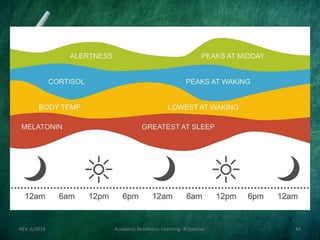
environment.
REV. 6/2018 Academic Readiness- Learning--R Speener 5
• Active
• Goal-oriented
• Regulated and
controlled
• Conducive environment
• Motivation
Cognition
• Cognition is learning
– Skills
– Habits
– Problem solving
– Critical thinking
– Study skills
– How to
• Connecting new
learning to old
• Repetition
• Organization
REV. 6/2018 Academic Readiness- Learning--R Speener 6
Metacognition
• Metacognition is
understanding how one
learns
• Forethought
• Planning
• Self-reflection
REV. 6/2018 Academic Readiness- Learning--R Speener 7
Management
• The learning
environment
– Location
– Tools
• Physical
• Emotional
REV. 6/2018 Academic Readiness- Learning--R Speener 8
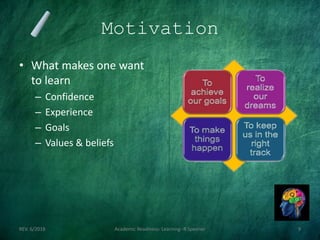
Motivation
• What makes one want
to learn
– Confidence
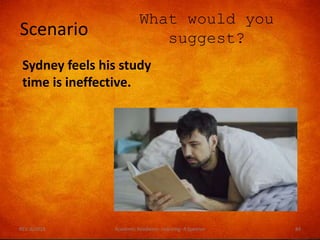
– Experience
– Goals
– Values & beliefs
REV. 6/2018 Academic Readiness- Learning--R Speener 9
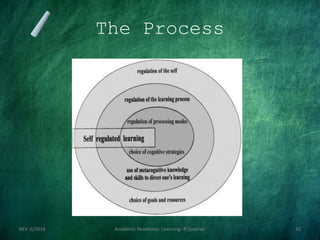
The Process
REV. 6/2018 Academic Readiness- Learning--R Speener 10
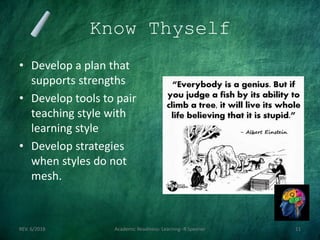
Know Thyself
• Develop a plan that
supports strengths
• Develop tools to pair
teaching style with
learning style
• Develop strategies
when styles do not
mesh.
REV. 6/2018 Academic Readiness- Learning--R Speener 11
THE 4 RS
The Core
REV. 6/2018 Academic Readiness- Learning--R Speener 13
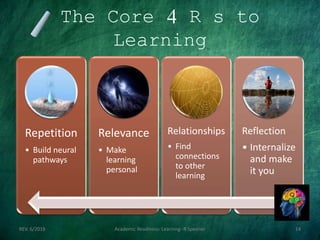
The Core 4 R s to
Learning
Repetition
• Build neural
pathways
Relevance
• Make
learning
personal
Relationships
• Find
connections
to other
learning
Reflection
• Internalize
and make
it you
REV. 6/2018 Academic Readiness- Learning--R Speener 14
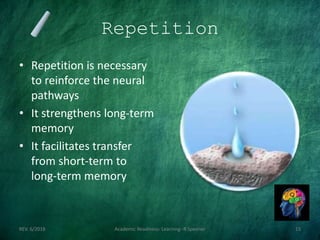
Repetition
• Repetition is necessary
to reinforce the neural
pathways
• It strengthens long-term
memory
• It facilitates transfer
from short-term to
long-term memory
REV. 6/2018 Academic Readiness- Learning--R Speener 15
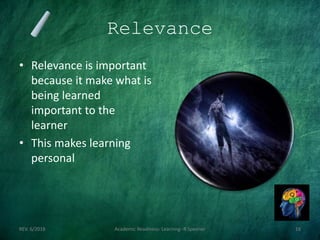
Relevance
• Relevance is important
because it make what is
being learned
important to the
learner
• This makes learning
personal
REV. 6/2018 Academic Readiness- Learning--R Speener 16
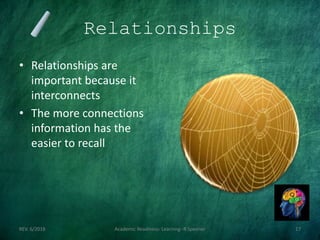
Relationships
• Relationships are
important because it
interconnects
• The more connections
information has the
easier to recall
REV. 6/2018 Academic Readiness- Learning--R Speener 17
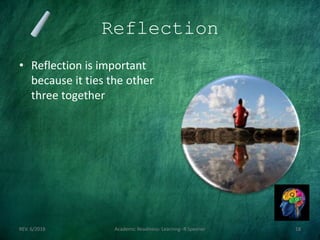
Reflection
• Reflection is important
because it ties the other
three together
REV. 6/2018 Academic Readiness- Learning--R Speener 18
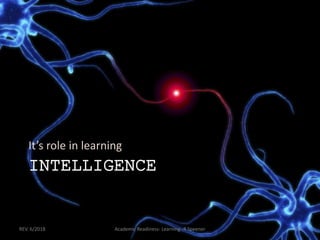
INTELLIGENCE
It’s role in learning
REV. 6/2018 Academic Readiness- Learning--R Speener 20
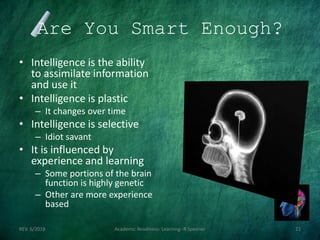
Are You Smart Enough?
• Intelligence is the ability
to assimilate information
and use it
• Intelligence is plastic
– It changes over time
• Intelligence is selective
– Idiot savant
• It is influenced by
experience and learning
– Some portions of the brain
function is highly genetic
– Other are more experience
based
REV. 6/2018 Academic Readiness- Learning--R Speener 21
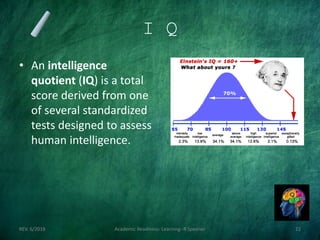
I Q
• An intelligence
quotient (IQ) is a total
score derived from one
of several standardized
tests designed to assess
human intelligence.
REV. 6/2018 Academic Readiness- Learning--R Speener 22
The Problem with I Q
Tests
• Most intelligence test
are culturally and
linguistically biased
• IQ can be increased
with practice
REV. 6/2018 Academic Readiness- Learning--R Speener 27
MULTIPLE INTELLIGENCES
More than one way to be smart
REV. 6/2018 Academic Readiness- Learning--R Speener 28
Multiple Intelligences
Defined
The theory of multiple intelligences challenges
the idea of a single IQ, where human beings
have one central "computer" where intelligence is
housed. Howard Gardner, the Harvard professor
who originally proposed the theory, says that
there are multiple types of human intelligence,
each representing different ways of processing
information:
• (from Multiple Intelligences: What Does the
Research Say?, 2016,
https://www.edutopia.org/multiple-intelligences-
research)
REV. 6/2018 Academic Readiness- Learning--R Speener 29
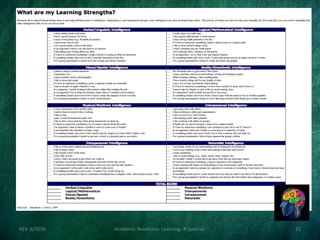
Multiple Intelligences
• related to language and to the written and spoken--
ObamaLinguistic/verbal
• related to reasoning, numbers, abstractions, and
patterns—Stephen HawkingLogical/mathematical
• Related to anything visual and the creation of mental
images—Steven SpielbergSpatial/visual
• Related to physical movement and actions located in the
brain’s motor cortex—Michael JordonBodily/kinesthetic
• Related to sounds and auditory patterns, to rhythm, beat
and tempo--UsherMusical
• Related to relationships with others and various means
of communication—Bill ClintonInterpersonal
• Related to self-reflection and self-awareness
(mindfulness)—Meryl StreepIntrapersonal
• Related to observation and awareness of the natural
world and the patterns found there—David AttenboroughNaturalistic
• Related to asking and examining questions about the
“big questions” (Spiritual)—Dali LamaExistential
REV. 6/2018 Academic Readiness- Learning--R Speener 30
REV. 6/2018 Academic Readiness- Learning--R Speener 31
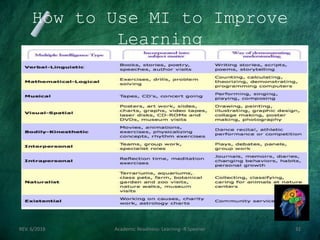
How to Use MI to Improve
Learning
REV. 6/2018 Academic Readiness- Learning--R Speener 32
T
F
Question Intelligence
One’s IQ never changes.
REV. 6/2018 Academic Readiness- Learning--R Speener 33
T
F
Question
Multiple
Intelligence
According to the theory of multiple intelligences, a
person can be very smart in one area and less so in
another area.
REV. 6/2018 Academic Readiness- Learning--R Speener 34
NEUROSCIENCE OF LEARNING
REV. 6/2018 Academic Readiness- Learning--R Speener 35
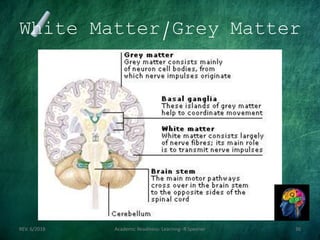
White Matter/Grey Matter
REV. 6/2018 Academic Readiness- Learning--R Speener 36
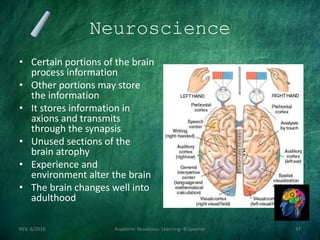
Neuroscience
• Certain portions of the brain
process information
• Other portions may store
the information
• It stores information in
axions and transmits
through the synapsis
• Unused sections of the
brain atrophy
• Experience and
environment alter the brain
• The brain changes well into
adulthood
REV. 6/2018 Academic Readiness- Learning--R Speener 37
Neuroscience (cont.)
• The brain is a social organ
– Stimulation and connection necessary to survive
• We have two brains
– Cerebral hemispheres
– The brain is plastic and can change
• The mind, brain and body are interwoven
• Learning builds neural connections and changes
the brain
• The brain has a short attention span and needs
repetition and multiple-channel processing
REV. 6/2018 Academic Readiness- Learning--R Speener 38
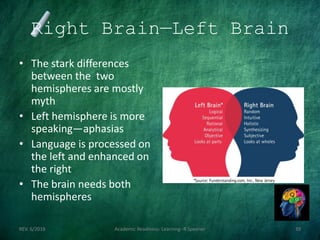
Right Brain—Left Brain
• The stark differences
between the two
hemispheres are mostly
myth
• Left hemisphere is more
speaking—aphasias
• Language is processed on
the left and enhanced on
the right
• The brain needs both
hemispheres
REV. 6/2018 Academic Readiness- Learning--R Speener 39
T
F
Question The Brain
As we age we stop creating new neurons.
REV. 6/2018 Academic Readiness- Learning--R Speener 40
T
F
Question Then Brain
The brain atrophies if it is not used.
REV. 6/2018 Academic Readiness- Learning--R Speener 41
CIRCADIAN RHYTHMS
REV. 6/2018 Academic Readiness- Learning--R Speener 42
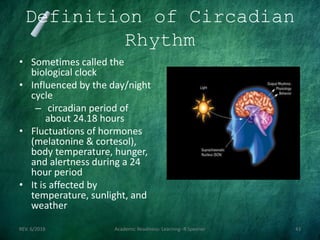
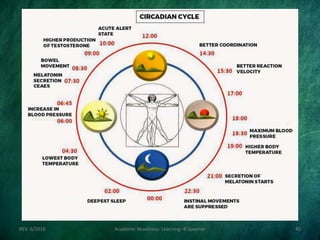
Definition of Circadian
Rhythm
• Sometimes called the
biological clock
• Influenced by the day/night
cycle
– circadian period of
about 24.18 hours
• Fluctuations of hormones
(melatonine & cortesol),
body temperature, hunger,
and alertness during a 24
hour period
• It is affected by
temperature, sunlight, and
weather
REV. 6/2018 Academic Readiness- Learning--R Speener 43
REV. 6/2018 Academic Readiness- Learning--R Speener 44
REV. 6/2018 Academic Readiness- Learning--R Speener 45
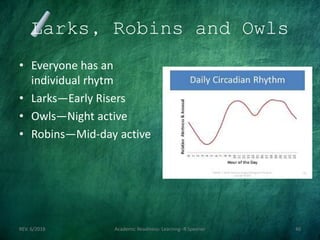
Larks, Robins and Owls
• Everyone has an
individual rhytm
• Larks—Early Risers
• Owls—Night active
• Robins—Mid-day active
REV. 6/2018 Academic Readiness- Learning--R Speener 46
Circadian Paradox
• Most alert times best
for analytical work
• Most drowsy times best
for creative work
• Most drowsy times
worst for making
desicions
REV. 6/2018 Academic Readiness- Learning--R Speener 47
MEMORY
REV. 6/2018 Academic Readiness- Learning--R Speener 48
Definition--Memory
• Memory is the faculty of the mind by
which information is
– encoded,
– stored, and
– retrieved (Atkinson & Shiffrin, 1968).
• Memory is vital to experience.
• Without memory, we are not us.
• If we could not remember past events, we could
not learn or develop language, relationships, nor
personal identity (Eysenck, 2012).
REV. 6/2018 Academic Readiness- Learning--R Speener 49
REV. 6/2018 Academic Readiness- Learning--R Speener 50
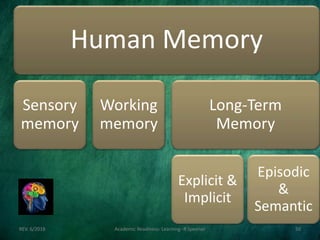
Human Memory
Sensory
memory
Working
memory
Long-Term
Memory
Explicit &
Implicit
Episodic
&
Semantic
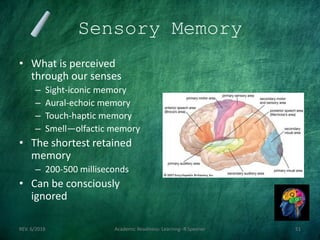
Sensory Memory
• What is perceived
through our senses
– Sight-iconic memory
– Aural-echoic memory
– Touch-haptic memory
– Smell—olfactic memory
• The shortest retained
memory
– 200-500 milliseconds
• Can be consciously
ignored
REV. 6/2018 Academic Readiness- Learning--R Speener 51
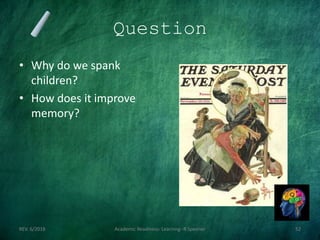
Question
• Why do we spank
children?
• How does it improve
memory?
REV. 6/2018 Academic Readiness- Learning--R Speener 52
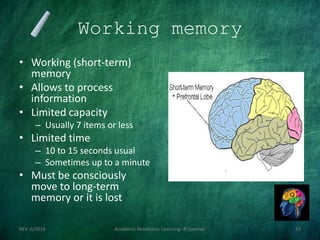
Working memory
• Working (short-term)
memory
• Allows to process
information
• Limited capacity
– Usually 7 items or less
• Limited time
– 10 to 15 seconds usual
– Sometimes up to a minute
• Must be consciously
move to long-term
memory or it is lost
REV. 6/2018 Academic Readiness- Learning--R Speener 53
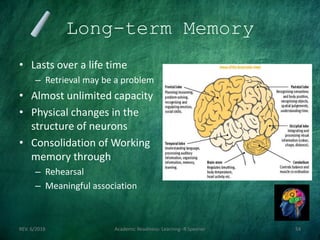
Long-term Memory
• Lasts over a life time
– Retrieval may be a problem
• Almost unlimited capacity
• Physical changes in the
structure of neurons
• Consolidation of Working
memory through
– Rehearsal
– Meaningful association
REV. 6/2018 Academic Readiness- Learning--R Speener 54
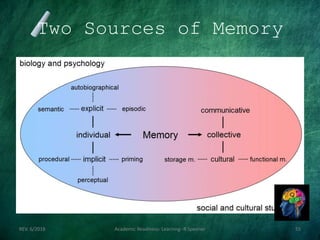
Two Sources of Memory
REV. 6/2018 Academic Readiness- Learning--R Speener 55
Explicit & Implicit
Memory
Explicit--Declarative
• Knowing what
• Encoded by the medial
temporal lobe
– hippocampus
– Entorhinal cortex
– Perirhinal cortex
• Stored in the temporal
cortex
Implicit--Procedural
• Knowing how
• Unconscious memory
• Encoded and stored in the
– Cerebellum
– Putamen
– Caudate nucleus
– Motor cortex
REV. 6/2018 Academic Readiness- Learning--R Speener 56
Episodic & Semantic
Memory
Episodic--experiences
• Experiences and specific
events
• Autobiographical events
– Flash bulb memory
• Incorporates emotional and
context
• Starts in the hippocampus
and stored in the neocortex
• Retrospective—
remembering the past
Semantic--knowledge
• Facts, meanings, concepts,
and knowledge of the
outside world
• Derived from episodic
memory
• Primarily the frontal and
temporal cortexes
• Prospective—remembering
the future
REV. 6/2018 Academic Readiness- Learning--R Speener 57
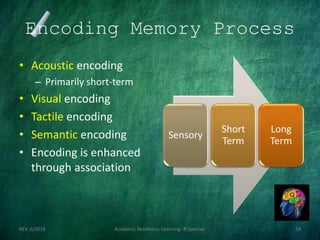
Encoding Memory Process
• Acoustic encoding
– Primarily short-term
• Visual encoding
• Tactile encoding
• Semantic encoding
• Encoding is enhanced
through association
Sensory
Short
Term
Long
Term
REV. 6/2018 Academic Readiness- Learning--R Speener 58
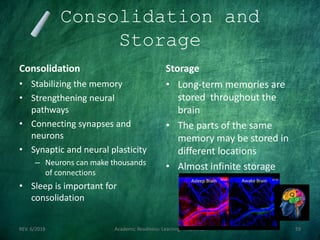
Consolidation and
Storage
Consolidation
• Stabilizing the memory
• Strengthening neural
pathways
• Connecting synapses and
neurons
• Synaptic and neural plasticity
– Neurons can make thousands
of connections
• Sleep is important for
consolidation
Storage
• Long-term memories are
stored throughout the
brain
• The parts of the same
memory may be stored in
different locations
• Almost infinite storage
REV. 6/2018 Academic Readiness- Learning--R Speener 59
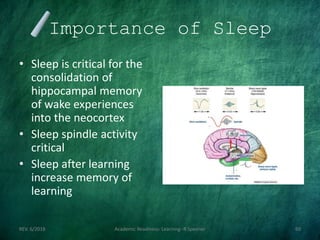
Importance of Sleep
• Sleep is critical for the
consolidation of
hippocampal memory
of wake experiences
into the neocortex
• Sleep spindle activity
critical
• Sleep after learning
increase memory of
learning
REV. 6/2018 Academic Readiness- Learning--R Speener 60
Recall and Retrieval
• Retrieving information from
long-term memory to Working
memory
– Linked by associations and
neural networks
• This consolidates and
reinforces memory
• Two methods
– Recognition
• Requires familiarity
• Largely unconscious
– Recall
• Requires reconstructing
information
• Recognition may encourage
recall
REV. 6/2018 Academic Readiness- Learning--R Speener 61
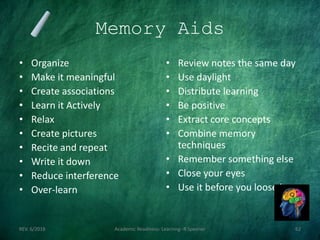
Memory Aids
• Organize
• Make it meaningful
• Create associations
• Learn it Actively
• Relax
• Create pictures
• Recite and repeat
• Write it down
• Reduce interference
• Over-learn
• Review notes the same day
• Use daylight
• Distribute learning
• Be positive
• Extract core concepts
• Combine memory
techniques
• Remember something else
• Close your eyes
• Use it before you loose it
REV. 6/2018 Academic Readiness- Learning--R Speener 62
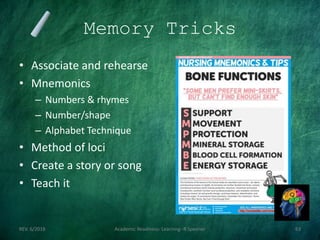
Memory Tricks
• Associate and rehearse
• Mnemonics
– Numbers & rhymes
– Number/shape
– Alphabet Technique
• Method of loci
• Create a story or song
• Teach it
REV. 6/2018 Academic Readiness- Learning--R Speener 63
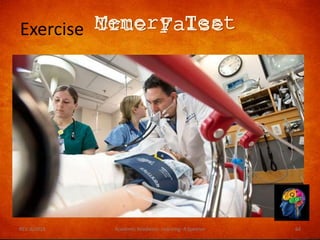
Exercise
1. There are four people in
the picture?
2. The patient had a blood
pressure cuff on?
3. The patient had a neck
brace on?
4. The patient has an I V?
5. The patient is male?
6. The time is 2:14?
7. The doctor has a name
badge on?
REV. 6/2018 Academic Readiness- Learning--R Speener 64
T
T
F
T
T
F
F
Memory TestTrue False
LEARNING STYLE
REV. 6/2018 Academic Readiness- Learning--R Speener 65
Learning Style
Definition
• Learning style can also be described as a set
of factors, behaviors, and attitudes that
facilitate learning for an individual in a given
situation.
• Styles influence how students learn, how
teachers teach, and how the two interact
REV. 6/2018 Academic Readiness- Learning--R Speener 66
Difference between
Intelligence and Learning
Styles
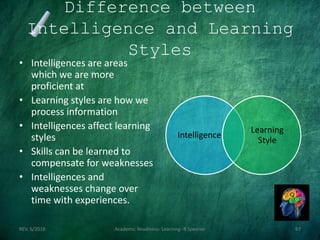
• Intelligences are areas
which we are more
proficient at
• Learning styles are how we
process information
• Intelligences affect learning
styles
• Skills can be learned to
compensate for weaknesses
• Intelligences and
weaknesses change over
time with experiences.
Intelligence
Learning
Style
REV. 6/2018 Academic Readiness- Learning--R Speener 67
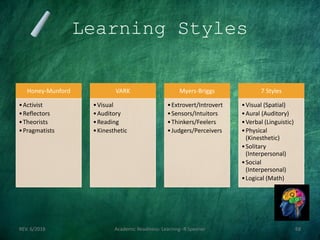
Learning Styles
Honey-Munford
•Activist
•Reflectors
•Theorists
•Pragmatists
VARK
•Visual
•Auditory
•Reading
•Kinesthetic
Myers-Briggs
•Extrovert/Introvert
•Sensors/Intuitors
•Thinkers/Feelers
•Judgers/Perceivers
7 Styles
•Visual (Spatial)
•Aural (Auditory)
•Verbal (Linguistic)
•Physical
(Kinesthetic)
•Solitary
(Interpersonal)
•Social
(Interpersonal)
•Logical (Math)
REV. 6/2018 Academic Readiness- Learning--R Speener 68
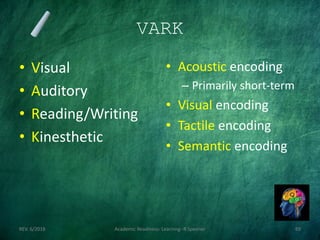
VARK
• Visual
• Auditory
• Reading/Writing
• Kinesthetic
• Acoustic encoding
– Primarily short-term
• Visual encoding
• Tactile encoding
• Semantic encoding
REV. 6/2018 Academic Readiness- Learning--R Speener 69
Question Learning Style
Cassandra takes copious notes and then converts them
to diagrams. What learning style(s) does she use?
a) Auditory
b) Kinesthetic
c) Reading-Language
d) Visual
REV. 6/2018 Academic Readiness- Learning--R Speener 70
Question Learning Style
Sterling appears to be sleeping in class, but when asked
a question he always has the answer. What learning
style(s) does he use?
a) Auditory
b) Kinesthetic
c) Reading-Language
d) Visual
REV. 6/2018 Academic Readiness- Learning--R Speener 71
Visual Strategies
• Highlight important
points in text; key words •
• Create flashcards for key
information; be concise •
• Limit amount of
words/information;
allows for mental imagery
•
• Convert notes and
translate words into
symbols, diagrams,
and/or pictures •
• Create visual reminders of
information •
• Practice turning visuals
back into words •
• Color-code, underline,
and/or highlight
information •
• Be creative with charts,
diagrams, mind maps
REV. 6/2018 Academic Readiness- Learning--R Speener 72
Auditory Strategies
• Work in groups or with a study
partner; i.e. discussions:
listening, talking •
• Review assignments and text
reading before class •
• Read notes and text out loud •
Recite information that is
important to remember •
• Record notes, key information,
and lectures; listen to
recordings regularly
• Use books-on-tape •
• Mathematical/technical
information
– State the problem out loud
– Think through a process or
sequence of steps: write out,
then read out loud
– Discuss questions/problems in
a group or with a study-buddy
REV. 6/2018 Academic Readiness- Learning--R Speener 73
Read/Write Strategies
• Rewrite notes
• Read/review notes every
day
• Rewrite ideas and
principles into other
words
• Organize diagrams/graphs
into statements
• Turn reactions, actions,
charts, etc. into words •
• Write exam answers
• Practice with multiple
choice questions
• Write paragraphs,
beginnings and endings
• Write lists (a,b,c,1,2,3,4)
• Arrange words into
hierarchies and points
REV. 6/2018 Academic Readiness- Learning--R Speener 74
Kinesthetic Strategies
• Skim through reading material
• Move around as you read aloud
or
• Record notes and listen to them
• Take frequent study breaks Listen
to music while studying
• Sit in the front of the classroom
• Stay actively engaged in class:
take notes,
• Create hands-on learning when
possible: o Use models, extra lab
time, visit museums
• Create cards for
processes:
– Color code like information
– Limit information: use key
words, symbols
– Arrange in order; shuffle
and repeat
• Type over notes from text
and class
• Create spreadsheets,
tables, charts to organize
material
REV. 6/2018 Academic Readiness- Learning--R Speener 75
T
F
Question Learning Styles
One must adjust learning styles for success.
REV. 6/2018 Academic Readiness- Learning--R Speener 76
T
F
Question Learning Styles
One can and needs to use more than one
learning style.
REV. 6/2018 Academic Readiness- Learning--R Speener 77
T
F
Question Learning Style
One needs to adjust one’s learning style to fit
the material learned
REV. 6/2018 Academic Readiness- Learning--R Speener 78
OTHER FACTORS
REV. 6/2018 Academic Readiness- Learning--R Speener 79
Other Factors that Affect
Learning
• Prior knowledge
• Prior experiences
• Learning environment
• Physical wellbeing
– Nutrition
– Hydration
– Energy level
– Alertness
– Mental status
• Stress
• Drugs and alcohol
REV. 6/2018 Academic Readiness- Learning--R Speener 80
SCENARIOS
Self-regulated Study
REV. 6/2018 Academic Readiness- Learning--R Speener 81
Scenario
What is the
problem?
Martin reads is
textbook and
highlights as he reads.
By the end of the
chapter he
remembers nothing.
REV. 6/2018 Academic Readiness- Learning--R Speener 82
Information is not
transferring from
working memory to
long-term memory.
How would you
suggest?
Scenario
What would you
suggest?
Norine is taking
anatomy. She needs
to learn all the major
bones for the test in
three weeks.
REV. 6/2018 Academic Readiness- Learning--R Speener 83
• Set up a study plan
• Set study time into
small increments
• Increase study as
the test nears
• Use techniques
that support her
learning style
Scenario
What would you
suggest?
Sydney feels his study
time is ineffective.
REV. 6/2018 Academic Readiness- Learning--R Speener 84
Scenario
What would you
recommend?
Stanley has a hard time
concentrating when
studying online.
• He finds the e-book
difficult because he
cannot markup the
pages.
• He finds that he is
restless sitting at the
computer for hours.
• He finds that he has
little retention.
REV. 6/2018 Academic Readiness- Learning--R Speener 85
REV. 6/2018 Academic Readiness- Learning--R Speener 86
Exercise
Fears
On a piece of paper
write five fears you
have about school.
REV. 6/2018 Academic Readiness- Learning--R Speener 87
1. Fold the paper in half
lengthwise
2. Fold in half widthwise
3. Open the paper
4. Fold the corners to the
center
5. Crumple this page up and
toss it into the waste
basket from the second
row of desks
Summary
• The brain has unlimited capacity to learn and
remember
• Use multiple methods for learning
• Know your learning style and skills and adjust
learning techniques as required
• The difficulty is in retrieving it
– Repetition
– Relevance
– Relationships
– Reflection
REV. 6/2018 Academic Readiness- Learning--R Speener 88
RESOURCES
REV. 6/2018 Academic Readiness- Learning--R Speener 89
Resources—Self-Regulated
Learning
• Effective Strategies for Self-regulated Learning: A
Meta-Analysis https://www.nro.nl/wp-
content/uploads/2014/05/PROO_Effective+strate
gies+for+self-regulated+learning.pdf
• Self-Regulated Learning
https://lincs.ed.gov/sites/default/files/3_TEAL_Se
lf%20Reg%20Learning.pdf
• A Review of Self-regulated Learning: Six Models
and Four Directions for Research
https://www.ncbi.nlm.nih.gov/pmc/articles/PM
C5408091/
REV. 6/2018 Academic Readiness- Learning--R Speener 90
Resources—The Brain
• Research in Brain Function and Learning
http://www.apa.org/education/k12/brain-function.aspx
• Resources on Learning and the Brain
https://www.edutopia.org/article/brain-based-learning-
resources
• How People Learn: Brain, Mind, Experience, and School
https://www.nap.edu/read/9853/chapter/8
• Plasticity in Gray and White
• Neuroimaging changes in brain structure during learning
https://www.ncbi.nlm.nih.gov/pmc/articles/PMC3660656/
•
REV. 6/2018 Academic Readiness- Learning--R Speener 91
Resources—Circadian
Rhythm
• A Time to Remember: The Role of Circadian Clocks in
Learning and Memory
https://www.ncbi.nlm.nih.gov/pmc/articles/PMC43857
93/
• Munich Chronotype Questionnaire
file:///C:/Users/Ronald/Downloads/MCTQ.pdf
• What is your chronotype?
https://thepowerofwhenquiz.com/
• Horne-Ostberg Morningness-Eveningness
Questionnaire https://sleephabits.net/morningness-
eveningness-questionnaire
REV. 6/2018 Academic Readiness- Learning--R Speener 92
Resources--Memory
• The Human Memory http://www.human-memory.net/types.html
• Memory Techniques for Exam Preparation: 10 Astonishing Ways to
Harness the Power of Your Brain https://www.oxford-
royale.co.uk/articles/memory-tricks-exam-success.html
• Memory Techniques, Memorizations Tips
https://www.academictips.org/memory/index.html
• Memory Techniques US Air Force Academy
http://www.au.af.mil/au/awc/awcgate/usafa/memory.htm
• Memory Methods
http://changingminds.org/techniques/memory/memory.htm
• Anatomy and Physiology Nursing Mnemonics & Tips
https://nurseslabs.com/anatomy-and-physiology-nursing-
mnemonics-tips/
REV. 6/2018 Academic Readiness- Learning--R Speener 93
Resources—Multiple
Intelligences
• Multiple Intelligences: What Does the
Research Say?
https://www.edutopia.org/multiple-
intelligences-research
REV. 6/2018 Academic Readiness- Learning--R Speener 94
Resources—Learning
Styles
• Ways of learning: Learning theories and learning styles in the classroom
(2013) http://www.epitropakisg.gr/grigorise/ways%20of%20learning.pdf
• Learning styles and critical thinking relationship in baccalaureate nursing
education: a systematic review (2014)
https://www.researchgate.net/profile/Christos_Andreou/publication/247
154412_Learning_styles_and_critical_thinking_relationship_in_baccalaur
eate_nursing_education_A_systematic_review/links/00b7d521afed92096
e000000.pdf
• Learning styles and approaches to learning among medical
undergraduates and postgraduates
https://bmcmededuc.biomedcentral.com/articles/10.1186/1472-6920-13-
42
• VARK Learning Styles: Visual, Auditory, Read/Write, Kinesthetic
http://www.gardner-
webb.edu/Assets/gardnerwebb/academics/advising/files/vark-learning-
styles.pdf
REV. 6/2018 Academic Readiness- Learning--R Speener 95
Resources—Sleep
• About Sleep's Role in Memory
https://www.ncbi.nlm.nih.gov/pmc/articles/PMC3768102
/
• Deciphering Neural Codes of Memory during Sleep
https://www.sciencedirect.com/science/article/pii/S01662
23617300450
• Sculpting memory during sleep: concurrent consolidation
and forgetting
https://www.sciencedirect.com/science/article/pii/S09594
38816301726
• Sleep Spindles as Facilitators of Memory Formation and
Learning
https://www.hindawi.com/journals/np/2016/1796715/
REV. 6/2018 Academic Readiness- Learning--R Speener 96
REV. 6/2018 Academic Readiness- Learning--R Speener 97

Learning

  • 1.
  • 2.
    Objectives Goal: To improvelearning effectiveness • Develop self-regulated learning • Practice the core 4R • Explain the neuroscience of the brain • Describe how intelligence affects learning • Develop tools to improve memory • Understand learning style • Explore all factors the improve learning REV. 6/2018 Academic Readiness- Learning--R Speener 2
  • 3.
    Table of Content Self-Regulated Learning The4 Rs Intelligence Neuroscience of Learning Memory Learning Styles Other Factors Resources REV. 6/2018 Academic Readiness- Learning--R Speener 3
  • 4.
    SELF-REGULATED LEARNING REV. 6/2018Academic Readiness- Learning--R Speener 4
  • 5.
    Definition—Self-regulated Learning • An active,constructive process whereby learners set goals for their learning and then attempt to monitor, regulate, and control their cognition, motivation and behavior, guided and constrained by their goals and the contextual features in the environment. REV. 6/2018 Academic Readiness- Learning--R Speener 5 • Active • Goal-oriented • Regulated and controlled • Conducive environment • Motivation
  • 6.
    Cognition • Cognition islearning – Skills – Habits – Problem solving – Critical thinking – Study skills – How to • Connecting new learning to old • Repetition • Organization REV. 6/2018 Academic Readiness- Learning--R Speener 6
  • 7.
    Metacognition • Metacognition is understandinghow one learns • Forethought • Planning • Self-reflection REV. 6/2018 Academic Readiness- Learning--R Speener 7
  • 8.
    Management • The learning environment –Location – Tools • Physical • Emotional REV. 6/2018 Academic Readiness- Learning--R Speener 8
  • 9.
    Motivation • What makesone want to learn – Confidence – Experience – Goals – Values & beliefs REV. 6/2018 Academic Readiness- Learning--R Speener 9
  • 10.
    The Process REV. 6/2018Academic Readiness- Learning--R Speener 10
  • 11.
    Know Thyself • Developa plan that supports strengths • Develop tools to pair teaching style with learning style • Develop strategies when styles do not mesh. REV. 6/2018 Academic Readiness- Learning--R Speener 11
  • 12.
    THE 4 RS TheCore REV. 6/2018 Academic Readiness- Learning--R Speener 13
  • 13.
    The Core 4R s to Learning Repetition • Build neural pathways Relevance • Make learning personal Relationships • Find connections to other learning Reflection • Internalize and make it you REV. 6/2018 Academic Readiness- Learning--R Speener 14
  • 14.
    Repetition • Repetition isnecessary to reinforce the neural pathways • It strengthens long-term memory • It facilitates transfer from short-term to long-term memory REV. 6/2018 Academic Readiness- Learning--R Speener 15
  • 15.
    Relevance • Relevance isimportant because it make what is being learned important to the learner • This makes learning personal REV. 6/2018 Academic Readiness- Learning--R Speener 16
  • 16.
    Relationships • Relationships are importantbecause it interconnects • The more connections information has the easier to recall REV. 6/2018 Academic Readiness- Learning--R Speener 17
  • 17.
    Reflection • Reflection isimportant because it ties the other three together REV. 6/2018 Academic Readiness- Learning--R Speener 18
  • 18.
    INTELLIGENCE It’s role inlearning REV. 6/2018 Academic Readiness- Learning--R Speener 20
  • 19.
    Are You SmartEnough? • Intelligence is the ability to assimilate information and use it • Intelligence is plastic – It changes over time • Intelligence is selective – Idiot savant • It is influenced by experience and learning – Some portions of the brain function is highly genetic – Other are more experience based REV. 6/2018 Academic Readiness- Learning--R Speener 21
  • 20.
    I Q • Anintelligence quotient (IQ) is a total score derived from one of several standardized tests designed to assess human intelligence. REV. 6/2018 Academic Readiness- Learning--R Speener 22
  • 21.
    The Problem withI Q Tests • Most intelligence test are culturally and linguistically biased • IQ can be increased with practice REV. 6/2018 Academic Readiness- Learning--R Speener 27
  • 22.
    MULTIPLE INTELLIGENCES More thanone way to be smart REV. 6/2018 Academic Readiness- Learning--R Speener 28
  • 23.
    Multiple Intelligences Defined The theoryof multiple intelligences challenges the idea of a single IQ, where human beings have one central "computer" where intelligence is housed. Howard Gardner, the Harvard professor who originally proposed the theory, says that there are multiple types of human intelligence, each representing different ways of processing information: • (from Multiple Intelligences: What Does the Research Say?, 2016, https://www.edutopia.org/multiple-intelligences- research) REV. 6/2018 Academic Readiness- Learning--R Speener 29
  • 24.
    Multiple Intelligences • relatedto language and to the written and spoken-- ObamaLinguistic/verbal • related to reasoning, numbers, abstractions, and patterns—Stephen HawkingLogical/mathematical • Related to anything visual and the creation of mental images—Steven SpielbergSpatial/visual • Related to physical movement and actions located in the brain’s motor cortex—Michael JordonBodily/kinesthetic • Related to sounds and auditory patterns, to rhythm, beat and tempo--UsherMusical • Related to relationships with others and various means of communication—Bill ClintonInterpersonal • Related to self-reflection and self-awareness (mindfulness)—Meryl StreepIntrapersonal • Related to observation and awareness of the natural world and the patterns found there—David AttenboroughNaturalistic • Related to asking and examining questions about the “big questions” (Spiritual)—Dali LamaExistential REV. 6/2018 Academic Readiness- Learning--R Speener 30
  • 25.
    REV. 6/2018 AcademicReadiness- Learning--R Speener 31
  • 26.
    How to UseMI to Improve Learning REV. 6/2018 Academic Readiness- Learning--R Speener 32
  • 27.
    T F Question Intelligence One’s IQnever changes. REV. 6/2018 Academic Readiness- Learning--R Speener 33
  • 28.
    T F Question Multiple Intelligence According to thetheory of multiple intelligences, a person can be very smart in one area and less so in another area. REV. 6/2018 Academic Readiness- Learning--R Speener 34
  • 29.
    NEUROSCIENCE OF LEARNING REV.6/2018 Academic Readiness- Learning--R Speener 35
  • 30.
    White Matter/Grey Matter REV.6/2018 Academic Readiness- Learning--R Speener 36
  • 31.
    Neuroscience • Certain portionsof the brain process information • Other portions may store the information • It stores information in axions and transmits through the synapsis • Unused sections of the brain atrophy • Experience and environment alter the brain • The brain changes well into adulthood REV. 6/2018 Academic Readiness- Learning--R Speener 37
  • 32.
    Neuroscience (cont.) • Thebrain is a social organ – Stimulation and connection necessary to survive • We have two brains – Cerebral hemispheres – The brain is plastic and can change • The mind, brain and body are interwoven • Learning builds neural connections and changes the brain • The brain has a short attention span and needs repetition and multiple-channel processing REV. 6/2018 Academic Readiness- Learning--R Speener 38
  • 33.
    Right Brain—Left Brain •The stark differences between the two hemispheres are mostly myth • Left hemisphere is more speaking—aphasias • Language is processed on the left and enhanced on the right • The brain needs both hemispheres REV. 6/2018 Academic Readiness- Learning--R Speener 39
  • 34.
    T F Question The Brain Aswe age we stop creating new neurons. REV. 6/2018 Academic Readiness- Learning--R Speener 40
  • 35.
    T F Question Then Brain Thebrain atrophies if it is not used. REV. 6/2018 Academic Readiness- Learning--R Speener 41
  • 36.
    CIRCADIAN RHYTHMS REV. 6/2018Academic Readiness- Learning--R Speener 42
  • 37.
    Definition of Circadian Rhythm •Sometimes called the biological clock • Influenced by the day/night cycle – circadian period of about 24.18 hours • Fluctuations of hormones (melatonine & cortesol), body temperature, hunger, and alertness during a 24 hour period • It is affected by temperature, sunlight, and weather REV. 6/2018 Academic Readiness- Learning--R Speener 43
  • 38.
    REV. 6/2018 AcademicReadiness- Learning--R Speener 44
  • 39.
    REV. 6/2018 AcademicReadiness- Learning--R Speener 45
  • 40.
    Larks, Robins andOwls • Everyone has an individual rhytm • Larks—Early Risers • Owls—Night active • Robins—Mid-day active REV. 6/2018 Academic Readiness- Learning--R Speener 46
  • 41.
    Circadian Paradox • Mostalert times best for analytical work • Most drowsy times best for creative work • Most drowsy times worst for making desicions REV. 6/2018 Academic Readiness- Learning--R Speener 47
  • 42.
    MEMORY REV. 6/2018 AcademicReadiness- Learning--R Speener 48
  • 43.
    Definition--Memory • Memory isthe faculty of the mind by which information is – encoded, – stored, and – retrieved (Atkinson & Shiffrin, 1968). • Memory is vital to experience. • Without memory, we are not us. • If we could not remember past events, we could not learn or develop language, relationships, nor personal identity (Eysenck, 2012). REV. 6/2018 Academic Readiness- Learning--R Speener 49
  • 44.
    REV. 6/2018 AcademicReadiness- Learning--R Speener 50 Human Memory Sensory memory Working memory Long-Term Memory Explicit & Implicit Episodic & Semantic
  • 45.
    Sensory Memory • Whatis perceived through our senses – Sight-iconic memory – Aural-echoic memory – Touch-haptic memory – Smell—olfactic memory • The shortest retained memory – 200-500 milliseconds • Can be consciously ignored REV. 6/2018 Academic Readiness- Learning--R Speener 51
  • 46.
    Question • Why dowe spank children? • How does it improve memory? REV. 6/2018 Academic Readiness- Learning--R Speener 52
  • 47.
    Working memory • Working(short-term) memory • Allows to process information • Limited capacity – Usually 7 items or less • Limited time – 10 to 15 seconds usual – Sometimes up to a minute • Must be consciously move to long-term memory or it is lost REV. 6/2018 Academic Readiness- Learning--R Speener 53
  • 48.
    Long-term Memory • Lastsover a life time – Retrieval may be a problem • Almost unlimited capacity • Physical changes in the structure of neurons • Consolidation of Working memory through – Rehearsal – Meaningful association REV. 6/2018 Academic Readiness- Learning--R Speener 54
  • 49.
    Two Sources ofMemory REV. 6/2018 Academic Readiness- Learning--R Speener 55
  • 50.
    Explicit & Implicit Memory Explicit--Declarative •Knowing what • Encoded by the medial temporal lobe – hippocampus – Entorhinal cortex – Perirhinal cortex • Stored in the temporal cortex Implicit--Procedural • Knowing how • Unconscious memory • Encoded and stored in the – Cerebellum – Putamen – Caudate nucleus – Motor cortex REV. 6/2018 Academic Readiness- Learning--R Speener 56
  • 51.
    Episodic & Semantic Memory Episodic--experiences •Experiences and specific events • Autobiographical events – Flash bulb memory • Incorporates emotional and context • Starts in the hippocampus and stored in the neocortex • Retrospective— remembering the past Semantic--knowledge • Facts, meanings, concepts, and knowledge of the outside world • Derived from episodic memory • Primarily the frontal and temporal cortexes • Prospective—remembering the future REV. 6/2018 Academic Readiness- Learning--R Speener 57
  • 52.
    Encoding Memory Process •Acoustic encoding – Primarily short-term • Visual encoding • Tactile encoding • Semantic encoding • Encoding is enhanced through association Sensory Short Term Long Term REV. 6/2018 Academic Readiness- Learning--R Speener 58
  • 53.
    Consolidation and Storage Consolidation • Stabilizingthe memory • Strengthening neural pathways • Connecting synapses and neurons • Synaptic and neural plasticity – Neurons can make thousands of connections • Sleep is important for consolidation Storage • Long-term memories are stored throughout the brain • The parts of the same memory may be stored in different locations • Almost infinite storage REV. 6/2018 Academic Readiness- Learning--R Speener 59
  • 54.
    Importance of Sleep •Sleep is critical for the consolidation of hippocampal memory of wake experiences into the neocortex • Sleep spindle activity critical • Sleep after learning increase memory of learning REV. 6/2018 Academic Readiness- Learning--R Speener 60
  • 55.
    Recall and Retrieval •Retrieving information from long-term memory to Working memory – Linked by associations and neural networks • This consolidates and reinforces memory • Two methods – Recognition • Requires familiarity • Largely unconscious – Recall • Requires reconstructing information • Recognition may encourage recall REV. 6/2018 Academic Readiness- Learning--R Speener 61
  • 56.
    Memory Aids • Organize •Make it meaningful • Create associations • Learn it Actively • Relax • Create pictures • Recite and repeat • Write it down • Reduce interference • Over-learn • Review notes the same day • Use daylight • Distribute learning • Be positive • Extract core concepts • Combine memory techniques • Remember something else • Close your eyes • Use it before you loose it REV. 6/2018 Academic Readiness- Learning--R Speener 62
  • 57.
    Memory Tricks • Associateand rehearse • Mnemonics – Numbers & rhymes – Number/shape – Alphabet Technique • Method of loci • Create a story or song • Teach it REV. 6/2018 Academic Readiness- Learning--R Speener 63
  • 58.
    Exercise 1. There arefour people in the picture? 2. The patient had a blood pressure cuff on? 3. The patient had a neck brace on? 4. The patient has an I V? 5. The patient is male? 6. The time is 2:14? 7. The doctor has a name badge on? REV. 6/2018 Academic Readiness- Learning--R Speener 64 T T F T T F F Memory TestTrue False
  • 59.
    LEARNING STYLE REV. 6/2018Academic Readiness- Learning--R Speener 65
  • 60.
    Learning Style Definition • Learningstyle can also be described as a set of factors, behaviors, and attitudes that facilitate learning for an individual in a given situation. • Styles influence how students learn, how teachers teach, and how the two interact REV. 6/2018 Academic Readiness- Learning--R Speener 66
  • 61.
    Difference between Intelligence andLearning Styles • Intelligences are areas which we are more proficient at • Learning styles are how we process information • Intelligences affect learning styles • Skills can be learned to compensate for weaknesses • Intelligences and weaknesses change over time with experiences. Intelligence Learning Style REV. 6/2018 Academic Readiness- Learning--R Speener 67
  • 62.
    Learning Styles Honey-Munford •Activist •Reflectors •Theorists •Pragmatists VARK •Visual •Auditory •Reading •Kinesthetic Myers-Briggs •Extrovert/Introvert •Sensors/Intuitors •Thinkers/Feelers •Judgers/Perceivers 7 Styles •Visual(Spatial) •Aural (Auditory) •Verbal (Linguistic) •Physical (Kinesthetic) •Solitary (Interpersonal) •Social (Interpersonal) •Logical (Math) REV. 6/2018 Academic Readiness- Learning--R Speener 68
  • 63.
    VARK • Visual • Auditory •Reading/Writing • Kinesthetic • Acoustic encoding – Primarily short-term • Visual encoding • Tactile encoding • Semantic encoding REV. 6/2018 Academic Readiness- Learning--R Speener 69
  • 64.
    Question Learning Style Cassandratakes copious notes and then converts them to diagrams. What learning style(s) does she use? a) Auditory b) Kinesthetic c) Reading-Language d) Visual REV. 6/2018 Academic Readiness- Learning--R Speener 70
  • 65.
    Question Learning Style Sterlingappears to be sleeping in class, but when asked a question he always has the answer. What learning style(s) does he use? a) Auditory b) Kinesthetic c) Reading-Language d) Visual REV. 6/2018 Academic Readiness- Learning--R Speener 71
  • 66.
    Visual Strategies • Highlightimportant points in text; key words • • Create flashcards for key information; be concise • • Limit amount of words/information; allows for mental imagery • • Convert notes and translate words into symbols, diagrams, and/or pictures • • Create visual reminders of information • • Practice turning visuals back into words • • Color-code, underline, and/or highlight information • • Be creative with charts, diagrams, mind maps REV. 6/2018 Academic Readiness- Learning--R Speener 72
  • 67.
    Auditory Strategies • Workin groups or with a study partner; i.e. discussions: listening, talking • • Review assignments and text reading before class • • Read notes and text out loud • Recite information that is important to remember • • Record notes, key information, and lectures; listen to recordings regularly • Use books-on-tape • • Mathematical/technical information – State the problem out loud – Think through a process or sequence of steps: write out, then read out loud – Discuss questions/problems in a group or with a study-buddy REV. 6/2018 Academic Readiness- Learning--R Speener 73
  • 68.
    Read/Write Strategies • Rewritenotes • Read/review notes every day • Rewrite ideas and principles into other words • Organize diagrams/graphs into statements • Turn reactions, actions, charts, etc. into words • • Write exam answers • Practice with multiple choice questions • Write paragraphs, beginnings and endings • Write lists (a,b,c,1,2,3,4) • Arrange words into hierarchies and points REV. 6/2018 Academic Readiness- Learning--R Speener 74
  • 69.
    Kinesthetic Strategies • Skimthrough reading material • Move around as you read aloud or • Record notes and listen to them • Take frequent study breaks Listen to music while studying • Sit in the front of the classroom • Stay actively engaged in class: take notes, • Create hands-on learning when possible: o Use models, extra lab time, visit museums • Create cards for processes: – Color code like information – Limit information: use key words, symbols – Arrange in order; shuffle and repeat • Type over notes from text and class • Create spreadsheets, tables, charts to organize material REV. 6/2018 Academic Readiness- Learning--R Speener 75
  • 70.
    T F Question Learning Styles Onemust adjust learning styles for success. REV. 6/2018 Academic Readiness- Learning--R Speener 76
  • 71.
    T F Question Learning Styles Onecan and needs to use more than one learning style. REV. 6/2018 Academic Readiness- Learning--R Speener 77
  • 72.
    T F Question Learning Style Oneneeds to adjust one’s learning style to fit the material learned REV. 6/2018 Academic Readiness- Learning--R Speener 78
  • 73.
    OTHER FACTORS REV. 6/2018Academic Readiness- Learning--R Speener 79
  • 74.
    Other Factors thatAffect Learning • Prior knowledge • Prior experiences • Learning environment • Physical wellbeing – Nutrition – Hydration – Energy level – Alertness – Mental status • Stress • Drugs and alcohol REV. 6/2018 Academic Readiness- Learning--R Speener 80
  • 75.
    SCENARIOS Self-regulated Study REV. 6/2018Academic Readiness- Learning--R Speener 81
  • 76.
    Scenario What is the problem? Martinreads is textbook and highlights as he reads. By the end of the chapter he remembers nothing. REV. 6/2018 Academic Readiness- Learning--R Speener 82 Information is not transferring from working memory to long-term memory. How would you suggest?
  • 77.
    Scenario What would you suggest? Norineis taking anatomy. She needs to learn all the major bones for the test in three weeks. REV. 6/2018 Academic Readiness- Learning--R Speener 83 • Set up a study plan • Set study time into small increments • Increase study as the test nears • Use techniques that support her learning style
  • 78.
    Scenario What would you suggest? Sydneyfeels his study time is ineffective. REV. 6/2018 Academic Readiness- Learning--R Speener 84
  • 79.
    Scenario What would you recommend? Stanleyhas a hard time concentrating when studying online. • He finds the e-book difficult because he cannot markup the pages. • He finds that he is restless sitting at the computer for hours. • He finds that he has little retention. REV. 6/2018 Academic Readiness- Learning--R Speener 85
  • 80.
    REV. 6/2018 AcademicReadiness- Learning--R Speener 86
  • 81.
    Exercise Fears On a pieceof paper write five fears you have about school. REV. 6/2018 Academic Readiness- Learning--R Speener 87 1. Fold the paper in half lengthwise 2. Fold in half widthwise 3. Open the paper 4. Fold the corners to the center 5. Crumple this page up and toss it into the waste basket from the second row of desks
  • 82.
    Summary • The brainhas unlimited capacity to learn and remember • Use multiple methods for learning • Know your learning style and skills and adjust learning techniques as required • The difficulty is in retrieving it – Repetition – Relevance – Relationships – Reflection REV. 6/2018 Academic Readiness- Learning--R Speener 88
  • 83.
    RESOURCES REV. 6/2018 AcademicReadiness- Learning--R Speener 89
  • 84.
    Resources—Self-Regulated Learning • Effective Strategiesfor Self-regulated Learning: A Meta-Analysis https://www.nro.nl/wp- content/uploads/2014/05/PROO_Effective+strate gies+for+self-regulated+learning.pdf • Self-Regulated Learning https://lincs.ed.gov/sites/default/files/3_TEAL_Se lf%20Reg%20Learning.pdf • A Review of Self-regulated Learning: Six Models and Four Directions for Research https://www.ncbi.nlm.nih.gov/pmc/articles/PM C5408091/ REV. 6/2018 Academic Readiness- Learning--R Speener 90
  • 85.
    Resources—The Brain • Researchin Brain Function and Learning http://www.apa.org/education/k12/brain-function.aspx • Resources on Learning and the Brain https://www.edutopia.org/article/brain-based-learning- resources • How People Learn: Brain, Mind, Experience, and School https://www.nap.edu/read/9853/chapter/8 • Plasticity in Gray and White • Neuroimaging changes in brain structure during learning https://www.ncbi.nlm.nih.gov/pmc/articles/PMC3660656/ • REV. 6/2018 Academic Readiness- Learning--R Speener 91
  • 86.
    Resources—Circadian Rhythm • A Timeto Remember: The Role of Circadian Clocks in Learning and Memory https://www.ncbi.nlm.nih.gov/pmc/articles/PMC43857 93/ • Munich Chronotype Questionnaire file:///C:/Users/Ronald/Downloads/MCTQ.pdf • What is your chronotype? https://thepowerofwhenquiz.com/ • Horne-Ostberg Morningness-Eveningness Questionnaire https://sleephabits.net/morningness- eveningness-questionnaire REV. 6/2018 Academic Readiness- Learning--R Speener 92
  • 87.
    Resources--Memory • The HumanMemory http://www.human-memory.net/types.html • Memory Techniques for Exam Preparation: 10 Astonishing Ways to Harness the Power of Your Brain https://www.oxford- royale.co.uk/articles/memory-tricks-exam-success.html • Memory Techniques, Memorizations Tips https://www.academictips.org/memory/index.html • Memory Techniques US Air Force Academy http://www.au.af.mil/au/awc/awcgate/usafa/memory.htm • Memory Methods http://changingminds.org/techniques/memory/memory.htm • Anatomy and Physiology Nursing Mnemonics & Tips https://nurseslabs.com/anatomy-and-physiology-nursing- mnemonics-tips/ REV. 6/2018 Academic Readiness- Learning--R Speener 93
  • 88.
    Resources—Multiple Intelligences • Multiple Intelligences:What Does the Research Say? https://www.edutopia.org/multiple- intelligences-research REV. 6/2018 Academic Readiness- Learning--R Speener 94
  • 89.
    Resources—Learning Styles • Ways oflearning: Learning theories and learning styles in the classroom (2013) http://www.epitropakisg.gr/grigorise/ways%20of%20learning.pdf • Learning styles and critical thinking relationship in baccalaureate nursing education: a systematic review (2014) https://www.researchgate.net/profile/Christos_Andreou/publication/247 154412_Learning_styles_and_critical_thinking_relationship_in_baccalaur eate_nursing_education_A_systematic_review/links/00b7d521afed92096 e000000.pdf • Learning styles and approaches to learning among medical undergraduates and postgraduates https://bmcmededuc.biomedcentral.com/articles/10.1186/1472-6920-13- 42 • VARK Learning Styles: Visual, Auditory, Read/Write, Kinesthetic http://www.gardner- webb.edu/Assets/gardnerwebb/academics/advising/files/vark-learning- styles.pdf REV. 6/2018 Academic Readiness- Learning--R Speener 95
  • 90.
    Resources—Sleep • About Sleep'sRole in Memory https://www.ncbi.nlm.nih.gov/pmc/articles/PMC3768102 / • Deciphering Neural Codes of Memory during Sleep https://www.sciencedirect.com/science/article/pii/S01662 23617300450 • Sculpting memory during sleep: concurrent consolidation and forgetting https://www.sciencedirect.com/science/article/pii/S09594 38816301726 • Sleep Spindles as Facilitators of Memory Formation and Learning https://www.hindawi.com/journals/np/2016/1796715/ REV. 6/2018 Academic Readiness- Learning--R Speener 96
  • 91.
    REV. 6/2018 AcademicReadiness- Learning--R Speener 97