The Teaching of Edukasyong Pantahanan at
Pangkabuhayan (EPP) and Technology and
Livelihood Education (TLE)
What is EPP and
TLE?
EPP
is the name of the subject in TLE from grades 4 to 6.
Filipino is the medium of instruction for grades 4 to 5.
English for grade 6 in preparation for teaching TLE.
Entrepreneurship is integrated in all four areas of TLE.
TLE covers 4 areas---
1.1 The Legal Basis
of the Teaching EPP
and TLE
The Legal Basis of the teaching
EPP and TLE 1987 Constitution
Art. II, section 17 It is declared
policy of the state to “give
priority to education, science
and technology, arts, culture and
sports to foster patriotism and
nationalism, accelerate social
progress, and promote total
human liberation and
development.
an Act Strenghthening the Ladderized Interface
Between Technical Vocational-Education and
Training in Higher Education, which was signed
into law on November 21, 2014 states: “It’s hereby
declared the policy of the state to
institutionalized the ladderized interface
between technical vocational educational
education and training and (TVET) and higher
education to open the pathways of
opportunities for career and educational
progression of students and workers.
R. A 10467
1.2 Intended Outcomes and Scope
of Teaching EPP and TLE
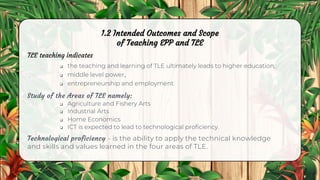
 the teaching and learning of TLE ultimately leads to higher education,
TLE teaching indicates
 middle level power,
 entrepreneurship and employment.
Study of the Areas of TLE namely:
 Agriculture and Fishery Arts
 Industrial Arts
 Home Economics
 ICT is expected to lead to technological proficiency.
Technological proficiency - is the ability to apply the technical knowledge
and skills and values learned in the four areas of TLE.
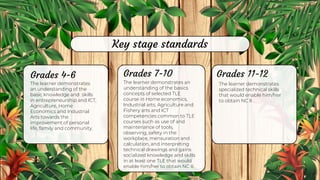
The learner demonstrates
an understanding of the
basic knowledge and skills
in entrepreneurship and ICT,
Agriculture, Home
Economics and Industrial
Arts towards the
improvement of personal
life, family and community.
Grades 4-6
The learner demonstrates an
understanding of the basics
concepts of selected TLE
course in Home economics,
Industrial arts, Agriculture and
Fishery arts and ICT
competencies common to TLE
courses such as use of and
maintenance of tools,
observing, safety in the
workplace, mensuration and
calculation, and interpreting
technical drawings and gains
socialized knowledge and skills
in at least one TLE that would
enable him/her to obtain NC II.
Grades 7-10
Key stage standards
Grades 11-12
The learner demonstrates
specialized technical skills
that would enable him/her
to obtain NC II .
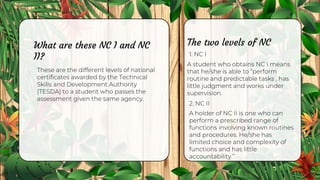
What are these NC I and NC
II?
These are the different levels of national
certificates awarded by the Technical
Skills and Development Authority
(TESDA) to a student who passes the
assessment given the same agency.
1. NC I
The two levels of NC
A student who obtains NC I means
that he/she is able to “perform
routine and predictable tasks , has
little judgment and works under
supervision.
2. NC II
A holder of NC II is one who can
perform a prescribed range of
functions involving known routines
and procedures. He/she has
limited choice and complexity of
functions and has little
accountability.”
Guidelines and Guiding
Principles in the
Teaching of EPP and TLE
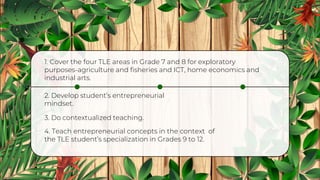
2. Develop student’s entrepreneurial
mindset.
1. Cover the four TLE areas in Grade 7 and 8 for exploratory
purposes-agriculture and fisheries and ICT, home economics and
industrial arts.
3. Do contextualized teaching.
4. Teach entrepreneurial concepts in the context of
the TLE student’s specialization in Grades 9 to 12.
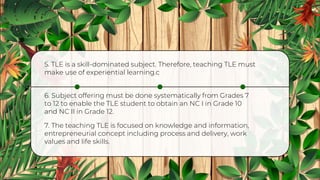
6. Subject offering must be done systematically from Grades 7
to 12 to enable the TLE student to obtain an NC I in Grade 10
and NC II in Grade 12.
5. TLE is a skill-dominated subject. Therefore, teaching TLE must
make use of experiential learning.c
7. The teaching TLE is focused on knowledge and information,
entrepreneurial concept including process and delivery, work
values and life skills.
Teaching Approaches, Methods
and Techniques
The framework of TLE teaching in the K to 12 curriculum made by
the TLE experts of the department of education cited the
following in relation to teaching approaches, methods, and
techniques- entrepreneurial, contextualized, integrative,
experiential, authentic and constructivist learning.
Direct Method of
Instruction
Since TLE is a skill subject, direct instruction
is most appropriate. The demonstration
method is a direct method of instruction. It
is referred to as the “show and tell” method.
The teacher simply shows to the students
how a thing is done and explains as he/she
demonstrate. For an effective
demonstrations, it is necessary that the
teacher mentions the dos and don’ts of the
process for emphasis and clarity. It is
important that as a teacher demonstrates a
process, he/she cautious students on steps
of a skill where students are most often
mistaken or which are most often missed.
It is expected that after the teacher demonstrate of a process, the students are given the
opportunity to demonstrate the process or the skill themselves. However, students should not
expected to demonstrate the process or the skill immediately on their own after the teacher
has shown it. This has to be done gradually, The steps are:
 Teacher demonstrates. – “Watch me and listen to me”.
 Students demonstrates with scaffolding from teacher. – “Let’s do it together”.
 When students can do the process by himself/herself, student demonstrate the skill or process. – “Do it
as I watch”.
 Teacher gives more opportunity for the practice for skill mastery. Teachers assesses to determine skill
mastery by all students.

TLE presentation

  • 1.
    The Teaching ofEdukasyong Pantahanan at Pangkabuhayan (EPP) and Technology and Livelihood Education (TLE)
  • 2.
    What is EPPand TLE?
  • 3.
    EPP is the nameof the subject in TLE from grades 4 to 6. Filipino is the medium of instruction for grades 4 to 5. English for grade 6 in preparation for teaching TLE. Entrepreneurship is integrated in all four areas of TLE.
  • 4.
    TLE covers 4areas---
  • 5.
    1.1 The LegalBasis of the Teaching EPP and TLE The Legal Basis of the teaching EPP and TLE 1987 Constitution Art. II, section 17 It is declared policy of the state to “give priority to education, science and technology, arts, culture and sports to foster patriotism and nationalism, accelerate social progress, and promote total human liberation and development. an Act Strenghthening the Ladderized Interface Between Technical Vocational-Education and Training in Higher Education, which was signed into law on November 21, 2014 states: “It’s hereby declared the policy of the state to institutionalized the ladderized interface between technical vocational educational education and training and (TVET) and higher education to open the pathways of opportunities for career and educational progression of students and workers. R. A 10467
  • 6.
    1.2 Intended Outcomesand Scope of Teaching EPP and TLE  the teaching and learning of TLE ultimately leads to higher education, TLE teaching indicates  middle level power,  entrepreneurship and employment. Study of the Areas of TLE namely:  Agriculture and Fishery Arts  Industrial Arts  Home Economics  ICT is expected to lead to technological proficiency. Technological proficiency - is the ability to apply the technical knowledge and skills and values learned in the four areas of TLE.
  • 7.
    The learner demonstrates anunderstanding of the basic knowledge and skills in entrepreneurship and ICT, Agriculture, Home Economics and Industrial Arts towards the improvement of personal life, family and community. Grades 4-6 The learner demonstrates an understanding of the basics concepts of selected TLE course in Home economics, Industrial arts, Agriculture and Fishery arts and ICT competencies common to TLE courses such as use of and maintenance of tools, observing, safety in the workplace, mensuration and calculation, and interpreting technical drawings and gains socialized knowledge and skills in at least one TLE that would enable him/her to obtain NC II. Grades 7-10 Key stage standards Grades 11-12 The learner demonstrates specialized technical skills that would enable him/her to obtain NC II .
  • 8.
    What are theseNC I and NC II? These are the different levels of national certificates awarded by the Technical Skills and Development Authority (TESDA) to a student who passes the assessment given the same agency. 1. NC I The two levels of NC A student who obtains NC I means that he/she is able to “perform routine and predictable tasks , has little judgment and works under supervision. 2. NC II A holder of NC II is one who can perform a prescribed range of functions involving known routines and procedures. He/she has limited choice and complexity of functions and has little accountability.”
  • 9.
    Guidelines and Guiding Principlesin the Teaching of EPP and TLE
  • 10.
    2. Develop student’sentrepreneurial mindset. 1. Cover the four TLE areas in Grade 7 and 8 for exploratory purposes-agriculture and fisheries and ICT, home economics and industrial arts. 3. Do contextualized teaching. 4. Teach entrepreneurial concepts in the context of the TLE student’s specialization in Grades 9 to 12.
  • 11.
    6. Subject offeringmust be done systematically from Grades 7 to 12 to enable the TLE student to obtain an NC I in Grade 10 and NC II in Grade 12. 5. TLE is a skill-dominated subject. Therefore, teaching TLE must make use of experiential learning.c 7. The teaching TLE is focused on knowledge and information, entrepreneurial concept including process and delivery, work values and life skills.
  • 12.
  • 13.
    The framework ofTLE teaching in the K to 12 curriculum made by the TLE experts of the department of education cited the following in relation to teaching approaches, methods, and techniques- entrepreneurial, contextualized, integrative, experiential, authentic and constructivist learning.
  • 14.
    Direct Method of Instruction SinceTLE is a skill subject, direct instruction is most appropriate. The demonstration method is a direct method of instruction. It is referred to as the “show and tell” method. The teacher simply shows to the students how a thing is done and explains as he/she demonstrate. For an effective demonstrations, it is necessary that the teacher mentions the dos and don’ts of the process for emphasis and clarity. It is important that as a teacher demonstrates a process, he/she cautious students on steps of a skill where students are most often mistaken or which are most often missed.
  • 15.
    It is expectedthat after the teacher demonstrate of a process, the students are given the opportunity to demonstrate the process or the skill themselves. However, students should not expected to demonstrate the process or the skill immediately on their own after the teacher has shown it. This has to be done gradually, The steps are:  Teacher demonstrates. – “Watch me and listen to me”.  Students demonstrates with scaffolding from teacher. – “Let’s do it together”.  When students can do the process by himself/herself, student demonstrate the skill or process. – “Do it as I watch”.  Teacher gives more opportunity for the practice for skill mastery. Teachers assesses to determine skill mastery by all students.