
Early Intermediate English Phrasal Verbs Lesson #1 By Jeremiah Bourque http://learnoutlive.com/
Don’t Give Up Now To “give up” is to surrender; to stop trying; to no longer attempt to succeed at something.  To urge someone to “not give up” is to urge that person to continue trying, even if that person faces adversity (difficulty).
She’s Looking After The Kids To “look after” someone is to take care of someone.  Example: “Susan is  looking after  Donald and Megan.” (Present) Susan is taking care of the children named Donald and Megan.
I’m Going To Find Out What’s Going On To “find out” is to discover.  To  find out  what’s  going on  is to  discover  what is  happening  (occurring now, in the present).  Example: I’m going to  find out  where Donald went. (Future)
Let Me Call You Right Back To “call someone back” is to return a message, usually a telephone call. So to “call you right back,” a person is interrupting (halting) the current telephone conversation while making a promise to call the original caller in a short time.  Example: Tom called Peter, but Peter was busy. Peter says, “I’ll  call  you right  back , Tom.” Peter will call Tom soon.
She Just Blew Right Up To “blow up” has three meanings.  #1: To explode, like a suicide bomber.   #2: To inflate. To “blow up” a tire can mean to put air in the tire to inflate it… but it can be confused with meaning #1!  #3: To become angry. Colloquially, to “blow up” in anger is to become angry enough to (figuratively) explode.
Just Fill The Car Right Up To “fill up” generally means to fill to the maximum (100% of capacity). To  fill up  a gas tank for a motor vehicle is to fill the tank to the maximum capacity.  Something that is  filled up  (past) is  full .  Colloquially, “Fill her right up” is used to request enough gas to completely fill a gas tank at a drive-in gas station. (Her can sound more like “er” (written ‘er)).
Get Over It To “get over” something is to recover.  One can  get over  a cold,  get over  rejection by a boyfriend, or  get over  a disappointment. Commonly misused  as a substitute for “come over,” as in, “ Get over  here!” (Informal, rude.) To come over is to approach, to draw near, to move closer.
I’m Not Making This Up To “make something up” (as opposed to the noun, “make-up,” for beauty cosmetics) is to fabricate a story for the purpose of deception and fraud (lying). “I’m not  making  this  up ” (Present) is therefore claiming (through a double negative sentence) to be telling the  truth .  That is, to be honest.
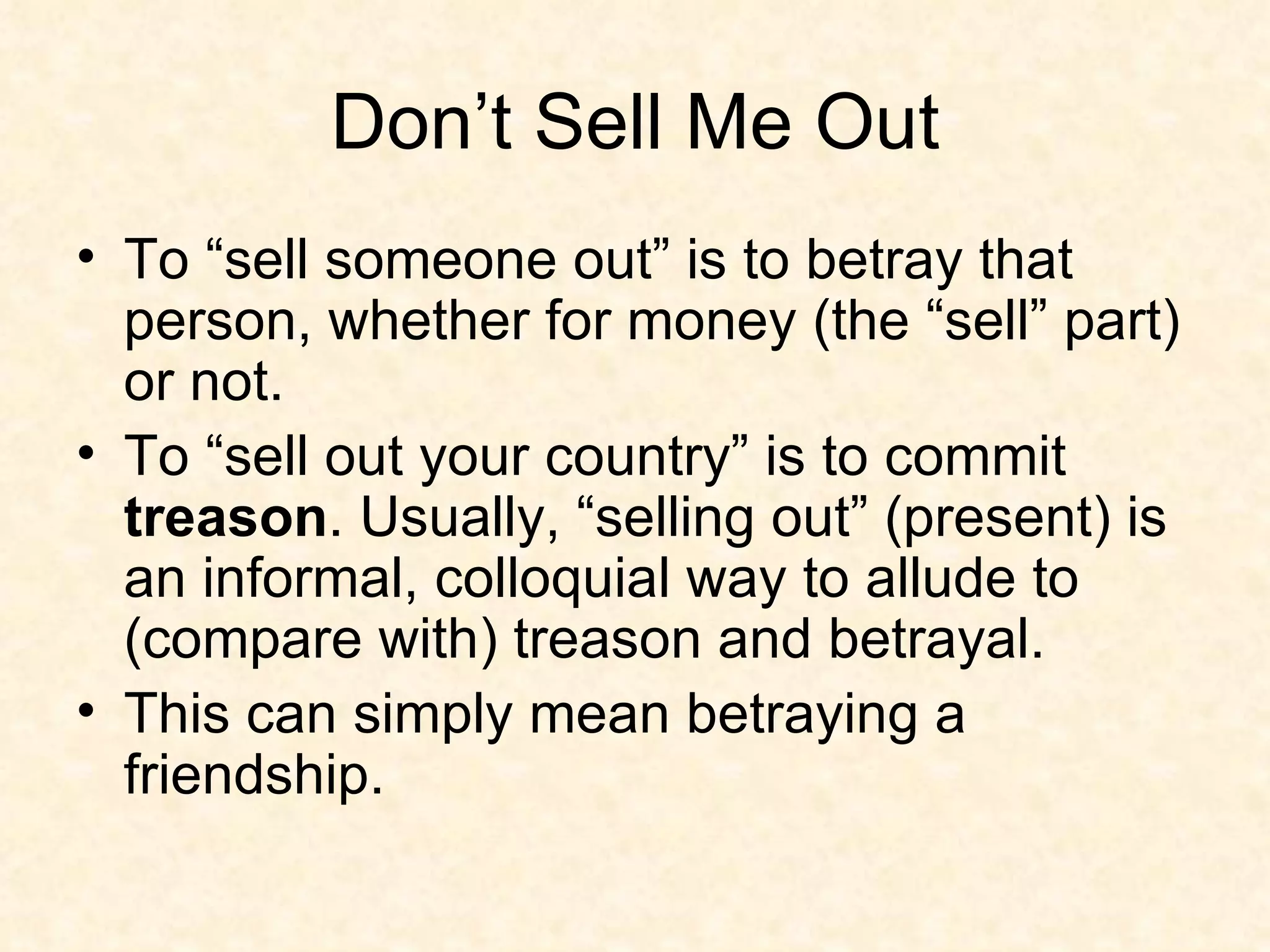
Don’t Sell Me Out To “sell someone out” is to betray that person, whether for money (the “sell” part) or not.  To “sell out your country” is to commit  treason . Usually, “selling out” (present) is an informal, colloquial way to allude to (compare with) treason and betrayal. This can simply mean betraying a friendship.
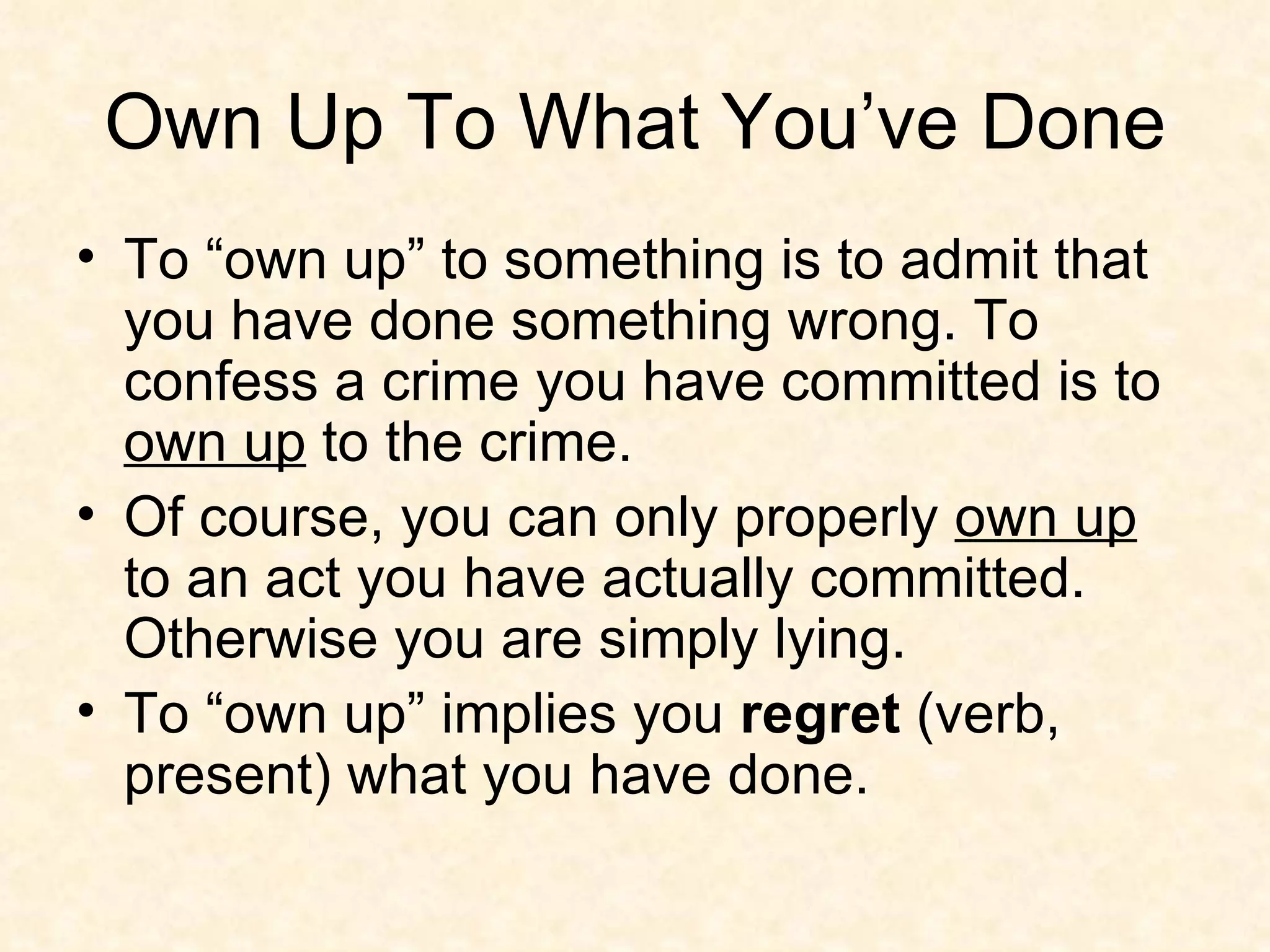
Own Up To What You’ve Done To “own up” to something is to admit that you have done something wrong. To confess a crime you have committed is to  own up  to the crime. Of course, you can only properly  own up  to an act you have actually committed. Otherwise you are simply lying.  To “own up” implies you  regret  (verb, present) what you have done.
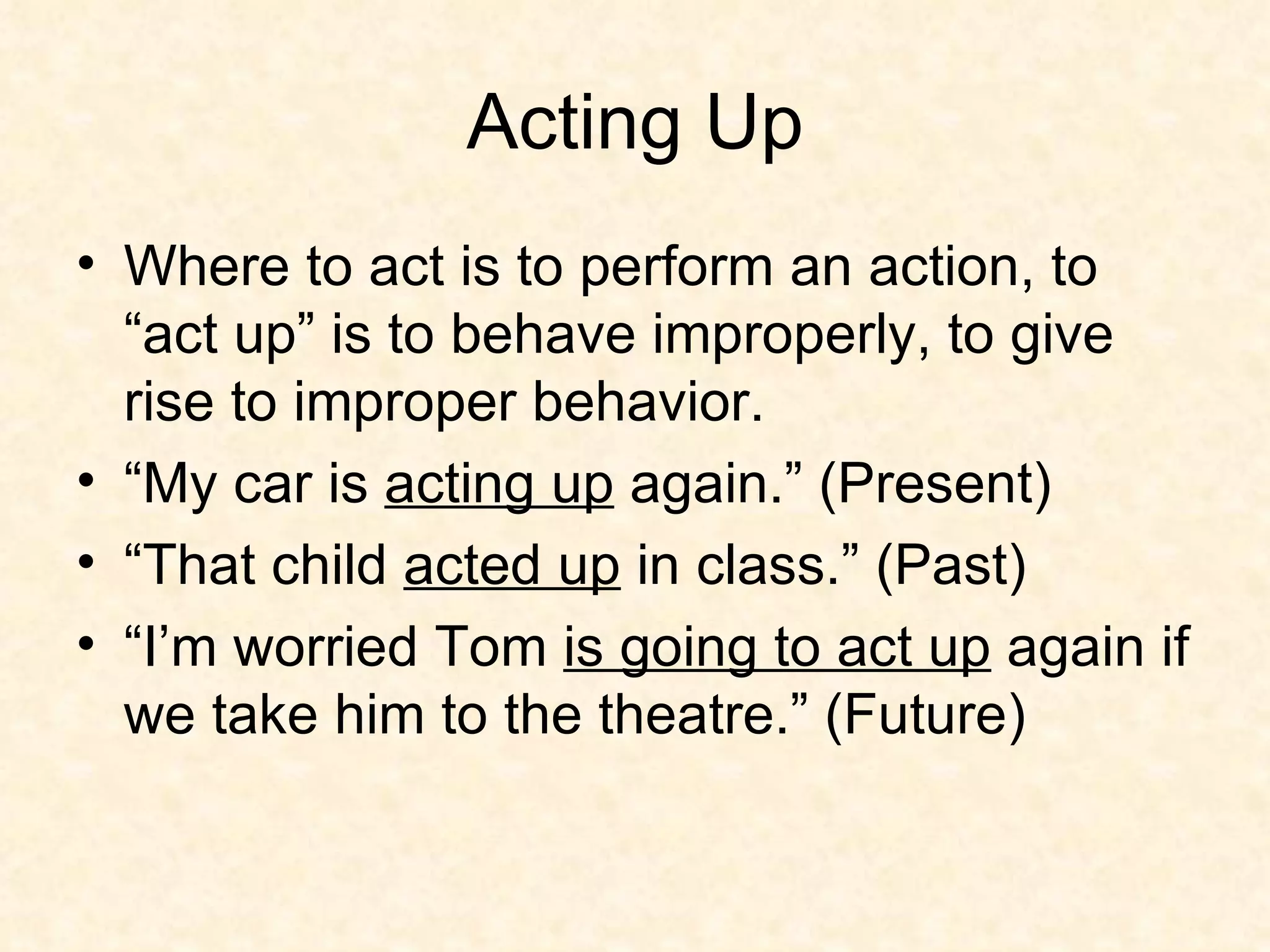
Acting Up Where to act is to perform an action, to “act up” is to behave improperly, to give rise to improper behavior. “My car is  acting up  again.” (Present) “That child  acted up  in class.” (Past) “I’m worried Tom  is going to act up  again if we take him to the theatre.” (Future)
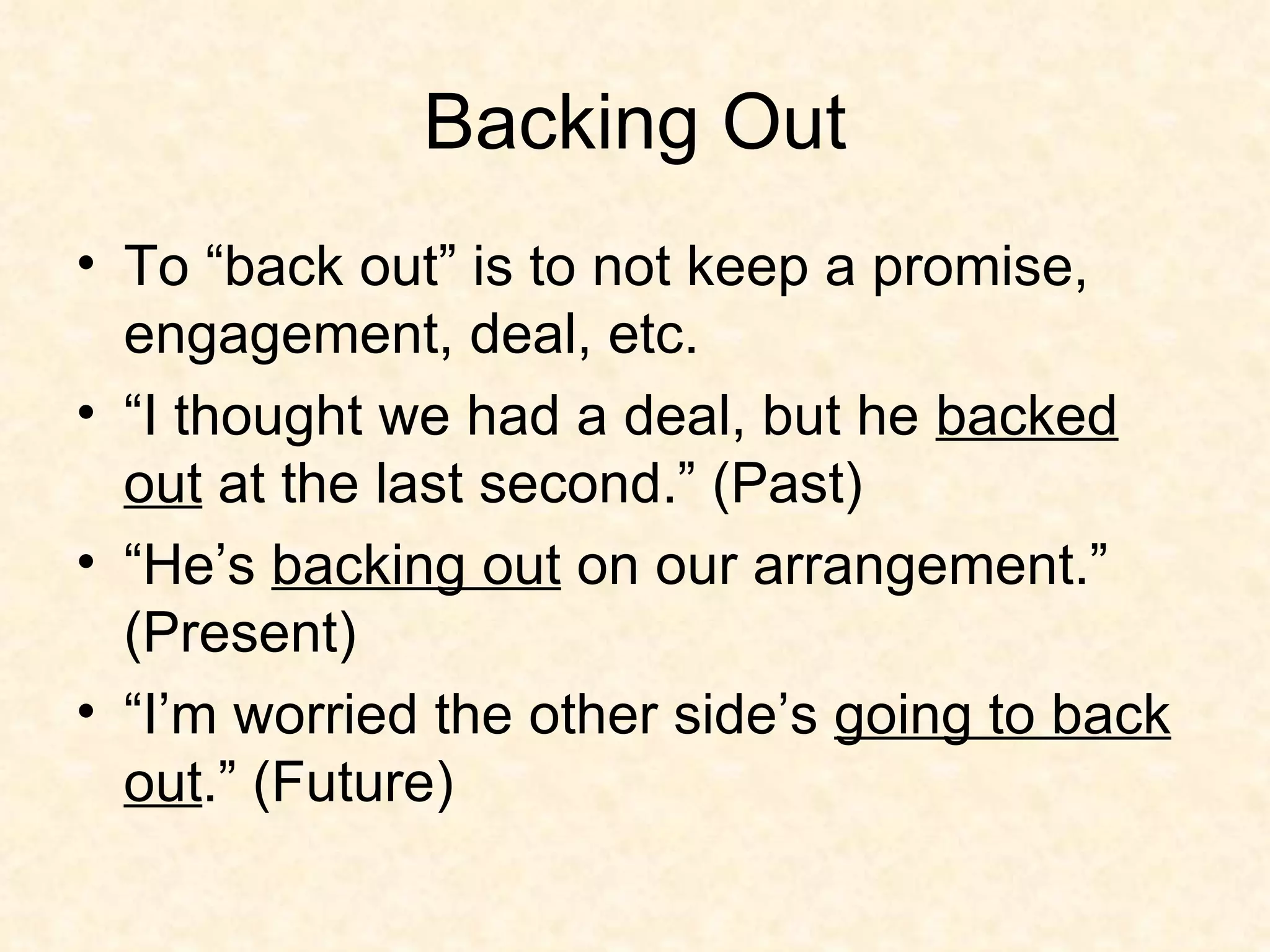
Backing Out To “back out” is to not keep a promise, engagement, deal, etc.  “I thought we had a deal, but he  backed out  at the last second.” (Past) “He’s  backing out  on our arrangement.” (Present) “I’m worried the other side’s  going to back out .” (Future)
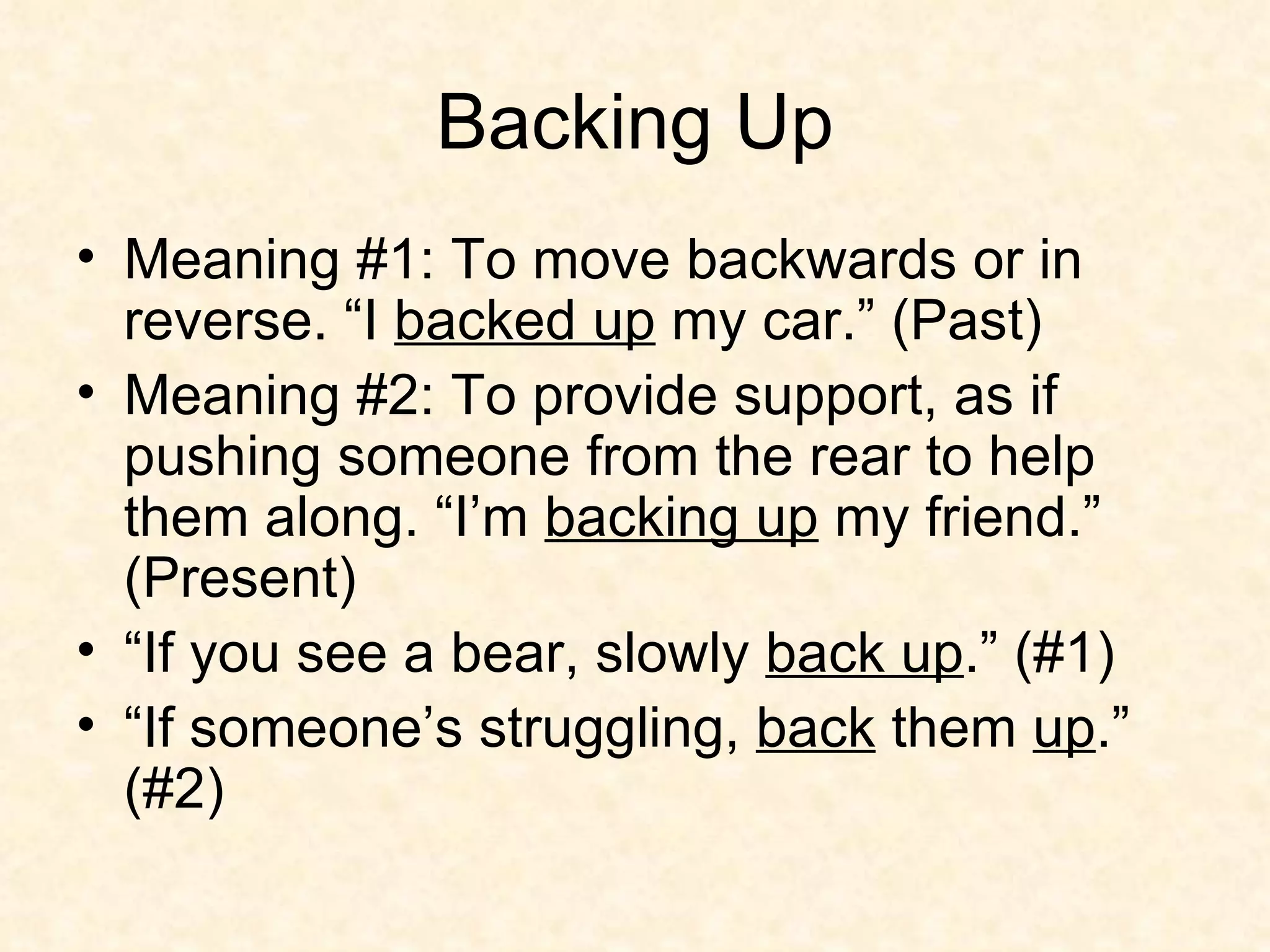
Backing Up Meaning #1: To move backwards or in reverse. “I  backed up  my car.” (Past) Meaning #2: To provide support, as if pushing someone from the rear to help them along. “I’m  backing up  my friend.” (Present) “If you see a bear, slowly  back up .” (#1) “If someone’s struggling,  back  them  up .” (#2)
Blowing Over To “blow over” is to pass without causing great problems. Originally a reference to  storms ; applied broadly to other matters. “Don’t worry, they always argue like this. It’ll  blow over .” (Future) “The controversy blew over in record time.” (Past) Best used in past or future tense; the present “blowing over” sounds awkward.
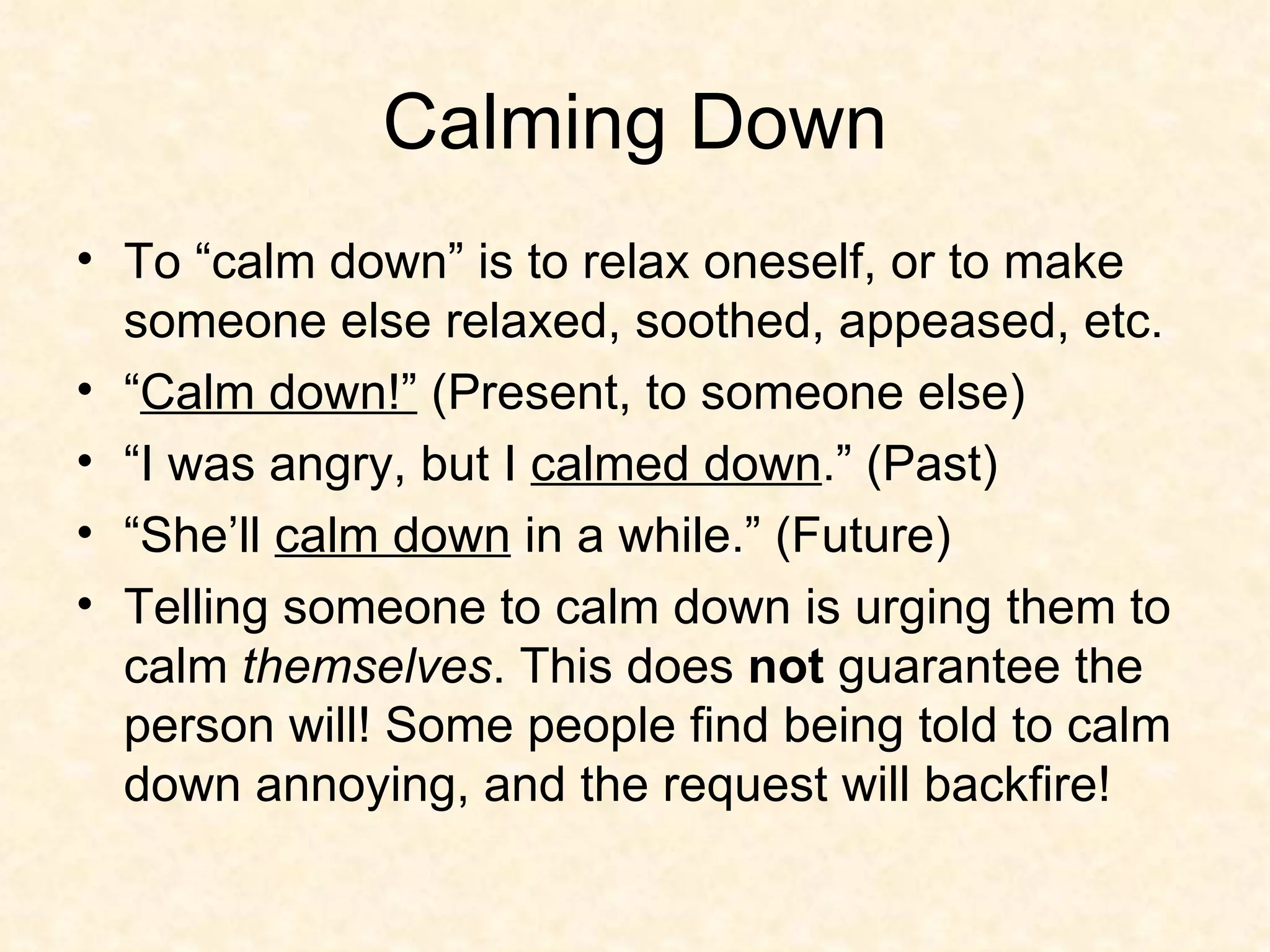
Calming Down To “calm down” is to relax oneself, or to make someone else relaxed, soothed, appeased, etc.  “ Calm down!”  (Present, to someone else) “ I was angry, but I  calmed down .” (Past) “ She’ll  calm down  in a while.” (Future) Telling someone to calm down is urging them to calm  themselves . This does  not  guarantee the person will! Some people find being told to calm down annoying, and the request will backfire!
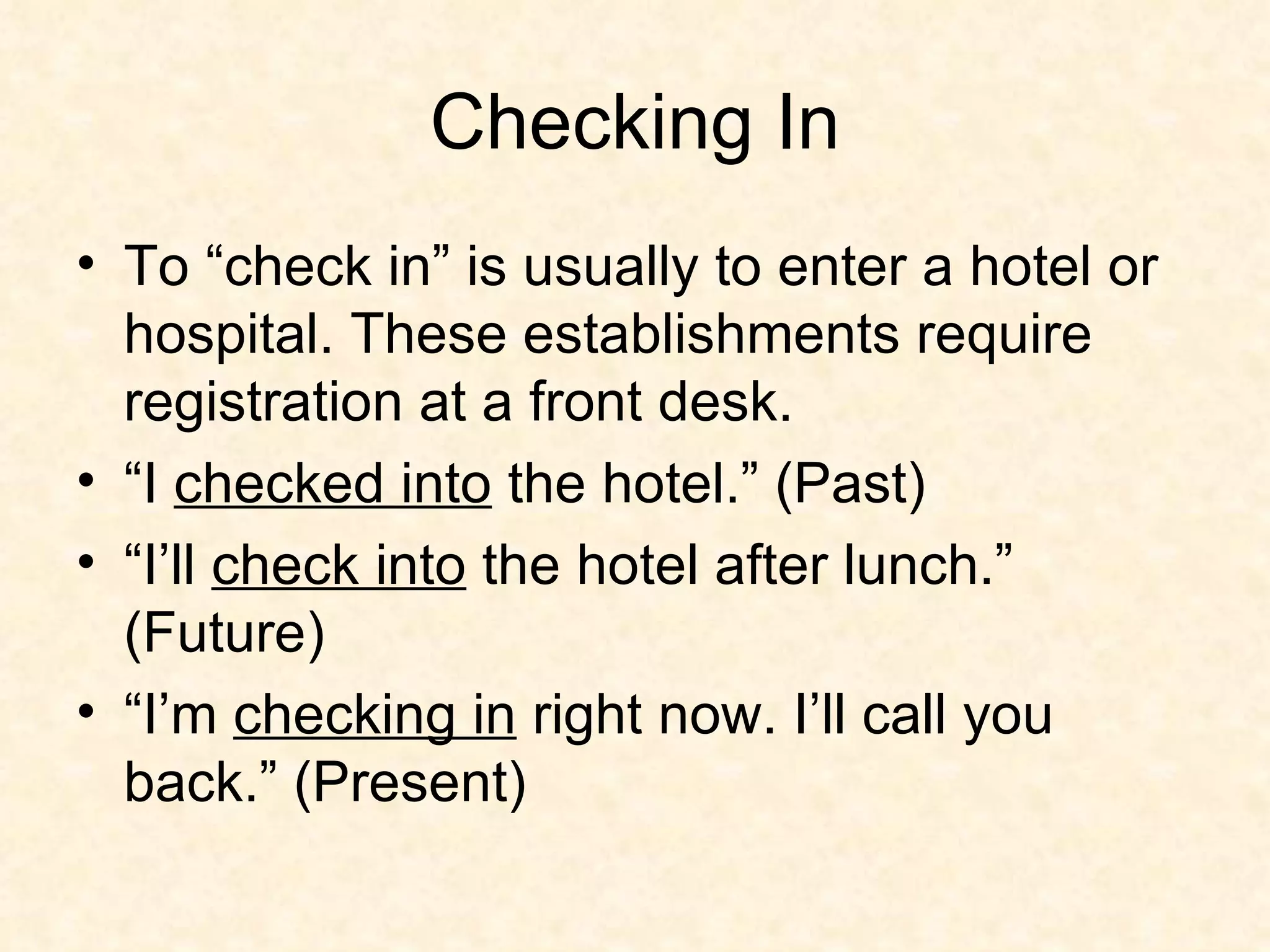
Checking In To “check in” is usually to enter a hotel or hospital. These establishments require registration at a front desk.  “I  checked into  the hotel.” (Past) “I’ll  check into  the hotel after lunch.” (Future) “I’m  checking in  right now. I’ll call you back.” (Present)
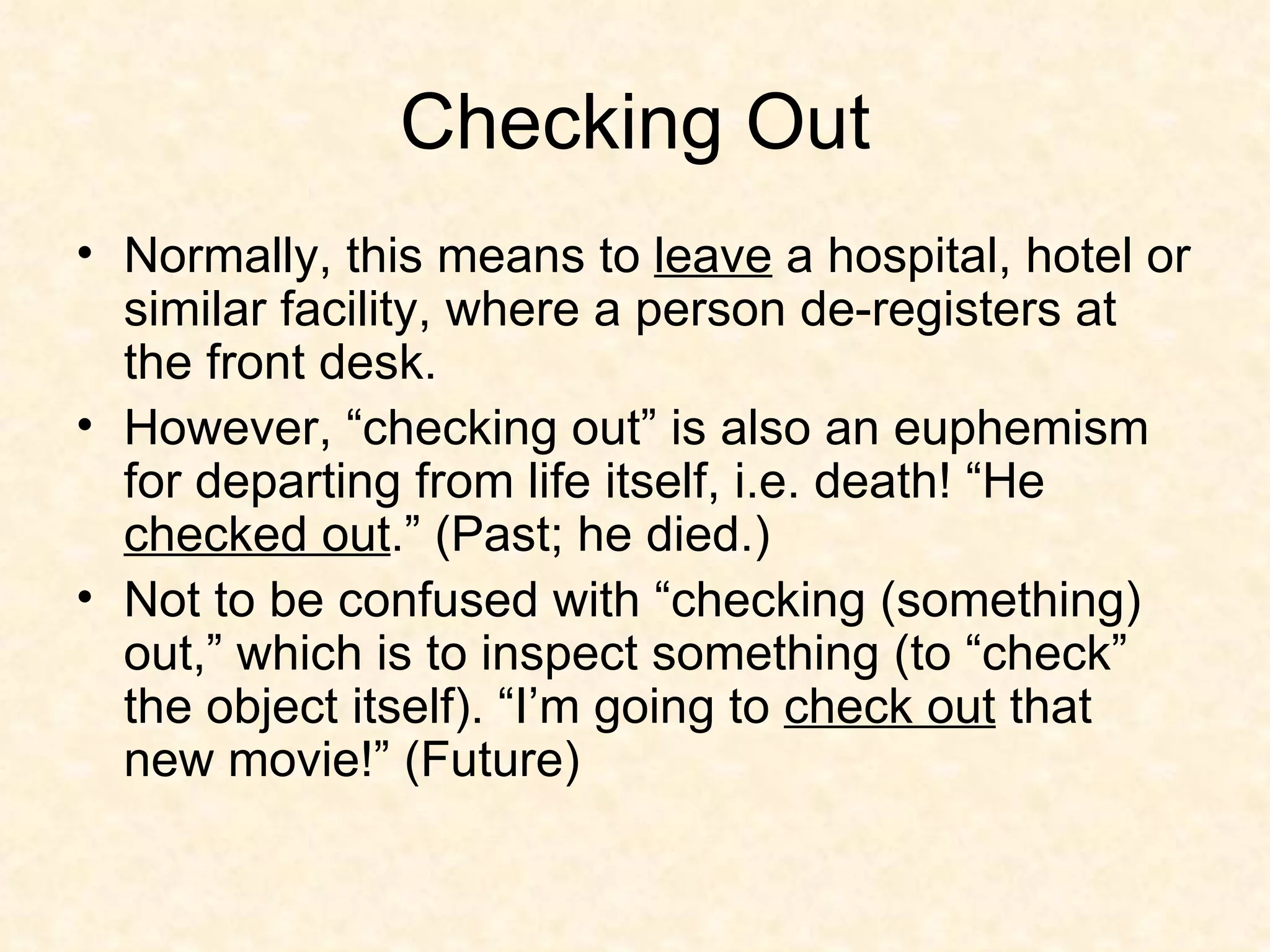
Checking Out Normally, this means to  leave  a hospital, hotel or similar facility, where a person de-registers at the front desk. However, “checking out” is also an euphemism for departing from life itself, i.e. death! “He  checked out .” (Past; he died.)  Not to be confused with “checking (something) out,” which is to inspect something (to “check” the object itself). “I’m going to  check out  that new movie!” (Future)
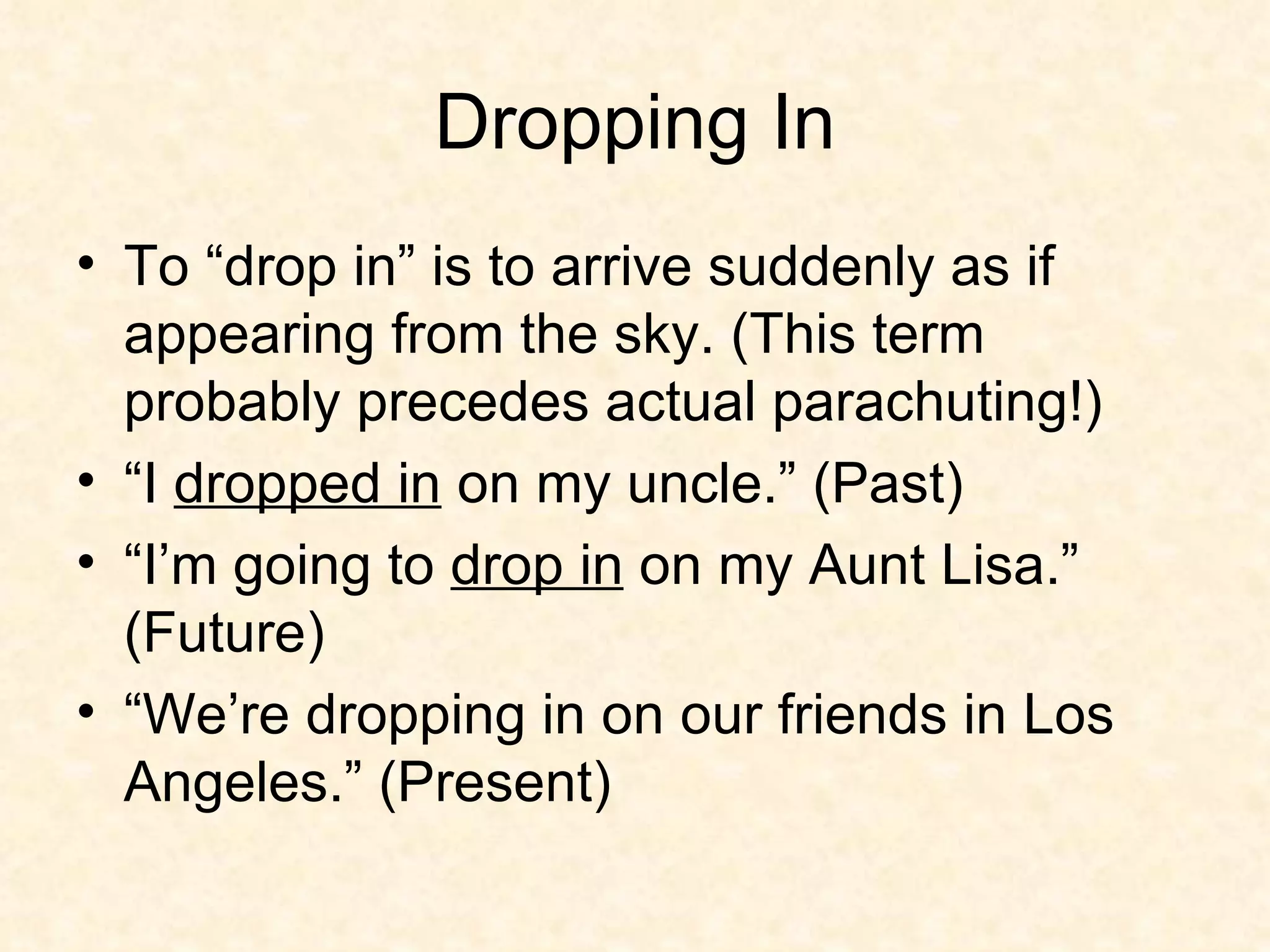
Dropping In To “drop in” is to arrive suddenly as if appearing from the sky. (This term probably precedes actual parachuting!)  “I  dropped in  on my uncle.” (Past) “I’m going to  drop in  on my Aunt Lisa.” (Future) “We’re dropping in on our friends in Los Angeles.” (Present)
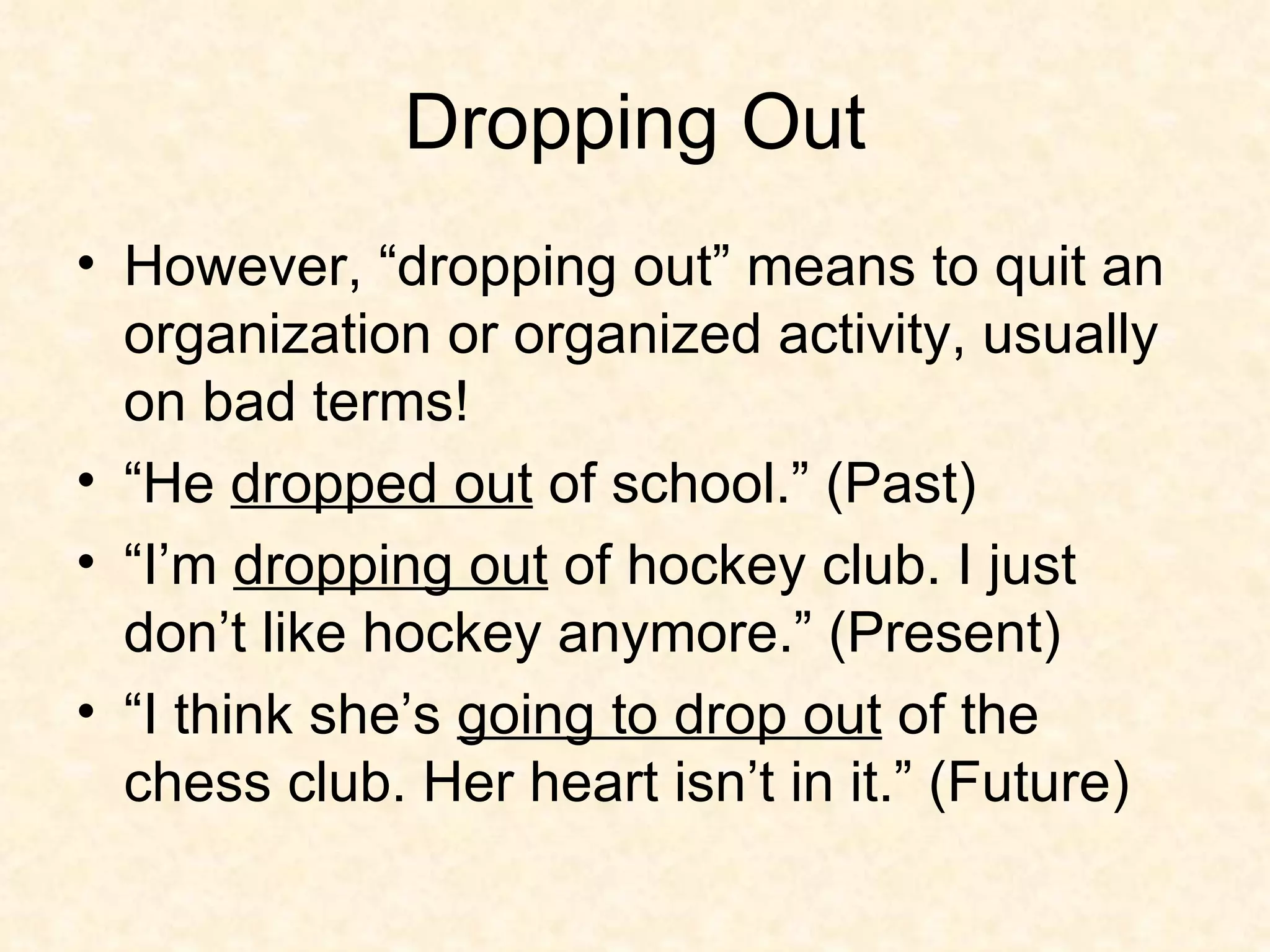
Dropping Out However, “dropping out” means to quit an organization or organized activity, usually on bad terms!  “He  dropped out  of school.” (Past) “I’m  dropping out  of hockey club. I just don’t like hockey anymore.” (Present) “I think she’s  going to drop out  of the chess club. Her heart isn’t in it.” (Future)
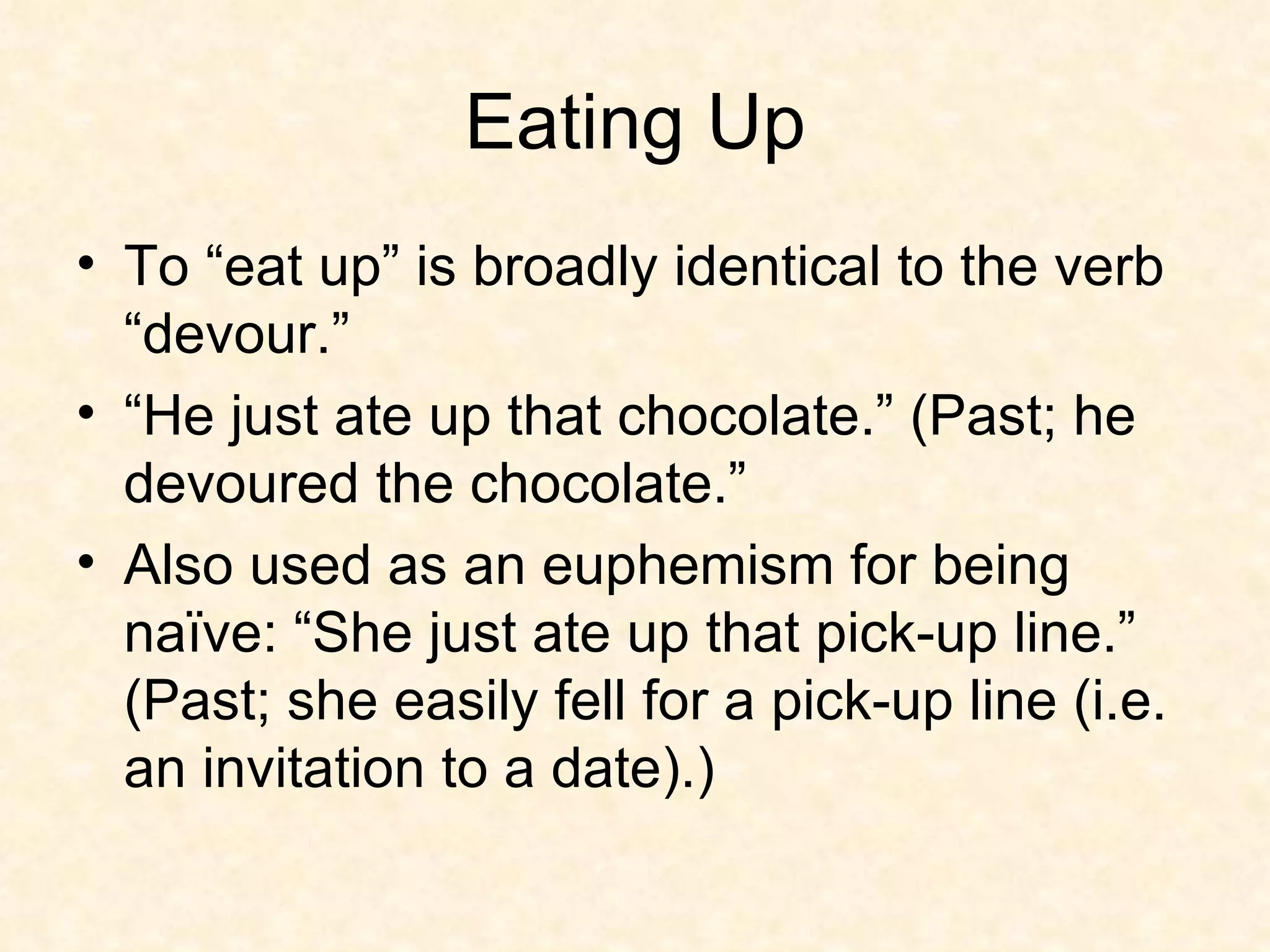
Eating Up To “eat up” is broadly identical to the verb “devour.”  “He just ate up that chocolate.” (Past; he devoured the chocolate.” Also used as an euphemism for being naïve: “She just ate up that pick-up line.” (Past; she easily fell for a pick-up line (i.e. an invitation to a date).)
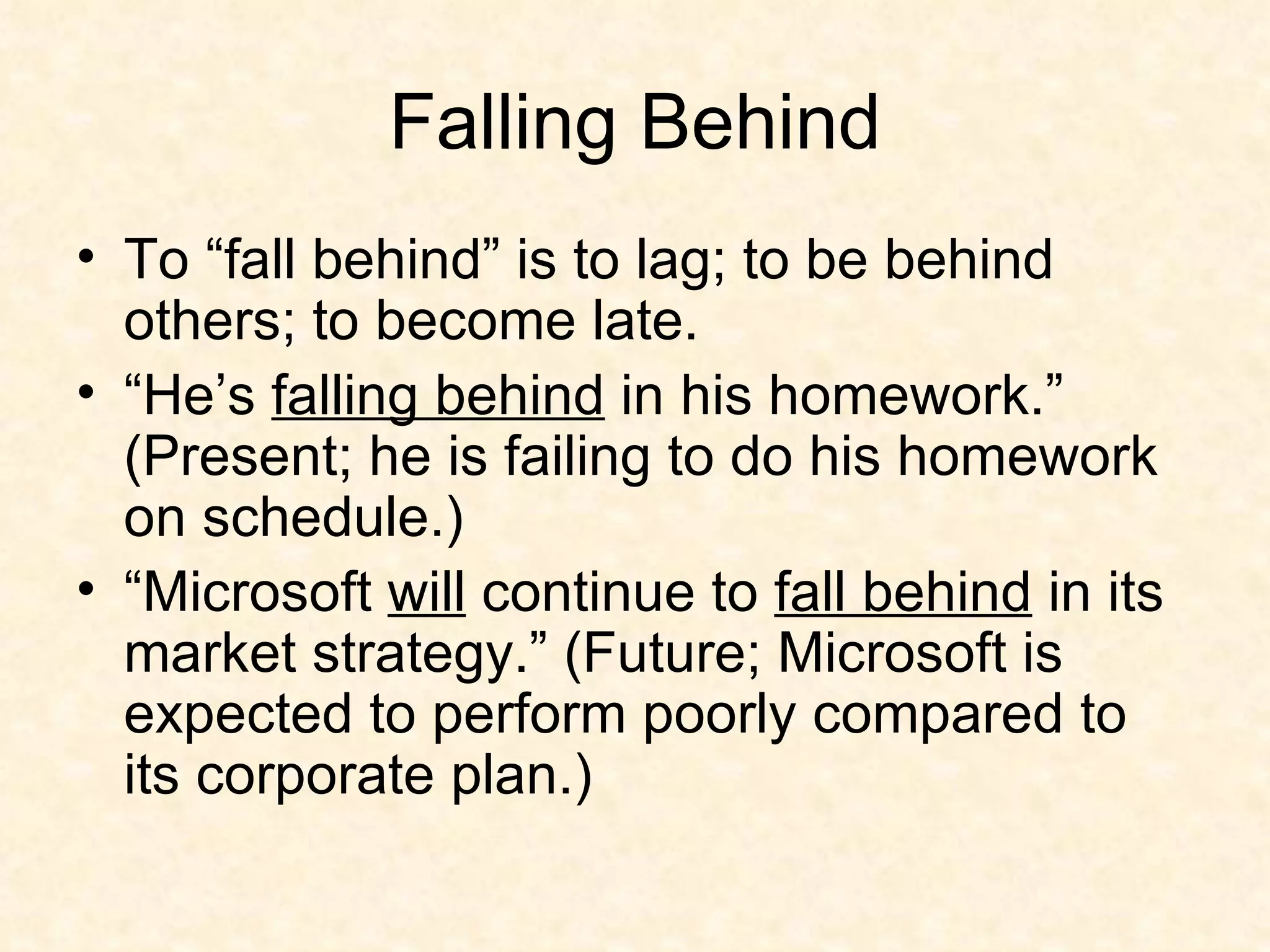
Falling Behind To “fall behind” is to lag; to be behind others; to become late.  “He’s  falling behind  in his homework.” (Present; he is failing to do his homework on schedule.) “Microsoft  will  continue to  fall behind  in its market strategy.” (Future; Microsoft is expected to perform poorly compared to its corporate plan.)
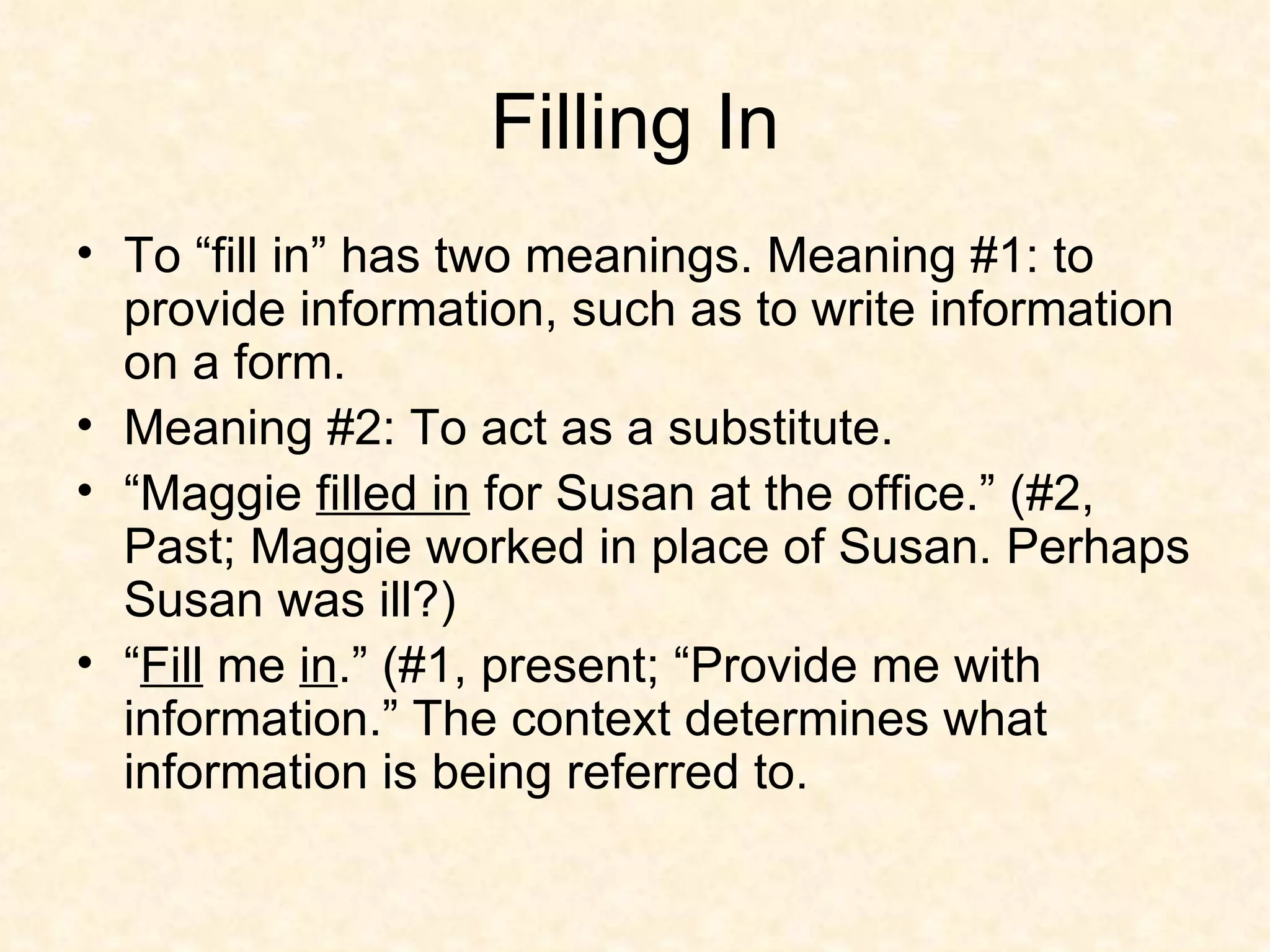
Filling In To “fill in” has two meanings. Meaning #1: to provide information, such as to write information on a form. Meaning #2: To act as a substitute.  “ Maggie  filled in  for Susan at the office.” (#2, Past; Maggie worked in place of Susan. Perhaps Susan was ill?) “ Fill  me  in .” (#1, present; “Provide me with information.” The context determines what information is being referred to.
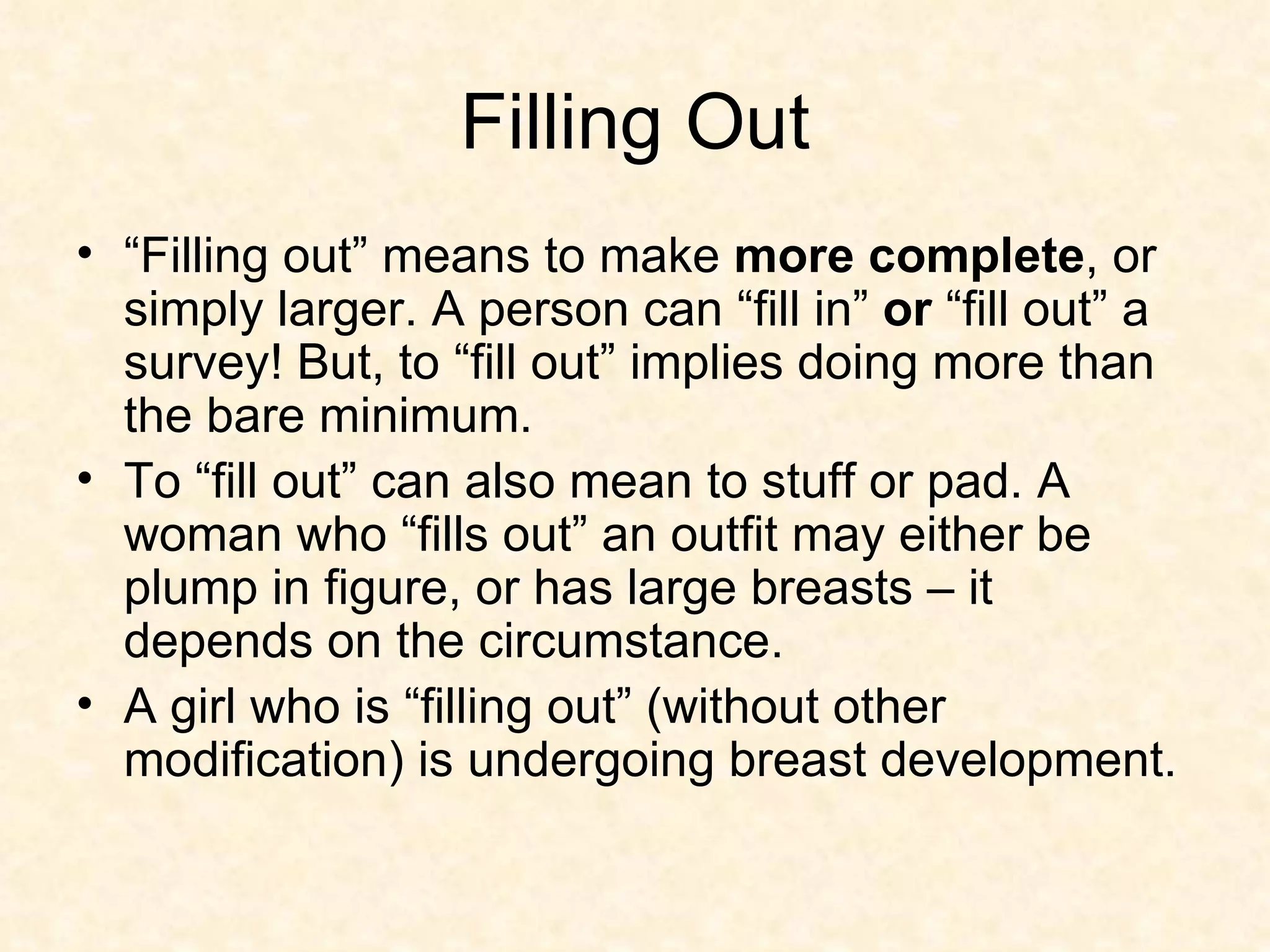
Filling Out “ Filling out” means to make  more complete , or simply larger. A person can “fill in”  or  “fill out” a survey! But, to “fill out” implies doing more than the bare minimum. To “fill out” can also mean to stuff or pad. A woman who “fills out” an outfit may either be plump in figure, or has large breasts – it depends on the circumstance. A girl who is “filling out” (without other modification) is undergoing breast development.
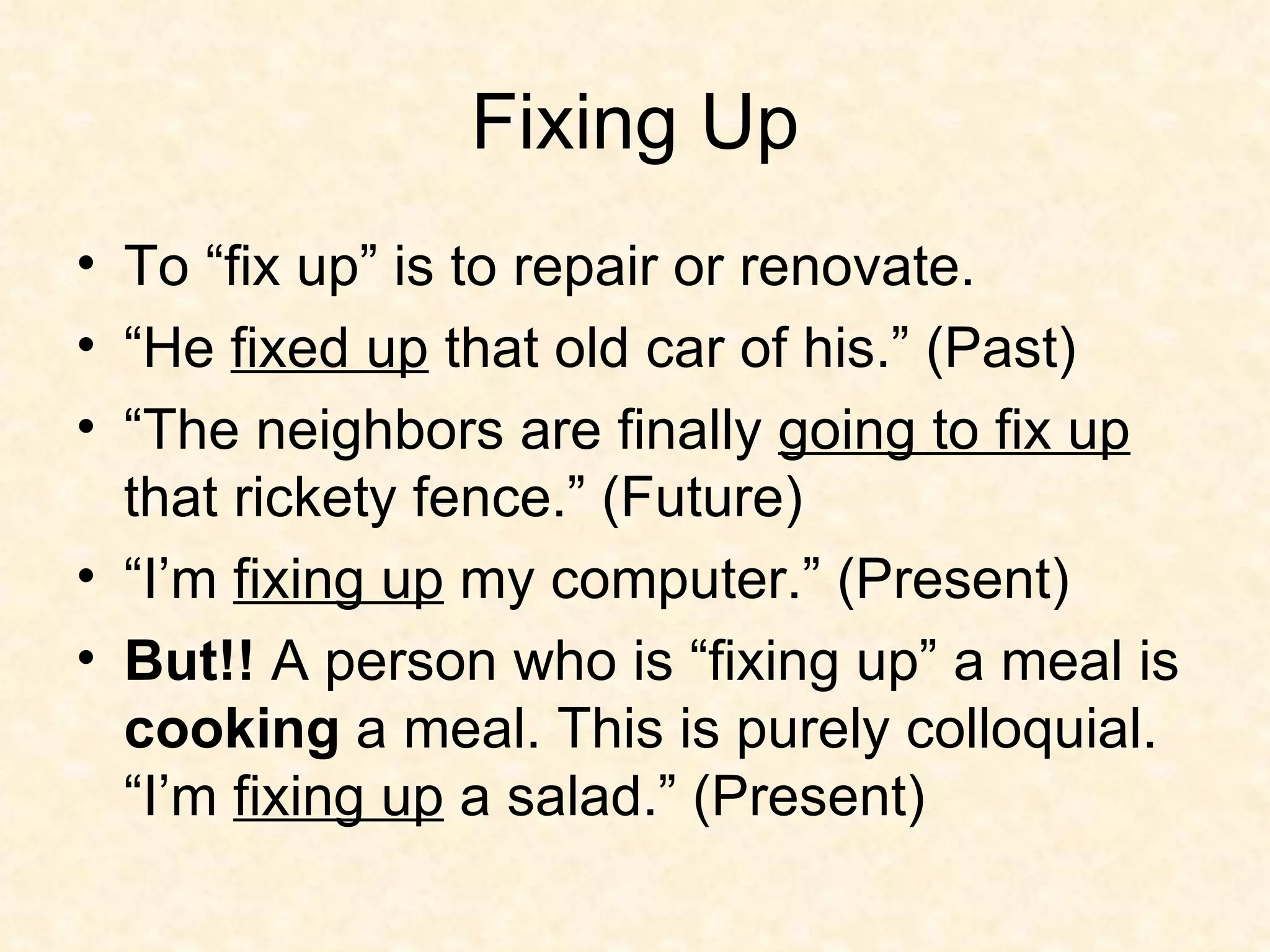
Fixing Up To “fix up” is to repair or renovate.  “He  fixed up  that old car of his.” (Past) “The neighbors are finally  going to fix up  that rickety fence.” (Future) “I’m  fixing up  my computer.” (Present) But!!  A person who is “fixing up” a meal is  cooking  a meal. This is purely colloquial. “I’m  fixing up  a salad.” (Present)
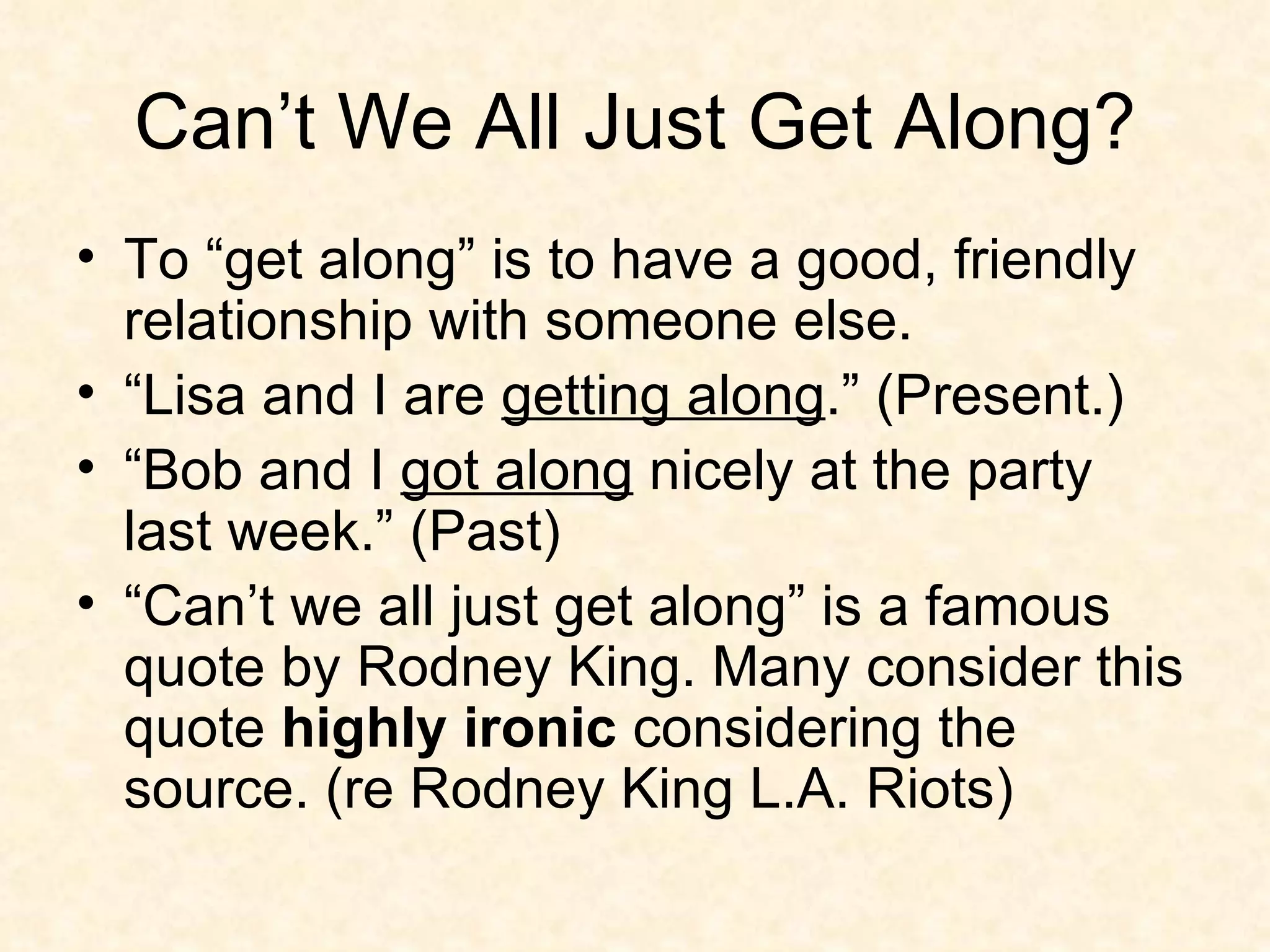
Can’t We All Just Get Along? To “get along” is to have a good, friendly relationship with someone else. “Lisa and I are  getting along .” (Present.) “Bob and I  got along  nicely at the party last week.” (Past) “Can’t we all just get along” is a famous quote by Rodney King. Many consider this quote  highly ironic  considering the source. (re Rodney King L.A. Riots)
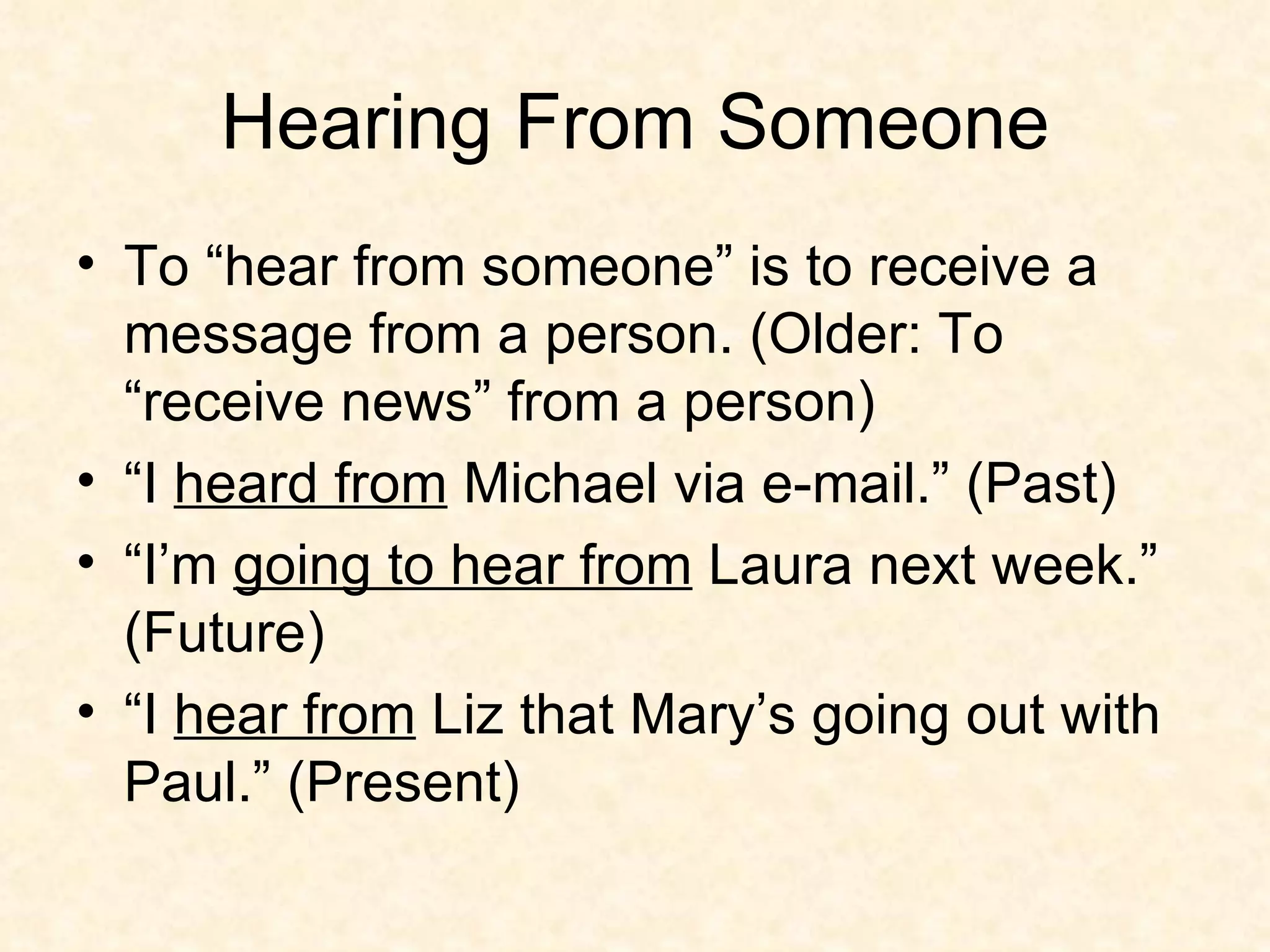
Hearing From Someone To “hear from someone” is to receive a message from a person. (Older: To “receive news” from a person) “I  heard from  Michael via e-mail.” (Past) “I’m  going to hear from  Laura next week.” (Future) “I  hear from  Liz that Mary’s going out with Paul.” (Present)
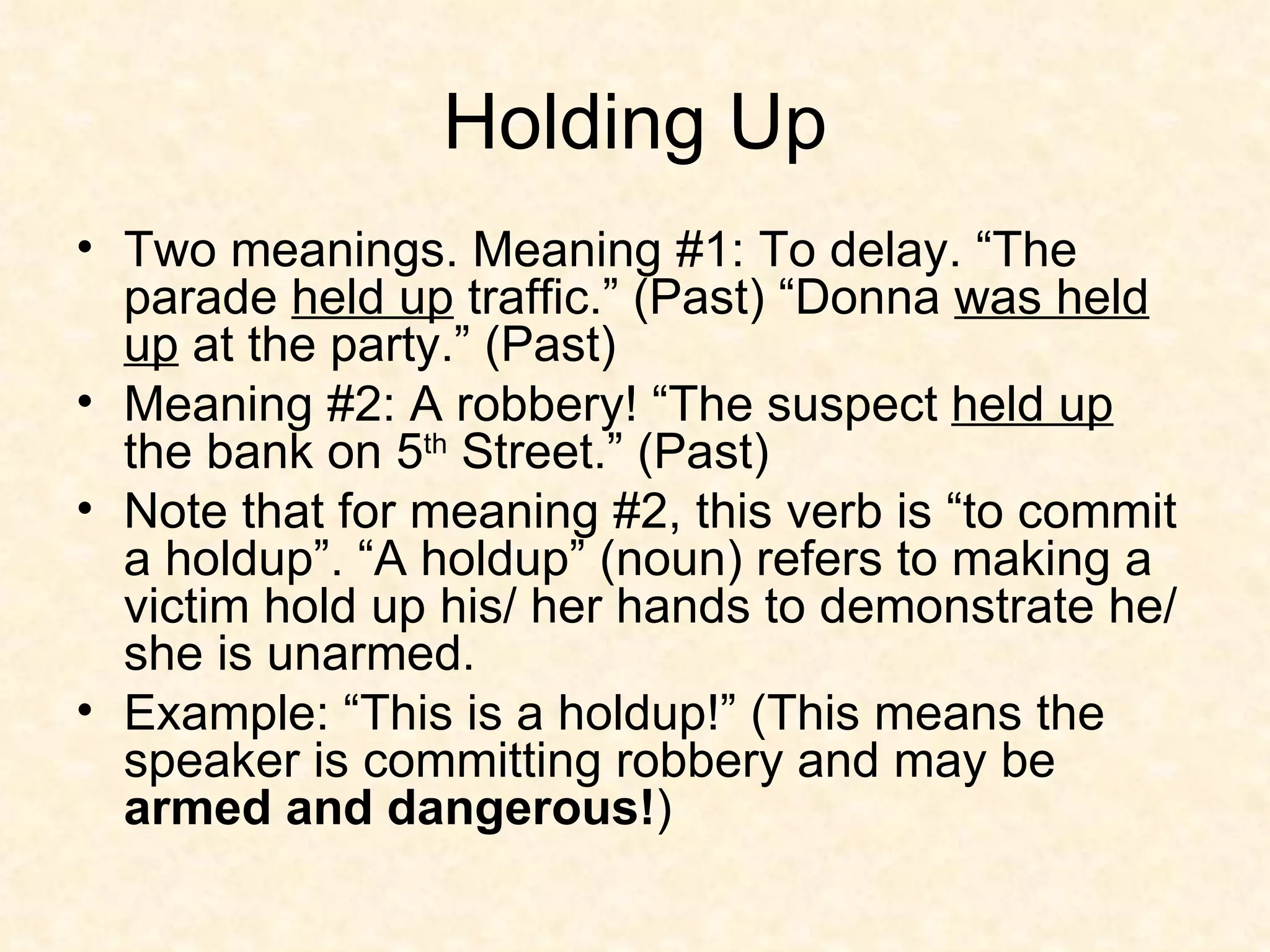
Holding Up Two meanings. Meaning #1: To delay. “The parade  held up  traffic.” (Past) “Donna  was held up  at the party.” (Past) Meaning #2: A robbery! “The suspect  held up  the bank on 5 th  Street.” (Past) Note that for meaning #2, this verb is “to commit a holdup”. “A holdup” (noun) refers to making a victim hold up his/ her hands to demonstrate he/ she is unarmed.  Example: “This is a holdup!” (This means the speaker is committing robbery and may be  armed and dangerous! )
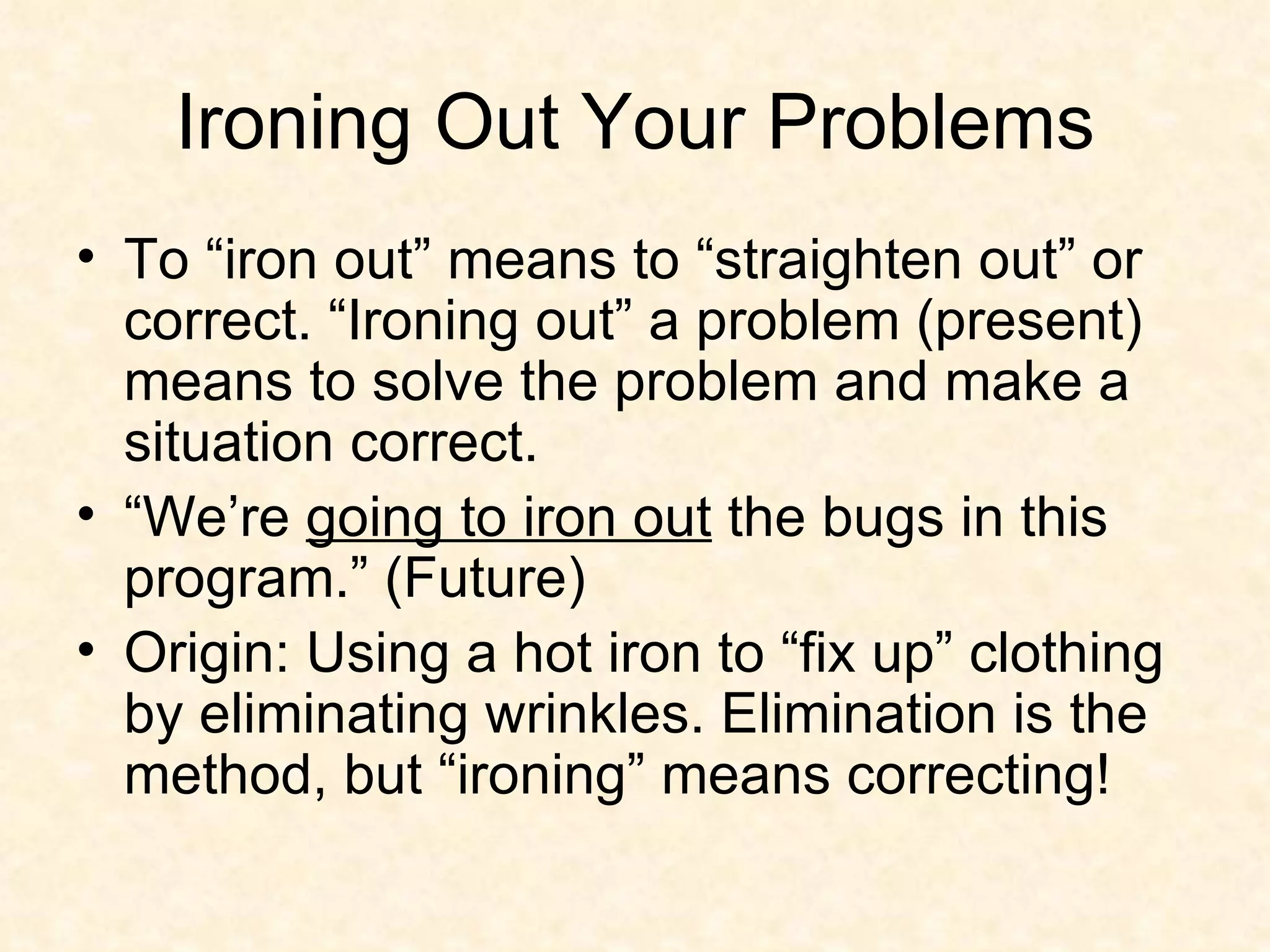
Ironing Out Your Problems To “iron out” means to “straighten out” or correct. “Ironing out” a problem (present) means to solve the problem and make a situation correct.  “We’re  going to iron out  the bugs in this program.” (Future)  Origin: Using a hot iron to “fix up” clothing by eliminating wrinkles. Elimination is the method, but “ironing” means correcting!
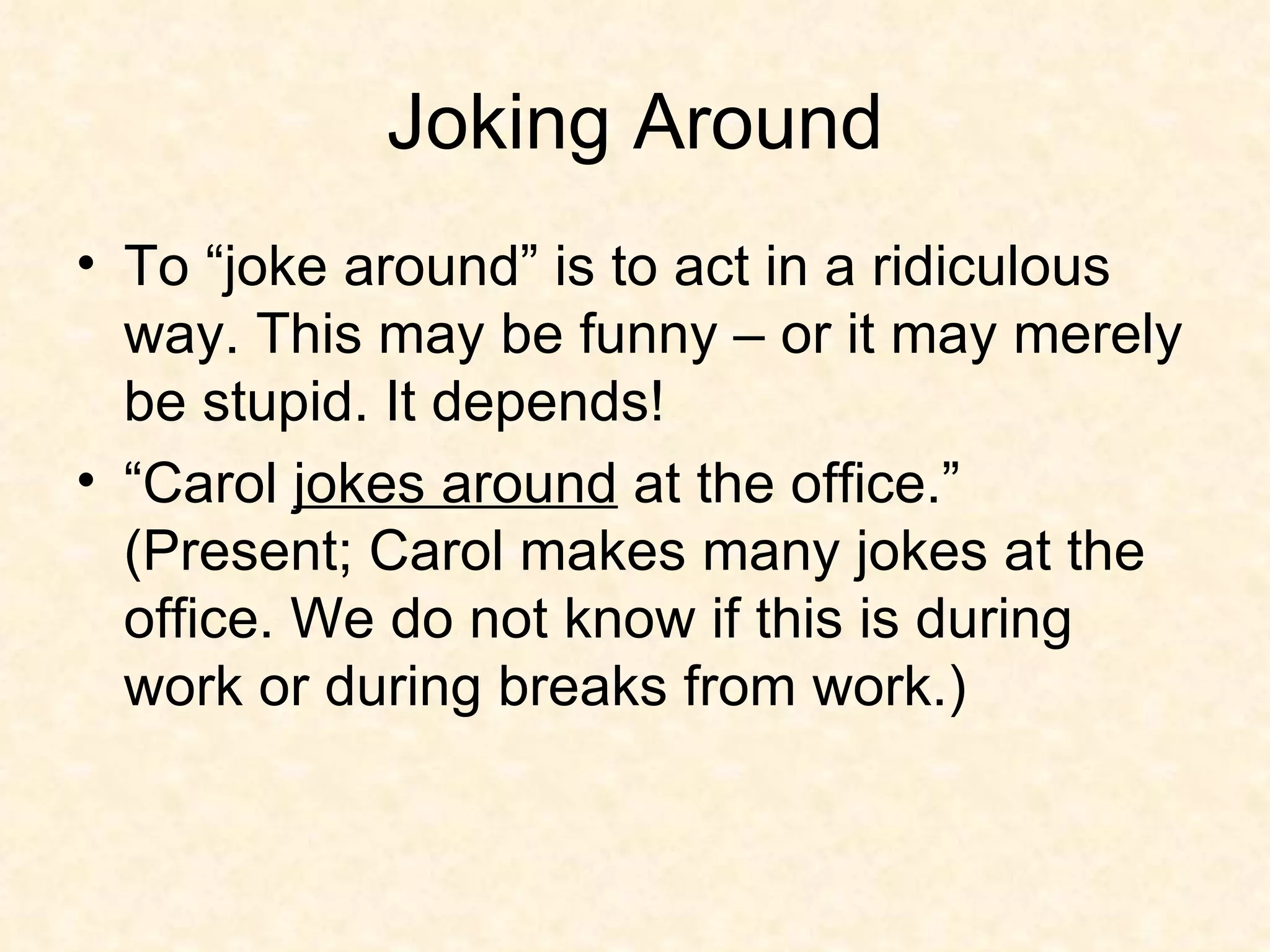
Joking Around To “joke around” is to act in a ridiculous way. This may be funny – or it may merely be stupid. It depends! “Carol  jokes around  at the office.” (Present; Carol makes many jokes at the office. We do not know if this is during work or during breaks from work.)
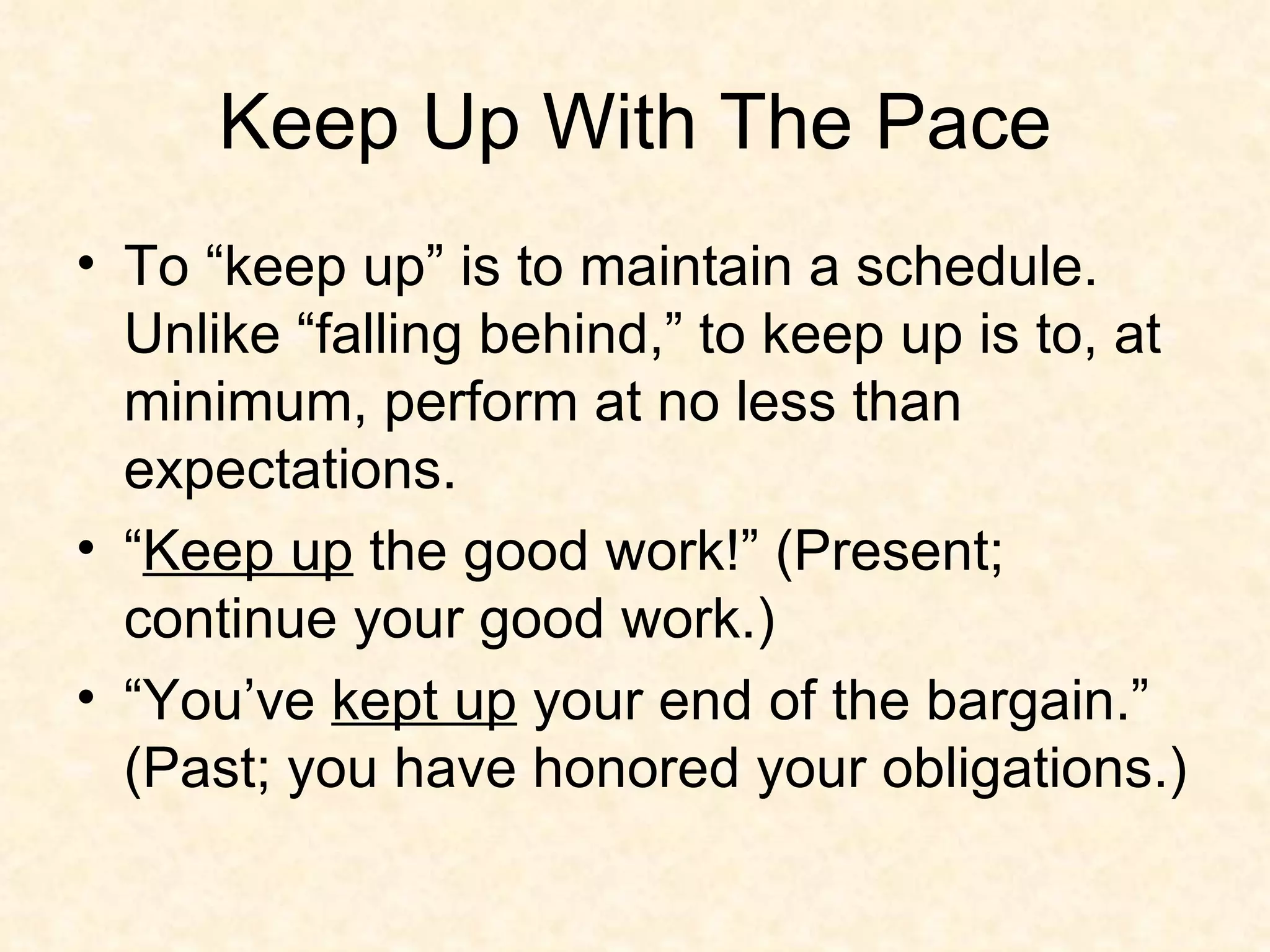
Keep Up With The Pace To “keep up” is to maintain a schedule. Unlike “falling behind,” to keep up is to, at minimum, perform at no less than expectations.  “ Keep up  the good work!” (Present; continue your good work.)  “You’ve  kept up  your end of the bargain.” (Past; you have honored your obligations.)
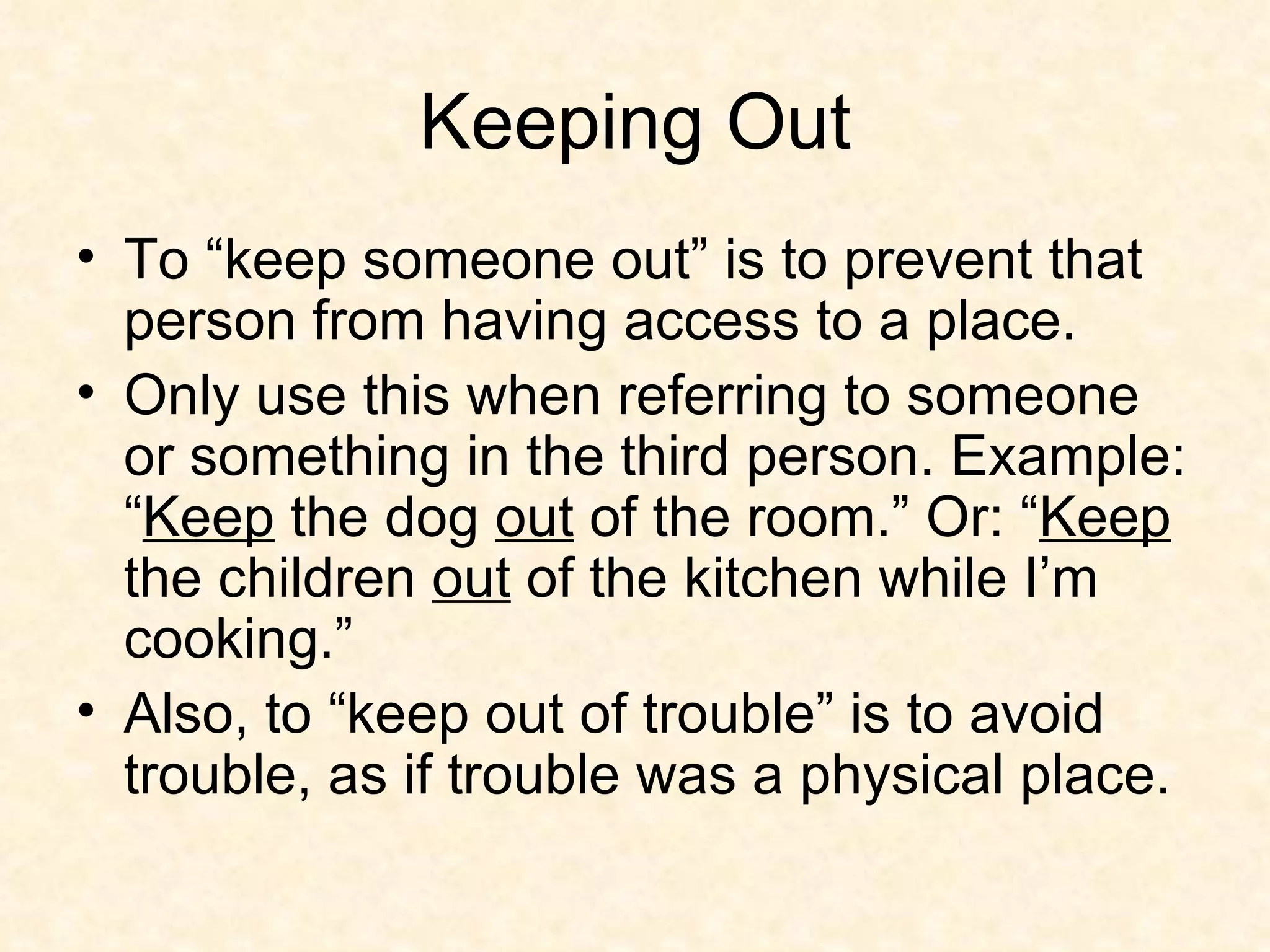
Keeping Out To “keep someone out” is to prevent that person from having access to a place.  Only use this when referring to someone or something in the third person. Example: “ Keep  the dog  out  of the room.” Or: “ Keep  the children  out  of the kitchen while I’m cooking.”  Also, to “keep out of trouble” is to avoid trouble, as if trouble was a physical place.
Leaving Out To “leave out” is to omit.  “I  left  Brian  out  of the trip.” (Past. Brian was omitted from the trip, i.e. left behind.) “I’m  leaving behind  my car because Paul is driving.” (Present)
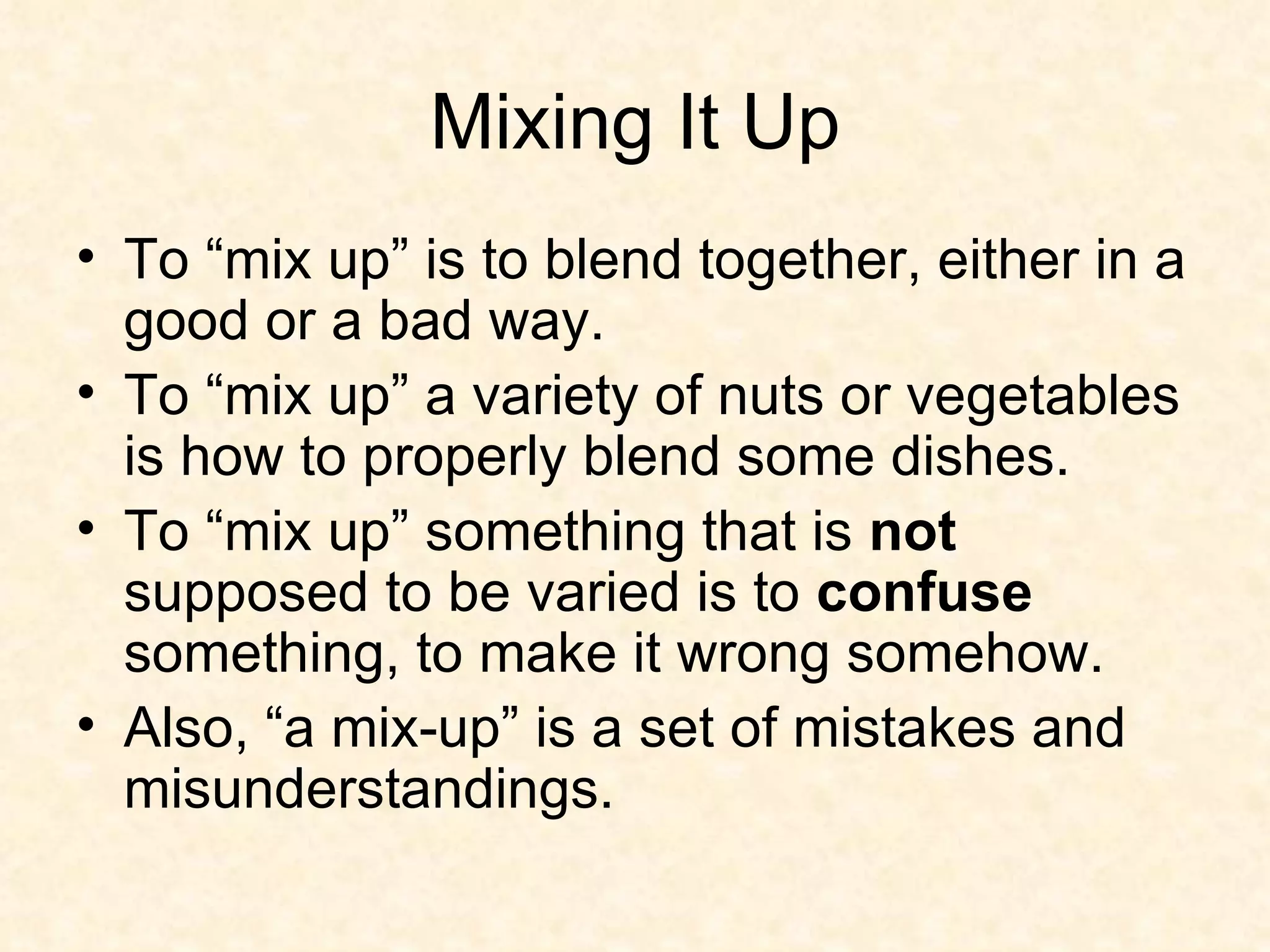
Mixing It Up To “mix up” is to blend together, either in a good or a bad way. To “mix up” a variety of nuts or vegetables is how to properly blend some dishes. To “mix up” something that is  not  supposed to be varied is to  confuse  something, to make it wrong somehow. Also, “a mix-up” is a set of mistakes and misunderstandings.
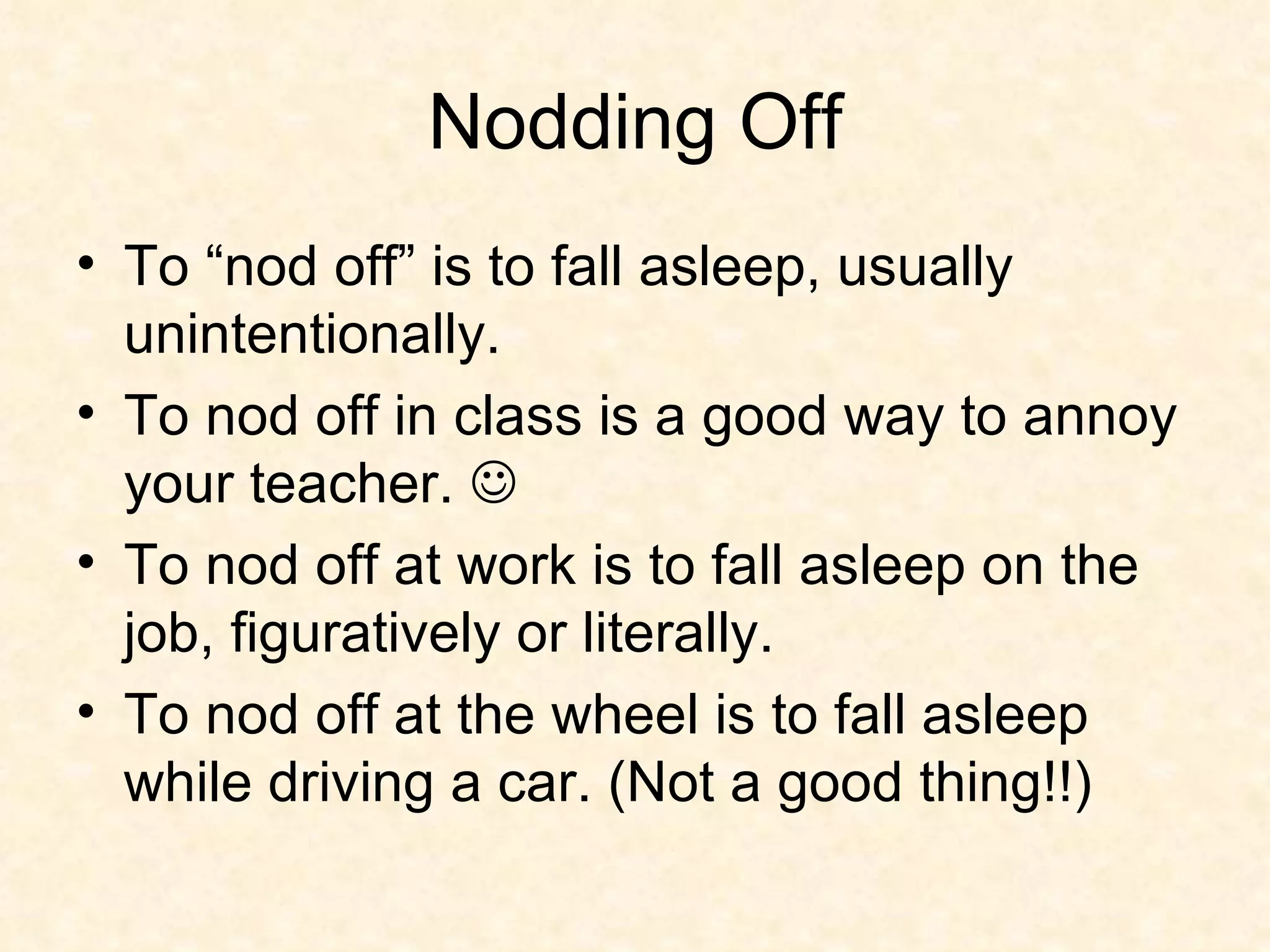
Nodding Off To “nod off” is to fall asleep, usually unintentionally. To nod off in class is a good way to annoy your teacher.   To nod off at work is to fall asleep on the job, figuratively or literally.  To nod off at the wheel is to fall asleep while driving a car. (Not a good thing!!)
Opening Up Normally, to “open up” has the same meaning as “to open” generally does. However, when speaking about emotional states, to “open up” is to become less defensive, warmer, friendlier, more relaxed, and so forth.  Opening up is a necessary part of learning conversation in ESL. Relax, don’t be shy.
Don’t Pick On Me! To “pick on someone” is to tease or bully that person. More broadly, it is to single that person out for negative treatment.  The expression implies someone stronger acting against someone weaker (bullying).
Quiet Down! (Well, don’t really.) “Quiet down” is a mix of “be quiet” and “settle down.” To be quiet is to be silent. To “settle down” is to begin acting calmly after a period of not acting calmly. A teacher might tell a class to “quiet down” when the students are speaking to each other in a disruptive way.
Running Out Of Luck To “run out” of something is to exhaust the supply of that thing.  To run out of luck is to be out of good luck. A movie villain might gloat, “Your luck has run out!” to a hero in difficulty. (Past tense)
I’ve Been Set Up! To “set up” a person is to arrange something for that person. This usually has two distinct and separate meanings. 1) To pair two people together romantically. 2) To frame a person for a criminal offense. Though I would not call it proper English, the noun “set-up” is an act of false incrimination, framing the victim for a crime of which he/ she is innocent.
Please Stand By To “stand by” is to wait.  If someone asks you to stand by, that person is asking you to wait for the time being.  “Please stand by for further instructions” means to wait for further instructions. It’s that simple.
Thinking Things Through To “think things through” is to consider whatever the “things” are with care and consideration. “You need to  think this through ” is urging the listener to think carefully about the results of his or her planned actions.
Using Up Your Nine Lives To “use up” is to exhaust a supply of something. In legend, “a cat has nine lives.” So to  use up  a person’s nine lives is to  run out  of luck, as covered earlier in the lesson.
Veering Off To “veer off” or “veer away” is to turn away from something, to stay away from something, or simply, to avoid something. “Veering off from danger” means turning away from danger. Simple.
Waiting Up To “wait up” originally meant to stay awake while waiting for someone or something. Modern usage has made “waiting up” virtually identical to the earlier “standing by.”  Asking someone to “Wait up!” is calling upon the person to wait where they are and allow the speaker to catch up.
Yakking On And On To “yak” or to “yammer” is an extremely informal reference to talking, and more specifically, talking in a very informal way, that is, not using “good English.”  To “yak on” or “yammer on” is to speak in such a manner in a continuous, annoying way, that is, to speak without pause and without any useful purpose.
Zoning Out To “zone out” is to lose focus. Conversely, to “zone in” is to focus on something, as if leaning closer to an object to take a closer look. Students are known to zone out at the end of a long class. Have you been zoning out, or did you manage to pay attention?     To be “zoned out” is to be fatigued to the point of lost focus. So get some rest!

Learn Out Live Eng Phrasal Verbs 1

  • 1.
    Early Intermediate EnglishPhrasal Verbs Lesson #1 By Jeremiah Bourque http://learnoutlive.com/
  • 2.
    Don’t Give UpNow To “give up” is to surrender; to stop trying; to no longer attempt to succeed at something. To urge someone to “not give up” is to urge that person to continue trying, even if that person faces adversity (difficulty).
  • 3.
    She’s Looking AfterThe Kids To “look after” someone is to take care of someone. Example: “Susan is looking after Donald and Megan.” (Present) Susan is taking care of the children named Donald and Megan.
  • 4.
    I’m Going ToFind Out What’s Going On To “find out” is to discover. To find out what’s going on is to discover what is happening (occurring now, in the present). Example: I’m going to find out where Donald went. (Future)
  • 5.
    Let Me CallYou Right Back To “call someone back” is to return a message, usually a telephone call. So to “call you right back,” a person is interrupting (halting) the current telephone conversation while making a promise to call the original caller in a short time. Example: Tom called Peter, but Peter was busy. Peter says, “I’ll call you right back , Tom.” Peter will call Tom soon.
  • 6.
    She Just BlewRight Up To “blow up” has three meanings. #1: To explode, like a suicide bomber.  #2: To inflate. To “blow up” a tire can mean to put air in the tire to inflate it… but it can be confused with meaning #1! #3: To become angry. Colloquially, to “blow up” in anger is to become angry enough to (figuratively) explode.
  • 7.
    Just Fill TheCar Right Up To “fill up” generally means to fill to the maximum (100% of capacity). To fill up a gas tank for a motor vehicle is to fill the tank to the maximum capacity. Something that is filled up (past) is full . Colloquially, “Fill her right up” is used to request enough gas to completely fill a gas tank at a drive-in gas station. (Her can sound more like “er” (written ‘er)).
  • 8.
    Get Over ItTo “get over” something is to recover. One can get over a cold, get over rejection by a boyfriend, or get over a disappointment. Commonly misused as a substitute for “come over,” as in, “ Get over here!” (Informal, rude.) To come over is to approach, to draw near, to move closer.
  • 9.
    I’m Not MakingThis Up To “make something up” (as opposed to the noun, “make-up,” for beauty cosmetics) is to fabricate a story for the purpose of deception and fraud (lying). “I’m not making this up ” (Present) is therefore claiming (through a double negative sentence) to be telling the truth . That is, to be honest.
  • 10.
    Don’t Sell MeOut To “sell someone out” is to betray that person, whether for money (the “sell” part) or not. To “sell out your country” is to commit treason . Usually, “selling out” (present) is an informal, colloquial way to allude to (compare with) treason and betrayal. This can simply mean betraying a friendship.
  • 11.
    Own Up ToWhat You’ve Done To “own up” to something is to admit that you have done something wrong. To confess a crime you have committed is to own up to the crime. Of course, you can only properly own up to an act you have actually committed. Otherwise you are simply lying. To “own up” implies you regret (verb, present) what you have done.
  • 12.
    Acting Up Whereto act is to perform an action, to “act up” is to behave improperly, to give rise to improper behavior. “My car is acting up again.” (Present) “That child acted up in class.” (Past) “I’m worried Tom is going to act up again if we take him to the theatre.” (Future)
  • 13.
    Backing Out To“back out” is to not keep a promise, engagement, deal, etc. “I thought we had a deal, but he backed out at the last second.” (Past) “He’s backing out on our arrangement.” (Present) “I’m worried the other side’s going to back out .” (Future)
  • 14.
    Backing Up Meaning#1: To move backwards or in reverse. “I backed up my car.” (Past) Meaning #2: To provide support, as if pushing someone from the rear to help them along. “I’m backing up my friend.” (Present) “If you see a bear, slowly back up .” (#1) “If someone’s struggling, back them up .” (#2)
  • 15.
    Blowing Over To“blow over” is to pass without causing great problems. Originally a reference to storms ; applied broadly to other matters. “Don’t worry, they always argue like this. It’ll blow over .” (Future) “The controversy blew over in record time.” (Past) Best used in past or future tense; the present “blowing over” sounds awkward.
  • 16.
    Calming Down To“calm down” is to relax oneself, or to make someone else relaxed, soothed, appeased, etc. “ Calm down!” (Present, to someone else) “ I was angry, but I calmed down .” (Past) “ She’ll calm down in a while.” (Future) Telling someone to calm down is urging them to calm themselves . This does not guarantee the person will! Some people find being told to calm down annoying, and the request will backfire!
  • 17.
    Checking In To“check in” is usually to enter a hotel or hospital. These establishments require registration at a front desk. “I checked into the hotel.” (Past) “I’ll check into the hotel after lunch.” (Future) “I’m checking in right now. I’ll call you back.” (Present)
  • 18.
    Checking Out Normally,this means to leave a hospital, hotel or similar facility, where a person de-registers at the front desk. However, “checking out” is also an euphemism for departing from life itself, i.e. death! “He checked out .” (Past; he died.) Not to be confused with “checking (something) out,” which is to inspect something (to “check” the object itself). “I’m going to check out that new movie!” (Future)
  • 19.
    Dropping In To“drop in” is to arrive suddenly as if appearing from the sky. (This term probably precedes actual parachuting!) “I dropped in on my uncle.” (Past) “I’m going to drop in on my Aunt Lisa.” (Future) “We’re dropping in on our friends in Los Angeles.” (Present)
  • 20.
    Dropping Out However,“dropping out” means to quit an organization or organized activity, usually on bad terms! “He dropped out of school.” (Past) “I’m dropping out of hockey club. I just don’t like hockey anymore.” (Present) “I think she’s going to drop out of the chess club. Her heart isn’t in it.” (Future)
  • 21.
    Eating Up To“eat up” is broadly identical to the verb “devour.” “He just ate up that chocolate.” (Past; he devoured the chocolate.” Also used as an euphemism for being naïve: “She just ate up that pick-up line.” (Past; she easily fell for a pick-up line (i.e. an invitation to a date).)
  • 22.
    Falling Behind To“fall behind” is to lag; to be behind others; to become late. “He’s falling behind in his homework.” (Present; he is failing to do his homework on schedule.) “Microsoft will continue to fall behind in its market strategy.” (Future; Microsoft is expected to perform poorly compared to its corporate plan.)
  • 23.
    Filling In To“fill in” has two meanings. Meaning #1: to provide information, such as to write information on a form. Meaning #2: To act as a substitute. “ Maggie filled in for Susan at the office.” (#2, Past; Maggie worked in place of Susan. Perhaps Susan was ill?) “ Fill me in .” (#1, present; “Provide me with information.” The context determines what information is being referred to.
  • 24.
    Filling Out “Filling out” means to make more complete , or simply larger. A person can “fill in” or “fill out” a survey! But, to “fill out” implies doing more than the bare minimum. To “fill out” can also mean to stuff or pad. A woman who “fills out” an outfit may either be plump in figure, or has large breasts – it depends on the circumstance. A girl who is “filling out” (without other modification) is undergoing breast development.
  • 25.
    Fixing Up To“fix up” is to repair or renovate. “He fixed up that old car of his.” (Past) “The neighbors are finally going to fix up that rickety fence.” (Future) “I’m fixing up my computer.” (Present) But!! A person who is “fixing up” a meal is cooking a meal. This is purely colloquial. “I’m fixing up a salad.” (Present)
  • 26.
    Can’t We AllJust Get Along? To “get along” is to have a good, friendly relationship with someone else. “Lisa and I are getting along .” (Present.) “Bob and I got along nicely at the party last week.” (Past) “Can’t we all just get along” is a famous quote by Rodney King. Many consider this quote highly ironic considering the source. (re Rodney King L.A. Riots)
  • 27.
    Hearing From SomeoneTo “hear from someone” is to receive a message from a person. (Older: To “receive news” from a person) “I heard from Michael via e-mail.” (Past) “I’m going to hear from Laura next week.” (Future) “I hear from Liz that Mary’s going out with Paul.” (Present)
  • 28.
    Holding Up Twomeanings. Meaning #1: To delay. “The parade held up traffic.” (Past) “Donna was held up at the party.” (Past) Meaning #2: A robbery! “The suspect held up the bank on 5 th Street.” (Past) Note that for meaning #2, this verb is “to commit a holdup”. “A holdup” (noun) refers to making a victim hold up his/ her hands to demonstrate he/ she is unarmed. Example: “This is a holdup!” (This means the speaker is committing robbery and may be armed and dangerous! )
  • 29.
    Ironing Out YourProblems To “iron out” means to “straighten out” or correct. “Ironing out” a problem (present) means to solve the problem and make a situation correct. “We’re going to iron out the bugs in this program.” (Future) Origin: Using a hot iron to “fix up” clothing by eliminating wrinkles. Elimination is the method, but “ironing” means correcting!
  • 30.
    Joking Around To“joke around” is to act in a ridiculous way. This may be funny – or it may merely be stupid. It depends! “Carol jokes around at the office.” (Present; Carol makes many jokes at the office. We do not know if this is during work or during breaks from work.)
  • 31.
    Keep Up WithThe Pace To “keep up” is to maintain a schedule. Unlike “falling behind,” to keep up is to, at minimum, perform at no less than expectations. “ Keep up the good work!” (Present; continue your good work.) “You’ve kept up your end of the bargain.” (Past; you have honored your obligations.)
  • 32.
    Keeping Out To“keep someone out” is to prevent that person from having access to a place. Only use this when referring to someone or something in the third person. Example: “ Keep the dog out of the room.” Or: “ Keep the children out of the kitchen while I’m cooking.” Also, to “keep out of trouble” is to avoid trouble, as if trouble was a physical place.
  • 33.
    Leaving Out To“leave out” is to omit. “I left Brian out of the trip.” (Past. Brian was omitted from the trip, i.e. left behind.) “I’m leaving behind my car because Paul is driving.” (Present)
  • 34.
    Mixing It UpTo “mix up” is to blend together, either in a good or a bad way. To “mix up” a variety of nuts or vegetables is how to properly blend some dishes. To “mix up” something that is not supposed to be varied is to confuse something, to make it wrong somehow. Also, “a mix-up” is a set of mistakes and misunderstandings.
  • 35.
    Nodding Off To“nod off” is to fall asleep, usually unintentionally. To nod off in class is a good way to annoy your teacher.  To nod off at work is to fall asleep on the job, figuratively or literally. To nod off at the wheel is to fall asleep while driving a car. (Not a good thing!!)
  • 36.
    Opening Up Normally,to “open up” has the same meaning as “to open” generally does. However, when speaking about emotional states, to “open up” is to become less defensive, warmer, friendlier, more relaxed, and so forth. Opening up is a necessary part of learning conversation in ESL. Relax, don’t be shy.
  • 37.
    Don’t Pick OnMe! To “pick on someone” is to tease or bully that person. More broadly, it is to single that person out for negative treatment. The expression implies someone stronger acting against someone weaker (bullying).
  • 38.
    Quiet Down! (Well,don’t really.) “Quiet down” is a mix of “be quiet” and “settle down.” To be quiet is to be silent. To “settle down” is to begin acting calmly after a period of not acting calmly. A teacher might tell a class to “quiet down” when the students are speaking to each other in a disruptive way.
  • 39.
    Running Out OfLuck To “run out” of something is to exhaust the supply of that thing. To run out of luck is to be out of good luck. A movie villain might gloat, “Your luck has run out!” to a hero in difficulty. (Past tense)
  • 40.
    I’ve Been SetUp! To “set up” a person is to arrange something for that person. This usually has two distinct and separate meanings. 1) To pair two people together romantically. 2) To frame a person for a criminal offense. Though I would not call it proper English, the noun “set-up” is an act of false incrimination, framing the victim for a crime of which he/ she is innocent.
  • 41.
    Please Stand ByTo “stand by” is to wait. If someone asks you to stand by, that person is asking you to wait for the time being. “Please stand by for further instructions” means to wait for further instructions. It’s that simple.
  • 42.
    Thinking Things ThroughTo “think things through” is to consider whatever the “things” are with care and consideration. “You need to think this through ” is urging the listener to think carefully about the results of his or her planned actions.
  • 43.
    Using Up YourNine Lives To “use up” is to exhaust a supply of something. In legend, “a cat has nine lives.” So to use up a person’s nine lives is to run out of luck, as covered earlier in the lesson.
  • 44.
    Veering Off To“veer off” or “veer away” is to turn away from something, to stay away from something, or simply, to avoid something. “Veering off from danger” means turning away from danger. Simple.
  • 45.
    Waiting Up To“wait up” originally meant to stay awake while waiting for someone or something. Modern usage has made “waiting up” virtually identical to the earlier “standing by.” Asking someone to “Wait up!” is calling upon the person to wait where they are and allow the speaker to catch up.
  • 46.
    Yakking On AndOn To “yak” or to “yammer” is an extremely informal reference to talking, and more specifically, talking in a very informal way, that is, not using “good English.” To “yak on” or “yammer on” is to speak in such a manner in a continuous, annoying way, that is, to speak without pause and without any useful purpose.
  • 47.
    Zoning Out To“zone out” is to lose focus. Conversely, to “zone in” is to focus on something, as if leaning closer to an object to take a closer look. Students are known to zone out at the end of a long class. Have you been zoning out, or did you manage to pay attention?  To be “zoned out” is to be fatigued to the point of lost focus. So get some rest!