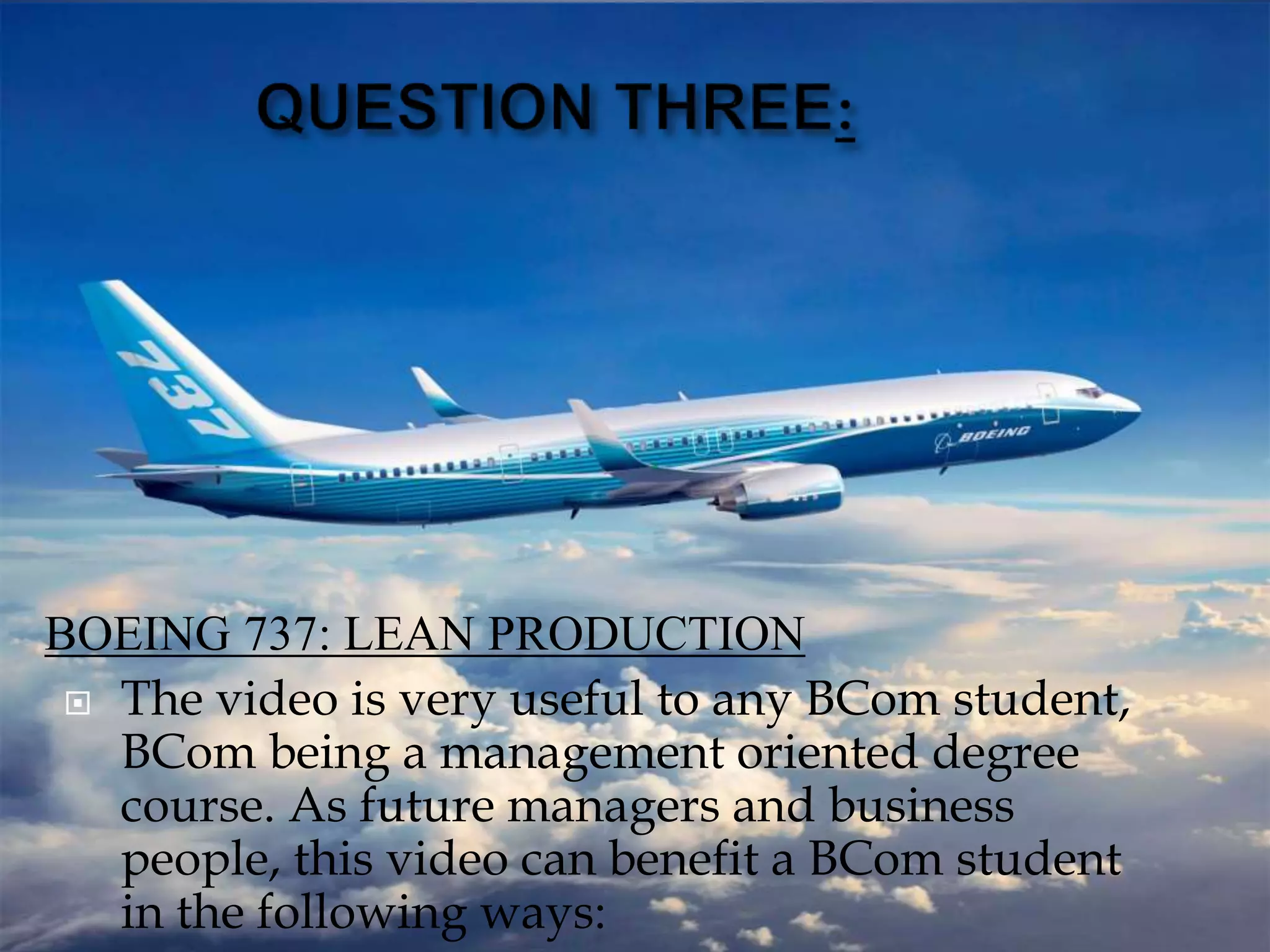
BOEING 737: LEAN PRODUCTION
 The video is very useful to any BCom student,
BCom being a management oriented degree
course. As future managers and business
people, this video can benefit a BCom student
in the following ways:
 This video is dedicated to a team of Boeing 737
employees who developed a new continuously
moving assembly line. This assembly line slowly
moves the aircraft being assembled from one
assembly team to the next. This keeps the aircraft
assembly at a steady pace, allowing employees to
gauge production status at a glance and reducing
the amount of work-in-process inventory.
 A B.Com student can therefore learn about the
importance of innovativeness in the work place
and its usefulness in the improvement of any
organization’s operations. Employee innovation is
key to any company’s business survival and
profitability.
 This is a lean production tool. It is a production
scheduling system meant to control the
logistical chain from a production point view.
This video is therefore very useful in
illustrating how the Kanban system works and
how it reduces muda.
 Kanban cards are employed to replenish parts
when stocks run low to ensure no muda in the
form of supply bottlenecks are non-existent.
This results in high quality aircraft delivered to
the customer in time.
 This is the practice of continuously improving
standardized production procedures and activities
aimed at eliminating waste. As in the video, all line
personnel are expected to stop their moving
production line in case of any abnormality. Rapid
response teams promptly respond to the problem.
Team members and supervisors suggest improvements
to resolve abnormalities, therefore initiating kaizen.
 Kaizen is therefore a fundamental concept that a
B.Com student can deduce from the video. Kaizen can
be useful to the student both as an individual through
application of its techniques such as the Plan, Do,
Check, Act cycle to enable continuous improvement of
the individual
 The innovation of the moving line assembly in this
video is not attributed to an individual but a whole
team in the production process. The Boeing production
process is broken down to teams of five members and a
team leader. Teamwork in the production process is
key to high quality aircraft and high levels of
productivity.
 The Boeing 737 assembly line is heavily dependent on
the involvement of all employees in the process.
Employees are empowered to stop the whole process
in case of any abnormalities and are actively involved
in improving the production process.
 All activities in the assembly line are performed
through formal teamwork.
 As in the video, kits at each production stage
contain standardized instructions and
equipment required for each specific job.
Developing and relying on standardized work
processes and equipment ensure high levels of
productivity and quality is maintained.
 This is therefore an important concept for the
B.Com student to grasp.
 The Boeing assembly line involves extensive
quality control procedures ranging use
standardized equipment and assembly
instructions to a monitoring system (called the
Pacer System) which monitors progress of the
whole process.
 There is a scorecard menu which records
whether production is at par with set targets.
This ensures that production is on schedule to
ensure the aircraft is delivered to the customer
on time as ordered.
 Japanese for ‘Making abnormalities visible’.
 Every team member is empowered to stop the
production process whenever an abnormality
is detected that a solution can be found
immediately. Therefore any problem is made
visible on the factory floor and it is displayed
on the Andon boards. Teams quickly respond
to the problem.
 Production is determined by the demand pull
from the customer. This way, Boeing will only
produce the type of aircraft needed by the
customer, when it is needed and in the optimal
desired quantities. Supplying "what is needed,
when it is needed, and in the amount needed"
according to this production plan can eliminate
waste, inconsistencies, and unreasonable
requirements, resulting in improved
productivity. Any manager or Bcom student
must therefore understand this production
system if they want to succeed in their careers.
GENERAL MOTORS
 Employee involvement in quality management
GM continues to drive a quality focus deeper into the company,
across all disciplines – from Design and Engineering, to
Manufacturing and Sales and Marketing. It is an enterprise-wide
approach to quality where every employee plays a role.
‘At GM, it’s about getting everything right for our customers –
from the way we design, engineer and manufacture our vehicles,
all the way through the ownership experience’.
 Continuous Improvement
GM boasts of a culture where they think creatively, consistently
innovate, and be leaner and more efficient. Over the course of our
everyday work, we focus on several areas where we can make a
difference, like more fuel-efficient vehicles, energy efficiency,
waste reduction and resource preservation
New Frontiers For Lean.
 It is an integrated social-technical system developed
by Toyota that comprises its management
philosophy and practices.
 Its main philosophies include elimination of waste ,
respect for people and continuous improvement. It’s
main objectives of the TPS are to design out
overburden (muri) and inconsistency (mura), and to
eliminate waste (muda).
 The Toyota production system is responsible for
having made Toyota the company it is today.
 The Toyota production system has come to be known today
as lean manufacturing system.
 Lean manufacturing system is defined as an integrated set
of activities designed to achieve high volume production
using minimum inventories. Lean production uses the same
principles as the Toyota production system.
 While lean is seen by many as a generalization of the
Toyota Production System into other industries and
contexts there are some acknowledged differences that
seem to have developed in implementation.
 One of the differences is that of Seeking profit. Seeking
profit is a relentless focus for Toyota exemplified by the
profit maximization principle (Price – Cost = Profit) and
the need, therefore, to practice systematic cost reduction to
realize benefit. Lean implementations can tend to de-
emphasize this key measure.
 The production or transport of just what is needed ,only when
it is needed ,only in the quantity needed.
 The parts arrive at the work station just in time for production
 It is a pillar of lean production and eliminates waste of
inventory.
 . JIT inventory systems expose hidden cost of keeping
inventory, and are therefore not a simple solution for a
company to adopt. The company must follow an array of new
methods to manage the consequences of the change. The ideas
in this way of working come from many different disciplines
including statistics, industrial engineering, production
management, and behavioral science. The JIT inventory
philosophy defines how inventory is viewed and how it relates
to management.
 It is a manufacturing term referring to a system to
notify management ,maintenance, and other workers
of a quality or process system.
 The centerpiece is a signboard incorporating signal
lights to indicate which workstation has the
problem. The alert can be activated manually by a
worker using a pull cord or button, or may be
activated automatically by the production equipment
itself.
 Once the Andon cord is activated the production line
stops and the problem is rectified.
 Kaizen refers to activities that continually improve all
functions and involve all employees from the chief executive
officer to assembly line workers. It is the practice of
continuous improvement.
 Kaizen is a daily process, the purpose of which goes beyond
simple productivity improvement. It is also a process that,
when done correctly, humanizes the workplace, eliminates
overly hard work , and teaches people how to perform
experiments on their work using the scientific method and
how to learn to spot and eliminate waste in business
processes. The format for kaizen can be individual,
suggestion system, small group, or large group. At Toyota, it
is usually a local improvement within a workstation or local
area and involves a small group in improving their own work
environment and productivity. This group is often guided
through the kaizen process by a line supervisor; sometimes
this is the line supervisor's key role.
 Was developed in 1908 by henry ford when he built the
first simple and affordable car that an average African
American could afford.
 The chassis automobile’s frame was assembled using
revolutionary industrial technique.it was then run on a
continuously moving assembly line . A motor and rope
pulled the chassis past workers and parts on the factory
floor, cutting the man-hours required to complete one
Model from 12-1/2 hours to six hours. Within a year,
further assembly line improvements reduced the time
required to 93 man-minutes. The staggering increase in
productivity effected by Ford's use of the moving
assembly line allowed him to drastically reduce the cost of
the Model T, thereby accomplishing his dream of making
the car affordable to ordinary consumers.
 According to the passage this served as arsenal of
development during world war two.
 It is a a scheduling system for lean and just-in-time
(JIT) production.
 Kanban is a system to control the logistical chain
from a production point of view, and is not an
inventory control system. It was developed by
Taiichi Ohno, at Toyota, as a subsystem of the
Toyota production system.
 Kanban helps to improve and maintain a high level
of production and is one method to achieve just in
time production.

Lean production in Toyota and Boeing

  • 1.
    BOEING 737: LEANPRODUCTION  The video is very useful to any BCom student, BCom being a management oriented degree course. As future managers and business people, this video can benefit a BCom student in the following ways:
  • 2.
     This videois dedicated to a team of Boeing 737 employees who developed a new continuously moving assembly line. This assembly line slowly moves the aircraft being assembled from one assembly team to the next. This keeps the aircraft assembly at a steady pace, allowing employees to gauge production status at a glance and reducing the amount of work-in-process inventory.  A B.Com student can therefore learn about the importance of innovativeness in the work place and its usefulness in the improvement of any organization’s operations. Employee innovation is key to any company’s business survival and profitability.
  • 3.
     This isa lean production tool. It is a production scheduling system meant to control the logistical chain from a production point view. This video is therefore very useful in illustrating how the Kanban system works and how it reduces muda.  Kanban cards are employed to replenish parts when stocks run low to ensure no muda in the form of supply bottlenecks are non-existent. This results in high quality aircraft delivered to the customer in time.
  • 4.
     This isthe practice of continuously improving standardized production procedures and activities aimed at eliminating waste. As in the video, all line personnel are expected to stop their moving production line in case of any abnormality. Rapid response teams promptly respond to the problem. Team members and supervisors suggest improvements to resolve abnormalities, therefore initiating kaizen.  Kaizen is therefore a fundamental concept that a B.Com student can deduce from the video. Kaizen can be useful to the student both as an individual through application of its techniques such as the Plan, Do, Check, Act cycle to enable continuous improvement of the individual
  • 5.
     The innovationof the moving line assembly in this video is not attributed to an individual but a whole team in the production process. The Boeing production process is broken down to teams of five members and a team leader. Teamwork in the production process is key to high quality aircraft and high levels of productivity.  The Boeing 737 assembly line is heavily dependent on the involvement of all employees in the process. Employees are empowered to stop the whole process in case of any abnormalities and are actively involved in improving the production process.  All activities in the assembly line are performed through formal teamwork.
  • 6.
     As inthe video, kits at each production stage contain standardized instructions and equipment required for each specific job. Developing and relying on standardized work processes and equipment ensure high levels of productivity and quality is maintained.  This is therefore an important concept for the B.Com student to grasp.
  • 7.
     The Boeingassembly line involves extensive quality control procedures ranging use standardized equipment and assembly instructions to a monitoring system (called the Pacer System) which monitors progress of the whole process.  There is a scorecard menu which records whether production is at par with set targets. This ensures that production is on schedule to ensure the aircraft is delivered to the customer on time as ordered.
  • 8.
     Japanese for‘Making abnormalities visible’.  Every team member is empowered to stop the production process whenever an abnormality is detected that a solution can be found immediately. Therefore any problem is made visible on the factory floor and it is displayed on the Andon boards. Teams quickly respond to the problem.
  • 9.
     Production isdetermined by the demand pull from the customer. This way, Boeing will only produce the type of aircraft needed by the customer, when it is needed and in the optimal desired quantities. Supplying "what is needed, when it is needed, and in the amount needed" according to this production plan can eliminate waste, inconsistencies, and unreasonable requirements, resulting in improved productivity. Any manager or Bcom student must therefore understand this production system if they want to succeed in their careers.
  • 10.
    GENERAL MOTORS  Employeeinvolvement in quality management GM continues to drive a quality focus deeper into the company, across all disciplines – from Design and Engineering, to Manufacturing and Sales and Marketing. It is an enterprise-wide approach to quality where every employee plays a role. ‘At GM, it’s about getting everything right for our customers – from the way we design, engineer and manufacture our vehicles, all the way through the ownership experience’.  Continuous Improvement GM boasts of a culture where they think creatively, consistently innovate, and be leaner and more efficient. Over the course of our everyday work, we focus on several areas where we can make a difference, like more fuel-efficient vehicles, energy efficiency, waste reduction and resource preservation
  • 11.
  • 12.
     It isan integrated social-technical system developed by Toyota that comprises its management philosophy and practices.  Its main philosophies include elimination of waste , respect for people and continuous improvement. It’s main objectives of the TPS are to design out overburden (muri) and inconsistency (mura), and to eliminate waste (muda).  The Toyota production system is responsible for having made Toyota the company it is today.
  • 13.
     The Toyotaproduction system has come to be known today as lean manufacturing system.  Lean manufacturing system is defined as an integrated set of activities designed to achieve high volume production using minimum inventories. Lean production uses the same principles as the Toyota production system.  While lean is seen by many as a generalization of the Toyota Production System into other industries and contexts there are some acknowledged differences that seem to have developed in implementation.  One of the differences is that of Seeking profit. Seeking profit is a relentless focus for Toyota exemplified by the profit maximization principle (Price – Cost = Profit) and the need, therefore, to practice systematic cost reduction to realize benefit. Lean implementations can tend to de- emphasize this key measure.
  • 14.
     The productionor transport of just what is needed ,only when it is needed ,only in the quantity needed.  The parts arrive at the work station just in time for production  It is a pillar of lean production and eliminates waste of inventory.  . JIT inventory systems expose hidden cost of keeping inventory, and are therefore not a simple solution for a company to adopt. The company must follow an array of new methods to manage the consequences of the change. The ideas in this way of working come from many different disciplines including statistics, industrial engineering, production management, and behavioral science. The JIT inventory philosophy defines how inventory is viewed and how it relates to management.
  • 15.
     It isa manufacturing term referring to a system to notify management ,maintenance, and other workers of a quality or process system.  The centerpiece is a signboard incorporating signal lights to indicate which workstation has the problem. The alert can be activated manually by a worker using a pull cord or button, or may be activated automatically by the production equipment itself.  Once the Andon cord is activated the production line stops and the problem is rectified.
  • 16.
     Kaizen refersto activities that continually improve all functions and involve all employees from the chief executive officer to assembly line workers. It is the practice of continuous improvement.  Kaizen is a daily process, the purpose of which goes beyond simple productivity improvement. It is also a process that, when done correctly, humanizes the workplace, eliminates overly hard work , and teaches people how to perform experiments on their work using the scientific method and how to learn to spot and eliminate waste in business processes. The format for kaizen can be individual, suggestion system, small group, or large group. At Toyota, it is usually a local improvement within a workstation or local area and involves a small group in improving their own work environment and productivity. This group is often guided through the kaizen process by a line supervisor; sometimes this is the line supervisor's key role.
  • 17.
     Was developedin 1908 by henry ford when he built the first simple and affordable car that an average African American could afford.  The chassis automobile’s frame was assembled using revolutionary industrial technique.it was then run on a continuously moving assembly line . A motor and rope pulled the chassis past workers and parts on the factory floor, cutting the man-hours required to complete one Model from 12-1/2 hours to six hours. Within a year, further assembly line improvements reduced the time required to 93 man-minutes. The staggering increase in productivity effected by Ford's use of the moving assembly line allowed him to drastically reduce the cost of the Model T, thereby accomplishing his dream of making the car affordable to ordinary consumers.  According to the passage this served as arsenal of development during world war two.
  • 18.
     It isa a scheduling system for lean and just-in-time (JIT) production.  Kanban is a system to control the logistical chain from a production point of view, and is not an inventory control system. It was developed by Taiichi Ohno, at Toyota, as a subsystem of the Toyota production system.  Kanban helps to improve and maintain a high level of production and is one method to achieve just in time production.