The Value of Lean
Thinking
Presented by:
Brian D Krichbaum
Process
Coaching
Incorporated
Process
Coaching
Incorporated
Page 1 of 46
© 2008 Process Coaching Incorporated
What is Lean Thinking?
A systematic approach to identifying and
through continuous improvement
by flowing the service or product at the pull
in pursuit of perfection.
eliminating waste
of customers
Process
Coaching
Incorporated
Page 2 of 46
© 2008 Process Coaching Incorporated
History of Lean Manufacturing
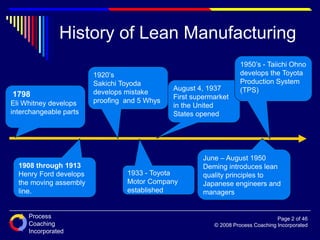
1798
Eli Whitney develops
interchangeable parts
1933 - Toyota
Motor Company
established
1908 through 1913
Henry Ford develops
the moving assembly
line.
1920’s
Sakichi Toyoda
develops mistake
proofing and 5 Whys
August 4, 1937
First supermarket
in the United
States opened
June – August 1950
Deming introduces lean
quality principles to
Japanese engineers and
managers
1950’s - Taiichi Ohno
develops the Toyota
Production System
(TPS)
Process
Coaching
Incorporated
Page 3 of 46
© 2008 Process Coaching Incorporated
Benefits of Lean Production
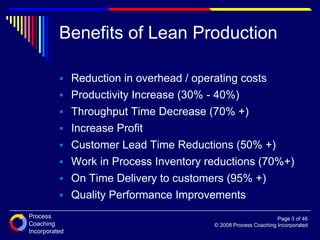
 Reduction in overhead / operating costs
 Productivity Increase (30% - 40%)
 Throughput Time Decrease (70% +)
 Increase Profit
 Customer Lead Time Reductions (50% +)
 Work in Process Inventory reductions (70%+)
 On Time Delivery to customers (95% +)
 Quality Performance Improvements
Process
Coaching
Incorporated
Page 4 of 46
© 2008 Process Coaching Incorporated
The Eight Deadly Wastes
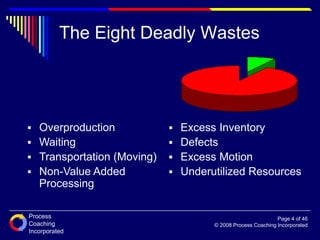
 Overproduction
 Waiting
 Transportation (Moving)
 Non-Value Added
Processing
 Excess Inventory
 Defects
 Excess Motion
 Underutilized Resources
Process
Coaching
Incorporated
Page 5 of 46
© 2008 Process Coaching Incorporated
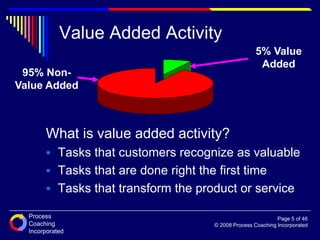
Value Added Activity
What is value added activity?
 Tasks that customers recognize as valuable
 Tasks that are done right the first time
 Tasks that transform the product or service
5% Value
Added
95% Non-
Value Added
Process
Coaching
Incorporated
Page 6 of 46
© 2008 Process Coaching Incorporated
Lean Manufacturing Principles1
 Specify Value
 Identify the Value Stream
 Make value creating steps flow
 Let the customer pull product
 Strive towards Perfection
1James Womack, Lean Thinking, (Simon & Schuster, 1996), p. 16 - 26
Process
Coaching
Incorporated
Page 7 of 46
© 2008 Process Coaching Incorporated
Lean Manufacturing Principles
 Correctly specifying value is critical in lean
thinking
 Providing the wrong good or service the
correct way is still waste
 Value must be defined in terms of specific
products at specific prices at specific times
 Only the ultimate customer can define value
– but they often don’t know how to do it!
Specify Value
Process
Coaching
Incorporated
Page 8 of 46
© 2008 Process Coaching Incorporated
 Customers and producers must challenge old
value definitions and work together to define
what is needed – not just a better widget
 Look at the “whole” product – not just the
features, but how it is used – to determine it’s
requirements
 Define the Target Cost (the cost of producing
the product waste free)
Lean Manufacturing Principles
Specify Value
Process
Coaching
Incorporated
Page 9 of 46
© 2008 Process Coaching Incorporated
 When the steps for producing a product aren’t
identified, they can’t be challenged
 The purpose of value stream mapping is to
identify waste
 We map the current state and the future
(lean) state
 All value streams have internal (our plant) and
external (our plant + suppliers + customers)
components
Lean Manufacturing Principles
Identify the Value Stream

Lean Manufacturing Overview in Engineering

  • 1.
    The Value ofLean Thinking Presented by: Brian D Krichbaum Process Coaching Incorporated
  • 2.
    Process Coaching Incorporated Page 1 of46 © 2008 Process Coaching Incorporated What is Lean Thinking? A systematic approach to identifying and through continuous improvement by flowing the service or product at the pull in pursuit of perfection. eliminating waste of customers
  • 3.
    Process Coaching Incorporated Page 2 of46 © 2008 Process Coaching Incorporated History of Lean Manufacturing 1798 Eli Whitney develops interchangeable parts 1933 - Toyota Motor Company established 1908 through 1913 Henry Ford develops the moving assembly line. 1920’s Sakichi Toyoda develops mistake proofing and 5 Whys August 4, 1937 First supermarket in the United States opened June – August 1950 Deming introduces lean quality principles to Japanese engineers and managers 1950’s - Taiichi Ohno develops the Toyota Production System (TPS)
  • 4.
    Process Coaching Incorporated Page 3 of46 © 2008 Process Coaching Incorporated Benefits of Lean Production  Reduction in overhead / operating costs  Productivity Increase (30% - 40%)  Throughput Time Decrease (70% +)  Increase Profit  Customer Lead Time Reductions (50% +)  Work in Process Inventory reductions (70%+)  On Time Delivery to customers (95% +)  Quality Performance Improvements
  • 5.
    Process Coaching Incorporated Page 4 of46 © 2008 Process Coaching Incorporated The Eight Deadly Wastes  Overproduction  Waiting  Transportation (Moving)  Non-Value Added Processing  Excess Inventory  Defects  Excess Motion  Underutilized Resources
  • 6.
    Process Coaching Incorporated Page 5 of46 © 2008 Process Coaching Incorporated Value Added Activity What is value added activity?  Tasks that customers recognize as valuable  Tasks that are done right the first time  Tasks that transform the product or service 5% Value Added 95% Non- Value Added
  • 7.
    Process Coaching Incorporated Page 6 of46 © 2008 Process Coaching Incorporated Lean Manufacturing Principles1  Specify Value  Identify the Value Stream  Make value creating steps flow  Let the customer pull product  Strive towards Perfection 1James Womack, Lean Thinking, (Simon & Schuster, 1996), p. 16 - 26
  • 8.
    Process Coaching Incorporated Page 7 of46 © 2008 Process Coaching Incorporated Lean Manufacturing Principles  Correctly specifying value is critical in lean thinking  Providing the wrong good or service the correct way is still waste  Value must be defined in terms of specific products at specific prices at specific times  Only the ultimate customer can define value – but they often don’t know how to do it! Specify Value
  • 9.
    Process Coaching Incorporated Page 8 of46 © 2008 Process Coaching Incorporated  Customers and producers must challenge old value definitions and work together to define what is needed – not just a better widget  Look at the “whole” product – not just the features, but how it is used – to determine it’s requirements  Define the Target Cost (the cost of producing the product waste free) Lean Manufacturing Principles Specify Value
  • 10.
    Process Coaching Incorporated Page 9 of46 © 2008 Process Coaching Incorporated  When the steps for producing a product aren’t identified, they can’t be challenged  The purpose of value stream mapping is to identify waste  We map the current state and the future (lean) state  All value streams have internal (our plant) and external (our plant + suppliers + customers) components Lean Manufacturing Principles Identify the Value Stream