1
Dr. Adrian von Orelli, Fredi Schmidli
Zürich, Mai 2014
23.5.2014 pragmatic-solutions.ch
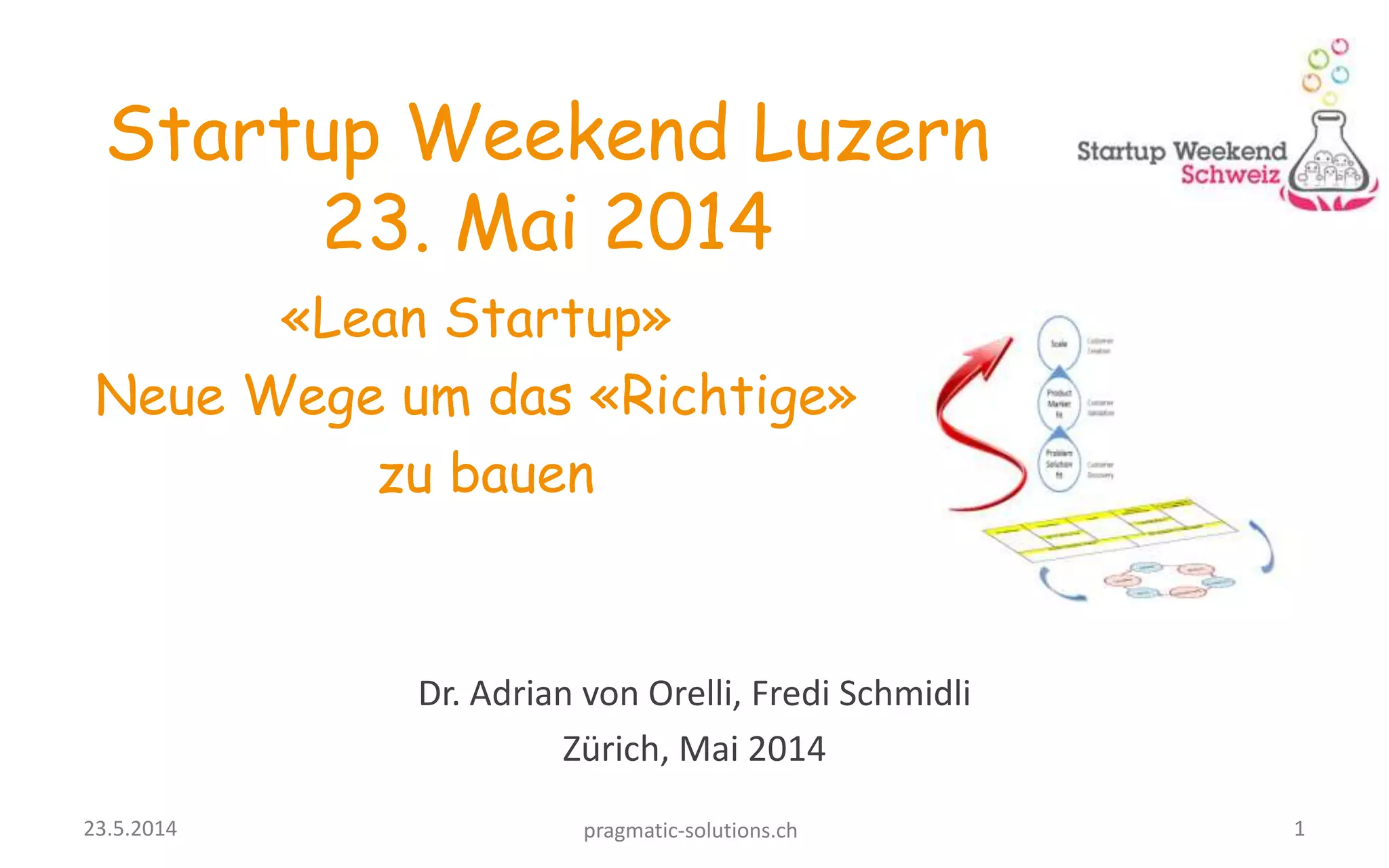
Startup Weekend Luzern
23. Mai 2014
«Lean Startup»
Neue Wege um das «Richtige»
zu bauen
23.5.2014
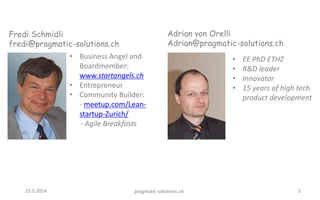
Fredi Schmidli
fredi@pragmatic-solutions.ch
• Business Angel and
Boardmember:
www.startangels.ch
• Entrepreneur
• Community Builder:
- meetup.com/Lean-
startup-Zurich/
- Agile Breakfasts
2
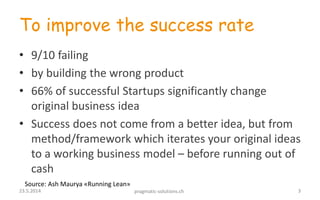
Adrian von Orelli
Adrian@pragmatic-solutions.ch
• EE PhD ETHZ
• R&D leader
• Innovator
• 15 years of high tech
product development
pragmatic-solutions.ch
To improve the success rate
• 9/10 failing
• by building the wrong product
• 66% of successful Startups significantly change
original business idea
• Success does not come from a better idea, but from
method/framework which iterates your original ideas
to a working business model – before running out of
cash
Source: Ash Maurya «Running Lean»
323.5.2014 pragmatic-solutions.ch
What is a start up?
A temporary organization in search of a
scalable, repeatable business model
under condition of extreme uncertainty
423.5.2014 pragmatic-solutions.ch
The definitions from
Eric Ries, Steve Blank combined
In a startup the customer and what he/she might find
valuable is unknown. Value is generated by learning
these unknowns.
What is lean?
value is “providing benefit to the customer”, anything
else is waste.
23.5.2014 pragmatic-solutions.ch 5
Lean is …
A company culture touching all aspects: Values,
Leadership, Employee Development, Empowerment,
Performance, Accountability, …
Not a collection of tools
A culture can not be copied
623.5.2014 pragmatic-solutions.ch
Deming
“In God we trust,
all others must bring data”
W. Edwards Deming
723.5.2014 pragmatic-solutions.ch
Goals
Finding a business model, which is
• profitable
• repeatable
• scalable
823.5.2014 pragmatic-solutions.ch
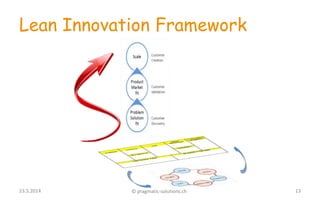
Lean Innovation Framework
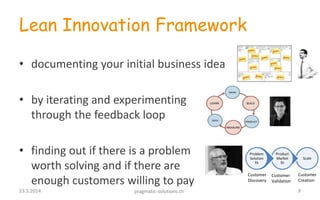
• documenting your initial business idea
• by iterating and experimenting
through the feedback loop
• finding out if there is a problem
worth solving and if there are
enough customers willing to pay
Scale
Product
Market
fit
Problem
Solution
fit
Customer
Discovery
Customer
Validation
Customer
Creation
923.5.2014 pragmatic-solutions.ch
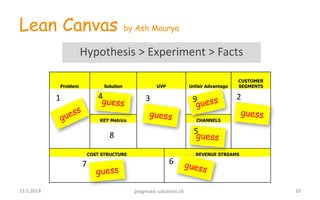
Lean Canvas by Ash Maurya
Problem Solution UVP Unfair Advantage
CUSTOMER
SEGMENTS
KEY Metrics CHANNELS
COST STRUCTURE REVENUE STREAMS
1 234
5
67
8
9
1023.5.2014 pragmatic-solutions.ch
Hypothesis > Experiment > Facts
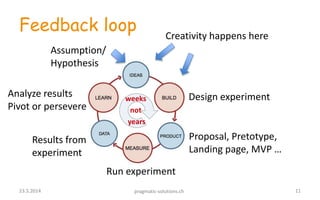
Feedback loop
Design experiment
Proposal, Pretotype,
Landing page, MVP …
Results from
experiment
Analyze results
Pivot or persevere
weeks
not
years
Assumption/
Hypothesis
Run experiment
Creativity happens here
1123.5.2014 pragmatic-solutions.ch
Experiment report
23.5.2014 pragmatic-solutions.ch 12
Experiment report Title Author: created:
FromLeanstackbySpark59
Background:
what are you trying tio achieve?
why is it relevant?
Falsifiable Hypothesis:
declare your expected outcome
[Specific repeatable action] will [expected measurable outcome]
Set scope and time box
Details:
How do you set up the experiment
results:
qualitative or quantitative results
next action:
What is the next experiment
validated learning:
Sumarize your learning from the experiment. (Validated, invalidated,
inconclusive.
Lean Innovation Framework
1323.5.2014 © pragmatic-solutions.ch
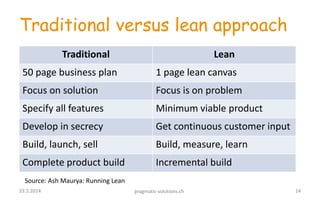
Traditional versus lean approach
Traditional Lean
50 page business plan 1 page lean canvas
Focus on solution Focus is on problem
Specify all features Minimum viable product
Develop in secrecy Get continuous customer input
Build, launch, sell Build, measure, learn
Complete product build Incremental build
Source: Ash Maurya: Running Lean
1423.5.2014 pragmatic-solutions.ch
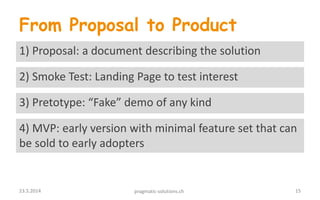
From Proposal to Product
4) MVP: early version with minimal feature set that can
be sold to early adopters
1) Proposal: a document describing the solution
3) Pretotype: “Fake” demo of any kind
2) Smoke Test: Landing Page to test interest
1523.5.2014 pragmatic-solutions.ch
Minimal Viable Product
A MVP is not a minimal product, it is a strategy and process
directed toward making and selling a product to customers.
The MVP is that version of a new product which allows a team to
collect the maximum amount of validated learning about
customers with the least effort. (Eric Ries)
A MVP may be a prototype, an entire product, or a sub-set of
product (such as a feature)
1623.5.2014 pragmatic-solutions.ch
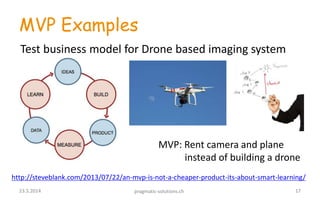
MVP Examples
http://steveblank.com/2013/07/22/an-mvp-is-not-a-cheaper-product-its-about-smart-learning/
Test business model for Drone based imaging system
MVP: Rent camera and plane
instead of building a drone
1723.5.2014 pragmatic-solutions.ch
23.5.2014 pragmatic-solutions pragmatic-solutions.ch
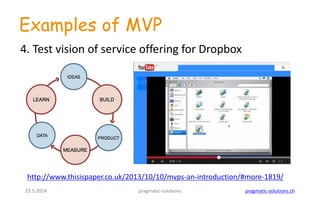
Examples of MVP
http://www.thisispaper.co.uk/2013/10/10/mvps-an-introduction/#more-1819/
4. Test vision of service offering for Dropbox
23.5.2014 pragmatic-solutions pragmatic-solutions.ch
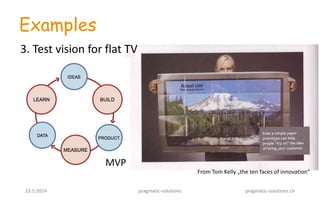
Examples
MVP
3. Test vision for flat TV
From Tom Kelly „the ten faces of innovation“
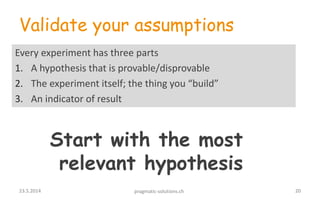
Validate your assumptions
Every experiment has three parts
1. A hypothesis that is provable/disprovable
2. The experiment itself; the thing you “build”
3. An indicator of result
Start with the most
relevant hypothesis
2023.5.2014 pragmatic-solutions.ch
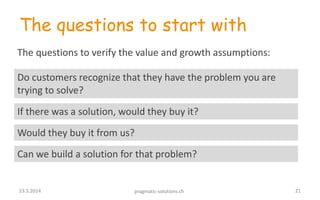
The questions to start with
Do customers recognize that they have the problem you are
trying to solve?
The questions to verify the value and growth assumptions:
If there was a solution, would they buy it?
Would they buy it from us?
Can we build a solution for that problem?
2123.5.2014 pragmatic-solutions.ch
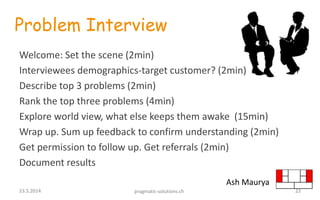
Problem Interview
Welcome: Set the scene (2min)
Interviewees demographics-target customer? (2min)
Describe top 3 problems (2min)
Rank the top three problems (4min)
Explore world view, what else keeps them awake (15min)
Wrap up. Sum up feedback to confirm understanding (2min)
Get permission to follow up. Get referrals (2min)
Document results
Ash Maurya
2223.5.2014 pragmatic-solutions.ch
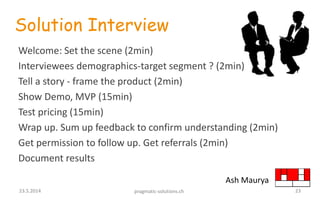
Solution Interview
Welcome: Set the scene (2min)
Interviewees demographics-target segment ? (2min)
Tell a story - frame the product (2min)
Show Demo, MVP (15min)
Test pricing (15min)
Wrap up. Sum up feedback to confirm understanding (2min)
Get permission to follow up. Get referrals (2min)
Document results
Ash Maurya
2323.5.2014 pragmatic-solutions.ch
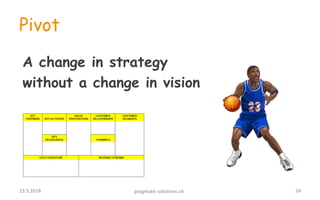
Pivot
A change in strategy
without a change in vision
2423.5.2014 pragmatic-solutions.ch
23.5.2014 pragmatic-solutions pragmatic-solutions.ch
More information
HBS article „Why lean start up changes everything“
www.steveblank.com
Ash Maurya: “Running Lean”
Eric Ries: „Lean start up“
Brant Cooper: “Entrepreneurs Guide to Customer Development”
Steve Blank: “Customer Development Manifesto”;“Startup Owners Manual”
Alexander Osterwalder: “Business Model Generation”
The end
2623.5.2014 pragmatic-solutions.ch

Lean Innovation introduction

  • 1.
    1 Dr. Adrian vonOrelli, Fredi Schmidli Zürich, Mai 2014 23.5.2014 pragmatic-solutions.ch Startup Weekend Luzern 23. Mai 2014 «Lean Startup» Neue Wege um das «Richtige» zu bauen
  • 2.
    23.5.2014 Fredi Schmidli fredi@pragmatic-solutions.ch • BusinessAngel and Boardmember: www.startangels.ch • Entrepreneur • Community Builder: - meetup.com/Lean- startup-Zurich/ - Agile Breakfasts 2 Adrian von Orelli Adrian@pragmatic-solutions.ch • EE PhD ETHZ • R&D leader • Innovator • 15 years of high tech product development pragmatic-solutions.ch
  • 3.
    To improve thesuccess rate • 9/10 failing • by building the wrong product • 66% of successful Startups significantly change original business idea • Success does not come from a better idea, but from method/framework which iterates your original ideas to a working business model – before running out of cash Source: Ash Maurya «Running Lean» 323.5.2014 pragmatic-solutions.ch
  • 4.
    What is astart up? A temporary organization in search of a scalable, repeatable business model under condition of extreme uncertainty 423.5.2014 pragmatic-solutions.ch The definitions from Eric Ries, Steve Blank combined
  • 5.
    In a startupthe customer and what he/she might find valuable is unknown. Value is generated by learning these unknowns. What is lean? value is “providing benefit to the customer”, anything else is waste. 23.5.2014 pragmatic-solutions.ch 5
  • 6.
    Lean is … Acompany culture touching all aspects: Values, Leadership, Employee Development, Empowerment, Performance, Accountability, … Not a collection of tools A culture can not be copied 623.5.2014 pragmatic-solutions.ch
  • 7.
    Deming “In God wetrust, all others must bring data” W. Edwards Deming 723.5.2014 pragmatic-solutions.ch
  • 8.
    Goals Finding a businessmodel, which is • profitable • repeatable • scalable 823.5.2014 pragmatic-solutions.ch
  • 9.
    Lean Innovation Framework •documenting your initial business idea • by iterating and experimenting through the feedback loop • finding out if there is a problem worth solving and if there are enough customers willing to pay Scale Product Market fit Problem Solution fit Customer Discovery Customer Validation Customer Creation 923.5.2014 pragmatic-solutions.ch
  • 10.
    Lean Canvas byAsh Maurya Problem Solution UVP Unfair Advantage CUSTOMER SEGMENTS KEY Metrics CHANNELS COST STRUCTURE REVENUE STREAMS 1 234 5 67 8 9 1023.5.2014 pragmatic-solutions.ch Hypothesis > Experiment > Facts
  • 11.
    Feedback loop Design experiment Proposal,Pretotype, Landing page, MVP … Results from experiment Analyze results Pivot or persevere weeks not years Assumption/ Hypothesis Run experiment Creativity happens here 1123.5.2014 pragmatic-solutions.ch
  • 12.
    Experiment report 23.5.2014 pragmatic-solutions.ch12 Experiment report Title Author: created: FromLeanstackbySpark59 Background: what are you trying tio achieve? why is it relevant? Falsifiable Hypothesis: declare your expected outcome [Specific repeatable action] will [expected measurable outcome] Set scope and time box Details: How do you set up the experiment results: qualitative or quantitative results next action: What is the next experiment validated learning: Sumarize your learning from the experiment. (Validated, invalidated, inconclusive.
  • 13.
    Lean Innovation Framework 1323.5.2014© pragmatic-solutions.ch
  • 14.
    Traditional versus leanapproach Traditional Lean 50 page business plan 1 page lean canvas Focus on solution Focus is on problem Specify all features Minimum viable product Develop in secrecy Get continuous customer input Build, launch, sell Build, measure, learn Complete product build Incremental build Source: Ash Maurya: Running Lean 1423.5.2014 pragmatic-solutions.ch
  • 15.
    From Proposal toProduct 4) MVP: early version with minimal feature set that can be sold to early adopters 1) Proposal: a document describing the solution 3) Pretotype: “Fake” demo of any kind 2) Smoke Test: Landing Page to test interest 1523.5.2014 pragmatic-solutions.ch
  • 16.
    Minimal Viable Product AMVP is not a minimal product, it is a strategy and process directed toward making and selling a product to customers. The MVP is that version of a new product which allows a team to collect the maximum amount of validated learning about customers with the least effort. (Eric Ries) A MVP may be a prototype, an entire product, or a sub-set of product (such as a feature) 1623.5.2014 pragmatic-solutions.ch
  • 17.
    MVP Examples http://steveblank.com/2013/07/22/an-mvp-is-not-a-cheaper-product-its-about-smart-learning/ Test businessmodel for Drone based imaging system MVP: Rent camera and plane instead of building a drone 1723.5.2014 pragmatic-solutions.ch
  • 18.
    23.5.2014 pragmatic-solutions pragmatic-solutions.ch Examplesof MVP http://www.thisispaper.co.uk/2013/10/10/mvps-an-introduction/#more-1819/ 4. Test vision of service offering for Dropbox
  • 19.
    23.5.2014 pragmatic-solutions pragmatic-solutions.ch Examples MVP 3.Test vision for flat TV From Tom Kelly „the ten faces of innovation“
  • 20.
    Validate your assumptions Everyexperiment has three parts 1. A hypothesis that is provable/disprovable 2. The experiment itself; the thing you “build” 3. An indicator of result Start with the most relevant hypothesis 2023.5.2014 pragmatic-solutions.ch
  • 21.
    The questions tostart with Do customers recognize that they have the problem you are trying to solve? The questions to verify the value and growth assumptions: If there was a solution, would they buy it? Would they buy it from us? Can we build a solution for that problem? 2123.5.2014 pragmatic-solutions.ch
  • 22.
    Problem Interview Welcome: Setthe scene (2min) Interviewees demographics-target customer? (2min) Describe top 3 problems (2min) Rank the top three problems (4min) Explore world view, what else keeps them awake (15min) Wrap up. Sum up feedback to confirm understanding (2min) Get permission to follow up. Get referrals (2min) Document results Ash Maurya 2223.5.2014 pragmatic-solutions.ch
  • 23.
    Solution Interview Welcome: Setthe scene (2min) Interviewees demographics-target segment ? (2min) Tell a story - frame the product (2min) Show Demo, MVP (15min) Test pricing (15min) Wrap up. Sum up feedback to confirm understanding (2min) Get permission to follow up. Get referrals (2min) Document results Ash Maurya 2323.5.2014 pragmatic-solutions.ch
  • 24.
    Pivot A change instrategy without a change in vision 2423.5.2014 pragmatic-solutions.ch
  • 25.
    23.5.2014 pragmatic-solutions pragmatic-solutions.ch Moreinformation HBS article „Why lean start up changes everything“ www.steveblank.com Ash Maurya: “Running Lean” Eric Ries: „Lean start up“ Brant Cooper: “Entrepreneurs Guide to Customer Development” Steve Blank: “Customer Development Manifesto”;“Startup Owners Manual” Alexander Osterwalder: “Business Model Generation”
  • 26.