THE BUREAUCRACY
By:
1. Parth Raj-94
2. Rahul Kumar-111
BUREAUCRACY DEFINED
 A Bureaucracy is "a body of nonelective
government officials" and/or "an administrative
policy-making group. "
 An organizations with a hierarchical structure and
specific responsibilities
 An organizations which operate on management
principles intended to enhance efficiency and
effectiveness
HISTORY
WORD ORIGIN
 The term "bureaucracy"
is French in origin
 It combines of French
word bureau – desk or
office – with the Greek
word kratos – rule or
political power
 It was coined sometime
in the mid-1700s by the
French
economist Jacques
Claude Marie Vincent de
Gournay
CHARACTERISTICS OF BUREAUCRACY
S- Specialization
H-Hierarchy
R-Rule
T-Technical competence
I-Impersonal
F-Formal written communication
ADVANTAGES AND PROBLEMS WITH THE
BUREAUCRACY
THE ADVANTAGES OF
BUREAUCRACY
 Bureaucracies are created and evolved as a
means to undertake the purposes and
responsibilities of organizations. They
provide:
• Standardization
• Expertise and Competence
• Accountability
• Coordination
THE PROBLEMS OF
BUREAUCRACY
 Size – Can institutions this large effectively
manage many of the tasks assigned them?
 Coordination – Can agencies with offices
throughout the country effective coordinate
a single policy?
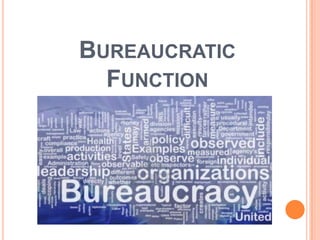
BUREAUCRATIC
FUNCTION
THE FUNCTIONS OF THE BUREAUCRACY
Implementation
Regulation
Administration
IMPLEMENTATION
 The executive branch is charged with the
enforcement of the law, and agencies are largely
the mechanism for this.
 However, most statutes contain vague language, so
in implementing the law agencies often have great
discretion on its exact meaning.
REGULATIONS
 General statutory language can become the basis
for the bureaucracy’s development of its own
precise rules, a form of agency-created law called
regulations, which govern the topics under a
particular agency’s jurisdiction
 Statutes also specify the procedures that agencies
must use in developing regulations
ADMINISTRATION
 Michael lipsky is well know in the field of public
administration
 It is concerned with the implementation of
government policies
 Classic public administration underpinned by
professional and politicians.
Bureacracy

Bureacracy

  • 1.
    THE BUREAUCRACY By: 1. ParthRaj-94 2. Rahul Kumar-111
  • 2.
    BUREAUCRACY DEFINED  ABureaucracy is "a body of nonelective government officials" and/or "an administrative policy-making group. "  An organizations with a hierarchical structure and specific responsibilities  An organizations which operate on management principles intended to enhance efficiency and effectiveness
  • 3.
  • 4.
    WORD ORIGIN  Theterm "bureaucracy" is French in origin  It combines of French word bureau – desk or office – with the Greek word kratos – rule or political power  It was coined sometime in the mid-1700s by the French economist Jacques Claude Marie Vincent de Gournay
  • 5.
    CHARACTERISTICS OF BUREAUCRACY S-Specialization H-Hierarchy R-Rule T-Technical competence I-Impersonal F-Formal written communication
  • 7.
    ADVANTAGES AND PROBLEMSWITH THE BUREAUCRACY
  • 8.
    THE ADVANTAGES OF BUREAUCRACY Bureaucracies are created and evolved as a means to undertake the purposes and responsibilities of organizations. They provide: • Standardization • Expertise and Competence • Accountability • Coordination
  • 9.
    THE PROBLEMS OF BUREAUCRACY Size – Can institutions this large effectively manage many of the tasks assigned them?  Coordination – Can agencies with offices throughout the country effective coordinate a single policy?
  • 10.
  • 11.
    THE FUNCTIONS OFTHE BUREAUCRACY Implementation Regulation Administration
  • 12.
    IMPLEMENTATION  The executivebranch is charged with the enforcement of the law, and agencies are largely the mechanism for this.  However, most statutes contain vague language, so in implementing the law agencies often have great discretion on its exact meaning.
  • 13.
    REGULATIONS  General statutorylanguage can become the basis for the bureaucracy’s development of its own precise rules, a form of agency-created law called regulations, which govern the topics under a particular agency’s jurisdiction  Statutes also specify the procedures that agencies must use in developing regulations
  • 14.
    ADMINISTRATION  Michael lipskyis well know in the field of public administration  It is concerned with the implementation of government policies  Classic public administration underpinned by professional and politicians.