1'"gus~rv"ying


                                          Engin}ering


                                      P.O. Box 519,   210   E     Main
                                       MT. VERNON.    OR        97865
                                        PHONE (541)932-4520
                                        FAX     (541)932-1430
                                        EUAlL   djst2@ortelconet


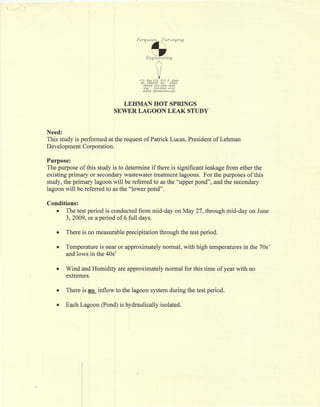
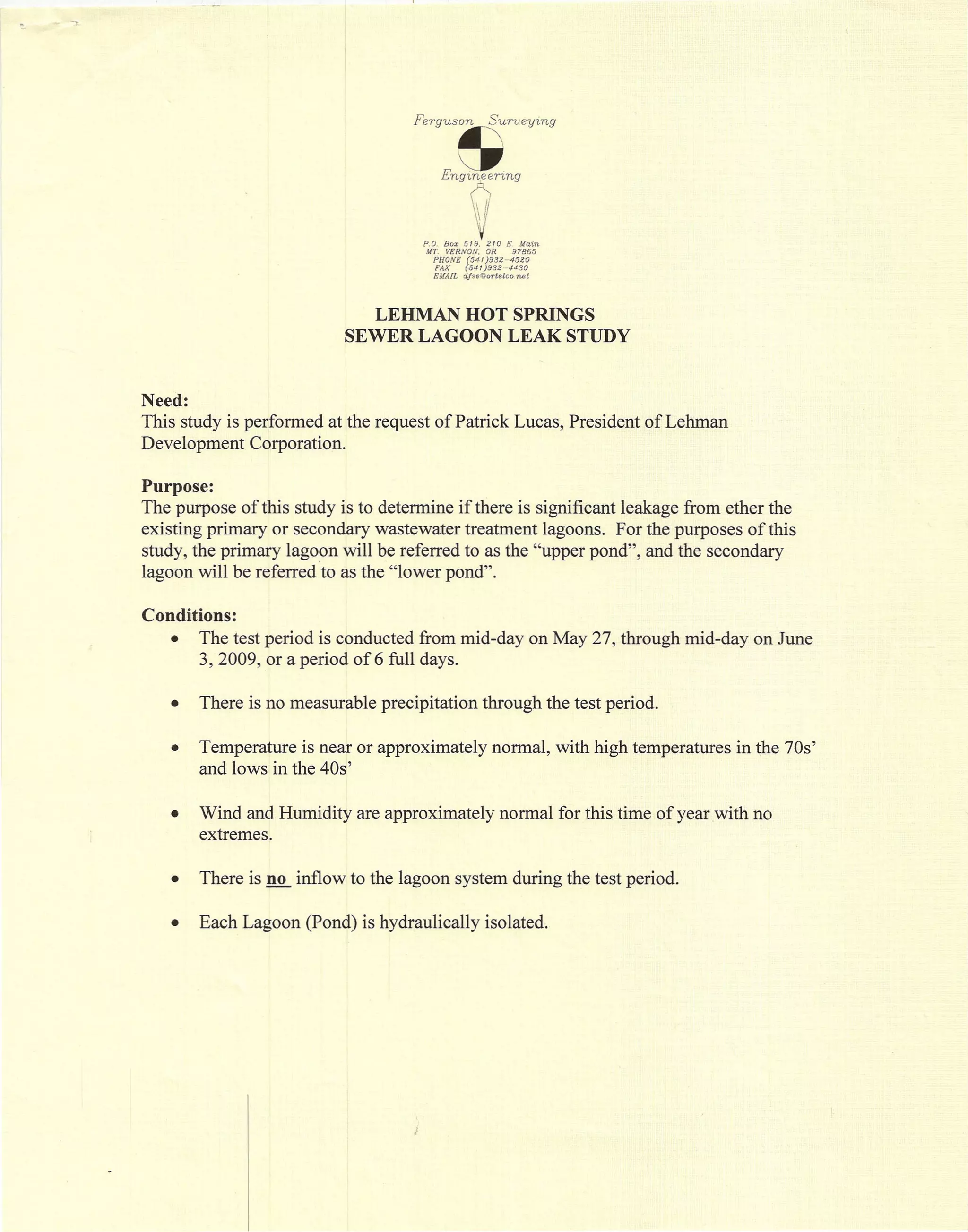
                              LEHMAN HOT SPRINGS
                           SEWER LAGOON LEAK STUDY


Need:
This study is performed at the request of Patrick Lucas, President of Lehman
Development Corporation.

Purpose:
The purpose of this study is to determine if there is significant leakage from ether the
existing primary or secondary wastewater treatment lagoons. For the purposes of this
study, the primary lagoon will be referred to as the "upper pond", and the secondary
lagoon will be referred to as the "lower pond".

Conditions:
   • The test period is conducted from mid-day on May 27, through mid-day on June
       3, 2009, or a period of 6 full days.

   •    There is no measurable precipitation through the test period.

    •   Temperature is near or approximately normal, with high temperatures in the 70s'
        and lows in the 40s'

   •    Wind and Humidity are approximately normal for this time of year with no
        extremes.

   •    There is no inflow to the lagoon system during the test period.

   •    Each Lagoon (Pond) is hydraulically isolated.
Methodology:

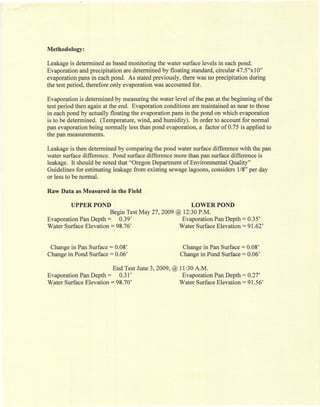
Leakage is determined as based monitoring the water surface levels in each pond.
Evaporation and precipitation are determined by floating standard, circular 47.5"xlO"
evaporation pans in each pond. As stated previously, there was no precipitation during
the test period, therefore only evaporation was accounted for.

Evaporation is determined by measuring the water level of the pan at the beginning of the
test period then again at the end. Evaporation conditions are maintained as near to those
in each pond by actually floating the evaporation pans in the pond on which evaporation
is to be determined, (Temperature, wind, and humidity). In order to account for normal
pan evaporation being normally less than pond evaporation, a factor of 0.75 is applied to
the pan measurements.

Leakage is then determined by comparing the pond water surface difference with the pan
water surface difference. Pond surface difference more than pan surface difference is
leakage. It should be noted that "Oregon Department of Environmental Quality"
Guidelines for estimating leakage from existing sewage lagoons, considers 1/8" per day
or less to be normal.

Raw Data as Measured in the Field

         UPPER POND                                      LOWER POND
                        Begin Test May 27,2009 @ 12:30 P.M.
Evaporation Pan Depth = 0.39'                    Evaporation Pan Depth       =   0.35'
Water Surface Elevation = 98.76'                Water Surface Elevation      =   91.62'


 Change in Pan Surface = 0.08'                       Change in Pan Surface   = 0.08'
Change in Pond Surface = 0.06'                      Change in Pond Surface   = 0.06'


                        End Test June 3, 2009, @ 11:30 A.M.
Evaporation Pan Depth = 0.31'                     Evaporation Pan Depth      =   0.27'
Water Surface Elevation = 98.70'                 Water Surface Elevation     =   91.56'
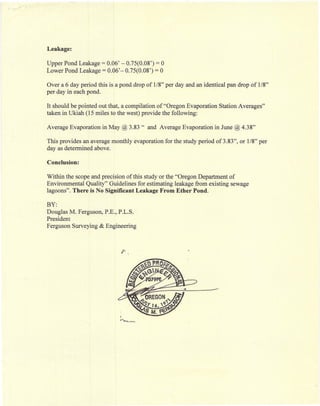
Leakage:

Upper Pond Leakage = 0.06' - 0.75(0.08') = 0
Lower Pond Leakage = 0.06'- 0.75(0.08') = 0

Over a 6 day period this is a pond drop of 1/8" per day and an identical pan drop of 1/8"
per day in each pond.

It should be pointed out that, a compilation of "Oregon Evaporation Station Averages"
taken in Ukiah (15 miles to the west) provide the following:

Average Evaporation in May @ 3.83"      and Average Evaporation in June @ 4.38"

This provides an average monthly evaporation for the study period of 3.83", or 1/8" per
day as determined above.

Conclusion:

Within the scope and precision of this study or the "Oregon Department of
Environmental Quality" Guidelines for estimating leakage from existing sewage
lagoons". There is No Significant Leakage From Ether Pond.

BY:
Douglas M. Ferguson, P.E., P.L.S.
President
Ferguson Surveying & Engineering


                             i
                             ~~~.<O'~

Leakage test

  • 1.
    1'"gus~rv"ying Engin}ering P.O. Box 519, 210 E Main MT. VERNON. OR 97865 PHONE (541)932-4520 FAX (541)932-1430 EUAlL djst2@ortelconet LEHMAN HOT SPRINGS SEWER LAGOON LEAK STUDY Need: This study is performed at the request of Patrick Lucas, President of Lehman Development Corporation. Purpose: The purpose of this study is to determine if there is significant leakage from ether the existing primary or secondary wastewater treatment lagoons. For the purposes of this study, the primary lagoon will be referred to as the "upper pond", and the secondary lagoon will be referred to as the "lower pond". Conditions: • The test period is conducted from mid-day on May 27, through mid-day on June 3, 2009, or a period of 6 full days. • There is no measurable precipitation through the test period. • Temperature is near or approximately normal, with high temperatures in the 70s' and lows in the 40s' • Wind and Humidity are approximately normal for this time of year with no extremes. • There is no inflow to the lagoon system during the test period. • Each Lagoon (Pond) is hydraulically isolated.
  • 2.
    Methodology: Leakage is determinedas based monitoring the water surface levels in each pond. Evaporation and precipitation are determined by floating standard, circular 47.5"xlO" evaporation pans in each pond. As stated previously, there was no precipitation during the test period, therefore only evaporation was accounted for. Evaporation is determined by measuring the water level of the pan at the beginning of the test period then again at the end. Evaporation conditions are maintained as near to those in each pond by actually floating the evaporation pans in the pond on which evaporation is to be determined, (Temperature, wind, and humidity). In order to account for normal pan evaporation being normally less than pond evaporation, a factor of 0.75 is applied to the pan measurements. Leakage is then determined by comparing the pond water surface difference with the pan water surface difference. Pond surface difference more than pan surface difference is leakage. It should be noted that "Oregon Department of Environmental Quality" Guidelines for estimating leakage from existing sewage lagoons, considers 1/8" per day or less to be normal. Raw Data as Measured in the Field UPPER POND LOWER POND Begin Test May 27,2009 @ 12:30 P.M. Evaporation Pan Depth = 0.39' Evaporation Pan Depth = 0.35' Water Surface Elevation = 98.76' Water Surface Elevation = 91.62' Change in Pan Surface = 0.08' Change in Pan Surface = 0.08' Change in Pond Surface = 0.06' Change in Pond Surface = 0.06' End Test June 3, 2009, @ 11:30 A.M. Evaporation Pan Depth = 0.31' Evaporation Pan Depth = 0.27' Water Surface Elevation = 98.70' Water Surface Elevation = 91.56'
  • 3.
    Leakage: Upper Pond Leakage= 0.06' - 0.75(0.08') = 0 Lower Pond Leakage = 0.06'- 0.75(0.08') = 0 Over a 6 day period this is a pond drop of 1/8" per day and an identical pan drop of 1/8" per day in each pond. It should be pointed out that, a compilation of "Oregon Evaporation Station Averages" taken in Ukiah (15 miles to the west) provide the following: Average Evaporation in May @ 3.83" and Average Evaporation in June @ 4.38" This provides an average monthly evaporation for the study period of 3.83", or 1/8" per day as determined above. Conclusion: Within the scope and precision of this study or the "Oregon Department of Environmental Quality" Guidelines for estimating leakage from existing sewage lagoons". There is No Significant Leakage From Ether Pond. BY: Douglas M. Ferguson, P.E., P.L.S. President Ferguson Surveying & Engineering i ~~~.<O'~